Posts Tagged ‘History’

The Low Tech Dreams of Christmas Past.

December 15, 2009

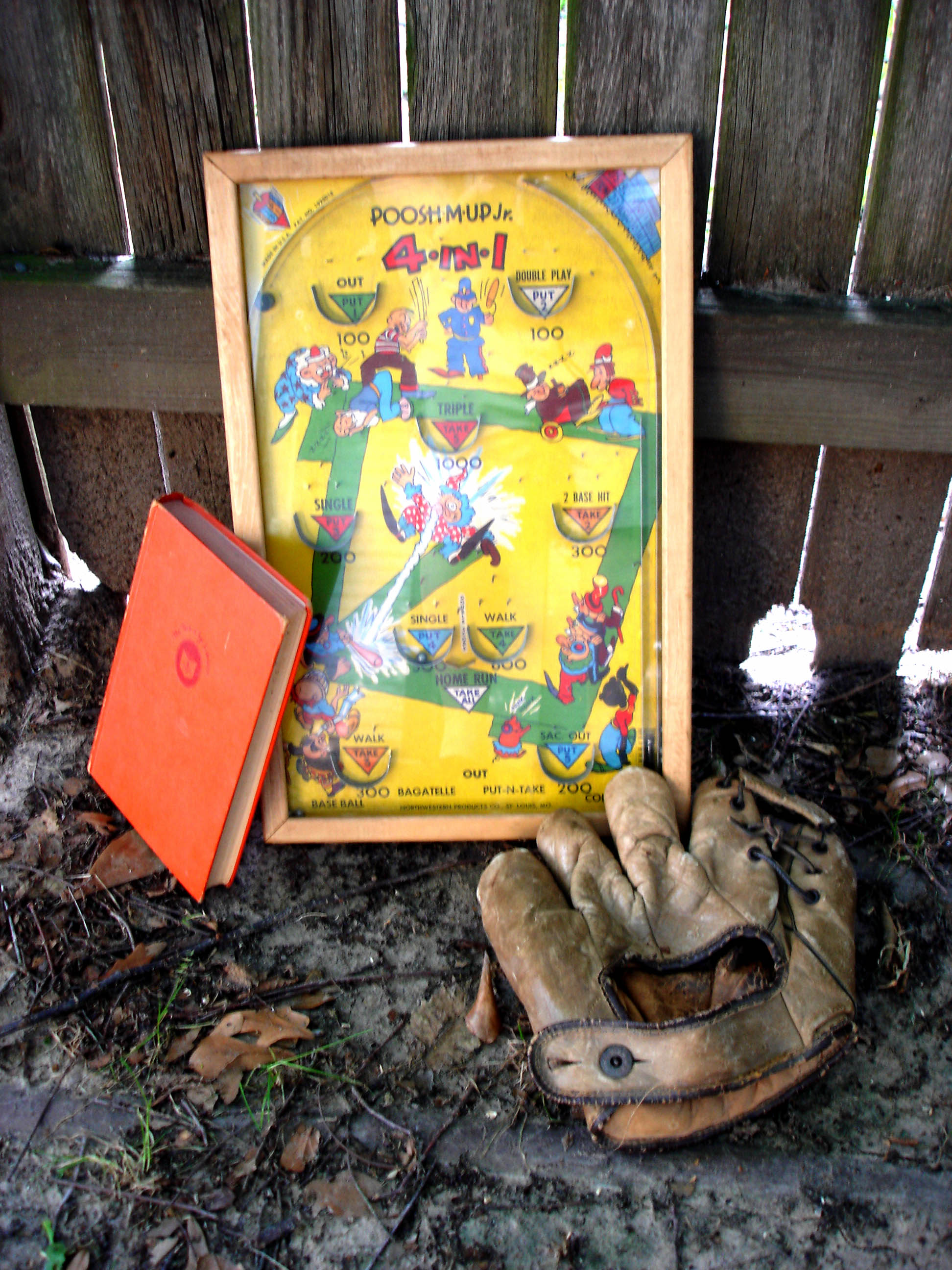
Pinball Wizard Tommy had nothing on me when it came to baseball!

Heading toward Christmas in this high tech era of highly sophisticated and extremely realistic sports game toys, I am blown away by their contrast to  the things we used to purchase and improvise as games and means to the same competitive ends back in the late 1940s and early 1950s. Our games required our use, either or both, of those fine old qualities known as imagination and/or skill – and I mean skill that went beyond our dexterity with finger manipulations of a control device attached to a TV, computer, or game box screen.

As most of you older kindred spirits already know, we didn’t have that kind of game set-up help back in the day. We had to imagine what we were doing and we had to visualize all the pictures that now appear graphically on the digital game screen. Our screens were, for the most part, simply rolling through our brains as we escaped into our own little game trips away frm the mundane of everyday reality.

The baseball pinball game shown here is an exact replica of my chldhood buddy from way, way back. My brother found it in a flea market and gave it to me as a Christmas present a few years back. I’m not sure what happened to my original game, but it most likely suffered the same fate as all my other childho0d things. Whenever we stopped using anything back then for very long, our dad quietly just threw these things away without uttering a word to anyone. As a result, I have few things, other than books, that remain from childhood. Dad didn’t dare throw out my books. He knew I always came back to them.

I got pretty skilled at the pinball game. I can still play it pretty well too, but nothing like I did at age 10 to 12. Back then I could almost will that little metal ball into the home run pocket when when I needed it to go there.

Another low tech game held my interest for a short while, but its lack of improvisational opportunity soon put it on the boring shelf. It was called “Foto Electric Football”, a game which allowed you to insert offense and defense pages into an upward shining light box that illuminated how certain plays turned out against certain defenses.

The big game back then was that vibrating football contest by Tudor that came out in 1947. Little metal players lined up and vibrated down a metal field until contact with an enemy player tackled them at the new yard line of progress. It was fun for a while. You could bend the little vibrator reeds under your running backs to make them turn at the line of scrimmage, but that was about it. Sometimes your runner would get turned around and run toward your own goal line for a safety. That sucked. Plus, it was too much of a hassle to keep setting up twenty-two players at the line of scrimmage after each completed play. That being said, it made my Christmas one year as a gift I knew was coming. My anticipation of that game was far greater than the playing of it could ever hope to be. Sort of like marriage.

Finally, a game came along that remains with me to this day in computer form. In 1951, the APBA Game Company opened shop in Lancaster, PA with a card and dice baseball game based upon actual major league teams and players. It was totally structured upon realistuc probabilities in a complex array of actual game situations. You had to bring your own theatre of the mind to get a good picture, but that was never a problem for a lot of us back in the day. We lived in our dreams. Besides, with APBA, the heart of the game was  then, and is now, its dynamic similarity by play outcome to what actually happens in a real baseball game. Because of APBA, I never got lost in the Stratomatic Baseball Game of similar, but less complex probability roots.

APBA was just a high tech game waiting to happen. I’ve been playing its computer version of baseball since the mid-1980s. It’s simply a place I go whenever I need to take a vacation from this little, no-fun, no sense of humor world we’ve created all around us. It’s not my only mental retreat, but it is one of my most enjoyable destinations.

Merry Christmas Dreams, everybody!
Getting Around Houston Prior to 1952.

December 14, 2009

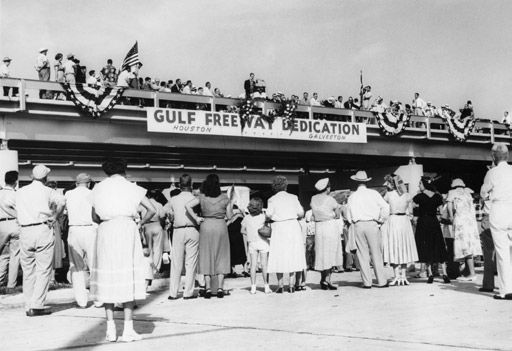
Prior to it;s August 1952 Opening, Houstonians referred to this answer to all our local travel problems as "The Super Highway"!

Our hopes didn’t fly for long, but there was a brief time in the late summer of 1952 that Houstonians thought that we had solved our local transportation problems for all time.  Under construction since 1948, the Gulf Freeway opened in August 1952 as the four-lane (two each way) clear shot passage from downtown Houston as a fifty-mile bullet car path to Galveston Island. All we had to do was to climb into our cars, enter the freeway, push the petal to the metal, and zoom on down to the Gulf of Mexico without ever stopping for a single traffic light.

It seemed too good to be true. Getting around this city of 490,000 souls without traffic would soon enough be an issue of the past in 1952. Of course, the fact that Jesse Jones and the Lamar Hotel “Good Ole Rich Boys Developers Club” had already bought up most of the land between Houston and Galveston and other boondocks places that could be turned into new housing subdivisions never occurred to most of us as the real motivation behind the construction of the Gulf, Southwest, Katy, Eastex, North, and Baytown freeways that soon enough spiderwebbed Houston like a form of concrete Kudzu vines. By 1965, we were hopelessly tied to freeways and the use of personal automobiles in this town. For a city as spread out as we had become, nothing les than the personal automobile could give many Houstonians the flexibility they needed to travel around and do business. Those who could’ve been served by trains to stationary work places were kept on the freeways too as the Texas Department of Transportation moved in to buy up usable rail lines and take them out in favor of freeway expansions like the recently completed I-10 route west into Katy.

The Gulf Freeway in 1956 wasn't wide enough to handle what was coming.

This past summer, I was coming back from an appointment far out the Gulf Freeway during the rush hour hour when I ran into a totally stopped up block of traffic in the old Gulfgate Mall area next door ro my old Pecan Park neighborhood. I thought, “Why not?”

I got off the freeway at Woodridge and took Redwood to Griggs, Griggs to 75th, 75th to Lawndale, Lawndale to Telephone, Telephone to Leeland, and Leeland to downtown. The whole detour took me no more than 15-20 minutes, just as it did in the old days prior to freeways. Then it dawned on me. We didn’t really have traffic jams back in the days prior to August 1952, but we did have a lot of really very   inconvenient red lights that today seem to run just fine with proper timing. We were sold on freeways as a route that wouldn’t stop us. We just didn’t understand that our impending glut of the freeways with increasingly necessary additional cars would stop us dead in our tacks without any red lights on our freeways. By the time I reached downtown using the old way, I could’ve still been siting out there on I-1o and Telephone via the freeway.

Oh well, what’s done is done. I’m just left thinking about all the old travel routes we once used to fan into our neighborhoods from downtown prior to the freeways. To travel east, you took Navigation, Harrisburg, or Leeland. To head south, you wanted Almeda or South Main. To head west, you had many choices, starting with Buffalo Drive (now Allen Parkway) to Shepherd and from Shpehred north and south to the western paths of Westheimer, Alabama, Richmond, Bissonnet (used to be Richmond Road), Memorial, Washington, Hempstead Highway, and Old Katy Road. To go north, the most obvious route was North Main, but you could also take Houston Avenue, Heights Boulevard, Fulton, Jensen, or Irvington as other options among the most travelled routes.

Regardless of your direction from town in 1950, you could be home inside of a one to eight mile trip. It was pretty simple stuff, this travelling, til we committed to the freeways. Now we’re back and looking for ways to living closer to work downtown so we don’t have to use the freeways we once built to escape the same scene we seek to recapture today.

Our problem is not the freeways. Our problem is that we once bit into the idea that freeways were our answer. Now we can’t make them go away. For one thing, we are hooked on having to using them. For another, the freeways have too much money and power behind them now to ever disappear.

Have a nice week, everybody!

Texas and The Babe.

December 13, 2009

Babe Ruth was baseball from the 1920s forward. He still is, if you scratch the surface of things even ever so slightly. And he had all the makings of an unforgettable character from the very start too. His unbelievably gifted joint talent as first a pitcher and then a slugger remains unmatched in the game to this day. Baseball has never known another player who could’ve made it all the way to the Hall of Fame in Cooperstown with either of those singular talents for throwing or slugging the baseball alone, but “The Babe” had them both, and he owned them at just the right moments in baseball history. By now it’s a biographically worn out story. After sparkling in two World Series championship seasons for the Boston Red Sox in 1916 and 1918, Ruth moved over to the New York Yankees in 1920 by way of a devilishly infamous/heavenly fortuitous trade, dependent upon the presence of your Red Sox/Yankees red corpuscles.

Regardless, Babe Ruth got to New York just in time to help America soon forget about/or recover from the terrible blow inflicted upon the game by the Chicago “Black Sox” Scandal of 1919. For those who haven’t heard, eight members of the 1919 White Sox club were expelled forever from baseball after the 1920 season for conspiring to fix the 1919 World Series in favor of the Cincinnati Reds. They were kicked out of the game in spite of the fact that they were never found guilty of such an act by a court of law. It consquentially fell upon the broad shoulders of one George Herman”Babe” Ruth to help fans find positive distraction from the dark side of things – and to do it with his ability to blast a baseball out of the park with a bat. He did it often – and for prolific distances.

During the 1920s and early 1930s, Babe Ruth came to Texas and Houston often in the springtime as a barnstorming member of the New York Yankees. The club played minor league teams and sometimes even squared off against the local Texas college clubs where they toured. My late father often told me the story of how the New York Yankees came to Austin in the spring of 1928 to play the Universty of Texas Longhorns during the time that Dad was a prep school outfielder at St. Edwards there. Somehow the school arranged to get the entire St. Edwards Bronchos team into the game over at UT for seating down the right field line, where Ruth was playing that afternoon against the Longhorns.

Dad long ago forgot the final score, but he implied that it was a heavily crushing “no mercy” margin in favor of the Yankees over the Longhorns. One of these days I may get around to actually checking Dad’s memory against the library line score record of that game, but I have no question about his most vivid recollection of that afternoon. During the game, Babe Ruth had an autographed baseball business set up down the right field line at UT. Ruth had a guy posted in foul territory with a bag full of balls. For five dollars cash, Babe Ruth would run over to the sidelines between batters and sign one of these balls for any fan who was willing to pay. The assistant would then toss it up to purchaser and that lucky fan got to leave with an authentic Babe Ruth signature on a baseball for the price of five dollars.

Of course, my adolescent question of Dad always rose quickly to”Why didn’t you get one?” That always opened the door for Dad to launch into the subject of prep school student poverty and the value of five dollars in 1928. It never even occurred to Dad that getting one of those Ruth signed baseballs was within the realm of possibility. “It would have been like you going to Buff Stadium in the spring and finding out that Stan Musial was signing balls during the game for those who were willing to pay him five hundred dollars for the thing,” Dad said. “Could you have bought one of those Musial balls in 1954 at that rate?”

“No, Dad,” I always answered, “I got the point a long time ago.”

Stiil, the Babe didn’t always come to town just to take people’s money. In 1930, the Yankees were in Houston to play the Buffs at Buff Stadium in single games scheduled for March 29th and March 30th. The Yankes took both games by scores of 17-2 and 6-5. while he was here, Babe Ruth went downtown and gave an address to Houston kid members of the Knothole Gang. The presentation took place at the old City Auditorium on the corner of Lousiana and Texas, on the site of the current Jones Hall building. The full house meeting was sponsored by the Kiwanis Club and a good time was had by all.

Wish we had the text of what “The Babe” actually said that day in 1930 Houston. It would be sort of  interesting to see if Ruth gave any advice to the kids that day that we wasn’t actually living up to in his own real life adult adventures. On the other hand, it really doesn’t matter what Ruth said or didn’t say that long ago day in Houston history. He was Babe Ruth, a guy who led by example on the field – and by the fact that he would even show up on a spring day in 1930 to speak with hundreds of Houston kids for free.

He was Babe Ruth and, for a few hours long ago, he walked among us here in Texas as our flesh and blood, larger than life hero. For those who were around at that time, nothing could detract from the power and magic of those Ruthian moments of joy that they were simply here together in his presence – and in their very own state and home town.

Irvin-Dierker Movie Saved by Sony Hand Camera!

December 11, 2009

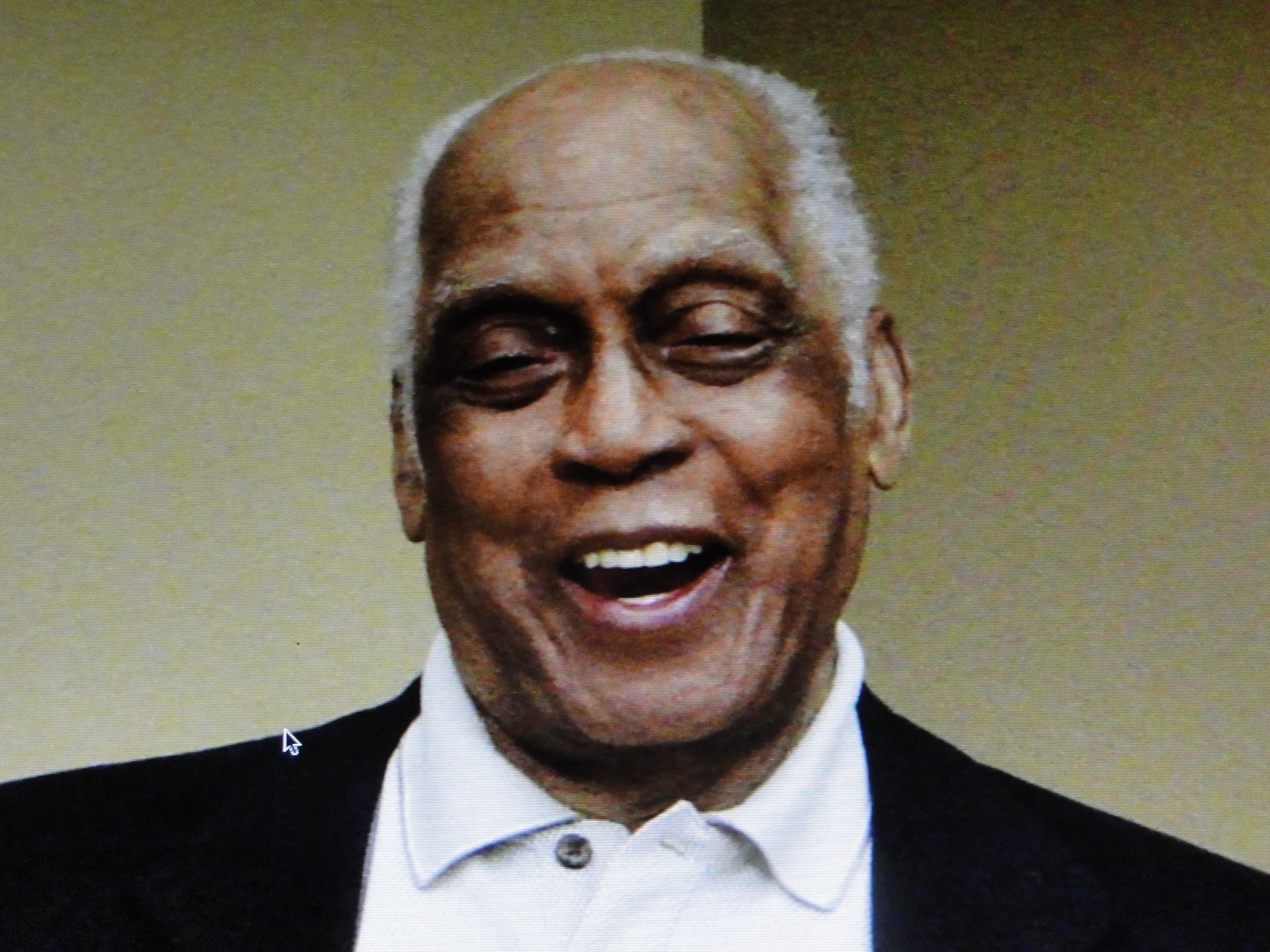
Monte Irvin on Fidel Castro’s Failed Tryout: “If we had known he wanted to be a dictator, we would have kept him around and made him an umpire.”

Larry Dierker: “Did I ever have any pitchers who fought to stay in games when I went out there and asked for the ball? Nope. Those guys were all gone by the time I became a manager.”

“Not sure what it is, Monte. When you have a guy like Dave Raymond moderating a thing like this, it just seems to liven things up!:

Forgive my liberal translation above of what was being said by the participants in these stills from the DVD movie of Tuesday night’s SABR-sponsored Monte Irvin-Larry Dierker panel discussion on baseball history that many of us attended at Minute Maid Park on 12/09/09.  I simply wanted to use the photos to show all of you who couldn’t be with us some examples of the joyful moments you missed. I also want to let you know that we are lucky to have what we have in the digital movie.

Our plans for a professional coverage of the panel discussion fell apart at the very last moment. We didn’t even have a digital movie camera to do the job ourselves. Late in the afternoon, Bob Dorrill of SABR and I had just about given up on the matter as another lost opportunity to get get the 90-year old Hall of Famer Mone Irvin and Houston Colt .45s/Astros icon Larry Dierker on video record of wht promised to be a landmark evening,

Then we got lucky. I recently bought a new full 100 HD Sony Cybershot hand camera for doing still photo work. It came with its own rechargeable battery, a moviemaker option, and a capacity for capturing as many photos as the user could posssibly load onto a memory stick. Not really knowing if I would ever need it, I went overkill on the memory stick, purchasing one that could hold 16 gigs of recorded visual material. I wasn’t thinking about doing movies, nor had I ever used the moviemaking function until this past Tuesday night.

Man! Am I ever happy with the way this little camera saved the day for us!

I started out, sitting on the front row, to record as much as I could get before the battery went dead, I’m thinking I may be lucky to get 15 to 30 minutes, but was that ever selling this thing short. The panel lasted about two hours and I got the whole thing on digital copy, with adequate sound from the little mike within the camera. I had the power and the storage space by chance to capture the whole thing, a fact I only learned for certain when my adult son Neal came home and helped me upload the thing onto my computer hard drive. (My computer dependency far exceeds my computer geekiness, unfortunately.)

At any rate, the whole thing took up about 10.3 gigs of the 16 gig memory stick. I’m not a pro, but I think I got a fairly steady picture, along with the isometric exercise of my life. Holding that camera in the air without tripod or wall-lean support for the duration of the show was quite challenging.

I don’t how many DVDs it will take to now transfer this material intact into copies from my computer, but we will figure it out, along with a way to make copies available to those who want them. The Irvin, Raymond, and Dierker families will all get copies, along with copies we will make for our SABR and Cooperstown recorded history libraries. If there is a way to post the tape on our SABR website so that people can watch it from there is another option to be explored. Of course, if someone like our own Greg Lucas wanted to use the material for any kind of report he wanted to do for FOX, we will make the data available to him too.

I’m just thrilled that we were able to save a little bit of history that looked for a while as though it was going to be lost. As things turned out, the evening became one of the greatest moments that many of us have ever experienced with living baseball history. Monte Irvin and Larry Dierker are both one-of-a-kinds. And moderator Dave Raymond did a magnificent job of lighting the matches that started the fire of passionate storytelling. Those of you who weren’t there Tuesday night really missed something special.

The Chicken Shack: A Memory Jogger of the 50’s Culture..

December 10, 2009

The Chicken Shack was an East End institituion back in the 1950s. I don’t remember much about the South Main location, nor did I know that the place was a Texas chain of some sorts back in the pre-big chain era of places to eat out. People mainly ate at home during the 1950s. Restaurants, cafes, drive ins, and other kinds of away-from home eateries were all special in their own rights, and some, like our East End Chicken Shack location at the corner of Telephone and Wayside were honestly downright held close to institutional status by their favorite local patrons.

The Chicken Shack was renowned for its “chicken fried chicken.” As opposed to “chicken fried steak,” “chicken fried chicken” had that sweet and greasy chickeny flavor that so many of us artery-clogging galoots of that era preferred with our french fries and creamy apple pies. Man! It’s a wonder that any of us survived our culture of misinformation on what was good for us.

Want some real fun? Go shirtless all summer in the sun! Want to stop those mosquito bites? Run behind that neighborhood DDT spray truck and rub that foggy smelling dew into your bodies! As you do, say goodbye to the little critters! Not sure if your shoes fit? Stick those little feet in the store’s foot x-ray machine! See for yourself how much room you have inside your current shoes for your toes! Want a healthy meal when you can’t get a good one at home because Mom is too sick to cook again tonight? Come on down to the Chicken Shack! Anything on the menu should fix you up just fine with that “stick-to-your-ribs” goodness people came to expect from one of their favorite away-from-home eating places.

Of course, we avoided certain unhealthy practices back then too. Whenever we practiced baseball or football in the early and late summer, we took salt tablets and drank no water. That made a lot of sense. Only babies and mama’s boys needed water at practice when they turned blood-red in the face and started vomiting in dry heaves on the smoldering summer grass! Those of us who were ready, made it through steady!

When we awoke to the biological messages of adolescence that seemed to overnight change and drive how we thought about the opposite sex, everything in general, and fun in particular, we simply put sex out of our minds in the consoling knowledge that we could always pick it up again one day, once we were actually married to someone really gorgeous and we were only yielding to that powerful new drive for the sake of having children.

We didn’t waste time talking with adults about what we wanted to do with our lives when we grew up, nor did we talk with our parents or counselors about what was important about love and relationships between men and women. We just played ball and drove around in our cars as we also knuckled down in school, as best we could, for the sake of getting the right answers and making good grades. If we really wanted to learn about love and relationships, we listened to the lyrics from songs sung on the radio by entertainers Frank Sinatra and Nat King Cole. Those guys were much more eloquent on the subjects of love and marriage than our parents ever dreamed of being.

We didn’t get lost in drugs either. We had beer and whisky to get us by legally without ever breaking the law. That is, as long as there was somebody around of legal age to do the actual buying for us, or we could find a merchant who could do a wink-purchase sale to honest, well-intentioned minors who were just trying to have a little fun.

We didn’t need adults to set up “self esteem building” experiences for us. We just assumed that it was up to each of us to either get something done or be written off as worthless. That seemed pretty fair to me as I look back on it now. The idea, or even the phrase “self esteem,” were neither topics nor words that even came up for discussion back in the day. It was up to each of us to either make something of our lives or else, fall by the wayside.

We must have done something right back then. Look how healthy and well adjusted so many us turned out to be.

In the Cool, Cool, Cool of the Evening!

December 9, 2009

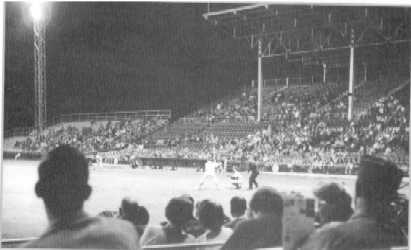
On another long ago cool evening at Buff Stadium, dreams lived big!

Sometimes it just takes a memory jog from something someone else says about life in Houston during the 1950s. Well, at last night’s SABR meeting panel at Minute Maid Park  that featured the wise and wonderful 90-year old Hall of Famer Monte Irvin and the simply younger, but also cool as evening  icon of Houston baseball Larry Dierker and erstwhile moderator glue and spark man Dave Raymond, there was a whole lot of soul-deep mind-jogging going on.

As I listened to Monte Irvin, images came forward that I have few words to back up. I recall him being here before in the early 1950s. The New York Giants came through Houston on a spring training ‘storm through Buff Stadium playing the Cleveland Indians. I can still see the black and orange in the Giants’ uniforms, the red and blue colors in the Indians’ uniforms. Also detached, but flowing from the talk of the Negro League days, I again see the Indianapolis Clowns all decked out in blousy flannels with some bright red, white, and blue shining forth in a pre-game exhibition of shadow ball at Buff Stadium. This image too floats from some some early long forgotten until now moment in my early baseball game watching career. I don’t even recall who they played, but the Clowns were unforgettable in this little patchy scene.

After the meeting, I asked Monte Irvin if he remembered a pitcher named Octavio Rubert from his days in Cuba as an outfielder for Almendares. Monte’s eye ignited in apparent joy at the question. “Oh yes,” he said, “Octavio Rubert and I played together and grew to be very close friends.” Irvin laughed at how Rubert used that false left eye of his to keep runners close to first. It was Larry Dierker’s mention only moments earlier of what righthanders do to hold runners on first that made me even think of Rubert. Now my mention of Rubert to Monte Irvin was bringing one of Rubert’s notable traits full circle to how it had landed in my mind in the first place. Octavio Rubert had the ability to to position that false left eye so that it appeared to be watching the runner on first. Monte Irvin added Rubert’s other trait, a ball he threw that simply dropped off a cliff as it reached home plate, one of those hard-to-pass-up, but just about impossible-to-hit pitches. I remember that pitch from Rubert’s Buffs days, as did former Buffs teammate Larry Miggins, who walked up to join us in these late night recollections of Cuban-born Rubert.

It was one of those cool, cool evenings that no one could ever count on having, chockful of new memories and observations about the old days of the Negro League, the fall of the color line, winter baseball in Cuba, how players and the game have changed, and what two great former players have learned that they are so feely willing to share. Dierker talked about his fortuitous striking out of  Willie Mays when he made his major league mound debut at age 18. “I had a pitch that broke left when it reached the plate, but I was so pumped that I threw it way inside. It probably made Willie think he was going to get hit because it came in right at him,” Dierker said. “It caused Mays to freeze and back off, just as the ball then broke left and crossed the plate for a called strike three.”

Monte Irvin spoke of his early admiration for Yankee greats Lou Gehrig and Joe DiMaggio. And, of course, Irvin also spoke of the great catches of Willie Mays, the fluid power of Josh Gibson, and the all-time greatest Negro Leaguer skills of players like Oscar Charleston and Martin Dihigo. Dierker chose Babe Ruth as his greatest player of all time. “There aren’t many people who can become both great hitters and also great pitchers,” Larry explained. “Because he was both, I have to go with the Babe.”

Monte Irvin saved the best story of the evening til nearly the very end: “When I was playing for Almendares in Cuba during the early 50s winter ball season, a young fellow named Fidel Castro tried out with us as a pitcher. He could throw the ball hard, but he was way too wild. He walked too many batters and we had to let him go. Of course, he went from there to the mountains and became a dictator. – As things have turned out, it’s too bad we didn’t know that he wanted to be a dictator. We could’ve kept him with us and made him into an umpire.”

Thanks to Tal Smith from SABR for making our cool, cool evening at Minute Maid Park possible. It turned out to be one of those once-in-a-lifetime nights. I caught the whole thing on digital movie mode with my little hand-held Sony regular camera. If we can determine that I’ve captured something usable, we will try to figure out a way to make it available through SABR for viewing by others. Keep your fingers crossed.

THE TOY CANNON: The Life and Baseball Times of Jimmy Wynn.

December 5, 2009

Hello, everybody! It’s good being back here on the blog site after an absence of about a week. The publication deadline took me away for awhile had everything to do with a project very dear to my heart. Allow me to explain.

About two weeks ago, former Houston Astro slugger Jimmy Wynn and I learned that the book he and I had been working on about his baseball and personal life story had been picked up for publication by McFarland Company, the largest publisher of baseball biographies in the country. The good news simply left me with some last minute manuscript editorial barbering and detail work to perform that took priority over all other projects in the short term. That work wrapped up yesterday when I tromped on out through the snow and FedExed all our submisson materials to the publisher. What a great sense of relief that turned out to be.

The working book title is identical to the title of this blog article, but could change between now and our release date. We missed the McFarland dance card for a spring list release, but “The Toy Cannon” will be available for purchase through bookstores and Internet sites like Amazon.Com some time between July and December 2010. We’re hoping for a publication near the 201o All Star Game.

All I can tell you for now is that working with Jimmy Wynn on his life story turned out to be the labor joy of my life. We were already friends, but this project simply drew us closer. The guy was an amazing ballplayer, alright, but he’s an even more incredible human being. Jimmy doesn’t allow an ounce of ego fat to get in the way of any life lesson he’s needed to learn for the sake of his own survival and spiritual growth. And it will all be right there on the approximate 300 pages of this book to soon be.

Jimmy and I did the book with him telling his story in the first person over numerous hours of taped interview sessions. The story begins in the snow of his Cincinnati childhood and it moves all the way through his sometimes misadventurous big league playing days and finally forward to this incredible moment today in his late-in-life second career as an Astros community services representative and blossoming FOX Network baseball television analyst.

Along the way, Jimmy doesn’t play dodgeball with the consequences that arose from certain personal experiences, nor does he miss the wisdom that only comes strongly from enrollment time in the school of hard knocks. Those lessons carried forward as the invisible binding of  this work. To put it in plain and simple terms:  This book is not just about the yearly stats of “The Toy Cannon;” it is eventually and inevitably about the soaring wisdom and soul of a man named Jimmy Wynn.

As we get closer to knowing the actual release date of the book, I will keep you informed. In the very sweet and lovely meanwhile, I have to say that it’s good to be back in the land of The Pecan Park Eagle. I’ll try not to spam you too much, but I won’t make any promises.

Have a nice weekend – and try not to eat too much as you’re watching all the conference championship NCAA college football games that are unfolding before our sports-weary eyes this very cold Saturday!

Why Was The Sandlot So Joyful?

November 23, 2009

Our Eagle Field (1950) is Now Called Japonica Park.

The Pecan Park Eagles were real. Back in 1950, we played on an East End site in our neighborhood that we called Eagle Field. We played other places too, but this was our turf, our home field, our hatchery for every baseball dream that any of us ever knew. We had no lights at this sacred ground, but we didn’t need them. At a time in our young lives when summers meant we owned the place from from dawn to dusk, we didn’t need night baseball. Besides, night time was Houston Buffs time, a time for all of us to either be at Buff Stadium in the Knothole Gang, or else, to be listening tight to Loel Passe broadcasting the games over AM radio station KTHT, 790 on the dial.

What none of us knew back there in those innocent days of our young lives seems simple now. No matter what any us accomplished from there, some things would never get any better than they already were back in the summers of 1947 through 1952. Those years, especially the summer of 1950, were the seasons of the Pecan Park Eagles, and Eagle Field is where we all yielded our hearts and best playing efforts to the game of sandlot baseball. Nothing ever, in any form, yielded more pure joy to any of us than those treasured moments in the sun that we Eagles shared with each other on that hallowed turf.

Unfettered by normal adult responsibilities and the kind of cultural cynicism that now seems to ooze from every loose seam in the talking heads media, and also from every social network site on the Internet, we simply lived out the days of 1950 living in the moment of acting out our grandest dreams on a field that was tailor made by God for bare-feet running, heavy sweat bat-swinging, and rag-tag ball catching with hand-me-down gloves on a makeshift diamond that just happened to be available to us at the place where Japonica bleeds into Myrtle Street, one block over from Griggs Road and about two blocks east on Griggs from the Gulf Freeway.

The old place is still there in 2009, but it’s sadly now cluttered with playground equipment that we would’ve hated and probably destroyed sixty years ago. These things would only get in the way of a good game. Sadly too, today’s kids of my old neighborhood don’t seem to need that good game as once we did. They also don’t seem to either need the playground swings, etc., that the City of Houston has so thoughtfully constructed for them. I usually check out the old place about once a year – and I’ve never seen a kid playing there anytime I’ve driven by my oldest and strongest early haunt.

Driving slowly past Eagle Field, I sometimes stop and walk out upon it again, just to note all the landmarks that still remind me of what it was like to play ball there. The telephone pole in deep center field appears to be the same one that was in place all those many decades ago. There’s a big mixed breed dog in Mrs. McGee’s fenced backyard that now barks at me as though it would eat me alive if it could. I can still look over to the front porch of Randy Hunt’s old house. It seems that my presence on the “The Lot” (it’s other name) would bring Randy bounding out the front door to join me with a ball and glove, as it once did, but that never happens these days.

I never leave the place without saying something to Eagle Field like, “Goodbye, old friend, until next time!”

If I really have to explain why my personal sandlot was so joyful, I guess I can’t do it. Just know that some loves never end. And this was my big one.

The Phold of ’64!

November 22, 2009

It’s not a new story. It’s also not one that those us who were around in those days will ever forget. The 1964 Philadelphia Phillies had the world on a string late in the season. With 12 games to go, they held a 6 1/2 game lead over the St. Louis Cardinals and the Cincinnati Reds and they were moving into a seven-game home stand that surely would allow them to finish the job and prepare for the World Series, most probably against the New York Yankees. It was to be the year that the Phillies got back at the Yankees for that four-game sweep in the 1950 World Series.

It was not to be. Something happened to turn destiny on its tail and send it the other way, shooting up the halls of heartache in eastern Pennsylvania and forever altering the course of baseball history.

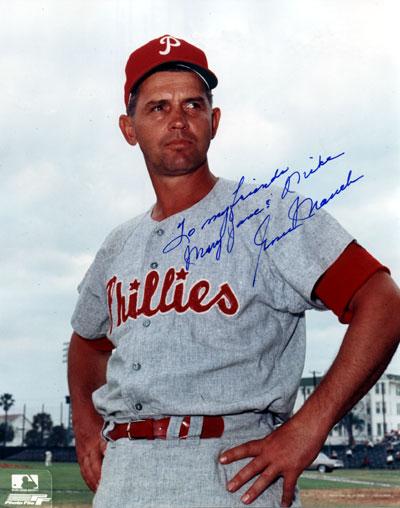
The easiest, incomplete way to summarize it is simple. Manager Gene Mauch made a fatal decision going into the seven-game home stand to basically go with a two-man rotation the rest of the way. As a result, starters Jim Bunning and Chris Short got the nod to start 7 of the next 10 games, 6 of which resulted in starts on 2 days rest. The Phillies lost all ten games while the Cardinals and Reds both heated up.

The Phillies finally won their last two games of the season, but that only left them tied with Cincinnati for 2nd place. Philly fans had hoped for more. Didn’t happen. The Cardinals won on the last day of 1964, giving them a one-game championship advantage over Philadelphia and Cincinnati.

The “Philadelphia Phold” was complete. The New York Yankees-Philadelphia Phillies World Series Reunion would have to wait until 2009 while the ’64 St. Louis Cardinals renewed their 1926-1928, 1942-1943 World Series rivalry with the Bronx Bombers.

Because of The Phold, the Cardinals had a chance to beat the Yankees in a thrilling seven-game Series in 1964. The Cardinals win cost Yogi Berra his job as manager of the Yankees and handed it to Johnny Keane, the manager of the Miracle Cards, who himself was in line to be fired by St. Louis until his club pulled this incredible comeback and capture of the 1964 World Series Championship.

Who can ever know how far The Phold rippled? Maybe if the Phillies had made it to the 1964 World Series and lost to the Yankees, just maybe it would have been good enough for Mickey Mantle to retire then in contentment, sparing himself and the rest of us  those four extra final seasons (1965-68) that tore his career average down below .300 and exposed him to living decay as a ballplayer in the field.

Maybe this. Maybe that.

And who knows how the absence of The Phold might have affected the future careers of Yogi Berra, Johnny Keane, and Gene Mauch differently? When a team blows a 6 1/2 game lead with 12 games left to play, it simply changes everything for everybody for all time.

What’s impossible to recapture here is how it felt daily to watch this steady slide into ignominy that the Phillies made so desperately. Short of writing a whole book that awakens all the five senses, including special horror movie sound effects on the subject, the best a writer can hope for in this short space is to show you how the Phold Phound Philly over that dark period through a daily look at changes in the standings:

9/20/64: The Phillies (90-60) led the Cardinals (83-66) & the Reds (83-66) by 6.5 games with 12 games to go for the Phillies.

9/21/64: Reds 1 – Phillies 0; Cardinals idle.

Phillies (90-61) led the Reds (84-66)  by 5.5 games & the Cardinals (83-66) by 6 with 11 games to go for the Phillies.

9/22/64: Reds 9 – Phillies 2; Cardinals 2 – Mets 0.

Phillies (90-62) led the Reds (85-66) by 4.5 games & the Cardinals (84-66) by 5 games with 10 games to go for the Phillies.

9/23/64: Reds 6 – Phillies 4; Mets 2 – Cardinals 1.

Phillies (90-63) led the Reds (86-66) by 3.5 games & the Cardinals (84-67) by 5 games with 9 games to go for the Phillies.

9/24/64: Braves 5 – Phillies 3; Cardinals 4-4 – Pirates 2-0; Reds idle.

Phillies (90-64) led the Reds (86-66) by 3 games & the Cardinals (86-67) by 3.5 games with 8 games to go for the Phillies.

9/25/64: Braves 7 – Phillies 5; Reds 3-4 – Mets 0-1; Cardinals 5 – Pirates 3.

Phillies (90-65) led the Reds (88-66) by 1.5 games & the Cardinals (87-67) by 2.5 games with 7 games to go for the Phillies.

9/26/64: Braves 6 – Phillies 4; Reds 6 – Mets 1; Cardinals 6 – Pirates 3.

Phillies (90-66) led the Reds (89-66) by 0.5 games & the Cardinals (88-67) by 1.5 games with 6 games to go for the Phillies.

9/27/64: Braves 14 – Phillies 8; Reds 9-3 – Mets 1-1; Cardinals 5 – Pirates 0.

Reds (91-66) now led the Phillies (90-67) by 1 game & the Cardinals (89-67) by 1.5 games with 5 games to go for the Phillies.

9/28/64: Reds idle; Cardinals 5 – Phillies 1.

Reds (91-66) now led the Cardinals (90-67) by 1 game & the Phillies (90-68) by 1.5 games with 4 games to go for the Phillies.

9/29/64: Pirates 2 – Reds 0; Cardinals 4 – Phillies 2.

Cardinals (91-67) & the Reds (91-67) are now tied for 1st; the Phillies (90-69) now trail by 1.5 games with 3 games to go.

9/30/64: Cardinals 8 – Phillies 5; Pirates 1 – Reds 0.

Cardinals (92-67) now led the Reds (91-68) by 1 game & the Phillies (90-70) by 2.5 games with 2 games to go for the Phillies.

10/01/64: Cardinals & Phillies idle; Reds 5 – Pirates 4.

Cardinals (92-67) now led the Reds (92-68) by 1 game & the Phillies (90-70) by 2.5 games with 2 games to go for the Phillies.

10/02/64: Mets 1 – Cardinals 0; Phillies 4 – Reds 3.

Cardinals (92-68) now led the Reds (92-69) by 0.5 games & the Phillies (91-70) by 1.5 games with 1 game to go for the Phillies.

10/03/64: Mets 15 – Cardinals 5; Reds & Phillies idle.

Cardinals (92-69) now tied with the Reds (92-69) for 1st; the Phillies (91-70) are 1 game back with 1 game to go for all three contending clubs.

10/04/64: Cardinals 11 – Mets 5; Phillies 10 – Reds 0.

Cardinals (93-69) win the NL pennant by 1 game over the Reds (92-70) and Phillies (92-70).

The Phillies came back with a death rattle run in their last two games, but it was far too little and way too late. Forty-five years later, 1964 still hangs in my mind as the most exciting pennant race in personal memory. Some of you will understand exactly what I’m saying here, as will those fans outside Philadelphia who didn’t cut their throats in funereal sympathy for the Phillies.

My Native Texan College Team!

November 21, 2009

Texas Baseball History Goes Way, Way Back!

Lone Stars of the Diamond, like most good reference books, is a work that lingers. I couldn’t resist having a minor run this morning at organizing my all-time native Texan team of former college players. In the short run, all I could do was come up with a roster I wouldn’t mind taking to spring training for the sake of allowing performance to whittle things down from there – with one major exception. If Tris Speaker goes 0 for 50 in spring training, he will still be my starting center fielder on Opening Day.

If you’re wondering where Roger Clemens is because you don’t know any better, he’s missing, of course, because he wasn’t born in Texas. He was born in Ohio. Otherwise, had he been a native Texan, Roger Clemens would have been my Opening Day starting pitcher, no matter what.

Here’s the spring training roster, with all of these guys showing up in their primes. Brad Mills should be so lucky, but that’s not how these kinds of all star teams work. We fans can put this kind team together and not be impeded by reality. If we were, I’d hate to consider what this team would cost us at today’s market values:

C – Matt Batts, Baylor; Chris Snyder, Houston; Jason LaRue, Dallas Baptist

1B – Lance Berkman, Rice; Norm Cash, Sul Ross; Eddie Robinson, Paris JC

2b – Davey Johnson, Texas A&M; Chuck Knoblauch, Texas A&M; Debs Garms, Howard Payne

3b – Grady Hatton, Texas; Max Alvis, Texas; Pinky Higgins, Texas

SS – Spike Owen, Texas; Roger Metzger, St. Edward’s; Ben Zobrist, Dallas Baptist; Topper Rigney, Texas A&M

LF – Don Baylor, Blinn JC; Bibb Falk, Texas; Ox Eckhardt, Texas; Steve Henderson, Prairie View A&M; Jose Cruz, Jr., Rice; Glenn Wilson, Sam Houston State; Aubrey Huff, Miami

CF – Tris Speaker, Texas Wesleyan; Curt Walker, Southwestern; Michael Bourn, Houston; Max West, North Texas; Jim Busby, TCU

RF – Beau Bell, Texas A&M; Ernie Koy, Texas; Keith Moreland, Texas; Carl Warwick, TCU; Hunter Pence, UT Arlington

P  –  John Lackey, UT-Arlington

P –  Doug Drabek, Houston

P –  Woody Williams, Houston

P – Burt Hooton, Texas

P – Tex Carleton, TCU

P – Bert Gallia, St. Mary’s

P – Murray Wall, Texas

P – Dou Rau, Texas A&M

P – Huston Street, Texas

P – Greg Swindell, Texas

P – Bill Henry, Houston

P – Calvin Schiraldi, Texas

P – Joel Horlen, Oklahoma State

P – Dennis Cook, Texas

P – Tex Hughson, Texas

P – Kip Wells, Baylor

P – Ryan Wagner, Houston

Have a great weekend, everybody!