Posts Tagged ‘History’

A Short Ride on Houston’s First Rail System.

January 28, 2010
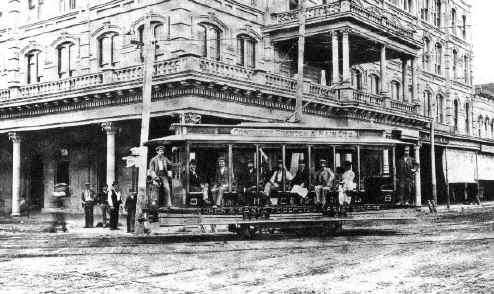
"Car 8 was built as one of the original 12 cars to inaugurate electric service in June of 1891." - As with all other photos & text used in these column pictorials, this material is courtesy of Steve Baron, Houston Streetcar History Pages.

“Car 8 was built as one of the original 12 cars to inaugurate electric service in June of 1891.” – As with all other photos & text used in these column pictorials, this material is courtesy of Steve Baron, Houston Streetcar History Pages @ http://members.iglou.com/baron/

From its 1836 inception, people saw Houston’s long range potential as a seaport because of its access to the Gulf of Mexico via Buffalo Bayou and Galveston Bay. As the port idea grew in the 19th century, it wasn’t long before incremental improvements to the waterway route over time led to the formal christening of the Houston Ship Channel in 1914. Over this same economic time frame, Houston grew exponentially as a shipping center for cotton, cattle, and that newly found nearby commodity known as oil.

The thing that made it all come together was rail, local and long distance tracks that moved both people and products around town and out of state or country. Had it not been for the invention and growing ecopolitical punch of the spontaneous combustion engine industries, Houston and other developing western cities would have stayed with rail and grown quite differently, but as we know, that is not what happened. A short run at our first local history with rail is still a fun and factually packed trip to take.
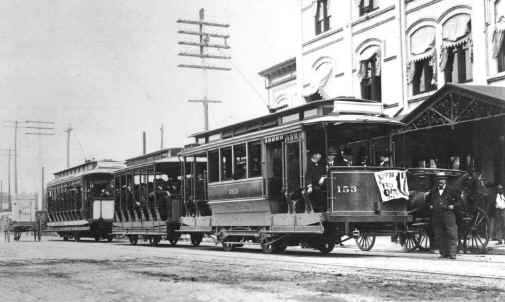
"Posed in front of Grand Central Depot (Southern Pacific lines) are brand new "California" car 153, trailer 33, and an 1896-built nine-bench open car.   Such was public transit in Houston in 1902.  Sic transit gloria mundi!" - Courtesy, Steve Baron.

“Posed in front of Grand Central Depot (Southern Pacific lines) are brand new “California” car 153, trailer 33, and an 1896-built nine-bench open car. Such was public transit in Houston in 1902. Sic transit gloria mundi!” – Courtesy, Steve Baron, http://members.iglou.com/baron/

Houston’s first mule-drawn streetcars began service in 1868.  On May 2, 1874, the  Houston City Street Railway began mule-powered operations on Travis Street, marking the true beginning of organized rail service in Houston. By 1889, a competing company, the Bayou City Street Railway began operations. It will later be absorbed by the Houston City Street Railway.

On June 12, 1891, the first local operation of electric streetcars began. In 1892,  the Houston Heights line also opened.  For several years thereafter, it operated as a separate company.

In 1896, a court-ordered receivership forced the sale of the Houston City Street Railway. It was reorganized by its new owners as the Houston Electric Street Railway. In 1901, following another receivership, the street railway was sold to investors associated with the Stone & Webster firm of Boston, Mass.  It was reorganized this time as the Houston Electric Company.
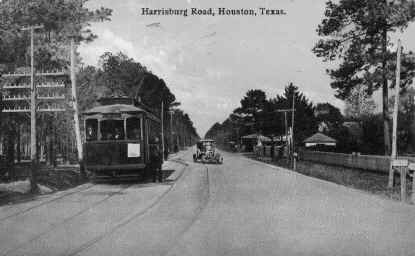
"The Harrisburg line was opened to streetcar traffic in 1908, and this postcard view was made not long after.  The car is a double-truck semiconvertible design, the mainstay of the fleet during this period." - Courtesy, Steve Baron.

“The Harrisburg line was opened to streetcar traffic in 1908, and this postcard view was made not long after. The car is a double-truck semiconvertible design, the mainstay of the fleet during this period.” – Courtesy, Steve Baron, http://members.iglou.com/baron/

By 1908, the Harrisburg line opened from downtown to Houston’s growing east end. By 1910, the Bellaire line opened to the west from South Main along the lazy country lane that is now the car-clogged boulevard  we know as the Holcombe-Bellaire continuum. My mom spoke often of how she and my maternal grandparents took the street car south from their home in the Heights back in the 1920s to visit relatives in Bellaire. “By the time we transferred way out South Main to the Bellaire line,” Mom said, “it already felt like we were way out in the country. Now we’re getting ready for a rail ride through the woods. There wasn’t anything out there back in the 1920s. Then, when, you finally got to Bellaire, there wasn’t much there either, except for relatives and a few strange folks that we didn’t know.”

On December 5, 1911, the Interurban route to Galveston opened. The Galveston-Houston Electric Railway operated as a separate company from HECo., but it too remained under the ownership and control of the parent company. By 1911, public service companies were sensitive to the need for obscuring any kind of expansion that might begin to look to federal authorities like a monopoly. That ball would stay in economic play forevermore, except for periods of obvious disregard.

"A busy downtown scene in the late 1920's finds car 416 on the Mandell line, preparing to head outbound to the Montrose district.  These cars, built in 1927, were the last series of streetcars ordered by the Houston Electric Co.  (There were two later experimental cars, but that's another story.)" Courtesy, Steve Baron.

“A busy downtown scene in the late 1920’s finds car 416 on the Mandell line, preparing to head outbound to the Montrose district. These cars, built in 1927, were the last series of streetcars ordered by the Houston Electric Co. (There were two later experimental cars, but that’s another story.)” Courtesy, Steve Baron, http://members.iglou.com/baron/

The downtown shot of this Mandell Line car also features the newer kid on the block in the far ight hand corner. The automobile was making its presence felt big time in Houston as the city rolled through the Jazz Age on its way with the rest of the country to the Great Depression.

The appeal of cars always was the fact that they weren’t tied to fixed route travel by tracks. Their growing affordability and the bountifulness of cheap gas made them a growing-in-popularity alternative to rail travel. Since 194, some individual attempted to use their cars as public transport “jitney” service upon open and fixed routes. These were finally banned by City Council in the early 1920s in favor of public busses. On April 1, 1924, the first Houston bus route, on Austin Street, began operations in Houston in the wake of a city referendum outlawing jitneys.

The 1930s saw the growth of bus service and private automobile use. By the end of the decade, the streetcar and interurban rail lines were dead. On October 31, 1936, the last run of the Galveston-Houston interurban line clattered its way north and south between the two cities. The section that served people from downtown to Park Place, however, continued under HECo. operation until 1940.

On June 9, 1940, the Houston Electric Company took its last run with electric rail streetcars. The final two routes to give way to automobiles and busses were the lines serving Pierce and Park Place. Even by this time, local highly placed politicians and real estate entrepreneurs were beginning to plan freeways that would both “solve” the growing congestion problem of increasing auto travel and more privately and quietly help certain individuals invest and profit from planned growth to the far-reaching suburbs that they also would create from the recent earlier purchase of cheap land on the nearby prairies woodlands.
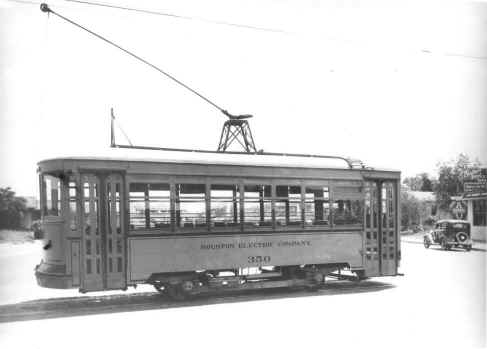
"A 1930's view of one of Houston's single-truck Birney cars.  Built in 1918, this was one of several cars that were modernized in the company shops, changing them from double-end to single-ended, and installing full length doors with inside steps." - Courtesy, Steve Baron, website: (http://members.iglou.com/baron/)

“A 1930’s view of one of Houston’s single-truck Birney cars. Built in 1918, this was one of several cars that were modernized in the company shops, changing them from double-end to single-ended, and installing full length doors with inside steps.” – Courtesy, Steve Baron, website: (http://members.iglou.com/baron/)

Once again, in 2010, the inner, older, and more compact center of Houston is being best served practically by new rail service. The far-reaching Houston, the one that grew from the ambitions of the few and the addiction of us all to the automobile, is now unserviceable by any single form of mass public transportation – nor are we inclined in Houston to want to use public transportation as anything other than an occasionally quaint reminder of our long ago past.

It is what is. And we are what we are. Take me out to the ballgame, but let’s use your car or mine.

For a complete look at the magnificent work that historian Steve Baron has done on the history of rail transportation in Houston, please do yourself a favor and check out his website, Houston Streetcar History, at http://members.iglou.com/baron/
Houston Baseball’s 1st Pennant Had to Pause.

January 27, 2010

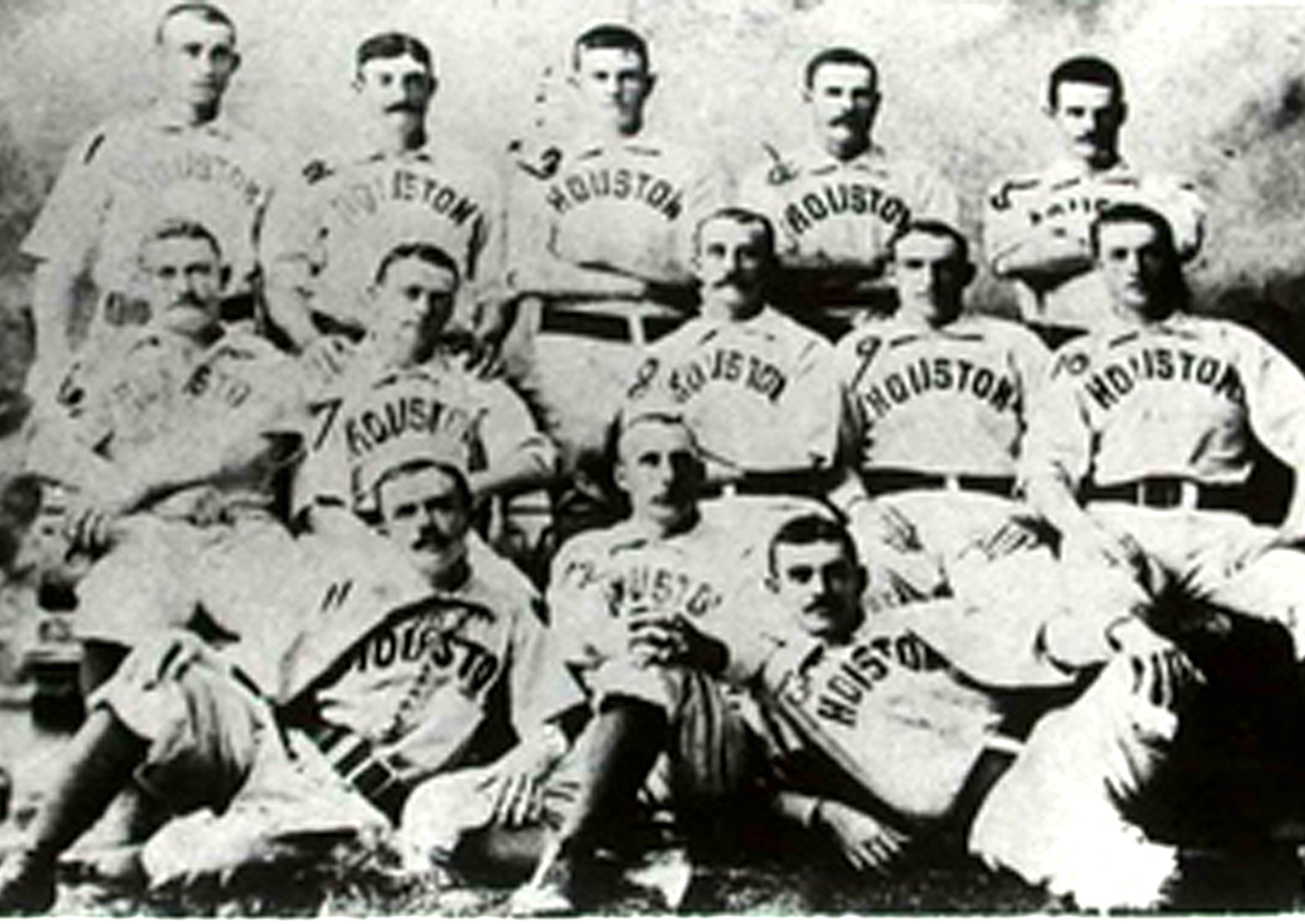
The 1889 Houston Mud Cats Brought Our Town Its First Flag.

As we have written recently and often over the years, baseball faced a lot of obstacles getting started in Houston and Texas during the late 19th ccentury. Scheduling problems, competitive imbalance between the really good and really bad teams, building a pattern of regular game attendance among fans who were not yet accustomed to that idea, the poor condition of fields and playing venues, the absence of “revenue stream” thinking, the scarcity of “revenue streams period” beyond gameday gate tickets and minor food concession sales, poor club projections on operating expenses, player abandonments from clubs that delayed paydays, the general inadequacy of financial backing, and the limited availability of really talented players all fed into the problem.

In many ways, all these factors fed into the 1889 second season of the Texas League. 1889 proved to be the year for Houston’s first professional baseball pennant, but it was a flag that came with some administrative resistance and quite a bit of tarnish to the cloth of our city’s first glorious flag of victory. The way things turned out, 1889 was as much a victory over financial dragons as it was a win on the field of play.

The 1889 Houston Mud Cats of the second-season Texas League finished their year with a record of 54 wins, 44 losses, and a winning percentage of .551. John McCloskey, the man remembered today by most historians as the “Father of the Texas League,” served as the fiery playing manager of the Houston Mud Cats.

Our town’s team nickname changed often in the early years. Houston had been the Babies/Red Stockings in their first year not-so-good start with the new Texas League in 1888. The 1889 re-christened fish club, however, proved they were anything but “bottom feeders.” The Mud Cats soared to Houston’s first baseball and professional sports crown of any kind.

Led by the inspirational spark and upbeat personality tempo of John McCloskey, Houston did great on the field of play, but they still almost lost their  first title on a technicality. The club had never paid their league membership dues in full for the 1889 season. Those unpaid dues were only a part of the financial landslide that soon came avalanching down upon Houston in early August of 1889.

Because of these massive money problems, and in spite of their comfortable game performance lead in the Texas League, the Mud Cats decided to resign from play on August 9, 1889. Three days later, on August 12, 1889, the whole Texas League collapsed under a pile of debt – and in realistic respect for the fact that dwindling attendance offered no hope for recovery.

When Houston then moved to accept the temporarily fallen league’s designation as the official champions of 1889 because of their record through the date of total collapse, they ran into a little hitch. As for earning it, the Texas League office and other clubs had no problem with the fact that Houston had proved themselves champions in actual game play, but league officials still withheld the championship award until Houston agreed to pay its late membership dues to the league office.

Once Houston scrambled around for the cash and paid the late dues money, the city got its first pennant.

How glorious is that memory?

Baseball’s Bobby Bragan Passes Away at 92.

January 23, 2010

Nobody Did More for Kids Than Bobby Bragan!

Sometimes the end comes quietly and mercifully to the lions of this world. It seems to have happened that way for Bobby Bragan this week. He had been suffering a cold for about week and had simply retired early from watching television for a shave and shower before going to bed at his home in Fort Worth around 6:30 PM on Thursday, January 21, 2010.  When he did not return in a normal amount of time, his wife Betty went to the bathroom to check on him. She found him sitting on the dressing bench, leaning against the wall as though he were asleep.

In this final quiet exit from the dugout of Home Team Earth, the brassy 92-year old Bobby Bragan was gone from the game of life forever and those of us who knew him and were touched directly by his kindness will miss him greatly.

Bragan was truly a Renaissance Man. He was an athlete, a baseball player, a manager, an innovator, an artist, a comedian, an entertainer, a musician, an actor, a good friend, a loyal husband and family man, and one of the most generous humanitarians and philanthropists who ever came down the pike.

"You Can't Hit the Ball with the Bat on Your Shoulder!" - Bobby Bragan.

From its 1992 inception forward, the Bobby Bragan Foundation in Fort Worth raised around one million dollars in scholarship money for deserving students. It was the thing that Bobby put the full weight of his personal influence and friends energies into and it paid off handsomely for the kids he supported. Now it’s up the foundation and Bobby’s friends to make sure that the good work continues. The effort takes a great hit with the loss of Bobby.

Bobby Bragan was born In Birmingham, Alabama on October 30, 1917. As a kid who grew up loving baseball, he had a seven-year playing record as a shortstop/catcher for the Philadelphia Phillies (1940-42) and Brooklyn Dodgers (1943-44, 1947-48). Bobby had five brothers who also played professional baseball, but none of them made it to the major leagues.

Bragan only hit .240 with 15 homers over his MLB career, but his real talent was leadership. After four seasons as manager of the Fort Worth Cats (1948-52) and three seasons as manager of the Hollywood Stars (1953-55) Bobby Bragan moved up to the big leagues for stints as field manager of the Pittsburgh Pirates (1956-57), the Cleveland Indians (1958), and the Milwaukee Braves (1964-65) / Atlanta Braves (1966). Bobby also served time as a coach for the Los Angeles Dodgers and was a member of the original club developmental staff for the 1962 Houston Colt .45s.

Bobby Bragan managed five Hall of Famers: Roberto Clemente, Bob Lemon, Hank Aaron, Eddie Mathews, and Warren Spahn.

In his later years, he served as President of the Texas League when the designated hitter rule was put on trial for later use by the American League. Bobby never defended the “DH” rule in his discussions with me, but he did feel strongly that MLB should either apply the rule across the board, or else, get rid of it.

Bobby Bragan was a member of several halls of fame, including the Alabama Sports Hall of Fame, the Texas Sports Hall of Fame, and the Texas Baseball Hall of Fame. He had a reputation as a manager for being thrown out of games for arguing with umpires that later spilled over into his later years. When the independent league Fort Worth Cats decided to honor Bobby by making their official manager for one game at age 87, Bragan not only established a record as the oldest official manager in baseball history, he also managed to get thrown out of that game early for arguing with an umpire.

Some spots never go away.

My favorite Bragan story concerns the exciting role he played in the 1947 Word Series for the Brooklyn Dodgers against the New York Yankees. It almost didn’t happen. Bragan seemed destined for bullpen catching as the great Roy Campanella, another Hall of Famer, took charge in the starting lineup as expected.

In spite of his remote chances for game action, Bobby persuaded his parents, George and Corinne Bragan, to take the train up to New York from Birmingham in the hope of seeing him play. By Game Six, it was beginning to look as though that wasn’t going to happen, but suddenly, Bobby’s luck changed.

The Dodgers were down 3 games to 2 in the Series and 5 to 4 in the 6th inning of Game Six and facing elimination when, suddenly, they got two runners on base.

Dodger manager Burt Shotton sent a call to the bullpen. He wanted Bragan to come in and hit for pitcher Ralph Branca against Yankee relief ace Joe Page. Bobby’s heart ascended to his throat, but he heeded the word and trotted out of the shadows and into the limelight.

On a 1-2 count, Bragan put the wood on a double down the left field line, tying the game. The Dodgers went on to win the game, 8-6, forcing the decisive Game Seen that would unfortunately lose, but Bragan had known his moment in the sun.

Here’s the kicker. After the game, Bobby couldn’t wait to hear his parents’ reaction to seeing his heroic moment. It wasn’t there. George and Corinne had chosen the moment immediately prior to the announcement of Bobby’s entry into the game to leave their seats for a quick bathroom trip. They missed the whole thing. And that turned out to be Bobby’s only World Series appearance.

Bobby's Pinch Hit Double Saved Game 6 of the '47 world Series.

Bobby Bragan played the piano, sang and wrote songs, and even recorded his own CD album in later years to help boost contributions to his foundation. My favorite Bragan number will always be the one that best typifies his character and attitude about baseball and life. Its title and second line in the verse says everything you need to know about how Bobby Bragan felt about facing life’s challenges: “You can’t hit the ball with the bat on your shoulder. You got step up there and swing.”

We’ll keep swinging down here, Bobby, but we’ll miss seeing you in that third base coaching box, from here to eternity. Keep us in mind even now, old friend. We shall continue to thrive upon precious memory and contact with your indomitable spirit.

Johnny Grodzicki: Another Buffs Might-Have-Been!

January 21, 2010

For of all sad words of tongue or pen, the saddest are these: ''It might have been.'' - John Greenleaf Whittier.

At 6’2″ and 200 pounds, Johnny Grodicki (BR/TR) was another of those young Houston Buff arms from the 1930s who might have been something had fate broken a little differently. It just wasn’t to be.

Grodzicki arrived in Houston late in 1936 at age 19 after registering a 16-12 record for New Iberia of the Evangeline League, a place that saw the start of many future great Cardinal pitchers. Howie Pollet and ed Munger both got their starts there.

Grodzicki got into three games for ten innings of work with the Buffs in 1936, picking up a single loss as his only Texas League mark in that first year, but hopes were high in St. Louis for his success at Houston in 1937.

Grodzicki’s fastball had good heat and his curve was decent enough. As often happened, his problem was control. In 244 innings of work for the 1937 Buffs, Grodzicki walked 174 batters. He still finished the season with a great record of 18 wins against only 11 losses and he complied an attention-getting earned run average of only 2.88 for a Houston club that finished in 7th place with a 67-91 record.

Young Grodzicki also starred in the 1937 Texas League All Star Game at Buff Stadium. In only the second game of its kind in league history, an overlow crowd of over 8,000 Houston fans showed up that day to watch the North and South All Stars square off against each other. Grodzicki came into the game in the fourth inning, bringing form and focus with him. He proceeded to imitate the earlier accomplishments of major league great Carl Hubbell by striking out six of the best hitters in the North lineup as his first item of business. The hitters, all of whom carrying .300+ batting averages with them into the game, included Homer Peel, Red Harvel, Joe Bilgere, Lou Brower, Norman McKaskill, and Ed “Bear Tracks” Greer.

1938 saw Grodzicki post a 12-21 record for a 5th place Houston Buffs (74-84) club. His innings of work increased to 269 and his walks dropped to 169, but his ERA ballooned to 4,25.

1939-1940 saw Grodzicki moving up the Cardinal chain for two seasons at Rochester where he compiled a total record for two seasons of 11 wins and 10 losses. In 1941, “Grod” moved over to Columbus for a record of 19-5, 2.58 ERA and his best season record in professional baseball. His success at Columbus earned Grodzicki a late season call-up to the parent St. Louis Cardinals where he posted a 2-1 record and a drop-dead gorgeous ERA of only 1.35 in 13.1 innings of work.

Then came World War II and a hiatus from the game that finished the future of Johnny Grodzicki. In his first season back, 1946, “Grod” worked only four innings, recording no record, but posting a 9.00 ERA for the Cardinals. In 1947, Johnny worked only 23.1 innings for the Cards, posting a record of 0-1 with an ERA of 5.40. Aging, injury, and ineffectiveness, plus four years of war rust wouldn’t go away. They were collectively the end of Johnny  Grodicki’s stock as a prospect. After 1947, he would never again darken the doorway of an MLB clubhouse.

Twelve years after his first arrival, Johnny Grodzicki returned to the Houston Buffs in 1948 as a an old 31-year old minor league veteran. “Grod” did OK in limited action as a 6-5, 2.05 ERA starter/reliever in 88 innings. Coming off their 1947 Dixie Series championship year, the ’48 Buffs under manager Johnny Keane were only an 82-71 3rd place club. “Grod” was starting to be a fit for mediocrity.

1949 saw Grodzicki go 4-5 for the Buffs before moving up to Rochester again for a 2-1 mediocre finish. Johnny Grodzicki continued to plod his way through the minors for three extra seasons of unremarkable achievement before hanging it all up after 1952 at the age of 36. He finished with a career minor league record of 108 wins, 83 losses and an ERA of 3.65

Johnny Grodzicki passed away in retirement at the age of 83 on May 2, 1998 in Daytona Beach, Florida. As a faded away former minor league prospect, he was the living embodiment of “what might have been.” With a little more control, a tad bit more of good luck contact with the right mentor who never showed up in reality, and with a lot less wear and tear from World War II, who knows what might otherwise have become of Johnny Grodzicki?

Johnny, we hardly knew you.

The 1904 Houston Wanderers.

January 20, 2010

The Buffs Called Themselves the Houston Wanderers Back in 1904.

As I hope you could glimpse from the piece I recently wrote here on the start of the Texas League, baseball didn’t exactly get off to a seamless start in Houston or any other Texas city back in 1888. Teams and season schedules sometimes folded like a House of Cards when the going got tough. Unstable lineups led to unstable results; unstable results led to unstable attendance;  unstable attendance led to players not getting paid on time; missed paydays led to teams failing to keep their travel commitments for road games; abruptly canceled games drove fans away; and lost fans meant lost teams. It wasn’t very pretty, especially at the start.

By 1902, the Texas League had recovered sufficiently to reorganize, but Houston was not among the clubs that came together for another go at playing a full season. In 1903, Houston joined with Galveston, Beaumont, and San Antonio to form the four-team South Texas League as competition for the four-club Texas League group of Dallas, Fort Worth, Paris,/Waco, and Corsicana. For the first time in 1903, our local baseball team was known as the “Houston Buffalos.”

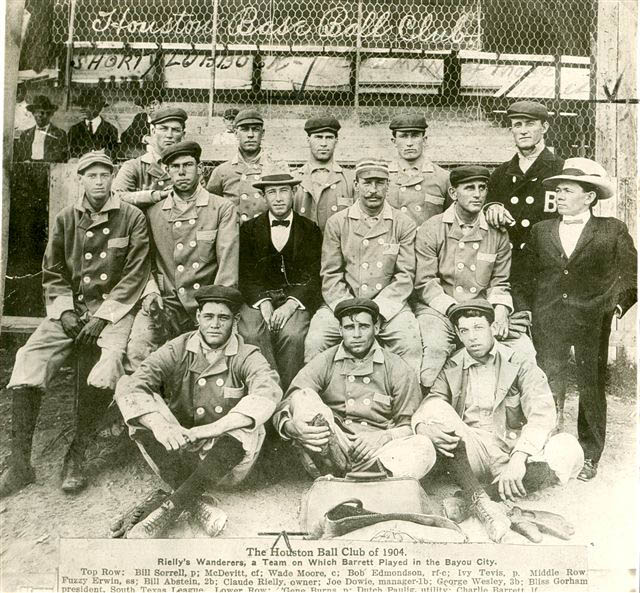
The 1903 Buffs were followed by a one-season identity hiccup. The 1904 club changed their name to the “Houston Wanderers” for that single season. By 1905, the club had gone back to “Buffalos” and they never looked elsewhere again for a better moniker. From 1905-1942, 1946-1961, our boys would be known as the Houston Buffs in the South Texas League, the Texas League, and the American Association.

After the 1906 season, the two competing state circuits settled their differences and reorganized the Texas League that continues to exist from 1907 through 2010. The 1904 Wanderers finished with a 66-59 record (.528), or only good enough for a third place spot in a four club league. Claude Rielly was the club owner by this time. The 1904 Houston Wanderers  featured the league’s leading hitter (Bob Edmundson, .340) and the league’s winningest pitcher (Clayton Robb, 26 wins). In fairness, we note that Robb won some of those game for Beaumont before he was traded during the season to Houston. Robb also finished in a tie for most wins with Baldo Luitich of Galveston/Beaumont. Luitich also bagged 26 South Texas League wins in 1904. Add one more local leader. Houston’s Bill Sorrells led the 1904 Texas League in strikeouts with 243.

Yes, Houston club owner (and sometimes manager) Claude Rielly really spelled his name “ie” rather than the conventional “”ei”, but that’s not surprising. The rules that governed the early years of professional baseball had nothing to do with following guidelines like “i after e, except after c”. The early baseball founders made up their own rules and boundaries, sometimes taxing their full faith and credit investment in the public’s trust in the integrity of the game. The only rule they could not suspend is the one that governs the bottom line: If you don’t make money over time, you have to fold your tent and go away.

For Houston, the 1904 Wanderers were simply another step in the right direction. They played all the games they were scheduled to play, and they finished the season without crashing their payroll commitments to their players. 1904 Houston club leader Claude Rielly understood a basic tenet about baseball in particular and business in general. That is, before you can hope to expect profitable “success,” you better be able to spell “infrastructure solvency.”

Gone But Not Forgotten Houston Eateries.

January 15, 2010

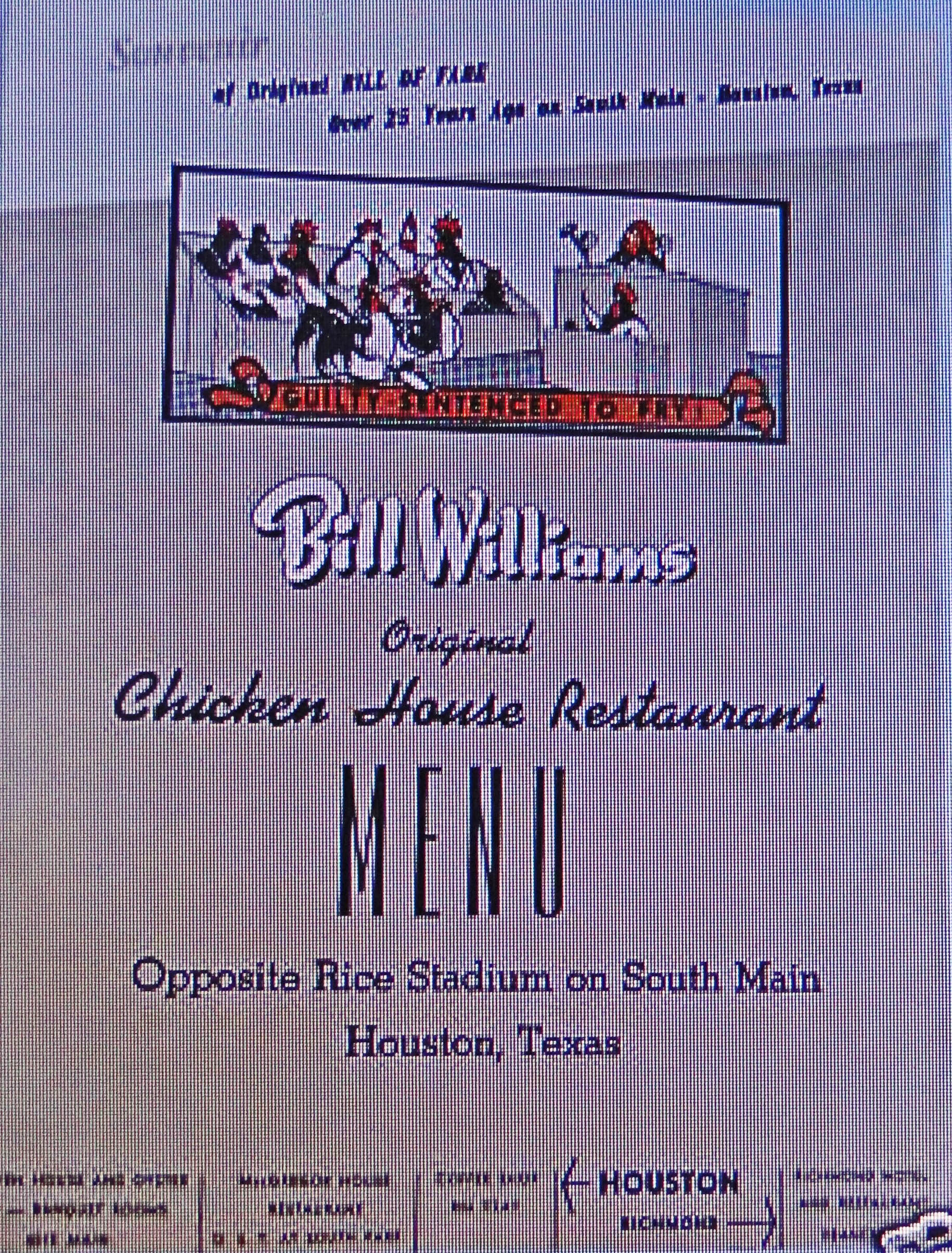
Bill Williams Chicken House. We haven’t exactly forgotten the Bill Williams Chicken House that used to advertise chicken fried “savage style” with the neon image of a Native American brave (formerly Indian warrior) squatting and cooking over a campfire. In fact, I’ve mentioned the place here in the past.  Today I simply ran across an old restaurant menu that recently went to auction on Ebay. Based upon what we can see in the photo, the menu had to be from the 1940s at the latest. It advertises “BWCH” as “opposite Rice Stadium on South Main.” That means it was produced during the period in which Rice still used the old Rice Stadium on South Main as their football venue. Football moved to the “new” 70,000 seat Rice Stadium in 1950.

It’s an interesting graphic. A chicken is on trial. We must presume that the bird was charged with being plump, juicy, and delicious because the heartless chicken judge and jury have just found him guilty and “sentenced (him) to fry.” The Internet piece also notes the availability of soft drinks, coffee, and iced tea available at nickel and dime size prices. Iced tea today in most Houston restaurants probably costs more than a whole fried chicken meal for two at Bill Williams back in the day.

Of course, I always have to mention her when it comes to Bill Williams memories, I’ll never forget the fortune-teller robot woman in the glass box near the door. For a dime or so you could have your fortune read before you walked out the door after a Bill Williams chicken dinner. I should have listened to her. I think she’s was trying to tell me: “Cut back on the fried food, boy! One of these days, your pipes are going to clog!” Professional buildings surrounding the Texas Medical Center swallowed Bill Williams years ago. They didn’t even pause long enough to fry him savage style.

Weldon’s Cafeteria. Heading north from Bill Williams, we wind our way to my all-time favorite cafeteria back in the 1940s and 1950s. Weldon’s served the most delicious chicken and dumplings I ever tasted outside my mom’s own kitchen. Weldon’s was located on the site and in the same building that later housed the Massey Business College for years. I’m not sure what’s there now.

Kelly’s Steakhouse. Just up the road and barely south of downtown on South Main, we had Kelly’s Steakhouse, one of best early steakhouses I ever visited as a kid. I’m not sure how Dad swung it, but he took us there once in a blue moon on Sundays. I can’t recall what’s there now in 2010.

Bill Bennett’s Grill. Thanks to fellow St. Thomas High School Class of 1956 classmate A.J. Garney for opening the memory door on this favorite haunt. Wow! How could I have forgotten. In our trip up South Main, we turn right on Pierce and head to LaBranch. At LaBranch near St. Joseph Hospital, we turn right again and take another right at Jefferson (now St. Joseph Parkway) and there it is on the left: Bill Bennett’s Grill. As A.J. so fondly recalls, Bill Bennett’s served these great homemade all-you-can-eat biscuits and practically everything else that could be grilled or fried – and at the modest prices we could all afford as high school guys out there on the original rock-n-roll boogie trail. I’m not sure when Bill Bennett’s closed, but it came down when TXDOT acted to use that space for that section of the downtown freeway we now call the Pierce Elevator. Oh well. It was great while it lasted – as were we and the times of our youth. Thanks for the memories, AJ!

If you can think of any other places that have breezed through the sieve of my memory bank about the 1940s or 1950s, please let me know what they are and what you remember of them. As always, I’ll do what I can here to help Houston remember what we’ve lost or given up in the name of progress over time.

Martin Dihigo: Virtuoso in a Vacuum.

January 14, 2010

He was born of humble circumstances in Matanzas, Cuba on May 25, 1905. He grew up to be a 6’4″, 190 lb. professional baseball player who, batting and throwing right,  handled all nine field positions with exceptional skill. Most of those who saw him seem to agree that pitcher and second base were his best positions.

Dihigo never had a chance to play in the old white big leagues because of the color line, but he eventually earned his way into the baseball halls of fame of the Dominican Republic, Venezuela, Mexico, Cuba, and Cooperstown by 1977, or by six years after his death at age 66 on May 20, 1971 in Cienfuegos, Cuba.

He was Martin Dihigo. He played baseball so well that stars like Buck Leonard, Johnny Mize, and Monte Irvin hint that he may have been the greatest baseball player that ever lived.

Dihigo was the consummate five-tool, do-it-all guy. He hit for power and average – and “they” say he could run, throw and catch with the best of the rest in the white majors and Negro leagues.

Here’s where it always gets tough when it comes to making an objective case for greatness based upon performance records of Negro leaguers. Record-keeping in the Negro leagues was often spotty and, because of segregation, it’s impossible to use data that shows how Negro leaguers have performed in direct competition with the white major leaguers of that their era over the long season. We are left with the testimonials of others as to their greatness and to the statistics we can find for the sake of drawing our own conclusions.

In the matter of Martin Dihigo, all I know is that I’ve never run across anything in writing that ever came close to describing him as anything less than phenomenal in all phases of the game. I decided to place my trust in these massive anecdotal references and to select Martin Dihigo as my all time third baseman. I only placed him on third base because I had the other bases covered well. Dihigo probably could have made the team at virtually any position. That’s how good these testimonial remarks imply that he was.

Martin Dihigo posted a .307 batting average and a .511 slugging average over the course of his twelve season career in the Negro League. His greatest year as a pitcher, however, came as a 1938 Mexican Leaguer when he won 18, lost 2, and posted a 0.90 earned run average, From the early 1920s through 1950. Martin Dihigo performed in the Negro American League and every baseball league that existed in Latin America, gathering all-star and MVP awards as though they were a bag of sunflower seeds. He may as well have performed in a vacuüm tube. Few observers of any credible power in the white media saw him play and, as we know, there is little moving film material and no electronic tape or digital moving photo record of Negro League action from back in the day.

Fortunately for Martin Dihigo, the few who did see or play with or against Martin Dihigo never forgot what they saw. To them, his eye-witness advocates, we say thank you for telling us all about a guy who may have been the greatest all round baseball player of all time.

A Monte Irvin Baseball Quiz.

January 13, 2010

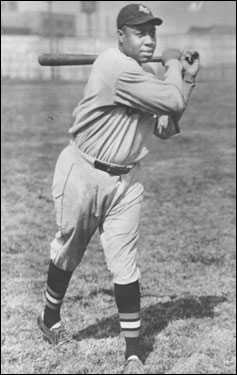
Monte Irvin, Baseball Hall of Fame, 1973.

This little quiz focuses upon Hall of Famer Monte Irvin as the key to all its answers. If you are a deep water port baseball fan, it will be tough. If you are a casual fan to a non-fan, it will be impossible. Either way, don’t take the test, or yourself, all that seriously. Life isn’t fun for self-important people. And who needs that plague in particular or those boring people in general?

Just have fun with it.

The answers to this quiz are below. I wrote it honor of Hall of Famer Monte Irvin’s appearance and discussion at our December 2009 meeting of SABR, the Society for American Baseball Research. We didn’t get to the quiz until last night at our January 2010 meeting. Unfortunately, I neglected to bring the answer sheet with me, thus causing me to into brain-freeze on a couple of the answers until I got help from some of the members who hung with me long enough to take the test. I think that’s what Wee Willie Shakespeare had in mind when he came up with the phonetic expression, “hoisted upon my petard.”

This petard is a booger if you don’t have the answer sheet handy, but that will not be a problem here. The answers really are listed below. Just try to resist scrolling too fast past the opportunity of giving the quiz your best shot.

Before you take the quiz, please make a note of the built-in clue. Since I originally wrote the quiz to honor Monte Irvin, the answers to the ten questions, in order, are each preceded by the letters of his first and last names: M-O-N-T-E  I-R-V-I-N. These letters each represent the first letters of the last names of each person that is the answer to each specific question.

Got it? Good! Here is the question that applies to each of the ten “Monte Irvin” statements: What is the first and last name of the person we are talking about here? Remember, his last name will start with the bold-typed letter that precedes that particular statement. One more small hint: Each answer will contain the name of a Baseball Hall of Fame member, going all the way back in some cases to the 19th century.

M. He was no Bugs Bunny, but he had a lot of staying power.

O. His quirky batting style only got him into the Hall of Fame.

N. It’s not how fast you throw, but what happens when you do.

T. He was last National Leaguer to hit .400 in one season.

E. In 18 years, he played every field position and hit .303 life.


I. His middle name is Merrill, but call him “Mr. Murder.”

R. “The Hoosier Thunderbolt” won 31 plus, 4 straight years.

V. Reached the HOF with only 197 wins from 1916 to 1935.

I. Invert Route 66 upside down for his MLB career HR total.

N. Won 30 plus 7 times and won 361 games in MLB career.

Scroll down for the answers >>>>

>>>>>>>>>>>>

>>>>>>>>>>>>

>>>>>>>>>>>>

>>>>>>>>>>>>

>>>>>>>>>>>>

>>>>>>>>>>>>

ANSWERS:

M. Rabbit Maranville

O. Mel Ott

N. Phil Niekro

T. Bill Terry

E. Buck Ewing

I. Monte Irvin

R. Amos Rusie

V. Dazzy Vance

I. Monte Irvin

N. Kid Nichols

Monte Irvin Notes: During his eight season MLB career (1949-56), Monte Irvin compiled a career slugging average of .475 and a career batting average of .295. His best season for a high batting average was 1953 when he hit .329. On February 25, 2010, God Willing, Monte Irvin will celebrate his 91st birthday.

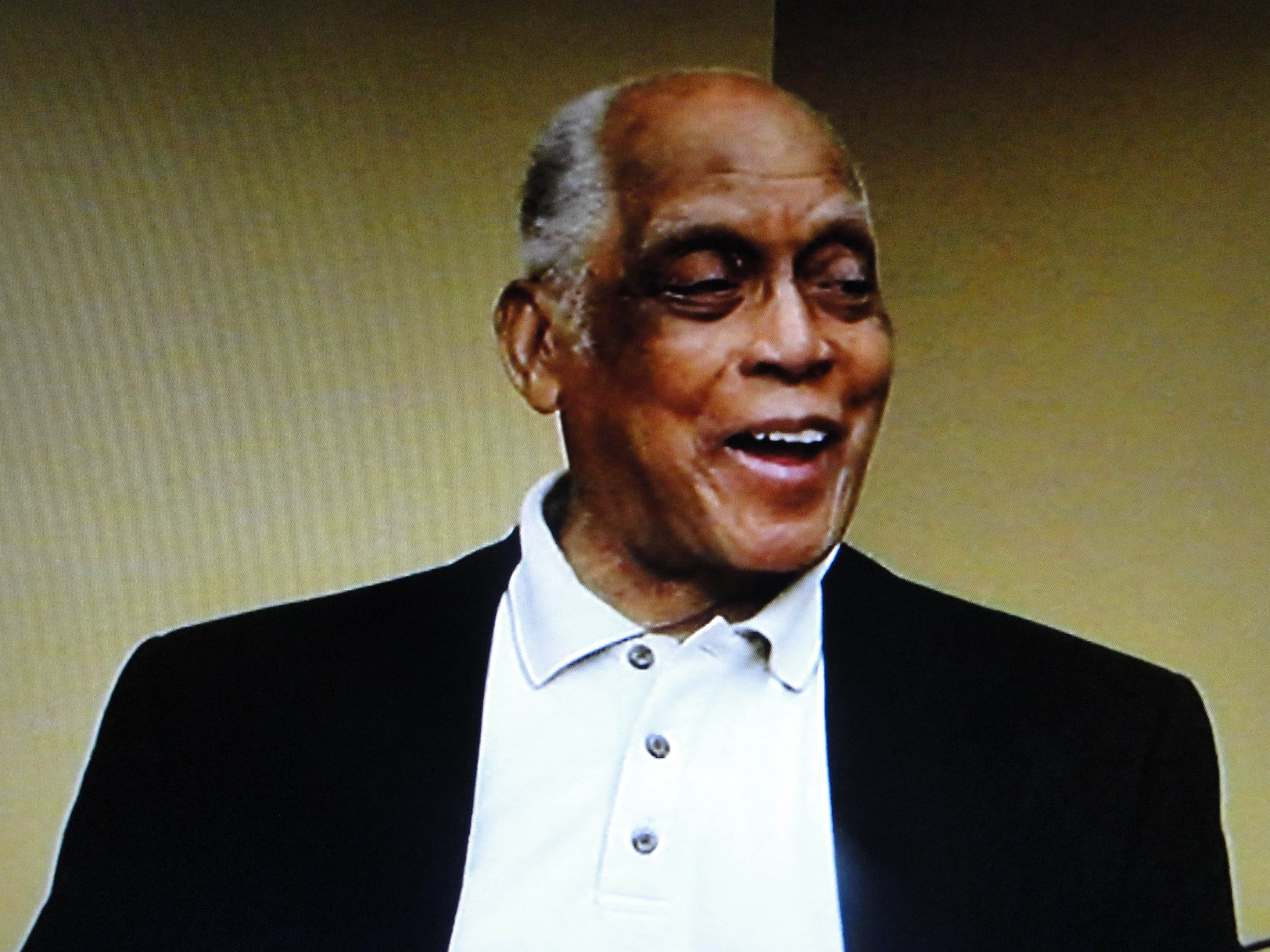
Early Happy Birthday # 91, Monte Irvin, and thanks too for all the happy memories you’ve brought to us by your willingness to spend time with our SABR group. As a piece of baseball history, that two-hour DVD we did of you and Larry Dierker with interviwer Dave Raymond at our December 8, 2009 SABR meeting is a treasure that reaches far beyond all of our lifetimes as an item of historical value.

Texas League Birth Came by C Section.

January 12, 2010

The early years of the Texas League of Professional Baseball Clubs were anything but smooth. In fact, it’s even hard to believe that the league that launched the storied history of professional baseball in Houston through the team that finally came to be known as the Houston Buffaloes even survived its first 1888 season of operations. By all contemporary standards and expectations, in fact, we would be forced to write it off as an abysmal failure. except for one thing: Playing somebody somewhere was apparently more important in 1888 than the accuracy of the league standings, the exact composition of the league by teams on any given day, or the statistical accomplishments of each player.

In brief, here’s how the Texas League got started and how its first season of operations played out for history:

In the fall of 1887, the champion St. Louis Browns of the American Association, led by Charlie Comiskey, toured Texas for s series of exhibition games against their traveling companion, the New York Giants of the National League, led by John Montgomery Ward. At the same time, a minor league club from Joplin, Missouri, led by fiery young John J. McCloskey, also invaded Texas to pick up some loose change playing local amateur clubs. Like the boys from Joplin, the Browns and Giants also played more games against local groups than they did against each other.

When the minor league star Joplins finally crossed paths with the major league  Giants in Austin for a series of exhibitions, the passion of the cranks (fans) for these games was hardly lost to the watchful eye of the energetic 25-year old McCloskey. After his Joplins soundly defeated the Giants in the first two games of a schedule three-game series, New York declined to play the last contest. These results caused Austin businessmen to go after McCloskey to start professional baseball in Austin and Texas, something he wanted to do anyway. McCloskey already had appraised that Texas was ready for a professional league of its own. Now he had Texas power and money to back him and he quickly harvested the good contacts he had cultivated around the state on his tour and added to these the names of other influential people supplied by his Austin contacts.

Big John went right to work.

John J. McCloskey of Louisville, Kentucky was a charismatic guy, one that just oozed with passion for the game of baseball. In a way, many people caught the baseball “bug” directly from their 1887 contact with John McCloskey.

A much longer story made short: Instead of returning to Missouri for Christmas, McCloskey’s business in Texas simply segued from playing the game to promoting the start of a new league. For the amazing work he did in a relatively short period of time, John J. McCloskey is remembered today as the Father of the Texas League. By December 15, 1887, McCloskey had pulled together a group of prominent business people from all over the state and the City of New Orleans for a Texas League organizational meeting in Austin.

Houston, Dallas, Austin, and New Orleans were represented in person at the December 15th meeting. San Antonio, Galveston, and Fort Worth were also on board with the idea, even if their people couldn’t get to the meeting. New Orleans pulled out in favor of joining the “closer to home” league forming in the South as the Southern Association. The others held together to form the six-club all Texas city group now forevermore known by charter as The Texas League of Baseball Clubs. Waco also sent a letter of support for the idea to the meeting, but was unable to form a local plan for competition during the league’s proposed first season in 1888. The new league had hoped to start with eight clubs, but had to settle for the six groups that held together. One of those clubs, the Austin group, was really the old Joplin club. McCloskey had simply relocated his established group of young stars to the Texas capital city.

The Texas League started with a fairly organized plan. Salaries were established at $1,000 per season and playing rules were adopted to fit the club into the growing pattern of organized baseball. Ticket prices were set at 25 cents per game and a contract was reached with the A.J. Reach Company of Philadelphia for the production of the official Texas Leagye ball. Umpires (one per game) would be paid $75 plus train fare. The league secretary was approved for a salary of $50 per month for the entire year.

The league secretary needed a pencil and eraser fund. Most of the first year would be spent making and rearranging schedules and trying to keep up with game outcomes that were frequently unreported or not reported accurately. The biggest problem would be the crashing of franchises in mid-stream of the league’s first active season.

Season play started on April 5, 1888. By early June, every club, but Dallas, was in financial trouble and San Antonio was forced to fold. This fatality required a schedule revision to accomodate five teams. The effect was to leave one team idle for three or four days each week as the other four played.

Shortly aftr the San Antonio collapse, Fort Worth also folded its tent as a professional club. They didn’t disband. They simply declared themselves “amateurs” and started playing other local teams in their home area. The Texas League now had to survive as a four-club loop.

Change was far from done. When Austin began to fail, San Antonio rose from the dead and took it over, becoming the first city in baseball history to sponsor two different teams in the same league during the same season. That relocation was quickly followed by the return of New Orleans as a mid-season entry into the pennant race as a brand new fifth team. Any connection between game outcomes and a credible standing of the teams had now been totally removed. The goal now was staying alive as an organization, but how was the Texas League to do that with the plug now pulled on believability?

By September 1888, Houston and Galveston both dropped out of the league for financial reasons. This move prompted New Orleans to quit again rather than continua their trips into Texas to play the two remaining teams.

With no clubs other than Dallas and San Antonio remaining, the Texas League simply stopped playing ball in early October. The Dallas Hams reorganized as the “State Fair and Exposition team” and kept on playing ball against amateur teams at the state fairgrounds. This was back in the pre-Big Tex days at the State Fair, if you recall.

With a record of 55 wins and 27 losses, and a winning percentage of .671, Dallas had the best reported record for 1888, but no official champion was named for that first season, although the Dallas club always felt that it had justly earned it. The Houston Mudcats of 1889 would become the first recognized official champions of the Texas League.

Before we can keep score of anything that matters, we have to survive, and that’s the position that the Texas League faced when they first opened their doors to competition in 1888.

Because Houston, led by S.L. Hain, had been the last group to aign on with an approved plan, they briefly acquired the ignominious initial nickname of “Babies.” By popular demand from all fronts, the Babies quickly renamed themselves as the Houston Red Stockings in 1888. They would become the Mudcats in 1889 and go through Magnolias and Wanderers ovr the early years before finally finding their permanent identity as the Buffs in the first decade of the 20th century.

The 1888 season was zany. For the league founders and everybody else.

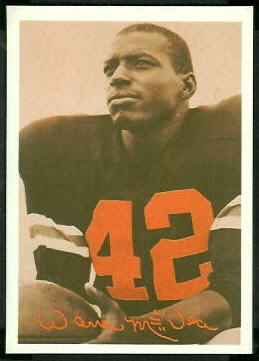
Wondrous Warren McVea.

January 10, 2010

He was a human water bug as a running back. Try to trap him with your hands as a defensive lineman and he will simply relax the muscles in his legs and torso, allowing your touches to suddenly slide off his body as though they were spoons slipping off a buttered noodle. You are left in the lurch, grasping at air as the water bug quickly squirts off in another burst of animated motion down the field behind you.

If you then, as one of three linebackers, pick up all this happening before your disbelieving eyes, you have about one nanosecond to make eye contact with the tiny approaching figure as he looks you one way and then dashes around you another. By the time you have all relocated your jock straps, the water bug has gone again, moving deeper into your team’s side of the fifty, and now heading on a left angled diagonal trek across the field and into the intercepting pathways of four quick, cunning, and converging defensive backs.

As interceptor one, you make a calculated dive for the dancing legs. They boogie by your empty-armed grasp and you are left tumbling on a teeth-clinching roll into the turf.

As interceptors two and three, you pick up the bug in your sites and attack from cross angles. One of you reaches a left shoulder, causing the bug to spin back. The other of you explodes against the right calf of the bug as it turns back from you in response to the other side assault. Another nanosecond later and the two of you joint interceptors are crashing into each other. A near 360 degree spin by the water bug has first freed him from your almost deadly grasp and then propelled him on a course to the opposite right pylon corner of the now even evermore inviting goal line.

As the fourth, last, and greatest interceptor. you close in upon the water bug from an angle that is slightly to his left. Your paths converge at the one yard line. Just as you are about to finally bring down the elusive bug, he stares and you blink. A quick frame later, the water bug has braked just long enough to cut behind you and step over the goal line for an 84-yard touchdown run.

At journey’s end, no ball-slamming or end zone dancing takes place. The water bug simply discards  the no-longer-needed football with a gently releasing toss and trots back to his team’s sideline.

“What an incredible run! How does the guy do it?” As a fan, your dual points of exclamation and wonder about the water bug helped invent the word redundancy as it came to apply to sports page expression in the 1960s.

That human water bug, of course, was a diminutive running back from the University of Houston named Warren McVea. Between the lines, there’s never been another one like him. His ability to escape capture in an open field made him something like the Harry Houdini of college football back in the salad days of “once upon a time.”

Here’s how it all began, once upon a time in San Antonio, just days after the John F. Kennedy assassination in November 1963. Brackenridge and Lee high schools of San Antonio met in the Alamo City in a state football bi district playoff game that is still regarded by many (and all of us who saw it) as the greatest playoff game in Texas High School Football history. It also marked the very daybreak of television’s power to make overnight stars of high school kids. The image-building job was made easier by the fact that this game featured two kids who were doing pretty darn good on their own without the face of television.

Linus Baer of Lee and Warren McVea of Brackenridge were each the star running backs of their two schools, propelling their teams over all comers with virtually unstoppable running attacks. Now they had to play each other and it was anyone’s guess as to which team would prevail. The demand for tickets was so great that the game was put on television by a San Antonio station. I’m not sure how far their TV coverage reached into other markets, but I was fortunate to have been visiting with my folks in Beeville following the Kennedy death and I got to watch it with my dad.

Both clubs put their stars back to receive on kickoffs. As a result, both clubs avoided kicking deep. The one time that Lee made the mistake of doing so, Warren McVea ran it back something close to 100 yards for a touchdown. McVea collected over 200 yards rushing in the game and both stars scored multiple touchdowns before Lee finally prevailed on a last second touchdown by 55-48.

Linus Baer went on to play for the University of Texas Longhorns. Warren McVea had his pick of any top school in the country that then accepted black players. Above 73 others, McVea chose to sign with the University of Houston and to become the first black football player in the school’s history.

At UH from 1965-1967, McVea played masterfully in multiple rolls as a running back, wide receiver, and kick returner. On September 23, 1966, McVea took a pass from QB Bo Burris and went 99 yards for an unbreakable one-play distance TD catch-and-run record against Washington State. In 1967, McVea’s 84 some-odd yard touchdown run against Michigan State led the visiting Cougars to national prominence with a 37-7 win on the road at East Lansing. He made two first team All American teams in 1966-67 and then left UH for an NFL career.

After a six-year stint with Cincinnati and Kansas City of the NFL, McVea played briefly with the Detroit Wheels and old Houston Texans of the now long defunct World Football League. By this time, the 5’8″ 160 pounds soaking wet water bug had seen his better jiggling days.

Sinking into a life dominated by domestic violence, petty crime, and heavy drug addiction, Warren McVea sadly found himself sentenced to twenty-years in the Texas Department of Corrections penitentiary system.  After several years of incarceration, McVea was paroled and left to pick up the pieces of his once promising life. From all appearances, he apparently has done that neatest escape from ignominy.

Warren McVea today is sober and living in San Antonio. He works as a courier/delivery guy in the Alamo City . He came to Houston and was admitted to the University of Houston Athletic Hall of Honor in 2004 and he has since also been inducted into the San Antonio Athletic Hall of Fame.

Life’s one day a time now. If Warren McVea can avoid a relapse into that lost dark hall of the soul, it will be the greatest escape of the water bug’s life. With God’s help, it will be done.