Posts Tagged ‘History’

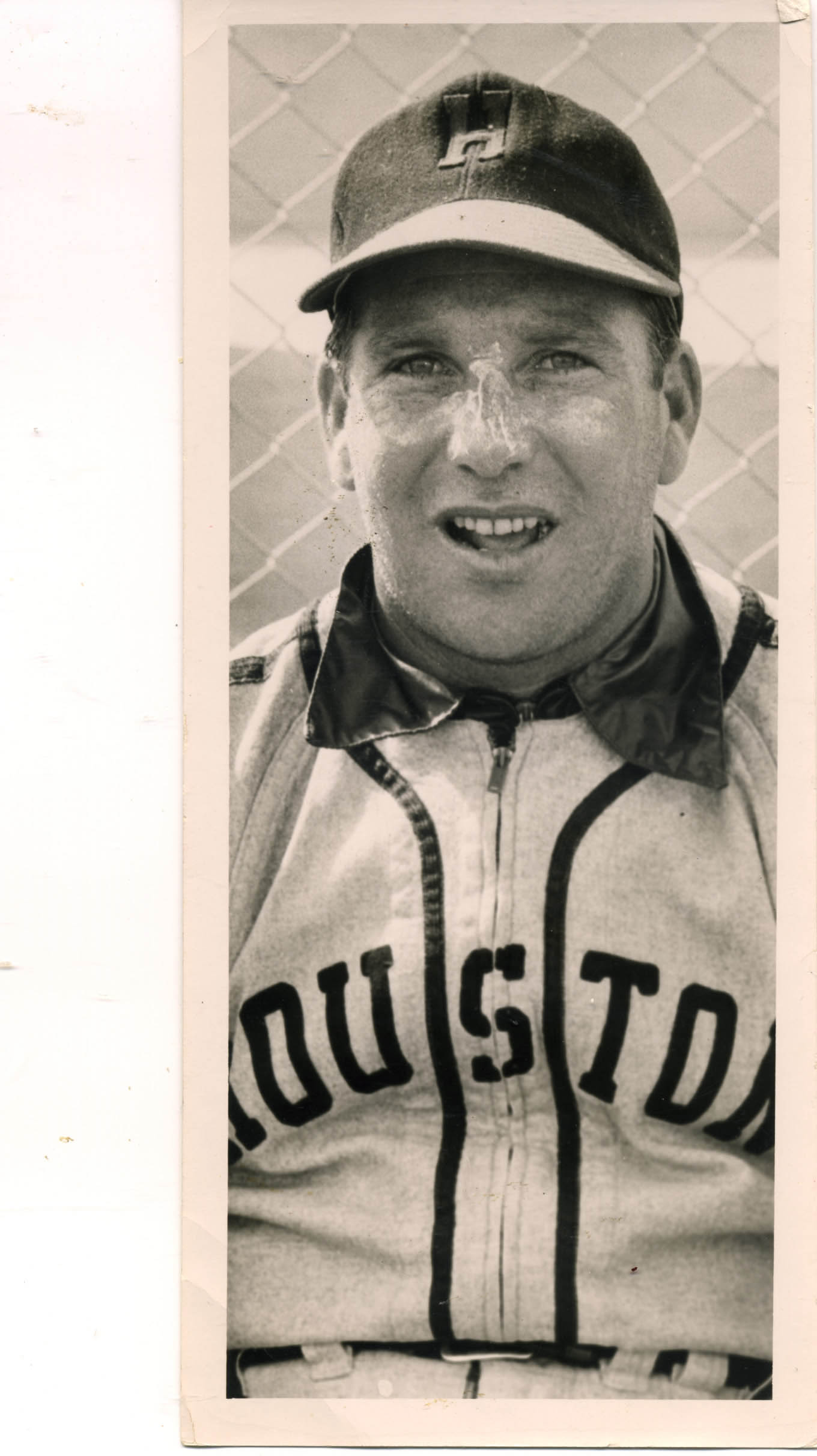
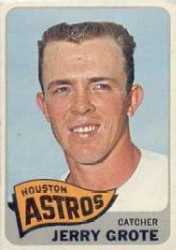
Jerry Grote: One of the Guys Who Got Away!

March 12, 2010

One the Astros lost.

For 21-year old Jerry Grote of San Antonio, Christmas of 1963 must have been an especially joyous holiday season. After all, the young Houston Colt .45 signee at catcher had just finished his first full year of professional baseball, even got to play for his home town San Antonio Bullets, batting .268 on the year with 14 homers. Even though he made 18 errors in 867 chances in the field, all of his miscues were correctable with experience and he seemed to have a way of building confidence in his pitchers, even at that early age.

Grote made it up to the Astros for a few times at bat in September of 1963, but I didn’t get to see him play until the summer of 1964. I was completing my graduate school studies at Tulane University in New Orleans at the time and had to hook short trips to Houston to see the Colt .45s for a few games. I liked what I saw in Grote, even though he wasn’t hitting “Mendoza” in his first real major league trial. He was a little guy who played with a lot of energy and with an attitude of alertness about what was going on with his pitcher and everywhere else. He played on top of the ball; he didn’t allow the ball to play him; same for the game. Grote was on top of what was going on. He held runners at first and he threw a bunch of them out when they tried to steal. He talked to his pitchers constantly with his body language and I don’t know how many times I saw him follow a quick mound trip with a called or swinging strike on the batter. I thought: “Forget the batting average for now. This guy is going to be a leader. He already knows how to handle pitchers.”

It didn’t happen. Not for Houston, anyway. After a .265, 11 HR season for AAA Oklahoma City, the newly renamed Houston Astros dealt Grote away to the New York Mets on October 19, 1965 for a pitcher named Tom Parsons, some cash, and, I presume, the conventional bag of balls. Parsons was out of baseball before he ever threw an official pitch for the Astros and Jerry Grote was on his way to a different destiny among the “Amazin’ Mets.”

I had a bad feeling about the trade when it came down. I had just seen too many things in Grote that I

He was good enough for Seaver and Ryan in 1969.

liked to feel nothing about a transaction that basically came down as a player dump. Sadly, Mr. Grote proved a lot of us Astros fans who felt that way justified in our concerns. Soon enough, Jerry Grote found an acceptable level of offensive production with the Mets. By 1968, he even batted .282, his second best average for a full season. He had no power, but he could handle pitchers, hold or throw out base runners, and play the game on top of the ball. In 1969, Grote handled two future Hall of Famers, Tom Seaver and Nolan Ryan, on the Amazin’ Mets march to a World Series title in their ninth year of existence. He also made only 11 errors in 788 chances in the field that championship year too.

Grote ended up playing on a second Mets National League pennant winner in 1973 and, all tolled, he played for 16 seasons in the big leagues (1963, 64-81) with Houston, the Mets, the Dodgers, and Royals.

Jerry Grote finished his major league career with a batting average of .252, but he clouted only 39 homers in 4,339 times at bat. Slugging definitely was not one of the tools in Jerry’s war chest, but it didn’t matter. He had so many others.

Anyway, I doubt that the bag of balls the Astros got for Jerry Grote in the deal with the Mets lasted quite as long as he did. Oh well. We can’t get ’em all right, can we?

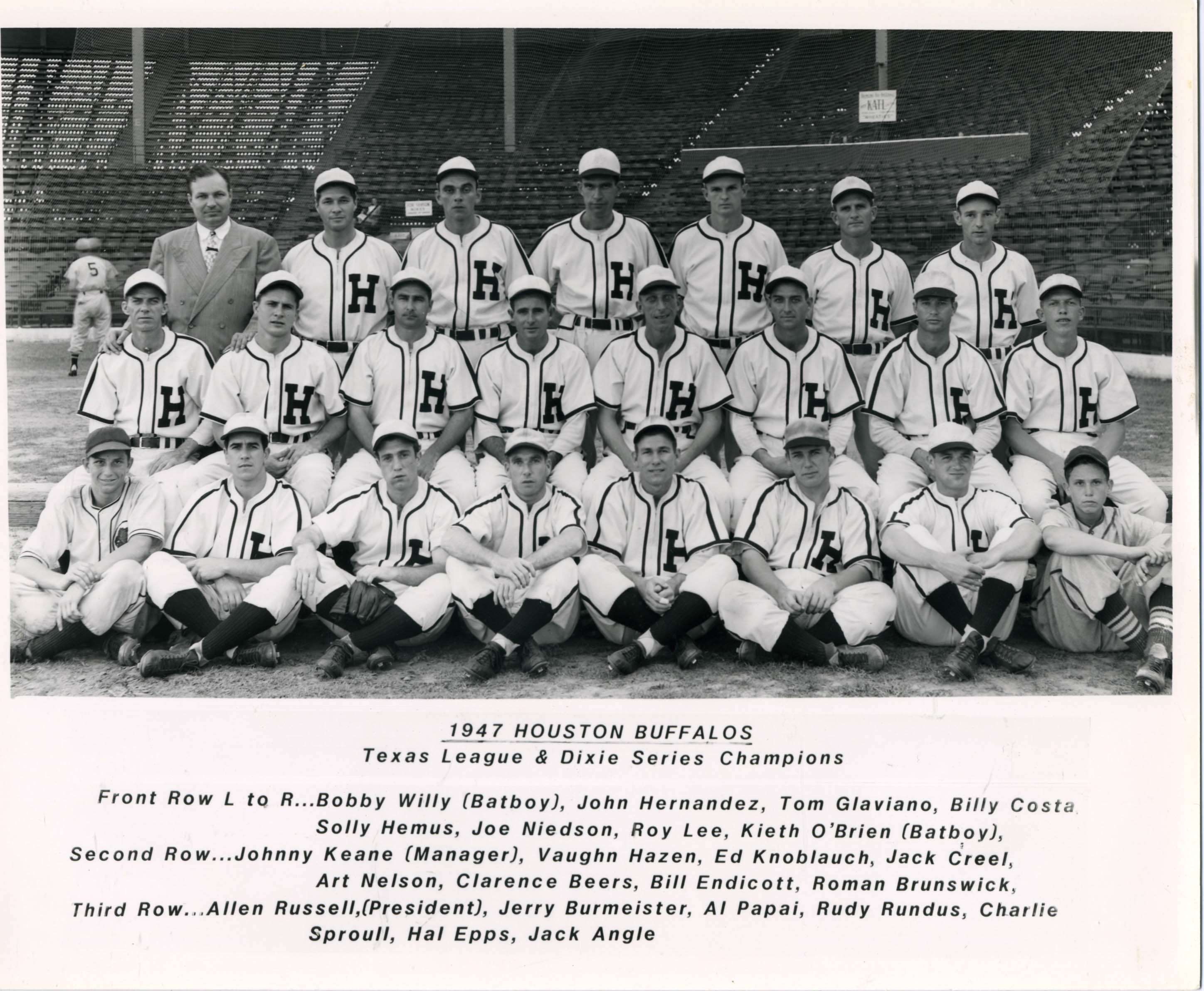
Solly Hemus: “Little Pepper Pot” of the ’47 Buffs.

March 11, 2010

Happy Days at Buff Stadium Ignited from the Energy of Solly Hemus.

Back in 1947, Houston Buff fans, writers, and broadcasters referred to second baseman Solly Hemus as “The Little Pepper Pot” because of his fiery field leadership of the club. It was a fire  that went on to ignite the Buffs’ capture of first place in  the Texas League on the last day of the season by narrow half game margin. The Buffs went on from there to capture the playoff pennant and then to defeat the Mobile Bears in the Dixie Series. As a nine-year old kid, the 1947 Buffs were my first conscious club of heroes – and Solly Hemus was my first baseball hero.

How lucky can a kid be?

Born April 17, 1923 in Phoenix, Arizona, might have missed a stop in Houston altogether, except for the intervention of untempered hunger and fate. Then I’d likely be writing about someone else today, but that’s apparently not how these things work. I only learned these facts in a hotel lobby conversation with good friend and late major league catcher Red Hayworth in the late 1990’s. Red Hayworth was a scout for the Houston Astros for a period of time in the murky past.

Here’s the story s Red Hayworth told it to me. Red’s brother, Ray Hayworth, was set to manage Solly Hemus for the Brooklyn Dodgers at their 1946 Fort Worth Cats club. Young Hemus originally signed with the Dodgers after the conclusion of World War II.

On the bus trip back to Fort Worth, the team vehicle stopped for gas somewhere on the highway near the team’s destination of LaGrave Field, the Fort Worth home venue. Manager Hayworth supposedly told all players to stay on board during the “short stop” for fuel, but 23-year old Solly Hemus got off the bus in spite of his manager’s warning and started heading into the little attached gas station cafe.

“Where are you going, kid?” Ray Hayworth called out to his rookie. “I told you to stay in the bus.”

“I don’t give a s*** what you say,” Solly supposedly yelled back to his manager. “I’m hungry and I’m going to get  me a sandwich.”

What Solly got for his sandwich decision was a one-way ticket to Pocatello, Idaho and the sale of his playing contract to the St. Louis Cardinals. Solly proceeded to hit .363 in 120 games as a middle infielder for Pocatello in preparation for his promotion to the 1947 Houston Buffs and a faster track to the big leagues as a future shortstop for the Cardinals. With Pee Reese and Jackie Robinson entrenched in the middle infield with the help of Junior Gilliam during this same era, Solly’s punitive sale to the Cardinals was the best thing that could have happened to him.

Hemus hit .277 with 0 homers in 1947, following that up in with two more seasons as a Buff and averages of .288 and .328. One more season at .297 with the Little World Series champion Columbus Redbirds in 1950 and Solly Hemus was ready for his eleven season major league career (1949-59) with the Cardinals and Phillies and a batting average of .273 with 51 homers. As a five-year minor leaguer (1946-50), Hemus batted .308 with 16 home runs.

Billy Costa & Solly Hemus are 4th & 5th from the left on the front row.

Solly took over as manager of the St. Louis Cardinals in 1959, but wasn’t too successful in the standings, or with getting along with star pitcher Bob Gibson. After two and one half seasons, Hemus was replaced by Johnny Keane, his former manager in Houston in 1947.

Hemus and Gibson both had fiery dispositions, but I do not believe their core problems with each other were racial, as some writers would have you believe. I’ve never heard Solly Hemus make an off-the-cuff statement that smelled of racism in any of my conversations with him. In my experience, he seems as color-blind as you could hope a man to be. On the other hand, I have no problem seeing how he and Gibson probably clashed from the start. They are both strong-willed men.

One of my favorite stories about Solly happened in St. Louis during his managerial period. An overweight field umpire on the other side of the diamond seemed to be calling everything the other team’s way. By the fifth inning, Solly had suffered enough. He marched out of the dugout to make this request of the Oliver Hardy-sized arbiter:

“Sir, would you mind calling the rest of the game from our side of the field? Your weight seems to be tilting the ground the other team’s way?”

Solly got to watch the rest of the game from the level confines of the Cardinal clubhouse.

Solly Hemus turns 87 next month. He still operates his successful oil business from offices in Bellaire, but a serious fall on a trip to Alaska a couple of years ago left him with some ongoing damage to his mobility. Even that kind of thing doesn’t hold this good man down. Look for Solly Hemus to be back at Minute Maid Park again this season as a fan of the Astros. The ties that bind Solly Hemus to Houston as a result of his long ago sandwich decision apparently are forever.

Early Televised Baseball in Houston.

March 10, 2010

Houston Buffalos 1953 Official Score Card
– Complements of Contributor Tom Murrah


What was televised baseball like back in the old days? Well, if you were around to see it in the late 1940s, you don’t need to hear from me. If you weren’t, I’ll try to give you my take on the experience, starting with what I think is a fairly literal and perfect analogy. Early black and white, fuzzy-pictured televised baseball and today’s multiply angled, high-definition color casts bear  the same relationship to each other as the first “PONG” game does to today’s X Box and Play Station offerings. It was a wholly different world of primitive communication back then.

KPRC-TV, Channel 2, was the godfather of Houston baseball telecasting from 1949, when the station was first known as KLEE-TV. The name changed to KPRC-TV in 1950 when the William P. Hobby family bought the station from original owner Albert Lee. It would fall to Channel to become pioneers in Houston sports telecasting. Twenty-two years earlier, on April 11, 1928, KPRC radio, with Bruce Layer at the mike, had become the first radio station in Houston to broadcast a live baseball game to the home audience. Now they were doing it again as Channel 2 with televised baseball. There was no protocol for how to show baseball live on television. There was only challenge and a sludge-glowing black and white picture being broadcast to screens that weren’t much bigger than today’s iPods and a whole lot harder to watch because of their poor picture quality.

As the photo in this story’s visual aide shows, the early telecasts used  a camera on the first base side to show the mostly right-handed batters from a facial side shot. We also got to see the numbers on the backs of left-handed batters. In Houston, at least, there was no corresponding angle camera on the third base side to cover lefties. A second camera, however,  was usually positioned behind home plate, and behind the screen, to show the ball coming in to the batter and, when hit, going out to the fielders. On those early ten inch diameter screens, the view also compared favorably to watching baseball as it might be played out on an ant farm. You saw this fuzzy little round object move in, move out, and then disappear into the far dominions of a poorly lighted minor league field.

You had to develop a capacity for reading the body language of the tiny fielders to know if the ball had been handled or not. Some people bought these magnifying glass accessories that gave you a larger, even furrier picture of what was going on in the far away regions of the outfield.

In spite of these descriptions, however, keep in mind that we didn’t know any better back then. Getting any kind of moving picture at home seemed miraculous to us at the time. We didn’t know HD from VD. We were just glad to receive moving pictures at home. How good could things get? Our expectations were low. We just cared that it moved. It took as a while to free ourselves from the amazement that standing in front of the screen did not block out the picture as it would at the movies. We also weren’t too bright back in the day.

On June 11, 1950, televised baseball brought about a tragically melodramatic moment to Buff Stadium. I just happened to have been there that night with my dad as an auditory witness. We were sitting about twelve rows back from where the incident took place, but neither of us actually saw it happen, We certainly heard it, however, and we witnessed the startled reaction of players on the field.

Solo broadcaster Dick Gottlieb was working the game from a spot to the immediate right of the first base camera when a man came up to him deep into the game and announced that we was about to commit suicide. Before Gottlieb could even register to the reality of the man’s statement, the visitor pulled out a hand gun and shot himself in the head. As he slumped to floor of the stands, the KPRC-TV camera man reflexively turned the camera toward the man and caught the fall of his limping dead body going down.

Tulsa Oiler fielders hit the ground as though they were soldiers under sudden surprise attack. Players near both dugouts dove for safety on the benches with teammates. Buff fans murmured and stood, but no one panicked. Within forty-five minutes, the man’s body had been removed and the blood cleaned up. The game resumed and our surprised play-by-play man Dick Gottlieb hung in there to finish the story of the scheduled contest.

A number of my friends saw the whole thing happen on television. Dad and I never saw it because we were at the ballpark when it all unfolded.  There was no videotape in those days.

Technically, televised baseball has improved on quantum leap levels since 1949. Humanly, some issues remain the same in 2010 as they were in 1949. Some people still prefer getting attention to getting well, even if it kills them.

____________________

Billy “Little Napoleon” Costa

March 9, 2010

BILLY COSTA, SS, HOUSTON BUFFS, 1947, 1951-52.

During their 1947 Texas League and Dixie Series championships season, the Houston Buffs featured one of the most effective and compact keystone combinations in minor league baseball. Billy Costa (5’6″, 155 lbs.) at shortstop and Solly Hemus (5’9″, 165 lbs.) at second base weren’t going to have the mass and altitude to fire over the heads of too many oncoming runners at second base on the double play, but they more than made up for their small physical sizes with a give no quarter attitude about winning. That factor was evident to the very last play of the 1947 season.

In the final game of the season at Buff Stadium, the Buffs trailed the Fort Worth Cats by half a game and they were tied with the Cats in the bottom of the 9th inning. Costa came in to score the game and pennant winning run from second base on a hit by center fielder Hal Epps and the Buffs were off and running from there.

“Costa was a hustling little ballplayer,” the late Jerry Witte used to say, “but he had that complex that little guys always seem to have. They run their mouths big time to make up for their lack of size and Costa was no different. I used to break up a lot of his long speeches in the clubhouse by asking him something like, ‘what’s that you say, Little Napoleon? You’ll have to speak up. I can’t hear you.'” Jerry Witte was Costa’s teammate and the starting first baseman for the Buffs in 1951-52. “I didn’t mean no harm and Billy knew that I was just reminding him in my way that we’d heard his dadgum speech about all the things he was going to do about thirty times before he even started this latest rendition,” Jerry Wittte added.

No one could argue with Costa’s effort, but his bat, unfortunately, fell short of his plans for it over the long run. Still, in his ten season, all minor league career (1941-42, 1946-53), Billy Costa hit a respectable .265 with virtually no power. In 4,046 official times at bat, Billy hit only ten career home runs. He never got his cup of coffee in the major leagues. He never even got to smell it perking in the parent Cardinal clubhouse. As was the case for many players during the reserve clause era, Billy Costa never put up the kind of stats that would keep him from getting lost in the talent-deep farm system of one of baseball’s premier talent developing clubs.

By the time that Billy Costa was free of the Cardinals and playing out his final season for the 1953 Beaumont Exporters as a 33-year old veteran, he also had stumbled or “miracled” his way into his best season at the plate by hitting .293 in 140 games. Billy had come down with a case of adult polio infection the previous season at Houston and, for a while, it appeared that he might not even walk again, let alone be well enough to continue playing baseball. The affliction seemed to challenge Costa and he came back in 1953 in a way that far exceeded any of his earlier seasons.

It was just too little too late.

Billy Costa retired after the 1953 season and went into business and then politics in Houston. A few years later, Costa pursued a successful election to the Harris County Commissioners Court, where he served honorably for quite a while. Billy died of a heart attack about thirty years ago, but not before he found a way in his life after baseball to deliver on some of those earlier promises as a politician.

I no longer am able to recall what Billy Costa promised or delivered as a member of Commissioners Court, but the feeling that he did alright lingers with me anyway. I guess that’s a big part of what makes a politician seem OK. If he or she can make us voters think they’re working for us, even when they are not, they are able to sleep with themselves at night. When some of that behavior also extends to the goal of covering up their tracks in self-serving or unlawful acts, a lot of the blame has to also fall back on us for going to sleep at the wheel.

All I know is Billy Costa inspired me as a kid. When he came down with polio, I agreed to say the rosary in his behalf everyday for the rest of my life if God would allow him to recover, which He did – and he did. I’m a little behind in my childhood promise these days and can only hope that God will cut me some slack for an over-the-top commitment by a heartbroken kid back in 1952. If He does not, I guess I’d better stop writing and start praying.

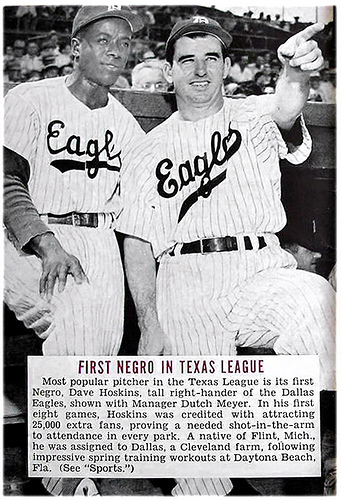
Dave Hoskins: First Black Texas Leaguer, 1952.

March 7, 2010

Dave Hoskins with Dallas Eagles Manager Dutch Meyer, 1952.

Five years after Jackie Robinson broke the major league color line in 1947, Dave Hoskins did the honors for his race in the Texas League as a pitcher for the Dallas Eagles.  Those 1952 Eagles were a great club, finishing in first place under Manager Dutch Meyer with a record of 92-69 before losing to Oklahoma City in a six-game first round playoff series. Hoskins was the prime force for the ’52 Eagles, leading the league with 22 wins and an overall record of 22-10 and an ERA of 2.12.

Those of us in Houston during that era were two years away from the 1954 date that Bob Boyd would step on the field as the first black player to play for the Houston Buffs, but that didn’t stop a handful of us Houston whites and all of the segregated-stand seated Houston blacks from cheering for Hoskins during his first and every appearance at Buff Stadium. The guy threw the ball with such pop and poise. It didn’t take long for Dave Hoskins to establish that he already was too good for the Texas League at age 30.

Dave Hoskins was born in Greenwood, Mississippi on August 3, 1922, but his family moved to Flint, Michigan in 1936 when he was 14. His dad worked in the automobile assembly industry and Hoskins grew up playing baseball in the Flint City League. His averages of .438, .395, .350, and .412 over four seasons drew hard attention from scouts in the Negro League. His first stops in professional baseball landed him with the Ethiopian Clowns, the Homestead Grays, and the Cincinnati Clowns. During his three seasons with the Homestead grays (1944-46), Hoskins batted .345, .351, and .317. He also served as the club’s best pitcher in 1945.

In April 1945, Dave Hoskins, Sam Jethroe, and Jackie Robinson were chosen as Negro Leaguers to be given a joint tryout in a camp sponsored by the Boston Red Sox and Braves. Hoskins ended up missing the tryout due to a game injury.

By 1947, Dave had returned home to star as an outfielder in the Flint City League. As an all-star from that group, Hoskins proceeded to rack up three hits in a game that Flint’s Best played against the Detroit Tigers.

Dave Hoskins: Greatness That Might Have Been.

Dave Hoskins finally rode the wings of some good words by Satchel Paige and signed with the Cleveland Indians as a hard-hitting outfielder. After he signed, however, Hoskins decided to change from hitting to pitching. “I was tired of pitchers throwing at me and made up my mind to throw at other guys,” Hoskins explained. After unspectacular years (1949-51) as a pitcher for Grand Rapids, Dayton, and Wilkes-Barre, Hoskins joined the Dallas Eagles in 1952 for his banner breakout season in organized baseball.

Hoskins made an auspicious start for Cleveland in his first major league appearance in early 1953. Coming into the game early in relief of Bob Feller and trailing 3-0, Hoskins gave up no runs while crashing a double and homer for four RBI that gave him and the Indians the victory. He went on to post a 9-3 record for the Indians in 1953 with an ERA of 3.99 in 26 games.

An unfunny thing happened to Dave Hoskins with the Indians in 1954. Because of the talent-glutted pitching staff among Indian starters that year (Lemon, Garcia, Wynn, Feller, and Houtteman), Dave only hit the mound on 14 occasions in 1954, posting a 0-1 record and a harvest of disappointment.  David Hoskins would continue playing minor league baseball, including a brief stint with the 1959 Houston Buffs, through 1960, but he would not see the major leagues again after the ’54 heartbreaker. He would finish his minor league life with 78 wins, 69 losses, and an ERA of 3.79

After baseball, Dave Hoskins returned to Flint and a second career as an automobile plant worker. He married and raised three daughters before passing away of a heart attack on the job at age 47 on April 2, 1970.

In 1987, Dave Hoskins was inducted into the Greater Flint  Afro-American Hall of Fame. In 2004, Dave Hoskins also found quick, ready, and appropriate induction into the newly created Texas League Hall of Fame.

Dave Hoskins was a great one, but like a lot of Negro Leaguers from that period, his chance came around a little bit on the late side to be of much value to a long career in major league baseball. Dave’s 1952 Texas League record and his 1953 brief run with Cleveland merely hint at those saddest of all words, what might have been.

Ray Oyler: The Bat That Blew Too Much.

March 5, 2010

“You Can’t Hit the Ball with the Bat on Your Shoulder.” – Bobby Bragan.

Fellow writer and friend Al Doyle of Oshkosh, Wisconsin and I have been collecting names of some very special ball players over the past seven years. By some fairly loose, but clearly defining standards, Al and I are in perpetual pursuit of those players who have managed to survive for several seasons in the big leagues without rising above a measurable level of mediocrity as performers.  The idea behind this seemingly idle-time research is to establish a data bank of players who will be eligible for a new hall of honor – The National Baseball Hall of Mediocrity.

Ideally, we are looking for hitters who manage to survive for ten seasons in the big leagues without hitting more than .210. The closer these candidates get to the .200 Mendoza Line or less, the better their chances will be for subsequent induction.

Pitching candidates are those who fail to achieve double-digit wins in a single season, but consistently reach that mark on the loss side with earned run averages exceeding 7.00 per season. Twenty loss seasons are a big plus on this yardstick of deservedness too.

In general, any player who experiences a career year that leads him to individual honors as a hitter, fielder, or pitcher is disqualified for membership in the BHOM (Baseball Hall of Mediocrity). We also generally frown upon considering those statistically qualified souls who have been members of a World Series championship club, but, as I said earlier, our standards are appropriately loose and subject to the same kind of mediocre flexibility we expect of our honorees.

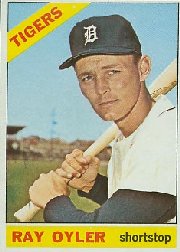
A former shortstop named Ray Oyler is the poster boy for all BHOM candidates. Oyler only played for parts of six major league seasons with the Detroit Tigers (1965-68), the Seattle Pilots (1969), and the California Angels (1970), but he managed to achieve just about everything one might expect from a mediocre major leaguer over that extended course of time. In 542 total games, the equivalent of about 3.5 full seasons, Oyler collected only 221 hots in 1,265 official times at bat for a career batting average of .175. His On Base Percentage (OBP) was a mere .258 and his Slugging Average (SA) was only .251. Of his total hits, only 29 were doubles, 6 were triple, nd 15 were home runs. He also struck out 359 times relative to the 135 times he walked. Other than the shortfall on his time in the majors, the only other blight on Ray Oyler’s record is the fact that he played for the 1968 World Series Champion Detroit Tigers. Also, it may be fairly obvious by now, but it was Ray’s defense that kept him big league afloat for as long as he managed to last. He was still done and out of the fun in 1970 at the age of 32.

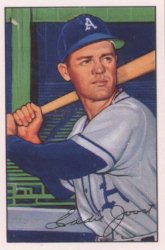
Eddie Joost’s .185 in 1943 is the worst ever for a full-time player in one season.

Several seasons earlier than Ray Oyler, fellow shortstop Eddie Joost set the record for the worst single season batting average by a full-time big league player when he clocked in at .185 for the 1943 Boston Bees. He also punked out a .299 OBP and a .252 SA on the ’43 season.

Sadly, Joost wasn’t able maintain this level of ineptitude over his entire 17-season (1936-55) career. He managed to finish with an elevated .239 BA, a .361 OBP, and a .366 SA with multiple major league clubs to pull himself up from the direst strains of pure mediocrity.

Why should we honor mediocrity? Here’s the best reason in the world: If it weren’t for the supremely mediocre players, the bad players would never look good, the good players would never look great, the great players would never seem deserving of the Hall of Fame, and the Babe Ruths and Hank Aarons wouldn’t have ten books a year published on each of them by different houses and authors. Plus, we probably never would have heard of Bob Costas or Peter Gammons as commentators on greatness without all those mediocre players out there making everybody else look so much better.

If you have a favorite candidate for the future BHOM, Al Doyle and I would love to hear from all of you. Just drop me an e-mail or, better yet, leave a comment below as part of this article. If your candidate is selected, we will be very happy to give you credit as the nominating party when the day comes to get this special hall of honor up and running in reality.

In the Baseball Hall of Mediocrity, all new inductees will get in on the ground floor and just stay there. Without that flooring, the stars of the game would have no place to walk. We want to make sure that every deserving plank, knotholes and all, is remembered for its particular contribution to the backdrop of the game. Once that  purpose is clearly understood, the BHOM will become what it needs to be: a place where we remember baseball’s individually forgettable players, managers, general managers, administrators, owners. broadcasters, writers, pundits, coaches, and commissioners.

Also, send us your ideas on the best potential site for the Baseball Hall of Mediocrity. We are looking for a town and community that will help the BHOM live up to its name.

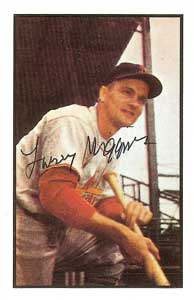
Larry Miggins: Honesty is the Only Policy!

March 4, 2010

In 1950, Larry’s honesty may have cost his Columbus Redbirds team a playoff win.

84-year-old Larry Miggins and his dear wife Kathleen are two of my dearest friends. I count my lucky stars daily to have these good people of love, cheer, and integrity in my life as close companions on this ride through life. As a kid, I never would have dreamed it possible.

Larry Miggins was a Buffs baseball star back in the day. I was just a kid fan from the East End of Houston. I simply didn’t understand at the time that if you love baseball long enough it will bring you together with some of the people you once loved as players. Life is truly amazing.

Yep, Larry was one of my heroes as the left fielder  for the Houston Buffs of the Texas League over several scattered seasons in the late 1940s and early 1950s. 1951 was the big year. That was the season that Jerry WItte (38 HR) and Larry Miggins (28 HR) led the Buffs offense as Vinegar Bend Mizell and Al Papai pitched the club to the straight-away and playoff championship of the Texas League.

Larry had a reputation even back then as a pure of heart guy who wouldn’t tell a lie for anything. He once declined an opportunity to walk future movie star and wife of Bing Crosby Kathryn (Grandstaff) Grant to home plate in a beauty contest at Buff Stadium because “she barely had any clothes on.” As I recall, Miss Grandstaff was wearing one of those one-piece cover all bathing suits that were the very modest style for women in the early 1950s. It simply wasn’t enough flesh-covering material for the modest Mr. Miggins.

The ultimate Miggins honesty story occurred a year earlier, when Larry was playing left field for the AAA Columbus Redbirds of the American Association. How it all came about in a critical playoff game speaks volumes for the Miggins reputation for honesty that preceded the incident itself. The opposing manager in that game actually instigated the event in the hope that Larry’s honesty would allow his club to prevail in a critical game situation.

In a best-of-seven league playoff games semifinal contest, Columbus had won two of three against the St. Paul Saints in Minnesota before going home for what would turn out to be a memorable fourth game on Sept. 17, 1950.

Columbus held a 2-1 lead in the eighth inning when a grand slam homer by St. Paul catcher Jake Early suddenly gave the Saints a three-run lead. The next Saints batter, pitcher Bill Ayers, drove a ball to the deep left field wall in Columbus. Larry Miggins was the Columbus gardener in that area of the pasture.

Former Cardinal Larry Miggins’s two big league home runs came off Warren Spahn & Preacher Roe.

“I went over there and leaned up and missed the ball by about a foot,” Miggins exclaims. “The ball hit a seat in the stands and bounced back and I grabbed it and fired it back to second base.”

Umpire Bill Jackowski called it a ground-rule double. The call yanked St. Paul manager Tommy Heath out of the dugout on a fast track to protest. As Heath predictably started losing the argument he decided upon one final plea to Jackowski.

“Ask Miggins out in left field if it was a home run,” Heath pled.

Also aware of Miggins’s reputation for honesty, Jackowski started walking toward left field, taking a step he would have risked with few others. Jackowski was going to ask Miggins to report on what he had seen of the ball’s landing spot.

The teammates of Larry Miggins went into panic. Behind the walking umpire, Columbus shortstop Solly Hemus could be seen waving his arms in a desperate signal of “NO HOMER” to Larry Miggins in left. Center fielder Harry Walker actually tried to lead Miggns away from the advancing umpire.

Nothing worked. Umpire Jackowski caught up with a grim-faced, hands-on-hips Miggins in deep left.

“I lost the ball in the sun and couldn’t tell if it bounced in or went in (to the stands) on the fly, Larry,” the umpire explained. “I gotta ask you man to man: Was it a home run?’ ”

Miggins thought a moment and then spoke. “Bill,” Larry commented to the umpire, “anybody who hit a ball that far on the fly in this ballpark deserves a home run. Yes, it was a home run — but, for heaven’s sake, from now on, you do the umpiring. I have enough trouble trying to play left field.”

When Jackowski then gave the whilrybird sign for a home run in deep left, the grinning St. Paul runner went into his job-finishing jog from second base as the Columbus crowd rained loud boos upon the ump, the Saints, and their own left fielder, Larry Miggins. At inning’s completion, another chorus of boos for Larry Miggins accompanied him on his jog to the dugout.

Columbus lost that game but won the series in six. The Red Birds then followed that victory by defeating Indianapolis in the championship series when Mo Mozzali hit a home run in the top of the 13th inning in Game 7. The homer  earned the Red Birds a place in the Junior World Series. The Red Birds then defeated International League champion Baltimore four games to one in what proved to be the last Junior World Series title for Columbus — and the last year that Hemsley managed the team.

End of story. Start of integrity test.

If you had been in Larry’s Miggins’s shoes that day In Columbus back in 1950, how would you have answered the umpire’s question? Feel free to post your answer below as a comment if you so choose to own your position publicly.

Rettig’s Ice Cream was Hmm! Hmm! Good!

March 3, 2010

Retttig’s at 1900 Milam Made & Sold Ice Cream on a Wholesale & Retail basis.

The sign above says it all. If you need more of a visual reminder, check out these copyright protected photos of what used to exist at the 1900 block of Milam in downtown Houston from the 1920’s forward for about thirty years. (You may have to cut and paste the following website address to see them.)

http://www.sloanegallery.com/historic_houston_texas_vintage_r.htm

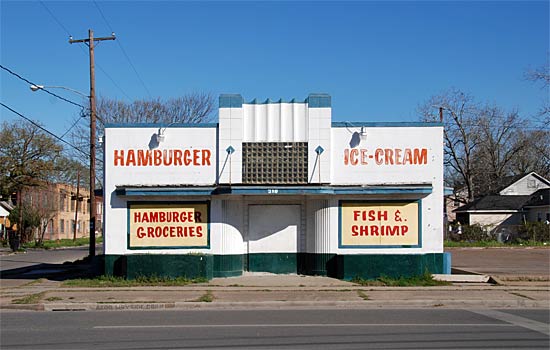
Rettig’s produced some delicious ice cream in several tasty flavors. They eventually got around to opening several neighborhood stores around Houston that they called Rettig’s Heap-O-Cream. Here’s a photo of the one I remember best at 210 Wayside. The old store building remains, but is now all boarded up, as though it were waiting for a comeback that is now never going to happen.

Rettig’s Heap-O-Cream, Once Upon a Time at 210 Wayside.

Things always change, but the great taste of delicious ice cream remains popular to the palate even though it now must battle with new health information, common sense, and the politically correct forces of the Dr. Oz types who want to move all of us hard-core sugar addiction cases to a far healthier, more boring way of life.

Thanks for the memories, Rettigs!

Frank Shofner: An Everyday Guy.

March 2, 2010

Frank Shofner Hit .241 for the '51 Buffs.

Every field of human endeavour has them. Most of us are them. We are the minions of the masses that make every clock of human effort tic. Without us, there would be no night sky in place for all the stars to shine. There would be no cars fixed by the side of the road when really important people are late for meetings in the halls of power. There would be no torch bearers streaming through the darkness when it was time to storm Dr. Frankenstein’s castle. There would be no  Rosencrantz or Guildenstern lending quiet body and soul to the telling of Hamlet.

Frank Shofner of the 1951 Houston Buffs was such a character in baseball. We may talk and write of Ruth and Aaron all we want, but we simply could not play the game without the multitudes of mediocre performances supplied much more frequently by ordinary guys like Frank Shofner of the minor leagues and Ray Oyler of the majors (See Ray’s stats for Detroit, 1968, or just check out his general career.)

Frank Shofner hit .241 with 6 homers as a back up to rising star Eddie Kazak as third baseman for the ’51 Houston Buffs, He delivered a few key pinch hits along the way and he battled every opportunity that came his way as though it were the chance of a lifetime. At 6’1″ and 185 pounds, Shofner had a stockier appearance and not much speed, but he had quick hands and a frog-and-the-June-bug relationship with balls dribbled or bunted down the third base line.

From the stands, you could often hear him barking support, laughing, kidding encouragement to his mates, doing whatever he could to help everybody keep their heads in the game. As a torch bearer, he lit his own and tried hard to ignite the lights of all the other Buffs. Put that personality and temperament into the same guy who batted .241 and you sure would prefer to have Frank Shofner on your bench than some guy who batted .300, but only cared in a dead pan way about his own stats and credit.

In his nine season career (1944-1952) as a minor leaguer, Frank Shofner batted .278 with 49 home runs. He was 2 for 13 (.154) with a single and a triple in his only major league action for the 1947 Boston Red Sox, but that’s OK. The rule of the minions still applies: Without the Frank Shofners of this world, there would be no stage for the Ted William’s and Stan Musials of the hardball game.

Shofner and Oyler shall live on through the ages as Rosencrantz and Guildenstern characters in Baseball’s Hamlet.

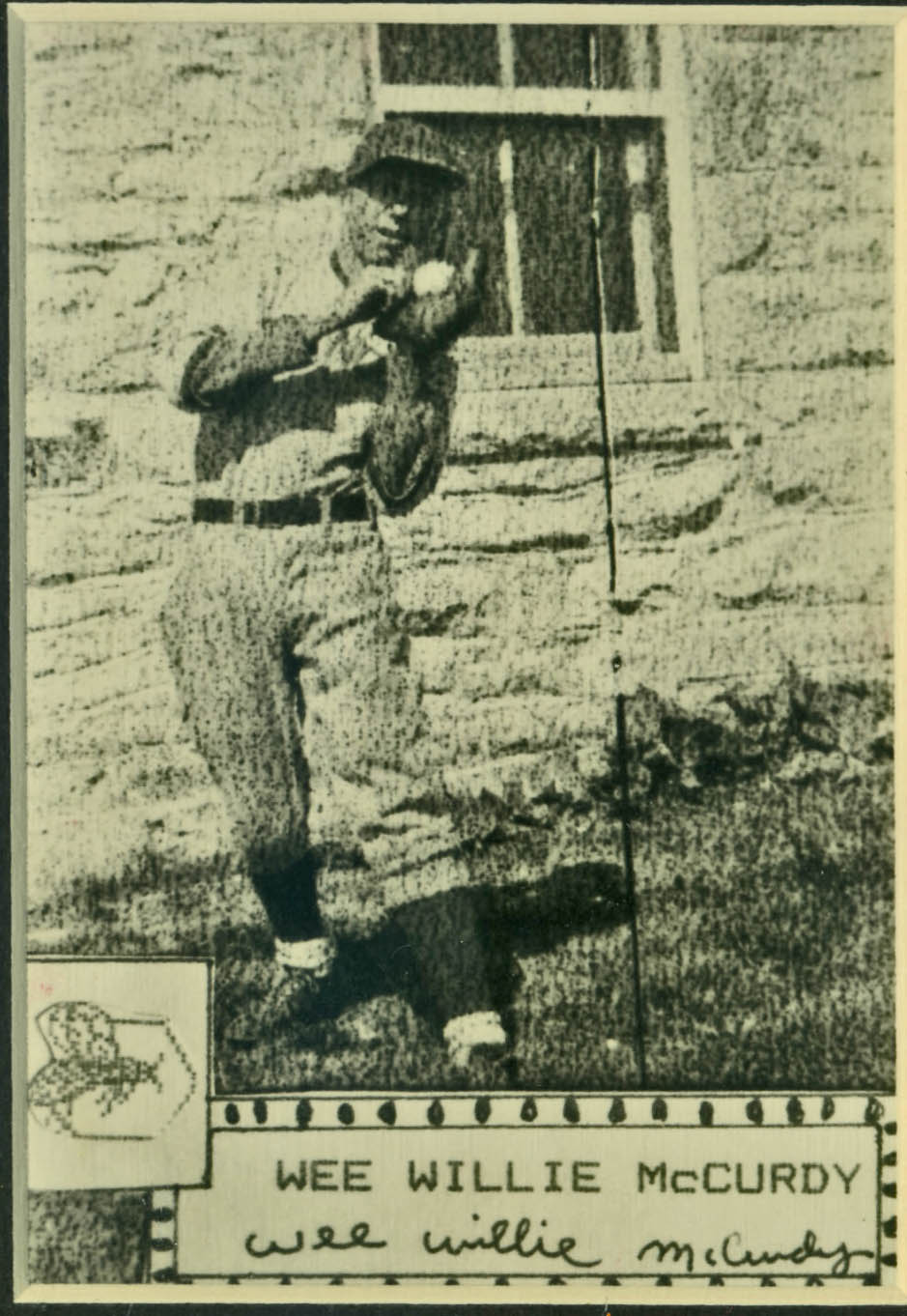
Remembering Wee Willie.

March 1, 2010

Dad played CF for the 1928 St. Edward's Broncos. He loved this card I made for him a few thousand years ago.

“You’re the baby, Bill! – You’re the baby!”

One of my earliest memories trails back to the year 1939, when I was only about one and a half years old. I’m stomping around the right field wooden grandstands of the old ballpark at the Bee County Fairgrounds with my mom sitting nearby. My dad is coming to bat from the  left side of the plate and his Beeville Bee teammates are yelling encouragement to the baby on the team. Then I see Dad swinging the bat and lacing a base hit to right field. There is cheering. Then all goes to black down memory lane. That little snippet is all that remains, but it is as clear as the bad lighting of the old field back home allows it to be.

Of course, all my descriptions of what just happened came later. I didn’t know baseball from base hit back then. I just knew that people were cheering for my dad and that he had done something to make most of them happy. I saw it all happen.

Three and one half years later, on my New Years Eve fifth birthday, we would move from Beeville to the place that would become my home forever – a place called Houston – and I would learn a lot more about baseball from my dad, the Houston Buffs, and almost endless summer days on the sandlots of Houston’s East End.

Dad was first and best ever teacher. Then he got out of the way and allowed me to learn the rest of the game on my own with my summertime sandlot buddies. None of us had eager parents leaning over our shoulders or buying us things back in the day. In the East End, at least, we either inherited bats, balls, and gloves or we got little jobs to buy them over time. Uniforms, even caps, were a luxury we didn’t even dream about possessing.

One year my mom made me a Houston Buffs uniform. In fact, she steam-ironed those letters onto the front of the jersey, “Houston Buffs.” It came with a little blue cap that had four red stripes evenly descending from the button top of the cap crown.

I wore the homemade Buffs uniform at home. Even paused long enough for Mom to take a picture of me in it once. I simply wouldn’t wear it to the sandlot. None of my teammates had one and I didn’t want to be different from them. I only wanted  to be one of them, as I already was. Knowing in our hearts and minds that we were the Pecan Park Eagles was good enough for us. We didn’t need a Houston Buff uniform Christmas present to play baseball.

We once got into a turf war with the kids from Kernel Street over the use of our field on Japonica. We had even taken to using pipe guns that shot gravel (made for us by one of our adult machinist neighbors) to defend our territory. I can’t believe we took it that far, but we did.

When the war broke out, my dad came flying out of the house and put a stop to all of it. I never learned what happened to our pipe guns, or how he handled it with the neighbor who built them for us, but we never got any more “help” from the machinist after this episode. That much I know.

Dad made us all assemble on the sandlot and play out our differences in a game of baseball, Japonica versus Kernel streets. We did. And we whacked ’em pretty good. After that, we all played together on the same field with no further trouble.

I had further trouble. Dad still wailed the tar out of me at home after the game for my involvement in the production of those pipe guns, but I deserved it. How he put up with my shenanigans as well as he did, I’ll never know. I’ll just always be grateful he was there.

“You were the baby, dad. Thanks for being in my life for as long as I was privileged to have you here with me. I’m old now, but I’ll never grow too old to say thank you. You taught me much more than baseball. You taught me tough love, honesty, integrity, loyalty, and commitment.

The one thing you didn’t teach me is how to get over missing you.