Posts Tagged ‘History’

Sandlot Days: Making Do with What We Had.

April 2, 2010

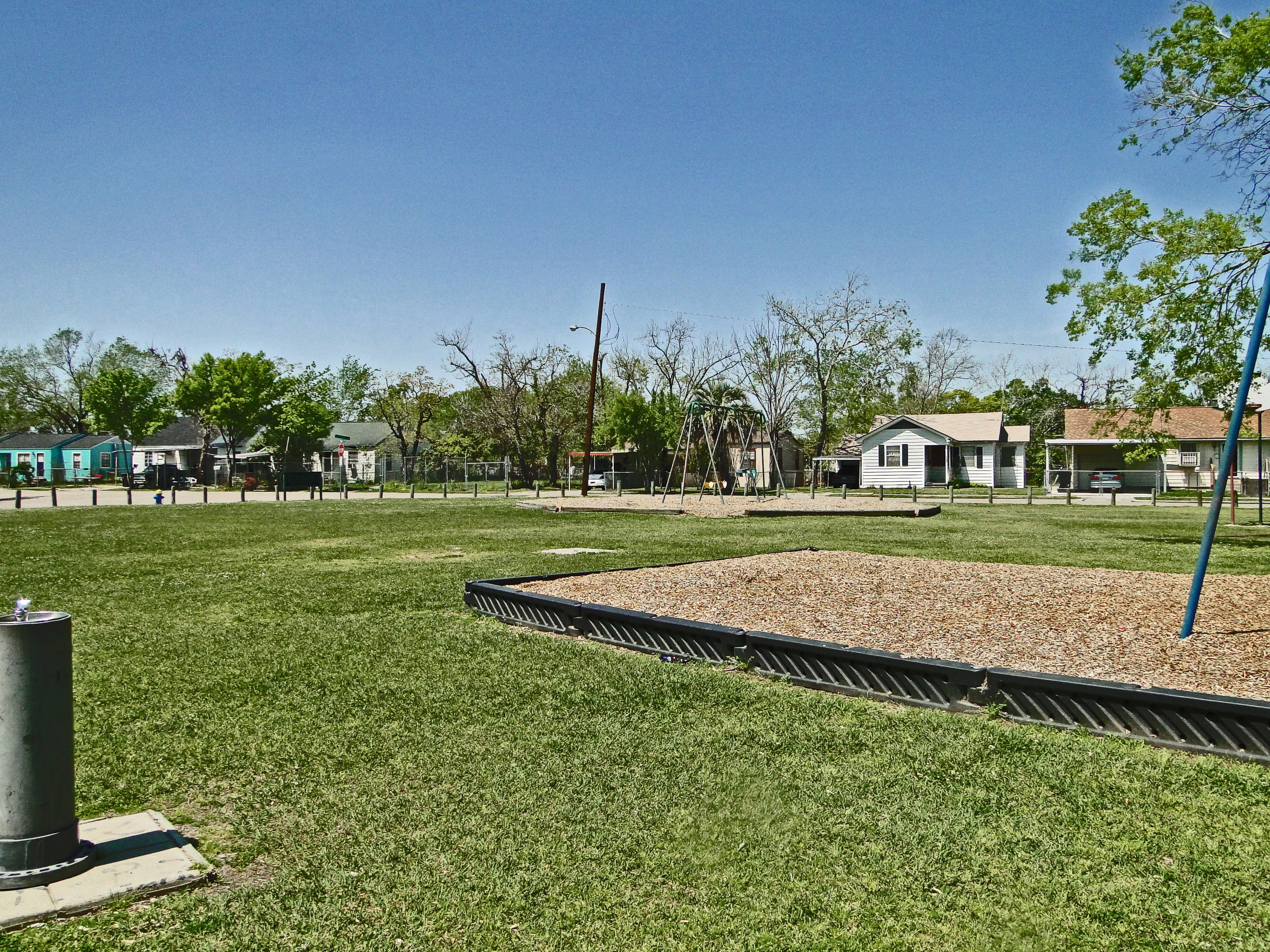
"Eagle Park", Japonica@Myrtle, Houston, Texas.

For a lot of us who grew up back then, the years following World War II were not even close to the cornucopian basket that others have known in this land of the fatted calf. In East End regions of Houston like Pecan Park, we had to make do with whatever we had – or repaired – or built – or simply imagined our way into use as tools in the art of play.

Sometimes our imaginations got us into trouble. And street war games became a ripe arena for a number of mistakes we made in pursuit of authenticity. One time, for example, about six of us caught hell for the unauthroized requisition of eggs from our home refrigerators for use as hand grenades. Another time, my little brother John used a real grenade casing that our Uncle Carroll had brought us from World War II and heaved it through the open window of slow driving car that was passing by the front of our house.

The driver of the car turned out to be a veteran. The sudden presence of the grenade on the seat next to him provoked screams of PTSD horror I shall never forget – and neither will brother John. The man stopped his car down the street and came running back to our house with mayhem in his eye. Fortunately for John, our dad came rushing out of the house to intervene and to administer a “whipping” that I’m sure John has never forgotten. I’ve never seen Dad so mad – except on those occasions when he was equally mad at me for some stupid thing I did.

“Now you stay out of the street and never let me catch you throwing hand grenades again!” Dad ordered.

“What if I run out into the street and get killed by a car? Then what are you going to do?” John asked.

“II’ll probably be so mad you disobeyed that I will whip you anyway!” Dad answered.

I later got a whipping like that for a far worse offense. That was the time I asked a machinist neighbor to build us some working pipe guns that we could use to ward off invasion at Eagle Park from the kids on Kernel Street. We didn’t explain our true purposes in wanting the guns. We said we needed them for target practice, but that was never our true goal.

I’ve written about this gun incident before. My dad caught us in the act of firing these weapons at the Kernel kids and took them away. Then he made us Japonica-Myrtle Eagles settle our differences with the Kernel kids in a game of baseball. Then he whipped my posterior in a way that left me virtually buttless. It was one of those corner-turning experiences from childhood that would have gone a very different route had it not been for the presence of the greatest hero in my life, my dad.

At Eagle Park, we made do with what we had. The gloves we did have were hand-me-downs from dads and older brothers. The balls we used were most of the time those cheapos that flattened out on one side with the first solid contact smack of the bat. The few good baseballs that we captured at Buff Stadium stayed in play for as long as we could hold them together with black electrical tape. Even the best of all  baseballs could not hold up for long against the skinning they each took with the one-block skip and roll down concrete streets as a result of mighty hits one way – and catcher misses the other.

To cut down on the damage to balls from catcher misses, and mainly to have a ball retriever, we created a tenth defensive position we called the “hind catcher.” We would not have needed a hind catcher nearly so often if we had been blessed with a backstop, but that was a piece of equipment we didn’t have at Eagle Park.

The hind catcher stood about ten feet back of the catcher. It was his or her job to stop an balls that got past the catcher, or else, chase them down Japonica Street and get them back in as soon as possible. It was job we always gave to the youngest, most naive kids, the one who were trying to earn their way into the actual game. We stressed to our hind catcher recruits that those who stopped balls most often and went after the loose ones the fastest had the best chance of breaking into the everyday game on the field.

It was a popular job among the little kids. Sometimes we would even have a hind-hind and a hind-hind-hind catcher out there backing up the hind catcher. At the end of the day, or as some kids had to go home early from the field, all our hind catchers moved into the actual game and got to bat – at least once.

The system worked for us. It’s how we all started.

Bat preservation also presented certain challenges. Since all our bats back then were also old and always wooden, they eventually cracked and became useless without repair. We nailed and taped our bats back together too, looking for every last hit we could ring out of each sacred bludgeoning weapon that still stood moderately straight in our baseball war chest. A bat had to break totally in half before we gave up on it for all time.

As for bases, we used what we could find. We never had permanent bases at Eagle Park. Garbage can lids  worked for home plate, but they sure expanded the strike zone. We used everything from decaying hunks of sidewalk curb concrete to tee shirts for our actual bases.

On those days we couldn’t field eighteen players for a regular game, we played “Work Up.” It was just baseball with fewer players and a slightly different goal. You had three to four batters in Work Up. The object was stay at bat as long as possible. If the defense got you out, all the fielders rotated from 9 to 1, with the number 1 fielder, the pitcher now going in to bat. The number 2 catcher now moving to pitcher, etc. You, of course, moved to the number 9 right field position to try to do what game says, “work up” to becoming a batter again.

Another popular game for a small number of players was “Flies and Rollers.” In this game, one player hit fungos to the other players in the field. The first fielder to successfully handle either three flies or nine rollers, without a miscue, got to replace the fungo stick batter, who would now take the field.

Somehow we survived. A big part of that “somehow” was the fact that we all mostly had parents who cared; we lived in neighborhoods where other parents could and did intervene and deal with issues of bad judgment and miscreant kid behavior; and the world was still safe enough for us kids to go out there and work things out on our own.

A lot of us didn’t have much back then, but we neither thought of ourselves as poor or entitled to everyday salvation at the expense of the community. Our parents taught us that jobs were the answer to financal needs and that you simply didn’t buy things you could not afford. We learned to make do with what we had.

We did OK, even if a very important part of our little world was being  held together most of the time by electrical tape.

In Search of a Few Ballparks.

April 1, 2010

Bob Dorrill of SABR surveys the turf at “Eagle Park.”

On Tuesday, March 30, 2010, good friend and fellow SABR member Bob Dorrill, our esteemed Larry Dierker Chapter leader and field manager of our vintage base ball Houston Babies, and I spent the day in search of some old local ballparks. For the most part, we knew that all of them on our list were long gone in physical form, but we were searching for something a little harder to see. We wanted to make whatever contact that might still be possible with the essence of these neighborhoods that spawned them long ago. Going in, we also knew that most of the cultures that once existed in each area we visited had long ago either mutated or been run off to the hinterlands. It was a daunting task, sort of on the level of trying to travel through time without a time machine, but that’s the very nature of historical baseball research. You always end up yearning for that one-hour direct view of the game or event or place itself that is under study – or for that one interview moment with the last eyewitness on the fiftieth anniversary of their burial in the cemetery. Neither ever happens.

Here’s a thumbnail on what we found and didn’t find.

(1) Buff Stadium.


Buff Stadium 1928-1961 (Forget the years they called it Busch Stadium.)

As I described yesterday, Buff Stadium was our first and main stop. The memory of the grandest old ballpark in Houston baseball history is well protected by the Finger family on the site of their store on the Gulf Freeway at Cullen. The Houston Sports Museum is again operating within the store in a vastly improved and tasteful presentation of Houston baseball history under the capable direction of Curator Tom Kennedy.

(2) Eagle Park.


Eagle Park, 1947-54; Sandlot Home of the Pecan Park Eagles.

Eagle Park was the name a few of us Japonica-Myrtle Street kids gave the little city park we claimed as home field of our Pecan Park Eagles. The place represents all the thousands of sandlots that once filled daily in the Houston summertime from dawn to dusk for some serious non-stop baseball. We had to stay inside during the so-called “heat of the day” (12:00 PM to 3:00 PM) in 1950 due to the threat of polio, but we made up for lost AB’s once we were again paroled to the streets.

The above featured photo shows the field perspective from where home plate used to stand. All of that dumb playground equipment and the water fountain weren’t around back in 1950. We would have torn that stuff to the ground for getting in the way of baseball back then. Now the kids don’t play sandlot ball on their own out of some natural love for the game. If they play the game at all. it’s the Little League version under constant adult supervision. No wonder the kids lost interest in the game. Organized youth sports offer no freedom and about two games and six at bats per week. We had days on the sandlot when the individual times at bat ran well into the hundreds.


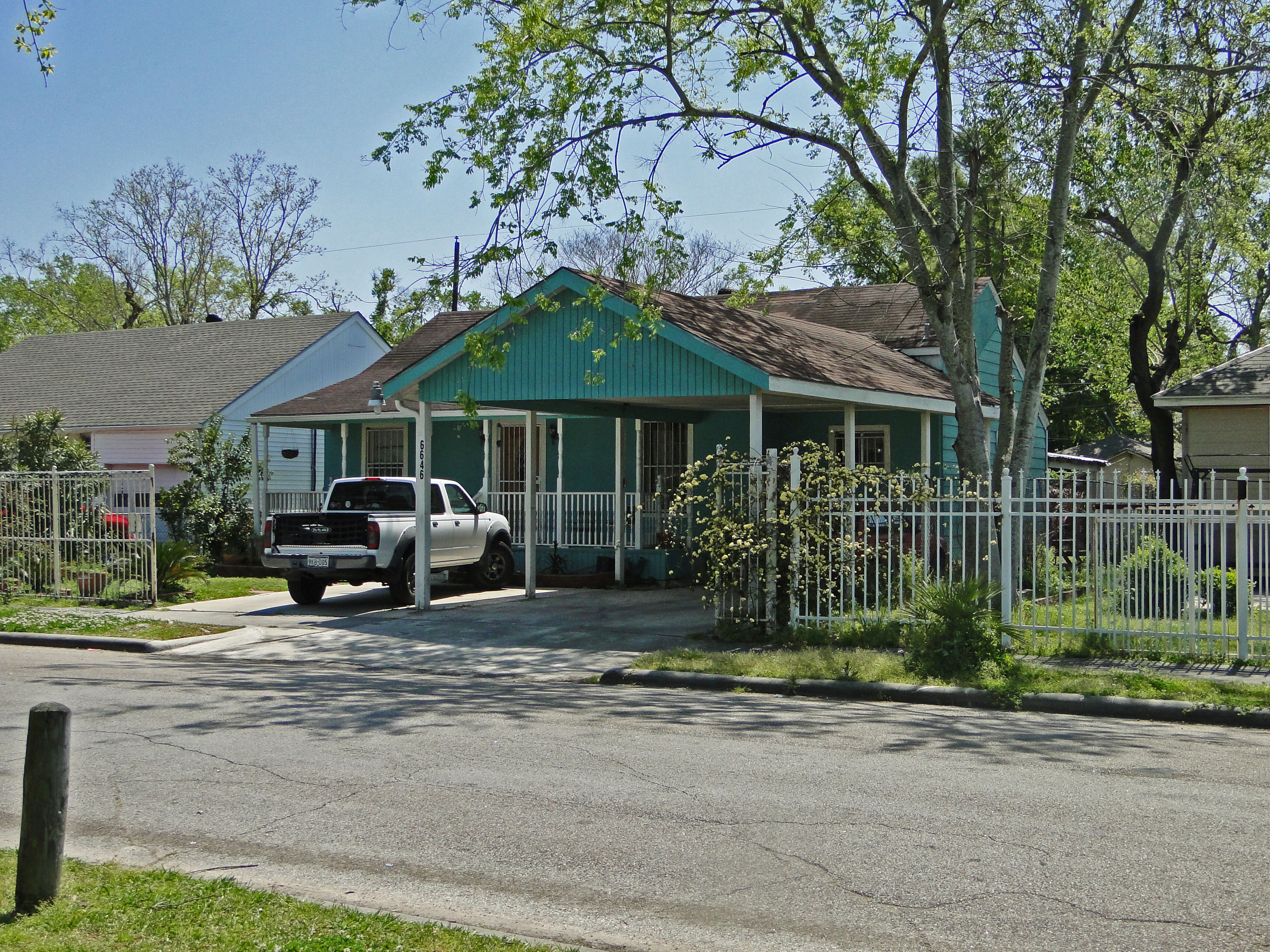
6646 Japonica Street, Houston 17, Texas.

The front door of my childhood home was just about ninety feet from home plate at Eagle Park. The house wasn’t blue back in the day, but neither was I. The world of hope spread out before me as the endless lawn of summer fun with other East End street urchins as we pursued our all-day, no matter what, from here to eternity passion for the game of baseball.

(3) East End Park.

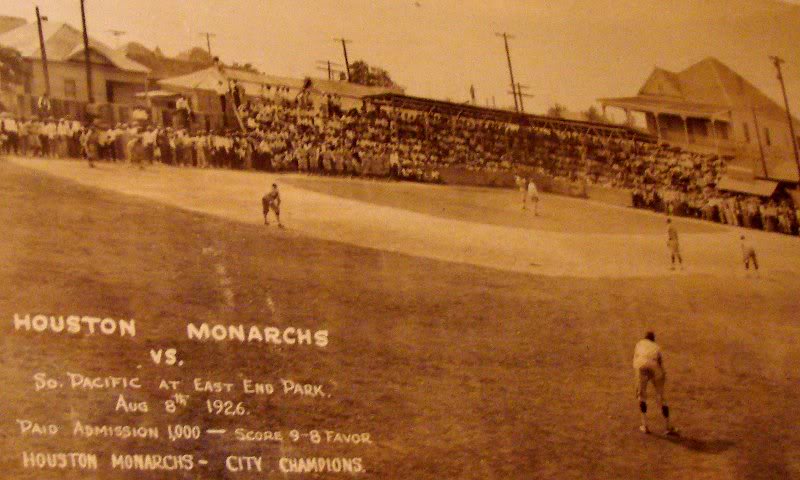
East End Park, 1920s, on Cline off Clinton Drive.

Thanks to team owner John and James Liuzza, East End Park was the thriving home of black baseball for several years in Houston during the early decades of the 20th century. Both the Houston Monarchs and their later named selves, the Houston Black Buffs, played here, especially to enthusiastic crowds on Sundays.

Everything in the photo is gone or changed beyond recognition today. Some dilapidated one-story shanties now stand on the street where the two-story homes once stood. The ballpark is completely gone, now replaced by a large and fairly new and well-kept looking garden apartment building project. Because of the old fifth ward neighborhood’s proximity to downtown, new homes and bastille-guarded apartments are springing up like orchids in a patch of architectural weeds in this area, but there is no  sign of baseball  here. Not now.

(4) Monarch Stadium. No picture is available to us, but the Liuzza Brothers  built a second ballpark in the 1930s near East End Park on Gillespie Street. It also is gone, leaving no trace of where it ever prevailed as a site for baseball. When people change directions, they eventually or sooner change the landscape too.

(5) West End Park.


West End Park, Home of the Houston Buffs, 1907-1927.

We took Smith Street south from downtown to Andrews Street, the little lane that angles off the northern side of of Allen Center and past the southern side of the iconic Antioch Baptist Church. A few short blocks to 601 Andrews put us right where the 1919 Houston Street Directory tells us was the 601 Andrews Street mailing address for West End Park. Today it is some kind of power grid for the electric company. It is only  a short block from where the freeway cuts off Andrews from further movement southwest. Mike Acosta of the Astros believes that the old location for home plate at West End Park would now be found under the freeway. If the field was laid out facing southeast, as we “think” it was, then Mike’s guess is probably right on target. Like the others, West End Park is now gone, without a trace of evidence remaining that it ever existed in the physical world.

(6) Minute Maid Park.


Minute Maid Park 2000-Now.

We finally found a ballpark that still lives, houses baseball, sells beer and hot dogs, puts a Houston team on the field that tries its best to win ballgames, and one that brings the thrill of a pennant race into our lives almost every single year. It’s at this ballpark, where baseball has a present and future to go along with its rich past, that all comes to new life. While we were there, I even managed to pick up a couple of nose-bleed tickets for Opening Day next Monday and the Oswalt-Lincecum match-up between the Astros and the San Francisco Giants.

It was a great day. If those of us who love baseball could have more days like the one that Bob Dorrill and I shared last Tuesday in search of old ballparks, we would all live happily to about the age of 150.

See you at the ballpark, friends!

My Souvenir from Ballpark Search Day.


Straight from the Heart. (That’s the Eagle Park dirt in the glass jar.)

My souvenir from the ballpark search day was no accidental find. I planned it by bringing a tall glass jar and a small garden hand spade with me on Tuesday. The bottle now contains something I’ve wanted to bring home for years. It’s a bottle filled with dirt from the home plate area of Eagle Park – and it is just as black and hard as the gumbo we played on sixty years ago. – And why shouldn’t it be black and hard and similar? It’s beyond similarity. It’s the same ground we played on a lifetime of ballgames ago.

Have some fun, folks. None of us are getting any younger.

The Houston Sports Museum Is Back!

March 31, 2010

Rodney Finger Has Reincarnated an Improved Tribute to Houston History at his “new” store on the Gulf Freeway at the Site of Legendary Buff Stadium (1928-61).

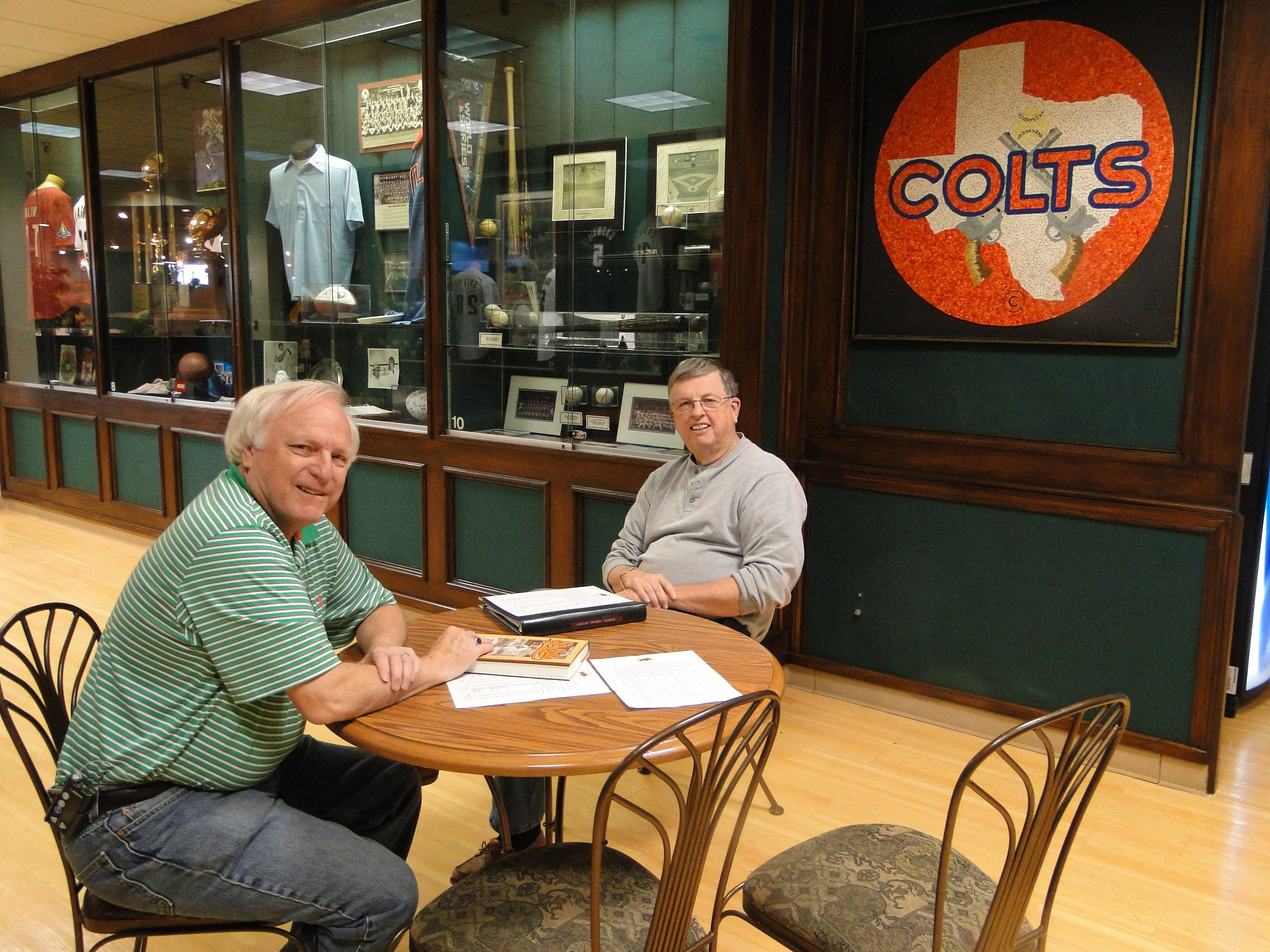
Yesterday Bob Dorrill of SABR and I went over to meet with Tom Kennedy, the Curator of the Houston Sports Museum, and to get his tour of what is happening with the newly reopened facility at the also newly remodeled and reopened Finger furniture store at that historical location.

Words alone fail. That’s why you will be getting many photos today. Rodney Finger and Tom Kennedy are pulling out all the stops to make sure that the presentation and artifact preservation issues that plagued the “HSM” in the past are now resolved and replaced by a rotating exhibit of items that are truly unique and valuable to history.

The HSM will keep its historic name and honor its dedication to remembering the Houston Oilers and Earl Campbell as well, but this evolving version of the dream will be mostly about baseball, as was the original intention of 1960s founder and Rodney’s grandfather, Sammy Finger.

Bob Dorrill (L) and Tom Kennedy talk things over in front of a new mural version of Buff Stadium on its original Opening Day, April 11, 1928.

On display are two of the original 80 36″ diameter metal buffalo medallions that once rimmed the exterior perimeter stadium walls of Buff Stadium.

In a DVD narrated by Gene Elston, the story of Houston professional baseball from 1888 forward now plays continuously on a high-definition television set within the museum. Other digital telecasts are planned for inclusion in the future on a rotating basis.

The quiet, classy hand of Houston Astros Acquisitions Director Mike Acosta is also visible in the new HSM on several levels. Acosta has been working with Kennedy to help make the new Finger’s showcase the first order presentation it is fast becoming.

“It’s not how much space you have, but how you use the space you have that matters.” Kennedy and the HSM are dedicated to the idea that choice items, rotated for view on a frequent thematic basis, will help keep giving people reasons to return. The public will have a chance to view the world’s oldest baseball card from 1869 at some undetermined point in the near future.. Rodney Finger has asked card owner JeFF Rosenberg, the owner of Tri Star Productiions, to allow the HSM to display it sometime soon and it is expected that this will happen. Say tuned for further specific details from Tom Kennedy. Everything well done takes time. To better protect historical treasures, HSM also has installed protective lighting to help preserve artifacts and help prevent the fading of important signatures from autographed items. In case you are wondering, that’s an ancient Houston Buffs jersey on display in this photo, along with several books that are important to local baseball history.

The former exact site of home plate is still imbedded in the floor of the HSM. It will soon be joined by the return of the larger than life statue of Dickie Kerr, the late-in-life Houstonian who once pitched as the “honest man in” for the 1919 Chicago Black Sox.

The art of LeRoy Neiman’s Nolan Ryan rises above the lesser light of some dedicated less celebrated Astro heros.

The history of Houston baseball is all here. Look for word of the HSM’s Grand Re-Opening Day, but drop on by anytime now to check the progress. Tommy Kennedy says he has about sixty per cent of their Finger’s items on display and that further acquisitions are planned. It’s a show that will never end or be complete and it’s Houston baseball history in its purest form. The vision of Rodney Finger and the hard work of Tom Kennedy is out there saving the day for something that could have been lost forever. Thank you, Rodney! And you, Tom! The business of museums belongs in the hands of those people of integrity who truly care about history – and you guys are both such folks!

Many of us grew up reading our first baseball game stories from the mind and pen of former Houston Post writer Clark Nealon. It is only right and fitting that the HSM honors the late Nealon in the fine way it does.

There will always be room at the HSM for a fellow named Earl, even if he didn’t play baseball.

Rodney Finger is a man of vision. He took out a wall so that visitors to the new Finger’s store on the Gulf Freeway would have this view of the Houston Sports Museum as they entered the building. Good luck, Rodney! Based upon what we saw in a nearly three-hour meeting with Tom Kennedy yesterday, I think it’s safe to say that Bob Dorrill and I both walked away quite impressed. Know too that we will be around to help you any way we are able – and that we will spread the word to other SABR members about your plans and actions to date.

Have a nice spring day, everybody. We’ll see you at the ballpark soon.

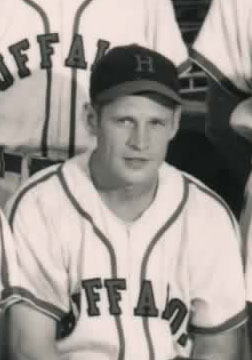
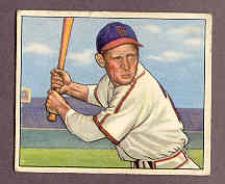
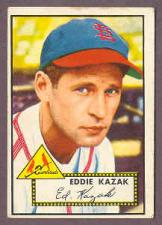
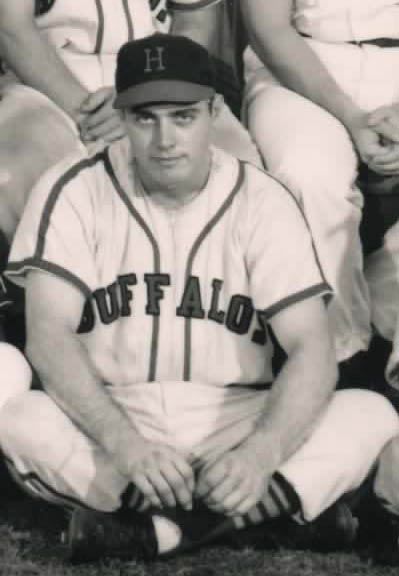
Eddie Kazak, 3B, ’42-’51 Houston Buffs.

March 30, 2010

Eddie Kazak, 3B, '42, '51 Buffs

He came here young and left here old. In between his two years of service as a third baseman for the 1942 and 1951 Houston Buffs, Eddie Kazak (6’0″, 175 lbs., BR/TR) of Steubenville, Ohio carved out a pretty fair mostly minor league career for himself in the St. Louis Cardinal system. Born July 18, 1920, Kazak began his first tour with the ’42 Buffs at age 21; he was 32 with three seasons of major league experience at St. Louis behind him by the time he returned to the Lone Star State.

I remember Eddie Kazak as a far superior hitter and fielder at third base than Tommy Glaviano, our column subject yesterday. He was slashing, line drive hitting without a lot of home run power, but the kind of guy that Buff fans trusted in those pinch moments when Kazak came to bat.

Eddie Kazak hit .304 with 13 homers and a slugging average of .474 in 104 games for the ’51 Buffs. His offensive numbers earned him a late season call up to the parents Cardinals. In 1942, Eddie batted only .257 with 5 HR for the Buffs. In 17 seasons as a minor leaguer (1940-42, 1946-60), Eddie Kazak batted pretty darn well. He registered a batting average of .307 with 153 home runs and  slugging average of .445. His best minor league season came after his last gasp as an MLB prospect when he batted .344 with 104 RBI, 19 HR, and a slugging average of .532 for the 1954 Beaumont Exporters as a farm club property of the Chicago Cubs.

Kazak’s major league numbers offensively were adequate to less than inspiring. In five seasons and 238 games (all but the last 13 games were spent with the Cardinals; the final quiet MLB hurrah for Eddie came as a Cincinnati Red), Eddie Kazak batted .273 with 11 HR 71 RBI, and a slug(gish)ging average of .383.

In 1949, Eddie helped compound the Cardinal frustration in their search for an adequate replacement for Whitey Kurowski at third base by chipping in 19 errors in 258 total chances at the hot corner. Tommy Glaviano, the other former Buff Cardinal third base suspect/prospect contributed another 19 errors in 267 total chances that same 1949 season. Cardinal ownership and the fans were tearing their hearts out in frustration – and Ken Boyer, who wasn’t even on the radar screen in 1949, wouldn’t get there as a solution until 1955.

Eddie Kazak was a fun-loving buddy of first baseman Jerry Witte while the two played together on the 1951 Buffs Texas League championship club and it’s easy to see why. They shared a Polish Catholic background and they both grew up in blue-collar families in northern cities. Witte hailed from the St. Louis area. Both men liked working with their hands and both loved hunting.

“We didn’t have much time to hunt and it was the off-season for hunting when we played for the Buffs,” Jerry Witte used to say, “but we made life pretty miserable for the turtles of Sims Bayou near Kazak’s place.” The two Buffs used to quell their appetites for shooting by taking aim with a .22 caliber rifle at turtle heads that surfaced on the Sims Bayou in the Houston’s East End. Back in the day, most people around here didn’t see this little recreation as cruelty to animals. In fact, for two Polish guys who liked to hunt, it was just “something to do.”

Eddie Kazak remained in Texas after his baseball career concluded. He died in Austin, Texas on December 15, 1999 at the age of 79.

Tommy Glaviano, 3B, 1947 Houston Buffs.

March 29, 2010

Tommy Glaviano, 3B, 1947 Houston Buffs

Tommy Glaviano may not have been the greatest stick and glove man who ever rounded the bend, but he held down the third base job pretty well for the 1947 Texas League-Dixie Series Champion Houston Buffs. On his way up for a brief career with parent St. Louis Cardinals, the 23-year old Glaviano batted .245 with 13 home runs and a .405 slugging average for the ’47 Buffs.

Tommy Glaviano (BR/TR) was born in Sacramento, California on October 26, 1923. At 5’9″ and 175 lbs, Tommy wasn’t exactly big enough to offer a wall of protection against slashing grounders and twisting cannon ball shot liners, but he was fast enough to have earned the nickname “Rabbit” for his speed and reflexive quickness. Tommy’s errors often came on the mental part of the throw that had to follow the great stop, but he wasn’t the first third baseman to suffer from that issue.

After signing with the Cardinals as a very young free agent, Glaviano broke in as a 17-year old 53-game rookie for the 1941 Class C Fresno club, batting .253 with 1 HR. The following full season, Tommy batted a combined .223 with Fresno and another Class C Cardinal farm team at Springfield, Ohio, where he played for future Hall of Fame manager Walt Alston.

1943-45 took Tommy Glaviano into the service of his country in World II. He returned to baseball in 1946, again on assignment to Fresno. This time it would be for an appointment with his greatest year in baseball, bar none. In 1946, Glaviano batted .338 in 126 games. He collected 29 doubles, 13 triples, and 22 home runs for a lights-out slugging average of .616 on the season.

A season like that at age 22 is enough to buy you at least a cup of coffee in the big leagues on the road ahead, even in the players-controlled-like-cattle era of the reserve clause and heavy club investment by some in their farm systems. In spite of Tommy’s down and disappointing statistical dive with the ’47 Buffs, he would get his run at the majors after an improving year with AAA Columbus, Ohio of the American Association in 1948. Glaviano batted .285 for Columbus, collecting 17 doubles, 7 triples, and 18 homers that bounced his slugging average up to .30 on the season.

Tommy Glaviano began a five season (1949-53) big league career the following spring. He never quite found the brass ring. In fact, he missed it by a country mile. In his five seasons (four with the Cardinals and one with the Philadelphia Phillies), Tommy Glaviano batted .257 in 1,008 official times at bat. He recorded 55 career doubles, 6 triples, 24 triples and a sluggish .395 slugging average.

After 1953, Glaviano played for two more full seasons (1954-55) and a doughnut-dunk at San Antonio in 1957, finishing with an eight-season minor league career batting average of .257 (same as majors) with 69 homers.

Tommy Glaviano passed away in retirement at his home in Sacramento on January 19, 2004. He was 80 years old. Tommy may not have lived up to his hoped-for potential, but he was old school. His death was another loss to our living remembrance of that golden earlier era in the game’s history. It will be up to the rest of us who also remember to make sure that Tommy and his baseball pals are never forgotten.

Long Live the Houston Buffs. Long Live the memory of the game.

Les Fusselman, Catcher in the Pie.

March 28, 2010

Les Fusselman: Catcher in the Pie.

Les Fusselman of the 1948, 1950-51 Houston Buffs was the personification of what everybody used to think that a stockily built catcher should look like. At 6’1″ and 195 lbs., Les had the physique of a catcher, the posture of a catcher, and the listen-to-me look of a catcher in his eye.

Unfortunately, Les Fusselman also ran and hit like a career minor league catcher who never would be quite strong enough, early enough, to make it for long in the big leagues with a talent-heavy club like the contract owning St. Louis Cardinals, but that’s OK. Les had his place in the higher minors. He was a   steady influence upon the pitching staff of the 1951 Buffs Texas League championship club and he had the catching range and moxie to work with pitchers like wily veterans Al Papai and Fred Martin while also serving as a steady and strong teaching influence upon the up-and-coming lefty star that Wilmer “Vinegar Bend” Mizell was becoming.

Les also hit with some pop for the ’51 Buffs, banging 36 doubles, an incredible 5 triples, and 12 homers for a .444 slugging average and a .255 batting average over the course of that championship season. It was enough to win the Western Illinois University alum a short-term trial with the 1952-53 Cardinals. In his two seasons and 43 games at St. Louis, Fusselman would hit a less-than-Mendoza-meager .169 and be sent back to the minors forever.

Les Fusselman’s rare baseball card is supposedly worth $300.00 today. I’d love to have one for my former Buffs collection, but not at that price. I can remember and appreciate Les Fusselman without his card, if need be, and that does seem to be the state of “need” for me on the card level. Meanwhile, I do think Les is another of those guys who could have had an earlier and longer major league career had he played the game today – now instead of then. He just seemed to be in control of things when he conferred with his pitchers during tight game situations. Maybe his age and veteran experience and persona were the keys that carried with through the gate of peer respect. He was as old as any and senior to most on the ’51 Buffs club.

Over the trail of his nine-season minor league career (1942, 1946-51, 1953-54), Le Fusselman batted .274 with 49 homers and a slugging average of .414. His best hitting seasons for average both came in widely separated seasons for Columbus, Georgia of the Sally League. He broke in with a rookie BA of .303 at Columbus in 1942; he also batted .308 for the 1947 Columbus team. These two full season accomplishments (117 and 129 games) were the only times that Les batted over .300 for a single year.

Sadly, Les Fusselman died early. He passed away in Cleveland, Ohio on May 21, 1970 at the age of 49 and he is buried there in the Acacia Masonic Memorial Park. Cleveland was Les’s late-in-life home, but he was born in Pryor, Oklahoma on March 7, 1921.

As I conclude these thoughts, I’ll add the words that always flow through my brain anytime I write about the members of our old minor league club in Houston: Long Live the Memory of the Houston Buffs!

Fred Martin: Former Buff Fathered Split Finger.

March 27, 2010

Fred Martin: Father of Fame.

Fred Martin holds a distinctive position in baseball history. The twice-blessed as a Houston Buff right-handed pitcher (1941, 1951) was one of those lesser known guys whose innovations helped him make a decent (for the times) living at a job he loved as his ability to teach certain new  pitch skills to others led even one of is students to the Hall of Fame.

You see, Fred Turner Martin (BR/TR), born June 27, 1915 in Williams, Oklahoma, is the almost too quiet inventor of the split finger fastball, a pitch that literally saved some pitching careers as it converted others to levels of performance that echoed all the way to Cooperstown.

Hall of Fame relief pitcher Bruce Sutter learned the split-finger fastball from Martin while the latter was a pitching coach for the Chicago Cubs. Sutter went from being a struggling young pitcher to becoming a virtually unhittable reliever with the new pitch under his belt.

Somewhere along the way too, former Mets pitcher Roger Craig also learned the “splitter” from Martin. He then extended the human chain of special knowledge by teaching the deceptive killer pitch to others during his coaching and managerial career. Craig’s most notable student turned out to be Mike Scott, who went on to win the Cy Young Award as a pitcher for the 1986 Houston Astros.

The list goes on and on. This spring training time in 2010, some coach out there somewhere is trying to teach the killer pitch to some new raw rookie or tired and fading veteran. Their ability to learn the mechanics and then reproduce the pitch will make a difference in the shape of baseball’s history wall in the years to come.

What is the split-finger fastball?

The splitter is a variant of the fastball. It derives its name from the mechanics of how it is held. With the index finger positioned on one side of the ball and the middle finger on the other, this split positioning of the two controlling digits is how the split finger fastball is held through the release point. The splitter will appear to the batter as a straight on fastball that should be hittable at the plane its travelling as it appears in nanosecond sight upon approaching the plate. The batter will be tempted to swing at this appetizing approach and most often will. Reflexes and hit-hunger take over in a flash for most batters.

Here’s the problem: At the last nanosized moment, the effective  splitter will drop as though it is falling off a cliff, often challenging the catcher’s skills by landing in the dirt on a hard skirting sideways skid. To the untrained eye, the batter’s futile swing may even appear as little more than a hapless, poorly executed miss on a very bad pitch. The fact is, when these events come together as described, it was a very good pitch from the pitcher’s and catcher’s point of view. The problem for the batter, as explained, was his inability to resist swinging. It looked just like a hittable fastball, heading toward the fat part of the plate. Then it transformed into the pitch from hell.

And what if it had been a straight fastball? Somewhere in the batter’s mind is this thought: “I’m going to look pretty stupid if I just stand here and take a fat pitch down the middle without swinging at a ball I can juice!”

The similarity of the approaching track and speed as the two pitches, fastball and splitter, hurtle toward the plate is the big factor in making the unhittable splitter the slugger’s irresistible choice to swing. He doesn’t want to look bad taking a hittable fastball, if that’s what it is. What a mind game weapon that is for the pitcher in this never-ending baseball encounter.

The names of David Cone, Roger Clemens, John Smoltz, Curt Schilling, and Carlos Zambrano come to mind as recent masters of the splitter. As long as it can be executed effectively, it will have a place in baseball as an important tool of deception. And that’s still a factor that is so much more important than pure pitch speed or power.

Warren Spahn said it best many years ago. The Hall of Fame Braves lefty put it this way: “Batting is timing. Pitching is upsetting the batter’s timing.” The split-finger fastball upsets timing a whole lot.

Fred Martin’s own career wasn’t bad either. Over a twenty-five year span (1935-60), Fred Martin compiled a 17-season career minor league record of  169 wins and 135 losses. His ERA was 3.38. In his two years with very good clubs at Houston, Martin posted a 23-6, 1.44 ERA record with the 103-win 1941 Buffs and 15-11 with a 2.54 ERA for the Buffs’ 1951 Texas League pennant winners. Martin also had lesser roles with the 1953 and 1959 Buffs.

As a major leaguer (1946, 1949-50), all with the Cardinals, Fred Martin had a record of 12 wins, 3 losses, and an ERA of 3.78. Martin “got in Dutch” with organized baseball when he elected to join several others who fled to Mexico after 1946 in revolt against low paying salaries, state-side. He was punished with the other defectors upon his return with a short ban, but that was only the formal penalty. I’ve always felt that Martin was an example of one player who was punished by having all his major league second chances taken away from him. Fred Martin simply had too many good minor league years beyond 1949 to not get another serious or even slight chance in the big leagues.

I don’t know the story of how Martin learned to throw the split finger fastball. In many other cases, the search for a beginning on new pitches always seems to go back to either or both the great Christy Mathewson or the phenomenal early Negro League pitcher Rube Foster. So, if the splitter also turns out to be traceable to these men, and not original to the mind of Fred Martin, I will not be surprised. In the meanwhile, I will happily continue to give Martin credit until his originality is contradicted with hard evidence. Like so many other things in baseball, the splitter could prove to be simply another evolutionary development that passed through several minds and hands over the past century of experience.

As for Martin, Chicago White Sox manager Don Kessinger brought Fred Martin back as his pitching coach in 1979, but the old workhorse was suffering from cancer by then. Fred Martin died on June 11, 1979 at the age of 63. If any soul ever passed through the Pearly Gates after a lifetime of perfecting and teaching deception on earth, it was Fred Taylor Martin. I saw him pitch many times at Buff Stadium in 1951. And I shall remember him well always as a steady, reliable hope for victory anytime he took the mound. Those old school boys were hard to beat.

The Buffs-Colts-Astros Player Chain.

March 26, 2010

Dave Giusti, P

Aaron Pointer, OF

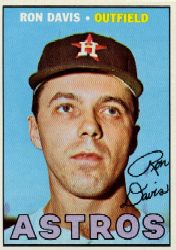
Ron Davis, OF

If this idea catches on, we may soon be able to use an adaptation of the “Seven Degrees from Kevin Bacon” movie actor test to determine which Astros players are closest to the only three pioneering baseballers who each played for the minor league Houston Buffs and also for the major League Colt .45s and Houston Astros during the specific years the big league club was nicknamed differently. These three Houston big leaguers included successful major league pitcher Dave Giusti and two barely-made-it, short-time outfielders, Aaron Pointer and Ron Davis.

If you are unfamiliar with the Kevin Bacon test, it goes like this. A few years ago, when the Internet Movie Data Base first went online, actor Kevin Bacon was used as the contemporary actor goal line for seeing how quickly players could link other actors, especially from the old days, by the fewest number of links in roles played with other movie performers to Bacon, The theory and game killer rule was that anyone should be able to make the connection between Kevin Bacon and, say, John Barrymore in seven links (degrees) or fewer. Otherwise, you lose.  The link trace here might go something like this: Craig Biggio played with Billy Doran (1 degree) who played with Terry Puhl (2 degrees) who played with Bob Watson (3 degrees) who played with Ron Davis (4 degrees), one of our all-Houston-clubs trio. Maybe there’s an even shorter route to Davis, Pointer, or Giusti that you will find.

Here’s a quick sketch of the Buffs-Colts-Astros Player Chain Trifecta!

(1) Dave Giusti went 2-0 with a 3.00 ERA in his only three games for the 1961 Buffs. He then went 2-3 with the 1962 and 1964 Colt .45s and 45-50 with the 1965-68 Astros before moving on for a long run at Pittsburgh and a closing year split between Oakland the Cubs, Over his full major league career, Dave Giusti compiled a career record of 100 wins, 93 losses, and ERA of 3.60.

(2) Aaron Pointer will always be remembered best as the little brother of the famous Pointer Sisters singing group. After that, Aaron was a 3 for 8 (.375) hitter in four games for the 1961 Buffs and a .208 career hitter in a 40-game, three season big league career as an outfielder for both the 1963 Colt .45s and 1966-67 Astros.

(3) Ron Davis bit .179 in eleven games for the 1961 Houston Buffs before going on to bat .214 in seven games for the 1962 Houston Colt. 45s. Davis completed his Houston baseball nickname trilogy by batting .247 and .256 for the 1966 and 1967 Houston Astros. Over his total five seasons in the big leagues (1962, 1966-69), Ron Davis batted .233 with 10 HR. Sadly, he passed away in 1992.

There is also a shorter, more numerous player chain link between Houston’s minor league and major league histories. The following men either played for or managed both the last 1961 Houston Buffs club and the first 1962 Houston Colt .45s major league team. Except for three aforementioned players, The rest of these guys never completed the trilogy trip as Astros, but these men did each participate officially in both Houston’s last minor league season and first major league season. Aaron Davis is not listed here because he did not make his Colt .45 debut until the second year, 1963 big league season:

Last Buffs/First Colt .45s Club ~ “The Magnificent Seven”

(1) Pidge Browne, 1B: Buffs 1956-57, 1959, 1961; Colt .45s 1962.

(2) Jim Campbell, C: Buffs 1961; Colt .45s 1962-63.

(3) Harry Craft, Manager: Buffs 1961; Colt .45s 1962-64. *

(4) Ron Davis, OF: Buffs 1961; Colt .45s 1962; Astros 1966-67.

(5) Dave Giusti, P: Buffs 1961; Colt .45s 1962, 1964; Astros 1965-68.

(6) J.C. Hartman, SS: Buffs 1961; Colt .45s 1962-63.

(7) Dave Roberts, OF-1B: Buffs 1961; Colt .45s 1962; Astros 1966-67.

* NOTE: Harry Craft took over as the fourth and final manager of the last 1961 Buffs team. Craft was replaced in mid-season by Luman Harris as manager of the 1964 Colt .45s.

Presuming our research is accurate in this matter, we could find no Houston Buffs who jumped over the experience of playing for the Colt .45s to later play for the renamed (1965 or later) Astros. Old Buffs had to play their way through the Colt .45 years and only three of them survived the four-year gap (1961-65) to surface again as Astros – and only one of these former Buffs, Dave Giusti, actually thrived as a major leaguer.

Have a nice weekend, everybody, and take my advice on this one. Give yourselves a little break from small detailed baseball research questions that are the psychological equivalent of blind-stitching or sewing up Nike shoes in Jakarta.

I’ll catch you later. I’m off to the walking track now.

Hail to Houston’s Mancuso Brothers!

March 25, 2010

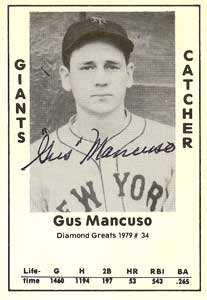
Gus Mancuso, Born in Galveston, 12/05/1905.

The Mancuso Brothers are two of this area’s deepest blue credits to the talent and character pool of players in Houston baseball history. I was too young to have ever seen older brother Gus play, but I knew of him – and I listened to him broadcasting sports during the time in the early 1950s that he worked for the new Houston television station KPRC-TV as a sportscaster. Younger brother Frank was another story. I grew up watching him play in the Texas League for San Antonio, Beaumont, and, finally, as a time-to-be-cheered-on-for-our-side catcher for the 1953 Houston Buffs.

Frank Mancuso, Born in Houston, 05-23-1918.

Another factor made the Mancuso Brothers special to me in my early life. Their mother lived just five doors east down the block from our house on Japonica Street on the northeast side of the Flowers Street intersection with Japonica. Mrs. Mancuso was one of the sweetest ladies in our Pecan Park neighborhood, an older grandmother who sometimes went shopping with our mom because our mom was younger, had a car, and loved the company of this really gentle widow lady. We also (and I’m talking all the kids in our little Pecan Park Eagle cadre here) were keenly aware that Mrs. Mancuso’s two sons were these awesome baseball catching talents – and that both had risen to the big league levels and actually had performed in separate World Series contests.

Gus Mancuso had been a lights-out baseball star in the amateur leagues around Houston before he began his professional career. He batted .304 lifetime in an eight-season book-ends minor league career that split down into two segments from 1925-29 and 1946-48. In between, Gus played for 17 seasons in the major leagues (1928, 1930-45) for the Cardinals, Giants, Cubs, Dodgers, and Phillies – with most of that time spent with St. Louis and New York of the National League. For his big league career, he batted .265 with 58 home runs in 1,460 games, and also appearing in five World Series for the Cardinals (1930-31) and Giants (1933, 1936-37) – and playing in two All Star Games (1935, 1937).

As a minor leaguer, Gus played parts of two seasons with the Houston Buffs (1925, 1928). As a major leaguer, Gus had his best full season at the plate when he batted .301 in 139 games for the 1936 National League champion New York Giants. He earlier had batted .366 in 76 games for the 1930 National League champion St. Louis Cardinals.

Gus Mancuso became one of the first former athletes to transition successfully into broadcasting and commentary on radio and TV after his career.

Gus Mancuso died in Houston on October 26, 1984, just about six weeks shy of his 79th birthday.

Frank Mancuso is a much more personal memory for me. In his later years, we got to be good friends and one of my main go-to-guys on any fuzzy question that came up for me in my research on Houston’s early baseball history. Between Frank Mancuso, Red Munger, Jerry Witte, Jim Basso, and Larry Miggins, a lot of deep personal experience from these guys saved me countless hours of shoe leather burning, musty page turning research at the downtown library. Now only Larry Miggins remains from my little informal group of original research consultants.

Frank Mancuso’s baseball history is laced with the painful thought of what-might-have been. His early minor league seasons had definitive future big league star written all over them. In 13 seasons scattered over the 1937-1955 era, Frank batted a career .276 with 128 homers. Frank’s record during the pre-World War II years, however, were loaded with .300 plus season batting averages. His potential as top-notch offensive and defensive catcher seemed like a really good bet.

Then came the war and the intervention of unexpected events.

As a US Army paratrooper trainee at boot camp in Georgia in 1943, Frank Mancuso became briefly the “catcher in the sky.” On his first jump, however, his chute failed to open properly and he suddenly found himself hurtling toward earth and what appeared to be a sure end. Miraculously, Frank survived a hard fall, but he broke his back and damaged a number of discs for all time. Incredibly, he wasn’t paralyzed by the near tragedy.

Frank dedicated himself to recovery. No longer able to serve in the military, Mancuso managed to work himself back into shape to play as a rookie catcher for the 1944 St. Louis Browns. Frank only batted .205 with 1 HR in 88 games, but he teamed well with Red Hayworth as receivers for the only Browns club in history to win an American League pennant and reach the World Series. Frank’s defensive skills were still high. He simply couldn’t look straight up to search for high foul tips.

Franks Mancuso’s 1944 World Series action was limited to pinch-hitting, but that action provided him with perhaps his proudest moment in baseball. Frank went two for three as a pinch hitter with one RBI and a .667 World Series batting average that he treasured for the rest of his life.

As a four-season major leaguer with the Browns (1944-46) and Washington Senators (1947), Frank Mancuso batted .241 and 5 career homers.

After baseball, Frank came home to Houston and went into politics. For thirty years, he represented most of the East End as one of the most honest and dedicated people to have ever served on Houston’s City Council, and working hard to make sure that the largely blue-collar residents of the East End were not shortchanged on the distribution of city services. He was especially effective in getting East End parks built and upgraded for youth sporting activities over the years. The City  of Houston and Harris County finally named a complex in his behalf as a sign of their recognition of his service contributions to kids during his retirement years.

I knew Frank as a real gentleman and good friend. He loved baseball – and he loved Houston. There was nothing in his power that ever held him back from quietly doing what he could to help preserve the memory of the game and make it known and available as a sport of choice for the kids of generations to come. Frank was helping me in the early stages of my research on the history of West End Park.

When he died, I lost a good friend. And Houston surrendered an irreplaceable resource. Frank Mancuso was the very heart of the spirit that made this city the place it fought hard to become as a wide-open area of honest opportunity for all who were willing to work to get there. His departure from us is impossible to calculate in the loss column.

Frank Mancuso died in Houston on August 4, 2007 at the age of 88.

Two of Frank’s family survive as my good friends – and also as friends and supporters of Houston baseball history. They are Frank Mancuso, Jr., an executive with St. Arnold Brewery and Shaun Bejani, Frank Mancuso, Sr.’s grandson. Shaun is an up and coming sports talk show host for AM Radio Station 610. I’ve also met the son of Gus Mancuso, a retired military man. Gus, Jr. also loved baseball and values preserving the history of the game. It apparently just runs with gene-power in the Mancuso family.

Long Live the Mancusos! You were the face of the force that made Houston a great city!

Beeville Orange Growers: Another Photo Mystery.

March 24, 2010

1910 Beeville Orange Growers: Photo Courtesy of the Randy Foltin Collection.

Research colleague Randy Foltin sent me this photo yesterday of the 1910 Beeville Orange Growers because he knew I was born in that little South Texas town and that I hold special interests in the baseball history of the area. As often is the case, the photo came with its own historical mysteries. These all mainly spin around the presence of the most famous player in the shot, number 6 on the back row, Beeville native and future major league pitcher Bert Gallia.

First let’s cover a little background on the brief history of the Beeville Orange Growers. They didn’t last very long, but then again, neither did the agricultural course of raising oranges or any other citrus fruit crop in Beeville. Located fifty miles north of Corpus Christi, the Beeville winters were simply too cold and too filled with freezing temperature days ro make the industry practical for that too-far-north region of the state. Still, playing minor league baseball and raising oranges had a parallel run in the Beeville area until both got frosted away in the second decade of the twentieth century.

The Beeville baseball-playing Orange Growers were members of the two-season, six-team Southwest Texas League in 1910-11. Other league members included the Brownsville Brownies, the Corpus Christi Pelicans, the Laredo Bermudas, the Bay City Rice Eaters, and the Victoria Rosebuds. Second Place Brownsville won the first of the league’s only two pennants in 1910 by taking a 3-2 series playoff with First Place Victoria. Third Place Beeville was awarded the other pennant in 1911 when First Place Bay City refused to participate in their scheduled championship playoff series.

After 1911, the Southwest Texas League was no more and Beeville went back to raising cattle, harvesting broom corn, and playing their amateur town ball games of baseball. Make no mistake, the failure of the Southwest Texas League was no barometer on the levels of Beeville’s interest in and talent for baseball. By 1925, this small community of a few hundred people had sent their third native son to the big leagues in the form of Lefty Lloyd Brown. Pitcher Bert Gallia went first, joining the Washington Senators in 1912. Outfielder Curt Walker was second, coming up with the New York Yankees at the tail end of the 1919 season before going on to twelve successful years with the Giants, Phillies, and Reds. Walker’s lifetime .304 batting average helped earn him an induction into the Texas Baseball Hall of Fame back in 2001.

Now to the mysteries.

Bert Gallia is shown in the photo with the 1910 Beeville Orange Growers, but his Baseball Reference minor league record indicates that he did not begin his playing career until 1911, and that he then started with Laredo before shifting over to Beeville before season’s end. The next year, 1912, found Melvin “Bert” Gallia ascending all the way up to the roster of the Washington Senators.

I’ve checked the photos against the team records maintained by Baseball Reference.Com. That’s definitely the 1910 club. Except for Gallia, all of the other players in the photo are represented in the Baseball Reference database as players for the 1910 Beeville club,

The other mystery concerns the ‘S’ letter that appears on Bert Gallia’s jersey. The letter has nothing to do with Beeville – nor with the Laredo Bermudas that apparently broke him in at the start of the 1911 season.

One more incidental comment on the 1911 Beeville club: Ted Schultz began the (63-54, .538) season as the team’s manager, but he was replaced during the year by Billy Disch, a young man who would go on from Beeville to become the baseball coaching icon at the University of Texas.

Any ideas you may have on the subject’s two mystery questions are most welcome as comments here in the section below this article.

Have a nice Wednesday, everybody, and keep the spring hope watered and green. The 2010 baseball season is almost here.