Posts Tagged ‘History’

At UH, It’s Still the Same Old Story, A Fight for Love and Glory.

May 3, 2010

At UH these days, it’s still the same old story, a fight for love and glory, and maybe on the NCAA sports level, even a case of do or die, as well. The big UH sports question really is: (1) Will UH President/Chancellor Renu Khator and UH Athletic Director Mark Rhoades be able to recognize the historical entrenchment of the obstacles they each face and be able to martial the university’s fairly powerful alumni elders and legislative supporters behind them as they concurrently rally the diverse student body and general population of UH sports fans and ordinary peopled alumni to get behind this latest big push for excellence at the NCAA Division I level? The questions alone is a mouthful. The answers are far more mercurial than they always first seem. An this is not the first UH dance with this problem.

The UH fan support plight has been mentioned fairly often as a challenge in the past, but usually in far less sophisticated terms as a ticket “selling job.” It is that, but more too. We know better now. It comes down to selling tickets, but the job at hand is really so much larger.
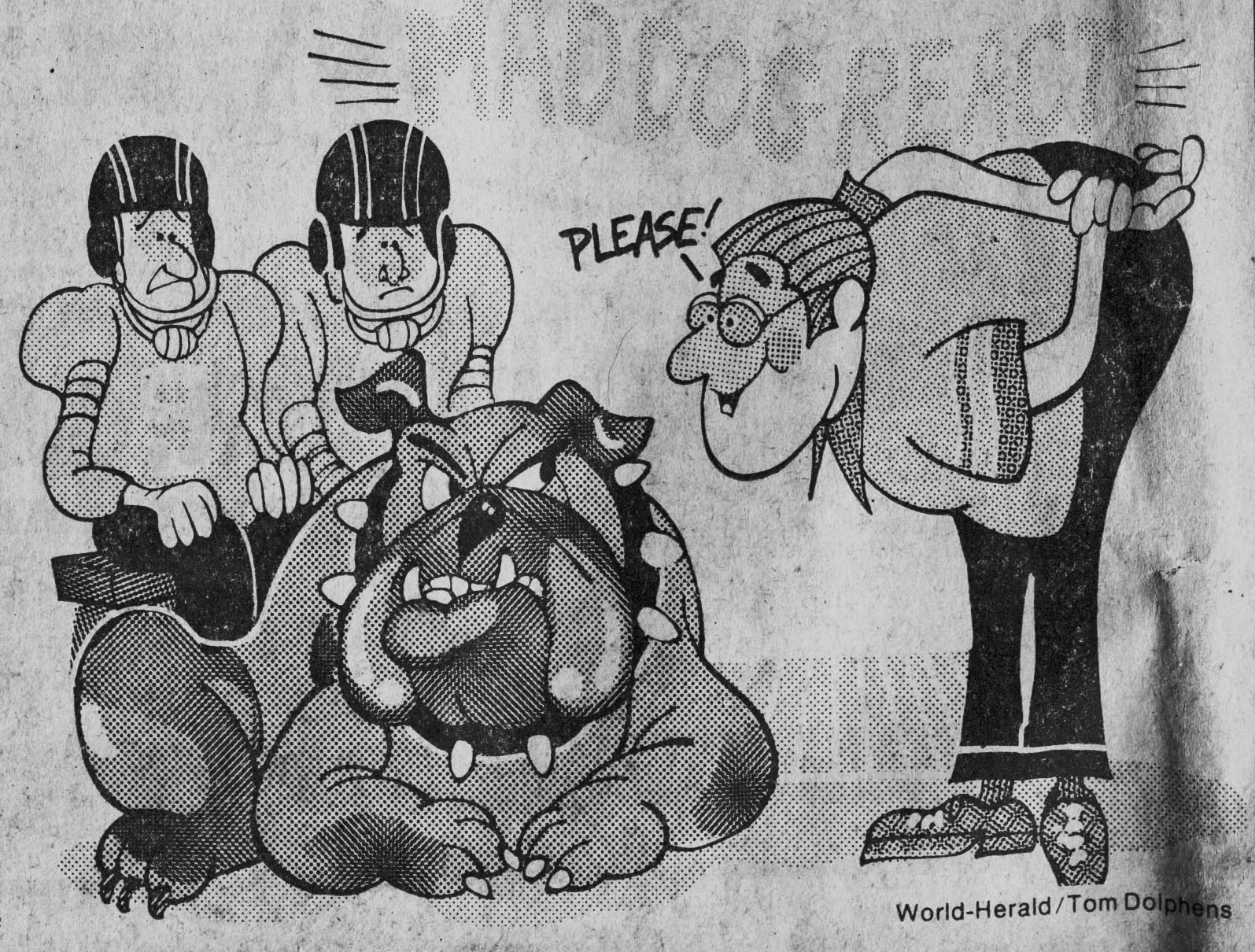
In 1979-80, Babe McCurdy served as mascot of the UH Mad Dog Defense.

As a UH alumnus (1960), I dove in for a first hand look at what I might do individually to help sell the team back in 1979. Back then I owned an English Bulldog named Babe, whom I thought would make a great mascot for the UH Mad Dog Defense. I also had a hunch that UH could do something with an authentic football game jersey that no other university or professional team had ever tried. In my proposal, UH would retail the sale of real UH football jerseys to fans. All would bear the digit #1 that currently was in use by UH linebacker Danny Brabham. At the end of the season, we would hold a retirement ceremony for #1, reserving that number of singular sensation fame from there to forever for the exclusive use of fans who bought official jerseys from UH.

As the best laid plans of mice and men so often unfold, things didn’t happen the way I hoped they would. UH ran off an 11-1 season in 1979 that included a 17-14 win over Nebraska in the Cotton Bowl and a #4 finish in the final AP Top 25 Poll, but the university dropped the ball in the way they decided to handle this incredible success: (1) The Retirement of Jersey #1 for the fans never happened. When linebacker Brabham went out with an injury early in the 1979 season, he applied and received permission for another year of eligibility in 1980. The retirement ceremony was postponed, but still never happened because the importance of the event was not communicated to the football coaching staff – who promptly promised the #1 to another recruit. And that was that. (2) Mad Dog Babe had become a darling of the fans, but the presence of the feisty and talented bulldog on the field had aroused some jealousy among members of the Cougar Guard students who took care of Shasta, the live Cougar, on the sidelines. There wasn’t much they could do with Shasta, who came to each game under heavy sedation for the safety of one and all. Meanwhile, the Mad Dog Babe was roaming the sidelines, tearing up jerseys and replicas of the opposition’s mascots and leading the Cougar defense on the field prior to games. As her owner, trainer, and good buddy in ridiculous mayhem, I got to be there with her for every game, even getting to kick a 35 yard field goal in an after midnight half time ceremony in a game with Texas A&M that had to be postponed until later in the evening due to a baseball playoff game between the Astros and Phillies back in 1980. It was simply a wonderful time for the two years (1979-80) that it lasted.
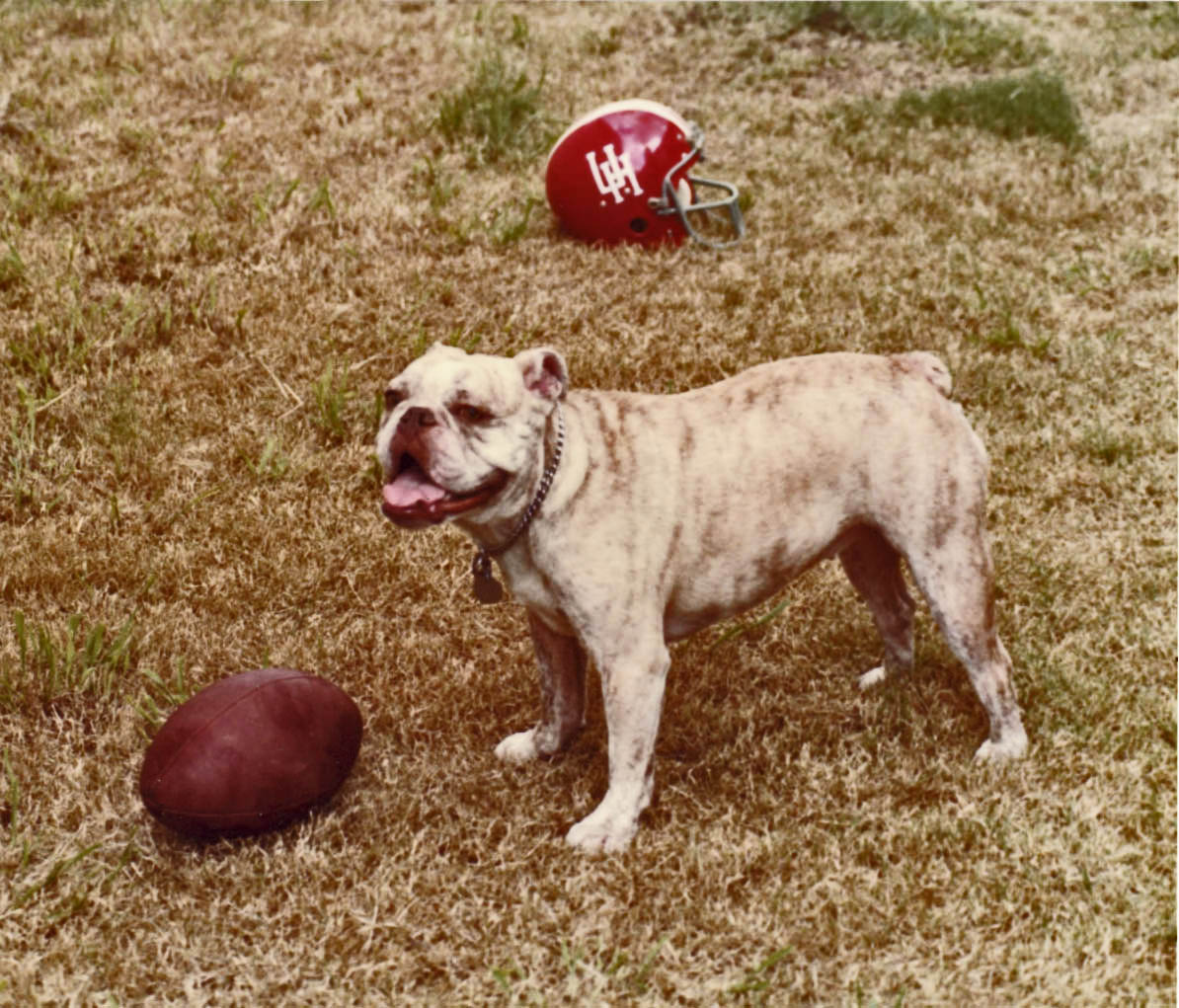
Babe was trained to move the football anytime she heard the Cougar Fight Song.

(3) The worst misunderstanding by former AD Dempsey fell hard upon Cougar Nation in 1980. Instead of grasping and flying with the jersey retirement-fan inclusion plan after that successful 1979 season, Dempsey decided to add a $100 per ticket personal seat license on sales to all UH season ticket holders. The crashing sound that followed was the clatter of UH fans, including yours truly, allowing their season ticket options to fall and hit the pavement. Babe and I were gone from UH after 1980 – and it took another twenty years and former AD Dave Maggard to get me back as a season ticket holder again.

The spirit of Mad Dog Babe is as long as her teeth.

Cedric Dempsey was simply the worst thing that ever happened to UH Athletics. He never really understood UH or the people of Houston. We cannot again afford to have anyone at the helm who either thinks or acts as Dempsey once did.  If UH athletics are to rise again to their SWC football and Phi Slama Jama basketball glory days, the Cougars are going to need (1) an infusion of new blood into the body of season ticket holders. When we remove our Cougar game caps, our current alumni bunch pans out like a field of aging cotton tops;  (2) first class facilities for football and basketball are a must; (3) more season ticket holders who are willing to pay more because they’ve been clearly told what they are paying for; (3) exceptional recruits and better salaries for ket staff that will allow us to keep coaches like the intelligent and classy Kevin Sumlin; and (4) membership in a first tier BCS football conference.

It’s a tall, tall order, but it either has to be done or we Cougars have to stop complaining. It’s put up or shut time at UH.

A Houston Buffs Souvenir Mitt Mystery.

April 29, 2010

The Souvenir Buffs Mitt is About 5″ Tall. When was it sold at Buff Stadium?

Yesterday an acquaintance got in touch with me about a souvenir Houston Buffs catcher’s mitt he had just acquired from another collector. This person is a solid Houston Buffs and City of Houston history fan, but he wishes to remain anonymous in this matter that he now shares with everybody else. The question we both have is: When, if ever, was this little (pictured above) item sold at Buff Stadium?  My own guesses are only speculative.

I never saw anything along the line of souvenir gloves for sale at Buff Stadium during the Post World II Era. I recall a few miniature bats and pennants for sale, but I never acquired anything like that as a kid. We weren’t thinking about souvenirs when we went to Buff Stadium back in my day and it’s just as well. Remember what I’ve written here many times over. We played in the sandlot with baseballs held together by electrical tape. There was no money for thinking about souvenirs.

Besides, the style of the glove looks older to me, like something from the early 30s. That sort of works against the idea that souvenirs could have been very appealing to the average Buffs Baseball fans of Houston during the Great Depression Era, but who knows? Maybe they were. We simply lack the proof that this item ever sold at Buff Stadium during any period, in spite of what it says broad as all daylight on the souvenir glove itself. I personally believe that it was once a Buff Stadium souvenir. I just can’t prove it.

Fred Ankenman served as President of the Houston Buffs from 1925 through 1942, the beginning of the World War II Texas League shutdown. Allen Russell took over as President of the Buffs in 1946 and served through 1952. I’m fairly convinced that the souvenir glove in question sold at Buff Stadium somewhere during one of these two periods. It’s too antiquated to have sold beyond the Russell Era – and it’s simply a little impractical to think it sold earlier at West End Park. Buff Stadium didn’t open until 1928.

The back side of the souvenir glove appears to have once been stuck to something.

My friend and I both observed that the marketing decision to actually write the word “souvenir” on the mitt seems a little primitive and unsophisticated by today’s marketing standards, but a lot of items could be judged that way in comparison to the promotion of uniform replica and game-authentic sale of ballpark material in 2010. We have to remember that game replica jerseys and caps have only been around as sales items to fans since the early 1980s. (We sold an authentic game jersey to fans at the University of Houston in 1979, but that’s a much longer story about what probably was the first sale of game-style apparel items to the general  public in America.)

The buffalo figure is remindful of the logo used during the late 20s and early 30s.

If you ever saw this featured Buffs item for sale at Buff Stadium, or if you have any of your own theories on when it might have appeared there, please post them below as comments on this article. Like so many other artifacts of baseball history, the Houston Buffs souvenir mitt comes to light raising more questions than it answers.

Hopefully, it will someday find its way into proper public exhibition and not just get stuck in someone else’s attic or closet for another sixty or seventy years.

Cows and Bulls and Bluebonnets.

April 28, 2010

Cows & Bulls & Bluebonnets.

Cows and Bulls and Bluebonnets – Callin’ me back – To the land that I love.Cows and Bulls and Bluebonnets,Pullin’ me backTo South Texas.

If you’ve ever been a songwriter at heart, or simply somebody who harbored a song-bursting bone anywhere in your spiritual body, what I write about this morning will make perfect sense. If not, then just bear with me through today. I’ll try to get back to normal by tomorrow. The subject is just rolling too hard on my mind for now to let go.

I don’t quite know, for sure,  what got me started, but I’ve been writing songs for little everyday occasions for as long as I can remember. I even wrote the goodnight lullabies that we sang to our son Neal when he was a little one.

Dad, Mom, and genes may be partly or wholly responsible.

My dad was a part-time songwriter as a young man. Dad even met my mom when he heard her singing “Paper Moon” live over the radio in Beeville, Texas and then had to drop by the station to see who was singing.

Dad even once managed to get a  famous singer from the 1920s and 1930s named Rudy Vallee to sing a published number of his on the crooner’s  “coast-to-coast” radio program back in the early 30s. He had to drive all the way to New York and be a pest to Mr. Vallee to get it done, but he got it done Dad named the number “The Moon Is Here.” It was actually the only song that Dad ever published and he wrote it in collaboration with a songwriting partner from Beeville, Texas,  a fellow named Dan Lanning. After that little venture, Dad went back to trying to make a living in the real world of the Great Depression era, but he kept on singing his heart out for as long as he lived. All tolled, he was my inspiration in baseball, as a writer, and in life.

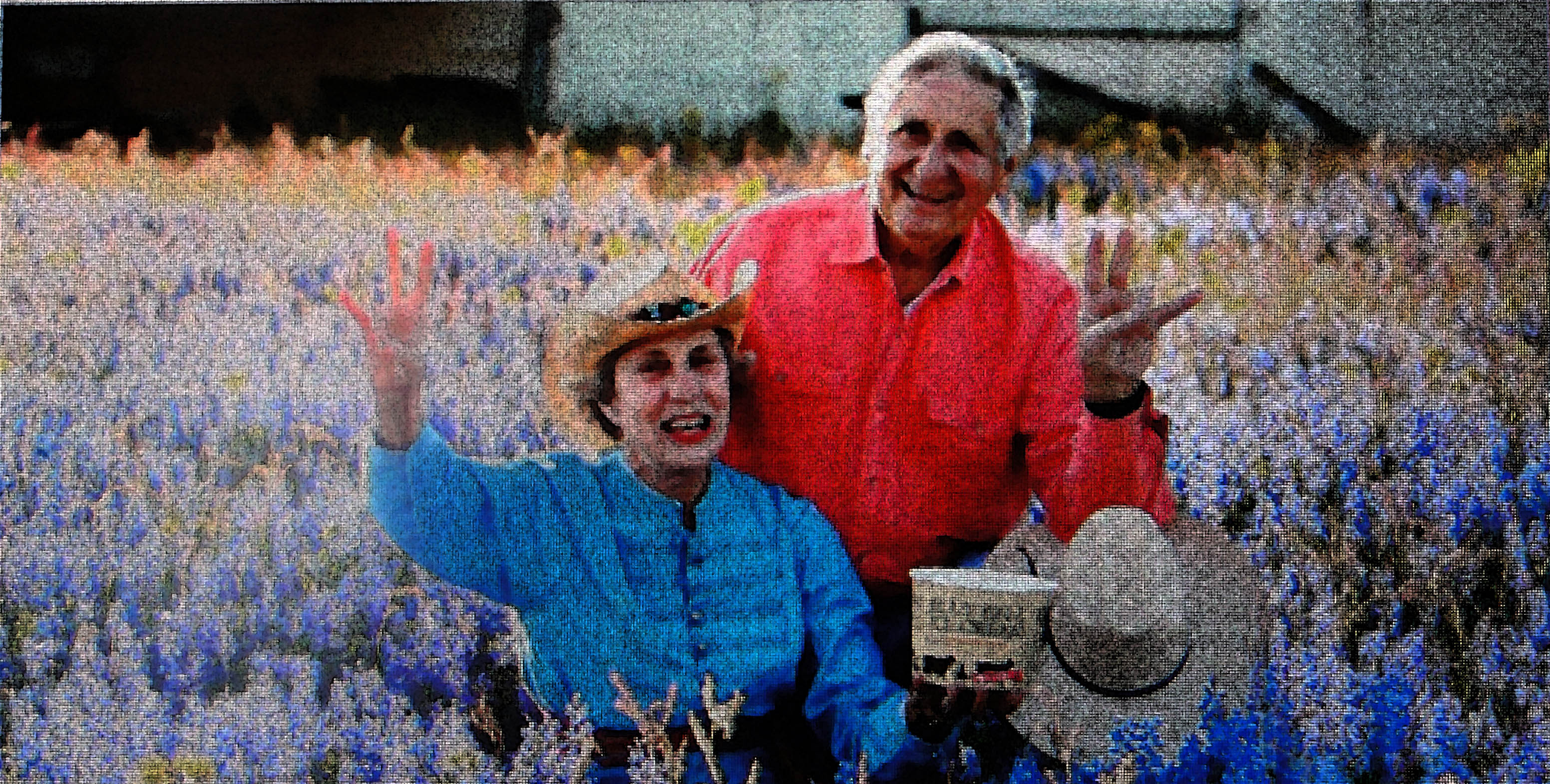
“Cows and Bulls and Bluebonnets” came to mind again for me when my wife Norma and I drove up to Chappell Hill this past weekend to have lunch and check out the last of the botanical Mohicans. We missed the deep rich flourish of full-blue bonnet fields that were there on previous weekends, but we did manage  to capture the singular glow of a few isolated holdouts on extinction as pictured here.

The sight of these reminded me of the spring of 1965, when I was still working at Tulane University, but strongly feeling the home call of Texas. All that came to light for me shaped out as  the vision of “cows and bulls and bluebonnets” and the little hum I felt all the way from my head to my toes each time I came back to Texas for an Astros game and crossed that state line on old Highway 90, heading west to Houston from the Golden Triangle area.

The song for “C&B&BB” didn’t have much of a tune, but its call was quite powerful and permanent. I still travel far and wide, but I have no desire to live anywhere else, but Houston. This place owns my heart.

I feel normal coming back right now. Let’s go, Astros! It’s  time to take Game Two of the Reds Series and keep the turnaround going strong!

UH Honors Alumnus Richard Coselli and Others.

April 27, 2010

UH Grads Mary Jo & Richard Coselli, At Home in Chappell Hill.

For five years, 2004 to 2009, it was my great pleasure to work along side attorney Richard Coselli as volunteers in service to the Texas Baseball Hall of Fame. As Board President from 2004 to 2008, and as President Emeritus through the crack of doom since 2008, but now retired from active service, it remains my fondest hope that the TBHOF will still someday find its home in the form of a physical presence that Houstonians and fellow Texans will be proud to embrace as worthy of its fully stated mission statement for preserving Texas baseball history.

Mr. Richard Coselli was the major person who helped us organize this effort as a legal entity from 2004 through 2009, even providing us with the use of his own office board room for our periodic meetings. We could not have done it all without him. Richard Coselli just happened to have been the exact person we needed during our transitional years in Houston. He was a native Houstonian and a man who loved baseball. Put that all in the basket with his intellect, experience, wisdom, and senses of balance and humor, and we could not have found a better counsel of service to a cause that remains to this day – one that shall always be larger than the whims, aims, needs, or desires of any single person at the helm of leadership. Although Richard Coselli, yours truly, and most others of us from our original formative group are now gone from direct connection to the TBHOF, I think I speak for us all when I say that we still hope for the best and that the organization will survive these hard economic times and find a way to flourish and grow in the future along lines that are governed by integrity of purpose and stable financial support.

Richard Coselli is no newcomer in service to this community. I could not begin to list all the things that both he and his wife, Mary Jo Coselli, have done for Houston, but the two University of Houston graduates continue to do a great many things.

I first became acquainted with Richard Coselli’s contributions while we both were students at UH more than a half century ago. Richard was slightly older than me back then – and still is, for that matter. Funny how that works. – Anyway, we never met back in the 1950s, but I was very aware of his work in organizing the original Frontier Fiesta at UH, the largest campus college show on earth, one that grew big enough to gain a write-up in Life Magazine – a publication from back in the day that spread the good word  in those primitive pre-Internet times that something big was happening in Houston. Ironically, even though I worked on the Frontier Fiesta myself, Richard Coselli and I never met until we both fell into involvement with the Texas Baseball Hall of Fame move to Houston in 2004. I had been a volunteer member of the TBHOF’s selection committee since 2001, but I didn’t wade into the deep water of its work until 2004, when Greg Lucas of Fox Sports and I agreed to head up a move of the organization’s headquarters from Dallas to Houston. Richard Coselli soon came on deck as our legal advisor.

Last Friday night, April 23, 2010, the University of Houston honored Richard Coselli (BS ’55, JD ’58) as one of eleven distinguished alumni who have made enormous contributions to the benefit of UH over the years. The occasion was marked by a formal dinner party, hosted by the UH Alumni Association and addressed by UH Chancellor and President Renu Khator.

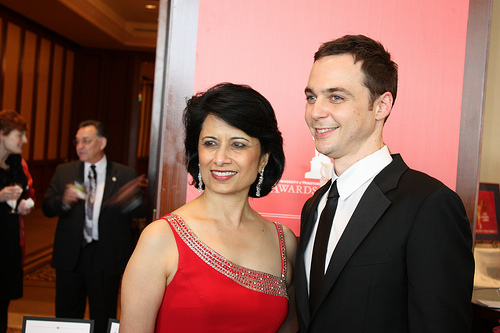
President Renu Khator & Jim Parsons (BS '96) of TV's Big Bang Theory.

Richard Coselli was denied the opportunity of being the funniest man on the dais Friday by the presence of fellow honoree Jim Parsons. A 1996 UH graduate, Parsons is having a pretty good run these days on television as the star of the hit comedy show called “The Big Bang Theory,” but that is OK too. Our UH people come in all ages, shapes, and sizes across a diverse line of differential talent.

Richard Coselli simply brings a quartet of elements to the table of any enterprise that money cannot buy. Their names are intelligence, loyalty, honesty, and integrity.

Congratulations, Richard! It’s good to know that our university has now officially recognized what a lot of your friends have known for years. You are the kind of person that has made the University of Houston and the City of Houston the great places they each are.

“In Time” is our UH motto. In time, UH has now finally recognized one of its own for all he has done in service to the greater good of the university community. Congratulations again, my friend. You deserve every ounce and inch of credit that flows from this much larger measure.

Cold Case: Who Killed Eddie Gaedel?

April 25, 2010

August 19, 1951: St. Louis Browns Manager Zack Taylor Ties Eddie Gaedel's Right Baseball Shoe..

The story of Eddie Gaedel’s one-time at bat as the only midget pinch hitter in big league history back on August 19, 1951 is one of baseball’s biggest travelers. We talked about it here yesterday.

A much less popular subject is the death of Eddie Gaedel nearly ten years later on June 18, 1961 in Chicago. Eddie’s mom found him dead in bed in his apartment on that date. He had a bruise and cuts near his left eye and bruises and cuts on his knees. The coroner’s report concluded that Eddie had died of a heart attack, probably caused by the trauma of physical assault upon his body in physical combat with an unknown other or others. The only fact ascertained by the police in their brief look at the case was that Eddie Gaedel may have gone to a nearby bowling alley the previous evening where he may have had too much to drink and may have either gotten into an argument at the alley or encountered an assailant on his walk home. From what I can tell, there was no real evaluation performed on Eddie’s blood contents in the sketchy post-mortem that followed. Almost everything about his death had been concluded by the Chicago police from Eddie Gaedel’s reputation as a heavy drinker and combative personality.

Since money was missing, the CPD concluded that Eddie Gaedel had been attacked and robbed, but that he was able to make it home before collapsing and dying. The “evidence” of missing money is not spelled out as a missing wallet, nor do the CPD reports jump out and say how they knew how much cash Eddie had on him in the first place.

Because of his “reputation,” the Chicago Police Department declined to investigate the death of Eddie Gaedel any further.

What? …. What?

Since when is “reputation” grounds for letting someone go off to eternity without justice while some other guilty person gets off Scott-Free of murder? Eddie Gaedel died 49 years ago this summer. It’s wholly conceivable that his murderer is still out there in the bleachers during a White Sox or Cubs games in 2010. He or she wouldn’t be particularly conscious by this late time in life, but how alert do you need to be to keep going to baseball games as a Chicago fan on either side of town in 2010?

The point here is simple: Someone got away with murder in the Case of Eddie Gaedel and that’s too bad.

A Few Baseball Terms Revisited.

April 23, 2010

Things aren’t always what they seem. Sometimes they are. In baseball, the presence of certain colorful expressions speaks volumes for what has just transpired on the field. All of you deep blue baseball fans will already know the true meaning of each term on this short list, but you do have to be from Houston to be certain of one in particular. It doesn’t matter. These are all offered in the name of good fun. First we’ll state what each term doesn’t mean. Then we will offer a brief explanation of what each expression really means as a baseball term or idea:

Worm Burner

(1) Worm Burner. A worm burner is not an underground arsonist. A worm burner is a sharply hit ground ball that skims the surface of the field so free of bounce that it threatens to burn the backs of all underground worms in its path from the sheer generation of friction heat all along the travel route.

.

Rope

(2) A Rope. A baseball rope is not an entwined heavy thread of fibrous cords. A baseball rope is more like a batted worm burner that leaves the ground, traveling on a rope-like trajectory at great speeds toward the outer regions of the field. Former Houston Buff and Baltimore Oriole star Bob “The Rope” Boyd was famous for hitting such batted balls; hence, the nickname.

Can of Corn

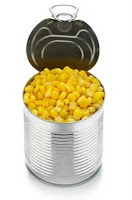
(3) Can of Corn. A can of corn is not just the poor single guy’s answer to the question, “What’s for supper?” A can of corn in baseball is a ball that is batted so softly and lazily to the outfield that it is so easy to catch that even your grandmother could not miss it. i.e., “That ball was as easy to catch as it is to open and eat a can of corn.”

Blue Darter

(4) Blue Darter. A blue darter is not merely a beautiful fish. A blue darter is a batted ball that moves quickly and closely to the ground like its fishy namesake, behaving almost as though it possesses special powers of vision and intuition for the job of avoiding a fielder’s glove. It almost always results in a runner reaching first base on a hit or fielding error.

Sacrifice Fly

(5) Sacrifice Fly. A sacrifice fly is not a  special offering of one subject from that pesky species on the grill with a prayer that all its brothers and sisters will go away from a backyard barbecue party. In baseball, a sacrifice fly is a batted ball that is caught in the outfield by any fielder that results in an existing base runner scoring after the catch is made for either the first or second out of the inning. When this sequence is completed, the batter of the “sac fly” is not charged with a time at bat, but he is given credit for a run batted in. The whole concept of the sacrifice fly is based upon the supposition that the batter intended to hit a ball that would score the runner, even if it were caught for an out that didn’t end the inning.

Twin Killing

(6) Twin Killing. A baseball twin killing is not the murder of, nor the murder by, twins. It is, of course, the ability to get two outs on one play, or, as it is more commonly known, a ball in play that results in the “double play” of two outs on one throw from the pitcher. As you know, it is possible in several ways to get a double play on the field without the batter ever touching the ball with his bat. You may even argue that a successful attempt at the old “hidden ball trick” by an infielder after the previous play was assumed dead could theoretically lead to a double play without further action by the pitcher.

The Infield Fly Rule.

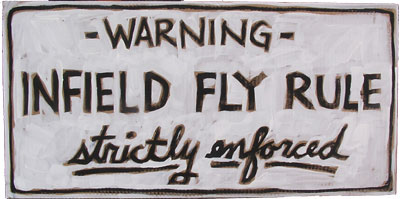
(7) The Infield Fly Rule. The infield fly rule has nothing to do with the false assumption that infielders are required in the name of proper decorum to make sure their pants are zipped before taking the field. The infield fly rule is in place to keep infielders from using force out situations with less than two outs as instances for allowing easy infield fly balls to drop for the sake of getting a double play or simply removing a faster runner off the bases with a force play. When the umpire calls the infield fly rule, he raises his fist to the sky, meaning the batter is out and the runners hold where they are.

The Drag Bunt

(8) The Drag Bunt. There is no truth to the rumor that any batter attempting the “drag” bunt shall be required to wear at least one item of women’s clothing when he does so. It is true that the batter needs to be left-handed for this offensive option to make any sense. In the drag bunt, the batter is attempting to drag bunt the ball into play as he simultaneously breaks from the box for a head start on beating it out for a hit down the line. You don’t see a lot of lefties today with the skills or ability for drag bunting as they once did, but Ichiro Suzuki (pictured here) is one who does do it well.

Crawford Boxer

(9) Crawford Boxer. OK, here we go, concluding with the special Houston baseball term. – A Crawford Boxer is not a special breed of dog that has been bred to patrol Crawford Avenue in downtown Houston. – A Crawford Boxer is a special play that only takes place inside Minute Maid Park when a batter hits a ball to the left field grandstands that back up to Crawford Avenue. Located some 315 feet down the left line, home runs into this special section are simply called “Crawford Boxers.”

That’s all we have time for exploring this morning, folks, but please feel free to add and comment on your own favorite baseball terms in the comment section that follows this article.

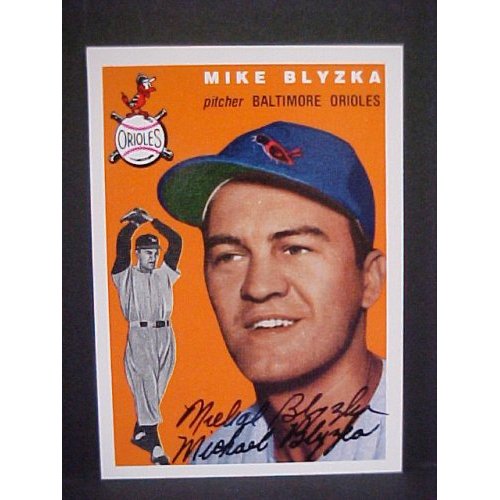
Mike Blyzka: One of the Last Old Browns.

April 22, 2010

Mike Blyzka lost his first 9 pitching decisions in 1947.

Mike Blyzka lived with a little noted, but no less important distinction in baseball history. As a right handed pitcher, Mike worked for both the last 1953 St. Louis Browns club and the first 1954 Baltimore Orioles team. All he did to attain that quiet “honor” was to have been on the roster at the time the decision was made to sell the Browns to Baltimore interests and then make it through the mild ripple of player transactions that followed as fanfare for the people of Baltimore that “the Orioles are coming home to their ancient big league roost! – even if they have to land in the lower branches of the big league tree with a bunch of ex-Browns flapping their wings and gasping for air.”

The news of the Browns move came down hard upon me in Houston. You see, as a 7th grader,  I had become a converted Browns fan in 1951 due to the incredible season that pitcher New Garver put up as a 20-game winner for a last place three-digit loss Browns club. Garver had gone 20-12 with a 3.73 for a last place Browns club that finished 8th with a record of  52-102. And I was always hooked on throwing my support to deserving underdogs. Garver stood out as such to me.

You may know the famous story that spawned on the heels of Garver’s incredible year. When Garver sought a substantial reserve clause era raise for his efforts in his new 1952 contract, Browns owner Bill Veeck turned him down, supposedly explaining that “we could’ve finished last without you.”

At any rate, Mike Blyzka arrived in time to go 2-6 for the 1953 Browns and then 1-5 for the 1954 Orioles in 70, mostly relief appearances. His 3-11, 5.58 ERA record for those two seasons turned out to be his major league career. As a seven-season minor leaguer (1947-50, 1955-57), Mike Blyzka posted a career sub-major league record of 63-60 with a 4.18 ERA.

I never really dug into Mike Blyzka’s record until years later, when I got to know him a little better as a person. Starting in 1996, and moving through 2003, I saw Mike Blyzka every year at the annual reunion dinners for the St. Louis Browns in St. Louis. Mike came religiously each spring as a former Brown. I came each season as a member of the St. Louis Browns Historical Society. It was through these laid-back conversations at breakfast and just sitting around the hotel lobby that I even learned a little of all that Mike Blyzka overcame to fulfill his dream of pitching in the big leagues.

By the time I met Mike, his health was bad and he lived alone in retirement in Cheyenne, Wyoming. He didn’t get around too well so I drove us places on a few eating and shopping expeditions away from the banquet hotel. Other old Browns like Red Hayworth often came with us. It was a joyful time to see old and new St. Louis through the eyes of men who had been such a big, but quiet part of the city’s baseball history.

In 2003, the Cardinals wanted to honor the history of the Browns by playing a uniform throwback game at old Busch Stadium II against the Baltimore Orioles playing as the 1944 Browns. They had a hard time talking the current Oriole players into going along with the plan, but that is not surprising. The Orioles have spent over a half century doing all in their power to forget the idea that their club ever played as the St. Louis Browns. Somehow they managed to overcome resistance and get it done, and they played the game on a Saturday in June that followed a Friday night game in which the last Browns club was honored.

It would have been a whole lot easier, it seems to me, if someone in the Cardinals organization had remembered that Mike Blyzka, Don Lenhardt, and a handful of others present that weekend had also played in 1954 as original new Orioles, but nobody mentioned the fact.

Oh well. Michael John Blyzka is our main subject here today. Born on Christmas Day in 1928 in Hamtramck, Michigan, Mike signed originally with the Chicago White Sox as an 18-year old (BR/TR) pitcher. He was assigned to pitch for Class D Lima, Ohio in 1947, where something happened that could have ended the career of a lesser man. – Mike lost his first nine decisions in professional baseball.  Assigned elsewhere in mid-season with an 0-9 record as baggage, Blyzka proceeded to finish at Class D Madisonville with a 2-6 mark, leaving him with a 2-15 start to his professional baseball career and a ticket over to the St. Louis Browns organization in 1948 via a minor trade.

Mike took those early lemons and brewed up some lemonade.

Pitching for the Browns club at Class D Belleville, 19-year old Mike Blyzka posted a 12-9 mark with a 3.37 ERA. He also led the Illinois State League with 192 strikeouts in 1948. After posting 28 total wins at Class C and A ball in 1949-50, Mike got swooped up for military service in Korea in 1951-52, but he was ready for his Browns debut when he returned to baseball in 1953. Such as it was, he will, or should be, remembered for his part in history.

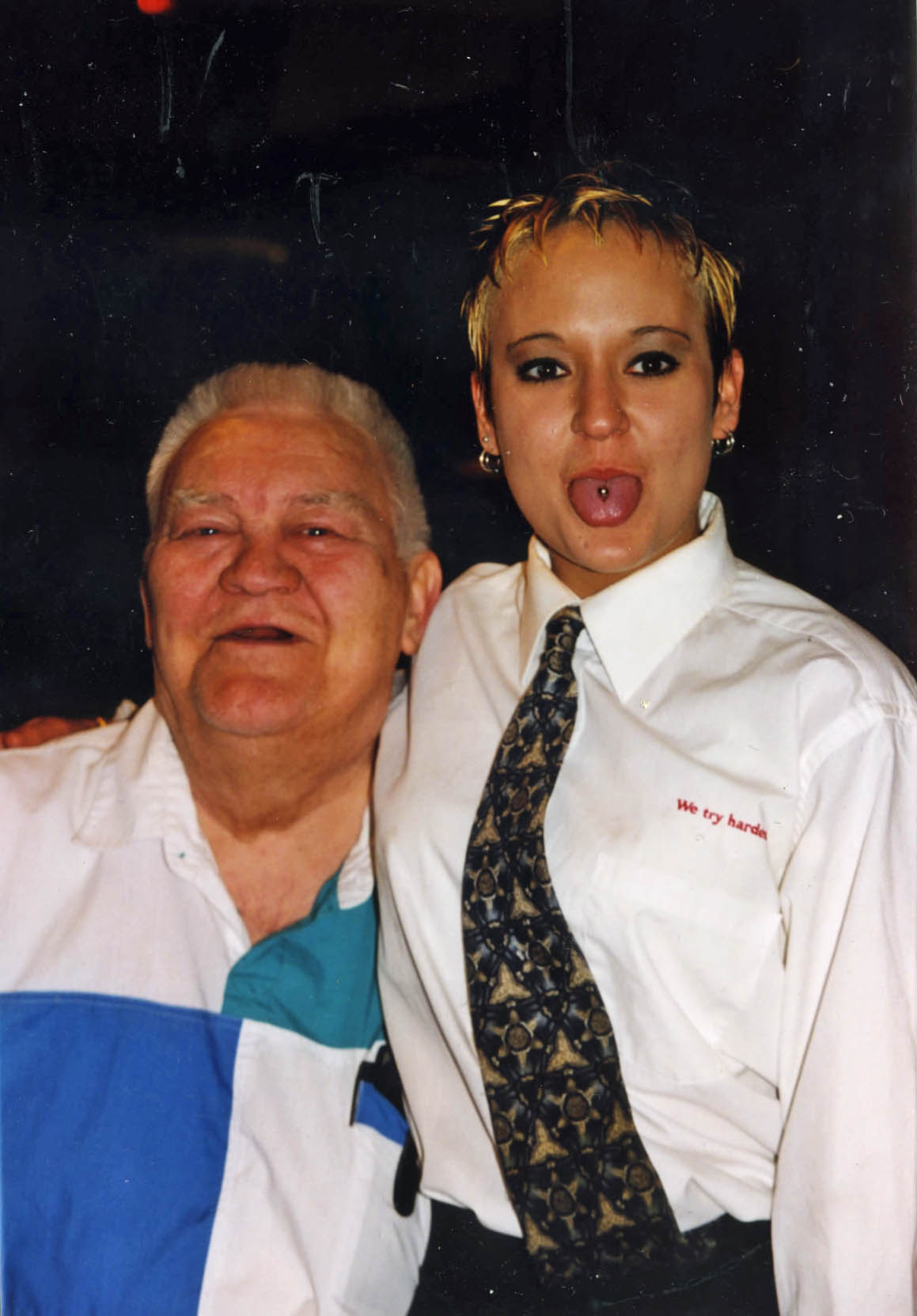
Mike Blyzka and admirer. Mike was a true gentleman with a quiet sense of humor.

Mike Blyzka did nothing to call attention to himself, but he possessed a delightful sense of humor about aging and the inevitability it brings to the table. On that last time I saw Mike Blyzka in  St. Louis, one of the girls in the hotel restaurant decided to play with Mike about going out on the town when she got off work. Mike played along with the joke, even though he knew there was nothing to it, and always sticking to his story that he appreciated the invitation, but but that he couldn’t make it due to other commitments.

As we were leaving the restaurant after breakfast, Mike offered the following: “You know, Bill, I might have taken her up on the invitation, but I think I’d rather live to see the game tomorrow.”

Mike Blyzka passed away at his home in Cheyenne on October 13, 2004.

God rest your soul, Happy Mike. And long live the Browns.

Dreaming Of The Majors: Living In The Bush.

April 21, 2010

Lefty O'Neal Is A Rare White Veteran of the Negro Leagues.

Yesterday I heard from Lefty O’Neal, the rare white veteran of Negro League baseball who wrote a book last year on his improbable experiences in baseball. We have not been in contact for quite a while, but it was good to hear from the man again.I’ve never met the man face-to-face, but I did read his manuscript over the time he was searching for a publisher.

All I can really say is – Lefty writes honestly from the heart. His little book with the long, long title, “Dreaming of the Majors: Living in the Bush,” is a wide open testament to his faith, spirit,and ability to play the game. I won’t go into the details here of how a white guy came about playing in the Negro Leagues because that’s a big part of the book, but I will say that no gets to an accomplishment on that level without possessing the “miles and miles and miles of heart” that are described in the lead song from “Damn Yankees.” Dick “Lefty” O’Neal had all the heart one could hope to pump into the chase of such a dream and he got there – by the Grace of God and with the help of a legion of fairly earth-bound angels.

Houston Astros icon Larry Dierker put O’Neal’s journey in this perspective: “O’Neal will take you on an ironic tour of race relations on the diamond: as Lefty becomes the mirror image of Jackie Robinson, playing as the only white guy on a Negro League team.”

Former major leaguer and recent hitting coach of the Los Angeles Dodgers expressed these thoughts on O’Neal’s story: “His writings are a pleasure and a joy to read.” Merv Johnson, a former assistant  college baseball coach at both Arkansas and Oklahoma put it well for what it is: “This book is a must read for anyone who has a dream.”

You don’t read Lefty’s book for great literature. You read it as a clearly stated map on where the forces of faith, hope, and love can take us if we are simply willing to hear the call of the Holy Spirit and lean all the way into the job of doing our part to get there.

Dick “Lefty” O’Neal listened and then did what he had to do. Along the way, he met the earth-bound army of angels who helped him overcome doubt and complete the journey.

Who is Dick “Lefty” O’Neal? For starters, he’s a retired United States Air Force officer with twenty years past service to his credit. He is now an adjunct professor in the speech communication field,  part-time corporate training consultant, a motivational speaker, a board member for the San Antonio Chapter of the Fellowship of Christian Athletes, and, last but not least, he is Vice President of the SOuth Texas Professional Baseball Negro League Players Association.

Lefty O’Neal and his wife Harriett have been married for more than 36 years and they have two adult children, Amy and Richard Adam. The O’Neal family makes their home in Universal City, Texas.

O’Neal’s inspirational book is available online through Amazon and by order from such booksellers as Borders and Barnes and Noble. You may also order from the publisher, WinePressBooks.Com. The cost is $14.99, plus tax and shipping.

Some people do great things for the sake of directly helping the human condition. Others serve as the objects of personal example to others. Some do both. Meet Dick “Lefty” O’Neal.

Historic Houston Streets: Just To Name a Few.

April 20, 2010

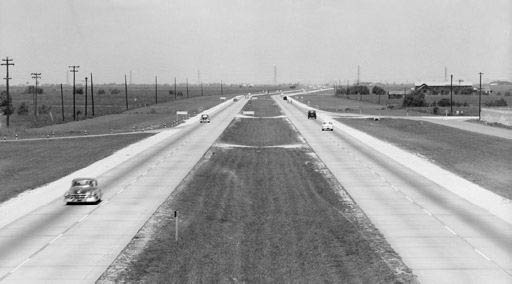
Gulf Freeway 1952: Two Lanes North. Two Lanes South. Who could ask for anything more?

A few light years ago, a fellow named John Churchill Chase wrote an entertaining book on the origins of street names in New Orleans. Entitled “Frenchmen Desire Good Children and Other Streets of New Orleans,” the book was a popular hit in the Crescent City, where colorful events and the names of its roads and avenues usually sparked of mystery and adventure. Heck! During the time I worked for Tulane Medical School in the mid-1960s, I lived in Pirate Alley. Hard to top that one for color anywhere.

Now a fellow named Marks Hinton has written a book about the history of Houston street names. It’s called “Historic Houston Streets: The Stories Behind the Names.” It’s not nearly as extensive or colorful as the New Orleans book, but so what? We’re Houston. We were never the home of famous buccaneers like Jean Lafitte. We are what we are – and it’s still interesting to know how we got some of the street names we still use. The book falls far short of explaining many that I personally would like to know about, but let’s take a quick look at some of the bigger ones it covers.

Crawford: Today this north-south downtown street is most famous as the namesake of the seats that sit perched a mere 315 feet down the left field line at Minute Maid Park. These so-called Crawford Boxes are all that stands between a right-handed batter’s home run swing and Crawford Avenue or Street that lays just beyond the Minute Maid Park exterior. It was always called Crawford Avenue when I was a kid, but today I hear and read a lot of references to it as Crawford Street. Pick which you like better, I guess. At any rate, Crawford was named for Joseph Tucker Crawford, a British agent who was sent to Houston to evaluate the developing situation in the newly formed Republic of Texas back in 1837. According to Hinton, Crawford’s mission wasn’t to explore ways of making Texas a British colony, but to see how Texas could usefully help block America’s expansion westward. So, what it comes down to is this: Crawford came here to try to get Texas to help England throw a monkey wrench into the American Manifest Destiny and our city’s pioneer leaders ended up naming a major downtown street for him. Go figure. Or else use this little known information as a part of a local parody of “Take Me Out to the Ballgame.”

“…Buy me a seat in the Crawford Box; that guy came here an American Pox.”

Cullen Boulevard. It is the main street at the University of Houston and it once served as the main drag beyond the right field line at Buff Stadium on the Gulf Freeway. Most people know this one, but it bears repeating for the sake of remembering one of Houston’s greatest philanthropists. Hugh Roy Cullen is the namesake person here. Cullen was the wildly successful oil man who gave millions to Houston charities over the years – and especially to the University of Houston, Baylor University, and most of Houston’s major hospitals. They threw away the mold for generosity when Mr. Cullen departed this world years ago.

Kirby Drive. Named for John Henry Kirby, a very successful 19th century Houston lumberman and capitalist, this is the street that runs directly beside the Reliant Stadium-Astrodome complex in a very appropriate way. In 1895, when professional baseball was struggling for a breath of fresh sustaining life in Houston, Kirby headed up a small group that established the “Houston Baseball Association” to keep the city on its feet in the new Texas League. The “HBA” capitalized the Houston baseball club with $3,000 in operating funds and installed Kirby as its first president. Because of Kirby, early professional baseball in Houston survived the turn of the 19th into the 20th century and set all in motion for the long banner life of the Houston Buffalos through 1961.

Westheimer Road. Named for Michael Lewis Westheimer, who immigrated from Germany to Houston in 1859, the namesake here was a diversified buusiness entrepeneur who bought and developed a 640-acre tract of land west of Houston. If you know Houston, you’ve already heard enough to get where this is going. Most famous locally for his Westheimer Transfer and Storage Company, Westheimer Road followed from here where Mr. Westheimer went, becoming to this very moment the other major artery alternative to Memorial Drive and the Katy Freeway as the major corridor to  Houston’s forever expanding western growth. Memoril, of course, is assigned as a name to honor all men and women who have given their lives in defense of this nation; Katy Freeway and old Katy Road before it were named for the little city they once approached to the west of Houston.  That same Katy, Texas was swallowed long ago as one of Houston’s present and major bedroom communities.

Gessner. August Gessner also migrated from Germany to the United States in 1886. He fought in the Spanish-American War with Teddy Roosevelt and later built a monument to the Rough Riders in Puerto Rico before coming to Houston and establishing himself in business as a cabinet-maker. Years later, when Harris County built a north-south way that covered a lot of ground on the then unincorporated west side, they needed a name. Longtime Commissioner Squatty Lyons raised his hand and offered something like the following, “Hey! I went to school with this nice guy named Gessner. We could name it for him. His family are all good people.”

Sometimes it is who you know that matters, but I would like to see us do more to name our city streets for people who have made some particular contribution to the city. Holcombe Boulevard was a great pick, deriving its name from longtime former Mayor Oscar Holcombe, a politician who stood up to the Ku Klux Klan back in the 1920s, loosening their hate-mongering control of things and freeing Houston for future growth. We’ve also named a number of streets for Houstonians who served in World War I. The later wars could use a little better presence on the naming list.

Hey. All that’s good. I’d just like to see us make better use of street-naming as a way of remembering the many others who have made significant contributions to the history of the city.

For example, Allen Russell, the 1946-1952 President of the Houston Buffalos who really put our city on the map for major league baseball expansion, tops my list of people who are most deserving of a  significant street name. I’m sure we have others in the fields of sport, education, business, space, and the arts who are just as deserving too. In fact, if you have a favorite candidate for a Houston street name, please list it below with a brief statement of why you think that person deserves the mention.

At any rate, the little reference book on local street nmes is a fun read for Houstonians. One of its sidebar features is a display of interesting street intersections. Someplace in town, the streets of “Mutiny” and “Bounty” intersect. We may not have much of a local histroy in piracy (excluding mention of some closely similar practices in the oil industry), but we do apparently have some recollection of major conflict on the high seas, even if quite a bit of it was fictional in content.

The least we might do is to get rid of that practice of allowing developers to build new neighborhoods with all those cute-sounding similar names that just make it easier for our postal service to fail us. Know what I’m talking about? Try sorting the mail for a neighborhood that includes Westwick, Wickwild, and Wild West, for example. I think I made up the “Wild West” street, but you get the idea. We do have a Wilcrest, a Wickchester, and a Wilchester  that are all  pretty near each other. Maybe it’s time to finally simplify the things that can be simplified.

1948 Buffs Photo: Many Pictures in One.

April 19, 2010

1948 Houston Buffs: Zooming In, A Photo May Raise More Questions than it Answers.

The 1948 Houston  Buffs had a tough act to follow. They had to take the baseball stage on the heels of the 1947 Buffs, a tenacious club that won both the Texas League pennant and the Dixie Series championship. As it turned out, the ’48 Buffs, also playing under ’47 Manager Johnny Keane and with several players from their championship year, could only make it to third place and a full ten games back of the first place and eventual pennant-winning Fort Worth Cats. The ’48 Buffs lost to Tulsa in the first round of the Shaughnessy Playoffs.

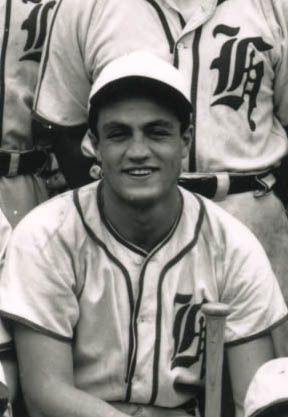
I used the featured team photo of the ’48 Buffs to crop and display an individual picture of Jim Basso in yesterday’s article on the Buff who knew Hemingway. Remember this one? It shows up pretty darn crisp and clear:

Jim Basso Never Came To Bat for the '48 Buffs.

Before Jim Basso ever came to bat for the 1948 Houston Buffs, he was dealt away, ending his three season status (1946-48) as a member of the club. Based upon his length of time with five other clubs in 1948, it is fairly safe to assume that this photo of Basso in the team photo of the Buffs was taken in the spring or very early part of the season.

What else is in the photo, however unintentional it may have been?

The fan isn't smoking; it's a print negative scratch.

When I first saw the fan second from right in the photo, I thought we had a live photo of someone actually smoking in the grandstands, which many fans did in wild abandon back in 1948. It turns out that it was simply a scratch on the negative that had created this illusion.

What’s not an illusion is that all these young guys were there early to see a game, we presume. It could be that fans or family members were allowed into Buff Stadium just to watch the team photo shooting, but that isn’t likely. The issue that throws e off here is the casual attire of team President Allen Russell. He usually went suit and tie on game days so we can’t really be sure if maybe it was an off-day or just early enough in the day for Russell to change later. Still, if Russell dressed formally for games, you would think he would have done the same for the team picture. It’s possible to think ourselves into a corner on mysteries at this level.

Sporty Allen Russell in 1948 Team Photo Corner.

The sporty shot of Buffs President Allen Russell also reveals more seated civilians over each shoulder. Based on their youthful appearance and body language, I’m guessing they are “kids from the ‘hood” who came early for Knothole Gang seating who got to roam the better seats prior to the start of each game. We did that all the time back in the day.

It must be a long while prior to game time. Otherwise, Allen Russell wouldn’t be smiling that broadly with all those empty seats lurking behind him.

Somebody had a game date this day.

Way back there in the stands, we see a young couple seated, with a lonely lurking twerp seated sort of glumly behind them. The couple’s presence adds more weight to the possibility that this photo was taken early on a game date. As I recall our culture in that era, one didn’t usually get a date to simply go watch  practice or a team photo shoot at Buff Stadium.

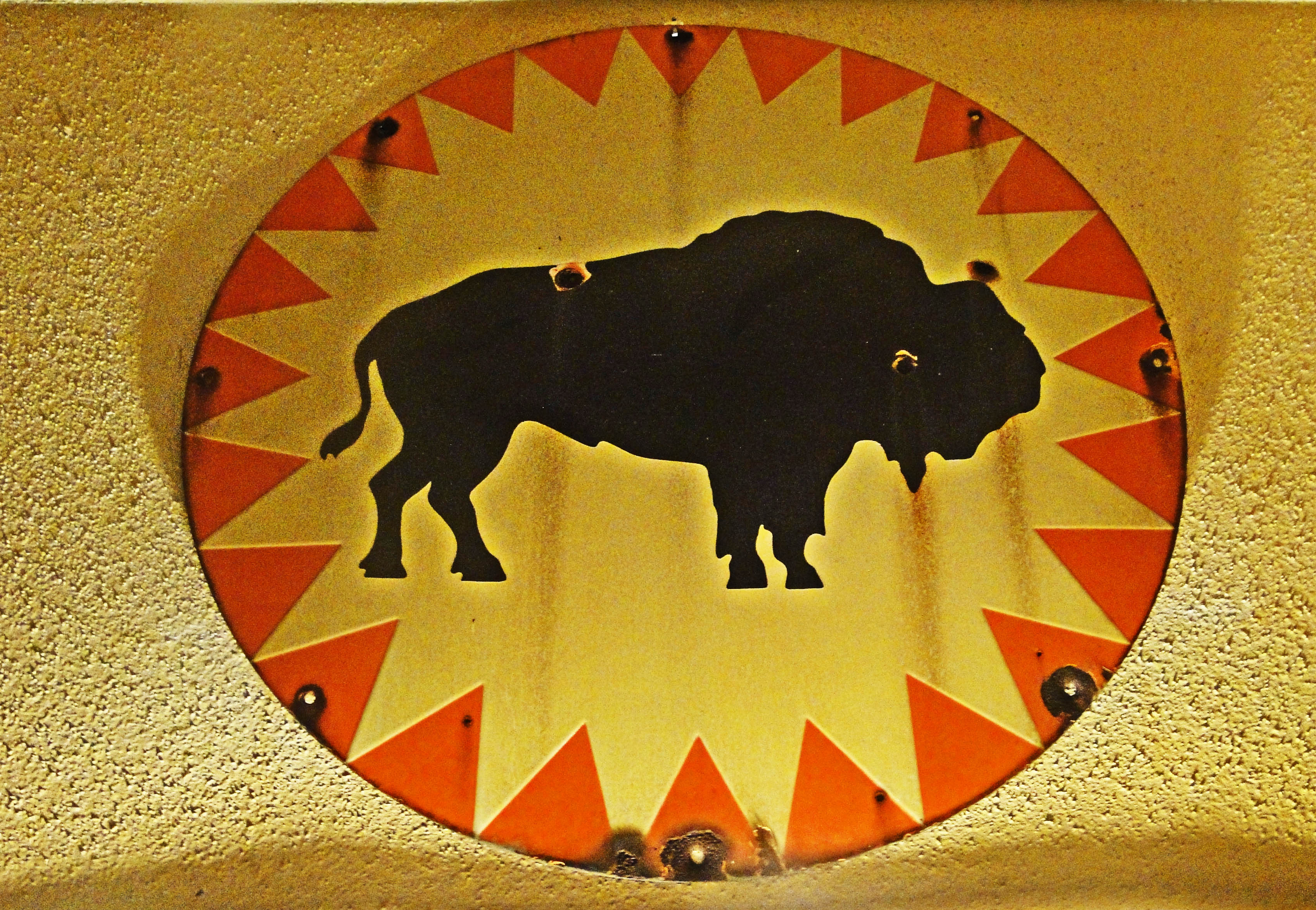
The silhouette of these buffalo medallions confirm that Buff Stadium, indeed, is the site of our 1948 Houston Buffs team photo.

A total of eighty 36″ in diameter steel buffalo medallions once rimmed the exterior walls of Buff Stadium from 1928 to 1961. Two of these medallions hang today in the Houston Sports Museum at Finger Furniture. A few others are scattered among individual owners and I have one that was given to me by former Buff Jerry Witte and his family for historical safekeeping. It will eventually go to a place yet to be determined which can guarantee its preservation and display for history in perpetuity.

For now, here’s how this unmistakable symbol of Buff Stadium looks this morning in the space above my head where I write each day:

Eighty of these beautiful medallions once rimmed the exterior walls of Buff Stadium.

There is much in a photo. This one starts out showing us the faces of a team. It then ends up raising the question we all have to answer for ourselves: How much part are we each willing to play in the preservation of history.

Think about it. Then get out there and give the world your answer. No contribution can be too large or too small. If you do nothing more than join SABR, the Society for American Baseball Research, you will be helping all the rest of us take a giant leap forward – and this is not a commercial. It’s simply a fact. SABR works for baseball.

For more information about SABR in general, check out the national organization:

info@sabr.org

For more information about the Houston-based Larry Dierker Chapter of SABR, contact group leader Bob Dorrill at

E-Mail:

bdorrill@aol.com

Phone:

281-361-7874

Meanwhile, enjoy your old photos even more. And have a nice day.