Posts Tagged ‘History’

Defensive Drills from the Pecan Park Sandlot.

May 16, 2010

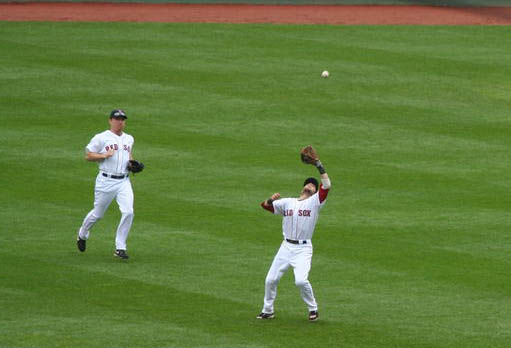
Red Sox Players Imitating the Pecan Park "Bloop" Drill.

A few weeks ago, I wrote an article on the little games we played on the Sandlot grasses of Eagle Field in the East Houston neighborhood that was Pecan Park during the immediate Post World War II years. Today I would like to carry that thought further to include the drills we simply devised for fun when only as few as two or three of us were available, We didn’t do these thing because we thought of them as work. We did them because they challenged us to get better, to find out how fast and quick we could be on all kinds of twisting, darting liners and grounders, to see how far we could run, jump, and still make out-play-catches on a fly ball,  All we needed for these drills was two people to have lots of fun, but three was even better because it taught us more about how we had to cooperate to be good defensive players.

Here’s a sampling:

(1) The Bloop Drill. The object here was to work on catching balls that might fall between the infield and outfield for bloop Texas League hits. We needed two people to play the two IF/OF spots and one person to either fungo or else, throw slow arching balls that had a chance of falling into the space between the two fielders. We were playing our version of “bloop” on the day that Houston Buff infielder Jack Cusick stopped by to work with us on his way to Buff Stadium. Cusick liked our bloop drill, but he suggested on addition that made it even better – after watching a couple of us collide on an attempted catch.

“Somebody’s gotta call for it,” said Cusick, “and that guy should be the outfielder coming in. He’s got the view on things and whether or not he can make the play. If the outfielder yells, ‘I got it,’ the infielder needs to peel off and let him take it. If the outfielder is in doubt, he needs to keep his mouth shout and peel away so he doesn’t hit the infielder, but stay in the area for the ball in case it drops in.” – After adopting the Cusick suggestion, the bloop drill got to be even more fun. – Wish Cusick had come back for other coaching visits. We might have even gotten smart with a little baseball help.

Long before Willie Mays's famous catch in 1954, he inspired us to practice a drill we humbly called "The Catch."

(2) The Catch. You only needed two people and you could play it anywhere. Of its many variations, the object was to catch an arching fly ball that was thrown over your head as the fielder. One version was “The Willie,” where, just as Willie does in the picture, you try to catch the ball looking up over your shoulder, either basket-style or by a more conventional grab.

(3) Off the Wall. In this version of “the catch” drill, we worked on catching balls that were headed toward the side of the house (our make-believe outfield wall) either on a leaping out-grab or by the best carom shot angle we could take on the play. Had we ever played a real game next to our garage, I could have been the deadliest defensive outfielder in the game.

(4) Shoestrings. Yep. We drilled ourselves on the art of the shoestring catch for hours at a time. It paid off for me several times over, but most importantly later on when I was playing center field in a parochial school CYO all-star game and managed to pull a shoestring catch out of my jock strap for the third out in a bases loaded situation. That had to be the highlight of my fleeting baseball glory, but all that work we put in for fun over the years had prepared me well for it. It wasn’t my first shoestring catch of record.

We also did conventional infield drills all the time back on the sandlot – and we loved going to Buff Stadium to watch the teams take infield practice prior to games. It was like watching a dance – or a game of shadow ball that could only help players get better and the logic behind why even the pros did these things back in the day made sense to us too.

You get better at things you practice. It’s fundamental.

Bowery Boys English Lessons.

May 15, 2010

Dimwit Sidekick Huntz Hall & Gang Boss Leo Gorcey: Bowery Boy Kingpins of the 1940s B Movie Series Circuit.

The boys started out as the Dead End Kids, the “when things go wrong” bad examples of what the mean city streets will do to a kid when he’s had nothing but bad company for as his role models. The year was 1937. The movie was “Dead End.” The star was Humphrey Bogart. From there through the early 1950s, “the boys” made a living as stars of their own B movie comedy series in which they were ariously known as the “Dead End Kids,” the “East Side Kids,” and most famously as, the “Bowery Boys.”

Actor Leo Gorcey starred as “Slip Mahoney,” aka “Mugs McGinnis;” Huntz Hall, if memory serves, was always known as “Sach,” the mentally challenged sidekick of the the gang that also included “Whitey” and three or four others who never had any speaking parts, but they were all regular movie performers on Saturdays at kid fares offered at places like our own turf theatre, the Avalon at 75th and Lawndale in the Houston East End, just after the end of World War II.

“The Boys” always gathered at Louie’s Sweet Shop on the lower East Side. Tiny, nervous shopkeeper Louie Dumbrowski was played by Leo Gorcey’s 4’10” tall father, Bernard Gorcey. “Louie’s” constant nerve-wracking worry was over the fact that he allowed the Bowery Boys to run up a soda credit tab that they never got around to paying. How he stayed in business is anyone’s guess. He never seemed to have any other customers beyond his band of deadbeat teens.

Leo Gorcey’s schtick was that he always tried to come off smarter and better educated than he actually was. The result was a non-stop flow of spoken malaprops that only became funnier to some of us as we aged, read more, and learned to recognize better what he was doing.

Examples:

(1) Slip (Leo Gorcey) wants to butt into a conversation, so he says, “Pardon me for protrudin’!”

(2) Slip to Louie (regarding his soda tab): “I’d love to pay somethin’ on the bill, Louie, but today my funds are a little bit constipated.”

(3) Slip’s financial plan: “OK, boys, empty your pockets. Let’s pool our money and catapult it into something safe that pays well.”

(4) Slip, on making friends with a guy he doesn’t trust: ” My happiness over our new friendship is only surpassed by my mortification over the idea.”

(5) Slip to receptionist over the phone: “Let me speak to Mr. Smith right away. What I have to say to him is rather impertinent.”

Somehow, most of us who grew up in the Houston East End on a steady diet of Bowery Boys and Charlie Chan films actually reached adulthood without a warped sense of word meaning and with no impairment to our skills for proper contextual  application of certain words.

Have a nice Saturday brunch or lunch, everybody, and may whatever you order come packed with a delirious taste. If you think of what you really want to eat hard enough today  before you trace your order, your compensation will be rewarded in a way that feels desultory.

Have fun! Life’s short! (I don’t have a way to misstate those two sentences.)

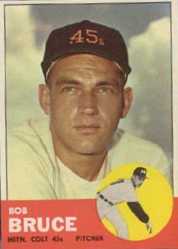
Bob Bruce: Houston’s 1st Big League Winner.

May 14, 2010

In 1964, Bob Bruce was Houston's 1st 15-Game Big League Winner.

Things weren’t easy during the three season life span of this city’s first major league club, the Houston Colt .45s. We had a local team made up of names from the 1961 expansion draft and a few fresh rookie snares, plus some veteran free agent players acquired in minor deals. and a few wannabe guys, most of whom never saw the light of day wearing the orange and deep navy blue of the new big league club.

One of the jewels in the early talent lot was a right-handed pitcher named Bob Bruce, whom the Colt .45s acquired from the Detroit Tigers. The 6’3″, 195 pound 29-year old turned out to be the most effective double-digit game winner in the club’s early history.

In 1962, when Houston finished 8th in an undivided 10-team National League, only besting the Chicago Cubs and the fellow expansion bunch at New York called the Mets, Bob Bruce hit the club record books as the first pitcher to register double-digit wins and a winning record in a single season. His 10-9 mark with  4.06 ERA and 135 strikeouts in 1962 did it for Bruce.

Teammate Dick Farrell also had ten wins in 1962, but he also picked up twenty losses along the way, a feat which prompted this proud explanation from the colorful guy they also called Turk: “Do you realize how good I had to be to keep going out there often enough to have lost 20 games in one year?”

Bruce fell off to 5-9 with a 3.59 ERA in 1963, but in 1964, in their third and final year to dress out as the Colt .45s, he came roaring back to become the first 15-game winner in franchise history, posting a season mark of 15 wins, 9 losses, an ERA of only 2.76 in 202.1 innings pitched – and another good year for “Ks” with 135 recorded again.

Bruce pitched two more years as a “Houston Astro” (1965-66), but he had run out of big-win seasons. His combined record for two Astrodome seasons was 12-31. Bob moved over to Atlanta in 1967 where he registered a 2-3 record for his last season in baseball.

Happy Birthday, Bob! Bob Bruce turns 77 on May 16 and he is still going strong in real estate.

All tolled, Bob Bruce worked a nine-season major league career (1959-67) into a final record of 49-71 and a fine 3.85 ERA over his 1,122.1 total innings. He played for Detroit (1959-61), Houston (1962-66), and Atlanta (1967).

A good fastball, an effective curve, and good control also allowed Bob Bruce to finish with 733 strikeouts against only 340 walks. During his Colt .45 years, Bruce was the guy who gave Houston fans rare hope for victory every time he took the mound. As one of those fans, I will always be grateful to him for that infusion of sunshine into our early big league community baseball spirit.

As a minor leaguer for eight years (1953-67), Bob Bruce also compiled a record of 76-55 and an ERA of 3.33 over several scattered seasons.

Happy Birthday, Bob Bruce! And thanks again the memories.

For those of you wanting to catch up on Bob Bruce today, or maybe even shop for some real estate in the Hill Country, check out Bob on Facebook. I’m sure he would be most glad to hear from you.

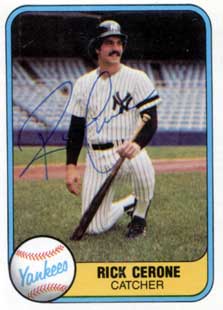
Rick Cerone: Another Bronx Zoo Tale.

May 13, 2010

Rick Cerone: Another Bronx Zoo Tale.

If you have followed baseball for as long as I have, you will have sooner or later developed an interest in the careers of certain guys that never even come close to playing for your particular team. As an older-than-they-are Colt .45s/Astros fan, catcher Rick Cerone is such a guy in my books. Rick did play briefly for AAA Charleston of the International League in 1977, when that club was a farm team of the Astros, so, you could make the case that Cerone came close to Houston, but just didn’t get here.  I always liked him, anyway,  for his fiery spirit and ability – and for his willingness to stand up for himself. He simply didn’t take these positions of assertion in ways that might  help his job security during the latter stages of the Bronx Zoo era. And that’s putting it mildly.

Besides, standing up for yourself is not about job security. It is about self respect. It’s how you do it and with whom you do it that determines your fate on the job – and Rick was working in the “Bronx Zoo” when his major stands took place, More on that in a moment.

Born May 19, 1954 in Newark, New Jersey, Cerone was a natural cultural and personality fit for the latter-day 20th century New York Yankees, but he entered pro ball as the 7th pick in the 1975 1st round amateur draft out of Seton Hall University. It was the beginning of an 18-season big league career that included stops with the Indians (1975-76), the Blue Jays (1977-79), the Yankees (1st time, 1980-84), the Braves (1985), the Brewers (1986), the Yankees (2nd time, 1987), the Red Sox (1988-89), the Yankees (3rd time, 1990), the Mets (1991), and the Expos (1992).

For his career, Rick Cerone (BR/TR) (5’11”, 192 lbs.) batted .245 as a major leaguer. He slammed 59 career home runs and he fell two hits shy of 1,000 on the career hits list. Defensively, I always felt he called and played a pretty good and aggressive game too. He gunned down 37% of the attempted base stealers he saw and – as i saw it – he seemed able to fire up his pitching battery mates when the chips were on the line.

Unfortunately or not (or that’s just how it was), Rick Cerone had an anger flash point that got him in frequent trouble in the Bronx with people like owner George Steinbrenner and manager Billy Martin. Those guys had flash tempers too – and a lot more power over the answers to “What next?” any time a conflict broke out on the team.

His Mouth Over-Ran His Mind.

It wasn’t hard to do the math on conflict outcomes in the Bronx: (1) Owner Steinbrenner goes on a tirade in the Yankee clubhouse. Player Cerone responds with expletive laced comments on the boss’s weight and lack of playing experience. Cerone gets dealt away from the Yankees. (2) Manager Martin calls out catcher Cerone in his own fit of rage for calling pitches that the other club clobbers for game-winning hits. Cerone curses back and throws his equipment at the manager. Cerone gets dealt away from the Yankees (again).

A 2009 article by Matt Gagne of the New York Daily News detailing Cerone’s current attempts to get back into post-playing career work in baseball with somebody seems to bear out my earlier impressions of the old temper factor. I’m not sure if anything has developed for Rick since last summer, but the article does a pretty fair job of mapping the relationship hill that Cerone needs to climb to get his next chance in the game.

Here’s the link:

http://www.bing.com/images/search?q=rick+cerone&FORM=BIFD#focal=

2c718c6ba567de4d2da6caff2cfe7e66&furl=http%3A%2F%2Fassets

.nydailynews.com

%2Fimg%2F2009%2F07%2F19%2Famd_cerone-now.jpg

Cerone’s current problem finding new employment in baseball probably is best captured in this one statement he made for the Gagne article. About his current search for work in baseball broadcasting, Rick said: “I’ve sent out some resume tapes, but when you don’t get callbacks at all – when people you’ve worked with for years don’t have the decency to to call back, or email, or text – you know what, I don’t beg.”

You know what, Rick? If people fear your temper, they aren’t going to jump to hire you. False pride has to heal before any honest rebuilding can start – and your potential employers in baseball out there have to believe you’re on the right road before some of them maybe, just maybe,  become willing to give you another shot.

This isn’t about begging. It’s about stepping up – and owning up to your own behavior with someone who is willing to (maybe)  give you another opportunity. If I was hiring, Rick,  I would be willing to give you a chance because I think you possess a core passion for the game and a real understanding about the importance of loyalty as a result of these experiences that money alone can never buy. It’s just up to you to get that message across to real potential employers who may find it easier to look for someone who’s background is less passionate, but also less “colorful.”

Heck. If he can handle it. I’d rather hire Rick Cerone any day of the week. If I’m your potential employer, Rick, (again) it’s up to you to show me why I should take the risk of trusting you.

That’s it, except for one more thought: Good Luck!

Hal Epps: The Mayor of Center Field.

May 12, 2010

Mr. Mayor Himself, Hal Epps!

During their 1947 Texas League and Dixie Series championship season, they called Hal Epps by a nickname that fit well with his ability ti patrol the deep central pasture at Buff Stadium. Hal Epps was known as “The Mayor of Center Field’ for the speed, agility, arm, and intelligence he brought to the job as center fielder for the Houston Buffs.

Epps also was no slouch on offense in 1947. He batted .302 in 136 games, banging out 24 doubles, 15 triples, and 6 homers along the way. “Clutch” could have been his middle name, Time and again, Epps supplied the key hit in a late inning Buffs rally. He was the guy that you wanted at the top of the order and the fellow you wanted in center when it was time to take the field.

Beyond watching my dad play, Hal Epps was the first outfielder that ever drew my attention in the summer of 1947. I was nine years old and watching Buffs baseball for the first time in my life. I wasn’t analyzing anything back then. All I knew is that I wanted the Buffs to win and that Hal Epps seemed to be a big part of helping the Buffs reach that outcome, Right after second baseman Solly Hemus, my first Buffs hero in 1947, Hal Epps rode into my mind and imagination next as the great rescuer of hope for victory. As a kid, Solly Hemus and Hal Epps were the guys I wanted to se coming to the plate more than any others when the Buffs really needed a run to get back into a game. Funny thing is – that wasn’t a hard crush to embrace. Those were the same Buff players that most grown ups wanted to see in the clutch as well.

Hal Epps (BL/TL) was born in Athens, Georgia on March 26, 1914. He played a 15-season minor league career (1934-43, 1947-49, 1950-52) and a 4-season major league career with the St. Louis Cardinals (1938, 1940), St. Louis Browns (1943-44), and Philadelphia Athletics (1944). Epps batted .300 as a  minor leaguer and .253 as a big leaguer. His defense was always impeccably strong. He simply didn’t hit well enough (or lucky enough, often enough) to get more opportunity in the big leagues during that very talent-crowded, totally owner-controlled era of the reserve clause.

Hal Epps had a long, scattered-over-time history with the Buffs, playing for the club in 1936-39, 1941-42, and  1947-49. Following his retirement from baseball after the 1952 season, Hal settled in Houston and lived out his life quietly from there as a steel worker, raising his family and being the good dad and father that we all aspire to be, He cared nothing for the spotlight or making speeches – and he held on to a kind of shyness about public appearances or utterances for the rest of his days.

I didn’t get to meet Hal Epps, one of my first two Buff baseball heroes,  until the September 1995 Last Round Up of the Houston Buffs. He was quiet, friendly, and reserved, but very real. Everything about the soft-speaking gentleman said, and without words, “this is who I really am. I’m just grateful to have lived out my life as i did with no regrets.”

Who among us could ever really ask for anything more? And how many of us actually pass into our sunset years with that kind of honest settlement with ourselves that fully in place? If we come close to the peace of an aging Hal Epps, we are most fortunate. Crowds made Hal nervous, but he was happy with himself and how he had lived his life. And he loved the game of baseball to the end.

Hal Epps passed away in Houston at the age of 90 on August 25, 2004 and he was buried in a military service held at the National Cemetery on Veterans Memorial Highway as a result of his honorable military service in World War II. By the way he lived his life and played the game of baseball, Hal Epps left this world as a distinguished example of how one member of the “Greatest Generation” walked those values of integrity and loyalty without even trying.

That is just who he was. I simply was blessed to have crossed his path on a golden late summer Sunday in 1995.

Best Pitcher Money Ever Bought.

May 11, 2010

Old Hoss Radbourn left a salute from here to eternity in this photo. Check out the finger positioning on his left hand. It wasn't the only time he pulled this same stunt, but what's a club to do? Some 59-wins in one season pitchers are simply eccentric on the grumpy side..

In 1884, Old Hoss Radbourn almost singlehandedly pitched the Providence Grays to a 10.5 game edge over the Boston Beaneaters for the National League pennant. He won 59 games for a club that finished 84-28, .750. At a salary of $3,000 per season, plus gaining the balance of Charlie Sweeney’s $2,700 salary after Sweeney was first suspended and then left the club, Radbourn turned out to be the deal on a pitcher that any club owner ever bought.

In 1884, Old Hoss Radbourn finished the year with 73 complete games in 73 starts. He won 59 while losing only 12, and he registered an earned run average of 1.38.

How do you like those apples? Over his career, he produced an orchard of sweet baseball fruit. In eleven seasons of big league ball, Hoss Radbourn won 309 games, lost 195, and had an ERA of 2.67. Deservedly so, he was inducted into the Baseball Hall of Fame at Cooperstown in 1939.

In the incredible 1884 season, Radbourn was credited with 60 wins for about a hundred years. That figure changed late in the 20th century when it was discovered by researchers that Old Hoss Radbourn had been given credit for a win in one game in which he entered in relief after his club had regained the lead.  That win was returned as credit to starter Cyclone Miller, even though Miller had pitched poorly and Radbourn had retired every man he faced in his three to four innings of work. The reasoning for the change was consistent with the current long-time policy on win assignments, even though Radbourn, like many relievers today, pitched more deservedly than the shaky starter he replaced, he wasn’t in the game when Providence took the lead that they never again surrendered.

Now let’s do the simplest math on the bargain that was Old Hoss Radbourn. When you combine his $3,000 salary with the approximate $2,000 he picked up from defector Sweeney’s salary, that still only a season income of about $5,000. Big by the standards of those times, but barely meal money on a short road trip for today’s big leaguers.

For $5,000, the ownership of the 1884 Providence Grays bought 59 wins at cost of about $84.75 per “W”.

Now there’s a baseball bargain that will never again be matched. Would you agree, Drayton?

1906: 1st 35 MM Movie.

May 9, 2010

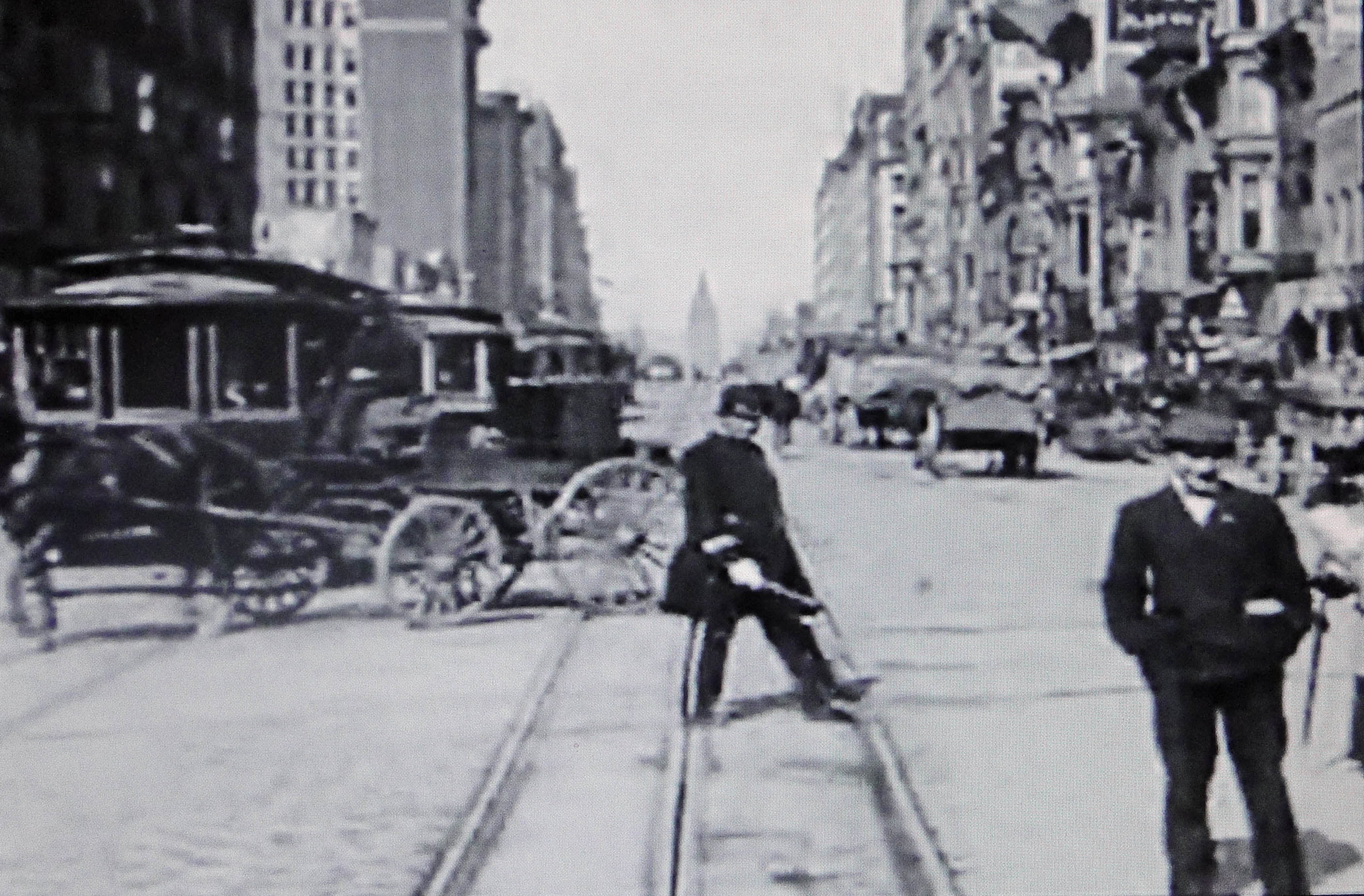
On April 14, 1906, just four days prior to the Big Earthquake, this first-ever 35 mm film clip was shot on Market Street in San Francisco.

It’s 1906 and the Houston petroleum industry is gushing over the discovery of oil at the Goose Creek Field east of the city. Thirty oil companies and seven banks are now operating in Houston. Out west, the City of San Francisco will just about crumble into dust when a great earthquake strikes the area on April 18, 1906.

A photographer friend, John Wendell Mason, and now living in England, sent me a link to this remarkable film clip overnight. Taken only four days prior to the big San Francisco Earthquake of 1906, it is the first 35 millimeter film ever shot and successfully developed in history. Aside from all else that makes this film special, that historical factor is noteworthy today. It gives all the rest of us the chance to view the mother of all modern films on Mother’s Day!

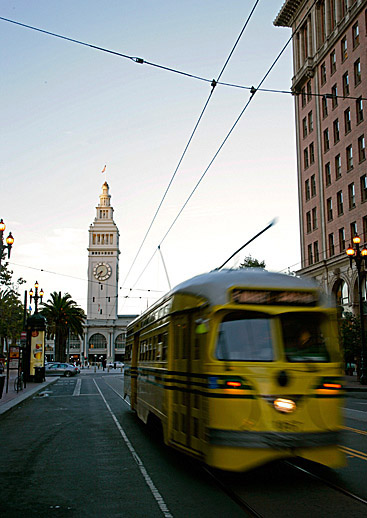
According to the information I received with the film clip link, the film was taken on Market Street by a camera mounted on the front of a cable car that ran out to the Embarcadero Wharf. The clock tower that we see prominently in the clip at the end of the ride is still there today as one of those rare sturdy survivors of what was about to soon shake the land and the city’s history.

Here’s the link. Just watch and enjoy:

http://www.youtube.com/watch?v=dGloeX1SpAU

The visual pleasures here are incredible. Check out the dressing styles of both men and women, the numbers of autos, bikes, and horse-drawn carriages, the chaos of traffic movement as people dodge the cable car at the last-minute on foot or simply turn their vehicles to cross the tracks in front of the cable car at the last second. No wonder we have so many street car/gas vehicle collisions today in Houston. Some human behaviors do not change all that much over time.

To me, the enjoyment is watching everything take place in real-time, without the herky-jerky false speed-up of a Charlie Chaplin comedy, a Teddy Roosevelt speech, or a Babe Ruth roach-speed home run trot. The film is the closest we shall ever come to a simulated time-travel arrival in San Francisco on April 14, 1906.

Back in this era, everybody got to inhale dried horse manure. It rook a while for the new gas and electricity driven vehicles to clean up all the city air by replacing all the horses.

This is a good time to reflect also on all that was going on in the Houston area back in 1906. We already know on the baseball front that 1906 was the year that the light-hitting Chicago White Sox (the so-called Hitless Wonders) rose to upset the heavily favored Chicago Cubs in the World Series, but let’s tap into more happenings from Houston in 1906.

On February 10, 1906, the suspicions of many about the artesian purity of the water being provided by the Houston Water Company when a repairman in the fifth ward discovers five catfish swimming in a water main.

On April 1, 1906, members of the new city commission form of government go to work under the new system and right away report on the increased level of efficiency and competence that the system brings to their work. I’m not sure how they measure this result on the first day in motion. Perhaps, they have a light agenda this day or maybe they are truly treating the moment for what it is – April Fool’s Day.

With public reaction to the earlier catfish find stirring them on in May 1906, the city purchases the plant and property of the Houston Water Company. Again, an improvement in water service is reported immediately. In this case, “improvement” may have been measured by the absence of catfish or tad poles in the drinking water.

Also in May 1906, Houston launches its plan for a “War on Mosquitoes.” Starting next week, the city will begin to cover every ditch in the city with a coat of oil. And where is Houston going to get the oil to be used in this treatment? – Get serious.

In August 1906, Houston’s first wireless radio station opens as one of only four that now exist in the state. The station is perceived as a competitive personal communication alternative to the telephone and telegraph. That’s how “wireless” came to be the new medium’s name. The concept of radio as a broadcast medium for general news, entertainment, and advertising was years away in 1906.

On September 3, 1906, work begins on the turning basin for the ship channel. Big ships won’t come to Houston until they have water that’s deep enough to traverse, and a place to turn around once their business is done here.

Also going up in September 1906 are Houston’s first truly named “skyscrapers.” A building that will reach eight-stories in height upon completion is under construction, much to the pride and awe of Houstonians.

The problem of Houston drivers of the new automobiles exceeding the 6 MPH speed limits around town draws the attention of city government in October 1906. Mayor Rice recommends that the city purchase an automobile for use as a police car in the chase and apprehension of speeders.

More National News, 1906: Writer Upton Sinclair publishes his novel, “The Jungle;” the 1906 San Francisco Earthquake kills 3,000 and leaves hundreds of thousands homeless in it’s almost total destruction of the city.

International News, 1906: Roll Royce Limited registers as a maker of fine cars; Mount Vesuvius erupts in Italy, devastating Naples.

When all is said and done, Happy Mother’s Day, Everybody!


Market Street Approach to Clock Tower Today, 2010.

Additional San Francisco Film Notes: “This film, originally (was) thought to be from 1905 until David Kiehn with the Niles Essanay Silent Film Museum figured out exactly when it was shot. From New York trade papers announcing the film showing to the wet streets from recent heavy rainfall & shadows indicating time of year & actual weather and conditions on historical record, even when the cars were registered (he even knows who owned them and when the plates were issued!).. It was filmed only four days before the Great California Earthquake of April 18th 1906, and (it was) shipped by train to NY for processing.” – E-Mail from John W. Mason.

The Code of the Baseball Cellar.

May 8, 2010

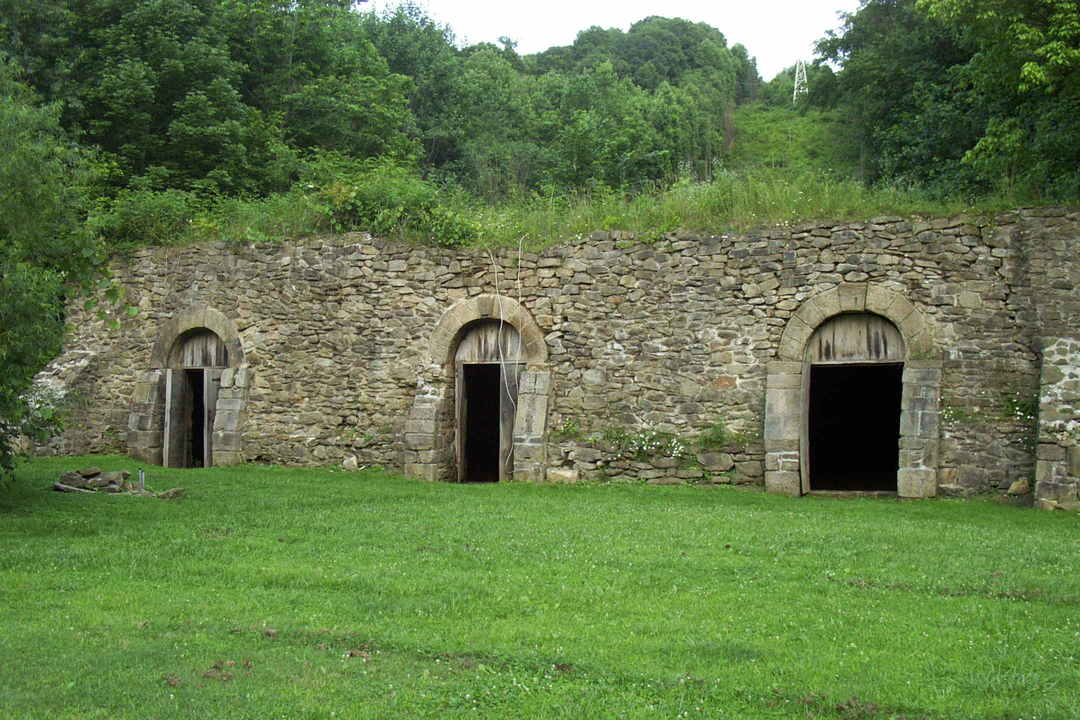
In a vineyard cellar, sweet grapes transform over time into fine wines. In a baseball cellar, bitter whines transform over time into sour grapes.

Fellow SABR member Bob Stevens sent me two interesting links yesterday to new articles on the unwritten codes of baseball. The first of these is a piece by Jerry Crasnick of ESPN.COM; the second is the work of Jason Turbow, who’s also written a new book on the subject that he is calls  “The Baseball Codes.” Both are entertaining and fun. Check ’em out:

http://sports.espn.go.com/mlb/columns/story?columnist=crasnick_jerry&page=starting9/100505

http://sports.yahoo.com/mlb/blog/big_league_stew/post/The-Code-Ten-unwritten-baseball-rules-you-mig?urn=mlb,238853

These articles have inspired me to write a brief piece on the unwritten codes and truths that govern life for teams on their not-so-merry-ways to that residential place in the season standings we call the cellar. The first of these I’ve already written above as the caption to the vineyard cellar doors photo, but I shall repeat it here for the sake of putting all our storied eggs in one basket.

Ten Truths and Codes that Govern Everyday Life in Any MLB Division Cellar:

1) In a vineyard cellar, sweet grapes transform over time into fine wines. In a baseball cellar, bitter whines transform over time into sour grapes.

(2) Buyer’s Regret is a condition that multiplies exponentially for club owners and general managers of cellar-dwelling teams. If you have somewhere along the way signed a 200-pound outfielder to a multi-year contract to hit .300, but you now find him on the way to weighing 300 pounds, while hitting .200, you’re going to be much more aware of this inversely developing set of facts as a cellar-dweller.

(3) The players on your cellar-dwelling 25-man roster suffer from one of two immediately incurable conditions: They are either too young or two old.

(4) Over time, and it doesn’t take many losing streaks to get there, your cellar-dwelling players stop thinking of ways to win – and they start asking themselves in the field, by the second inning at the latest: “I wonder how we’re going to lose this one? All I can do is try to get my hits and stay out of the way of disaster. If I’m lucky, maybe they’ll trade me to a contender late in the season.”

(5) Your stalwart pitching ace may become disheartened by the absence of support over time and start thinking these kinds of thoughts prior to each start: “OK, I’ve got a chance to win, if I can keep the other team from scoring, if my defense only has to make routine plays, and if I can either pitch a whole game, or else, turn the ball over to the pen with no less than a four-run lead to protect.”

(6) The other clubs above the cellar dwellers all start looking more and more like the ’27 Yankees and you start hearing these kinds of comments off the cuff from some of the guys: “Uh-Oh! The Pirates are coming to town tonight. Hate to see it. They are starting to play us like we’re the eggs and they are the egg-beaters!”

(7) On cellar dwelling clubs, players start talking about post-season hunting and fishing plans by the First of June. Of course, in this instance, except for the Yankees, even the front-running clubs are doing the same thing. In New York, the players are talking more about their international business plans and how playing ball sometimes gets in the way of keeping an eye on their global industries and celebrity girl friends. Cellar dwelling club players don’t have celebrity girl friends – not for long, anyway.

(8) In homage to humility, cellar dwelling managers eventually get around to using something like a table of random numbers as a strategy for making out new lineup combinations. Eventually the goal of coming up with a winning lineup simply mutates into the challenge of finding a different lineup for every game that remains on the schedule from August 1st forward.

(9) By late August, cellar dwellers have figured out that they can finish last without the presence of any high-salaried players who remain on the roster. Anybody whose performance has not totally stunk is then traded as a cost-saving strategy for addressing the big and growing red-dollar deficit on the club’s profit and loss statement.

(10) Cellar dwellers eventually settle in to a nice quiet season play-out with their few remaining loyal fans who still attend games in person. These fans always show up, but they never boo, as was the case long ago with a famous cellar dwelling team we once knew as the St. Louis Browns before they moved to Baltimore and morphed into the Orioles in 1954.

”Our fans never booed us,” said former Browns pitching ace Ned Garver. “They wouldn’t dare boo us,” he added, “we outnumbered ‘em!”

Have a nice weekend, everybody, and stay away from the cellar, unless you’re going down there for some good wine.


Baseball Loses Robin Roberts.

May 7, 2010

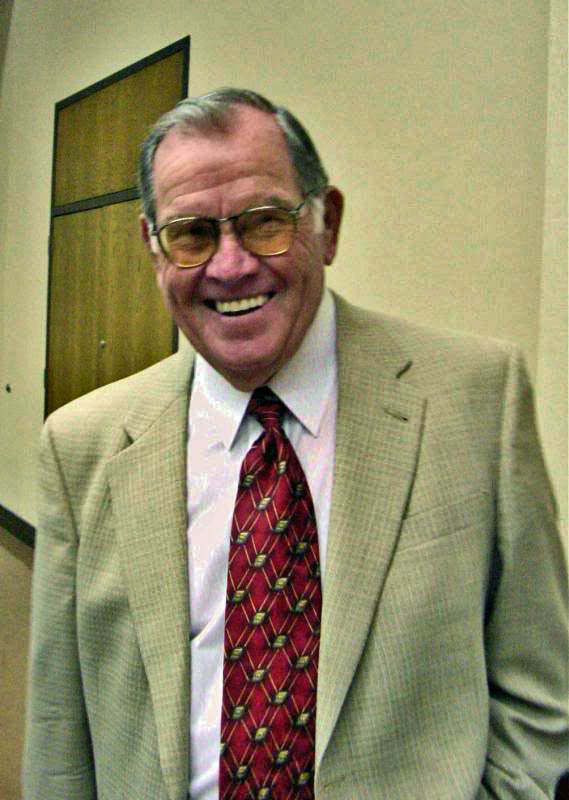
"C'mon, Robin! Give us that great old Whiz Kids smile!" -2001.

The news that we had given up Hall of Fame pitcher Robin Roberts at age 83 yesterday, May 6, 2010, hit me pretty hard. I was only a passing acquaintance of the former Phillies great, but he was really big to me back in the summer of 1950. That was the year that the 23-year old Roberts and his phellow band of Philadelphia Phillie juveniles pulled together to nip the Brooklyn Dodgers on the last day of the season for their city’s first National League pennant in thirty-five years. The Phillies then got swept by the New York Yankees in the 1950 World Series, but they had left their mark for all time upon the hopes of young people everywhere.

Robin Roberts (BR/TR) was born on September 30, 1926 in Springfield, Illinois. Before turning pro, he pitched for Michigan State University as a widely heralded future star, one of those that did not disappoint.

Starting with the 1950 Whiz Kids season, Robin Roberts rang up six consecutive seasons of twenty wins or more (1950-55). His best statistical season turned out to be 1952, when he compiled a 28-7 wins-losses record and an earned run average of 2.59.

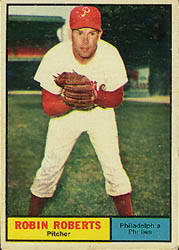
Robin Roberts: The way I'll always remember him.

Robin Roberts had a 19-year major league career with the Phillies (1948-61), Orioles (1962-65), Astros 1965-66), and Cubs 1966. He had 45 career shutouts, 2,357 strikeouts, and he pitched 305 complete games. Pitchers worth their salt finished what they started back in Roberts’s day. In the past 25 years, Phillies pitchers have thrown a total of 300 complete games — five fewer than Robin Roberts worked by himself. Roberts made 609 starts, finishing more than half of those he began.

Roberts also gave up more home runs than any other major league pitcher in history. Chalk that one up to his tenacity for challenging the hitters and his ability to locate his pitches in the “I win or you win” zones. Current Phillies pitcher Jamie Moyer is on the verge of breaking that mark. Moyer, 47, has given up 498 homers, seven fewer than Robin Roberts at 505.

In his two partial seasons as Astro, Roberts went 5-2 with a 1.89 ERA in 1965 and 3-5 with a 3.82 ERA in 1966. For many of us Astro fans, he was just part of a baseball world that appeared to be headed toward some kind of new perfection. We had the first domed stadium that was big enough to handle major league baseball and we had THE Robin Roberts pitching for our newly rechristened Houston Astros. How right could we expect the world to get from here? What a great feeling that was, while it lasted.

Robin Roberts was inducted into the National Baseball Hall of Fame in 1976. He had been a regular annual supporter by his presence at Cooperstown induction ceremonies ever since and a passionate fan in retirement of his old club, the Phillies. It offers some small comfort to this diehard Astros fan to know that Robin Roberts lived to see his old club finally succeed in the World Series, but that’s as far as that kind wish goes. I wish it could have been the Astros, and not the Phillies, that had taken that 1980 playoff series, but that’s a horse of another color on this particular day. The subject today is one of the great right-handers of all time.

I always saw Roberts as one of those rare fastballers who also possessed strong finesse and ball location skills. In a way, as implied earlier, it may have been Robin’s ability to consistently locate his pitches in challenging places that inversely helped hitters to take him deep fairly often. Roberts didn’t seem to care enough to change his style. He still won the balance of his encounters and he did it often enough to make it to the Hall of Fame.

I first met Robin Roberts in 2001 at the reception prior to inductions into the Texas Baseball Hall of Fame in Fort Worth. That’s where I took the civilian shot of Roberts that appears in this post. When I asked Robin’s permission to take the photo, he responded willingly, but grimly, until  I posed the the request put forth in caption with the photo. After that photo, it was my pleasure to talk a few minutes with Robin Roberts about that magical 1950 season. That Phillies smile never left him in the process.

I last saw Robin Roberts only last year at the Joe Niekro Knuckle Ball banquet at Minute Maid Park. I remember thinking how well he looked. His passing this week at age 83 just drives home the point one more time: Live today. Never takes tomorrow for granted.

Goodbye, Robin Roberts. We shall miss your smiling presence at our baseball gatherings, but we shall keep you in our baseball memories forever.

1861: Baseball Comes to Houston.

May 6, 2010

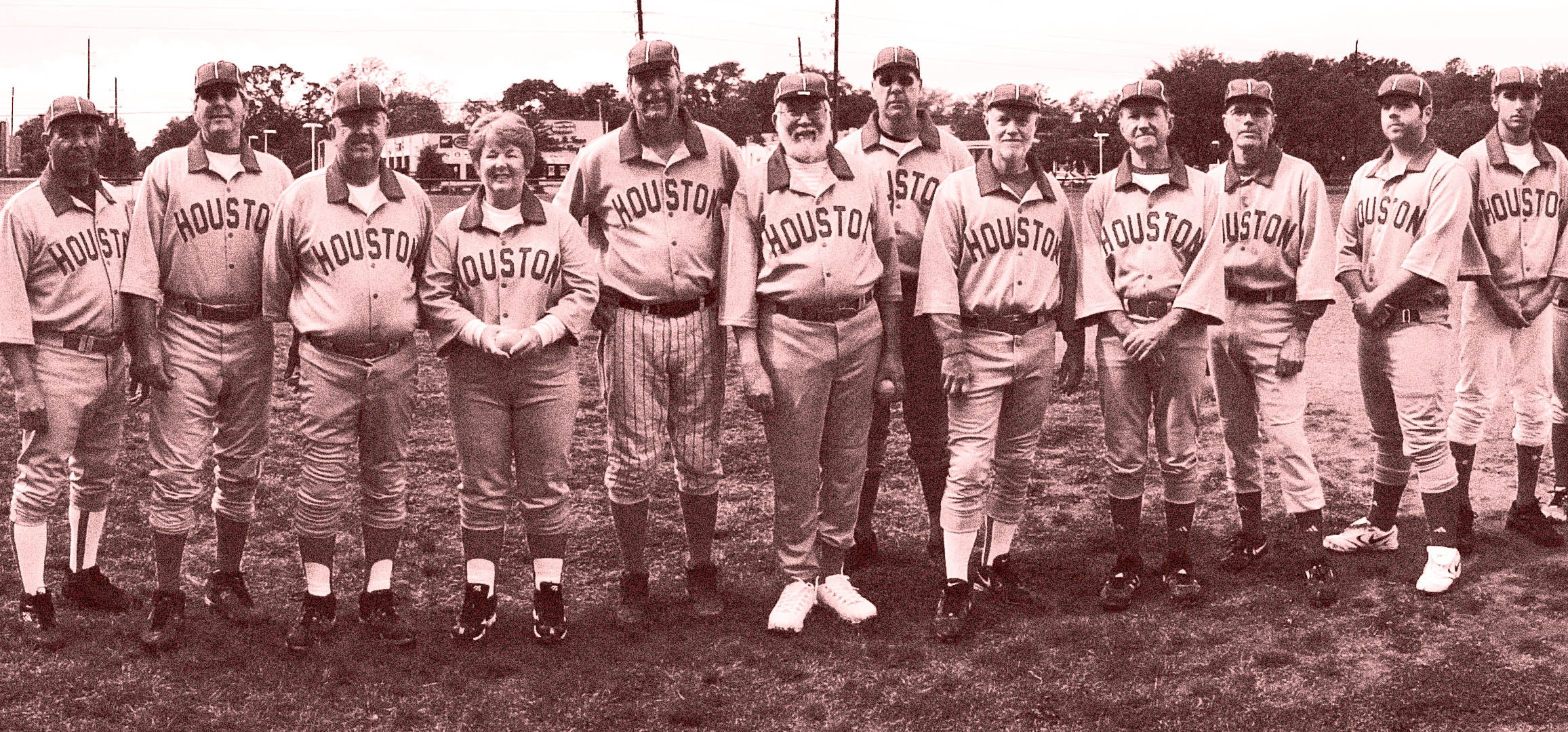
(L>R): 1861 Houston Mayor Will Hutchins. Major Abner Doubleday, Darrell Evans, J.H. Evans, CSA Capt. Dick Dowling, CSA Gen. Robert E. Lee, Glen McCarthy, 1st Houston Base Ball Club Board President F.A. Rice, Ike Clanton, Bat Masterson, Doc Holliday, & William H. Bonney. (J/K. The rest of the article is for real.)

1861 was a pretty tough, but dynamic year for the 25-year old City of Houston. The town was growing hard and fast as in inland port city and railroad transportation depot. At the same time, the winds of secession and civil war were blowing hard in the face of progress.

Local hero and city namesake Sam Houston stood strong and fast against the idea of Texas seceding from the Union that it fought so hard to join and then defend, but his was a voice of the minority in a struggle that seemed to most Houstonians as a battle between state rights versus federal authority – or more practically – the right of southern and new states to continue building their good fortunes on the backs of slave labor versus the national outcry against the hypocrisy of our American words in the Declaration of Independence and Constitution.

On the local level, Houston’s interest in the game of base ball kept on growing, in spite of the heavy hand that was about to fall on the future of all America. Houston had been founded by the Allen brothers of New York and it had been attracting settlers from the east coast region that already knew and loved the game before they arrived in Houston.

On April 16, 1861, just four days after the first shot of the Civil War had been fired at Fort Sumter in South Carolina, a core group of Houstonians met in a second-floor room above J.H. Evans’s store on Market Square for the purpose of organizing the first official “Houston Base Ball Club.” Mr. F.A. Rice was elected to serve as the club’s first Board President, but it took a while to actually get things going for actual play. Base Ball’s competition for manpower with the rapidly forming Confederate Army  would effectively delay regular play until after the Civil War’s conclusion in 1865. By then, the influx of new base ball fans from migrating Union soldiers and the return of Confederate military men to Houston had sweetened the pot of local talent.

For quite a few years, the flavor of Civil War sympathies continued to pour through the naming of local area amateur teams. On Texas Independence Day, April 21, 1867, the Houston Stonewalls defeated the Galveston Robert E. Lees in what has to be one of the great lopsided base ball games of all time. The final score was Houston 35 – Galveston 2.

One of our local SABR Chapter research goals is to confirm the exact site of the 1861 J.H. Evans store on Market Square. Regardless of what is there now, the site alone is certainly deserving of a plaque that notes the location as the birthplace of baseball in Houston. It’s time to get the job done now before this quiet, but important Houston historical fact slips through everyone’s fingers from here to eternity.

Note: In case you have not figured it out by now, or simply had no way of knowing, the folks in the gag photo above are really members of the Houston Babies, a reincarnation of the 1888 first professional baseball team in the Bayou City.

Have a nice Thursday, Everybody!