Posts Tagged ‘History’

Downtown Double Play

June 7, 2010

Minute Maid Park, Houston, Sunday, June 6, 2010

Minute Maid Park in Houston has been the driving present force for both change and preservation in the east downtown area now for the past eleven years. Anyone who knows anything about our city will tell you, no matter how bleak things look at any given moment, that the picture is a lot prettier today than it would have been – had the Astros remained south of the Texas Medical Center in the iconic, but falling down fast, rat-infested Astrodome over this same period of time.

Although ballgame attendance is down in 2010 due to economic and talent conditions affecting the team, the Astros have experienced some of their best years at the gate since the 2000 move to the cozier confines of the downtown “Juice Box.” We fully expect to see that three million people  season attendance gate again too – just as soon as the hope of winning and the availability of expendable income both ratchet up again a couple of notches in the hearts and pocketbooks of Houston baseball fans.

If we can ever succeed in rebuilding a well-heeled downtown living community, and a seven days a week alive service and entertainment environment going on again downtown, I think we shall also see an even clearer  rise in everyday ballgame attendance, Today there are simply too few grocery stores, other shopping places, restaurants, schools, and affordable homesite choices to make serious downtown living a practical option for most people, and especially for young families.

There’s not enough going on down there that’s affordable and people can’t wait for game days with the Astros, Rockets, and Dynamo to have choices. Of course, the other double play that enters into the picture here is the availability of work choices in the near downtown area. You can’t move to the downtown area to avoid the freeways if you still have to drive to the ‘burbs to earn a living, but there’s not a whole lot of job expansion going on downtown in the middle of our current economic climate.
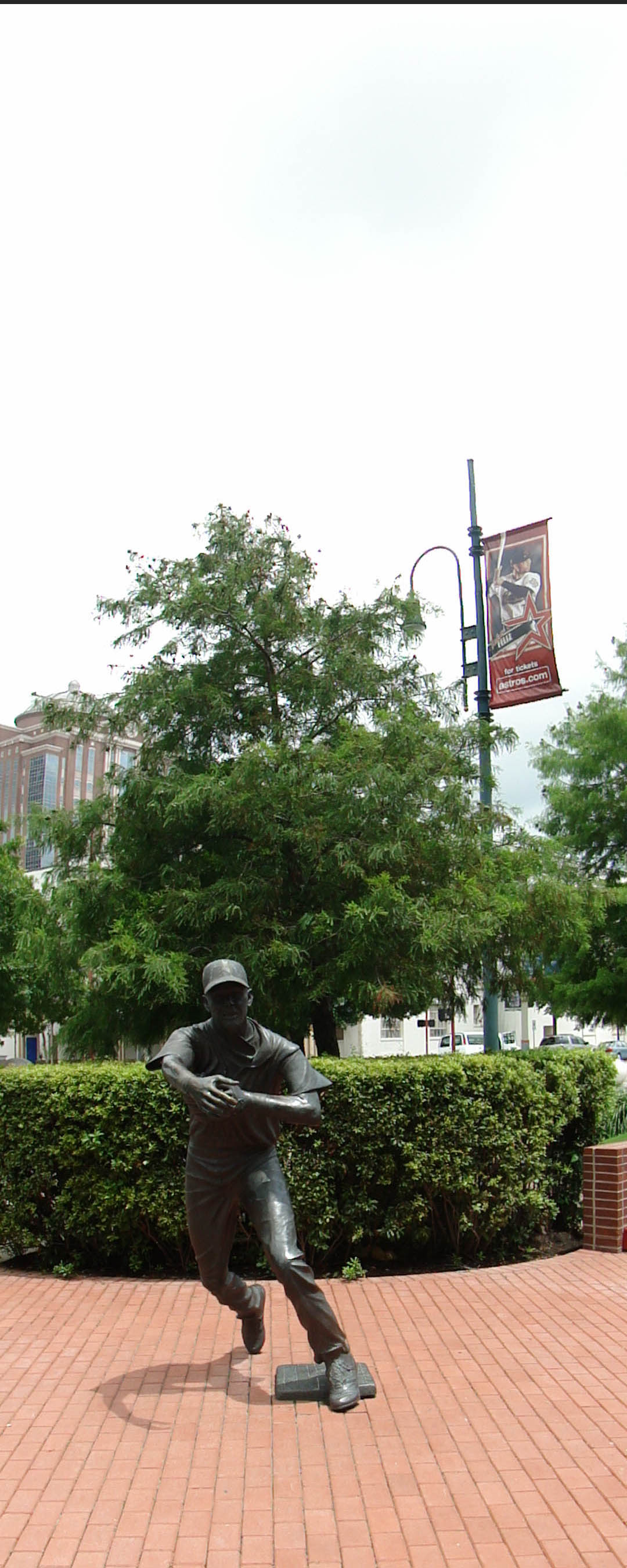
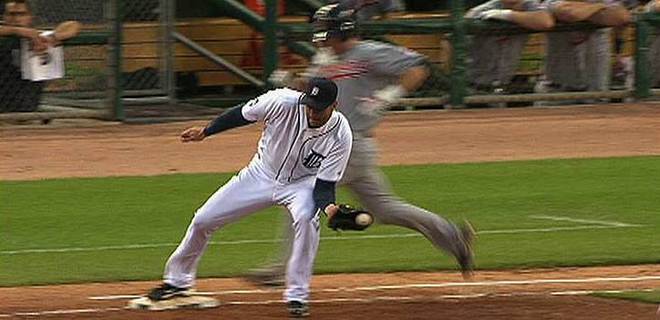
Craig Biggio makes the throw to first ....

I’m sure there must be some kind of downtown economic development council meeting somewhere in Houston today to discuss a more serious approach to improving growth conditions on the east side of downtown Houston. All I can offer are these few general thoughts and words – and the memory of our last best known downtown Houston double play combo of Craig Biggio and Jeff Bagwell.

Downtown Houston needs the dual availability of affordable, attractive area living choices, plus the availability of good-paying professional jobs in the downtown and near downtown region. Put those two plays together in some kind of stable form, where jobs and infrastructure come together in a way that people trust as real change and not a fragile promo package and we will start to see real movement to the restoration of everyday life in the downtown area.
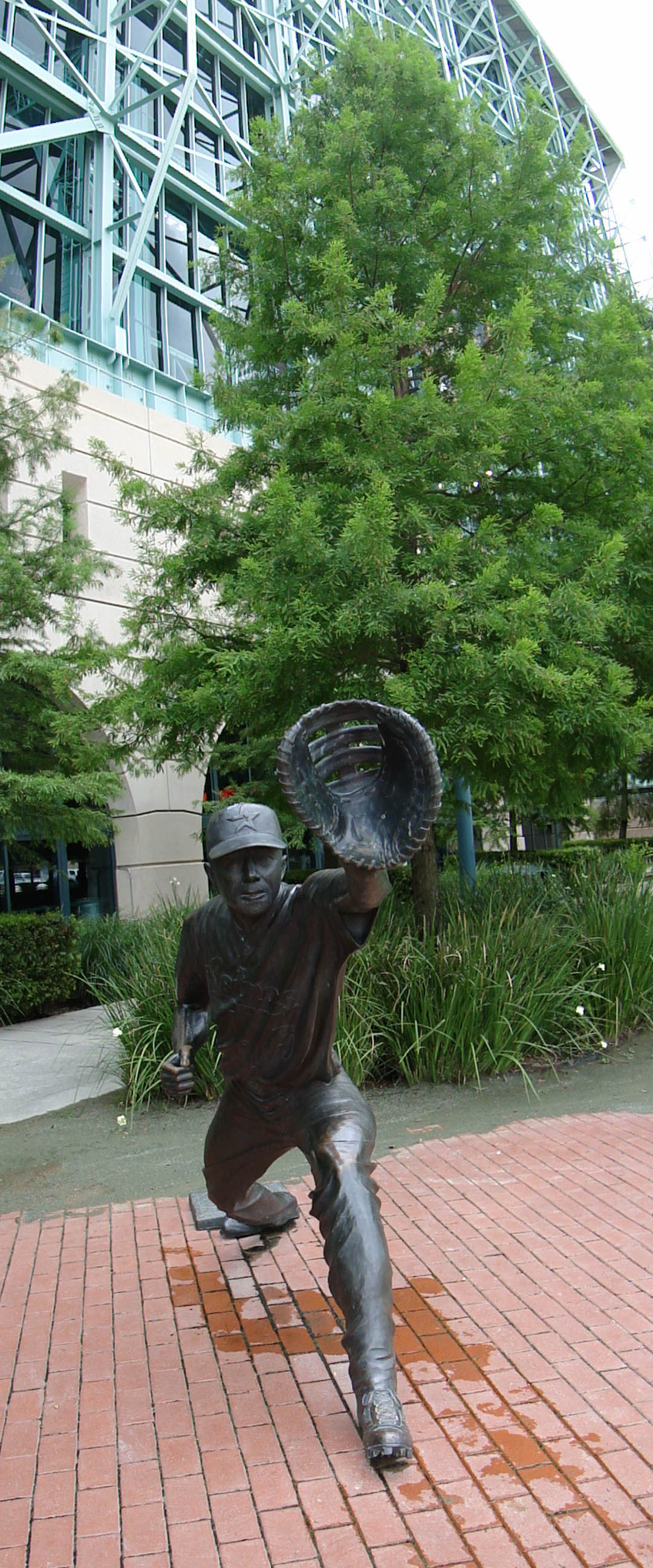
... and Jeff Bagwell takes it in to complete the double play!

The last time we pulled off a memorable double play downtown so well, we built statues to honor the facilitators. If Houston can pull off the downtown living double play, the only statues needed will come in the form of hands shaking in success.

I hate to sound like the Chamber of Commerce here, especially when I don’t even have a dog in the money hunt that certainly has to result from the success of this effort, but I see it as a move that really appeals to my personal double-play of caring for Houston.

I’d simply like to see us build a new Houston that doesn’t require us to destroy the physical and architectural  history of our local heritage in the process. Don’t tear down the old houses and buildings to simply make parking lots and new formless glass office space. Adapt the fine old structures already there for new use, wherever and whenever possible.

The Inn at the Ballpark at the corner of Texas and Crawford stands as a brilliant example of how even the tasteless old World Trade Center Building could be made like new into something that reeks with the ambience of a building it never was,

We can only hope that the relic across the street from Minute Maid Park at Union Station that was once the 12-story Ben Milam Hotel will someday soon shine even brighter once that lofty project is completed.

All for Houston. And Houston for all.
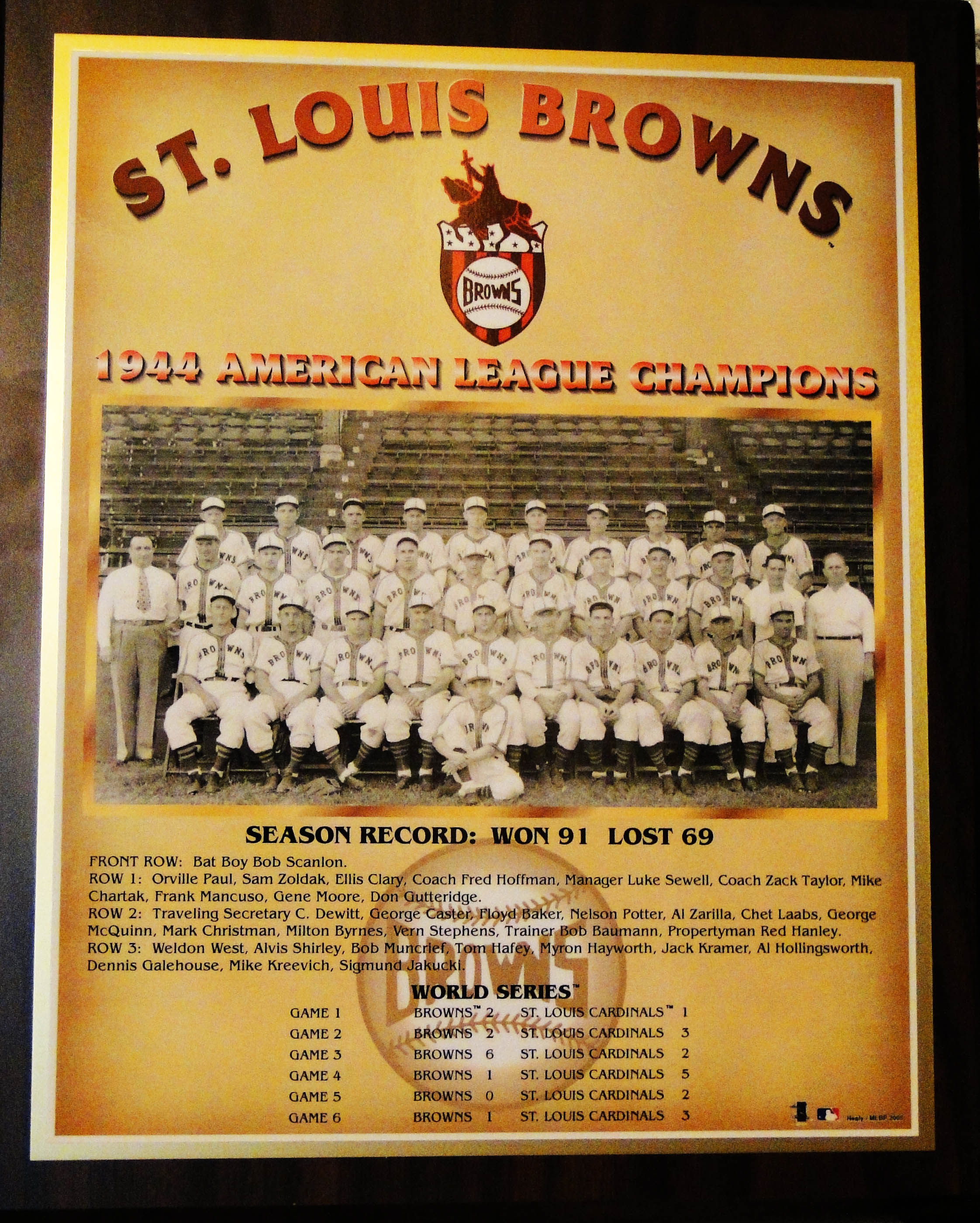
Baseball Cord Travels Far & Wide

June 5, 2010

I received this beautifully framed photo narrative of the 1944 St. Louis Browns yesterday as a gift from Ron Pawlik, a buddy I played ball with back in 1951, but only yesterday caught up with again for only the second time in the past year.

Yesterday I attended an alumni luncheon at St. Thomas High School in Houston where, I must note, the natives are quite happy with their still new baseball coach, Craig Biggio. Just in case you haven’t heard, and in only his second season at the helm, Coach Biggio has now led the fighting Eagles to a state high school baseball championship. We can only hope that Craig stays a while before he heeds the big league call to manage somewhere.

Something else happened yesterday to powerfully remind me of how far-reaching the cord of baseball has traveled in my life. Out of the blue, but not really, I ran into Ron Pawlik, a buddy of mine from St. Christopher’s Parochial School in Park Place. Ron was a year ahead of me in school, but we played in the same outfield together one year for the 1951 ever-rambling St. Christopher Travelers. I had seen Pawlik at last year’s alumni luncheon for the first time since 1997, when we held a reunion at old St. Chris, and before that time, I had not seen Ron since his graduation from St. Thomas in 1955.

The short of it is the fact that he gave me that beautiful framed Browns piece displayed here. Ron had been reading some of blog articles over the past year and had become aware of my affinity for the old Browns. I was both shocked and appreciative of his generosity. I really like the Browns piece on ts own merit, but also because it simply helps drive to the surface the realizations I’m trying to express this quiet Saturday morning.

Like a lot of you, the long  cord of baseball has been with me forever, often serving as the X factor in whether or not I became friends with, or worked things out with, other human beings that came into my life over time. Once I knew that someone liked baseball, and was sure they understood not to call runs points, umpires referees, or managers coaches, we could overcome just about all other obstacles to working out the parameters of our everyday life relationship.

When I was a kid, growing up in the Houston East End, we were all Houston Buff fans. of course, and almost 100% of the adults I knew were St. Louis Cardinal fans when it came down to supporting a favorite major league club. I too became a Cardinal fan as a result. They were the parent club of my local Buffs – and their roster was loaded with all the Buffs who played good enough to get there.

My admiration for pitcher Ned Garver converted me into a St. Louis Browns fan in 1951, but I now think that change was helped by my need as a kid to rebel against the Cardinal blanket that totally  surrounded me. Besides, I didn’t totally abandon my support for the Cards. I just added the hapless Browns as my underdog battling American League club.

By the time I reached St. Thomas High School, I was assigned to a home room that was run by a Basilian priest scholastic named “Mr. Klem.”

Aha! Now there’s a major clue as to the ongoing presence of the baseball cord. Mr. Klem turned out to be the nephew of Hall of Fame umpire Bill Klem, a real baseball guy, and a fan of the New York Giants, his home state club. I had never met a Giants fan previously, but Mr. Klem seemed to be as knowledgeable of baseball as all the Cardinal people I grew up knowing. It made me think that maybe Giants fans weren’t all that bad after all. Besides, Mr. Klem seemed pretty high on his club’s young center fielder, Willie Mays, and of course, 1952 was the year that followed the 1951 Shot Heard Round the World. During Mr. Klem’s religion classes on miracles in our daily lives, we got to hear a lot about Bobby Thomson as a primary example of same.

For some unfortunate reason, I never dated any women that really cared for, or knew much about, baseball. I did have a Freudian theory professor in graduate school at Tulane whose brilliance was matched, and  somewhat neutralized by her thick German accent and the upside down Nazi-way she held her lighted cigarette during lectures. I couldn’t find the baseball rope or Freudian string on this period in my life, but I survived.

“You vill learn zee theories of Herr Freud und you vill not be deceived by all zee sick patients who unconsciously or sociopathicly wish to manipulate you, zee doctor, unto seeing zem as honest und trustworthy!”

I survived Dr. Gestapo and the concerted efforts of the formal education process I had embarked upon to change the way I thought, talked, wrote, and viewed life in general, If I was of any help to people who sought me out as clients over my years of practice as a professional counselor, it was because of what I had learned from baseball and from growing up in Pecan Park – and not from some cold burial in the theoretical alien-spirited offerings of Tulane University.

A good friend of mine in New Orleans, a fellow named Donald M. Marquis of Goshen, Indiana, wrote one of the seminal books on the history of jazz in 1979. That book, which is now being made into a movie, is called “The Search for Buddy Bolden,”  and it took Don Marquis seventeen years of focused research and investigation into the life of jazz’s first trumpet man before it was finally done.

Where did Don Marquis acquire his patience for the job? Easy. He was a Cleveland Indians fan. If you want something done that takes a ton of patience, hire an Indians fan.

One of my best friends in graduate school at Tulane was Sue Elster-Hepler-Liuzza. Sue was easy to like. She’s a north side Chicago girl who loves the Cubs and, of course, hates the White Sox. I was a little shocked, but not really surprised earlier this week when Sue told me that she never even stepped foot on the South Side until well into her adult years. She also explained that she is typical of many North Siders. They want nothing to do with the South Side or the White Sox. Unfortunately, this knot n Sue’s baseball rope came at a cost. She never got to see the original Comiskey Park in person. By the time she went there, it had been torn down.

My own baseball rope on life trucks on, flaring lessons all the way: (1) The days of our lives are like the games on the schedule of the long baseball season. You win some. You lose some. And you take each day one at a time and go on from there. (2) Whatever you’re doing, keep your eye on the ball. A few of the pitchers we face in everyday life may try to throw a few emery balls at us. (3) Pick a project team of people you know you can trust – and go into combat with them. There aren’t many things you can do out there well alone without help and you probably will need to rely upon people who know their jobs and your expectations of them – ones who will also cover your backside honestly, but still be strong enough to hit you with the truth when you need that feedback most. (4) keep your word. (5) take responsibility for your “E”s, learn from them, and move on. (6) Look for some kind of joy in all you do. (7) Never give up on anything that’s really important to you.

That’s enough for now. And thanks again, Ron Pawlik. And thanks to you too, great wondrously flexible cord of baseball. You keep popping up to remind me where my real education came from in the first place. The Pawlik gift is simply another life reminder:

(8) Loyalty and real friendship are forever.

Commissioner Selig Blows the Bigger Call

June 4, 2010

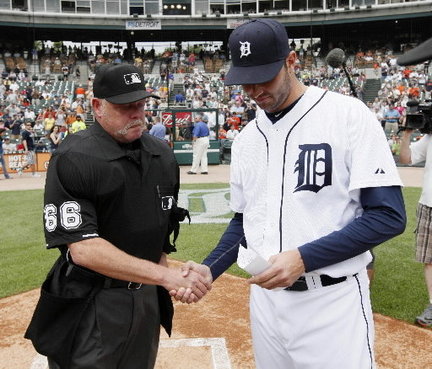
On the Day After the Perfect Game Blown Call, Umpire Jim Joyce joins Pitcher Armando Galarraga at home plate to enter the Tiger's Thursday lineup and take their places together in history as two joined-at-the-soul-hips "Heartbreak Kids."

Cleveland Manager Manny Acta is among those who think that Commissioner Bud Selig did the right thing by refusing to reverse the blown call by umpire Jim Joyce that blew the perfect game of Detroit pitcher Armando Galarraga on the 27th and potentially final out of Wednesday’s perfect game effort against the Indians. “If he had done something like that, he would have opened a whole can of worms,” said Acta. “If you change that, then the next thing we’d want him to do is change the play before that one.”

Acta had to be engaging in hyperbole in this instance. Does anyone remember the play before the big one at first base? And the one before that one was the Willie Mays-like catch by the center fielder. Does anyone really want to reverse that call?

As I told a friend of mine last night, I fully respect his support for the idea of leaving things as they stand in protection of the “sanctity” of baseball history, but that I no longer feel married to that point of view in situations where an obvious uncontested wrong call could be corrected for the sanctity of  getting things rights for the record in baseball history.

Galarraga’s perfect game would have been the third in a month, but only the 21st in a history of baseball that goes back to 1869. How big is that? No one is arguing in favor of the original “safe” call that even umpire Joyce admirably now admits was a blown call. Unless Bud Selig had been willing to use his power “for the greater good of baseball” to make it right by reversing the call and ending the game on that play as the 3-1 put out it actually was, that record is now lost forever.

Please note: I would not support the reversal had the game continued from Joyce’s blown call and turned into an Indians’ victory, but that did not happen. The very next batter was retired to end the game as a Detroit win, the result that would have followed from the perfect game victory. I also would not have supported reversing the call if the safe/out verdict by instant replay had been in question – or if umpire Joyce had stuck steadfastly to his original call. Under either of those circumstances, or by reversing a Cleveland victory, we would have been tampering with history in ways that go far beyond correcting an obvious wrong.

Twenty years ago, I would not have even entertained this idea, but I’ve changed, for better or worse. Today I think getting the truth right, especially when it frees people from unwarranted pain, is far more important than standing on ceremony. As things now stand, two people, pitcher Galarraga and umpire Joyce are going to be forced to live with the full brunt of an untruth (the runner was safe for a “hit”) that alters each of their lives forever.

No one on earth can take away the pain that Wednesday’s game will be forever spoiled by what actually happened, but Commissioner Bud Selig does have the power to right a wrong that will especially punish the diligent conscience of umpire Joyce forever, if he does not.

The criminal justice system is fairer. If the courts send a man to prison for a crime he didn’t commit and that fact is later proven to be the case, what do they do? They let him out. They don’t just stand on the idea that “well, we’d like to let the man out, but sending him to prison already has happened so we’ll just have to leave him there,” nor do they buy into Acta’s implied concern that “we can’t free a single innocent man. If we let one free person out of jail, then all the wrongly imprisoned will want out too.”

Do the right thing in a timely way. Restore Armando Galarraga as the owner of baseball history’s 21st perfect game and free two men from a lifetime balance of pain over an outcome that could have been reversed for a greater good that far surpasses one man’s loss of a badly earned infield single.

Next up? Don’t wait for a clearer warning, baseball. Get your act together on how you want to use technology in the near future (as in – as soon as possible) to help avoid this sort of thing without slowing the game into a pool of total molasses.

Perfect Game Lost to Imperfect World of Umpires

June 3, 2010

Blown Umpire Call on 27th Batter Costs Detroit Pitcher Galarraga His Perfect Game!

I was piqued the other day when umpire Bill Hohn tossed Astro pitcher Roy Oswalt in the third inning for being frustrated with his postage stamp strike zone. Today I am enraged over the fact that a horrible call by umpire Jim Joyce yesterday on the 27th batter of the game has cost Detroit Tiger pitcher Armando Galarraga his perfect game. With the pitcher himself covering first base on what should have been – indeed was – the last out by way of a grounder on every batter he had faced, Joyce called the runner safe. He would admit his error later upon an examination of the replay after the game, but the perfect game was still lost forever.

The Galarraga perfecto would have been the third such animal in thirty days, the only time that three of these most improbable of all baseball jewels have adorned the neck of our national game in a lone season of play. It would’ve also been only the 21st perfect game in major league history. Now it will simply have to be the shared bad dream of pitcher Galarraga and umpire Joyce, and all others of us who care about these things, from here to kingdom come.

I haven’t been this upset over the outcome of a baseball contest since Game Six of the 1986 National League Championship Series between the New York Mets and the Houston Astros. At least that one turned on managerial decisions and what happened on the field. This one – THIS ONE – turned only on  what one game official saw with his naked brain and eye against what we could have ascertained accurately had instant replay been permissible under the circumstances.

Look! Nobody wants this kind of outcome. Not umpire Joyce. Not pitcher Galarraga. Not the players. And not the fans. As per usual, change will now come to baseball on the heels of disaster. It’s time to make even greater use of instant reply to keep this sort of thing from happening again.

When instant replay was approved a couple of years ago for fair/foul and distance marker calls on home runs, it was done to keep blown perceptual decisions of the umpire’s fallible human eye from wrongly affecting the outcome of games. Shouldn’t we also try to extend that same protection to the integrity of baseball history?

We already know that instant replays do not resolve all questionable calls and that it would be too time-consuming to allow them on every play. Some errors are going to simply continue, especially on the distorted ways the human eye sees the strike zone differently from umpire to umpire. Until we can get to a point of calling balls and strikes by laser ray, I don’t see balls and strikes consistency getting much better,

This thing that happened yesterday, however, is a horse of a different color. Instant replay clearly showed that the 27th batter of the game was OUT by a couple of feet on the grounder play at first base. Had instant replay been allowable under the circumstances, history could have been correctly registered with no shame upon the umpire’s missed observation – and we would not all be sitting around today trying to figure out a way to make anger, remorse, and regret digestible.

What kind of sauce tastes good with a boiled dead rat, anyway?

Here’s what I propose as protection against the repetition of yesterday’s improbable rat boil:

Any time a pitcher enters the ninth inning with a no-hitter going, instant replay should be allowable on any questionable field play affecting safe/out calls. For an umpire’s “safe” call on any runner to be reversed, there must be clear evidence on tape to support an overrule. This condition will continue in the game for as long as the pitcher remains in a position to throw either a no-hitter or perfect game. and will cease as an appeal option as soon as a hit is recorded. Decisions on instant replay reviews will be handled in the same manner as the one in place now for foul/fair balls and home runs.

Do it now, Commissioner Selig. The integrity of the game’s history is on the line.

Curt Walker and the Boys of Beeville

June 2, 2010

Curt Walker, MLB, 1919-30; .304 BA; Struck Out only 254 times in 4,858 official times at bat.

When my dad was growing up in our little Texas birth town of Beeville back in the early part of the 20th century, the city population of this little farm and ranch community was only about 3,000, but they were all mostly people who loved baseball. It showed on the rough playing fields of South Texas too. Beeville sent three players to the major leagues during those early times, all of whom got there with enough staying power to carve out careers in the big time over several seasons.

Two of the these men were pitchers: (1) Melvin “Bert” Gallia, 1912-20, W 66 L 68, ERA 3.14 and (2) Lloyd “Lefty” Brown, 1925, 1928-37, 1940, W 91, L 105, ERA 4.20.

Gallia (1918-20) and Brown (1933) both spent some of their time pitching for the old St. Louis Browns. Gallia was a 17-game winner for the Washington Senators in 1916-17 consecutively. Brown leads the Lou Gehrig victim lst for having given up 4 of the Iron Horse’s career-leading 23 Grand Slam Homers.

Then there was outfielder Curt Walker, who played a major role modeling place in my dad’s life as a young ballplayer. Grandfather McCurdy published, edited, wrote for, and printed the local Beeville Bee, but he died when Dad was only two years old. One result was that Dad grew up needing some other local adult male to look up to – and it turned out to be Curt Walker, who also worked in Beeville during the off-season at his other occupation as one of the town’s leading undertakers.

By the time Dad was old enough to follow Curt Walker as he broke into the big leagues with the 1920 New York Giants, radio had yet to take over as a coast-to-coast medium of mass communication. If you wanted to follow the daily changes in baseball back in that era, you either had to have access to large daily newspapers and be able to check the sports pages for the stories, box scores, and up-to-date standings – or else, you had to do what Dad and other small town people did back then. You had to walk downtown to your weekly newspaper office, or Western Union station, and check for news and box scores as they came streaming live through every little nook and cranny of America. Some of these places, as was the practice of the Beeville Bee and Beeville Picayune, kept chalk board accounts in their Main Street windows that detailed scores, standings, and brief news on what the “Boys of Beeville” were doing on a given summer day.

Dad often described these walks downtown for scores in the late afternoon as the highlight of his summer day as a kid.

For me, Curt Walker would become the reason behind my eventual involvement in the Texas Baseball Hall of Fame. When I attended my first TBHOF induction banquet in Arlington in 1996 and learned that Walker was not a member of the state hall, I began campaigning for his induction. It took five years, but the late Curt Walker finally was inducted into the Texas Baseball Hall of Fame in 2001.

Curt Walker had hung out in the shadows of Texas baseball history for too long. If you will take the time to compare his career marks with fellow Texan contemporary Ross Youngs, an inducted member of the National Baseball Hall of Fame, you will not find a lot of significant difference. Both were deserving players from this state. Walker just got lost by posting his best season batting average of .337 and 196 hits with the 1922 Philadelphia Phillies and then spending most of his big league career (1924-30) in the hinterlands with the Cincinnati Reds.

Curt Walker’s lifetime MLB batting average of .304 and his limited 254 strike outs in 4,858 official times at bat pretty much speak for themselves and his batting ability over time – although he arrived in New York with a scouting tout that even Curt could not fulfill in reality.

When the Giants purchased the contract of Curt Walker from the Augusta Georgians in 1920, they paid $7,000, or ten times what the Tigers paid for Ty Cobb’s services from the same club back in 1905.  Many South Atlantic League veteran observers were saying they felt that Walker was better than Cobb at that stage of his development. Of course, that scouting report turned out to be a major oversell, one that led John McGraw to deal Curt Walker away in 1921 to the Phillies, but he was a steady good ballplayer for years to come – and much better than average. He also was a smart and speedy runner and fielder with a good arm.

Years later, catcher Eddie Taubensee would become the fourth native Beevillian to make it to the big leagues. Also, famous big league hitting coach Rudy Jaramillo, a native of Dallas, but a kid who grew up in Beeville would also rise up to leave their own marks on the game.

Two other things I always note about Walker are these: (1) Curt played 41 games for the Houston Buffs in 1919, his first year in professional baseball; and (2) As a member of the 1926 Reds, Walker tied a major league record that will always be very hard to break. In a game against the Boston Braves, Curt collected two triples in the same inning.

What are the odds against anyone ever hitting three triples in the same inning? I’m guessing they are about equal to Curt Walker’s chances of ever being inducted into the National Baseball Hall of Fame.

Balls and Strikes

June 1, 2010

Good thing Roy Oswalt didn't have a perfect game going into the 9th yesterday!

When Astros starting pitcher Roy Oswalt got tossed by plate umpire Bill Hohn yesterday in the third inning of his game against the Washington Nationals for expressing his frustration over the strike zone, it not only strongly effected the outcome of the contest, but it reawakened all the key arguments over what baseball should do about it:

(1) Make the umpires go to school on what the strike zone is so that calls are made more uniformly. That’s been tried and I’m sure that many umpires would tell you that they still do get together and try to make sure they are all coming from the same page on balls and strikes. Oh yeah? Go see a few games and watch how these guys variously call the strike zone. Either a lot of people are lying or the strike zone is so subject to variable perception that getting all the umps to call it even close to the same way is either highly improbable or probably impossible.

(2) Leave things as they are and let pitchers and batters adjust to the variations in the strike zone as they occur from umpire to umpire. That’s probably what will happen here, but the Oswalt ejection highlights an ongoing problem. Oswalt was ejected for ostensibly baiting umpire Hohn for not calling strikes on the outside corners of the plate. Oswalt says he was just venting his frustration – and what’s wrong with that? If we are going to cut the slack of imperfect human nature and allow umpires to vary the strike zone, can’t we at least allow pitchers to stomp around the mound and mumble to themselves when their equally human frustration spills over? Why do the umpires have to take those actions personally? Are umpires the center of the universe? Are umpires the reason we buy tickets to go see  ballgame? I don’t think so.

As things stand, it’s now up to the umpire to diagnose the intent of the pitcher as he moves around and mumbles. If the umpire chooses to take the pitcher’s actions personally, he then has the power to throw the whole game out of whack by dispatching a club’s ace at any junction in the game or point of time in the season.

What if Oswalt had been tossed in that last game at St. Louis in the 2005 NLCS playoffs? What if Roy Halladay of the Phillies had been ejected with one out to go in his perfect game effort last week? Neither happened, but they could have happened under the current rules.

For now, the umpire has the power to change the history of baseball in any game he chooses by acting on a perceived offense and ejecting a key player. If the cause was protested and found to be poorly administered later, it might help baseball rid itself of a poor official – but that wouldn’t bring back the pennant or a perfect game that may have been lost by the original act of ejection.

So, what’s the alternative?

(3) Laser Tech or Looser Rules on Player Frustration Acts. I really have no idea where we are on the use of laser technology for calling balls and strikes, but if we are anywhere close, I’m all in favor of baseball looking into it. I don’t think it serves the best interests of the game when any club’s ace, especially, is dispatched as Oswalt was yesterday, but neither do I think we are talking about a change that only protects aces in big games. We need a change that protects all pitchers in all games.

More practically, we may have to get a clearer definition of what are acceptable acts of frustration by a pitcher when he is struggling on the mound over the strike zone or for any other reason. Common sense by the umpire points the way here. If a pitcher stomps around and kicks dirt and mumbles something the umpire cannot hear, let him do it. If a pitcher points his finger at the umpire and calls him something like a “Blind SOB” – by all means – throw him out of the game.

Just please, Mr. Umpire, stay away from initiating conversations with the upset pitcher that begin with you walking toward the mound, asking, “What’s that you said?” If you do that, it just tells us fans that you have already decided to toss the pitcher because you can’t handle anything that may be taken as criticism of your umpiring abilities.

Mr. Umpire, as a fan, I don’t go to the ballgame to watch you umpire. I don’t even go to the ballgame to learn your name and, chances are, if you are doing your job well, I never will know your name.

Do you get my drift  here this morning, Mr. Bill Hohn?

Some Memorial Day Thoughts

May 31, 2010

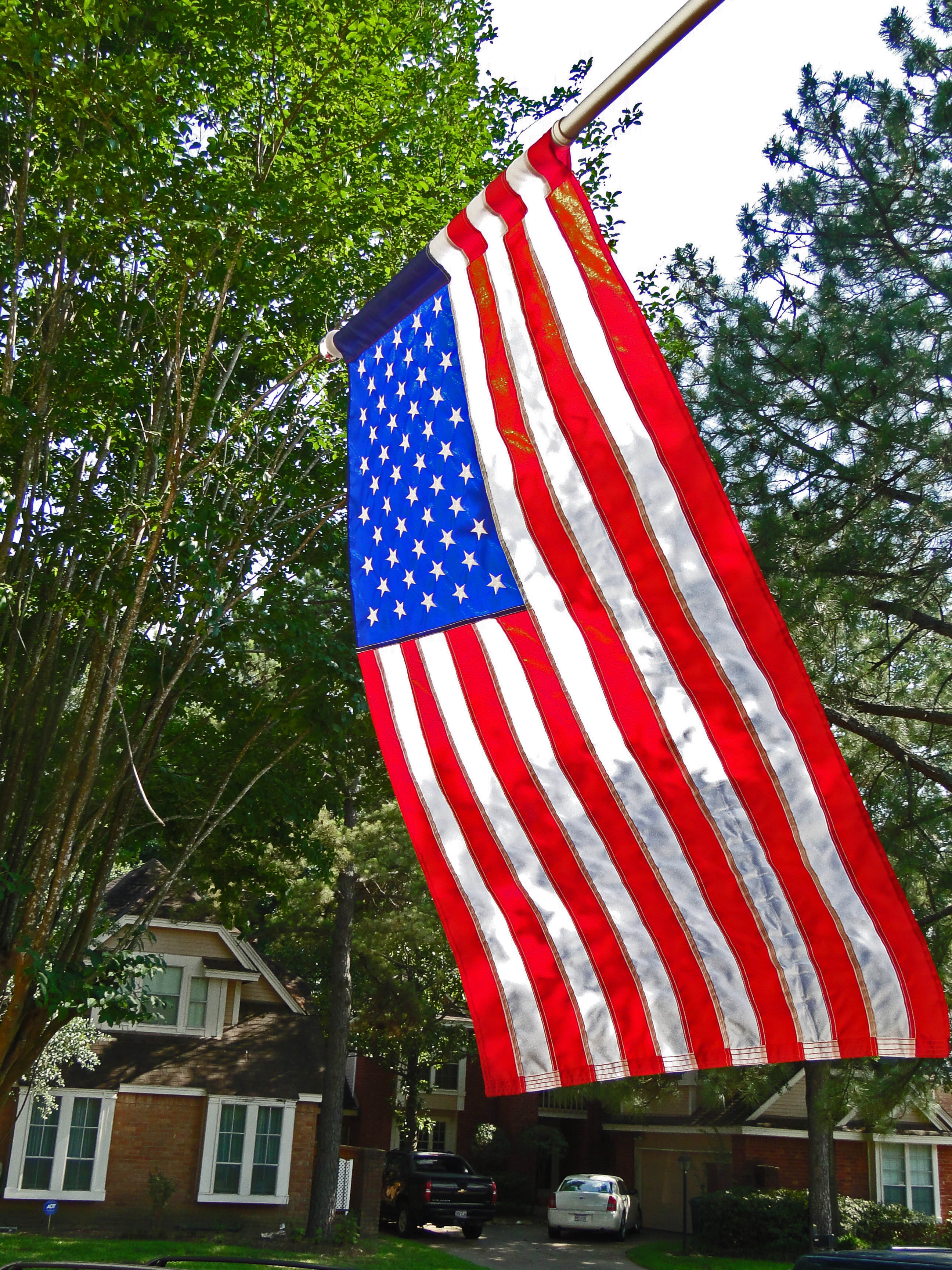
Long Live the USA! And Long Live the Memory of Those Who Died for Our Country!

Memorial Day 2010. The Indy 500. Baseball Season. The Beginning of Summer. Bar B Que. Which will we remember the most? Or maybe I shouldn’t ask. Bar B Que is an American craving. Maybe it’s simply more important for us to continue giving and receiving all those messages that remind us of what Memorial Day is supposed to mean to our American way of life each year.

We need to remember all the brave men and women who have  surrendered their lives for our country. We need to remember them everyday – but especially on this day – Memorial Day of 2010 and forever.

Happy Memorial Day, Everybody! When you you sink a salivating bite into some Bar B Que today. Just remember who made it all possible, but also remember the even more important items on our plates that their brave actions have secured for us as no other nation has ever enjoyed them:

Freedom of Thought and Movement, Respect for Human Rights, Scientific Advancement, Creative Artistry, Literature, and Athletic Accomplishment, yes, these and all other worthy expenditures of human energy are all the fruits that grow best in the constitutional sunlight of an open society – but these qualities, alone or together, don’t come without a price. Without the supreme sacrifices our military people have paid from the start, no one else in America has pockets deep enough to pick up the tab on what it’s all worth to the rest of us.

Pour that thought on your Bar B Que today too, folks. It’ll taste better. I guarantee it.

Remembering Uncle Carroll.

May 30, 2010

Reprinted here from the blog article I wrote on ChronCom.Com last Memorial Day, May 23, 2009.

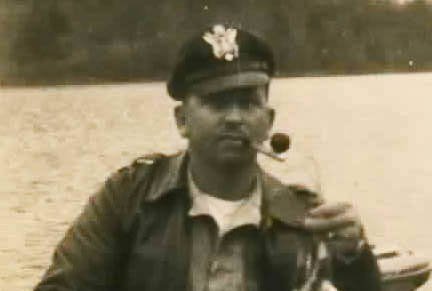
Uncle Carroll & Aunt Florence on Lake Hamilton outside Hot Springs, Arkansas from 1946-1955.

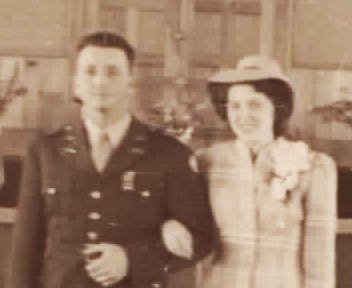
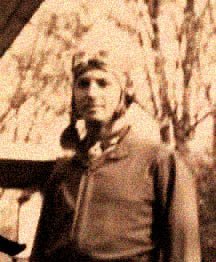
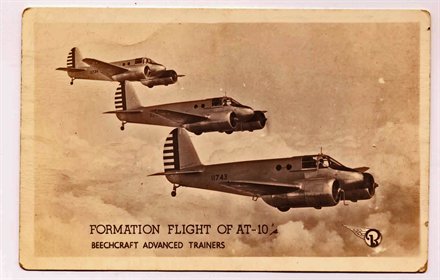
Major Carroll Houston Teas (1917-1964) was a man of his time. When World War II came to the USA, he joined the service in San Antonio and went straight into training at Kelly Field with the Army Air Corps. Before shipping out to the Pacific theater as a military cargo pilot, he married his high school sweetheart, the forever lovely Florence MacPherson.

Uncle Carroll Teas & Aunt Florence married during world War II, before he shopped out to the South Pacific with the US Army Air Corps..

Uncle Carroll was my mother’s little brother. He and Aunt Florence were special to me during my young life in ways I’ll never be able to put into adequate words.

During World War II, Uncle Carroll flew logistic flghts of supplies all up and down the various South Pacific island chains. After the war, he used to regale me with stories of all the things they learned to do to keep from getting shot down by Japanese Zeroes over the open seas. One time, he told me, they were so badly outnumbered by Japanese figter planes that they had to fly blind within the clouds for many miles, just to keep from being taken down as an easy target. Many other times, they had to fly above or below the cloud banks to disguise themselves from Japanese fighter planes flying in the opposite direction.

“Off we go – into the wild blue yonder, flying high – into the sun.”

The Japanese also hid in blind cloudbank flight. The dangers of so doing on both sides are obvious, but that option beat the near certainty of getting shot down by faster aircraft in open skies.

I used to have a pair of pilot wings that Uncle Carroll sent me during World War II. Wish I had been a more careful saver of something that is now even more important to me, but I wasn’t. I used to pin those wings on my tee shirt before going out to play sandlot baseball and, somewhere on the playing fields of Houston, that’s where I gave it up.

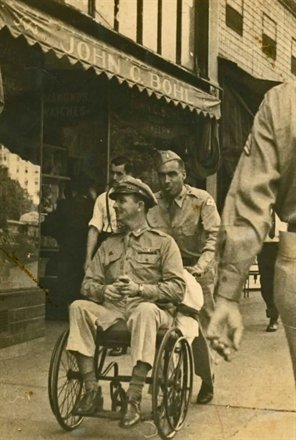
After safely serving nearly the entire war in combat, Uncle Carroll finally ran into something that stopped him in ways that rapid-fire ammunition failed to do. He contracted polio while stationed in New Guinea. Oh, he came home to America alive in 1945, but he came home paralyzed for life. The only question was: Would he regain any use of his body – or would he be forced to live out his life in an iron lung?

Uncle Carroll and a buddy on the streets of San Antonio – right after coming home from World War II.

Coming home, I didn’t really see Uncle Carroll at all during the early months of his struggle with polio. The army sent him up to Hot Springs, Arkansas, where they treated a lot of polio cases back then with the aid of hot springs baths and swimming. Prior to his illness, Uncle Carroll was always a powerful, athletic person. He was a hard-hitting third baseman for the Brackenridge High School Eagles in San Antonio back in the mid-1930s and he wasn’t the kind of guy to give up in the face of adversity. That core value, in fact, is the lesson he always tried to instill in me at every chance he was yet to have. I can see him even now doing his most to make the best of a bad situation in his time of greatest personal crisis.

With Aunt Florence always by his side, Uncle Carroll fought back and regained full use of his body from the waist up. With special attachments to his car, he was able to drive again. Although still wheelchair bound for life, Uncle Carroll and Aunt Florence bought a home on Lake Hamilton in Hot Springs, where he resumed his life as a fisherman and hunter. His Chris Craft lake boat was his other kind of new mechanical mobility – but he also could still swim like a fish in the water with the use of his legs in spite of their failure to him on shore.

Uncle Carroll continued working for the Army in Hot Springs as an accountant after the war, but he also started his own freshwater fishing lure company, selling lures that he designed himself. During the winter months, he added “avid duck hunter” to his resume.

We lost Uncle Carroll to a coronary in 1964. It was one of the three saddest days in my life, along with those two crushing others, when I said goodbye to Mom and and then Dad.

The two things I’ve always tried to remember from Uncle Carroll will only die for me when I do: (1) Do the things in life you are willing to put your whole heart into; and (2) Never give up on what is really important to you.

It’s Memorial Day again and my thoughts go immediately to my Uncle Carroll Teas. He didn’t die in World War II, as is the group intended for core honor on Memoral Day, but he gave up his life, his health, and his future there for the sake of his country, as did millions of others. There’s simply no way this holiday ever passes without me thinking of him with love and gratitude. My hope here today too is that your thoughts also turn to the special American veteran in your own lives who once, or currently, have placed his or her life on the line for the defense of us all. Let’s do it again each day, and especially on our next Veterans Day!

“We’ll fly on – in fame – or down – in flame – Nothing can stop the Army Air Corps!”

Have a peaceful and blessed Memorial Day, everybody – and let’s all try to remember all the men and women of American military service who gave up their lives and health for the sake of this wonderful place we call the USA!.

Visual Images and Baseball Inspiration.

May 29, 2010

Crank up the Metallica theme, boys! Here comes our closer!

As a kid, I found visual images all over the place in everyday life that I plugged into my sometimes silent, but always present fascination with the game of baseball. I once enjoyed the company of the same young Dominican nun teacher for 6th through 8th grade at St. Christopher’s in Park Place. Sister Reginald wasn’t a professed athlete, or particularly a baseball fan, but she showed an athletic ability in some of her teaching gesticulations that made me conclude that she could have been an effective sidewinder pitcher, had she so chosen to be. Sometimes in class she could bring that right arm around with all the sweeping motion of a vintage Ewell Blackwell in pointing to one of us “boys” as indicted, convicted, and sentenced for disturbing the peaceful goals of parochial school education.

I loved it, even I happened to be the one that day that was drawing the chin whiskers pitch from our hardworking taskmaster teacher. It gave me the opportunity to imagine hitting Sister Reginald’s pitch out of the park.

Yeah, that’s right. They say there’s a thin line between the presence of creative imagination and the mental residence of abject insanity in the minds, hearts, and souls of us too. I tried to keep that in mind from an early age, but I couldn’t help myself. I kept seeing the imagery of human motion as it applied to baseball in just about everything I saw. And nowhere was that more true than at the movies.

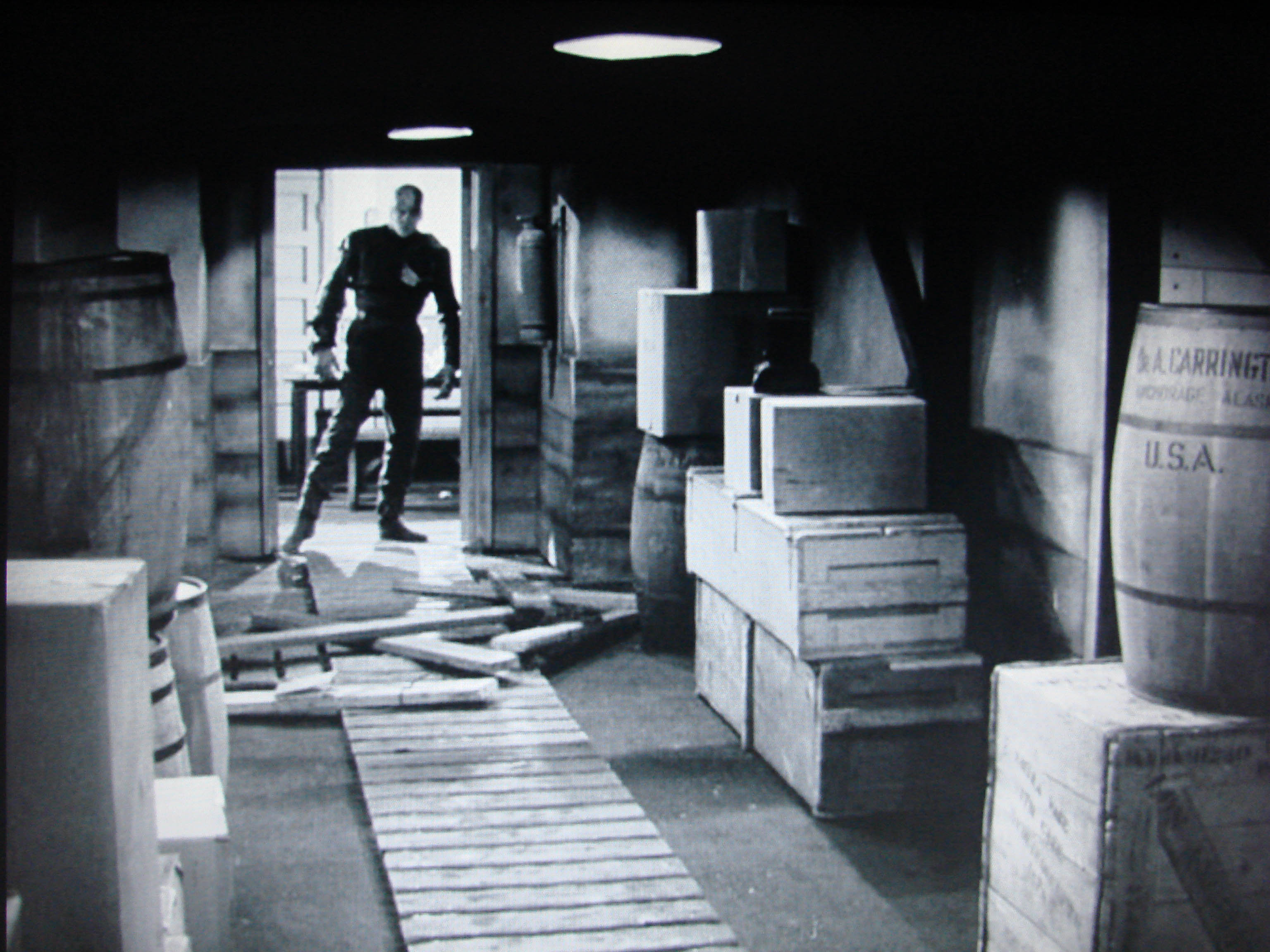
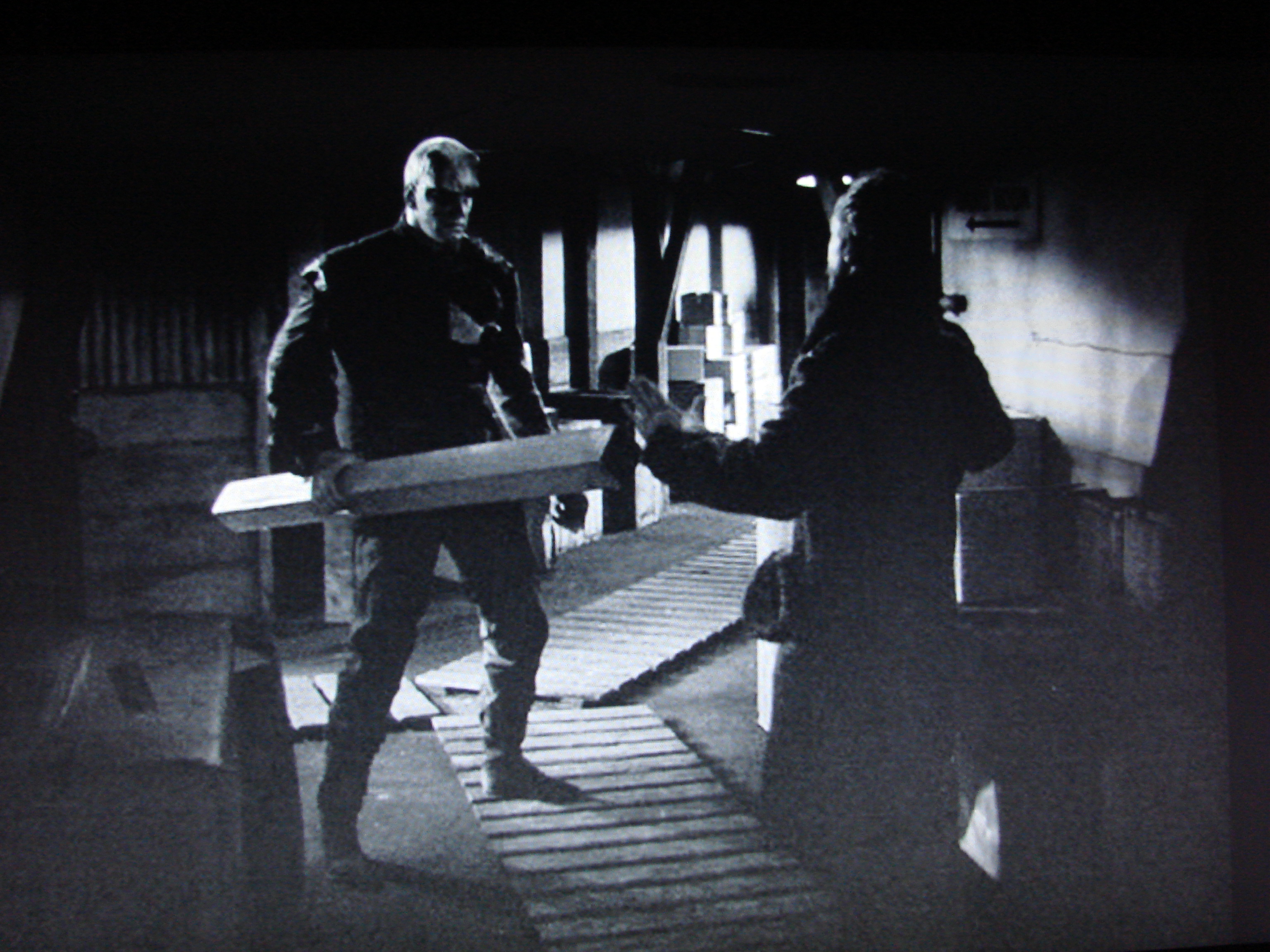
Long before the concept of “closer” became an everyday concept in baseball, I loved the climactic scene from the movie “The Things From Another World” in which “the thing” (James Arness), a vegetative man from another planet, comes through the military outpost door near the North Pole and halts in the doorway. I thought, “Wow! What if he was really an ace relief pitcher for the Buffs coming into put out a Dallas rally in the ninth inning at Buff Stadium? The visitors would be beaten as soon as they saw him standing there!”

As soon as he picked up the lumber, The Thing morphed from Closer to Slugger.

Of course, as the Thing plodded “closer” to the humans in the movie, they threw a big stick of wood at him to force him onto that wooden walking path, a route that was wired for electrification of the mad invader as  he drew nearer. The visual effect on my baseball fantasy of him was that the Freudian presence of the big stick immediately transformed The Thing into a potential slugger with all the pop of a steroids stallion – and all these imagery synapses were firing in my young brain some forty years prior to our common knowledge of HGH and what it could do. I just loved the vision of the Houston  Buffs acquiring a real “Superman,” an unretirable, unbeatable slugger that even the parent Cardinals could not take from us.

Yep, that’s right. I was a rank dreamer – and a Freudian one at that.

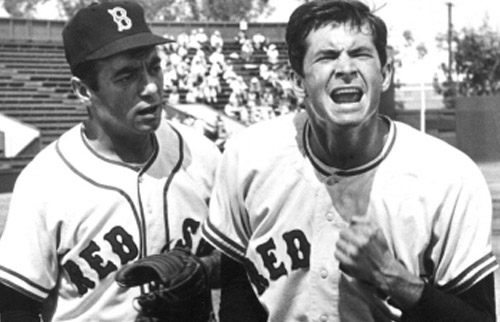
"Why is that every time I throw a ball, I throw it like a girl?" - Anthony Perkins (R) in the movie about Jimmy Piersall, "Fear Strikes Out" (1957).

The imagery issue had another backfiring effect upon me. I had little patience with Hollywood for bad casting of non-athletes as baseball players. They did it a lot – and maybe that speaks more for the fact that actors generally are not athletes – and vice versa. Although, we seem to have a greater supply of athletic actors today than we did back in the 1940s and 1950s.

Anthony Perkins has to be my all time favorite worst athlete/actor  for his 1957 portrayal of Jimmy Piersall in “Fear Strikes Out.” Just for the heck of it, here’s my top ten list of worst athletic portrayals by an actor in a baseball movie. To me, these are the instances of visual failure that are inexcusable to the tastes of any real baseball fans. That being said, I’ve been able to rise above my unhappiness with the playing abilities of all these actors to have enjoyed all the movies on this list. They were about baseball, weren’t they?

Worst Athletic Actors in a Favorite Baseball Movie:

1. Anthony Perkins in “Fear Strikes Out” (1957).

2. Ray Milland in “It Happens Every Spring” (1949).

3. Jimmy Stewart in “The Stratton Story” (1949).

4. Gary Cooper in “Pride of the Yankees” (1942).

5. Dan Dailey in “Pride of St. Louis” (1952).

6. William Bendix in “The Babe Ruth Story” (1948).

7. Ray Liotta in “Field of Dreams (1989).

8. Ronald Reagan in “The Winning Team” (1952).

9. Bruce Bennett in “Angels in the Outfield” (1951).

10. Michael Moriarty in “Bang the Drum Slowly” (1973).

Have a nice Memorial Day weekend, everybody, and watch where you are looking. You never know when something is going to pop into view that reminds you of baseball – even if you happen to be watching an Astros game.

One Photo / Many Questions.

May 28, 2010

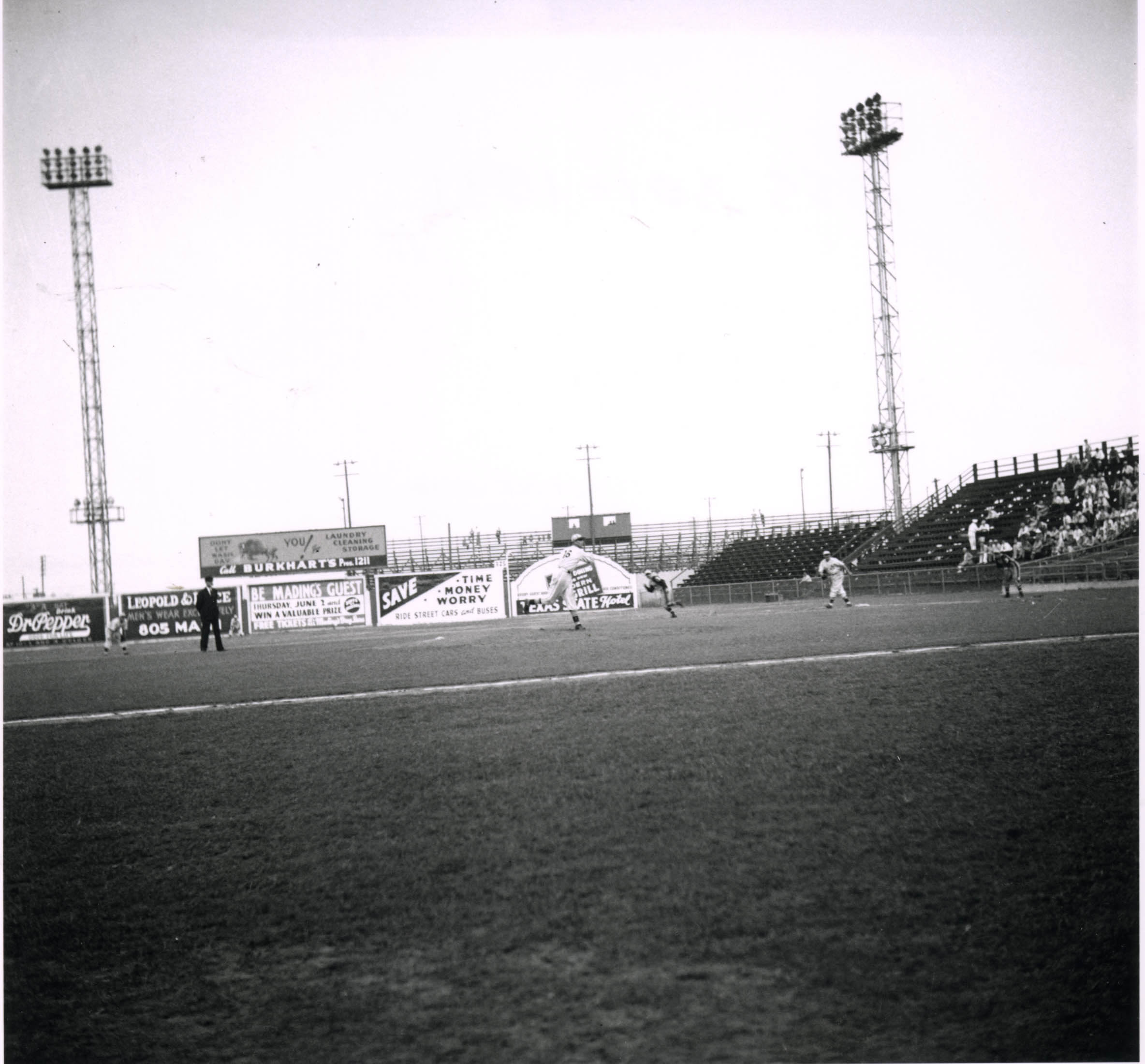
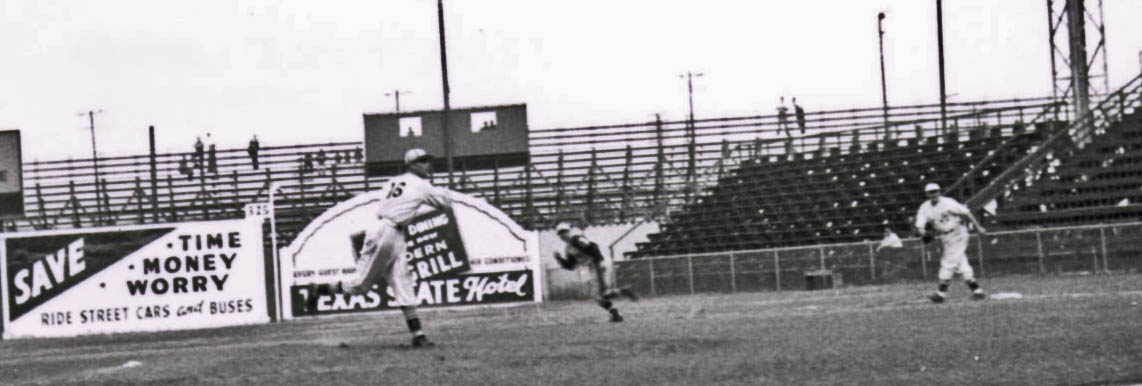
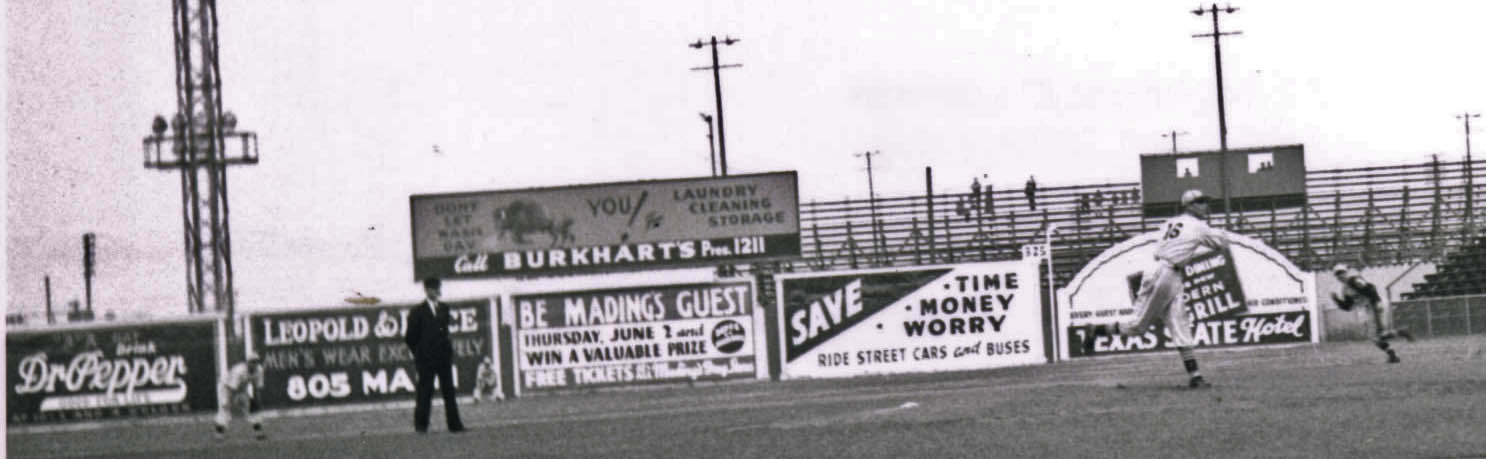
Right Field in Buff Stadium is a place of mystery and curiosity in this photo, starting with the fact that I'm not sure of the exact year it was taken.

Sometimes a photo makes everything obvious. Just as often, a photo may raise more questions than it really answers. The photo shown above is of the latter type. I acquired it some time ago from the very special Texana Collection at the julia Ideson wing of the Houston Public Library. We knew that it was taken in old Buff Stadium in the Houston East End, but that was about the only fact that was clear.

I’m not sure who #15, the pitcher, is but he is a Buff, as best I can see from the old English H that is visible on the left jersey breastplate in another close up of the  unidentified Buffs first baseman. The year of this uniform could have been anywhere from 1938 to 1942 or 1946-47. The ’47 Buffs club preferred the Buff logo on the jersey, but they also used the old English H. I simply cannot find another photo of the 46-47 team wearing the light colored caps with stripes – and a photo I have of the ’41 Buffs shows them wearing dark caps. More research is needed.

The HR-resistant Gulf winds came roaring in over these walls in the Houston summertime.

If you look closely above at the first crop-shot from the main photo, you may be able to see that the distance down the right field line was 325 feet, the same as I remember it from my Buff Stadium kid days (1947-54) and the same as it is now in Minute Maid Park. The major differences between these two ballpark right field lines would be the roof option at MMP and the no choice prevalent winds that blew in and over to left field from right field at Buff Stadium. – Also, you may have trouble seeing it here, but the right field foul pole is barely taller than the “325” distance sign.

I’m not sure about the outfield box area with two windows in this photo. There was no scoreboard function in right field during my Buff Stadium days and the main Press Box are was located on the roof behind home plate. I’m not even sure what those lined stands in right were about. We certainly had no outfield bleachers during my time there either.

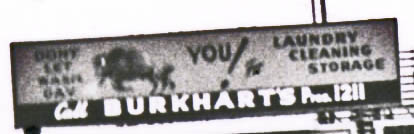
"Don't Let Wash Day Buffalo You!"

That top sign is from Burkhart’s and it’s promoting the idea in words and pictures that you (meaning “you housewives”) should not let wash day make you fear dirty clothes. With Burkhart’s help, they are offering protection from being buffaloed by the challenge.

Left to right above, the signs are also advertising Dr. Pepper, Leopold & Price Men’s Store, A Special Giveaway at Mading’s Drugs, Save Time, Money, and Worry by Riding Street Cars and Buses, and enjoy the comfort of the Texas State Hotel, including their first class modern grill.

Who could ask for anything more?

The sad days of segregated stands existed into the mid-1950s at Buff Stadium. The empty stands at left above were the designated "colored section.".

Segregated seating for black fans at Buff Stadium existed through the 1954 season, the year that first baseman Bob Boyd broke the color line by becoming the first black player to integrate any Houston sports team, amateur or professional, in the City of Houston. Why the so-called “colored section” at the left above is empty in this photo I could not begin to explain. It’s just shameful that even baseball wasn’t big enough to rise up sooner against the formal practice of racial discrimination, but that’s not the way history played out.

As for today, the empty “colored section” is simply one of the curiosities and mysteries that float forward in this single photo of an active past game day in right field at old Buff Stadium.

There are numerous lessons on the loose here in this picture, but not the least of these for all those photographers of history is this one: If you want your photos to capture history, do not expect the picture alone to tell the story. Write down when and where it was taken and leave a few words about who is in it and why it may be important to remember. Otherwise, by taking and leaving the photo alone, you will have over time simply left another visual egg of mystery to scramble the brains of viewers in the future.

Pass the salt and pepper, Mammy! Let’s close with a good clear closeup of that wash day buffalo ad:

"Buffalo Gal, Won't You Come Out Tonight - And Dance by the Light of the Moon?"

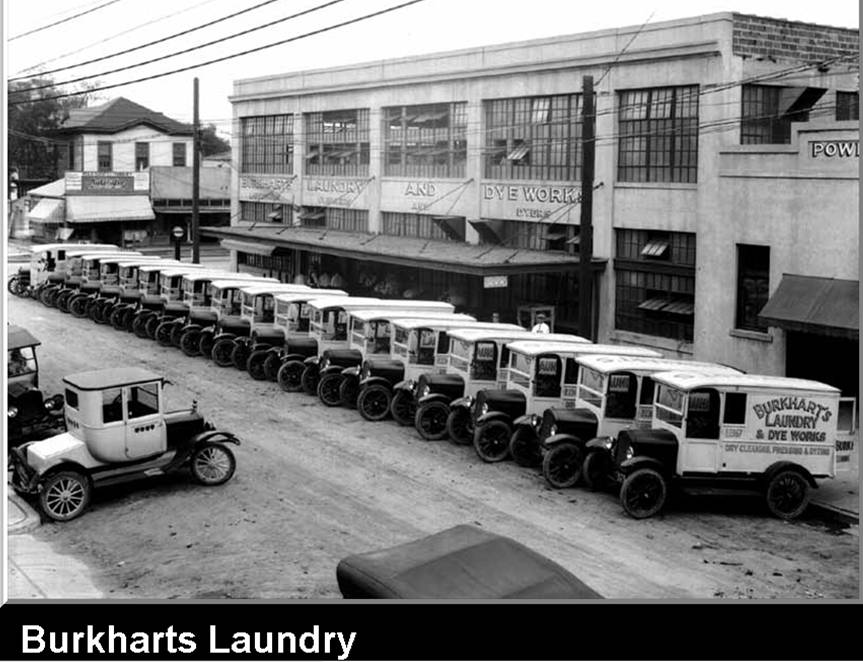
Thanks to a post-publication contribution suggestion from Larry Hajduk, the following photo, compliments of the Story Sloane Gallery, is added to show how Burkhart’s Laundry appeared in 1928. It appears that Burkhart’s had a long ago thriving business helping Houston do its laundry.

Burkhart's Laundry, Houston, compliments of Story Sloane Gallery, http://www.sloanegallery.com

Also, local history sleuth Mike Vance checked in with an important observation that he somehow could not register below as a comment. Mike says the last streetcar in Houston ran in 1940. So, if we are to believe the outfield sign advocating public use 0f Houston’s “street cars,” that does narrow down the year possibilities for this photo considerably. Thanks, Mike Vance. That’s a major help.