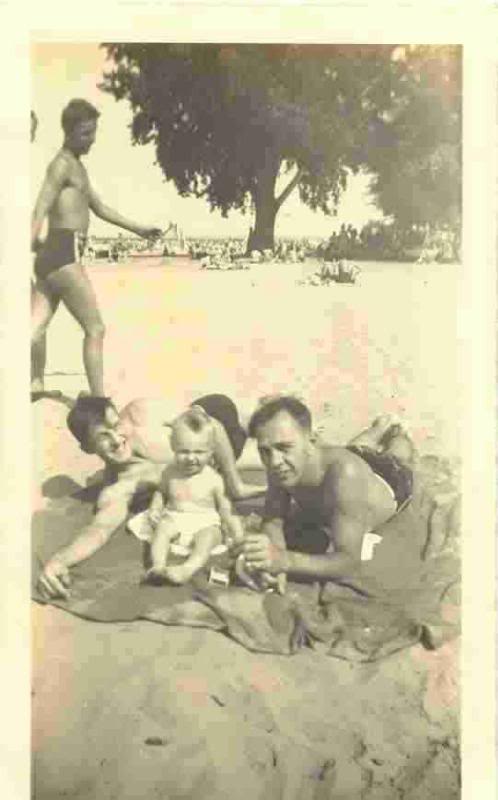
Stan Musial with former coach Chuck Schmidt with daughter enjoy day at the beach in early 1940s ST trip.
Just finished reading the earliest of two recent biographies of Stan Musial, “Stan The Man: The Life and Times of Stan Musial” (2010) by Wayne Stewart. I had read the other, “Stan Musial: An American Life” (2011) by George Vecsey a couple of months ago.
Both writers had taken upon themselves a daunting challenge. It’s very hard to write a fascinating book about a popular, accomplished, good citizen, and already well-known athlete that will hold the readers’ interest for very long – and no baseball player in history fits that bill of difficulty any better than Stan Musial. Even Babe Ruth, the greatest bio object in baseball attracts new readers to new books about him. Because of the Babe’s character, people will read another treatment of his life to get either a new take on his famous past sins – or maybe get unlucky and read of something new that’s been unearthed.
Not so Musial. It all comes back as “modest man … the guy next door … a smile and a handshake for everyone … and he loved and took care of his mother … never cheated n his wife … was a great dad and role model … best teammate ever …. always willing to do whatever was best for the team … never put on airs around ordinary folk … and in business, was as honest as the day is long … even got to be close friends with Pope John Paul II as a very active practicing (and famous) Polish-American Catholic.
How many pages can a writer roll with that one and still hold his or her audience?
Stewart and Vecsey both did credible jobs – because of their abilities as researchers and writers – and because I really wanted to read what they had to say about my favorite active major leaguer from my post World War II childhood.
I didn’t really learn a lot of new things about Stan’s public performance, but I found Wayne Stewart’s trail on the factual unfolding of Musial’s personal life, from childhood to old age, just about the most complete I’ve ever read, and right down to a blow-by-blow unnecessary description of the deterioration in Musial’s physical health through 2010 on his way to age 90.
George Vecsey spent too much time trying to analyze Musial’s speech patterns for some fresh light on the inner soul of this seemingly perfect man. Maybe due to the fact that I come from the primary field of behavioral analysis in my lifelong “day job,” I have an aversion to excessive attention from writers who turn on a subject with a paraphrasing “AHA! The subject is smiling when he should be crying.”
Don’t go there, fellas – especially if you go there only armed with something you heard from Dr. Phil. It isn’t fair to your subject.
Vecsey exposed his writer’s expertise as a speech analyst on page 41 when, talking of a Musial childhood speech issue, he wrote:
“Musial would retain a trace of a stammer into his adult life, sometimes speaking fast in the local accent of his childhood, sometimes using familiar mantras – whaddayasay-whaddayasay, wunnerful-wunnerful – as a defense mechanism, to soften having to speak seriously.”
Thank you, Dr. Vecsey, but we could have gone all day without reading that.
In the end, both writers paraded out the narrative, but personally found more enjoyment in the fact-centered linear account of Stewart.
In the end, I do always enjoy reading how mathematically it worked out that Stan Musial proved the even-steven quality of his hitting at home and on the road. He finished his 22-season career (1941-1963) with a ,331 BA, 475 HR, and 1,951 RBI. His 3,630 career hits came evenly. He nailed 1,815 hits at home and 1,815 hits on the road.

The day I met Stan Musial, May 1996.
 Houston, Baseball, & Other Musings.
 The Pecan Park Eagle