
Only Perfect Game in World Series History
Don Larsen, New York Yankees
October 8, 1956
In the column I wrote about Yogi Berra this week, I described him, among other things, as “the guy who celebrated Don Larsen’s 1956 World Series perfect game by leaping into his arms after Dale Mitchell took a dubious called strike three final out.”
That comment prompted a tempered, but clear rebuttal by e-mail from SABR friend Mark Wernick about the outcome of that pitch. Mark implicitly removes the “dubious” aspect that has long been associated the question ” was the pitch really in the strike zone” and he places it – where he and other think it belongs: It was a called strike three, alright, but it should have been ruled a swinging – no question, batter Mitchell’s out – strike three by examining the whole pitch and swing sequence with the kind of cutting board stop action technology available to us today.
When you look at the tape today with our current modern technology for instant replay review of hard to call plays, you can see – clear as day – it was a swinging strike three that simply wasn’t added to umpire Pinelli’s quick call, just prior to Mitchell’s wrists breaking into a swing at the pitch as the ball passes.
Even Mitchell’s quick recoil of the bat to beg for a “swing check on ball four” could not sell any reconsideration by umpire Pinelli. To my eyes, it really looked like a hittable ball that Mitchell missed.
Whether it was in the strike zone as a hittable ball isn’t even the question. He swung at it. And he missed. And just maybe – that was why Dale Mitchell didn’t make a bigger stink about the strike call than he did. Mitchell knew, even if he never said so, that he didn’t deserve a break. He swung. And he missed. On strike three.
Here’s how Mark Wernick expressed it briefly: “One thing about the Mitchell 3rd strike in the perfect game, which seems to be pervasively missed by so many, including no less a luminary than George Will: it was a swinging strike, not a called strike. Mitchell tried to hold up, but his bat was well out past the plate when Pinelli rang him up. Freeze this footage at the 2:59 mark, and you will see clearly that this is a swinging strike 3.”
“For all we know, the ‘Pinelli missed the call’ wave began before freeze-frame YouTube videos were available to all. This YouTube phenomenon also helped verify Yogi Berra’s claim that Jackie Robinson was really out, and that Babe Ruth really pointed towards center field, while both Root and Hartnett had their backs to him.” ~ Mark Wernick.
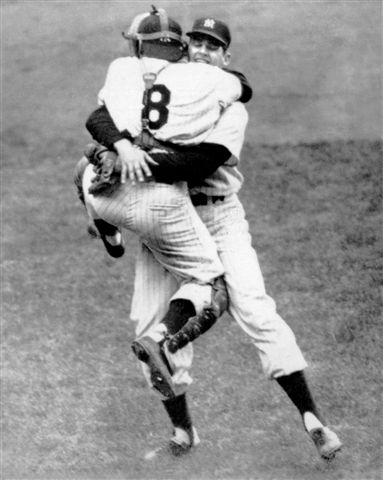
The Iconic Visual Moment The World Series Perfect Game Five New York 3 – Brooklyn 0 October 8, 1956
As one who watched that strikeout in Houston on a grainy 17″ television set between classes as a UH freshman, it never occurred to me to ask for a second look at the pitch. We didn’t have that little technological game-changer at our disposal back on October 8, 1956.
Even if we had been so blessed/cursed, it still may have been impossible to click it off in stop-action mode and told much on the kinds of sets we watched in those days. George Wills says the ball was “a foot and a half” outside. Really? Maybe George Will had his buddy Michael J. Fox fly a 70″ flat screen and game-officials quality replay equipment back from the future to wherever he watched the game at age 15. None of us could really see where the ball was pitched that accurately back in the day, but that didn’t stop many of us from creating and perpetuating the mind-teaser that maybe – just maybe – that third strike “call” was really the umpire’s contribution to the perfect game.
My worst regret? About fifteen years ago, I had about an hour of private time in St. Louis with Don Larsen in the hotel lobby where we were both attending the same banquet that night. All we talked about was the World Series perfect game. – And I never asked him anything on this specific vital detail beyond “was that last pitch really a strike?” Larsen answered with a smile. “It was a strike, alright, and it’s always going to stay a strike.”
It was the strike that immortalized the memory of Don Larsen and the visage of Yogi Berra running to the mound and jumping into Don Larsen’s arms, but no real memory of Dale Mitchell stood out quite so boldly, other than that feint call to doubt that the pitch may have missed the strike zone. I, for one, had no TV memory of the Mitchell swing. I was too busy jumping on a couch in over-the-top celebration with Yogi and Larsen.
I did ask Don Larsen that early 21st century day we talked in St. Louis one question that he, at least, told me was new to him. That news surprised me. It could easily have been the first question any of us might have asked him back anytime after October 8, 1956.
“What was the last thought you had before you released that two-strike pitch to Mitchell in the top of the ninth with two outs?” I asked.
Don Larsen stared at me with those steely blue eyes for a brief moment. Then he spoke in three deliberately quiet words.
“Here. Goes. Nothing.” End of answer. No need to ask more. Larsen’s voice was steady. His face was as frozen as Gary Cooper’s, just prior to the big shoot-out in “High Noon,” as his piercing blue eyes again met mine as he spoke those three distinct words. His fierce look seem to caution me to ask no more.
“Here. Goes. Nothing.”
It was nothing, alright. The kind of big nothing that will be the big something we shall always use as our legacy memory of Don Larsen – along with the dance that he and Berra pulled off just after the last out.
____________________
 Bill McCurdy
 Houston, Baseball, & Other Musings.
 The Pecan Park Eagle