Posts Tagged ‘culture’

Ode to Prince’s Drive Inn

October 1, 2009

PRINCES 02

PRINCES 01

When the long day’s done, when nostalgia seaps through, there’s still time left, for a burger and brew, at the one place in town, that’s pulled Houston  through – the Depression, the wars, and the freeways.

“Fit for a King,” don’t mean a thing, if it ain’t got that fling, that original sauce bling, that seeded bun sting, that all crisply tells us, “you’re eating at Prince’s tonight!”

 From 1934, through the ’80s or so, your good taste in burgers, was all we could know, of a meal that was laid out, quite perfectly so,  in a kitchen just this side of heaven. 

With rings on the side, as the onions were fried, you charmed us with carhops and Elvis. – We flocked to your gate, and we always stayed late, but the smooching was hard on the pelvis. 

On South Main you were royal, to your subjects so loyal, and you soon built a thousand locations. – Then hitting them all, ‘came our gist of it all, as our favorite on-the-go avocation. 

You closed down for a while, but you came back in style, with a plan for the new generation.  No carhops this time, just burgers sublime, and a dab of the ’50s, in sweet spiritual decoration.  

And now that you’re back, with a storefront or two, it’s still nice to taste, a great burger from you, but I still have to ask, ‘fore the clock on me, gently, I hope – just slips me away too:

“Who is that beautiful girl whose carhop cutout figure now hangs on the wall of your Briar Forest place? I remember her from the old days, but I never got her name!”

Houston: A Grocery Store Memoir.

September 26, 2009

Haenel's Groceries

Once upon a time, about 1950, this now fairly abandoned site at the corner of Myrtle and Redwood in Pecan Park thrived as Haenel’s Grocieries, one of the many small family-run grocery stores that threaded their way all over the Houston East End. In fact, Haenel’s was located directly across the street on the Redwood side from Graves’ Groceries. There was room enough for both little stores, in spite of the nearby competitive presence of larger grocers, like Weingarten’s, Henke & Pillot, Piggily Wiggiily, A&P, and Minimax.

Right around the corner from Haenel’s and Graves was the Griggs Road Butcher Shop, where they sold only fresh cuts of meat from beef cattle, chickens, and pigs. You could also buy fish there, sometimes, but special fish markets stores also took care of those items for most people.

Saturday was the big day for family shopping back in that era. Most people didn’t have time to shop fully during the week because of work schedules and limited shopping hours. Most stores opened from 8 AM to 8 PM. Monday through Saturday, with all stores being closed on Sundays. Some of the smaller stores, like Haenel’s, even shut down at 6 PM, Monday through Thursday. So, since most families only had one car that dad used for work during the week, and mom was busy watching kids and fixing meals during the week, most of the family shopping for a whole week pushed toward Friday nights and, especially, all day Saturday.

As a veteran checker, sacker, and stocker at the A&P on Lawndale near 75th, all I can tell you is that there was nothing quite like a Saturday morning at the grocery store back in 1954-56 era I worked the trade. In so many ways, it was the most enjoyable job I ever had – and also the most challenging.

Starting pay back then was  50¢ per hour as a “package boy” (sacker) – with a raise to 75¢ possible upon one’s promotion to checker. That wasn’t bad for the times. Some customers tipped 25-50¢ for help with a heavy load of groceries. What was bad for us was the lesson in economics we faced with promotion. By getting a raise to checker status, we also lost money by losing the opportunity for tips.

One Saturday morning, as I was contemplating my lost income to my checker promotion, an elderly woman customer stopped me as I was walking away from my register on break. It was a case of best/worst timing for the question she shouted my way. “Young man,” screetched the woman, “can you tell me where this store keeps its all day suckers?”

“Well, you’re talking to one of them,” I replied.

Unfortunately, our store manager in 1955-56, Mr. Wright was coming around the aisle just in time to hear both parts of our brief exchange. I received a severe lecture for trying to be funny on the job and summarily ordered to finish the afternoon “mopping the slop” all the rest of the day at the freight dock behind the store. At the end of the day, Mr. Wright wanted to know if I still thought that my  grocery store job was a place for funny business. What could I say? Short of “take this job and shove it,” there was nothing funny about “mopping the slop” for several hours in 100 degree temperatures, but I was too stubborn to let Mr. Wright run me off from a job I sorely needed. And I also saw his humorless point and learned more about working with uptight, authoritarian bosses at the A&P than I would ever see anywhere else. It’s also why I’ve spent most of my adult life, as much as possible, self-employed.

Nearing Christmas of 1954, I convinced my previous A&P manager, Mr. Dodgen, that some seasonal music owuld help sales by putting customers in the right buying spirit. Mr. Dodgen allowed me to bring down a record player and put on a little Bing Crosby Christmas album that belonged to my parents. It played very well over the loudspeaker system, bringing praise to Mr. Dodgen from customers – and looks of managerical approval to me. I thought, “Oh Boy! I’ve finally done something that’s going to help me around here!”

Then, one day, Mr. Dodgen had to be out of the store for a district meeting. We used the opportunity to remove Bing Crosby and started playing Little Richard at the A&P. When Mr. Dodgen came back earlier than expected, rock and roll was still blasting away, but the customers didn’t seem to mind. In fact, some of the younger mothers were even bopping in the aisles – and our little adolescent task force didn’t mind that action at all.

Mr. Dodgen was no music expert. If he were, he wouldn’t been down at the A&P, approving checks, but even he knew that some change had taken place in his absence.

“That doesn’t sound like Christms music to me!” Mr. Dodgen said.

“”No, but look at how happy the customers are, sir!” I replied.

Mr. Dodgen looked, smiled, and walked away. After that time, it didn’t matter what we played. We had music in the store. And I’ve always guessed that we may have been the first in Houston to do so.

The store Christmas party of 1954 couldn’t have happened in 2009. Once the store closed, several days before Christmas, all of us employees were invited to stay and help celebrate the season with Mr. Dodgen and our other bosses. Beer and hard liquor was available to everyone, including those of us who were only 16.

Well, everyone ended up grossly overserved and, for me, it was my first experience with having way too much to drink. It was also my first opportunity to slide into a level of thinking that can only come from alcohol or similar mind-altering chemicals. We decided that it would be a good idea to take an unopened bottle of Jim Beam bourbon and stuff it into one of the turkeys we had on sale at the meat counter. My companions and I carried out this immature act – and then spent the next two days waiting to see who actually ended up purchasing our “bonus surprise bird.”

Someone did buy the loaded bird, but we failed to see it happen. Then we started worrying that such a customer might actually bring the loaded bird back to the A&P and start complaining. That didn’t happen either. We never knew who got the bird. We just knew that we were lucky. Had it become public, a lot us could have gotten the bird from A&P. As I matured, I always worried that we may have passed on the loaded bird to someone who was looking for a sign from Heaven that they needed to stop drinking. Hell! What we passed on was the Devil’s green light. All I can say now is – I’m sorry for any real harm we may have caused by our immaturity.

I still loved the camaraderie with my co-workers – and I loved my favorite customers. Fifty-five years later, I still see their faces in the check-out line of my mind, as they waited for me to manually ring up their groceries and make change, using little more than my ability to do addition and subtraction in my head. Hey! I had to have something going for me! Without mathematical accuracy, I wouldn’t have been able to keep my job.

I might have survived at A&P without change, anyway, had Mr. Dodgen remained our manager, but not with Mr. Wright around. Mr. Wright needed to know that everyone at A&P understood that there’s nothing funny or enjoyable about selling groceries. I didn’t get that lesson, but I did learn a lot about taking personal responsibility for my behavior from Mr. Wright. He turned out to be a pretty cool old school guy afer all.

Buff Stadium: The Fair Maid Moon!

September 24, 2009

Fair Maid 001

Some of us called it “The Fair Maid Moon.”  By evening game time at Buff Stadium during the Post World War II last days of Houston’s minor league history (1946-61), the old bread bakery sign hung faithfully, and lovingly, and hopefully too, in the summer night sky. Suspended in full view of Buff fans, and hanging like an ascending astral body, just above the left center field fence line, and even though it never actually moved, the neon-lighted Fair Maid sign always seemed ready to take off in celebration of the Buffs  across the Houston evening air. What is sent to us in compensation for its own lack of movement was a fragrance usually reserved for the baker man himself.  The aroma of freshly baking bread came wafting into the stands at Buff Stadium like clockwork, peaking appetites, and probably boosting hot dog and hamburger sales many times over President Allen Russell’s wildest dreams.

Fair Maid 004

The photo that yields this typical glimpse of a night at Buff Stadium reveals through the above crop-shot that that season  of its taking had be wither 1956 or 1957. Those were the only two times that the league included Austin, Dallas, Fort Worth, Houston, Oklahoma City, San Antonio, Shreveport, and Tulsa. From a larger copy of this shot than I am able to include here, I can give you this rundown on the three line scores on display: Dallas @ San Antonio, San Antonio leads 1-0 through 6 innings; Fort Worth @ Austin, Austin leads 7-2 through 3 innings; Tulsa @ Shreveport, game is tied 4-4 though 4 1/2 innings. That leaves Oklahoma City, playing in the field, against Houston, the home club. I can’t tell you the score because we cannot see the Buff Stadium home scoreboard in far left field.

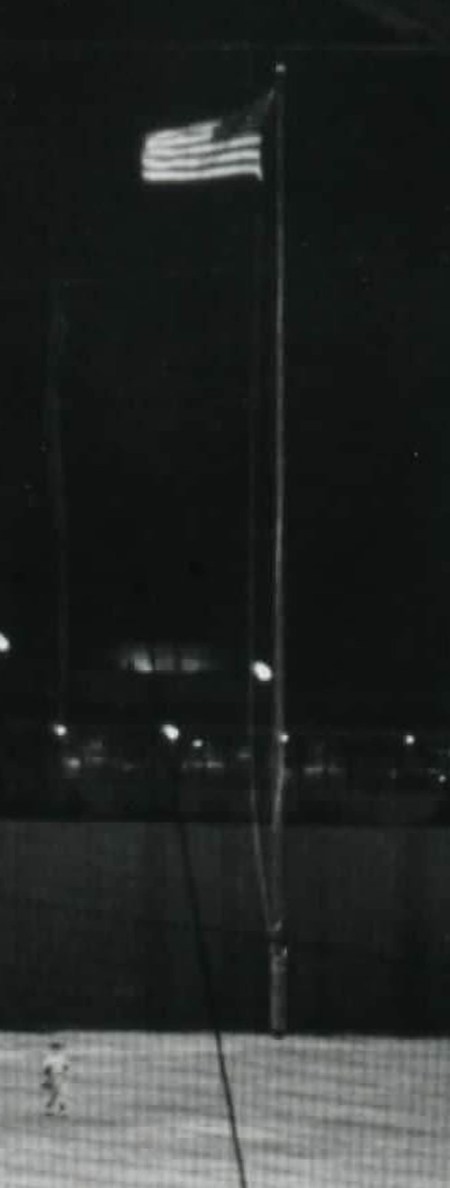
Fair Maid 005 Dead center field in Buff Stadium was 424 feet from home plate. and the outfield pasture also included a free-standing flagpole of some considerable similarity to the one that now resides in Minute Maid Park. It was located about five feet in from the outer wall, but there was no hill to climb.

Note the prevailing wind that typically blew the flag from right to left as the breeze came across the right field fence from the gulf.

Fair Maid 006

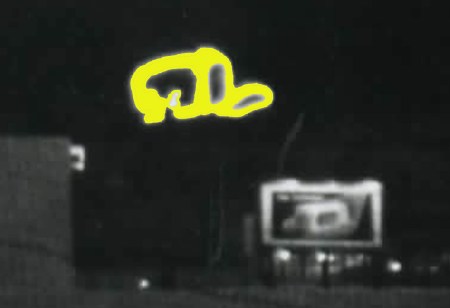
That’s the Fair Maid Moon close up, hanging low in the sky behind Buff Stadium from its perch above the Fair Maid Bakery, a long two blocks north of the ballpark at the corner of Leeland and Cullen and burning much brighter than its product image on the billboard to its right. The happy face of an old friend, even in a photograph, is a mighty comfort that peels away so much loss over time. I thank you for being there again today, old friend.

Good night again, Fair Maid Moon, wherever you now are. The memory of your fragrance tells us, heaven’s not far. – Buff Stadium and Heaven, they were once and always, and forevermore they remain the same, the place we once both planted and harvested the seeds and fruits of our fondest baseball dreams about hope and possibility in a once more beautiful world.

Aaron Pointer: A Man for All Seasons.

September 23, 2009

HBHC POINTER 1 Aaron Pointer (Batted Right/Threw Right; Outfield) has to be one of the best examples of how life sometimes arms certain people with talents that could take them in several varied directions, but all the while, these opportunities are rising and falling constantly with how the individual makes and uses the decisions he or she finally decides to take responsibility for putting into motion.

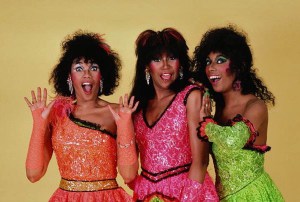
Born in Little Rock, Arkansas on April 19. 1942, but raised in Oakland, California, Aaron Pointer was the son a of a preacher man and his wife, the Reverend Elton and Sarah Elizabeth Porter. Aaron’s older brother Fritz was also a gifted amateur athlete who grew up to be a college English professor and published author. Aaron’s younger sisters, Ruth, Anita, Bonnie, and June stormed the entertainment world from the early 1970s forward as the fabulous Pointer Sisters.

Pointer served as President of the Student Body at McClymonds High School, where also excelled in baseball, football, and basketball. McClymonds in Oakland just happens to be the same school that also gave the world Bill Russell in basketball and Frank Robinson in baseball.  After his high school graduation, Pointer entered San Francisco University on a basketball scholarship, with an understanding that he would also be allowed to play baseball. A chronic sore arm knocked Pointer out of his plans to continue baseball as a pitcher at SFU. Aaron was still good enough as a position player to attract the attention of the Houston Colt .45s as an outfield prospect. He signed with Houston in 1961 for a bonus of $30,000 and was assigned to Class D Salisbury  and what turned out to be a memorable season.

HBHC POINTER 2Aaron Pointer batted .402 in 93 games for Salisbury (132 hit for 329 at bats) in 1961 for 19 doubles, 14 triples, and 7 home runs. By breaking the /400 mark, Pointer became the last professional baseball player to exceed that magic mark over a full summer of play. (Rookie League and Mexican League marks are not considered as data on this achievement trail.) At season’s end, Pointer was called up to the 1961 AAA Houston Buffs in time to also hit .375 ( 3 for 8 ) in four games.

After 1961, Aaron Pointer would never again have another lights out year over the course of his nine-season, mostly minor league career.

On September 271963, he was part of an all-rookie lineup that remains  on record as  the youngest lineup in MLB history, with an average age of 19. Joe MorganRusty Staub and Jim Wynn were the only three players that went on to great careers from that group of promising rookies.

By breaking in with the 1963 Colt .45s and then coming back with the 1966-67 Astros, Aaron Pointer also placed himself in a quietly unique category for former Houston Buffs. Aaron Pointer, outfielder Ron E. Davis, and pitcher Dave Giusti are the only three professional baseball players who actually performed for Houston under all three of their identities as Buffs, Colt .45s, and Astros. Giusti’s distinction is slightly greater in this regard as the only last former Buff from 1961 who also played for the first Colt .45 club in 1962 and the first Astro club in 1965. Pointer did not join the Colt .45’s until their second season (1963) and did not play either for the Astros until their second season (1966). Davis also missed the first Astros year, but arrived in time to play parts of three seasons as an Astro (1966-68).

Pidge Browne, Jim R. Campbell, Ron E. Davis, Dave Giusti, and J.C. Hartman were the only five last Buffs (1961) who also played the next year as first-season Colt .45s (1962), but four of these men, all but Giusti, were gone by the time the club became the Astros in 1965. As mentioned above, Pointer also became a Colt .45, but not until the 1963 season. Ron E. Davis, as mentioned, rejoined the club in 1966 during their second season run as the Astros.

After being traded to the Chicago Cubs organization in 1968, Aaron Pointer spent all of 1969 at Tacoma. He finished that season with a career batting average of .272. He  then played three mediocre seasons in Japan and, at age 30, he retired from baseball. Returning to his adopted  home in Tacoma Washington, Pointer went to work for the Pierce County Parks and Recreation Department, supervising their athletics programs. He started officiating high school football games , eventually working himself into a new career as an NFL game official from 1987 to 2003.  He now serves as a member of the Board for the Tacoma Athletic Commission.

In June 2008, Aaron Pointer was inducted into the Tacoma Hall of Fame.

What a life path! – Godspeed, Aaron Pointer! And may your senior days be mellow and bright!

My All Time Jewish All Stars

September 21, 2009

My All Time Jewish All Stars

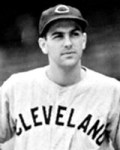
Sandy KoufaxHank_GreenbergLou Boudreau

At the risk of writing anything these days that moves along ethnic lines, I’m still proud to present my all time Jewish All Stars in a starting lineup. It wasn’t that hard to pick these guys out. Most of the older ones were also players that I followed as a kid and young man without regard for their race, color, or creed. I mean, really! How tough is picking out three Hall of Famers at pitcher, first base, and shortstop, a catcher who was brilliant enough also to have served in the dual role of spy for our government in team trips to Japan prior to World War II, a third baseman who whacked the American League silly for ten seasons, a nifty ex-Dodger in center field, a slugging nobody’s fool in left field, and two more recent stars in right field and second base? Geez Us! This one was a piece of cake. – Yeah, I know. Boudreau’s mother alone was Jewish, but if she was good enough for Lou, she’s certainly good enough for the rest of us in making Lou a qualified member of this special club.

The other thing I like about this club? You can put ’em on the field everyday and never have to worry about anybody doing anything dumb.

That being said, here they are:

Ian Kinsler, 2b

Lou Boudreau, ss

Al Rosen, 3b

Hank Greenberg, 1b

Sid Gordon, lf

Shawn Greene, rf

Cal Abrams, cf

Mo Berg, c

Sandy Koufax, p

Oh yeah, here’s my one back-up hedge. If Berg can’t go at catcher, or if he has other work to do that he might not be free to discuss with the rest of us, I’ll have Brad Ausmus  lined up to take over behind the plate without missing a beat – and probably adding a little on defense too.

Bob Boyd: Houston’s Jackie Robinson.

September 18, 2009

BoydBob2625.72_HS_NBL When Cecil Cooper was named manager of the Houston Astros in late 2007, the fact that he’s black was not covered by the current media as even an interesting footnote to the fact that it then had been a little more than fifty-three years since Houston saw it’s first black baseball player take the field to play for a racially integrated Houston sports team. – Think about it. From the time Houston “welcomed” it’s first black baseball player to the time it saw its first black manager in baseball, fifty-three years and three months had passed.

Thursday, May 27, 1954 shall forever remain a special date in my personal memories of the Houston Buffs. That was the date that Bob “The Rope” Boyd made his debut as a first baseman for the Houston Buffs in old Buff Stadium. (They called it Busch Stadium by then, but I stood among those who never bought into the name change when August Busch bought the St. Louis Cardinals and all their organizational holdings, including the Houston Buffs and the ballpark, a year earlier in 1953.)

Buffs General Manager Art Routzong had purchased the contract of Boyd from the Chicago White Sox about a week earlier than his debut in an effort to help the club make their eventually successful run at the 1954 Texas League championship. That was quite a club, one that also featured a rising future Cardinal star at third base named Ken Boyer.

Bob Boyd would prove to be the hitting and defensive specialist that the club needed to anchor the right side of the Buffs infield as strongly as young Boyer held down the left side. Boyd hit .321 for the ’54 season and he followed that production with the ’55 Buffs by posting a .309 mark.

It all started on a night of great change in the face of Houston sports.

I was drawn to the ballpark that 1954 twilight eve as a 16-year old kid who wanted to see Bob Boyd break the color line and, hopefully, have a good first night for the Houston Buffs. TheBob Boyd 003 fact that I had just started to drive by that time and needed a good excuse to borrow the family car also factored into the equation. When I borrowed the car, I told my dad why I needed to be there at the ballpark that night. I wanted to see Bob Boyd play for the Buffs as the man who broke the color line in Houston.
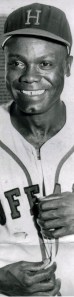
Although I had grown up in segregated Houston, I was blessed with parents who taught love and acceptance over hate, even though they also had been raised with that blind acceptance of segregation as the way of life. Whatever it was, my parents held beliefs that left the door open for me to actively question the unfairness of segregation and to also embrace Jackie Robinson as a hero when he broke the big league color line in 1947.

No one in the family or the neighborhood wanted to go with me that night, so I went alone. I also bought a good ticket on the first base side with a little money I had earned that week from my after-school job at the A&P grocery store. I also had to buy a dollar’s worth of gas as my rental on the use of dad’s car.

There were only about 5,000 fans at the game that night and almost half of them were the blacks who were then still forced to sit separately in the “colored section” bleachers down the right field line.

The atmosphere was contrasting and electric. The so-called “colored section” fans were rocking from the earliest moment that Bob Boyd first appeared on the field in his glaringly white and clean home Houston Buffs uniform to take infield with the club. While we felt the rumble of all the foot stomping that was going on in the “colored section,” only a few of us white fans stood to show our support with the understated and reserved applause that we white people always do best at times when more raw-boned enthusiasm would have been better.

“Enthusiasm” evened into a loud foot-stomping roar from all parts of Buff Stadium when Bob Boyd finally came to bat in the second inning for his first trip to the plate as a Houston Buff and promptly laced a rope-lined triple off the right field wall. Even those whites who had been sitting on their wary haunches prior to the game rose to cheer for Bob Boyd and his first contributions to a Buffs victory, and, whether they realized it or not, to cheer for another hole in the overt face of segregation in Houston.

Here’s a taste of how iconic sports writer Clark Nealon covered it the next morning in the Houston Post:

“Bob Boyd Sparkles in Debut As Buffs Wallop Sports, 11-4”

by Clark Nealon, Post Sports Editor

“Bob Boyd, the first Negro in the history of the Houston club, made an impressive debut Thursday night.

“The former Chicago White Sox player banged a triple and a double and drove home two runs as the Buffs pounded the Shreveport Sports, 11-4, and Willard Schmidt recorded his sixth victory without a defeat.

“Before one of the largest gatherings of the year – 5.006 paid including 2,297 Negroes – the Buffs started like they were going to fall flat on their faces again, got back in the ball game on bases on balls, then sprinted away with some solid hitting that featured Dick Rand, Kenny Boyer, and Boyd.

“Rand singled home the two go ahead runs in the first, added another later. Boyer tripled with the bases load for three runs batted in and Boyd tripled in a run in the second and doubled in another to start a five-run outburst in the fourth that settled the issue. …

” … Boyd was the center of attention Thursday night, got the wild acclaim of Negro fans, and the plaudits of all for his two safeties and blazing speed on the bases.”

Yes Sir! Yes Maam! May 27, 1954 was a big day in Houston baseball, Houston sports in general, and a moment of positive change in local cultural history. So was Tuesday, August 28,Bob Boyd 002 2007, the day that Cecil Cooper made his debut as a manager for the Houston Astros, a day for change, but it had nothing to do with race. Cecil just didn’t get here quite as loudly and, for reasons that have nothing to do with race, he also may leave soon, just as quietly, but maybe not. Maybe the Astros won’t unload all of the 2009 Astros’ failures on the back of their skipper.
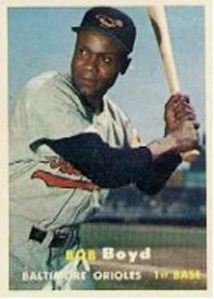
In Houston baseball and general sports history, there was only one Bob Boyd. By the time professional football and basketball arrived here, integration was already a part of the total team package. The job of proving that race should not be a factor never had to ride again on the back of one individual player. Bob Boyd already had unlocked, opened, and oiled that gate for all who have come after him – and he did it all back in 1954.

After the 1955 Buffs season, Boyd’s performance at AA Houston earned him a second shot at the big leagues with the Baltimore Orioles. Bob had made a promising start with the Chicago White Sox (1951, 1953-54), but now. after Houston, the now 29-year old lefthanded first bagger seemed primed for a really fine major league career.

In 1956, it was time for Bob Boyd to shine in the big leagues, indeed!

Bob Boyd roped off full season batting averages of .311, .318, and .309 in his first three Oriole seasons (1956-58). His 1959 full season average dropped to .265, but he bounced back in 1960 to hit .317 in 71 games for Baltimore. Boyd played one more limited time season in 1961 for Kansas City and Milwaukee, completing his 693-game big league career with a total batting average of .293 with 19 home runs over nine seasons. Bob Boyd played three more seasons in the minors after 1961 (1962-64) and then retired completely as an active player. Interestingly too, most of Boyd’s last three  years were spent in the minor league farm system of the then baby new National League Houston Colt .45s at San Antonio and Oklahoma City.
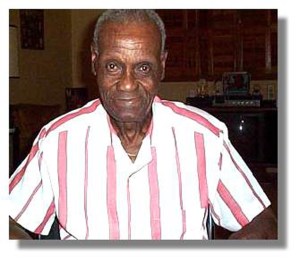
Bob Boyd 001 Following his far better than average baseball career, Bob Boyd returned to his home in Wichita, Kansas, where he worked without complaint as a bus driver until he reached retirement age. Bob died in Wichita at age 84 on September 27, 2004. Today, the man who started his career with the Memphis Red Sox (1947-49) of the Negro Leagues is honored as a member of the Negro League Hall of Fame and also the National Baseball Congress Hall of Fame. Hopefully, we shall always continue to remember and honor Bob Boyd and all others who took the first step toward changing things that needed to change. Bob Boyd did his job with grace, dignity, and tremendously unignorable ability.

Jerry Witte: A Man of Love and Loyalty!

September 16, 2009

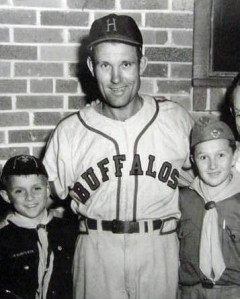
HBF - WITTE 1B

Yesterday I wrote about the three major villains of my Houston Buffs during the post World War II years. I also pointed out that all or any of the three bad guys, Russ Burns, Les Fleming, or Joe Frazier, could’ve been wiped clean of that dark designation had they simply done one thing – that is, to have signed or been traded to the Buffs for the sake of finishing their careers as Houston Hometown Heroes. – It didn’t happen, not with these three guys.

There was a fourth villain in this group, however, and he was far worse than all of the others because of his prodigious ability to slam monster-like Ruthian home runs, blows that exploded local hope like one of those mushroom cloudy atomic bombs we’d all witnessed in wild-eyed fear in the movie theatre newsreels.
And his name was Jerry Witte.
Jerry Witte had cracked out 46 homers at Toledo in 1946. The “46 in ’46” had landed him a late season call up by the parent club St. Louis Browns, but that didn’t work out too well for Jerry at age 31. After another bad start with the Browns in’47, Jerry found himself back at AAA Toledo for the balance of the season.
After the ’47 season, Witte was dealt to the Red Sox, who assigned his contract to their AAA Louisville club. Owner Dick Burnett of the Dallas Eagles then acquired Jerry Witte as one of the veteran bonecrushing players he pulled together for his ’49 Dallas Eagles.
The ’49 Eagles broke fast from the gate, crumbling every foe that came up on the schedule until a couple of things began to happen. – Their veteran players ran out of gas – and their pitchers failed miserably. The club of villains fell miserably Still, in 1949, Jerry Witte crushed 50 home runs in the Texas League and, to me at least, it seemed as though he hit them all against our Houston Buffs. Our ’49 Buffs had little hope, anyway, but what they did have was quickly stomped into the dirt beneath the grass at Buff Stadium by a predictable barrage of homers that flew off the bat of the slugging right handed hitting first baseman.
After the ’49 season, Dallas sold the contract of JerryWitte to the St. Louis Cardinals, who in turn then assigned the former Eagle AAA Rochester. Due to an overstocking of younger first basemen at Rochester and Witte’s desire to play in a warmer climate, Jerry was reassigned to play for the ’50 Buffs on June 11, 1950. As I said in the 2003 book on his life and career that we wrote together, “A Kid From St. Louis,” learning in the Houston Post the next morning  that Jerry Witte was now a Houston Buff was roughly the emotional equivalent to me of learning that Darth Vader suddenly had been dealt to the forces of the light. My favorite enemy had been instantly transformed into my biggest life hero.
Jerry Witte and I wouldn’t really connect personally until the September 1995 Last Round Up of the Houston Buffs, but we quickly made up time for all the years we lost.  Jerry Witte and his wonderful wife Mary are both gone now, but I shall both love and miss each of them forever. They were like second parents to me – and their seven lovely daughters became like seven sisters, as well. There’s nothing I would not do for any of them, if it were  in my power. They are all just such good souls – the kind we need more of in our harvest of American people.
Jerry and Mary Witte were both down-to-earth midwesterners who retired in Houston after Jerry’s three seasons with the Buffs (1950-52). All seven of their lovely daughters are quite accomplished people professionally, but all have retained that basic one-two punch of integrity that once flowed so readily from their mom and dad: (1) say what you mean, and (2) do what you say.
May the memory and the values of Jerry and Mary Witte live on forever in the middle of our everyday lives. Such is the stuff of real heroes – that the practice of love for and loyalty to others always outweighs all ambitions to use other people for selfish  personal gain. You don’t befriend people because of how useful they may be to you. You befriend people because it’s the right way to be – in a world where heroes really aren’t just determined by the names on their uniforms, but by the actions of the people who wear them.

Former Buffs – Movin’ On Up!

September 7, 2009

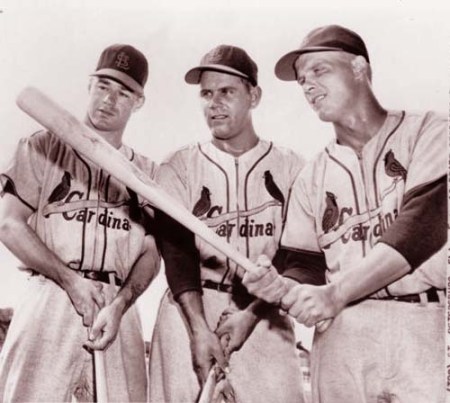
Three BuffsThe goal of every young and upcoming Houston Buff from 1923 through 1958 was to play well enough in the Texas League to either move up the following season to AAA ball, or even better, to do so well that that they went straight on up to the roster of the St. Louis Cardinals. I’m bracketing the era as 1923 through 1958 for one simple reason: That’s the time period in Buffs history in which the Cardinals either controlled or owned the futures of all ballplayers who passed through Houston professional baseball.
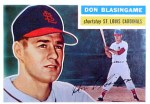
In our featured photo, shortstop Don Blasingame (far left), outfielder Russell Rac (center), and outfielder Rip Repulski (far right) were certainly no variants from that common aspirational goal. In this picture, from what most likely is the spring of 1955, the three eager Buffs shown here pause together for their own “raring-to-go” pictorial on baseball ambition. Two of the three young men shown here would play on to see that dream come true.

Three Buffs BlasingameThree Buffs Repulski

Don Blasingame enjoyed a 12-year MLB career (1955-66) as a middle infielder for the the Cardinals, Giants, Reds, Senators, and Athletics, one that was highlighted by a 1961 World Series appearance with the Reds. Rip Repulski hit .269 with 106 homers over nine seasons (1953-61) with the Cardinals, Phillies, Dodgers, and Red Sox.

Three Buffs Rac2 The third man, Russell Rac, never got a single time at bat in the big leagues in spite of some pretty good hitting and fielding success with the Buffs in seven of his eleven season (1948-58) all minor league career. He began in Houston in 1948 – and he left as a Buff ten years later with a .312 season average, 12 homers, and 71 runs batted in for 1958. Few, if any, other players spent as many seasons as an active member of the Houston Buffs roster. Russell Rac went back to Galveston and into business from baseball following the 1958 season, where he continues to live in retirement as a man whose heart still belongs to baseball.
Once upon a time, Russell Rac also had a moment in Latin American winter ball that few hitters ever have, anywhere. He hit four home runs in a single game. I know he did because he told me he did once at a baseball dinner reception and I have no reason to doubt the word of this very good man. If I can ever recapture the details of where, when, and for whom he performed this rarest of baseball feats, I promise to report the whole story here on WordPress.Com in a fresh article about what had to be the most amazing day in the career of former Houston Buff Russell Rac.

Russell Rac was certainly good enough over time to have earned an opportunity to play in the big leagues, but the breaks simply weren’t there for him in the crowded talent pipeline that once was the St. Louis Cardinals farm system – and during an era in which there were only sixteen major league clubs, not the thirty separate organizations that exist today.

Many of the older players who remain with us from the 1940s and 1950s will tell you. – You had be both good and lucky to make it to the big leagues back in the day. – You also had to play hurt. A former Houston Buff, the late Jim Basso, once put it to me this way: “You take a day off to heal a sore arm or a leg cramp back then and some other guy’s going to be wearing your jock strap and sitting at your locker when you come back!”

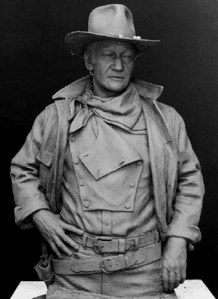
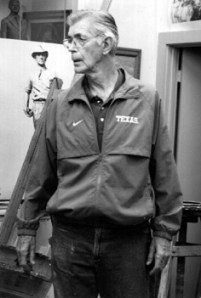
Another former player from the Dodger organization, Larry (now Lawrence) Ludtke, told me the same thing in these words: “I pitched for the big club down in Florida until my arm fell off. When it finally didn’t heal, I just had to look for another line of work. That’s how things were back then. You tell them your arm hurt back then and they would just look behind you in line to the next guy and holler out, ‘Next!’ ” Ludtke may have caught his career break right there in 1956 when a damaged arm forced him off the pitching mound and out of baseball. He went on from there to become Lawrence Ludtke, a Houston-based, world renowned sculptor.

Ludtke 2 Ludtke 1

God’s Grace through serendipity works things out in it’s own curious, but always amazing way – and that’s a truth that lands on all of us, not just professional baseball players. We only need open eyes to see it working in all things. If we don’t see it, it’s just because we are still in the painful lessons tunnel and haven’t yet come to the light on the other side of whatever the big obstacle mountain may be.

MY EARLY LIFE ROLL-YOUR-OWN MODELS.

September 3, 2009

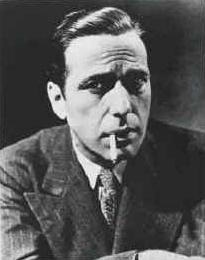
BOGART 001 I grew up in a Post World War II era of blue smokey haze. Everything I saw, heard, or breathed vicariously into my lungs from the adults in my life said to me: “Smoking is good! As soon as you’re old enough you’ll be able to light up too!” My dad smoked, but so did most of the other dads and quite a few of the moms in our Pecan Park neighborhood in Houston. At Sunday Mass, it was like a stampede at the end as 75 to 100 men herded toward the front door for a post-spiritual firing up of the old Chesterfield and Camel nicotine incense out front. Hallelujah! None of those mamby-pamby filtered cigarettes were strong enough for my dad’s generation. These were real men who smoked only those short full-tobacco blast sticks fromthe “Big C” companies. And why not?  “Seven out of ten doctors preferred and recommended Camels for your smoking pleasure!”
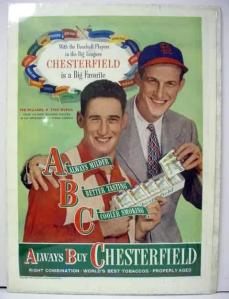
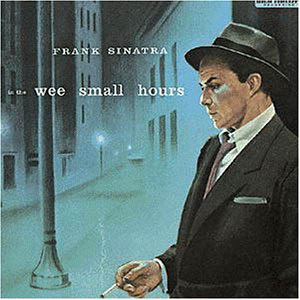
Forget the doctors’ recommendations about Camels being the best. All of my baseball and movie heroes were busy lighting the way for the addictive-prone members of my generation – and I was a charter member of the chemically addictive proneness group back in the mid-1950s. My role model list reads like a “who’s who” call of the biggest stars from our post-war period: Humphrey Bogart, Joe DiMaggio, Frank Sinatra, Ted Williams, John Wayne, and Stan Musial stands out in memory. Man! even Stan the Man was there, but it wasn’t just him!  They were all there – and they are all names that jump to the front of my mind as favorite stars who either smoked or pushed cigarettes through advertisements and commercials.

By the time I reached St. Thomas High School, I was still free of nicotine at age 14, but I saw that more than half of my Basilian priest teachers smoked, efficiently using those three minute breaks between classes to step outside and catch a break from all us snot-nosed Catholic pubescents in the what is still the best all male Catholic secondary school in Houson. We thought nothing of it. The priests were just doing what most of the other men from that era were doing. We even had a post-lunch smoking area for students at St. Thomas. No one had to bring a note from home to be allowed smoking privileges back in the day. They just had to do it on “the green slab” after luch only. The Green Slab sort of resembled that scene from so many old prison movies. Know the one I’m talking about? It was the yard scene where the inmates gathered to plan their escapes and essr schemes. SOmetimes a good fight even broke out. Smoking and looking out of the corner of your eye for impending trouble were just standard behaviors.

WILLIAMS-MUSIAL

Songs of the day celebrated cigarettes as both a lamp of love and a source of comedy. “Smoke Gets in Your Eyes” by The Platters is an exemplary romantic model song; “Cigareets and Whiskey and Wild, Wild Women” was also a typical funny song, but my favorite number by Phil Harris, “Smoke, Smoke, Smoke That Cigarette” included these engaging true-to-form lyrics:

“Smoke, smoke, smoke that cigarette!

Smoke, smoke, smoke, and if you smoke yourself to death,

Tell St. Peter at the Golden Gate that you hate to make him wait,

But you just gotta have another cigarette!”

By my senior year, I was still a non-smoker, but I had become the designated cigarette purchase runner to the store for my home room teacher whenever he ran out of smokes during the middle of the school day. I got the job by having a car and an expressed willingness to miss a little class time running errands. I still wasn’t tempted to start smoking at 17, but then something happened I hadn’t counted on.

SINATRA 001

I tried out for the senior play and got the lead part in a little known work called “Brother Orchid.” Edward G. Robinson had played the same part in the movie version back in the early 1940s.

Our play director asked if I smoked. I told him no. Then he said that I might be more effective in the role if I took up smoking cigars during the run our practices through the performances of the play. I did. And I felt it helped. I even improvised one my play entrances to be announced by a puff of blue smoke that I exhaled onto the stage before I made a dramatic entrance. When the audience reacted with a roar of approval, I was hooked on the idea that smoking was just too cool to quit.

DIMAGGIO JOE 002

After the play, I bought my first pack of cigarettes, a pack of Old Gold, to more exact – and I didn’t sop for fifty years. Finally, on March 24, 2006, through the Grace of God, I took my last drag from a cigarette. With the help of God, Nicorettes, and the support of my wife, family, and friends, I quit smoking altogether. I lost some considerable lung power from my half century of misadventure, but so far, my lungs remain clear of cancer.

It’s a different world today. I don’t blame anybody for the fact I became addicted to cigarettes. All of us, including my high school mentors, were simply products of our time. It was a very different era back in the 1950s. Unless you lived through it, it’s hard to explain. When life backfired on us back then, our major first response was not to find someone to blame. We were simply taught to take resposnsibility for the consequences of our own bad decisions.

The main thing I can say about cigarettes now covers five points: (1) If you’ve never smoked one, don’t do it; (2) If you want to quit, find a way that works for you to get totally away from them and then don’t pick another one up; (3) If a half century smoker like me can quit, so can you;  (4) whatever you do, take it one day at a time, and don’t beat up on yourself if you have any setbacks. Just get back up and keep after it; (5) find something else to do (and I don’t mean drinking, drugging, or eating) that you enjoy. – For me, baseball, reading, research, writing, and photography are my joys, but yours may differ in this “whatever floats your boat” world; and (6.) Don’t procrastinate. Just do it! The time of your life is now. Always is. Always only is.

And remember – your life is only precious – if it’s precious to you.

Base Ball To Day!

September 1, 2009

Base Ball Today 3

My grandafther, William O. McCurdy I,  took this photo from the front door of his newspaper office on Washington Street in Beeville, Texas. The year was about 1896, when “market day” was still usually the thing to do on Saturday. Based upon the shadows, I’m estimating that the time is about 8:30-9:00 AM in this northward frozen-in-time glance up the street. As you may also dedect from the banner draped over Beeville’s main street (Washington), there will be “Base Ball To Day,” just as soon as shopping and other ranch business is taken care of and people have a chance to unwind a little bit before they go into their full Sunday rest.

If you will notice in the background behind those two men conversing in the middle of the street, there’s a large crowd of wagons and horseback riders coming into town from the north.  A couple of town boys are standing on the corner, across the street, apparently coming downtown early to check out the action that will soon transform Beeville’s retail stores into a hive of weekly shopping and buying activity. Wish those kids could still move and talk within the picture. I’d love to ask them who is playing in the game today, although I’m fairly sure that the contest would’ve been scheduled for the fair grounds out on the George West Highway. That much didn’t change around Beeville for quite a few years. Unfortunately, I’ve just never been able to pin down anything from my grandfather’s files that tells us the exact date of this photo, who played the then still two-worded “base ball” gane, and how the contest actually turned out.

Beeville, Texas, the city of my birth, is located about 180 miles southwest of Houston down US Highway 59. We moved to Houston on my 5th birthday, New Years Eve, 1942. I grew up, and still am, a Houstonian, but my family roots go back to the little town that once seemed so far away and removed from any common ground with our big city. The spread of Houston today now almost makes Beeville seem like another distant suburb. Beeville even sometimes gets mentioned on the weather forecasts from Houston TV stations these days. That’s sort of a suburban acknowledgement in its own right, isn’t it?

At any rate, this picture speaks far more than the proverbial one thousand words. Beyond its resemblance to a western movie scene, it stands as further evidence of how far  back the State of Texas goes in its long term romance with the game of baseball. The interest climate in Beeville, in fact, was strong enough to have produced three native son major leaguers by the 1920s – and this all came to be from a community that back then only served as home to a few hundred people.

The three early Beeville natives who made it to the big leagues were (1) Melvin “Bert” Gallia (1912-1920), a pitcher for the Senators, Browns, and Phillies who compiled a 65-68, 3.14 ERA career record; (2) Curt Walker (1919-1930), an outfielder for the Yankees, Giants, Phillies, and Reds who batted a career .304, striking out only 254 times in 4,858 times at bat; and (3) Lloyd “Lefty” Brown ((1925, 1928-1937, 1940), a pitcher for the Dodgers, Senators, Browns, Red Sox, Indians, and Phillies who finished at 91-105 with a 4.20 ERA. Later in the 20th century, Beeville also became the birthplace of premier big league batting coach Rudy Jaramillo and former Astros (among others) catcher Eddie Taubensee.

Curt Walker and Rudy Jaramillo are both inducted members of the Texas Baseball Hall of Fame.

Back in that turn of the early 20th century era, “Base Ball To Day” was not just an advertisemnt in little Texas towns like Beeville. It was a way of life.