Posts Tagged ‘culture’

Cows and Bulls and Bluebonnets.

April 28, 2010

Cows & Bulls & Bluebonnets.

Cows and Bulls and Bluebonnets – Callin’ me back – To the land that I love.Cows and Bulls and Bluebonnets,Pullin’ me backTo South Texas.

If you’ve ever been a songwriter at heart, or simply somebody who harbored a song-bursting bone anywhere in your spiritual body, what I write about this morning will make perfect sense. If not, then just bear with me through today. I’ll try to get back to normal by tomorrow. The subject is just rolling too hard on my mind for now to let go.

I don’t quite know, for sure,  what got me started, but I’ve been writing songs for little everyday occasions for as long as I can remember. I even wrote the goodnight lullabies that we sang to our son Neal when he was a little one.

Dad, Mom, and genes may be partly or wholly responsible.

My dad was a part-time songwriter as a young man. Dad even met my mom when he heard her singing “Paper Moon” live over the radio in Beeville, Texas and then had to drop by the station to see who was singing.

Dad even once managed to get a  famous singer from the 1920s and 1930s named Rudy Vallee to sing a published number of his on the crooner’s  “coast-to-coast” radio program back in the early 30s. He had to drive all the way to New York and be a pest to Mr. Vallee to get it done, but he got it done Dad named the number “The Moon Is Here.” It was actually the only song that Dad ever published and he wrote it in collaboration with a songwriting partner from Beeville, Texas,  a fellow named Dan Lanning. After that little venture, Dad went back to trying to make a living in the real world of the Great Depression era, but he kept on singing his heart out for as long as he lived. All tolled, he was my inspiration in baseball, as a writer, and in life.

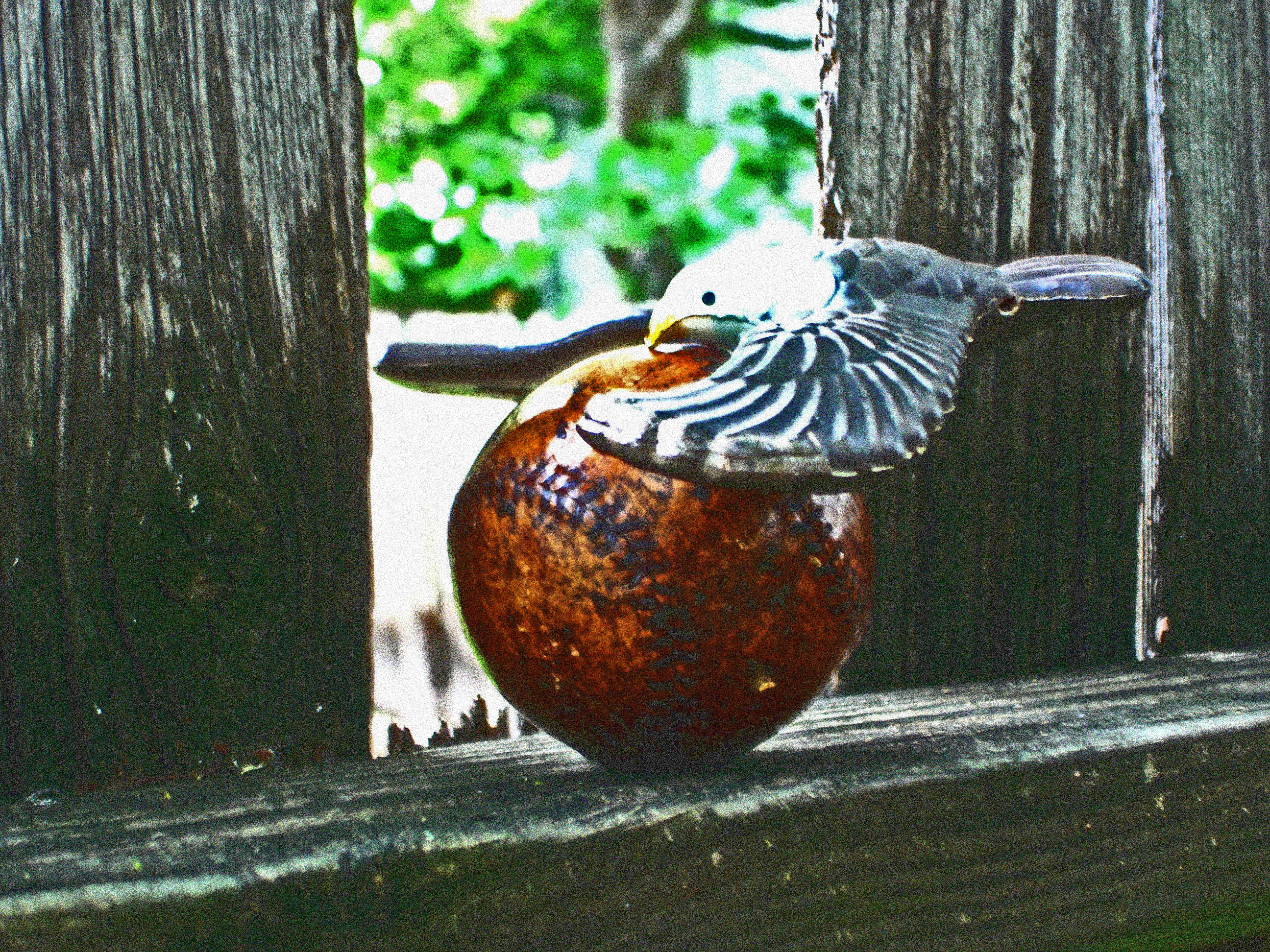
“Cows and Bulls and Bluebonnets” came to mind again for me when my wife Norma and I drove up to Chappell Hill this past weekend to have lunch and check out the last of the botanical Mohicans. We missed the deep rich flourish of full-blue bonnet fields that were there on previous weekends, but we did manage  to capture the singular glow of a few isolated holdouts on extinction as pictured here.

The sight of these reminded me of the spring of 1965, when I was still working at Tulane University, but strongly feeling the home call of Texas. All that came to light for me shaped out as  the vision of “cows and bulls and bluebonnets” and the little hum I felt all the way from my head to my toes each time I came back to Texas for an Astros game and crossed that state line on old Highway 90, heading west to Houston from the Golden Triangle area.

The song for “C&B&BB” didn’t have much of a tune, but its call was quite powerful and permanent. I still travel far and wide, but I have no desire to live anywhere else, but Houston. This place owns my heart.

I feel normal coming back right now. Let’s go, Astros! It’s  time to take Game Two of the Reds Series and keep the turnaround going strong!

Dreaming Of The Majors: Living In The Bush.

April 21, 2010

Lefty O'Neal Is A Rare White Veteran of the Negro Leagues.

Yesterday I heard from Lefty O’Neal, the rare white veteran of Negro League baseball who wrote a book last year on his improbable experiences in baseball. We have not been in contact for quite a while, but it was good to hear from the man again.I’ve never met the man face-to-face, but I did read his manuscript over the time he was searching for a publisher.

All I can really say is – Lefty writes honestly from the heart. His little book with the long, long title, “Dreaming of the Majors: Living in the Bush,” is a wide open testament to his faith, spirit,and ability to play the game. I won’t go into the details here of how a white guy came about playing in the Negro Leagues because that’s a big part of the book, but I will say that no gets to an accomplishment on that level without possessing the “miles and miles and miles of heart” that are described in the lead song from “Damn Yankees.” Dick “Lefty” O’Neal had all the heart one could hope to pump into the chase of such a dream and he got there – by the Grace of God and with the help of a legion of fairly earth-bound angels.

Houston Astros icon Larry Dierker put O’Neal’s journey in this perspective: “O’Neal will take you on an ironic tour of race relations on the diamond: as Lefty becomes the mirror image of Jackie Robinson, playing as the only white guy on a Negro League team.”

Former major leaguer and recent hitting coach of the Los Angeles Dodgers expressed these thoughts on O’Neal’s story: “His writings are a pleasure and a joy to read.” Merv Johnson, a former assistant  college baseball coach at both Arkansas and Oklahoma put it well for what it is: “This book is a must read for anyone who has a dream.”

You don’t read Lefty’s book for great literature. You read it as a clearly stated map on where the forces of faith, hope, and love can take us if we are simply willing to hear the call of the Holy Spirit and lean all the way into the job of doing our part to get there.

Dick “Lefty” O’Neal listened and then did what he had to do. Along the way, he met the earth-bound army of angels who helped him overcome doubt and complete the journey.

Who is Dick “Lefty” O’Neal? For starters, he’s a retired United States Air Force officer with twenty years past service to his credit. He is now an adjunct professor in the speech communication field,  part-time corporate training consultant, a motivational speaker, a board member for the San Antonio Chapter of the Fellowship of Christian Athletes, and, last but not least, he is Vice President of the SOuth Texas Professional Baseball Negro League Players Association.

Lefty O’Neal and his wife Harriett have been married for more than 36 years and they have two adult children, Amy and Richard Adam. The O’Neal family makes their home in Universal City, Texas.

O’Neal’s inspirational book is available online through Amazon and by order from such booksellers as Borders and Barnes and Noble. You may also order from the publisher, WinePressBooks.Com. The cost is $14.99, plus tax and shipping.

Some people do great things for the sake of directly helping the human condition. Others serve as the objects of personal example to others. Some do both. Meet Dick “Lefty” O’Neal.

Eagle Memories: The Way We Were.

April 13, 2010

The culture of field behavior changes forever.

Unless you are one of us ancients, you may not have noticed the wide range of change in field behavior that has taken place in baseball over the past half century. The game remains the same, of course, but player behavior on the field has mutated considerably from what it used to be. I’ll try to cover some of the major things I see here. Feel free to add, refresh, or comment on this subject below as a response to this subject.

Changes in Baseball Field Behavior Since 1960:

(1) Baseball Gloves on the Field When Your Team is Batting. We used yo copy the pros on the sandlot, throwing our gloves on the outfield grass while our club was at bat. I never played in a game or saw a Buffs game in which a tossed fielder glove interfered with a batted ball or a running fielder. The practice disappeared about 1959-60. I can’t recall exactly how or when it came about.

(2) Pepper Games. Prior to games, players in groups of two to five used to play pepper near the stands almost every time in spite of the “No Pepper Games” signs that prevailed in the interest of fan safety from errantly batted balls. A pepper game was simply a gingerly batted ball at close range to a group of three or four fielders standing back about six ro eight feet from the batter. I haven’t seen a pepper game in ages now.

(3) Infield Practice. It used to be as routine a pre-game ritual as batting practice still is. And what a thing of grace and beauty it was to watch too, but no more. I guess infielders must have gotten so good at what they do that the practice of fielding became unnecessary.

(4) Infield Game Chatter. Infielders used to keep us this hum of chatter on defense. It was there as a voice of distraction to hitters and runners and a show of support for the pitcher. At some point, it became un-cool to do – and infielders stopped. When they did, they seemed to lapse into stone-cold expressions and a more tranquil face on the subject of game conflict in action.

(5) Bench Jockeys. These guys were the original trash talkers. A baseball bench jockey worked on pitchers and batters of the other team. When one of the Detroit Tiger pitchers Schoolboy Rowe went on the air to do a radio show prior to the 1934 World Series, he finished his radio remarks by asking his wife, “How am I doin’, Edna?” And that’s exactly what he got from Leo Durocher, the St. Louis Cardinals’ chief bench jockey in his first pitching assignment. Every time Rowe walked a man or gave up a hit, Durocher let fly with a deriding cry of “How am I doin’, Edna?” It unnerved Rowe and helped the Cardinals beat him in the Series. Somewhere along the way, the bench jockeys of baseball either all died, retired, or shut up for all time. Too bad. The loss of bench jockeys leaves the world of baseball a slightly duller place to be.

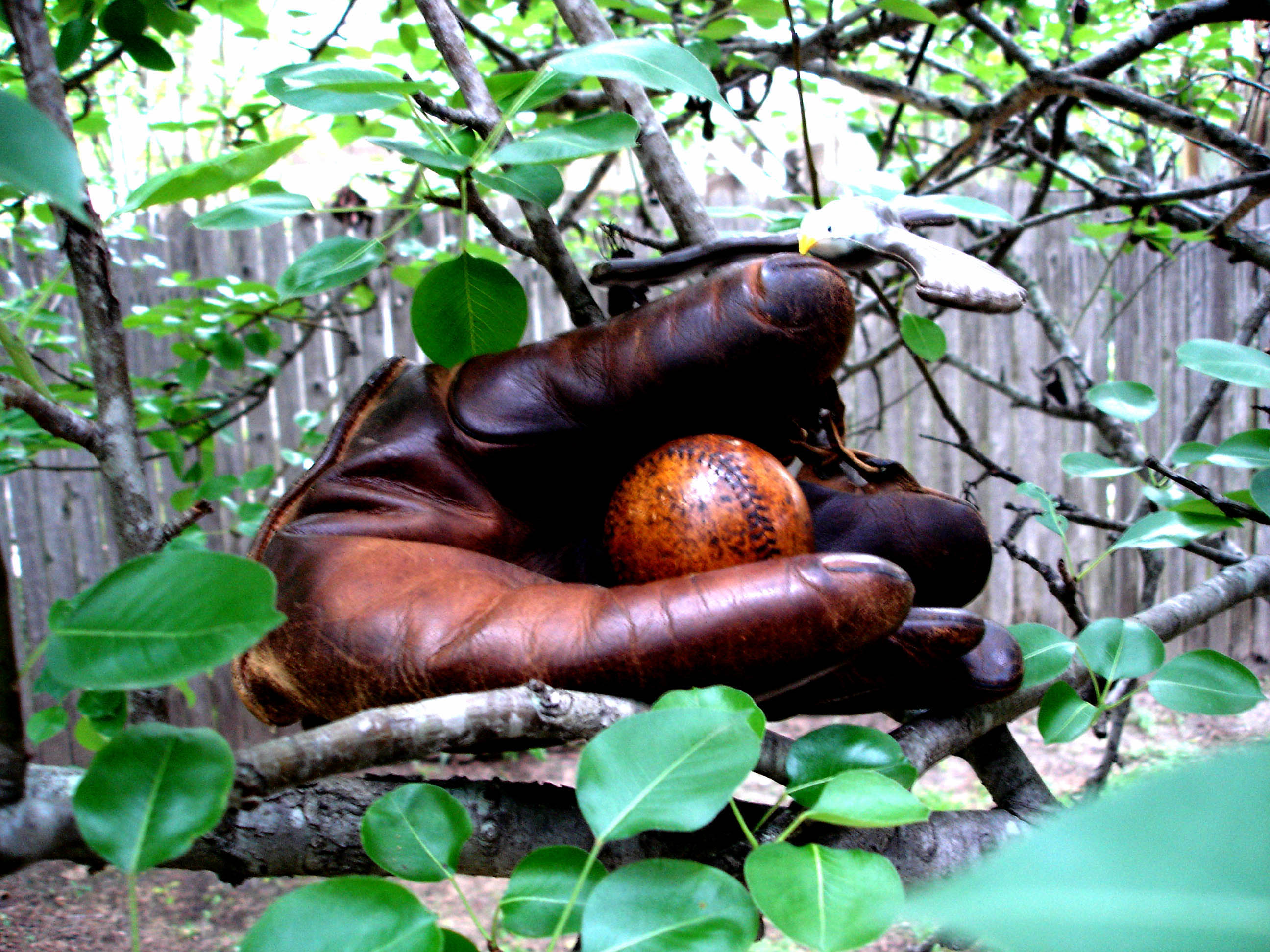
Gloves on the ground were common. Gloves with balls in a tree were rare.

(6) Indifference to Opposition. Baseball used to enforce its rule about players not “fraternizing” on the field with players from the other team. Today players disregard that rule as though it were no longer on the books and, who knows, maybe it isn’t. Lance Berkman stands out in my mind as a guy who treats every enemy runner who makes it to first base as though he were a long-lost friend. And who knows again, maybe they are. Lance is a pretty sociable guy.

(7) Pitchers as Pinch Runners. Clubs, especially the minor league clubs with their small rosters, used to use pitchers as pinch runners in late innings. I guess that baseball finally figured out that it wasn’t worth the risk to a pitcher’s arm or general welfare to put him out there under those circumstances of potential harm, doing something he ordinarily doesn’t do very often.

(8) Players (especially visiting team players) Often Began Day Games with Dirty Uniforms from the Night Before. We have better, faster washer dryers today and a little more support help on uniform maintenance.

(9) You used to be able to see the major spots on the field where the fielders spit their tobacco juices. Less chawing has led to a cleaner look in most ballparks today.

(10) Night Spot Team Brawls. Teams like the Yankees of the 1950s or even the Mets of the 1980s are getting into fewer club arrests for drunk and disorderly behavior arrests in night clubs these days.  I’m not sure if this means that today’s players are more problem-free than their predecessors or that today’s players are simply more discrete in the ways they choose to stir up trouble as a form of entertainment.

Either way, it’s a different ballgame today. In baseball and in life.

Sandlot Wisdom: Things We Figured Out on Our Own.

April 12, 2010

Houston East, 1952. (I'm the kid kneeling at left and wearing the Hawaiian shirt.)

Back on the Post World War II Sandlot, we didn’t have the best coaching or equipment in the world. As a matter of fact, we hardly had any coaching at all beyond those things that we picked up from our dads by chance in games of catch in the backyard after our dads’ work was done, but that didn’t happen every day. Our dads in the Houston East End worked long hard blue-collar job hours and they weren’t always home or simply up to playing catch every day that they were there.

Out on the sandlot, of course, we did a lot of “my dad says this” talking with each other. “Get in front of the ball on grounders. If you can’t catch ’em, at least, block ’em with your body” stands out in my memory as the most universal lesson we all picked up as a dad throwaway message. We might never have picked that one up on our own. There was no such thing as a true hop on our Eagle Park field, but we still came around to blocking grounders at the risk of  broken teeth and black eyes. It was the thing to do. Our fathers told us it was.

So, let’s give dads the credit for that first wisdom of the sandlot and then hit upon some of the other things we pretty much figured out on our own by simply playing the game with each other from dawn to dusk during the summers.

Some Wisdom of the Sandlot:

(1)  Get in front of the ball on grounders. If you can’t catch ’em, at least, block ’em with your body. Kids who didn’t block grounders were at risk of being labeled as “dog catchers.” These were fielders who chased hot grounders like dogs chase cars. If they do catch up with the ball, they just run along beside it, barking all the way as the ball clears the lot and rolls on down the street.

(2) In making out a batting order, put the fast little guys who show they can get on base in there ahead of the bigger, slower-moving, but harder-hitting guys.

(3) If you’re pitching, throw strikes. If you can get that first one in there for a strike, you put the batter at a disadvantage that remains with him, unless you give it away by forgetting where the strike zone is located.

(4) If you’re pitching, “accidentally” throw one hard, inside, and wild every now and then. If a wild pitch  makes the batter fall back or down, it becomes easier to throw a strike with your next pitch, especially if you can put it on the outside corner.

(5) As an outfielder, throw the ball ahead of the runner. To learn this one, all we had to do was watch little kids in right field throw ground ball singles to first base, allowing the runner to safely move on to second base in the process. What we didn’t learn on our own in the sandlot is how to effectively set up and use cut-off men on balls hit deep to the outfield. I didn’t learn that one until I played organized ball with an adult coach.

(6) Play the game to win. If you don’t play to win, you may as well not be playing. (Sandlot Yoga would not have been very popular in Pecan Park back in the day. It probably still isn’t.)

(7) If your opponent has an obvious weakness, take advantage of it. This value taught us how to hit to all fields. In fact, Wee Willie Keeler’s credo, “Hit ’em where they ain’t” simply meant to us: “hit ’em where the other team doesn’t have somebody positioned who looks like they can catch or stop a hard-batted ball. And hey, if it looks like nobody out there can catch, go ahead and swing from the heels, Eagles! This is “track-meet-on-the-bases” day!

(8) Never let the other team back in the game because you feel sorry for them. (See Lesson 6 again.) Don’t confuse the absence of mercy with unsportsmanlike behavior. You play the game of baseball to win – or you don’t play the game at all. Good sports understand this creed. Bad sports are the crumb-bums who beg for mercy and then have a tantrum when you beat ’em fair and square.

(9) Always try to find your highest level of competitive ability. If the other players in your world are bigger, better, and older than you, making it impossible for you to compete successfully, there’s nothing wrong with you stepping back and finding your niche with players who are more at your own level. There’s a place for almost everyone who wants to play. I said “almost.” If you can’t play well enough at any level to keep from hurting your team, you can learn to live with it and still enjoy the game as a fan.

(10) Most of all, the sandlot taught us that we’d never figure out the game completely on our own. To understand baseball better, we need to be dedicated to a lifetime of learning about the game’s history, strategies, and techniques.  We still won’t walk away knowing as much about pitching as a Larry Dierker does – or as much about hitting as a Jimmy Wynn, but we will become more knowledgeable – and that just makes the game all the more fun.

If you picked up some special lesson from the sandlot, please post it below as a comment on this article. We’d all like to hear what it was, whether it was a lesson about baseball specifically or life in general.

Have a great week, everybody. Unlesss you’re a Cardinal fan, let’s hope this may be the day that our 2010 Houston Astros start learning something about how to win their first game of the new season.

Sandlot Days: Making Do with What We Had.

April 2, 2010

"Eagle Park", Japonica@Myrtle, Houston, Texas.

For a lot of us who grew up back then, the years following World War II were not even close to the cornucopian basket that others have known in this land of the fatted calf. In East End regions of Houston like Pecan Park, we had to make do with whatever we had – or repaired – or built – or simply imagined our way into use as tools in the art of play.

Sometimes our imaginations got us into trouble. And street war games became a ripe arena for a number of mistakes we made in pursuit of authenticity. One time, for example, about six of us caught hell for the unauthroized requisition of eggs from our home refrigerators for use as hand grenades. Another time, my little brother John used a real grenade casing that our Uncle Carroll had brought us from World War II and heaved it through the open window of slow driving car that was passing by the front of our house.

The driver of the car turned out to be a veteran. The sudden presence of the grenade on the seat next to him provoked screams of PTSD horror I shall never forget – and neither will brother John. The man stopped his car down the street and came running back to our house with mayhem in his eye. Fortunately for John, our dad came rushing out of the house to intervene and to administer a “whipping” that I’m sure John has never forgotten. I’ve never seen Dad so mad – except on those occasions when he was equally mad at me for some stupid thing I did.

“Now you stay out of the street and never let me catch you throwing hand grenades again!” Dad ordered.

“What if I run out into the street and get killed by a car? Then what are you going to do?” John asked.

“II’ll probably be so mad you disobeyed that I will whip you anyway!” Dad answered.

I later got a whipping like that for a far worse offense. That was the time I asked a machinist neighbor to build us some working pipe guns that we could use to ward off invasion at Eagle Park from the kids on Kernel Street. We didn’t explain our true purposes in wanting the guns. We said we needed them for target practice, but that was never our true goal.

I’ve written about this gun incident before. My dad caught us in the act of firing these weapons at the Kernel kids and took them away. Then he made us Japonica-Myrtle Eagles settle our differences with the Kernel kids in a game of baseball. Then he whipped my posterior in a way that left me virtually buttless. It was one of those corner-turning experiences from childhood that would have gone a very different route had it not been for the presence of the greatest hero in my life, my dad.

At Eagle Park, we made do with what we had. The gloves we did have were hand-me-downs from dads and older brothers. The balls we used were most of the time those cheapos that flattened out on one side with the first solid contact smack of the bat. The few good baseballs that we captured at Buff Stadium stayed in play for as long as we could hold them together with black electrical tape. Even the best of all  baseballs could not hold up for long against the skinning they each took with the one-block skip and roll down concrete streets as a result of mighty hits one way – and catcher misses the other.

To cut down on the damage to balls from catcher misses, and mainly to have a ball retriever, we created a tenth defensive position we called the “hind catcher.” We would not have needed a hind catcher nearly so often if we had been blessed with a backstop, but that was a piece of equipment we didn’t have at Eagle Park.

The hind catcher stood about ten feet back of the catcher. It was his or her job to stop an balls that got past the catcher, or else, chase them down Japonica Street and get them back in as soon as possible. It was job we always gave to the youngest, most naive kids, the one who were trying to earn their way into the actual game. We stressed to our hind catcher recruits that those who stopped balls most often and went after the loose ones the fastest had the best chance of breaking into the everyday game on the field.

It was a popular job among the little kids. Sometimes we would even have a hind-hind and a hind-hind-hind catcher out there backing up the hind catcher. At the end of the day, or as some kids had to go home early from the field, all our hind catchers moved into the actual game and got to bat – at least once.

The system worked for us. It’s how we all started.

Bat preservation also presented certain challenges. Since all our bats back then were also old and always wooden, they eventually cracked and became useless without repair. We nailed and taped our bats back together too, looking for every last hit we could ring out of each sacred bludgeoning weapon that still stood moderately straight in our baseball war chest. A bat had to break totally in half before we gave up on it for all time.

As for bases, we used what we could find. We never had permanent bases at Eagle Park. Garbage can lids  worked for home plate, but they sure expanded the strike zone. We used everything from decaying hunks of sidewalk curb concrete to tee shirts for our actual bases.

On those days we couldn’t field eighteen players for a regular game, we played “Work Up.” It was just baseball with fewer players and a slightly different goal. You had three to four batters in Work Up. The object was stay at bat as long as possible. If the defense got you out, all the fielders rotated from 9 to 1, with the number 1 fielder, the pitcher now going in to bat. The number 2 catcher now moving to pitcher, etc. You, of course, moved to the number 9 right field position to try to do what game says, “work up” to becoming a batter again.

Another popular game for a small number of players was “Flies and Rollers.” In this game, one player hit fungos to the other players in the field. The first fielder to successfully handle either three flies or nine rollers, without a miscue, got to replace the fungo stick batter, who would now take the field.

Somehow we survived. A big part of that “somehow” was the fact that we all mostly had parents who cared; we lived in neighborhoods where other parents could and did intervene and deal with issues of bad judgment and miscreant kid behavior; and the world was still safe enough for us kids to go out there and work things out on our own.

A lot of us didn’t have much back then, but we neither thought of ourselves as poor or entitled to everyday salvation at the expense of the community. Our parents taught us that jobs were the answer to financal needs and that you simply didn’t buy things you could not afford. We learned to make do with what we had.

We did OK, even if a very important part of our little world was being  held together most of the time by electrical tape.

In Search of a Few Ballparks.

April 1, 2010

Bob Dorrill of SABR surveys the turf at “Eagle Park.”

On Tuesday, March 30, 2010, good friend and fellow SABR member Bob Dorrill, our esteemed Larry Dierker Chapter leader and field manager of our vintage base ball Houston Babies, and I spent the day in search of some old local ballparks. For the most part, we knew that all of them on our list were long gone in physical form, but we were searching for something a little harder to see. We wanted to make whatever contact that might still be possible with the essence of these neighborhoods that spawned them long ago. Going in, we also knew that most of the cultures that once existed in each area we visited had long ago either mutated or been run off to the hinterlands. It was a daunting task, sort of on the level of trying to travel through time without a time machine, but that’s the very nature of historical baseball research. You always end up yearning for that one-hour direct view of the game or event or place itself that is under study – or for that one interview moment with the last eyewitness on the fiftieth anniversary of their burial in the cemetery. Neither ever happens.

Here’s a thumbnail on what we found and didn’t find.

(1) Buff Stadium.


Buff Stadium 1928-1961 (Forget the years they called it Busch Stadium.)

As I described yesterday, Buff Stadium was our first and main stop. The memory of the grandest old ballpark in Houston baseball history is well protected by the Finger family on the site of their store on the Gulf Freeway at Cullen. The Houston Sports Museum is again operating within the store in a vastly improved and tasteful presentation of Houston baseball history under the capable direction of Curator Tom Kennedy.

(2) Eagle Park.


Eagle Park, 1947-54; Sandlot Home of the Pecan Park Eagles.

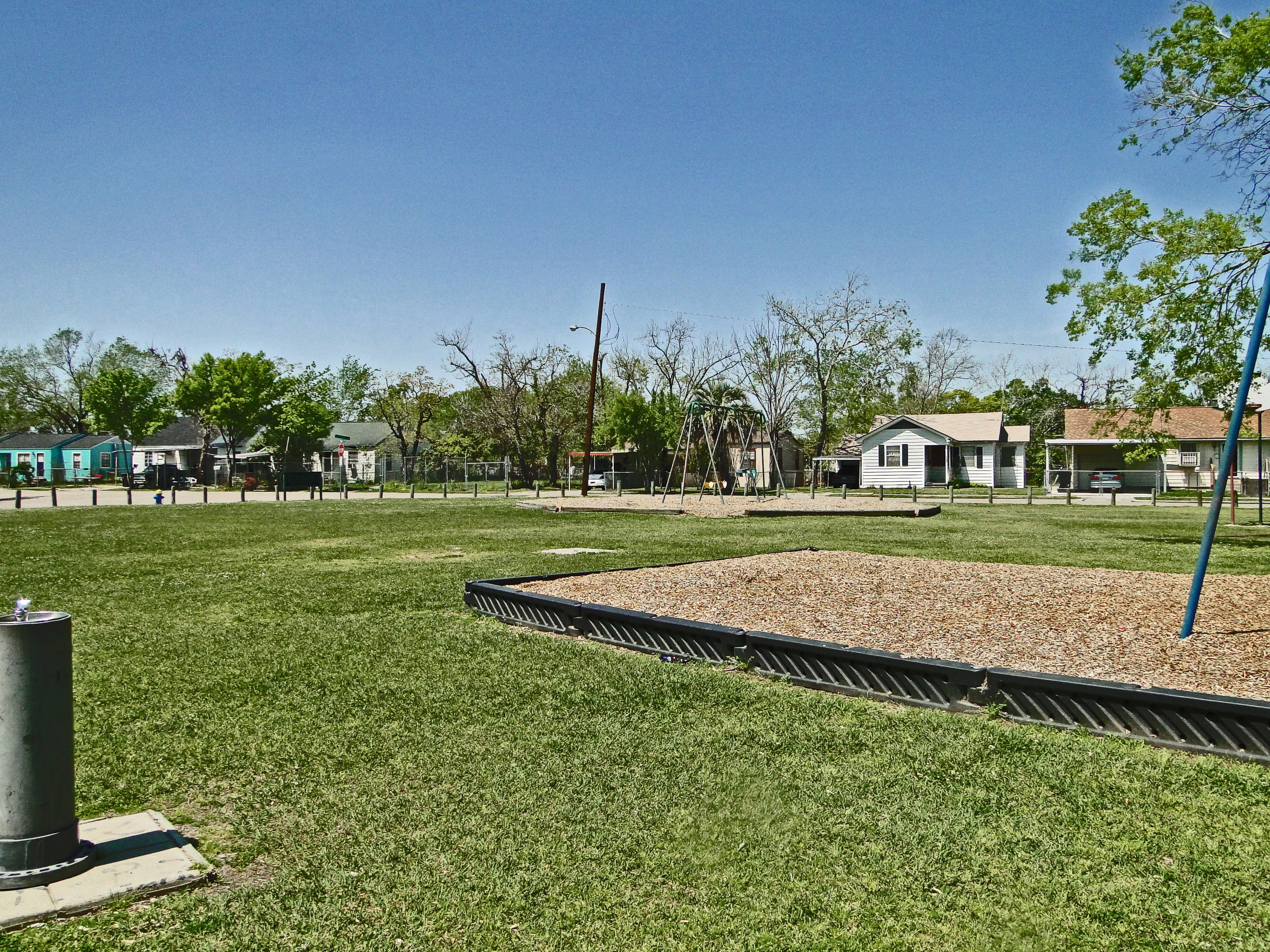
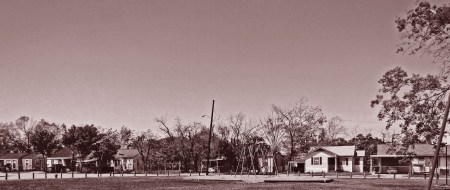
Eagle Park was the name a few of us Japonica-Myrtle Street kids gave the little city park we claimed as home field of our Pecan Park Eagles. The place represents all the thousands of sandlots that once filled daily in the Houston summertime from dawn to dusk for some serious non-stop baseball. We had to stay inside during the so-called “heat of the day” (12:00 PM to 3:00 PM) in 1950 due to the threat of polio, but we made up for lost AB’s once we were again paroled to the streets.

The above featured photo shows the field perspective from where home plate used to stand. All of that dumb playground equipment and the water fountain weren’t around back in 1950. We would have torn that stuff to the ground for getting in the way of baseball back then. Now the kids don’t play sandlot ball on their own out of some natural love for the game. If they play the game at all. it’s the Little League version under constant adult supervision. No wonder the kids lost interest in the game. Organized youth sports offer no freedom and about two games and six at bats per week. We had days on the sandlot when the individual times at bat ran well into the hundreds.


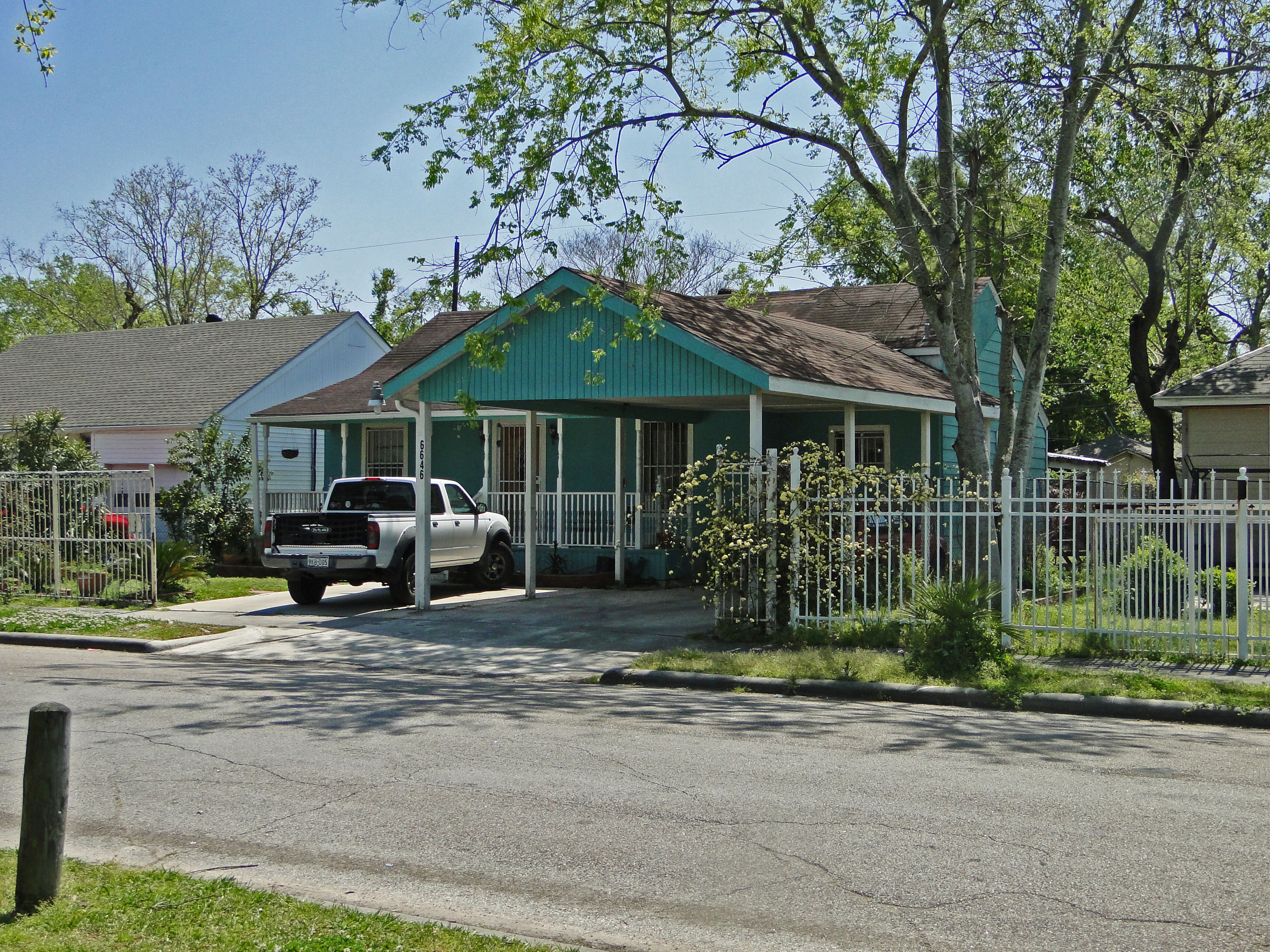
6646 Japonica Street, Houston 17, Texas.

The front door of my childhood home was just about ninety feet from home plate at Eagle Park. The house wasn’t blue back in the day, but neither was I. The world of hope spread out before me as the endless lawn of summer fun with other East End street urchins as we pursued our all-day, no matter what, from here to eternity passion for the game of baseball.

(3) East End Park.

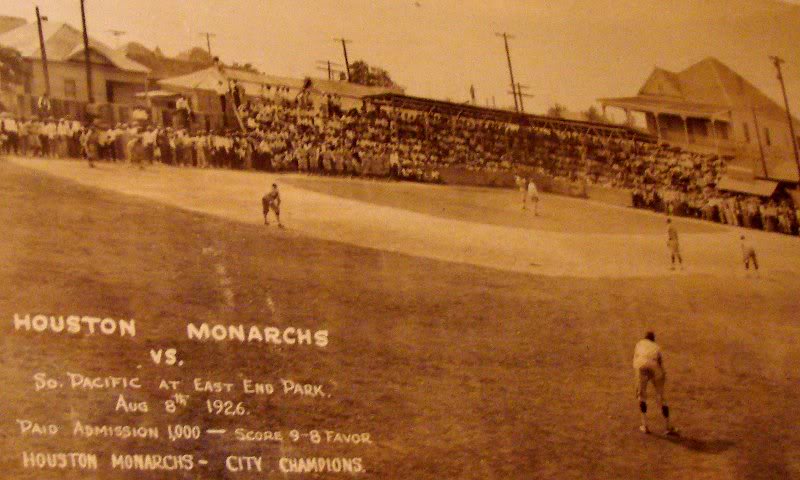
East End Park, 1920s, on Cline off Clinton Drive.

Thanks to team owner John and James Liuzza, East End Park was the thriving home of black baseball for several years in Houston during the early decades of the 20th century. Both the Houston Monarchs and their later named selves, the Houston Black Buffs, played here, especially to enthusiastic crowds on Sundays.

Everything in the photo is gone or changed beyond recognition today. Some dilapidated one-story shanties now stand on the street where the two-story homes once stood. The ballpark is completely gone, now replaced by a large and fairly new and well-kept looking garden apartment building project. Because of the old fifth ward neighborhood’s proximity to downtown, new homes and bastille-guarded apartments are springing up like orchids in a patch of architectural weeds in this area, but there is no  sign of baseball  here. Not now.

(4) Monarch Stadium. No picture is available to us, but the Liuzza Brothers  built a second ballpark in the 1930s near East End Park on Gillespie Street. It also is gone, leaving no trace of where it ever prevailed as a site for baseball. When people change directions, they eventually or sooner change the landscape too.

(5) West End Park.


West End Park, Home of the Houston Buffs, 1907-1927.

We took Smith Street south from downtown to Andrews Street, the little lane that angles off the northern side of of Allen Center and past the southern side of the iconic Antioch Baptist Church. A few short blocks to 601 Andrews put us right where the 1919 Houston Street Directory tells us was the 601 Andrews Street mailing address for West End Park. Today it is some kind of power grid for the electric company. It is only  a short block from where the freeway cuts off Andrews from further movement southwest. Mike Acosta of the Astros believes that the old location for home plate at West End Park would now be found under the freeway. If the field was laid out facing southeast, as we “think” it was, then Mike’s guess is probably right on target. Like the others, West End Park is now gone, without a trace of evidence remaining that it ever existed in the physical world.

(6) Minute Maid Park.


Minute Maid Park 2000-Now.

We finally found a ballpark that still lives, houses baseball, sells beer and hot dogs, puts a Houston team on the field that tries its best to win ballgames, and one that brings the thrill of a pennant race into our lives almost every single year. It’s at this ballpark, where baseball has a present and future to go along with its rich past, that all comes to new life. While we were there, I even managed to pick up a couple of nose-bleed tickets for Opening Day next Monday and the Oswalt-Lincecum match-up between the Astros and the San Francisco Giants.

It was a great day. If those of us who love baseball could have more days like the one that Bob Dorrill and I shared last Tuesday in search of old ballparks, we would all live happily to about the age of 150.

See you at the ballpark, friends!

My Souvenir from Ballpark Search Day.


Straight from the Heart. (That’s the Eagle Park dirt in the glass jar.)

My souvenir from the ballpark search day was no accidental find. I planned it by bringing a tall glass jar and a small garden hand spade with me on Tuesday. The bottle now contains something I’ve wanted to bring home for years. It’s a bottle filled with dirt from the home plate area of Eagle Park – and it is just as black and hard as the gumbo we played on sixty years ago. – And why shouldn’t it be black and hard and similar? It’s beyond similarity. It’s the same ground we played on a lifetime of ballgames ago.

Have some fun, folks. None of us are getting any younger.

The Houston Sports Museum Is Back!

March 31, 2010

Rodney Finger Has Reincarnated an Improved Tribute to Houston History at his “new” store on the Gulf Freeway at the Site of Legendary Buff Stadium (1928-61).

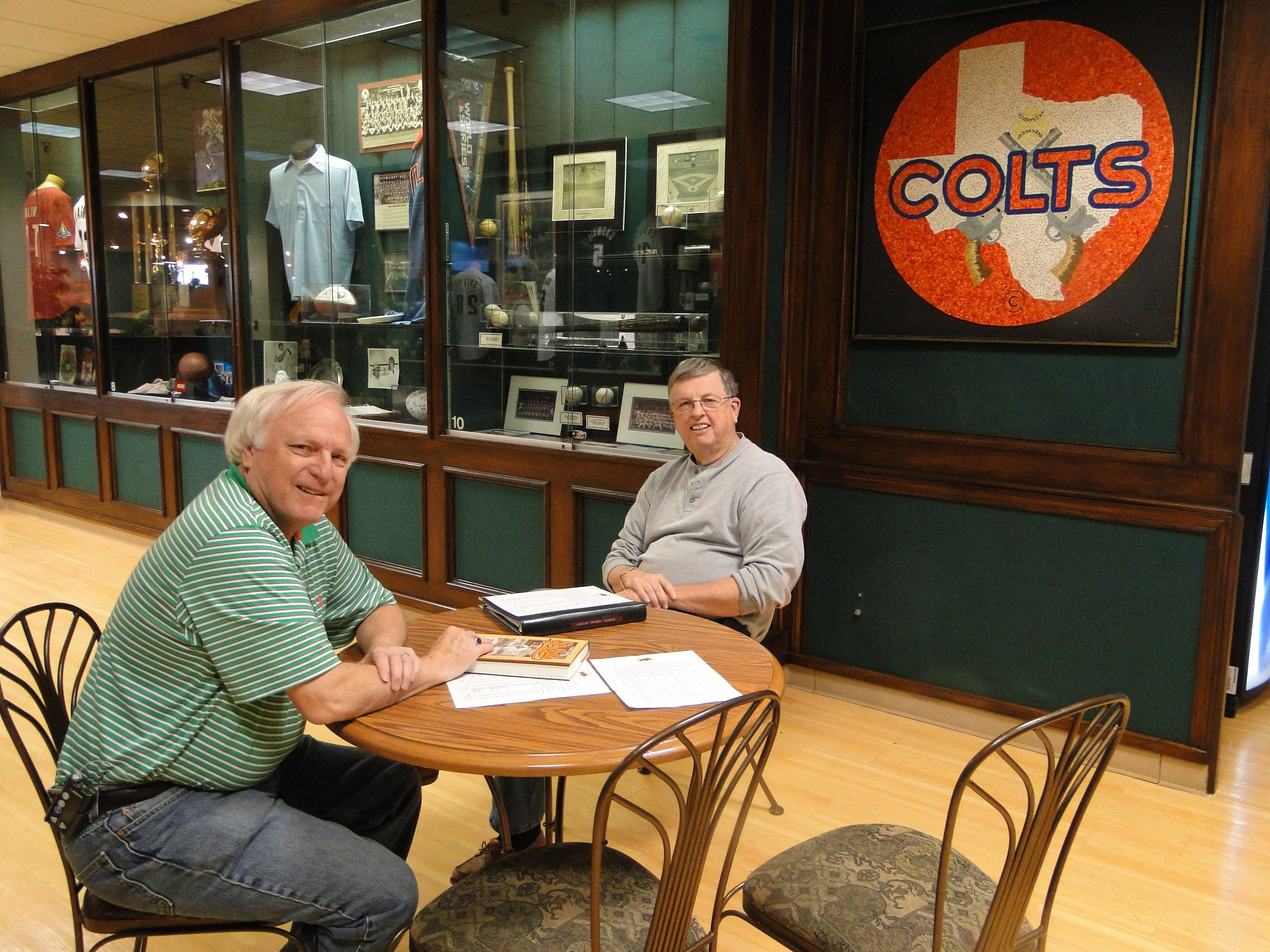
Yesterday Bob Dorrill of SABR and I went over to meet with Tom Kennedy, the Curator of the Houston Sports Museum, and to get his tour of what is happening with the newly reopened facility at the also newly remodeled and reopened Finger furniture store at that historical location.

Words alone fail. That’s why you will be getting many photos today. Rodney Finger and Tom Kennedy are pulling out all the stops to make sure that the presentation and artifact preservation issues that plagued the “HSM” in the past are now resolved and replaced by a rotating exhibit of items that are truly unique and valuable to history.

The HSM will keep its historic name and honor its dedication to remembering the Houston Oilers and Earl Campbell as well, but this evolving version of the dream will be mostly about baseball, as was the original intention of 1960s founder and Rodney’s grandfather, Sammy Finger.

Bob Dorrill (L) and Tom Kennedy talk things over in front of a new mural version of Buff Stadium on its original Opening Day, April 11, 1928.

On display are two of the original 80 36″ diameter metal buffalo medallions that once rimmed the exterior perimeter stadium walls of Buff Stadium.

In a DVD narrated by Gene Elston, the story of Houston professional baseball from 1888 forward now plays continuously on a high-definition television set within the museum. Other digital telecasts are planned for inclusion in the future on a rotating basis.

The quiet, classy hand of Houston Astros Acquisitions Director Mike Acosta is also visible in the new HSM on several levels. Acosta has been working with Kennedy to help make the new Finger’s showcase the first order presentation it is fast becoming.

“It’s not how much space you have, but how you use the space you have that matters.” Kennedy and the HSM are dedicated to the idea that choice items, rotated for view on a frequent thematic basis, will help keep giving people reasons to return. The public will have a chance to view the world’s oldest baseball card from 1869 at some undetermined point in the near future.. Rodney Finger has asked card owner JeFF Rosenberg, the owner of Tri Star Productiions, to allow the HSM to display it sometime soon and it is expected that this will happen. Say tuned for further specific details from Tom Kennedy. Everything well done takes time. To better protect historical treasures, HSM also has installed protective lighting to help preserve artifacts and help prevent the fading of important signatures from autographed items. In case you are wondering, that’s an ancient Houston Buffs jersey on display in this photo, along with several books that are important to local baseball history.

The former exact site of home plate is still imbedded in the floor of the HSM. It will soon be joined by the return of the larger than life statue of Dickie Kerr, the late-in-life Houstonian who once pitched as the “honest man in” for the 1919 Chicago Black Sox.

The art of LeRoy Neiman’s Nolan Ryan rises above the lesser light of some dedicated less celebrated Astro heros.

The history of Houston baseball is all here. Look for word of the HSM’s Grand Re-Opening Day, but drop on by anytime now to check the progress. Tommy Kennedy says he has about sixty per cent of their Finger’s items on display and that further acquisitions are planned. It’s a show that will never end or be complete and it’s Houston baseball history in its purest form. The vision of Rodney Finger and the hard work of Tom Kennedy is out there saving the day for something that could have been lost forever. Thank you, Rodney! And you, Tom! The business of museums belongs in the hands of those people of integrity who truly care about history – and you guys are both such folks!

Many of us grew up reading our first baseball game stories from the mind and pen of former Houston Post writer Clark Nealon. It is only right and fitting that the HSM honors the late Nealon in the fine way it does.

There will always be room at the HSM for a fellow named Earl, even if he didn’t play baseball.

Rodney Finger is a man of vision. He took out a wall so that visitors to the new Finger’s store on the Gulf Freeway would have this view of the Houston Sports Museum as they entered the building. Good luck, Rodney! Based upon what we saw in a nearly three-hour meeting with Tom Kennedy yesterday, I think it’s safe to say that Bob Dorrill and I both walked away quite impressed. Know too that we will be around to help you any way we are able – and that we will spread the word to other SABR members about your plans and actions to date.

Have a nice spring day, everybody. We’ll see you at the ballpark soon.

Baseball and the Art of Distraction.

March 19, 2010

August 19, 1951: Bill Veeck sends midget Eddie Gaedel to bat for St. Louis Browns against the Detroit Tigers.

Baseball is the fine game it is because it the only major team sport game in America that allows you time to reflect, think or not think, keep score in riveted attention or simply eat peanuts, drink beer, and lollygag with your neighboring fans as the clock ticks on with no particular relevance at all to what is going on out there on the field.

That is, baseball used to be that way during its pastoral beginnings in the 19th century. Then came the 20th century, the New York Yankee demolition of pennant races in the American League, and the advent of television in post World War II America. Now, all of a sudden, we had owners who worried that fans would leave the ballparks for the very reasons that attracted them in the first place. They detected boredom as the enemy and they embarked upon small to exaggerated measures of distraction as the remedy to falling attendance.

Let’s be clear here before proceeding. It was never baseball and boredom that drove fans away in some markets. It was bad baseball and despair of winning that did the trick. Ask fans of the old St. Louis Browns (while their few in numbers still survive) what drove them home and they will confirm what I’m saying here, but that didn’t matter to people like Browns owner Bill Veeck in the early 1950’s. Veeck knew the truth, but part of the truth was that he had found himself caught up in that familiar ownership hole in the days prior to relative talent parity. – The Browns needed to win to draw fans, but they had a far more pressing need to sell their better players just to pay the bills. As a result, showman Veeck turned to a plan of  distraction in 1951 in the hopes of saving his club in the short-term.

On August 19, 1951, Bill Veeeck successfully began a game at Sportsman’s Park in St. Louis by sending midget Eddie Gaedel into an afternoon game against the Detroit Tigers as a pinch hitter for lead-off batter Frank Saucier. Veeck had given Gaedel strict instructions to swing at nothing. “I’m going to be on the roof with a rifle,” Veeck told Gaedel. “If you swing at anything, you’re a dead man.” Gaedel walked on four pitches and was promptly removed for a pinch runner. Baseball promptly banned the use of midgets and dwarfs. We must only presume that this bias against vertically challenged people remains there in a musty, hastily written page of the baseball rule books, simply waiting for some new and ambitious short person to make a civil rights action case out of it.

Five days later, on August 24, 1951, Bill Veeck staged “Fan Manager Night” at Sportsman’s Park. A group of fans seated behind the thrid base dugout were given color coded placards to signal their preferences for certain choices for player action in the game while Browns manager Zack Taylor sat in a rocking chair on the third base side, smoking his pipe and taking it easy. Even though the Browns defeated the Philadelphia A’s, 5-3, that night, Baseball also quickly put the banishment screws on Fan Management in future games.

Where are you, Donna Summers? Are you OK?

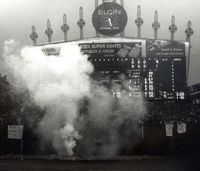
Later, in 1979, another Bill Veeck stunt would literally blow up in his face at Comiskey Park in Chicago. Now acting as owner of the White Sox, Veeck had planned a “Disco Disk Demolition Derby” in which fans were invited to bring their disco “records” for explosion in one big pile on the field. Before that could happen, drunk fans were inspired to sail their vinyls through the ballpark air like so many potentially decapitating frisbees. The places turned into a riot scene, complete with fights, fires, and fan arrests. This time, a ban from Baseball was unnecessary to the fate of these nights in the future.

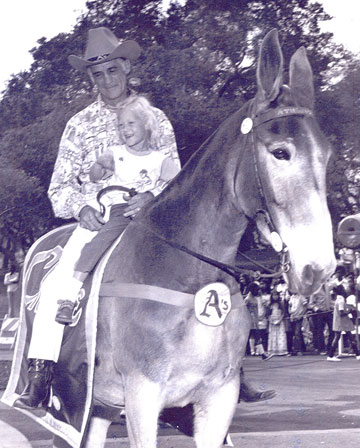
A's Owner Charlie Finley and Charlie O. the Mule.

Owner Charlie Finley of the Kansas City/Oakland A’s back in the 1970’s was another of Baseball’s bright light believers in distraction. Finley came up with everything from more garish color combinations in team uniforms to the promotion of orange baseballs for better vision, facial hair tonsorial fashion, and team mascot mules that grazed the outfield grass.

To his credit, Finley also put a pretty good baseball game product on the field as well. As you probably know, his Oakland A’s won three World Series titles in a row from 1972 through 1974.

1964: Judge Hofheinz and the Coming of the Big Distraction.

Houston held its own with the rest of Baseball’s great distractors. Judge Roy Hofheinz was the reincarnation of P.T. Barnum in spirit, if not in soul. His introduction of the world’s first domed stadium for baseball stands as the most distracting innovation in the game’s history. Over the course of its thirty-five season history (1965-1999), the Dome helped distract Houston fans from the fact that they had never played in a World Series over the entire course of their 20th century existence.

How was that for distraction?

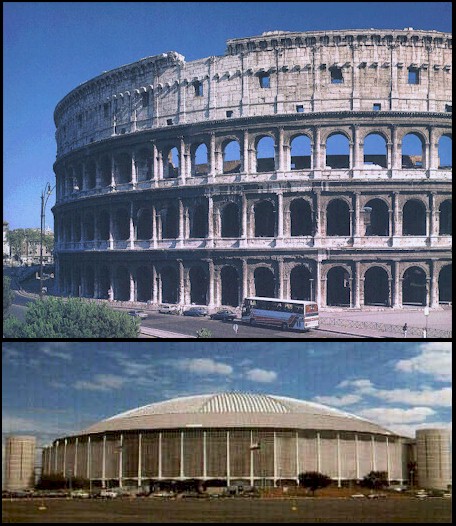
Was part of the Rome Coliseum wall taken out by some clown slingshoting souvenir Nero togas into the stands?

Some choose to romanize the idea that Judge Hofheinz drafted his ideas for a domed stadium from his fascination with the great Coliseum of Rome. It’s more likely that he copied the earlier failed attempts of the O’Malleys in Brooklyn and Branch Rickey in Pittsburgh. Either way, the deal was fun for Houston, but a distraction, no less, from the leisurely joy of baseball in its pure form.

Somewehre along the way too, some sports marketing group sold baseball teams on the idea that they needed a minion army of young buffoons to run around the stadium firing souvenir tee shirts into the crowd for the sake of keeping the younger fans interested in staying at the ballpark for the length of the game. I hate that stuff almost as much as I do “the wave” as a ballpark distraction.

But what do I know? I’m an old folie. I come to the ballpark to get lost in the game of baseball  and away from the  distractions of international terrorism, the perils of health care, and the apparent failure of integrity among our various elected officials. Neither the wave nor the slingshot tee shirts offer us much to heal those concerns.

Bottom Line: I never liked distractions at the ballpark, even as a kid. I go to the ballpark for the game and I don’t worry about the game running too long. Each game is what it is. It will end when it ends and not a moment sooner. And that’s how baseball should be, I think.

If I had to make an historic exception I would have loved being there for the Gaedel pinch hitting role in 1951, but he’s the beginning and end of my very short list.

1964: Judge Hofheinz and the Coming of the Astrodome

Who Dat Be Sayin’ Who Dat When I Say Who Dat?

February 6, 2010

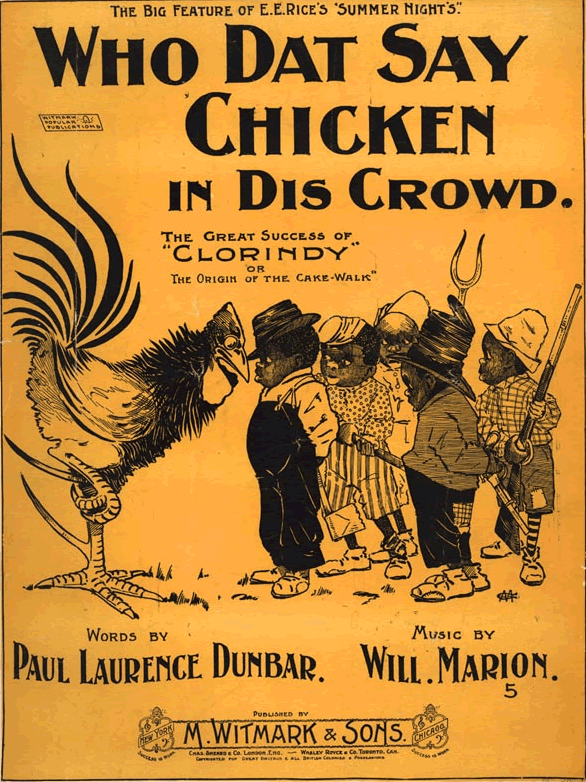
"Who Dat" Derives & Survives from Black Minstrel & Burlesque. Certainly racist by today's standards, the poster above advertises a musical presented back in 1898.

The first time I ever heard the “Who Dat” phrase, I was a graduate student at Tulane University in 1961. It came bellowing at me as a song phrase from a trio of French Quarter street singers and tap dancers who called themselves “Skeet, Pete, and Repeat.”

“Who dat be sayin’ … ‘Who Dat?’ … when I say … ‘Who Dat?’ … Who dat be … the question … of em all?” On the face of things, Skeet, Pete, and Repeat appeared for post-performance tips before their all white street crowds of that era as the very embodiment of Uncle Tomism, making fun of their own statures as men and human beings for the sake of getting money from an audience who craved demeaning affirmation of their bogus superiority over blacks.

Because of my work as an activist on black voter registration in 1964, and my natural affinity for jazz all along, I got to know a number of black families in New Orleans back in the early 1960s in ways that most whites did not experience during that period. It became a time of great joy, mighty sadness, and ultimately, of  important awakening for me. The “who dat” phrase was little more than a small part of it, but it bore a deeper significance, one that Skeet, Pete, and Repeat “dug” a whole lot better than the politically correct white scholars who cried out against it at the time as the docile language of the old Uncle Tom, yielding post-Civil War, “spooked by the KKK” black male culture.

I hope I can give you the picture of what Skeet, Pete, and Repeat did with that little phrase on the streets, one they often used in performance as the wrap-up number on the last set of the evening at the Dixieland {Jazz) Hall on Bourbon Street. Allow me to try and summarize the view, even if I do know in advance that my words will fail in adequacy. It’s important for you to know what stirred me from the visual side to talk with the guys about it – and important to understanding what the fellows really felt they were doing with “who dat” in that routine.

Here’s the picture:

Skeet, Pete, and Repeal all dressed in garish looking, zoot-suit fitting suits with formal shirts and ties. All three men tap danced extremely well. They would all take stage (or outside on Bourbon Street in earshot of the music) in a line, tap dancing up a storm to “When the Saints Go Marching In.” They would all be smiling to the point of sheer deferential obsequiousness into the faces of their usually older white tourist audiences. As the song neared its end, Pete would start dancing in a rotating circular motion between Skeet and Repeat as the latter two dancers each placed an index finger on the top of their partner’s head as though he were a spinning top. The touch of those fingers on the head would always produce a dreamy look of abject stupidity on Pete’s face, one  that invited the laughter of those people who needed help in feeling smarter by the sight of someone portraying himself as really so much dumber.

Then came the finale of the act and my introduction to who dat. The guys all returned to a line facing the audience and sang out in smiling harmonic unison as they continued to stomp-dance hard:

“Who dat be sayin’ … ‘Who Dat?’ … when I say … ‘Who Dat?’ … Who dat be … the question … of em all?”

“I said now, who dat be sayin’ … ‘Who Dat?’ … when I say … ‘Who Dat?’ … Who dat be? … It jus’ be us … that’s all!”

As I got to know Skeet, Pete, and Repeat a little bit, I had to activate my 23-year old brain and ask them one evening backstage at Dixieland Hall. “How can you guys do this routine  night after night, putting yourselves down in front of white people when you’ve all got enough talent to blow them away without all this Uncle Tom stuff?”

“You don’t get it because you’re white too, young man,” Pete told me. “When we say ‘who dat’ to all them white people, no matter how we be sayin’ it, we really be sayin’, ‘you better be ready to come up with an answer to that question, folks, because we all of us here, men and people too – and we ain’t goin’ away. – Who dat? – Dat be us!'”

Who dat’s gone mainstream now, but the question is still out there to be answered by each us about ourselves on all matters, large and small, and about nobody else. We all have to sink or swim on the heels of what we each do, and fail to do, with our own lives.

And guess what? This weekend, millions of us will be frittering away our time as answers to the question about who dat be watchin’ the Super Bowl on Sunday.

Who dat? – Dat be us.

Wise Guy Comebacks.

January 30, 2010

Margaret Dumont: "How impertinent of you, Sir! I've never been so insulted in my life!" Groucho Marx: "Relax, Madam! The evening's young!"

Wise guy comebacks are best remembered when they land in one-line form. They are the essence of intimidating wit and all sustaining comedy over time. They are the lines that somehow speak for all of us as the statements we wish we had thought of or said ourselves in our own behalf. They are that way because they truly belong to all of us. Our laughter as the audience serves as proof.

Bob Hope, Jack Benny, and Groucho Marx were masters of the one-liner wise guy comeback. Here are examples of each using the one-line comeback to greatest advantage:

Bob Hope (From the 1940 movie “Ghostbreakers”) Bob is asking fellow actor Richard Carlson about zombies):

Richard Carlson: “A zombie has no will of his own. He walks around blindly with those dead eyes, following orders, not knowing what to do, not caring.”

Bob Hope: “You mean like Democrats?”

Jack Benny (From his 1940s radio program, I’ve remembered this one for sixty years):

Armed Robber: “Your money or your life!”

Jack Benny: (arms raised and silent)

Armed Robber: “I SAID – YOUR MONEY OR YOUR LIFE!”

Jack Benny: “I’m thinking! I’m thinking!”

Groucho Marx (from an interview after one of his divorces):

Interviewer: “What does the California community property law mean to you now that you’re getting divorced?”

Groucho Marx: “It means that she now gets to live off the property and I now get to live off the community.”

Priceless stuff.

Even we everyday people have our moments. The first one for me that comes to personal memory happened when I was 16 and working as a  shelf stocker at the old A&P Grocery Store that used to operate in the Houston East End near the intersection of Lawndale at 75th:

Matronly Customer: “Young man, can you tell me where I might find the all day suckers?”

Grocery Clerk (me): “Yes, Madam, you’re talking to one of them!”

I almost got fired. The customer cracked up with laughter and I then did take her to the aisle and shelf that contained the wrapped version she wanted, but I wasn’t aware that my boss had been standing in the next aisle and heard the whole brief exchange. He told me that it was lucky for me that the customer laughed because, otherwise, I was about to be fired for my “Smart Aleck” remark – and would be, if I ever did it again. I didn’t, but I did do other things of that nature on my road to whatever state of adult maturity I actually achieved over time.

The most recent personal example unfolded last night. It’s what “inspired” me to write this piece this morning and, as per usual, this opportunity came literally knocking at my door about 7:00 PM Friday evening.

The knock sent our dogs into their worst snarling, barking mode as I made my way from my study to see who was at the door. Through the window, I could see that it was a young high school kid. He was dressed in a white shirt and tie and I presume he had come to sell me magazines for the sake of some locally worthy cause. Our conversation never got that far, thanks to the opening he gave me for early termination. I support a lot of causes, but none of them are items I’ve purchased at the front door. To me, door-to-door sales are the “spam of 3-D life.”

I will leave you with my short report of this easy set-up exchange. If the young man was smart, he changed his script before he knocked on any more doors:

Door Opens …

Enthusiastic Student Salesman: “You must be the king of the house!”

Grumpy Wizened Resident: “That’s correct, I am the king here, but you will have to excuse me for  now. I was on my way to the throne when you rang the doorbell!”

The student left and never returned. Only the postman rings twice, or so they say. I’ve never quite understood the meaning of that old movie title. Even my postman never rings twice when I tell him I’m on my way to the throne.