Posts Tagged ‘culture’

Some Fun with Puns

June 18, 2010

Today’s one of those Fridays that calls for a change of pace. How many of you are familiar with the German word witzelsucht, (pronounced vitzel-zukht). I didn’t think so. I’d never heard of it either until I started reading up on the history of puns as a form of humor recently. Then I received an e-mail from a friend that contained the first ten puns in the group I’m presenting here today for no reason in my own mind other than the fact that that I do find this sort of humor to be invariably funny.

The 26th edition of Stedman’s Medical Dictionary, on the other hand, defines this fascination with the humor genre as “… a morbid tendency to pun, make poor jokes and tell pointless stories while being oneself inordinately entertained thereby.” Well, la-d-da! If that’s how you’re going to be, I say, “Stick it, Stedman! You’re getting in the way of all the fun!”

Here are twelve elaborately wonderful groaners for your coming weekend pleasure. WIsh I could attribute authorship to these to their creators, but I cannot. And that’s another thing about memorable puns. They all seem to rapidly loosen their moorings to any original port and slip forever into the waters of oceanic appreciation:
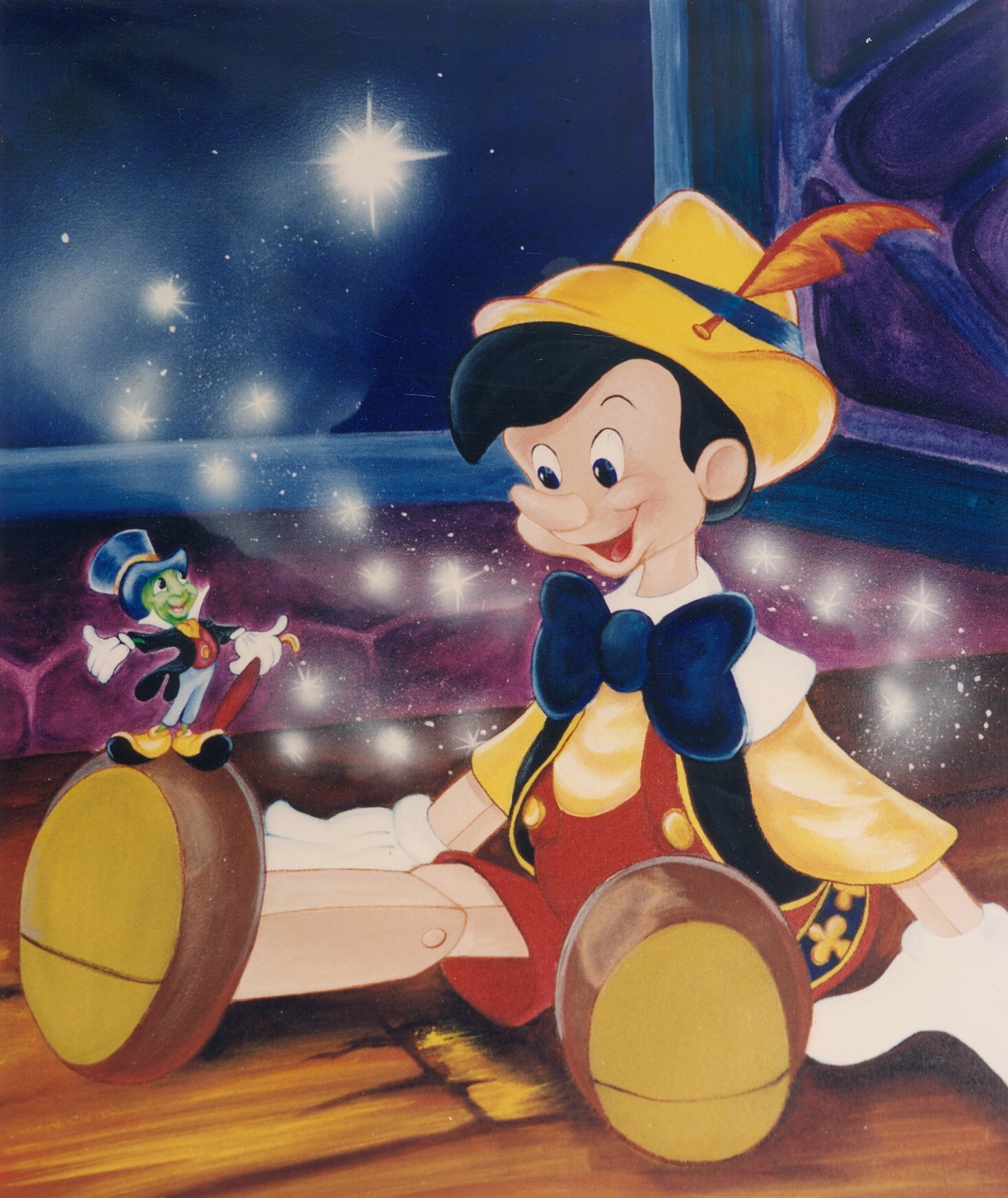
1.  King  Ozymandias of  Assyria was running low on cash after years of  war with the Hittites. His last great possession was the Star of the  Euphrates , the most valuable diamond in the  ancient world. Desperate, he went to Croesus, the  pawnbroker, to ask for a loan. Croesus said, “I’ll give  you 100,000 dinars for it.”  “But I paid a million dinars  for it,” the King protested. “Don’t you know who I am?  I am the king!”  Croesus replied, “When you wish to pawn a Star, makes no difference who you are.”
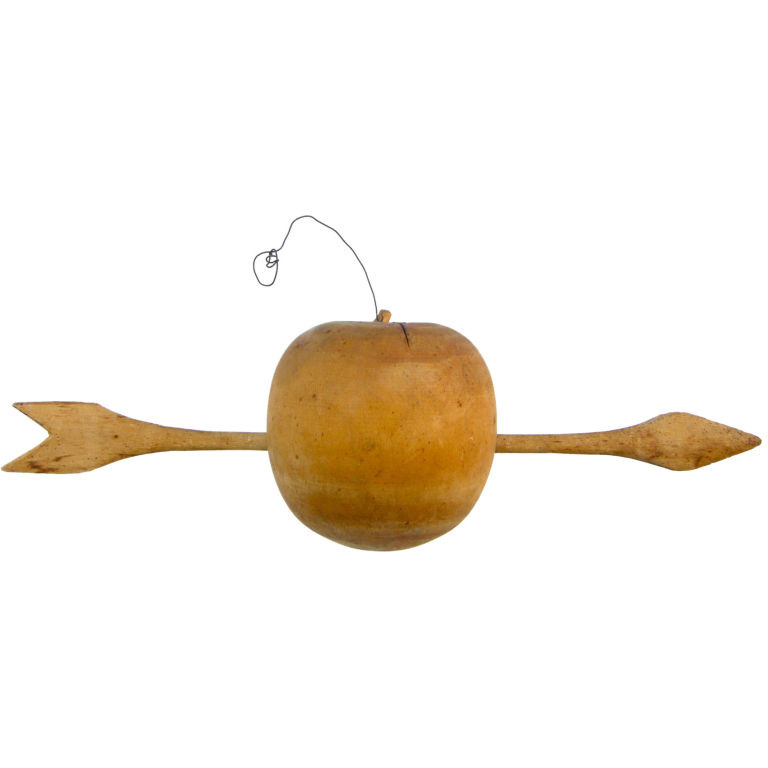
An apple a day won't keep the flaming arrows away.

2. Conclusive evidence has been found to confirm that William Tell and his entire archery-addicted family were also hooked into an every Monday night Geneva association as avid bowlers. Unfortunately, all of the  Swiss league records were destroyed in a monster fire, … and so … we’ll never know for whom the Tells bowled.
"Has your address or insurance changed since your last doctor's appointment?"

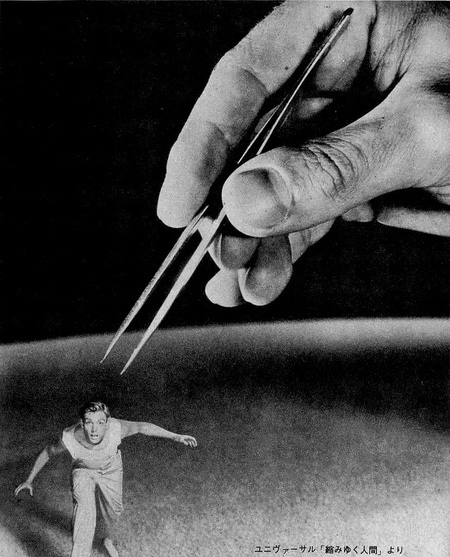
3. A man rushed into a busy doctor’s office and shouted, “Doctor!  I think I’m shrinking!” The doctor calmly responded, “Now, settle down. You’ll just have  to be a little patient.”
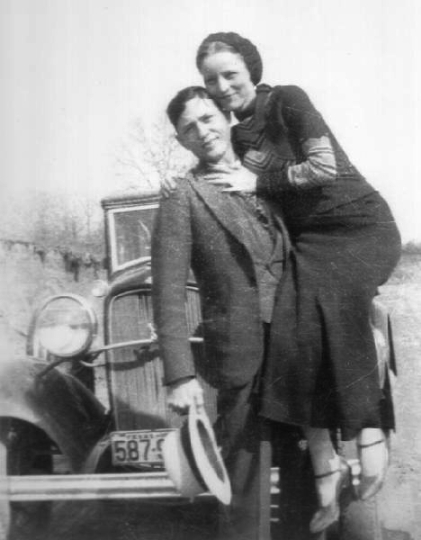
"We're coming up on the state line, honey? How old did you say you were?"

4.  A marine biologist  developed a race of genetically engineered dolphins that  could live forever if they were fed a steady diet of seagulls.  One day, his supply of the birds ran out so he had to go out and trap some more.  On the way  back, he spied two lions asleep on the road.  Afraid to wake them, he gingerly stepped over them.  Immediately, he was arrested and charged with…transporting gulls across  sedate lions for immortal porpoises.
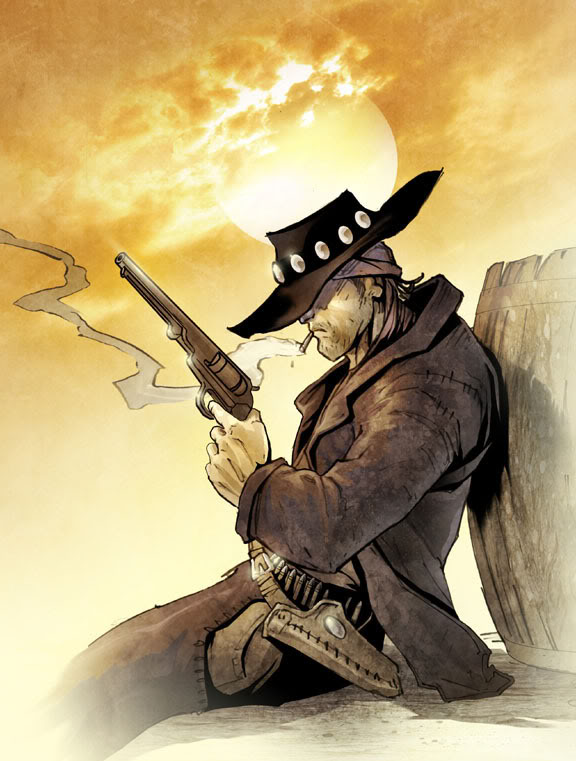
"Should I pull the trigger or not?"

5.  Back in the 1800’s the Tate’s Watch Company of  Massachusetts wanted  to produce other products, and since they already made these fine cases for watches, they used them to produce compasses. The new compasses were so bad that people often ended  up in Canada or Mexico rather than  California . This, of  course, is the origin of the expression ,… “He who has a Tate’s is lost!”

6.  A thief broke into the  local police station and stole all the toilets and  urinals, leaving no clues.  A spokesperson for the police investigating team was quoted  as saying, “We have absolutely nothing to go on.”

"You gotta start off each day with a thong ..." - Jimmy Durante

7. An Indian chief was feeling very sick, so he summoned the medicine man. After a brief examination, the medicine man took out a long, thin strip of elk rawhide  and gave it to the chief, telling him to bite off, chew, and  swallow one inch of the leather every day.  After a  month, the medicine man returned to see how the chief was  feeling. The chief shrugged and said, “The thong is ended, but the malady lingers on.”

If you look beyond the numbers, you may come up with an extra census-read perception.

8.  A famous Viking explorer returned home from a voyage and found his name missing from the town register. His wife insisted on complaining to the local civic official who apologized  profusely, saying, “I must have taken Leif off my census.”

Go figure.

9.  There were three Indian squaws. One slept on a deer skin, one slept on an elk skin, and the third slept on a hippopotamus skin.  All three became pregnant.  The first two each had a baby boy. The one who slept on the hippo skin had twin boys. This just goes to prove that … the squaw of the hippopotamus is equal to the sons of the squaws of the other two hides.
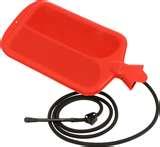
10. A skeptical anthropologist was cataloging South American folk remedies with the assistance  of a tribal Brujo who indicated that the leaves of a  particular fern were a sure cure for any case of  constipation.  When the anthropologist expressed his  doubts, the Brujo looked eehim in the eye and said, “Let me  tell you, with fronds like these, you don’t need  enemas.”
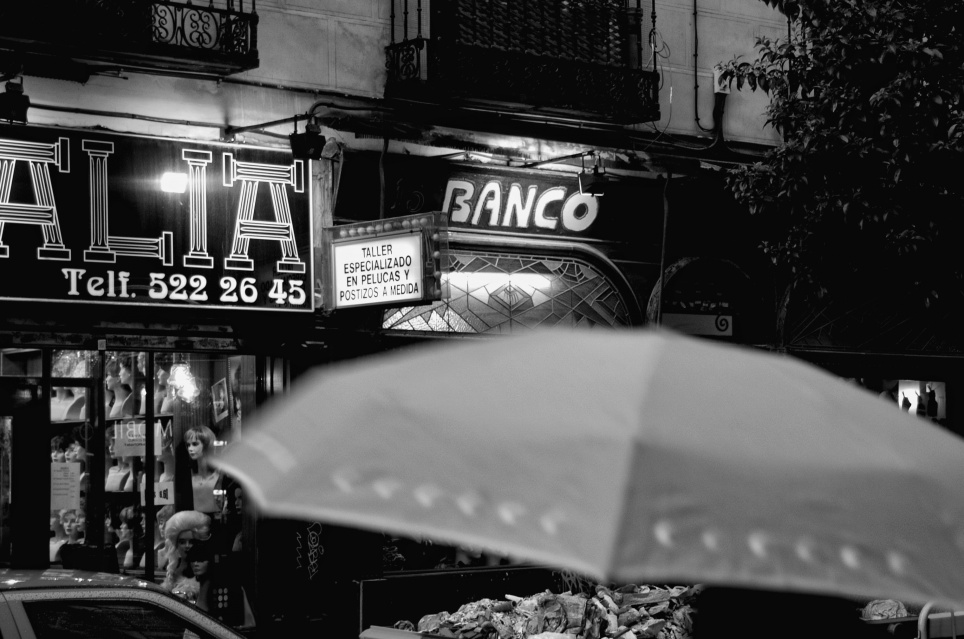
The Rain in Spain ...

11. Once upon a time, actor John Wayne was on a plane for Madrid with crew and cast to make an action movie. There was a lot of drinking going on and a lot of kidding about the dangers of drinking too much in some of the hilly areas they would be filling. Wayne assured one at all that he would be OK on the trail, but as he rose from his seat for a pit stop before landing, he caught his foot and went crashing down in the aisle. Arising quickly, the Duke stayed on subject with this now famous actual quote: “Well, what do you know? It seems as though “the – Wayne in Spain – falls mainly on the plane.”
Mel Famous, Pitcher, 1969 St. Louis Cardinals

12. A few years ago, the St. Louis Cardinals had a fireballing right-handed relief pitcher named Mel Famous. Unfortunately, Mel had a real thirst for Budweiser beer whenever he got into a personal pinch or tough game situation. The problem came up big time in a 1969 game at the Astrodome. With the game tied at 2-2 in the bottom of the 9th, with the bases loaded and two outs, and the Astros batting, Houston sent up lefty Norm Miller as a pinch hitter for pitcher Larry Dierker. Sweating beads and making excuses about a broken shoelace, Cardinal pitcher Famous ducked quickly off the field, ostensibly to fix the lace, but actually to down a quick six-pack of Bud in the clubhouse tunnel before hustling back out to face Miller. Back on the mound, Famous quickly walked Norm Miller on four pitches, forcing in the winning run for a 3-2 Astros victory. Word got around among the players about Mel’s real reason for the previous quick timeout. From that moment forward, Norm Miller could never see a bottle or can of Bud without uttering these immortal words, “Budweiser! Why that’s the beer that made Mel Famous walk me.”

The Kid Who Struck Out 27 in One Game

June 14, 2010

Ron Necciai of the Bristol Twins: The Man with 27 K's and a No-No on May 13, 1952.

All of the current ballyhoo over Washington Nationals rookie phenom pitcher Stephen Strasberg just stirs the memory of a kid who still stands for some of us as the guy who arrived in the bigs with the biggest hype of all time – and I’m not talking about David Clyde of the 1973 Texas Rangers.

I’m talking about Ron Necciai (pronounced Net-shy) of the 1952 Pittsburgh Pirates, who broke in to the majors with his first start on August 10, 1952 at the tender age of barely 20. To get there, all Ron had to do was perform a feat that no other pitcher in the history of baseball had pulled off until he squeezed the trigger in a 7-0 winning game no-hitter pitched for the Class D Appalachian League Bristol Twins over  the Welch Miners on May 13, 1952, when Necciai was still only age 19.

Necciai’s gem against the miners tallied 27 strikeouts over nine frames, including one batter who reached first base on a passed ball in the ninth inning. That miscue was covered by a fourth strikeout in the ninth to go along with the 23 other men he had fanned on the night. One earlier other out was recorded on a ground ball play to first in the second inning. One other Welch batter put the ball into play in the ninth, reaching first on an error before Necciai breezed one more guy to seal the shutout no-hitter. Two other Welch batters reached base during the game on a walk and hit batsman, but nobody got a hit or even came close. With blazing speed and a curve that broke like the proverbial pitch that falls off a table, the 6’5″, 185 pound Ron Necciai had pitched his way into the relatively media-quiet cobweb of sports reporting in 1952, Can you imagine what Necciai’s life could have been like had the world had Twitter, Facebook, and blogs back in 1952?

Ron Necciai’s roll didn’t stop with the sensational game against Welch. His very next time out saw him strike out 24 in a two-hitter win. By the time he got the call up to the talent-challenged Pirates during that same 1952 season, he had struck out 109 hitters in 43 innings with Bristol, and then posted a Class B Carolina Legaue-high 172 strikeouts in 126 innings at Burlington-Graham.

The trouble brewing for Necciai, however, was part health and part culture. Ron suffered from ulcers, even at that early age, and the tension and stress began to take its toll upon him. He was working on a torn rotator cuff with the way he threw those hard to hit fast ones in the minors and there was no one around in the Pirate system who was any different than the rest of the baseball system at that time. Back then, if you had a guy who could throw that hard and that effectively, most clubs just allowed the apparent genie in the bottle to keep on blowing smoke for as long as he was able.

True to the the tempo of that age, that’s just what the Pirates did.They allowed Ron Necciai to simply blow his arm away. By the time he was called up to make his major league debut on August 10, 1952, he was pretty much done before he had any fun. In the 54.2 Pirate innings that Ron Necciai worked between his call up date and his final major league appearance on September 28, 1952, he compiled what turned out be his career major league record of 1 win, 6 losses, a 7.08 earned run average, and only 31 strikeouts.

The army drafted Necciai after the 1952 season due to the Korean Conflict, but his bleeding ulcer condition made short work of his military career. By the time spring training rolled around again, the rotator cuff tear pretty much had ended any chance that Ron Necciai had for a comeback, although I’m not sure when or if the injury was ever actually accurately diagnosed during the time frame that Ron kept trying to play. We do know that Ron Necciai kept trying to make something work out until he finally gave up in 1955.

Ron Necciai went into the sporting goods business after his baseball future collapsed around him, but the man married, had a nice family, and an apparently happy and successful life from there, simply accepting his baseball injury as “just one of those things” that happened. Five days from now, on June 18, 2010, Ron Necciai and his family will be celebrating his 78th birthday at the old fireballer’s home in Gallatin, Pennsylvania.

Happy Birthday, Ron Necciai – and thanks for the wonderful memories of a guy who, had he played during a more enlightened medical era, might have made it all the way to the big Hall with a little different twist on the dial of destiny. It just wasn’t meant to be.

Another Lost Summer Love

June 12, 2010

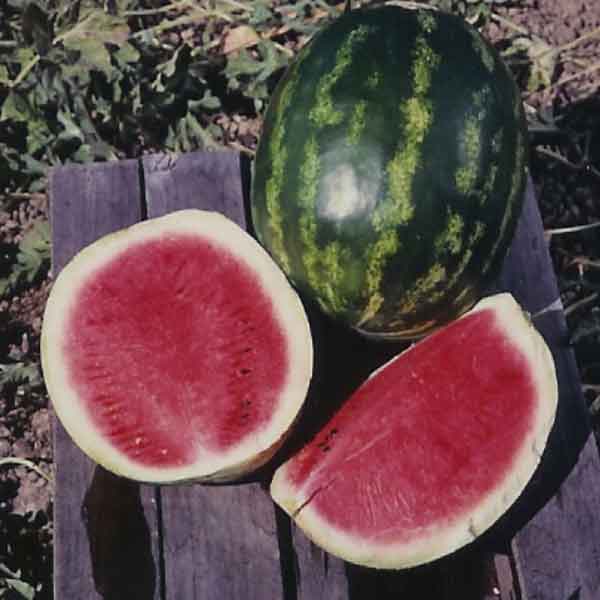
Back in the summer of 1954, you got a lot of sweet-tasting love for 15 cents a slice.

Watermelon stands. They used to be everywhere once summer embedded its way into Houston for another four or five months, depending on the early or late availability of sizzler-breaking northers in the early or late fall, but we didn’t mind so much. We were old school Houstonians, the generation that grew up without home or car air conditioning and the everyday expectation that the opportunity to live sweat-free was guaranteed by the Bill of Rights.

We didn’t mind it so much because we didn’t know any better, but also because we had some great reprieves from the everyday heat and humidity that otherwise dominated the three school-recess months of June, July, and August that we kids and teens viewed as summer. And the funny thing is – some of these things involved sweating – and we knew that going in.

I always thought of these things as items on my summer fun, run, and love list because they all had a lot to do with each. They were all fun; they each required us to either run or do them on the run; and they were all things we did in the name of, the taste of, or the pursuit of – what else? A thing called Love.

The list was endless, considerably shared by Houston teens, but still individualized, as well, and it often included such items as playing baseball or running over to Buff Stadium to catch a Buffs game; fighting off the mosquitoes on date trips to one of our numerous drive-in movie theatres to catch the latest sci fi or rock-n-roll rip-off flicks; cruising Prince’s, Stuart’s, and any of the many other drive-in coke and burger stores; swimming at one of our also many public pools; heading to the beach in Galveston; catching the roller coaster and carnival (win-a-stuffed-bear) games at Playland Park on South Main; doing the big time downtown movie scene of the Metropolitan, Loews State, or Majestic when you needed to impress a date; hitting the suburban movies when impressions weren’t all that important; going to the drive-in movies (as mentioned earlier) when you were more interested in date reactions over the need to make impressions; playing miniature golf; just driving around and burning up all that cheap gas that sometimes went on sale for eighteen cents a gallon during price wars; bagging groceries and throwing newspapers to float the money we needed for our mostly innocent acts of summer love; and maybe even catching some Friday night wrestling, bowling, or midget auto racing as a break from our usual fare.

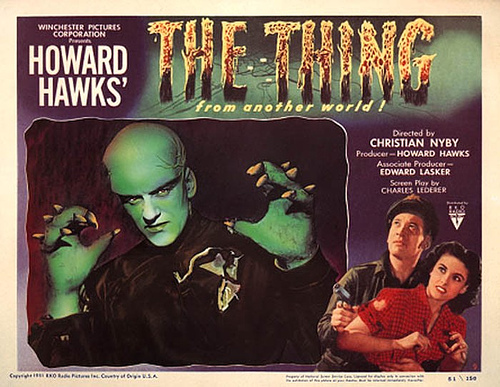
James Arness played the green vegetable alien terror in the classic movie “The Thing.” The film became a regular feature at drive-in movies during the 1950s, where James Arness then exerted more influence on teen couples going steady than Elvis ever dreamed of having.

The last of these now mostly lost summer fun runs were the watermelon stands that used to pop up all over in June and stay with us through Labor Day. My particular favorite was one we had on that little corner in the East End where Griggs Road, Lawndale, and Evergreen all still come together.

The place came with a tent-like top and open sides that caught the Gulf breeze, when there was one, and the melon came ice cold and always sweet – and straight from the famous melon fields of Hempstead, Texas, Ample sitting room was available on wooden benches at redwood tables. And the melon came at you with pre-purchase sweetness sampling for ten to fifteen cents a slice. Just add a beautiful brunette girl friend with a soft voice, fiery brown eyes, and a certain haunting smile – and the melon tasted out of this world.

I still miss the old watermelon stand, but the memory lingers on in quiet compensation for the fact that some of the sweet things we find early in life don’t stay late, except as treasured memories that sometimes find a way to dance in our dreams of happily recalled once-upon-a-times.

For me, baseball has been the one early love of my life that I never had to give up or alter in some way due to changes in my own need for emotional growth. Once baseball and I found each other back in 1947, we never let go. Never had to. All other things have either grown, mutated, or gone away, but not so the game of baseball.

“It’s still the same old story, a fight for love and glory, a case of do or die. The fundamental things apply, as times goes by.”

From then to now, the melon stand call of baseball is the same: – “PLAY BALL!”

And may you enjoy your own summer love recollections full tilt, without regret. Life’s too short for anything less than lessons, adjustments, and even happier, fuller celebrations of the human spirit.

America the Breakable

June 6, 2010

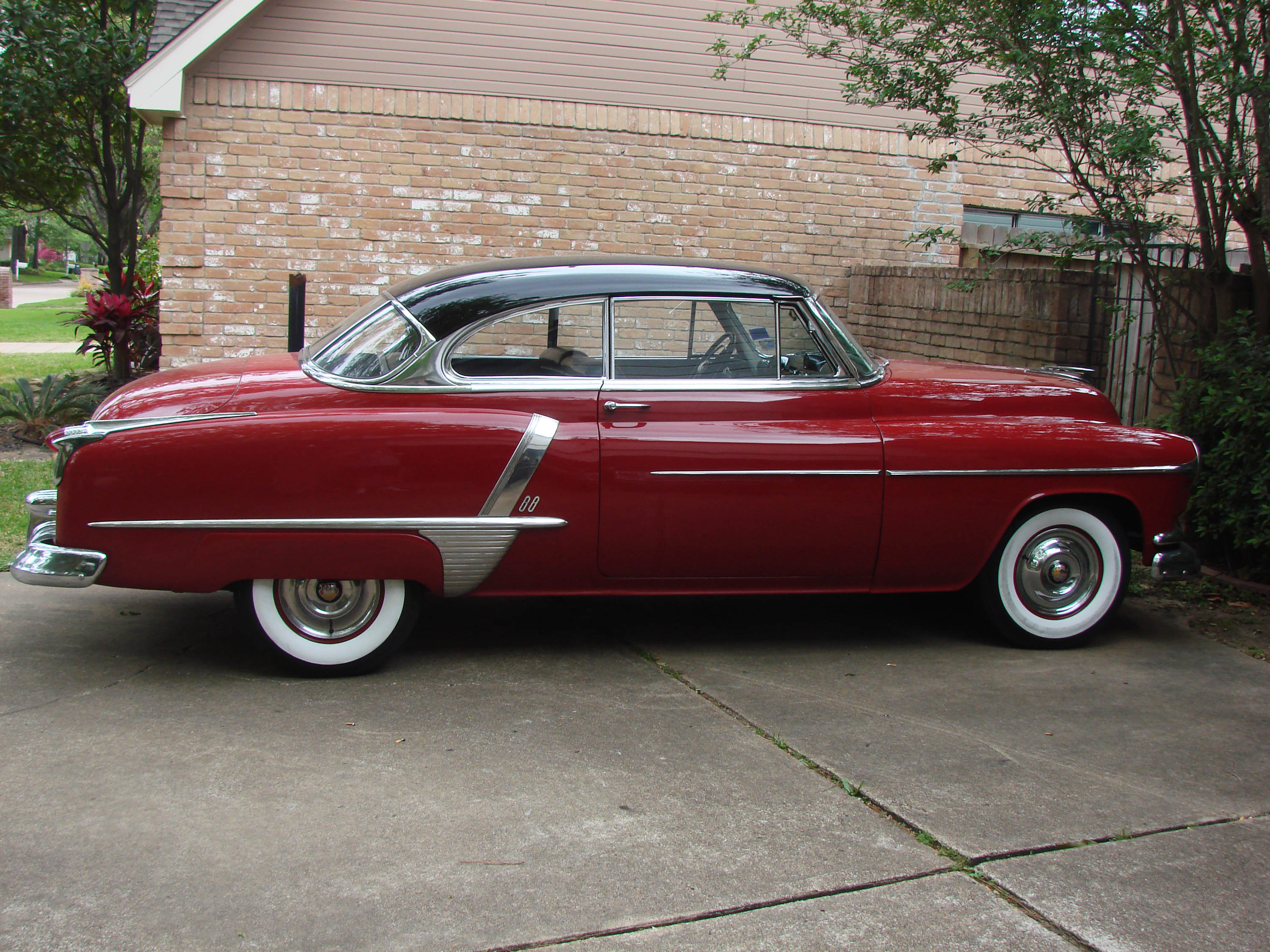
The 1951 Oldsmobile was once one of the classiest cars on the All American highway.

Fords and Chevys and proud Chryslers too,

They once all rolled ‘cross the Red White and Blue,

But they had lots of company; what else can I say?

They were all born and bred in the USA!

Hudson and Nash and Kaiser-Fraser we knew,

‘Long with Packard, DeSoto, and Studebaker too.

Our affections resounded in many a pucker,

As we each laid a kiss on our happy new Tucker.

We built them with steel and extra cheap oil

That just seemed to flow from American soil.

We made them with care, taking nothing for granted,

We left trains for highways; we were simply enchanted.

Four wheels on gas would run us forever,

And Ike’s new roads worked like pushing a lever,

We rodded to the suburbs and a screaming new call,

That resulted in cities that strangled on sprawl.

Somewhere in time we stopped paying attention,

And the quality we built in them grew too slight to mention.

And new cars from Europe – and then from Japan,

Came in to soon challenge – the kings of car land.

And then one by one, our cars fell aside,

And we stopped making steel – as oil prices skied.

We borrowed more money – to just stay afloat,

As others from worse fates climbed onto the boat.

And now we all sit – on a bloated national debt,

As the oil spill floods us – and the terrorists fret,

Over who’s going to take us, hardest and first?

The threat of their bombs? Or the damn oilrig burst?

To all I say, “Listen! – It’s time for a change,

Back to that spirit we once found on the range.

We saw it in the Lady near old Ellis isle,

We found it on the trains that we built with great style.

New Americans and Old – it’s time to rebuild,

On passion not prices – on good and not greed.

I know we can do it – setting politics aside,

But how we do what – escapes my limited hide!”

Suggestions are welcome here.

Suggestions that work are more important than rhymes.

Baseball Cord Travels Far & Wide

June 5, 2010

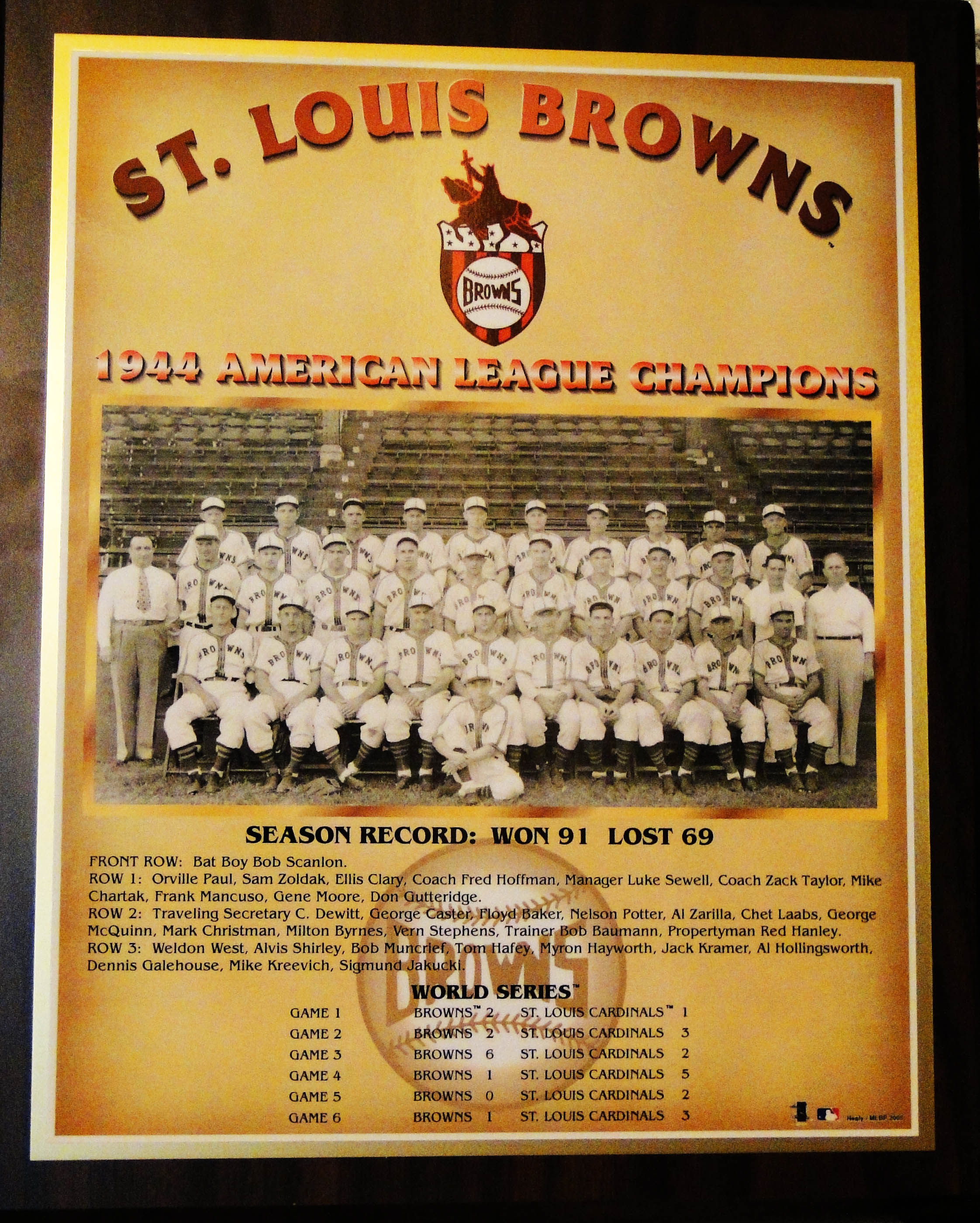
I received this beautifully framed photo narrative of the 1944 St. Louis Browns yesterday as a gift from Ron Pawlik, a buddy I played ball with back in 1951, but only yesterday caught up with again for only the second time in the past year.

Yesterday I attended an alumni luncheon at St. Thomas High School in Houston where, I must note, the natives are quite happy with their still new baseball coach, Craig Biggio. Just in case you haven’t heard, and in only his second season at the helm, Coach Biggio has now led the fighting Eagles to a state high school baseball championship. We can only hope that Craig stays a while before he heeds the big league call to manage somewhere.

Something else happened yesterday to powerfully remind me of how far-reaching the cord of baseball has traveled in my life. Out of the blue, but not really, I ran into Ron Pawlik, a buddy of mine from St. Christopher’s Parochial School in Park Place. Ron was a year ahead of me in school, but we played in the same outfield together one year for the 1951 ever-rambling St. Christopher Travelers. I had seen Pawlik at last year’s alumni luncheon for the first time since 1997, when we held a reunion at old St. Chris, and before that time, I had not seen Ron since his graduation from St. Thomas in 1955.

The short of it is the fact that he gave me that beautiful framed Browns piece displayed here. Ron had been reading some of blog articles over the past year and had become aware of my affinity for the old Browns. I was both shocked and appreciative of his generosity. I really like the Browns piece on ts own merit, but also because it simply helps drive to the surface the realizations I’m trying to express this quiet Saturday morning.

Like a lot of you, the long  cord of baseball has been with me forever, often serving as the X factor in whether or not I became friends with, or worked things out with, other human beings that came into my life over time. Once I knew that someone liked baseball, and was sure they understood not to call runs points, umpires referees, or managers coaches, we could overcome just about all other obstacles to working out the parameters of our everyday life relationship.

When I was a kid, growing up in the Houston East End, we were all Houston Buff fans. of course, and almost 100% of the adults I knew were St. Louis Cardinal fans when it came down to supporting a favorite major league club. I too became a Cardinal fan as a result. They were the parent club of my local Buffs – and their roster was loaded with all the Buffs who played good enough to get there.

My admiration for pitcher Ned Garver converted me into a St. Louis Browns fan in 1951, but I now think that change was helped by my need as a kid to rebel against the Cardinal blanket that totally  surrounded me. Besides, I didn’t totally abandon my support for the Cards. I just added the hapless Browns as my underdog battling American League club.

By the time I reached St. Thomas High School, I was assigned to a home room that was run by a Basilian priest scholastic named “Mr. Klem.”

Aha! Now there’s a major clue as to the ongoing presence of the baseball cord. Mr. Klem turned out to be the nephew of Hall of Fame umpire Bill Klem, a real baseball guy, and a fan of the New York Giants, his home state club. I had never met a Giants fan previously, but Mr. Klem seemed to be as knowledgeable of baseball as all the Cardinal people I grew up knowing. It made me think that maybe Giants fans weren’t all that bad after all. Besides, Mr. Klem seemed pretty high on his club’s young center fielder, Willie Mays, and of course, 1952 was the year that followed the 1951 Shot Heard Round the World. During Mr. Klem’s religion classes on miracles in our daily lives, we got to hear a lot about Bobby Thomson as a primary example of same.

For some unfortunate reason, I never dated any women that really cared for, or knew much about, baseball. I did have a Freudian theory professor in graduate school at Tulane whose brilliance was matched, and  somewhat neutralized by her thick German accent and the upside down Nazi-way she held her lighted cigarette during lectures. I couldn’t find the baseball rope or Freudian string on this period in my life, but I survived.

“You vill learn zee theories of Herr Freud und you vill not be deceived by all zee sick patients who unconsciously or sociopathicly wish to manipulate you, zee doctor, unto seeing zem as honest und trustworthy!”

I survived Dr. Gestapo and the concerted efforts of the formal education process I had embarked upon to change the way I thought, talked, wrote, and viewed life in general, If I was of any help to people who sought me out as clients over my years of practice as a professional counselor, it was because of what I had learned from baseball and from growing up in Pecan Park – and not from some cold burial in the theoretical alien-spirited offerings of Tulane University.

A good friend of mine in New Orleans, a fellow named Donald M. Marquis of Goshen, Indiana, wrote one of the seminal books on the history of jazz in 1979. That book, which is now being made into a movie, is called “The Search for Buddy Bolden,”  and it took Don Marquis seventeen years of focused research and investigation into the life of jazz’s first trumpet man before it was finally done.

Where did Don Marquis acquire his patience for the job? Easy. He was a Cleveland Indians fan. If you want something done that takes a ton of patience, hire an Indians fan.

One of my best friends in graduate school at Tulane was Sue Elster-Hepler-Liuzza. Sue was easy to like. She’s a north side Chicago girl who loves the Cubs and, of course, hates the White Sox. I was a little shocked, but not really surprised earlier this week when Sue told me that she never even stepped foot on the South Side until well into her adult years. She also explained that she is typical of many North Siders. They want nothing to do with the South Side or the White Sox. Unfortunately, this knot n Sue’s baseball rope came at a cost. She never got to see the original Comiskey Park in person. By the time she went there, it had been torn down.

My own baseball rope on life trucks on, flaring lessons all the way: (1) The days of our lives are like the games on the schedule of the long baseball season. You win some. You lose some. And you take each day one at a time and go on from there. (2) Whatever you’re doing, keep your eye on the ball. A few of the pitchers we face in everyday life may try to throw a few emery balls at us. (3) Pick a project team of people you know you can trust – and go into combat with them. There aren’t many things you can do out there well alone without help and you probably will need to rely upon people who know their jobs and your expectations of them – ones who will also cover your backside honestly, but still be strong enough to hit you with the truth when you need that feedback most. (4) keep your word. (5) take responsibility for your “E”s, learn from them, and move on. (6) Look for some kind of joy in all you do. (7) Never give up on anything that’s really important to you.

That’s enough for now. And thanks again, Ron Pawlik. And thanks to you too, great wondrously flexible cord of baseball. You keep popping up to remind me where my real education came from in the first place. The Pawlik gift is simply another life reminder:

(8) Loyalty and real friendship are forever.

Remembering Uncle Carroll.

May 30, 2010

Reprinted here from the blog article I wrote on ChronCom.Com last Memorial Day, May 23, 2009.

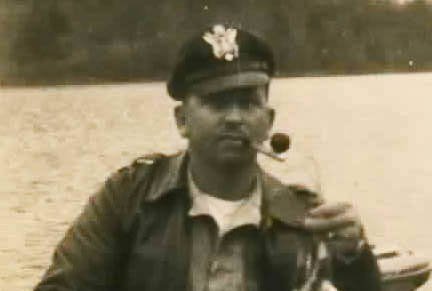
Uncle Carroll & Aunt Florence on Lake Hamilton outside Hot Springs, Arkansas from 1946-1955.

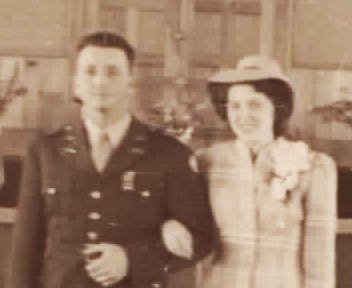
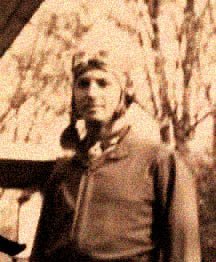
Major Carroll Houston Teas (1917-1964) was a man of his time. When World War II came to the USA, he joined the service in San Antonio and went straight into training at Kelly Field with the Army Air Corps. Before shipping out to the Pacific theater as a military cargo pilot, he married his high school sweetheart, the forever lovely Florence MacPherson.

Uncle Carroll Teas & Aunt Florence married during world War II, before he shopped out to the South Pacific with the US Army Air Corps..

Uncle Carroll was my mother’s little brother. He and Aunt Florence were special to me during my young life in ways I’ll never be able to put into adequate words.

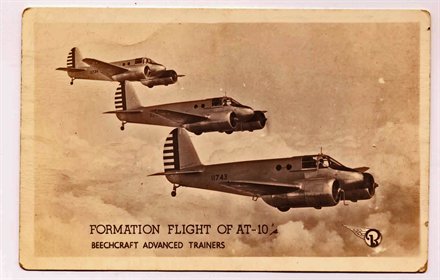
During World War II, Uncle Carroll flew logistic flghts of supplies all up and down the various South Pacific island chains. After the war, he used to regale me with stories of all the things they learned to do to keep from getting shot down by Japanese Zeroes over the open seas. One time, he told me, they were so badly outnumbered by Japanese figter planes that they had to fly blind within the clouds for many miles, just to keep from being taken down as an easy target. Many other times, they had to fly above or below the cloud banks to disguise themselves from Japanese fighter planes flying in the opposite direction.

“Off we go – into the wild blue yonder, flying high – into the sun.”

The Japanese also hid in blind cloudbank flight. The dangers of so doing on both sides are obvious, but that option beat the near certainty of getting shot down by faster aircraft in open skies.

I used to have a pair of pilot wings that Uncle Carroll sent me during World War II. Wish I had been a more careful saver of something that is now even more important to me, but I wasn’t. I used to pin those wings on my tee shirt before going out to play sandlot baseball and, somewhere on the playing fields of Houston, that’s where I gave it up.

After safely serving nearly the entire war in combat, Uncle Carroll finally ran into something that stopped him in ways that rapid-fire ammunition failed to do. He contracted polio while stationed in New Guinea. Oh, he came home to America alive in 1945, but he came home paralyzed for life. The only question was: Would he regain any use of his body – or would he be forced to live out his life in an iron lung?

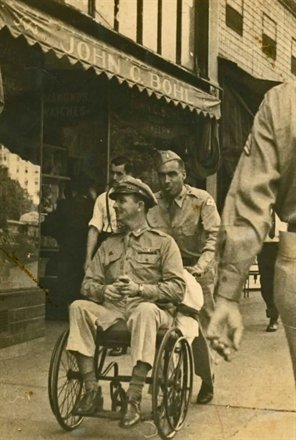
Uncle Carroll and a buddy on the streets of San Antonio – right after coming home from World War II.

Coming home, I didn’t really see Uncle Carroll at all during the early months of his struggle with polio. The army sent him up to Hot Springs, Arkansas, where they treated a lot of polio cases back then with the aid of hot springs baths and swimming. Prior to his illness, Uncle Carroll was always a powerful, athletic person. He was a hard-hitting third baseman for the Brackenridge High School Eagles in San Antonio back in the mid-1930s and he wasn’t the kind of guy to give up in the face of adversity. That core value, in fact, is the lesson he always tried to instill in me at every chance he was yet to have. I can see him even now doing his most to make the best of a bad situation in his time of greatest personal crisis.

With Aunt Florence always by his side, Uncle Carroll fought back and regained full use of his body from the waist up. With special attachments to his car, he was able to drive again. Although still wheelchair bound for life, Uncle Carroll and Aunt Florence bought a home on Lake Hamilton in Hot Springs, where he resumed his life as a fisherman and hunter. His Chris Craft lake boat was his other kind of new mechanical mobility – but he also could still swim like a fish in the water with the use of his legs in spite of their failure to him on shore.

Uncle Carroll continued working for the Army in Hot Springs as an accountant after the war, but he also started his own freshwater fishing lure company, selling lures that he designed himself. During the winter months, he added “avid duck hunter” to his resume.

We lost Uncle Carroll to a coronary in 1964. It was one of the three saddest days in my life, along with those two crushing others, when I said goodbye to Mom and and then Dad.

The two things I’ve always tried to remember from Uncle Carroll will only die for me when I do: (1) Do the things in life you are willing to put your whole heart into; and (2) Never give up on what is really important to you.

It’s Memorial Day again and my thoughts go immediately to my Uncle Carroll Teas. He didn’t die in World War II, as is the group intended for core honor on Memoral Day, but he gave up his life, his health, and his future there for the sake of his country, as did millions of others. There’s simply no way this holiday ever passes without me thinking of him with love and gratitude. My hope here today too is that your thoughts also turn to the special American veteran in your own lives who once, or currently, have placed his or her life on the line for the defense of us all. Let’s do it again each day, and especially on our next Veterans Day!

“We’ll fly on – in fame – or down – in flame – Nothing can stop the Army Air Corps!”

Have a peaceful and blessed Memorial Day, everybody – and let’s all try to remember all the men and women of American military service who gave up their lives and health for the sake of this wonderful place we call the USA!.

One Photo / Many Questions.

May 28, 2010

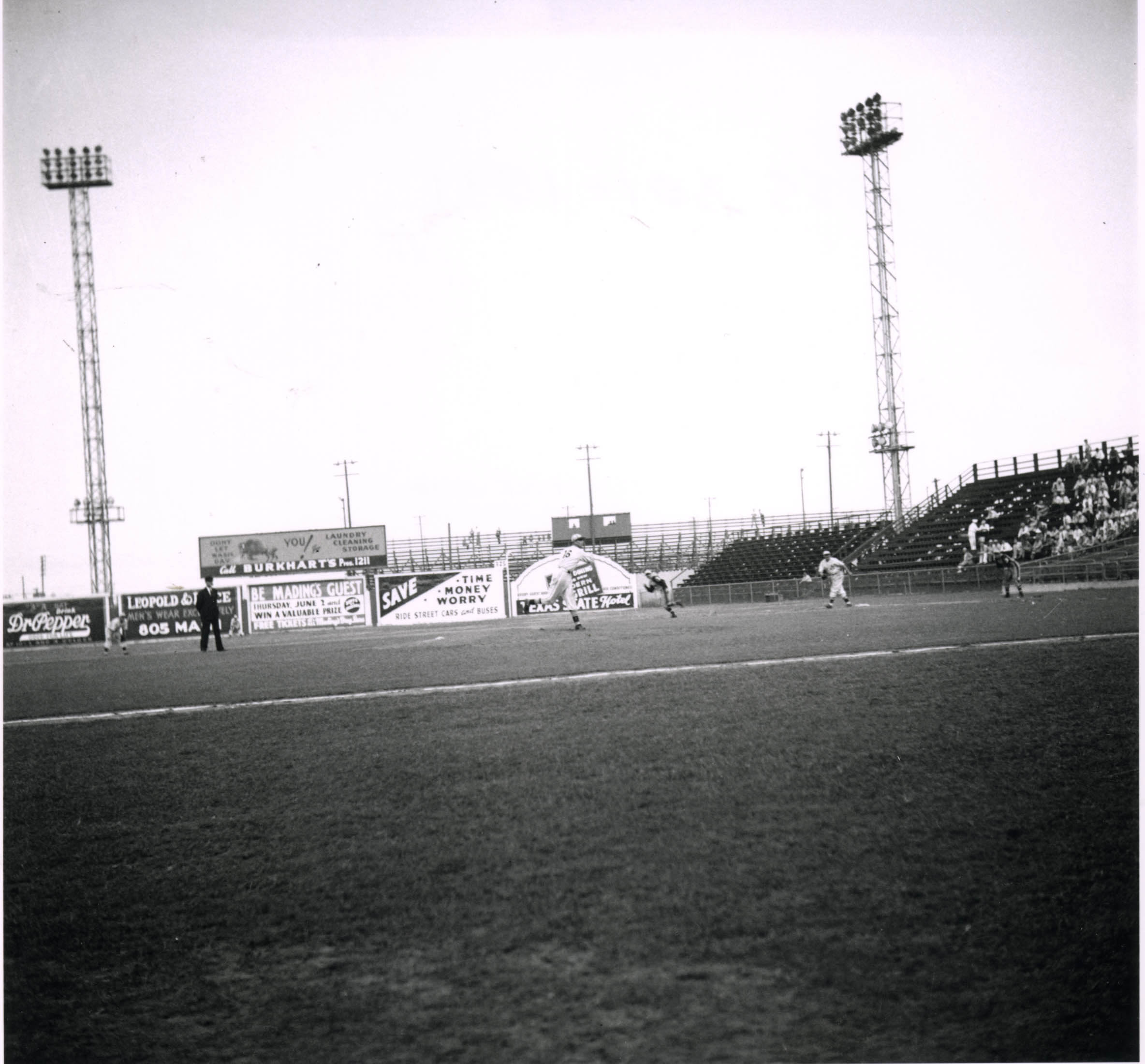
Right Field in Buff Stadium is a place of mystery and curiosity in this photo, starting with the fact that I'm not sure of the exact year it was taken.

Sometimes a photo makes everything obvious. Just as often, a photo may raise more questions than it really answers. The photo shown above is of the latter type. I acquired it some time ago from the very special Texana Collection at the julia Ideson wing of the Houston Public Library. We knew that it was taken in old Buff Stadium in the Houston East End, but that was about the only fact that was clear.

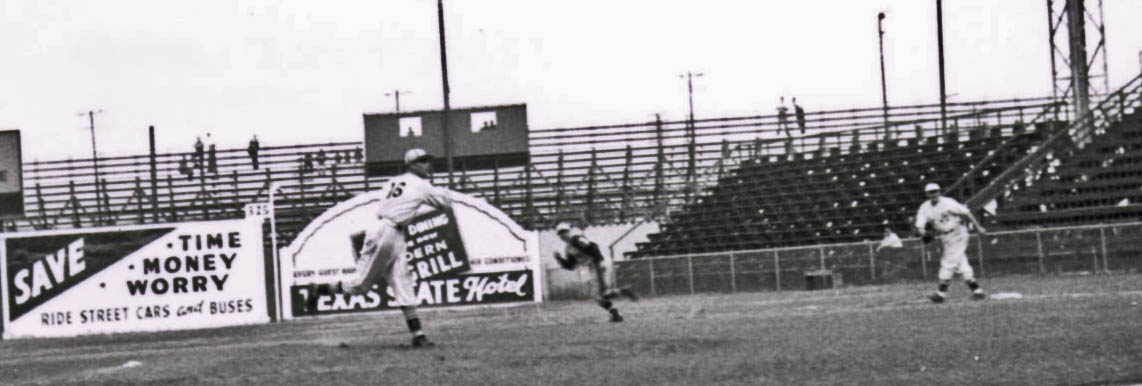
I’m not sure who #15, the pitcher, is but he is a Buff, as best I can see from the old English H that is visible on the left jersey breastplate in another close up of the  unidentified Buffs first baseman. The year of this uniform could have been anywhere from 1938 to 1942 or 1946-47. The ’47 Buffs club preferred the Buff logo on the jersey, but they also used the old English H. I simply cannot find another photo of the 46-47 team wearing the light colored caps with stripes – and a photo I have of the ’41 Buffs shows them wearing dark caps. More research is needed.

The HR-resistant Gulf winds came roaring in over these walls in the Houston summertime.

If you look closely above at the first crop-shot from the main photo, you may be able to see that the distance down the right field line was 325 feet, the same as I remember it from my Buff Stadium kid days (1947-54) and the same as it is now in Minute Maid Park. The major differences between these two ballpark right field lines would be the roof option at MMP and the no choice prevalent winds that blew in and over to left field from right field at Buff Stadium. – Also, you may have trouble seeing it here, but the right field foul pole is barely taller than the “325” distance sign.

I’m not sure about the outfield box area with two windows in this photo. There was no scoreboard function in right field during my Buff Stadium days and the main Press Box are was located on the roof behind home plate. I’m not even sure what those lined stands in right were about. We certainly had no outfield bleachers during my time there either.

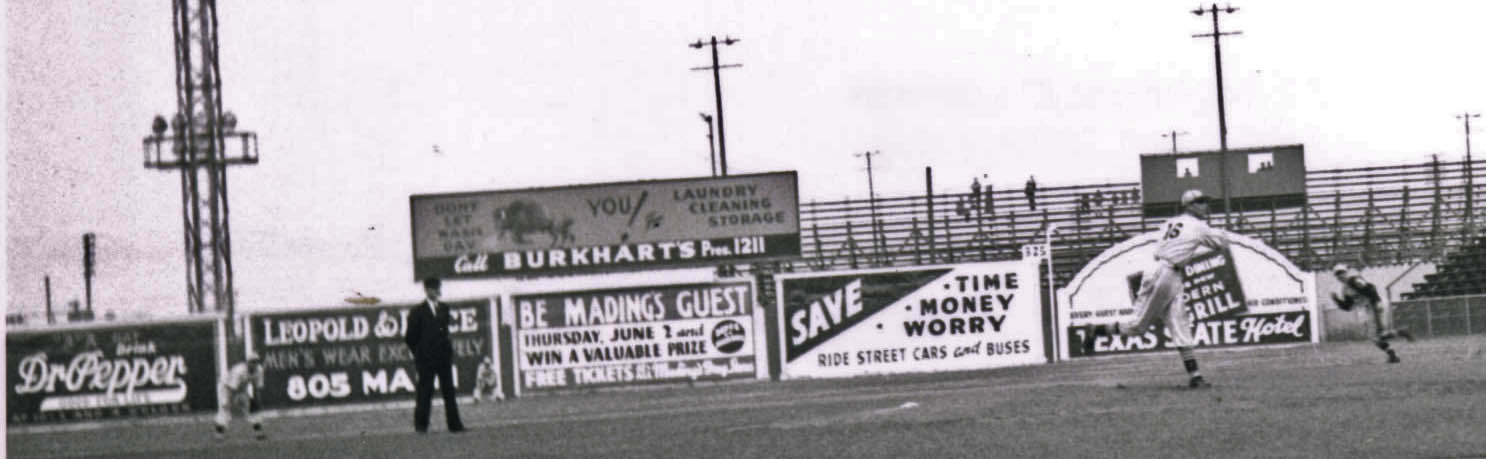
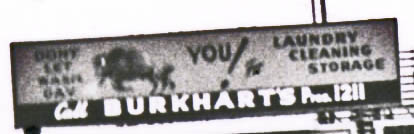
"Don't Let Wash Day Buffalo You!"

That top sign is from Burkhart’s and it’s promoting the idea in words and pictures that you (meaning “you housewives”) should not let wash day make you fear dirty clothes. With Burkhart’s help, they are offering protection from being buffaloed by the challenge.

Left to right above, the signs are also advertising Dr. Pepper, Leopold & Price Men’s Store, A Special Giveaway at Mading’s Drugs, Save Time, Money, and Worry by Riding Street Cars and Buses, and enjoy the comfort of the Texas State Hotel, including their first class modern grill.

Who could ask for anything more?

The sad days of segregated stands existed into the mid-1950s at Buff Stadium. The empty stands at left above were the designated "colored section.".

Segregated seating for black fans at Buff Stadium existed through the 1954 season, the year that first baseman Bob Boyd broke the color line by becoming the first black player to integrate any Houston sports team, amateur or professional, in the City of Houston. Why the so-called “colored section” at the left above is empty in this photo I could not begin to explain. It’s just shameful that even baseball wasn’t big enough to rise up sooner against the formal practice of racial discrimination, but that’s not the way history played out.

As for today, the empty “colored section” is simply one of the curiosities and mysteries that float forward in this single photo of an active past game day in right field at old Buff Stadium.

There are numerous lessons on the loose here in this picture, but not the least of these for all those photographers of history is this one: If you want your photos to capture history, do not expect the picture alone to tell the story. Write down when and where it was taken and leave a few words about who is in it and why it may be important to remember. Otherwise, by taking and leaving the photo alone, you will have over time simply left another visual egg of mystery to scramble the brains of viewers in the future.

Pass the salt and pepper, Mammy! Let’s close with a good clear closeup of that wash day buffalo ad:

"Buffalo Gal, Won't You Come Out Tonight - And Dance by the Light of the Moon?"

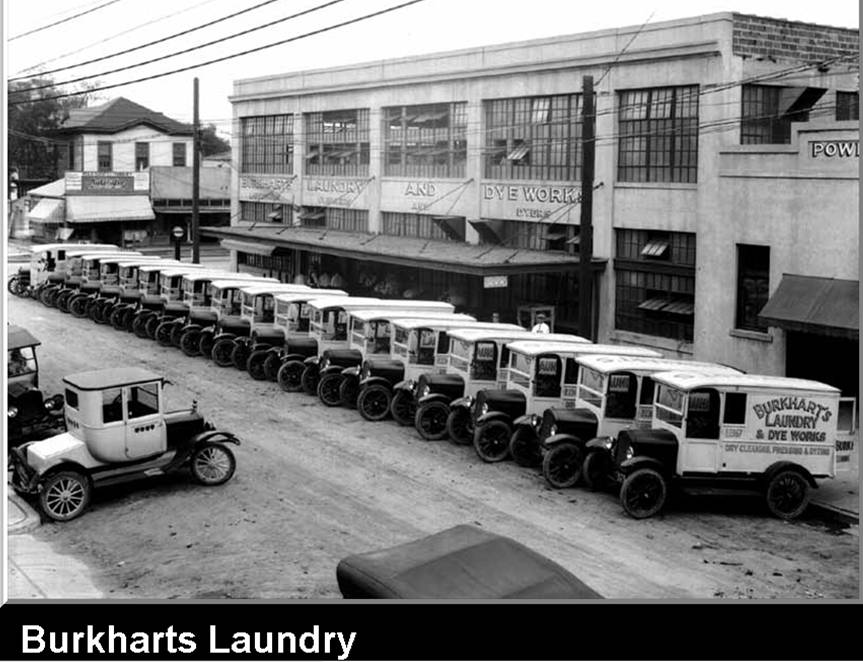
Thanks to a post-publication contribution suggestion from Larry Hajduk, the following photo, compliments of the Story Sloane Gallery, is added to show how Burkhart’s Laundry appeared in 1928. It appears that Burkhart’s had a long ago thriving business helping Houston do its laundry.

Burkhart's Laundry, Houston, compliments of Story Sloane Gallery, http://www.sloanegallery.com

Also, local history sleuth Mike Vance checked in with an important observation that he somehow could not register below as a comment. Mike says the last streetcar in Houston ran in 1940. So, if we are to believe the outfield sign advocating public use 0f Houston’s “street cars,” that does narrow down the year possibilities for this photo considerably. Thanks, Mike Vance. That’s a major help.

The “Over-The House” Drill.

May 19, 2010

Writer's rendition of the "Over The House Drill." No real graphic artists were used in the low tech production of this visual aide nor were they harmed in the presentation of this simplified depiction of the even simpler Pecan Park game.

Some days around here are simpler than others. In fact, most days are pretty simple and quiet around here and that’s the way we like it. These days are a little louder than usual because we are now in the middle of having our house Hardee-planked to make up for the fact that the builder of our home some thirty years ago chose a siding material for the homes in out neighborhood that turned out to be over time little more than cheap cardboard-in-disguise. Regardless of how today’s drawing may appear, I have no respect for people who do shoddy work at the expense of others, but we sadly don’t seem to be running out of these sorry folk, do we?

The short of it is that a lot of inside work is happening here today too and that doesn’t make for good writing space. So, I need to tell you about something that will not require additional research or composition time. I wanted to include this material, anyway, when I wrote the article on our Pecan Park sandlot baseball drills and this is a good time to do it.

The “Over-The-House” drill is my personal invention by the following rules. Anyone else could have thought of it just as easily and probably did, but these were the rules we used to govern its play on our block:

(1) Pick a house in which both parents are gone. i.e., Dad is working; Mom is shopping. The reason for this one is simple. Parents always said “no” to the “Over the House” drill because they feared what a baseball might do to the windows, roof, and walls of their houses.

(2) Play was limited to singles or doubles games, very similar to tennis. I always preferred singles play.

(3) The object of the game was to throw the ball over the house without touching the roof and get it to land in the opposite front or back yard where your opponent stood. A ball that hit the ground of your opponent’s field without being first caught counted as a run and entitled the thrower to “go again” until a ball was finally caught on the fly for an out.

(4) Balls that first touched the roof or landed out-of-bounds (off the house property) were also counted as outs, turning the ball over to the other player for a turn at throwing.

(5) The game lasted for a total of 27 outs, no matter who made them.

(6) Whoever had the most runs at game’s end was the winner.

That was it. And it was lots of fun. When you were waiting, you never knew for sure where the ball was going to land until you saw it crest over the top of the roof. Some balls came on a high bloop and others traveled more as line drive darters. (Since all our houses were one-story jobs, you didn’t have to throw the ball too high to make it over.)

If memory serves, we never broke any windows and we rarely hit the roofs of any houses we used for the game, although we did manage to thump some nearby cars that had been parked on the street and in adjacent driveways. We could sort of see why our parents didn’t much care for “Over the House.”

Depending on how much we trusted each other, we either got by on the honor system or we used two other kids to make the calls on house hits, fair falls, and out catches. You could get by with one umpire, but that required a lot of back and forth running – and sometimes, some repetitive fence-jumping. Almost nobody who could do the job really wanted to take it on, especially since hard feelings toward umpires who determine the outcome of any competitive situation so rarely go away over night. Even as kids, we understood that becoming an umpire, even for “Over the House,” was the pathway to unpopularity.

Gotta go for now. If you can’t get your dreams over the rainbow today, folks, now you have another choice. You and a friend can go play a fun game of “Over the House.”

Just don’t tell your parents.

The Wings of Summer.

May 17, 2010

1950: The Wings of Summer Were Mainly Named Schwinn.

Back in 1950, summer spread out upon the imaginations of us kids in Houston as though it had been sent to us from God as a little time slice of Heaven and a virtually endless lawn of non-stop sandlot baseball, a game we all loved and played with poor equipment and virtually no adult interference for as long as the light came upon us with the dawn and lasted for us through the dusk.

Parental fears about the relationship between summer temperatures and the possible onset and development of infantile paralysis hit us hard. We ran into the “Heat of the Day” requirement in the Summer of 1950 – and that amounted to a three-hour parental suspension of outside play from 12 Noon to 3:00 PM daily in the belief that we were being protected from polio by this action. With five hundred cases of polio hitting Houston children in the summer of 1950, it was hard to argue against the time-out call, even though we actually knew very little back then about the virus that actually had spawned the epidemic.

Summer had time limits, but we also soared through the vast free space available to us in that time on the wings of summer, our mainly classic big-wheeled Schwinn bicycles. I owned one of these bright red beauties, one that looked very much like the model depicted in today’s article. As was true with all of us, that Schwinn bike and me were pretty much one unit together once we hit the road. I could lean myself around corners with hands on a comic book and almost never crash, except for the time that a lady over on Keller Street also turned onto Flowers from the other direction and scared me into a last second plunge into a drainage ditch.

She did stop to make sure I wasn’t dead and, of course, I never said anything about the near miss when I much later in the day finally found my way home. You just didn’t report things that might limit your future freedom back then, but I think that kid code is still in effect. Some things never change.

We wore no bike helmets back in the day – and, yes, we probably did destroy a few now-sacred Mickey Mantle cards as noisemakers that we clothes-pinned to play against the spokes of our wheels.

We  never surrendered our bikes voluntarily. Those wonderful machines really were our wings through summer and out to the larger universe beyond our East End homes and neighborhoods.

When Little League Baseball came to Houston in 1950, a large bunch of us rode our bikes over to Canada Dry Park on the Gulf Freeway for the city-wide tryout. Hundreds and hundreds of kids had shown up to tryout for the few team rosters that were going to be available to all Houston kids that first year. I think I got to catch one fly ball, but got no times at bat before I was told “thanks for coming.” I felt pretty bad about it until I learned that none of us from Pecan Park had been given the chance to hit. That privilege seemed to be going to those kids whose fathers had the freedom to come with their sons to the tryout during the work week. None of our Pecan Park dads had that kind of time luxury on the morning of a weekday – and we could figure that the dad-presence factor was a big fat difference-maker in a situation like this one. We didn’t blame our dads, but we did lose a lot of respect for those first year Little League people running the show. Over time, I grew to see what a no-win situation those early Houston Little League founders faced here that first 1950 season, but I was nowhere close to understanding or forgiving the way we were treated that particular day.

Collectively, those of us from Pecan Park knew we weren’t that undeserving, but we could see what we were up against with the numbers and the daddy-presence factor. So, we did as we were told. We went home.

We rode home as a squadron of dejected East Enders, but that also happened to be the day the Pecan Park Eagles were born. By the time we got home, we had gone to the sandlot and reorganized our identity as the Pecan Park Eagles. We also named our home as Eagle Field for the first time and we recruited one of our adult neighbors to serve as our coach. We then organized a simple schedule of games against other nearby sandlot clubs and played once a week at Mason Park for a short while.

Our efforts made us feel better about the jobbing we took at the Canada Dry tryout. That much is sure, but the experience also taught us that you have to rally from disappointment and do whatever you can do to learn from setbacks and go forward in a different way.

The End of Schwinn, 1954.

We still travelled by bike for quite a while beyond the summer of 1950. The end of Schwinn as the Wings of Summer Era didn’t arrive until we aged enough to start dating girls. Once that little shift in priorities settled in, we traded in our summer wings for the four wheels of summer that we found on those spontaneous combustion engine-powered muscle cars that now consumed our imaginations.

I lost my heart, and my freedom from debt, to a 1951 Oldsmobile 88. “Ain’t that a shame” that those kinds of changes also signal the death of childhood’s freedom wings, at least, for a while.

Over time, I recaptured my freedom wings of summer and, this time, they came without a bicycle. The formula may vary for each of us who want those wings back may vary a little, but basically, I think it goes like this:

(1) Put yourself in a position as much as possible in which you control your time. Make sure your time does not control you; (2) Give yourself to causes that go beyond making money and acquiring things, replacing these with activities which aim for the betterment of something bigger than the fulfillment of your own selfish goals; (3) Do things you can really give your heart to doing; (4) Stay away from selfish people who want to use you for their personal gain at the sacrifice of your health and well-being; (5) Enjoy each day that comes your way and make the most of honoring each day for whatever it is; (6) Never make promises you don’t plan to keep; (7) Let go of all resentment and regret about the past, but learn from your mistakes; (8) Hang out with happy people who share some of your particular joys in life; (9) Keep your priorities in order and live life from there; and (10) Love baseball.

I just threw that last one in to see if you were paying attention, but you should be able to get the drift of what I’m suggesting overall. The better I get at these things, the more my happiness grows – and my personal list really does include all ten listed items.

1906: 1st 35 MM Movie.

May 9, 2010

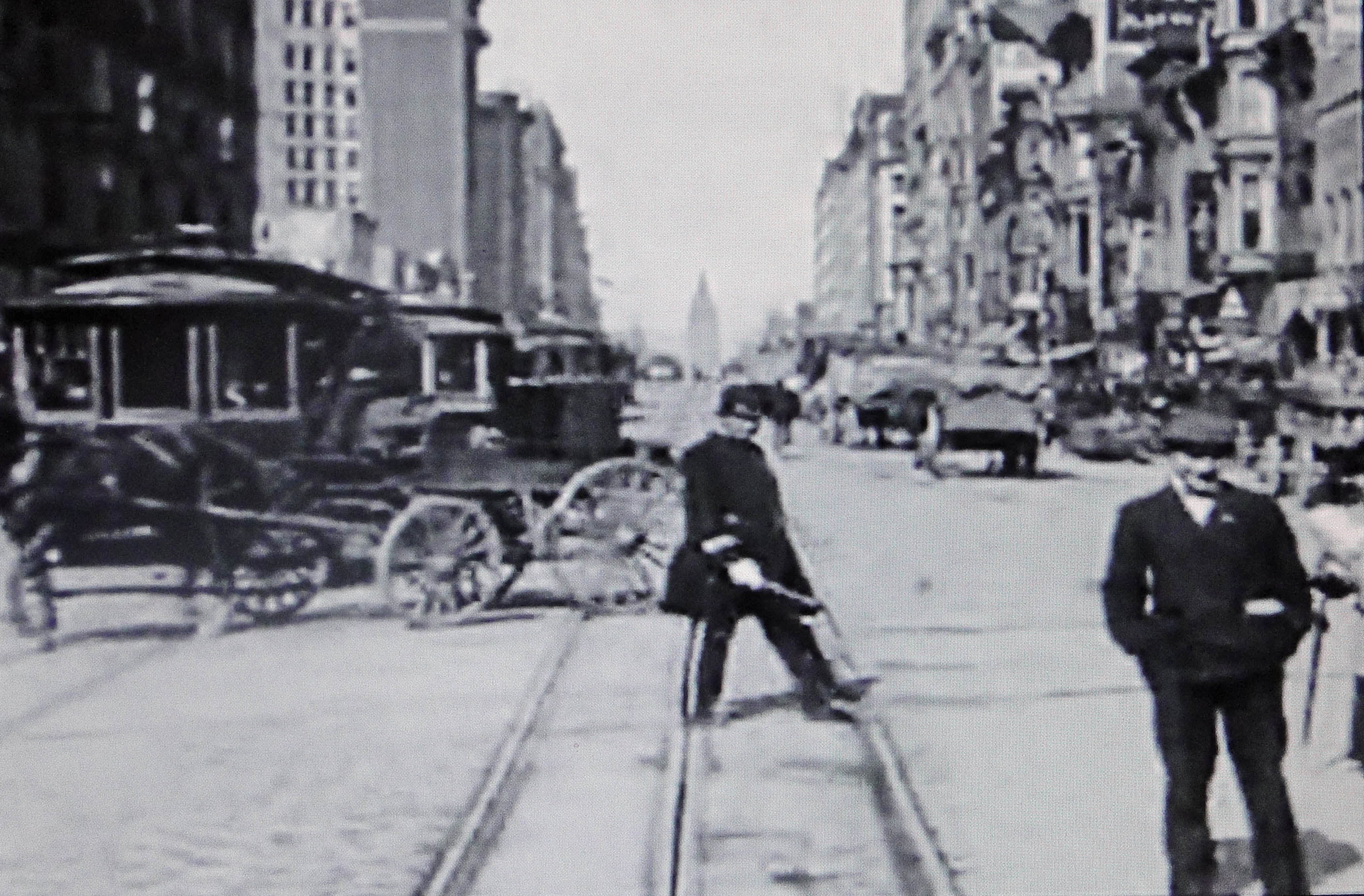
On April 14, 1906, just four days prior to the Big Earthquake, this first-ever 35 mm film clip was shot on Market Street in San Francisco.

It’s 1906 and the Houston petroleum industry is gushing over the discovery of oil at the Goose Creek Field east of the city. Thirty oil companies and seven banks are now operating in Houston. Out west, the City of San Francisco will just about crumble into dust when a great earthquake strikes the area on April 18, 1906.

A photographer friend, John Wendell Mason, and now living in England, sent me a link to this remarkable film clip overnight. Taken only four days prior to the big San Francisco Earthquake of 1906, it is the first 35 millimeter film ever shot and successfully developed in history. Aside from all else that makes this film special, that historical factor is noteworthy today. It gives all the rest of us the chance to view the mother of all modern films on Mother’s Day!

According to the information I received with the film clip link, the film was taken on Market Street by a camera mounted on the front of a cable car that ran out to the Embarcadero Wharf. The clock tower that we see prominently in the clip at the end of the ride is still there today as one of those rare sturdy survivors of what was about to soon shake the land and the city’s history.

Here’s the link. Just watch and enjoy:

http://www.youtube.com/watch?v=dGloeX1SpAU

The visual pleasures here are incredible. Check out the dressing styles of both men and women, the numbers of autos, bikes, and horse-drawn carriages, the chaos of traffic movement as people dodge the cable car at the last-minute on foot or simply turn their vehicles to cross the tracks in front of the cable car at the last second. No wonder we have so many street car/gas vehicle collisions today in Houston. Some human behaviors do not change all that much over time.

To me, the enjoyment is watching everything take place in real-time, without the herky-jerky false speed-up of a Charlie Chaplin comedy, a Teddy Roosevelt speech, or a Babe Ruth roach-speed home run trot. The film is the closest we shall ever come to a simulated time-travel arrival in San Francisco on April 14, 1906.

Back in this era, everybody got to inhale dried horse manure. It rook a while for the new gas and electricity driven vehicles to clean up all the city air by replacing all the horses.

This is a good time to reflect also on all that was going on in the Houston area back in 1906. We already know on the baseball front that 1906 was the year that the light-hitting Chicago White Sox (the so-called Hitless Wonders) rose to upset the heavily favored Chicago Cubs in the World Series, but let’s tap into more happenings from Houston in 1906.

On February 10, 1906, the suspicions of many about the artesian purity of the water being provided by the Houston Water Company when a repairman in the fifth ward discovers five catfish swimming in a water main.

On April 1, 1906, members of the new city commission form of government go to work under the new system and right away report on the increased level of efficiency and competence that the system brings to their work. I’m not sure how they measure this result on the first day in motion. Perhaps, they have a light agenda this day or maybe they are truly treating the moment for what it is – April Fool’s Day.

With public reaction to the earlier catfish find stirring them on in May 1906, the city purchases the plant and property of the Houston Water Company. Again, an improvement in water service is reported immediately. In this case, “improvement” may have been measured by the absence of catfish or tad poles in the drinking water.

Also in May 1906, Houston launches its plan for a “War on Mosquitoes.” Starting next week, the city will begin to cover every ditch in the city with a coat of oil. And where is Houston going to get the oil to be used in this treatment? – Get serious.

In August 1906, Houston’s first wireless radio station opens as one of only four that now exist in the state. The station is perceived as a competitive personal communication alternative to the telephone and telegraph. That’s how “wireless” came to be the new medium’s name. The concept of radio as a broadcast medium for general news, entertainment, and advertising was years away in 1906.

On September 3, 1906, work begins on the turning basin for the ship channel. Big ships won’t come to Houston until they have water that’s deep enough to traverse, and a place to turn around once their business is done here.

Also going up in September 1906 are Houston’s first truly named “skyscrapers.” A building that will reach eight-stories in height upon completion is under construction, much to the pride and awe of Houstonians.

The problem of Houston drivers of the new automobiles exceeding the 6 MPH speed limits around town draws the attention of city government in October 1906. Mayor Rice recommends that the city purchase an automobile for use as a police car in the chase and apprehension of speeders.

More National News, 1906: Writer Upton Sinclair publishes his novel, “The Jungle;” the 1906 San Francisco Earthquake kills 3,000 and leaves hundreds of thousands homeless in it’s almost total destruction of the city.

International News, 1906: Roll Royce Limited registers as a maker of fine cars; Mount Vesuvius erupts in Italy, devastating Naples.

When all is said and done, Happy Mother’s Day, Everybody!


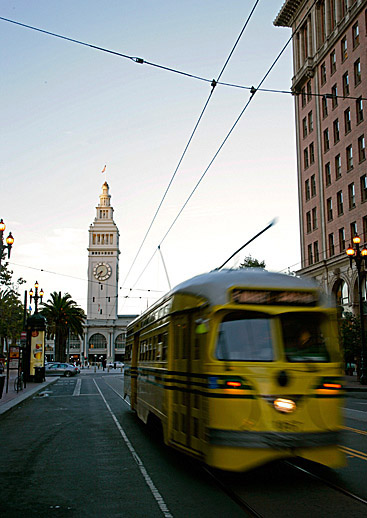
Market Street Approach to Clock Tower Today, 2010.

Additional San Francisco Film Notes: “This film, originally (was) thought to be from 1905 until David Kiehn with the Niles Essanay Silent Film Museum figured out exactly when it was shot. From New York trade papers announcing the film showing to the wet streets from recent heavy rainfall & shadows indicating time of year & actual weather and conditions on historical record, even when the cars were registered (he even knows who owned them and when the plates were issued!).. It was filmed only four days before the Great California Earthquake of April 18th 1906, and (it was) shipped by train to NY for processing.” – E-Mail from John W. Mason.