Posts Tagged ‘culture’

6646 Japonica Street!

August 26, 2009

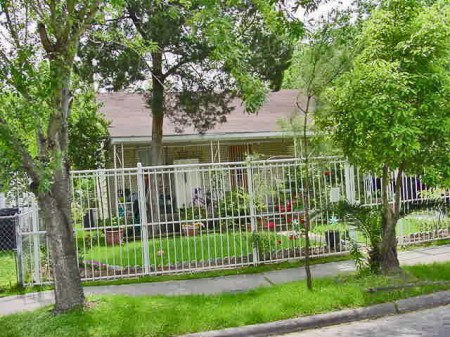
PPE 006 The front of our little house bore no resemblance to the one that now features a long porch across the street-side portion that faces north – nor did we possess or have any need for a museum quality fence across the front yard. – but it was home. From February 1945 to October 1958, from the time I was 7 and just finishing the first grade at Southmayd Elementery until the time I was a 20-year old junior and full-time working student at the University of Houston, “6646 Japonica” Street in Pecan Park, in the Houston East End, just east of the Gulf Freeway off the Griggs Road intersection, was the place where I hung both my baseball cap and my heart.  I lived there with two parents who stayed together 58 years in marriage until death took each of them just five weeks apart in 1994.

I grew up with a funny little red-headed brother named John, who was fours years my junior, and a cute little blonde-headed sister named Margie, who got here late enough to be my eleven year junior sibling in 1949. With the arrival of Margie, Dad added a third bedroom, but we still had to make do with only one bathroom, a one-car garage, and no air conditioning. That was OK. Up until about 1957, everybody in our part of town pretty much lived the same way. It didn’t really bother us because none of us knew any better. Besides, we all had attic fans that did a pretty good job of sucking hot air through every window in the house during the humid summer months. The fact this method of cooling also brought dust, allergens, and the smell of rotting figs mixed in with the aroma of the Champions Paper Mill perfume didn’t seem to get to us either.

We were tough old birds back in the day.
PPE 015

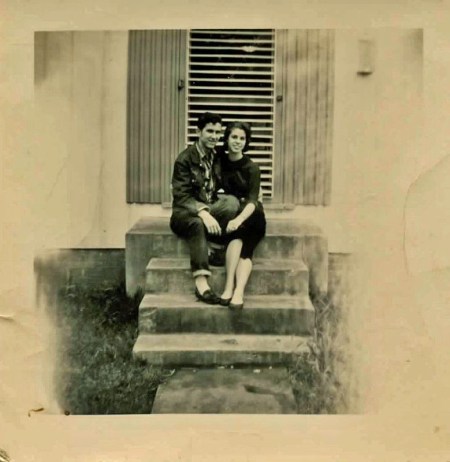
The picture of me sitting on our front porch with my 1957 girl friend will give you a little better idea of how our house actually looked back in the day. No frills. Most of the houses in our block were built back in 1939 or 1940. We were the second occupants of the house when we moved to Pecan Park from our rental house on Oxford Street in the Heights back in 1945. My dad had worked as a welder at the Brown Shipyard during World War II. We moved to the East End after he took a post-war job as Parts Manager for the Jess Allen Chrysler-Plymouth dealership on Harrisburg.

Dad had owned his own Dodge-Plymouth dealership in our original hometown of Beeville, Texas prior to the war and was hoping to work his way back to that kind of situation again. We didn’t care what he did. He was our dad and we loved him. He was the dad who played catch with us after he came home from work. He was the dad who introduced us to Houston Buffs baseball at old Buff Stadium in 1947. He was the guy we could count on as a guide to how we handled responsibility, as was Mom the lady we could depend upon to help us dream of a world that was bigger than the little house on Japonica Street.

The irony is that neither Mom nor Dad seemed to really understand that what they were giving to us at 6646 Japonica was already bigger and more important than anything else we were going to find out there in the larger world of greater achievement and attainment. All of us grew up and moved away from Pecan Park, but my heart never really left the place. Everything I am and everything I value started there. And it never left me.

My dad told me that he bought “6646 Japonica” for something like $5,000 back in 1945. Today it’s material and locational worth is valued by the Harris County Appraisal District at close to $88,000.  As for me, I couldn’t even put a dollar mark on what that little site is worth to the value of my life.

All I can say is, “Long live Pecan Park! And long live the champion eagle heart spirit that stills soars the skies of that special place – and all the other special ‘6646 Japonica’ addresses in history where we each got launched, one way or another, for better or worse, on the path of becoming the persons we are today.”

If it was a good trip, we need to celebrate it. If it wasn’t so easy, we need to make our peace with it. Both are important to moving on.
A Video of LaPorte, Back in 1948!

August 25, 2009

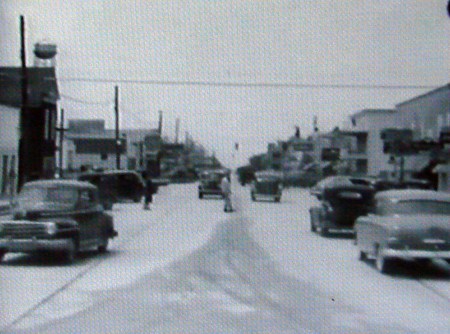
LaPorte 1948

Thanks to my old classmate and late-in-life St. Thomas High School buddy Vito Schlabra for sending me today’s “local history” subject. It’s a beautiful video jouney for anyone that may have been around here back in the day.  Someone has put together a nice little antique film strip on LaPorte, Texas, circa 1948 or so. Edited with appropriate background music, this show is now playing on You-Tube. The views of the old “Port” movie theatre  on Main Street and “Bob & Marie’s” cafe near Sylvan Beach bring back a lot of memories, even to us Houstonians who only made it over to LaPorte on occasional weekends back in the 1940s and 1950s.

A picture is worth a thousand words. A moving picture with music has to be worth at least 100,000. Enjoy!

World War II: When MLB Players Went “Over There!”

August 14, 2009

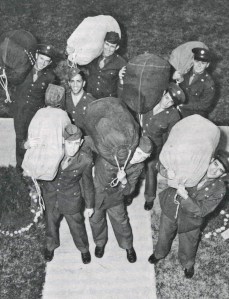
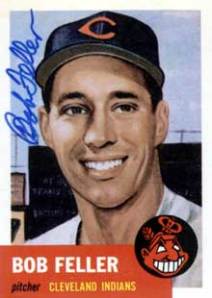
Witte Arrmy Pic In the picture at left, that’s former Houston Buff and St. Louis Brown first baseman Jerry Witte toting his US Army duffel bag in the top center, back row position of the scene. Witte was merely one of hundreds of professsional baseball players who poured themselves into the business of fighting World War II from the very start of it all. The great Bob Feller was on his way to Cleveland to sign his 1942 playing contract with the Indians when the Japanese pulled off their sneak bombing of Pearl Harbor on December 7, 1941. Instead of signing another baseball contract, Feller took the first opportunity the very next day to join the Navy and the fight.
Not everybody from the big leagues went right away – and not everyone of eligibility went until they felt the chill of the draft breathing down their necks, but they went. And they served, in combat and in programs of special morale service to all branches of the United States Military. Once FDR wrote his now famous letter to Baseball Comissioner Kenesaw Mountain Landis, declaring that keeping the big league game going during World War II was important to the morale of the American people, the level, if not the pigmentary complexion, of the big leagues began to change. Many of the minor leagues did shut down, but the President’s “keep playing” message offered no assurance that play could continue at a high quality level anywhere. Baseball players were offered no special deferment from service status based on their employment in a morale-building industry.

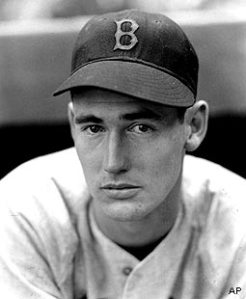
Over the years 1942-1945, the quality of play in the major leagues reduced considerably. How could it not? With stars like Bob Feller, Ted Williams,  Joe DiMaggio, Stan Musial, and Hank Greenberg all away serving in the military, there were no replacements out there who could even come close to filling their enormous shoes. Many overage stars of earlier years, people like Lloyd and Paul Waner, prolonged their careers, playing through 1945 in limited capacities as stars who had begun MLB back in the 1920s.

With the serious wounding and weakening of the New York Yankees, Detroit Tigers, Boston Red Sox, and Cleveland Indians through personnel loss, the always lowly St. Louis Browns managed to put together a 1944 club that was good enough to nip the Tigers at the wire by a single game for what would prove to be their only American League pennant in history. Unfortunately for the Browns, their same town rival Cardinals still had players like Stan Musial playing for them in 1944 and the frequent flyer winners of the National League pennant would go on to take the ’44 Browns in the World Series, four games to two. Musial would be in the service in 1945, opening the door for the also lowly Chicago Cubs to win their most recent National League  pennant.

Ted Williams Joe DiMaggio and Bob Feller  lost  three seasons to World War II; Hank Greenberg (thanks to a correction supplied me by fellow SABR buddy Bob Kienzle of Dayton, Ohio) lost the better part of four and one-half seasons; Stan Musial only lost one year. Ted Williams, on the other hand, lost three seasons to World War II and almost all of two more years later when he was called back to fly combat fighter missions in Korea. You can play all day with the numbers on what they each lost to military service, but you know dadgum what? So did all our no-big-name parents and grandparents from everyday life who also put down their ploughs and welding rods at home to serve this country in wartime. They didn’t call them the “greatest generation” for any lighthanded reason.
If you really want to grab a handle on how broad and deep this cut into baseball careers ran red, click onto this link and take an especial look at “Those Who Served” from the left hand column on the home page.

http://www.baseballinwartime.com/

Bob Feller I recently saw Bob Feller at the July 31st “Knuckle Ball” in Houston. Nearing age 91, the man still possesses amazing energy and alertness. I think if you asked Bob Feller today how he felt about the baseball time he lost to World War II, he’d answer with something like, “I didn’t lose anything. I gave my time to my country when it needed me to be there on the fighting line for America.”
Semper Fi!

And not just by the way, Happy V-J Day! On August 15, 1945, a jubilant announcement roared across America that Japan had surrendered, ending World War II. On September 2, 1945, the Japanese formally surrendered on the deck of the U.S.S. Missouri in Tokyo Bay. Pick either of these dates as V-J (Victory Over Japan) Day and remember what they were about while you are celebrating both. Like all our great victories for peace, V-J Day came at a great cost that is always born on the backs of our great people in the U.S. Armed Services.

TELEVISED BASEBALL AIN’T WHAT IT USED TO BE – THANK GOODNESS!

August 13, 2009

tv baseball Televised baseball “ain’t” what it used to be – thank goodness! Ten years after the first televised big league game from Ebbets Field in Brooklyn in 1939, KLEE-TV, Channel 2 in Houston, our only televison station then operating locally during the pre-coaxial cable days introduced the first viewing of baseball to the few Houstonians who owned those early 10 inch screen console receving sets that sold for about $400 at places like the Bayne Appliance Store. That was a lot of money for a family to pay for television back in 1949, but it was Houston’s first year with the new medium and there were then, as now, people with both the money and ego that were large enough to buy one at the early inflated price. There were no easy credit line purchases back in the day.

Unfortunately for us, our dad was not one of these monied ego types. If we wanted to see TV, we had to scrounge up an invitation to the Sanders household. The Sanders family was the only household  in our neighborhood for the longest time in 1949 that even had a TV. Lucky for me, Billy Sanders was my “best bud” and my original co-founder of the Pecan Park Eagles. Billy also loved to contemplate the future of technology with me. Our “what will they think of next” answer to what lay ahead for us all beyond television was unanimous in our poll response from the rest of the Pecan Park Eagles too. – None of us could wait for the introductions of Feelavision, Smellavision, and Tasteavision. We’re still waiting, I suppose, but I cannot speak for the rest of the Eagles. We all grew up and were lost to each other so many years ago.

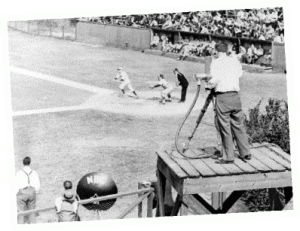
tv baseball 2 Bill Newkirk handled the first televised play-by-play at Buff Stadium of 1949 Houston Buffs games. He was assisted by longtime Buff, Colt .45, and Astro engineer Bob Green in generating those early productions. Newkirk was succeeded in 1950 by Dick Gottlieb of Channel 2, which by its second year had now been purchased by the William P. Hobby family and re-christened as KPRC-TV. Guy Savage, later of KTRK-TV Sports, Channel 13, also handled the play-by-play on a number of those early baseball telecasts from Buff Stadium.

Dick Gottlieb would achieve minor notoriety-by-association fame as the only known telecaster of a a suicide in the history of the medium. At a night game in 1951, a man sidled up beside lone broadcaster Gottlieb, announced that he was going to shoot himself, and then did so. The camera man responded instinctively, turning the camera from the field of play to the figure of the slumping dead man as he made his way to the floor. I didn’t see it, but I heard it. My dad and I were at that game, sitting about twenty rows back of Gottlieb and where it all took place. I remember that we were playing Tulsa that night and that the visitors were in the field when the gunshot boomed out. I can still see Tulsa’s Roy McMillan hitting the dirt, spread eagle. Many others did the same. Those who didn’t drop fast and hard ran like mad for the nearest dugout, not necessarily their own. Amazingly, Gottlieb recovered and finished the broadcast of the game. Not even violent death stopped the Buffs.

Of course, there was nothing remotely resembling high definition picture quality available in 1949. Those small fuzzy analog pictures gave us only a blurring vision of little white and little gray colored figures moving around on a lighter grey field at night under poorly lighted field conditions. With a main or only camera directly behind home plate in 1949, we also saw through the pattern of that safety screen device as we attempted to follow the action on the field.

For a long time, there was no second camera. The effect was like it being the pong-era of televised baseball.  The camera had to follow this little round white object when it was hit – and that was only possible when the ball left the bat on a grounder route, to or through the infield. The ball got smaller and disappaeared each time. On fly balls, these vanished immediately. We had to make a judgment about what we were viewing that was based upon how the fielders behaved. In the process, we always lost track of the runner since we couldn’t watch both him/them and the flight of the ball too. Sometimes the camera would swing back, hoping to catch a play at the plate. It would often get there just in time to show us a runner already running past home plate – and we would have to wait on the announcer to tell us what had happened on the play.

Early televised baseball was a lot like “radio with pictures” because the technical limitations on both our televising and receiving equpment weren’t good enough in 1949 to let a picture speak for itself. Thank goodness for a half century of incredible improvement. Thank goodness for the discovery that the view over the pitcher’s shoulder was the best primary shot on the field. Thank goodness for multiple cameras and copying technology. And thank goodness for 2009 telecasters like Bill Brown, Jimmy Deshaies, and Greg Lucas!

Roll Call of The Buffs!

July 27, 2009

Buff Medallion Blue

From late in the 19th century through 1961, a large number of major league baseball players wound their way through Houston as up-and-coming stars of the game. Most of the names on the following list played for the Buffs on their way up the baseball ladder to the big leagues. Some came through town on their way down the rungs of the same prescious climb. A few of these even made it all the way to the Baseball Hall of Fame.

Although the list is far from complete, it’s a pretty good sample of the quality of players we have been privileged to watch here in Houston during a local baseball interest period that is now chipping its way into a third different century of life. This roll call will not thrill any of you who care little or nothing for the game, but it speaks volumes to those who care enough to get clear on one of my favorite rant-subjects: Baseball goes back to the root years of our city. The first Houston Base Ball Club was formed in April 1861, a mere few weeks after Texas had seceded from the Union – and a good twenty to thirty years prior to the introduction of football in Houston on a minor organizational level at the Univeristy of Texas and Texas A&M Proffessional baseball finally reached Houston in 1888 with the formation of the Texas League. It would take the Texas League nearly two more decades to achieve stabilty, but once it did, it became the cradle of Houston’s greatest players in history.

In short, baseball ignited Houston first. Footbal came much later, and didn’t really take hold until electrification brought “Friday Night Lights” to Texas high school football in the 1930s.

Remember that milestone pattern the next time you are forced to hear another national talking sports head TV guy say that “Houston is growing pretty fast in its knowledge of the game for a city that is basically a football town that only recently discovered baseball!” Don’t pay any attention to these idiots. These are the same ignorant people who still come to Houston expecting to see mountains on the horizon, cacti growing wildly in our neighborhoods, and tumbleweed blowing crazily down Main Street.

The quick list shown here is pretty impressive. Look ’em up individually at either Baseball Almanac or Baseball Reference (d0t.coms) and see what I mean. Most of these guys did pretty darn well at the major league level:

Luis Arroyo, Vern Benson, Ray Blades, Don Blasingame, Don Bollweg, Bob Boyd, Ken Boyer, Al Brazle, Harry Brecheen, Willard Brown, Tex Carleton, Mort Cooper, Walker Cooper, Nick Cullop, Mike Cvengos, Dizzy Dean, Paul Dean, Murry Dickson, Dick Ellsworth, Hal Epps, Herman Franks, Don Gutteridge, Chick Hafey, Wild Bill Hallahan, Solly Hemus, Larry Jackson, Eddie Kazak, Johnny Keane, Johnny Kling, Frank Mancuso, Gus Mancuso, Fred Martin, Pepper Martin, Harry McCurdy, Von McDaniel, Joe Medwick, Larry Miggins, Vinegar Bend Mizell, Red Munger, Danny Murtaugh, Al Papai, Homer Peel, Howie Pollet, Rip Repulski, Art Reinhart, Ron Santo, Al Schacht,  Bob Scheffing, Cary Selph, Wally Shannon, Hal Smith, Pancho Snyder, Tris Speaker, Bobby Tiefenauer, Emil Verban, Curt Walker, Harry Walker, Watty Watkins, Del WIlber, Ted Wilks, Billy Williams, Jerry Witte, and  Johnny Wyrostek.

By special request from Wade Porter, I am extending this post to include my All Time Starting Line-Up based upon the Buffs/Major Leaguer pool listed previously. These decisions were based upon each player’s ability to perform at both the major and minor league level. That means I faced a tough choice on first base, choosing between my close old now deceased friend Jerry Witte and his 38-homer season for the 1951 Buffs and Bob Boyd for his two .300 plus hitting seasons in 1954-55. Both  were also men of outstanding character and fairness too. I finally had to go with Bob Boyd because of his near .400 Negro League marks and his recognition by the Negro League Hall of Fame, plus his several plus .300 or above seasons with the Baltimore Orioles after leaving the Buffs. It was the fair thing to do and I know Jerry Witte would have agreed. He was all about fairness. Jerry Witte only had two very short and not too happy trips to the majors in 1946-47. When we worked on his biography years ago, Jerry even told me: “I just want credit for the things I did. Don’t give me credit for things I didn’t do – and for God’s sake, don’t ever say I was best at something when somebody else was better.” This was one of those times, Jerry, but nobody will ever be a finer man or better person than you were. Nobody did it better in that league.

That being said, here’s my starting lineup of the Greatest Houston Buffs Ever:

Solly Hemus, 2b

Bob Boyd, 1b

Tris Speaker, cf

Billy Williams, lf

Joe Medwick, rf

Ron Santo, 3b

Johnny Kling, c

Don Blasingame, ss

Dizzy Dean, p

I must confess too. I had to go back and add Don Blasingame to fill out the shortstop position. It was hard leaving a few guys out of the starting lineup here, but as Cecil Cooper might tell you, that’s one of the tough parts about managing. Of course, if old Cecil had this talent available at peak form on the roster of the 2009 Astros, we might be running away with the NLC by now. Don’t you think?

If you see a starting lineup that you prefer, please post it below as a comment on this issue.

Have great new week everybody!

Remembering Lou Mahan!

July 25, 2009

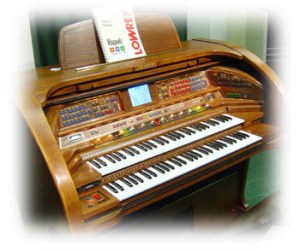
ballpark organ 3 We have Channel 13 Sports Direector Bob Allen to thank for today’s blog subject. Yesterday he sent me a nice note about his own early Houston Buff Stadium memories – and one of the names he mentioned among these jewels was Lou Mahan, the ballpark organist. Thank you, Bob! The mere mention of the talented Ms. Mahan alone simply pulls my spinal soul back to the place where it received its original baseball charge – and for people like Bob Allen and yours truly, that place was Buff Stadium on the Gulf Freeway at Cullen Boulevard, on the site of the recently closed Finger Furniture location there. If you followed my previous blog over at Chron.Com, you’ve heard me write about Buff Stadium many times. It was the home of our pre-major league Houston Buffs from 1928 through 1961.
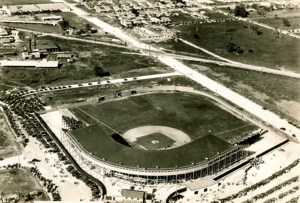
Going to Buff Stadium during the post World War II years was a five senses, three-dimensional, technicolor immersion into everything you now read about in nostalgia accounts of baseball’s so-called glory years – and the sounds that emanated from the ballpark back in that day were as integral to the experience as all things visual.

Coming up next here is an aerial photo of Buff Stadium from the early days. As you look into it, try to allow the photo to come fully into life the way those old black-and-whites sometimes do from the early movie credits that lead us into an historical period movie. It all starts with a still, colorless, soundless picture, but the gradual awakening of certain sounds eventually brings the dull still life into full color view and energized animation. Got it? I think you do. I believe you know exactly what I’m writing about here.

Buff Stadium 001 Here comes the soundtrack … one item at a time … each new item simply adding to all others that came before it: … footsteps by the hundreds … laughter and loud voices shouting between fans who are meeting up for the game … the louder yells of early food vendors hawking hot dogs and beer to the early arrivals … the twilight ear buzz of Houston’s vampire mosquito squad … the sound of fungo bats banging baseballs into the deepests alleys of the Buff Stadium outfield … the occasionally muffled sound of private player talk, oozing into the stands as the players take defensive drill practice before the game … and one more thing – the sound of an organ playing in theme to whatever is going on upon the brilliant green playing surface of Buff Stadium.
It is the music that finally transforms the picture from black and white into color. And it is the ballpark organ that sets everything still into dynamic motion. In Houston, it is Ms. Lou Mahan, ballpark organist extraordinaire, who both follows and leads the game into three-dimensional animation, and sometimes, at the expense of getting herself in trouble. More on that little problem in a minute. First we need to set a few facts straight about the not-quite-so-ancient association of baseball to organ music.

A lot of people think that organ music and baseball go back to the early 20th century Dead Ball Era. The fact is that the organ wasn’t really introduced to baseball until 1941 when the Chicago Cubs brought one in as a one-day special event program. The music was so popular that they left the organ at Wrigley Field and began using it on a regular basis at games. Today about half the major league clubs employ a full-time organist. The rest of the clubs use those “cheater track” organ sounds of the organ doing that four-note upscale climb when a rally is needed and the like.

For more on the history of  ballpark organs and their current status, check out this link:

http://www.ballparktour.com/Organists.html

In Houston, Lou Mahan served as our Buff Stadium organist from sometime after World War II through the mid-1950s. She had a theme for everything that was going on before, during, and after every game. Balls that rolled up the angled screen behind home plate got there with the help of an organ peal up the scale. Then they came down the scale on their way to the ground, with Lou Mahan throwing in an extra bump note when they finallly rolled off the screen and hit the grass.

Lou had a situational fix put-to-music for everything that happened in the game too. You had to be up on the Buffs, up on baseball, and up on the unheard lyrics to Lou’s music to “get” everything she was throwing at us too. Here are a couple of great examples from the 1951 season:  (1) Buffs first baseman Jerry Witte comes to bat late in the game, nursing something like a three-week homer drought – but with the Buffs needing a long ball to win in the bottom of the ninth, trailing by two runs, with two runners on base. Lou plays the music to: “Kiss me once, kiss me twice, kiss me once again. It’s been a long, long time!” (2) Left fielder Larry Miggins comes to bat with the tying Buffs run on third – and the winning run on second, bottom of the 9th in another game. Lou Mahan plays: “Shrimp boats are a comin’, there’s dancin’ tonight! Shrimp boats are a comin’, their sails are in sight! — Why don’t you hurry, hurry, hurry home!

Lou’s sensitivity to unfolding game themes finally got her in trouble one day. After watching the three Texas League game umpires walking in from their left field dressing quarters prior to a game for the umpteen hundredth time, Lou Mahan could resist the urge no longer. She broke into a few bars of  “Three Blind Mice” as public address announcer Morris Frank was introducing the arbiter crew. I don’t know how severe the penalties spread from there, but Lou was throw out of the game for sliding into hilarity at the umpires’ expense. It was the only organ-silent game I ever watched at Buff Stadium

Of course, when the Buffs won any game in a 9th inning rally, which was pretty often in 1951, Lou loved playing a lively version of “Happy Days Are Here Again!” I told Bob Allen how I felt, and I meant every word of what I wrote to him about those Buff Stadium days. As much as I still love baseball in 2009, it never got better for me than it got back at old Buff Stadium. That was as good as any heaven on earth could ever get. Those early impressions, and every single one of them themed by the organ music of the wonderfully talented Lou Mahan, were electrically charged upon my young soul to last forever.

I wish I had known Lou Mahan personally. In fact, if any surviving family members should read this piece and be willing to fill us in about her life, I would love to hear from you. She was so much a part of the ballpark experience at Buff Stadium for all of us during the years that followed World War II.

Those were the days, my friend. We thought they’d never end. And in our hearts, they never have.


Houston Buffs Baseball: The “Shorts” Version.

July 24, 2009

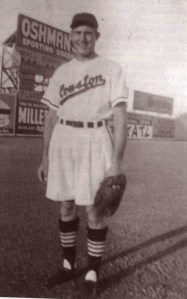
Jerry Witte Models Late 1950 Buffs Uniform Shorts. They weren’t exactly bad. They were just absolutely horrible. The 1950 Houstons Buffs of the AA minor-level Texas League were well on their way to a deserved last place finish due to a severe absence of talent. It was one of those seasons in which the parent club St. Louis Cardinals had pumped all the talent upstream to their higher AAA level Columbus, Ohio and Rochester, New York teams.

With winning out of the mix as an attendance booster for the games at Buff Stadium in July 1950, the Buffs had to fall back upon the creative inspiration of club president Allen Russell for their hope of avoiding the dreaded red ink that usually follows a losing club like an old airplane message sky streamer. In Russell, the parent Cardinals trusted. The man already had taken the Buffs through the 1948 winning season in which the AA Houston club had outdrawn the losing St. Louis Browns of the major American League.

Allen Russell would find an answer for the challenge of 1950. Or so everyone hoped.

When the Russell antidote was announced, Houston fans reacted with derisive laughter and obsessive curiosity. It was the curiosity factor that Russell was betting on as the ultimate winner in this mood tug-of-war when he announced that the Buffs would embark upon a “Beat the Heat” campaign for the balance of the 1950 season by switching to short pants as their everyday uniform lower garment. “May as well try to beat the heat,” some Buff  fans exclaimed, ” ’cause they sure as heck ain’t beatin’ nobody else!”

The first fan reaction for the first Buffs game in shorts was not totally virginal. Russell had experimented briefly with the idea during the also fairly awful 1949 Buffs season, but without this kind of marketing promotion to the plan. Most fans were seeing the “new look” for the first time and the first wave came in droves to see what there was to see.

What the fans saw was a club that was equally capable of losing in short pants. These short pants, by the way, were little more than cut-off versions of the old blousy flannel trousers that eventually found their way to the scissors-mill. In fact, the blousiness of the Buff shorts caused them to more easily resemble a short skirt –  another factor that didn’t eactly appeal to any of the ballplayers interviewed. As I reflect now upon my 12-year old memory bank of that season, all I am able to recall is the common “what choice do we have?” attitude that threaded its way through the player quotes in the Houston Post. If there were any comfortable cross-dressing Buffs on the 1950 club, they either didn’t talk, or else, they weren’t quoted in the papers of that era. At age 12, I wouldn’t have recognized them anyway.

The players really did hate the uniform shorts. Good friend and late Buffs first baseman Jerry Witte talked about this period in “A Kid From St. Louis,” a biography that I helped him write a few years ago. The pain of sliding on bare skin and the exposure vulnerability to Houston’s vampire-squad mosquito attacks were the major objections. “We produced enough (blood-scrape) strawberries to open our own fruit market,” Witte said.

The experiment didn’t last more than three weeks. Once the attendance slipped back to its previous low level and people no longer cared what the Buffs were wearing on their way to the bottom, Russell killed the campaign, allowing the Buffs to finish the season in last place, but standing tall in long pants.

Curiously, and as bad as they were, the 1950 last place in the Texas League Houston Buffs still managed to outdraw the 1950 seventh place American League St. Louis Browns at the gate. Season home attendance for the ’50 Buffs topped out at 255,809. – The ’50 Browns drew 247, 131 fans to Sportsman’s Park in St. Louis. If anything, those three weeks in shorts probably gave the Buffs the 8,000 plus extra fans they needed to again mildly  pummel the Browns at the main place it counts in baseball: that is, smack dab in the pocketbook.