Posts Tagged ‘Connie Mack’

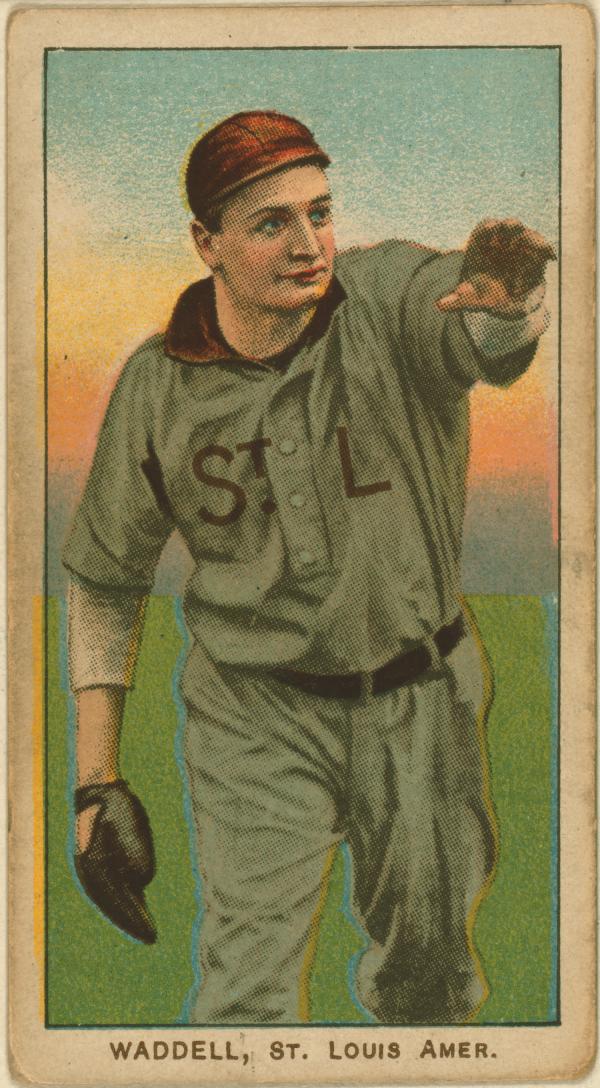
Rube Waddell, A.D.D.

October 11, 2012

Long before our awareness of “Attention Deficit Disorder” and the medications that help to control the behavior that spins from this condition, there were people in this world like George Edward “Rube” Waddell, the Hall of Fame lefty pitcher that lit up batters during the first decade of the twentieth century and the American League.

Rube was a virtual savant performer, able to pitch with the best in the world against other greats like Cy Young, Addie Joss, and Walter Johnson and winning far more often than losing against some of the best of the American League.

As we vividly note in Norman Macht’s first volume on Connie Mack, the price a club paid for having the talents of Waddell on their side was the personal behavior of the man himself. Left to his own devices, urges, impulses, attractions, and addictions, Rube was every pound and muscle inch little more than an overgrown child with no control over his distractions from the game of baseball and his contractual obligations to the club. Waddell would sometimes disappear for days or weeks to tend bar somewhere, go fishing, or hang out with new friends he met along the way. He was able to come back because of the talent he brought with him. An average or marginal pitcher would have been finished at the first turn down this “bad actor” lane.

And Rube Waddell had a temper that could frighten anyone, if they pushed the right buttons long enough. On page 322 of Norman Macht’s “Connie Mack and The Early Years of Baseball,” the author describes the Athletics Manager Connie Mack’s lesson in the first decade of the 20th century from Waddell’s temper after the eccentric lefty returned to the club on the heels of being jailed on an assault and battery charge:

“I went after him strong,” Mack said. “I was laying on the words thick and fast and I saw a nasty look come into Rube’s eyes.” Quick as a flash it dawned on me that I had gone too far. Breaking off in the middle of a scorching sentence, I reached out my hand and said, ‘Say, Rube, I had you that time. All that time you thought I was in earnest.’ And do you know that great big fellow who was ready a few seconds earlier to throw me through the door actually broke down and cried.”

Yep. “Anger Management” would have been a good alternative recommendation back then, but there was no such option back in Rube Waddell’s “Turn of the 20th Century” era. Then as now, the jailhouse is still our best option for those fists, knives, or guns people who take out their anger upon others. “Anger Management” only works for people who choose it soberly in calmer moments.

Rube Waddell wasn’t just about anger. His mind and behavior were all over the place, fitting him almost everywhere in the psychiatric lexicon of things. As a psychiatric disorder, Rube Waddell is variously diagnosable all over the psychiatric diagnostic manual dial as a schizophrenic, a bi-polar disorder, a character disorder bordering on sociopathy, an inadequate personality disorder, an alcoholic and/or drug addict, or even a codependent relationship partner.

His behavior often suggested that he was not particularly grounded in reality; he suffered mood swings from out of control highs to down in the depth lows; he sometimes took advantage of people in ways that showed little concern from him about the suffering they had endured from his behavior; he could binge drink for days and weeks; and he probably used other substances that helped him self medicate the difficult feelings he housed.

Rube was famous for chasing fire trucks, supposedly leaving his dugout during games to chase a fire-wagon down the street. I’m not really sure how often this sort of thing happened, but it serves as a good model for the kind of behavior that is typical of some people who suffer from “Attention Deficit Disorder” as a hard level of extreme distractibility from long-term attention to an engagement at hand. A.D.D. people have trouble at work and home because they simply cannot stay focused on what is going on in the moment for very long. A.D.D. seems to derive from some kind of biochemical imbalance which responds well in many people to the kinds of meds we now have available.

There were no efficacious treatment drugs for A.D.D. in Rube Waddell’s time. Rube did what most people still do to medicate themselves. They drink and drug themselves with whatever is available as a mind-altering substance, most often suffering the downside of whatever flows from the loss of impulse control effects that flow from entertainment drinks and substances.

I cannot place old Rube in any category for sure since I’ll never have a chance to meet him in this lifetime, but I will hedge enough to suggest that his two principal issues were “Bi-polar Mood Disorder” with “Attention Deficit Disorder” and that any treatment for him would begin or end with the presence or absence of appropriate  medication, administered to a patient who was willing to start his treatment by taking his medication regularly as prescribed. Only then could we move on to the stuff that might have mattered.

I still like old Rube. Waddell is history’s proof that you don’t always have to have peace of mind, relationship sanity, or a full grip on reality to do great things that entertain, but do not bring harm to others.
The Jack Kevorkian of Baseball Myth

April 17, 2012

Norman Macht is the author of "Connie Mack: The Turbulent and Triumphant Years, 1915-1931. This work is Volume II in a three-part planned biography of the iconic owner/manager of the Philadelphia Athletics that Macht has been working on for over 30 years. Based on his talk to the Houston SABR Chapter last night (4/16/12), one could only conclude that Macht's search for the truth in all places large and small is nothing short of relentless.

Norman L. Macht has been one of my favorite baseball researcher/writers since he first published Volume I of his landmark work on the life and times of the great half century owner/manager of the Philadelphia Athletics, the legendary Connie Mack. Macht published his first treatment of Mack in collaboration with the grand old man’s grandson, Connie Mack III, in 2007. That starter kit to Macht-addiction was entitled “Connie Mack and the Early Years of Baseball.”

It was high honor to simply meet the man for a light meal prior to hearing him speak before the monthly meeting of the Larry Dierker Chapter of SABR, the Society for American Baseball Research, Monday night, April 16th, at the Inn at the Ballpark across the street from Minute Maid Park in Houston. Macht was the third of three wonderful speakers on the evening and he was preceded by sports media writer David Barron of the Houston Chronicle and former third baseman and current administrative employee of the Houston Astros, the great Enos Cabell, who each serially brought news of the Astrodome’s demise and the Astros’ plans to rise. Both were very good in their own rights, but it is Macht who draws my attention here today because of what he represents as a role model to our own current research into the first one hundred years (1861-1961) of baseball history in Houston.

The man is totally dedicated in all his searches to a pursuit of verifiable truth – and that’s not easy when the subject matter is baseball, a game that has sewn its seeds plentifully and often on the wings of stories by sportswriters that weren’t “necessarily so.”

Macht best describes his pursuit of the truth in a mere few words as the one-sentence second paragraph of his opening acknowledgement section of his new book. In lamenting the loss of a valuable research colleague, Macht writes the following:

“Without Jim ‘Snuffy’ Smith’s zealous pursuit of the truth and accuracy in all matters, I would have fallen further short of the holy grail of getting it all right.”

“Pursuit of truth and accuracy in all things” is the active operant ticker heart of this man, Norman Macht.

Working on any history in the baseball world, one must wade through a culture that has already built a thriving self-image around a plentiful supply of lies and legends about events that most probably never happened. (Uh, “The Babe Calls His Shot in Chicago, 1932,” for example). Sports writers learned early that baseball stories don’t have to be true to sell newspapers. They simply have to be entertaining – “funny” helps and “magical” transcends.”

As one example of the stories that Macht has taken apart, he told the story of a column written by the esteemed Dave Anderson in the New York Times, I believe, back in 1975. Anderson wrote a story, one supposedly told by Joe DiMaggio at a banquet arouned that time. (I may get some facts wrong here. i wasn’t taking notes last night.)

In the tale, DiMaggio of the Yankees hits a home run off a fastball thrown by BoBo Newsom of the Philadelphia Athletics. The next time up, and before he bats, A’s manager Mack tells pitcher Newsom: “DiMaggio teed off on your fastball last time, Bobo. This time, show him your curve. Newsom did the curve, but it didn’t break much. DiMaggio hit it into the upper deck in left at Shibe Park. As DiMaggio is rounding third on that second homer of the day off Newsom, Bobo supposedly walks off the mound to yell into the dugout to his manager: “Hey! Mr. Mack! Guess what? He hit your pitch even further than he hit mine!”

Great baseball story. Full of breakfast table smiles for the avid readership. But there’s just one thing. Was it true?

Norman L. Macht took the story and did what few will do. He researched the hard-core record books: Was there ever a game in which Joe DiMaggio hit two runs in a single game against the Athletics? If so, did he ever do the deed against Bobo Newsom.

Macht found that the first set of answers were “yes” and “no.”

If memory serves, “yes,” DiMaggio had three double homer games against the A’s in his career, but “no,” none of these games occurred against Bobo Newsom.

Those results don’t settle things for a relentless searcher like Norman Macht. He carries it further to the possibility that maybe the story is right, but the facts are wrong. Of the three double homer games, Macht rules out one game in which the two homers came against two different men. Then he methodically eliminates both of the separate pitchers who did surrender double homers in games against DiMaggio for psychological reasons. One was shy and retiring; the other was shell-shocked into a quiet state from service in World War II. Neither was a candidate for shouting from the playing field to their manager,

The story did not pass the Macht smell test. It was just an amusement, but not worth the ink on the pages of actual history. So Macht put it to sleep until some boob like me jumps on it for its entertainment value and repeats it here. How many of you out there who now act to share the DiMaggio story with others will also go through the steps of explaining that it’s not true, clarifying that it’s just a funny story, one that probably fired off the pistons that once cranked off the entertaining mind of a writer named Dave Anderson? * (See footnote at end of column.)

Answer: Probably not too many.

Forgave me, Norman. You still have my utmost respect for all you do in the name of historical truth.

I came away from the evening in even greater awe of Norman L. Macht, but with a new perspective on his characteristic role in baseball research. It was a new image for me of the man – and one helped greatly on the transferential level by his physical similarity to another great historical man who found himself captured tightly by his obsession with rightful purpose.

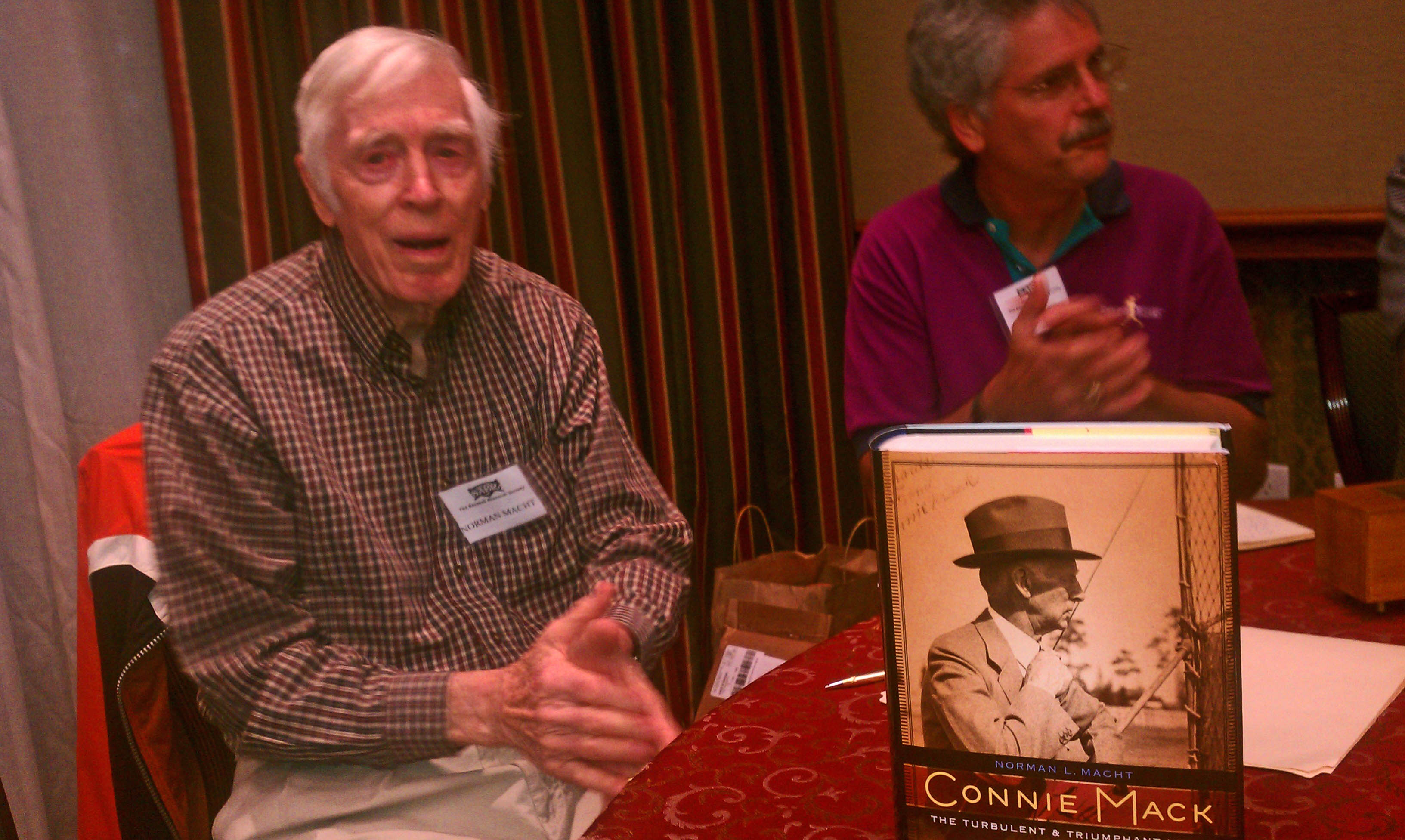
Norman L. Macht and Volume II of his Connie Mack story.

It finally came to me this morning. Norman L. Macht is the Jack Kevorkian of baseball research. He is totally dedicated to the goal of assisting all untrue stories in baseball to the cemetery of the unpublished waste pile. If they are not verifiable in some hard copy form, he will not use them in his own work, He is, and I think rightfully so, distrustful of what others write in blogs, books, and sports columns and articles that offer no hard fact support as the truth.

Keep up the good work, Norman. The truth needs you as much as you need the truth.

* Footnote, 4/18/12: As the result of word from Norman Macht in response to this column (see his comment below), I have been duly corrected that it was Dave Anderson, not Red Smith, who told the DiMaggio story used in this piece. Because it both stands as bonus proof of Mr. Macht’s desire for truth, and my propensity for human hearing and memory error, I have replaced Smith in the story with the correct name of Anderson. I share Mr. Macht’s desire for getting all things right, even when my human capacities sometimes get in the way. Thanks you again, Norman Macht, for calling this error to my attention. – Bill McCurdy.

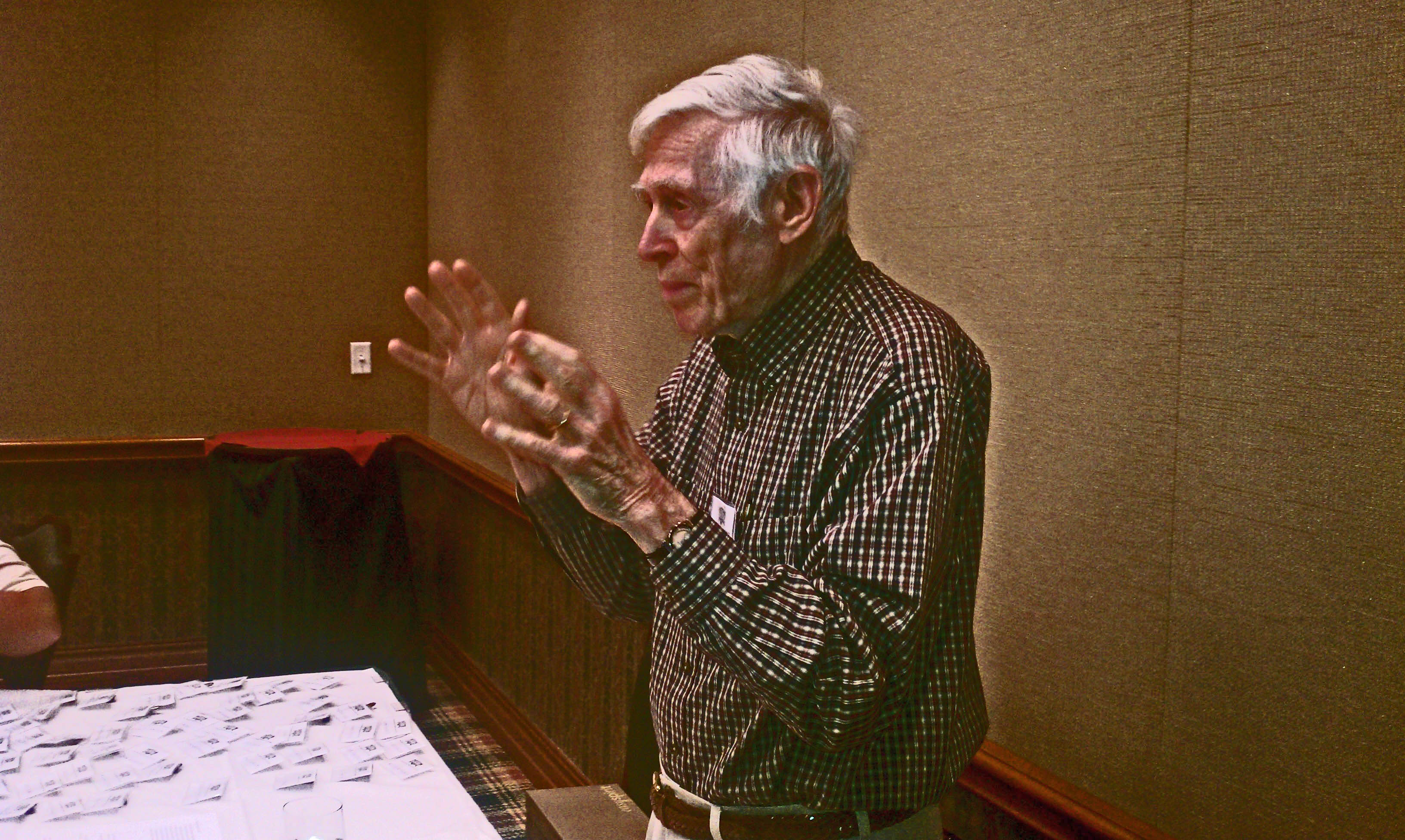
Column Addendum, 4/18/12: Here’s a better shot of Norman Macht as he personally euthanized the “Two Homers off Bobo Newsom by Joe DiMaggio in the Same Game” story for being untrue at the 4/16/12 meeting of SABR’s Larry Dierker Chapter on Monday Night at The Inn at the Ballpark next to Minute Maid Park in Houston:

Historical Euthanization in Progress: "Way to go, Norman! You metaphorically put the whole DiMaggio-Newsom Two Homer tale to its eternal rest away from the big book of history as untrue on Monday night. And we thank you for so acting."

Thanks again, Norman Macht, Baseball research needs more people on board who are as careful with the truth as you are.