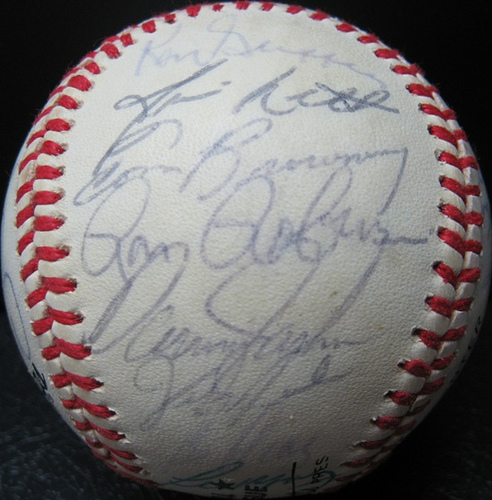
Golden Rule: Never trace over fading signatures with a new pen to make them easier to read. You have just destroyed the historical/commercial value of the item when you have done so.
What’s the difference between a collectible and an artifact? It’s all in the eye and the motivation of the beholder. If you keep something of history because it has commercial value, or you simply like gathering items into your own control, it’s a collectible. If you search for, find, and save an item because you know it is important to history, and your further search from there is for a place where it will be protected and put to use by historians and the interested public, it’s an artifact.
Both are important concepts to a better understanding of our own motivations. The word “artifact” just sounds nobler than collectible because it is. All artifacts may also be viewed as collectibles, but not all collectibles have much to any value as artifacts of history. For example, the ball that Babe Ruth hit for his 60th home run in 1927 is clearly an artifact that might have become one of the uniquely revered and traded collectible items in the world. Fortunately, however, the Ruth #60 homer ball is in safekeeping and on display at the National Baseball Hall of Fame in Cooperstown, New York as one of the unique artifacts in baseball history.
In recent years, baseball card companies have seized upon the addiction-seed and consumer-need for uniqueness that runs rampant among collectors. As a result, these companies have produced an ironic stream of “limited edition” cards, and always for “a few dollars more” in price above the normal “see-em-everyday” cards that everyone else buys at a cheap rate. These rarer baseball cards will likely never be collectibles on the level of the famous 1909 Honus Wagner cards, unless someone wants to start a museum dedicated to the dual history of greed and compulsion.
Some things stand out that collectors and researchers need to keep in mind when they are searching for those true dual-identity collectibles and artifacts in all those attic trunks out there, somewhere. Here are a few of the big ones:
(1.) Carpe Diem: Go into the search with as much knowledge as you can bring to the table, but never put off an open opportunity to search because you think you aren’t ready. That special old dusty trunk in your grandmother’s attic may not be there later when you think you are ready. Check it out now – before someone else throws it out or hauls it away.
(2) The Golden Rule: If you run across an old baseball, or any other item, with faded signatures, do NOT trace over these original writings with a fresh ballpoint pen or marker point. The artifactual and collectible value of these items is destroyed from the moment that anyone works them over with a new pen.
(3) Handling: Use cloth gloves when handling old items, especially anything that is highly sensitive to chemical reaction with oils from the skin. Be careful where you touch items. Keep your bare hands off signed balls as much as possible and never put your fingers on the front side of photos. Common sense is the major rule here, but remember the gloves. They will save you a lot of heartache that cannot always be undone.
(4) Storage: Keep old items out of the sunlight, especially items that have been signed. The sunlight, and even the artificial light of a home or office, will eat up the color in the item faster than you can ever imagine. Put your collectibles/artifacts in a sock drawer or safe deposit box until they are either supplied with protective light ray covers or relocated to a professionally curated museum storage environment. Cooler temperatures are also better for items that are being stored. Never leave them in one of those hothouse storage rooms that get up to 120 degrees in the shade during the summertime.
(5) Appraisals: Get your items appraised as collectibles and artifacts. That may or may not require you to seek the counsel of more than one expert. As per usual, experts in the commercial collectible field may or may not be aware of an item’s value as an artifact of history – and an expert on history may or may not be aware of an item’s commercial value.
(6) Insurance: If you have homeowner’s insurance, explore the cost of adding an itemized list of valuable items to your policy. Make sure you have photographed and described each item for insurance purposes – and placed your own copy of the list in either a safe deposit box or a secure separate location from your residence.
(7) Make a Record: Write down what you know about the item you are keeping, including how you came to control it. Make sure the record is placed in storage with the item. If something happens to you, the item cannot speak for itself. Make sure your record includes some affirmation of your will for the item in the event of your own demise. Even our close family members and friends may not know our minds as to the disposition of our collections unless we have spelled out our intentions for them somewhere. Very expensive items should be included in one’s official will.
Those are the basics. Other tips are most welcomed here as comments on this article.
 Houston, Baseball, & Other Musings.
 The Pecan Park Eagle