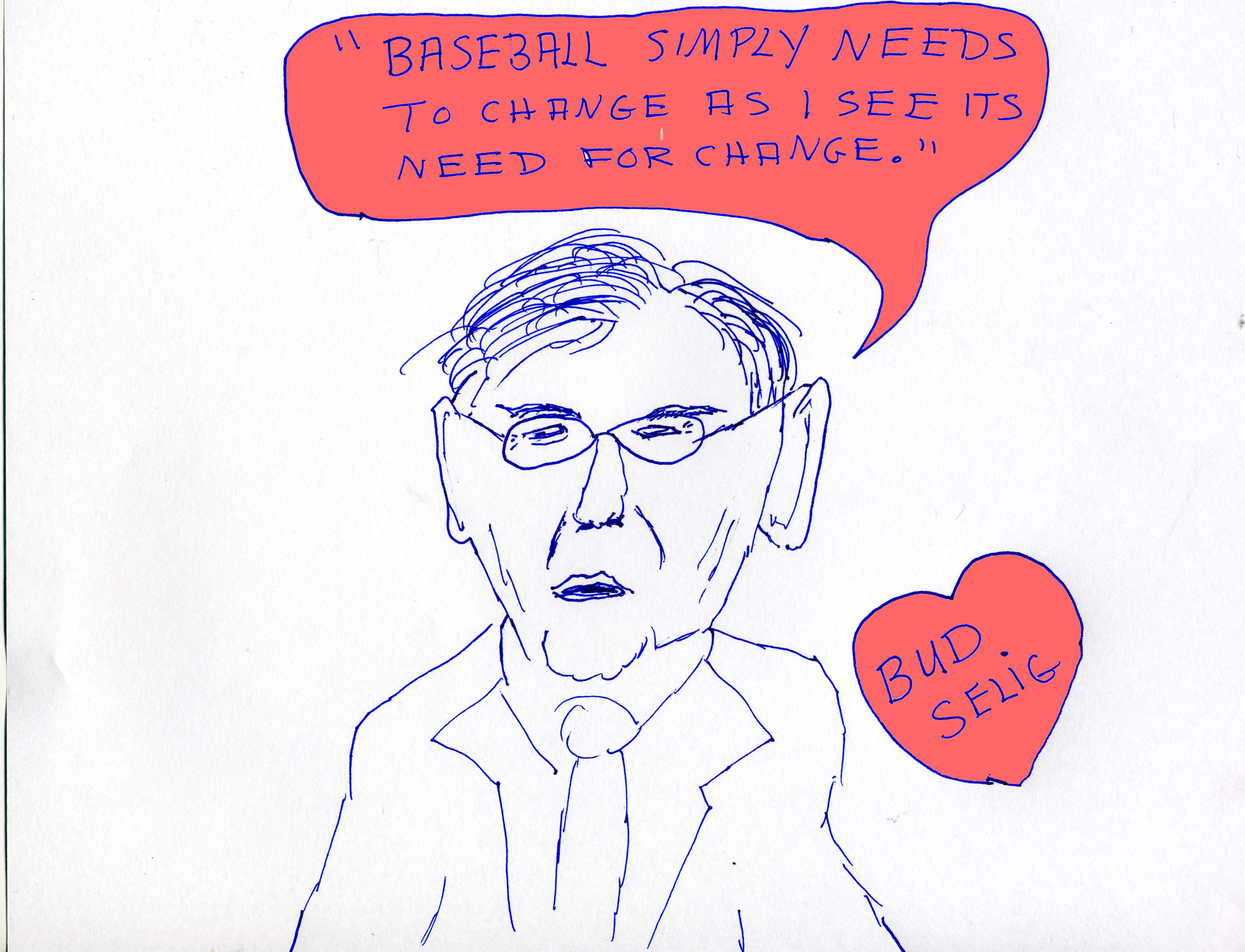
Bud Selig of Milwaukee
Commissioner of Baseball
Easy for you to say, Mr. Selig.
Back in 1997, you got what you wanted as a club owner when your Milwaukee Brewers agreed to move from the American League to the National League, ostensibly to save the big leagues from being forced to rely upon inter-league play as the only practical option for season play scheduling. Then, in 2011, you again got what you wanted, this time as Commissioner of Baseball, when the Houston Astros were forced by your office to accept their relocation from the National League to the American League as a condition for getting your approval of the club’s sale to Mr. Jim Crane.
What changed, if anything, Mr. Selig, in those fourteen years? In 1997, the Milwaukee move left the American League with 14 teams and the National League with 16. The “even-numbered team memberships in each league meant that the two AL/NL groups could drop inter-league game scheduling at any point and return to traditional league only scheduling without ever leaving a club idle during each series of play. On the other hand, the odd-numbered 15-to-15 team distribution that kicks in next season means exactly the opposite. Now the two leagues will each have three 5-team divisions, but they will each have no choice but to keep inter-league play, or else, go to a “bye” schedule for one team in each league with each new regular season series.
In 1997, the addition of expansion clubs Arizona to the NL and Tampa Bay to the AL would have increased the league population in each group from 14 teams a piece to 15 teams each, making inter-league play the only option to “bye” game scheduling in each league without inter-league play. No club wanted to change leagues to keep inter-league play optional until Mr. Selig made the apparently noble gesture of offering to take his AL Brewers to the NL for the sake of restoring balance, giving the NL 16 clubs to the AL’s 14.
MLB had two 14 teams leagues at the end of 1997. The creation of the Arizona Diamondbacks for the NL and the Tampa Bay Devil Rays for the AL, starting in 1998, would have expanded MLB to two 15 team leagues by itself. The Milwaukee 1997 agreement to move to the NL in 1998 changed the balance to 16 NL clubs versus 14 AL clubs, sparing baseball from being locked into inter-league play with only the “bye” game scheduling alternative as their only option.
I’m not sure of all the politics that were going on back then, but the need for Milwaukee to move to the NL wold not have been there had MLB “simply” placed both the new franchises for 1998 in one league or the other. (I parenthesized “simply” just to note the contradiction. Baseball rarely, if ever, does anything “simply.”)
A lot has happened in the past 15-20 years to partially, or wholly, explain what’s actually changed since the 1997 Milwaukee move agreement. The two league offices and presidencies have been dissolved. The league baseballs have been eliminated in favor of one generic ball that is now made for use by all MLB teams. And the separate league umpiring groups have been consolidated into one group with standard approach to training, dress, and the use of protective gear. The absence of “designated hitter (DH)” formula in the NL is really about the only difference that still exists between the two leagues – and between the NL and all the rest of professional baseball. It’s a very basic difference on a very important point of view about how the game should be played.
Saturday at Sugar Land, I asked Tal Smith what he thought of the question I’m raising here. – What has changed, if anything, Almost fifteen years ago, Milwaukee owner Bud Selig humbly stepped forward and offered up his Brewers for the sake of preserving the power of choice with each league. – Today, Commissioner Bud Selig uses coercion to force changes (Houston to the AL by ultimatum, for example) which eat away at league differences and deliver all power to the Commissioner’s office.
Tal just smiled. “You make the point I’ve been making all along,” he added. I won’t begin to presumptuously quote Tal Smith beyond that point, but I will take responsibility for what I think, even if the AL move doesn’t seem to be as upsetting to me as others seem to think it should. I guess I’m just ready at my age to see some different teams while I have the time to see them. I’m no fan of the DH, but I will take AL baseball over none at all.
Bottom Line of the Question: Bud Selig seems to be the leader of those forces that would like to see all league differences disappear as central control builds in the Commissioner’s office. Nothing has really changed. In 1997, Selig just played the politics of “good soldier” by offering his Brewers as the sacrificial solution to keeping league options open on inter-league play. For Selig, it was really about building credit that would help him build the power he needed to reach the position he’s in today. Now he also knows he has the power to force a club to give up a half century of NL affiliation for the sake of getting a club sale approved.
You think old Bud may want to use this power again? …… You think?
And who do the Houston Astros really belong to? – Jim Crane and Company? – The people of Houston? – Astros fans everywhere? – Or do the Astros and all other clubs (except for the Yankees and Red Sox) really belong to the man who has built a considerable power base for himself, Commissioner Bud Selig?
We’ll see.
 Houston, Baseball, & Other Musings.
 The Pecan Park Eagle