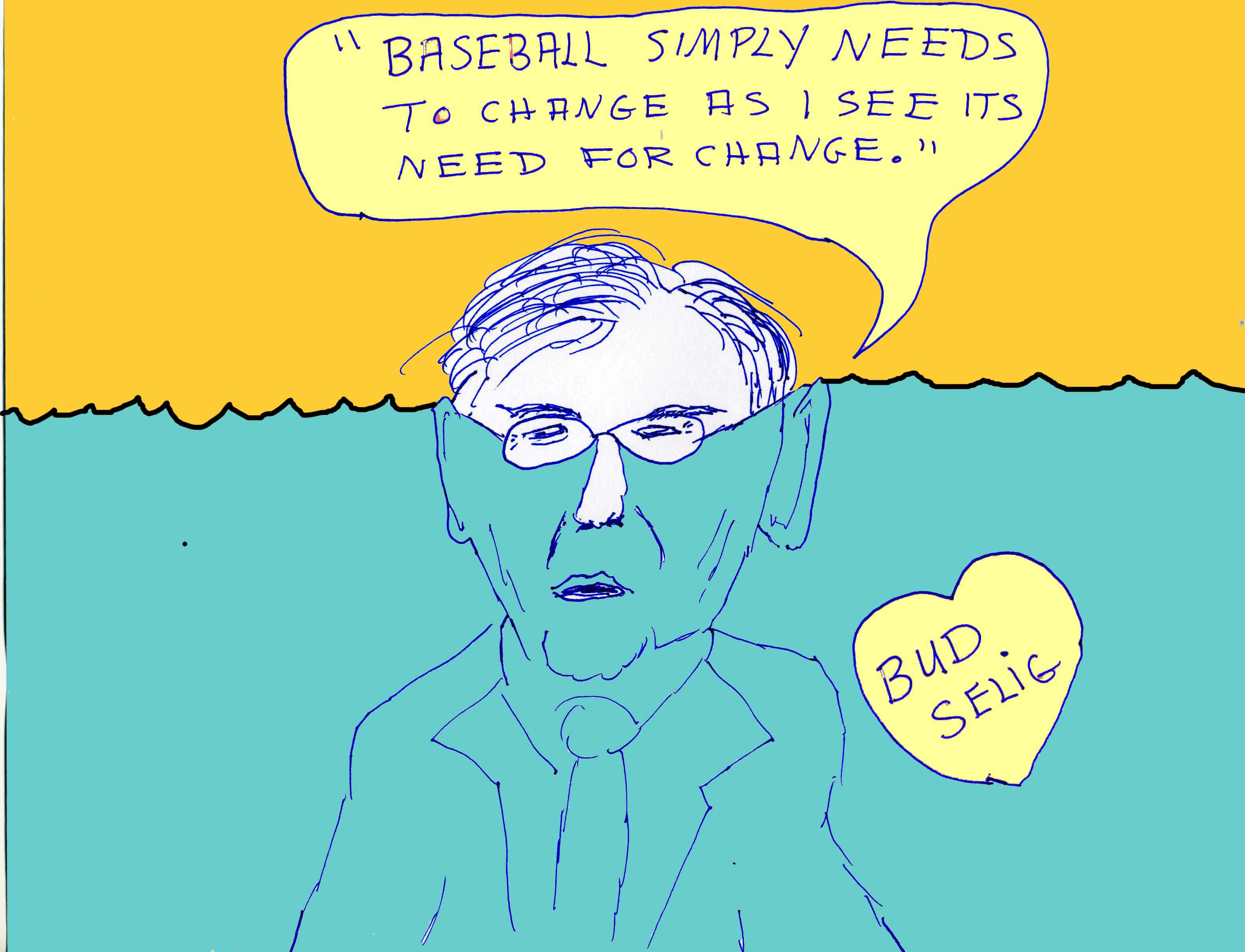
an original cartoon creation
by
The Pecan Park Eagle
Back in 1997, the American and National Leagues each had 14 teams in three 5-5-4 club division set-ups per league. MLB also had approved two new franchise clubs late in the year that would add a new team for each league, bringing the MLB total club membership up from 28 to 30 teams.. The Tampa Bay Rays were slated for the American League in 1998; the Arizona Diamondbacks would be headed for the National League, also in 1998.
Now, unless my math is wrong, those changes for 1998 should have given both leagues what they have now had since 2014: 30 clubs; two 15 team leagues; and three divisions per league of a 5-5-5 franchise distribution – and the perfect formula for ongoing inter-league play during the season.
The league alignment change we now have didn’t happen in late 1997, but why not? I may be wrong here, but I’m guessing that Bud Selig, the owner of the American League Milwaukee Brewers, who just happened also to have been the magnanimous acting Commissioner of Baseball and his car salesman-style interpersonal power and marketing abilities had something to do with it.
Here comes the magnanimous part. The acting commissioner apparently spoke with the Milwaukee Brewers owner and convinced him that one of the now 30 major league clubs in 1998 needed to change leagues so that both the AL and NL could continue to maintain an even number of teams for balanced scheduling. Brewers owner Selig volunteered to Commissioner Selig that he, with some considerable regret, would offer to allow the Milwaukee franchise to be the club that sacrificed their place in the American League to become a member of the National League – and all to save the day for everyday balanced scheduling.
Brewers owner Selig admitted in a November 7, 1997 AP article that “for the Milwaukee Brewers, switching to the National League is like ‘coming home’, but he also acknowledged that Milwaukee’s return to the National League, where they played as the Braves from 1953 to 1965, was a mixed bag. “There is sadness over the prospect of ending a 28-year relationship with the American League and its member clubs and anticipation over returning Milwaukee to its root in the National League.”
“Those of us old enough remember the glory days of Aaron, Mathews and Logan, and Spahn and Burdette, review this as coming home,” uttered the humbly pleased owner Selig.
But let’s also be clear, Selig listened to a lot of polling among Milwaukee fans before he made this generous offer to move the Brewers from the American to the National League. Once 75% of the Milwaukee fans polled said they supported the move to the National League, owner and commissioner Selig noted that this display of public support was an important factor in the offer and approval of Milwaukee’s move to the National League.
Isn’t it amazing how things work out over time. The cruel ironies overflow from those agreements between the Commissioner of Baseball and the Owner of the Milwaukee Brewers back in 1997:
(1) Milwaukee’s sacrificial decision to move to the National League in 1998, we suppose, “for the greater good of baseball”, simply was a time bomb in the chain of events that would eventually force the Houston Astros to surrender their place in the National League and move to the American League as a late condition placed upon the sale of the franchise to the Jim Crane group by a now fully empowered Commissioner Bud Selig who apparently didn’t give a twit this time about what the Houston fans wanted or didn’t want.
(2) And Houston was ostensibly moved out of the National League for a similar reason given for moving Milwaukee into the National League back in 1998. It was to help with scheduling. Now, with the Houston move to the AL, each league now would have 15 teams, making it essential that there always be room on the schedule for one inter-league series for the sake of avoiding long lay offs for all teams during the season.
(3) In the end, MLB is what it is – until the commissioner says it’s something else. – Then, everything that used be be thought of as permanent – changes again.
Thanks, Bud Selig, for all of your brilliant contributions to baseball. It’s too bad we fans couldn’t have given you a few of our own ultimatums before you went to pasture. We should have tried, at least, to get you to take that “All Star Game Winner Determines Home Field Advantage” rule with you back to Wisconsin. No team in baseball should be given any direct advantage that they did not also earn directly for themselves. And that idea expands to include not having any owner, who by the “smoke and mirrors, it’s perfectly legal” route also finds him or herself wearing another hat that says “Acting or Permanent Commissioner of Baseball” written all over it.
 Houston, Baseball, & Other Musings.
 The Pecan Park Eagle