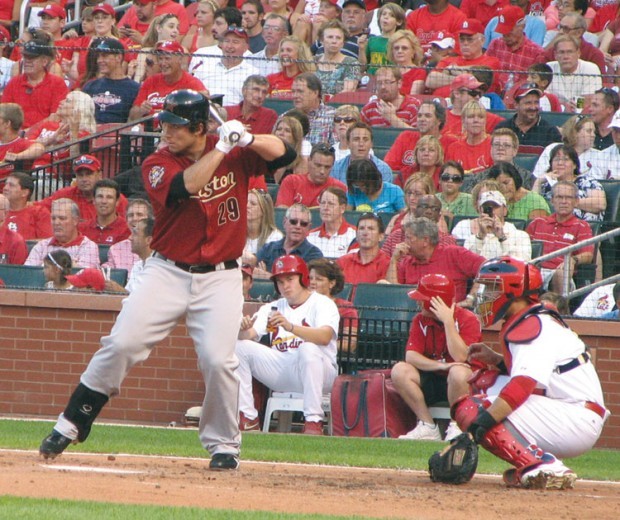
Brett Wallace, Astros: The Pirates Defense Recently Showed Him A Thing or Two.
Going back to the “Ted Williams Shift,” and maybe even earlier against some lesser known public hitting terrors, baseball club geniuses have been dragging out special defenses against the hitting of certain stars of the game, who, like Williams, had proven their performance through the delivery of all their hits to one side of the field – and also demonstrated an adamant reluctance to change their own patterns of directional delivery.
Lou Boudreau of the Cleveland Indians came up with the “Ted Williams Shift” during the 1946 season to defend against the right-side-of-the-field power delivered by Ted Williams of the Boston Red Sox. The defense basically involved shifting all the infielders over to the 100% right side hitting zone of Williams. The second baseman played back of the fist baseman in short right field, shallow enough to convert an outfield grounder into a 4-3 out at first. – The shortstop played deep at the normal lefty pull hitter position of the second baseman – and the third baseman played behind the bag at second base in shallow center, also close enough to make some 5-3 put outs from that normal hit territory. – The right fielder played deep down the line in right; the center field played deep in right center; and the right fielder basically covered center field.
The left side of the infield was left vacant, as was all the outfield from left center over to the left field line. The defensive bet was this: Ted Williams either cannot, or will not, shift his own batting style to either bunting or taking advantage of the open territory for hitting to the left side. And the defense would now have more fielders to handle balls hit into the Williams hitting zone on the right side.
Hey! Guess what? With good adaptable fielders out there, it often worked! Williams had too much ego to take it the other way. The flaw? There was still no defense against balls hit out of the park – or high off the outfield walls – and it probably messed with the Thumper’s head a little, even if he never admitted it.
Last week in Houston, we got to see the Pittsburgh Pirates pull a little shift trick on young Brett Wallace, the first full rookie season first baseman of the Houston Astros. Now hitting .308 in all games through June 19th, the lefty-hitting Wallace has shown a pronounced tendency to pull all grounders and liners to the right, but to slice many outfield flies to left. – In the final afternoon game of the series on Thursday, June 16th, the Bucs gave Wallace something to think about in his second trip to the plate, with one out and a man on second.
The Pirates pulled all their infielders to right side, ala the Ted Williams Shift, but they then shifted their outfielders to the left far enough to leave right field and the right field line basically unprotected. The defense may vae been deployed just to give Wallace something to think about besides getting a hit and driving the runner home. After all, if he hit the ball low, he now needed to hit it to the left side. If he was going to hit it high, he needed to pull the ball down the right field line.
As it turned out, Wallace passed on swinging at four balls and took a walk to first. And maybe that was the best acceptable outcome the Pirates saw in this situation. They either get Wallace swinging on a pitch out of the zone as he tries to beat the system, or, worse turns to worst, he walks, but no run scores. Since the Jolly Rogers never tried it again, we must presume that they were simply attempting to play with the young Astros’ head.
It didn’t work, but the Astros still lost the game, 5-4.
In the end, “don’t bite” and “hit ’em where they ain’t” are still an exceptional hitter’s best set of options against any kind of defensive shift.
At any rate too, the current progress of Brett Wallace and the struggling potential of starter J.A. Happ still look pretty darn good in measurement against the loss of injury-hampered and aging starter Roy Oswalt late in 2010. All we need now is for a lot of other personnel moves to turn out well for the future of the Houston Astros. That’s my not-even-slightly-biased opinion, anyway.
Have a great week, everybody, even if the world pulls one of those reality shifts on you somewhere along the way. If it does, just don’t swing at anything that’s not in the zone.


 Houston, Baseball, & Other Musings.
 The Pecan Park Eagle