 Jane Leavy’s 2010 book on Mickey Mantle, “The Last Boy,” probably won’t be the last biography on Mickey Mantle, but it is hard to see how future authors are going to be able to combine stories of The Mick’s all-out debauchery with any more tales of how old Number 7 also turned his drunken, groping attentions to them as well. With Mantle now dead these days for about a thousand years, Jane Leavy probably has the last word on that level of contact with one of the great Yankees all sewn up.
Be that as it may, as long as fans shall continue to buy anything that has “Mickey Mantle” in the title or his all American smiling face on the dust jacket front cover, make no mistake: There will be another book coming down the publisher pike, sooner or later.
I felt a curious combination of thoughts and emotions as I read “The Last Boy:”
“So what?” There wasn’t anything there that was really new or surprising. Mantle grew up in the mining country of Oklahoma with a father who drove him to either use baseball as his ticket out-of-town, or else, stay home and choke his way to an early death in the footsteps of his father as a miner.
Mantle never grew up. He married his home town girl friend to please his father, but he quickly found the bright lights of Manhattan with the help of running mates Whitey Ford and Billy Martin, after his father died so early in his big league career.
The 1950’s weren’t like this early “Dr. Phil Era” of the 21st century. Celebrities like Mantle didn’t get tried daily on television programs like Entertainment Tonight, even though Mantle had nights to rival any of those that actor Charlie Sheen is now having. Writers didn’t report it, and, if you had enough money and power behind you, it all got swept under the rug pretty quickly back in the day.
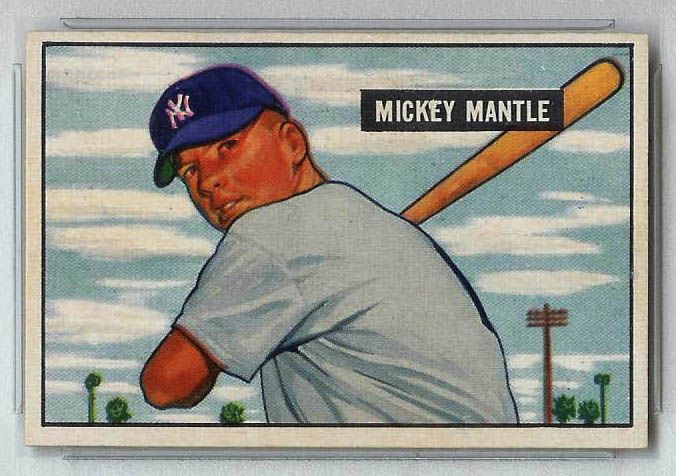
The Holy Grail: A 1951 Bowman Mickey Mantle Rookie Card.
For a raw, uneducated kid like Mickey Mantle, who was basically a guy who never really learned to socialize or experience any joy in reading, learning, or even making a cultural connection to the rest of life through movies, there was only this tremendous talent for baseball and the raw, never satisfied hunger for a chemical alteration of consciousness through alcohol and sex. “Booze and broads,” as the Sinatra Era taught them, were all about feeling good and having fun, but they were really his only easy defense against guilt, horrendous self-esteem, and a total inability to be a sober friend, a loyal relationship partner, or a father to his children. As Mantle’s sons would learn over time, they would only be able to have a relationship with their father once they became old enough to become his drinking buddies. (And that’s a sad tale that exceeds our time and space here for fair treatment.)

Buff Stadium, April 8, 1951.
I only got to see Mickey Mantle play one time – and that’s when he and the 1951 New York Yankees came through Houston in the spring and really put it on the Houston Buffs, 15-9. Here’s a link I once wrote about that experience on my old blog site at ChronCom:
http://www.chron.com/commons/persona.html?newspaperUserId=billmccurdy&plckPersonaPage =BlogViewPost&plckUserId=billmccurdy&plck PostId=Blog%3abillmccurdyPost%3a5624d402-68be-4d6a-b330 40dd0f3f7c8b&plckController=PersonaBlog&plckScript=personaScript&plckElementId=personaDest
In his post-career days, Mantle finally made a too-little, too-late recovery from alcohol. By this time, he was dying from cancer, but one of the things he still bemoaned was the fact that he had played long enough to drop his career batting average to .298. That .300 magic mark meant a lot to Mantle, and he hated having taken this statistical hit upon his overall record. If you read his various comments on that subject, it appears to be right up there on a level with his general disappointment with himself as a human being. Not surprising, is it? After all, success on the field was about all that Mantle had to help him feel worthwhile in any human way.
Had Mantle simply not played the 1968 season, a year that found him going 103 for 435 (.237), he could have closed after 1967 with a career batting average of .302 and still had 518 career home runs. It would not have erased all the demons that haunted Mickey Mantle near the end of his life, but it would have meant something to The Mick, no matter what.
Sorry things went down so hard, Mick! A lot of us kids who grew up idolizing you didn’t know about any of this painful other stuff you carried as your load. We just loved you, anyway – and what you did on the field is all we saw. You were one of our baseball gods, and on that level, you will never stop being our hero.

 Houston, Baseball, & Other Musings.
 The Pecan Park Eagle