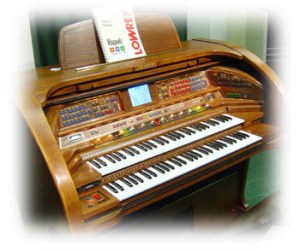
 We have Channel 13 Sports Direector Bob Allen to thank for today’s blog subject. Yesterday he sent me a nice note about his own early Houston Buff Stadium memories – and one of the names he mentioned among these jewels was Lou Mahan, the ballpark organist. Thank you, Bob! The mere mention of the talented Ms. Mahan alone simply pulls my spinal soul back to the place where it received its original baseball charge – and for people like Bob Allen and yours truly, that place was Buff Stadium on the Gulf Freeway at Cullen Boulevard, on the site of the recently closed Finger Furniture location there. If you followed my previous blog over at Chron.Com, you’ve heard me write about Buff Stadium many times. It was the home of our pre-major league Houston Buffs from 1928 through 1961.
Going to Buff Stadium during the post World War II years was a five senses, three-dimensional, technicolor immersion into everything you now read about in nostalgia accounts of baseball’s so-called glory years – and the sounds that emanated from the ballpark back in that day were as integral to the experience as all things visual.
Coming up next here is an aerial photo of Buff Stadium from the early days. As you look into it, try to allow the photo to come fully into life the way those old black-and-whites sometimes do from the early movie credits that lead us into an historical period movie. It all starts with a still, colorless, soundless picture, but the gradual awakening of certain sounds eventually brings the dull still life into full color view and energized animation. Got it? I think you do. I believe you know exactly what I’m writing about here.
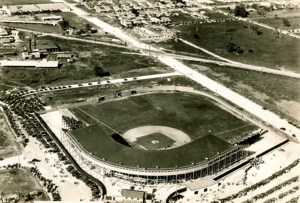 Here comes the soundtrack … one item at a time … each new item simply adding to all others that came before it: … footsteps by the hundreds … laughter and loud voices shouting between fans who are meeting up for the game … the louder yells of early food vendors hawking hot dogs and beer to the early arrivals … the twilight ear buzz of Houston’s vampire mosquito squad … the sound of fungo bats banging baseballs into the deepests alleys of the Buff Stadium outfield … the occasionally muffled sound of private player talk, oozing into the stands as the players take defensive drill practice before the game … and one more thing – the sound of an organ playing in theme to whatever is going on upon the brilliant green playing surface of Buff Stadium.
It is the music that finally transforms the picture from black and white into color. And it is the ballpark organ that sets everything still into dynamic motion. In Houston, it is Ms. Lou Mahan, ballpark organist extraordinaire, who both follows and leads the game into three-dimensional animation, and sometimes, at the expense of getting herself in trouble. More on that little problem in a minute. First we need to set a few facts straight about the not-quite-so-ancient association of baseball to organ music.
A lot of people think that organ music and baseball go back to the early 20th century Dead Ball Era. The fact is that the organ wasn’t really introduced to baseball until 1941 when the Chicago Cubs brought one in as a one-day special event program. The music was so popular that they left the organ at Wrigley Field and began using it on a regular basis at games. Today about half the major league clubs employ a full-time organist. The rest of the clubs use those “cheater track” organ sounds of the organ doing that four-note upscale climb when a rally is needed and the like.
For more on the history of ballpark organs and their current status, check out this link:
http://www.ballparktour.com/Organists.html
In Houston, Lou Mahan served as our Buff Stadium organist from sometime after World War II through the mid-1950s. She had a theme for everything that was going on before, during, and after every game. Balls that rolled up the angled screen behind home plate got there with the help of an organ peal up the scale. Then they came down the scale on their way to the ground, with Lou Mahan throwing in an extra bump note when they finallly rolled off the screen and hit the grass.
Lou had a situational fix put-to-music for everything that happened in the game too. You had to be up on the Buffs, up on baseball, and up on the unheard lyrics to Lou’s music to “get” everything she was throwing at us too. Here are a couple of great examples from the 1951 season: (1) Buffs first baseman Jerry Witte comes to bat late in the game, nursing something like a three-week homer drought – but with the Buffs needing a long ball to win in the bottom of the ninth, trailing by two runs, with two runners on base. Lou plays the music to: “Kiss me once, kiss me twice, kiss me once again. It’s been a long, long time!” (2) Left fielder Larry Miggins comes to bat with the tying Buffs run on third – and the winning run on second, bottom of the 9th in another game. Lou Mahan plays: “Shrimp boats are a comin’, there’s dancin’ tonight! Shrimp boats are a comin’, their sails are in sight! — Why don’t you hurry, hurry, hurry home!”
Lou’s sensitivity to unfolding game themes finally got her in trouble one day. After watching the three Texas League game umpires walking in from their left field dressing quarters prior to a game for the umpteen hundredth time, Lou Mahan could resist the urge no longer. She broke into a few bars of “Three Blind Mice” as public address announcer Morris Frank was introducing the arbiter crew. I don’t know how severe the penalties spread from there, but Lou was throw out of the game for sliding into hilarity at the umpires’ expense. It was the only organ-silent game I ever watched at Buff Stadium
Of course, when the Buffs won any game in a 9th inning rally, which was pretty often in 1951, Lou loved playing a lively version of “Happy Days Are Here Again!” I told Bob Allen how I felt, and I meant every word of what I wrote to him about those Buff Stadium days. As much as I still love baseball in 2009, it never got better for me than it got back at old Buff Stadium. That was as good as any heaven on earth could ever get. Those early impressions, and every single one of them themed by the organ music of the wonderfully talented Lou Mahan, were electrically charged upon my young soul to last forever.
I wish I had known Lou Mahan personally. In fact, if any surviving family members should read this piece and be willing to fill us in about her life, I would love to hear from you. She was so much a part of the ballpark experience at Buff Stadium for all of us during the years that followed World War II.
Those were the days, my friend. We thought they’d never end. And in our hearts, they never have.
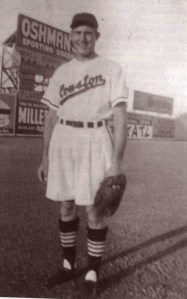 They weren’t exactly bad. They were just absolutely horrible. The 1950 Houstons Buffs of the AA minor-level Texas League were well on their way to a deserved last place finish due to a severe absence of talent. It was one of those seasons in which the parent club St. Louis Cardinals had pumped all the talent upstream to their higher AAA level Columbus, Ohio and Rochester, New York teams.
 Houston, Baseball, & Other Musings.
