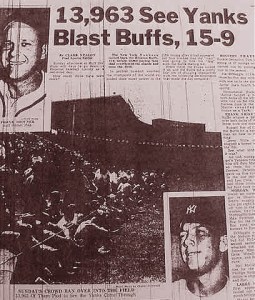
 Sunday, April 8, 1951 was the date of the most memorable game I ever watched at old Buff Stadium – and it didn’t even count in the standings. It didn’t have to count, except in the heart of play we witnessed that day – and in the pictures it imprinted upon the minds of the record crowd of 13,963 fans who attended that hot and sunny spring afternoon exhbition game.
I was only 13 at the time, but I was already seriously interested in photography. Unfortunately, I never had the money needed to pay for film and development of my pictures down at Mading’s Drug Store. Had I been able to spring for those costs back then, I would be showing you the pictures I took with the family’s Kodak Brownie box camera – not just trying to tell you about the images that remain on my soul-mind’s eye to this day, some fifty-eight years later.
First let me offer some perspective on where these pictures were taken.
Because my dad felt we wouldn’t need to buy tickets in advance, he, my kid brother John, my best friend Billy Sanders, and I all ended up standing behind the section of left center field that had been roped off for all of the other SRO fans who thought like my dad, but that turned out to be way more than just OK. First of all, we caught space on a section that was directly on the rope in the front row. There were four or five rows of other fans standing behind us. My dad was only 5’6″ and the rest of us were kids. We’d have been lost any further back, but that’s not how it happened. Next, and most importantly, we were standing no more than about ninety feet away from Joe DiMaggio in center field, to our left – and Gene Woodling in left field, to our right. They were wearing their blousy gray road uniforms with the words “NEW YORK” arching in dark letters across the breast plates of their jerseys. I don’t have a physical picture of DiMaggio wearing his road uniform that day, but I’ll never forget the one that plays on forever in my mind. DiMaggio was as graceful as the writers always described him in The Sporting News.
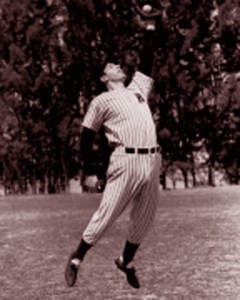 I watched every single nuanced thing DiMaggio did in the field – and I loved it when he had to run over near us for a fly ball. He was close enough for us to hear the ball pop leather on the catch many times. I even thought we made eye contact once.
I watched the way Joe DiMaggio leaned in from center field prior to each pitch, getting some kind of instinctual/visual/baseball savvy gauge on which way he needed to lean in anticipation of a batted ball. Sometimes I would lean in with him and close my right eye. That closed eye blocked out my sight of Woodling and allowed me to pretend my way into the left field spot next to the great DiMaggio. And why not? There was a kid that was only five years older than me playing over in right field that day – an eighteen year old “phenom” from Oklahoma named Mickey Mantle. He was catching all the ink back then as the logical successor to Joe DiMaggio on the Yankee rosary chain of greatness.
Before the day was done, we would hear much more from both Mantle and DiMaggio. Mickey got the Yankees on the board for their first three runs by slamming a home run over our heads and over the double deck wall in left field in the fifth inning. Mantle nailed it off Buffs lefty starter Pete Mazar. Mantle’s blow almost swallowed the entire 4-0 Buff lead and with it, the player/fan delusion that the Buffs might actually defeat the World Champions that afternoon.
Not to be.
After Mantle’s reality blow landed, everybody else in the Yankees lineup began to hit Houston pitching awfully hard. We could have injured our necks watching balls fly over and into the walls that stood behind us that day. Joe DiMaggio also later homered with one on in the ninth off Buff reliever Lou Ciola.

Wierd! And I learned about this later from dear friend and former slugger Jerry Witte. – After Joe DiMaggio’s top of the 9th inning homer, he sent the same home run bat over to the Buffs’ Jerry Witte as delivery on a promised gift. – Jerry Witte then immediately used it to hit a three-run homer to left for Houston in the bottom of the ninth. This may have been the only time in history, at least, at this level of professional baseball competition, that players from different teams have used the same physical bat to homer in the same inning of the same game they were playing against each other.

Franks Shofner and Russell Rac also homered for the Buffs that day. Gil McDougald of the Yankees had three hits and teammates Johnny Mize, Yogi Berra, and Gene Woodling each had two bingles in the game. Mize’s hits included a double and Yogi’s production produced four runs batted in. The Buffs broke Yankee starter Tom Morgan’s streak of 27 innings pitched without giving up an earned run. The Yankees won the game, 15-9, and they out-hit the Buffs, 19-14.
I went home mildly disappointed that the Buffs had lost, but even at 13, I was proud of our boys for giving the fabled Yankees all they could handle. Wish I could say that I made a total return to reality by the time we got home, but I probably didn’t. You see, I’ll always remember that day as the game in which I sort of got to play left field next to DiMaggio in center – and Mantle in right. – In my most cherished baseball memory box, I even have the pictures to prove it.
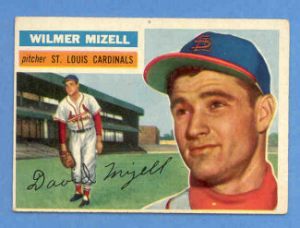 The young man they were already calling Vinegar Bend Mizell arrived in Houston with the Buffs in the spring of 1951, heralded full bore as the lefthanded second coming of Dizzy Dean from twenty years earlier. Buff fans, sportswriters, club president Allen Russell, and the parent team St. Louis Cardinals all hoped the “Lil Abner Look-n-Sound-Alike” would turn out to be everything his growing legend screamed out that he was going to be: a sure-fire and consistent twenty game wins per season superstar and future Hall of Famer. Mizell wasn’t quite the young braggart that Dean had been, but he opened his mouth enough to create words that some writers ran to type as promises for use as future nails, should he fail to deliver.
 Mizell was critical to the success of Houston’s 1951 Texas League pennant drive, posting a 16-14 record that wasn’t altogether his fault on the short side of his wins to losses ratio. The club just had one of those seasons in which they often had trouble giving Mizell the offensive support he needed to take the win. His 1951 Earned Run Average of 1.96 still spoke volumes about his bright future as a prospect.
 I had the good fortune of finally meeting Wilmer David Mizell when we were seated together at the same table at the banquet hall for the Spetember 1995 “Last Round Up of the Houston Buffs.” I had a chance to ask him if the squirrel hunting story were true. “Did you like the story?” Mizell asked me in return?” “Oh yeah! I always loved it!” I told Mizell. “In that case, it was absolutely true!” Mizell shot back with a wink and a smile.
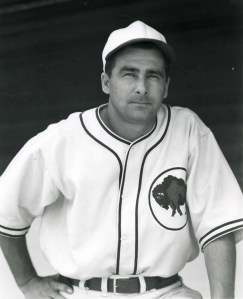 The late Eddie Knoblauch is a classic example of the currently popular axiom that “perception is reality.”Some of his fellow teammates, as well as Dutch Meyer, his manager at Dallas in the early 1950s, seem to think that Eddie had all the ability in the world to have moved on up to the big leagues over the 1938-1955 course of his career, but that he just lacked the will to crank it up to that level. If so, why not? One old teammate, armed by the cloak of anonymity in 1998 Dallas newspaper artile suggested that the money differential between minor leagie and major league pay back in the day simply wasn’t big enough to motivate Eddie Knoblauch.
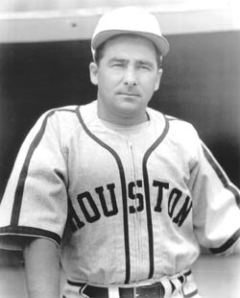 Eddie Knoblauch garnered 391 career doubles and 117 career triples. He also scored 1,420 runs.
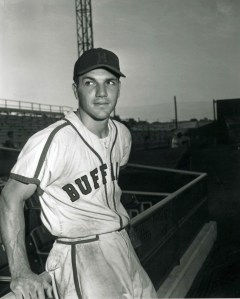 Ken Boyer was neither the first nor the last of the baseball playing Boyer boys. He was simply the best of the six brothers who ventured into the arena of the professional over the two decades that followed World War II. The Alba, Missouri native was also just one among the pack of the fourteen kids born to the rural Boyer family who discovered baseball as a way up and out to the larger world when he began his career with Class D Lebanon in 1949. Ken started as a pitcher, going 5-1 with a 3.42 ERA in ’49, but he also did something else that first year that distracted the parent Cardinal organization from seeing his future on the mound. He hit .455 for the season. Once Boyer’s pitching record slipped to 6-8 with a 4.39 ERA in 1950 with Class D Hamilton, while his battting average stayed up there at .342, the Cardinals felt that they had to keep the guy in the lineup as a position player. Ken made the transition just fine as a third baseman for Class A Omaha in 1951. He batted .306 with 14 HR and 90 RBI before going into the service for two two years (1952-53) during the Korean War. Ken Boyer resumed his career in 1954 as a third baseman for the Houston Buffs. His career took off like a rocket. Batting .319 with 21 homers and 116 runs batted in for the ’54 Buffs, Boyer led the club to the Texas League championship – as he also launched his own career to the major league level in 1955.
 John Hernandez was the star lefthanded battting and throwing first baseman of the 1947 Texas League and Dixie Series Champion Houston Buffs. After an early acquisition from Oklahoma City in 1947, Hernandez did very well in Houston. His .301 batting average, 17 home runs, and 78 runs batted in were a big part of the reason the Buffs enjoyed one of their finest seasons of all time that year, and that doesn’t even take into account his defensive contributions with the glove. The guy was a sweet fielding wizard at his position.
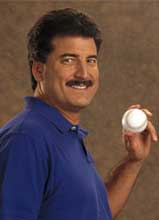 John Hernandez’s son Keith grew up to be one of the greatest defensive first baseman in major league history. Keith Hernandez’s 11 straight gold glove awards is a mjor league record. He also wan’t too shabby as a hitter either, leading the National League in hitting in 1979 with a .344 average at St. Louis. Keith Hernandez also was a leading force on two World Series ball clubs, the 1982 St. Louis Cardinals and the 1986 New York Mets. What a lot of people don’t know is that Keith Hernandez always used his dad as his anchor man coach for helping him straighten out anything that was getting in the way of his best game, and that assistance covers a lot of ground in this instance.
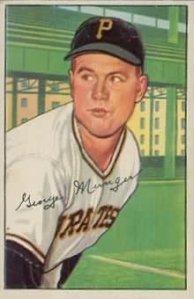
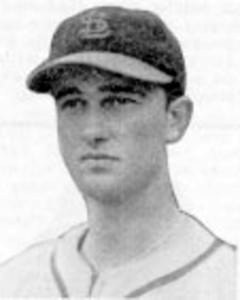
 We just returned last night from a two-day train trip to Lake Charles, but that’s a story for another day. This morning I want to tell you about another ex-Cardinal and former Buff pitcher who also just happened to be a good friend. His name was George “Red” Munger, a name that won’t be lost to the memories of anyone who was around during all those 1940s years of great Cardinal teams. Red Munger just happened to be a big part of that success. The native Houstonian and lifelong East Ender was smack dab in the middle of that zenith era in Cardinal history, even though he lost all of 1945 and most of the championship 1946 season to military service. Red still managed to return in time to make his own contributions to the Cardinals’ victory over the Boston Red Sox in the 1946 World Series.
 achieved some great, but unsurprising success in service baseball. He was just too good for the competition he faced at that rank amateur level. Once Red obtained his second lieutenant’s commission and was assigned to developing the baseball program at his base in Germany, he just stopped playing in favor of full time teaching. He even said that he had no heart for pitching or hitting against competitors who were too young, too green, and too unable to compete against him.
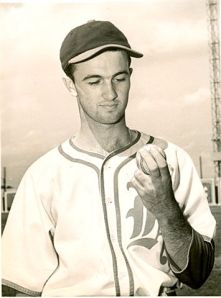
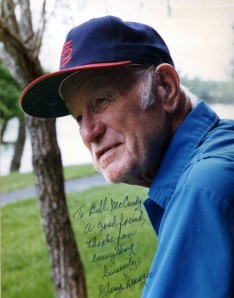 After baseball, Red Munger worked as a minor league pitching coach and also as a private investigator for the Pinkerton agency. He later developed diabetes and passed away from us on July 23, 1996 at age 77. I took that last picture of him in the 1946 Cardinals replica cap on a visit to his home, about two weeks before he died. Red gave me that cap that he wore in the picture at left on the same day. I have treasured it ever since.
 Red Munger enjoyed watching position players with strong arms and then imagining how effective they might be as pitchers. His favorite subject that last summer of 1996 was Ken Caminiti – and this was long before all the disclosures about Ken’s mind-altering and performace-enhancing drug abuse. Red Munger just liked the man as a gifted athlete. Caminiti fit the bill on what Red Munger was looking for in pitching potential. “Give me a guy with a strong arm and I can probably teach him the other things he needs to know about pitching. I can’t teach a guy how to have a strong arm – and as far as I can see, no one else can do that either beyond telling him to work out and hope for the best. As far as I’m concerned in the matter of good arms, you’ve either got one or you don’t.”
 From the late 1920s through the early 1950s, the St. Louis Cardinals operated a farm system that pretty much resembled the good and growing business of a fabled Hempstead, Texas watermelon grower. – Everything they harvested came out tasting sweet – with very little hassle from unwanted seeds.
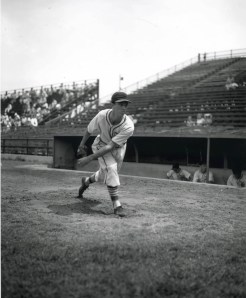 Back with Houston in 1941, the now 20-year old lefty showed that he had little left to prove in the minor leagues, even at his still tender age. In 1941, Pollet posted a 20-3 record for the Buffs and a league leading ERA of only 1.16. In all of Texas League history through 2008, only Walt Dickson’s 1.06 ERA, also posted with Houston back in 1916, beats the 1941 mark of Howie Pollet. Pollet also led the Texas League in strikeouts in 1941 with 151. The Buffs again won the Texas League straightaway race, this time by 16.5 games, but they lost in the first round of the playoffs for the Texas League pennant.
 After baseball, Howie Pollet returned to his adopted home of Houston and went into the insurance business with his former Buffs and Cardinals manager, Eddie Dyer. He even returned to baseball one year to serve as pitching coach for the Houston Astros. He was only age 53 when he died of cancer in 1974. Sometimes the good guys who arrive early also make an early exit. Baseball and Houston were the poorer from the early passing of the great Howie Pollet, but we’re glad we had him while we did.
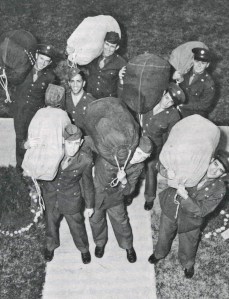 In the picture at left, that’s former Houston Buff and St. Louis Brown first baseman Jerry Witte toting his US Army duffel bag in the top center, back row position of the scene. Witte was merely one of hundreds of professsional baseball players who poured themselves into the business of fighting World War II from the very start of it all. The great Bob Feller was on his way to Cleveland to sign his 1942 playing contract with the Indians when the Japanese pulled off their sneak bombing of Pearl Harbor on December 7, 1941. Instead of signing another baseball contract, Feller took the first opportunity the very next day to join the Navy and the fight.
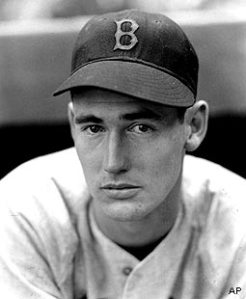 Joe DiMaggio and Bob Feller lost three seasons to World War II; Hank Greenberg (thanks to a correction supplied me by fellow SABR buddy Bob Kienzle of Dayton, Ohio) lost the better part of four and one-half seasons; Stan Musial only lost one year. Ted Williams, on the other hand, lost three seasons to World War II and almost all of two more years later when he was called back to fly combat fighter missions in Korea. You can play all day with the numbers on what they each lost to military service, but you know dadgum what? So did all our no-big-name parents and grandparents from everyday life who also put down their ploughs and welding rods at home to serve this country in wartime. They didn’t call them the “greatest generation” for any lighthanded reason.
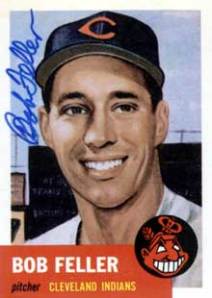 I recently saw Bob Feller at the July 31st “Knuckle Ball” in Houston. Nearing age 91, the man still possesses amazing energy and alertness. I think if you asked Bob Feller today how he felt about the baseball time he lost to World War II, he’d answer with something like, “I didn’t lose anything. I gave my time to my country when it needed me to be there on the fighting line for America.”
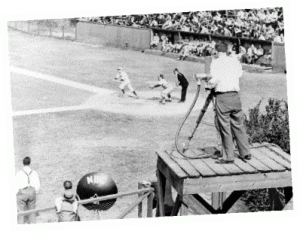 Televised baseball “ain’t” what it used to be – thank goodness! Ten years after the first televised big league game from Ebbets Field in Brooklyn in 1939, KLEE-TV, Channel 2 in Houston, our only televison station then operating locally during the pre-coaxial cable days introduced the first viewing of baseball to the few Houstonians who owned those early 10 inch screen console receving sets that sold for about $400 at places like the Bayne Appliance Store. That was a lot of money for a family to pay for television back in 1949, but it was Houston’s first year with the new medium and there were then, as now, people with both the money and ego that were large enough to buy one at the early inflated price. There were no easy credit line purchases back in the day.
 Bill Newkirk handled the first televised play-by-play at Buff Stadium of 1949 Houston Buffs games. He was assisted by longtime Buff, Colt .45, and Astro engineer Bob Green in generating those early productions. Newkirk was succeeded in 1950 by Dick Gottlieb of Channel 2, which by its second year had now been purchased by the William P. Hobby family and re-christened as KPRC-TV. Guy Savage, later of KTRK-TV Sports, Channel 13, also handled the play-by-play on a number of those early baseball telecasts from Buff Stadium.
 Houston, Baseball, & Other Musings.
 The Pecan Park Eagle