Posts Tagged ‘Baseball’

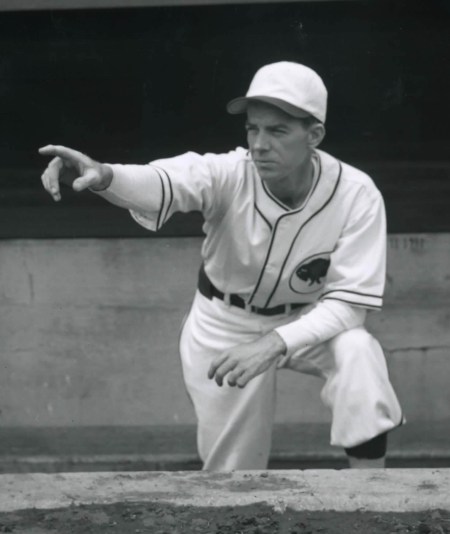
Who Is Brad Mills?

October 28, 2009
77bfe38295_bradmills2_10202009

BRAD MILLS: FRESH EYE ON AGING TEAM CULTURE.

When the Houston Astros announced yesterday that Brad Mills would be the new field manager of the club in 2010, I was more than OK with it. I would have been all right with either Phil Garner or Dave Clark too, but both of those guys, especially Garner, were insiders to the organization and may have suffered already from one condition that the new manager is going to have to deal with next season, one way or another. It might have been a lot harder for Phil Garner, whom many of the current players already know well from his very recent tenure as the most vertically successful manager in Astros history. Dave Clark may have had a better shot at it, but even Dave has already suffered from being the interim manager for what, eighteen games at the tail end of this past awful 2008 season? It wasn’t the kind of formula for imbuing a man with much authority on the near future screen and scheme of things.

The “it” factor here is the influence of certain key veterans upon the rest of the team as producers and clubhouse politicians. I’m talking here about the impact of Lance Berkman, Carlos Lee, and Roy Oswalt. What each of these stars do, and fail to do, matters greatly. These guys can lead the younger players to get behind a manager from the start – or they can just as easily, no matter how subtly they do it, send out a message of disrespect for a manager that spreads like a virus. And why not? After all, this has been “their” club for years – and they’re the guys who get paid the big bucks to make Houston a champion. Brad Mills may have played some third base, but he was no Mike Schmidt. Who is he to tell anybody in this family what to do?

Our Houston stars didn’t invent that dynamic. The resistance of elitists to control by others viewed as less qualified by talent and tenure is as old as the proverbial hills. It goes way back and way beyond baseball as one of the great destroyers of aspiring kingdoms and expiring dynasties. We just seem to have it at play in Houston baseball today, even though we’ve never won anything but a single National League pennant.

Let’s face it. The Houston Astros cannot win without good production from Lance Berkman, Roy Oswalt, and Carlos Lee. They also cannot win if these key veterans fail to support Brad Mills as manager. Everybody, including us fans, loses if Brad Mills doesn’t have a clue as to how important these three guys are to both team production and morale. Just as importantly, Brad Mills needs to come in with an honest strategy for gaining their confidence and support as early as possible. All three of these players are also smart guys – and should quickly see how important resolving this issue is to each of them and the club, as well. Pretending it doesn’t exist is both foolish and potentially fatal to future success in the National League.

That issue, my friends, is the one that 90% of the 2010 season now turns upon, in my humble opinion. Let’s all get behind Brad Mills and wish him and our Houston Astros the best outcome possible.

Eddie Dyer: Lots of Bang for Mr. Rickey’s Buck.

October 26, 2009

Eddie Dyer Iconic General Manager Branch Rickey of the St. Louis Cardinals had a three-pronged plan for helping himself. (1) He had a deal with club owner Sam Breadon. He got to keep a percentage of the net profits on the club’s operations, which meant, of course, that the less he paid out in personnel salaries, the more he got to keep for himself, as long as the club kept on winning. (2) He counted on the reserve clause and a loaded pipeline of talented players in the farm team system, players with no choice in baseball beyond the Cardinals, to keep him supplied with game-winning material. (3) He needed a few key people in the organization who were capable of doing more than one essential task at one time for the lowest salary he could work out with them for the price of a single employee’s salary.
Branch Rickey hit the jackpot when he met and signed a young pitcher/1st baseman/outfielder/baseball thinker/field manager/accountant/front office businessman named Eddie Dyer.

Born October 11, 1899 in Morgan City, Louisiana, Eddie Dyer’s family moved to Houston when he was still a kid, and he grew up among us as another “got here fast as I can” Houstonian with a talent and love for the game of baseball. After high school, he attended and played baseball at Rice, where he caught the attention of Branch Rickey and the Cardinals. This was around the same time that Mr. Rickey was surreptitiously taking control of the Houston Buffaloes for the Cardinals through a straw man purchaser for the sake of avoiding censure from Commissioner Landis, who thought that major league club control of minor league teams was bad for baseball.

Signed as a right handed pitcher, the Cardinals assigned Dyer to Syracuse of the International League to sharpen his skills.  Dyer’s progress was slow and mediocre. For the next five years, Eddie shuffled back and forth between the Cards and some of their top farm clubs, trying to break through as a more consistent winner. He seemed to be getting things together in 1927 when, again with Syracuse, he won his first six games before running into one of those life-changing events. An arm injury tagged Dyer with his first loss, but that was the small deficit. That 1927 arm injury ended Eddie Dyer’s pitching career.

From 1928 forward, Eddie Dyer became a Cardinals farm club manager, also continuing his playing career as an outfielder through the 1933 season he split between Greensboro and Elmira. Here’s where the Rickey touch/Dyer ability really started coming together. Wherever he went for the Cards as a manager, Dyer also served as business manager or club president – and all for the same money. What a deal!

In 1937-38, Eddie Dyer pulled leave as a manager, taking over in 1938 as Supervisor for Cardinal Farm Team Operations in the Southern and Southwestern Regions of the United States. He returned for three years (1939-40) as Manager of his home town Houstons Buffs . It turned out to be an impressively successful run, one that that would vault Dyer even higher up the Cardinal ladder of managerial plans in the years immediately following World War II. Dyer led the 1939-41 Buffs to three consecutive first place finishes in the Texas Leage, averaging 102 runs per season. His 1940 Buffs club also won the playoffs for the pennant, but then lost the Dixie Series to Nashville in five games. In 1942, Dyer moved up to the then AA Columbus (O) Redbirds of the American Association, finishing first and also winning the league pennant playoff series.

During World War II (1943-45), Dyer performed admimistrative duties for the Cardinals as Farm System Director in 1943 and then spent a couple of years (1944-45) taking care of his personal businesses in Houston. Then, when Cardinals Manager Billy Southworth suddenly departed St. Louis to take over the helm for the Boston Braves after the ’45 season, the wheel passed to Eddie Dyer to take over as Manager of the St Louis Cardinals in 1946. – What a timely move that turned out to be.

With all the big stars returning from military service, Eddie Dyer led the 1946 Cardinals to a first place tie with the Brooklyn Dodgers for the National League pennant. The Cardinals then took the flag by winning the first two games of  a best two of three games series with the Dodgers. They then faced off with Ted Williams and the Boston Red Sox in that “one for the ages” World Series in which Enos Slaughter’s “mad dash” run-scoring, game and Series-deciding tally from first base in Game Seven became one of the iconic moments in World Series history.

Dyer kept the Cardinals close again in 1947 and 1948, but lost out in the end as second place finishers to the Dodgers and Braves. When the Dyer-led Cards again narrowly missed in 1949, finishing only a game back of the Dodgers, things looked bleak. With Branch Rickey now guiding the Dodgers, the Cards no longer had the talent jam in their system that they once enjoyed. Dyer knew that too. He had worked every phase of the Cardinal operations over the years and really needed no “handwriting on the wall” to tell him what was coming soon. If anything, in fact, Eddie Dyer’s next actions were the writer of things to come for the St. Louis Cardinals.

After finishing the 1950 season in 5th place, Eddie Dyer resigned as manager of the Cardinals and retired to tend his considerable business interests in Houston. Dyer was involved in insurance, real estate, and oil. Marty Marion would take over as Cardinals Manager in 1951, but neither he nor any of the many who followed him would have the answer to winning it all again anytime soon. The Cardinals would not win another World Series until another Houstonian, Johnny Keane, got them there for that thrilling seven-game triumph over the New York Yankees in 1964.

Eddie Dyer’s retirement years in Houston were productive – and presumably content. Sadly, Eddie Dyer suffered a stroke in 1963 and then passed away in Houston on April 20, 1964 at age 65. Part of his legacy will live on as a tribute to Branch Rickey. The great Branch Rickey couldn’t have done it quite as renumeratively in baseball without the help he received from people like Eddie Dyer, but, of ourse,  it took a man like Rickey to recognize from early on what he had on his hands in the kid from Houston that he signed out of Rice (now University) Institute back in 1922.

Rookie Alex Schmelter Leads Houston Babies to Twin Bill Sweep of Richmond Giants, 13-7, 5-2!

October 25, 2009
ON A DAY LIVED IN HEAVEN, BABIES SWEEP GIANTS, 13-7, 5-2.

ON A DAY LIVED IN HEAVEN, BABIES SWEEP GIANTS, 13-7, 5-2.

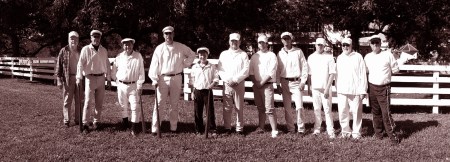
It was a great day for autmnally roaring vintage base ball at the  George Ranch yesterday as the Houston Babies squared off against the local Richmond Giants yesterday, October 24, 2009. Only the date claimed anchorage in the 21st century. Everything else suggested that we had all, finally and at last, found our way through that time warp into the 19th century romper room of baseball’s infancy as the national pastime, when it was a game played without gloves and with abundant fortitude for the contest that needed two words, “base ball,” to describe itself.

SKIPPER BOB DORRILL'S MODEL T STYLE SUITS BABIES TO A T!

SKIPPER BOB DORRILL'S MODEL T STYLE SUITS BABIES TO A T!

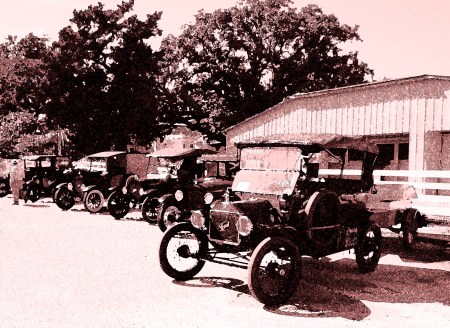
 Some Babies players arrived for the 10:30 AM scheduled twin bill with the Giants by automobile. They parked their vehicles with the same kind of finely-tuned precision and machine-powered mechanization that goes into their approach to team-victorious vintage 19th century base ball – when no one had even heard of a Model T and most simply laughed at the concept of a horseless carriage!

NEVER LOOK BACK. SOMETHING MIGHT BE GAINING ON YOU.

NEVER LOOK BACK. SOMETHING MIGHT BE GAINING ON YOU.

Four of ten members who attempted coming by bicycle out the Southwest Freeway also arrived, but we’ll take a .400 arrival percentage any day of the week and twice on a perfect Saturday Game Day in October. We tried to get our cyclists, especially, to heed the wisdom of the wonderful Satchel Paige about the danger of looking back. Too bad about the deep sixers we lost. We simply feel fortunate that 40% actually did heed the warning . Had we lost those four players too, we would have faced the perils of renegotiation on our double game contract and possible forfeiture to the Richmond club.
"HAVE YOU HEARD THE GERMAN BAND?" ... EXCERPT FROM "THE PRODUCERS"

"HAVE YOU HEARD THE GERMAN BAND?" ... EXCERPT FROM "THE PRODUCERS"

Our Houston Area Vintage Base Ball Commissioner, Wee Willie Kaiser, showed up with the missus, the ever sweet and smiling Wilhemina Kaiser, to boost morale and offer his support for the old time ball movement in our region. Commissioner Kaiser is hot on the trail of sponsorship money for new uniform and team equipment, but, so far, he’s only come up with enough cash to pay for the splendid outfit he wore to yesterday’s Babies@Giants twin bill. When asked yesterday how he could justify spending our limited funds on himself, Kaiser replied, “What are you talking about? I have to look presentable when I go calling on potential investors, don’t I?’ We doubt that salty answer will fly far or settle all disgruntlement, but we’ll stay on it for future developments.
A 6 FOR 8 DAY AT THE PLATE & SPARKLING DEFENSE EARNED MVP HONORS FOR ALEX SCHMELTER!

A 6 FOR 8 DAY AT THE PLATE & SPARKLING DEFENSE EARNED MVP HONORS FOR ALEX SCHMELTER!

The 13-7, 5-2 victories by the Houston Babies yesterday over the Richmond Giants  increased the club’s all time 21st century record to 6-3, as Manager Bob Dorrill also picked up his 6th straight win as the undefeated manager of Houston’s most time-honored base ball club. The Babies came out of mothballs in 2008, but proceeded to lose thieir first three games in 120 years of suspended play by mistakenly taking the field and playing by commitee. Things are much better now with the even keel headed Dorrill at the helm. The man both inspires and steadies the boat ride to happy destiny of vintage baseball triumph.
 
Bob Dorrill can also thank his grandson for a lot of yesterday’s outcome, as well. 13 year old Alex Schmelter accompanied his grandparents, Bob and Peggy Dorrill to George Ranch yesterday, perhasp, never dreaming that he had a job to perform on the field as well. Well, when we lost those six turned-their-heads cyclists, we needed all the help we could get. Little Alex Schmelter gave the Babies all the hlp they needed and then some. Playing nd base and batting clean up, Alex went 6 for 8 on the day with 2 runs scored and 2 runs batted. He also handled the ball well in the field, getting some key outs and participating in a couple of successful rundown plays. For his efforts,  Alex Schmelter was named Most Valuable Player (MVP) of the entire day by his Babies teammates. What a fine young man and ballplayer this kid is turning out to be. His parents and grandparents have every right to be very proud of him.
FOR ALEX SCHMELTER, IT WAS A TECHNICOLOR MEMORY OF HITTING!

FOR ALEX SCHMELTER, IT WAS A TECHNICOLOR MEMORY OF HITTING!

BOB "DOUBLE DUTY" BLAIR PITCHED AND WON BOTH GAMES!

BOB "DOUBLE DUTY" BLAIR PITCHED AND WON BOTH GAMES!

 In addition to the outstanding spark the Babies got from young “Alex the Great,” our venerable righthanded “Iron Man,” Bob Blair pitched another games down the corridor of his own personal journey into the Houston Babies Hall of Fame. Blair held the normally hit-raining bats of the potent Richmond Giants to a mere drizzle on the mound in both games, for two more wins on his vintage ball bats. If memory serves, Balir has been the winning pitcher in four of the six games captured by the Babies. He probably could have had them all, but had to miss  one of our victorious twin bills a while back. Also, although Bob doesn’t see himself as a hitter, he went 3 for 8 with 2 runs scored on the day and made some meat-slapping stops on liners up the middle on defense. Keep it up, Mr. Blair. McGinnity of the old New York Giants has nothing on you as a contributor to team excellence.

Here’s how the recorded Babies lineup fared yesterday, and special thanks to Brigitte Blair for keeping score and providing us with this data:
(1) Bob Blair, p (3 for 8, 2 runs)
(2) Jimmy Disch, c (2 for 8, 1 run)
(3) Larry Joe Miggins, 1b (6 for 8, 4 runs)
(4) Alex Schmelter, 2b (6 for 8, 2 runs)
(5) Bill Hale, 3b (5 for 8, 2 runs)
(6) John Civitello (6 for 7, 3 runs)
(7) Eric Blair, lf (4 for 7, 2 runs)
(7a) Nate Who, lf (1 for 1, 1 run)
(8) Robert McArthur, cf (4 for 6, 2 runs)
(9) Bob Stevens, rf (1 for 6, 0 runs)
(9a) George Osborne, c (o for 1, 0 runs)
 
 
Eric Blair shined in left field, stopping many a long hit with straight on and one bounce out catches. John Civitello was the toughest out of the day, proving again that those dyed-in-the-wool  Connecticut boys take to base ball like kids take to candy. Bill Hale earned the Fearless Fosdick Award for handing some of those fierce body-hole-piercing drives down the third base line. Robert McArthur and Bob Stevens manned the other two cow pastures most ably, never allowing a Giant home run to survive on the trail and spoil the day. Larry Joe Miggins was a human baseball trap at first base, and he ended up the day with the red stinging hands to prove it. Last, but not least, Jimmy Disch called a masterful game behind the plate for Bob Blair, and he never came close to a Ray Fosse experience with any of the rosy running big boys of the Richmond Giants arsenal.
WHEN JIMMY DISCH SCORED, IT TURNED ON THE TECHNICOLOR!

WHEN JIMMY DISCH SCORED, IT TURNED ON THE TECHNICOLOR!

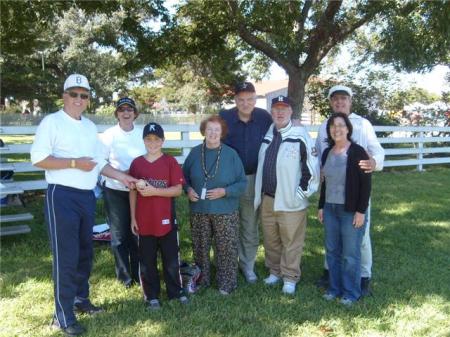
alex mvpAlex Schmelter (above) received the MVP from his grandad, Babies Manager Bob Dorrill, as Grandma Peggy Dorrill looked on over his right shoulder. Also in the photo, left to right, are Kathleen and Larry Miggins, the former Cardinal and Buff, Babies General Manager Bill McCurdy, plus Bob “Double Duty” Blair and his wife, our Babies scorekeeper, Brigitte Blair. 

LARRY MIGGINS & FAMILY WERE THERE TO CHEER THE BABIES TOO!

LARRY MIGGINS & FAMILY WERE THERE TO CHEER THE BABIES TOO!

Former St. Louis Cardinal and Houston Buff Larry Miggins was there yesterday with his lovely wife Kathleen. We see them pictured above with their son and daughter in law, Mr. and Mrs. Larry Joe “Long Ball” Miggins. The Miggins family are  the keepers of the flame on the memory and signifiance of the Dick Dowling  statue in Hermann Park – and that has been true  for forty years. If it were up to me, I would appoint Lerry Miggins as the Patron Saint of Houston’s Baseball Heart too. He’s that purely dedicated to both the science and the poetry of the game. When I asked Larry yesterday how much he enjoyed his first trip to George Ranch to watch vintage base ball, his answer was swift, simple, and unecumbered by any need for interpretation. “I think we’ve all died and gone to Heaven,” Larry answered, with that always Irish smile in his voice.
EVERYBODY WAS HAPPY!

EVERYBODY WAS HAPPY!

AND IT REALLY WAS A BEAUTIFUL DAY IN BASE BALL HEAVEN!

AND IT REALLY WAS A BEAUTIFUL DAY IN BASE BALL HEAVEN!

Next time we have one these playing dates, especially if it’s at the  beautiful George Ranch, come on out and play with or watch the Houston Babies in action. Our club is a slice of Houston living base ball history and it is most deserving of your support. You’ll be doing yourself and Houston baseball history too by hooking up with our little tribe of baseball, Houston, and history lovers. Of course, if you want to help us sponsor the purchase of our own authentic Houston Babies uniforms, that will free us from having to borrow the used duds of the Montgomery County Saw Dogs every time we play.  If you are interested in sponsoring the Houston Babies, seriously, please contact Babies Manager Bob Dorrill at 281-361-7874.


The Houston Babies: Playing with Heart Since 1888!

Johnny Keane: A Manager for (Almost) All Seasons.

October 22, 2009


Born November 3, 1911 in St. Louis, Johnny Keane accepted his first minor league managerial job just prior to the start of World War I. – No, wait! – It wasn’t really that early. It just Johnny Keane 02 seems that way. His 17-year minor league playing career (1930-41, 1946-48) as a pretty good hitting middle infielder, however, quickly revealed an even greater talent for leadership. At age 26, Keane was awarded his first managerial assignment from the parent Cardinals as Manager of the Class D Albany, Georgia Travelers. Johnny promptly rewarded the Rickey organization’s judgment of him by reeling off two consecutive first place league pennant winners in Albany in both 1938 and 1939.

Over the course of his 17 seasons as a manager in the St. Louis Cardinals minor league system (1938-41, 1946-58), Keane won 4 league championships and lost 8 other playoff appearances.  He had a losing record in only 5 seasons. His winning touch in the minors (1,357 wins, 1,166 losses) finally won him a place on the coaching staff of the Major league Cardinals in 1959, where he remained until he replaced Solly Hemus as manager on July 6, 1961. It is a note of irony that Solly Hemus had first played for Johnny Keane when the latter led the 1947 Houston Buffs to the Texas League title and Dixies Series championship.

In Johnny Keane’s fourth year at the Cardinal helm, he came under fire as the Cardinals seemed to be fading in the stretch of the 1964 National League pennant race. It soon became the worst kept secret in town that the club planned to bury Keane’s St. Louis managerial career at year’s end.

A funny thing happened on the way to the funeral.

With some considerable help from Phillies manager Gene Mauch and his misuse of pitchers, the NL’s 1st place Philadelphia club pulled the arguably biggest el foldo job in history over the last two weeks as the Cardinals got hot neough to catch them at the wire for the National League pennant. Now the talk of firing Keane went dark as he then led the club to an exciting seven-game World Series victory in 1964 over the fabled frequent Big Show flying New York Yankees.

Now, before Cardinals owner August Busch could disengage his foot from the brake pedal on a policy reversal and offer Keane a new contract extention with the Cardinals, the New York Yankees and Johnny Keane had a notice of their own, one that called for a quick media conference.  The Yankees announced that they were firing Yogi Berra and hiring Johnny Keane as their new manager for 1965.

I suppose Keane found some revenge for the Cardinals’ lack of faith in him through this move, but further validation of his abilities as a mentor would be unavailable in New York. The talent bank at New York was pretty much bankrupt by 1965 as the once great Mickey Mantle played out in emptiness the four bad last seasons of his career. They were the years that never should have been. All Mantle did from 1965 to 1968 was roughly drop his career batting average below .300 lifetime while adding a few meaningless home runs to his already assured Hall of Fame career, but Keane would not be around long enough to see even half of that period of demise.

After leading the Yankees to a 77-85 record and 6th place finish in 1965, Keane and the Yankees got off to a horrendous 4-16 start in 1966, prompting yet another exercise in the Yankees’ quick trigger finger response policy. On May 7, 1966, the Yankess fired Johnny Keane, replacing him with former Yankee manager Ralph Houk.

Johnny Keane’s managerial record had come to an end at sge 54. He went back to his home in Houston  and private business, but that didn’t last long. On January 6, 1967, Johnny Keane suddenly passed away from a heart condition at age 55. Whoa again! Less than three years after winning the National League Manager of the Year Award, Johnny Keane was gone.

Johnny Keane was loved by the old time baseball community members in Houston who remembered him as either a fellow player or manager. I use the past tense here because most of those who remember Johnny Keane are also now gone. He was a long-time winner with a quick and fast memory for what appeared to him as acts of short term, underhanded disloyalty.

As a manager, Johnny Keane did the five things that I think any winning manager must do: (1) he was a good judge of talent; (2) he managed his pitchers well; (3) he treated his players with respect; (4) he publicly covered for his players; and (5) he took responsiiblity for the outcome of his own decisions. He apparently did not, however, adjust to the change in cultures he experienced when he moved from the Cardinals to the Yankees. As a disciplinarian, his style worked with Cardinal youngesters and veterans there who knew him well. When he moved to New York, however, the proud Yankees did not like the little man who apparently came there to tell the proud Yankees what to do. The Yankees read his authoritative style as disrepect for their proud heritage and ability. Going from the laid-back style of Yankee legend Yogi Berra to the more militant mode of outsider Keane didn’t help matters either. Besides, many of the Yankees felt that Yogi had gotten a raw deal in the post-1964 World Series firing and weren’t about to be open to taking on the man who had defeated them as the Cardinal mentor. As a result, Johnny Keane either never had or quickly lost control of the Yankees in 1965. There was no way that the situation could hold up for a second full year after the club’s horrible 1966 start.

Johnny Keane’s signature was one of the few autographs I ever collected directly as a kid. It was about 1950 and Keane was actually playing in one of those post-season “All Star Games” that President Allen Russell liked to stage at Buff Stadium. Keane and some of his random teammates were having a beer in the clubhouse at game’s end when they opened the door for us kids to greet the players coming out. All I had was a scoring pencil so I grabed a loose paper cup and tore it open flat for Johhny to sign, which he did. – Wish today I had saved it. I used to think back in 1947 that Johnny Keane was the smartest man in the world and, who knows, maybe he was.

Johnny Keane had an ancient Buffs connection. He played a few games for the 1934 Buffs, then returned for three full seasons as a player from 1935-37, batting .265, .272, and and .267. He even had a few times at bat during his three (1946-48) managerial years with the Buffs. Somewhere along the way, Johnny Keane fell in love with Houston and made it his adopted home town – and I’m glad he did. I just wish he could’ve hung around longer, but it was not to be.

Willard Brown: A Late-in-the-Day Buff!

October 20, 2009

Willard BrownWillard Brown was one of those older, out-of-the-shadows players who glanced his way through organized baseball during the early days of its desegregation. He got there in time to leave one very indelible mark, but not early enough to use all of his abilities in their prime form, and not late enough to find any real place for himself in the major leagues among a more receptive crowd of accepting white teammates. No indeed. An older Willard Brown got there playing for a team that still overflowed in 1947 with some old school white racists.
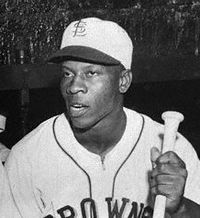
Born on June 26, 1915 in Shreveport, Louisiana, Willard Brown grew up playing and loving baseball. He even got to spend some time as a kid serving as bat boy for the Kansas City Monarchs while they went through spring training in Shreveport. By 1934, the 19 year old hustling, power-slugging outfielder signed to play for the Negro Minor League Monroe (LA) Monarchs His progress quickly pulled him up the ladder. By 1936, he signed to play for the Negro Major League legends, the Kansas City Monarchs. Brown played continuously for the KC Monarchs from 1936 to 1943, establishing himself as the most prolific home run hitter in Negro League history, exceeding even the feats of the better known slugger, Josh Gibson. Gibson, in fact, was so enamored by Brown’s power, that he gave him the nickname of “Home Run” as the word-tarp on his baseball identity. Brown also hit for a high average during this early period, posting marks in the mid .340-.350 range.

Brown returned to the Monarchs in 1946, picking up where he left off. Early in the ’47 season, however, Brown received an offer from organized (previously all white) baseball to become one of the first two black players to join the roster of the old St. Louis Browns of the American League. (For those who don’t know, the Browns moved to Maryland in 1954 where they continue to play baseball by their rechristened name, the Baltimore Orioles.) In July 1947, Willard Brown joined fellow Negro Leaguer Hank Thompson as the first two blacks to play for the St. Louis Browns. Sadly, the two black pioneers were not exactly welcomed with open arms by some of the white Brownie players. When Willard Brown borrowed a teammate’s bat and then quickly belted out an inside the park gapper for the first home run of any kind in the American League by a black player, the white player who owned the bat was supposedly so enraged that he destroyed the bat to keep Brown from using  it again. I can neither recall nor easily find the name of the offended white player who allegedly acted out this stupid play of self destruction, but, if you know for certain who it was, please add that information below as a comment on this article.

As for the act itself, stupid is as stupid does, I guess. In my book, there’s nothing dumber than the behavior that follows from the minds of those who act impulsivlely upon the feelings spawned by raw, ignorant racism.

Almost needless to add, Willard Brown was a most unhappy camper in the company of a team that wallowed in losing and racial contempt. After U841883ACME hitting .179 in 21 games with the Browns, Willard Brown left the big leagues and returned to the familiar confines of his more comfortable life among the Monarchs in Kansas City. That winter of 47-48, Brown went to Puerto Rico and batted .432 with 27 homers and 86 RBI in only 60 games, earning for himself yet another nickname as Ese Hombre or – “That Man”.
Brown won the Puerto Rican Winter League Triple Crown during the 1949-50 season. He also produced his only “hit for the cycle” game of his career somewhere around this period. Brown also hit .374 for the ’48 Monarchs, producing one of his best-ever seasons, even at this late date in his career.

By 1950, the 35-year old Brown was ready to play out the rest of his days again in organized ball, and this time, most of his tenure would be invested in the Texas League. After hitting .352 for Ottawa of the Class C  Border League in 1950, Willard sort of quasi-retired, hitting a short-time .167 for Jalisco-Nuevo Laredo of the indepemdemt Mexican League in 1951.

After staying away in 1952, Brown joined Dallas of the AA Texas League in 1953 and promptly hit .310 with 23 HR and 108 RBI over the whole year. In 1954, Brown started for Dallas, but was then dealt to the Houston Buffs during the summer, batting .314 with 35 homers and 120 RBI for both clubs over the season. Playing right fielld and slugging like the big stick he always was, Brown joined forces with Ken Boyer and Bob Boyd to lead the Buffs to the 1954 Texas League championship.

Brown returned for another year as  a Buff in 1955, hitting .301 with 19 HR and 104 RBI. He followed that season by hitting .299 with 14 HR and 73 RBI at Austin, San Antonio, and Tulsa of the Texas League. Brown dipped down to Class A Topeka for one final year, batting .294 with 3 homers and 14 RBI in 1956. Over the course of his five minor league seasons (1950, 1953-56), Willard Brown did better than OK for a man playing it out from age 35 to age 41. He batted .309 with 95 HR and 437 RBI during that late-in-his-baseball-life era, and that’s some pretty fair country hitting for anyone playing pro ball at any age.

Aftter baseball, Willard Brown retired from baseball to his adopted home in Houston where he worked as a steeler until his retirement from all work. He had an apparently happy life in retirement, staying in touch too with several of the guys he called teammates, foes, and friends from his Texas League days.  Sadly, he slipped into Alzheimers Disease in 1989.

Willard Brown passed away in Houston on August 4, 1996. He was 81.

On July 30, 2006, Willard Brown was one of twelve former Negro Leaguers who were posthumously inducted into the National Baseball Hall of Fame at Cooperstown.

Some Great Team Names.

October 18, 2009

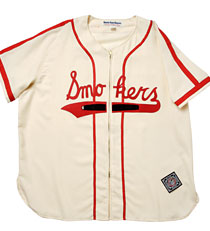
Tampa SmokersAmong all the great controversial names ever assigned to minor league baseball clubs, I have to go with the Tampa Smokers as my all time favorite venture into the future of political incorrectness. Of course, it came about in the early twentieth century, during the era in which Tampa, Florida was reknowned for its cigar products, but that kind of explanation probably cuts little ice with the 2009 Surgeon General or his/her legion of anti-smoking lobbies. As a puritanical culture, we still aren’t that forgiving of people found guilty of past addictions, even those that once held their ground as the social norm. I was a smoker for a long, long time, and although I wouldn’t recommend it today to any young person that wants to save his or her lungs, I never became one of those holier-than-thou ex-smokers who enjoyed either beating-up-on or lauding-my-abstinence-over those folks who still smoke. Anyone who really ever went through breaking the tobacco habit, I think, will not soon forget what it was like to be trapped there. It was the toughest bad habit that I ever had to break, bar none, and I didn’t get out early, easy, or without God’s Help. That’s how I see it, anyway.
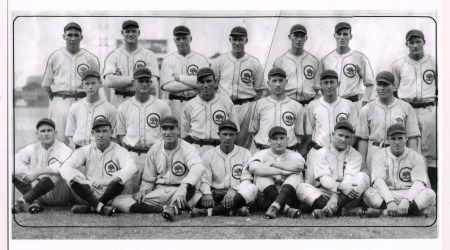
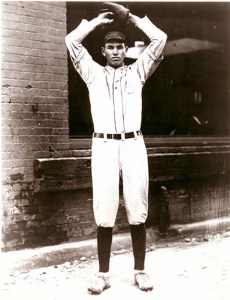
 I also recall my two earliest social models for smoking in the first place: (1)  The Blue-Purple Haze Belchers included all those fans at Buff Stadium who laid out that blanket of haze from the stands to the field on a windless summer night; and (2) The Holy Smokers, all those men, including my own dad, who raced to the front door of church each Sunday morning after Mass for the sake of starting a cigarette-smoking bonfire outside the building’s front steps. In the end, I hold only myself responsible for getting into smoking. It was only when, years later, and because of God’s Power and my willingness to change that Divine Intervention got me out from under the blue haze of a lifetime smoking habit. Now I’m just grateful it happened, even though I know it would still be so easy to go back to a nicotine-addiction pull that some say is stronger than crack cocaine. One day at a time, with God’s Help, that won’t happen.

Those were the days, my friend! Oh, and let’s just get back to baseball nicknames. In case you’re wondering, that Tampa Smokers jersey, and many others,  is still available to fans through a little company called Ebbets Field Flannels. I have no personal stake or profit interest in “EFF” beyond the fact that I have been a customer in the past, but I think you may find their offerings of interest. The website link is http://www.ebbets.com/

At any rate, here are a few of  my other favorite great names in minor league baseball. Some are there because they are iconic. Some rank up there on my personal favorite list. And others are simply there because they struck me as amusing. You may have some of your own. If you do, please feel free to list them as comments on this article. The more the merrier.

Some of My Favorite Great Minor League Team Names: The Durham Bulls, Hollywoood Stars, New Orleans Pelicans, San Francisco Seals, Sioux Falls Canaries, Sweetwater Swatters, Wilson Bugs, York Prohibitionists, Racine Malted Milks, Hannibal Cannibals, Vancouver Horse Doctors, Kalamazoo Kazoos, Waterbury Frolickers, Grand Forks Flickertails, Albany Nuts, Moose Jaw Robin Hoods, Salina Insurgents, Jackson Convicts, Victoria Rose Buds, Muscatine Buttonmakers, San Jose Prune Pickers, St. Paul Apostles, Freeport Pretzels, Zanesville Infants, Bridgeport Orators, Chattanooga Lookouts, Houston Babies, Toledo Mud Hens, San Antonio Missions, Beeville Bees, Hammond Berries, North Wilksboro Flashers, Saginaw Wa-Was, and, last but not least,  the always  unforgettable Orange Hoo-Hoos.

My All Time Favorite Minor League Team  Name: (What else?) The Houston Buffaloes/Buffs.

Don’t forget to add your own favorites in the comment section below.

The Great 1931 Houston Buffs!

October 17, 2009

1931 Buffs

The Houston Buffs won 108 games in 1931 on their way to capturing first place by 14 games over runner-up Beaumont. Only the 1922 and 1924 Fort Worth Cats ever won more games in a  single Texas League season. The Cats did it by posting 109 wins in each year of those two championship seasons.

Popularly selected as #42 on the list of Minor League Baseball’s 1oo Greatest Teams, the ’31 Buffs were the cradle of several players who would soon after go star as the backbone of  the 1934 World Champion St. Louis Cardinals, the club that becamebetter  known to entire baseball world as The Gashouse Gang. Few have forgotten the names and major league feats of pitcher Dizzy Dean and outfielder Joe Medwick – and only a handful more need to be reimnded all these years later of the pitching star that was Tex Carleton. It still doen’t hurt, every now then, to recall all the major parts of the whole that went into the making of a champion, so today, we bring you a brief look at the 1,starting lineup and star pitchers of the 1931 Buffs:

Starting Lineup

Ed Hock, 3b (age 32, BL/TL, .299, 0 HR, 42 RBI): The speedy Hock was an anomaly, a rule-breaker that few of us have seen in our lifetime, a lefthanded throwing third baseman. I even have trouble simulating a vision of Hock making routine plays in my mind. Oh, I can see him diving toward the line pretty well to stop balls headed down the line, allright; I just can’t see him getting up and making a throw to first. Hock made 31 errors for Houston in’31 and he had a .936 fielding average. When he first switched from outfield to shortstop at Oklahoma City in 1925-26, Hock made 74 and 68 errors consecutively, so, I guess his fielding record at Buff Stadium in 1931 marks improvement.

Carey Selph, 2b (age 29, BR/TR, .322, 3 HR, 88 RBI): Selph posted the Buffs’ second highest average. His ability to hit for average and in the clutch with men on base was a key to the ’31 championhsip season. He also had good range on defense and showed a native ability for knowing what to do in the field. In other words, Selph was “baseball smart.”

Homer Peel, lf (age 28, BR/TR, .326, 7 HR, 95 RBI): Peel finished with the highest team batting average. His ability as a contact hitter paired with Selph in producing baserunners and clutch hitting with other ducks on the pond.

Joe Medwick, cf (age 19, BR/TR. .305, 19 HR, 126 RBI): This guy was ripped long before anyone ever heard of LA Fitness and, in 1931, he had the glow of future stardom written all over him. Medwick led the Texas League in both homers and runs batted in during the ’31 season. He almost got stuck with the nickname “Muscles” until a female fan wrote Houston Post sportswriter Lloyd Gregory that she loved Medwick, even if he did walk like a duck. She even admitted to thinking of him as “Ducky” Medwick. Gregory agreed with the lady and published the story of Medwick’s new name.. He also started describing the young phenom as Ducky Medwick in his game stories. – It stuck. The rest is history.

Guy Sturdy, 1b (age 32, BL/TL, .295, 3 HR, 49 RBI): Sturdy was “Old Reliable” on defense at the most-outs bag and a steady bat in the lineup.

Earl L. Smith, rf (age 40, BB/TR, .272, 1 hr, 19 RBI): Only played 67 games before moving up to Columbus. He was replaced by Jim Sanders, who also subbed for Medwick in center on rare occasion.

Jim Sanders, rf-cf (age 29, BL/TL, .278, 1 HR, 40 RBI): Taking over for Smith, Sanders was a veteran minor leaguer who hit pretty well and did no harm in the field.

Hal Funk, c (age 31, BR/TR, .254, 1 HR, 50 RBI):  Funk’s major contribution was his ability to handle and get the most out of a very young Dizzy Dean, but the other pitchers liked him as well. How many times do we see a championship club that doesn’t have a catcher who holds the confidence of a talented, but sometimes temperamental pitching staff? I can’t think of too many.

Tom Carey, SS (age 24, BR/TR, .240, 2 HR, 36 RBI): “Good Field/Mediocre Hit.” Yuong Carey got the job done in the field, anchoring the middle infield defense well in tandem with the more veteran Selph.

Pitchers:

DeanDizzy300 Dizzy Dean (age 21, BR/TR, 26-10, 1.53 ERA): Dizzy was brilliant and Houston loved him. His 26 wins and 303 strikeouts led the Texas League in 1931 and his 1.53 ERA tied him with Whitlow Wyatt of Beaumont for the lowest mark in the league.
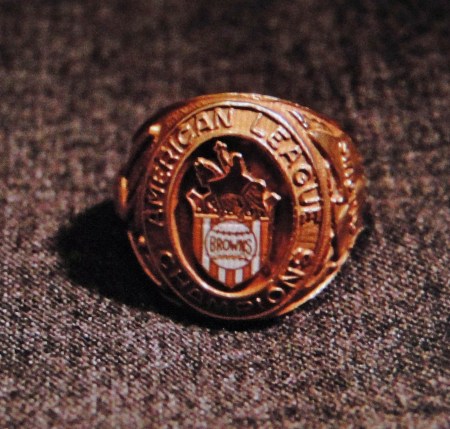
George Payne (age 42, BR/TR, 23-13M 2.75).

Tex Carleton (age 25, BB/TR, 20-7, 1.90 ERA).

Elmer Hanson (age 36, B?/T?, age 36, 16-7, 1.81): I seem to remember a newspaper article that described Fowler as a righthander, but I cannot be sure.

Jesse “Pete” Fowler (age 32, 15-8, 2.40).

The above five pitchers accounted for exactly 100 of the Buffs’ 108 wins in 1931. Eight Buffs were subsequently named to the 13-man end-of-season Texas League All Star Team. These included: pitchers Dean, Payne, and Carleton, plus position players Self, Hock, Peel, Medwick and Funk.

In the end, the pitching,  hitting,  and defense was certainly good enough to carry the ’31 Buffs to complete victory under manager Joe Schultz, but the club fell a game short, losing the seventh game of the Dixie Series to the Birmingham Barons after sailing through the Texas League straight away championship  and then winning the Shaughnessy Playoffs for their well-deserved pennant.

Sometimes the best of teams can’t win ’em all because some other club happens to be better at a given moment in time. And when that moment in time happens to be Game Seven of the last series in the season, for better or worse, destiny takes a hand.

We’ve a long history of surviving this kind of disappointment in Houston and we will never give up the belief that is always inspired by a great team like the 1931 Houston Buffs: Our day will come!

A Tale of Two World Series Rings.

October 16, 2009

I’m not really sure when major league baseball clubs started handing out World Series rings to the members of their winning teams, but I do recall reading somewhere  that the 1927 New York Yankee players received special wrist watches for their slightly other-planet accomplishments. By the 1940’s, however, the practice of awarding especially designed World Series rings had taken over, and probably had been in place for several years.

Circumstances recently put me in contact with images of two different rings from two very different eras. The pictures speak fairly well for themselves about one measure of how much things have changed over the time.WS RING SLB 1944

The above shot of a 1944 St. Louis Browns World Series ring came to me from Wayne Williams of Colorado, one of my friends in the St. Louis Browns Historical Society. Wayne got it from a guy who somehow acquired it somewhere in the wide, wide world of memorabilia collecting. It supposedly belonged originally to the team doctor. The gold ring bears the Browns’ crest and it contains no rare jewels on its scaled-to-everyday-wear sized body.  The Browns lost the ’44 World Seris to their hometown rival Cardinals, four games to two. The ring was properly inscribed for what it was, an “American League Championship” ring. Since the Browns only won this single time over the entire course of their 52-year history (1902-53), the 1944 ring is especially meaningful as the triumph of patience over self pity.

2008 Philadelphia Phillies World Series Ring

2008 Philadelphia Phillies World Series Ring

WOW! Look at that recent Phillies World Series ring on my finger in the above photo! My hands aren’t that big, but the size of this thing made me feel like a Hobbit or something. The ring belongs to Gene Diaz, Director of Media Relations for the Houston Astros. Gene was a long-time employee of the Phillies organization before accepting the upgrade spot he now holds down for the Astros. Gene brought the ring with him to a presentation he made at  our September 2009 SABR meeting downtown at Molly’s Pub. In contrast to the “plain and simple” Browns ring, the Phillies ring brings new color and definition to the phrase “big and fancy.” It’s golden oversized body feels more like a bowling ball that you soon wish to put down before it takes your whole arm away, but it glitters while you wait for relief. I think it contains 103 diamonds, one for each of however many games the Phillies actually won in 2008. -What do they do to top this thing if the Phillies win it all again this year?
 
What if these two clubs actually squared off against each other at Time Warp Field to play a World Series against each other? We’d have that delicious match up that nobody ever dreams of, the 1944 Browns versus the 2008 Phillies! – Oh well! Based upon ring design differentials, and what we can  know of speculatively about a pairing of these two clubs from a talent standpoint, I would venture this prediction about the outcome of a best four of seven Series:
 
Blingville 4 – Bluesville 0.

Murderers’ Row: The ’27 Yankees.

October 15, 2009

Yankees 27 003

Above (Left  to Right): Miller Huggins, Manager; (1) Earle Combs, CF; (2) Mark Koenig, SS; (3) Babe Ruth, RF; (4) Lou Gehrig, 1B;  (5) Bob Meusel, LF; (6) Tony Lazzeri, 2B; (7) Joe Dugan,  3B; (8) Pat Collins, C; Herb Pennock, P.

In my mind, at least, they are the unarguably most legendary, fabled, iconic, colorful, and especially productive baseball team in all of major league history. Whether you like the New York Yankees or not, it’s hard to argue that any team anywhere ever bore more lustre and bluster than the 1927 version of the Bronx Bombers because, simply put, the team dubbed rightly so as Murderers’ Row is the only one that ever featured an out of this world one-of-a-kind slugger in his prime named George Herman “Babe” Ruth.

I’m not suggesting that the Babe Ruth of 1927 would certainly out-produce a guy like Albert Pujols if the former were teleported to 2010 with all of the talent he possessed in 1921 or 1927 intact, but I wouldn’t bet against it either. If the Babe had to adjust to the baseball culture of this early 21st century era, I’m betting he could do it, even if he had to spend these winter months at the Betty Ford Clinic getting ready for 2010, but that’s all speculative and unprovable.

Yankees 27 002 What is demonstrable is the fact that Ruth accomplished things in 1927 that no other hitter, including Prince Albert, could ever hope to top. 1927 was the season that Babe Ruth broke his own season home run record by hitting number 60 on the last day of the season. It was a  record that turned the digit “60” into an iconic number for baseball’s most glamorous power statistic, and, thirty-four years later,  it converted 61* (asterisk included) into the new record for Roger Maris, who needed 162 games to best by one homer what Babe Ruth had done in 154 contests.
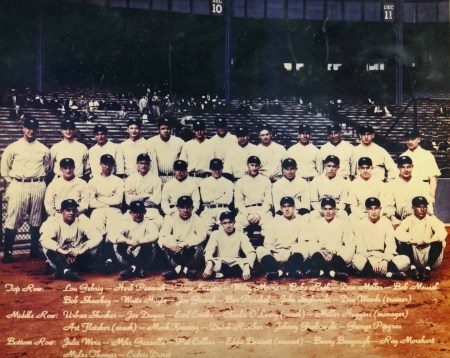
There isn’t much that can be added to what’s already been written about Babe Ruth’a recording-breaking,  phenomenal 1927 season. His 60 homers alone were more than any of the other seven clubs in the American Leaguue could muster as whole teams.

Although many of us like to remind that Babe Ruth’s 1921 offesive season was superior overall to his individual 1927 season total output, there’s no argument that the total Yankees result in the latter season was simply the greatest season to come along when it came down to winning with power, winning by a big margin, and winning by a runaway few laps in the final standings. The ’27 Yankees both had it all and did it all.

For the first time in big league history, the ’27 Yankees became the only club through that date to come along with two players that hit over 45 home runs for the same club in the same season. Ruth’s 60 HR were strongly matched and supported by Lou Gehrig’s 47. Tony Lazzeri added 18 HR of his own to the ’27 hitting assault, good enough for third place on the Yankees. And had it not been for teammates Ruth and Gehrig, Tony Lazzeri would have led American League in home runs over the course of the ’27 season.

Yankees 27 001

Babe Ruth hit his 60th HR on September 30, 1927 off Tom Zachary of the Washington Senators Senators before a sparse crowd at old Yankee Stadium, which was then only cpncluding its 5th season of operation. Fas weren’t crazy for records so much in those days. Besides, the Yankees had long since wrapped up the American League pennant by that final day and were simply playing out the string against the lowly Sens. Besdies too, Rut already owned the HR record at 59. By hitting 60, he would just be mocing up he own mark by one digit. It’s no big deal. Right?

Ruth also batted .356 with 164 RBI in 1927, but, hey, after all is said and done, the 1927 Yankees still were not all Ruth, It takes more than one killer to build a Murderers’ Row and the Yankees had such a group. Earle Combs was the leadoff man and a .356 hitter on the year. His 231 hits and 23 triples led the American League in 1927. Mark Koenig batted 2nd, hitting a steady .285 for the year. The came Babe Ruth in the 3rd spot. The following year, this batting order would be used to determine the major numbers that went on the backs of each Yankee player in 1928. Lou Gehrig batted 4th, hitting .373, with league-leading marks in 52 doubles and 175 RBI.  Bob Meusel batted 5th, hitting .337 with 47 doubles and 103 RBI. Then came the number 6 man, Tony Lazzeri, who, in addition to his 18 homers, also batted .309 with 102 RBI. Jumping Joe Dugan batted a steady .269 in the number 7 hole; and catcher Pat Collins batted .275 in the number 8 spot.

The ’27 Yankees also featured a pitching staff that was a Murdererrs’ Row in its own right. Look at these names and number – and give them all the awe they each deserve: Waite Hoyt 22-7, 2.63 was good enough to lead the American Legaue in wins and lowest ERA in ’27; Wilcy Moore, 19-7, 2.28 didn’t have enough innings to qualify for the ERA title, but his 13 saves would have tied him for the league lead in that category with Garland Braxton of Washington had baseball bothered to keep track of that record in 1927; Herb Pennock went 19-8 with a 3.00 ERA; Urban Shocker went 18-6, 2,84; Dutch Ruether was 13-6, 3.38; and George Pipgras went 10-3 with a 4.11 ERA.

The 1927 New York Yankees finished the season with a record of 110 wins and 44 losses for a winning percentage of .714. Thier killer record put them in first place in American League, a full 19 games ahead of the 2nd place Philadelphia Athletics and a blow-away 59 games up on the 8th and last place Boston Red Sox. Then the ’27 Yankees went out and swept the Pittsburgh Pirates, four games to zip, in the World Series. No wonder so much of the world, especially the part that is Boston, hates the Yankees, but that still doesn’t take away the title earned by the ’27 Big Apple club!

Murderers’ Row. – Any questions about the operational definition of that term?

Houston Buffs: Octavio Rubert, P, 1951.

October 14, 2009

Octavio Rubert 2The 1951 Texas League Champion Houston Buffs didn’t finish 13 1/2 games in first place by accident. Like most good teams, they had a pitching staff that got them there. Fortified by knuckleball ace Al Papai (23-9, 2.44), lefty rookie phenom Vinegar Bend Mizell (16-14, 1.96), veteran righty Fred Martin (15-11, 2.56), Mike J. Clark (10-7, 2.78), relievers Dick Bokelmann (10-2, 0.79) and Jack Crimian (1-2, 0.90), the ’51 Buffs needed few other pieces to be as about as complete a staff as any winning club could ever hope to unfold, but they had that extra “umphh” arm too!
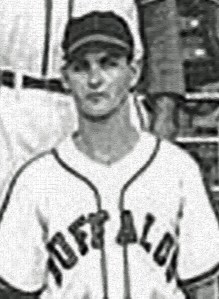
26-year old Cuban righthander Octavio Rubert brought a record of 19-5, 2.28 to the banquet table in that special ’51 season, and it came too with much Latin color and playing field gusto. The tremendously popular Rubert not only knew how to pitch, he also knew how to use all of his God-Given gifts and life conditions to best advantage in his pitching craft. You see, he had this special left eye, one that could’ve worked against him, but not as Rubert used it.

octavio rubertRubert had a blind and wandering left eye. I always thought it was just an abnormality in his natural eye, but teammate Larry Miggins says it was actually a glass eye, one that Rubert could actually manipulate in the socket as he saw fit  while he worked the mound. The stories are quietly legend about how Rubert used the eye to hold first base runners close to the bag. An unsuspecting opponent could reach first base and be fine as per normal – until he started to take his lead on Rubert. Then he’d look over to the mound and see the pitcher in the stretch position, but also looking straight at him.
WHOA! – And that was pretty much the intended message that Octavio Rubert hoped to be sending.

Unfortunately, 1951 was Rubert’s last really good minor league season. Octavio returned to go 9-9, 4.50 for the last place 1952 Buffs, but then he won only 13 final games in his last three seasons of organized ball (1953-55).  Over the course of his ten seasons in American baseball (1946-55), however, Octavio Rubert compiled a career minor league record of 123 wins and 65 losses, with a an Earned Run Average of 2.53.

The game was different then because of the reserve clause, but you do have to wonder as you examine Rubert’s first three season stats in the Class C Florida International League (1946-48). The guy went 58-25 over that period, with an ERA that hovered around the two runs per game mark. You wonder how a pitcher that productive could simply be held back to success at that level and not move up faster, even with the acknowledged abundance of fully controlled other pitchers in the farm system hopper.

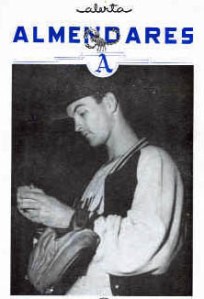
Ocatvio Rubert 4 The 6’0″ , 160 lb. Cuban also enjoyed several good seasons with Almendares in the Cuban Winter  League prior to the 1959 government takeover by Fidel Castro. He was inducted into Cuban Baseball Hall of Fame in Miami, Florida in 1997. That organization went into into some kind of suspended status following 1998 due to political tensions between Cuban-American residents and their homeland of origin, but it’s still quite a statement about the abilities of Octavio Rubert that he even got there.

Ocatvio Rubert is listed among the living at age 84 in 2009. I have no idea where he now lives nor what he’s been doing since baseball. When I am able to learn something, I’ll write about it here.  In the meanwhile, I’ll settle for the gratitude that this talented young Cuban immigrant was once such a great contributor to the success of our hometown Buffs.