Posts Tagged ‘Baseball’

My Hollywood Movie Roster.

November 12, 2009

starsIf you are also a baseball movie buff, as I am, you will no doubt recognized every movie and character referred to here today. You will also undoubtedly have your own ideas about who to include in a mythical staff and roster for an all star team that will never play anywhere else but on the sandlot fields of our own imaginations.

My club is loaded with iconic characters, a couple with superhuman powers, and one whose pitching skills are entirely supported by a substance that he rubs on baseballs to make them repellant to wood. That would be a fellow named King Kelly, played on the screen by actor Ray Milland.  I’m not really sure my club needs any pitchers beyond Kelly, but we’ve got ’em, just in case.

I’ve got one guy on this club who probably will see limited action. That would be Jimmy Piersall, played by actor Tony Perkins. The limited action will not be a result of any lingering emotional issues with Piersall, but with the unconvincing limited playing ability of actor Perkins. I’ll just say it, not gender offense intended: Tony Perkins throws a baseball with all the skill of a five-year old girl. Truth to tell, Gary Cooper as Lou Gehrig is not much better.

At any rate, without further adieu, here’s what we have to offer on my own version of a Hollywood Stars club. Please weigh in with your own thoughts in the comment section. Tell us what you think of the club? What movie players would you add or delete? Do you have your own favorite starting lineup along these lines? In other words, loosen up and have some fun with baseball movies today. It’ll do you good.

Here’s my stuff:

My HOLLYWOOD STARS (From the Movies)

STAFF

Manager: Wilford Brimley (as Pop Fisher in “The Natural” 1984)

Bench Coach: Richard Farnsworth (as Red Blow in “The Natural” 1984)

Hitting Coach: Danny Glover (as George Know in “Angels in the Outfield” 1994)

Pitching Coach: Tom Hanks (as Jimmy Dugan in “League of Their Own” 1992)

1st Base Coach: Ted de Corsia (as Jimmy Dolan in “It Happens Every Spring” 1949)

3rd Base Coach: John Mahoney (as Kid Gleason in “Eight Men Out” 1988)

Bullpen Coach: Robert De Niro (as Bruce Pearson in “Bang the Drum Slowly” 1973)

Team Doctor: Burt Lancaster (as Doc Graham in “Field of Dreams” 1988)

SCOUTS

Frank Morgan (as Barney Wile in “The Stratton Story” 1949

Walter Brennan (as Sam Blake in “Pride of the Yankees” 1942)

RADIO NETWORK BROADCASTER

Bob Uecker (as Harry Doyle in “Major League” 1989)

25-MAN PLAYER ROSTER

Catcher: Kevin Costner (as Crash Davis in “Bull Durham” 1988)

Catcher: Paul Douglas (as Monk Lanigan in “It Happens Every Spring” 1949)

Catcher: James Earl Jones (as Leon Carter in “Bingo Long, et al” 1976)

Pitcher: Ray Milland (as King Kelly in “It Happens Every Spring” 1949)

Pitcher: Dennis Quaid (as Jimmy Morris in “The Rookie” 2002)

Pitcher: Louis Gossett (as Satchel Paige in “Don’t Look Back” 1981)

Pitcher: Tim Robbins (as Nick LaLoosh in “Bull Durham” 1988)

Pitcher: Dan Dailey (as Dizzy Dean in “The Pride of St. Louis 1952)

Pitcher: Michael Moriarity (as Henry “Author” Wiggen in “Bang the Drum Slowly”  1973)

Pitcher: James Stewart (as Monty Stratton in “The Stratton Story” 1949)

Pitcher: Joe E. Brown (as Elmer Kane in “Elmer the Great” 1933)

Pitcher: Ronald Reagan (as Grover Alexander in “The Winning Team” 1952)

Pitcher: Billy D. Williams (as Bingo Long in “Bingo Long, et al” 1976)

Pitcher: Charlie Sheen (as Ricky “Wild Thing” Vaughn in “Major League 1989

1st Base: Gary Cooper (as Lou Gehrig in “Pride of the Yankees” 1942)

2nd Base: Frank Lovejoy (as Rogers Hornsby in “The Pride of St. Louis” 1952)

3rd Base: John Cusack (as Buck Weaver in “Eight Men Out” 1988)

Shortstop: Sam Brison (as Louis Keystone in “Bingo Long, et al” 1976)]

Left Field: WIlliam Bendix (as Babe Ruth in “The Babe Ruth Story” 1948)

Center Field: Tab Hunter (as Joe Hardy in “Damn Yankees” 1989)

Right Field: Robert Redford (as Roy Hobbs in “The Natural” 1984)

IF/OF: Tony Perkins (as Jimmy Piersall in “Fear Strikes Out” 1957)

IF/OF: Wesley Snipes (as Willie Mays Hayes in “Major League” 1989)

Left Field: WIlliam Bendix (as Babe Ruth in “The Babe Ruth Story” 1948)

OF: Richard Pryor (as Charlie Snow in “Bingo Long, et al” 1976)

OF: Ray Liotta (as Joe Jackson in “Field of Dreams 1989)

STARTING OPENING DAY LINEUP

JOE HARDY, CF

ROGERS HORNSBY, 2B

BABE RUTH, LF

ROY HOBBS, RF

LOU GEHRIG, 1B

LEON CARTER, C

ROGERS HORNSBY, 2B

DOC WEAVER, 3B

LOUIS KEYSTONE, SS

KING KELLY, P
Mark Fidrych: The Birdman of ’76.

November 11, 2009

mark fydrich ttm

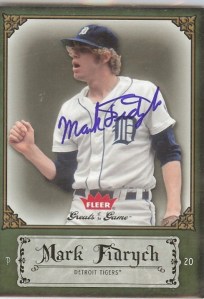
At age 53, Mark “The Birdman” Fidrych died when the truck he was working on fell on him last spring, The date was April 13, 2009. The place was Fidrych’s own 107 acre farm in Northborough, MA. The truck was Mark’s very own pickup.

So sad. Family found the body in the early afternoon of the same day. Once again, the talented and colorful young man who set the baseball world on its ear during his 1976 rookie season as a pitcher for the Detroit Tigers had left the scene too soon. Far too soon.

Selected in the 10th round of the 1974 amateur draft by the Detroit Tigers, Fidrych quickly found the roster of the big league club, winning 19, losing 9, and posting a 2.34 ERA to boot. More than games alone, Mark won the hearts and imagination of baseball fans everywhere by his fresh and unorthodox physical approach to the art of pitching. People thought he was talking to the baseballs as he prepared to throw them. It was actually an exercise in focus upon the job at hand. If he was speaking to anyone, Mark was actually speaking to himself along these lines: “Be here now fully in this moment. Give this pitch your very best shot. Visualize in you mind the outcome of this pitch as an easy out.” The young pitcher really subscribed to the belief that we cannot accomplish any goal we cannot actually see ourselves reaching. While he was meditating, a lot of people thought Mark Fidrych was simply being superstitious. They were wrong.

fidrych-300x177 Fidrych did like to get down on the ground prior to games and hand prune tiny rocks and paper trash out of the soil before he worked. He also tended to abandon and mistreat baseballs that hitters converted into hits from his pitches. More than once, he asked umpires to take balls out of play that  had been struck for hits. He wanted the umpires to place these errant balls in the company of balls that knew how to behave as outs once they left a pitcher’s hand. So, there’s no denying that Mr. Fidrych came wrapped with his own flavor of special eccentricity.
The sad elements of the Mark Fidrych story are the things that took him out of baseball – and eventually out of life. In both instances, these things happened as Mark simply went about the business of  being himself.


image001

Mark Fidrych got his "Bird" nickname from Big Bird himself!

Mark Fidrych’s future in baseball looked wide and deep as he went to spring training in the the spring of 1977. Unfortunately, while clowning around in the outfield, Mark tore some cartilage in his knee and was forced out of action for a short period. When he came back to work, he pitched fine, but about six weeks after his return, in a game against Baltimore, Mark said he suddenly just felt his right throwing arm simply “go dead.”

Mark had torn a rotator cuff, but it wasn’t diagnosed as such until 1985, eight years later, and five years beyond his forced retirement from baseball  at age 29 in 1980.

Mark Fidrych was only 10-10 over those last four post-injury seasons (1977-80) and he retired with very incomplete information about the cause of his lost skill and effectiveness. Still, he handled the end of his career well, but probably never fully appreciating the extent of the enthusiasm that his personal style had pumped back into the game. Baseball even gives Fidrych credit today for pumping several additional millions into the gate during his 1976 hay-day.

Then he goes out and gets killed by a sick truck that wasn’t  jacked up properly. What a waste.

Too bad Mark Fidrych couldn’t have hung around longer. In baseball. And in life.

Eddie Waitkus: An “Unnatural” Destiny.

November 10, 2009

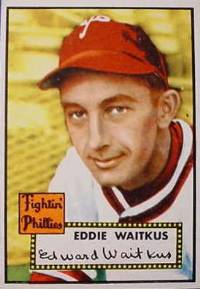
waitkus-52t When Bernard Malamud wrote about baseball phenom Roy Hobbs getting shot by a mysterious woman in black in his novel “The Natural,” he was doing what a lot of writers do for the sake of art. He was drawing from real life. Oh, there never was a real Roy Hobbs, just a lot of young guys who may have looked like him or Robert Redford on the field, but even they were all lost in a barrel with the one guy who really was him on the diamond, a fellow named Mickey Mantle, but even ladies man Mickey somehow always dodged the bullet. We likely will never know how close that guys like Mantle or Ruth ever came to suffering in reality the artful Hobbsian fate.
First baseman Eddie Waitkus of the Philadelphia Phillies and a disturbed young woman from Chicago named Ruth Ann Steinhagen were another story. On June 14, 1949, Waitkus and Steinhagen spent no more than five minutes of their lives together in a Chicago hotel room, but that shared time almost turned out to be the last five minutes in Eddie’s life – and definitely enough stuff to later make up a baseball story dream launcher for writer Malamud.

Here’s how it happened.

Ruth Ann Steinhagen grew up a troubled young girl In Chicago. In 1946, at age 16, she went to a Cubs game at Wrigley Field with her girl friend and the latter’s boy friend. She became fixated on Eddie Waitkus at this game. Waitkus was then the Cubs’ first baseman and he was having a pretty good year at the plate, but that didn’t really matter. Steinhagen thought he was cute.

Ruth Steinhagen started an intense scrapbook on Eddie Waitkus, documenting his every achievement and printed picture as religiously as later generations of young girls would similarly record and celebrate the lives of certain rock stars. Ruth still had major issues with her self esteem and was episodically involved in psychiatric therapy during her adolescence. She doesn’t appear to have ever experienced an actual relationship with any male as a boy friend during this early period of life.

When Eddie Waitkus was traded by the Cubs to the Phillies on December 14, 1948, Ruth Ann cried and said she didn’t want to live. She went through a very shaky period, but finally decided she needed to see Eddie Waitkus and let him know that she wanted to be his girl friend. It was a very psychotic idea. I rather doubt she shared it with anyone in any position to stop her back then. Even in 1948, it would have raised red flags among the psychiatrically trained. Even then, mental health experts knew that patients who are suicidal over psychotically perceived  losses are equally capable of turning around their self-destructive thoughts and converting them into thoughts of harming the perceived cause of loss and pain.

In this case, Eddie Waitkus was perceived as the one to blame for the pain of Ruth Ann Steinhagen. It was all Eddie’s fault, in her mind, and he didn’t even know the girl.

In May 1949, now 19 and an attractive young woman, Ruth Ann Steinhagen took out a two-day room reservation at the Edgewater Beach Hotel on Lake Shore Drive in Chicago, where Waitkus and the Phillies would also be staying during a series with the Cubs.

Ruth Ann also invited a friend, Helen Farazis, over to the hotel on her first night  there, June 13th. Ruth told Helen that she had a a gun and that her real intentions in being there were to shoot Eddie Waitkus. Helen did not believe Ruth Ann, nor did she tell anyone else about what seemed like a joking threat.

The next day day, June 14, 1949, Ruth Ann went to Wrigley Field and watched Eddie Waitkus and the Phillies beat up on the Cubs, 9-2. She then went back to her hotel room after the game and ordered three drinks from room service. When the bellboy arrived, she gave him five dollars and told him to take a written message to Eddie Waitkus. The note read as follows:

““It is extremely important that I see you as soon as possible.  We are not acquainted, but I have something of importance to speak to you about.  I think it would be to your advantage to let me explain this to you as I am leaving the hotel the day after tomorrow.  I realize this is out of the ordinary, but as I say, it is extremely important.”

Steinhagem signed the note “Ruth Ann Burns” and the bellboy left in the room that was shared by Waitkus with teammate Russ Meyer. (Here’s the story gets a little tricky, almost as though a Hollywood scriptwriter or Barnard Malamud had come up with the gimmick on a cup of coffee and five or six cigarettes!)

Meyer came  back to the room first. He found  the note inviting Waitkus to join Ruth in Room 1297. Meyer assumed the note was from a real girl friend of Eddie, a woman named Ruth Martin. When Waitkus then arrived, Meyer just told him that Ruth was waiting for him in Room 1297. Eddie went on up to the noted room, all the while thinking it was an invitation from his real friend.

When Eddie arrived at Room 1297, he asked for his friend, Ruth Martin. Ruth Ann Steinhagen simply introduced herself as a friend of Martin’s and explained that she had stepped out for a minute. She invited Eddie into the room for a short wait for Ruth Martin. Eddie suspected nothing and accepted. He stepped into the room and took a seat.

As Eddie was seating himself, Ruth Ann walked straight to the closet and pulled out a loaded .22 rifle. She took aim at Eddie Waitkus and pulled the trigger, hitting him once in the chest under the heart. As she did so, she yelled the most famous words ever expressed by most people in cases of relationship “love” violence: “If I can’t have you, nobody can!”

The bullet lodged in the muscles near the spine as Eddie Waitkus’s right lung collapsed. Ruth Ann Steinhagen then calmly called the front desk and told them that had just shot a man in Room 1297. Had she not placed the call immediately, it is likely that Eddie Waitkus would have bled to death.

Eddie Waitkus recovered physically and went on to highlight  his career as a member of the 1950 Phillies Whiz Kids champions, finishing in 1955 with a lifetime batting average of .285. Eddie passed away from cancer at age 53 on September 15, 1972.

Ruth Ann Steinhagen was found innocent by reason of  insanity and committed for psychiatric treatment of schizophrenia and therapy that included a long period of hospitalization and shock therapy. On April 17, 1952, less than three years after the shooting, Ruth Ann Steinhagen was declared sane and released.  The charge of assault with intent to kill was dropped. She and Eddie never saw each other again.

Years later, Eddie Waitkus looked back on his near fatal encounter with the psychotic Ms. Steinhagen and remarked, ““She had the coldest-looking face that I ever saw.”

You bet she did, Eddie. It was cold steel cold.

Baseball Food: Mighty Superstitious!

November 7, 2009

Wynn Jimmy 5759.71b_HS_NBL One of my favorite off-season topics has always been baseball superstitions, The fact that new stats and pennant races come to a halt in between seasons just seems to help the process of study move along better without distractions. A big help also was a little paperback  that a fellow named  Mike Blake put together back in 1991, It was called, and honestly so, “The Incomplete Book of Baseball Superstitions, Rituals and Oddities.” This morning, we will just edge into a few of the interesting superstitions that have to do with food, according to Blake.

(1) Jimmy Wynn. Jimmy supposedly believed he got his power from honey. According to Blake, Wynn “Ate jars of the stuff whenever possible.

(2) Nolan Ryan. Nolie is said to have eaten vanilla ice cream and chili beans prior to many big games because he believed these two foods both calmed the nerves and aided digestion. We will assume that they weren’t mixed together on the same plate prior to consumption.

(3) Greg Swindell. Not sure how this one qualifies as “food” other than being something a player could put in his mouth, but re Swindell used to bite off a long finger nail prior to a pitching start, making sure to keep that mail in his mouth as a chewing object all the while he worked the mound. Swindell said that he never chewed to tobacco at the same time because that substance ruined the taste of the finger nail. Greg earns our “Big Barf” award of the day.

(4) Mike Cuellar ate Chines food the night before his pitching starts, except when he pitched in Milwaukee. In the wisconsin city, Cuellar always dropped into a particular restaurant and had several bowls of beef stew before he pitched.

(5) Charlie Kerfeld. During his Houston Astros days, Charlie was caught by the television cameras ordering a couple of spare rib plates while he was waiting to be called into a game from the bullpen. No superstition pattern is attached to Kerfeld’s behavior in this instance.

(6) Bill “Spaceman” Lee supposedly had a pre-game preference for organic buckwheat pancakes, sprinkled with a half-ounce of marijuana.

(7) Frank “Hondo” Howard, in a pattern spurred as much by his size and a certain level of gluttony as it was superstition, routinely downed  a half dozen hamburgers, three milk shakes, a half dozen orders of fries, and a couple of dessert pastries as his pre-game road meal.

(8) Ben McDonald of the Baltimore Orioles used to prefer cans of mustard sardines before his starts on the mound.

(9) Sid Fernandez preferred baked potatoes covered with mustard, rather than butter, prior to pitching starts, or any other time, for that matter. He felt mustard saved calories and made for a healthier meal.

(10) Rick Rice, a minor league pitcher for the Baltimore Orioles used to eat frog legs prior to a game because he thought they made his fastball jump. Apparently they didn’t help it jump enough. He never reached the big leagues.

That’s enough for a busy Saturday. Hope you’re having a lunch today that will help you get done whatever it is you need to get done. Just don’t be too superstitious about it. If you get lost in a food superstition by chance, just grab a pinch of salt and toss it over your left shoulder with your right hand, That should make it go away.

The Yankees Are the Fast Lane!

November 6, 2009

babe & lou Speaking of the Yankees, the “27th Heaven” version gets their ticker tape parade down Broadway today as the rest of go through baseball withdrawal until spring.
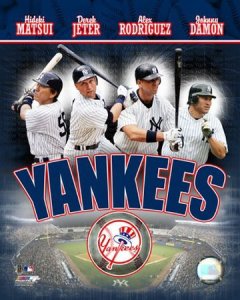
Andy Pettitte, Derek Jeter, and Jorge Posada appeared together on David Letterman’s Show last night, giving the host a chance to lay one in there on Andy for going back to Houston for a while (2004-06). “Andy,” Letterman said, “I believe you left New York for a while to go home and work in a Dairy Queen. Isn’t that right?” Everyone, even Andy,  had a big laugh over that line, but then he answered, still sort of sheepishly: “That’s right, Dave, but at least while I was back there at the Dairy Queen, I got to go to another World Series.”

See there? That’s exactly one of the points I was hoping to make yesterday, all rolled up in a single object lesson: Our Houston Astros’ National League pennant of 2005 may have just been a big night at the Dairy Queen for big celebrities like David Letterman and Andy Pettitte, but it was a pretty big deal to those of us Houston rubes who waited nearly a half century to see it happen here for even once. Now the tally stretches even further through 2009. In 48 seasons of major league play (1962-2009), our Houston Colt .45s/Astros have made it to only one World Series. We’re still looking for our first World Series win – or even a game victory. The White Sox shut us out four games to none in 2005, remember?

The New York Yankees, on the other hand, got to the World Series for the first time in 1921, during their 18th opportunity of the games even being played. They lost that first one to the New York Giants, and again the next year to the same club. Once the Yankees tweeked the Giants, 4-2, in the 1923 World Series for their first  win on the big stage, things started to change. A rosary of rarely broken dynasties was being beaded for the future.

Four Years Later: The 1927 and 1928 Yankees put together back-to-back WS wins on the heels of a 1926 WS loss to the Cardinals. Ruth and Gehrig were the leaders of the pack.

Four Years Later: The 1932 Yankees return to win again as Babe Ruth calls his shot against the Cubs in Chicago.

Four Years Later: Starting in 1936, the first real dynasty begins behind Joe DiMaggio as New York wins four World Series titles in a row (1936-39).

Two Years Later: The Yankees take their first World Series title over the Brooklyn Dodgers in 1941, but then fall in the 1942 classic to the St. Louis Cardinals.

Two Years Later: The Yankees avenge their loss of the previous year, defeating the Cardinals in the 1943 games.

Four Years Later: The 1947 Yankees return to take another Series win over the Dodgers.

Two Years Later: The Stengel Dynasty hits town. The Yankees reel off five World Series titles in a row, from 1949-1953.

Three Years Later: After losing to the Dodgers in 1955, the Yankees return the universe to normal by recapturing the World Series championship from the Dodgers in 1956.

Two Years Later: The Yankees recapture the 1958 World Series from the Milwaukee Braves after losing it to the same club in 1957.

Three Years Later: The 1961 Maris-Mantle club blasts its way past the 1961 Reds after losing in seven to Bill Mazeroski and the Pirates in 1960. The Yankees also win again over the 1962 San Francisco Giants.

Fifteen Years Later: The 1977-78 Yankees pull out of the second  longest dry hole in their modern World Series history, defeating the Los Angeles Dodgers twice in back-to-back fashion. During this period, the Yankees had lost World Series contests in 1963, 1964, and 1976,

Eighteen Years Later: The big gulch finally ends when the 1996 Yankees beat the Atlanta Braves, four games to two. Along this neck of the journey, the Yanks made only one other World Series appearance, losing to the 1981 LA Dodgers in six.

Two Years Later: The Torre Boys return for three straight crowns over the 1998 Padres, the 1999 Braves, and the 2000 Mets.

Nine Years Later: The Yankees take the Phillies in six games as the world returns to normal, and fairly loaded in favor of the studs from New York City. This particular dry spell is marked by Yankee losses in the 2001 World Series to Arizona, and again in 2003 to Florida.

The whole point here again is numbers. Not only have the Yankees been to forty World Series and won twenty-seven, they don’t have to wait as long as most other teams to get another chance.

Wait? Long lines? No way! Once they got there that first time in 1921, 18 years has been tops on the dry spell run for the Yankees. Compare that to the Chicago Cubs. Their wait in line has now reached 102 years!

Why Many Fans Hate the Yankees!

November 5, 2009
New-York-Yankees-Photograph-C12793347

The 27th Yankee Champions!

It’s part New York arrogance; part New York power; part listening to Frank Sinatra singing “New York, New York” after every Yankee home win; part watching Rudy Guiliani wearing that “NYFD/PD” cap to all the big games in honor of his own memory; part George Steinbrenner looking down from his suite with his arms folded under a grim quick-to-lash-out face; and frankly, it’s just a big part numbers. The reasons why many fans simply hate the Yankees is a subject we could hang with all day and still have plenty left open to talk about tomorrow.

The numbers side of it is big enough for us today as a toasty subject. Let’s consider a few takes on that side of things:

(1) The Yankees have now won 27 of their 40 World Series appearances.

(2) With 10 World Series wins, the St. Louis Cardinals are the only other club even in double digits.

(3) In the 105 World Series played since 1903. the Yankees have played in .38% of these events, winning .26% of all World Series played.

The numbers just go on from there to a point of total numbness. The Yankees are smart baseball people. They spend the most money on salaries and, possibly also on player development. They have the biggest ancillary system of other revenue streams from regional broadcasting and merchandise sales. They can afford adding any player they really want who becomes eligible to them through free agency. They produce the largest group of players who later become eligible for induction into the Hall of Fame at Cooperstown simply on the force of their sheer numbers with quality,

I don’t see another  franchise ever overcoming the place that the New York Yankees have established for themselves in baseball. And that call is right in there with the prediction that we”l never see  a second moon in the sky. It’s so obvious. Anyone else who wins the World Series has to do it in spite of the Yankees. They will not get there by overcoming the Yankees for very long.

Some things in life aren’t fair. They just are the way they are. The New York Yankees fit that description to a tee. Hate ’em if you choose. Beat ’em only if you try really smart and hard – and also happen to get lucky every once in a while.

Congratulations from Houston, New York. We”ll see you down the road one of these days. And we won’t roll over or run away when you come into sight. You’ll get our best Astros shot!

Dick Sisler’s Legacy.

November 4, 2009

For a couple of days now,  I’ve been battling a virus that has done everything justaYGrYANJ above turning me inside out. I still am hoping to get this article done before  I crash again. It will keep if I don’t, but it will be more timely to get it done now, while the World Series is still going on.
Two days ago, I made the kind of error in a story that I never used to make. I wrote that the Philadelphia Phillies reached the 1950 World Series in a playoff victory over the Brooklyn Dodgers on a late inning home run by Del Ennis.

Whoa! I was so wrong about something I usually know so well. And I should know it well. I was 12 years old and taking in baseball with all five senses back in those days. I even heard the big game played out on the radio because the last day of the season fell on a Sunday, October 1, 1950.

I guess I had a senior moment. We all make mistakes, but I probably never will recover from the aspect of my perfectionism that says, “Yeah, Bill, we all make mistakes, but that’s one you shouldn’t have made.”

I’m also interested in learning why we make certain mistakes. In this case, it’s pretty easy: When you get to be 72, don’t always trust your memory!

Enough said. Let’s get down to the business of historical rectification about a very important game played 59 years ago.

The big game had all the excitement of a playoff. It wasn’t. It was the last game of the season. The game was decided by a late inning home run, but it really wasn’t the Phillies long ball man, Del Ennis, who hit it. It was first baseman Dick Sisler, the son of the great Hall of Famer, George Sisler of the old St. Louis Browns, who lit his way into baseball history by slamming a 3-run homer in the top of the 10th that carried the Phils to their second National League pennant.

It was a season in 1950 that baseball genuinely relished back in the pre-playoff era. Back in those days, two runaway champions in both leagues made for a boring few weeks near the end of the season. Fans were just waiting for the season to end so the World Series could start.

Not so in 1950. The Yankees took a close pennant race over the Tigers, Red Sox and Indians in the American League. The National League race came down as a race to the wire between Philadelphia and Brooklyn.

A little background helps the story build-up here.

In 1950, the Phillies were coming off a run of 29 losing seasons in 30 between 1918 and 1948. After going 81-73 in 1949, they entered the ’50 season with bright hopes as the “Whiz Kids,” a nickname that flew off the page from their average player age of 26.

On September 20, 1950, the Phillies had a 7 1/2 game lead over the Dodgers. The the Phils proceeded to lose 7 of their next 9 as they went into Brooklyn for a final two games on September 30-Oct 1. Their lead over the Dodgers had shrunk to 2 games. A Dodger sweep could tie them with the Phils for 1st place and force a best 2 wins of 3 games playoff series for the NL pennant.

The Dodgers were pumped. The Phillies were exhausted. When the Dodgers won the Saturday game, 7-3, Brooklynites were salivating for more of that red Philly blood. The moment was electric – and a groundswell of Phillies fans trekked up  to Flatbush, both sensing their team’s need for support, and also  hoping to score a ticket for the big game. Most couldn’t find a ticket into the packed 32,000 capacity ballpark, but they hung around the streets, anyway, listening to the game on their radios.

The stage was set for melodrama – and the kind of baseball we will not see again due to changes in pitching philosophy over the past half century. The great Don Newcombe took the mound for Brooklyn in a face off against  future Hall of Famer Robin Roberts of Philadelphia. As you may have guessed, these guys dominated the day. Going into the bottom of the 9th at Ebbets Field, the score stood tied and tight at 1-1.

Cal Abrams led off the bottom of the 9th for Brooklyn. He reached 1st on a 3-2 pitch walk and then advanced to 2nd on a single to left center by Pee Wee Reese. Uh Oh! Here comes Duke Snider!

The Phillies played in, looking for a sacrifice bunt from the Duke under these circumstances, but the Duke fooled ’em. He lined a base hit to  center as Abrams took off, rounding 3rd and heading for home with the potential winning run. Because he was playing shallow, Ashburn made a perfect pick up and throw to the plate, where catcher Stan Lopata nailed Abrams for the 1st out, and preventing Abrams from scoring the pennant-winning run.

On the play at the plate, Reese raced to 3rd and Snider took 2nd, With the double play now off, the Phillies remained in the deep dew. The winning run was now on 3rd with only one out and Jackie Robinson was coming to the plate.

Roberts walked Robinson, loading the bases and setting up the double play.

Carl Furillo then hit a harmless pop fly to 1st baseman Eddie Waitkus for the 2nd out, but that still left room for Gil Hodges to play the assassin’s role as the next batter.

Hodges unloaded one, sending a deep fly ball to right center. Del Ennis pulled it in near the scoreboard for the 3rd out, sending the game into extra innings.

Pitcher Robin Roberts was the first scheduled batter in the top of the 10th. Are the Phils thinking pinch hitter? No way. Roberts bats and lines a single to left.

Eddie Waitkus failed to sacrifice Roberts to 2nd, but then he reached on a Texas Leaguer to center, with Roberts stopping at 2nd. The Phils had two men on with nobody out.

Ashburn tried to move the runners with a sacrifice bunt, but he pushed it too hard. Newcombe was able to make the play at 3rd, forcing Roberts. The Phils still had men on 1st and 2nd, with one out, and lefty Dick Sisler coming to the plate. On a 1-2 pitch, Sisler got good late wood on a fastball that took off for the opposite left field wall. The ball kept going as home crowd voices watched in startled shock. It landed in the left field stands for a home run and the Phillies were suddenly going crazy. They now led the Dodgers, 4-1!

The Phillies scored no more, but neither did the Dodgers. Robin Roberts went out and put them down quietly in the bottom of the 10th and the Phiilies were back in the World Series for the first time in 35 years, and for only the second time in their history.

Dick Sisler was the batting hero that day. No question about it.

Dick Sisler recorded only 55 home runs in his eight year major league career, but one of those blasts will be remembered forever, even by those of us who sometimes forget. My apologies, Mr. Sisler. I doubt I’ll ever forget you again.

1950: THE 1ST YANKEES-PHILLIES SERIES.

November 2, 2009

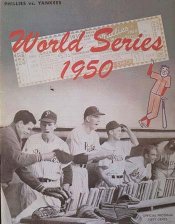
1950wsprogram My grandfather was a small town newspaper man. He founded and ran the Beeville (TX) Bee back in 1886 until his death in 1913. When he started, he counted a lot upon readers sending in local news to fill in some column space, but he also never gave up his eye for the fact that anything that wasn’t timely wasn’t news.
Back in 1889, when Grandfather Will McCurdy was only 23, some readers in Port Lavaca sent him a write-up on their Christmas celebration. Trouble was, Grandfather Will received the story only two weeks prior to the following Easter Sunday. It led Grandfather to the obvious conclusion that “old new was not news.” All he could do was try to explain to his contributor/consumer readers why the article would not appear.

“The Bee is sad to report,” Will McCurdy wrote, “that the story of how Port Lavaca celebrated Christmas will not appear on the pages of our little weekly newspaper. Although we appreciate the effort, we need our contributors down in Port Lavaca to keep in mind this fact: The hoary hand of time has quite a different effect upon local news than it does upon wildcat whiskey. – Local news does not get better with age.”

With my grandfather’s advisory in my mind, I thought I’d better get about my intended business of writing a short story on the first 1950  Yankees-Phillies World Series before the current New York bullies make history out of the 2009 Phils. Down three games to one now, the Phillies face the tall order of needing to defeat the Yankees three games straight to fulfill their hopes for a second straight World Series crown. That isn’t likely now, especially with the last two games, if needed, coming in New York. Of course, if the Yankees win tonight in Philly, it’s all over.

In 1950, the New York Yankees and the Philadelphia Phillies met for the fist time in the World Series. Back then it was the Yankees seeking their second World Series win in a row and their 13th World Series victory in 17 total appearances. For the ’50 Phillies. it was then a search for their first World Series victory in only their second appearance in baseball’s big show. The 1915 Phillies lost their only previous World Series in five games to Babe Ruth and the Boston Red Sox.

Robin Roberts 2

Robin Roberts: One of Several Future Hall of Famets in the 1950 World Series.

In 1950, Eddie Sawyer was in his third season as manager of the Phillies. A guy named Casey Stengel was in his second full season as manager of the Yankees.

Because Roberts had pitched in three of the last five games of the regular season, he was unavailable for the Series opener on October 4th at Shibe Park in Philadelphia. Sawyer surprised the baseball world by starting 33-year old relief ace Jim Konstanty in the Series opener against Stengel’s choice, 31-year old ace right hander Vic Raschi (21-8, 4.00). Konstanty had appeared in 74 games in 1950, but only in relief, on his way to 22 saves in a tight-inning stopper role – and long before baseball ever used the term closer.

Game One: NY 1 – PHI 0 (Shibe Park, 10/04/50). Konstanty did OK, but Raschi did great, giving up only 2 singles in a 9-inning complete game pitching victory. Konstanty worked 8 innings, giving up the only run of the ball game in the top of the 4th. After Bobby Brown doubled to lead off the 4th, he moved to 3rd and then came home on flies by Hank Bauer and Gerry Coleman.

Yankees led the Series, 1-0.

Game Two: NY 2 – PHI 1 (Shibe Park, 10/05/50). 31-year old right handed Allie Reynolds (16-12, 3.74)  of the Yankees squared off against 24 year-pld  righty Robin Roberts (20-11, 3,02) of the Phillies. Both men each pitched complete games in a 10-inning contest that ultimately was decided by a solo shot homer off the bat of the great Joe DiMaggio.

Yankees led the Series, 2-0.

Game Three: NY 3 – PHI 2 (Yankee Stadium, 10/06/50. Please note too the absence of a travel day off as the 1950 world Series moved the short distance from Philadelphia to New York. Also note what you cannot see. All these games were played in the daytime –  and they were played during an era in which no one had even heard the phrase, pitch count). Game 3 shaped up as a battle between two lefty “wheez kids” as 35-year old Ken Heintzleman (3-9, 4.09) took the mound for Philadelphia against 32-year old Eddie Lopat (18-8, 3.47).  Old man Heintzleman did pretty well until late in the day. He had a 2-1 lead over Lopat and the Yankees, but he got into trouble after two outs in the bottom of the 8th by walking the next three batters he faced. The usually sure-handed shortstop Granny Hamner then booted a routine grounder off the bat of Bobby Brown to let the tying run score. The Yankees got no more, but Heintzleman was gone as the Phillies seemed to deflate over New York pulling into a 2-2 tie.

In the bottom of the ninth, and with reliever Russ Meyer now pitching for the Phils, Gene Woodling scored from 2nd base on a single by Gerry Coleman to end the game and put the death rattle on Philadelphia hope. Meyer took the loss for Philly; Tom Ferrick got the win in relief of Lopat.

Yankees led the Series, 3-0.

Game 4: NY 5 – PHI 2 (Yankee Stadium, 10/07/50). 24-year old right handed Bob Miller (11-6, 3.57) carried one last Phillies shot to the mound against 21-year Yankee rookie sensation lefty Whitey Ford (9-1, 2.81.) New York jumped Miller for two runs in the first, driving him from the mound after only one out in favor of Jim Konstanty. Mr. K. settled things down, but Mr. Ford blanked the Phils for most of the day. A home run by Yogi Berra and a triple by Bobby Brown in the 5th tallied three more NY runs, effectively icing the game at 5-0.   Ford ran into a little trouble in the 9th, giving up 2 runs that led to his removal with two outs in favor of Allie Reynolds. Reynold struck out Stan Lopata with two men on base to end the game and the Series.

Yankees won the 1950 World Series, 4 games to 0, over the Phillies.

If the Yankees also win the 2009 World Series, their overall record will be 27 World Series championships in 40 World Series appearances. If that becomes the case, the Phillies will drop to 2 World Series titles in 7 World Series tries.


Houston Buffs: “Boke Knucklemann”

October 30, 2009
53Topps204Bokelmann

AKA (TO ME) AS BOKE KNUCKLEMANN!

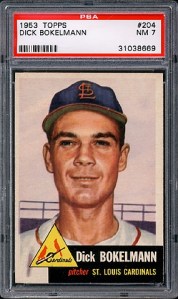
Dick Bokelmann was Boke Knucklemann! When I was a kid, I tried writing fictional action stories and I always used real people as models for my heroes and main characters. That’s how former Buffs pitcher Dick Bokelmann got to be “Boke Knucklemann.” It happened during the red hot Houston Buffs championship season of 1951. Even though I only wrote for my eyes only, I somehow picked up on the idea that a writer couldn’t use an actual name of a real person in his writings, but that changing the name enough to capture the model’s identity without using his actual name made it OK.

Like his real life namesake, Knucklemann pitched for the Buffs, but when he wasn’t pitching, he was fighting crime on the streets of Houston – knocking out bank robbers with knuckle balls that he carried with him in a bag as his weapon of choice. Well, they weren’t exactly knuckle balls while they were still in the bag, but that’s what they were destined to become – once the good guy  “Bokeymann” got through throwing them.

Boke would run up on a robber coming out of a bank with his gun in one hand and his bag of loot in the other. Boke always stopped running toward his man once he got about 60′ 6″ away and then stare him down to a frightened halt. Then he would reach into his ball bag and pull out a weapon that he unleashed as a knuckler, one invariably heading straight for the robber’s face.

Long before Cassius Clay ever thought of it, these pitches of Boke Knucklemann carried with them the powers to both “dance like a butterfly and sting like a bee.”  I always tried to convey these ideas in my 13-year old descriptions of all those “good rallies past evil” moments of final redemption. Although I burned or threw away all my original stories long ago, the big moment always went something like this:

“Gypsy Joe Stalinovich stalled in the doorway of the First National Bank on Main Street as he saw the athletic figure of Boke Knucklemann racing toward him. As Boke stopped some short distance away, Gypsy Joe also froze, with his gun in the left hand and his bag of loot in the right. Coming toward him hard was a bobbing, weaving baseball, which his eyes attempted to closely follow in flight. Suddenly, with his peepers now crossed in locked tracking mode on the incoming white meteor, there’s a loud SPLAT sound as Joe takes it right between the baby blues! – Cartoon butterflies encircle the evil Gypsy Joe’s injured cranium as he falls face flat forward to the pavement for one of the easiest robbery arrests in HPD history. Gypsy Joe’s message is one he’d like to pass on to all other mean and evil Houston crooks: ‘The Bokeymann will get you if you don’t watch out!'”

So, folks, I got a lot out of watching Houston Buffs baseball back in the day, and, thankfully, I was realistic enough back then to spare the public my adolescent storytelling efforts. The point of sharing that literary history with you now is simply to make this point: Those guys weren’t merely my baseball heroes. They also were my inspiration for heroic central casting and my writing character models.

The real Dick Bokelmann was a good enough pitcher in reality to actually need no additional superhero alter ego. As a knuckle balling reliever for the 1951 Houston Buffs in 27 of the 30 games he worked, Bokie won 10 and lost 2 as he complied an incredible ERA of 0.74 over 85 innings of work.

Born 10/26/26 in Arlington Heights, Illinois, the recently turned 83-year old Dick Bokelmann posted a career minor league mark of 66-51, with a 3.21 ERA, from 1947-54. He spent four partial years with the Buffs (1950-53) while spending part of that same time with the parent club St. Louis Cardinals (1951-53). Bokie’s Cardinals/Big League mark was 3-4 with a 4.90 ERA.

It is also true that it was two men, Houston Buff knuckleballers Al Papai and Dick Bokelmann,  who prepared me to be a fan of Joe and Phil Niekro a few years later. It was an easy jump to make. I don’t think I’ve ever met a knuckleballer that I didn’t really like.Every one of them has been a remarkably individual and high integrity human being.

Who Is Brad Mills: Part 2?

October 29, 2009
20091027-143959-pic-994162072.preview

BRAD MILLS, HOUSTON ASTROS MANAGER, 2010.

Brad Mills was born on January 19, 1957 in Exeter, California. He played college baseball as a 6’0″, 195 lb. BL/TR infielder for the University of Arizona, from where he was then selected by the Minnesota Twins in the 16th round of the 1977 draft. He didn’t sign with the Twins and was later taken again, this time  in the 17th round by the Montreal Expos, in the 1979 amateur player draft.

In a five-season minor league career as a third baseman (1979-86), Brad Mills hit  .287 with 37 home runs. He marked his best year with the AAA 1981 Denver Bears, where he batted .314 with 12 HR. It was the only time he ever posted a plus .300 average and double digit homer figures over the course of a full season.

In limited major league service with the Montreal Expose over four seasons (1980-83), Mills batted .256 career with only a single home run.

Brad Mills was traded by the Expos to the Astros on July 4, 1984 for outfielder Scott Loucks, but he never saw MLB service in Houston. Moving over from Indianapolis to Tucson, the Astros’ AAA farm team in 1984, Mills’ offensive production dropped remarkably. He played another unproductive year for Tucson in 1985 and then finished his active career playing with Iowa in the Cubs’ farm system in 1986.

Brad Mills began his five-season (1987-90, 2002) minor league managing career in the Cubs farm system the following season. He didn’t set the  woods on fire in those five years, but he did finish with a winning record of 334 wins, 296 losses, and a .530 plus side winning percentage.

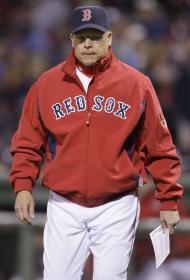
From there, Brad Mills has built a quiet, but glowing reputation and record as the bench coach of Terry Francona, first at Philadelphia, and since 2004 through 2009 at Boston. He was the man who helped Terry Francona lead the Boston Red Sox through the end of the Curse of the Bambino with two World Series victories in 2004 and 2006. He now comes to Houston with highest praise from Francona as an organizer and communicator.

Let’s hope that Mssrs. McLane, Smith, and Wade have just captured lightning in a bottle through the hiring of Brad Mills as new manager of the Houston Astros.

While we’re hard at hoping, let’s also try to hold the reins on our expectations that Brad Mills, or any other manager, could or will be able to fast-track the Astros to a pennant next year in spite of the talent depletion reality that now exists. Mills will have his hands full building a relationship of trust that will empower him to lead. It will remain up to McLane & Company to resolve the other, far-reaching issues.

Drayton McLane was quoted in this morning’s Houston Chronicle as saying, “We need to be where the Phillies are.” Unless I miss my guess, I’m counting fourteen other National League clubs who would probably offer the same sentiment. The difference-maker between those who get there and those who don’t simply reduces to these steps:

  1. Those who really want to be champions carefully study what champions do;
  2. Then they have to do some serious gut-checking: Do we have the will, the financial resources, and the administrative people in place we shall need to get the job done with a plan for success that will work for us in our town?
  3. Is a club willing  to commit to an overt plan for action without cutting corners on what is essential to long-term local success?
  4. And finally, if all these steps can be answered affirmatively, is a club willing, right now, to step forward forthrightly and “just do it.”

We fans can be terribly patient when we believe that a plan is in place to really deliver us to a World Series victory. In my book, hiring Brad Mills is a step in the right direction. Now let’s take the Phillies and Cardinals championship books and run with them into a plan that fits Houston.

A plan for similar success in Houston couldn’t look that that different. Could it?