Posts Tagged ‘Baseball’

Dave Hoskins: First Black Texas Leaguer, 1952.

March 7, 2010

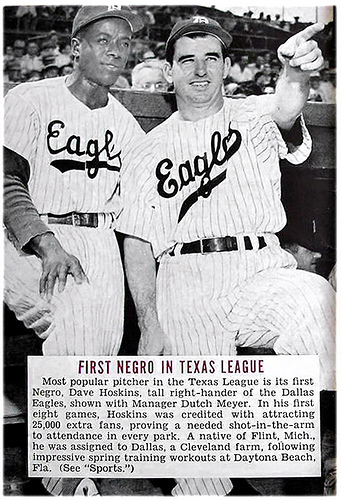
Dave Hoskins with Dallas Eagles Manager Dutch Meyer, 1952.

Five years after Jackie Robinson broke the major league color line in 1947, Dave Hoskins did the honors for his race in the Texas League as a pitcher for the Dallas Eagles.  Those 1952 Eagles were a great club, finishing in first place under Manager Dutch Meyer with a record of 92-69 before losing to Oklahoma City in a six-game first round playoff series. Hoskins was the prime force for the ’52 Eagles, leading the league with 22 wins and an overall record of 22-10 and an ERA of 2.12.

Those of us in Houston during that era were two years away from the 1954 date that Bob Boyd would step on the field as the first black player to play for the Houston Buffs, but that didn’t stop a handful of us Houston whites and all of the segregated-stand seated Houston blacks from cheering for Hoskins during his first and every appearance at Buff Stadium. The guy threw the ball with such pop and poise. It didn’t take long for Dave Hoskins to establish that he already was too good for the Texas League at age 30.

Dave Hoskins was born in Greenwood, Mississippi on August 3, 1922, but his family moved to Flint, Michigan in 1936 when he was 14. His dad worked in the automobile assembly industry and Hoskins grew up playing baseball in the Flint City League. His averages of .438, .395, .350, and .412 over four seasons drew hard attention from scouts in the Negro League. His first stops in professional baseball landed him with the Ethiopian Clowns, the Homestead Grays, and the Cincinnati Clowns. During his three seasons with the Homestead grays (1944-46), Hoskins batted .345, .351, and .317. He also served as the club’s best pitcher in 1945.

In April 1945, Dave Hoskins, Sam Jethroe, and Jackie Robinson were chosen as Negro Leaguers to be given a joint tryout in a camp sponsored by the Boston Red Sox and Braves. Hoskins ended up missing the tryout due to a game injury.

By 1947, Dave had returned home to star as an outfielder in the Flint City League. As an all-star from that group, Hoskins proceeded to rack up three hits in a game that Flint’s Best played against the Detroit Tigers.

Dave Hoskins: Greatness That Might Have Been.

Dave Hoskins finally rode the wings of some good words by Satchel Paige and signed with the Cleveland Indians as a hard-hitting outfielder. After he signed, however, Hoskins decided to change from hitting to pitching. “I was tired of pitchers throwing at me and made up my mind to throw at other guys,” Hoskins explained. After unspectacular years (1949-51) as a pitcher for Grand Rapids, Dayton, and Wilkes-Barre, Hoskins joined the Dallas Eagles in 1952 for his banner breakout season in organized baseball.

Hoskins made an auspicious start for Cleveland in his first major league appearance in early 1953. Coming into the game early in relief of Bob Feller and trailing 3-0, Hoskins gave up no runs while crashing a double and homer for four RBI that gave him and the Indians the victory. He went on to post a 9-3 record for the Indians in 1953 with an ERA of 3.99 in 26 games.

An unfunny thing happened to Dave Hoskins with the Indians in 1954. Because of the talent-glutted pitching staff among Indian starters that year (Lemon, Garcia, Wynn, Feller, and Houtteman), Dave only hit the mound on 14 occasions in 1954, posting a 0-1 record and a harvest of disappointment.  David Hoskins would continue playing minor league baseball, including a brief stint with the 1959 Houston Buffs, through 1960, but he would not see the major leagues again after the ’54 heartbreaker. He would finish his minor league life with 78 wins, 69 losses, and an ERA of 3.79

After baseball, Dave Hoskins returned to Flint and a second career as an automobile plant worker. He married and raised three daughters before passing away of a heart attack on the job at age 47 on April 2, 1970.

In 1987, Dave Hoskins was inducted into the Greater Flint  Afro-American Hall of Fame. In 2004, Dave Hoskins also found quick, ready, and appropriate induction into the newly created Texas League Hall of Fame.

Dave Hoskins was a great one, but like a lot of Negro Leaguers from that period, his chance came around a little bit on the late side to be of much value to a long career in major league baseball. Dave’s 1952 Texas League record and his 1953 brief run with Cleveland merely hint at those saddest of all words, what might have been.

A Failadelphia Story.

March 6, 2010

The Phillies were Bottom-Feeders for Most of the 20th Century; the A's weren't much better most of the time..

I like stories about Philadelphia that have nothing to do with Ed Wade. This one starts off simply with a few numbers and a couple of questions:

1940, 1941, 1942. 1943.

Questions: (1) Did you know that both of the Philadelphia big league clubs, the Phillies and the Athletics, each finished in last place simultaneously for these four consecutive seasons? (2) Do you now think that there may be some historical reason for the fact that Philadelphia fans are still the crankiest and hardest to please? (3) Ya’ think?

At least, Connie Mack of the Athletics would periodically mobilize his resources and put together a pennant and World Series winning team through the early 1930s. Then he would back up the truck and allow the A’s to slip all the way to oblivion in a single season. After 1931, the A’s never rose again. The Phillies won pennants in 1915 and 1950, but only first tasted a World Series championship in 1980. That was the year that the Houston Astros lost the NL pennant to the Phillies due to some late inning playoff pitching failures and a ton of bad luck and bad umpiring calls. The bad luck actually began earlier when the league-dreaded giant fastballer, J.R. Richard, was lost to the Astros club via a career-ending stroke.

Back in the Failadelphia Folder days of World War II, there wasn’t much hope for any kind of early recovery or advance into winning for most bottom-feeding big league clubs. Those also happened to be the days in which the New York Yankees and St. Louis Cardinals established their league leadership roles as frequent-flying pennant-winners, a situation that continues to grow, even in this era of greater parity and quicker hope for losing clubs transforming themselves into pennant winners.

Back in those buried-in-the-reserve-clause days, poor clubs survived by selling or trading their better prospects and players to the richer clubs for the sake of paying the rent. Crowds and gates were small. There were no revenue streams beyond the leaking-faucet trickle of gate ticket sales. Most clubs even gave away the radio broadcasting rights. It would take the later big money contracts with the television networks, free agency, the construction of super-duper gimmick stadia, Bonnie and Clyde pricing of ballpark food, the cutting edge marketing of game similar and game worn uniforms and collectible items, and corporate support of luxury accommodations to stir Mississippian movement in multiple new revenue streams.

Philadelphia of the 1940s had none of these advantages, but neither did any other city. In effect, this thing I’ve called a “Failadelphia story” was really baseball’s story until recent times. It was a plight that hung out as remarkably bad in the City of Brotherly Love during those four ungracious years, but other clubs like the St. Louis Browns and Washington Senators also felt its regular sting. How either Philadelphia club got any fans to the park in 1943 after heaping that much failure on the citizenry is almost beyond reasonable  comprehension. I guess people will take bad baseball over none at all.

Speaking of bad baseball. it was the Athletics who broke the double cellar deal with the Phillies by rising to a 6th place American League finish in 1944. The Phillies’ consecutive last place skein for that era ran for eight consecutive years, from 1938 to 1945.

Phillie home attendance in 1938, the first year of their eight season run as last place residents in the National League was 166,111. Phillies attendance in their 1945 eighth season of cellar-dwelling futility had risen to 285,057. Go figure. The late ’30s found people still digging out of the Great Depression. 1945 was a time of new hope with World War II wrapping up as a victory of freedom over fascism.

My favorite fan story from that era concerns an advertising sign that once hung at the ballpark during their long era of failure. It originally read that  ‘THE PHILLIES USE LIFEBUOY SOAP!”

A Phillies fan had taken a paint brush and made this addition: “…AND THEY STILL STINK!”

Ray Oyler: The Bat That Blew Too Much.

March 5, 2010

“You Can’t Hit the Ball with the Bat on Your Shoulder.” – Bobby Bragan.

Fellow writer and friend Al Doyle of Oshkosh, Wisconsin and I have been collecting names of some very special ball players over the past seven years. By some fairly loose, but clearly defining standards, Al and I are in perpetual pursuit of those players who have managed to survive for several seasons in the big leagues without rising above a measurable level of mediocrity as performers.  The idea behind this seemingly idle-time research is to establish a data bank of players who will be eligible for a new hall of honor – The National Baseball Hall of Mediocrity.

Ideally, we are looking for hitters who manage to survive for ten seasons in the big leagues without hitting more than .210. The closer these candidates get to the .200 Mendoza Line or less, the better their chances will be for subsequent induction.

Pitching candidates are those who fail to achieve double-digit wins in a single season, but consistently reach that mark on the loss side with earned run averages exceeding 7.00 per season. Twenty loss seasons are a big plus on this yardstick of deservedness too.

In general, any player who experiences a career year that leads him to individual honors as a hitter, fielder, or pitcher is disqualified for membership in the BHOM (Baseball Hall of Mediocrity). We also generally frown upon considering those statistically qualified souls who have been members of a World Series championship club, but, as I said earlier, our standards are appropriately loose and subject to the same kind of mediocre flexibility we expect of our honorees.

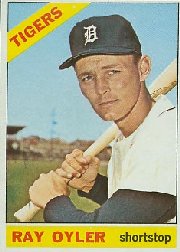
A former shortstop named Ray Oyler is the poster boy for all BHOM candidates. Oyler only played for parts of six major league seasons with the Detroit Tigers (1965-68), the Seattle Pilots (1969), and the California Angels (1970), but he managed to achieve just about everything one might expect from a mediocre major leaguer over that extended course of time. In 542 total games, the equivalent of about 3.5 full seasons, Oyler collected only 221 hots in 1,265 official times at bat for a career batting average of .175. His On Base Percentage (OBP) was a mere .258 and his Slugging Average (SA) was only .251. Of his total hits, only 29 were doubles, 6 were triple, nd 15 were home runs. He also struck out 359 times relative to the 135 times he walked. Other than the shortfall on his time in the majors, the only other blight on Ray Oyler’s record is the fact that he played for the 1968 World Series Champion Detroit Tigers. Also, it may be fairly obvious by now, but it was Ray’s defense that kept him big league afloat for as long as he managed to last. He was still done and out of the fun in 1970 at the age of 32.

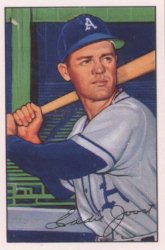
Eddie Joost’s .185 in 1943 is the worst ever for a full-time player in one season.

Several seasons earlier than Ray Oyler, fellow shortstop Eddie Joost set the record for the worst single season batting average by a full-time big league player when he clocked in at .185 for the 1943 Boston Bees. He also punked out a .299 OBP and a .252 SA on the ’43 season.

Sadly, Joost wasn’t able maintain this level of ineptitude over his entire 17-season (1936-55) career. He managed to finish with an elevated .239 BA, a .361 OBP, and a .366 SA with multiple major league clubs to pull himself up from the direst strains of pure mediocrity.

Why should we honor mediocrity? Here’s the best reason in the world: If it weren’t for the supremely mediocre players, the bad players would never look good, the good players would never look great, the great players would never seem deserving of the Hall of Fame, and the Babe Ruths and Hank Aarons wouldn’t have ten books a year published on each of them by different houses and authors. Plus, we probably never would have heard of Bob Costas or Peter Gammons as commentators on greatness without all those mediocre players out there making everybody else look so much better.

If you have a favorite candidate for the future BHOM, Al Doyle and I would love to hear from all of you. Just drop me an e-mail or, better yet, leave a comment below as part of this article. If your candidate is selected, we will be very happy to give you credit as the nominating party when the day comes to get this special hall of honor up and running in reality.

In the Baseball Hall of Mediocrity, all new inductees will get in on the ground floor and just stay there. Without that flooring, the stars of the game would have no place to walk. We want to make sure that every deserving plank, knotholes and all, is remembered for its particular contribution to the backdrop of the game. Once that  purpose is clearly understood, the BHOM will become what it needs to be: a place where we remember baseball’s individually forgettable players, managers, general managers, administrators, owners. broadcasters, writers, pundits, coaches, and commissioners.

Also, send us your ideas on the best potential site for the Baseball Hall of Mediocrity. We are looking for a town and community that will help the BHOM live up to its name.

Larry Miggins: Honesty is the Only Policy!

March 4, 2010

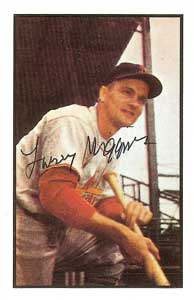
In 1950, Larry’s honesty may have cost his Columbus Redbirds team a playoff win.

84-year-old Larry Miggins and his dear wife Kathleen are two of my dearest friends. I count my lucky stars daily to have these good people of love, cheer, and integrity in my life as close companions on this ride through life. As a kid, I never would have dreamed it possible.

Larry Miggins was a Buffs baseball star back in the day. I was just a kid fan from the East End of Houston. I simply didn’t understand at the time that if you love baseball long enough it will bring you together with some of the people you once loved as players. Life is truly amazing.

Yep, Larry was one of my heroes as the left fielder  for the Houston Buffs of the Texas League over several scattered seasons in the late 1940s and early 1950s. 1951 was the big year. That was the season that Jerry WItte (38 HR) and Larry Miggins (28 HR) led the Buffs offense as Vinegar Bend Mizell and Al Papai pitched the club to the straight-away and playoff championship of the Texas League.

Larry had a reputation even back then as a pure of heart guy who wouldn’t tell a lie for anything. He once declined an opportunity to walk future movie star and wife of Bing Crosby Kathryn (Grandstaff) Grant to home plate in a beauty contest at Buff Stadium because “she barely had any clothes on.” As I recall, Miss Grandstaff was wearing one of those one-piece cover all bathing suits that were the very modest style for women in the early 1950s. It simply wasn’t enough flesh-covering material for the modest Mr. Miggins.

The ultimate Miggins honesty story occurred a year earlier, when Larry was playing left field for the AAA Columbus Redbirds of the American Association. How it all came about in a critical playoff game speaks volumes for the Miggins reputation for honesty that preceded the incident itself. The opposing manager in that game actually instigated the event in the hope that Larry’s honesty would allow his club to prevail in a critical game situation.

In a best-of-seven league playoff games semifinal contest, Columbus had won two of three against the St. Paul Saints in Minnesota before going home for what would turn out to be a memorable fourth game on Sept. 17, 1950.

Columbus held a 2-1 lead in the eighth inning when a grand slam homer by St. Paul catcher Jake Early suddenly gave the Saints a three-run lead. The next Saints batter, pitcher Bill Ayers, drove a ball to the deep left field wall in Columbus. Larry Miggins was the Columbus gardener in that area of the pasture.

Former Cardinal Larry Miggins’s two big league home runs came off Warren Spahn & Preacher Roe.

“I went over there and leaned up and missed the ball by about a foot,” Miggins exclaims. “The ball hit a seat in the stands and bounced back and I grabbed it and fired it back to second base.”

Umpire Bill Jackowski called it a ground-rule double. The call yanked St. Paul manager Tommy Heath out of the dugout on a fast track to protest. As Heath predictably started losing the argument he decided upon one final plea to Jackowski.

“Ask Miggins out in left field if it was a home run,” Heath pled.

Also aware of Miggins’s reputation for honesty, Jackowski started walking toward left field, taking a step he would have risked with few others. Jackowski was going to ask Miggins to report on what he had seen of the ball’s landing spot.

The teammates of Larry Miggins went into panic. Behind the walking umpire, Columbus shortstop Solly Hemus could be seen waving his arms in a desperate signal of “NO HOMER” to Larry Miggins in left. Center fielder Harry Walker actually tried to lead Miggns away from the advancing umpire.

Nothing worked. Umpire Jackowski caught up with a grim-faced, hands-on-hips Miggins in deep left.

“I lost the ball in the sun and couldn’t tell if it bounced in or went in (to the stands) on the fly, Larry,” the umpire explained. “I gotta ask you man to man: Was it a home run?’ ”

Miggins thought a moment and then spoke. “Bill,” Larry commented to the umpire, “anybody who hit a ball that far on the fly in this ballpark deserves a home run. Yes, it was a home run — but, for heaven’s sake, from now on, you do the umpiring. I have enough trouble trying to play left field.”

When Jackowski then gave the whilrybird sign for a home run in deep left, the grinning St. Paul runner went into his job-finishing jog from second base as the Columbus crowd rained loud boos upon the ump, the Saints, and their own left fielder, Larry Miggins. At inning’s completion, another chorus of boos for Larry Miggins accompanied him on his jog to the dugout.

Columbus lost that game but won the series in six. The Red Birds then followed that victory by defeating Indianapolis in the championship series when Mo Mozzali hit a home run in the top of the 13th inning in Game 7. The homer  earned the Red Birds a place in the Junior World Series. The Red Birds then defeated International League champion Baltimore four games to one in what proved to be the last Junior World Series title for Columbus — and the last year that Hemsley managed the team.

End of story. Start of integrity test.

If you had been in Larry’s Miggins’s shoes that day In Columbus back in 1950, how would you have answered the umpire’s question? Feel free to post your answer below as a comment if you so choose to own your position publicly.

Frank Shofner: An Everyday Guy.

March 2, 2010

Frank Shofner Hit .241 for the '51 Buffs.

Every field of human endeavour has them. Most of us are them. We are the minions of the masses that make every clock of human effort tic. Without us, there would be no night sky in place for all the stars to shine. There would be no cars fixed by the side of the road when really important people are late for meetings in the halls of power. There would be no torch bearers streaming through the darkness when it was time to storm Dr. Frankenstein’s castle. There would be no  Rosencrantz or Guildenstern lending quiet body and soul to the telling of Hamlet.

Frank Shofner of the 1951 Houston Buffs was such a character in baseball. We may talk and write of Ruth and Aaron all we want, but we simply could not play the game without the multitudes of mediocre performances supplied much more frequently by ordinary guys like Frank Shofner of the minor leagues and Ray Oyler of the majors (See Ray’s stats for Detroit, 1968, or just check out his general career.)

Frank Shofner hit .241 with 6 homers as a back up to rising star Eddie Kazak as third baseman for the ’51 Houston Buffs, He delivered a few key pinch hits along the way and he battled every opportunity that came his way as though it were the chance of a lifetime. At 6’1″ and 185 pounds, Shofner had a stockier appearance and not much speed, but he had quick hands and a frog-and-the-June-bug relationship with balls dribbled or bunted down the third base line.

From the stands, you could often hear him barking support, laughing, kidding encouragement to his mates, doing whatever he could to help everybody keep their heads in the game. As a torch bearer, he lit his own and tried hard to ignite the lights of all the other Buffs. Put that personality and temperament into the same guy who batted .241 and you sure would prefer to have Frank Shofner on your bench than some guy who batted .300, but only cared in a dead pan way about his own stats and credit.

In his nine season career (1944-1952) as a minor leaguer, Frank Shofner batted .278 with 49 home runs. He was 2 for 13 (.154) with a single and a triple in his only major league action for the 1947 Boston Red Sox, but that’s OK. The rule of the minions still applies: Without the Frank Shofners of this world, there would be no stage for the Ted William’s and Stan Musials of the hardball game.

Shofner and Oyler shall live on through the ages as Rosencrantz and Guildenstern characters in Baseball’s Hamlet.

Remembering Wee Willie.

March 1, 2010

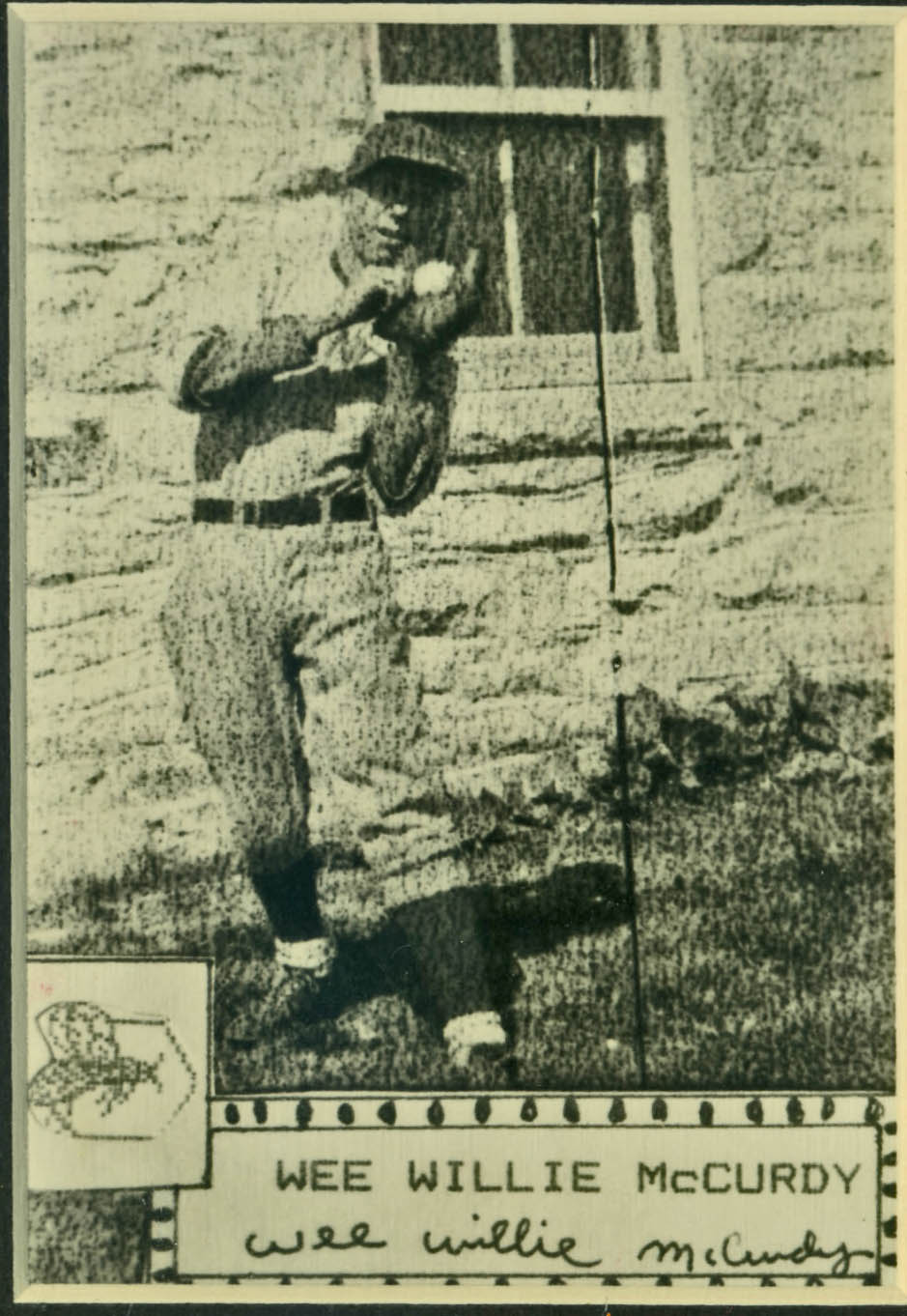
Dad played CF for the 1928 St. Edward's Broncos. He loved this card I made for him a few thousand years ago.

“You’re the baby, Bill! – You’re the baby!”

One of my earliest memories trails back to the year 1939, when I was only about one and a half years old. I’m stomping around the right field wooden grandstands of the old ballpark at the Bee County Fairgrounds with my mom sitting nearby. My dad is coming to bat from the  left side of the plate and his Beeville Bee teammates are yelling encouragement to the baby on the team. Then I see Dad swinging the bat and lacing a base hit to right field. There is cheering. Then all goes to black down memory lane. That little snippet is all that remains, but it is as clear as the bad lighting of the old field back home allows it to be.

Of course, all my descriptions of what just happened came later. I didn’t know baseball from base hit back then. I just knew that people were cheering for my dad and that he had done something to make most of them happy. I saw it all happen.

Three and one half years later, on my New Years Eve fifth birthday, we would move from Beeville to the place that would become my home forever – a place called Houston – and I would learn a lot more about baseball from my dad, the Houston Buffs, and almost endless summer days on the sandlots of Houston’s East End.

Dad was first and best ever teacher. Then he got out of the way and allowed me to learn the rest of the game on my own with my summertime sandlot buddies. None of us had eager parents leaning over our shoulders or buying us things back in the day. In the East End, at least, we either inherited bats, balls, and gloves or we got little jobs to buy them over time. Uniforms, even caps, were a luxury we didn’t even dream about possessing.

One year my mom made me a Houston Buffs uniform. In fact, she steam-ironed those letters onto the front of the jersey, “Houston Buffs.” It came with a little blue cap that had four red stripes evenly descending from the button top of the cap crown.

I wore the homemade Buffs uniform at home. Even paused long enough for Mom to take a picture of me in it once. I simply wouldn’t wear it to the sandlot. None of my teammates had one and I didn’t want to be different from them. I only wanted  to be one of them, as I already was. Knowing in our hearts and minds that we were the Pecan Park Eagles was good enough for us. We didn’t need a Houston Buff uniform Christmas present to play baseball.

We once got into a turf war with the kids from Kernel Street over the use of our field on Japonica. We had even taken to using pipe guns that shot gravel (made for us by one of our adult machinist neighbors) to defend our territory. I can’t believe we took it that far, but we did.

When the war broke out, my dad came flying out of the house and put a stop to all of it. I never learned what happened to our pipe guns, or how he handled it with the neighbor who built them for us, but we never got any more “help” from the machinist after this episode. That much I know.

Dad made us all assemble on the sandlot and play out our differences in a game of baseball, Japonica versus Kernel streets. We did. And we whacked ’em pretty good. After that, we all played together on the same field with no further trouble.

I had further trouble. Dad still wailed the tar out of me at home after the game for my involvement in the production of those pipe guns, but I deserved it. How he put up with my shenanigans as well as he did, I’ll never know. I’ll just always be grateful he was there.

“You were the baby, dad. Thanks for being in my life for as long as I was privileged to have you here with me. I’m old now, but I’ll never grow too old to say thank you. You taught me much more than baseball. You taught me tough love, honesty, integrity, loyalty, and commitment.

The one thing you didn’t teach me is how to get over missing you.

Houston Babies Fall in 2010 Opening DH!

February 28, 2010

The Houston Babies Lost by Scores of 9-0, 29-4 on Saturday, Feb. 27th.

Forget the highlights from yesterday’s opening day doubleheader of vintage base ball for the Houston Babies. There weren’t any.

The Babies dropped a twin bill to the Richmond Giants at George Ranch on Saturday, February 27th, by the scores referenced here only once in the caption to our featured team photo. I will not mention them a second time. The memory itself is sufficiently painful as a reminder of how far the Babies have to go to get back into the shape they were in at the close of the 2009 campaign. These losses brought a six-game win streak by the Babies to a train-wreck level close on a sunny, brisk, and windy Saturday at a game played in the greater Houston area. Even the historic site of the wonderful George Ranch State Park failed to halt the pain or relieve the injury of our club’s 2010 embarrassing start.

To put it mildly: “We wuz awful!”

On the bright side, the Babies problems were few and easy to diagnose: (1) We couldn’t hit; (2) We couldn’t run the bases when we did reach; and (3) We couldn’t make basic plays in the field.

Silent Bats! Unholy Sight! All Laid Calm! Far into the Night!

The brighter news is that we can only get better from here, but we’ve got to recapture the heart we found in our first two seasons of 21st century revival. Remember! The original Babies got bombed by the Cincinnati Red Stockings in their first game back on March 6, 1888 and they came back with heart to play decently. By 1889, the Babies had captured their first pennant as champions of the Texas League.

Babies General Manager Bill McCurdy assured the post-game media that he has every confidence in the world that Babies field manager Bob Dorrill will be able to pull the Babies out of their starting gate swoon and get them back into their winning ways. “We are extremely fortunate to have a man of Bob Dorrill’s savvy and wisdom guiding our Babies team out there on the field. He has my complete vote of confidence as general manager. In fact, if Bob ever gets in trouble as manager, I’ll probably be getting a call on the same day too. …. What’s that, you say? ….  You say I’m wanted on the phone? …. Forget it for now. …. Whoever it is, tell ’em to call back and go to voice mail. ….. Thanks.”

Nobody’s losing confidence in you Babies players either, guys and dolls! Hope that doesn’t register as too unbecoming to today’s PC standards, but there has to be room for a little Damon Runyan perspective on a plight like our current one – and not just maybe, but hell yes, a lot of Douglass Wallop too. (Wallop is the guy who wrote “The Year the Yankees Lost the Pennant,” the inspiration for “Damn Yankees.”)

In their honor, I want to leave you with these words, Babies. Carry them with you into our next game on April 10th. There’s something important here about baseball and I want to try to get it across to all of you in the words of the great Broadway song lyricist Benny Van Buren. In the musical “Damn Yankees,” the manager of the Washington Senators is talking, then singing to his team after they’ve just been drubbed again by the New York Yankees. I’ll also simply close my words to you all today on these lyrical notes of how I feel we generally have to face all disappointments in life:

See boys, that’s what I’m talking about. Baseball is only one half skill, the other half is something else…..something bigger!

You’ve gotta have….Heart! All you really need is heart! When the odds are sayin’ you’ll never win, that’s when the grin should start! You’ve gotta have hope! Musn’t sit around and mope. Nuthin’ half as bad as
it may appear, wait’ll next year and hope.

When your luck is battin’ zero, get your chin up off the floor. Mister, you can be a hero. You can open any door.There’s nothin’ to it, but to do it.You’ve gotta have heart! Miles and miles and miles of heart!  Oh, it’s fine to be a genius of corse!But keep that ol’ horse before the cart! First you’ve got to have heart!

Smokey: A great pitcher, we haven’t got!
Rocky: A great slugger, we haven’t got
Sohovic: A great pitcher, we haven’t got!

All: What’ve we got? We’ve got heart! All you really need is heart! When the odds are sayin’, You’ll never win, that’s when the grin should start! We’ve got hope! We don’t sit around and mope! Not a solitary sob do we heave, mister’- cause we’ve got hope.

Rocky: We’re so happy, that we’re hummin’.

All: Hmm, Hmm, Hmm

Manager: That’s the heart-y thing to do.

Smokey: ‘Cause we know our ship will come in!

All: Hmm, hmm, hmm

Sohovic: So it’s ten years over due!

All: Hoo, hoo, hoo.We’ve got heart! Miles and miles and miles of heart! Oh it’s fine to be a genius of course, but keep that old horse before the cart!

Smokey: So what the heck’s the use of cryin’?

Manager: Why should we curse?

Sohovic: We’ve got to get better……

Rocky:….’cause we can’t get worse!

All: And to add to it; we’ve got heart! – We’ve got heart! – We’ve got Heart!

WE, THE HOUSTON BABIES, HAVE GOT HEART TOO!


Vintage Base Ball Today!

February 28, 2010

Houston Babies in Action at George Ranch Today, February 27th!

The Houston Babies spring into vintage base ball action today at the George Ranch Field in Sugar Land. The SABR-sponsored club will be facing the Richmond Giants and Lone Star College Saw Dogs in a round robin tourney doubleheader beginning at 10:30 AM. The second game will start about noon.

Led by dauntless manager Bob Dorrill, the Babies will be putting a six-game winning streak on the line as they throw out the first pitch of the 2010 season. This marks the third year of the resurrection of the club that last took the fields for Houston in the late 1880’s as the first professional base ball team in Houston.

These games are played by the 1860 rules of baseball. The principle differences from the modern game are that we use no gloves. You have to catch the balls bare handed and, the one-bounce out rule is in effect.

If you’ve never seen a vintage base ball game, come join us today. It’s free and very satisfying, the closest thing to sandlot baseball expression that any of us have ever known. I am no longer able to play, but I just enjoy being there. We even play ball in vintage uniforms that cover us a little better than the attire worn by the Babies in our featured picture.

Come on out. We’d love to meet you too!

Sincerely,

Bill McCurdy , General Manager, Houston Babies


Beeville’s Five Native Big Leaguers, Part 2.

February 26, 2010

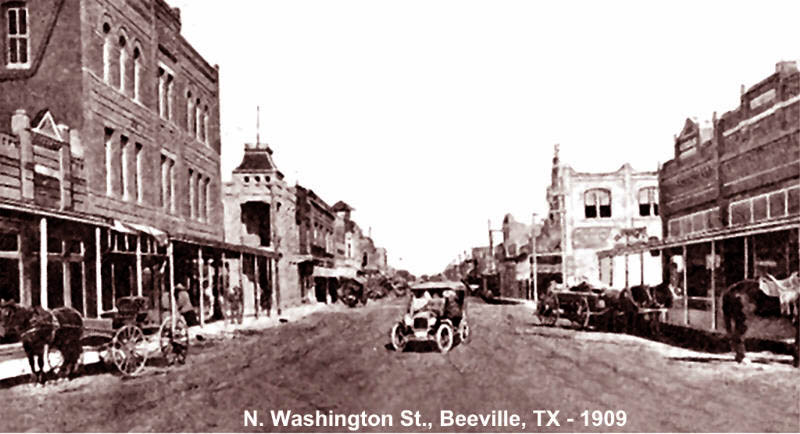
Beeville's roots as a community go back to the 1830s. It had a population of 2,500 in 1909.

The South Texas city of 13,000 now known as Beeville was first settled in the 1830s by by the Heffernan family, The Heffernans lost their lives in a Native American attack, but other European settlers soon came in sufficient numbers to survive the objections of local tribes. An infusion of immigrants from Mexico also fed the population pipeline and the place began to thrive.

After several name trials, the community settled on “Beeville” in honor of Bernard E. Bee., Sr. the Secretary of State and Secretary of War for the Republic of Texas. By 1859, the town had its own post office. The first newspaper was started by 20-year old W.O. McCurdy of Claiborne, Mississippi in 1886, the same year that the city got its first railroad. There were only 300 people in town in 1880, but the railroad and the growth of agriculture and cattle ranching soon enough changed all that. By 1908, the city reincorporated with a population nearing 2,500. The city had first incorporated in 1890, but that soon fell apart. The city wasn’t ready for that much organization. By 1908, they were big enough to require it.

The oil field boom of the 1920s caused a leap in growth and a demand for new services and forms of social entertainment. The streets were paved in 1921. The Rialto movie theatre (“picture show”) was built and opened in 1922. And a lot of people were playing forms of organized baseball.

For two seasons, the Beeville Orange Growers played baseball as members of the short-lived Southwest Texas League. It was an appropriate outcome for a team so-named. The attempt to grow oranges in Beeville also soon ended on the bitter cold realization that the winter climate of Beeville was too frigid for citrus crop survival most years.

Beeville next attempted professional ball as the Beeville Bees of the Gulf Coast League in 1926, but they moved to Laredo after getting off to a 4-9 start before sparse crowds. Beeville loved baseball, but the people weren’t spectators. They preferred playing the game for free to watching the game for pay.

A half century later, the Beeville Bees returned as members of the new independent Gulf Coast League for two seasons (1977-78). This time the club was wildly popular as an attraction at Joe Hunter Field, but the overall insolvency and lack of planning by the league sadly ended Beeville’s last venture into professional play.

Over the years, the vitality of Beeville’s love of the game is best measured by the fact it has sent four men to the major leagues as players and another as an esteemed batting coach. Here’s brief capsule on each:

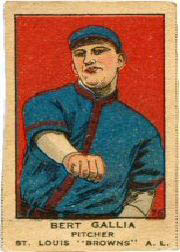
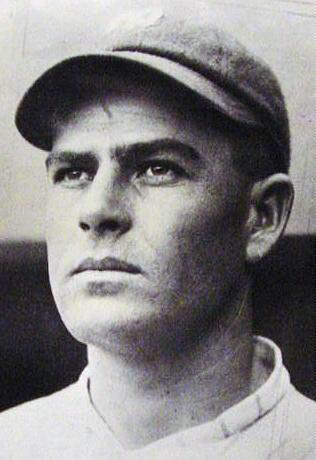
Melvin "Bert" Gallia, (MLB 1912-20)

Melvin “Bert” Gallia (BR/TR), born 10/14/1891 in Beeville, Texas,  posted a pitching record of 66 wind and 68 losses, with an earned run average of 3.14 for his nine MLB seasons with the Washington Senators, St. Louis Browns, and Philadelphia Phillies. He struck out 550 and walked 494 in 1,277 innings of work. He completed 61 of his 135 starts and he is credited with 10 saves in relief.

Curt Walker (MLB 1919-30)

Curt Walker (BL/TR), born in Beeville, Texas on July 3, 1896, was a speedy outfielder with a strong arm. Over his twelve-season career with the New York Yankees, New York Giants, Philadelphia Phillies, and Cincinnati Reds, Curt batted .304, striking out only 254 times in 4,858 official times at bat. He collected 235 doubles, 117 triples, and 64 home runs, and once hit two triples in the same inning against the Braves in 1926.  Walker also had 20 triples for the year in 1926. In 2001, Curt Walker was inducted into the Texas Baseball Hall of Fame.

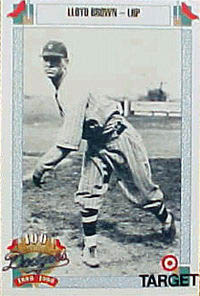
Lefty Lloyd Brown (MLB 1925, 1928-37, 1940)

Lefty Lloyd Brown (BL/TL), born in Beeville, Texas on December 25, 1904, won 91 games, lost 105, and recorded an earned run average of 4.20 in twelve seasons of work for the Brooklyn Robins, St. Louis Browns, Boston Red Sox, Cleveland Indians, and Philadelphia Phillies. He struck out 510 and walked 590 in 1,693 innings, completing 77 of the 181 games he started. He also is retroactively credited with 21 saves in relief, a stat they didn’t keep back in those days. Brown also holds the ignominious record of having surrendered four of the twenty-three record grand slam homers belted by the great Lou Gehrig.

Eddie Taubensee (MLB 1991-2001)

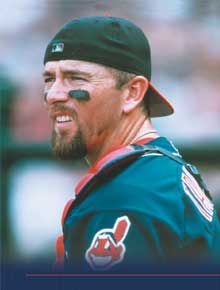
In his eleven big league seasons, Eddie Taubensee (BL/TR) was born in Beeville, Texas on October 31, 1968. Eddie was a good hitting catcher, posting a career batting average of .273 with 151 doubles, 9 triples, and 94 homers. He struck out 574 times in 2,874 times at bat, walking 255 times. He played for the Cleveland Indians, the Houston Astros, the Cincinnati Reds, and a final short season again with the Indians, the club that gave him his start.

Rudy Jaramillo (Minor Leagues, 1973-76)

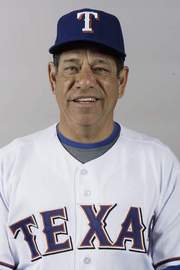
Rudy Jaramillo (BL/TR) is a Beevillian by family background, but he actually was born in Dallas, Texas on September 20, 1950. After a so-so four seasons as a .258 minor league hitter, Rudy and others discovered that he had a personal talent for teaching others what he had not been able to do himself. He became a successful hitting coach for the Houston Astros and Texas Rangers and will now serve in that same capacity for the 2010 Chicago Cubs. The list of men who were actually better teachers of hitting than they were producers of hits is a long and interesting one – and Beevillian Rudy Jaramillo deserves an honored place in that company. He’s already done well enough teaching others to have been inducted into the Texas Baseball Hall of Fame in 2002.

Overall, these men speak for a pretty fair record of baseball achievement for a small Texas town. For these and many other reasons, I’ll always be proud of my birthplace. Second to Houston, Beeville once was home.

Beeville’s Five Native Big Leaguers, Part 1.

February 25, 2010

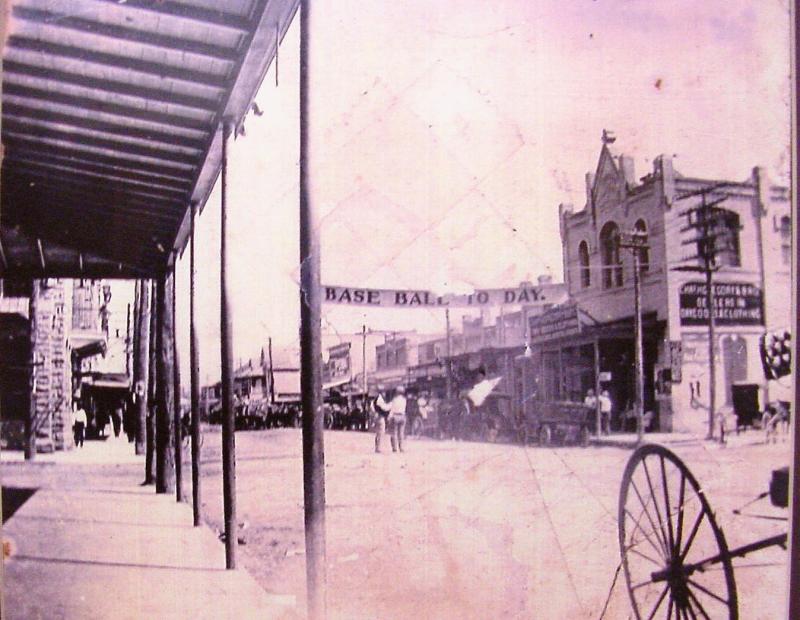
Beeville Bee Publisher/Editor W.O. McCurdy Took This Photo Around 1896.

My grandfather took this photo of Beeville, Texas about 9:30 AM, judging from the shadows. When I retraced the location of this shot, this is the perspective he would have had from the front door of his newspaper office on Washington Street, the main street in Beeville. I’m guessing the year must have been around 1896, but it could have been slightly later. I doubt it was anywhere close to 1906. Beeville had a few automobiles by that time. These would have been visible on market day. The big banner announcing “BASE BALL TO DAY” would have been a big deal back then, but I’ve never had the time in recent years to go to Beeville long enough to search the old newspaper files at the local library. I simply inherited this photo through my late father several years ago.

Here's the same perspective from above. I took this one in 1997,

Notice all the change in things over a century passage of time. Somewhere along the way, someone removed the ornate architectural street facing atop the drugstore up in the far right corner and, of course, there are no more horses and wagon wheels on Washington, except on the annual Western Days rodeo parade each October,

Beeville is my birthplace, but it’s also the birthplace of five former major leaguers who played a heck of a lot better than I ever did. Four of them played in the big leagues for extended career time. The other never played in the big leagues, but he’s made an active career for himself over recent years as a respected team batting coach.

Tomorrow I will continue this little trip to the place of my birth with some capsule information about Beeville’s five big leaguers: Bert Gallia, Curt Walker, Lefty Lloyd Brown, Eddie Taubensee, and Rudy Jaramillo.

Five major leaguers? That’s pretty good production for the sleepy little oil and cattle town that rests 53 miles west of Victoria and 50 miles north of Corpus Christi. Back in 1920, at the heart of the time that one of them was wrapping up a big league career and two others were just starting, Beeville only had a city population of 3,062 hardy souls and there were only 16 major league clubs.

More tomorrow.