Posts Tagged ‘Baseball’

Cold Case: Who Killed Eddie Gaedel?

April 25, 2010

August 19, 1951: St. Louis Browns Manager Zack Taylor Ties Eddie Gaedel's Right Baseball Shoe..

The story of Eddie Gaedel’s one-time at bat as the only midget pinch hitter in big league history back on August 19, 1951 is one of baseball’s biggest travelers. We talked about it here yesterday.

A much less popular subject is the death of Eddie Gaedel nearly ten years later on June 18, 1961 in Chicago. Eddie’s mom found him dead in bed in his apartment on that date. He had a bruise and cuts near his left eye and bruises and cuts on his knees. The coroner’s report concluded that Eddie had died of a heart attack, probably caused by the trauma of physical assault upon his body in physical combat with an unknown other or others. The only fact ascertained by the police in their brief look at the case was that Eddie Gaedel may have gone to a nearby bowling alley the previous evening where he may have had too much to drink and may have either gotten into an argument at the alley or encountered an assailant on his walk home. From what I can tell, there was no real evaluation performed on Eddie’s blood contents in the sketchy post-mortem that followed. Almost everything about his death had been concluded by the Chicago police from Eddie Gaedel’s reputation as a heavy drinker and combative personality.

Since money was missing, the CPD concluded that Eddie Gaedel had been attacked and robbed, but that he was able to make it home before collapsing and dying. The “evidence” of missing money is not spelled out as a missing wallet, nor do the CPD reports jump out and say how they knew how much cash Eddie had on him in the first place.

Because of his “reputation,” the Chicago Police Department declined to investigate the death of Eddie Gaedel any further.

What? …. What?

Since when is “reputation” grounds for letting someone go off to eternity without justice while some other guilty person gets off Scott-Free of murder? Eddie Gaedel died 49 years ago this summer. It’s wholly conceivable that his murderer is still out there in the bleachers during a White Sox or Cubs games in 2010. He or she wouldn’t be particularly conscious by this late time in life, but how alert do you need to be to keep going to baseball games as a Chicago fan on either side of town in 2010?

The point here is simple: Someone got away with murder in the Case of Eddie Gaedel and that’s too bad.

A Few Baseball Terms Revisited.

April 23, 2010

Things aren’t always what they seem. Sometimes they are. In baseball, the presence of certain colorful expressions speaks volumes for what has just transpired on the field. All of you deep blue baseball fans will already know the true meaning of each term on this short list, but you do have to be from Houston to be certain of one in particular. It doesn’t matter. These are all offered in the name of good fun. First we’ll state what each term doesn’t mean. Then we will offer a brief explanation of what each expression really means as a baseball term or idea:

Worm Burner

(1) Worm Burner. A worm burner is not an underground arsonist. A worm burner is a sharply hit ground ball that skims the surface of the field so free of bounce that it threatens to burn the backs of all underground worms in its path from the sheer generation of friction heat all along the travel route.

.

Rope

(2) A Rope. A baseball rope is not an entwined heavy thread of fibrous cords. A baseball rope is more like a batted worm burner that leaves the ground, traveling on a rope-like trajectory at great speeds toward the outer regions of the field. Former Houston Buff and Baltimore Oriole star Bob “The Rope” Boyd was famous for hitting such batted balls; hence, the nickname.

Can of Corn

(3) Can of Corn. A can of corn is not just the poor single guy’s answer to the question, “What’s for supper?” A can of corn in baseball is a ball that is batted so softly and lazily to the outfield that it is so easy to catch that even your grandmother could not miss it. i.e., “That ball was as easy to catch as it is to open and eat a can of corn.”

Blue Darter

(4) Blue Darter. A blue darter is not merely a beautiful fish. A blue darter is a batted ball that moves quickly and closely to the ground like its fishy namesake, behaving almost as though it possesses special powers of vision and intuition for the job of avoiding a fielder’s glove. It almost always results in a runner reaching first base on a hit or fielding error.

Sacrifice Fly

(5) Sacrifice Fly. A sacrifice fly is not a  special offering of one subject from that pesky species on the grill with a prayer that all its brothers and sisters will go away from a backyard barbecue party. In baseball, a sacrifice fly is a batted ball that is caught in the outfield by any fielder that results in an existing base runner scoring after the catch is made for either the first or second out of the inning. When this sequence is completed, the batter of the “sac fly” is not charged with a time at bat, but he is given credit for a run batted in. The whole concept of the sacrifice fly is based upon the supposition that the batter intended to hit a ball that would score the runner, even if it were caught for an out that didn’t end the inning.

Twin Killing

(6) Twin Killing. A baseball twin killing is not the murder of, nor the murder by, twins. It is, of course, the ability to get two outs on one play, or, as it is more commonly known, a ball in play that results in the “double play” of two outs on one throw from the pitcher. As you know, it is possible in several ways to get a double play on the field without the batter ever touching the ball with his bat. You may even argue that a successful attempt at the old “hidden ball trick” by an infielder after the previous play was assumed dead could theoretically lead to a double play without further action by the pitcher.

The Infield Fly Rule.

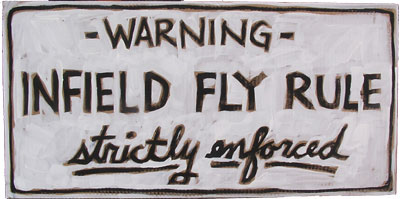
(7) The Infield Fly Rule. The infield fly rule has nothing to do with the false assumption that infielders are required in the name of proper decorum to make sure their pants are zipped before taking the field. The infield fly rule is in place to keep infielders from using force out situations with less than two outs as instances for allowing easy infield fly balls to drop for the sake of getting a double play or simply removing a faster runner off the bases with a force play. When the umpire calls the infield fly rule, he raises his fist to the sky, meaning the batter is out and the runners hold where they are.

The Drag Bunt

(8) The Drag Bunt. There is no truth to the rumor that any batter attempting the “drag” bunt shall be required to wear at least one item of women’s clothing when he does so. It is true that the batter needs to be left-handed for this offensive option to make any sense. In the drag bunt, the batter is attempting to drag bunt the ball into play as he simultaneously breaks from the box for a head start on beating it out for a hit down the line. You don’t see a lot of lefties today with the skills or ability for drag bunting as they once did, but Ichiro Suzuki (pictured here) is one who does do it well.

Crawford Boxer

(9) Crawford Boxer. OK, here we go, concluding with the special Houston baseball term. – A Crawford Boxer is not a special breed of dog that has been bred to patrol Crawford Avenue in downtown Houston. – A Crawford Boxer is a special play that only takes place inside Minute Maid Park when a batter hits a ball to the left field grandstands that back up to Crawford Avenue. Located some 315 feet down the left line, home runs into this special section are simply called “Crawford Boxers.”

That’s all we have time for exploring this morning, folks, but please feel free to add and comment on your own favorite baseball terms in the comment section that follows this article.

Mike Blyzka: One of the Last Old Browns.

April 22, 2010

Mike Blyzka lost his first 9 pitching decisions in 1947.

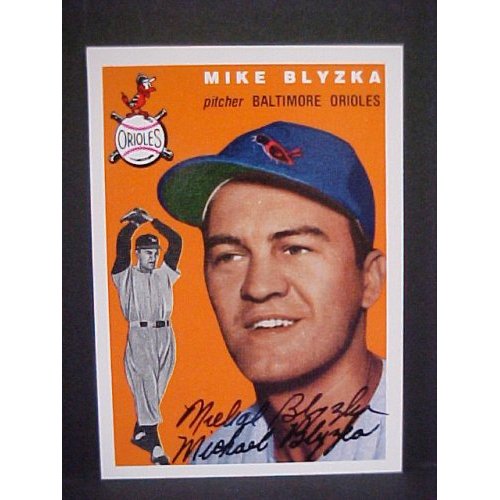
Mike Blyzka lived with a little noted, but no less important distinction in baseball history. As a right handed pitcher, Mike worked for both the last 1953 St. Louis Browns club and the first 1954 Baltimore Orioles team. All he did to attain that quiet “honor” was to have been on the roster at the time the decision was made to sell the Browns to Baltimore interests and then make it through the mild ripple of player transactions that followed as fanfare for the people of Baltimore that “the Orioles are coming home to their ancient big league roost! – even if they have to land in the lower branches of the big league tree with a bunch of ex-Browns flapping their wings and gasping for air.”

The news of the Browns move came down hard upon me in Houston. You see, as a 7th grader,  I had become a converted Browns fan in 1951 due to the incredible season that pitcher New Garver put up as a 20-game winner for a last place three-digit loss Browns club. Garver had gone 20-12 with a 3.73 for a last place Browns club that finished 8th with a record of  52-102. And I was always hooked on throwing my support to deserving underdogs. Garver stood out as such to me.

You may know the famous story that spawned on the heels of Garver’s incredible year. When Garver sought a substantial reserve clause era raise for his efforts in his new 1952 contract, Browns owner Bill Veeck turned him down, supposedly explaining that “we could’ve finished last without you.”

At any rate, Mike Blyzka arrived in time to go 2-6 for the 1953 Browns and then 1-5 for the 1954 Orioles in 70, mostly relief appearances. His 3-11, 5.58 ERA record for those two seasons turned out to be his major league career. As a seven-season minor leaguer (1947-50, 1955-57), Mike Blyzka posted a career sub-major league record of 63-60 with a 4.18 ERA.

I never really dug into Mike Blyzka’s record until years later, when I got to know him a little better as a person. Starting in 1996, and moving through 2003, I saw Mike Blyzka every year at the annual reunion dinners for the St. Louis Browns in St. Louis. Mike came religiously each spring as a former Brown. I came each season as a member of the St. Louis Browns Historical Society. It was through these laid-back conversations at breakfast and just sitting around the hotel lobby that I even learned a little of all that Mike Blyzka overcame to fulfill his dream of pitching in the big leagues.

By the time I met Mike, his health was bad and he lived alone in retirement in Cheyenne, Wyoming. He didn’t get around too well so I drove us places on a few eating and shopping expeditions away from the banquet hotel. Other old Browns like Red Hayworth often came with us. It was a joyful time to see old and new St. Louis through the eyes of men who had been such a big, but quiet part of the city’s baseball history.

In 2003, the Cardinals wanted to honor the history of the Browns by playing a uniform throwback game at old Busch Stadium II against the Baltimore Orioles playing as the 1944 Browns. They had a hard time talking the current Oriole players into going along with the plan, but that is not surprising. The Orioles have spent over a half century doing all in their power to forget the idea that their club ever played as the St. Louis Browns. Somehow they managed to overcome resistance and get it done, and they played the game on a Saturday in June that followed a Friday night game in which the last Browns club was honored.

It would have been a whole lot easier, it seems to me, if someone in the Cardinals organization had remembered that Mike Blyzka, Don Lenhardt, and a handful of others present that weekend had also played in 1954 as original new Orioles, but nobody mentioned the fact.

Oh well. Michael John Blyzka is our main subject here today. Born on Christmas Day in 1928 in Hamtramck, Michigan, Mike signed originally with the Chicago White Sox as an 18-year old (BR/TR) pitcher. He was assigned to pitch for Class D Lima, Ohio in 1947, where something happened that could have ended the career of a lesser man. – Mike lost his first nine decisions in professional baseball.  Assigned elsewhere in mid-season with an 0-9 record as baggage, Blyzka proceeded to finish at Class D Madisonville with a 2-6 mark, leaving him with a 2-15 start to his professional baseball career and a ticket over to the St. Louis Browns organization in 1948 via a minor trade.

Mike took those early lemons and brewed up some lemonade.

Pitching for the Browns club at Class D Belleville, 19-year old Mike Blyzka posted a 12-9 mark with a 3.37 ERA. He also led the Illinois State League with 192 strikeouts in 1948. After posting 28 total wins at Class C and A ball in 1949-50, Mike got swooped up for military service in Korea in 1951-52, but he was ready for his Browns debut when he returned to baseball in 1953. Such as it was, he will, or should be, remembered for his part in history.

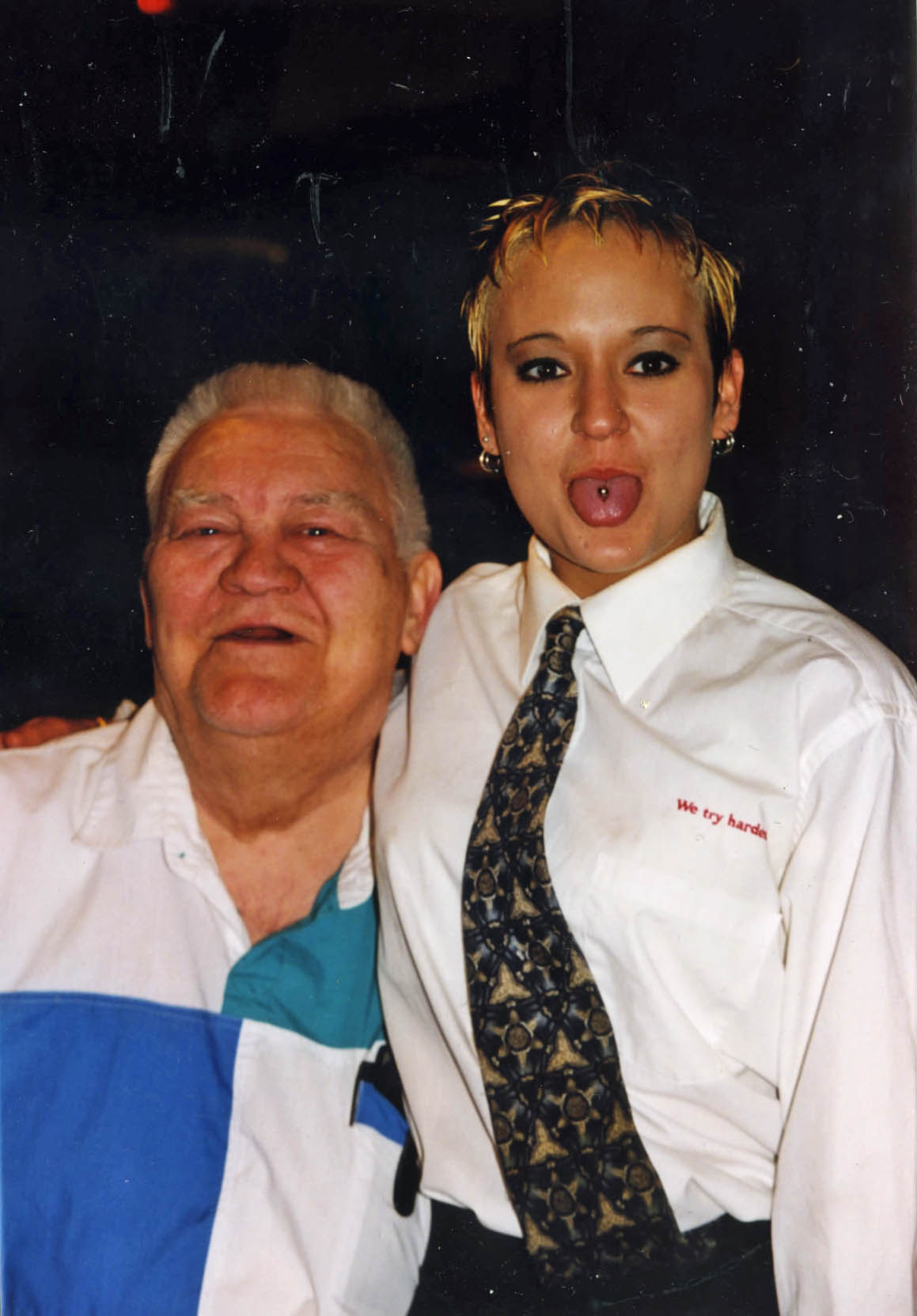
Mike Blyzka and admirer. Mike was a true gentleman with a quiet sense of humor.

Mike Blyzka did nothing to call attention to himself, but he possessed a delightful sense of humor about aging and the inevitability it brings to the table. On that last time I saw Mike Blyzka in  St. Louis, one of the girls in the hotel restaurant decided to play with Mike about going out on the town when she got off work. Mike played along with the joke, even though he knew there was nothing to it, and always sticking to his story that he appreciated the invitation, but but that he couldn’t make it due to other commitments.

As we were leaving the restaurant after breakfast, Mike offered the following: “You know, Bill, I might have taken her up on the invitation, but I think I’d rather live to see the game tomorrow.”

Mike Blyzka passed away at his home in Cheyenne on October 13, 2004.

God rest your soul, Happy Mike. And long live the Browns.

Dreaming Of The Majors: Living In The Bush.

April 21, 2010

Lefty O'Neal Is A Rare White Veteran of the Negro Leagues.

Yesterday I heard from Lefty O’Neal, the rare white veteran of Negro League baseball who wrote a book last year on his improbable experiences in baseball. We have not been in contact for quite a while, but it was good to hear from the man again.I’ve never met the man face-to-face, but I did read his manuscript over the time he was searching for a publisher.

All I can really say is – Lefty writes honestly from the heart. His little book with the long, long title, “Dreaming of the Majors: Living in the Bush,” is a wide open testament to his faith, spirit,and ability to play the game. I won’t go into the details here of how a white guy came about playing in the Negro Leagues because that’s a big part of the book, but I will say that no gets to an accomplishment on that level without possessing the “miles and miles and miles of heart” that are described in the lead song from “Damn Yankees.” Dick “Lefty” O’Neal had all the heart one could hope to pump into the chase of such a dream and he got there – by the Grace of God and with the help of a legion of fairly earth-bound angels.

Houston Astros icon Larry Dierker put O’Neal’s journey in this perspective: “O’Neal will take you on an ironic tour of race relations on the diamond: as Lefty becomes the mirror image of Jackie Robinson, playing as the only white guy on a Negro League team.”

Former major leaguer and recent hitting coach of the Los Angeles Dodgers expressed these thoughts on O’Neal’s story: “His writings are a pleasure and a joy to read.” Merv Johnson, a former assistant  college baseball coach at both Arkansas and Oklahoma put it well for what it is: “This book is a must read for anyone who has a dream.”

You don’t read Lefty’s book for great literature. You read it as a clearly stated map on where the forces of faith, hope, and love can take us if we are simply willing to hear the call of the Holy Spirit and lean all the way into the job of doing our part to get there.

Dick “Lefty” O’Neal listened and then did what he had to do. Along the way, he met the earth-bound army of angels who helped him overcome doubt and complete the journey.

Who is Dick “Lefty” O’Neal? For starters, he’s a retired United States Air Force officer with twenty years past service to his credit. He is now an adjunct professor in the speech communication field,  part-time corporate training consultant, a motivational speaker, a board member for the San Antonio Chapter of the Fellowship of Christian Athletes, and, last but not least, he is Vice President of the SOuth Texas Professional Baseball Negro League Players Association.

Lefty O’Neal and his wife Harriett have been married for more than 36 years and they have two adult children, Amy and Richard Adam. The O’Neal family makes their home in Universal City, Texas.

O’Neal’s inspirational book is available online through Amazon and by order from such booksellers as Borders and Barnes and Noble. You may also order from the publisher, WinePressBooks.Com. The cost is $14.99, plus tax and shipping.

Some people do great things for the sake of directly helping the human condition. Others serve as the objects of personal example to others. Some do both. Meet Dick “Lefty” O’Neal.

1948 Buffs Photo: Many Pictures in One.

April 19, 2010

1948 Houston Buffs: Zooming In, A Photo May Raise More Questions than it Answers.

The 1948 Houston  Buffs had a tough act to follow. They had to take the baseball stage on the heels of the 1947 Buffs, a tenacious club that won both the Texas League pennant and the Dixie Series championship. As it turned out, the ’48 Buffs, also playing under ’47 Manager Johnny Keane and with several players from their championship year, could only make it to third place and a full ten games back of the first place and eventual pennant-winning Fort Worth Cats. The ’48 Buffs lost to Tulsa in the first round of the Shaughnessy Playoffs.

I used the featured team photo of the ’48 Buffs to crop and display an individual picture of Jim Basso in yesterday’s article on the Buff who knew Hemingway. Remember this one? It shows up pretty darn crisp and clear:

Jim Basso Never Came To Bat for the '48 Buffs.

Before Jim Basso ever came to bat for the 1948 Houston Buffs, he was dealt away, ending his three season status (1946-48) as a member of the club. Based upon his length of time with five other clubs in 1948, it is fairly safe to assume that this photo of Basso in the team photo of the Buffs was taken in the spring or very early part of the season.

What else is in the photo, however unintentional it may have been?

The fan isn't smoking; it's a print negative scratch.

When I first saw the fan second from right in the photo, I thought we had a live photo of someone actually smoking in the grandstands, which many fans did in wild abandon back in 1948. It turns out that it was simply a scratch on the negative that had created this illusion.

What’s not an illusion is that all these young guys were there early to see a game, we presume. It could be that fans or family members were allowed into Buff Stadium just to watch the team photo shooting, but that isn’t likely. The issue that throws e off here is the casual attire of team President Allen Russell. He usually went suit and tie on game days so we can’t really be sure if maybe it was an off-day or just early enough in the day for Russell to change later. Still, if Russell dressed formally for games, you would think he would have done the same for the team picture. It’s possible to think ourselves into a corner on mysteries at this level.

Sporty Allen Russell in 1948 Team Photo Corner.

The sporty shot of Buffs President Allen Russell also reveals more seated civilians over each shoulder. Based on their youthful appearance and body language, I’m guessing they are “kids from the ‘hood” who came early for Knothole Gang seating who got to roam the better seats prior to the start of each game. We did that all the time back in the day.

It must be a long while prior to game time. Otherwise, Allen Russell wouldn’t be smiling that broadly with all those empty seats lurking behind him.

Somebody had a game date this day.

Way back there in the stands, we see a young couple seated, with a lonely lurking twerp seated sort of glumly behind them. The couple’s presence adds more weight to the possibility that this photo was taken early on a game date. As I recall our culture in that era, one didn’t usually get a date to simply go watch  practice or a team photo shoot at Buff Stadium.

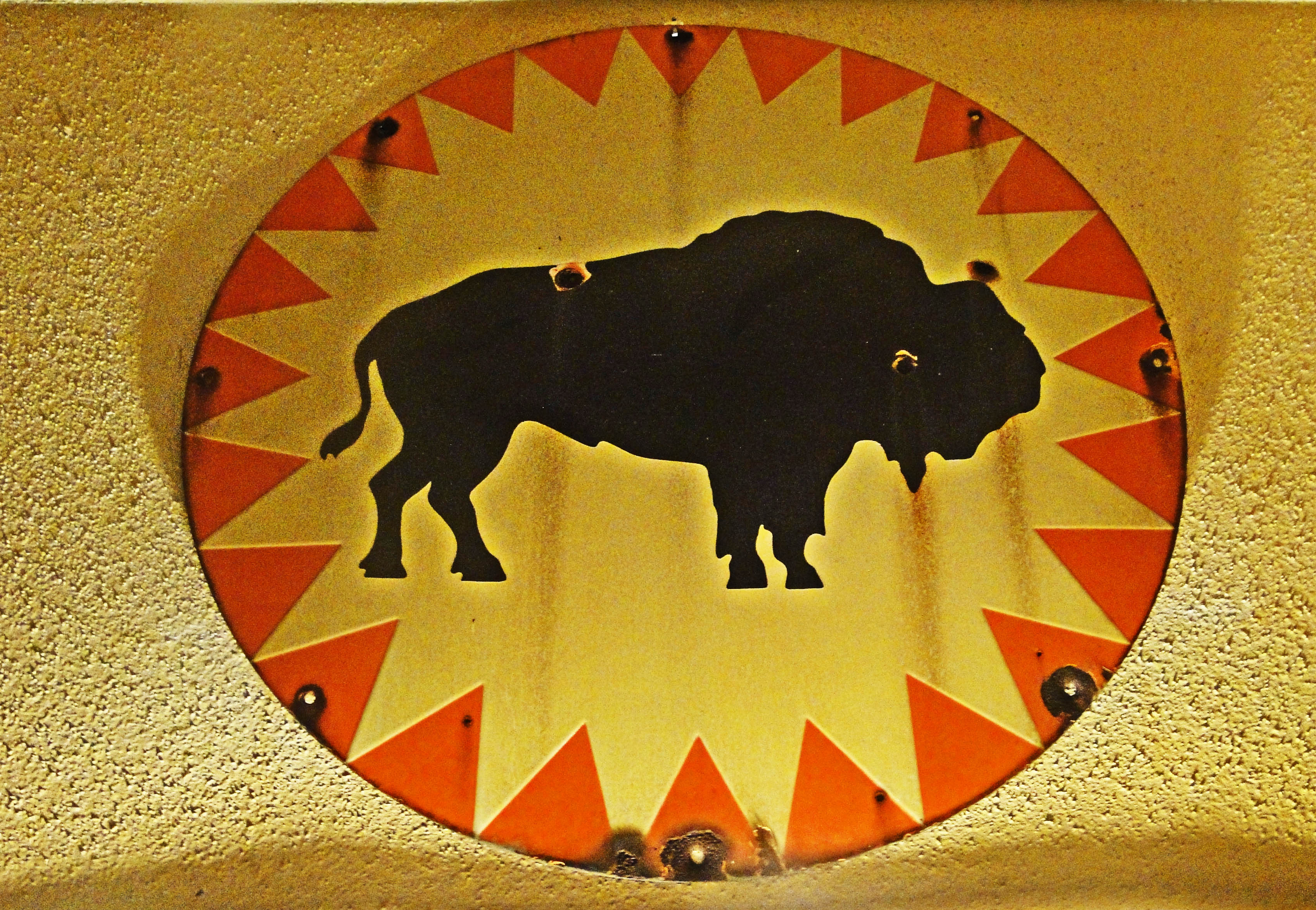
The silhouette of these buffalo medallions confirm that Buff Stadium, indeed, is the site of our 1948 Houston Buffs team photo.

A total of eighty 36″ in diameter steel buffalo medallions once rimmed the exterior walls of Buff Stadium from 1928 to 1961. Two of these medallions hang today in the Houston Sports Museum at Finger Furniture. A few others are scattered among individual owners and I have one that was given to me by former Buff Jerry Witte and his family for historical safekeeping. It will eventually go to a place yet to be determined which can guarantee its preservation and display for history in perpetuity.

For now, here’s how this unmistakable symbol of Buff Stadium looks this morning in the space above my head where I write each day:

Eighty of these beautiful medallions once rimmed the exterior walls of Buff Stadium.

There is much in a photo. This one starts out showing us the faces of a team. It then ends up raising the question we all have to answer for ourselves: How much part are we each willing to play in the preservation of history.

Think about it. Then get out there and give the world your answer. No contribution can be too large or too small. If you do nothing more than join SABR, the Society for American Baseball Research, you will be helping all the rest of us take a giant leap forward – and this is not a commercial. It’s simply a fact. SABR works for baseball.

For more information about SABR in general, check out the national organization:

info@sabr.org

For more information about the Houston-based Larry Dierker Chapter of SABR, contact group leader Bob Dorrill at

E-Mail:

bdorrill@aol.com

Phone:

281-361-7874

Meanwhile, enjoy your old photos even more. And have a nice day.

Keppinger’s a Keeper!

April 16, 2010

Jeff Keppinger

Yesterday Houston Astro utility infielder Jeff Keppinger jumped in there one more time as a major contributor to his club’s need for offense. Now hitting .391, Keppinger went 2 for 4 with a double, a run scored, and 3 runs batted in to pace the Astros to a 5-1 win over the Cardinals in St. Louis. The victory halted an eight-game, out-of-the-gate losing streak by the club, saving the Astros from a franchise history tie with the 1983 team for most consecutive losses to begin a season.

Keppinger played shortstop in yesterday’s game, but he is perfectly capable of filling in adequately at second base, third base, or in the outfield. Teammates laud his attitude and preparation for all games on the schedule. His 2009 year with the Astros already had shown his ability to play clutch ball as a late in the game or last inning pinch hitter, sometimes being the guy whose final at bat produced the hit that won the game for the Astros.

What a grab he was when the Astros obtained him in a minor deal with the Reds prior to the 2009 season. As others have pointed out, Keppinger is exactly the kind of guy you need on a club that is committed to a 12-man pitching roster. That commitment leaves room for only five extra players and one of them will always need to be a catcher. With Keppinger, you get the kind of guy who possesses the attitude, the versatility, and the capability of filling in on offense or defense, in the infield or the  outfield, as needed. Who could ask for anything more.

If the Astros’ 2010 season had to end after only nine games, and there may be some gloomy souls out there who still wish that it could, the rest of us would be torn between choosing star center fielder Michael Bourn or steady backup Jeff Keppinger as the club’s most valuable player in 2010. Through games of April 15th, Bourn is hitting .394 and Keppinger is good for .391. No one else is close.

How did we get this guy? Give some credit to General Manager Ed Wade and the Astros scouts who touted him as a choice pick up when he became available in Cincinnati. Keppinger appears to be one of those talented guys who just seemed to slip through the cracks several times over as clubs dealt him away in trades that were governed by factors beyond his individual ability. It happens all the time.

Jeff Keppinger originally was drafted out of the University of Georgia as a shortstop by the Pittsburgh Pirates back in 2001. He was subsequently traded to the New York Mets in 2004, then to the Kansas City Royals in 2006, and next to the Cincinnati Reds in 2007. He was always the back up guy who played adequately, but not enough to distract from or compete with some other “starting” player at either shortstop or second base. At New York, current Astro second baseman Kaz Matsui was his obstacle to playing more often.

Then, when Keppinger landed in Houston last year, he wasn’t going to replace either Miguel Tejada or Kaz Matsui at the keystone bag, but he did prove to be a more than adequate platoon partner with Geoff Blum at third base and the go-to guy when it came to facing lefties. Through the 2009 season, Jeff Keppinger has built a .341 batting average against lefthanders. If that kind of production doesn’t buy a guy a few starts somewhere, I can’t imagine what else might move the participation level over what ordinarily falls to good glove men backup types over the long season. Keppinger earned more playing time in 2009 by virtue of his building offensive record as a producer and by his big moments in key games against Chicago and St. Louis.

In his six-season MLB career (2004, 2006-2010), to date, Jeff Keppinger is batting .281 with 20 homers in 358 games and 1,204 official times at bat. The other good news is that Keppinger only turns 30 on his April 21st birthday next week. With a little luck, and a few grains of destiny dust, Jeff Keppinger could be around Houston long enough to help the Astros build their way back into NLC  contention for years to come.

At any rate, Jeff Keppinger’s contributions to stopping the season-start tailspin of 2010 will not be soon forgotten.

Kids Today and Baseball.

April 14, 2010

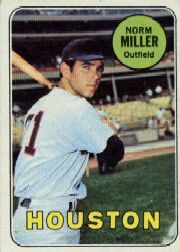
Former Astro Norm Miller, 2010.

Former Astros outfielder spoke to our Larry Dierker Chapter of SABR last night. His speech lit a fire that almost burns by spontaneous combustion for most of us elder folk. The topic, put simply, is the subject of kids and baseball today. It’s a  much bigger subject than baseball alone.

Miller began his talk with the disclaimer that he knows nothing about baseball’s history or the rules, claiming to be just a guy who played the game. As most of you know, you need to watch out when you hear that kind of opening disclaimer by a public figure in a public talk. It usually means you are about to take “a good old country lawyer” spraying of the speaker’s thoughts on the topic at hand. As per thesis, Norm Miller proved himself capable of delivering a ton of words on the subject he sort of chose for himself: Baseball Today.

Norm began with his opening question to the audience: “How do you feel about baseball today?”

Miller proceeded to take us through the facts that he was an old school Southern California guy who participated in baseball, football, basketball, and surfing during their appropriate seasons and times of day, but that baseball today is more about kids being controlled into playing baseball 24 hours a day, twelve months per year, and all in the parents’ invested hopes that the training experience will lead to a successful professional career in the big leagues. He mentioned the Select Baseball program as an approach that panders to that exalted expectation.

Norm also talkeed about his brief experience coaching in Select before he fully realized what he was getting into and being blown away by the attitude of so many kids he tried to coach. These kids on Norm’s watch resented being told what to do and some had the kind of sailor-vocabulary mouths to express themselves on the subject. One kid walked away from a practice order from Miller. When Miller then tried to stop him, the kid just looked up at Norm and said something like, “Get out of my way, you blankety-blank old man!”

Norm says it took all he had within him to keep from whacking the kid, but it proved to be the incident that led Norm to getting out. In general, he now feels that the pressure there to win and get better is so relentless that the kids can’t stand it, even though the parents seem to be buying into the hope that their child’s participation is going to lead to a big breakthrough career in baseball.

To me, it all simply sounded like too much baseball for all the wrong reasons. Those of us from the sandlot generation played the game all day during the season because we chose it for ourselves. We weren’t playing the game for the purpose of becoming big leaguers, even though we dreamed a lot about that sort of thing. There was no pressure to get better or die.

We simply had the good fortune back in the day to have grown up in a world in which it was still safe for kids to play in the neighborhood on their own without any over-the-shoulder supervision from all the adults in our lives. Because we did live in that safer world, parents didn’t feel so much that they had to control and supervise our time and guide our activities as preparations for the adult world to come.

Most of us got the message: It’s up to you to learn something that will allow you to support yourself when you’re grown. You have some talents inside, but it’s up to you to find out what they are and to then develop them by your own dedication to learning. College is a good way to go, but you’re going to have to help find a way to pay for it and, even if you get there through college, you are still going to have to decide what it is you want to do and make the most of your talents and opportunities. Not having an honest way to take care of yourself is the only unacceptable outcome of your childhood.

Pretty basic stuff was at play for us, but we got it.

Norm Miller, MLB, 1965-74.

Now the combination of an unsafe world and the additional discretionary resources of ambitious parents seem to be taking over the lives of many kids. And that’s really too bad. Way beyond the loss of the sandlot itself, kids have lost the relatively safe opportunity to simply work things out on the street with other kids without adult involvement. It’s really too bad.

Parents today can’t buy the kind of healing childhood experiences that our post World War II generation got for free.

Thank you, Norm Miller, for reminding us on the larger plane of what was so important about the sandlot. It went way beyond baseball alone to everything we did and tried to become.

By the way, Norm Miller has written and self-published a book recently on his big league experience. It’s entitled “To all my fans…from Norm Who?” You may purchase the book over the Internet or through your local bookstore.

Eagle Memories: The Way We Were.

April 13, 2010

The culture of field behavior changes forever.

Unless you are one of us ancients, you may not have noticed the wide range of change in field behavior that has taken place in baseball over the past half century. The game remains the same, of course, but player behavior on the field has mutated considerably from what it used to be. I’ll try to cover some of the major things I see here. Feel free to add, refresh, or comment on this subject below as a response to this subject.

Changes in Baseball Field Behavior Since 1960:

(1) Baseball Gloves on the Field When Your Team is Batting. We used yo copy the pros on the sandlot, throwing our gloves on the outfield grass while our club was at bat. I never played in a game or saw a Buffs game in which a tossed fielder glove interfered with a batted ball or a running fielder. The practice disappeared about 1959-60. I can’t recall exactly how or when it came about.

(2) Pepper Games. Prior to games, players in groups of two to five used to play pepper near the stands almost every time in spite of the “No Pepper Games” signs that prevailed in the interest of fan safety from errantly batted balls. A pepper game was simply a gingerly batted ball at close range to a group of three or four fielders standing back about six ro eight feet from the batter. I haven’t seen a pepper game in ages now.

(3) Infield Practice. It used to be as routine a pre-game ritual as batting practice still is. And what a thing of grace and beauty it was to watch too, but no more. I guess infielders must have gotten so good at what they do that the practice of fielding became unnecessary.

(4) Infield Game Chatter. Infielders used to keep us this hum of chatter on defense. It was there as a voice of distraction to hitters and runners and a show of support for the pitcher. At some point, it became un-cool to do – and infielders stopped. When they did, they seemed to lapse into stone-cold expressions and a more tranquil face on the subject of game conflict in action.

(5) Bench Jockeys. These guys were the original trash talkers. A baseball bench jockey worked on pitchers and batters of the other team. When one of the Detroit Tiger pitchers Schoolboy Rowe went on the air to do a radio show prior to the 1934 World Series, he finished his radio remarks by asking his wife, “How am I doin’, Edna?” And that’s exactly what he got from Leo Durocher, the St. Louis Cardinals’ chief bench jockey in his first pitching assignment. Every time Rowe walked a man or gave up a hit, Durocher let fly with a deriding cry of “How am I doin’, Edna?” It unnerved Rowe and helped the Cardinals beat him in the Series. Somewhere along the way, the bench jockeys of baseball either all died, retired, or shut up for all time. Too bad. The loss of bench jockeys leaves the world of baseball a slightly duller place to be.

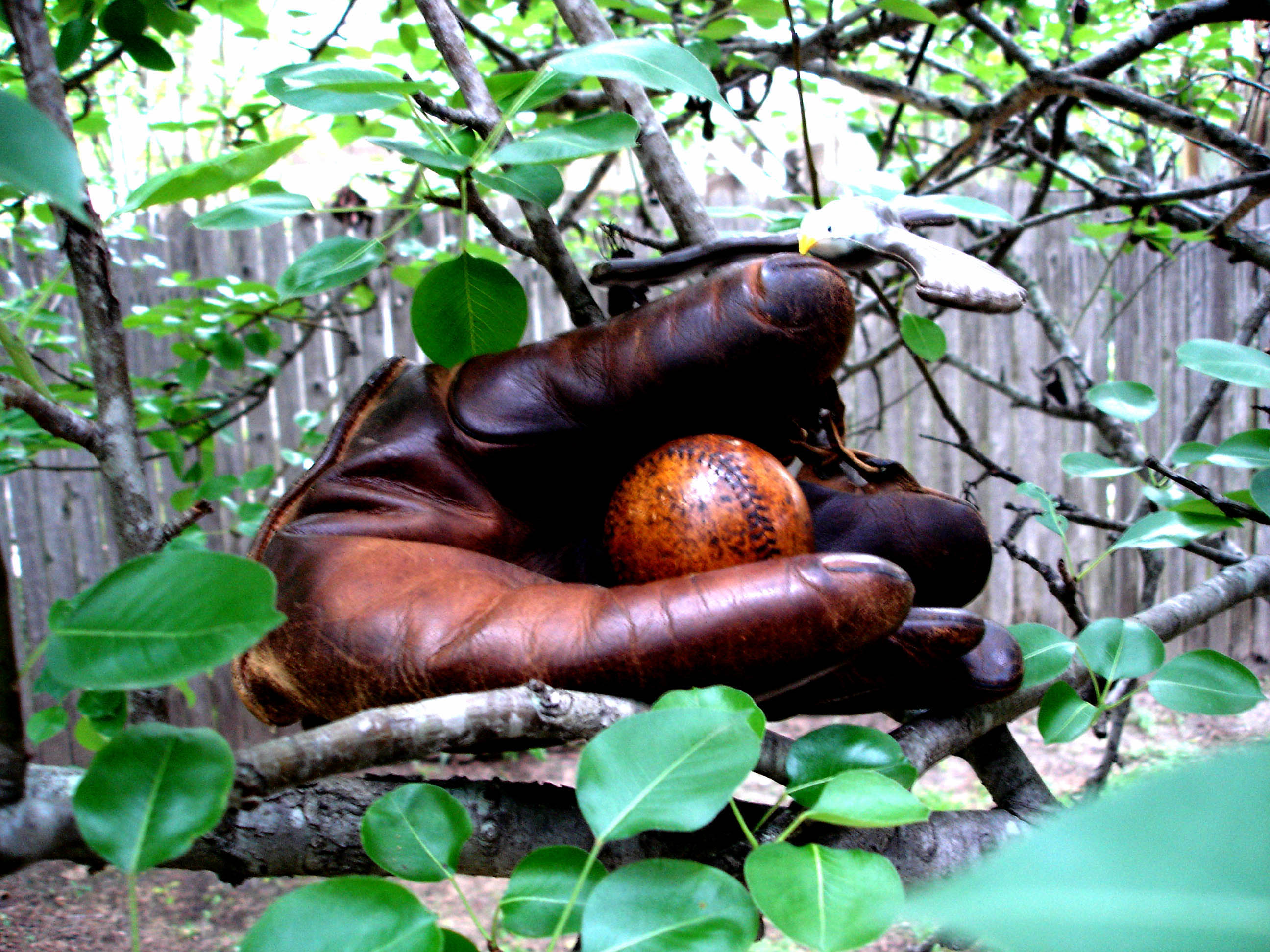
Gloves on the ground were common. Gloves with balls in a tree were rare.

(6) Indifference to Opposition. Baseball used to enforce its rule about players not “fraternizing” on the field with players from the other team. Today players disregard that rule as though it were no longer on the books and, who knows, maybe it isn’t. Lance Berkman stands out in my mind as a guy who treats every enemy runner who makes it to first base as though he were a long-lost friend. And who knows again, maybe they are. Lance is a pretty sociable guy.

(7) Pitchers as Pinch Runners. Clubs, especially the minor league clubs with their small rosters, used to use pitchers as pinch runners in late innings. I guess that baseball finally figured out that it wasn’t worth the risk to a pitcher’s arm or general welfare to put him out there under those circumstances of potential harm, doing something he ordinarily doesn’t do very often.

(8) Players (especially visiting team players) Often Began Day Games with Dirty Uniforms from the Night Before. We have better, faster washer dryers today and a little more support help on uniform maintenance.

(9) You used to be able to see the major spots on the field where the fielders spit their tobacco juices. Less chawing has led to a cleaner look in most ballparks today.

(10) Night Spot Team Brawls. Teams like the Yankees of the 1950s or even the Mets of the 1980s are getting into fewer club arrests for drunk and disorderly behavior arrests in night clubs these days.  I’m not sure if this means that today’s players are more problem-free than their predecessors or that today’s players are simply more discrete in the ways they choose to stir up trouble as a form of entertainment.

Either way, it’s a different ballgame today. In baseball and in life.

Sandlot Wisdom: Things We Figured Out on Our Own.

April 12, 2010

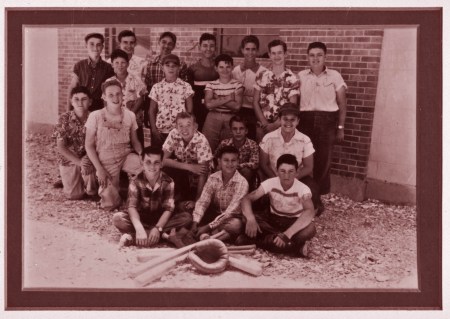
Houston East, 1952. (I'm the kid kneeling at left and wearing the Hawaiian shirt.)

Back on the Post World War II Sandlot, we didn’t have the best coaching or equipment in the world. As a matter of fact, we hardly had any coaching at all beyond those things that we picked up from our dads by chance in games of catch in the backyard after our dads’ work was done, but that didn’t happen every day. Our dads in the Houston East End worked long hard blue-collar job hours and they weren’t always home or simply up to playing catch every day that they were there.

Out on the sandlot, of course, we did a lot of “my dad says this” talking with each other. “Get in front of the ball on grounders. If you can’t catch ’em, at least, block ’em with your body” stands out in my memory as the most universal lesson we all picked up as a dad throwaway message. We might never have picked that one up on our own. There was no such thing as a true hop on our Eagle Park field, but we still came around to blocking grounders at the risk of  broken teeth and black eyes. It was the thing to do. Our fathers told us it was.

So, let’s give dads the credit for that first wisdom of the sandlot and then hit upon some of the other things we pretty much figured out on our own by simply playing the game with each other from dawn to dusk during the summers.

Some Wisdom of the Sandlot:

(1)  Get in front of the ball on grounders. If you can’t catch ’em, at least, block ’em with your body. Kids who didn’t block grounders were at risk of being labeled as “dog catchers.” These were fielders who chased hot grounders like dogs chase cars. If they do catch up with the ball, they just run along beside it, barking all the way as the ball clears the lot and rolls on down the street.

(2) In making out a batting order, put the fast little guys who show they can get on base in there ahead of the bigger, slower-moving, but harder-hitting guys.

(3) If you’re pitching, throw strikes. If you can get that first one in there for a strike, you put the batter at a disadvantage that remains with him, unless you give it away by forgetting where the strike zone is located.

(4) If you’re pitching, “accidentally” throw one hard, inside, and wild every now and then. If a wild pitch  makes the batter fall back or down, it becomes easier to throw a strike with your next pitch, especially if you can put it on the outside corner.

(5) As an outfielder, throw the ball ahead of the runner. To learn this one, all we had to do was watch little kids in right field throw ground ball singles to first base, allowing the runner to safely move on to second base in the process. What we didn’t learn on our own in the sandlot is how to effectively set up and use cut-off men on balls hit deep to the outfield. I didn’t learn that one until I played organized ball with an adult coach.

(6) Play the game to win. If you don’t play to win, you may as well not be playing. (Sandlot Yoga would not have been very popular in Pecan Park back in the day. It probably still isn’t.)

(7) If your opponent has an obvious weakness, take advantage of it. This value taught us how to hit to all fields. In fact, Wee Willie Keeler’s credo, “Hit ’em where they ain’t” simply meant to us: “hit ’em where the other team doesn’t have somebody positioned who looks like they can catch or stop a hard-batted ball. And hey, if it looks like nobody out there can catch, go ahead and swing from the heels, Eagles! This is “track-meet-on-the-bases” day!

(8) Never let the other team back in the game because you feel sorry for them. (See Lesson 6 again.) Don’t confuse the absence of mercy with unsportsmanlike behavior. You play the game of baseball to win – or you don’t play the game at all. Good sports understand this creed. Bad sports are the crumb-bums who beg for mercy and then have a tantrum when you beat ’em fair and square.

(9) Always try to find your highest level of competitive ability. If the other players in your world are bigger, better, and older than you, making it impossible for you to compete successfully, there’s nothing wrong with you stepping back and finding your niche with players who are more at your own level. There’s a place for almost everyone who wants to play. I said “almost.” If you can’t play well enough at any level to keep from hurting your team, you can learn to live with it and still enjoy the game as a fan.

(10) Most of all, the sandlot taught us that we’d never figure out the game completely on our own. To understand baseball better, we need to be dedicated to a lifetime of learning about the game’s history, strategies, and techniques.  We still won’t walk away knowing as much about pitching as a Larry Dierker does – or as much about hitting as a Jimmy Wynn, but we will become more knowledgeable – and that just makes the game all the more fun.

If you picked up some special lesson from the sandlot, please post it below as a comment on this article. We’d all like to hear what it was, whether it was a lesson about baseball specifically or life in general.

Have a great week, everybody. Unlesss you’re a Cardinal fan, let’s hope this may be the day that our 2010 Houston Astros start learning something about how to win their first game of the new season.

Babies Break Out New Look! Split Katy DH!

April 11, 2010

Houston Babies Take Richmond, 14-8; Fall to Boerne, 5-3.

Resplendent!

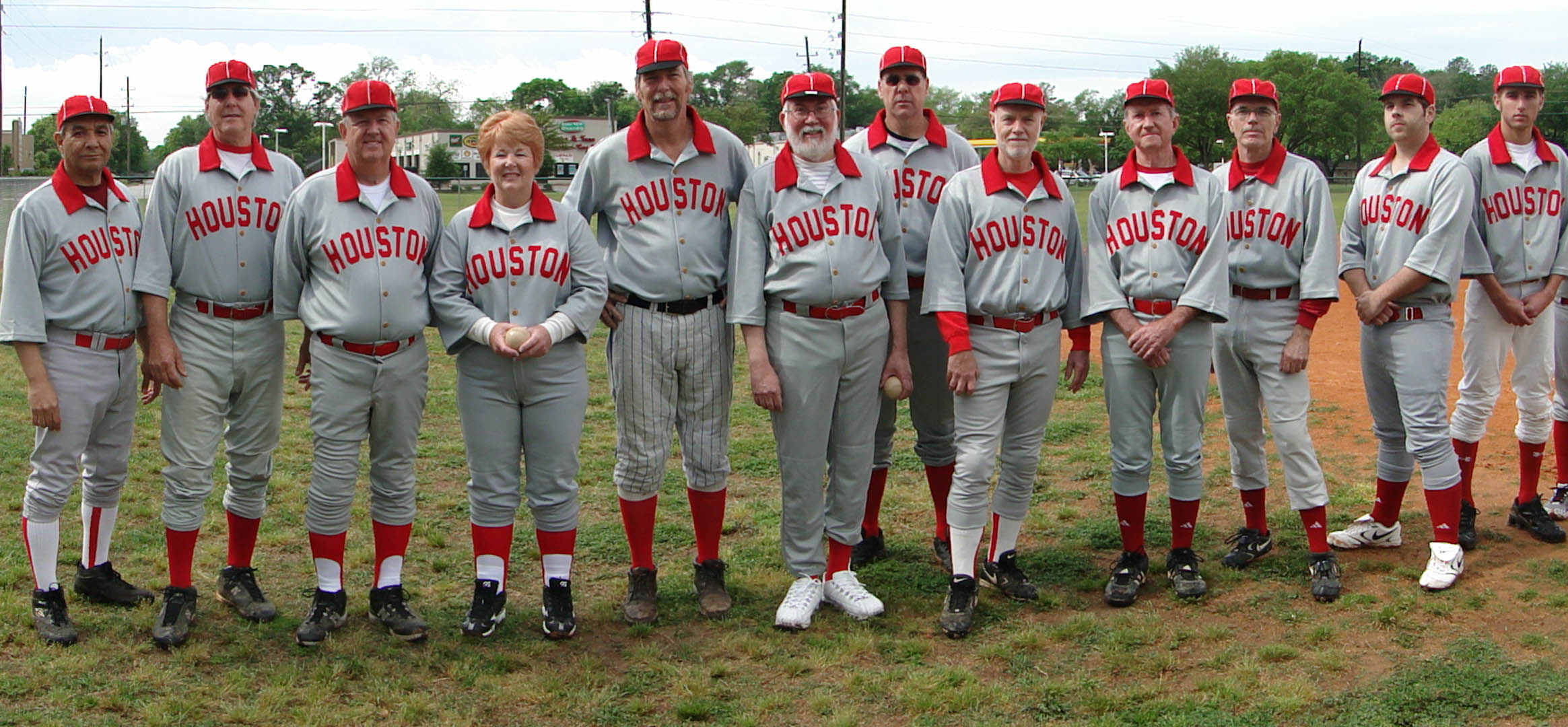
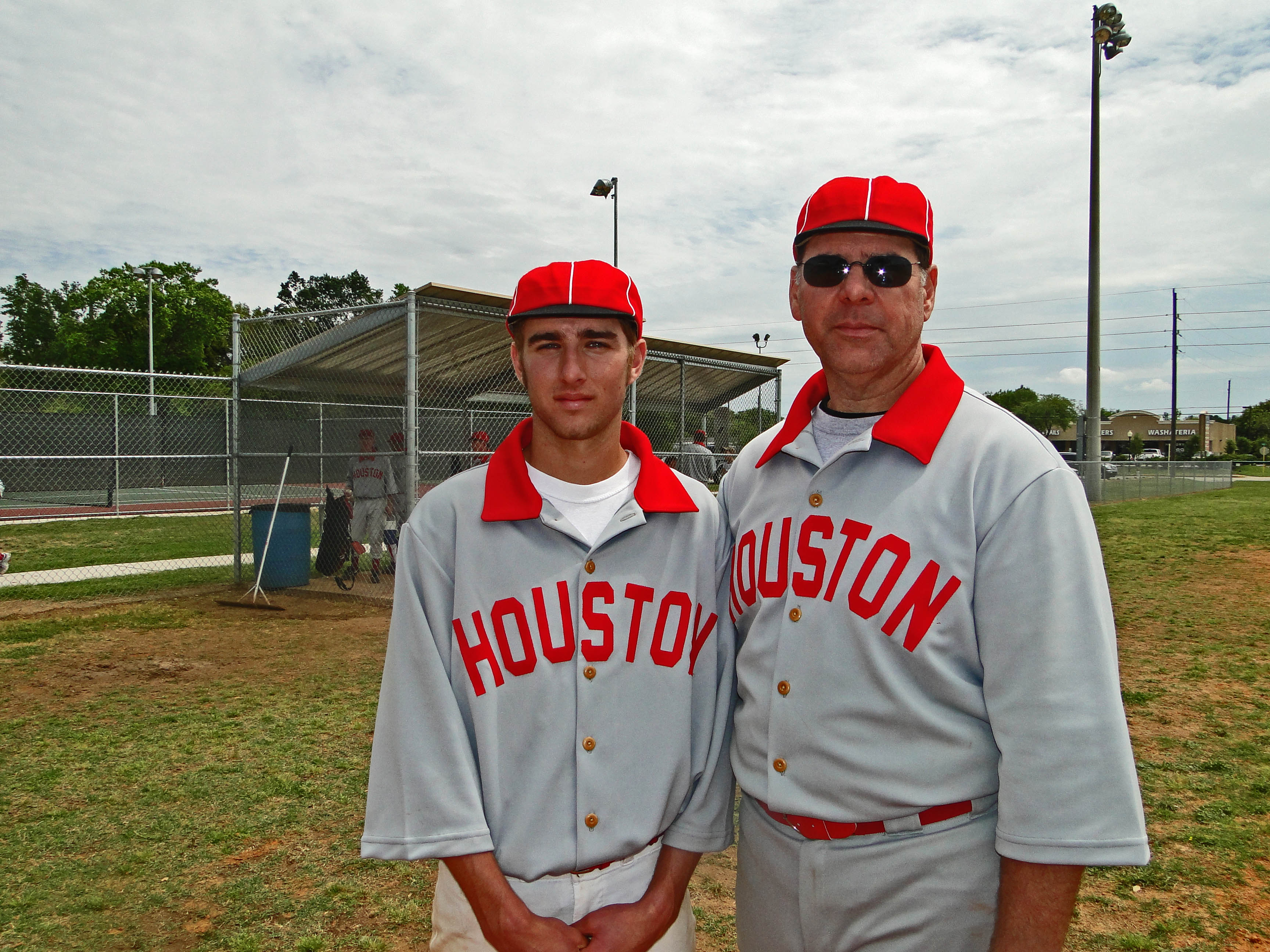
The Houston Babies/Red Stockings broke out their new red and grays just in time to launch a new era of play at Katy Park on Avenue D in Katy, Texas yesterday, winning their 10:30 AM opener over the Richmond Giants, 14-8, before dropping a close and hard-fought contest to the visiting Boerne (TX) White Sox in their second and early afternoon (1:00 PM) game. Richmond and Boerne later squared off against each other, but we have no results to report here on the outcome of the finale.

Playing for the first time at the splendid diamond that is Katy Park, the locals also originally had been set to play in what would have been a four-team, one-day tournament, but Katy had to postpone, pending further team developments. Without Katy, our three remaining clubs decided to simply round robin the rest of the day against each other.

Babies Manager Bob Dorrill

The Babies had a nice infusion of some additional older players who could really pick ’em up and lay ’em down in their two games as the visiting entrant. The other surprise of the day turned out to be the weather. Light rain at the start, clouds, and a heavy chilling wind were enough basis to send forecasters Frank Billingsley (Ch 2), Gene Norman (Ch 11), and David Tillman (Ch 13) all back to graduate school. It was not the perfect day that all the media weather folks had predicted.

The two Babies contests proved to be a clear display of the Babies’ two dispositions. In Game I with Richmond, Bob Blair pitched as the Babies battled back and forth for a 7-6 tie heading into the 6th scheduled  inning of our regular 7-inning game. Then the Babies bats broke out for a 7-run spot that boosted the game tally to its 14-8 final tab. A lot of good hitting and quick-minded fielding took place, with Alex Hajduk’s fast-track race around the bases for an inside-the-park homer leading the way. Newcomer older fellow Tim Stouffer also amazed with a double and lightning speed, both  on the base paths and in sparkling defensive play in the outfield.

Bob Blair was the winning pitcher in Game I versus Richmond.

Game 2 against Boerne also played out close, with the Babies jumping off to a 3-0 lead behind second game pitcher Larry Hajduk, but it was an advantage that they eventually gave away. The Babies had some lapses in the field in Game 2 – and they also fell back into the 1860’s-rules rally-killer pattern of trying to kill the ball on offense. As a result, the Babies spent most of the latter innings swatting flies that lent themselves too easily to one-bounce outs. On defense, the Babies twice elected to take one-bounce outs in the outfield over making the straight on-the-fly catch of balls that would have prevented the deciding runs from scoring. As a result, the seasoned White Sox club of Boerne took full advantage of these lapses to eek out a 5-3 win over the home area Houston Babies.

On the day for both games, here’s how the Houston Babies stacked their offensive deck:

Alex Hajduk and Bob Stevens both went 4 for 6 with a run scored. Alex also got that HR and an RBI for his efforts.

John Civitello ent 4 for 7 with 2 runs tallied.

Jo Hale went 3 for 5 with a run scored.

Speedy Tim Stouffer went 3 for 7 with a double and 3 runs scored.

Bob Blair (Winning Pitcher, Game 1) and newcomer Robert Pina each went 2 for 5 with a run scored, and Pina also contributed a triple on the day.

Larry Miggins and Bill Hale each went 2 for 6 with a double a piece. Larry tallied 2 runs; Bill scored 1 time.

Larry Hajduk and Phil Holland each went 1 for 6 with a run scored.

April Zamora also was 1 for 6 on the day and made a sparkling play in center field. Other defensive gems came as tips of our new red caps to Bill Hale, Bob Blair, Phil Holland, and Tim Stouffer.

Jimmy Disch and Robby Martin also went 0 for 3 in their two one-game appearances.

Alex & Larry Hajduk (R): Special Father-Son Bonding Time.

Special thanks also go out to Larry Hajduk (Losing Pitcher, Game 2) for his one-man ground crew treatment of the rain-battered infield to the Richmond Giants for supplying all of us with hot dogs, chips, cookies, and soft drinks for lunch. Food really doesn’t get any better than that. I don’t give a solid dadgum what people like Dr. Oz says! What does a guy like Dr. Oz know about having fun, anyway?

The action was sharp!

The camaraderie was straight from the sandlot memory bag!

The dugouts were first class!

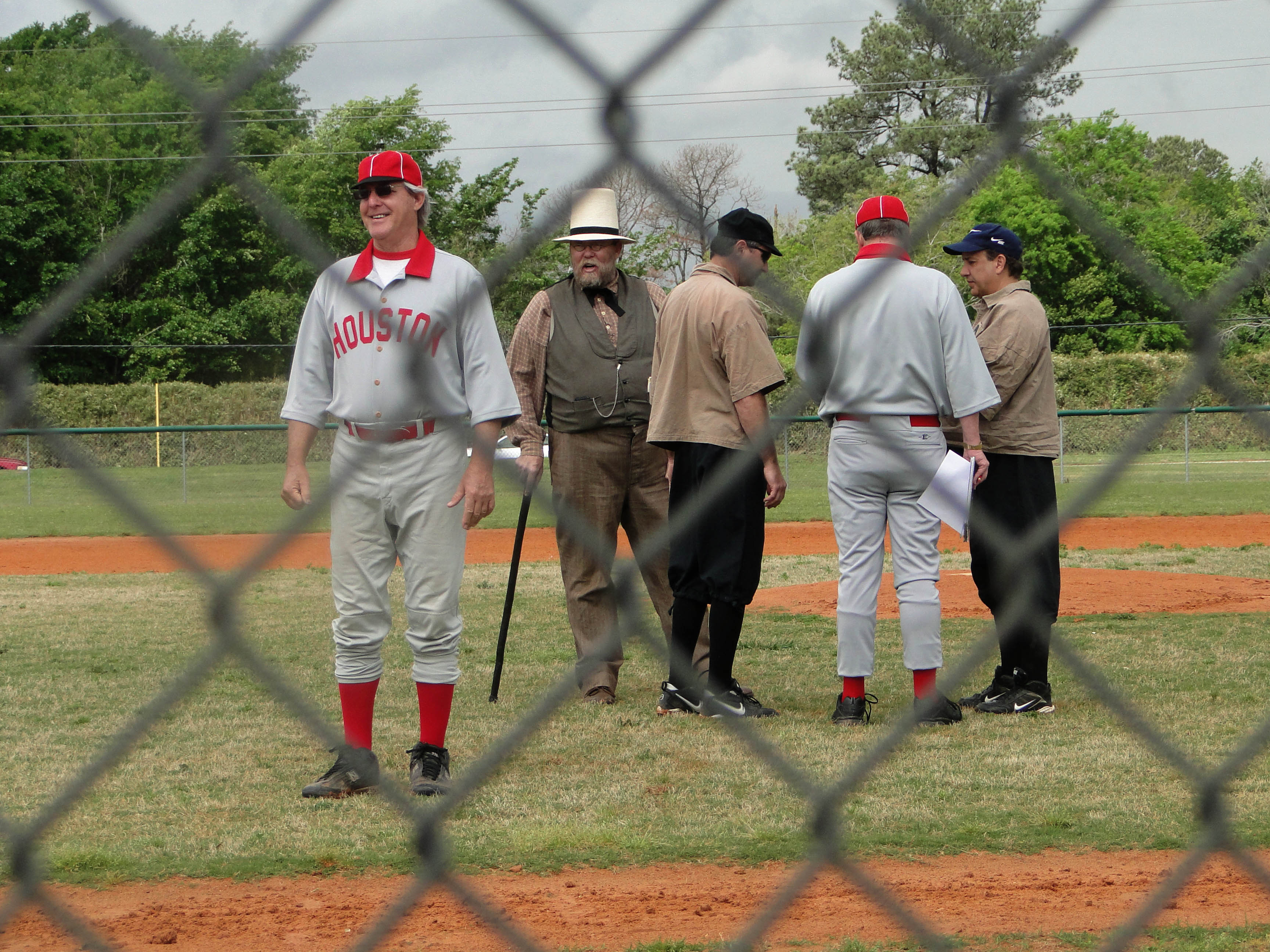
The pre-game discussions with the Blind Tom (umpire) were both civil and amusing.

The post-game congratulations were gentlemanly.

The time machine rumbled again on Saturday. If you weren't there, you don't really know fully what you missed.