Posts Tagged ‘Baseball’

The Trouble with Oswalt’s Trade Request.

May 22, 2010

Astros Ace Roy Oswalt Turns 33 on Aug. 29th.

If you look at the wall he’s been up against over the past couple of years, but especially this season, you can’t blame Roy Oswalt for wanting out of his situation with the Houston Astros. Everybody remotely close to things here in Houston and how these things work in baseball can see his point – but also the trouble the Astros are going to have fulfilling his request.

In his 9 games pitched in 2010, Oswalt has pitched well enough to have been 9-0 with a club that can both hit and protect late inning leads. With an ERA of 2.66 and a WHIP score of 1.066, Roy has done the same job this year that he’s done 7  times in his first 8 seasons (2001-08) of putting at least 14 wins in the success column for each of those seasons. This year, as you no doubt already know, he’s off to a 2-6 record that threatens to end up worse than his 8-6 fall in the injury-filled year that was 2009. The victories that eluded Oswalt in 2009 were largely due to his own inability to pitch deep and the pen’s inability to hold narrow leads. In 2010, the problem has been the almost total failure of the offense to give Roy any run support.

Now that Oswalt has finally had enough to shout “get me out of here,” it isn’t hard to see how that might be best for the player and a club that needs total rebuilding. On the surface, it says, “Hey, let’s move Roy to a club where he has a chance of winning and maybe reaching another World Series while the Astros accept  some good prospects in return that will help the team begin to paint a clearer picture of the future.

The troubles facing Astros General Manger Ed Wade in this matter hit fast and hard:

(1) Roy Oswalt turns 33 on August 29th and he now has a back injury history that has never been fully resolved. (2) Oswalt is owed 31 million over the next two seasons with a 2 million dollar buyout for the 2012 season. (3) Only a select group of teams have a great chance at the World Series over the next three years, but do those clubs both want to deal and have anything to offer that makes it really worthwhile to the Astros? (4) Are there any qualified clubs out there who want to trade a couple of good young prospects for a 33-year old ace with back trouble history and a heavy salary baggage that comes with him, even if the Astros agree to absorb some of it?

If any of us had the answers here, we could probably be of benefit to Ed Wade, but things don’t work that way. The fact is, Ed Wade may not be able to do anything constructive with Oswalt’s request. In that case, only two choices will remain and neither smacks as good news.

If General Manager Wade can’t move Oswalt in a deal that will at least help the Astros too, he will be forced to (1) appeal to Oswalt’s sense of pride and professionalism for making the best of it here as an Astro, while trying to quell any backlash from teammates; or (2) making a giveaway/salary dump deal just to get Roy out of Dodge because of the morale issue he could become for some of the others.

Jerry Witte & Roy Oswalt, 2001.

I have liked Roy Oswalt from his rookie season and I wish that things had never come down to this kind of situation. The rookie 2001 version of Roy was so nice and respectful to my old friend, the late Jerry Witte, on that night in August that great old former Houston slugger got to throw out the first pitch and Roy Oswalt served as his “catcher.”

“Young man,” Jerry asked of young Roy, “where did you learn to pitch like you do?” “My daddy taught me, sir,” Oswalt said.

“Well, you just keep up the good work,” Jerry added. “You’re a credit to your daddy and you’re going to be big credit to the game of baseball.”

Jerry Witte was right about Roy Oswalt. When I think about Roy and how he so respectfully helped Jerry that night in his one and only trip to the new downtown ballpark, even standing with him through the National Anthem, I hate the thought of knowing that the young gentleman from Weir, Mississippi will soon be moving on.

I know. Business is business. But Astro fans are going to miss Roy Oswalt once he’s gone. At least he’s not leaving over money. He’s leaving, or wants to leave, so he can have a taste of winning the big one again. No matter who the Astros may get for him, it will be our loss, the fans’ loss.

The status of Jeff Bagwell and Craig Biggio as career Astros is about to grow even larger as a baseball rarity.
Roy Broome’s Unforgettable Homer!

May 21, 2010

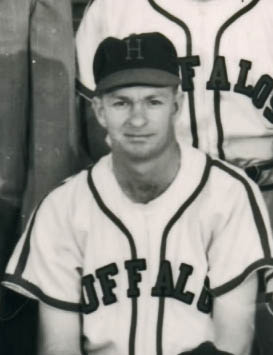
In 1951, Houston Buff Roy Broome hit a monster opposite field HR to right field at Buff Stadium. Anyone who saw it leave the planet could not possibly forget it.

For better or worse, how many big league ballplayers are remembered mostly for that one thing they did that changed the course of baseball history? Bobby Thomson (New York Giants, 1951) and Bill Buckner (Boston Red Sox, 1986) jump immediately to mind. Others abound.

Move the same question to career minor leaguers and you have to reshape the consequence end of it too. At least, for me, you do. I can’t think of any single act by a career minor leaguer that both totally shaped the way fans see him and also altered the course of baseball history, but I can sure call to mind a former Houston Buff who surely framed the way five to six thousand people at Buff Stadium on a summer night in 1951 remembered him forever.

The guy I have in mind is the late Roy Broome (BR/TR) (5’11”, 160 lbs.), an eleven-season minor leaguer, mainly in the Cardinal system from 1940-42 and 1946-53. Broome hit pretty well as a minor leaguer, finishing with a .290 career batting average. He only hit 89 career home runs in 5,419 official times at bat and he managed only 2 long balls for the 1951 Buffs in his short, 41-game, 157-times at bat tour as a Buff hitter.

Roy Broome was a 1951 Buff long enough to do two memorable things: (1) he was here long enough to be included in the official Buffs team photo; and (2) while he was here, he hit one of the longest, most surprising opposite field home runs in Houston Buffs history.

Time has erased everything else about that game moment in my mind except for the act itself. That much of it, I’ll never forget, as my dad and I watched from the first base grandstands. I don’t recall the opposing team or the game situation, or even the impact of the home run on the game itself, I simply remember what I saw. and that the game was played at night. Because right-handed batter Broome hit the home run to right field, I’ve often imagined over the years that it was cracked off some power pitcher like Bob Turley of the San Antonio Missions, but I don’t know that. One of these days I need to research the specifics of this event at the library. After all, he only hit two of them as a Buff – and it would be interesting to read whatever Clark Nealon or others said about it.

On a typical summer night at Buff Stadium, the wind blowing in and across from right field was not friendly to aspiring home runs. “Broome’s Blow” rose above the obstacle.

The mighty blow from Roy Broome’s bat took off on a Ruthian high arch toward the far right field wall, reaching an apex almost instantly and then gently floating above the low to the ground winds, riding them like a surfer takes on the big waves of Oahu’s eastern shores. It danced on the winds as a small speck of white and then it just seemed to vanish in the high-in-the-sky darkness beyond the right field wall. It must have come down some 500-600 feet away on the other side of Cullen, too far back into the world beyond baseball for us to track it by the light of the Buff Stadium arc lamps.

The reaction of fans to “Broome’s Blow” was not your typical fairly immediate cheer. The resounding crack of the bat and startling visual that I just so inadequately tried to describe here had a hushing effect upon all of us. I’m sure any camera focused upon us fans in that moment would have revealed a sea-face of dropping jaws and startled bug eyes. We were all too amazed to express much of anything. Add to it the fact that none of us expected anything like this from little Roy Broome – and to the opposite field, no less. By the time Broome had rounded third base, head for home, Buff fans had risen to their feet to applaud him what he had just done. As I recall, a smiling, blushing Roy Broome was then called upon by the continuation of that applause to make a couple or three curtain doffs of the cap from the Buffs dugout too as teammates slapped his back and playfully kidded him.

Broome was hitting .268 for the Buffs when he was soon promoted after this event to AAA Columbus of the American Association. We Houston fans hated to see him go. Unfortunately, Roy Broome turned out to be another talented Cardinal prospect who never got to see the light of day in the big leagues.

Roy Wilson Broome was born on February 17, 1921 in Norwood, North Carolina. He died on October 11, 1993 in Gastonia, North Carolina.

Thank you, Roy, for once upon a time in 1951 being that blind hog that Darrell Royal of UT used to talk about. You found your acorn in the woods as a Houston Buff. It didn’t change baseball history, but it left a lot of us with an awesome lifetime memory.

In Memoriam: The Late Bob Clear.

May 20, 2010

Former Houston Buff Pitcher Bob Clear Passed Away on April 6, 2010 at Age 82.

I only this morning learned that former Houston Buff pitcher Bob Clear (1951-53) passed away on April 6th at his home in California. He was 82 years old.

Bob Clear (BR/TR) (5’9″, 170 lbs.) never was a guy fans confused with the second coming of Dizzy Dean. He was never little more than a short-time, fill-in spot starter/reliever on the 1951 Texas League championship Buffs club and a regular low performing guy with the not-so-hot Buff teams of 1952 and 1953, but he was a hard worker who got by on guile and an ability to mix and locate his pitches.

Bob never made it up to the big club Cardinals during those pitcher loaded farm stock years, but he managed to ping out a pretty fair record for himself over 16 seasons in the minors (1946, 1948-61, 1967). Overall he won 162, lost 115, and posted a 3.72 career earned run average.

As a Houston Buff, Bob Clear was 1-2, 8.13 in only nine games in 1951. In 1952, Clear was 9-12, 3.45 – and 4-6, 3.35 in 1953 – and all together, not a lot to write home about.

Clear experienced his best season in baseball the year following his last 1953 Buffs year. Moving up to the 1954 AAA Omaha Cardinals, Bob recorded a 20-11 season with a 2.93 ERA. The showing still failed to earn his shot with the ’55 St. Louis club and his record for that season at Omaha slipped back to 1-10 and 4.42 in partial time service. Clear may have been injured in 1955, but I have no way to check that out at this writing.

For his career, Bob Clear posted two additional 20-plus win seasons (at Class C- level each time) for 1957 Douglas and 1960 Grand Forks. Clear’s career had a chance to end quietly in 1961 with a 4-5, 5.05 final season, but he came back on a two-game lark in 1967 at age 39 to go 1-0 with a 1.64 ERA in two relief jobs for Class A Clinton.

After 1967, Bob Clear never played another inning. He eventually retired to civilian life and lived out his final days in Rancho Palos Verdes, California.

Bob Clear was born on December 14, 1927 in Denver, Colorado. He gave his early productive life to baseball and he played three seasons for our Houston Buffs. That’s enough resume to make it into my memory bank.

Time flies. The last time I saw Bob Clear he was the same age and about the same size as my 25-year old son Neal is now. (Yep, my kid’s only 25. I was a late bloomer in several areas.)

Now I suddenly learn from an Internet data site on minor league baseball that young Bob Clear has recently died at age 82. Where has the time gone – for Bob Clear – and all the rest of us too, for that matter? We really don’t have a long time to be here, do we?

The death of anyone I’ve ever known always makes me think of that old poem by some anonymous author. It begins with this line: “The clock of life is wound but once and no one has the power, to know just when the hands will stop, at late or early hour.”

My positive thoughts and prayers go out to the Bob Clear family this morning.

Long live our memory of the Houston Buffs. All of them.

The “Over-The House” Drill.

May 19, 2010

Writer's rendition of the "Over The House Drill." No real graphic artists were used in the low tech production of this visual aide nor were they harmed in the presentation of this simplified depiction of the even simpler Pecan Park game.

Some days around here are simpler than others. In fact, most days are pretty simple and quiet around here and that’s the way we like it. These days are a little louder than usual because we are now in the middle of having our house Hardee-planked to make up for the fact that the builder of our home some thirty years ago chose a siding material for the homes in out neighborhood that turned out to be over time little more than cheap cardboard-in-disguise. Regardless of how today’s drawing may appear, I have no respect for people who do shoddy work at the expense of others, but we sadly don’t seem to be running out of these sorry folk, do we?

The short of it is that a lot of inside work is happening here today too and that doesn’t make for good writing space. So, I need to tell you about something that will not require additional research or composition time. I wanted to include this material, anyway, when I wrote the article on our Pecan Park sandlot baseball drills and this is a good time to do it.

The “Over-The-House” drill is my personal invention by the following rules. Anyone else could have thought of it just as easily and probably did, but these were the rules we used to govern its play on our block:

(1) Pick a house in which both parents are gone. i.e., Dad is working; Mom is shopping. The reason for this one is simple. Parents always said “no” to the “Over the House” drill because they feared what a baseball might do to the windows, roof, and walls of their houses.

(2) Play was limited to singles or doubles games, very similar to tennis. I always preferred singles play.

(3) The object of the game was to throw the ball over the house without touching the roof and get it to land in the opposite front or back yard where your opponent stood. A ball that hit the ground of your opponent’s field without being first caught counted as a run and entitled the thrower to “go again” until a ball was finally caught on the fly for an out.

(4) Balls that first touched the roof or landed out-of-bounds (off the house property) were also counted as outs, turning the ball over to the other player for a turn at throwing.

(5) The game lasted for a total of 27 outs, no matter who made them.

(6) Whoever had the most runs at game’s end was the winner.

That was it. And it was lots of fun. When you were waiting, you never knew for sure where the ball was going to land until you saw it crest over the top of the roof. Some balls came on a high bloop and others traveled more as line drive darters. (Since all our houses were one-story jobs, you didn’t have to throw the ball too high to make it over.)

If memory serves, we never broke any windows and we rarely hit the roofs of any houses we used for the game, although we did manage to thump some nearby cars that had been parked on the street and in adjacent driveways. We could sort of see why our parents didn’t much care for “Over the House.”

Depending on how much we trusted each other, we either got by on the honor system or we used two other kids to make the calls on house hits, fair falls, and out catches. You could get by with one umpire, but that required a lot of back and forth running – and sometimes, some repetitive fence-jumping. Almost nobody who could do the job really wanted to take it on, especially since hard feelings toward umpires who determine the outcome of any competitive situation so rarely go away over night. Even as kids, we understood that becoming an umpire, even for “Over the House,” was the pathway to unpopularity.

Gotta go for now. If you can’t get your dreams over the rainbow today, folks, now you have another choice. You and a friend can go play a fun game of “Over the House.”

Just don’t tell your parents.

World’s Oldest Ex-Big Leaguer: 05-18-2010.

May 18, 2010

Tony Malinosky, DOB: 10-07-1909.

Don’t blink. Don’t pause. Just honor Tony Malinosky for what he’s done and now represents while he’s still here. He is the current owner of the most tenuous distinction that any human being can hold in any field for very long. Born on October 7, 1909 in Collinsville, Illinois, and now age 100 years, 7 months, 2 weeks, and 4 days old, Tony Malinosky (5’10.5″, 165 lbs,, BR/TR) is our current holder of the title, “world’s oldest former major league baseball player.”

As a stroke of common irony in these matters, Malinosky was more of a journeyman minor leaguer for seven years (1932-38) as a shortstop/third baseman, but he managed to reach the big leagues for 35 games and 79 official at bats with the 1937 Brooklyn Dodgers in time to hit .228 with only two doubles to show for his extra base hit production. After 1937, Tony played out his last season of professional baseball with three minor league clubs before retiring from the game. His minor league career stats included a .282 batting average with 12 home runs.

Malinosky served in World War II and fought in the battle of the Bulge. He now lives alone in the Los Angeles area after being widowed from his wife of 64 years several years ago. A niece now looks after him on a regular basis, sometimes even taking Tony to ballgames at Dodger Stadium.

Malinosky says he follows the Dodgers on a regular basis and, from recent  interviews I’ve read, he seems to be in very good possession of his faculties about current events and the meaning of his status as “oldest ballplayer” to other people.

When asked the inevitable question about his personal secrets for longevity, Tony is totally practical in his response. “Just keep breathing and be associated with a good doctor.”

After World War, Malinosky worked several years for a company that built jet plane engines. After his retirement, he and his late wife, Vi, spent a lot of time traveling the country as “roadies.” One time in Minneapolis during the late 60s, they happened to hit town at the same time former Whittier College classmates was speaking to a group there. That former classmate just happened to be the then current President of the United States, Richard M. Nixon.

Somehow, Malinosky managed to work his way through security for a brief semi-public reunion with President Nixon. The Chief Executive was all smiles until Malinosky turned to leave. That’s when Nixon pulled Tony aside to whisper a mild admonition in his ear. The next time they met under these kinds of circumstances, Nixon told Tony that he preferred not to be addressed as “Dick” in public. “If we ever meet again under these circumstances, please call me ‘Mr. President’,” Nixon supposedly asked.

In 2005, Larry Dierker and I visited with the then world's oldest former big leaguer, 100-year old Raymond Lee Cunningham of Pearland, Texas,

Malinosky said he regrets never having played a full season in the big leagues, but he looks back with joy at the time he did enjoy at Ebbets Field. The pay was only $400 per month, but Tony had a cheap room he rented and he got by OK on a daily food allowance that went a long way at the corner store White Castle burger shop.

Malinosky’s proudest big league memories were getting singles off future Hall of Fame pitchers Dizzy Dean and Carl Hubbell. Hey! Good for Tony! That’s two more singles off future Hall of Famers than most of the rest of us here will ever be able to claim.

Good luck, Mr, Malinosky! Hope you hang in there with us for a while. Just keep breathing, watching the Dodgers, listening to your niece, and keep getting checked out by your doctors too.

The Wings of Summer.

May 17, 2010

1950: The Wings of Summer Were Mainly Named Schwinn.

Back in 1950, summer spread out upon the imaginations of us kids in Houston as though it had been sent to us from God as a little time slice of Heaven and a virtually endless lawn of non-stop sandlot baseball, a game we all loved and played with poor equipment and virtually no adult interference for as long as the light came upon us with the dawn and lasted for us through the dusk.

Parental fears about the relationship between summer temperatures and the possible onset and development of infantile paralysis hit us hard. We ran into the “Heat of the Day” requirement in the Summer of 1950 – and that amounted to a three-hour parental suspension of outside play from 12 Noon to 3:00 PM daily in the belief that we were being protected from polio by this action. With five hundred cases of polio hitting Houston children in the summer of 1950, it was hard to argue against the time-out call, even though we actually knew very little back then about the virus that actually had spawned the epidemic.

Summer had time limits, but we also soared through the vast free space available to us in that time on the wings of summer, our mainly classic big-wheeled Schwinn bicycles. I owned one of these bright red beauties, one that looked very much like the model depicted in today’s article. As was true with all of us, that Schwinn bike and me were pretty much one unit together once we hit the road. I could lean myself around corners with hands on a comic book and almost never crash, except for the time that a lady over on Keller Street also turned onto Flowers from the other direction and scared me into a last second plunge into a drainage ditch.

She did stop to make sure I wasn’t dead and, of course, I never said anything about the near miss when I much later in the day finally found my way home. You just didn’t report things that might limit your future freedom back then, but I think that kid code is still in effect. Some things never change.

We wore no bike helmets back in the day – and, yes, we probably did destroy a few now-sacred Mickey Mantle cards as noisemakers that we clothes-pinned to play against the spokes of our wheels.

We  never surrendered our bikes voluntarily. Those wonderful machines really were our wings through summer and out to the larger universe beyond our East End homes and neighborhoods.

When Little League Baseball came to Houston in 1950, a large bunch of us rode our bikes over to Canada Dry Park on the Gulf Freeway for the city-wide tryout. Hundreds and hundreds of kids had shown up to tryout for the few team rosters that were going to be available to all Houston kids that first year. I think I got to catch one fly ball, but got no times at bat before I was told “thanks for coming.” I felt pretty bad about it until I learned that none of us from Pecan Park had been given the chance to hit. That privilege seemed to be going to those kids whose fathers had the freedom to come with their sons to the tryout during the work week. None of our Pecan Park dads had that kind of time luxury on the morning of a weekday – and we could figure that the dad-presence factor was a big fat difference-maker in a situation like this one. We didn’t blame our dads, but we did lose a lot of respect for those first year Little League people running the show. Over time, I grew to see what a no-win situation those early Houston Little League founders faced here that first 1950 season, but I was nowhere close to understanding or forgiving the way we were treated that particular day.

Collectively, those of us from Pecan Park knew we weren’t that undeserving, but we could see what we were up against with the numbers and the daddy-presence factor. So, we did as we were told. We went home.

We rode home as a squadron of dejected East Enders, but that also happened to be the day the Pecan Park Eagles were born. By the time we got home, we had gone to the sandlot and reorganized our identity as the Pecan Park Eagles. We also named our home as Eagle Field for the first time and we recruited one of our adult neighbors to serve as our coach. We then organized a simple schedule of games against other nearby sandlot clubs and played once a week at Mason Park for a short while.

Our efforts made us feel better about the jobbing we took at the Canada Dry tryout. That much is sure, but the experience also taught us that you have to rally from disappointment and do whatever you can do to learn from setbacks and go forward in a different way.

The End of Schwinn, 1954.

We still travelled by bike for quite a while beyond the summer of 1950. The end of Schwinn as the Wings of Summer Era didn’t arrive until we aged enough to start dating girls. Once that little shift in priorities settled in, we traded in our summer wings for the four wheels of summer that we found on those spontaneous combustion engine-powered muscle cars that now consumed our imaginations.

I lost my heart, and my freedom from debt, to a 1951 Oldsmobile 88. “Ain’t that a shame” that those kinds of changes also signal the death of childhood’s freedom wings, at least, for a while.

Over time, I recaptured my freedom wings of summer and, this time, they came without a bicycle. The formula may vary for each of us who want those wings back may vary a little, but basically, I think it goes like this:

(1) Put yourself in a position as much as possible in which you control your time. Make sure your time does not control you; (2) Give yourself to causes that go beyond making money and acquiring things, replacing these with activities which aim for the betterment of something bigger than the fulfillment of your own selfish goals; (3) Do things you can really give your heart to doing; (4) Stay away from selfish people who want to use you for their personal gain at the sacrifice of your health and well-being; (5) Enjoy each day that comes your way and make the most of honoring each day for whatever it is; (6) Never make promises you don’t plan to keep; (7) Let go of all resentment and regret about the past, but learn from your mistakes; (8) Hang out with happy people who share some of your particular joys in life; (9) Keep your priorities in order and live life from there; and (10) Love baseball.

I just threw that last one in to see if you were paying attention, but you should be able to get the drift of what I’m suggesting overall. The better I get at these things, the more my happiness grows – and my personal list really does include all ten listed items.

Defensive Drills from the Pecan Park Sandlot.

May 16, 2010

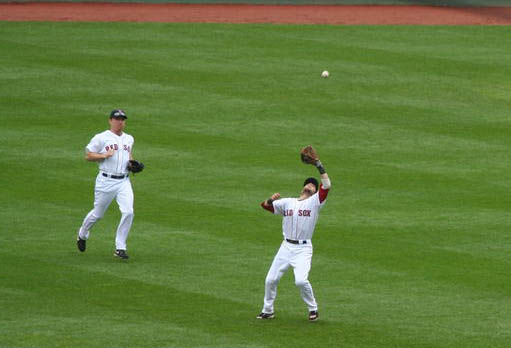
Red Sox Players Imitating the Pecan Park "Bloop" Drill.

A few weeks ago, I wrote an article on the little games we played on the Sandlot grasses of Eagle Field in the East Houston neighborhood that was Pecan Park during the immediate Post World War II years. Today I would like to carry that thought further to include the drills we simply devised for fun when only as few as two or three of us were available, We didn’t do these thing because we thought of them as work. We did them because they challenged us to get better, to find out how fast and quick we could be on all kinds of twisting, darting liners and grounders, to see how far we could run, jump, and still make out-play-catches on a fly ball,  All we needed for these drills was two people to have lots of fun, but three was even better because it taught us more about how we had to cooperate to be good defensive players.

Here’s a sampling:

(1) The Bloop Drill. The object here was to work on catching balls that might fall between the infield and outfield for bloop Texas League hits. We needed two people to play the two IF/OF spots and one person to either fungo or else, throw slow arching balls that had a chance of falling into the space between the two fielders. We were playing our version of “bloop” on the day that Houston Buff infielder Jack Cusick stopped by to work with us on his way to Buff Stadium. Cusick liked our bloop drill, but he suggested on addition that made it even better – after watching a couple of us collide on an attempted catch.

“Somebody’s gotta call for it,” said Cusick, “and that guy should be the outfielder coming in. He’s got the view on things and whether or not he can make the play. If the outfielder yells, ‘I got it,’ the infielder needs to peel off and let him take it. If the outfielder is in doubt, he needs to keep his mouth shout and peel away so he doesn’t hit the infielder, but stay in the area for the ball in case it drops in.” – After adopting the Cusick suggestion, the bloop drill got to be even more fun. – Wish Cusick had come back for other coaching visits. We might have even gotten smart with a little baseball help.

Long before Willie Mays's famous catch in 1954, he inspired us to practice a drill we humbly called "The Catch."

(2) The Catch. You only needed two people and you could play it anywhere. Of its many variations, the object was to catch an arching fly ball that was thrown over your head as the fielder. One version was “The Willie,” where, just as Willie does in the picture, you try to catch the ball looking up over your shoulder, either basket-style or by a more conventional grab.

(3) Off the Wall. In this version of “the catch” drill, we worked on catching balls that were headed toward the side of the house (our make-believe outfield wall) either on a leaping out-grab or by the best carom shot angle we could take on the play. Had we ever played a real game next to our garage, I could have been the deadliest defensive outfielder in the game.

(4) Shoestrings. Yep. We drilled ourselves on the art of the shoestring catch for hours at a time. It paid off for me several times over, but most importantly later on when I was playing center field in a parochial school CYO all-star game and managed to pull a shoestring catch out of my jock strap for the third out in a bases loaded situation. That had to be the highlight of my fleeting baseball glory, but all that work we put in for fun over the years had prepared me well for it. It wasn’t my first shoestring catch of record.

We also did conventional infield drills all the time back on the sandlot – and we loved going to Buff Stadium to watch the teams take infield practice prior to games. It was like watching a dance – or a game of shadow ball that could only help players get better and the logic behind why even the pros did these things back in the day made sense to us too.

You get better at things you practice. It’s fundamental.

Bob Bruce: Houston’s 1st Big League Winner.

May 14, 2010

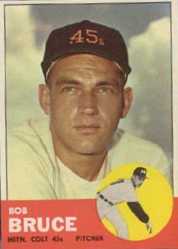
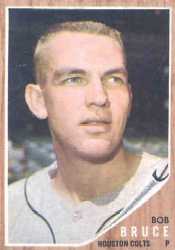
In 1964, Bob Bruce was Houston's 1st 15-Game Big League Winner.

Things weren’t easy during the three season life span of this city’s first major league club, the Houston Colt .45s. We had a local team made up of names from the 1961 expansion draft and a few fresh rookie snares, plus some veteran free agent players acquired in minor deals. and a few wannabe guys, most of whom never saw the light of day wearing the orange and deep navy blue of the new big league club.

One of the jewels in the early talent lot was a right-handed pitcher named Bob Bruce, whom the Colt .45s acquired from the Detroit Tigers. The 6’3″, 195 pound 29-year old turned out to be the most effective double-digit game winner in the club’s early history.

In 1962, when Houston finished 8th in an undivided 10-team National League, only besting the Chicago Cubs and the fellow expansion bunch at New York called the Mets, Bob Bruce hit the club record books as the first pitcher to register double-digit wins and a winning record in a single season. His 10-9 mark with  4.06 ERA and 135 strikeouts in 1962 did it for Bruce.

Teammate Dick Farrell also had ten wins in 1962, but he also picked up twenty losses along the way, a feat which prompted this proud explanation from the colorful guy they also called Turk: “Do you realize how good I had to be to keep going out there often enough to have lost 20 games in one year?”

Bruce fell off to 5-9 with a 3.59 ERA in 1963, but in 1964, in their third and final year to dress out as the Colt .45s, he came roaring back to become the first 15-game winner in franchise history, posting a season mark of 15 wins, 9 losses, an ERA of only 2.76 in 202.1 innings pitched – and another good year for “Ks” with 135 recorded again.

Bruce pitched two more years as a “Houston Astro” (1965-66), but he had run out of big-win seasons. His combined record for two Astrodome seasons was 12-31. Bob moved over to Atlanta in 1967 where he registered a 2-3 record for his last season in baseball.

Happy Birthday, Bob! Bob Bruce turns 77 on May 16 and he is still going strong in real estate.

All tolled, Bob Bruce worked a nine-season major league career (1959-67) into a final record of 49-71 and a fine 3.85 ERA over his 1,122.1 total innings. He played for Detroit (1959-61), Houston (1962-66), and Atlanta (1967).

A good fastball, an effective curve, and good control also allowed Bob Bruce to finish with 733 strikeouts against only 340 walks. During his Colt .45 years, Bruce was the guy who gave Houston fans rare hope for victory every time he took the mound. As one of those fans, I will always be grateful to him for that infusion of sunshine into our early big league community baseball spirit.

As a minor leaguer for eight years (1953-67), Bob Bruce also compiled a record of 76-55 and an ERA of 3.33 over several scattered seasons.

Happy Birthday, Bob Bruce! And thanks again the memories.

For those of you wanting to catch up on Bob Bruce today, or maybe even shop for some real estate in the Hill Country, check out Bob on Facebook. I’m sure he would be most glad to hear from you.

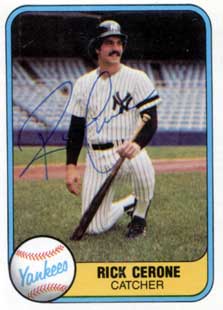
Rick Cerone: Another Bronx Zoo Tale.

May 13, 2010

Rick Cerone: Another Bronx Zoo Tale.

If you have followed baseball for as long as I have, you will have sooner or later developed an interest in the careers of certain guys that never even come close to playing for your particular team. As an older-than-they-are Colt .45s/Astros fan, catcher Rick Cerone is such a guy in my books. Rick did play briefly for AAA Charleston of the International League in 1977, when that club was a farm team of the Astros, so, you could make the case that Cerone came close to Houston, but just didn’t get here.  I always liked him, anyway,  for his fiery spirit and ability – and for his willingness to stand up for himself. He simply didn’t take these positions of assertion in ways that might  help his job security during the latter stages of the Bronx Zoo era. And that’s putting it mildly.

Besides, standing up for yourself is not about job security. It is about self respect. It’s how you do it and with whom you do it that determines your fate on the job – and Rick was working in the “Bronx Zoo” when his major stands took place, More on that in a moment.

Born May 19, 1954 in Newark, New Jersey, Cerone was a natural cultural and personality fit for the latter-day 20th century New York Yankees, but he entered pro ball as the 7th pick in the 1975 1st round amateur draft out of Seton Hall University. It was the beginning of an 18-season big league career that included stops with the Indians (1975-76), the Blue Jays (1977-79), the Yankees (1st time, 1980-84), the Braves (1985), the Brewers (1986), the Yankees (2nd time, 1987), the Red Sox (1988-89), the Yankees (3rd time, 1990), the Mets (1991), and the Expos (1992).

For his career, Rick Cerone (BR/TR) (5’11”, 192 lbs.) batted .245 as a major leaguer. He slammed 59 career home runs and he fell two hits shy of 1,000 on the career hits list. Defensively, I always felt he called and played a pretty good and aggressive game too. He gunned down 37% of the attempted base stealers he saw and – as i saw it – he seemed able to fire up his pitching battery mates when the chips were on the line.

Unfortunately or not (or that’s just how it was), Rick Cerone had an anger flash point that got him in frequent trouble in the Bronx with people like owner George Steinbrenner and manager Billy Martin. Those guys had flash tempers too – and a lot more power over the answers to “What next?” any time a conflict broke out on the team.

His Mouth Over-Ran His Mind.

It wasn’t hard to do the math on conflict outcomes in the Bronx: (1) Owner Steinbrenner goes on a tirade in the Yankee clubhouse. Player Cerone responds with expletive laced comments on the boss’s weight and lack of playing experience. Cerone gets dealt away from the Yankees. (2) Manager Martin calls out catcher Cerone in his own fit of rage for calling pitches that the other club clobbers for game-winning hits. Cerone curses back and throws his equipment at the manager. Cerone gets dealt away from the Yankees (again).

A 2009 article by Matt Gagne of the New York Daily News detailing Cerone’s current attempts to get back into post-playing career work in baseball with somebody seems to bear out my earlier impressions of the old temper factor. I’m not sure if anything has developed for Rick since last summer, but the article does a pretty fair job of mapping the relationship hill that Cerone needs to climb to get his next chance in the game.

Here’s the link:

http://www.bing.com/images/search?q=rick+cerone&FORM=BIFD#focal=

2c718c6ba567de4d2da6caff2cfe7e66&furl=http%3A%2F%2Fassets

.nydailynews.com

%2Fimg%2F2009%2F07%2F19%2Famd_cerone-now.jpg

Cerone’s current problem finding new employment in baseball probably is best captured in this one statement he made for the Gagne article. About his current search for work in baseball broadcasting, Rick said: “I’ve sent out some resume tapes, but when you don’t get callbacks at all – when people you’ve worked with for years don’t have the decency to to call back, or email, or text – you know what, I don’t beg.”

You know what, Rick? If people fear your temper, they aren’t going to jump to hire you. False pride has to heal before any honest rebuilding can start – and your potential employers in baseball out there have to believe you’re on the right road before some of them maybe, just maybe,  become willing to give you another shot.

This isn’t about begging. It’s about stepping up – and owning up to your own behavior with someone who is willing to (maybe)  give you another opportunity. If I was hiring, Rick,  I would be willing to give you a chance because I think you possess a core passion for the game and a real understanding about the importance of loyalty as a result of these experiences that money alone can never buy. It’s just up to you to get that message across to real potential employers who may find it easier to look for someone who’s background is less passionate, but also less “colorful.”

Heck. If he can handle it. I’d rather hire Rick Cerone any day of the week. If I’m your potential employer, Rick, (again) it’s up to you to show me why I should take the risk of trusting you.

That’s it, except for one more thought: Good Luck!

Hal Epps: The Mayor of Center Field.

May 12, 2010

Mr. Mayor Himself, Hal Epps!

During their 1947 Texas League and Dixie Series championship season, they called Hal Epps by a nickname that fit well with his ability ti patrol the deep central pasture at Buff Stadium. Hal Epps was known as “The Mayor of Center Field’ for the speed, agility, arm, and intelligence he brought to the job as center fielder for the Houston Buffs.

Epps also was no slouch on offense in 1947. He batted .302 in 136 games, banging out 24 doubles, 15 triples, and 6 homers along the way. “Clutch” could have been his middle name, Time and again, Epps supplied the key hit in a late inning Buffs rally. He was the guy that you wanted at the top of the order and the fellow you wanted in center when it was time to take the field.

Beyond watching my dad play, Hal Epps was the first outfielder that ever drew my attention in the summer of 1947. I was nine years old and watching Buffs baseball for the first time in my life. I wasn’t analyzing anything back then. All I knew is that I wanted the Buffs to win and that Hal Epps seemed to be a big part of helping the Buffs reach that outcome, Right after second baseman Solly Hemus, my first Buffs hero in 1947, Hal Epps rode into my mind and imagination next as the great rescuer of hope for victory. As a kid, Solly Hemus and Hal Epps were the guys I wanted to se coming to the plate more than any others when the Buffs really needed a run to get back into a game. Funny thing is – that wasn’t a hard crush to embrace. Those were the same Buff players that most grown ups wanted to see in the clutch as well.

Hal Epps (BL/TL) was born in Athens, Georgia on March 26, 1914. He played a 15-season minor league career (1934-43, 1947-49, 1950-52) and a 4-season major league career with the St. Louis Cardinals (1938, 1940), St. Louis Browns (1943-44), and Philadelphia Athletics (1944). Epps batted .300 as a  minor leaguer and .253 as a big leaguer. His defense was always impeccably strong. He simply didn’t hit well enough (or lucky enough, often enough) to get more opportunity in the big leagues during that very talent-crowded, totally owner-controlled era of the reserve clause.

Hal Epps had a long, scattered-over-time history with the Buffs, playing for the club in 1936-39, 1941-42, and  1947-49. Following his retirement from baseball after the 1952 season, Hal settled in Houston and lived out his life quietly from there as a steel worker, raising his family and being the good dad and father that we all aspire to be, He cared nothing for the spotlight or making speeches – and he held on to a kind of shyness about public appearances or utterances for the rest of his days.

I didn’t get to meet Hal Epps, one of my first two Buff baseball heroes,  until the September 1995 Last Round Up of the Houston Buffs. He was quiet, friendly, and reserved, but very real. Everything about the soft-speaking gentleman said, and without words, “this is who I really am. I’m just grateful to have lived out my life as i did with no regrets.”

Who among us could ever really ask for anything more? And how many of us actually pass into our sunset years with that kind of honest settlement with ourselves that fully in place? If we come close to the peace of an aging Hal Epps, we are most fortunate. Crowds made Hal nervous, but he was happy with himself and how he had lived his life. And he loved the game of baseball to the end.

Hal Epps passed away in Houston at the age of 90 on August 25, 2004 and he was buried in a military service held at the National Cemetery on Veterans Memorial Highway as a result of his honorable military service in World War II. By the way he lived his life and played the game of baseball, Hal Epps left this world as a distinguished example of how one member of the “Greatest Generation” walked those values of integrity and loyalty without even trying.

That is just who he was. I simply was blessed to have crossed his path on a golden late summer Sunday in 1995.