Posts Tagged ‘Baseball’

Baseball’s On Base Leaders

November 16, 2010

Ted Williams:Nobody Wins Til Somebody Gets On.

When I was a kid baseball fan, back in the post World War II days, all we cared about were batting averages and home runs when it came to picking our biggest heroes.. As we got older, most of us came to see that a lot of the guys who did these things well didn’t necessarily propel their clubs to pennants. Harry Walker stands out as a hitter who batted for a high average by getting a lot of dink hits when they didn’t mean much in a game. Walker’s .363 batting average in 1947 for the 2nd place St. Louis Cardinals (10 games) and 7th place Philadelphia Phillies (130 games) won him a batting championship, but didn’t help his Philly club all that much. Ralph Kiner of the 1940s and 1950s also is a poster boy for how a mighty home run hitter alone cannot elevate a club from the doldrums. Hall of Famer Kiner played out nine of his ten major league seasons for perennial losers Pittsburgh and Chicago of the National League.

The thing is this: To win n baseball, a club needs a lot of batters in the lineup who have an ability to get on base – some way, some how. Once that happens, the high average and home run hitters grow in importance to the goal of scoring runs and winning ball games.

Today we take a quick look at the all time leaders in OBP (On Base Percentage).

Using the Wikipedia explanation, which makes the stat as clear as any explanation I could find or conjure up on my own, “On-base percentage is calculated using this formula:

OBP = \frac{H+BB+HBP}{AB+BB+HBP+SF}

where

NOTE: Sacrifice flies were not counted as an official statistic until 1954. Before that time, all sacrifices were counted as sacrifice hits (SH), which included both sacrifice flies and bunts. Bunts (sacrifice hits since 1954), which would lower a batter’s on-base percentage, are not included in the calculation for on-base percentage, as bunting is an offensive strategy – often dictated by the manager – the use of which does not necessarily reflect on the batter’s ability and should not be used to penalize him. For calculations of OBP before 1954, or where sacrifice flies are not explicitly listed, the number of sacrifice flies should be assumed to be zero.”

I’m not really sure how baseball handles catcher interference calls, those rare instances in which a batter is awarded first base because a catcher’s glove is extended so far over the plate as to make contact with the bat on a swing. These interference calls are very infrequent and my guess is that they would simply be added as both an “ABCI” on the bottom and a “CI” on the top of our OBP equation. (If any of you know for sure, please leave a comment.)

At any rate, here’s our list of the Top 15 Career OBP Leaders through the 2010 season, plus their OBP percentages and years of MLB service.. Please note that the list is heavily sprinkled with Hall of Famers, shown in bold type:

1. Ted Williams, .4817 (1939-1942, 1946-1960)

2. Babe Ruth (.4740) (1914-1935)

3. John McGraw (4657) (1891-1906)

4. Billy Hamilton (.4552) (1888-1901)

5. Lou Gehrig (.4474) (1923-1939)

6. Barry Bonds (4443) (1986-2007)

7. Bill Joyce (.4349) (1890-1898)

8. Rogers Hornsby (.4337) (1915-1937)

9. Ty Cobb (.4330) (1905-1928)

10. Todd Helton (.4284) (1997-2010)

11. Jimmie Foxx (.4283) (1925-1942, 1944-1945)

12. Tris Speaker (.4280) (1907-1928)

13. Albert Pujols (4250) (2001-2010)

14. Eddie Collins (.4244) (1906-1930)

15. Ferris Fain (.4241) (1947-1955)

Look! Ted Williams and Babe Ruth were great players, all right, but not simply because of their abilities for hitting for average and power. These guys could be counted on to reach base almost half the time they each came to bat. Get on base enough – and your club is going to score and knock in the runs it needs to win in baseball. Sometimes we jump into complexities of analysis so fast that we bypass the obvious main goal in the game: to score more runs than the other guys do.
Baseball’s Strikeout Kings

November 15, 2010
  •  

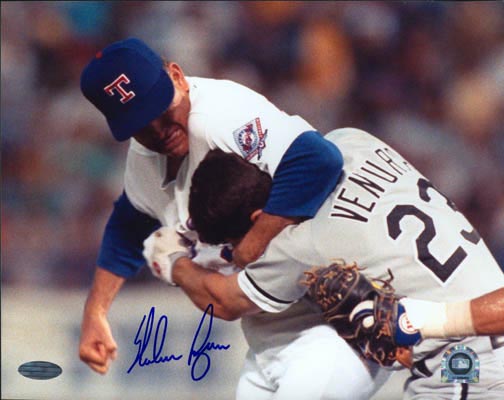
    Nolan Ryan also holds the MLB record for most "noogies" dished out in a single game.

    Top Twenty Career MLB Strikeout Pitchers:

  • (1) Nolan Ryan – 5,714
  • (2) Randy Johnson – 4,875
  • (3) Roger Clemens – 4,672
  • (4) Steve Carlton – 4,136
  • (5) Bert Blyleven – 3,701
  • (6) Tom Seaver – 3,640
  • (7) Don Sutton – 3,574
  • (8) Gaylord Perry – 3,534
  • (9) Walter Johnson – 3,509
  • (10) Greg Maddux – 3,371
  • (11) Phil Niekro – 3,342
  • (12) Ferguson Jenkins – 3,192
  • (13) Pedro Martínez – 3,154
  • (14) Bob Gibson – 3,117
  • (15) Curt Schilling – 3,116
  • (16) John Smoltz – 3,084
  • (17) Jim Bunning – 2,855
  • (18) Mickey Lolich – 2,832
  • (19) Mike Mussina – 2,813
  • (20) Cy Young – 2,803
  • Hall of Fame Members (11)): Nolan Ryan, Steve Carlton, Tom Seaver, Don Sutton, Gaylord Perry, Walter Johnson, Phil Niekro, Ferguson Jenkins, Bob Gibson, Jim Bunning, & Cy Young.
    HOF Eligible, But Not a Member (2): Bert Blyleven & Mickey Lolich.
    Recently Retired, Not Yet Eligible for HOF (6): Randy Johnson, Roger Clemens, Greg Maddux, Curt Schilling, John Smoltz. & Mike Mussina.
    Still an Active Player (1): Pedro Martinez.
    Throwing strikeouts over time probably gets you in the Hall of Fame, unless your name is Bert Blyleven or Mickey Lolich – or you’ve had your reputation stained by redundant accusations and hard evidence of steroid use and had your reputation for natural greatness burned beyond recognition by guys hiding in gyms who are ready to testify against you in exchange for witness protection guarantees.
    Look for Bert Blyleven to finally get the votes he needs to make it into the HOF in 2011. He’s been building in support for a while now and came fairly close in 2010. He should have been there years ago, but late is better than never – or far superior to induction after a guy dies and can’t be there to see it happen.
    I look for Randy Johnson and Greg Maddux to make it into the HOF in their first years of eligibility, but I’m not that high on the early, if ever, chances for John Smoltz, Curt Schilling, or Mike Mussina. I’m not saying an induction case could not be made for all three, I just don’t think that any of them performed on the consistent blue chip level that we associate with Randy Johnson and Greg Maddux – nor will the former three possess the popular support among voters that belongs to Johnson and Maddux on a first ballot.
    As for Roger Clemens, I’m afraid his steroids stain is going to be an obstacle to the HOF for years to come, if not forever. The shame of it is that we all know that Roger Clemens had a major talent and incredible work ethic that carried him to great accomplishments. He didn’t need steroids to have a HOF career and he is really innocent of using the stuff unless he’s ever proven guilty.
    The problem is two-fold: The “denial politics” of baseball may impede the issue from ever getting settled in court, but the public conviction of abuse in the minds of fans may be all that’s needed to keep Roger Clemens from receiving the kind of post-career recognition that he deserves for his natural ability and highest level baseball accomplishments.

    Anatomy of a Buffs Scorecard

    November 12, 2010

    Official Scorecard of the 1951 Houston Buffs

    The Norman Rockwell-like scene selected for the cover of the four-page 1951 Houston Buffs scorecard came courtesy of the ELks magazine. As the program also notes, the original piece of this work was then hanging in the Baseball Hall of Fame at Cooperstown.

    What else can we learn from this small artifact from local baseball history? The items we are about to see pretty much speak for themselves about who advertised, the availability and cost of baseball food and other mild altering products, plus lineups, rosters, and the Buffs 1951 game schedule. For the most part from here, I just want to get out of the wy and let the pictures speak for themselves. These all came from the four pages of the one-piece folding scorecard that once sold golden memories for ten cents a copy.

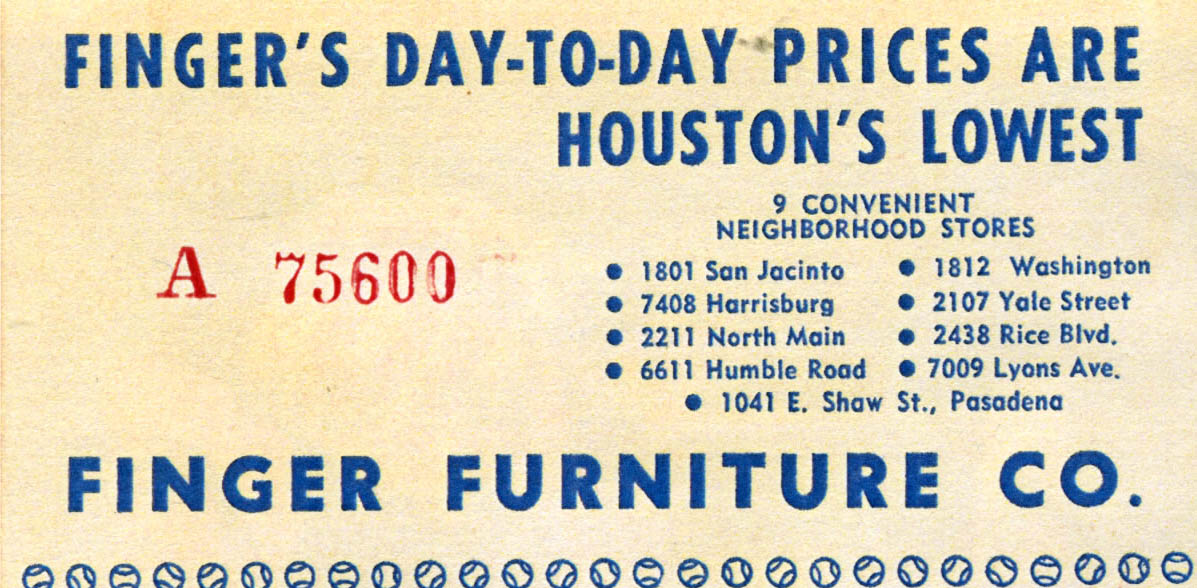
    As a Buffs supporter, Finger Furniture came early and stayed late. The memory of the Buffs is now immortalized, we hope, at the Houston Sports Museum inside the Finger Furniture Store that still operates on the site of Buff Stadium on the Gulf Freeway in Houston.

    I stand corrected by own better memory this morning. Aubrey, Orval, & Mac NEVER said "less overhead in LaPorte." That one belonged to the bald-headed Les Felzer (sp) and his dealership.

    Taking in a burlesque show after a Buffs baseball game was never part of my early baseball memories, but I guess old Bozo St. Clair must have pulled in a few fans along the way.

    Wild Man Rex Barney, outfielder Gino Cimoli, and manager Bobby Bragan stand out as famous names on the '51 Fort Worth Cats roster.

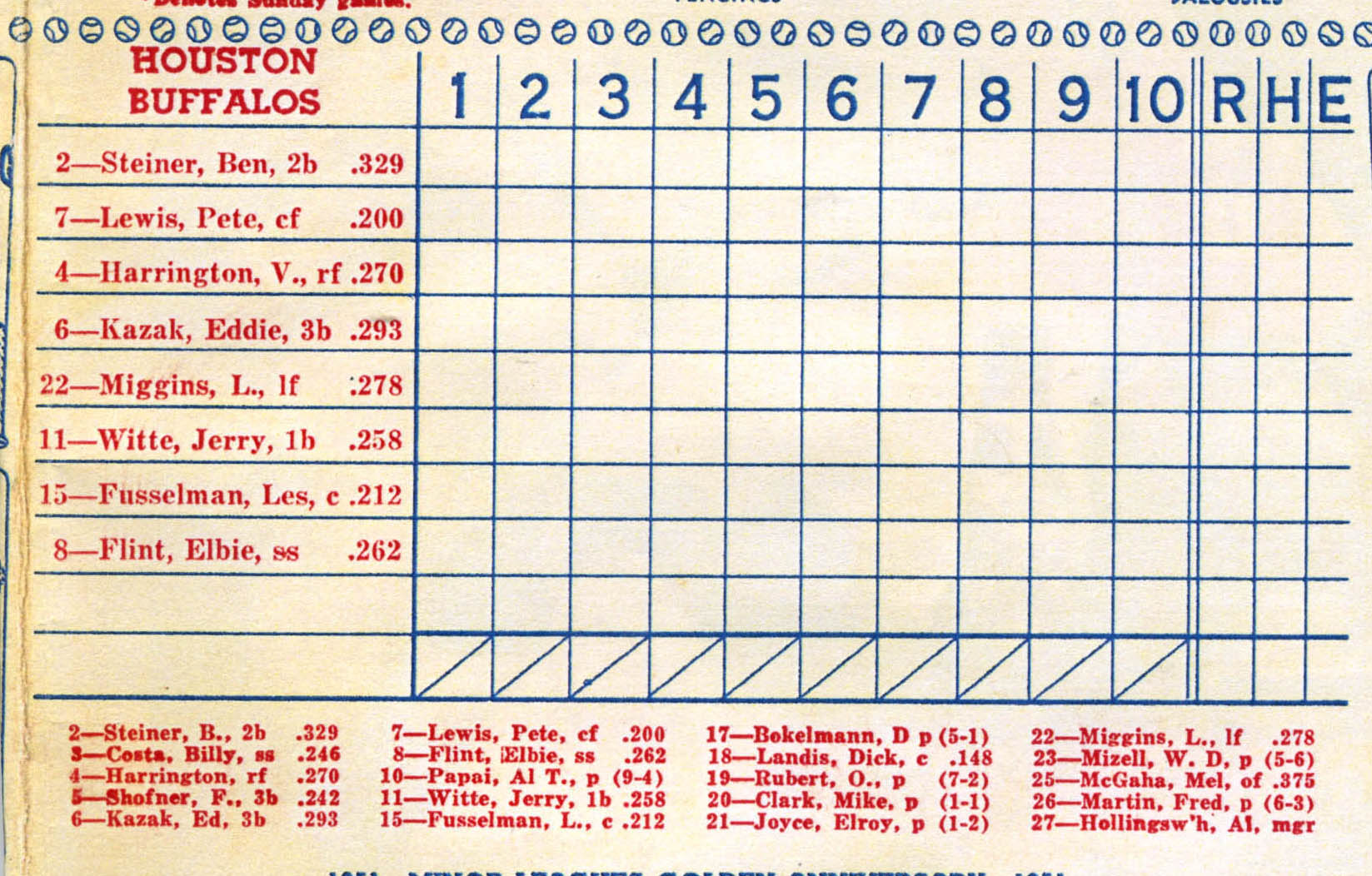
    Check out the # 5 and # 6 holes for Larry Miggins & Jerry Witte, the power of the '51 Buffs. Miggins had 28 HR on the season; Witte had 38.

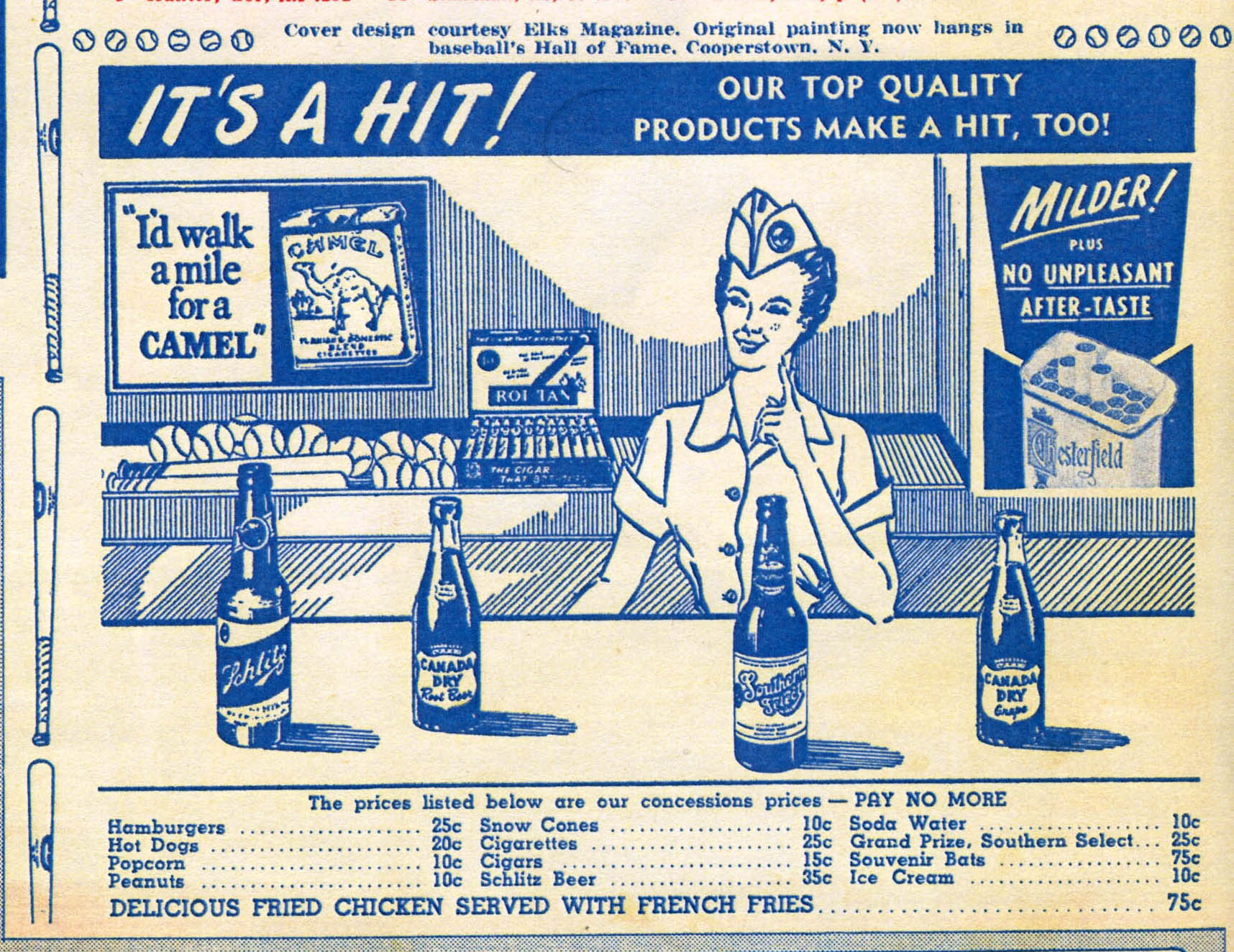
    Hope you can read the prices. Fans did not have to mortgage the ranch to buy good ballpark food and drink at old Buff Stadium, but also note the absence of souvenirs for sale. Baseball had yet to catch on to replica jerseys and caps as an important revenue stream - and maybe we didn't have the excess spending cash in those days, anyway.

    Buff Stadium Concession Stand Prices: "Oh, say! Can you see?" Burgers were 25 cents; hot dogs were 20 cents; a fried chicken dinner with fries hung as the big spender food item at 75 cents; soft drinks cost 10 cents; Grand Prize and Southern Select beers were 25 cents; Schlitz Beer set you back 35 cents and, WHOA!, a pack of cigarettes could be yours for a mere 25 cents. Ice cream stopped on a dime, as did peanuts pop corn, and snow cones. They did have a souvenir bat for a whopping 75 cents.

    A Buff homer won some "lucky" fan a ten dollar account credit at Grant's for holding the right number in the instant drawing that then occurred at Buff Stadium.

    It was also a "given" at Grant's that you could fill in this little coupon, cut it out of your beautiful historical game program, and drop it in the slot at Gran;s in person to have a chance at their next drawing for a "free" Motorola TV. The catch is - you had to go all the way downtown to Grant's to enter. Mail entries were thrown away.

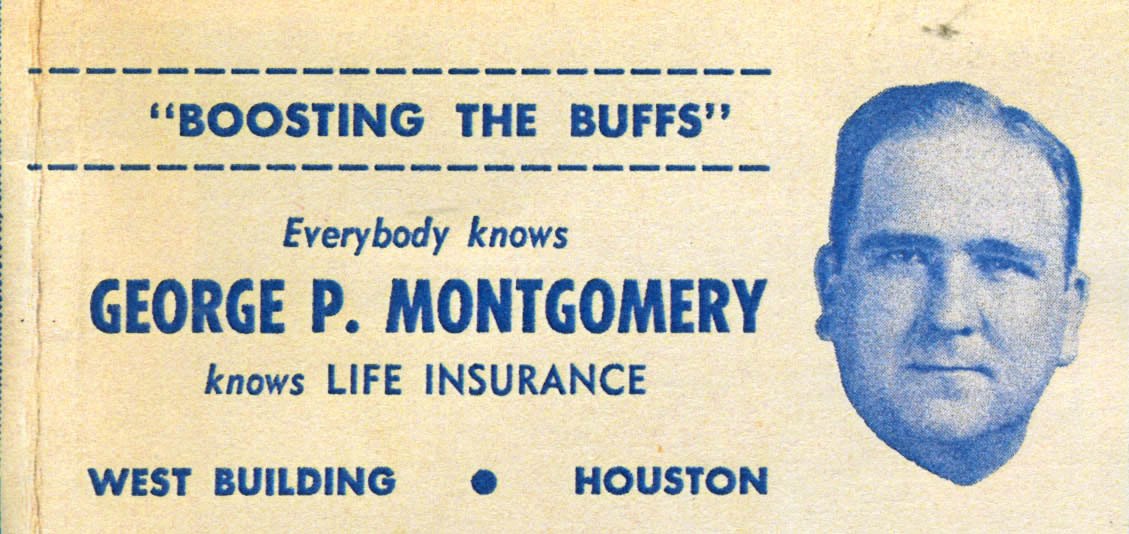
    I was a kid in 1951 so this ad did nothing for me, but I don't recall my hardworking dad running out to buy life insurance as result of this George P. Montgomery softball pitch.

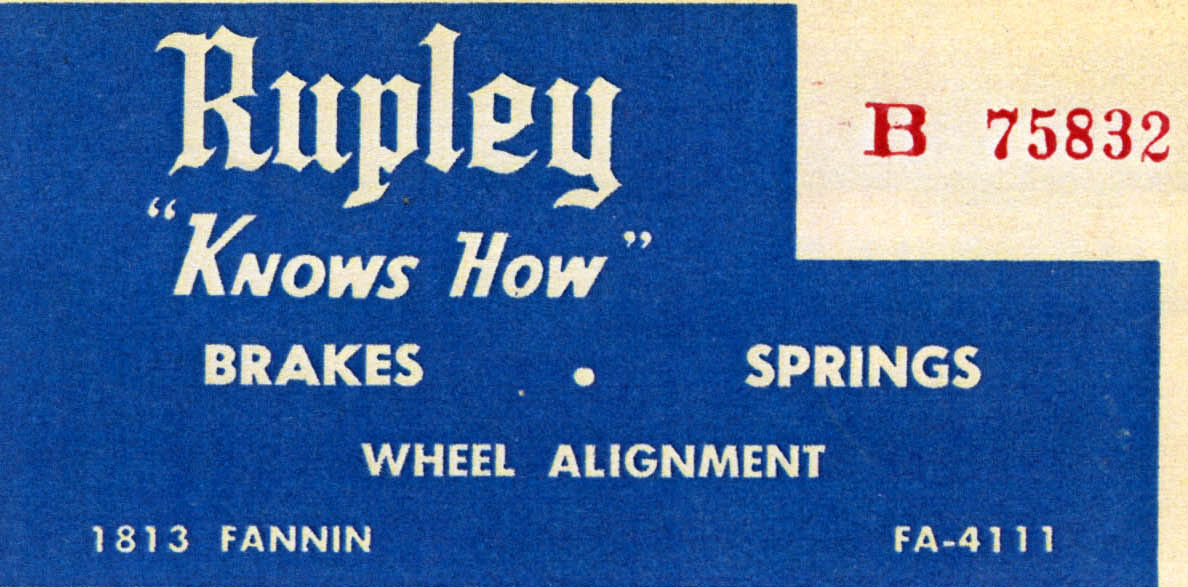
    Rupley fixed brakes. Gimme a "break," - what do you suppose he gave away during those drawings that got his name mentioned over the PA system at Buff Stadium?

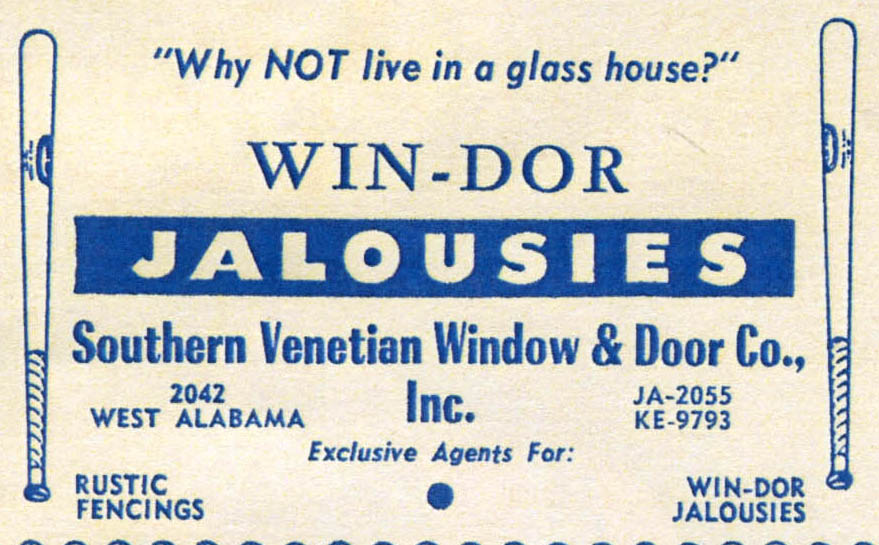
    Venetian windows and blinds were really big in the early 1950s, but I could not have told you that this company ever existed had I not read of it closely doing this dissection of the scorecard..

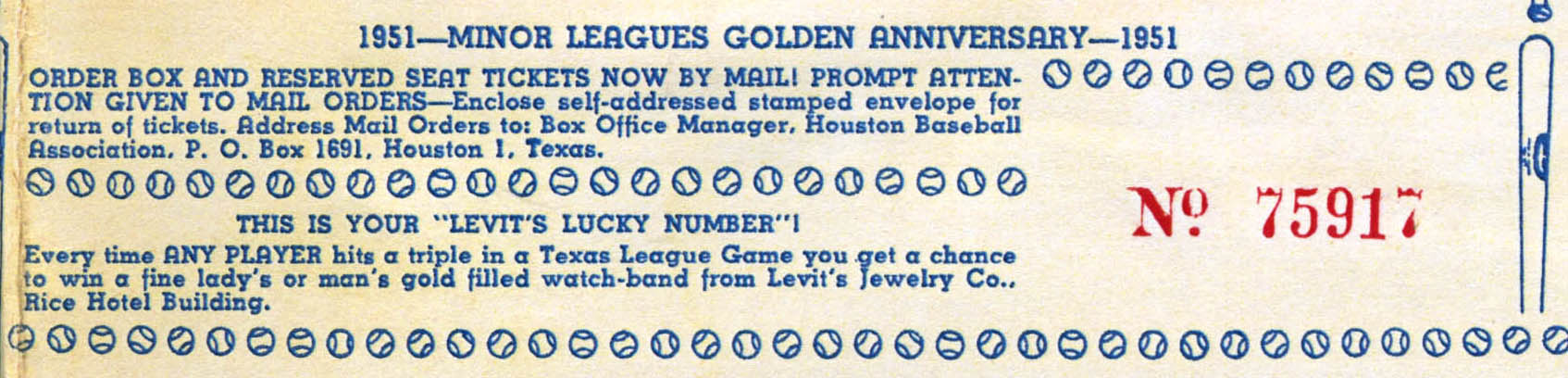
    How To Order Tickets By Mail & Another Drawing: This time fans had a chance to win a "gold-filled" watch band from Levit's Jewelry any time a player for either team hit a triple.

    W.T. Grant also pushed work clothes and portable radios. "Take one everywhere ... enjoy extra pleasure. See them at Grant's Department Store."

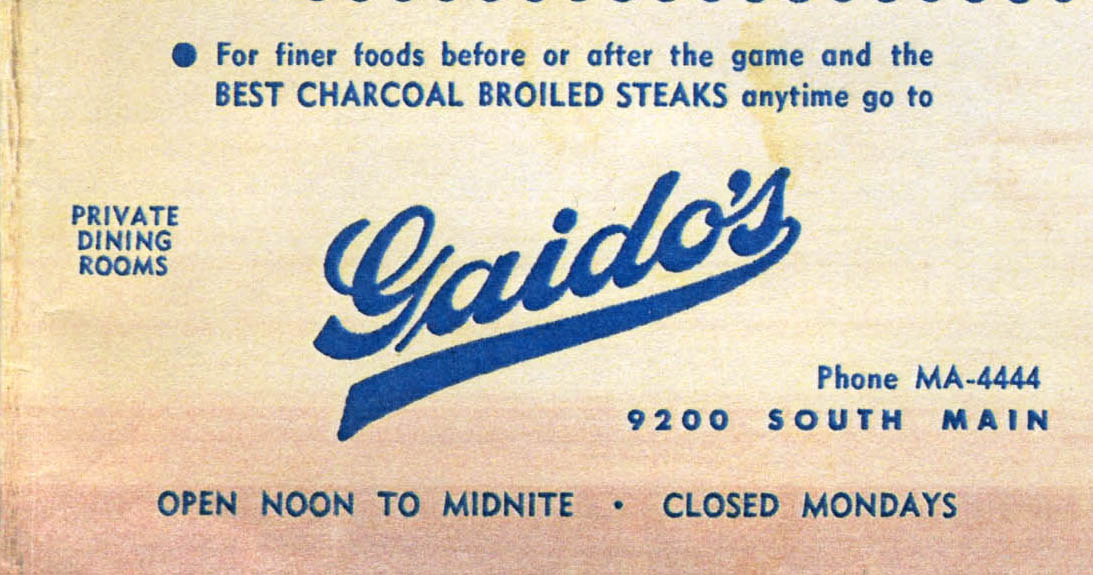
    Gaidos. Good then. Good now. (In Galveston only these days.)

    At 25 cents a local beer at Buff Stadium, some Buff fans with ten bucks, a thirst, and not much appetite could probably experience a not so sober end to their evening at the Baseball Bar on Cullen and then try driving home drunk. Some things are better today. The drunk driving numbers were much higher in the old days. They just don't show up in the arrest stats because drunk drivers once got away with it unless they caused a wreck or fatality.

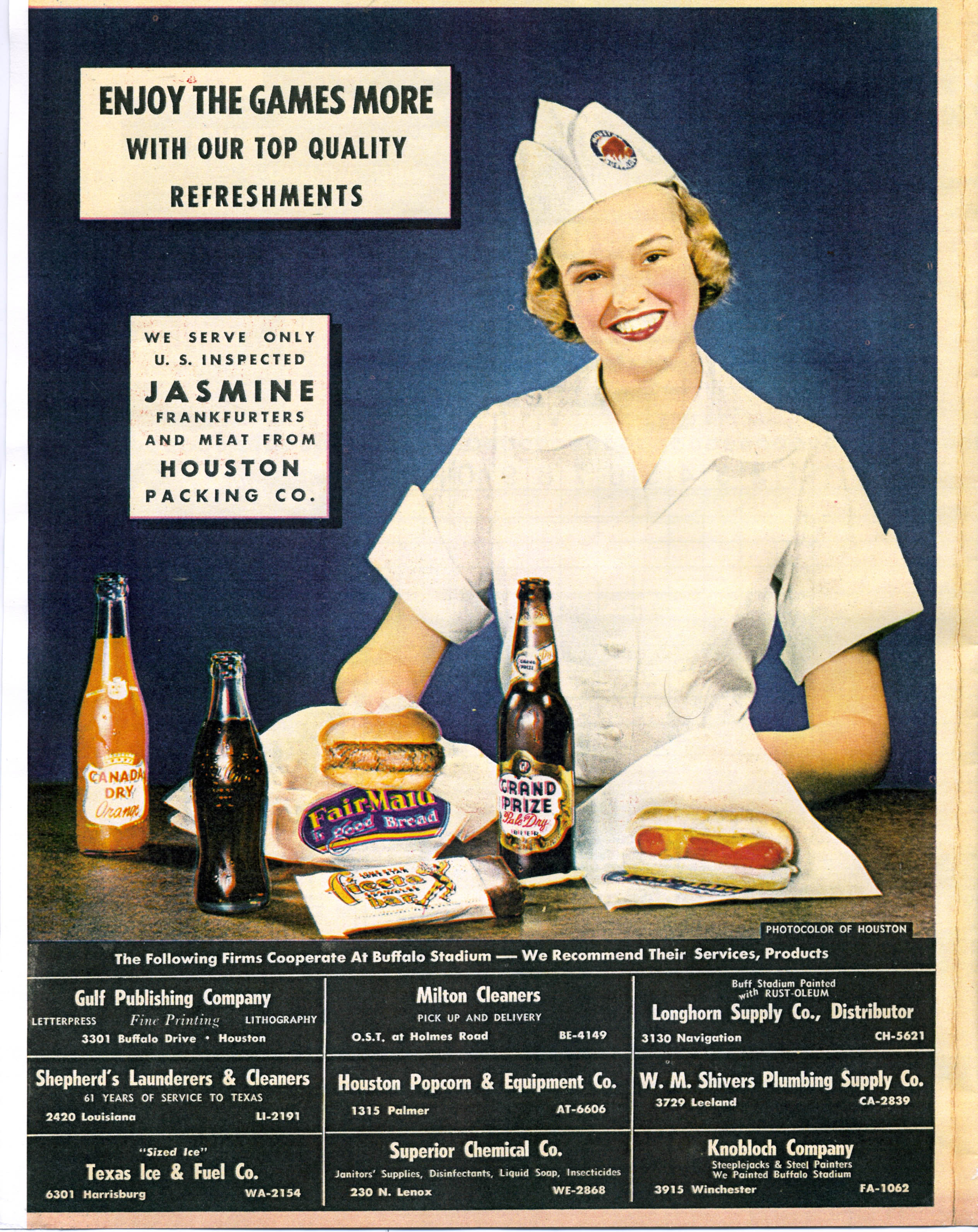
    I don't recall this pretty girl ever taking my order at the Buff Stadium Concession Stand. Most of the attendants who waited on me were old guys with a two-day beard growth and a Camel cigarette dangling from their lips as they dipped the mustard for the hot dogs.

    Some Final Advertisers: These nine additional local sponsors once supported the Buffs with their advertising dollars. For that contribution, those of us who care about the preservation of local baseball history need to express our gratitude.

    Well, that’s it. Four pages of the printed word with pictures and cartoons have survived in this fold-over piece of light cardboard paper like a little time capsule on the way things were in Houston during the middle of the twentieth century. I hope you’ve enjoyed this operation as much as I have enjoyed looking with you for all the little specific messages it contains from back in the day.

    Most of these little scorecards never made it out of the ballpark back in 1951. When the game was over, they ended up as trash in the stands to be collected and burned. This one just happened to end up in the hands of a thirteen year old kid who rarely threw anything away, especially if it had something to do with baseball and the Houston Buffs.

    Have a nice weekend, everybody!

    Kodak Moments in Post WWII Baseball

    November 9, 2010

    The following five photos have these traits in common: (1) They are each photos of big moments in baseball history; (2) They each were taken during the widely agreed upon post World War II Era of 1946 to 1960; and (3) each were the figurative fulfillment of that magical expression about “catching lightning in a bottle;” and (4) all you need is magic to make something memorable – and a rarified photograph of the moment simply makes it harder to forget.

    Here are my favorite examples from the post-World War II period:

    October 15, 1946: Enos Slaughter's Mad Dash from First to Home.

    October 15, 1946: Slaughter’s Mad Dash: It’s Game Seven of the World Series at Sportsman’s Park in St. Louis. The Cardinals and the Boston Red Sox are tied 3-3 in the bottom of the eighth inning. Enos Slaughter is at first base with two outs and Harry Walker is the batter.

    Walker takes off for second base on the hit and run when Walker follows through with a lazy, looping single to left center. As BoSox center fielder Leon Culberson lumbers after the ball, Slaughter hits second and rounds the base for third. Culberson makes the cutoff throw to shortstop Johnny Pesky as third base coach Mike Gonzalez puts up the stop sign for the dashing Slaughter.

    The mad man runner ignores the halt sign and rounds third base, heading for home. The pivoting Pesky takes a halting look at the action and then let’s go a not even close throw to the plate.

    Slaughter slides home safe for a 4-3 lead that holds up for a St. Louis final winning score in Game Seven, delivering the World Series to the Cardinals on a late-in-the game mad dash from first to home by Enos Slaughter on a Harry Walker dumping hit that should’ve never been anything more than a single.

    October 5, 1947: Gionfriddo's Catch.

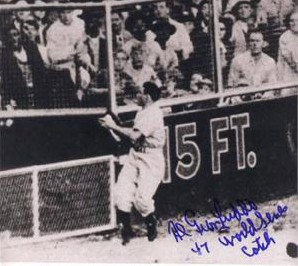
    October 5, 1947: Al Gionfriddo’s Catch: It’s the World Series again, the Yankees are losing 8-5 to the Brooklyn Dodgers in the bottom of the sixth of Game Six when Joltin’ Joe DiMaggio comes to the plate with two runners on base and a chance to tie it all up with the long ball.

    DiMaggio launches a blast that seems destined to reach the stands at the 415 feet mark, but late inning substitute left fielder Al Gionfriddo, all 5’6″ of him, races far across the field to reach over the fence and make the catch, denying Joe and the Yankees a game-tying homer at the 415 feet sign. The Dogers go on to win Game Six by 8-6, but lose in Game Seven to the dynastic Yankees.

    Not just by the way, the Gionfriddo photo is every inch covered in fame by another photo of this moment I like, but did not have available for this article. That’s the photo of Joe DiMaggio kicking the sand near second base when he realizes that Gionfriddo has just robbed him of the game-tying home run.

    October 3, 1951: The Shot Heard Round the World.

    October 3, 1951: The Shot Heard Round the World: If you’ve read this far, you probably already know the story by heart. The 1951 New York Giants were already a team powered by miracles when they reached the great cliff threat of their pennant-driving season. Coming from 13.5 games behind the Brooklyn Dodgers in August, the Giants had fought back to tie the Dodgers for first place on the last day of the regular season.

    Now, here they were in the bottom of the 9th of the third and deciding game of a playoff contest with the Dodgers at the Polo Grounds. With two runners on base and one man out, Bobby Thomson was coming to bat to face reliever Ralph Branca.

    At 3:57 PM, Eastern time, Bobby Thomson unloaded a line drive home run that just shot its way into the left field stands like a Revolutionary War cannonball. For even larger reasons, the firing of that baseball oFf the bat of Thomson would be remembered to this day and forever as “The Shot Heard Round The World.” The Giants won the game and the in the biggest roaring walk-off victory of all time.

    THE GIANTS WIN THE PENNANT! ~ THE GIANTS WIN THE PENNANT! ~ THE GIANTS WIN THE PENNANT!

    September 29, 1954: The Catch.

    September 29, 1954: The Catch: It is arguably the most famous baseball photograph of all time. Running hard to the afr distant stands in deepest center field of the Polo Grounds in Game One of the 1954 World Series, Willie Mays of the New York Giants brings home the catch of Vic Wertz’s long drive in the very inning of play, setting a downward tone that the heavily favored Cleveland Indians will never escape.

    The New York Giants sweep the Cleveland Indians in the 1954 World Series, four games to none. Willie sweeps defensive baseball history with “The Catch,” bar none.

    October 13, 1960: Maz's Homer Beats Yankees!

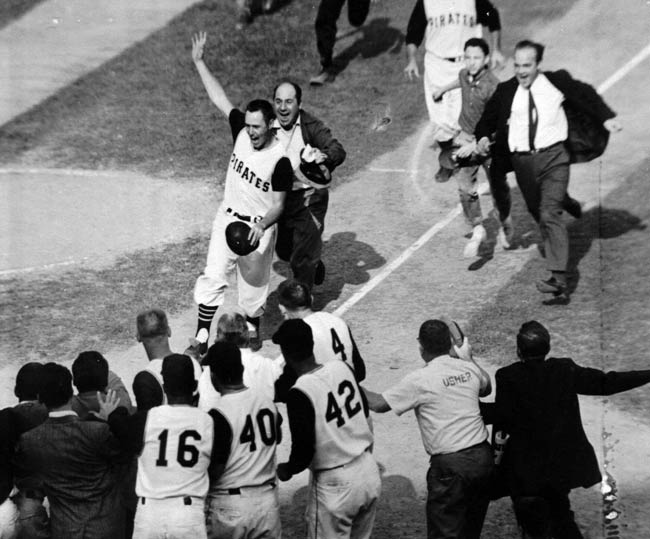
    October 13, 1960: Maz’s Homer Beats Yankees! In one of the most exciting Game Sevens of all time, little Bill Mazeroski came to bat for Pittsburgh in the bottom of the ninth at Forbes Field to face Ralph Terry of the Yankees with the score tied at 9-9.

    Then “Maz” did something he wasn’t famous for doing. He poked a hard liner drive to left field that just kept on climbing. Left fielder Yogi Berra first started backing up as though he would have a play. Then we see Berra turn to watch. He is watching the ball sail over the wall and out of the park. Bill Mazeroski has just unloaded a World Series winning walk-off home run for a 10-9 Pirates win and joyous bedlam in the Land of Three Rivers.

    Not so joyous in The Bronx or the home of their manager. Because of the loss, the Yankees fire manager Casey Stengel in spite of the fact that he had won ten pennants and seven previous World Series titles in his twelve seasons (1949-60) as the Yankee mentor.

    In one more sidebar of mindless action, a 14 year old Pirates fan named Andy Jerpe retrieves the World Series winning homer ball outside the Forbes Field wall and he takes it to Bill Mazeroski for an autograph. The kid apparently never thinks to give it to Mazeroski or make a trade and the celebrating Pirates never think about a way to save the ball either. And who knows where the Hall of Fame representatives were on this day. They sure weren’t on hand back in that era trying to obtain and preserve historical artifacts.

    The short of it is this: The Jerpe kid takes the signed Mazeroski major artifact baseball home with him. Some time later, an effort is made to locate the kid and the ball. The searchers learn the worst. The kid needed a ball for sandlot games at some point and put it in play. The magic Mazeroski home run ball was then worn down and finally lost.

    Oh well, At least we aren’t likely to lose our famous photos – not once they are digitalized, anyway.

    Have a nice day, everybody. And take care of what’s valuable to history.


    Baseball’s Bacon Bangers: Top RBI Men

    November 8, 2010

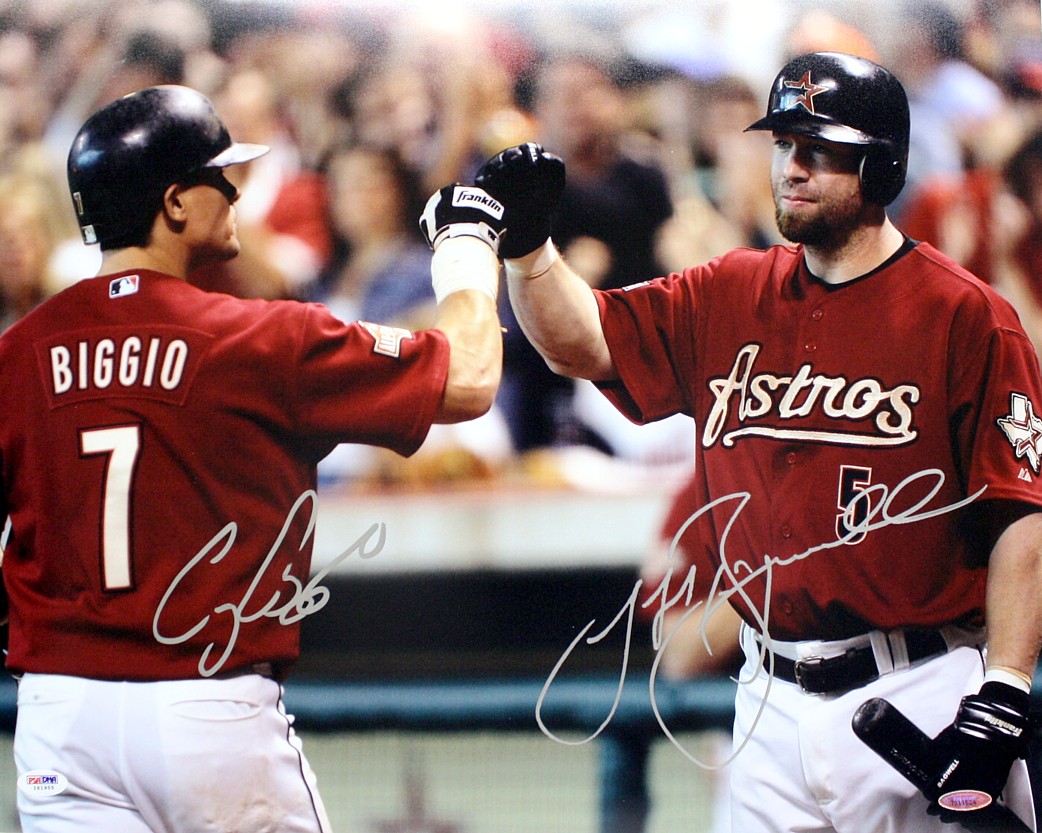
    Craig Biggio (# 155t) and Jeff Bagwell (# 45t) Rank Among Leaders.

    Craig Biggio was never your prototypical RBI man, but he played well enough over time to end up at # 155 in a tie with HOF great George Sisler with 1,175 RBI each. Jeff Bagwell made a deeper push up the list as a legitimate power hitter, stopped cold at the # 45 spot, tied with another HOF great one,  Tris Speaker, for now, by his unfixable shoulder problem in 2005 from going higher on the all time leader board.

    Most of those other names in the top ten for “runs batted in” (RBI) will not surprise, but the old racist Cap Anson at the # 3 spot may raise a few eyebrows. Anson did his work in the 19th century, when and  where the different rules and accuracy of record-keeping often casts a shadow upon the achievements of that period in comparison to the same accomplishments in the modern game.

    In spite of our several more recent and more sophisticated measures of productivity, I’ve always been most partial to the RBI figure because it tells us very directly whether or not a player is causing runs to score in comparison to others. The game is still about who scores the most runs. As long as the team that scores the most runs in the final game of the World Series is declared champion, we shall need to keep our attention upon the interesting RBI column – and those players who are most responsible for banging home the bacon.

    Listed here are simply the top 100 RBI men of all time. If you would care to study the all time list deeper, heres the link to the material source at Baseball Reference.Com:

    http://www.baseball-reference.com/leaders/RBI_career.shtml

    Top 100 All Time Career MLB RBI Leaders (Through 2010):

    Rank Player (age) Runs Batted In / Bats
    1. Hank Aaron+ 2297 R
    2. Babe Ruth+ 2213 L
    3. Cap Anson+ 2075 R
    4. Barry Bonds 1996 L
    5. Lou Gehrig+ 1995 L
    6. Stan Musial+ 1951 L
    7. Ty Cobb+ 1938 L
    8. Jimmie Foxx+ 1922 R
    9. Eddie Murray+ 1917 B
    10. Willie Mays+ 1903 R
    11. Mel Ott+ 1860 L
    12. Carl Yastrzemski+ 1844 L
    13. Ted Williams+ 1839 L
    14. Ken Griffey (40) 1836 L
    15. Rafael Palmeiro 1835 L
    16. Dave Winfield+ 1833 R
    17. Alex Rodriguez (34) 1831 R
    18. Manny Ramirez (38) 1830 R
    19. Al Simmons+ 1827 R
    20. Frank Robinson+ 1812 R
    21. Honus Wagner+ 1733 R
    22. Frank Thomas 1704 R
    23. Reggie Jackson+ 1702 L
    24. Cal Ripken+ 1695 R
    25. Gary Sheffield 1676 R
    26. Sammy Sosa 1667 R
    27. Tony Perez+ 1652 R
    28. Ernie Banks+ 1636 R
    29. Harold Baines 1628 L
    30. Jim Thome (39) 1624 L
    31. Goose Goslin+ 1609 L
    32. Nap Lajoie+ 1599 R
    33. George Brett+ 1595 L
    Mike Schmidt+ 1595 R
    35. Andre Dawson+ 1591 R
    36. Rogers Hornsby+ 1584 R
    Harmon Killebrew+ 1584 R
    38. Al Kaline+ 1583 R
    39. Jake Beckley+ 1578 L
    40. Willie McCovey+ 1555 L
    41. Fred McGriff 1550 L
    42. Willie Stargell+ 1540 L
    43. Harry Heilmann+ 1539 R
    44. Joe DiMaggio+ 1537 R
    45. Jeff Bagwell 1529 R
    Tris Speaker+ 1529 L
    47. Sam Crawford+ 1525 L
    48. Jeff Kent 1518 R
    49. Carlos Delgado (38) 1512 L
    50. Mickey Mantle+ 1509 B
    51. Dave Parker 1493 L
    52. Chipper Jones (38) 1491 B
    53. Billy Williams+ 1475 L
    54. Ed Delahanty+ 1466 R
    Rusty Staub 1466 L
    56. Eddie Mathews+ 1453 L
    57. Jim Rice+ 1451 R
    58. Joe Carter 1445 R
    59. George Davis+ 1440 B
    60. Luis Gonzalez 1439 L
    61. Vladimir Guerrero (35) 1433 R
    62. Yogi Berra+ 1430 L
    63. Charlie Gehringer+ 1427 L
    64. Andres Galarraga 1425 R
    65. Joe Cronin+ 1424 R
    66. Jim Bottomley+ 1422 L
    67. Mark McGwire 1414 R
    68. Jose Canseco 1407 R
    69. Robin Yount+ 1406 R
    70. Juan Gonzalez 1404 R
    71. Ted Simmons 1389 B
    72. Dwight Evans 1384 R
    73. Joe Medwick+ 1383 R
    74. Lave Cross 1378 R
    75. Johnny Bench+ 1376 R
    76. Chili Davis 1372 B
    77. Garret Anderson (38) 1365 L
    Orlando Cepeda+ 1365 R
    Jason Giambi (39) 1365 L
    80. Brooks Robinson+ 1357 R
    81. Darrell Evans 1354 L
    82. Gary Gaetti 1341 R
    83. Johnny Mize+ 1337 L
    84. Mike Piazza 1335 R
    85. Duke Snider+ 1333 L
    86. Ron Santo 1331 R
    87. Carlton Fisk+ 1330 R
    88. Al Oliver 1326 L
    89. Roger Connor+ 1323 L
    90. Ruben Sierra 1322 B
    91. Graig Nettles 1314 L
    Pete Rose 1314 B
    93. Ivan Rodriguez (38) 1313 R
    94. Mickey Vernon 1311 L
    Larry Walker 1311 L
    96. Paul Waner+ 1309 L
    97. Steve Garvey 1308 R
    98. Paul Molitor+ 1307 R
    99. Roberto Clemente+ 1305 R
    Sam Thompson+ 1305

    “+” by name = inducted member of Baseball Hall of Fame.

    Steroids: Will MLB Rule or Weasel Out on HOF Question?

    November 7, 2010

    The Sultan of Swat & The Slugger of Certainty!

    When Babe Ruth hit them, they were “no doubters,” home runs that left the yard with great certainty, big blasts that left no doubt they were departing the field from the very first crack of the bat. And when the Babe hit them, there was also no doubt that he took them out in spite of his poor physical appearance and apparent lack of conditioning, and in over-riding reaction to any most recent intake of alcohol, nicotine, or high fat food.

    No one paid as much attention to Hank Aaron while he was doing it too, but Henry’s quiet home run march to the head of the pack in the early 1970s was also regarded with nothing less than respect from all his non-racist fans. It only drew a crowd once people, and especially the KKK-minded folks, realized that Aaron was on his way to passing Ruth, but it was no less an honorable journey as an individual accomplishment all the way.

    Then everything changed in the early 21st century when Barry Bonds passed both Hank Aaron (755) and Babe Ruth (714) to register his record-breaking 762 long balls. By the Bonds era, all eyes were steadfast and fixed upon the steroid question and players with enormous muscles and large bulging heads. And when the formerly young and slim man named Barry Bonds hit number 762, it was like watching a ripped Giant Godzilla bobble head trotting around the bases in strutting celebration.

    Bonds and the other list of suspect sluggers from the “Roids to Ruin” era in baseball history have already been convicted of steroids abuse in the public mind, even if none have yet to be found guilty in a court of law. Where this all leads eventually, I’m really not sure. I just don’t think it leads to enshrinement in the Baseball Hall of Fame.

    I think the public mind convictions have already been sealed against home run sluggers Barry Bonds, Mark McGwire, Rafael Palmiero, and Sammy Sosa. I’m not as certain about Alex Rodriguez, even though he actually has admitted to brief past steroid use while the others mentioned previously have either denied it, cried innocence, blamed it on trainers, or simply refused to talk about it.

    Roger Clemens is the biggest non-slugger name on the public-mind-conviction list in this issue and most probably also will suffer the same fate as the others: denial from the Hall of Fame because of suspected, but not necessarily proven steroid abuse.

    I don’t see any other way this is turning out. Do you? And I think MLB still holds on to the denial-driven fantasy that it will just go away over time. Meanwhile, one of the avoidance paths baseball may take is to simply avoid the larger question: Should conviction of steroid abuse keep an otherwise qualified player out of the Hall of Fame? Instead of taking an active position, they will allow their voting minions to simply settle the matter by not voting for Barry Bonds or the others on that list.

    Not voting for Bonds may look like an active MLB position, but it isn’t. It’s the weasel route.

    The problem with the “weasel route” is that we don’t know for sure how low and for long it will float down the list of future candidates. How many future eligible players will be denied a vote because a few voting weasel writers have a flickering thought that the guy looked too muscular to have come by his skills and accomplishments honestly?

    Check out the list of Baseball’s top 100 career home run leaders and, without regard for who’s already in and who’s not, ask yourself: Is there anyone else on the list who might have trouble getting HOF votes because of his appearance during his prime playing days?

    I see a few, but I don’t want to spoil your own impressions by offering mine here. The question here is for you: Are there other top sluggers from this list who may be kept from the HOF because they register in the public memory as suspected steroids users?

    Please record any comments you may have below as comments on this article. Here’s the list:

    Top 100 Career Home Run Hitters through 2010:

    Rank Player (2010 HRs) HR
    1 Barry Bonds 762
    2 Hank Aaron 755
    3 Babe Ruth 714
    4 Willie Mays 660
    5 Ken Griffey, Jr. 630
    6 Alex Rodriguez (30) 613
    7 Sammy Sosa 609
    8 Jim Thome (25) 589
    9 Frank Robinson 586
    10 Mark McGwire 583
    11 Harmon Killebrew 573
    12 Rafael Palmeiro 569
    13 Reggie Jackson 563
    14 Manny Ramírez (9) 555
    15 Mike Schmidt 548
    16 Mickey Mantle 536
    17 Jimmie Foxx 534
    18 Willie McCovey 521
    Frank Thomas 521
    Ted Williams 521
    21 Ernie Banks 512
    Eddie Mathews 512
    23 Mel Ott 511
    24 Gary Sheffield 509
    25 Eddie Murray 504
    26 Lou Gehrig 493
    Fred McGriff 493
    28 Stan Musial 475
    Willie Stargell 475
    30 Carlos Delgado 473
    31 Dave Winfield 465
    32 José Canseco 462
    33 Carl Yastrzemski 452
    34 Jeff Bagwell 449
    35 Dave Kingman 442
    36 Andre Dawson 438
    37 Vladimir Guerrero (29) 436
    Chipper Jones (10) 436
    39 Juan González 434
    40 Cal Ripken, Jr. 431
    41 Mike Piazza 427
    42 Billy Williams 426
    43 Jason Giambi (6) 415
    44 Darrell Evans 414
    45 Albert Pujols (42) 408
    46 Andruw Jones (19) 407
    Duke Snider 407
    48 Andres Galarraga 399
    Al Kaline 399
    50 Dale Murphy 398
    51 Joe Carter 396
    52 Jim Edmonds (11) 393
    53 Graig Nettles 390
    54 Johnny Bench 389
    55 Dwight Evans 385
    56 Harold Baines 384
    57 Larry Walker 383
    58 Frank Howard 382
    Jim Rice 382
    60 Albert Belle 381
    61 Orlando Cepeda 379
    Tony Pérez 379
    63 Matt Williams 378
    64 Norm Cash 377
    Jeff Kent 377
    66 Carlton Fisk 376
    67 Rocky Colavito 374
    68 Gil Hodges 370
    69 Ralph Kiner 369
    70 Paul Konerko (39) 365
    71 Joe DiMaggio 361
    72 Gary Gaetti 360
    73 Johnny Mize 359
    74 Yogi Berra 358
    75 Greg Vaughn 355
    76 Adam Dunn (38) 354
    Luis Gonzalez 354
    Lee May 354
    79 Ellis Burks 352
    80 Dick Allen 351
    81 Chili Davis 350
    82 David Ortiz (32) 349
    83 George Foster 348
    84 Ron Santo 342
    85 Jack Clark 340
    86 Tino Martinez 339
    Dave Parker 339
    Boog Powell 339
    89 Don Baylor 338
    90 Joe Adcock 336
    91 Darryl Strawberry 335
    92 Todd Helton (8) 333
    93 Moisés Alou 332
    Bobby Bonds 332
    95 Hank Greenberg 331
    Carlos Lee (24) 331
    97 Shawn Green 328
    Mo Vaughn 328
    99 Lance Berkman (14) 327
    100 Jermaine Dye 325
    Willie Horton 325

    2010 HR totals are shown on above list in parentheses after active player names.

    The Magic Circle of 300 MLB Wins

    November 6, 2010

    "Mr. Clemens" may become first 300-game winner to miss the HOF.

    For years now, winning 300 games over the course of his MLB career was the sure-fire path to the Hall of Fame for any big league pitcher. If you examine the list of all players who have won a minimum of 300 games, you will quickly see that the only ones from that group who are not HOF inductees already are the handful who have yet to pass the five year wait between retirement and voting eligibility.

    Those players in waiting are Greg Maddux, Roger Clemens, Tom Glavine, and Randy Johnson. They have all pitched far well enough to enter  the HOF as inductees. There’s just one problem for one of these men. Roger Clemens may have to wait until hell freezes over because of his quagmire involvement in the steroid-use accusations and congressional denials that don’t exactly clear the mud.

    We don’t know the truth about Roger Clemens and steroids. In spite of all the circumstantial evidence of the trainer-collected needles and paraphernalia, the eye witness testimony of the former trainer, the fumbling inferences from the testimony of Clemens’s pal, Andy Pettitte, and the abject denials of Roger himself, we simply do not know what really happened for certain on the usage of steroids question.

    What we can know are these facts: (1) Roger Clemens was a great pitcher. He pitched well enough to be inducted into the Hall of Fame; (2) If he used them, steroids did not make Roger Clemens a great pitcher, but they may have helped him heal faster and survive long enough to win a few extra games that might have otherwise escaped his capacity as a power pitcher; (3) It will be a shame if the steroid cloud keeps Roger Clemens out of the Hall of Fame; and (4) If he doesn’t make it into the Hall, Roger Clemens has to at least bear responsibility for keeping the company of a trainer who admits to the illegal administration of HGH and other so-called performance enchancing substances. If a guy of that character turns on you, lots of luck clearing your name with verbal or written denials.

    Here’s a list of the 300-games plus winners and their pecking order on the all time order of things:

    The 300 Game Winners List: Hall of Fame Bound All, Until Steroids:

    Rank Player W
    1 Cy Young 511
    2 Walter Johnson 417
    3 Grover Cleveland Alexander 373
    Christy Mathewson 373
    5 Pud Galvin 364
    6 Warren Spahn 363
    7 Kid Nichols 361
    8 Greg Maddux 355
    9 Roger Clemens 354
    10 Tim Keefe 342
    11 Steve Carlton 329
    12 John Clarkson 328
    13 Eddie Plank 326
    14 Nolan Ryan 324
    Don Sutton 324
    16 Phil Niekro 318
    17 Gaylord Perry 314
    18 Tom Seaver 311
    19 Charley Radbourn 309
    20 Mickey Welch 307
    21 Tom Glavine 305
    22 Randy Johnson 303
    23 Lefty Grove 300
    Early Wynn 300

    t = already a member of Hall of Fame.

    Not just by the way, there are a number of Hall of Fame pitchers who did not reach 300 wins. Sandy Koufax at 165 career wins stands out as the poster child for starters on that list.

    There also are a few near-300 win pitchers who have long been deserving of induction, but cannot get all the votes they need. Tommy John (288), Bert Blyleven (287), and Jim Kaat (283) stand out as my prime examples, with Blyleven being my favorite of the three for induction.

    Among active pitchers, the little unstoppable time machine, Jamie Moyer, is still posting “W”s into his late 40s with a not-yet-sealed total of 267 wins.

    If you care to examine an extended list of the top 500-game winners, check out this chart on Wikipedia:

    http://en.wikipedia.org/wiki/List_of_Major_League_Baseball_leaders_in_career_wins

    Have anice weekend, everybody!

    Have a nice w


    Sparky Ranked High Among MLB Winning Managers

    November 5, 2010

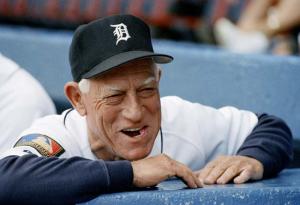
    Sparky Anderson, Baseball Hall of Fame, 2000

    Sparky Anderson died yesterday, Thursday, November 4, 2010, of complications from dementia. He was 76 and he passed away in a Thousand Oaks, California hospice after a brief stay. He leaves behind enough wins as an MLB manager at Cincinnati and Detroit to qualify for 6th place on the all time leader board.

    Sparky Anderson was the first manager to win World Series crowns for clubs in both big leagues and the only manager to become the career wins leader for two different clubs. When he finally retired after the 1995 season, Sparky was in 3rd place in wins, trailing only the legends Connie Mack and John McGraw. He has since been surpassed by Tony LaRussa, Bobby Cox, and Joe Torre.

    Anderson was inducted into the Baseball Hall of Fame in 2000. What doesn’t show up on his plaque at Cooperstown quite so easily was his uncanny ability to read, relate to, and get the most production out of his players. I had a brief encounter with Sparky charm in the summer of 2009 and it was powerful. If he diagnosed his players as clearly and as easily as he tabbed me, it’s no wonder he won two big ones for the Reds and another for the Tigers. I was ready to run through walls in appreciation for his treatment of me at the completion of the 2009 Knuckle Ball in Houston in August of that year,

    I had never met Sparky before that evening, but I had read a poem that evening that I had written in honor of the late Joe Niekro. It was simply a small part of the program.

    As we all were leaving the banquet at Minute Maid Park at night’s end. Sparky caught my eye from across the room. As he did, he abruptly changed course and began working his way through the crowd toward me.

    I will never forget the smile on his face when he finally reached me. The smile is framed around the quick hard hug he then gave me with these simple words: “Thank you, my man!” Then he nodded approvingly and went away, framing my only direct human contact with Sparky Anderson in each of our separately long lifetimes as just one special moment in mine.

    How lucky could I possibly be? That large moment with Sparky Anderson was as close as I’ll ever come to knowing what it feels like to hit a big league home run. And I have Sparky Anderson to thank for it. He didn’t have to fight the crowd to come thank me, an otherwise total stranger, but he did. And I shall be forever humbled and grateful that he did.

    Where is that wall? I’ll run through it now. And I’ll do it for Sparky Anderson, God rest his sweet soul.

    The following list was put together at Wikipedia. It reads like a Hall of Fame of the great ones who have managed in the game of baseball throughout the Modern Era long enough to pile up the most wins as managers. I hope you will find the chart both useful and fun to review. And please share your comments and questions here in response to this column.

    The chart also helps remind us: The Sparky Andersons of baseball don’t come around everyday, but when they do, they usually stay long enough to get great results over time.

    Most MLB Managerial Wins, All Time, Through 2010 Season:

    Rank↓ Name↓ Wins↓ Losses↓ Pct.↓
    1 Connie Mack * 3,731 3,948 .486
    2 John McGraw * 2,763 1,948 .586
    3 Tony La Russa 2,638 2,293 .535
    4 Bobby Cox 2,504 2,001 .556
    5 Joe Torre 2,326 1,997 .538
    6 Sparky Anderson * 2,194 1,834 .544
    7 Bucky Harris * 2,158 2,219 .493
    8 Joe McCarthy * 2,125 1,333 .615
    9 Walter Alston * 2,040 1,613 .558
    10 Leo Durocher * 2,008 1,709 .540
    11 Casey Stengel * 1,905 1,842 .508
    12 Gene Mauch 1,902 2,037 .483
    13 Bill McKechnie * 1,896 1,723 .524
    14 Lou Piniella 1,835 1,713 .517
    15 Ralph Houk 1,619 1,531 .514
    16 Fred Clarke * 1,602 1,181 .576
    17 Tommy Lasorda * 1,599 1,439 .526
    18 Dick Williams * 1,571 1,451 .520
    19 Jim Leyland 1,493 1,518 .496
    20 Clark Griffith * 1,491 1,367 .522
    21 Earl Weaver * 1,480 1,060 .583
    22 Miller Huggins * 1,413 1,134 .555
    23 Al Lopez * 1,410 1,004 .584
    24 Jimmy Dykes 1,406 1,541 .477
    25 Dusty Baker 1,405 1,284 .522
    26 Wilbert Robinson * 1,399 1,398 .500
    27 Chuck Tanner 1,352 1,381 .495
    28 Ned Hanlon * 1,313 1,164 .530
    29 Cap Anson 1,296 947 .578
    30 Charlie Grimm 1,287 1,067 .547
    31 Frank Selee * 1,284 862 .598
    32 Whitey Herzog * 1,281 1,125 .532
    33 Bruce Bochy 1,274 1,300 .495
    34 Billy Martin 1,253 1,013 .553
    34 Bill Rigney 1,239 1,321 .484
    36 Joe Cronin 1,236 1,055 .484
    37 Harry Wright * 1,225 885 .581
    38 Mike Hargrove 1,188 1,173 .503
    39 Hughie Jennings * 1,184 995 .543
    40 Lou Boudreau 1,162 1,224 .487
    41 John McNamara 1,160 1,233 .485
    42 Davey Johnson 1,148 888 .564
    43 Tom Kelly 1,140 1,244 .478
    44 Frankie Frisch 1,138 1,078 .514
    45 Art Howe 1,129 1,137 .498
    46 Bobby Valentine 1,117 1,072 .510
    47 Danny Murtaugh 1,115 950 .540
    48 Frank Robinson 1,065 1,176 .475
    49 Billy Southworth * 1,044 704 .597
    50 Red Schoendienst 1,041 955 .522
    51 Steve O’Neill 1,040 821 .559
    52 Felipe Alou 1,033 1,021 .503
    53 Jim Fregosi 1,028 1,095 .484
    54 Jack McKeon 1,011 940 .518
    55 Chuck Dressen 1,008 973 .509


    All Time World Series Wins Leader Board

    November 3, 2010

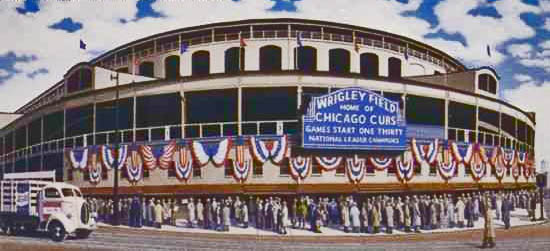
    Once upon a time, the Cubs even hosted a few World Series matches at Wrigley Field.

    The World Series Record by Team or Franchise, 1903-2010 (as prepared on Wikepedia and reproduced here for the sake of easy, quick reference):

    Team †
    ↓
    Series
    won↓
    Latest
    win↓
    Series
    played↓
    Latest
    Series↓
    New York Yankees (AL) 27 2009 40 2009
    St. Louis Cardinals (NL) 10 2006 17 2006
    [Philadelphia/Kansas City] Oakland Athletics (AL) 9 1989 14 1990
    Boston Red Sox [Americans] (AL) 7 2007 11 2007
    [New York] San Francisco Giants (NL) 6 2010 18 2010
    [Brooklyn] Los Angeles Dodgers (NL) ‡ 6 1988 18 1988
    Cincinnati Reds (NL) 5 1990 9 1990
    Pittsburgh Pirates (NL) 5 1979 7 1979
    Detroit Tigers (AL) 4 1984 10 2006
    Chicago White Sox (AL) 3 2005 5 2005
    [Boston/Milwaukee] Atlanta Braves (NL) 3 1995 9 1999
    [1st Washington Senators] Minnesota Twins (AL) 3 1991 6 1991
    [St. Louis Browns] Baltimore Orioles (AL) 3 1983 7 1983
    Philadelphia Phillies (NL) 2 2008 7 2009
    Florida Marlins (NL, 1993) * 2 2003 2 2003
    Toronto Blue Jays (AL, 1977) * 2 1993 2 1993
    New York Mets (NL, 1962) * 2 1986 4 2000
    Cleveland Indians (AL) 2 1948 5 1997
    Chicago Cubs (NL) 2 1908 10 1945
    [Los Angeles Angels; California Angels; Anaheim Angels]
    Los Angeles Angels of Anaheim (AL, 1961) *
    1 2002 1 2002
    Arizona Diamondbacks (NL, 1998) * 1 2001 1 2001
    Kansas City Royals (AL, 1969) * 1 1985 2 1985
    [2nd Washington Senators] Texas Rangers (AL, 1961) * 0 1 2010
    Tampa Bay Rays [Devil Rays] (AL, 1998) * 0 1 2008
    Colorado Rockies (NL, 1993) * 0 1 2007
    Houston Astros [Colt .45’s] (NL, 1962) * 0 1 2005
    San Diego Padres (NL, 1969) * 0 2 1998
    [Seattle Pilots] Milwaukee Brewers (AL 1969; NL 1998) * 0 1 1982
    [Montreal Expos] Washington Nationals (NL, 1969) * 0 0
    Seattle Mariners (AL, 1977) * 0 0

    * original league and year of origin for franchise teams.

    When the New York/San Francisco Giants defeated the Texas Rangers in this year’s 2010 World Series, they broke a 7th place tie with the Cincinnati Reds and Pittsburgh Pirates for 7th place all time in wins and entered into a 5th place tie with the Brooklyn/Los Angeles Dodgers for 5th place at six wins each.

    For the Giants, it was their fourth try since their last win in 1954 that did the trick. On three previous trips, all from San Francisco in 1962, 1989, and 2002), the Giants had fallen short, but not in 2010. The Boys from the west side of the bay put together a scrappy club of hungry veterans and talented youngsters to finally ring the bell for all those fans in NoCal that have supported them since they arrived on the west coast in 1958.

    A quick glance at the results chart shows us that the World Series has never been visited by the EEOC. Only the best clubs get there and the New York Yankees have been able to afford more of the best players that make up these best best clubs than any other – and by far.  Those 40 World Series appearances by the Yankees are more than double the numbers compiled by their nearest rivals.

    At least, the Houston Astros and Texas Rangers have reached now made it to a World Series, even if neither won. The Astros did it first in 2005, but the Rangers became the first State of Texas club to actually win a World Series game in 2010.

    The Chicago Cubs haven’t won a World Series since 1908. That’s 102 years since they took their second World Series crown and 65 years since they made their 10th Series appearance in 1945. That Billy Goat Curse is powerful – and accountably much more far-reaching than that more famous Curse of the Bambino that haunted the Boston Red Sox from 1918 to 2004.

    The list of existing teams that have never won a single World Series includes the Texas Rangers, the Tampa Bay Rays, the Colorado Rockies, the Houston Astros, the San Diego Padres, the Milwaukee Brewers, the current Washington Nationals, and the Seattle Mariners.

    The Washington Nationals, a club that began life as the Montreal Expos in 1969, and the Seattle Mariners are now the only two existing clubs that have never even been to a World Series.

    What is the probability that the winner’s trend we see here will continue to skew its way inevitably in the direction of the New York Yankees much more often than most other places? A lot of that answer hinges on which club Rangers ace Cliff Lee signs to play for as a free agent going into the 2011 season.

    Baseball clubs that can afford to build the foundation can also build the house. Baseball clubs with a ton of money can buy the whole house, plus stockpile a lot of the materials that others might otherwise have used to build their own nice houses nearby.

    At any rate, have fun staring at the list. It’s also fun to pay attention to trends you see about who’s been there lately – and who hasn’t been there in a very long time.

    Congratulations again to the 2010 champion San Francisco Giants. They are having their hometown victory parade today – and they are taking the parade down the same route the 1958 Giants traveled on their “Welcome to San Francisco” parade back in their first west coast year.

    Nice touch, San Francisco!

    The Giants Win The Series!

    November 2, 2010

    Giants Closer Brian Wilson Celebrates a Last Out K!

    The Giants won their division. The Giants won the pennant. And now the battling San Francisco Giants have won their 6th World Series overall, the first since they moved to San Francisco in 1958, and the first of any kind since they rolled over the Cleveland Indians to take the crown as the New York Giant in 1954.

    The Giants’ five game win over the Texas Rangers was a textbook tribute to what’s possible when talent and tenacity come together in one series. Their combination of coming-up-fast rookies and going-out-like-gangbuster veterans was way, way too much toothy win-hunger for the generally more talented Rangers to handle.

    Veteran shortstop Edgar Renteria was a worthy recipient of the Series MVP Award, but they could have just as easily handed the nod to tw-game winner Tim Lincecum or to one-game winners Matt Cain or Madison Bumgarner – or even to rookie catcher Buster Posey.

    If we sweep hand the Giants infield, we find the left side amply held down by two veterans with fast-closing expiration dates on their playing careers. In spite of their ages, Juan Uribe at third and Edgar Renteria at short played at the top of their games when it really counted – and each contributed game-winning homers along the way. The right side also fell into inspired hands in Freddy Sanchez at second and Ex-Astro Aubrey Huff at first. Sanchez started the Series by hammering out a record three straight doubles and then a single in his first four trips to the plate and Huff’s long ball made its own contribution to winning along the way.

    Beyond the Giant killer starters of Tim Lincecum, Matt, Cain, and Madison Bumgarner, the San Francisco pen was anchored by those scary beard “Smith Brothers” in hair-bonded spirits, Sergio Romo and Brian Wilson. All the arms did was shut out the Rangers twice and hold Texas to 12 total runs and a .190 team batting average.

    With 6 total World Series victories, the New York/San Francisco Giants are now tied with the Brooklyn/Los Angeles Dodgers for fifth place on the all-time winners’ list. The St. Louis Cardinals are second with 10 WS victories and, of course, the all-time runaway leaders shall likely remain in first place throughout the balance of the 21st century. And guess who that might be?

    Let’s not see the same hands.

    That’s right. The New York Yankees are still number one in World Series victories with a total of 27 championships.

    As for the 2010 Giants, none of that Yankee stuff matters this morning. All of their old and young Giant clocks came together over the past week to deliver the World Series banner to that beautiful city by the bay this morning – and we don’t mean to Oakland. Today the past and future don’t matter so much in San Francisco. It’s time to celebrate and enjoy the present for all the joy it’s worth.

    A number of Giants fans bore post-Game Five signs proclaiming the same general idea: “At long last, the torture is over!”

    The “torture” is a reference from the Giants fan perspective on what it’s like living with the pain of near misses on winning over the years. Other than Yankee fans, we all do it, and Giant fans can make a good case for how painful their course has been. As an Astros fan, but baseball man to the core, my guess is that these are the three biggest moments of torture in San Francisco Giants fan history since the team moved to the West Coast and first came to life as such in 1958:

    1962: Giants lose Game 7 to Yankees in San Francisco by one run when. with the bases loaded and two outs in the bottom of the 9th,  slugger Willie McCovey’s line drive smash is speared by a leaping little Yankee 2nd baseman named Bobby Richardson.

    1989: Twenty-seven years later, the Giants get back to the World Series, but they suffer both an earthquake and an ego-embarrassing loss to across-the-bay rival Oakland.

    2002: Thirteen years later, the Giants have a chance to put the Angels away in Game 6, but they blow that one and then lose Game 7 too, once more generating the torture that their fans now celebrate in 2010 as a time of deliverance from that evil torment.

    Congratulations, Giants! Congratulations, Giant fans! And may a little hard core of the joy you feel today live on forever in your hearts!

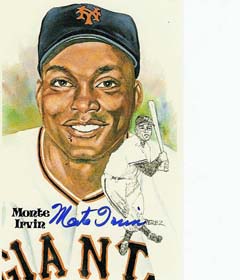
    Monte Irvin, HOF

    Finally, we want to congratulate our old SABR friend, 91-year old Monte Irvin, on the victory of the Giants in this year’s World Series. Monte Irvin was there as a player for that last World Series championship for the Giants in New York in 1954 – and he was also there in San Francisco last week to throw out the first ball in Series Game One.

    Reliable sources report that Houston retiree Irvin was floating on Cloud Nine over the Giants’ chances after they took the 3-1 game lead in Arlington so we are assuming that his heart and soul are really soaring today.

    Congratulations to you too, Monte Irvin! And hang around. The Giants need you. Baseball needs.you. Your friends and family need you. This world needs you. There will always be another World Series. There will never be another Monte Irvin.