Things aren’t always what they seem. Sometimes they are. In baseball, the presence of certain colorful expressions speaks volumes for what has just transpired on the field. All of you deep blue baseball fans will already know the true meaning of each term on this short list, but you do have to be from Houston to be certain of one in particular. It doesn’t matter. These are all offered in the name of good fun. First we’ll state what each term doesn’t mean. Then we will offer a brief explanation of what each expression really means as a baseball term or idea:

Worm Burner
(1) Worm Burner. A worm burner is not an underground arsonist. A worm burner is a sharply hit ground ball that skims the surface of the field so free of bounce that it threatens to burn the backs of all underground worms in its path from the sheer generation of friction heat all along the travel route.
.

Rope
(2) A Rope. A baseball rope is not an entwined heavy thread of fibrous cords. A baseball rope is more like a batted worm burner that leaves the ground, traveling on a rope-like trajectory at great speeds toward the outer regions of the field. Former Houston Buff and Baltimore Oriole star Bob “The Rope” Boyd was famous for hitting such batted balls; hence, the nickname.
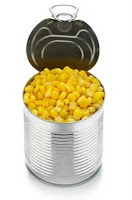
Can of Corn
(3) Can of Corn. A can of corn is not just the poor single guy’s answer to the question, “What’s for supper?” A can of corn in baseball is a ball that is batted so softly and lazily to the outfield that it is so easy to catch that even your grandmother could not miss it. i.e., “That ball was as easy to catch as it is to open and eat a can of corn.”

Blue Darter
(4) Blue Darter. A blue darter is not merely a beautiful fish. A blue darter is a batted ball that moves quickly and closely to the ground like its fishy namesake, behaving almost as though it possesses special powers of vision and intuition for the job of avoiding a fielder’s glove. It almost always results in a runner reaching first base on a hit or fielding error.

Sacrifice Fly
(5) Sacrifice Fly. A sacrifice fly is not a special offering of one subject from that pesky species on the grill with a prayer that all its brothers and sisters will go away from a backyard barbecue party. In baseball, a sacrifice fly is a batted ball that is caught in the outfield by any fielder that results in an existing base runner scoring after the catch is made for either the first or second out of the inning. When this sequence is completed, the batter of the “sac fly” is not charged with a time at bat, but he is given credit for a run batted in. The whole concept of the sacrifice fly is based upon the supposition that the batter intended to hit a ball that would score the runner, even if it were caught for an out that didn’t end the inning.

Twin Killing
(6) Twin Killing. A baseball twin killing is not the murder of, nor the murder by, twins. It is, of course, the ability to get two outs on one play, or, as it is more commonly known, a ball in play that results in the “double play” of two outs on one throw from the pitcher. As you know, it is possible in several ways to get a double play on the field without the batter ever touching the ball with his bat. You may even argue that a successful attempt at the old “hidden ball trick” by an infielder after the previous play was assumed dead could theoretically lead to a double play without further action by the pitcher.
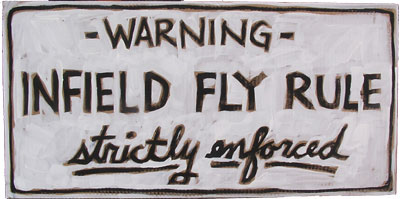
The Infield Fly Rule.
(7) The Infield Fly Rule. The infield fly rule has nothing to do with the false assumption that infielders are required in the name of proper decorum to make sure their pants are zipped before taking the field. The infield fly rule is in place to keep infielders from using force out situations with less than two outs as instances for allowing easy infield fly balls to drop for the sake of getting a double play or simply removing a faster runner off the bases with a force play. When the umpire calls the infield fly rule, he raises his fist to the sky, meaning the batter is out and the runners hold where they are.

The Drag Bunt
(8) The Drag Bunt. There is no truth to the rumor that any batter attempting the “drag” bunt shall be required to wear at least one item of women’s clothing when he does so. It is true that the batter needs to be left-handed for this offensive option to make any sense. In the drag bunt, the batter is attempting to drag bunt the ball into play as he simultaneously breaks from the box for a head start on beating it out for a hit down the line. You don’t see a lot of lefties today with the skills or ability for drag bunting as they once did, but Ichiro Suzuki (pictured here) is one who does do it well.

Crawford Boxer
(9) Crawford Boxer. OK, here we go, concluding with the special Houston baseball term. – A Crawford Boxer is not a special breed of dog that has been bred to patrol Crawford Avenue in downtown Houston. – A Crawford Boxer is a special play that only takes place inside Minute Maid Park when a batter hits a ball to the left field grandstands that back up to Crawford Avenue. Located some 315 feet down the left line, home runs into this special section are simply called “Crawford Boxers.”
That’s all we have time for exploring this morning, folks, but please feel free to add and comment on your own favorite baseball terms in the comment section that follows this article.
 Houston, Baseball, & Other Musings.
 The Pecan Park Eagle