
Roll Call of The Buffs!

July 27, 2009

Buff Medallion Blue

From late in the 19th century through 1961, a large number of major league baseball players wound their way through Houston as up-and-coming stars of the game. Most of the names on the following list played for the Buffs on their way up the baseball ladder to the big leagues. Some came through town on their way down the rungs of the same prescious climb. A few of these even made it all the way to the Baseball Hall of Fame.

Although the list is far from complete, it’s a pretty good sample of the quality of players we have been privileged to watch here in Houston during a local baseball interest period that is now chipping its way into a third different century of life. This roll call will not thrill any of you who care little or nothing for the game, but it speaks volumes to those who care enough to get clear on one of my favorite rant-subjects: Baseball goes back to the root years of our city. The first Houston Base Ball Club was formed in April 1861, a mere few weeks after Texas had seceded from the Union – and a good twenty to thirty years prior to the introduction of football in Houston on a minor organizational level at the Univeristy of Texas and Texas A&M Proffessional baseball finally reached Houston in 1888 with the formation of the Texas League. It would take the Texas League nearly two more decades to achieve stabilty, but once it did, it became the cradle of Houston’s greatest players in history.

In short, baseball ignited Houston first. Footbal came much later, and didn’t really take hold until electrification brought “Friday Night Lights” to Texas high school football in the 1930s.

Remember that milestone pattern the next time you are forced to hear another national talking sports head TV guy say that “Houston is growing pretty fast in its knowledge of the game for a city that is basically a football town that only recently discovered baseball!” Don’t pay any attention to these idiots. These are the same ignorant people who still come to Houston expecting to see mountains on the horizon, cacti growing wildly in our neighborhoods, and tumbleweed blowing crazily down Main Street.

The quick list shown here is pretty impressive. Look ’em up individually at either Baseball Almanac or Baseball Reference (d0t.coms) and see what I mean. Most of these guys did pretty darn well at the major league level:

Luis Arroyo, Vern Benson, Ray Blades, Don Blasingame, Don Bollweg, Bob Boyd, Ken Boyer, Al Brazle, Harry Brecheen, Willard Brown, Tex Carleton, Mort Cooper, Walker Cooper, Nick Cullop, Mike Cvengos, Dizzy Dean, Paul Dean, Murry Dickson, Dick Ellsworth, Hal Epps, Herman Franks, Don Gutteridge, Chick Hafey, Wild Bill Hallahan, Solly Hemus, Larry Jackson, Eddie Kazak, Johnny Keane, Johnny Kling, Frank Mancuso, Gus Mancuso, Fred Martin, Pepper Martin, Harry McCurdy, Von McDaniel, Joe Medwick, Larry Miggins, Vinegar Bend Mizell, Red Munger, Danny Murtaugh, Al Papai, Homer Peel, Howie Pollet, Rip Repulski, Art Reinhart, Ron Santo, Al Schacht,  Bob Scheffing, Cary Selph, Wally Shannon, Hal Smith, Pancho Snyder, Tris Speaker, Bobby Tiefenauer, Emil Verban, Curt Walker, Harry Walker, Watty Watkins, Del WIlber, Ted Wilks, Billy Williams, Jerry Witte, and  Johnny Wyrostek.

By special request from Wade Porter, I am extending this post to include my All Time Starting Line-Up based upon the Buffs/Major Leaguer pool listed previously. These decisions were based upon each player’s ability to perform at both the major and minor league level. That means I faced a tough choice on first base, choosing between my close old now deceased friend Jerry Witte and his 38-homer season for the 1951 Buffs and Bob Boyd for his two .300 plus hitting seasons in 1954-55. Both  were also men of outstanding character and fairness too. I finally had to go with Bob Boyd because of his near .400 Negro League marks and his recognition by the Negro League Hall of Fame, plus his several plus .300 or above seasons with the Baltimore Orioles after leaving the Buffs. It was the fair thing to do and I know Jerry Witte would have agreed. He was all about fairness. Jerry Witte only had two very short and not too happy trips to the majors in 1946-47. When we worked on his biography years ago, Jerry even told me: “I just want credit for the things I did. Don’t give me credit for things I didn’t do – and for God’s sake, don’t ever say I was best at something when somebody else was better.” This was one of those times, Jerry, but nobody will ever be a finer man or better person than you were. Nobody did it better in that league.

That being said, here’s my starting lineup of the Greatest Houston Buffs Ever:

Solly Hemus, 2b

Bob Boyd, 1b

Tris Speaker, cf

Billy Williams, lf

Joe Medwick, rf

Ron Santo, 3b

Johnny Kling, c

Don Blasingame, ss

Dizzy Dean, p

I must confess too. I had to go back and add Don Blasingame to fill out the shortstop position. It was hard leaving a few guys out of the starting lineup here, but as Cecil Cooper might tell you, that’s one of the tough parts about managing. Of course, if old Cecil had this talent available at peak form on the roster of the 2009 Astros, we might be running away with the NLC by now. Don’t you think?

If you see a starting lineup that you prefer, please post it below as a comment on this issue.

Have great new week everybody!
Remembering Lou Mahan!

July 25, 2009

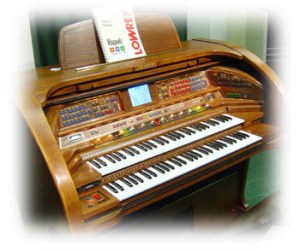
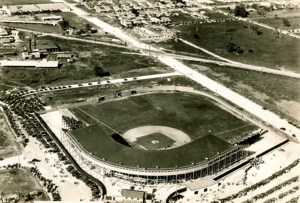
ballpark organ 3 We have Channel 13 Sports Direector Bob Allen to thank for today’s blog subject. Yesterday he sent me a nice note about his own early Houston Buff Stadium memories – and one of the names he mentioned among these jewels was Lou Mahan, the ballpark organist. Thank you, Bob! The mere mention of the talented Ms. Mahan alone simply pulls my spinal soul back to the place where it received its original baseball charge – and for people like Bob Allen and yours truly, that place was Buff Stadium on the Gulf Freeway at Cullen Boulevard, on the site of the recently closed Finger Furniture location there. If you followed my previous blog over at Chron.Com, you’ve heard me write about Buff Stadium many times. It was the home of our pre-major league Houston Buffs from 1928 through 1961.
Going to Buff Stadium during the post World War II years was a five senses, three-dimensional, technicolor immersion into everything you now read about in nostalgia accounts of baseball’s so-called glory years – and the sounds that emanated from the ballpark back in that day were as integral to the experience as all things visual.

Coming up next here is an aerial photo of Buff Stadium from the early days. As you look into it, try to allow the photo to come fully into life the way those old black-and-whites sometimes do from the early movie credits that lead us into an historical period movie. It all starts with a still, colorless, soundless picture, but the gradual awakening of certain sounds eventually brings the dull still life into full color view and energized animation. Got it? I think you do. I believe you know exactly what I’m writing about here.

Buff Stadium 001 Here comes the soundtrack … one item at a time … each new item simply adding to all others that came before it: … footsteps by the hundreds … laughter and loud voices shouting between fans who are meeting up for the game … the louder yells of early food vendors hawking hot dogs and beer to the early arrivals … the twilight ear buzz of Houston’s vampire mosquito squad … the sound of fungo bats banging baseballs into the deepests alleys of the Buff Stadium outfield … the occasionally muffled sound of private player talk, oozing into the stands as the players take defensive drill practice before the game … and one more thing – the sound of an organ playing in theme to whatever is going on upon the brilliant green playing surface of Buff Stadium.
It is the music that finally transforms the picture from black and white into color. And it is the ballpark organ that sets everything still into dynamic motion. In Houston, it is Ms. Lou Mahan, ballpark organist extraordinaire, who both follows and leads the game into three-dimensional animation, and sometimes, at the expense of getting herself in trouble. More on that little problem in a minute. First we need to set a few facts straight about the not-quite-so-ancient association of baseball to organ music.

A lot of people think that organ music and baseball go back to the early 20th century Dead Ball Era. The fact is that the organ wasn’t really introduced to baseball until 1941 when the Chicago Cubs brought one in as a one-day special event program. The music was so popular that they left the organ at Wrigley Field and began using it on a regular basis at games. Today about half the major league clubs employ a full-time organist. The rest of the clubs use those “cheater track” organ sounds of the organ doing that four-note upscale climb when a rally is needed and the like.

For more on the history of  ballpark organs and their current status, check out this link:

http://www.ballparktour.com/Organists.html

In Houston, Lou Mahan served as our Buff Stadium organist from sometime after World War II through the mid-1950s. She had a theme for everything that was going on before, during, and after every game. Balls that rolled up the angled screen behind home plate got there with the help of an organ peal up the scale. Then they came down the scale on their way to the ground, with Lou Mahan throwing in an extra bump note when they finallly rolled off the screen and hit the grass.

Lou had a situational fix put-to-music for everything that happened in the game too. You had to be up on the Buffs, up on baseball, and up on the unheard lyrics to Lou’s music to “get” everything she was throwing at us too. Here are a couple of great examples from the 1951 season:  (1) Buffs first baseman Jerry Witte comes to bat late in the game, nursing something like a three-week homer drought – but with the Buffs needing a long ball to win in the bottom of the ninth, trailing by two runs, with two runners on base. Lou plays the music to: “Kiss me once, kiss me twice, kiss me once again. It’s been a long, long time!” (2) Left fielder Larry Miggins comes to bat with the tying Buffs run on third – and the winning run on second, bottom of the 9th in another game. Lou Mahan plays: “Shrimp boats are a comin’, there’s dancin’ tonight! Shrimp boats are a comin’, their sails are in sight! — Why don’t you hurry, hurry, hurry home!

Lou’s sensitivity to unfolding game themes finally got her in trouble one day. After watching the three Texas League game umpires walking in from their left field dressing quarters prior to a game for the umpteen hundredth time, Lou Mahan could resist the urge no longer. She broke into a few bars of  “Three Blind Mice” as public address announcer Morris Frank was introducing the arbiter crew. I don’t know how severe the penalties spread from there, but Lou was throw out of the game for sliding into hilarity at the umpires’ expense. It was the only organ-silent game I ever watched at Buff Stadium

Of course, when the Buffs won any game in a 9th inning rally, which was pretty often in 1951, Lou loved playing a lively version of “Happy Days Are Here Again!” I told Bob Allen how I felt, and I meant every word of what I wrote to him about those Buff Stadium days. As much as I still love baseball in 2009, it never got better for me than it got back at old Buff Stadium. That was as good as any heaven on earth could ever get. Those early impressions, and every single one of them themed by the organ music of the wonderfully talented Lou Mahan, were electrically charged upon my young soul to last forever.

I wish I had known Lou Mahan personally. In fact, if any surviving family members should read this piece and be willing to fill us in about her life, I would love to hear from you. She was so much a part of the ballpark experience at Buff Stadium for all of us during the years that followed World War II.

Those were the days, my friend. We thought they’d never end. And in our hearts, they never have.


Houston Buffs Baseball: The “Shorts” Version.

July 24, 2009

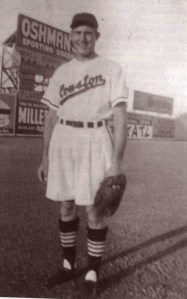
Jerry Witte Models Late 1950 Buffs Uniform Shorts. They weren’t exactly bad. They were just absolutely horrible. The 1950 Houstons Buffs of the AA minor-level Texas League were well on their way to a deserved last place finish due to a severe absence of talent. It was one of those seasons in which the parent club St. Louis Cardinals had pumped all the talent upstream to their higher AAA level Columbus, Ohio and Rochester, New York teams.
With winning out of the mix as an attendance booster for the games at Buff Stadium in July 1950, the Buffs had to fall back upon the creative inspiration of club president Allen Russell for their hope of avoiding the dreaded red ink that usually follows a losing club like an old airplane message sky streamer. In Russell, the parent Cardinals trusted. The man already had taken the Buffs through the 1948 winning season in which the AA Houston club had outdrawn the losing St. Louis Browns of the major American League.

Allen Russell would find an answer for the challenge of 1950. Or so everyone hoped.

When the Russell antidote was announced, Houston fans reacted with derisive laughter and obsessive curiosity. It was the curiosity factor that Russell was betting on as the ultimate winner in this mood tug-of-war when he announced that the Buffs would embark upon a “Beat the Heat” campaign for the balance of the 1950 season by switching to short pants as their everyday uniform lower garment. “May as well try to beat the heat,” some Buff  fans exclaimed, ” ’cause they sure as heck ain’t beatin’ nobody else!”

The first fan reaction for the first Buffs game in shorts was not totally virginal. Russell had experimented briefly with the idea during the also fairly awful 1949 Buffs season, but without this kind of marketing promotion to the plan. Most fans were seeing the “new look” for the first time and the first wave came in droves to see what there was to see.

What the fans saw was a club that was equally capable of losing in short pants. These short pants, by the way, were little more than cut-off versions of the old blousy flannel trousers that eventually found their way to the scissors-mill. In fact, the blousiness of the Buff shorts caused them to more easily resemble a short skirt –  another factor that didn’t eactly appeal to any of the ballplayers interviewed. As I reflect now upon my 12-year old memory bank of that season, all I am able to recall is the common “what choice do we have?” attitude that threaded its way through the player quotes in the Houston Post. If there were any comfortable cross-dressing Buffs on the 1950 club, they either didn’t talk, or else, they weren’t quoted in the papers of that era. At age 12, I wouldn’t have recognized them anyway.

The players really did hate the uniform shorts. Good friend and late Buffs first baseman Jerry Witte talked about this period in “A Kid From St. Louis,” a biography that I helped him write a few years ago. The pain of sliding on bare skin and the exposure vulnerability to Houston’s vampire-squad mosquito attacks were the major objections. “We produced enough (blood-scrape) strawberries to open our own fruit market,” Witte said.

The experiment didn’t last more than three weeks. Once the attendance slipped back to its previous low level and people no longer cared what the Buffs were wearing on their way to the bottom, Russell killed the campaign, allowing the Buffs to finish the season in last place, but standing tall in long pants.

Curiously, and as bad as they were, the 1950 last place in the Texas League Houston Buffs still managed to outdraw the 1950 seventh place American League St. Louis Browns at the gate. Season home attendance for the ’50 Buffs topped out at 255,809. – The ’50 Browns drew 247, 131 fans to Sportsman’s Park in St. Louis. If anything, those three weeks in shorts probably gave the Buffs the 8,000 plus extra fans they needed to again mildly  pummel the Browns at the main place it counts in baseball: that is, smack dab in the pocketbook.

What’s the Deal with Harry Potter, Anyway?

July 22, 2009

Harry Potter Doin' His Thing!

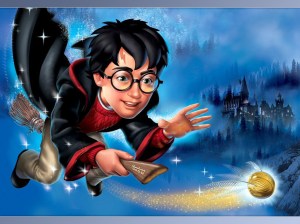
Monday night is “seniors night” at Memorial City Mall Cinemark so my wife Norma and I, plus our grown son Neal, went to see “Harry Potter and the Half-Blood Prince” as our weekly family evening out. We’ve seen all the previous Potter flicks, but none of us have ever read any of the J.K. Rowling books about this band of young British magic people. As the probable result of that shortfall on background, I always end up going to the newest Potter movie long on memories of people flying on broomsticks, but very short on recollections of what it is they are trying to accomplish. Usually I end up walking away from each new Potter movie vowing never to see another because … because why? …. because I either never quite get or care about what I just saw on the screen.  The Half-Blood Prince proved no exception.

In short. here’s what I think the movie was about:

Now a young man, the movie starts with Harry Potter about to score a pick up on a cute young waitress at a late night grill in damp old London town. All of a sudden, Harry’s old mentor at the magic school, Professor Dumblebunny, shows up and literally whisks Harry away to go see another old dementia-case dude who once taught at the magic school. Dumblebunny talks “old dude” into returning to the magic school, but he’s really trying to find out what the guy lied about that made him go away in the first place. In some unclear way, Dumblebunny expects Harry to help uncover the secret and the latter is forced to return early to the magic school where old dude will again teach.

Old dude’s secret has something to do with another male  student from much earlier (and that fact alone always makes you wonder!). Through flashbacks, we learn that the earlier student had some special dark and evil powers and a depressed mood that didn’t exactly fast track him as a future good guy, but we still don’t know his identity.

Once he’s reunited with his friends at school (Emma and the redheaded guy), Harry and his pals go through some of the usual teenage/young adult angst over relationships, they experience serious conflct with a violent blonde-headed male student, and they do a a lot of flying around on broomsticks for the sake of playing a game that resembles airborne soccer or hockey.

I never did get what the secret was, but Potter and Dumblebunny keep finding a lot of new clues in little pools of steaming liquid that is apparently powerful enough to produce video flashbacks of what has happened in the past. It’s just that the people in these flashbacks speak British-English in low voice tones – making it impossible for people like me to get what they are revealing – even with my hearing aid turned all the way up!

Dumblebunny and the Potter trio get lost in a big cave while searching for something (the truth, I presume) – and Harry is pulled into a deep underground pond of water that is inhabited by hundreds of swimming, grabbing zombie people. Dumblebunny rescues Harry, but the whole bunch is soon confronted again back at the top of the school by all the bad guys, including the blonde kid and that creepy professor with the long black hair that’s in all the Potter shows.

The creepy black-haired prof then kills Professor Dumblebunny and reveals that he, indeed, was the half-blood prince all the time, a bit of news that fell upon me and my going-numb backside with all the energy evoked by a very loud sigh of “so what???”

I left the theatre with the same resolution to never again see another Harry Potter movie. Maybe if I had read all the books by the time I was age ten I’d feel differently, but some things are hard to recapture in the land of the long tooth.

Goodbye Chron.Com! Hello WordPress.Com!

July 21, 2009

Good Morning Friends of My Chron.Com Blog!

After struggling all weekend with the failure of graphics over at Chron.Com for the umpteen hundredth time, I decided it was time to look for a new home for my future blogs. I will keep the old blog link at Chron.Com until I figure out what to do with two and one half years of mostly baseball and Houston history, but I will now be posting future blogs here, as I learn about and develop some skill with all the features offered by WordPress.Com.

I will continue to write about the two subjects dearest my researcher’s heart, the game of baseball and the City of Houston, but I will reserve the right also to go obliquely into cell phone rants from time to time, as these things occur.

WordPress.Com stresses the availability and quality of their support services to bloggers. All I can say is that anything they do will be an ugrade from zero assistance over at Chron.Com. WordPress.Com also allows for blog-polling, musical and video, and a wide array of graphics that weren’t available over at Chron.Com. I will have to grow into the use of these, but no matter what, I will remain writing content-based in my approach over developing ever-new proficiency in the use of special effects.

My attitude about Internet writing is identical to my view on movies. I’ll take the storytelling that is  available over at Turner Classic Movies over any of the new action or computer-generated movies that Hollywood now churns out like so many little new bunny rabbits – something like seven days a week!

For now, these few words of explanation about why I’ve changed blog sites will have to hang as my first post at WordPress.Com. Next we have to find out if I have enough trial and error moxie to even post the thing. (Only people my age worry about keeping their “moxie.” Younger people don’t even know what “moxie” is.) At any rate, look for me here again soon – when my energies are more available to focus on what I’m saying – and less tied up with the technicalities of how I say it.

Thank you for your past support and your ongoing patience. If I ever bore you to tears, or you just don’t want to receive further notice of my new blogs, let me know and I will remove you from my mailing list right away.

Regards,

Bill McCurdy