The 1931 Dixie Series: Houston v. Birmingham.

May 1, 2010

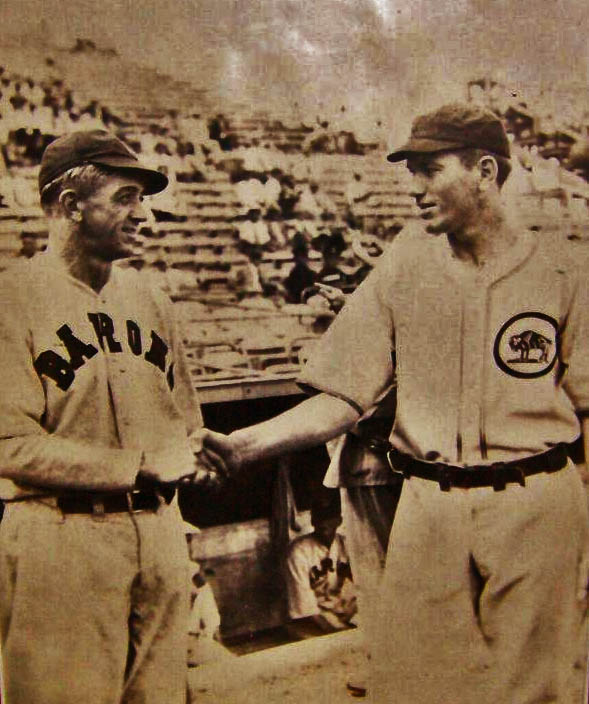
Ray Caldwell (age 43) of the Barons faced Dizzy Dean (age 21) of the Buffs in Game One.

The 1931 Texas League Champion Houston Buffs (108-51, .679) were supposed to walk all over the Southern Association Champion Birmingham Barons (97-55, .638) in the Dixie Series, but it did not happen. Led by rising star hurler, the 21-year old Dizzy Dean (26-10, 1.57) and the slugging young outfielder and next great future Gas House Gangster Joe Medwick (.305, 19 HR), the Buffs were on the tab as heavy favorites to take it all, but this would be another of those Aesop examples of the race going to the wiser over the swift.

Game One: 9/16/1931. Rickwood Field, Birmingham, Alabama: Barons 1 – Buffs 0.

43-year old Ray Caldwell (19-7, 3.45) wins a pitcher’s duel with Dizzy Dean. Barons lead the Series, 1 game to 0.

Game Two: 9/17/1931. Rickwood Field, Birmingham, Alabama: Buffs 3 – Barons 0.

Because Tex Carleton (20-7, 1.90) is injured and unable to play, the Buffs are allowed to borrow 25-year old Dick McCabe (23-7, 1.97) from Texas League rival Fort Worth as Carleton’s replacement for the Dixie Series. McCabe promptly shuts out the Barons to square the Series at 1-1. (The quality of mercy overflowed back in those days, I guess. Can you imagine last year’s 2009 Yankees allowing the Phillies to borrow Valverde from Houston, had Lidge been injured and unable to play in the World Series?)

Game Three: 9/19/1931. Buff Stadium, Houston, Texas: Buffs 1 – Barons 0.

The Buffs shut out the Barons again behind 42-year old George Washington Payne (23-23, 2.75) to take a 2-1 led in Series games won.

Game Four: 9/20/1931. Buff Stadium, Houston Texas: Buffs 2 – Barons 0.

Dizzy Dean comes back with a vengeance, His shutout of the Barons takes the Buffs to  3-1 Series lead and an over-confident cliff of hoping they will finish the Series at home the next day.

Game Five: 9/21/1931. Buff Stadium, Houston, Texas: Barons 3 – Buffs 1.

Clay Touchstone (15-11, 4.76) saves the day for Birmingham as the Barons win to force the Series back to Alabama with a 3-2 Houston lead, but with “Mr. Mo” now shifting back to the Southern Association boys.

Game Six: 9/23/1931. Rickwood Field, Birmingham, Alabama: Barons 14 – Buffs 10.

The Barons rack four Buff pitchers for 23 hits to even the Series and set up one final winner-take-all game featuring Dizzy Dean going up against 35-year old Bob Hasty (21-13. 3.67). The 3-3 Tie in the Series has Buff fans back home pulling their hair. Their major consolations are that Dean is pitching the deciding contest and that Game Seven will be played at home in Buff Stadium.

Game Seven: 9/25/1931, Buff Stadium, Houston, Texas: Barons 6 – Buffs 3.

Dizzy Dean strikes out five in the first two innings, but he cannot hold onto his dominance of the Barons. By the end of eight innings, the Barons led by 3-2. The visitors add three more runs in the top of the ninth, even though it’s not all on Dean. Two of the runs are unearned, but they still add up to a 6-2 Birmingham lead with the Buffs coming up for a final time at bat. – Once the Buffs push across a run with one out in the bottom of the ninth, Barons manager Clyde Milan pulls Hasty for an unnamed save opportunity that he hands to old warrior Ray Caldwell. Buffs manager Joe Schultz plays the hand he owns, sending Joe Medwick and Homer Peel out to face the old run-stopper. – Medwick fans and Peel slips easily into a 4-3 ground out to end the game and the Series.

Houston and Buff Stadium are stunned into silence. The Birmingham Barons go home to Alabama as the 1931 Dixie Series Champions.

Like a legion of other Buff fans, my (Grand) Papa Willis Teas was very unhappy with the outcome of the 1931 Dixie Series.

My Mom’s family lived in the Heights in 1931. My maternal grandfather Willis Teas, the man we all called “Papa”, was very unhappy with the Buffs loss, but he also liked to later use this story as an example of how we can never take anything for granted in life. The Buffs may have won this Series in their own minds in advance, but they didn’t then go out and win it on the field, according to Papa.

These also were the early years of the Great Depression, when some even harder lessons about taking things for granted were raining down on Papa and lot of other folks caught up in the great economic and agricultural dust storm. I think Papa saw that comparison too. He just didn’t talk with me about it in the years that followed. I wasn’t even around in 1931 – and I was still too little to learn much of anything about economics during Papa’s lifetime.

The lesson for me came down to this statement by Papa: “Don’t count your chickens before they hatch, even if you have Dizzy Dean sitting on the eggs.”
Astros as Baseball Bad Guys? C’Mon! Get Real!

April 30, 2010

Are the Houston Astros really the 4th most despised team in Baseball?

So you think the New York Yankees are the most hated team in baseball? Think a dam-gin if you care to place any credibility in a new “Internet algorithm” built by the famous Nielsen Co. for analyzing various keywords that people use in describing MLB teams. Nielsen uses the same approach here on MLB teams that they famously use in business studies  to “find out” whether people hold positive, negative, or neutral reactions to different brands and products under marketing study.

The Internet report for Fox Sports by David Biderman of the Wall Street Journal does not go into the details of the Nielsen study’s key words or methods here in the MLB Spite Study. The report simply lays out the Top Ten list of the most despised teams in Major League Baseball and then leaves the unguided digestion of such to the reader. Read the whole list before you break into full laughter:

Nielsen’s Top Ten Most Despised MLB Teams

(The 10 most despised teams in baseball scale is -5 to 5)

Team Score
Cleveland Indians 0.9
Boston Red Sox 1.1
Cincinnati Reds 1.1
Houston Astros 1.8
New York Yankees 1.8
Washington Nationals 1.9
Chicago White Sox 2.0
Baltimore Orioles 2.0
New York Mets 2.3
Los Angeles Dodgers 2.4

The raw figures show that Houston and the New York Yankees both have recorded raw scores of 1.8, but the Astros are assigned 4th place in the narrative and the Yankees are identified as 5th. When you see this kind of report in most research journals, the researcher normally will carry out the raw scores to enough decimal places to reach a differential tally. It simply wasn’t reported that clearly here.

As far as I’m concerned, the whole study is laughable. Look at the team that ended up on top as the most despised club in baseball – the poor little old Cleveland Indians, a baseball tribe that hasn’t won the World Series since 1948. If the Indians are really all that despicable, they ought to be packing the house all over the American League when they go on the road.

I can see the Boston Red Sox in the two hole. They’ve had enough success in recent years to have earned that spot, especially in light of the fact that their success has come at the personal expense of their greatest rival and truly most despised club in the world, the New York Yankees.

The bland band known as the Cincinnati Reds at #3 is right in there as a dual laugh stop with the #4 Houston Astros. The Reds have earned spite from a World Series victory since 1990 and the Astros have yet to win their first.

The New York Yankees at #5? Please. I can’t hold the contents of my breakfast on that read. These guys are again the reigning World Champions with a gazillion World Series titles in their trophy case. C’mon! Forget the words that people use in describing them and don’t even go near the words that non-Yankee fans refrain from expressing as their feelings toward the Bronx Bombers. The New York Yankees are the biggest winners of all time – and that’s how a club gets to be the most despised.

The Washington Nationals at #6 and the Baltimore Orioles at #8 are also fish-out-0f-hate-waters in my book. I thin Nielsen may be confusing hate with the very large apathy/frustration quotient that we could just as easily assign to clubs like the Indians, Reds, Astros, Nationals, and Orioles. All of us who live in cities outside the media centers of New York, Los Angeles, and Chicago can only aspire to the languish of general apathy when our clubs don’t win. Cincinnati versus Baltimore in the 2010 World Series is probably the last match up the networks would want to see. Fortunately for the networks, it isn’t likely to happen on the field.

The Chicago White Sox at #7, the New York Mets at # 9, and the Los Angeles Dodgers at #10 all deserve to be near the top of any legitimate ranking of our most despised teams. For winning often or winning ungraciously, each of these three have put their own media market town brand of abject despicability on the map.

The real hate-for-east-coast snobs button is pushed for me when writer David Biderman concludes his brief, but poorly presented report with this sentence: “The good news for the Yankees is that their low score is better than the only team that really matters: The rival Boston Red Sox, who are the second most-despised team.”

My Houston Astros may be as frustrating as the just concluded sweep loss at home to the Reds again proves, but they cannot be held up as the fourth most despicable team in America. They haven’t won enough to have earned spite.

Now, just watch the Astros win thirty World Series between now and the year 2050 and hate us all you want. Those of us Astros fans who are still on the top side of the dirt by then won’t care because that’s really the only lasting way to earn the hatred of other clubs in baseball. You have to beat the other guys early, late, and often.

Here’s the link to the piece that inspired this rebuttal article:

http://msn.foxsports.com/mlb/story/Are-the-Yankees-baseballs-most-hated-team-042810?GT1=39002

What do you think of the Nielsen study? Feel free to comment all you want.

A Houston Buffs Souvenir Mitt Mystery.

April 29, 2010

The Souvenir Buffs Mitt is About 5″ Tall. When was it sold at Buff Stadium?

Yesterday an acquaintance got in touch with me about a souvenir Houston Buffs catcher’s mitt he had just acquired from another collector. This person is a solid Houston Buffs and City of Houston history fan, but he wishes to remain anonymous in this matter that he now shares with everybody else. The question we both have is: When, if ever, was this little (pictured above) item sold at Buff Stadium?  My own guesses are only speculative.

I never saw anything along the line of souvenir gloves for sale at Buff Stadium during the Post World II Era. I recall a few miniature bats and pennants for sale, but I never acquired anything like that as a kid. We weren’t thinking about souvenirs when we went to Buff Stadium back in my day and it’s just as well. Remember what I’ve written here many times over. We played in the sandlot with baseballs held together by electrical tape. There was no money for thinking about souvenirs.

Besides, the style of the glove looks older to me, like something from the early 30s. That sort of works against the idea that souvenirs could have been very appealing to the average Buffs Baseball fans of Houston during the Great Depression Era, but who knows? Maybe they were. We simply lack the proof that this item ever sold at Buff Stadium during any period, in spite of what it says broad as all daylight on the souvenir glove itself. I personally believe that it was once a Buff Stadium souvenir. I just can’t prove it.

Fred Ankenman served as President of the Houston Buffs from 1925 through 1942, the beginning of the World War II Texas League shutdown. Allen Russell took over as President of the Buffs in 1946 and served through 1952. I’m fairly convinced that the souvenir glove in question sold at Buff Stadium somewhere during one of these two periods. It’s too antiquated to have sold beyond the Russell Era – and it’s simply a little impractical to think it sold earlier at West End Park. Buff Stadium didn’t open until 1928.

The back side of the souvenir glove appears to have once been stuck to something.

My friend and I both observed that the marketing decision to actually write the word “souvenir” on the mitt seems a little primitive and unsophisticated by today’s marketing standards, but a lot of items could be judged that way in comparison to the promotion of uniform replica and game-authentic sale of ballpark material in 2010. We have to remember that game replica jerseys and caps have only been around as sales items to fans since the early 1980s. (We sold an authentic game jersey to fans at the University of Houston in 1979, but that’s a much longer story about what probably was the first sale of game-style apparel items to the general  public in America.)

The buffalo figure is remindful of the logo used during the late 20s and early 30s.

If you ever saw this featured Buffs item for sale at Buff Stadium, or if you have any of your own theories on when it might have appeared there, please post them below as comments on this article. Like so many other artifacts of baseball history, the Houston Buffs souvenir mitt comes to light raising more questions than it answers.

Hopefully, it will someday find its way into proper public exhibition and not just get stuck in someone else’s attic or closet for another sixty or seventy years.

Cows and Bulls and Bluebonnets.

April 28, 2010

Cows & Bulls & Bluebonnets.

Cows and Bulls and Bluebonnets – Callin’ me back – To the land that I love.Cows and Bulls and Bluebonnets,Pullin’ me backTo South Texas.

If you’ve ever been a songwriter at heart, or simply somebody who harbored a song-bursting bone anywhere in your spiritual body, what I write about this morning will make perfect sense. If not, then just bear with me through today. I’ll try to get back to normal by tomorrow. The subject is just rolling too hard on my mind for now to let go.

I don’t quite know, for sure,  what got me started, but I’ve been writing songs for little everyday occasions for as long as I can remember. I even wrote the goodnight lullabies that we sang to our son Neal when he was a little one.

Dad, Mom, and genes may be partly or wholly responsible.

My dad was a part-time songwriter as a young man. Dad even met my mom when he heard her singing “Paper Moon” live over the radio in Beeville, Texas and then had to drop by the station to see who was singing.

Dad even once managed to get a  famous singer from the 1920s and 1930s named Rudy Vallee to sing a published number of his on the crooner’s  “coast-to-coast” radio program back in the early 30s. He had to drive all the way to New York and be a pest to Mr. Vallee to get it done, but he got it done Dad named the number “The Moon Is Here.” It was actually the only song that Dad ever published and he wrote it in collaboration with a songwriting partner from Beeville, Texas,  a fellow named Dan Lanning. After that little venture, Dad went back to trying to make a living in the real world of the Great Depression era, but he kept on singing his heart out for as long as he lived. All tolled, he was my inspiration in baseball, as a writer, and in life.

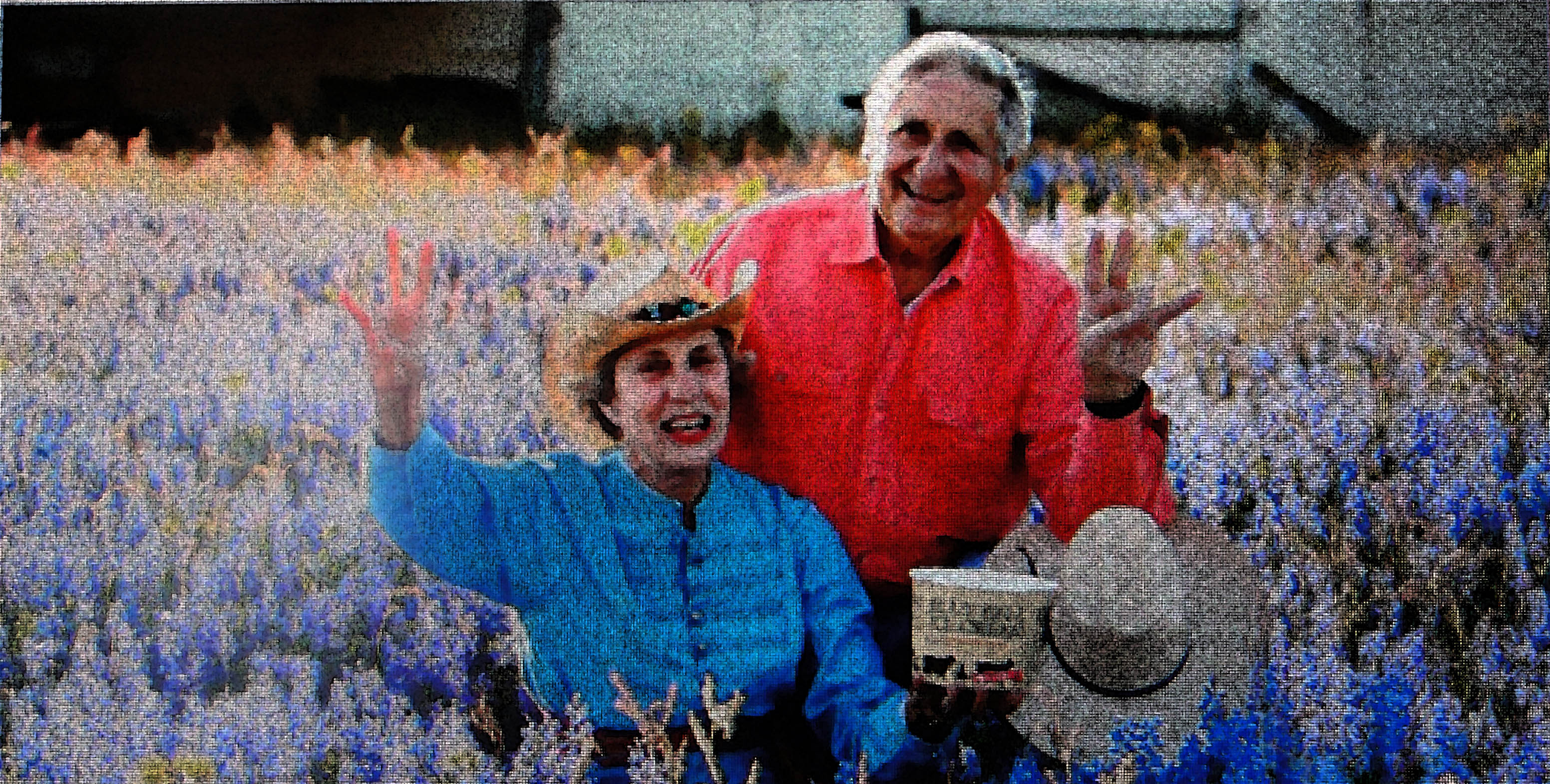
“Cows and Bulls and Bluebonnets” came to mind again for me when my wife Norma and I drove up to Chappell Hill this past weekend to have lunch and check out the last of the botanical Mohicans. We missed the deep rich flourish of full-blue bonnet fields that were there on previous weekends, but we did manage  to capture the singular glow of a few isolated holdouts on extinction as pictured here.

The sight of these reminded me of the spring of 1965, when I was still working at Tulane University, but strongly feeling the home call of Texas. All that came to light for me shaped out as  the vision of “cows and bulls and bluebonnets” and the little hum I felt all the way from my head to my toes each time I came back to Texas for an Astros game and crossed that state line on old Highway 90, heading west to Houston from the Golden Triangle area.

The song for “C&B&BB” didn’t have much of a tune, but its call was quite powerful and permanent. I still travel far and wide, but I have no desire to live anywhere else, but Houston. This place owns my heart.

I feel normal coming back right now. Let’s go, Astros! It’s  time to take Game Two of the Reds Series and keep the turnaround going strong!

UH Honors Alumnus Richard Coselli and Others.

April 27, 2010

UH Grads Mary Jo & Richard Coselli, At Home in Chappell Hill.

For five years, 2004 to 2009, it was my great pleasure to work along side attorney Richard Coselli as volunteers in service to the Texas Baseball Hall of Fame. As Board President from 2004 to 2008, and as President Emeritus through the crack of doom since 2008, but now retired from active service, it remains my fondest hope that the TBHOF will still someday find its home in the form of a physical presence that Houstonians and fellow Texans will be proud to embrace as worthy of its fully stated mission statement for preserving Texas baseball history.

Mr. Richard Coselli was the major person who helped us organize this effort as a legal entity from 2004 through 2009, even providing us with the use of his own office board room for our periodic meetings. We could not have done it all without him. Richard Coselli just happened to have been the exact person we needed during our transitional years in Houston. He was a native Houstonian and a man who loved baseball. Put that all in the basket with his intellect, experience, wisdom, and senses of balance and humor, and we could not have found a better counsel of service to a cause that remains to this day – one that shall always be larger than the whims, aims, needs, or desires of any single person at the helm of leadership. Although Richard Coselli, yours truly, and most others of us from our original formative group are now gone from direct connection to the TBHOF, I think I speak for us all when I say that we still hope for the best and that the organization will survive these hard economic times and find a way to flourish and grow in the future along lines that are governed by integrity of purpose and stable financial support.

Richard Coselli is no newcomer in service to this community. I could not begin to list all the things that both he and his wife, Mary Jo Coselli, have done for Houston, but the two University of Houston graduates continue to do a great many things.

I first became acquainted with Richard Coselli’s contributions while we both were students at UH more than a half century ago. Richard was slightly older than me back then – and still is, for that matter. Funny how that works. – Anyway, we never met back in the 1950s, but I was very aware of his work in organizing the original Frontier Fiesta at UH, the largest campus college show on earth, one that grew big enough to gain a write-up in Life Magazine – a publication from back in the day that spread the good word  in those primitive pre-Internet times that something big was happening in Houston. Ironically, even though I worked on the Frontier Fiesta myself, Richard Coselli and I never met until we both fell into involvement with the Texas Baseball Hall of Fame move to Houston in 2004. I had been a volunteer member of the TBHOF’s selection committee since 2001, but I didn’t wade into the deep water of its work until 2004, when Greg Lucas of Fox Sports and I agreed to head up a move of the organization’s headquarters from Dallas to Houston. Richard Coselli soon came on deck as our legal advisor.

Last Friday night, April 23, 2010, the University of Houston honored Richard Coselli (BS ’55, JD ’58) as one of eleven distinguished alumni who have made enormous contributions to the benefit of UH over the years. The occasion was marked by a formal dinner party, hosted by the UH Alumni Association and addressed by UH Chancellor and President Renu Khator.

President Renu Khator & Jim Parsons (BS '96) of TV's Big Bang Theory.

Richard Coselli was denied the opportunity of being the funniest man on the dais Friday by the presence of fellow honoree Jim Parsons. A 1996 UH graduate, Parsons is having a pretty good run these days on television as the star of the hit comedy show called “The Big Bang Theory,” but that is OK too. Our UH people come in all ages, shapes, and sizes across a diverse line of differential talent.

Richard Coselli simply brings a quartet of elements to the table of any enterprise that money cannot buy. Their names are intelligence, loyalty, honesty, and integrity.

Congratulations, Richard! It’s good to know that our university has now officially recognized what a lot of your friends have known for years. You are the kind of person that has made the University of Houston and the City of Houston the great places they each are.

“In Time” is our UH motto. In time, UH has now finally recognized one of its own for all he has done in service to the greater good of the university community. Congratulations again, my friend. You deserve every ounce and inch of credit that flows from this much larger measure.

The 1950 San Antonio Missions.

April 26, 2010

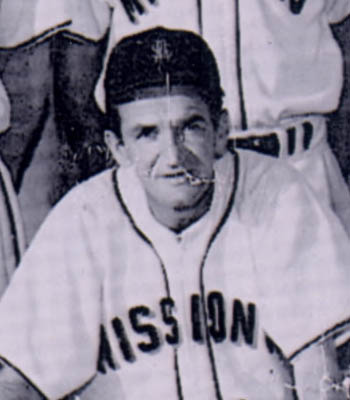
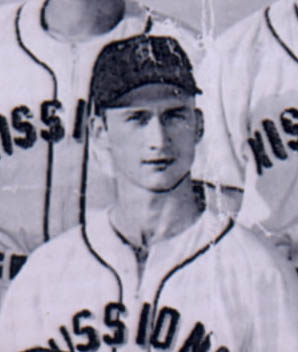
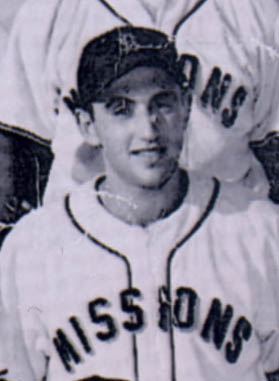
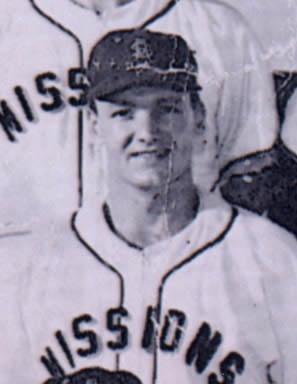
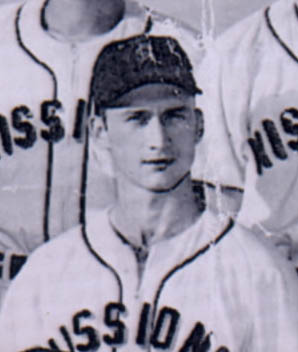
The 1950 Texas League Champion San Antonio Missions.

When I was growing up as a Post World War II of the Houston Buffs, my second favorite Texas League club (and I do mean a far second place, one with no chance of ever being number one) was the San Antonio Missions. My cousins Jim and Mel Hunt of San Antonio were big Mission fans, so I threw my support behind the boys from the Alamo City once in a while, if it were late in the season in one of those rare years that the Buffs were out of it with no chance for a comeback.

1950 was one of those saddest of Buff seasons. My boys were on their way to an 8th place last place finish behind Shreveport while San Antonio was squeaking into a fourth place finish and a shot at the pennant through the Shaughnessy Playoffs. The hope for San Antonio didn’t stop me from secretly crying myself to sleep on the night that Houston clinched last place, but it did reach a spot on the “item of interest” shelf of my mind as school started again on the Tuesday after Labor Day.

Besides, I needed a diversion from the pain I felt for my fallen Buffs. I was getting ready to start the 7th grade. Big boys don’t cry. I really needed to kill even the quiet crying over my favorite team’s painful  losses. If I were going to do any crying in the future over any disappointment, whether it be over a baseball disappointment, or lost love, it would have to take place deeper inside, silently, in that place called my heart. It wasn’t the world’s business anyway, but mine alone. Period.

I learned. And it’s good that I did. The Colt .45s and Astros were coming our way in a decade or so.

Meanwhile, the 1950 Missions were doing their very best to buoy the spirits of my loyal cousins over in San Antonio. The Missions surprised the first place Beaumont Roughnecks of manager Rogers Hornsby in a four-game sweep in the first round, a feat that surprised everybody. The Roughnecks featured pitcher Ernie Nevel, one of the three 21-game winners of the 1950 Texas League season, a young fellow named Gil McDougald at second base who led the TL in hits with 189, and a fiery young catcher named Clint Courtney. They had all this power and talent going for them by way of their New York Yankees player pipeline, but to no avail. Beaumont just fell flat against San Antonio in 1950, leaving the pennant open to the finals match series between 4th place San Antonio and 3rd place Tulsa, who also had swept 2nd place Fort Worth in the first round.

San Antonio then took Tulsa, 4 games to 2, capturing the 1950 Texas League pennant.

The 1950 San Antonio Missions weren’t done. They went on from their pennant victory in the Texas League to defeat the Southern Association champion Nashville Vols in a seven-game 1950 Dixie Series championship round that brought even greater honor to their city and the State of Texas. And they did it all as a farm team of the notoriously win-challenged major league club known as the St. Louis Browns.

A brief look at some of the headliners from that 1950 Missions team is in order:

Don Heffner, Manager

Don Heffner enjoyed an eleven season major league career (1934-44) with the New York Yankees, the St. Louis Browns, the Philadelphia Athletics, and the Detroit Tigers. For his MLB career as a middle infielder, Heffner batted .241.

For the next 23 years (1947-69), Heffner filed his time as a major league coach, minor league manager,  and developer of young talent. The ’50 Missions were lucky to have the right man at the right time.

Lou Sleater, Pitcher

Lou Sleater led the ’50 Missions pitching staff statistically, finishing with a record of 12 wins, 5 losses, and earned run average of  2.82. The lefty went on to a seven season career (1950-58) as a major leaguer, posting a total record of 12 wins, 18 losses and an ERA of 4.70.

Frank Mancuso, Catcher

Frank Mancuso served as the voice of veteran experience on this 1950 championship club. At age 32, he was six seasons removed from his American League championship season with the St. Louis Browns and was now the back up man to both manager Don Heffner and catcher Dan Baich. Frank would come home to Houston as a Buff in 1953. For 1950, he would bat .238 in a backup role.

Dan Baich, Catcher

Dan Baich would hit .258 with 17 home runs for the 1950 Missions. He also had a chance to briefly handle a young late season arrival named Bob Turley in his 0-2 start with the Missions. In spite of his power and pretty good stick for average, Baich would never see  a single time at bat in the big leagues. Go figure. His 16 season minor league career allowed him to produce a career batting average of .267 and slam 107 home runs. Why Baich never got even a major league look-see is beyond what I know of his career without further research. I know just enough about him to want to dig deeper. I just don’t have the answer today.

Frank Saucier, Outfield

Frank Saucier led the 1950 Texas League season in hitting with a .343 batting average. As we discussed the other day in the first article on Eddie Gaedel, Saucier was the Browns outfielder who suffered humiliation over his removal from a game in 1951 for a midget pinch hitter. The experience apparently chased him from baseball after he went only 1 for 14 in 18 games in 1951. Too bad. Saucier tore up the Texas League in 1950. The Missions could not have rallied to win it all without the presence of Frank Saucier in their lineup.

Rocco Ippolito, Outfield

Rocco Ippolito banged out 24 homers in 1950 to pace the Missions, even though his .235 batting average was nothing to write home about. He batted .283 over the course of his eight season minor league career, but neither that improvement nor his 135 total HR were enough to buy him  single shot in the big leagues either. In the fewer MLB teams structure of the reserve clause era, a lot of talented players never got a big league shot – and that may be the best explanation we shall find to explain what happened to guys like Baich and Ippolito. You didn’t need many weaknesses to get scratched off the “prospect” list back then, especially if an MLB club needed your body to help fill out their overall minor league roster plans. You either did the club’s bidding or went home to pump gas. Swell choice that was.

Jim Dyck, Third Base

Jim Dyck was a hitter. He batted .321 for the ’50 Missions and he posted a lifetime minor league batting average of .293 over a 16-season career (1941-1961) that finally did result in major league time. In six major league seasons, Dyck batted .246, far below his value as a contributor to numerous minor league clubs over the years. At least, Jimmy got his shot, even it came late and fell short of what he always hoped it would be. I know from some talk with him that he suffered disappointment in his big league production, but he loved the game – and he left this world with no other regrets.
The 1950 San Antonio Missions had a number of other good players, but these guys featured here speak well for the lot of them. They were champions when it was time to show that worth on the field and they got the job done. Even us Houston Buff fans had to appreciate the power of their accomplishments.

Cold Case: Who Killed Eddie Gaedel?

April 25, 2010

August 19, 1951: St. Louis Browns Manager Zack Taylor Ties Eddie Gaedel's Right Baseball Shoe..

The story of Eddie Gaedel’s one-time at bat as the only midget pinch hitter in big league history back on August 19, 1951 is one of baseball’s biggest travelers. We talked about it here yesterday.

A much less popular subject is the death of Eddie Gaedel nearly ten years later on June 18, 1961 in Chicago. Eddie’s mom found him dead in bed in his apartment on that date. He had a bruise and cuts near his left eye and bruises and cuts on his knees. The coroner’s report concluded that Eddie had died of a heart attack, probably caused by the trauma of physical assault upon his body in physical combat with an unknown other or others. The only fact ascertained by the police in their brief look at the case was that Eddie Gaedel may have gone to a nearby bowling alley the previous evening where he may have had too much to drink and may have either gotten into an argument at the alley or encountered an assailant on his walk home. From what I can tell, there was no real evaluation performed on Eddie’s blood contents in the sketchy post-mortem that followed. Almost everything about his death had been concluded by the Chicago police from Eddie Gaedel’s reputation as a heavy drinker and combative personality.

Since money was missing, the CPD concluded that Eddie Gaedel had been attacked and robbed, but that he was able to make it home before collapsing and dying. The “evidence” of missing money is not spelled out as a missing wallet, nor do the CPD reports jump out and say how they knew how much cash Eddie had on him in the first place.

Because of his “reputation,” the Chicago Police Department declined to investigate the death of Eddie Gaedel any further.

What? …. What?

Since when is “reputation” grounds for letting someone go off to eternity without justice while some other guilty person gets off Scott-Free of murder? Eddie Gaedel died 49 years ago this summer. It’s wholly conceivable that his murderer is still out there in the bleachers during a White Sox or Cubs games in 2010. He or she wouldn’t be particularly conscious by this late time in life, but how alert do you need to be to keep going to baseball games as a Chicago fan on either side of town in 2010?

The point here is simple: Someone got away with murder in the Case of Eddie Gaedel and that’s too bad.

The Ballad of Eddie Gaedel.

April 24, 2010

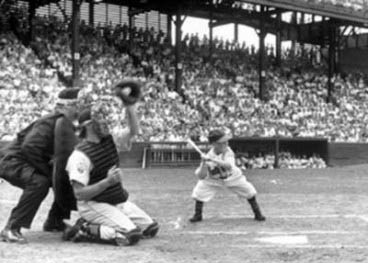
Eddie Gaedel, At Bat for the Browns Against Bob Cain of the Tigers, Sportsman's Park, St. Louis, August 19, 1951. The Catcher is Bob Swift; the Umpire is Ed Hurly.

It was a one-time practical joke and publicity stunt from the ever-mischievous-making mind of Browns owner Bill Veeck, but it looms in baseball history as big or bigger than Babe Ruth calling his home run shot in the 1932 World Series because of its shock value to the usual baseball norm and the picture that resides here with this article.

Frank Saucier, 1950.

Midgets simply don’t play major league baseball, except for this one incident of contractually legal entry into a game as a first inning pinch hitter by Eddie Gaedel, batting for the Browns’ rookie leadoff man and center fielder, Frank Saucier. Many say the episode ruined Frank Saucier for major league ball. He had led the Texas League in 1950 with a .343 batting average for the playoff champion 1950 San Antonio Missions, but he was gone from baseball after the Gaedel stunt due to the ego blow he suffered deeply on that fateful day in Sportsman’s Park, August 19, 1951. No matter how Bill Veeck and the Browns explained it later to Saucier, he apparently took it personally. After a 1 for 14 times at bat experience in 18 games for the 1951 Browns, Frank Saucier left baseball for good at season’s end. That .071 final batting average for season in limited action may have helped him close the door.

At any rate, little 3’7″ Eddie Gaedel finished his one time at bat history in the big leagues with a walk to first on four pitches from Detroit Tiger pitcher Bob Cain and then trotted down to first and into the history books. Gaedel supposedly batted under threat from owner Bill Veeck: “I’ll be on the roof with a rifle. If you take one swing, I’ll shoot you dead.”

Once he reached first, Browns manager sent outfielder Jim Delsing out to pinch run. “My surprise came after I reached the bag to take over for Gaedel,” the late Delsing once told me.  “Before Gaedel left the field, he patted me on the butt and wished me luck.”

Well, the Browns went on to eventually lose this game by a score of 6-2, but they imbedded the idea of this possibility coming up again into the minds of a baseball nation. the fantasy was short-lived. Baseball quickly acted to ban midgets and dwarfs from playing big league ball. We can’t be sure how that kind of ruling would fly in the 21st century. There are a lot of people out there now looking after the rights of vertically challenged people. All we need now is for one very short Mickey Mantle type to come screaming onto the scene, demanding the restoration of opportunity. I’d be all for him or her.

In the meanwhile, I’ll close here with a little tribute parody I wrote a few years back to honor the memory of Veeck’s man back in 1951. “The Ballad of Eddie Gaedel” is sung to the tune of “Rudolph the Red-Nosed Reindeer” and it is intended as a tribute to one of the few men in history who ever retired from baseball with a perfect one base percentage of 1.000.

The Ballad of Eddie Gaedel
(All verse stanzas are in regular shade type and are sung to the main tune of “Rudolph, The Red-Nosed Reindeer.” The two chorus stanzas, shown in bold type, are sung to the chorus tune from “Rudolph” that goes with “Then one foggy Christmas Eve, Santa came to say, etc.”)

by Bill McCurdy, 1999.

Bill Veeck, the Brownie owner,
Wore some very shiny clothes!
And if you saw his sport shirt,
You would even say, “It glows!”

All of the other owners,
Used to laugh and call him names!
They wouldn’t let poor Bill Veeck,
Join in any owner games!

(chorus)
Then one humid summer day,
Bill Veeck had to – fidget!
Got an idea that stirred his soul,
He decided to sign a – midget!

His name was Eddie Gae-del,
He was only three feet tall!
He never played much baseball,
He was always just too small!

(chorus)
Then one day in Sportsman’s Park,
Eddie went to bat!
Took four balls and walked to first,
Then retired – just-like-that!

Oh, how the purists hated,
Adding little Eddie’s name,
To the big book of records,
“Gaedel” bore a blush of shame!

Now when you look up records,
Look up Eddie’s O.B.P.!
It reads a cool One Thousand,
Safe for all eternity.

"Have a Nice Weekend, Everybody!" - Eddie Gaedel.

A Few Baseball Terms Revisited.

April 23, 2010

Things aren’t always what they seem. Sometimes they are. In baseball, the presence of certain colorful expressions speaks volumes for what has just transpired on the field. All of you deep blue baseball fans will already know the true meaning of each term on this short list, but you do have to be from Houston to be certain of one in particular. It doesn’t matter. These are all offered in the name of good fun. First we’ll state what each term doesn’t mean. Then we will offer a brief explanation of what each expression really means as a baseball term or idea:

Worm Burner

(1) Worm Burner. A worm burner is not an underground arsonist. A worm burner is a sharply hit ground ball that skims the surface of the field so free of bounce that it threatens to burn the backs of all underground worms in its path from the sheer generation of friction heat all along the travel route.

.

Rope

(2) A Rope. A baseball rope is not an entwined heavy thread of fibrous cords. A baseball rope is more like a batted worm burner that leaves the ground, traveling on a rope-like trajectory at great speeds toward the outer regions of the field. Former Houston Buff and Baltimore Oriole star Bob “The Rope” Boyd was famous for hitting such batted balls; hence, the nickname.

Can of Corn

(3) Can of Corn. A can of corn is not just the poor single guy’s answer to the question, “What’s for supper?” A can of corn in baseball is a ball that is batted so softly and lazily to the outfield that it is so easy to catch that even your grandmother could not miss it. i.e., “That ball was as easy to catch as it is to open and eat a can of corn.”

Blue Darter

(4) Blue Darter. A blue darter is not merely a beautiful fish. A blue darter is a batted ball that moves quickly and closely to the ground like its fishy namesake, behaving almost as though it possesses special powers of vision and intuition for the job of avoiding a fielder’s glove. It almost always results in a runner reaching first base on a hit or fielding error.

Sacrifice Fly

(5) Sacrifice Fly. A sacrifice fly is not a  special offering of one subject from that pesky species on the grill with a prayer that all its brothers and sisters will go away from a backyard barbecue party. In baseball, a sacrifice fly is a batted ball that is caught in the outfield by any fielder that results in an existing base runner scoring after the catch is made for either the first or second out of the inning. When this sequence is completed, the batter of the “sac fly” is not charged with a time at bat, but he is given credit for a run batted in. The whole concept of the sacrifice fly is based upon the supposition that the batter intended to hit a ball that would score the runner, even if it were caught for an out that didn’t end the inning.

Twin Killing

(6) Twin Killing. A baseball twin killing is not the murder of, nor the murder by, twins. It is, of course, the ability to get two outs on one play, or, as it is more commonly known, a ball in play that results in the “double play” of two outs on one throw from the pitcher. As you know, it is possible in several ways to get a double play on the field without the batter ever touching the ball with his bat. You may even argue that a successful attempt at the old “hidden ball trick” by an infielder after the previous play was assumed dead could theoretically lead to a double play without further action by the pitcher.

The Infield Fly Rule.

(7) The Infield Fly Rule. The infield fly rule has nothing to do with the false assumption that infielders are required in the name of proper decorum to make sure their pants are zipped before taking the field. The infield fly rule is in place to keep infielders from using force out situations with less than two outs as instances for allowing easy infield fly balls to drop for the sake of getting a double play or simply removing a faster runner off the bases with a force play. When the umpire calls the infield fly rule, he raises his fist to the sky, meaning the batter is out and the runners hold where they are.

The Drag Bunt

(8) The Drag Bunt. There is no truth to the rumor that any batter attempting the “drag” bunt shall be required to wear at least one item of women’s clothing when he does so. It is true that the batter needs to be left-handed for this offensive option to make any sense. In the drag bunt, the batter is attempting to drag bunt the ball into play as he simultaneously breaks from the box for a head start on beating it out for a hit down the line. You don’t see a lot of lefties today with the skills or ability for drag bunting as they once did, but Ichiro Suzuki (pictured here) is one who does do it well.

Crawford Boxer

(9) Crawford Boxer. OK, here we go, concluding with the special Houston baseball term. – A Crawford Boxer is not a special breed of dog that has been bred to patrol Crawford Avenue in downtown Houston. – A Crawford Boxer is a special play that only takes place inside Minute Maid Park when a batter hits a ball to the left field grandstands that back up to Crawford Avenue. Located some 315 feet down the left line, home runs into this special section are simply called “Crawford Boxers.”

That’s all we have time for exploring this morning, folks, but please feel free to add and comment on your own favorite baseball terms in the comment section that follows this article.

Mike Blyzka: One of the Last Old Browns.

April 22, 2010

Mike Blyzka lost his first 9 pitching decisions in 1947.

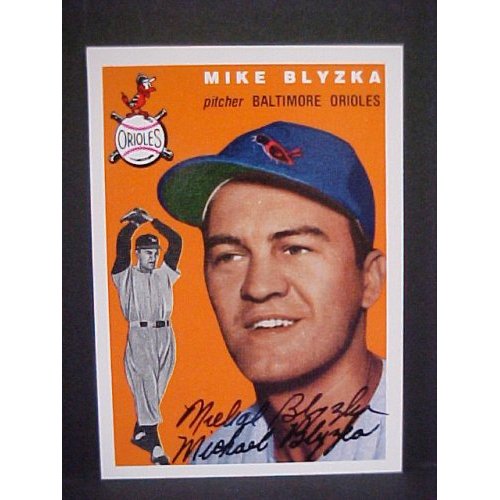
Mike Blyzka lived with a little noted, but no less important distinction in baseball history. As a right handed pitcher, Mike worked for both the last 1953 St. Louis Browns club and the first 1954 Baltimore Orioles team. All he did to attain that quiet “honor” was to have been on the roster at the time the decision was made to sell the Browns to Baltimore interests and then make it through the mild ripple of player transactions that followed as fanfare for the people of Baltimore that “the Orioles are coming home to their ancient big league roost! – even if they have to land in the lower branches of the big league tree with a bunch of ex-Browns flapping their wings and gasping for air.”

The news of the Browns move came down hard upon me in Houston. You see, as a 7th grader,  I had become a converted Browns fan in 1951 due to the incredible season that pitcher New Garver put up as a 20-game winner for a last place three-digit loss Browns club. Garver had gone 20-12 with a 3.73 for a last place Browns club that finished 8th with a record of  52-102. And I was always hooked on throwing my support to deserving underdogs. Garver stood out as such to me.

You may know the famous story that spawned on the heels of Garver’s incredible year. When Garver sought a substantial reserve clause era raise for his efforts in his new 1952 contract, Browns owner Bill Veeck turned him down, supposedly explaining that “we could’ve finished last without you.”

At any rate, Mike Blyzka arrived in time to go 2-6 for the 1953 Browns and then 1-5 for the 1954 Orioles in 70, mostly relief appearances. His 3-11, 5.58 ERA record for those two seasons turned out to be his major league career. As a seven-season minor leaguer (1947-50, 1955-57), Mike Blyzka posted a career sub-major league record of 63-60 with a 4.18 ERA.

I never really dug into Mike Blyzka’s record until years later, when I got to know him a little better as a person. Starting in 1996, and moving through 2003, I saw Mike Blyzka every year at the annual reunion dinners for the St. Louis Browns in St. Louis. Mike came religiously each spring as a former Brown. I came each season as a member of the St. Louis Browns Historical Society. It was through these laid-back conversations at breakfast and just sitting around the hotel lobby that I even learned a little of all that Mike Blyzka overcame to fulfill his dream of pitching in the big leagues.

By the time I met Mike, his health was bad and he lived alone in retirement in Cheyenne, Wyoming. He didn’t get around too well so I drove us places on a few eating and shopping expeditions away from the banquet hotel. Other old Browns like Red Hayworth often came with us. It was a joyful time to see old and new St. Louis through the eyes of men who had been such a big, but quiet part of the city’s baseball history.

In 2003, the Cardinals wanted to honor the history of the Browns by playing a uniform throwback game at old Busch Stadium II against the Baltimore Orioles playing as the 1944 Browns. They had a hard time talking the current Oriole players into going along with the plan, but that is not surprising. The Orioles have spent over a half century doing all in their power to forget the idea that their club ever played as the St. Louis Browns. Somehow they managed to overcome resistance and get it done, and they played the game on a Saturday in June that followed a Friday night game in which the last Browns club was honored.

It would have been a whole lot easier, it seems to me, if someone in the Cardinals organization had remembered that Mike Blyzka, Don Lenhardt, and a handful of others present that weekend had also played in 1954 as original new Orioles, but nobody mentioned the fact.

Oh well. Michael John Blyzka is our main subject here today. Born on Christmas Day in 1928 in Hamtramck, Michigan, Mike signed originally with the Chicago White Sox as an 18-year old (BR/TR) pitcher. He was assigned to pitch for Class D Lima, Ohio in 1947, where something happened that could have ended the career of a lesser man. – Mike lost his first nine decisions in professional baseball.  Assigned elsewhere in mid-season with an 0-9 record as baggage, Blyzka proceeded to finish at Class D Madisonville with a 2-6 mark, leaving him with a 2-15 start to his professional baseball career and a ticket over to the St. Louis Browns organization in 1948 via a minor trade.

Mike took those early lemons and brewed up some lemonade.

Pitching for the Browns club at Class D Belleville, 19-year old Mike Blyzka posted a 12-9 mark with a 3.37 ERA. He also led the Illinois State League with 192 strikeouts in 1948. After posting 28 total wins at Class C and A ball in 1949-50, Mike got swooped up for military service in Korea in 1951-52, but he was ready for his Browns debut when he returned to baseball in 1953. Such as it was, he will, or should be, remembered for his part in history.

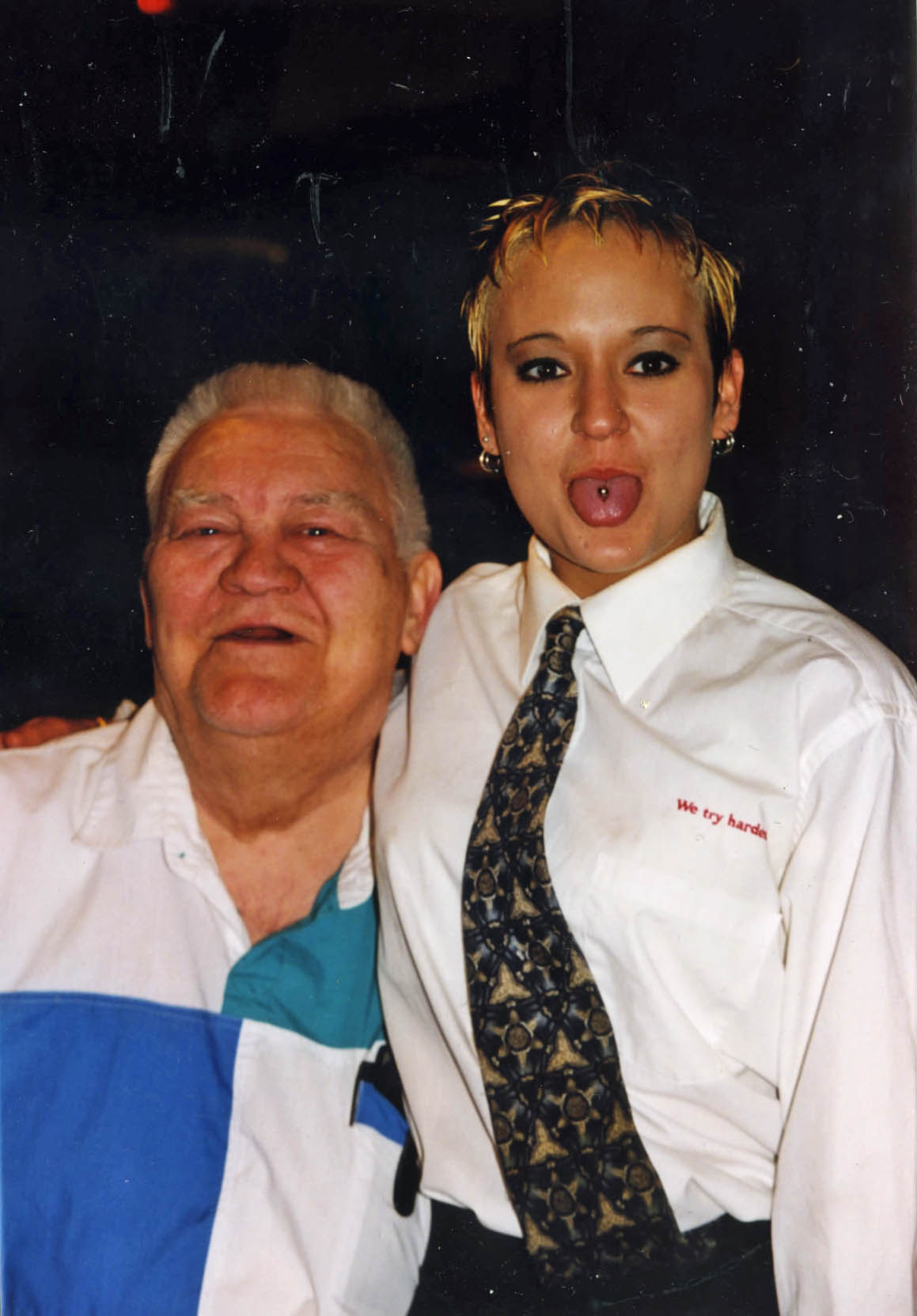
Mike Blyzka and admirer. Mike was a true gentleman with a quiet sense of humor.

Mike Blyzka did nothing to call attention to himself, but he possessed a delightful sense of humor about aging and the inevitability it brings to the table. On that last time I saw Mike Blyzka in  St. Louis, one of the girls in the hotel restaurant decided to play with Mike about going out on the town when she got off work. Mike played along with the joke, even though he knew there was nothing to it, and always sticking to his story that he appreciated the invitation, but but that he couldn’t make it due to other commitments.

As we were leaving the restaurant after breakfast, Mike offered the following: “You know, Bill, I might have taken her up on the invitation, but I think I’d rather live to see the game tomorrow.”

Mike Blyzka passed away at his home in Cheyenne on October 13, 2004.

God rest your soul, Happy Mike. And long live the Browns.