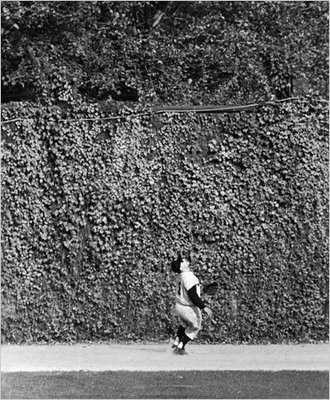
Take Me Out To The Ball Game

January 23, 2012


Three Versions. Take Your Pick. Or write your own.

Version 1: Classic Original.

Take me out to the ball game,

Take me out with the crowd.

Buy me some peanuts and Cracker Jack,

I don’t care if I never get back.

We will ROOT, ROOT, ROOT for the home team,

If they don’t win it’s a shame,

For it’s ONE! TWO! THREE STRIKES YOU’RE OUT,

In the old ball game.


Version 2: The Houstonian, I Don’t Wanna Go To The AL Whine.

Take me out – to the ball game,

Take me out – with the crowd.

Buy me a promise that our club is back,

Then settle down with a fifty buck snack.

We will ROOT! – ROOT! ROOT! for the ASTROS,

A-L ball –  is nearly the same,

It’s just ONE! – DUMB! – DH! away,

In the Land! – Of! – Shame!


Version 3: The 21st Century Business Model Re-formulation.

Take me out to the ball game.

Make me rich ‘fore we go,

Buy me some futures in peanut stock,

Nail me the beer track at every park shop.

Then we’ll ROOT! ROOT! ROOT! for redemption,

Of our copper exchanged for pure gold,

And we’ll ALL! GROW! RICH AS ALL HELL!

As we all – grow – old!

That Famous Mazeroski Home Run Ball

January 22, 2012

Mazeroski's 1960 Series-winning walk-off homer will find a 14 year old kid named Andy Jerpe on the other side of this wall. Andy left the game early to help his mom with supper and was standing among a small grove of cherry trees when the ball came down from its historic ride through the Pittsburgh sky. Jerpe preserved the ball through the winter, then lost it in the weeds of a sandlot game the following spring.

Mark Wernick, a good Houston SABR friend, dropped me a nice note about meeting Bill Mazeroski yesterday at the Tri-Star Collectibles Show at the George R. Brown Convention Center downtown. While signing a book for Mark, Wernick first apologized for asking what he knew was a question that Mazeroski had heard thousands of times – and then he asked it anyway.

“Was it a meatball, or was it a good pitch?” Wernick asked in reference to Ralph Terry’s last pitch of the 1960 World Series.

Mazeroski motioned with his hand and then spoke. “It wasn’t a good pitch. It was right over the plate. About belt high. Straight.”

“Fastball?” Wernick further queried.

“I thought it was,” Mazeroski added. “He (Terry) says it was a slider. But it didn’t slide.”

Referring to himself, of course, Wernick said, “You broke a 12-year old kid’s heart that day.”

Mark says he then noted a brief look of compassion in Mazeroski’s eyes, but that was quickly followed by an engaging laugh and further comment from the great Pirate hero. “I made a lot of them happy too!”

Wernick says he ironically agreed with Mazeroski. What he didn’t tell Mazeroski is that was listening to the game on an unauthorized transistor radio in the hallway at Mark Twain Junior High School in San Antonio at the time as a Yankees fan. The game-winning homer just happened while Wernick was walking from one class to another. Once it did it its stunning deed, Wernick says he had to duck into the boys’ rest room so that no one would see him crying from the pain that home run cased to him that day.

Mark Wernick’s a big boy these days. He’s recovered from the original pain and simply grown in his appreciation for the moment as simply a part of baseball’s magnificent history.

The irony is that another 14 year old Pirates fan named Andy Jerpe was having quite a different experience with that event at the very moment our San Antonio 14 year old was descending into despair. Andy Jerpe had been at the game, but had left a few minutes earlier to get home and help his mom with preparations for supper.

(Had that been me, I would have  stayed inside Forbes Field. Dinner would have been late. I’d have to have risked getting in trouble later.)

Because Andy Jerpe was a “good boy,” his progress home had carried him early to a grove of cherry trees, just beyond the left field line. All of a sudden, he heard an enormous roar from the ballpark. Then, from out of the sky, this baseball (THE Mazeroski Ball) drops out of the sky and only a few feet away. – And he’s the only one around the area at the time.

“Someone just homered,” was Jerpe’s conclusion. And once he went back long enough to find out all the particulars, he knew he wanted to keep the ball. He took it home and told the family wha had happened, but there was apparently no big uproar over his possession of a souvenir ball. Fans kept souvenir baseballs all the time.

Andy built a display case for it and things seemed cool about its survival for a while – or until spring came again. And Andy’s friends talked him into using the ball for some sandlot fun. Aside from the dirt spots and scratches that immediately started checking in, the ball was making it until Andy Jerpe himself sliced the ball into some tall festering weeds. The kids looked for the ball, but all say they never found it. And that is supposedly what happened to the Mazeroski.

Andy Jerpe says he has recovered from his regret and forgiven himself for losing the Mazeroski baseball.

Speak for yourself, Andy. You’re from Pittsburgh and should have known better, even at age 14, not to have used that special ball in any kind of sandlot game. There are those of us in Houston from the 1940s, 1950s, and 1960s who never would have done that – even at 14 frickin’ years of age – and we would have ordinarily killed for a good baseball – as long as it didn’t belong first to history.

Andy Jerpe, You Idiot! (Just Kidding – sort of.)

Here’s a link to a pretty good story of the Andy Jerpe experience with the Mazeroski baseball.

  http://www.pittsburghlive.com/x/pittsburghtrib/sports/pirates/s_700262.html


MLB HR Totals By Position, All Time

January 21, 2012

The Line Score: Easiest numbers in baseball to understand and, in the end, only the "runs per game" relative to your opponent's comparable total is the only stat that ultimately matters.

A recent addition to the Baseball Almanac site simply confirms what we all seem to know to the bone from other anecdotal experience with baseball history, The major production of home runs comes from players at the first base position, followed quickly by the two corner outfielders. In theory, the other corner power man is supposed to be the third baseman, but home runs from that slot position in the defense are slightly fewer than those produced by center fielders. That makes sense when you think about all the power guys who’ve played the central outfield garden spot over the years. Try toting up all the HR-bashing third basemen once you get past Mike Schmidt and Chipper Jones, Ron Santo and Ken Boyer.

The Baseball Almanac chart claims to account for all home runs in big league history, except for 21 shots that are still under study and remain uncategorized.  One other interesting note: In spite of the relative newness of its existence in only one of the two major leagues, designated hitters still account for 9,296 of all home runs, exceeding the contributions of all pinch hitters and pitchers from the beginning of time.

Here are the total home runs by position for almost all home runs, save 21, all time:

P: 3,623

C: 22,973

1B: 37,222

2B: 15,874

3B: 26,665

SS: 14,462

LF: 33,719

CF: 27,006

RF: 34,506

DH: 9,296

PH: 4,961

What follow via link is an easy-on-the-eyes clor graph of how these home numbers  by position break down relative to each other:

http://www.baseball-almanac.com/charts/HR/home_runs_by_position.shtml

Sometimes its nice to contemplate a straightforward bowl of baseball stats that are easy to see, confirming, and not confusing.

Have a nice weekend, everybody!

My All Time Switch Hitting Lineup

January 19, 2012

Lance Berkman is my pick for Right Field.

The switch hitter lineup was a fun pick. With apologies to the less iconic figures of the Negro Leagues and their lack of comparable stats and limited anecdotal testimony, I stuck with MLB players, even a few that haven’t made it to the Hall of Fame at Catcher, Third, or Right Field. My guess is that Chipper Jones will get there in time and that Lance Berkman may even put himself into the running with 3-5 more outstanding years at St. Louis (or somewhere) before he retires. I’d like to see Lance tweak that BA up over .300 and the HR totals beyond 400 before he’s done. These improvements would help Berkman’s HOF chances. Not sure if anything can still happen to help Ted Simmons with the HOF, but he sure was a dangerous hitter in key games in his time, along with a steady handler of some excellent pitchers.

George Davis was an outstanding shortstop for the Cleveland Spiders, New York Giants, and Chicago White Sox during the last decade of the 19th century and the first ten years of the 20th. During the era of the move-the-runners strategies of the dead ball era, Davis flourished when witch hitters were highly valued for their ability to hit to all fields. He was good enough for the HOF and I picked him over Ozzie Smith for this club, knowing full well what I was giving up on defense, although Davis was reputedly excellent in the field too.

That being said, here are my starting nine:

Roster Spots & Player Stats

Pitcher: Carlos Zambrano (.241, 23 HR, 69 RBI)

Catcher: Ted Simmons (.285, 248 HR, 1,389 RBI)

1st Base: Eddie Murray (.287, 504 HR, 1,917 RBI)

2nd Base: Frankie Frisch (.316, 105 HR, 1,244 RBI)

3rd Base: Chipper Jones (.304, 454 HR, 1,561 RBI)

Shortstop: George Davis (.295, 73 HR, 1,440 RBI)

Left Field: Pete Rose ( .303, 160 HR, 1,314 RBI)

Center Field: Mickey Mantle (.298, 536 HR, 1,509 RBI)

Right Field: Lance Berkman (.296, 358 HR, 1,193 RBI)


Batting Order / Game Time:

Rose, LF

Frisch, 2B

Mantle, CF

Murray, 1B

Jones, 3B

Berkman, RF

Simmons, C

Davis, SS

Zambrano, P


My All Time Righties Lineup

January 18, 2012

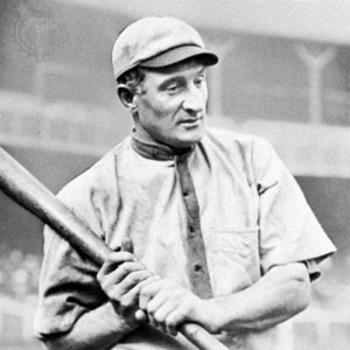
Honus Wagner is my only right-handed selection to hold the bat in this way at business time..

After doing the lefty swingers yesterday, I had a little more time to give my nighties some thought. ( just didn’t give myself enough time to recall that Bob Lemon hit left-handed, not right. This is not my week for memory without double checks. Thank you David Munger for the head bounce. I picked Bob Gibson as my new right=handed hitting pitcher because, even though he hit in Mendoza Land, he was still the amazing Bob Gibson when he took the mound. Plus, I liked the idea of the “Double Gibson” battery.

That being said, I’m going with what I think the greatest right-handed hitters do best. Call ’em the “Bash-Full Boys” or the “Bruise Brothers Supreme” and we still have a club that could most often beat another team senseless with long jacks. I granted myself the liberty of choosing the liberty of taking the Negro Leagues icon Josh Gibson as my right-handed hitting catcher in spite of the missing presence of comparable stats. This guy is simply too big to ignore as a legend of what might have been – had it not been for the damnable color line.

Please post your choices too. There is room for more than one of these great teams, depending on our awareness and perspective on what makes for greatness in a hitter, I’ll hang firm with my picks. As an actual club manager, I’d be happy to send this team out to play seven days a week and twice on Sundays.

Starters By Position

 Pitcher: Bob Gibson (.201, 24 HR, 144 RBI)

 Catcher:  Josh Gibson (Negro Leagues: 426, Gazillion HR & RBI)

1st Base:  Jimmie Foxx (.325, 534 HR, 1,922 RBI)

2nd Base: Rogers Hornsby (.358. 301 HR, 1,318 RBI)

3rd Base: Mike Schmidt (.267, 548 HR, 1,595 RBI)

Shortstop: Honus Wagner (.329, 101 HR, 7223 SB)

Left Field: Hank Aaron (.305. 755 HR. 2,297 RBI)

Center Field: Willie Mays (.302, 660 HR, 1.903 RBI)

Right Field: Roberto Clemente (.317, 240 HR, 1,305 RBI)

Game Day Lineup

Clemente, RF

Hornsby, 2B

Mays, CF

J. Gibson, C

Aaron, LF

Foxx, 1B

Schmidt, 3b

Wagner, SS

B. Gibson, P

My All Time Lefties Lineup

January 17, 2012

"When you think of lefties, think of me. I'm 'The Babe,' who else couid I be?"

We are now five weeks away from the date that pitchers and catchers report for spring training. My apologies to those who wish and sometimes ask that I forget baseball for a while during the winter months, I cannot seem to avoid the early January effect upon my brain that normally leads me into thoughts of various silly name teams – or my favorite all star lineups based upon some common uniting characteristics.

With no place for steroid suspects, here are my starting roster and lineup for my Hall of Fame All Star Left-handed Hitting Club. I might have given consideration to Sandy Koufax or Rube Waddell here, but both of those lefty throwers disqualified themselves by batting from the right side of the plate.

I also used no switch hitters. Other than Ruth and Cobb, you could possibly argue for a number of other guys in the other spots, but that’s what makes this kind of exercise so much fun. The room for disagreement is wide and open.

My hope is that some of you will submit your own starting lineups, with batting orders too. Feel free to go outside the Hall of Fame group list to pick your own top nine lefty hitters by position too.

Here are my picks:

Starters By Position

Pitcher: Lefty Grove (300-141, 3.06 ERA, 2,266 K’s)

Catcher: Yogi Berra (.285, 358 HR, 1,430 RBI)

1st Base: Lou Gehrig (.340, 493 HR, 1,995 RBI)

2nd Base: Charlie Gehringer (.320, 184 HR, 1,427 RBI)

3rd Base: Frank “Home Run” Baker (.307, 96 HR, 107 RBI)

Shortstop: Joe Sewell (.312, 49 HR, 1,055 RBI)

Left Field: Ted Williams (.344, 521 HR, 1,839 RBI)

Center Field: Ty Cobb (.367, 117 HR, 727 RBI)

Right Field: Babe Ruth (.342, 714 HR, 1,983 RBI)

Game Day Lineup

Ty Cobb, cf

Charlie Gehringer, 2b

Babe Ruth, rf

Ted Williams. lf

Lou Gehrig, 1b

Yogi Berra, c

Frank Baker, 3b

Joe Sewell, ss

Lefty Grove, p

Have a nice day!

What’s Behind the Blame for Tal Smith?

January 15, 2012

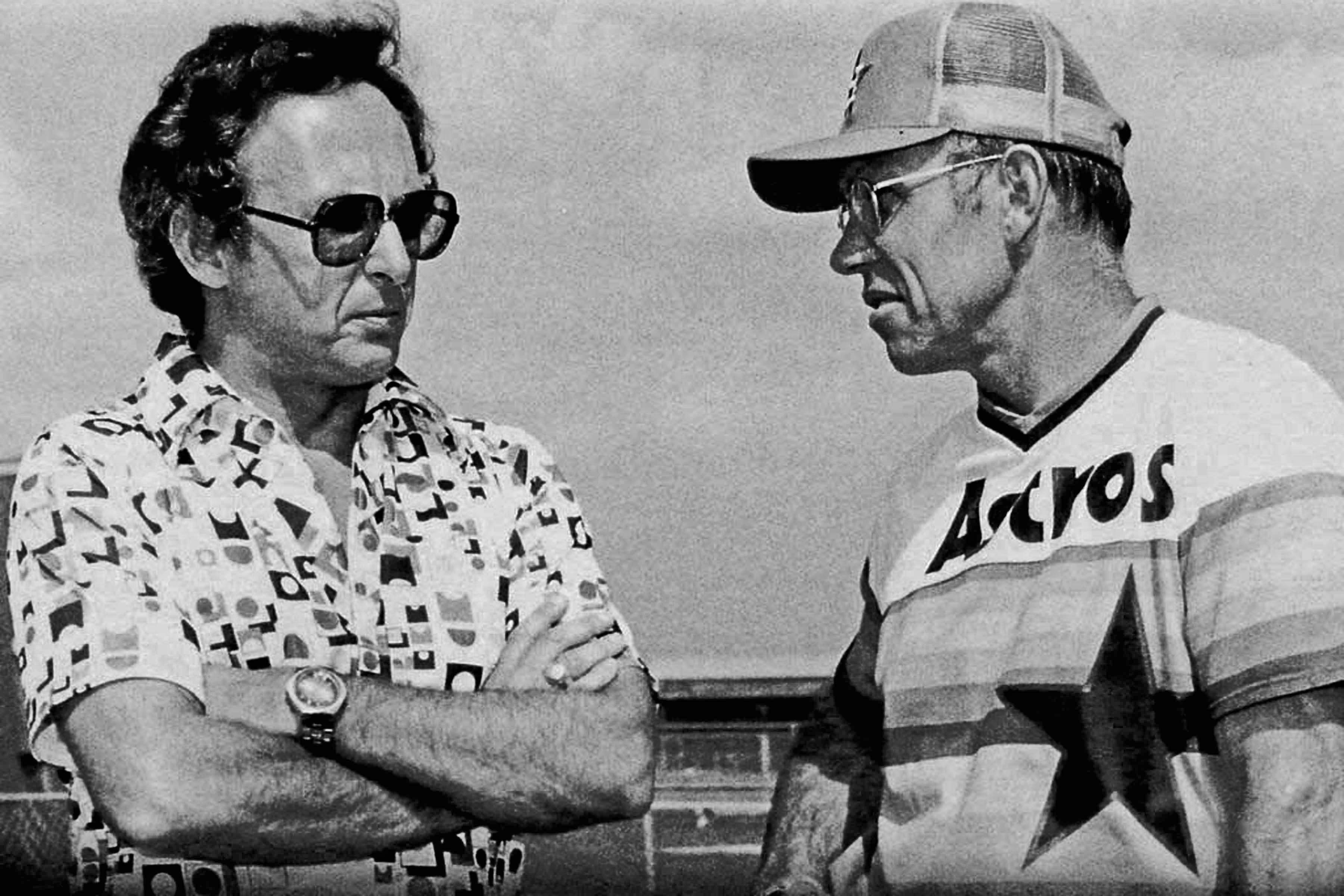
Ex-Astros President Tal Smith and former Astros Manager Bill Virdon

In reaction to the column I wrote this week on “Moneyball,” a reader identified as Gary has written the following as a comment on the article:

“Stats can tell you about 90% of what you need to know about established players. Projecting amateurs and minor leaguers is a different story. And, I’m sorry, but this must be said – Tal Smith has all but destroyed the Astros. It’s obvious the game passed him him by decades ago.”

Gary, forgive me, but when anyone tells me something is obvious that I still don’t see, I have to question: Am I just stupid here? Or do I first need to raise some questions of my own before I jump to that conclusion. So, please indulge me.

Are you saying that the current shape of the Astros roster and the longstanding decline of talent in the club’s minor league pipeline is all the result of Tal Smith’s out-of-touch inability to judge, sign, and cultivate competitive talent with no help or interference from his owner or supportive staff? Are you suggesting that Smith has no idea what is needed to make a contemporary MLB team competitive for a pennant and World Series trip through the playoffs? Are you suggesting that our worn out saddle on the now-in-its-last-year-multi-season contract with Carlos Lee is the fault of Tal Smith’s out-of-touch senior view on major league baseball?

I’m not writing today to simply defend Tal Smith. He doesn’t need any help from me on that score. I am writing to question any conclusion that the Astros’ current status is the result of poor judgment on Tal Smith’s part, with no help from circumstances and decision-making that went far beyond his individual control as President of Baseball Operations.

I don’t claim to know Tal Smith in-depth beyond our occasional baseball discussions over the years, but I have to admit to some favorable impression of his ideas on what a baseball club needs – and I have been very impressed with his open and routine use of external consultants over time on the assessment of both contract players and amateur prospects. Tal always maintained his lines with out-of-the-orgnization people like me. He never criticized anyone within his decision-making loop to me for anything that didn’t work out as he might have hoped.

It’s hard to see how any employed top baseball person in any organization today can deal with the impact of owners or market prices on talent coming into play and overriding any best laid plans of the hired baseball planning leader, but I would certainly like to know what the best modern solution to these ills might be. Unless you, or someone else, can show us how Tal Smith was not up-to-speed in specific terms as a baseball operations leader, I’ll just have to place myself in the “stupid” category for my failure to see the obvious.

Now, once upon a time, Cy Young pitched in the first World Series of 1903. On days he didn’t pitch, he helped sell tickets at the gate to the other games played in Boston. Not once did I ever hear Tal Smith say, “We need a Number One Starter in our rotation who also knows how to make change.” Had Tal said something like that, I would have had to agree. He needed to retire.

What’s really behind the bitterness that some people seem to have for Tal Smith? Is it simply the fact that the franchise went a half century with Tal Smith prominently in the picture without winning a single World Series?

Easy targets are hard to miss.

How much longer will it be before some Smith-hater decides to celebrate their resentment further by proposing that the Astros level Tal’s Hill from the centerfield landscape at Minute Maid Park?

Still, I have to finish where I started: I just wonder what you have in mind when you say that it is “obvious the game passed him (Tal Smith) by decades ago?” Do we simply reach that conclusion based upon age? If that’s it, you’ve got me too.

Keys To Success

January 14, 2012

Success is not something anyone else can give us, buy for us, make us accept, bring into our lives by their presence, or leave us in a will. Neither is it a short hop race or quick buy on E-Bay or a quick muscles, fast diet or mail order degree plan.

Success is something we gain from our own effort over time that we believe in and apply ourselves to accomplishing because even the effort expended to get there causes us to live more comfortably in our own skin.

Somewhere along the way, when we are kids, it helps to have had a parent, a teacher, a coach, or an adult mentor of some sort tell us what they see of our abilities. One trustworthy adult asking us, even once, something like, “Do you realize how good you are with math, poetry, or whatever it is” goes so much further than “try harder” or that great wall of silence that only feeds our childhood fear of the unknown. (“Maybe the adults don’t say anything good to me because they haven’t seen anything in me that they like.”)

I had a forty-year old man call me up this past year just to thank me for being there for him when he was ten and going through his parents’ divorce as an only child. Back then I was very active as a family therapist. I still maintain a small practice with people who prefer the old school approach, but nothing like the volume of the old days.

The man said I told him the following back then: “Look, I know you’re scared, but you are going to make it through this tough time because you are a very good guy with two parents who both love you too, even if they don’t much care for each other. And you have abilities to write that are going to carry you through school and onto a successful life working with people yourself someday.”

The kid held onto those words forever. Today he runs his own successful company. And he communicates as a grown man very, very well. I can’t begin to tell you how important that phone call was to me. It’s not the first of that nature that I have been privileged to receive. And I always hope that it’s not the last.

Perseverance with the truth about ourselves over time, and using what we know is true to give back to life with whatever love and talents we have is the closest I can now come at my age to defining success. It has nothing to do with being perfect, unless your love is performing brain surgery, or working as an airport controller, but it is about persevering in your fulfillment of accomplishable goals with the abilities you have for as long as you can rise out of the bullpen and pitch one more inning of near hitless and walk-free scoreless ball.

When you’ve got that done and clear of your system, it may be time to sit back and relax in satisfaction over a job well done and a life well lived. Everybody travels through the land of “been there / done that” – even if they missed their first chance to debark the train at Restwell. It’s OK to rest with your success. If you don’t see that, you’ve missed the whole point of what I’ve tried to say here.

Just remember, if there’s a special young person in your own life that you could encourage with the right kind of positive feedback you see in their abilities, don’t leave what you could say to them on the wall of silence. You may never know what difference it will make down the road, but it will matter. That much I know from personal experience many times over.


Moneyball Raises Questions Beyond A Blog

January 13, 2012

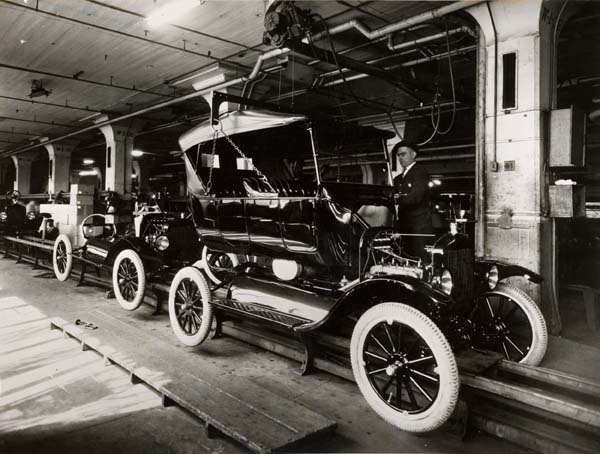
Building a World Series Champion is a little More Complex Than Building a Car.

I’ve seen Moneyball. Saw it three months ago. I’ve seen Brad Pitt as Billy Beane and Jonah Hill as the young statistical geek who effectively juices Beane into a new, more scientific way of thinking about talent assessment and the art of putting together the interchangeable parts that go into making up an affordable winning ball club. I also saw the way the movie unfairly portrayed Oakland A’s Manager Art Howe, both physically and philosophically, through the presence of acclaimed actor Phillip Seymour Hoffman.

Hoffman did a good job; he just wasn’t Art Howe. If we didn’t know any better, Moneyball The Movie asked us to believe that Art Howe is little more than a short, fat closed-minded man who dismisses any new thought in baseball that has come to light and common usage past the year 1900, the first year of the American League. The truth is that Art Howe is a tall and wiry, intelligent and baseball savvy guy who has done well in the game because of his abilities for listening and getting along with a broad range of people. Moneyball took an axe to the true character of Art Howe and, by extension to the scouting staff of the Oakland A’s that was in place when Billy Beane came on board as General Manager.

It would take a 500-page book, or probably five or six 500-page books by as many respected baseball writers to turn Moneyball completely upside down for a fairer look. I certainly don’t feel able to do that in a blog. All I wanted to do here is speak up for people like Art Howe and Tal Smith, really deep-rooted baseball people who still have much to offer. People who pass on the opportunity to learn from experts like Art Howe and Tal Smith are doomed creatures at the door of real learning. You talk to people of reputation for two reasons: (1) to learn what they’ve done that may also help you; and (2) to learn what they’ve done so that you may better avoid repeating the same errors.

Moneyball has much to offer. It simply isn’t the whole enchilada. If it were, every World Series team that gets assembled would be exactly identical to one of the iconic versions of previous winners. We’d just have to locate the right parts at an affordable point in history and plug them in. It just doesn’t work that way. Sometimes you plug-in a name like Howie Goss and the thing explodes in the light socket. Other times you plug-in a name that nobody even knew just a few years earlier back in 1998, when McGwire and Sosa were going crazy with the homers, a name like Albert Pujols, and the whole world lights up like that closing home run scene from The Natural.

We will always need the good judges of character, the people who know the culture of baseball, and the scouts like the great Red Murff, who signed Nolan Ryan. Murff didn’t sign Ryan for the Mets because of what he saw alone in this long skinny Texas kid. Murff saw the muscular physique of Ryan’s father and just knew that Nolan was only going to get better as he too grew to manhood. The day we stop listening to people like Red Murff is a bad day for baseball – but I don’t think that ever is going to happen.

Mine Moneyball for all it’s worth, but don’t throw the baby out with the bath water along the way. And while you’re working to do a smarter job, don’t forget the lady who brought you to this dance in the first place. Her name is Luck.

Boogie Woogie Beckons From a Land Far Away

January 11, 2012

Sometimes the brain needs a little jangling from something other than thoughts. When a lot of us were younger, we got that experience done with sports and music.

Remember Boogie Woogie? Man, how I loved that style. 
Here’s a Swiss pianist named Silvan Zangg whose fingers dance over the keyboard, along with a couple of young dancers who do the whole art of Boogie Woogie justice beyond belief. 

Just click on this link. Either listen up. Or just get up and dance.

http://www.youtube.com/watch?v=fWDfxgngrNc&feature=fvsr

If it doesn’t work, just go to You Tube and type in “Swiss Boogie Woogie.” You will find the man, his easy to hear music, and his hard to remember name.

The Pecan Park Eagle is just happy to be your after work Happy Hour stop today on this nice looking January Wednesday in the heart of what passes for winter in these parts.

… Learn to dance, Daddy, eight to the bar, You gotta Boogie Woogie or you won’t get far …