Courtesy Fielders? Come on! Get Real!

February 15, 2012

Catcher Clyde McCullough was the 1952 beneficiary of an illegal "courtesy fielder" assistance call by a misinformed umpire at Forbes Field in Pittsburgh.

Had an interesting call from SABR friend Mike McCroskey yesterday. Any call from Mike is interesting, especially if you enjoy baseball trivia and the oddball anomalies of the game from most other sports when it comes to exceptional rules that seem to fly in the face of the great game’s commitment to fiercely competitive encounter on the field of battle.

The old practice in the game of allowing “courtesy runners” by mutual consent between two managers was the subject. Mike and I had been discussing the same at the Astros FanFest this past Saturday. I can’t recall when we first started talking about “courtesy runners”, but I think I may have been the person who brought the subject into awareness for Mike at some recent point, but it doesn’t matter. We had been on the subject in curiosity – without having done any real research – for quite a while.

Mike had called yesterday after watching the old John Goodman movie about Babe Ruth. Apparently this movie depicted Babe Ruth being allowed a “courtesy runner” during that last 1935 series in Pittsburgh in which the Bambino struck three home runs in one game. Mike recalled me saying something (erroneously) about the courtesy runner practice going out after the 1920s – and here was a more recent example.

Well, as it turns out, we cannot use John Goodman movies as a good source on baseball history. A quick check with Retrosheet last night reveals that no “courtesy runner” was used for Babe Ruth in the famous 1935 3-HR game at Pittsburgh, but the same great site also revealed much more.

http://retrosheet.org/courtesy.htm

According to Retrosheet, “courtesy runners” were a legal, allowable practice from the 19th century through the 1949 season when the rules changed to disallow the practice altogether, starting with the 1950 season. While they were allowable, “courtesy runners” were used rarely and only by mutual consent between the two managers in one instance: If a base runner had been temporarily injured or incapacitated, a manager on offense was allowed to substitute a runner for the effected player during that time at bat – and still return the injured player back into the game to continue playing once his team took the field on defense again.

As you can see from the Retrosheet account of confirmed instances of this rule’s deployment, courtesy runners did not happen often relative to the thousand numbers of games played since beginning of baseball time.

But you will also see something else. – Prior to 1950, there were even less frequent times in which clubs were allowed to us “courtesy batters, courtesy fielders, and courtesy mid-play runners.”

In the case of courtesy batters and fielders, injured players were allowed to have temporary help from a designated replacement too, as long as they returned to the game in the next half inning. In the case of the two mid-play substitutions on record, designated runners were inserted into games simply for the sake of completing a play that was in progress when a runner was injured.

Mid-play substitutions apparently are still legal. Both instances (1977 and 1982) have involved the need for a runner to replace an injured player who could not complete his run around the bases on a settled outcome play because of his disability. Makes you wonder why this would even be necessary. If a guy knocks a walk-off game-winning homer and then falls and breaks his leg between third and home on the jog around the bases, why not just give him the rest of the trip by assumption? Why bring in a second guy to basically act as the designated “run scorer?” It all seems oh so unnecessary.

There has been one illegal use of the “courtesy fielder” rule since 1950 due to umpire error that was allowed to stand. It happened on August 10, 1952 in the second game of a Chicago @ Pittsburgh doubleheader:

“In the top of the ninth of the second game of a twin bill, Pirates catcher Clyde McCullough was injured and could not continue. The Pirates’ two other catchers, Eddie Fitzgerald and Joe Garagiola, had already been used in the game as pinch hitters. With the approval of Cubs manager Phil Cavarretta, Fitzgerald was allowed to replace McCullough. The Cubs won the game 4-3. Under the playing rules in effect since the 1950 season, that was an illegal substitution that the umpires should not have allowed.” – Retrosheet.

Well, Mr. McCroskey, I want to thank you again  for dropping by to pump the well on another blog subject column yesterday, Just know this much too, as one of our prime Houston Babies vintage base ball team players: Don’t worry about that 1950 rules change against the use of courtesy runners. As long as you keep running as you do, I’m sure that Babies Manager Bob Dorrill will continue to find a courtesy runner for you that meets with the approval of our esteemed opposition.

As for that “courtesy batter” or “courtesy fielder”  help you may also seek – you are on your own.
The Ten Houston MLB No Hitters

February 14, 2012

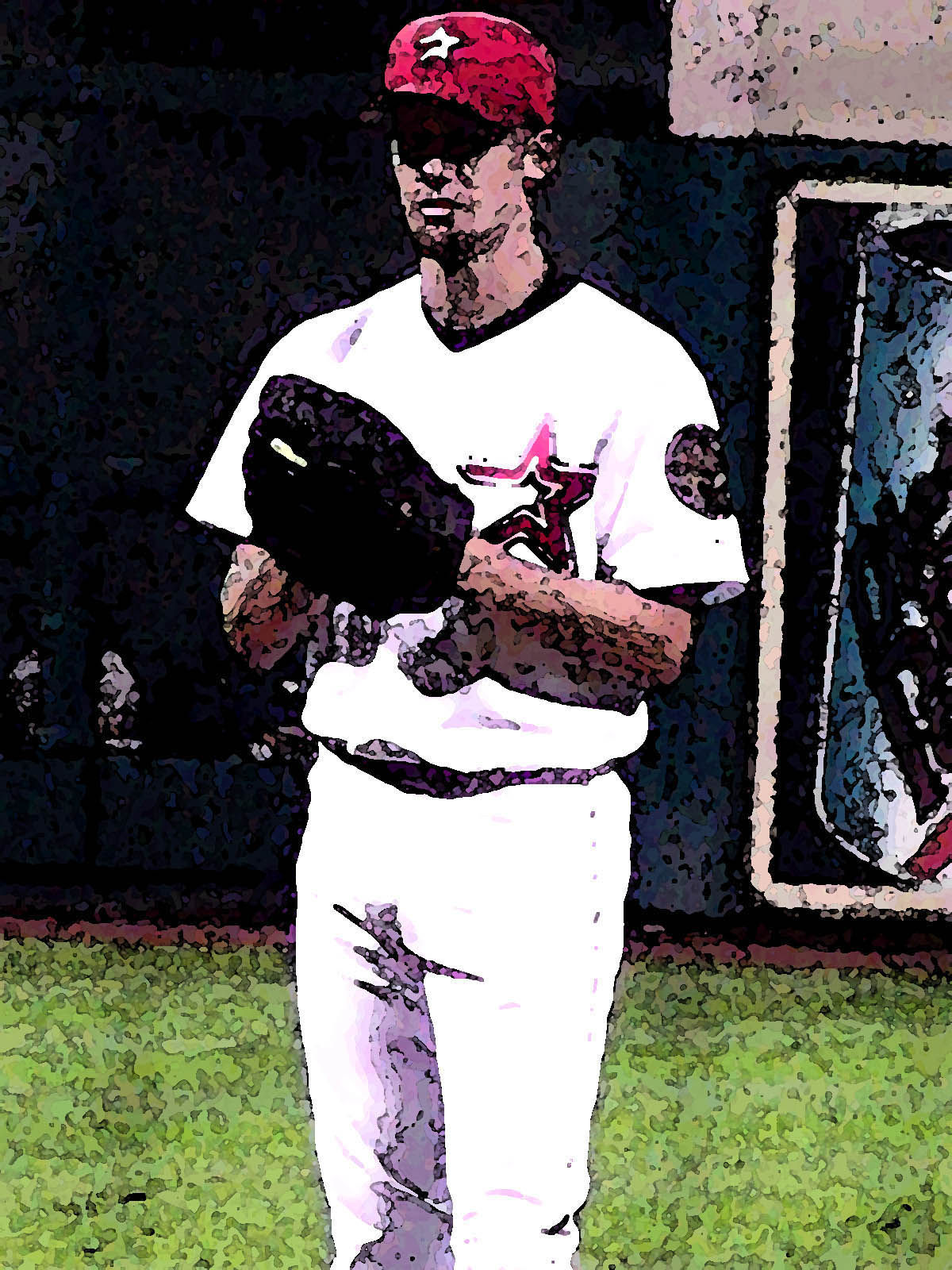
Roy Oswalt was the starting pitcher in the Astros' group no-no versus the New York Yankees in 2003. He simply didn't last long enough to also pick up the "W."

Thanks to the beautiful work of Baseball Almanac, here’s a reference link that covers the facts of a subject that comes up all the time in historical discussions among Houston Astros fans, It’s the chronological display by box score of the ten, so far, no-hitters thrown by pitchers working for our Colt .45’s and/or Astros. Please note those two very special ones: An Astros pitcher threw, but lost a no-hitter in the second one – and it took six different pitchers to claim that tenth group no-no.

Just click on the date of each game for details on who played in each game and what happened.

Work with this data often enough and you will know it by heart in time – if you don’t already. – And don’t worry about it. – It’s the path and end of all baseball history geeks.

Here’s an easy poetic way to remember them all in order:

Nottebart, Johnson, Wilson – twice!                                                                                                                                                                                                 Dierker, Forsch, Ryan – spice!                                                                                                                                                                                                                 Scott, Kile, and six were – nice!

Oswalt, Munro, the Sasrloos – dice!                                                                                                                                                                                                        Lidge, Dotel, and the Wagner – vice!                                                                                                                                                                                                  Repeat each day – and do it thrice!

Or just write it down – is my advice!

That being said, if you really are looking for the best, most reliable source on the Astros No Hitters = or for all things Astros, check out Astros Daily (dot) Com for the most complete club information you’ll find anywhere. Here’s their treatment of the no hitter material, as suggested by Darrell Pittman in the comment section that follows this column, My apologies for taking this long to speak up in their behalf. The gang at Astros Daily honest, thoughtful, caring, and thorough. When it comes to the history of the Houston Astros, Bob Hulsey, Darrell Pittman, and their crew never serve up half a loaf and stale beer. It’s always the five-course real-deal.

Check ’em out:

http://astrosdaily.com/history/nohitters.html

Then come on back and check our presentation too:

Houston Astros No-HittersName (IP) Date

(1) Don Nottebart (9.0) 05-17-1963

(2) Ken Johnson (9.0) 04-23-1964

(3) Don Wilson (9.0) 06-18-1967

(4) Don Wilson (9.0) 05-01-1969

(5) Larry Dierker (9.0) 07-09-1976

(6) Ken Forsch (9.0) 04-07-1979

(7) Nolan Ryan (9.0) 09-26-1981

(8) Mike Scott (9.0) 09-25-1986

(9) Darryl Kile (9.0) 09-08-1993

(10) Roy Oswalt (1.0) 06-11-2003   Peter Munro (2.2)    Kirk Saarloos (1.1)    Brad Lidge (2.0)    Octavio Dotel (1.0)    Billy Wagner (1.0)


Five Guys Who Played For and Managed the Astros

February 13, 2012

Art Howe and Phil Garner were two of the three former Astros players--managers who attended Friday night's Houston Winter Baseball Dinner. The other (not pictured here) was Larry Dierker. Two others, Bob Lillis and Dave Clark, were not present.

Five former Houston Astros players have gone on to also manage the club, even if one only made it there on the close to barest of possibilities. Dave Clark played his last professional season as a pinch hitter and utility corner outfielder for the 1998 Houston Astros. Then later, when he was working as a coach for the 2009 Astros club, he took over as interim manager when Cecil Cooper was fired with just a few games remaining on the schedule. The club hobbled to the finish line at 4-9 and .308 under Clark and that was it for the probably least remembered member of our small group.

No doubt about it – Larry Dierker was the most overall successful manager in club history. As a former Astros pitching ace, and the only member of the group to have had his number (49) retired by the team, Dierker guided the Astros to four first place division finishes from 1997 through 2001. Dierker’s 448-362 record produced the club’s highest winning managerial percentage (.553) in history.

Dierker’s 810 total games tied him with Art Howe as the most games managed for the Astros by a former Astros player, but the record for most regular season games managed by an Astros manager of any background goes to the one and only Bill Virdon, who took the Astros into regular season battle for a total of 1,066 times during the 1975 to 1982 period he managed in Houston. The Astros also took their first division crown under Virdon in 1980 and then, sadly, fell only one painful win short of reaching their first World Series that year.

Four of the former Astros players who later became Astros managers also had a direct connection to Bill Virdon, the man who put the run and gun into the offensive philosophy of the franchise that also learned to appreciate and cultivate good pitching and athletic defense under their grand mentor Bill Virdon and Astros administrative iconTal Smith. – Larry Dierker, Art Howe, and Phil Garner all played for Virdon and Bob Lillis coached for him.

Bob Lillis was the first former Astros player to later take the reins as Astros manager when he  followed after Virdon left the club late in 1982. Lillis managed from late 1982 through 1985, finishing with a respectable record of 276-261 and a winning percentage of .514.

Art Howe later managed the club to a 392-418, .484 mark at the end of the John McMullen ownership era, from 1989 to 1993. With the purchase of the Astros by Drayton McLane, Howe was “new-broomed” out the door in favor of Terry Collins. All Howe did was prep the young talent core for a harvest of performance that would not take place under new manager Collins, but under the Renaissance Man that would follow him, the tall drink of wisdom water named Larry Dierker.

The last to mention guy on our double Astros duty list was Phil Garner. Taking over in 2004 for manager Jimy Williams, Garner almost wild-carded the Astros into the World Series, a feat he accomplished in dramatic fashion several times over in 2005 as the wild card Astros advanced to their first World Series ever. When the Astros cooled to room temperature over the following two seasons, Garner was replaced, as most manager usually are. Coach Cecil Cooper took over for the final few games of the 2007 season and then returned to manage the team full-time n 2008. He would eventually depart in the same way in 2009, as we have mentioned, replaced by Dave Clark.

Phil Garner’s Astros managerial record was 277-252, .524

It will be interesting to see down the road to the return of another former Astros player as the next Astros manager, whenever that may be. We understand that my old Houston high school (St. Thomas) has won a couple of state baseball titles in a row behind the management of a head coach who used to play a few innings for the Astros. – You have to wonder if the guy I have in mind will ever be open to trying his hand with major league player management.

Lance Berkman: No Astro Does It Better

February 12, 2012

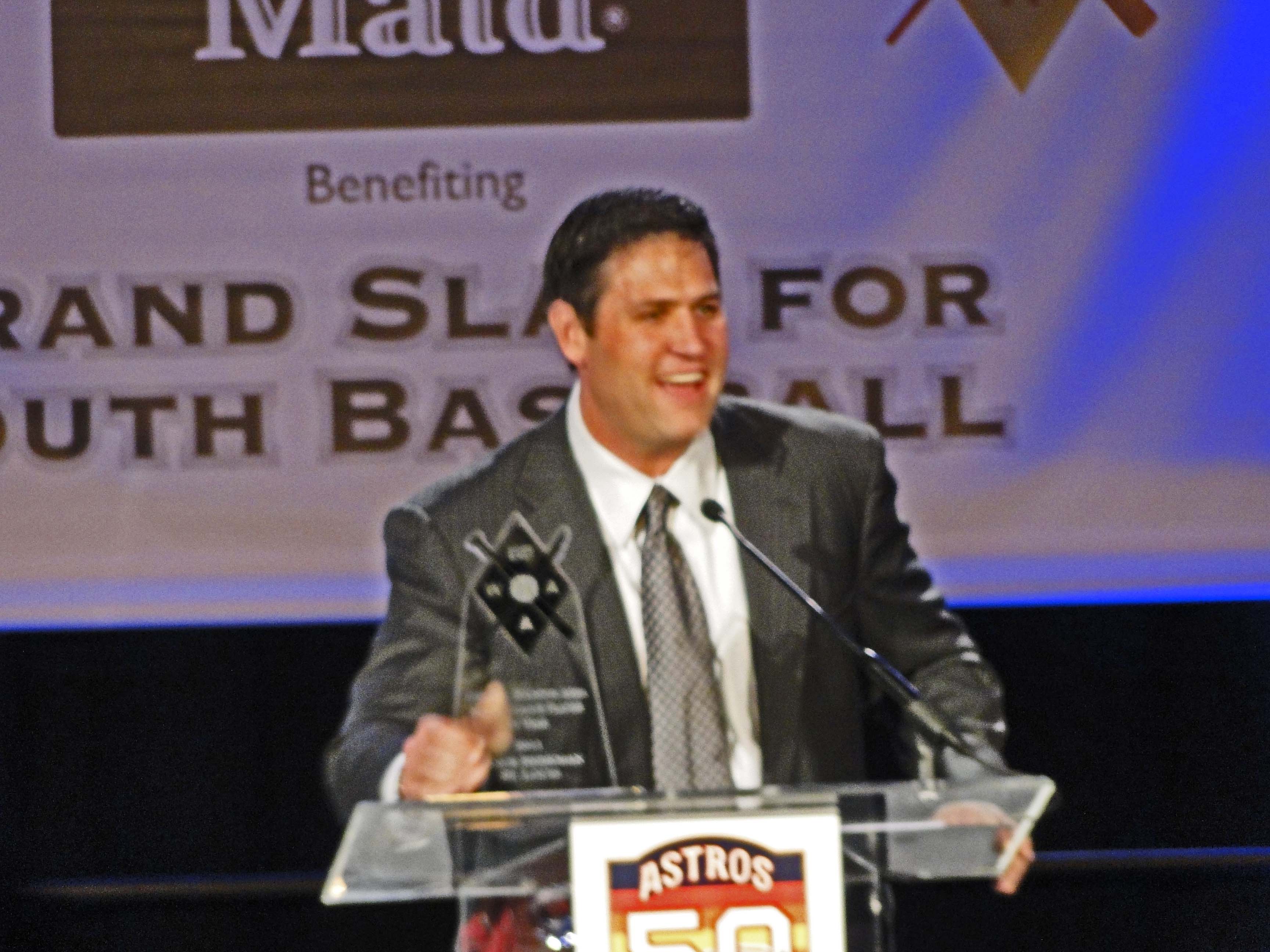
Lance Berkman accepting his award as the Houston Area Major League Player of the Year on Friday Night in Houston.

Friday Night, February 10, 2012, Lance Berkman was in Houston (where he lives, anyway) to accept his award at the 27th annual Houston Baseball Dinner as the Houston Area Major League Player of the Year. All the guy did to earn it for the 2011 season at the swank downtown Hilton Inn of the Americas presentation was bat .301 with 31 homers and 94 runs batted in for the World Series Champion St. Louis Cardinals while also becoming one of two Cards to bring his club back from a one-strike-away loss to the Texas Rangers and back into position to set up that game-winning dinger by teammates David Freese in the arguably most exciting Game Seven in history.

Now 35-year-old Lance Berkman has his .296 career batting average for 13-seasons (1999-2011) perched like two balanced red birds on a bat with a total of 358 home runs and 1,193 runs batted in thrown in for good measure. His world is right side up with apparently no regrets or lingering sadness over his rebuffed attempt to return to the Astros in 2011 after his brief-time unhappy trade to the New York Yankees late in 2010. To be accurate, it wasn’t so much unhappiness over the New York deal that generated the trauma, but his poor performance and problems of fitting into the Yankee club and fan culture that awaited him.

St. Louis in 2011 was an altogether different ride for Berkman. Manager Tony LaRussa and the St. Louis baseball community welcomed the addition of long-time enemy and nemesis Lance Berkman with welcome arms. And Lance responded by finding all kinds of gas still left his tank for play at a high level of accomplishment. He fit in with the Cardinals and he loves the team and town that gave him the chance for a World Series ring as a winner.

And Lance Berkman did it all without alienating the Houston fans who continue to embrace him as a member of the Astros family, even though he currently is under contract to play another season for St. Louis.

New Astros GM Jeff Luhnow, who shared the Cardinals with Berkman as an employer in 2011, cracked to Lance from the dais that he hoped the ex-Astro played his age in 2012. Berkman laughed, but nobody laughed it off that Lance Berkman could also be back with the Astros someday, once the Astros move to the American League in 2013.

The club is going to need a good designated hitter in 2013. And it would be OK with just about everyone I can think of if that very important new position could be filled by one of the whole city’s favorite Astros of all time.

Lost Art of The Complete Game

February 12, 2012

Christy Mathewson knew something about starting and finishing games back in the day,

“How dear to my heart was the old-fashioned hurler

Who labored all day on the ballpark green,

He did not resemble the up-to-date twirler

Who pitches five innings and ducks from the scene. 

The up-to-date twirler, I’m not very strong for;

He has a bad habit of pulling up lame,

And that is the reason I hanker and long for

The pitcher who started and finished the game. 

The old-fashioned pitcher, The iron-armed pitcher,

The stout-hearted pitcher, Who finished the game.”   

Our St. Louis Sportswriting Author is Unknown to me – and Shall Remain So, Until His True-Hearted Identity is Revealed by Beloved St. Louis Historian Bud Kane of the St Louis Browns Historical Society, the Friend Who Sent me this choice slice of delicious baseball doggerel yesterday. As soon as I get the baseball poet’s actual name from dear Citizen Kane, His identity will be revealed in this column by addendum.

02/18/12: Frank “Bud” Kane finally checked in with the name of our doggerel’s writer. His name alone is enough to elevate the thing to poetry status. “BK” says it was Damon Runyon, the once famous New York short story writer whose characters became the personification of certain on-the-fringe Brooklyn characters and the the central inspiration for the cast and plot line of “Guys and Dolls.” The writer’s character style became the “Runyonesque” description for a limitless, still-going-on parade of literary characters and stories about the shadowy world of street crime and con men in the Big Apple.

Damon Runyon. Wow. No wonder the lines rang so true.

Thanks for filling out the whole picture, BK!

Super Simple Baseball Game

February 10, 2012

my actual 1st baseball book; a replica of my 1st pinball baseball game; and a copy of my 1st baseball glove. After about 50,000 reps on the pinball game, you can get pretty good at pulls that move the little silver ball to the hard-to-reach HR slot.

Thanks to an e-mail from friend Darrell Pittman, here’s a formula for a super simple baseball game. All you need are the rules, a pair of dice (preferably of different colors or sizes), and a pencil and paper for scoring the action. If you are playing the game with your kid, or just playing the game with another adult who still thinks like a kid, it may help to have 9 or 18 little knick-knack or toy items to stand in rows as your starting lineups.

Everything else is easy to understand, based on the rules created by the game’s unidentified owner. Just click below and let the fun begin.

http://www.baseballprojection.com/ssbbg.html

Thanks, Darrell. I haven’t had a chance to try it yet, but I will. When I was a kid, we made up all kinds of simple board games and some of us then graduated to pinball wizardry before moving on to the complex formula dice and stat card games of APBA, Strat-O-Matic, and others,

Looks like a fun way to introduce your kid to a game of baseball in which no batter ever gets dusted by a Bob Gibson wannabe. Sometimes we have to sacrifice a little reality for the sake of simple fun.

Sad for the Little Dog I Lost But Never Met

February 10, 2012

All she needs is a pink scarf.

Everything we do, or fail to do, bears consequence. And it is a thing that happens to each of us daily. We just rarely know it because, most of the time, our choices blur into the sameness of ordinary decisions about where to have lunch, and with whom, or when to run errands like a simple drive from home to the post office.

Today I chose to leave home for a run to the post office at 11:30 AM. By leaving at that precise time, I set myself up for an encounter that was to make it no ordinary day.

Because I had parked on the street in front of our house, it was easier for me to vacate our subdivision by making a clockwise u-turn on the street behind us and back to the major street that leads to the Katy Freeway, one block away. As I was making the last turn onto my exit route, I heard a horn behind me. It was my son Neal. He was just coming back from a trip to see his auto mechanic about a problem with his gear shift. We exchanged brief hellos. I told him I’d see him after I made my postal run and then started the slow drive up the street to the freeway.

Then it happened. The cutest little Chihuahua I’ve ever seen came bounding up the street toward me. She was wearing a pink scarf around her neck and apparently was someone’s pet that had gotten away. She could have been an abandoned animal, but I didn’t want to think about that cruel possibility. I started to stop, and then to go back, but our exit street is not exactly easy to maneuver as a u-turn because of the two-way traffic.

Besides, I looked back in the rear view mirror and saw my son Neal stop. He had noticed the little dog too. I saw the little dog standing on her hind legs, bouncing up and down, and I knew that she and Neal were speaking. Then I saw Neal slowly turn the corner with the little dog in pursuit of him and I felt OK about things. Surely Neal would get the dog and we would begin a search for her owner by the time I returned from the post office.

Then, on the way home from the post office via the Katy Freeway, I saw the little Chihuahua again. She was laying on the ground, dead in the inside lane of east bound traffic near Eldridge. Her little eyes were still open, but they had been  stilled from any further life by the crushing weight of a car or truck. She was still wearing her little pink scarf, a scarf that now blew in the wind as if to say, “Please don’t forget me!”

When I got home and told Neal what I had seen, he was as grief-stricken as I. Right after I lost sight of Neal and the puppy earlier, Neal right away had car trouble that distracted him just long enough for the little dog to get away on his random search for some place safe as home.

Sadly, it was a search that only took away the sunlight of love and life forever from one of God’s smallest, totally innocent creatures.

I am reminded of two lines I wrote in a poem years ago, in a poem called “Today” …

“I cannot capture what is yet to be with my promises. ~ I cannot regain what might have been with my regrets.”

I cannot, Little One, promise you that I will definitely be too alert to ever let this happen again; and neither can I make good on my powerful wish that I could go back in time to 11:33 AM today and do a u-turn to pick you up off the street and save your life in time. I can just tell you that I will never again be  the same as a consequence of what I did, and didn’t do, today, to actively save your life.

I will never forget you, Little Miss Pink Scarf. Never. And some good will come of today. I just don’t know yet what it will be.


Broadcast E-Mail News is Like a Box of Chocolates…

February 8, 2012

Twice this week I’ve received broadcast e-mails courtesy of two friends who don’t know each other. Both bore the same information, each working “Tom Hanks’ Dad” into the title of the same basic misinformation.

My friends wanted me and a gazillion other people to know that the father of Tom Hanks was once the lead singer of that 1950s group, the Diamonds, and that this e-mail contained You Tube clips of the elder Hanks and the rest of the Diamonds singing their big hit, “Little Darlin’,” as young men in 1957 and then agin as old men in more recent times.

The problem with the thing was not the two performances. Fans of the Diamonds will love seeing and hearing them perform again. They were great, energizing, and guaranteed catalysts to that old hormonal jolt that some of us get from 1950s music.

The problem was with the false postulation that the father of Tom Hanks’s father sang with the group as their lead singer. If you look at the guy in the 1957 performance with no further information than I’ve given you here, it’s pretty easy to see the guy and think, “Yeah. That’s Tom Hanks’ dad all right. They look a lot alike.”

The problem is – the lead singer of the Diamonds was a Canadian fellow named Dave Somerville, who was born in 1933 and is still very much alive. Tom’s father was California-born Amos Mefford Hanks, born in 1924 and deceased since 1992.None of the DIamonds have ever used the name Hanks in their careers nor have any of them claimed a relationship to the Hanks family of any kind.

Check out the Snopes negation of this breezy claim at http://www.snopes.com/movies/actors/tomhanks.asp

After a thousand years on the Internet, this is hardly my first rodeo with wild lies spreading fast into the more prestigious categorization as “urban legends,” but it still irks me that off-the-wall assertions need only to titillate the taste buds of mass curiosity to take on a life that easily finds unquestioning acceptance as “the truth” from people too tired to question their veracity.

I guess that’s why Elvis still lives.


Eddie Knoblauch: Born Too Soon for the Bigs

February 6, 2012

Eddie Knoblauch, OF, Houston Buffs, 1942, 1946-49 (15 Season Total Minor League Career, 1938-1955).

Eddie Knoblauch is always a guy I come back to write about. As a kid, he was one of my first heroes with the Houston Buffs and a longtime productive player for the Buffs and several other clubs in the Texas League. With a career batting average of .313 and 2,543 total base hits, Eddie only banged only 20 career homers, but his speed on the base paths and on defense and his rather formidable throwing arm made him a major threat for run-and-gun offensive teams.

Many people today simply don’t realize how tough it was to even grab a cup of coffee in the big leagues back in the days of on only 16 big league clubs and reserve clause controlled farm systems through which clubs like the Cardinals and Yankees could stockpile and control which players would even get a chance. Knobby never got his shot. He most certainly would have during World War II, but his two plus years of military service during the quickly put him in the same boat with those who were being taken away. So the chance never came.

At 5’10” and 180 pounds, Eddie had a muscular appearance that combined with his speed to make him look something like a runaway train engine on the base paths. As a lefty all the way, Knoblauch also was a master of placing “Punch and Judy” hits to left that played into doubles against defenses that weren’t prepared to play against his flexible batting style.

The Knoblauch family sprang from a strong baseball gene. Brother Ray Knoblauch spent time as a minor league pitcher and then moved on to a long-term as the very successful baseball coach at Bellaire High School in the near southwestern Houston suburbs. Ray’s son, and Eddie’s nephew, Chuck Knoblauch, of course, later attended Tex A&M on a baseball scholarship before moving on to a major league career with the Twins, Yankees, and Royals (1991-2002).

Eddie Knoblauch also played some winter ball in the Latin American countries, highlighted by a 1950 Caribbean Series starting appearance with Navegantes del Magallanes. He lived and worked in Houston for years following his playing career before retiring to the Hill Country, He died in his home at Schertz, Texas of heart trouble on February 26, 1991 at the age of 73.

Hope you’ve found your eternal Field of Dreams, Eddie. That surprise opposite field pop into the corn rows down the left field line ought to be hard to defend against.

PS: Uniform Fashion Note. If the Astros could come up with a traditional and simple uniform design like the one Eddie is wearing in our feature story photo, that would be great too. The heart-side breast-plate circle could be used to hold that orbiting logo around the dome, or a giant “H” – or whatever the club decides to use as the new star logo. (All in orange & blue, of course.)

My Pick: Giants Over Pats, 27-24.

February 5, 2012

Here in 2012, the Giants again come back to put the run on Coach Belly Chick & the Brady Bunch.

My Call? New York Giants 27 – New England Patriots 24. (Sunday, Feb. 5th, 11:40 AM CST)

Post your picks too, if you dare. After all, it’s just fun to do in a world of people who think they really are pundits. I’ll be content with a game that’s 80% as entertaining as that Super Bowl these same two clubs played against each other four years ago.