Buff Prez Fred Ankenman: Some Like It Hot!

March 25, 2012

Houston Buffs President Fred Ankenman (far left) and two unidentified Buffs listen to Babe Ruth speech to the Knothole Gang in 1930. - Photo Excerpt from larger group shot owned & made available to us by the Story Sloane Gallery, Houston.

Do you remember “Some Like It Hot,” the 1959 Marilyn Monroe movie in which 1920s musicians Tony Curtis and Jack Lemmon escape from Chicago dressed as women to avoid getting rubbed out by mobsters who know they had been witnesses to the St. Valentine’s Day Massacre?

In my book, it was one of the funniest movies of all time as the boys hide as members of an all girls band that features Marilyn Monroe as their lead singer. As Josephine (Curtis) and Daphne (Lemmon), the guys bite the double edge of the safety it provides along with the blunting effect it places upon their shared interest in the pursuit of Ms. Monroe. – For comedic plot purposes only, Marilyn Monroe (“Sugar”) cannot detect that her two very interested friends are actually men.

Wow! What a hilarious premise. Even today.

What it brought it to mind was a conversation I had this week with friend and fellow researcher Mike Vance about Fred Ankenman, the Houston Buffs Baseball president from the end of World War I through 1942. In Fred’s autobiography, “Four Score and More,” we may have been handed a double entendre dab of spice on the “More” part of that title that only comes to light when Fred recounts his younger days celebration of the once local holiday in Houston they called “N.O.T.S.U.O.H” – or, Houston spelled backward.

I’m not really sure how it got started, or why it ended so early in the 20th century, but “N.O.T.S.U.O.H” (1899-1915) was sort of like a one-night Mardi Gras affair in which people went downtown to walk around in costume, drink, eat, and party like it was …. WELL … 1915! Fred Ankenman turned 28 in 1915 and he was still in the earlier part of his career as an employee of Southern Pacific. Fred and his wife Nanny were enjoying their young married life in Houston, but Fred’s career with the Houston Buffs was still about four years down the road.

N.O.T.S.U.O.H turned out to be a time for Ankenman to act out one of his purely innocent interests – the art of female impersonation. In one unspecified year, Nanny and her sister decided to go to N.O.T.S..O.H on the streets of downtown Houston dressed in “baby doll” dresses that included skirts that came all the way up to the knees. fred like the idea so much that the decide that his “fun night” needed to include some of the same. He asked his wife to make him a baby doll dress too, which he wore with silk stockings and a corset he borrowed from his sister-in-law.

“I had pretty legs for a man and after a clean shave, I really was the best looking girl in the group,” Ankenman wrote. (Four Score and More, p 25.)

The real ladies quickly tired of being accosted by some of the men who reached out to pinch them and offer a few unrequested hugs.

“They treated me the same way, not realizing I was a man. I told the girls to go on home, but I was going to stay,” Ankenman added. “I remained until midnight when the crowd began to thin out, but only after I had experienced the greatest night of fun in my entire life.” (ibid, p. 25.)

Ankenman goes on to describe specific pick up attempts by various men that he plays to the  hilt with each guy before dropping his voice to its true deeper male testosterone-dripping tone.

Apparently Fred Ankenman failed to encounter the kind of guy that Jack Lemmon ended up with in “Some Like It Hot.” When aging rich man Joe E. Brown as Osgood went after the female-dressed Jack Lemmon in the movie, “Daphne” wouldn’t even shake the guy’s proposal in the end with the disclosure that “what the heck! I can’t marry you, Osgood, because … frankly,  I’m a BOY!”

Had Fred Ankenman used the “I’m a boy” defense against a N.O.T.S.U.O.H suitor like Joe E. Brown, he may have gotten the same response that Jack Lemmon received at the close of the 1959 movie:

“Nobody’s perfect!”

Not even a future iconic President of the Houston Buffs.

If I Never Get Back

March 24, 2012
T

Baseball's Greatest Time Travel Novel (1990). If you str looking for a taste of what it's like to play vintage base ball by the 1860's rules, a la the Houston Babies this one is the book you need to read.

Take me out to the ball game!

Take me out with the crowd!

Buy me some peanuts and Cracker Jack!

I don’t care if I never get back!


Let me root, root, root for the home team!

If they don’t win, it’s a shame!

For it’s one, two, three strikes you’re out,

At the old ball game!

In Darryl Brock’s exciting to sentimental baseball novel, an unexpected time warp opens up and places 1990 newspaperman Sam Fowler back in 1869 and riding on the same train as the great undefeated Cincinnati Red Stockings of that golden year birth of professional baseball. I wouldn’t begin to spoil the two-novel series that unfolds from there, but if you like science fiction, baseball, history, intrigue, and romantic adventure – all rolled into one package – these two works by Darryl Brock are definitely for you. The sequel, “Two in the Field,” was published in 2002 and, unlike many follow-up novels, this one does not disappoint. It simply amplifies the action and depth of character involved in the life of a man who was born in the 20th century to really come of age in the late 1800s.

"Two in the Field" (2002) picks up where Darryl Brock's first novel leaves off without missing a broken heart beat and it carries new action of good versus evil from the east coast to a thrilling conclusion in the American West of 1875. I simply cannot speak to which time zone the story concludes because that information would be a spoiler.

Darryl Brock, Author.

Both books are still available for immediate delivery through Amazon, and probably Barnes & Noble and E-Bay too. I don’t often boost books, but these I do. They each were page turners for me, the kind of books that leave you feeling that you are saying good-bye to old friends when they conclude..

Thank you, Sam Fowler, Colm, Caitlyn and Tim O’Neill, Mark Twain, Andy Leonard, Asa Brainard, George and Harry Wright, Johnny, Linc, Goose, President Grant, George Armstrong Custer, and Crazy Horse. – It’s been a great ride.

Thank you, too, author Darryl Brock, for the fine research you did on a multiplicity of items that made Sam Fowler’s trip back in time so utterly believable. The sights, and sounds, and smoke stack smells of 1869 Cincinnati will be with your readers forever as brilliant background to the story your work unfolds. Thank you for giving your plot line  the very best shot at credibility.

And thank you, finally, for giving everyone who has ever wondered about the joy of vintage base ball action from the 19th century as it now plays again in the 21st as a little taste of what the buzz was all about.

If you would like a first person taste of vintage base ball, as played by basically the same 1860’s rules that governed the game in Brock’s novels, follow the Houston Babies next Saturday, March 31st, to Sealy, Texas for the big spring festival and vintage ball tournament. Complete info is available through the following link. They also provide a phone number for your additional questions.

http://www.sealynews.com/news/article_d73c0838-632e-11e1-9804-001871e3ce6c.html

Sealy, Texas is located about 50 miles west of Houston on I-10. Come join us, if possible,

Yogi Who?

March 23, 2012

Yogi Who

Yogi Berra (c) John G. Zimmerman

Yogi Berra
(c) John G. Zimmerman

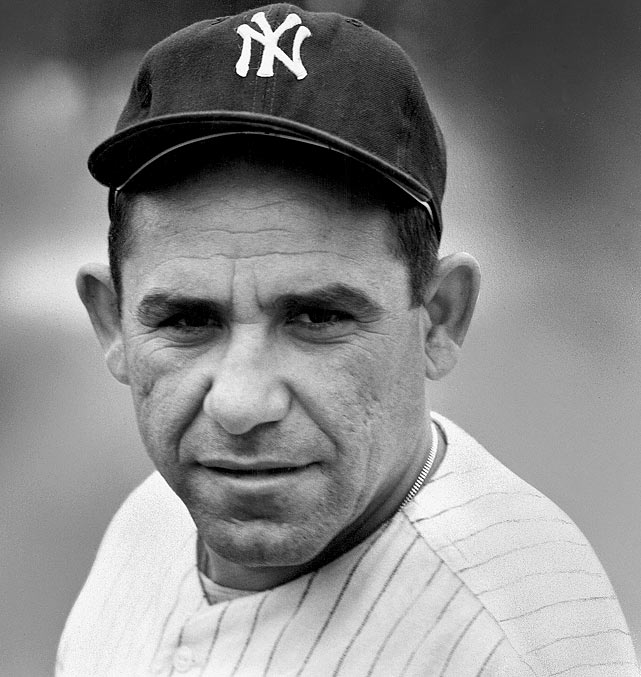
Most of you have heard the story of how young Larry Berra of St. Louis, Missouri picked up the nickname “Yogi” on his way to becoming an American sports icon and the only inspiration for the famous cartoon character, Yogi Bear. If you’ve ever wondered who the model yogi was for that divinely inspired identity alteration, I’m right in there with you, but let me warn you before you read even further: I still don’t know – and I’ve never met or read anyone else who apparently does. – That doesn’t mean it isn’t traceable or that we would not discover along the way that someone has quietly made a fairly safe rescue of the truth, but either never published it – or else, they published it too obscurely to be heard.

Let’s review what we know about how the nickname supposedly came about:

Factual Assertion # 1: When Berra was a young adolescent, he and some of his buddies from the Italian neighborhood in St. Louis known as “The Hill” went to the movies together. Since Berra was born on May 12, 1925, that would have put the year at about 1938 to 1940 tops, but I’m betting 1938, when he was just turning 13. We would still need to research all three years.

Factual Assertion # 2: As per usual with this movie period, Berra and friends witnessed a movie newsreel of current events. As a sort of earlier version of television’s “Entertainment Tonight,” these short extra films on world news usually featured and concluded with light stories designed to grab their American audiences into an “aw, look at that” state of attention. On this particular day, the newsreel featured film of a real Nation of India yogi in action (or inaction, to put it more technically.)

Factual Assertion # 3: After the movie, one of Yogi’s buddies (it may have been Joe Garagiola, but I’m not sure) said something like: “Hey! That yogi in the picture show looked a lot like Berra here. From now on, let’s call Larry by a name that fits him better. Let’s call him “Yogi Berra.” Berra apparently didn’t object and the name stuck. He was on his way to becoming Yogi Berra for the rest of his life, even if his mother and father didn’t know about it for quite a while.

Our Question: Who was the actual yogi figure that inspired this transfer of his title young Lawrence Peter Berra of St. Louis?

If you were going to research it, I would suggest these steps:

(1) Do a library/Internet search of what has been written on this subject and proceed to follow up on any questions and contacts discovered.

(2) Talk with Yogi Berra and Joe Garagiola, asap, if possible access can be arranged. Neither is getting any younger. Try to find out all you can about the year of the actual occurrence – and anything else they remember about the actual yogi film clip.

(3) There were only a few studios that did newsreels prior to World War II. Find out who they were – and how much availability you might be able to get for the sake of researching the question. Sometimes the knowledge that you are doing research for history is a turn-key to normally closed doors.

(4) Take whatever you find on film back to Berra, Garagiola, and other surviving members of that movie trip day in long ago St. Louis. Visual evidence sometimes can reawaken memories that are no longer available as conscious thoughts. – The photo of “Yogi Who” shown above is of an Indian mystic from that late 1930s period, but I’ve misplaced my record of his name and the news article I found on him in a search on this same question years ago. I’ve always thought he may have been the inspiration because of his similar facial resemblance to Yogi Berra. *

* Correction: I once had an unidentified photo from a 1930s yogi that strongly resembled this one, but the one I mistakenly used here is Mike Myers, as he appeared in the movie, “The Love Guru.” Frequent contributor Cliff Blau discovered my error and left a correctional comment below, something I always welcome when I get things wrong. The Myers photo was only listed in my files as “Yogi Mystic” – and I had never seen that movie and had failed to recognize the actor in make up in the photo used here. I thought it was the one I never found. – Just another lesson we are never too old to learn or re-learn: Always label your written and photo material accurately – or don’t use it. My apologies.

(5) In the end, if this research project doesn’t hold all your attention, you may want to turn your energies to this less academic research query. It’s one of much greater practical importance, but not nearly as much fun as the Yogi name quest.

Here’s the question: Given the current direction of our American economy, and no matter who wins the presidential election in November, how are we going to keep making a living in 2013?

Are The Texans Creating Some New Bad Luck?

March 22, 2012

Houston Texans GM Rick Smith: On his way to his office to pull the plug on the deal that will send team captain DeMeco Ryans to the Philadelphia Eagles for draft choices and chump change chops at the salary cap.

What is it with Houston Sports teams? Or maybe we should start with: How many different ways are there to keep raising the same question or keep striking at the same point? Is Houston the most “bad luck” cursed sports city in America? Or are we just excellent at creating our own bad luck and then disguising it as so-called “random circumstance” in interplay with the laws of probability as our best explanation for why, most of the time in major professional collegiate sports, except for the Rockets in 1994 and 1995, when Michael Jordan was taking a two-season nap, our teams always end up in the “close, but no cigar” chair?”

The other day I wrote (again) about the painful UH Cougars loss in the 1983 NCAA basketball title game to NC State, 50-48. It all came down to a last second stuff at the basket that only became possible when Akeem Olajuwon allowed himself to be pulled out of defensive position under the basket.

Was that bad luck?

Was it bad luck in Pittsburgh at the 1979 NFL Championship Game when Oilers receiver Mike Renfro was called pout-of-bounds on a TD catch that could have turned the game around for Houston over the Steelers?

Was it bad luck in 1980 when Nolan Ryan couldn’t hold a 3-run lead at home in the 8th inning of a game that could have sent the Astros to their first World Series?

Was it bad luck again in 1986 when pitcher Bob Knepper of the Astros couldn’t hold a 3-0 lead at home in the 9th inning over the Mets in the NLCS Series, blowing a win that would have tied things and forced New York to face nemesis Mike Scott in Game Seven?

Was it bad luck in 1989 when Nolan Ryan left the Astros for the Rangers after Houston owner John McMullen asked him to take a pay cut?

Was it merely bad luck in 2005 when Albert Pujols of the Cardinals hit that monster shot off Astros closer Brad Lidge in the NLCS, forcing the club to use Roy Oswalt one more time for the clinching NL pennant win that also knocked him out of his planned start in the World Series – a series that included plenty of its own “bad luck” plays on the way to a 4-0 sweeping win by the White Sox?

Are the Texans’ current personnel losses due to the bad luck fall out of signing superstar running back Arian Foster and now being to close to the salary cap to keep two of their best defensive players, Mario Williams and DeMeco Ryans, plus several others who have now signed elsewhere?

Houston has a bad habit of reaching for the top rung and then falling short. Is that because our clubs don’t reach high enough? Or because they don’t see where the top rung really is? Are we just being led by stupid and inept office people? Or is it because meddlesome owners eventually always get in the way? Or is it due to the fact that the cost of getting there is always just a little too steep for ownership’s pockets? Or is the cost of winning today so high that it can  only be sustained for a season or two before you have to give up the players who made you competitive?

Or, in our case, is it just plain old bad luck – served up Houston-style?

Rogers Hornsby: Baseball’s Mr. Cranky

March 21, 2012

Rogers Hornsby may have missed ever meeting Will Rogers.

Native Texan Rogers Hornsby was one of the greatest hitters in baseball history. His lifetime .358 batting average for 23 seasons  (1915-1937) in the big leagues is still the highest lifetime career mark for all right-handed batters and, even though his seven batting titles speak volumes for themselves, it remains important to remind that two of those were achieved with yearly averages over .400. Hornsby’s .424 mark for the Cardinals in 1924 is till the highest one-season batting championship mark to ever take the championship in either league.

Hornsby continued to fiddle with occasional hitting well into the late 1930s during his frustrating time as manager of the lowly, poorly talented St. Louis Browns, but, when he whacked his last safety in 1937, he was still 70 hits shy of 3,000 career hits. A lot us seriously doubt that getting to the currently revered magic mark was much of a big deal to Hornsby or anyone else back in the days of the Great Depression. Batting Average and Hoe Run totals were the big deal back then. And, in that regard, “The Rajah” didn’t fare too shabby with the long ball. His 301 career HRs fell less than halfway up the hill to Babe Ruth’s record 714 mark, but they were better than most.

I saw Hornsby in person when he managed the Beaumont Roughnecks of the Texas League to the straight season league title with future big leaguers like Gil McDougald and Clint Courtney in 1950. Beaumont then got eliminated in the first round of the Texas League post-season playoffs, falling to the eventual league champion San Antonio Missions, but that fall detracted little from the noise they made around the state under Hornsby that particular season. Hornsby also did pretty well as a playing manager back in 1926 when he led the St. Louis Cardinals to Chapter One in their storied history of 11 World Series titles. The Hornsby ’26 Cards won that dramatic 7-game series comeback win over Babe Ruth and the New York Yankees to get off the championship goose egg.

Most years like 1926 and 1950 were not there for Manager Hornsby. Stories of his rigid, humorless attempts to make others behave as though they were him are legendary – and universally frustrating too. Like a few other great athletes who later tried to manage (Ted Williams comes first to mind), Hornsby expected less talented players to perform far better once he explained and demonstrated his knowledge of hitting. The failed projection of heroic expectations upon lesser lights was compounded as a problem by Hornsby’s tight ideas of what a player should be doing when he wasn’t playing. – Not much to nothing come closer to the truth.

That old saw of Hornsby’s answer to the question, “What do you do in the off-season,” come close to the truth about how Hornsby approached almost all time away from the ballpark. Remember? Hornsby supposedly answered that he killed the off-season time by simply staring out the window and waiting for spring.

That wasn’t true. In spite of the fact that Hornsby did not smoke, drink, chase women, or even go to movies (He felt they were bad for his batting eye.), Hornsby had one obsessive human failing that almost did him in. He love slipping away to bet the horses whenever the team came to near to a track during racing season. As a result, he ran up some heavy gambling debts and came close to getting in fatal career trouble with Commissioner Kenesaw Mountain Landis. Hornsby may have been saved by his celebrity and record of accomplishment and the fear of Landis that really going after one of the game’s great achievers might be bad public relations for baseball.

In his next-to-last incarnation as a big league manager for the 1952 St. Louis Browns, the players actually conspired to get Hormsby fired. “It was force him out or kill him,” former Brown Ned Garver once jokingly told me, adding, “It isn’t right to stay that mad at one man all the time.”

“We (the ’52 Browns) weren’t all that good when we tried,” Garver added. “Management didn’t need much convincing to see how bad we could be if we didn’t try at all,” he added. Convinced the Browns were serious in their open rebellion against Hornsby, the Browns cut him loose in favor of Marty Marion in mid-season. The Browns also traded the rebel Garver to Detroit.

Hornsby got one final shot as a manager with Cincinnati in 1953, but they fired him too before the season was done, replacing him with Buster Mills. It was Rogers Hornsby’s last big league managerial opportunity. The baseball world was finally convinced: Rogers Hornsby is too unlikeable and he never seems to learn.

In spite of his selection for the Hall of Fame in 1942, eleven years later arrived as the time when Hornsby would finally leave his last really serious job in baseball, although he would continue to hang around the game until the day he died. Rogers Hornsby on a trip to Chicago on January 5, 1963 at the age of 66.

The late Buddy Hancken of Beaumont, a longtime respected baseball man and a former Houston Astros coach tells this quick story that probably summarizes the Hornsby problem best. It was not just a problem with players in particular. It was a problem with people in general. Put Rogers Hornsby in an area filled with other people – and Rogers would rapidly become everyone’s “pain in the area.”

Buddy put it this way:

“Back in 1950, I was managing in West Texas so I rented my house in to Hornsby in Beaumont so he could manage the Roughnecks, When I returned at season’s end, Rogers Hornsby was already gone, but it seems like all my neighbors found the time to drift over and welcome me home. – One of them finally blurted out the whole truth. The neighbors weren’t just glad to see me back. They were really glad to see Hornsby gone. – ‘Hornsby was the unfriendliest man I ever tried to meet,’ the neighbor said, as he added, ‘He was the biggest jerk that ever rolled into Beaumont, Texas.’ ”

Have a nice day, everybody. And stop staring out the windows too. Wet as it is Houston today, spring arrived yesterday.


Galveston Pleasure Pier Opening Set for May 2012

March 19, 2012

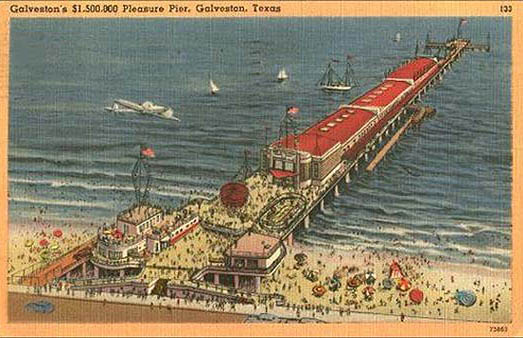
Pleasure Pier, Galveston, 1948-61, Seawall @ 25th. Tilman Fertitta is bringing it back, bigger and better, in May 2012.

In the years following World War II, trips to Galveston always brought to mind the enormous Pleasure Pier at Seawall and 25th. Built in 1948 as a recreational facility for the military stationed on Galveston Island, the place converted into a commercial fun spot to go that really didn’t die until Galveston got whacked by Hurricane Carla in 1961. After Carla, the site pretty much rested in shambles until the Flagship Hotel was built on the site in 1965. Then, already well beyond its better days, the Flagship took its own hurricane hit from Ike in 2008 and went into waiting for its current resurrection in new form.

Tilman Fertitta to the commercial rescue.

Restaurant magnate and Galveston native Tilman Fertitta is now in the process of restoring the seawall site to a state beyond its former glory. A 1100 foot long extension from the beach into the Gulf of Mexico is under rapid construction to bring back the glorious Pleasure Pier in a form it never knew the first time. For $60 million dollars, the new Pleasure Pier will feature modern incarnations of the old carnival rides, places to buy souvenirs, do more serious shopping, dine, and be entertained in ways that Fertitta hopes will help Galveston continue to sell itself as something more than a day trip destination of local tourists.

In spite of the murky gray Gulf waters, Fertitta and Galveston want international tourists to eventually see Galveston Island as the Texas version of Florida’s South Beach. They have some ground to cover to reach that goal, if ever, but that’s another story for another day. Big dreams have to start somewhere – and they seem to require the presence of dynamos like Tilman Fertitta to even have a chance. For now, I’m sure that Fertitta and Galveston will settle for delivery on their planned May 2012 Grand Opening and an overflowing crowd that books 90% of the best hotel rooms on the Island.

Channel 13 did a nice tight story on the new “Pier” recently and it is available at the following link.

http://abclocal.go.com/ktrk/story?section=news/local&id=8523095

Have a nice week everybody and, if you live in Houston, watch out for the frog-strangler rain that we are supposed to get on Tuesday.

Rob Sangster: Chairman of the Bored No More

March 18, 2012

Rob Sangster: Gentleman. Scholar. Lawyer. Traveler. Adventurer. Activist. Writer. Admirer of Women. Good Friend. And Damn Good Citizen of the World.

It is October 1955, the autumn of my senior year at St. Thomas High School in Houston with the Class of 1956. I am sitting in Religion to the left of my left-handed buddy, Rob Sangster, and I can’t help noting that he is writing something down with apparent fervor. Thinking that Rob may have picked up on something from Father Allnoch’s lecture that I missed, I am compelled to look over at his paper and check what he has jotted down in such clearly distinctive cursive script:

“Chairman of the Bored” is Rob’s quiet and quick message. It makes me smile. I have to give nodding approval to Rob for seizing the thought into consciousness ahead of me and placing it in written form for a fairly immediate audience response, even if is just me, but that’s OK. Even if Rob and I do not cruise for girls or play ball together, we seem to have a friendship that isn’t necessarily measured by mutual tail-gunning experience in flights over Nazi Germany, but by the empathy chords and hunger yearnings for the “deeper meaning” of issues that are starting to crash into our adolescent encounters with life.

Rob is my seat mate on a CYO (Catholic Youth Organization) bus trip to Galveston just prior to our junior year. Rob helps me work through the disappointment I am feeling over the loss of my first girl friend. Rob helps me see the deeper meaning of my sorrow. “Bill,” Robs advises, “maybe this sort of thing wouldn’t happen to you if you simply stopped robbing the cradle for new girl friends. As a guy whose about start his junior year, you are way too old to be dating freshmen girls the next time.”

I take Rob’s advice, but continue to run into broken hearts for quite a while. Rob and I then graduate in 1956 and we lose complete track of each other until 2011, when, because of the Internet, we catch up with each other again through an electronic digital reunion.

Wow! What this man has done with the 56 years that have now passed since the STHS Class of 1956 graduated is phenomenal. In short, he seems to have fulfilled every adventure he ever dreamed of having as a kid – and others that only come into view for those who seek the open doors of new opportunity and then discover what rests beyond the walls and over the mountains and across the oceans without somewhere along the way selling out to the usual stopping points of conformity and complacency. Most people halt in the safety-first comfort zone before they ever get to see much of life at all. Not Rob Sangster. His life has been an odyssey.

I can’t pretend to relate all the details of Rob Sangster’s adventure. That’s his job and right to do so anyway. All I can do is tell you what I’ve learned for the sake of making my point. The guy is alive and healthy, and looking very much like that photo above today, because of both his genes and his life style commitment to making his life all that life can be. And, like me, he’s 72 years old, but swimming in a lifestyle that floats like the Fountain of Youth.

In 1956, when I was registering at UH and getting ready to work my way through college, Rob Sangster was off to Stanford in Palo Alto. After Stanford, Rob then graduated from law school at UCLA, I think. He practiced law for a while, but that wasn’t enough to stave off his need to avoid the “chairman of the bored” experience in our adult world’s real-time portion of life.

Rob married somewhere in there, but I know nothing of his marriage experience, nor does it matter to the point of this column. Today I know that he has a girl friend and that he now lives in Nova Scotia.

Sangster left the law field to see the world, moving his way literally over the tallest mountains and deepest oceans, traveling or living in over 100 countries at one time or another, writing a newspaper column and becoming a professional travel/adventure writer. Check out this website page for further information on this phase of his life:

http://www.transitionsabroad.com/information/media/rob_sangster_bio.shtml

Today Rob Sangster is working on his first novel. We understand that it will be a story in which the survival of the world hangs in the balance. And yep. I get it. – Doesn’t sound like “chairman of the bored” to me.

Rob Sangster is one of those rare people who understood early that his life experience would hinge on his ability to weigh the risks-rewards of adventure and proceed from there with a willingness to take responsibility for the consequences of his actions – and inactions. While some of his old buddies were still struggling with questions like “how old should my girl friend be?”, Rob already had taken a handle on the reality that none of us are entitled to anything we aren’t willing to work for.

Rob’s grasp of the lesson that life is not about entitlements, but about our willingness to take responsibility for what we do, and fail to do came through loud and clear in a private note he e-mailed me yesterday in response to my column, “The Ghost Rules of Eagle Field.” You will get it too – just as soon as you see it. Here’s what Rob Sangster wrote to me about his own first childhood baseball experience:

“On my first big-time at bat the first three pitches were called balls. Then I watched  three in a roll called strikes. I vowed never to let that happen again – in life as well.” – Rob Sangster.

Thanks for the great explanation of entitlements as balls taken while waiting on a pass to first base and personal responsibility as the act of not taking three strikes, but risking some cuts at the ball in the game of life. If I’ve got a kid on his way up, or a grown up kid who is still looking for the lesson, I want him or her to read the wisdom of Rob Sangster at least daily until he or she gets it too.

Nothing in life that’s worthwhile comes free. And it isn’t bad luck that gets us, or the absence of opportunity in America that holds us back. It’s our willingness to settle into a comfort zone with whatever is safe and familiar – and our refusal to take a swing with all it takes at something we feel passionately about. Fulfillment does not come knocking on the door like an entitlement check. Never happens.

Thank you, Rob Sangster, too, for reminding us of the words we also heard early and often from the late and wonderful Bobby Bragan:“You can’t hit the ball with the bat on your shoulder, you got to stand in there and swing!”

Bobby Bragan and Rob Sangster are both icons of passion-fulfilled in their own unique ways. Neither expected reward to come their way as a free pass to first base. Both reached for everything possible from the parts of life they each felt passionately about. And both are exemplars of how to live life to the fullest.

Thanks for rolling out that batting metaphor, Rob. As you can see here, it made my day.

The Ghost Rules of Eagle Field, 1946-1954

March 17, 2012

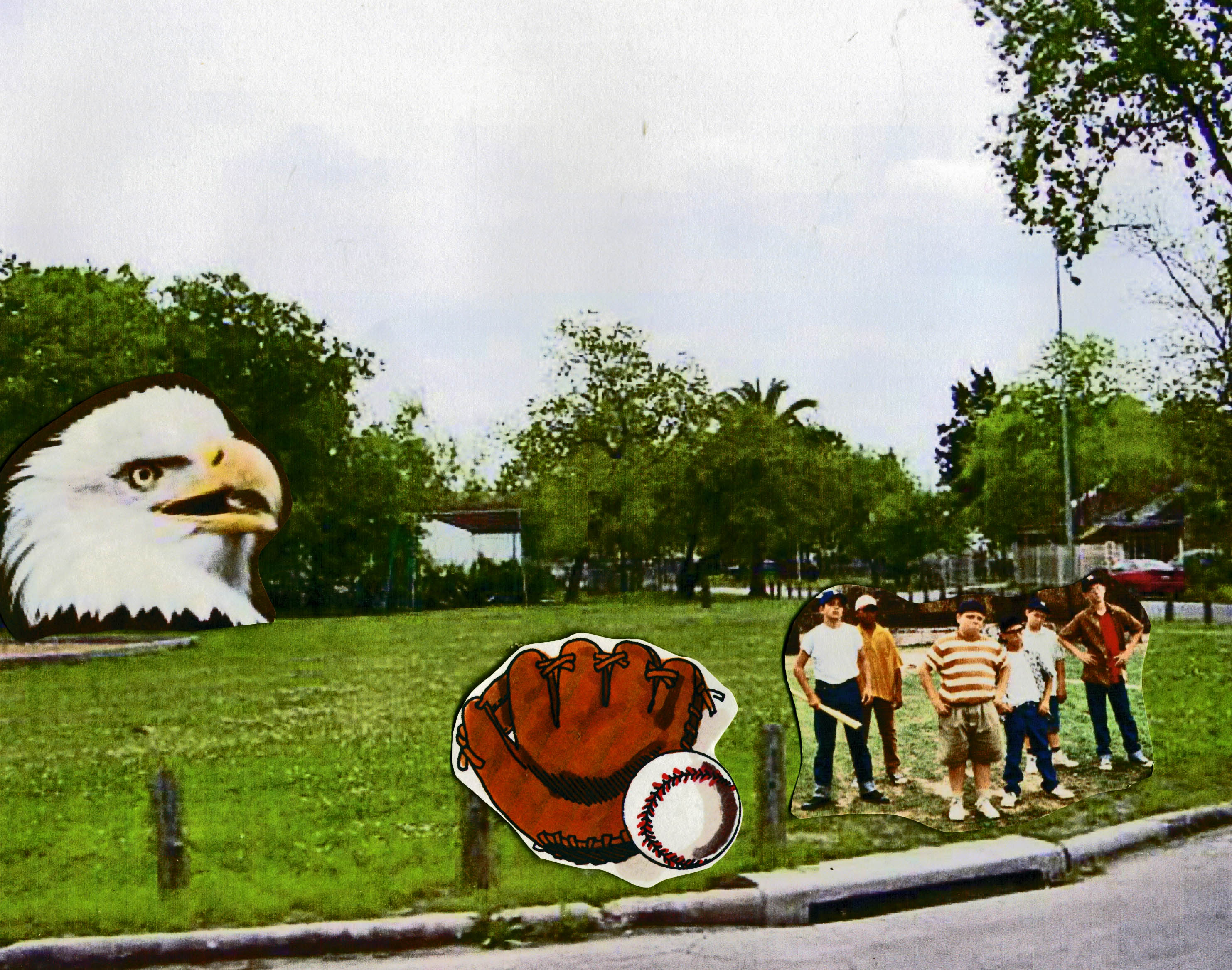
Eagle Field served as the home of the sandlot club we called the Pecan Park Eagles in 1950, before organized ball opened up big enough to handle all of us Houston kids who wanted to play on "real teams." The Eagles were real enough for me. My heart still soars with their blessed memory. - Eagle Field existed on a Houston city lot still operated today as a playground in the east end at the fork-corner of Japonica and Myrtle in Pecan Park near I-45 and Griggs. In 2012, the place now bears the name of Japonica Park - with no reference to the "Eagle Field" identity that we once gave it some 62 years ago.

My primary years on Eagle Field were 1948 through 1952, with 1950 serving as the year we organized the Pecan Park Eagles in reaction to the fact we felt that none of us from the neighborhood had been given a fair shake at the Canada Dry Field tryout for places on the eight first Little League teams set to compete in Houston that season. We weren’t interested in the problems Little League organizers had pleasing very many of us back in 1950. We just knew that none of us had been given much of s chance to show what we could do at their tryout camp. There were only about 500 of us kids, all boys, from all over the city that showed up that day at the tryout scheduled at Canada Dry Field on the Gulf Freeway. So, in short, my buddies and I formed the Pecan Park Eagles in compensation for our disappointment. – And we even had a girl player. Little Eileen Disch could pitch and hit for contact as well as any of her male Eagle teammates.

The culture of Eagle Field was like sandlots everywhere after World War II – and most probably the same as any other group since kids started playing the game in the 19th century. Here are a few of the ghost rules that governed everything, at least, here are the ones that stand out in my memory:

(1) Hind Catcher. Little kids had to prove themselves before they were allowed to take up space on the field. The exception to the rule kicked in on days when several good players were unavailable. On those days, you put anybody who could breathe on the field, just to have enough players to play the game. You figured: If the kid in right field can’t catch it, he can always still run after the ball so we can keep the game going.

Otherwise, the little ones got to play hind catcher. You could have as many hind catchers as you had applicants. In the absence of a backstop, a lot of balls got past the real catcher, who basically played with a glove and no protective equipment. It was the hind catcher’s job to chase the loose balls down the street. On kind-spirited days, we would allow the hind catchers to take a single time at bat in a special extra inning after the game that really didn’t count.

We all started that way, but it worked out. To get in the game, ll you had to do was show you could hit, throw, and catch the ball. If you had a little foot speed, that helped too.

(2) Swing, Batter. Catcher all talked to the hitters on the other team. It was yesterday’s version of today’s trash talk, as the catcher constantly worked on the hitter’s concentration and confidence in the hope of eroding both. “Swing, Batter” is my name for the whole act. Our catchers used that famous call to shaky batters, saying a progression of thoughts that came out something like this as the pitcher wound up to deliver and finally threw the ball: “OK, BATTER … DON’T SWING … DON’T SWING … DON’T SWING …. (then, as the ball arrived, it changed to) … SWING!!!” – Sometimes it worked.

(3) BURN OUT. BURN OUT was a pecking order game you played with those who came to challenge your place in the pecking order of things. The object of Burn Out was to make your partner sorry he had ever agreed to play catch. Both players threw hard as they could. It also helped if you could throw a fast ball that dropped in about three inches from the ground between the other player’s ankles. Burn Out ended when one of the players either said he’s had enough or else, just walked away from making further throws. And things got settled – without a word being said.

(4) GLOVE KICK. It must come naturally from some instinct that flows through the neuromuscular structure of anyone who’s ever tried to steal a few bases or stretch a double into a triple. When you are sliding into a base against a fielder who is showing you the white of the ball in his glove as awaits putting you out, what do you do? That’s right! – You kick his glove! Pop that ball out of the web to make sure you’re safe. Until fielders get old enough and good enough to stop showing the white of the ball on a slide to the runner, the glove kick is a runner’s best friend.

(5) STEAM ROLL I learned this one the hard way. It’s why you don’t stand in the baseline any longer than necessary when you take a throw at first base. In fact, it’s better that you never stand there, if possible. During my first try as a first baseman, a rather large building of a kid with legs ran over me at first like a steam roller. I literally saw stars. I had to regain consciousness before I could continue playing, but I did. They had to tell me that the put out on “Sluggo” still stood since I held on to the ball in spite of the collision, but you could not have proven it by me.

(6) HIDDEN BALL  The world’s oldest baseball trick was standard procedure in its use on little kids of 6 to 8, just breaking in from hind catcher and used to taking orders. It taught the little kids to stop listening to their elders and the lesson unfolded like this: Let’s say you have a little kidding running at first base. If you are the first baseman, you walk to the mound to talk with the pitcher, but you come back to first with the ball hidden in your glove. The little kid doesn’t know that you have the ball, but he’s giving you this smug smile that says, “You can’t get me. I’ve got my left foot on the base and right foot point toward second.”

Then you throw the kid a mental curve, knowing that he’s just coming up from hind catcher duty and used to taking orders. “Hey, Kid,” you say, “somebody’s going to break a leg stepping on that rock up the baseline toward home. Ho dig it out and throw it out-of-the-way.” Still eager to please and fit in, the little kid does as you say. – And when he leaves the base, you tag him out with the ball.

Had that one pulled on me. And then later, I pulled it one little kid, but couldn’t do it twice. It felt too much like a dirty trick, unless, of course, you pulled it on someone who was old enough to know better. Then it was good baseball. – We learned this “situational ethics” thing early on the Eagles.

(7) Phantom Ball. Long before any of ever read anything about the phantom ball tricks of the 19th century, we figured out on Eagle Field that sometimes you may be able to fool a few enemy base runners with a phantom baseball throw. We worked it against  team that the go ahead run in the form of a man on third when our catcher called time to speak with the pitcher at the mound. While he was there, the catcher his the real game ball in his glove and started walking toward the plate. When he got back and turned around, the pitcher yelled at the catcher to throw him the ball, The catcher turned his mitt over, exposing the ball to all, including the runner down the line at third.

The catcher then turned the glove over again, hiding the game ball from sight, as yelled something like an apology for his absent-mindedness back to the pitcher, During this distraction, however, the catcher was secretively pulling out another ball with brown paper taped around it. Then he pulled his glove up to mask the fact he was about to throw this other ball, and not the game ball, back to the pitcher. The game ball remained hidden in the pocket of the catcher’s mitt.

By intention, the catcher released a high errant throw of the ringer-ball over the pitcher’s head. The runner at third came home on the basis of that image where he was promptly tagged out by our adroit catcher. Much arguing ensued, but the put out was allowed to stand as the third out of a game we eventually also won by a single run. It was probably an illegal play by 1950, but we thought it was legal – and back in 1950, what we thought was so often made it so. – Come to think of it. Some things haven’t changed much since then.

Long Live the Pecan Park Eagles! – Every now then, I have to dig up their memories and feel that soar into summer on the sandlot again.

Please bear with me.

1983: Memories of the UH-NCS Game

March 14, 2012

April 4, 1983: Lorenzo Charles dunks the winning basket for NC State in their 52-50 victory over Houston in the NCAA final game at Albuquerque.- Coach Valvano launches into insanity run as the face of shock in celebration.

Most of us Cougars remember it as the UH game in all sports that we would most prefer to forget. Yet here I sit near the 29th anniversary of its cruel unfolding, writing about it again. Thank you, Sacher Masoch, for being a little more than am historical figure of Freudian speech. Maybe I will get you out of my system this time.

As many of you recall, 1983 was the nationally famous college basketball season of Houston’s famous Phi Slama Jama club featuring Hakeem (know then as Akim) Olajuwon and Clyde Drexler rolled into the championship game at “The Pit” in Albuquerque, NM as the heavy favorite to roll over the challenge of the Wolfpack from North Carolina State. UH was coached by the legendary Guy V. Lewis; NCS was led by the young “back east” upstart named Jim Valvano.

There was no 3-point line in those days; and no shot clock. Phi Slama Jama bedazzled foes in those days with some athletic big man work in the post, good perimeter shooting, speed on defense, and an adept use of Coach Guy’s four-corner keep-the-ball-away-and-kill-the-clock defense late in the game.

April 4, 1983 did not work out so well for the Cougars.

NC State took a quick 6-0 lead, before UH roared back to go ahead, 7-6. The rest of the game was fairly nip and tuck, with UH appearing to pull away late when Michael Young’s shot made it 40-35, Cougars. With the Wolfpack on the ropes against the late game razzle dazzle, Lewis mad the decision that most probably (and still unfairly) has kept him from election to the Basketball Hall of Fame. Instead of keeping the offensive pedal to the metal, he elected to go into the four-corners defense and try to run out the clock.

NCS countered by fouling, sending UH to the line to miss free throws that the Wolf pack then captured and adrenaline-drove back into a tie with UH and time running out. With 13 seconds to go in a 50-50 game, NCS inbounded for a one last shot try at winning the game. Then came the play that did the Cougars in.

After one attempt to drive the ball to the left perimeter was well guarded, NCS moved the ball back to the center of the court to guard Dereck Whittenburg, near the mid court line. At the moment of contact, one of the Cougars (I forget who) tried to steal the ball, but he only succeeded in causing the ball the bounce a few feet away.

That trickle bounce away from Whittenburg for maybe a full second only was enough to change everything. The visual of the briefly free ball under these dangerous circumstances was enough to draw all five Cougars reflexively toward the ball, including Olajuwon from his distant spot away as guardian under the basket.

Whittenburg quickly recovered the ball and, with time running out, he got off a high arching 30-foot air ball shot in the direction of the basket. And sadly for UH by this time, Olajuwon is no longer in the basket area. The ball is apparently destined to miss the basket and send the game into overtime.

Not to be.

Before the buzzer can sound to end the game, NCS forward Lorenzo Charles zooms in from out of nowhere, grabs the uncontested ball that no doubt would have gone to the taller, more dominant Olajuwon, had he remained home. Charles stuffs it for the uncontested winning basket and a 52-50 NCS victory in the finals that launches that pirouetted dance down the court by Coach Valvano that we have been forced, ever since, to watch every year during March Madness time – and always for us, in bleeding commemoration of our greatest Cougar sorrow.

Just thought I’d beat the national writing suckers to the punch this year.

If there is an NCAA title for Intimacy out there, it should go to my Houston Cougars. No one else is more famous for “getting close” than we are.

Jimmy Wynn Celebrates 70th Birthday with SABR

March 13, 2012

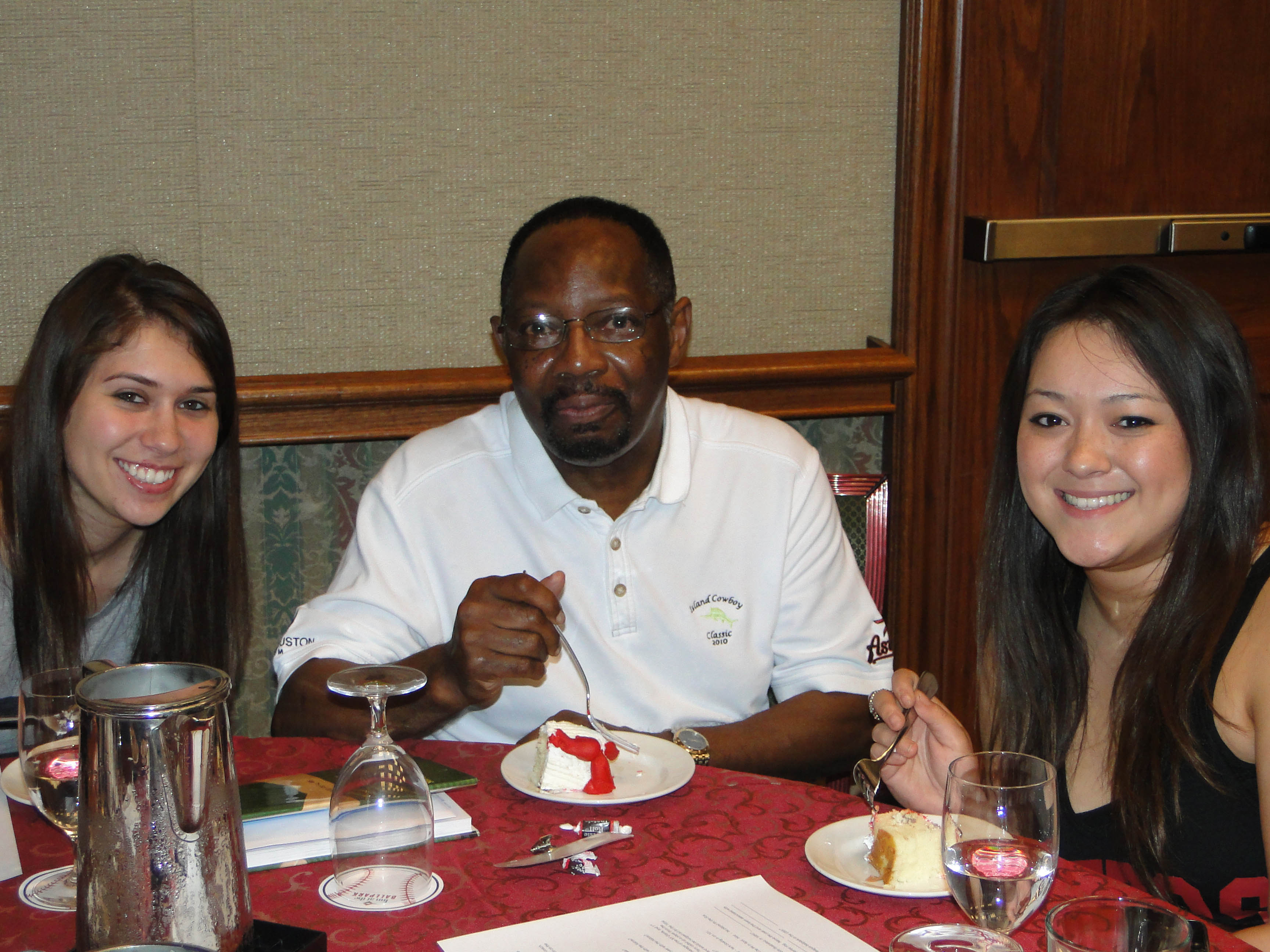
March 12, 1970: Jimmy Wynn celebrates 70th birthday at SABR meeting in Houston with two fans of the Toy Cannon.

Astros icon and SABR member Jimmy Wynn turned 70 years old yesterday, March 12, 2012, and we are grateful that he chose to spend the evening with his fans and fellow members of SABR, the Society for American Baseball Research. Meeting for the first time in the Yankee Stadium room at the Inn at the Ballpark downtown next to Minute Maid Park, about 35 members of the Larry Dierker Chapter welcomed the Toy Cannon with open arms for all he’s done, and still does, to make and keep Houston Astros baseball on the credible side in the public mind and trust.

This is special milestone year in the life and career of Jimmy Wynn. – It’s also been 50 years since Jimmy Wynn started in his professional career at Tampa in the Cincinnati Reds system; 49 years since he broke into the major leagues with the Houston Colt .45’s and hit the first of his 291 career big league home run off a New York Mets pitcher named Don Rowe; and 35 years, half his lifetime ago, that Jimmy Wynn hit his last major league long ball off Bill Travers of the Milwaukee Brewers.

Jimmy’s book end homers, first and last, both happened in two of baseball’s now vanished green cathedrals. His 1963 opening volley off Rowe came about in the old Polo Grounds, the immortal setting of Bobby Thomson’s “Shot Heard Rounds the World.” The closer bash left the deepest part of the field in center at old Yankee Stadium on Opening Day 1977 during Jimmy’s last season as a short-time member of the Yankee “Bronx Zoo” cast.

And last night was not only a time for memories of all the amazing things that Jimmy Wynn did with the bat and in in the field in between those two amazing times of his first and last big league seasons. Jimmy also quietly informed some of us last night too that he had been summoned to Minute Maid Park last Friday at the last minute. As it turns out, President Obama was in Houston to speak at Union Station that evening and had wanted to meet Jimmy Wynn.

Mission accomplished. – President Obama has now had the pleasure of meeting one of Houston’s finest: Jimmy “The Toy Cannon” Wynn.

I have to say what I mentioned to someone who asked me about it last night: Working with good friend Jimmy Wynn on his autobiography, “Toy Cannon,” was the most joyous writing experience of my life. We went into the journey (and all writing projects are journeys of some kind) as good friends, and, in spite of the fact that we had to deal in print with some not so pretty things that were part of Jimmy’s total life experience, we came out of it knowing that he had dealt with them all as honestly and forthrightly as possible and that Jimmy Wynn had still found room in the forever unfolding end to stand and walk tall into these now celebratory later years.

Spiritually today, I value Jimmy Wynn as though he were my blood brother. There is nothing to the good that I would not do for the man, if it were something in my power to deliver. He has every ounce of love and loyalty from me that any brother should expect to have from his own.

God Bless you, Brother Jimmy! And may we all get to inhale the fresh cut grass smells of spring training and a brand new baseball season for as long as possible – no matter how old we get to be.

One More Time: Happy 70th Birthday, Jimmy Wynn!