Auld Lang Syne Rules The Night

April 15, 2012

Fine landscape artist Sylvia Cameron and I attended school together here in Houston at St. Christopher's in Park Place from the 2nd through the 8th grades. Sylvia now has a show in progress at the Archway Gallery, 2305 Dunlavy, through May 3rd. "Umbrian Landscapes" is a great depiction of the Italian countryside.

Sylvia Cameron and her sister, Shirley Cameron, and I attended parochial school together from the mid-1940s through the early 1950s. It’s highly possible that by the time of our 1952 graduation day that we had never spoken to each other, let alone held a conversation, It was part of the culture that raised us back in the day. Boys and girls went to class together back in those pre-Vatican Catholic School Days, but we rarely, if ever, spoke or had anything to do with each other as the opposite sex. And the Dominican nuns who taught us pretty much kept things that way until we reached our final year there prior to moving on to the one boys and two all girls Catholic high schools in Houston.

Last night I shared more thoughts and words with Sylvia Cameron in smaller segments of time over two hours at her art show than I ever had in the seven years we attended school together and, in spite of our rather limited actual relationship with each other years ago as identifiable fellow students, it was good to see her again, see her beautiful art work, and good to learn a little about her wondrous life.

Shirley graduated from St. Agnes Academy in Houston in 1956 and then became a Dominican nun for fifteen years. I’m not sure what she did after she left the convent, but she obviously developed into the fine artist that she is today. Another fellow St. Christopher student who told me of the art show now featured at the Archway Gallery at 2305 Dunlavy, Garland (Debner) Pohl, also told me something I doubt many, if any of us, knew while we were classmates with Sylvia and Shirley Cameron back in the day:  They were the daughters of the family that owned Cameron Iron Works.

Wow! The owners of Cameron Iron Works! That was more than a chip shot away from where most of our fathers worked as members of the St. Christopher’s group, but you never would have known it by the humble and “just-two-among-us” behavior of the Cameron girls. The Camerons produced iron and raised kids with character of steel.

Bill and Garland (Debner) Pohl pose at The Archway Gallery in front of two paintings by our shared former classmate, Sylvia Cameron.

When I told Sylvia that I was glad I had been there Saturday night to see her work, I added words along the line that I felt she had brought great beauty to the world with the talents that God has given her. She thanked me and smiled, adding: “I’ve had a good life.”

Sylvia Cameron’s words were totally believable. You can see it in her work.
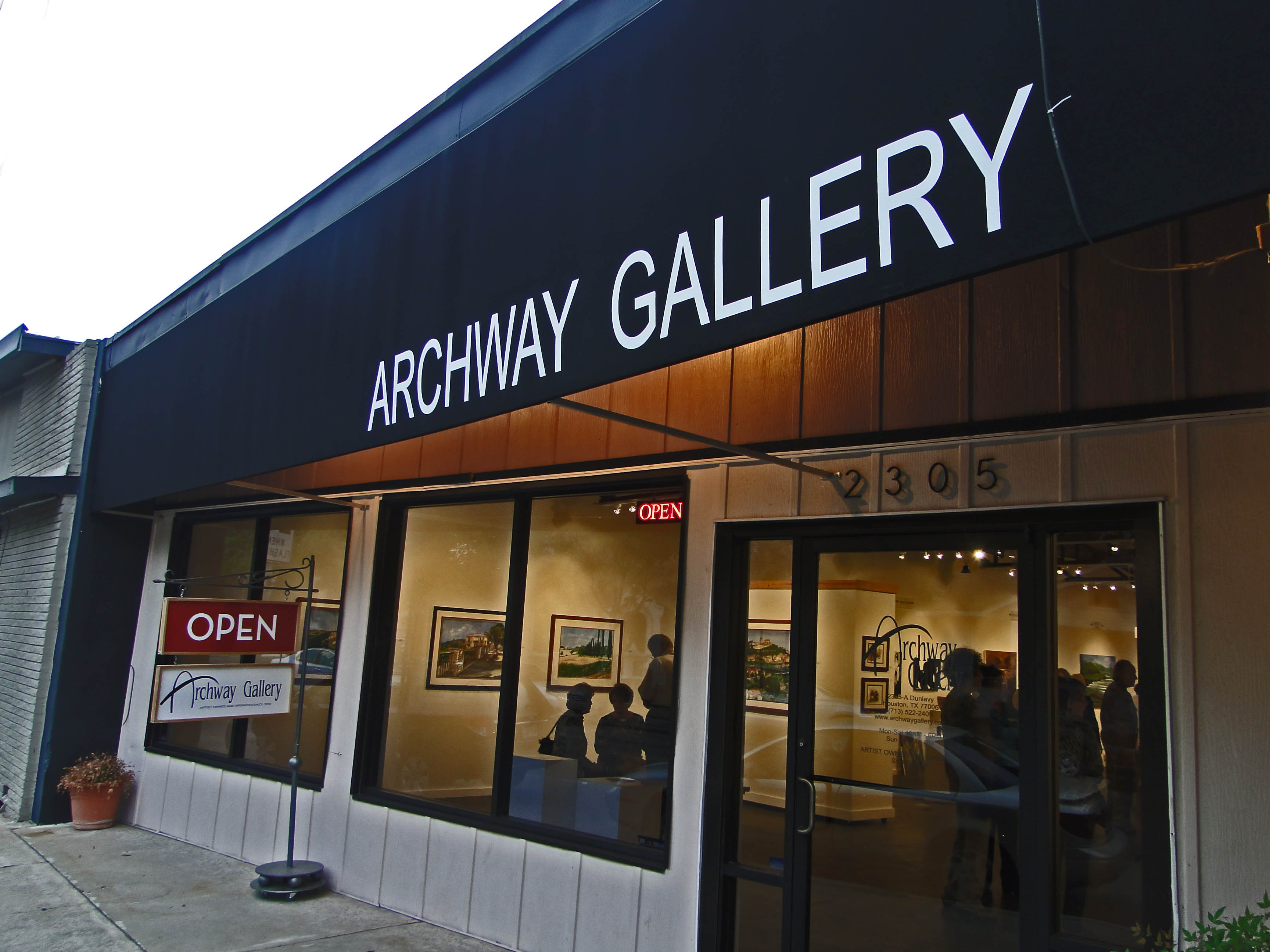
The Archway Gallery, 2305 Dunlavy, Houston, TX. Tel.: 713.522.2409

If you have any interest in Italy, Italian landscapes, or if you are planning a trip to Italy anytime soon, do yourself a joyous favor and check out the artwork of Sylvia Cameron that will remain on display at The Archway Gallery through Thursday, May 3, 2012.

The gallery is open to the public from 10:00 AM to 6:00 PM, Monday through Saturday and 1:00 PM to 5:00 PM on Sunday.

For further online information about “Umbrian Landscapes,” check out Archway’s website at this link:

http://www.archwaygallery.com/

Have a nice Sunday, everybody!


Random Baseball Rambles

April 14, 2012

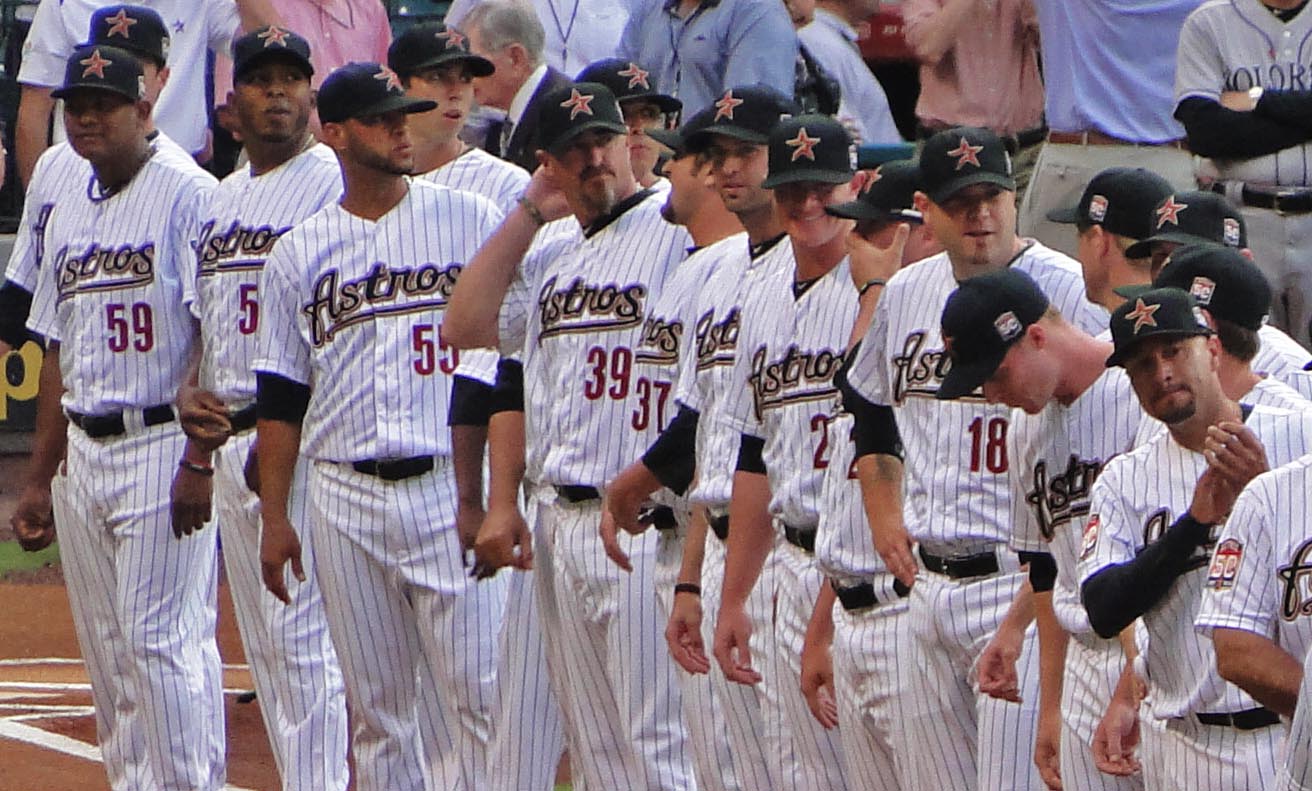
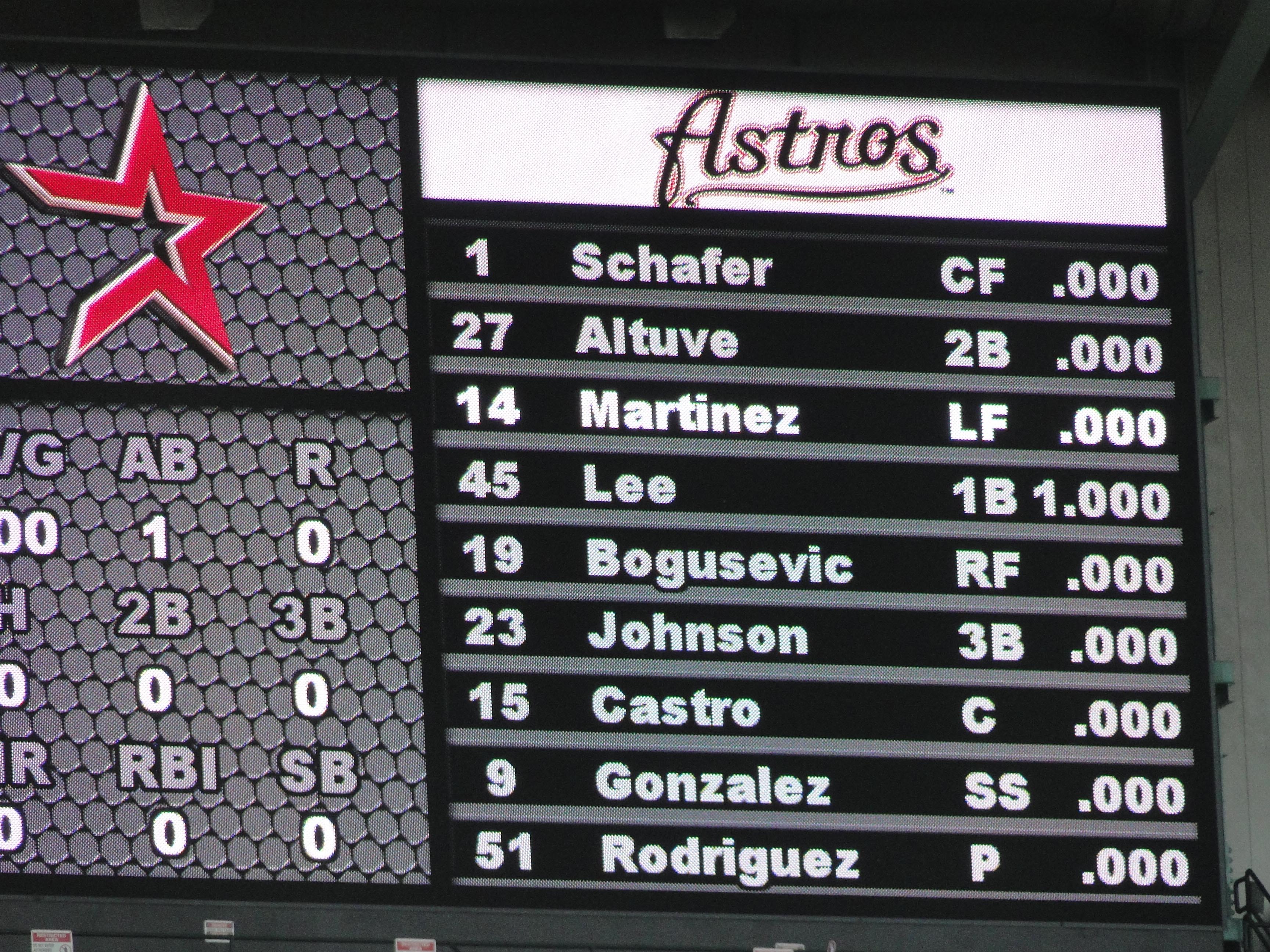
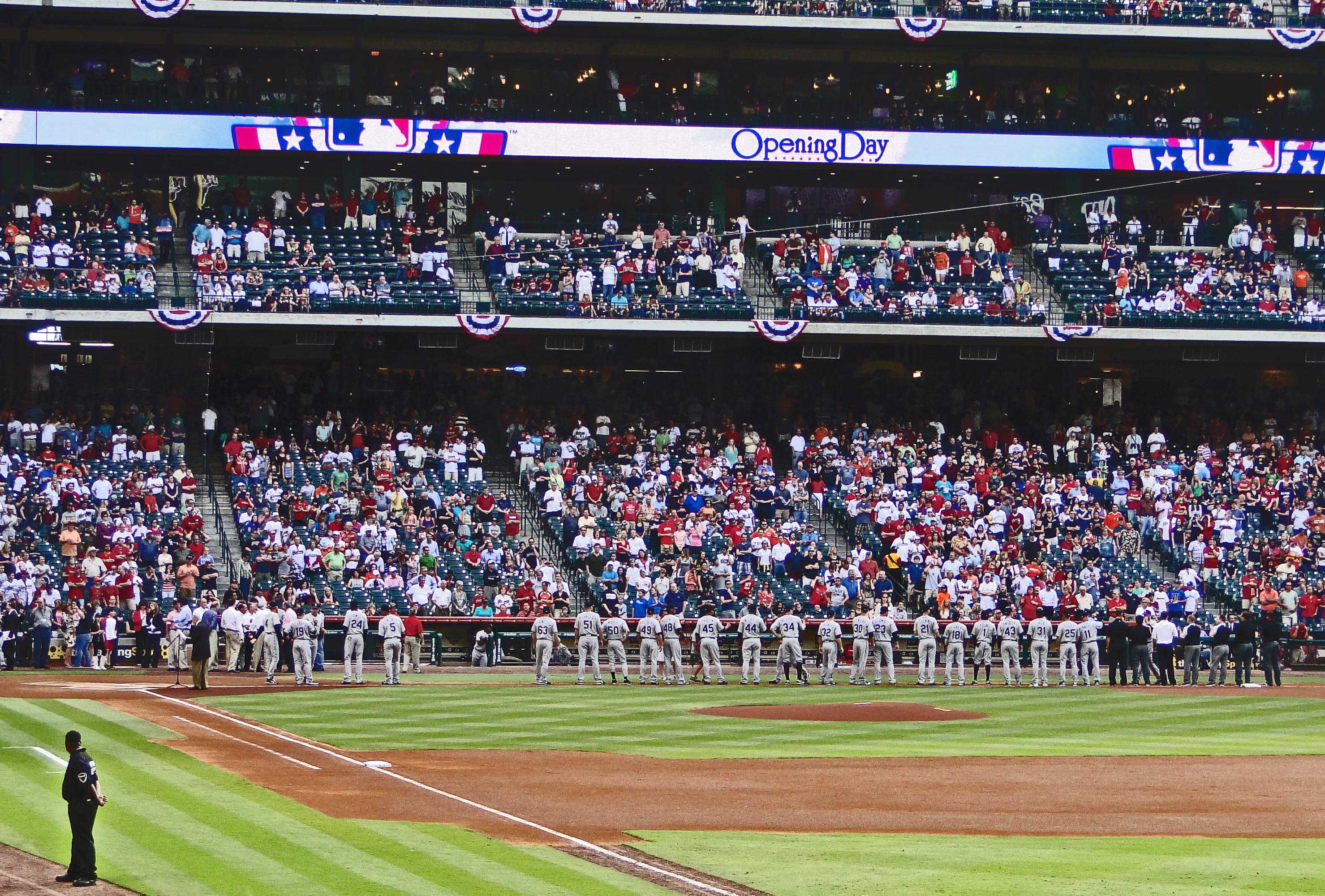
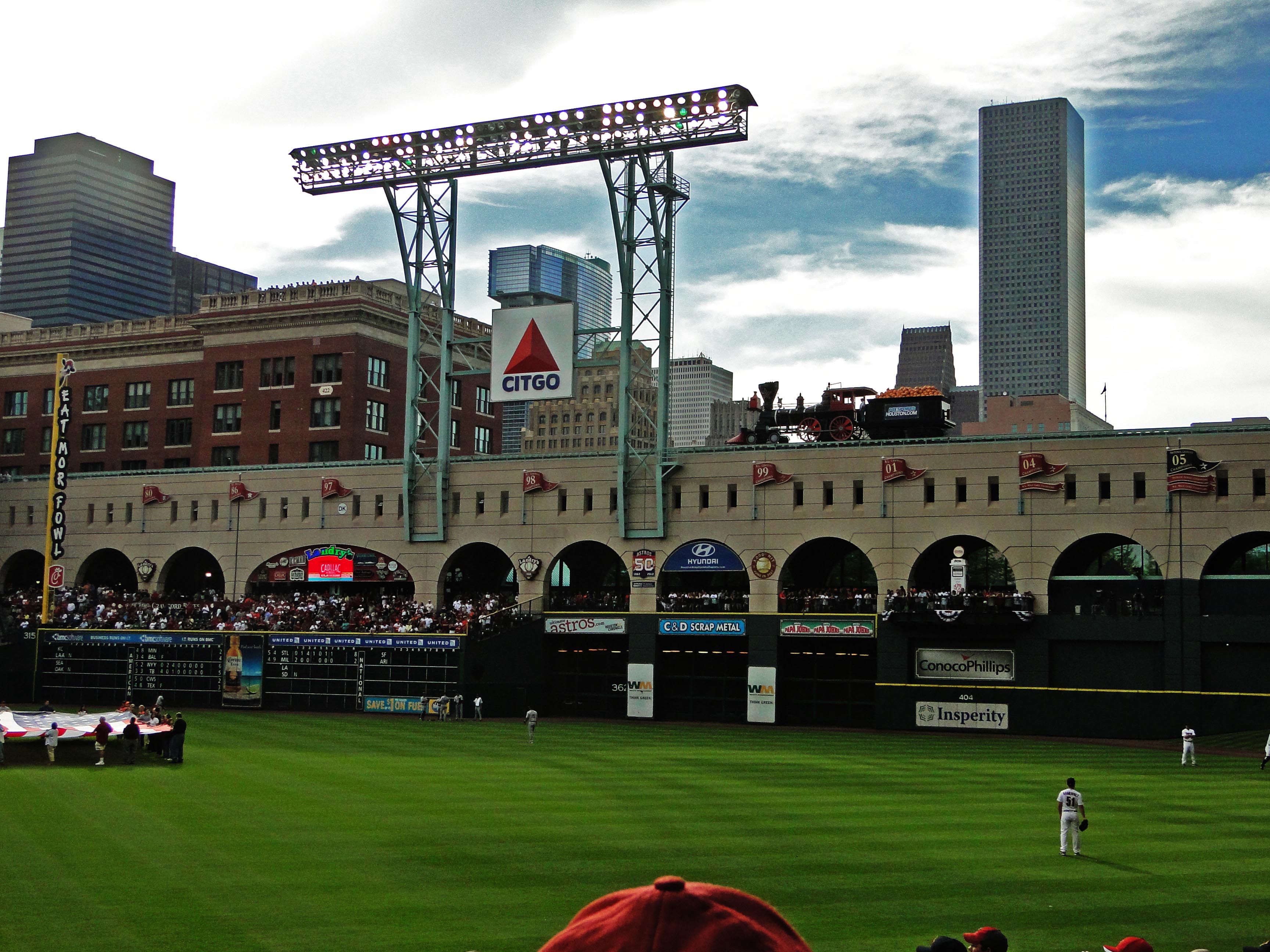
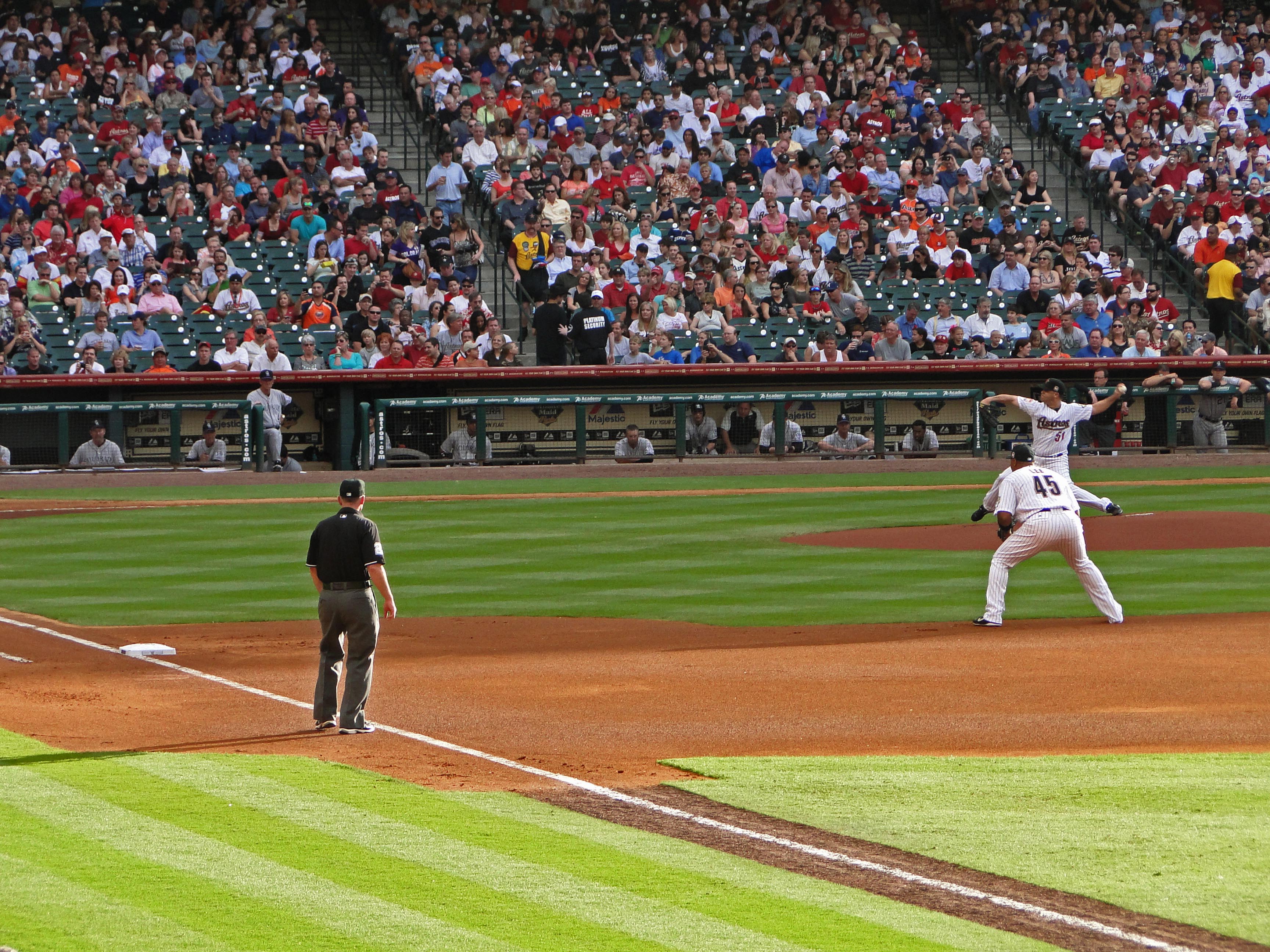
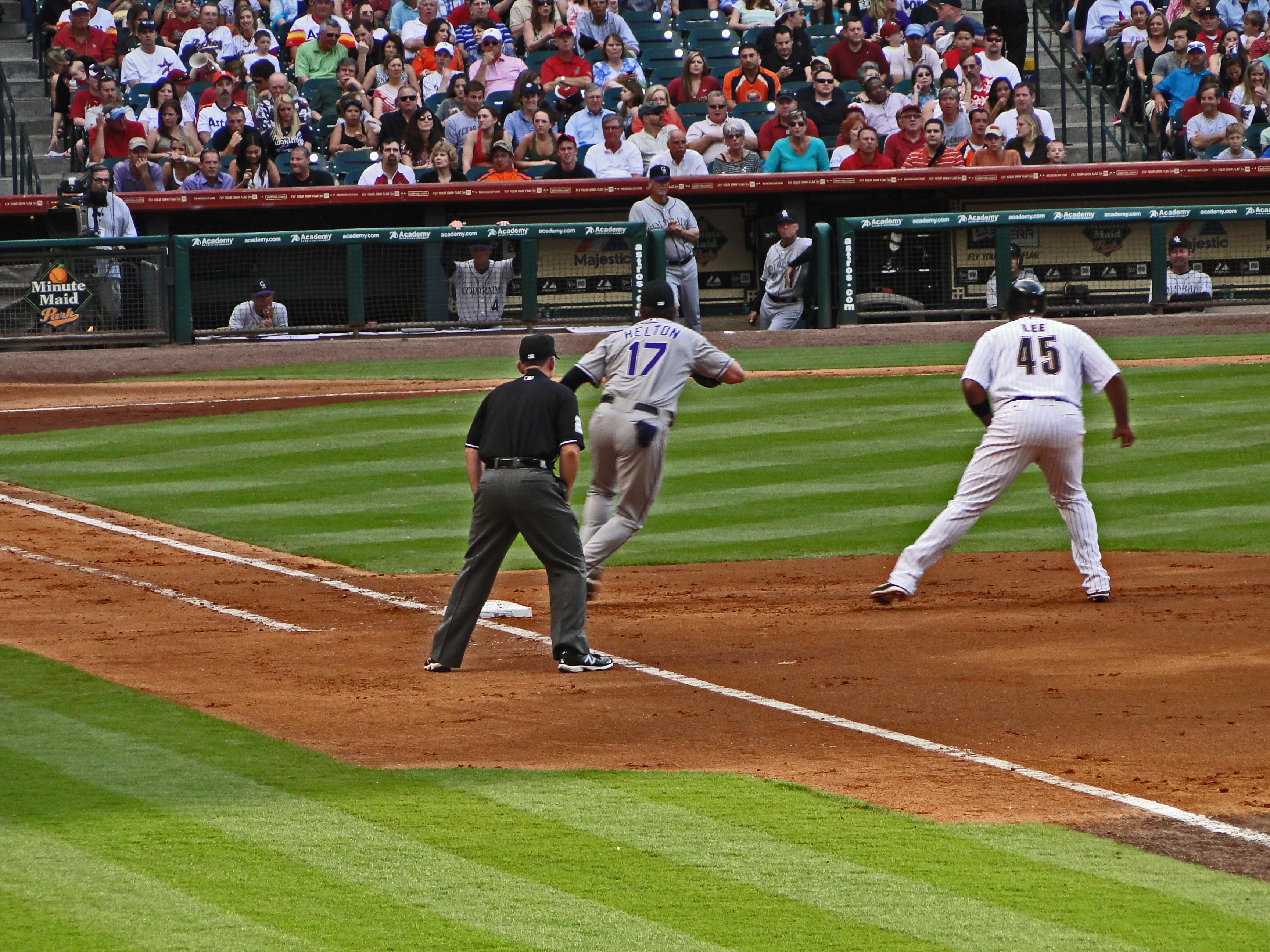
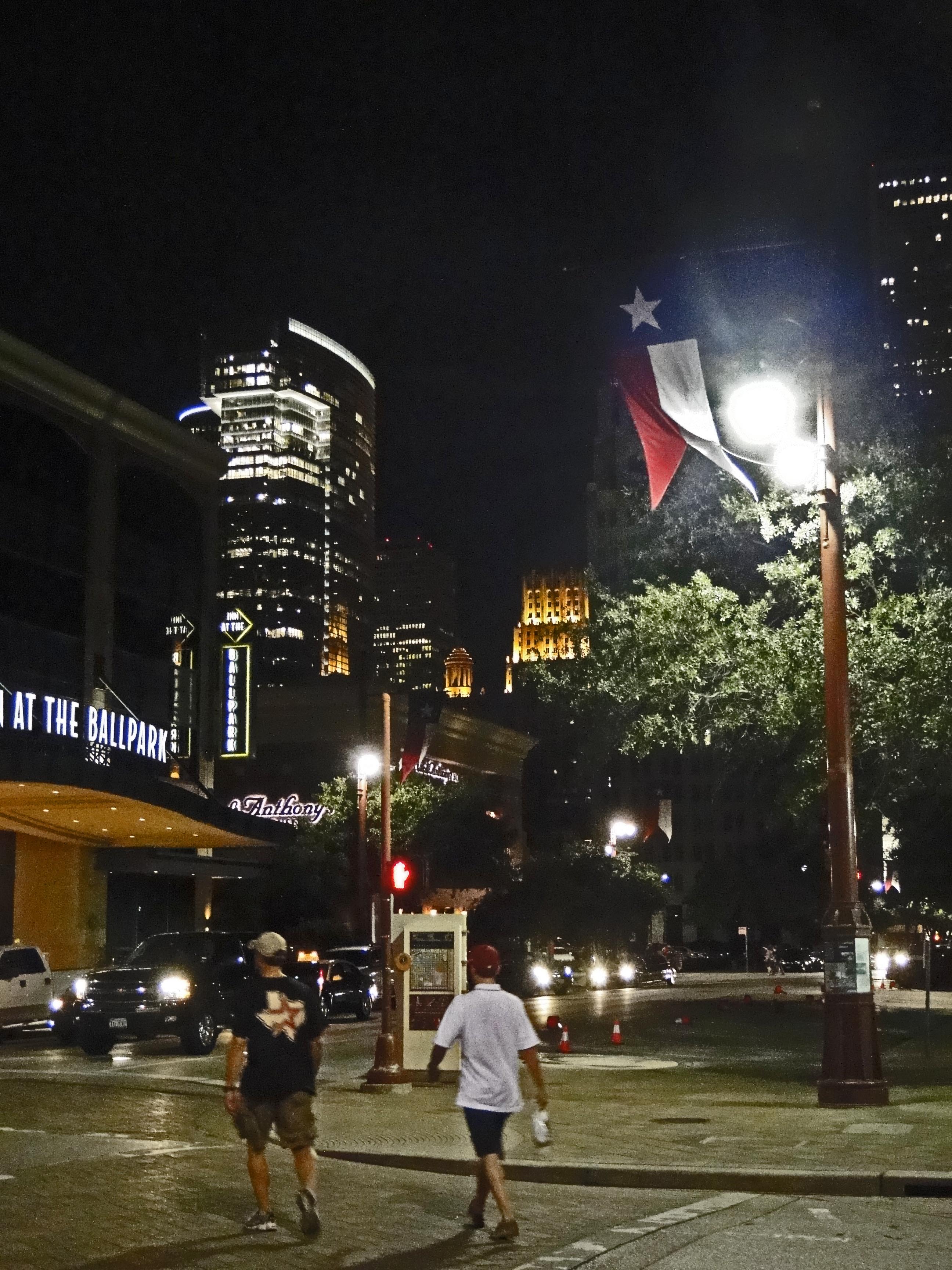
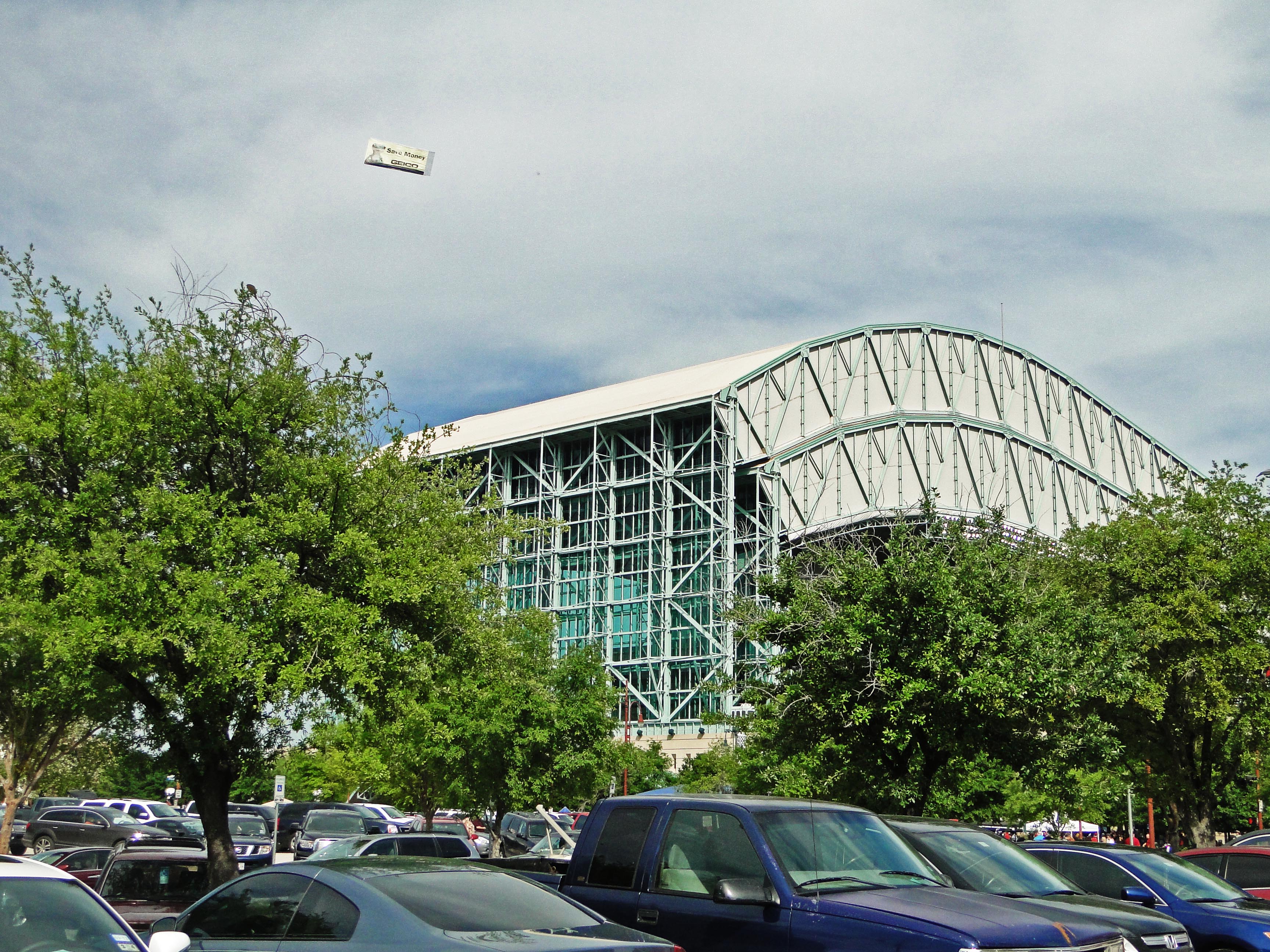
Minute Maid Park, Houston, TX, April 11, 2012

(1) What are the most and least frequent assisted out plays in baseball history?

I don’t know, but I’m guessing these suggestions are as good as any:

Most frequent “out” plays involving, at least, one player assist prior to the actual out play: 6-3 or 5-3.

Least frequent “out” plays, same deal: 7-9 or 9-7. (It’s possible here that neither has ever happened beyond Little League.)

(2) How do we calculate a pitcher’s E.R.A. (his “Earned Run Average”)?

First of all, for those who don’t know, but care to learn, an E.R.A. is a baseball statistic calculated to show a numerical figure for  how many “earned” runs a pitcher gives up on average over every 9 innings he pitches.

9 innings was selected as the benchmark because it equals the amount of innings a pitcher would have worked had he worked in whole game segments of 9 innings each time he pitched.

Earned runs are the only type charged against the pitcher in this calculation. If a batter reaches base on an error by any fielder, including the pitcher, and later scores, that run will be discounted as “unearned” and not included in the E.R.A. calculation. Similarly, if a batter reaches base after two outs, or any play that would have been the third and final out of the inning occurs to prolong the inning, any runs that score from this point will be treated as unearned and not included in the calculation of the pitcher’s E.R.A.

Here’s the calculation formula:

(a) add up the innings a pitcher worked in the game down to the fractional parts of one or two outs. If a pitcher works exactly 6 innings, show that on paper as “6.00”. –  if he worked through one out in the 6th, show that as “6.33” (reflecting that extra one-third of an inning that one out represents. If he works two outs into the 6th, of course, you record that figure as “6.67” (For working our example, let’s say the pitcher worked exactly 6 innings.)

(b) now add up all the earned runs the pitcher gave up in the innings he pitched. (For our example here, let’s say he gave up 4 earned runs.

(c) next, multiply the number of earned runs surrendered by 9 (example: 4 X 9 = 36)

(d) Now divide the earned runs total X 9 figure (“36” here) by the number of innings pitched (“6” here) or (36/6 = 6) and carry your answer to two decimal points beyond the whole number.

(e) The E.R.A in this example is 6.00. It stands as a pristine example of the E.R.A.’s pictorial accuracy. In our example, the pitcher worked 6 innings, or two-thirds of the game, giving up 4 runs. So, if he averaged 2 runs for 1/3 of the game, – and 4 runs for 2/3 of the game, – it now stands to reason that, if he keeps this up over the final 1/3 of the game, he’s going to end up with an E.R.A. of 6.00.

Got it? …. Good.

(3) What’s the deal with those dimensions at Marlins Park in Miami?

Did anyone else who watched the Houston @ Miami game from the new Marlins Park on TV last night come away also haunted by the thought,  “What were they thinking?” when they built in those those incredible distances down the lines and in the power alleys? Maybe I’m just too wired into our short distances down the line here, but those down the line distances were not what turned the game. It was that real death valley in the left center power alley that killed what would have been home runs by Carlos Lee and Chris Johnson, as I recall, and tipped the scale in Miami’s favor. Of course, the Marlins also suffered from the distances too. They will be lucky to have 40-50 home long balls this season.

Oh well, the late Jose Lima would have loved the place, as will most pitchers. Too bad a most favorable ballpark couldn’t save poor Brandon Lyon from what is too rapidly becoming his signature fate as “the walk off loser in another close late game.”

I was very happy to see J.D. Martinez put his name on his hometown park record books as the man who hit the first official game home run at Marlins Park. Through this morning, at least, Martinez still has a chance of being the only man to ever hit a home run in an official game at Marlins Park and that’s kind of a neat accolade too.

For your own study and amusement, here are the comparative field dimensions for both Marlins Park and Minute aid Park.

MARLINS PARK, MIAMI

Left Field Line – 344 feet (105 m)
Left-Center Power Alley – 386 feet (118 m)
“Bermuda Triangle” In Left-Center(unmarked) – 420 feet (128 m)
Center Field – 416 feet (127 m)
Right-Center Power Alley – 392 feet (119 m)
Right Field Line – 335 feet (102 m)
Backstop: – 47 ft (14.3 m)

MINUTE MAID PARK, HOUSTON

Left Field – 315 feet (96 m)
Left-Center – 362 feet (110 m)
Left-Center (deep) – 404 feet (123 m)
Center Field – 436 feet (133 m)
Right-Center – 373 feet (114 m)
Right Field – 326 feet (99 m)
Backstop – 49 feet (15 m)

(4) Have a nice weekend, everybody!
Patrick Lopez: Artist Extraordinaire

April 13, 2012


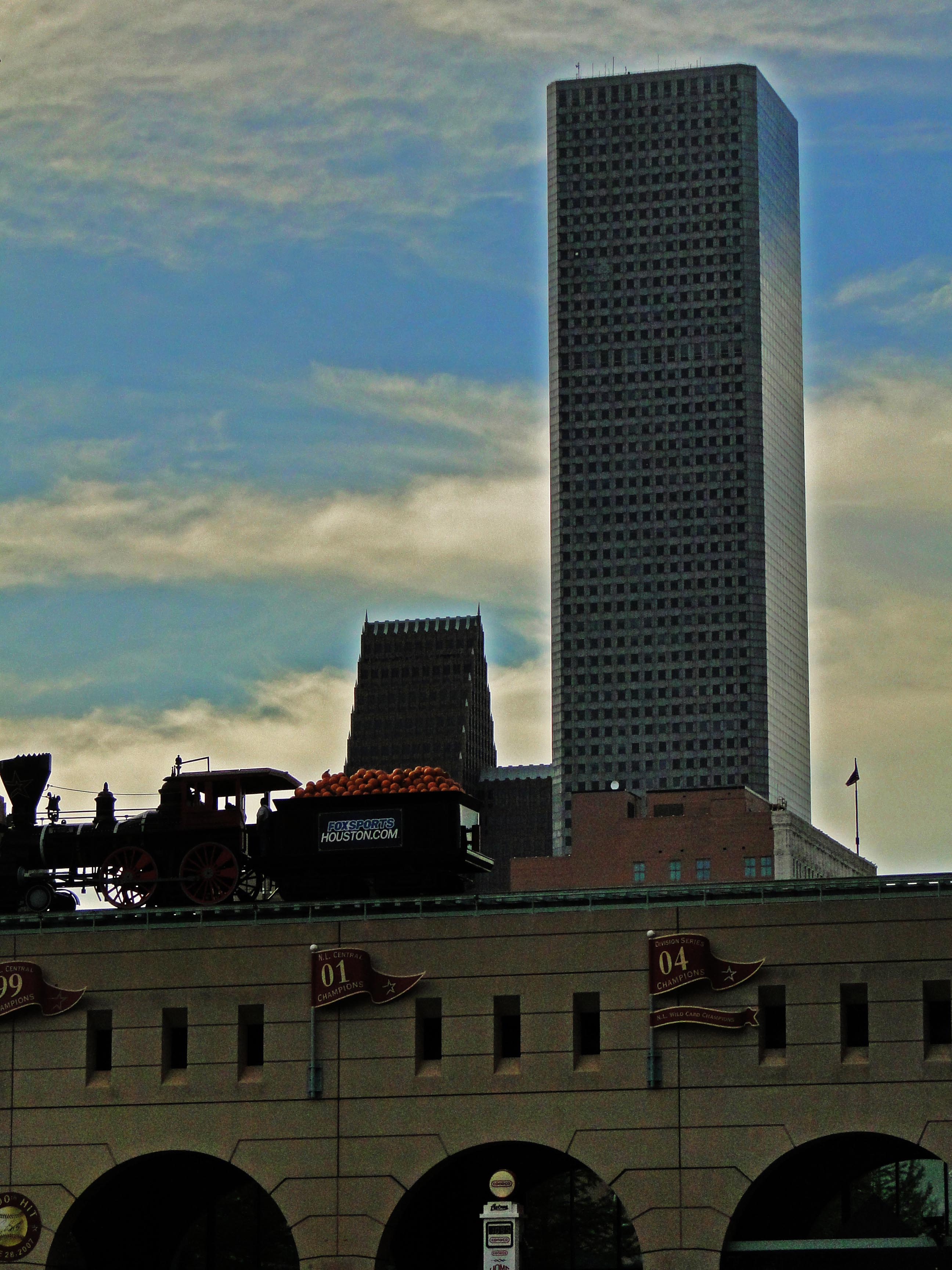
Patrick Lopez and his little pal Nappy are pictured here on a flight of fancy. Lopez reaches far and deep, wide and high for his artistic ideas. Then he brings them home to earth for our enjoyment. And now Patrick Lopez has signed on as another volunteer to the Early Houston Baseball History Project at SABR, and he is busy bringing new visual life to the 19th century scene that escaped the more limited coverage of photography in that era. Houston history will be the eternal landslide beneficiary of Patrick Lopez's talented generosity.

When architectural artist Patrick Lopez signed on to work up some visual renderings of Houston baseball in the 19th century for our current Early Houston Baseball Research Project, the world of our considerable effort virtually tilted on its axis to un expected new perspective on the way things here.

Discovered and recruited by our project’s stalwart knight of all local history, Mike Vance, Patrick Lopez was able to start working immediately from news accounts of the original professional base ball park at Travis and McGowen, the venue known variously as the Houston Base Ball Park, League Park, and the Travis Street Park, to sketch out in water colors how it must have appeared in its days of glory.

These are magnificent, but you will have to wait to see these down the line in conjunction with the publication. We had hoped to reach print by 2013, but that may now extend to 2014, or even 2015, due to the loss of certain researchers and writers to reasons of ill health, family matters, or the universal what-have-you blues.

The key phrase here is: God willing, we will get there – and through the commitment of those who are on board and willing to get it done in the first class way that is our only acceptable standard. When you write for history, nothing is more important than getting your coverage right and grounded as closely as possible to primary referential sources.

Right behind accuracy is the quality of our discoveries and their importance as connecting, dots on the bath of local baseball history – and in our case, from 1861 to 1961. The cream of the crop among our remaining staff of twelve workers  is responsible for now moving everything forward.

And finally, our goal is to produce a job of writing and visualization that is first rate as both an educational and entertaining work, the kind you don’t put down until you finish and hand it to your own children so that they may read it and someday hand it to their kids. With dedicated researchers like Mike Vance, internationally respected writers like Mickey Herskowitz, and fine artists like Patrick Lopez painting important pictures, this book will be our SABR legacy to the Houston ages – an essential treatment of Houston’s history that will either get done now or be lost forever, The help of us less well known contributors, but Houstonians all, also kicks into the mix. We are all in.

And we do intend to get it done. Getting lost or bailing out among our surviving volunteer workers is unacceptable.

Patrick Lopez and I share the St. Thomas High School background, but never met while were there. Patrick graduated in 1955 and I finished the following year with the Class of 1956. Funny how that works. I remember seeing Patrick in the halls and lunch in the cafeteria, but it took us over  a half century to meet and discover much we have in common.

I am totally blown away by Patrick Lopez’s architectural portfolio. You can tell that he had some exposure to comic books and Buck Rogers stuff as a kid. Get a load at this Lopez sketch of a Houston building that never got built. – It’s incredible. I like it even better than the one now going up as our replacement for the World Trade Center towers in New York.


A Patrick Lopez Rendering - the same design referred to in the previous paragraph. How could someone not put it up - somewhere? In my book of the visual, it's world class. - excerpted from "Antique Shops & Designers."

If you can get your hands on a copy of a special high end glossy trade publication called “Antique Shops & Designers,” check out the story on page 52 called “Back to the Future Patrick Lopez” by Nancy Ehrenkranz. It’s a superb story of Lopez’s life work. As Ehrenkranz reports, Patrick Lopez was honored for the body of his work in 2011 by Architecture Center Houston – and that’s high honor folks, one that only goes to the most deserving members of that field.

Thanks for helping to make our “baseball club” a “winning team,” Patrick Lopez. – When it comes to this kind of visualization, nobody does it better.


The 2012 AL West Fictional Standings

April 12, 2012

MLB standings makers are busy out west in 2012 looking for totem pole styles to show the new 2013 AL/NL balanced "2 leagues/3 divisions each/5 clubs each division" breakdown of competition that will structure all future competition, starting next season.

In the meanwhile, for those of you who just can’t wait to see the Houston Astros become competitive in the American League West (or anywhere else, for that matter), here’s a part fact/part fiction look at how they are doing early in the 2012 season. If anything interesting develops, even if no one seems to expect that to happen, we shall be sure revisit this same fictional base for future examination later in the season.

The premise here is simple.

The first standings show how the Astros are actually doing in the NL Central after the completion of their first six-game opening home stand. The second fictional standings re-features how the Astros would be doing in 2012 if they were already members of the AL West and matching their record on the field with the four current AL West members who await their new league and divisional company in 2013.

It’s a little early to see anything significant, although the Astros would be a half game closer to first place in 2012, had they already signed up for AL West this year.

Have fun! That’s what ideas that randomly detach from established reality are designed to provoke.

2012 NL Central (Fact) W L PCT GB
St. Louis 5 2 .714
Milwaukee 4 2 .667 0.5
Cincinnati 3 3 .500 1.5
Houston 3 3 .500 1.5
Pittsburgh 2 3 .400 2.0
Chicago Cubs 1 5 .167 3.5
2012 AL West (Fiction) W L PCT GB
Texas 4 2 .667
Seattle 4 3 .571 0.5
Houston 3 3 .500 1.0
Oakland 3 4 .429 1.5
Los Angeles Angels 2 3 .400 1.5

Astros TV Voice Bill Brown: Quality Over Time

April 11, 2012
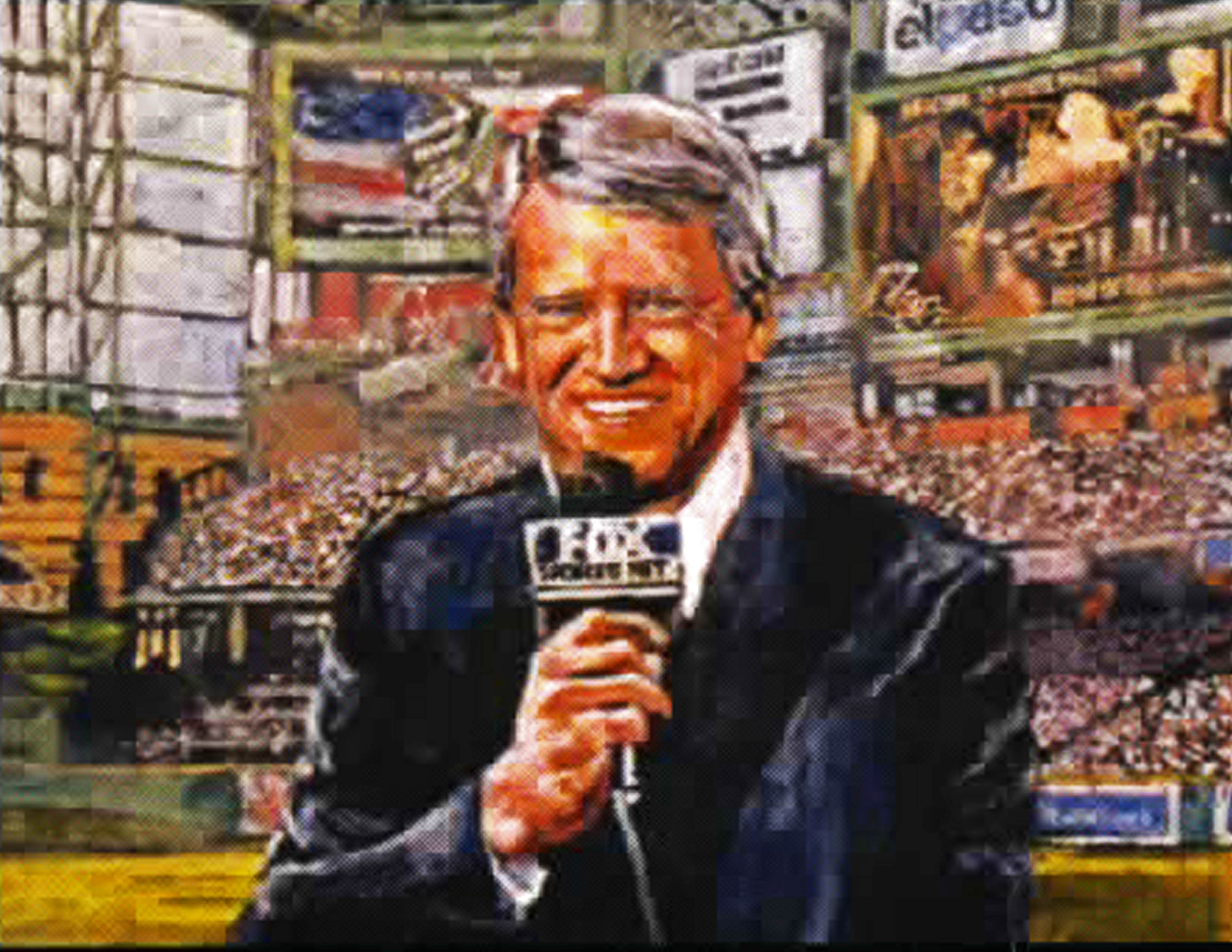
Bill Brown's Induction Portrait into the Texas Baseball Hall of Fame (2004) by Artist Opie Otterstad.

Bill Brown's Induction Portrait into the Texas Baseball Hall of Fame (2004) by Artist Opie Otterstad.

In their 50 year history, the Houston Astros have had two announcers who have earned the coveted Ford Frick Award from the Baseball Hall of Fame for broadcasting. Neither of them was named Bill Brown (so far, at least. One day, Houston may have three names on that list).

Also in their 50 hear history, only one announcer has been here long enough to project as the Astros media person with the longest period of continuous service as a broadcaster beyond all others. And that man is neither Ford Frick Award winner Gene Elston (Astros, 1962-1986) or Ford Frick Award winner Milo Hamilton (Astros, 1986-2012).

It’s Bill Brown (Astros, 1987-2012 and counting).

Gene Elston has been gone from the Astros since the year prior to Bill Brown’s arrival in Houston and Milo Hamilton retires after the 2012 season. Of these three figures of quality service over time, only Bill Brown will remain on duty in this city after 2012 – and with no end in sight to his remaining years of tenured quality service in prospect as the television play-by-play voice of the Houston Astros.

Bill Brown was born in Sedalia, Missouri on September 20, 1947. After several years of early media service and sports broadcasting, but mainly in Cincinnati with the Reds and several college teams, Bill and family, wife Dianne and daughter Allison, moved to Houston as Brown went to work for the Astros as the voice of their telecast play-by-play announcing.

Bill Brown

Through 2011, Bill Brown has now been an Astros employee for exactly 25 seasons – or exactly half the lifespan of Houston’s half century history as a major league club. That’s quite an accomplishment in itself, one that no one reaches by anything than less than being better than most, or all, at what he does so well – play-by-play baseball broadcasting on television.

Bill Brown is a broadcasting high achiever on that level. And he doesn’t do it by making himself the show ahead of the game – or the action on the field. He doesn’t do it by having a signature “call” phrase  that sets him apart from other announcers. And, thank the Lord, he doesn’t do it by hanging a mindless, endless stream of unrequested silly nicknames upon the players.

Bill Brown does it being prepared for the game, accurate with his descriptions and game assessments, sensitive to the special needs of television, being always a pleasant voice and personality, and the kind of guy who brings out the very best in the entertainment value of each game – and the people who work with him.

Current color broadcaster TV mate Jim DeShaies is one of the wittiest, best informed people on the tube – and a good part of Jim’s success is due to the fact that partner Bill Brown brings out the very best in him.

My adult son Neal recently asked me, “Hey, Dad, do you know how I can tell that Jim DeShaies is having a really good night on the air when the game is on television and I’m not even in the room watching every minute of it?”

How?

“I count the times I hear Bill Brown laugh per minute. That’s how,” Neal answered.

Bill Brown has had some great TV partners over the years – and every one of them has been better because Bill Brown’s healthy ego permits him to play straight man to the talents for humor in others. And that’s a rare gift. Not everyone can play Bud Abbott to all the Lou Costellos in this world. Sometimes the greater art is to allow the growth of humor from the storytelling of others. Although, make no mistake. Bill Brown is an excellent storyteller in his own right.

I can’t recall all the partners that have worked with Bill Brown on Astros telecasts over the years, but they include some good ones – super guys like Bill Worrell (I think), Larry Dierker (for sure), Greg Lucas, and current partner Jim DeShaies. Each has brought something good to the table; and each has been better due to the anchoring presence of Bill Brown.

I’ve gotten to know Bill Brown a little better personally over the bast decade through our shared membership in SABR, the Society for American Baseball Research, and I’ve especially come to see him more too as a valued colleague on baseball research and writing. I also look forward to whatever Bill produces as a written publication in the future. Whatever it may be, count on it being a quality job.

Bill Brown was inducted into the Texas Baseball Hall of Fame in 2004. Someday, there’s an even bigger Hall up the road in Cooperstown, New York that may be calling upon him too. The Ford Frick Award would be a nice fit for the longest running, good-as-or-better than any other play-by-play man to ever fill the bill in Houston too.

His name is Bill Brown. And he’s our guy to enjoy in Houston baseball on TV at the top of his game. How lucky can we be?

Happy 50th Birthday, Houston MLB Baseball!

April 10, 2012

R.E. "Bob" Smith, Judge Roy Hofheinz, George Kirksey, and Craig Cullinan, the Mount Rushmore of Houston MLB History, line up front to rear here with first GM Paul Richards. The field action all started 50 years ago on this exact date in history, April 10, 1962.

On April 10, 1962, 50 years ago today, it all started in old Colt Stadium off OST near Fannin, as the Houston Colt .45s played their first official National League game on Opening Day upon a playing field that many of us fans would soon enough come to know as “The Skillet” as the Houston summer heat descended upon us.

Major League Baseball officially started in Houston as the new and young Colt .45s blasted their way to an 11-2 Opening Day win against the Chicago Cubs. Little Lefty Bobby Shantz, no spring chicken himself, got the first start and win, striking out future Hall of Famer Lou Brock as the first our and “K” victim in franchise history. Houston’s Bob Aspromonte reached first base with the first base hit in franchise history and Roman Mejias then provided the big offensive club with two home runs and six RBI for the Colt. .45s.  Hal Smith also homered as the second player to hit a long ball for the locals in an official game.

When all was said and done, it was both a joyous start and a deserving tribute to Judge Roy Hofheinz and the other Houston Sports Association founders who contributed in their own unique ways to bringing Houston most deservedly into the world of major league baseball. Time and space press us into summary mention 0f those people who are even today the reasons why we have the new Jim Crane Era to celebrate in 2012, but hopefully, we shall never forget any of the men who were in the lineup that first Opening Day, or behind the broadcasting booths, or in the front office, or writing the stories that both sewed and sold our local legends and history of Houston MLB baseball.

Judge Hofheinz was our local version of P.T. Barnum and the visionary whose dream for a covered baseball stadium would soon enough bring the Astrodome to Houston in 1965 and change thinking and construction on sporting venues for all time. Craig Cullinan was the well placed and dedicated Houstonian who turned the wheel of Houston’s power structure behind support for the city’s bid for a major league club at the pregnant moment of great opportunity. R.E. “Bob” Smith was the primary Houstonian who climbed on board with the HSA, lending his money, power, and land to the plan for making the Judge;s dream a full-blown working reality. George Kirksey was the local writer, publicist, and bon vivant who worked throughout most of the 1950s in behalf of Houston’s building case for membership in the big leagues.

Mickey Herskowitz

Too much in the shadows until now was a young Houston Post sportswriter named Mickey Herskowitz.  Throughout the 1950s, Mickey wrote pieces on a lot of the ideas expressed by Kirksey in behalf of the Houston MLB cause. Mickey’s powerful command of expression gave the Kirksey ideas, plus plenty of his own, some powerful wings – flying them all the way into the hearts and minds of the decision-makers on Houston’s bid to the big dance in baseball. In 1959-60, a series that Herskowitz wrote in behalf of Houston’s cause may just have been the final push the drive needed, as Houston was approved in 1960 for one of two new franchises for the National League in 1962.

Also, let’s never forget Gene Elston, the golden voice who broadcast Houston big league games from 1962 to 1986 on his way to becoming one of two Houston media icons, along with Milo Hamilton, to be recognized by the Baseball Hall of Fame as Ford Frick Awards for  radio/tv broadcasting.

Jimmy Wynn and Larry Dierker stand out as early franchise playing icons with the Colt .45s, although neither man was around on that memorable day of the big start fifty years ago. Broadcaster Loel Passe was here fifty years ago, as was broadcast engineer Bob Green. We don’t want to forget those guys and all they did to bring the ongoing story of the Astros into our homes either. Bill Brown wasn’t around from the start as a telecast presence, but his 25 seasons (1987-2012) in the Astros  booth are on track to exceed every other local game-play-by-play voice.

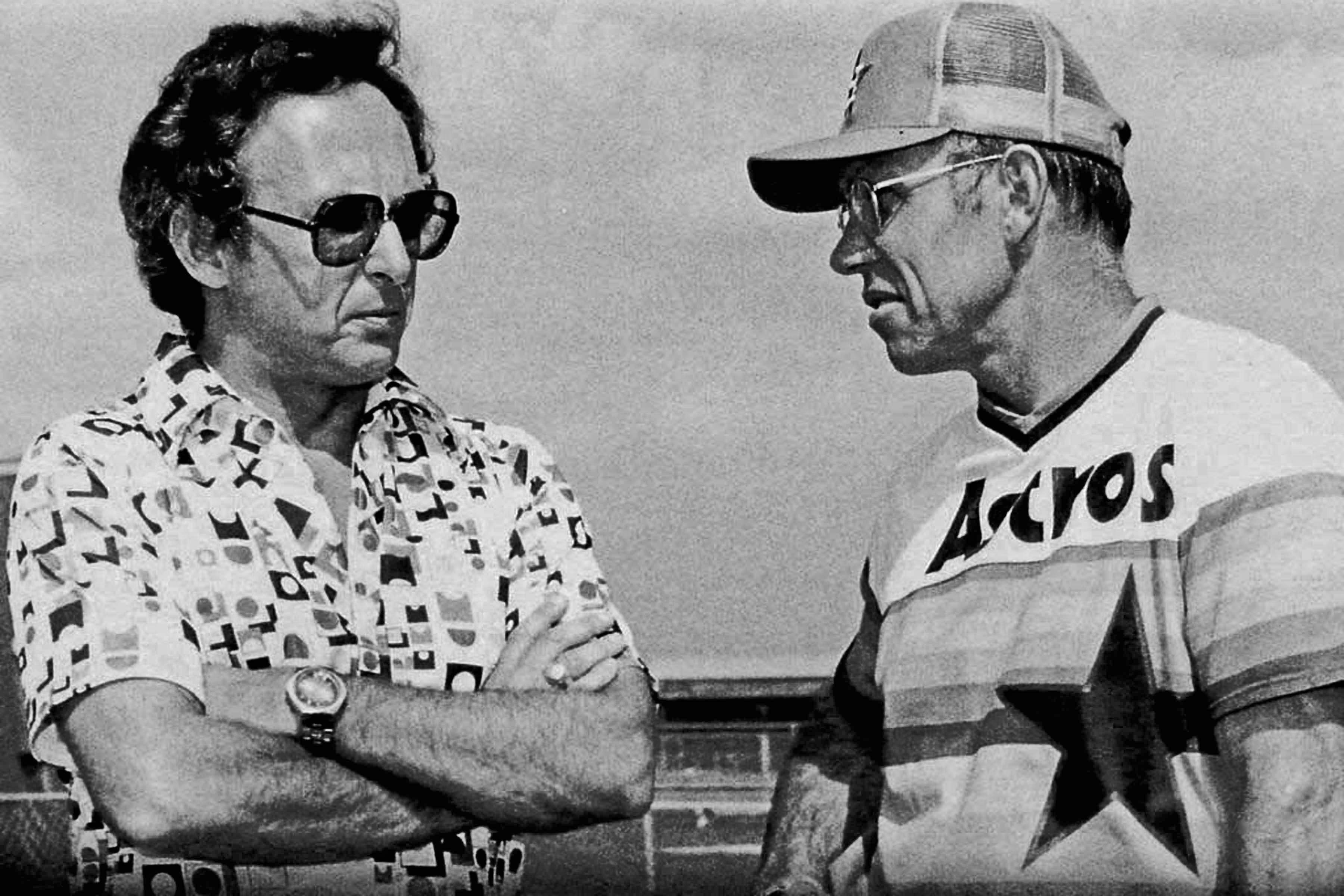
Astros GM Tal Smith & Manager Bill Virdon, 1980.

Most of all, and I have saved his name until last because he shall always belong in the company of the first when it comes to any serious mention of Houston baseball history in the big leagues, let us never forget the contributions of former President Tal Smith. A very young Tal Smith came to Houston with the first man HSA picked as their new GM, Gabe Paul.  When Paul left for the same GM post in Cleveland, well before the Colt .45s ever hit the ground, Tal Smith stayed on to assist the first both-feet-on-the-scene GM, Paul Richards, to help put together a staff, a plan, and a roster based largely upon discarded talent  from the other established clubs. Tal remained to oversee the construction of the Astrodome, the introduction of remedies to the roof-visual problems, including the utilization of Astroturf (c), the development of a farm system, the hiring of the manager who finally brought field success to the club, Bill Virdon,  enjoying years of success and steady progress as both the club’s GM and Baseball President, as well as another shot as over-site supervisor of Houston’s third major venue, this time  downtown, the park originally known as Enron Field and now called Minute Maid Park.

Tal’s Hill is a prominent reminder and symbol of all the obstacles that Houston has faced and worked hard to overcome in its first half century. May it remain with us always as the perpetual reminder of both the man it’s named to honor – and the effort it’s taken of so many to get us this far into the success lane of big league baseball.

Nothing good comes easy. And life itself comes with more than a few Tal’s Hills.

Happy 50th Birthday, Houston MLB History!

2012 Astros Are The New Houston Babies

April 9, 2012

2012 Astros Are The New Houston Babies

The 25 men on the roster for the Houston Astros on Opening Day 2012 are 27.3 years old in their average age. They aren’t exactly infants, but they are the closest thing we have in town in baseball garb that fits that description since our first professional club, the 1888 Houston Babies.

Subtract Gonzalez & Lee. Add Harrell & Downs. Equals a starting lineup averaging age 25.1.

On Opening Day, had the Astros started 28-year-old Matt Downs at 1st base instead of 35-year-old Carlos Lee, and pitched 26-year-old Lucas Harrell instead of 33-year-old Wandy Rodriquez, the average age of the starting lineup for the Houston Astros would have been 25.1  years.

Youth is no guarantee of a successful future, but there is no future without a group of talented youngsters on the roster and in the minor league pipeline to get a major league team headed back in the right direction. I think Ed Wade had started the ball rolling in 2010-11 with some of the moves he made, and I love what I’ve heard from new GM Jeff Luhnow, so far,, about his plans to combine traditional scouting with situational statistical evaluations for choosing those prospects for the club’s future. Statistics aren’t everything, but neither are they an abdication of critical decision-making away from baseball people into the hands of eggheaded math geeks who know nothing about the game. Sophisticated statistical analyses of how players perform, and how they are projected to perform in critical game situations, are nothing less than a potentially powerful enhancement to the job of  picking the best hands to build a franchise future around.

Knowledge of the game. Wisdom with people. Sensitivity to the intangibles of talent assessment. Better measurement of those items that determine future success. Bless the franchise that can handle them all under one united roof – for they shall someday be called champions of the baseball world.

While we’re waiting, I like what I’ve seen so far in the new Houston Babies, the 2012 Houston Astros. I ‘m expecting them to finish about 72-90 this year, but I like their chances of getting better, if the things we are hearing in the early stages of the new Crane Era continue to grow and get results on the young player development.

It also won’t break any hearts in Houston this year either if veterans Wandy Rodriguez, Brett Myers, and Carlos Lee play well enough to give some wings to their contract floatations elsewhere to 2012 playoff competitors before the summer trading deadline.

Youth is the thing in Houston. For now. And, in a way, forever. Carlos Lee. has convinced a lot of people, I hope. Older guys sitting on fat multi-year contracts is no way to build or sustain the successful future of an MLB franchise.

Go. Astros. Go Babies.


Astros Lose 2012 Season Opener, Part 2 of 2

April 8, 2012

“Astros Lose 2012 Season Opener, Part 2 of 2” is a continuation of the pictorial column published yesterday by The Pecan Park Eagle. For Part 1 of 2, click this link for a look-see at how things started:

https://thepecanparkeagle.wordpress.com/2012/04/07/astros-lose-2012-season-opener-part-1-0f-2/

Now, here we go with Sunday finish on how things went in the 2012 season opener at Minute Maid Park in Houston:

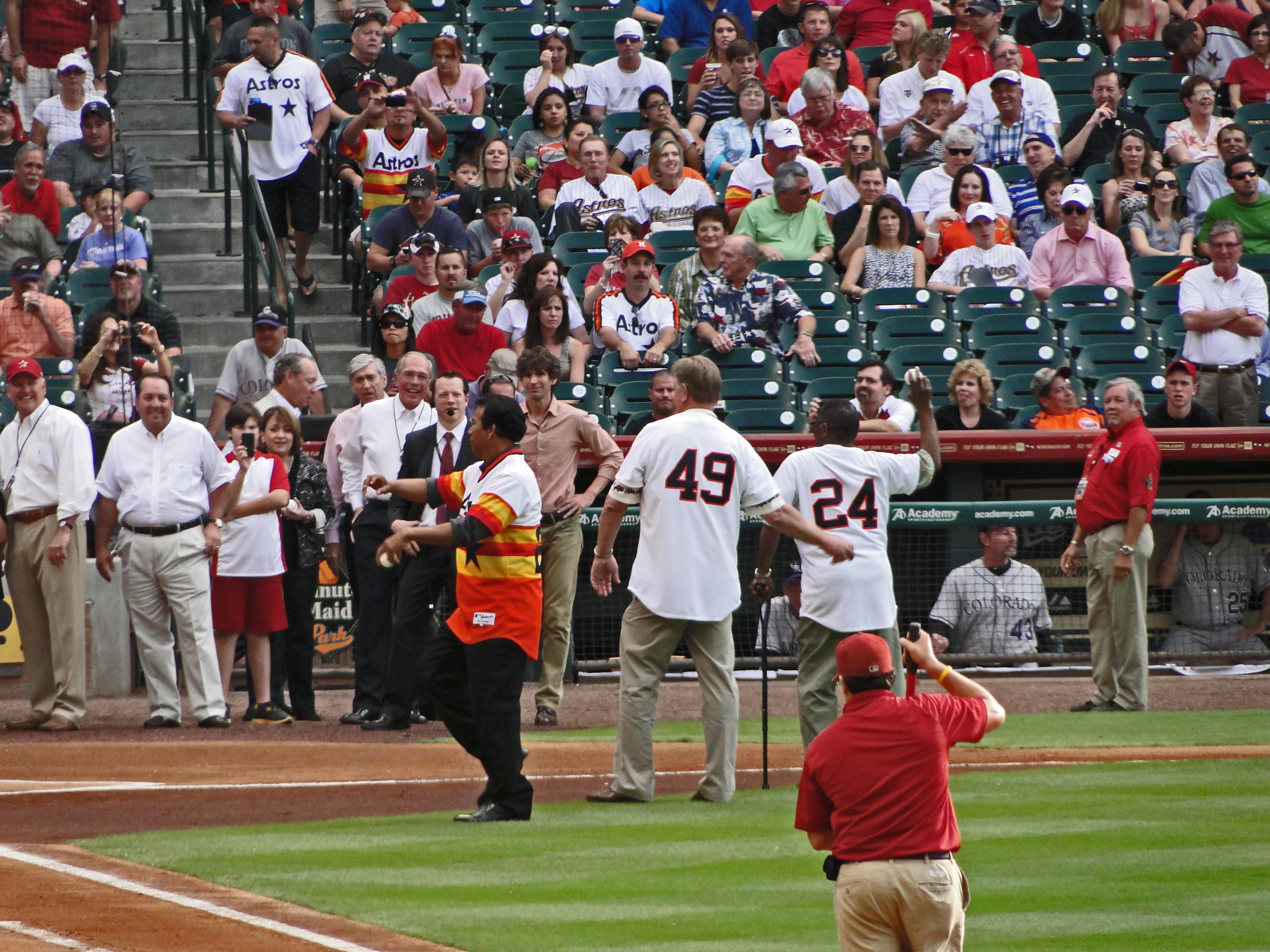
Houston baseball icons Jose Cruz, Larry Dierker, and Jimmy Wynn all threw out the first pitches of the game.

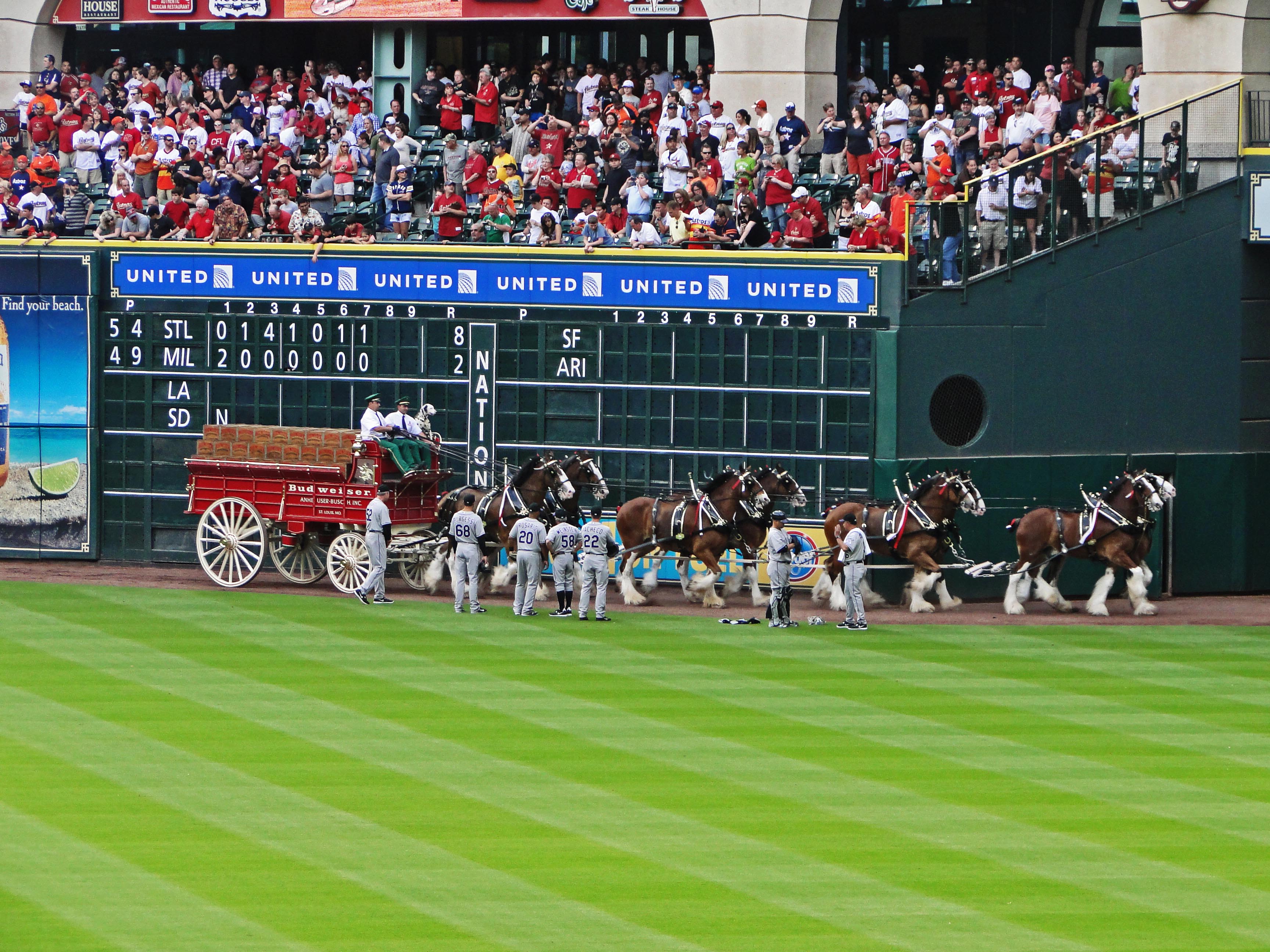
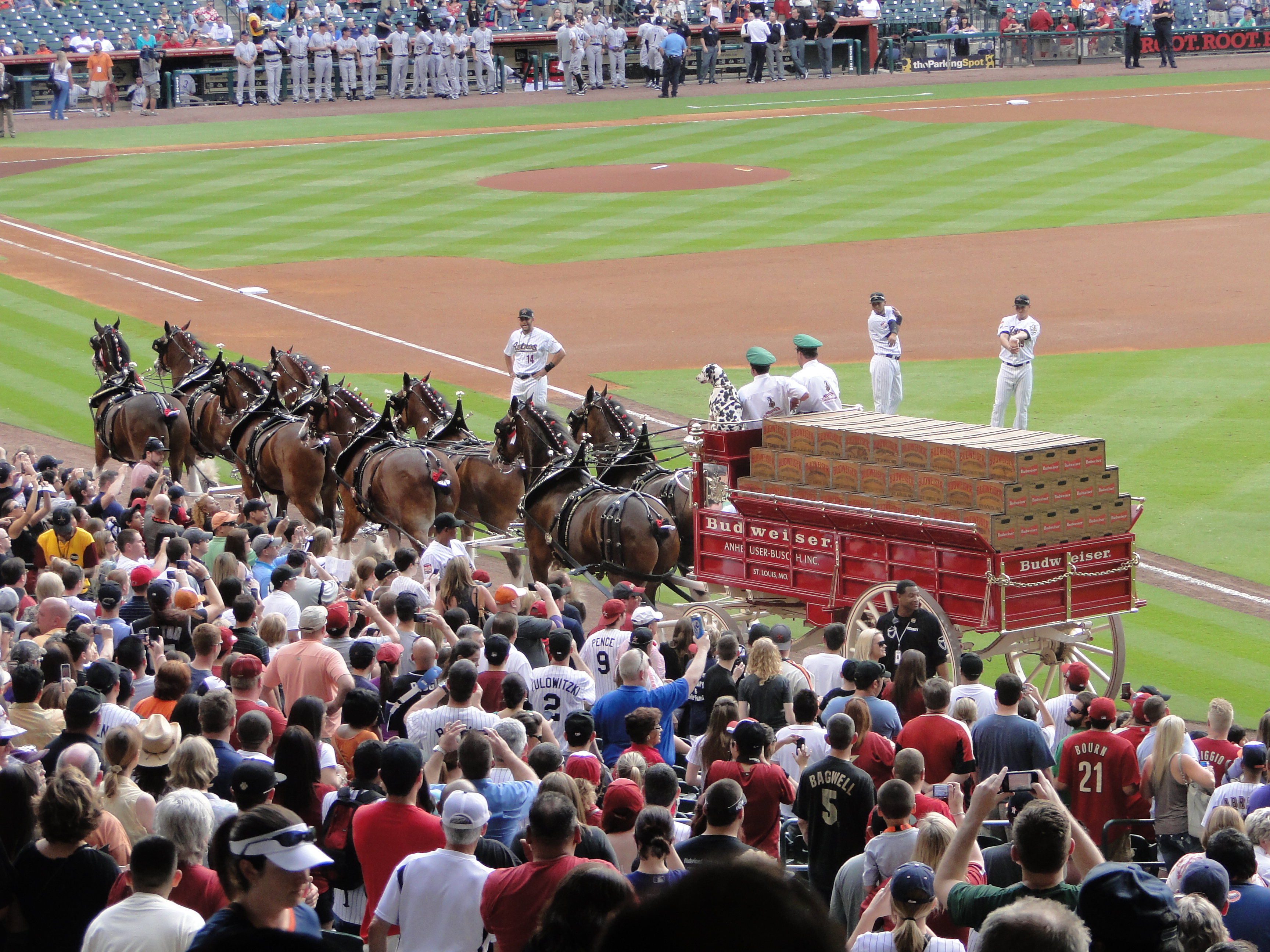
"And down the stretch they came..." The Budweiser Clydesdales made one more turn before giving up the field to Opening Day action.

But first, here's a great big "Houston Howdy" to our Opening Day visitors, the Colorado Rockies.

April 6, 2012 was a beautiful day for the start of the Jim Crane ownership era in the fiftieth anniversary year of Houston's first half century as a major league club.

Astros lefty veteran starter Wandy Gonzalez gets ready to deliver the first official itch of 2012 Houston NL season.

Carlos Lee takes his lead off first in the 1st inning after singling in Jose Altuve from 2nd base for the first Astros run and RBI of the 2012 season.

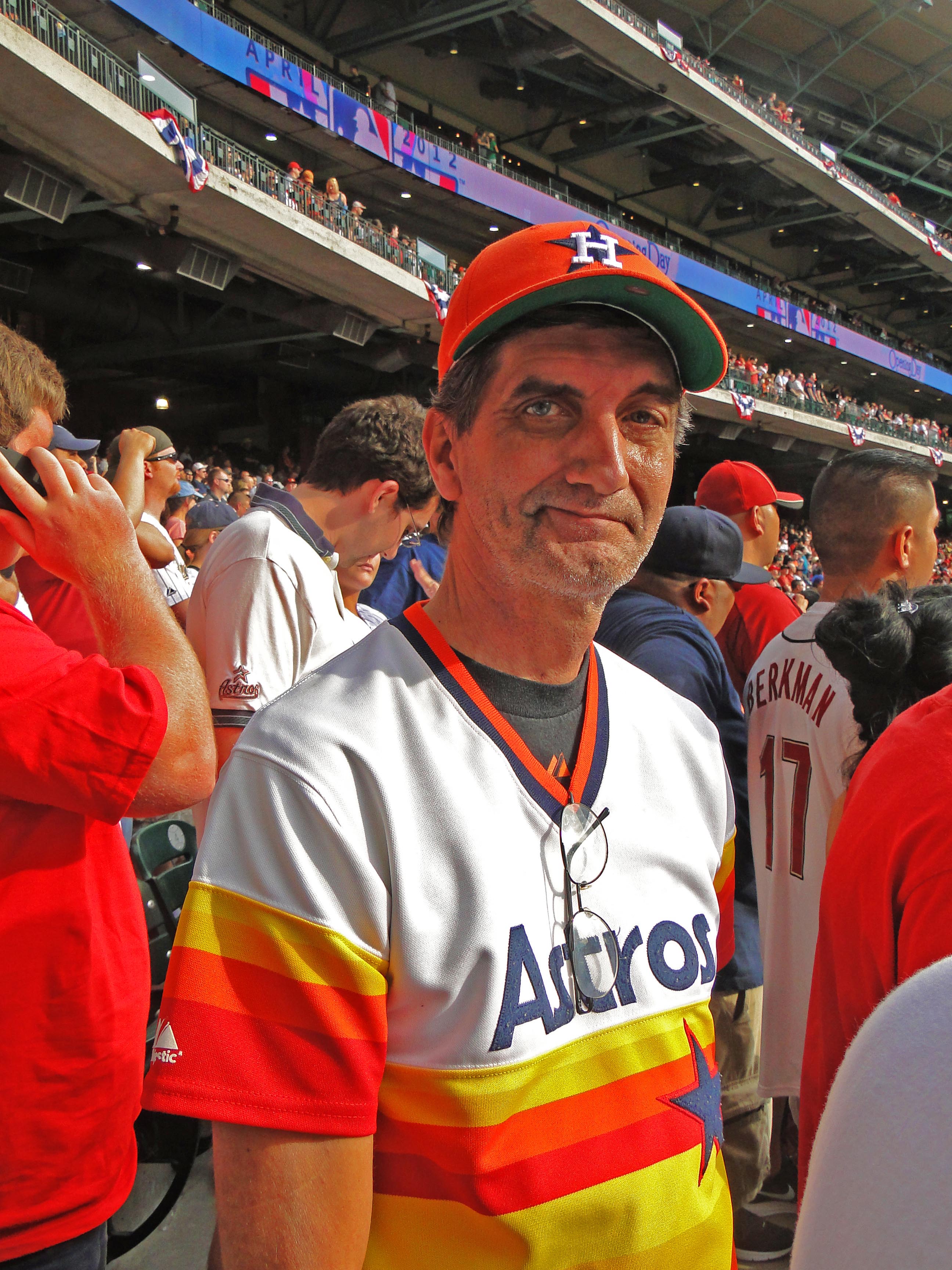
Longtime Astros fan Darrell Pittman smiles away his approval of the club's quick 1-0 start.

After the Rockies took a 3-1 lead in the top of the 4th, Carlos Lee homered for only the team's 2nd and only hits in the game to that point. It was beginning to look as though Lee was going to end the night as the only Astro with a season batting average beyond goose products as Houston pulled closer, but still trailed by a 3-2 deficit.

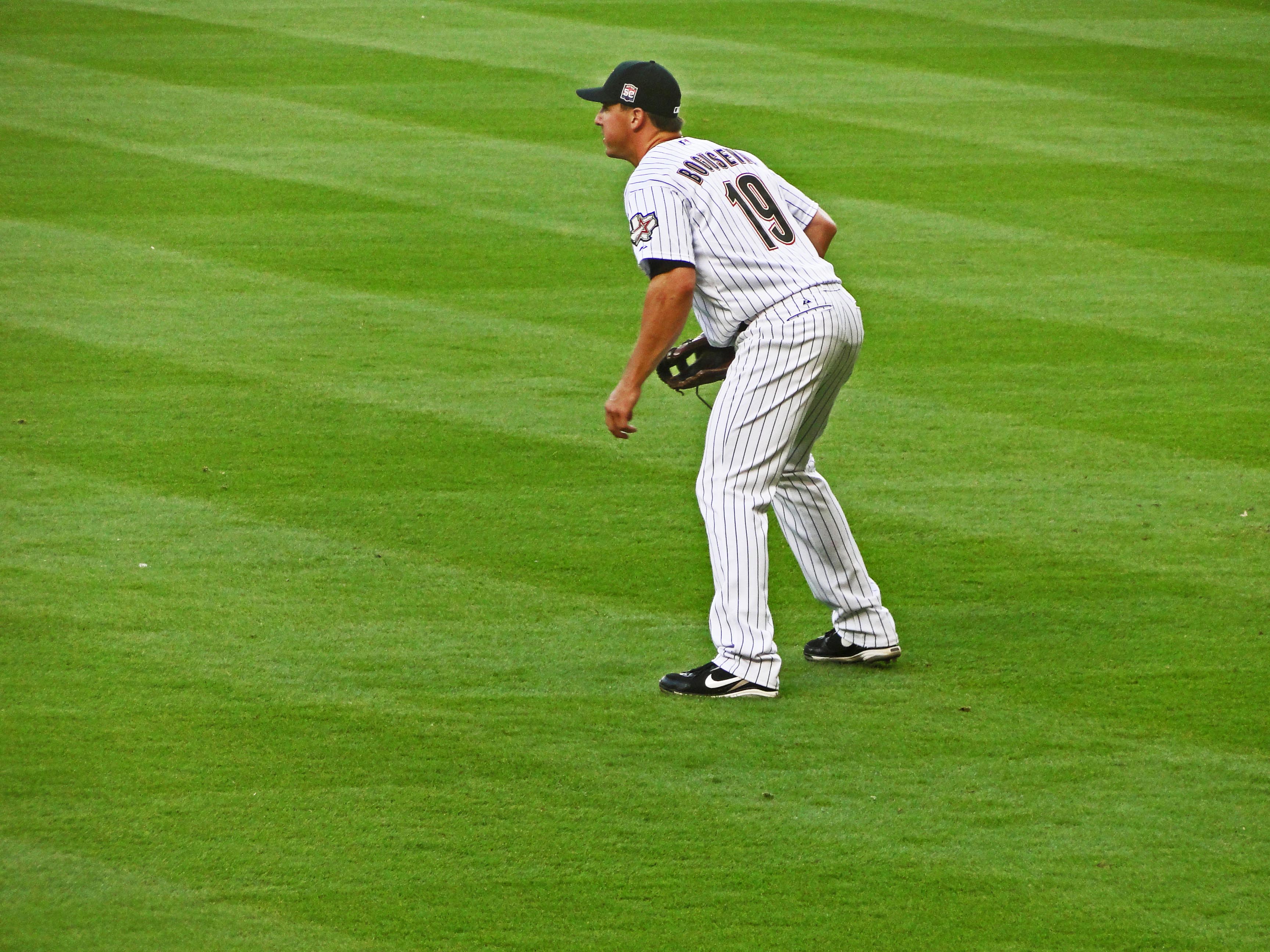
Brian Bogusevic then followed Lee with a back-to-back HR to the Conoco pump in left center. The 3-3 tie would hold until late inning errors by the Astros yielded two more runs and a 5-3 Rockies victory on Opening Day.

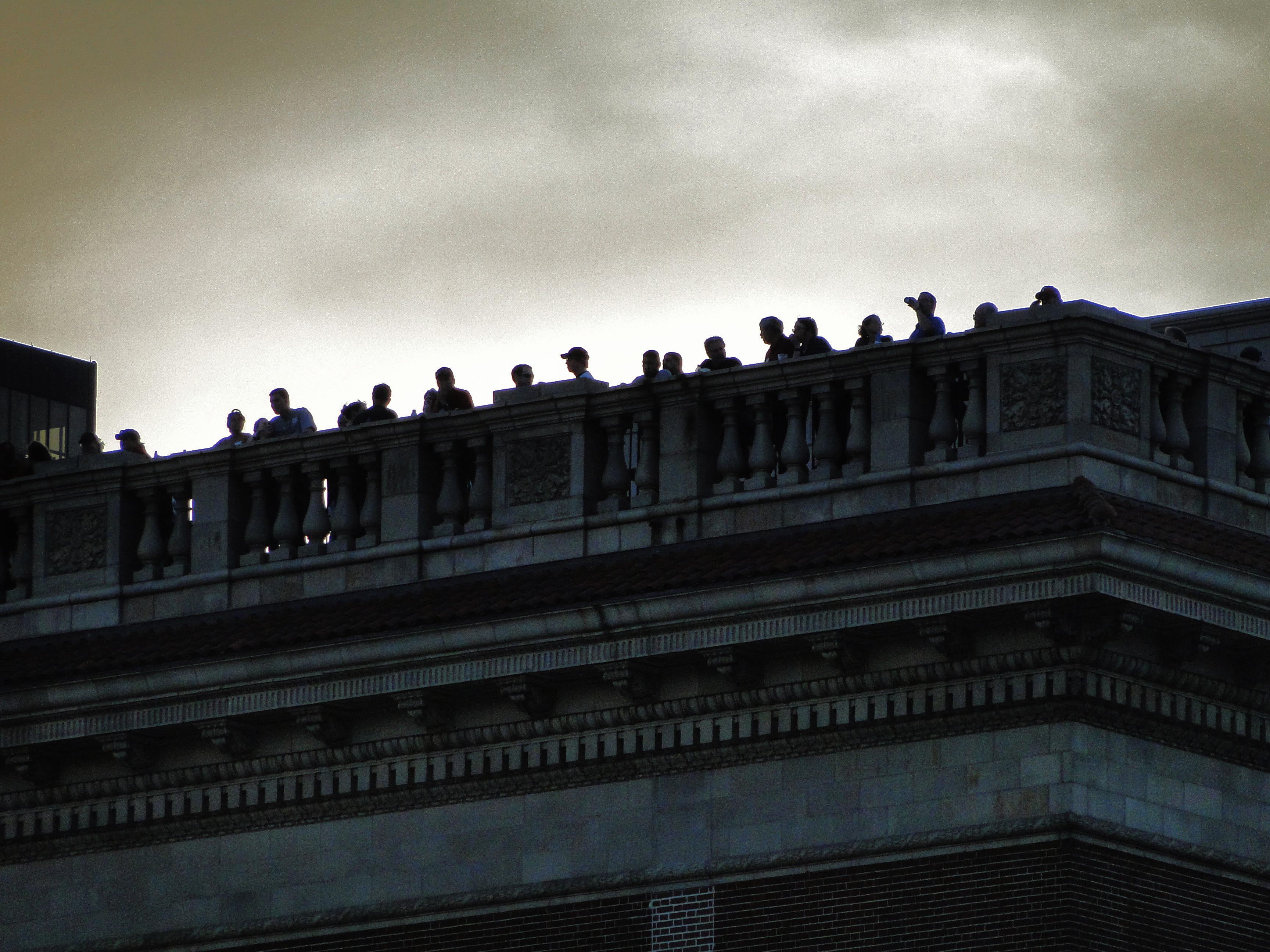
Some fans catch Opening Day action from the roof of Union Station ....

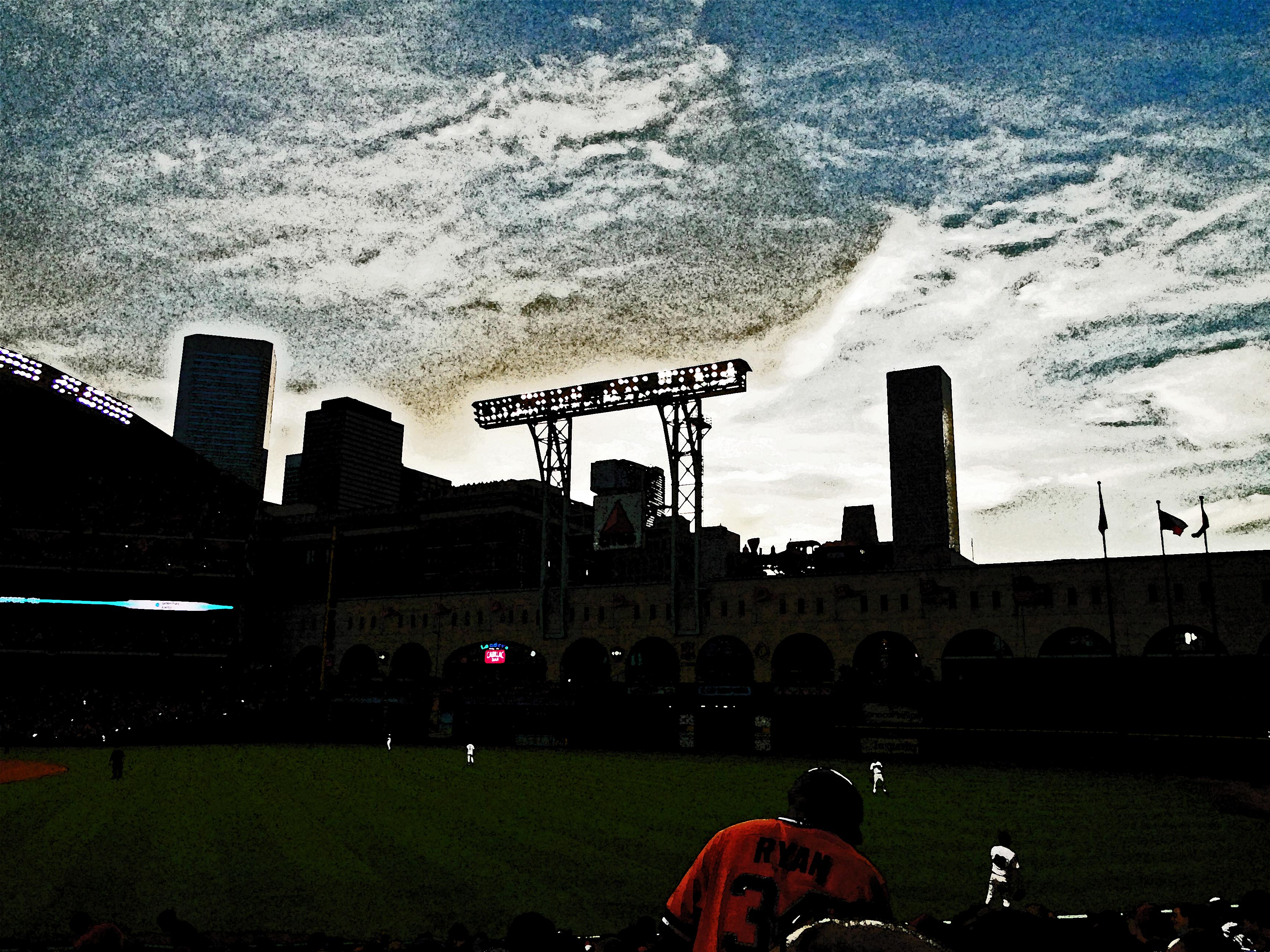
... as darkness descends upon Opening Day of the 2012 baseball season at Minute Maid Park in Houston.

After the game, Houston fans went home in the knowledge that their chances for a perfect undefeated season were now gone forever, but it didn't matter. The long baseball season is here and tomorrow is another day. And at this writing, the Astros have just defeated the Rockies, 7-3, in Game Two. Now we have a home team with a .500 winning percentage record in the National League. - And that bodes well for a nice bunny hop slide into Easter.

Happy Easter, Everybody! ~ These photos are the last Opening Day eggs I’ve got in my basket!
Astros Lose 2012 Season Opener, Part 1 0f 2

April 7, 2012

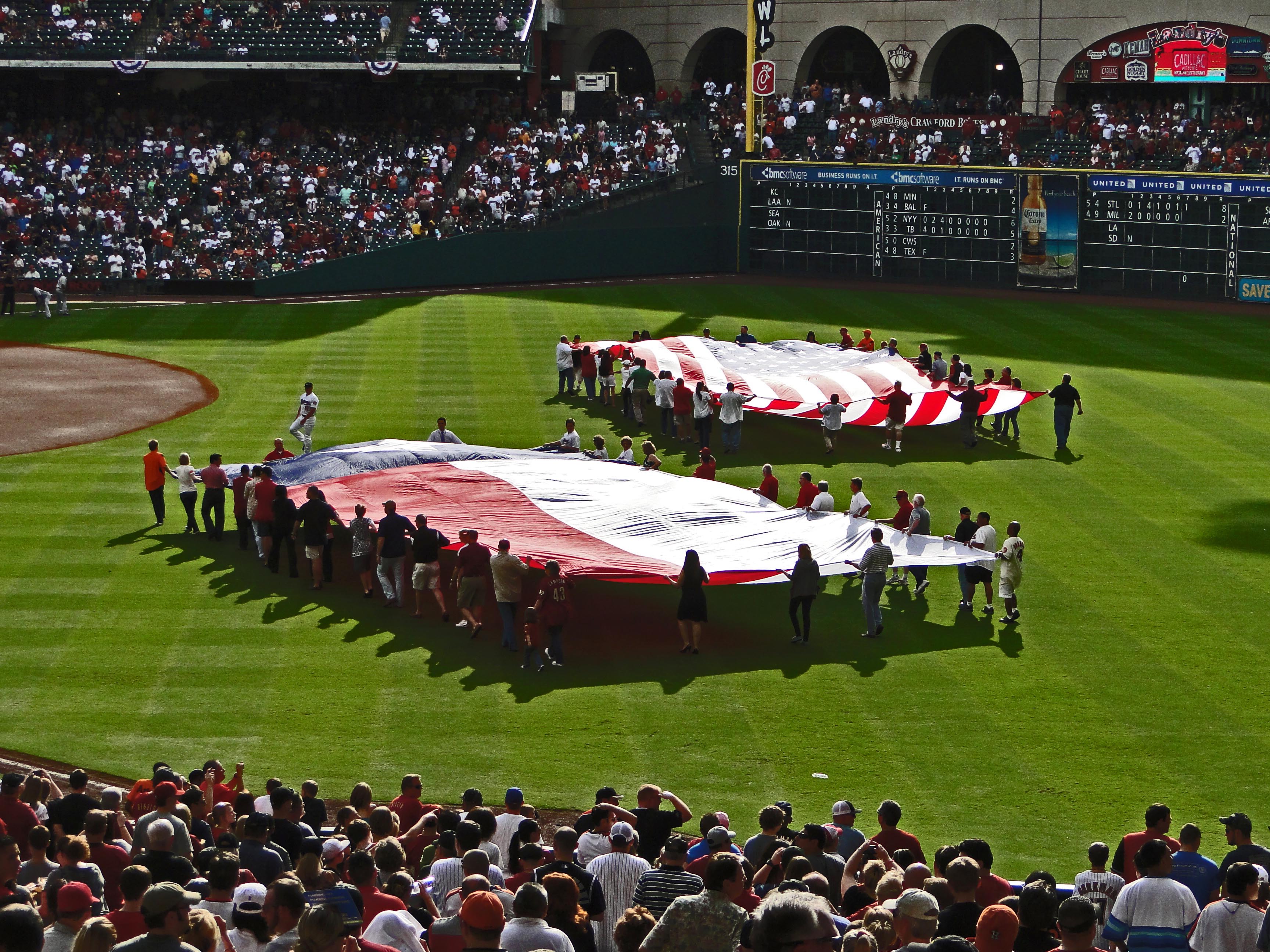
Part 1 0f 2 / This pictorial is a 2-part series due to loading limitations: The "Young Gun" 2012 Houston Astros showed up for their season home opener against the Colorado Rockies on April 6th. (See Part 2 of 2 for the rest.)

A 43,000 plus standing room only crowd arrived early. Some fans came for justice on the field that would help us all forget the crimes of defeat the Astros fell into during the 2011 season. Others just looked over at the nearby Harris County Criminal Courts Building as a symbol of life's other passage into equity and prayed for mercy.

The roof was rolled back wide open for Opening Day in Houston, 2012, the first under new ownership by the Jim Crane Group - and the club's last as a National League team prior to their departure in 2013 to the American League after 51 seasons in the senior circuit.

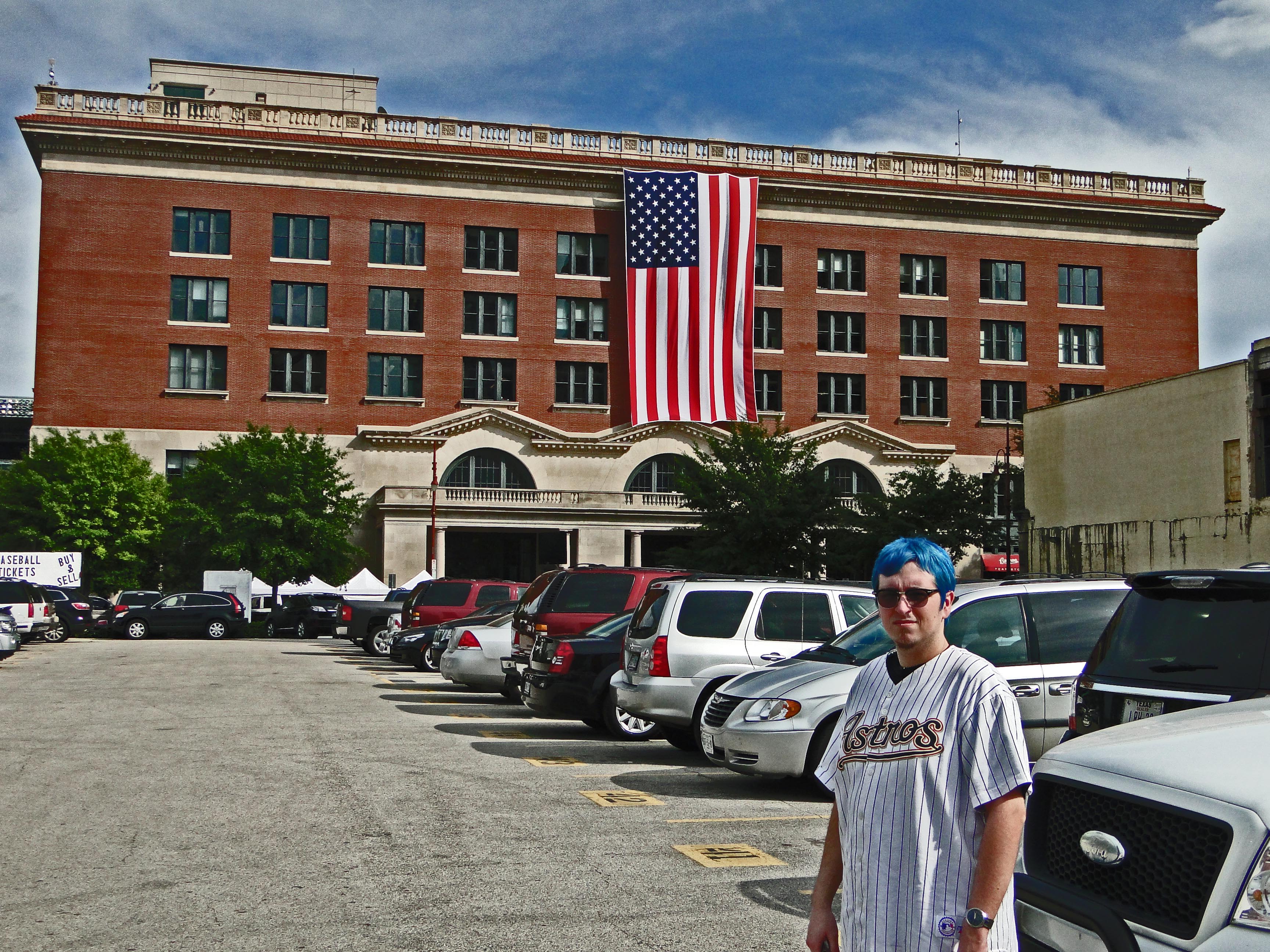
One close-to-home fan, my son, Neal McCurdy, came prepared to communicate his blues over the Astros' move to the American League next year in his own unique form as a visual statement. Neal assures me that, unlike tattoos, the case he's making is not a permanent feature, but one that will grow out and go away. Hopefully, that will all work itself out before Neal has his next job interview.

In spite of the facts about baseball rebuilding, some fans brought their spring hopes to Minute Maid Park in the form of great expectations.

Other fans simply transferred their spring hopes to the goal of running into the Budweiser Clydesdale Team before the evening ended. Based upon the fan behavior down the right field line, I'd say that many fans succeeded in finding Mr. Bud.

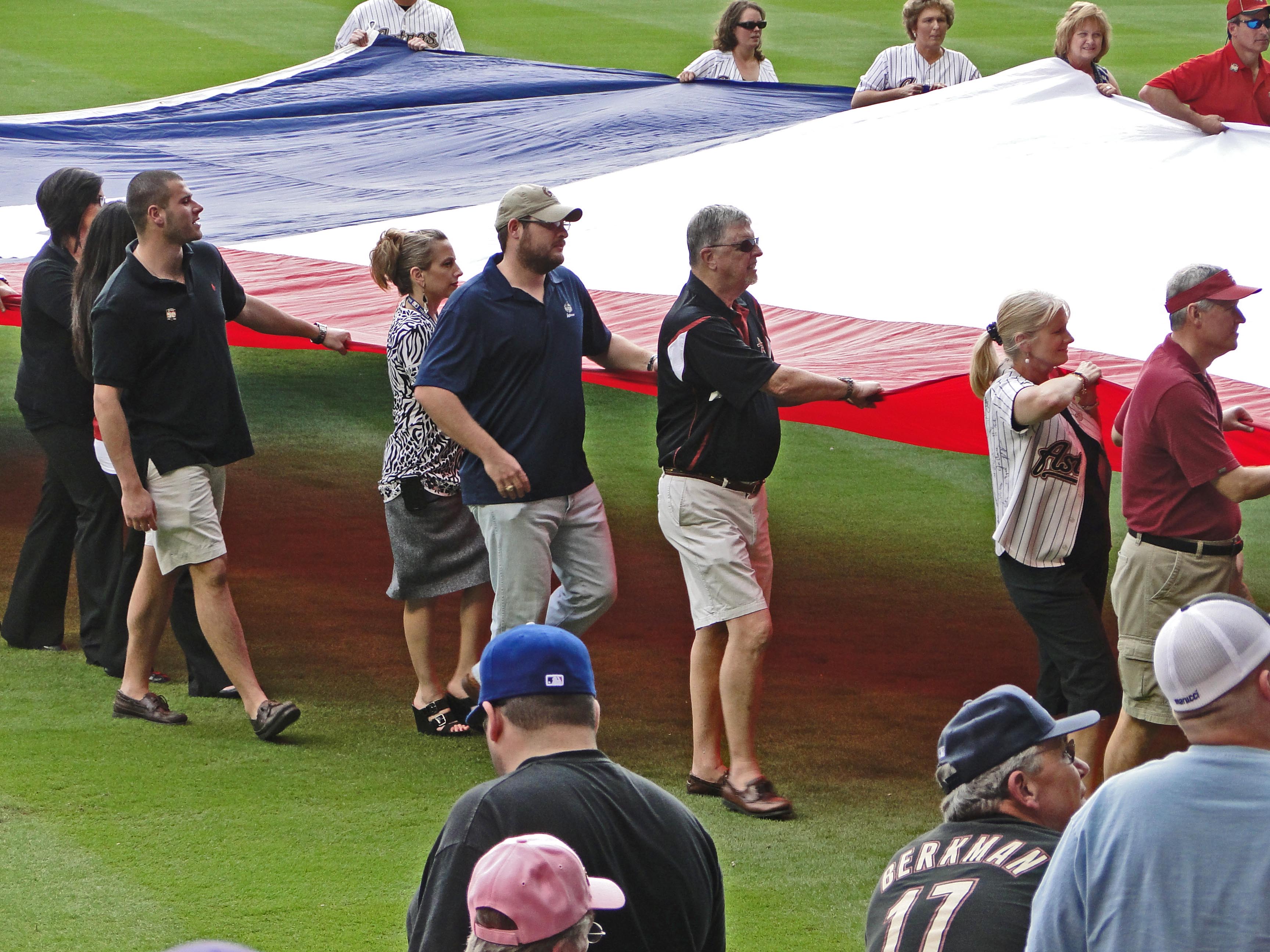
Bob Dorrill of SABR (sun glasses, dark shirt & white shorts, center) and wife Peggy (not shown here) helped present the colors prior to the game.

The state and national flags added a beautiful touch to Opening Day.

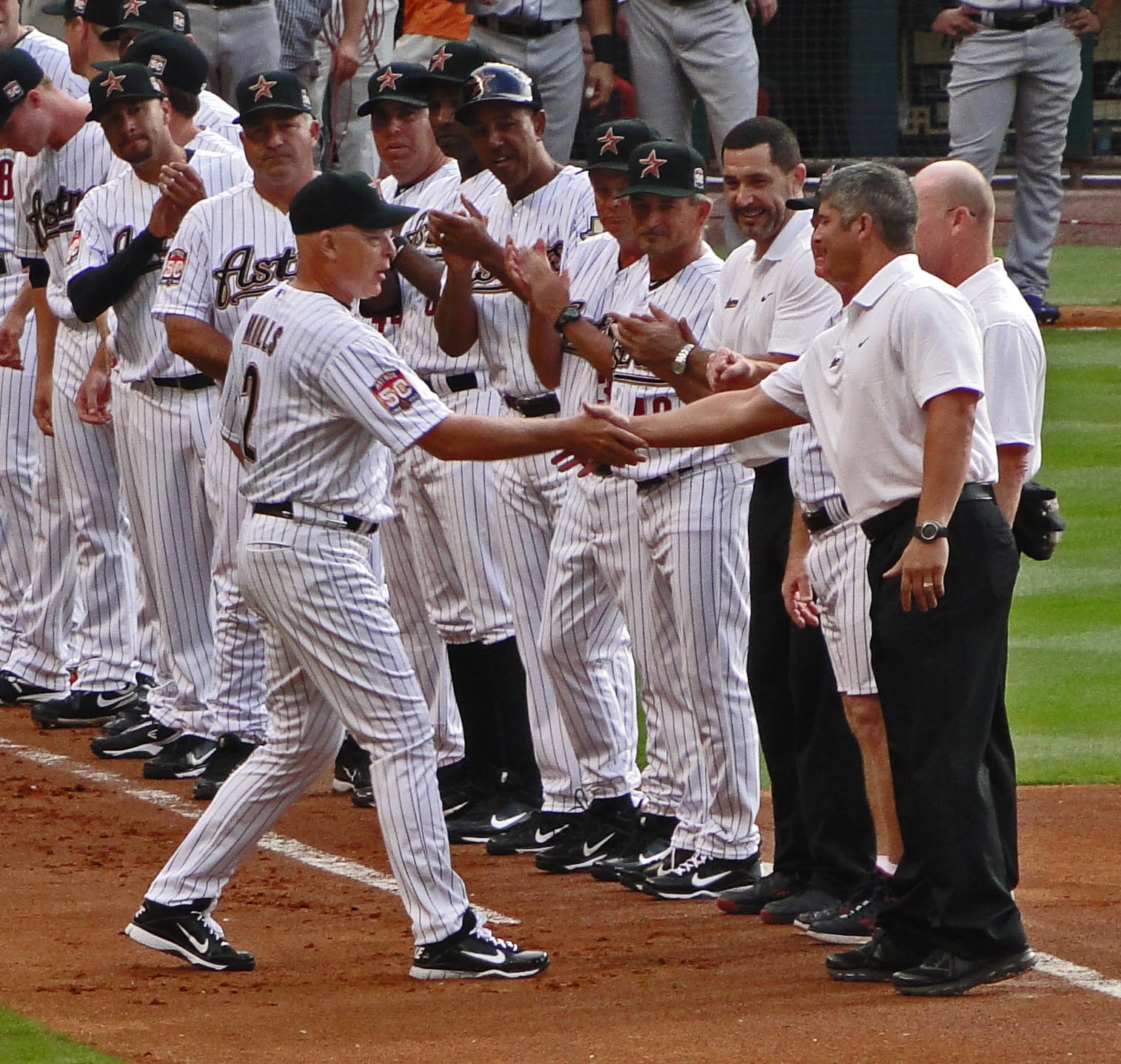
Astros Manager Brad Mills shakes hands with his future prior to the first pitch on Opening Day.

As old Dizzy Dean used to love saying, April 6, 2012, Good Friday and Passover, was also very much "a great day for baseball!"

See Part 2 of 2 in this pictorial review of Opening Day in Houston at the following link:

https://thepecanparkeagle.wordpress.com/2012/04/08/astros-lose-2012-season-opener-part-2-of-2/

Babies Make Page One of Chronicle Sports!

April 6, 2012

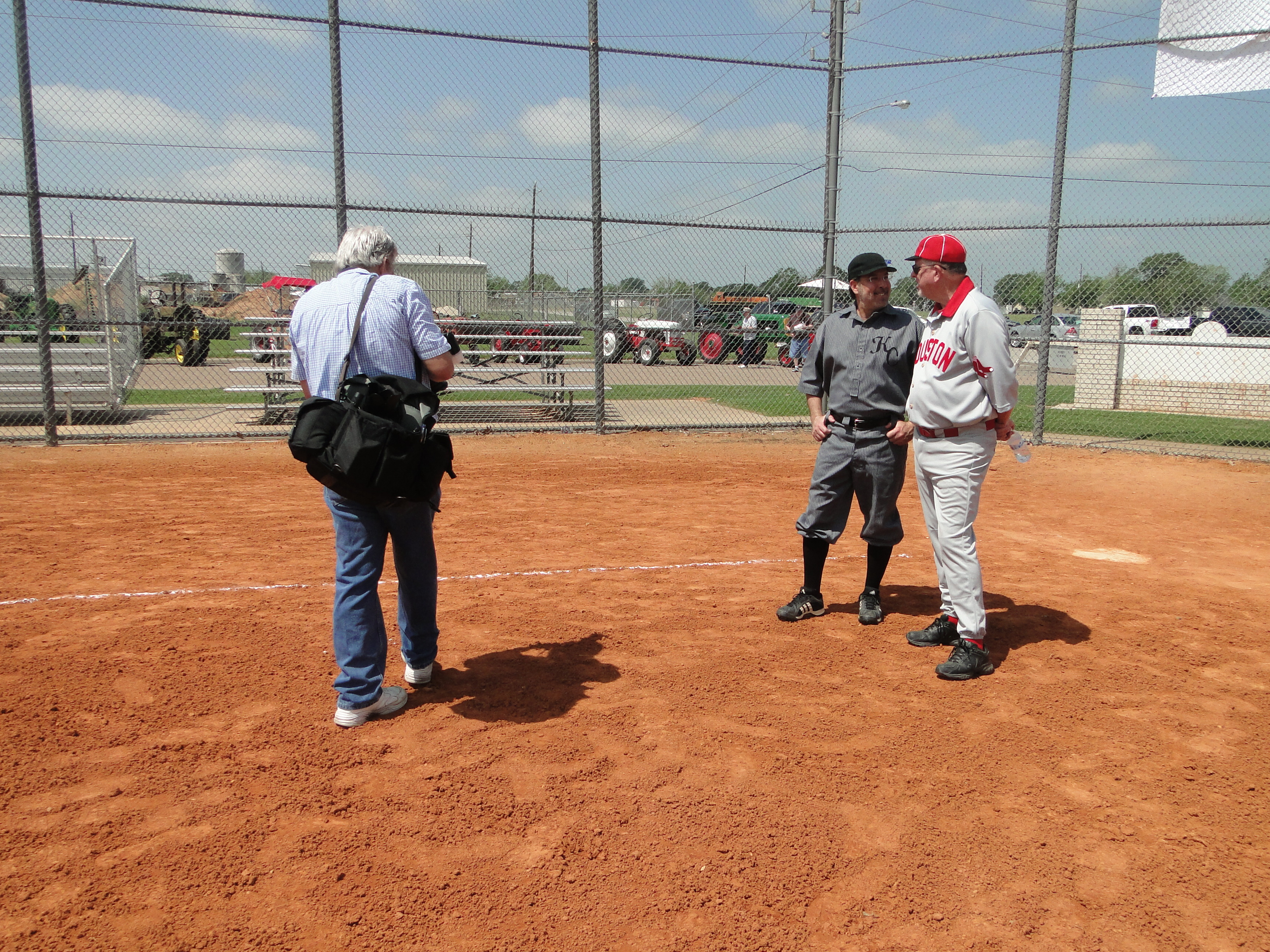
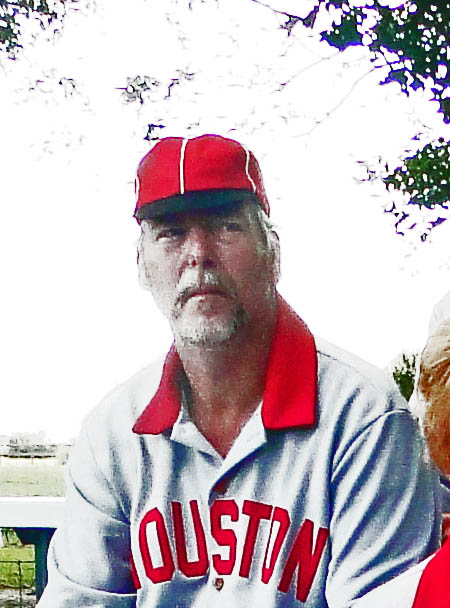
Houston Chronicle photographs managers Tom Flores of the Katy Combine (L) and Bob Dorrill of the Houston Babies after the latter took their 2012 opener in Sealy by 13-4 on March 31.

Thank you Houston Chronicle Sports Media writer David Barron!

Today the vintage base ball club we know and love as the Houston Babies cracked the big time of sports coverage in our dear old home town. Our opening game, 13-4, win over the Katy Combine last Saturday, March 31st, in Sealy, Texas was duly reported by the astute Mr. Barron and placed and then placed on the front page of the sports section of the Houston Chronicle – on Opening Day for MLB Houston Astros.

Talk about about a high cotton feeling! For those of us who are vintage base ball and ancient Houston fans, this is the real McCoy!

Larry "Longball" Miggins, 1st Base, Houston Babies

Larry “Longball” Miggins of the Babies stands tall in the Barron piece as a visual testament on the casualties to blood vessels in the hands from gloveless baseball, but it doesn’t stop him or any of the other Babies from loving the time they each have with the grand old game as it was played in its infancy. The Barron article captures that connection it makes with players and fans in a remarkably clear way,

Check out today’s Houston Chronicle – or link on to the same story as it appears online at ChronCom with far more pictures.The story was, and may still be at this posting, the front page story on Google earlier:

http://www.chron.com/sports/article/Houston-Babies-compete-under-1860-baseball-rules-3463089.php#photo-2784602