Astros Managerial Records at a Glance

August 4, 2012

Brad Mills (2010-2012): Without a plan, Brad would have been cast as Captain of the Titanic. With a plan, however, he’s Captain of the Firebird, on its way to the ashes to rise again someday in glory. He can only hope that he’s left in charge long enough to enjoy the entire unfolding of Astros-Resurrection.

Sometimes it’s simply fun to look at where we’ve been with the managers in Astros history. For me, this is one of those days.

There have been 19 different men who have had runs as manager of the Houston Colt .45s/Astros over the past half century, but 3 of those were only there as brief interim managers at mid-term or season’s end:

(1) Salty Parker took over for one game from Harry Walker in 1972 as the club awaited the arrival of new manager Leo Durocher. Parker won hi only game, becoming the only manager in franchise history with a perfect undefeated record.

(2) Matt Galante filled in for 27 games in 1999 when manager Larry Dierker went down with a brain seizure. Dierker returned to his post upon sufficient recovery, but Galante finished with a 13-14 record for a winning percentage of .481.

(3) Dave Clark stepped up fired manager Cecil Cooper in 13 games at the tail end of 2009, finishing with a small sample record of 4-9 and a winning percentage of .308.

The 16 Full Season Managers, including Brad Mills in progress, finished in this Winning Percentage order:

(1) Larry Dierker – .556 (435-348) 5 seasons (1997-2001)

(2) Terry Collins – .532 (224-197) 3 seasons (1994-1996)

(3) Phil Garner – .524 (277-252) 4 seasons (2004-2007)

(4) Hal Lanier – .523 (254-232) 3 seasons (1986-1988)

(5) Jimy Williams – .522 (215-197) 3 seasons (2002-2004)

(6) Bob Lillis – .514 (276-261) 4 seasons (1982-1985)

(7) Bill Virdon – .510 (544-522) 8 seasons (1975-1982)

(8) Leo Durocher – .508 (98-95) 2 seasons (1972-1973)

(9) Cecil Cooper – .50147 (171-170) 3 seasons (2007-2009)

(10) Harry Walker – .501412 (355-353) 5 seasons (1968-1972)

(11) Art Howe – .484 (392-418) 5 seasons (1989-1993)

(12) Preston Gomez – .443 (128-161) 2 seasons (1974-1975)

(13) Grady Hatton – .426 (164-221) 3 seasons (1966-1968)

(14) Harry Craft – .406 (191-280) 3 seasons (1962-1964)

(15) Lum Harris – .400 (70-105) 2 seasons (70-105)

(16) Brad Mills – .387 (167-264) 3 seasons and counting (2010-2012 in progress through 8/03/12)

Playoffs …

Four managers have taken Houston to 9 playoff appearances. Success began with Bill Virdon as the Astros made impressive, but heartbreaking appearances in 1980 and 1981 against Philadelphia and Los Angeles. Hal Lanier then led the club to their next playoff loss against the Mets in 1986. – Remember that one?

Then came Larry Dierker and the Astros racked up 4 playoff appearances in his five years at the helm (1997, 1998, 1999, and 2001). Finally, along came Phil Garner and the Astros followed a close loss to St. Louis in 2004 with a win over the Cardinals in 2005 for their first and only pennant and a trip to the World Series, where they lost to a White Sox broom in four straight games,

Now Mr. Mills is on baseball’s version of the clock as the current beleaguered manager of the rebuilding Astros. Will Brad Mills be allowed to hang around long enough to ride the rocket to franchise redemption? Or will hiring a new kind of rocket man for that phase of the job be the final coat of media paint on the new “House That Jeff Built?”

What do you think?

– My thanks again to Baseball Reference.Com for making good information so easily available to those of us who care enough to research and write about baseball.

When Baseball Cards Were Baseball Cards

August 3, 2012

Haenel’s Grocery Store: Where Pecan Park kids shopped for baseball cards in the post-WWII era.

Once upon a time, in the late 1940s and early 1950s, we could drop into Haenel’s corner grocery store in Pecan Park, at the corner of Myrtle and Redwood in Houston, to be more precise, and just to drop another nickel on dreams, we could buy a stick of bubble gum that came stuck to five new baseball cards. For those of us who were Pecan Parkers and kids back in that day, it was one-third science, one-third hope, one-third luck, and one hundred per cent magical each time we so acted and got anything we were actually hoping to find.

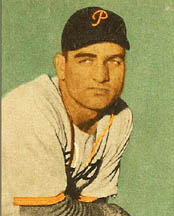
What would you rather find in a single pack, two more O’Brien twins cards from the Pirates – or a much more rare appearance by Pittsburgh slugger Ralph Kiner?. Easy answer to a tough accomplishment. A kid could throw all of his money and end up with Elmer Valo, Al Zarilla, and Johnny Wyrostek by the dozens and never to see the day he landed a Mickey Mantle, Ted Williams, or Stan Musial. It just didn’t seem fair at all, especially since we had to scrounge around and find ways to earn most of our nickels doing odd jobs at home or trying to run corner-located cold soft drink businesses.

The key was learning the delivery guy’s schedule and being there as soon as the new cards hit the store. It never took long to evaluate the latest harvest. If your first purchase included an O’Brien’s twin card that was usually a bad omen of more mediocrity to come. If you happened to land a Jackie Robinson or one of those sacred Stan Musial cards, it was whoa! Go find some more nickels before everyone else discovers that a possible mother-load has landed. Yes. We were worse than Wall Streeters when it came to hoarding rare baseball cards. And the street trading that grew from that little sub-culture was fierce.

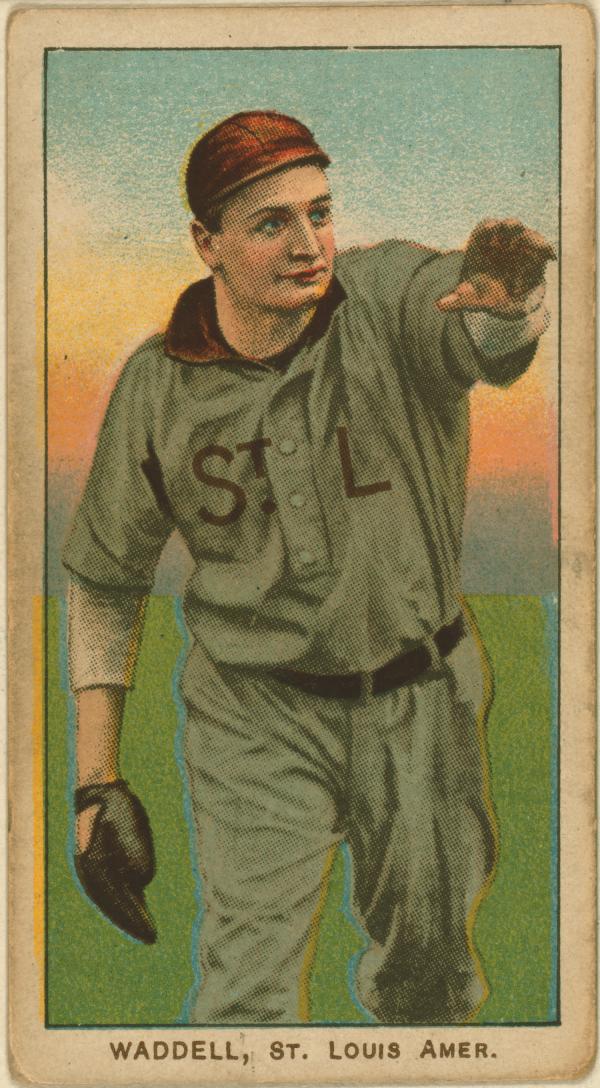
Rube Waddell

Unlike the Ohio family who recently learned that their older generational patriarch inadvertently left them a small fortune in pristinely stored and preserved 1910 tobacco cards, most of our post-WWII collections went the famous bike-spoke or housecleaning mom routes to the garbage dump. My killer-discarder was my dad. He threw out anything that didn’t move for two days. And that was also one of the big reasons we kept moving. Dad would have done the same to us – or, at least, we thought he would.

Somehow I managed to end up with one card from childhood.It turned up in a little souvenir box I found in storage a few years ago, but, no, it was not a classic Mantle rookie card. It was a timeless Clyde Vollmer card. – Who could ask for anything more?

Today I keep my most valuable card in the safe deposit box at our bank. It’s the same Rube Waddell card featured in this column, a 1909-11 T-206  series item that I bought at a Tri Star show at the GR Brown Center back in 1994. It’s not nearly as important to me as some of those I bought as a kid – even though it cost me far more than a nickel.

Nothing will ever exceed the adrenaline rush joy of those childhood card searches or the ecstasy of finding a cardboard version of a Williams, Musial, or Mantle that you could actually take home.

While I’m thinking of it, I just got to experience another loss that my dad inflicted – and this one is hitting me for the first time: When I was kid, I ordered a collection of 16 pennants, one for each of the 16 major league teams of 1949, and I used them to border the four walls of my bedroom, four pennants per wall. I’m not sure when they disappeared, but it was probably when I was in high school. I must have taken them down by then because I have no memory of them being there later on, but I must have taken them down and stored them when I did. I would never have thrown them away, but I have about a 99 per cent idea as to who did.

Thanks, Dad! You’re not here anymore, and I love you anyway! What you gave us will never be thrown away! You were the loving guiding light that brought me to baseball in the first place and that gift was worth all the baseball cards and pennants in the world to me.

Astros Rewrite July by Bill Gilbert

August 2, 2012

Even as the Astros burst into the second day of August 2012 with their cage-rattling August start to the month hanging out the window as a 13-4 loss to the Brewers, there’s still time to review the worst July in franchise history.  Thanks to Bill Gilbert of the Rogers Hornsby Chapter of SABR, here’s another take on the July trail that we hope is eventually best remembered as “the road less traveled.” Unfortunately, for now, it seems to be the only road available to the Astros.

Thanks, Bill. Your long-term, always well-considered evaluations of the Houston Astros are important to all serious followers of the club.

Astros Rewrite Record Book for Futility in July

 By Bill Gilbert

billcgilbert@sbcglobal.net

Bill Gilbert

             The Astros had the worst month in their 51-year history in July with a record of 3-24.  After starting the month with six straight losses, they beat Milwaukee 6-3 in what would be Wandy Rodriguez’ last win in a Houston uniform.  They then came right back for another win nine days later over San Diego, the last win for J.A. Happ for the Astros.  That’s when the problems really started as the team reeled off a 12 game losing streak before Lucas Harrell beat Pittsburgh, 9-5. The team finished the month with 2 more losses.

            Offensively, the Astros were last in the league in July with a batting average of .230, a slugging average of .351 and 3.15 runs per game.  The pitching was even worse with an ERA of 5.95, the highest in the major leagues.  The pitchers issued a major league high 96 walks and also allowed a major league high .296 batting average.  The bullpen converted only 2 of 10 save opportunities.

Of greater importance were the five trades that were completed in July.  In addition to Rodriguez and Happ, Carlos Lee, Brett Myers, Brandon Lyon, Chris Johnson and David Carpenter were also traded away.  In return, the Astros received 15 prospects, currently in the minor leagues, and two fringe major leaguers.  The trades significantly weakened the 2012 team but the team was likely to finish last in any case.  After four dismal seasons, a complete rebuild was obviously needed and General Manager, Jeff Luhnow, had indicated this was coming before the season started.  However, a rebuild of this magnitude is almost unprecedented.  Luhnow has been very decisive and has received favorable comments from baseball insiders for what he has been able to accomplish.  However, it will be at least three years before we will know how successful these moves were.

A reasonable expectation might be that the team will show some improvement next year and further improvement in 2014.  By 2015, the team could be in contention if some of the prospects develop and some other moves are made.  Unfortunately, it will be more difficult with the Astros moving to the American League.

As for bright spots in July, there weren’t many. Jose Altuve played in his first All-Star Game (and possibly his last since he will be competing with Robinson Cano, Dustin Pedroia and Ian Kinsler in the American League).  Scott Moore led the team with five home runs, the only player with more than two and Carlos Corporan batted .385.  Both are veteran minor league journeymen, filling in for injured major leaguers.  Harrell was the best starting pitcher in May with an ERA of 3.03 but won only one of his five starts.

What can be expected for the rest of this season?  Not much, unfortunately.  The pitching staff has been decimated with the loss of Rodriguez, Happ, Lyon and Myers.  Bud Norris and Lucas Harrell are the only reliable starting pitchers and the relief pitchers have been unable to get the job done.  Francisco Cordero, 37, was obtained in the Lyon deal, presumably to fill the closer role but he has failed in his three save opportunities with a record of 0-3 and an ERA of 18.00, the same as Brian Bogusevic.

8/1/12

Astros Finish July 2012 @ 3-24

August 1, 2012

Close the door on July 2012 and hope that August 2012 is not merely its clone-buddy.

The Astros won only three games in July. Their 6-3 win at home over Milwaukee on Saturday, July 7th, put an end to a 9-game losing streak that began with straight losses at the tail end of june 2012. Their second win on July 16th, a 2-0 conquest of San Diego at their place, snapped a 4-game loss-run that included the four days off for the All Star Game as time-killers. The third and last July win for the Astros finally came on Sunday, July 29th in the form of a 9-5 hammering of the Pirates at Minute Maid Park. That last one was significant for one major reason. It snapped the bleeding on a franchise-record 12-game losing streak that ran from July 17th through July 28th.

The Astros followed their final July win with a two-loss kick-start on a new downer streak as we slide into August.

Wow. And the Chronicle people are suggesting (as recently as yesterday) that GM Jeff Luhnow now thinks the club playing .500 ball the rest of the season is a reasonable expectation. Really? It’s hard to believe he really thinks or said that. Even going .500 next season is off the plane of my magical thinking without significant roster changes to add experience – and that’s not direction we are going. Besides, it’s not how many games we win now, or next year, that matters. What matters is – are we going in the right direction as for the goal of rebuilding this club into a contender? I personally think we are, if we are thinking three to five years. If it’s a double-decade strategy, ala the Pirates, then I’m not with it. I may not have the time to wait that long.

Some notes of interest on the 24 Astros losses for July 2012:

(1) I think the 24 losses is a franchise record for losses in one calendar month. Perhaps, some informed source, like Bob Hulsey of Astros Daily or Bill Gilbert of SABR or Greg Lucas of Fox Sports can confirm that for us. I frankly cannot recall a more horrible month since the whole big league shooting match started back in 1962.

(2) Half of  the 24 July losses came by 1 or 2 runs. (Make that 7 one-run losses and 5 two-run losses.)

(3) The Astros were shutout 4 times in July 2012.

(4) The Astros also lost by 3, 4, and 5 runs on 2 occasions each.

(5) The club also lost by 6 and 9 runs in 3 games each.

Now its August. We need some news along the line of  “ASTROS BITE LOSING STREAK.” The reverse is no longer news. It’s slipped into gear and become the expected result.

Ichiro The Great

July 31, 2012

Ichiro’s first Japanese manager hated his pendulum motion swing

So Ichiro is now a Yankee! Is it just my perception – or is there some kind of unwritten rule out there that requires most of the great players to come to New York and wear the Yankee pinstripes before they retire?

After eleven and one half seasons in Seattle, Ichiro Suzuki is now roaming right field in Yankee Stadium, and, although he;s only hitting in the .260’s at age 38, the man still plays with all the speed, fire, and flare that have blessed him as one of the greatest players in the history of baseball.

Prevented from coming here by Japanese rules, Ichiro played his first nine seasons (1992-2000) of  professional baseball in Japan, garnering over 1200 hits in the process. In November 2000, he was allowed to make himself available through the Japanese posting system for play in the American big leagues for the first time at age 27. The Seattle Mariners posted a winning bid of $23,125,000 for Ichiro’s services, allowing the great Japanese player to start his big league career in 2001.

Over the course of his eleven and one-half seasons in Seattle, Ichiro Suzuki has played light out baseball in the American League, batting .322 with a record ten seasons of 200 or more hits – while also establishing the all time record for most hits in a single season with 267 safeties in 2004. His ten seasons with 200 plus hits broke Wee Willie Keeler’s record of eight such years; his 267 most hits year beat the great George  Sisler’s record of 257 hits in 1920.

Consider this “might have been” record too: In his first eleven seasons (2001-2011), Ichiro posted 2,428 total hits. This works out to a little better than 220 hits per year. Let’s just round it down to 200 for hypothetical purposes.

Had Ichiro also played his first nine Japanese seasons (1992-2000) in the American big leagues, let’s say he might have averaged at least 200 hits for those nine seasons too. That would have given him credit for an extra 1,800 hit.

2,428 actual hits plus 1,800 hypothetical hits equal a grand total of 4,228 possible career hits for Ichiro Suzuki.

At age 39, and that doesn’t happen until October 22, 2012, Ichiro Suzuki could be sitting on 4,228 career hits, with some gas left in the tank and playing for the Yankees, a club that likes owning all the records, anyway, and be going into the 2013 season needing only 29 more hits to break Pete Rose’s all time record of 4,256 hits.

What an awesome “what might have been” that one is!

Does Ichiro Suzuki belong in the Hall of Fame someday, or what?

And we’ve done nothing here to extoll his considerable base-running and defensive skills. Also, even if Ichiro had been only able to mainatin his Japanese baseball totals in the big leagues from 1992-2000, he would still be looking at a very high finish among the greatest hit collectors of all time.

Cooperstown. Some Day. Gotta Be.

Longest Baseball Team Losing Streaks

July 30, 2012

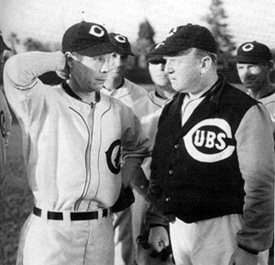
Manager: “How’d we miss the list, Joe?”
Joe: “Beats me, Boss!”

Even though the 12-game losing streak of the 2012 Houston Astros now has a cap from the club’s 9-5 win yesterday, July 29th, over the Pittsburgh Pirates, the local heroes had not even reached half way to the all time mark for all professional big league clubs in history.

The 1889 Louisville Colonels of the American Association hold the al time record for most consecutive regular season losses with 26. To no major surprise, Louisville finished in last place in the 1889 eight-team league with a record of  27-111, also becoming the first team to lose 100 games in a single season.

The infamous 1899 Cleveland Spiders of the 12-team National League waited only ten more years to register the second longest losing streak with 24, also establishing the worst season record in big league history with a 20-134 mark.

Both of those landmark losing streak records were the direct result of major roster-gut moves by ownership.

The Top Five Losing Marks Since 1960 include the following:

(1) 1961 Philadelphia Phillies (23): The Phillies  finished last in the last season of the National League’s eight-team circuit with a record of 47-107. Their mark is the record for the modern era of Major League Baseball and the National League.

(2) 1988 Ba;timore Orioles (21): The Orioles reeled their losses home in style, losing their first 21 games of the season. Their American League record would help carry and bury the sign-of-spring birds with a record of 54-107 in last place of the seven-club AL East division.

(3) 1969 Montreal Expos (20): The Expos celebrated their first year of existence with this 20-loss-spot on the all time consecutive game loser list, finishing the season at 52-110 for sixth and last place in the NL East division.

(4t) 1975 Detroit Tigers (19): The Tigers worked their losing wormhole into a 57-102 record, bad enough for last place in the six-club AL East division.

(4t) 2005 Kansas City Royals (19): The Royals rode their 56-106 mark to last place in the five-team AL Central, proving once again that teams that join the record books for most losses in  row have an almost 100% chance of taking their fates all the way to last place – and well before season’s end.

At least in Houston, thanks to yesterday’s blood coagulator with the Pirates, we can all now hum a low chorus of “Ding! Dong! The witch is dead!”

Just don’t sing too loud. The Astros have already taken out what appears to be a long-term lease on a basement level apartment.

Thank You, Jeff Luhnow!

July 29, 2012

Astro President George Postolos (L) & General Manager Jeff Luhnow at Minute Maid Park (speaking), Houston, Spring of 2012.

Everybody who’s paying attention this last Sunday in July 2012 knows the bad and good news today about Houston Astros baseball.

The bad news is that the Astros set a franchise record for most consecutive losses on Saturday night when they lost again at home to the Pittsburgh Pirates. It was their third straight loss to the Buccos and their twelfth defeat in a row. Not a very pleasant sight. It’s like watching the Astros take their lst swim in the National League pool with an anvil tied to each team leg.

“The better to sink you with, oh, dear!”

The good news is Jeff Luhnow. As the Astros’ new general manager since prior to this final NL season, Jeff told us exactly what he was going to do – and now he’s doing it. All of it. Luhnow told us he was going to rebuild our farm system and also unload some heavy salaries for prospects by the July 31st trading deadline. What he’s done is exactly what he told us he was going to do – only he took care of the big unloading of veterans far sooner than the July 31st deadline.

Gone are Carlos Lee, Brett Myers, Jay Happ,, Brandon Lyon, Wandy Rodriguez and a short boat load of lesser lights,and he has captured some  good sounding prospects from other clubs in exchange for the veteran baggage. He also continues to pick up piecemeal guys to help in the short-term, acquiring relievers like Chuckie Fick and utility players like Steve Pearce to both fill the immediate talent holes while also infusing the roster with players that haven’t been caught up in the recent downward collapse of the team. Bill Brown and Jim DeShaies hit on that point last night in the post-game tv show and I couldn’t agree more. Luhnow understands that he is now as GM “the straw that stirs the drink” when it comes to not letting the 2012 brew become so bitter that the whole roster collapses on itself posting a “how are we going to lose today” ticket. Until the club gets better. any new player infusions needs to temperamentally also be firemen – and not fire-setters or gasoline can providers.

These are the dark ages for Astros fans, but GM Jeff Luhnow is on it. I can’t wait to see what he does next – or how the club is going to be playing by 2015. I think we are in good hands and will be in for a treat.

Here’s to Astros principal owner Jim Crane and President George Postolos for bringing Jeff Luhnow to Houston. We think you did good, guys. I still don’t like the way you handled the release of Tal Smith, but I do think you deserve credit for picking a very bright and savvy young mind in Jeff Luhnow as our next Astros baseball operations leader. As General Manager, Jeff Luhnow’s forthrightness and transparency has pretty much laid out the game plan for the whole world to see: (1) Cut excess where it can cut; (2) rebuild the farm system; (3) use multiple sources of intuitive, evaluative, and statistical information in assigning value to prospects and contract players; and (4) work to be back in contention within three to five seasons or sooner.

As fans, we’ve now seen the yardstick and been given a time frame for success. Now all we have to do is keep supporting the Astros as we wait for Jeff’s cake to bake. Just ask Jeff to activate that little oven bell that goes off when the job is done. You will save everyone who works for the Astros a whole lot of grief from all the “are we there yet” questions that are bound to start coming your way from fans by the start of the 2015 spring training period at latest.

Thanks again, Jeff, and good luck.

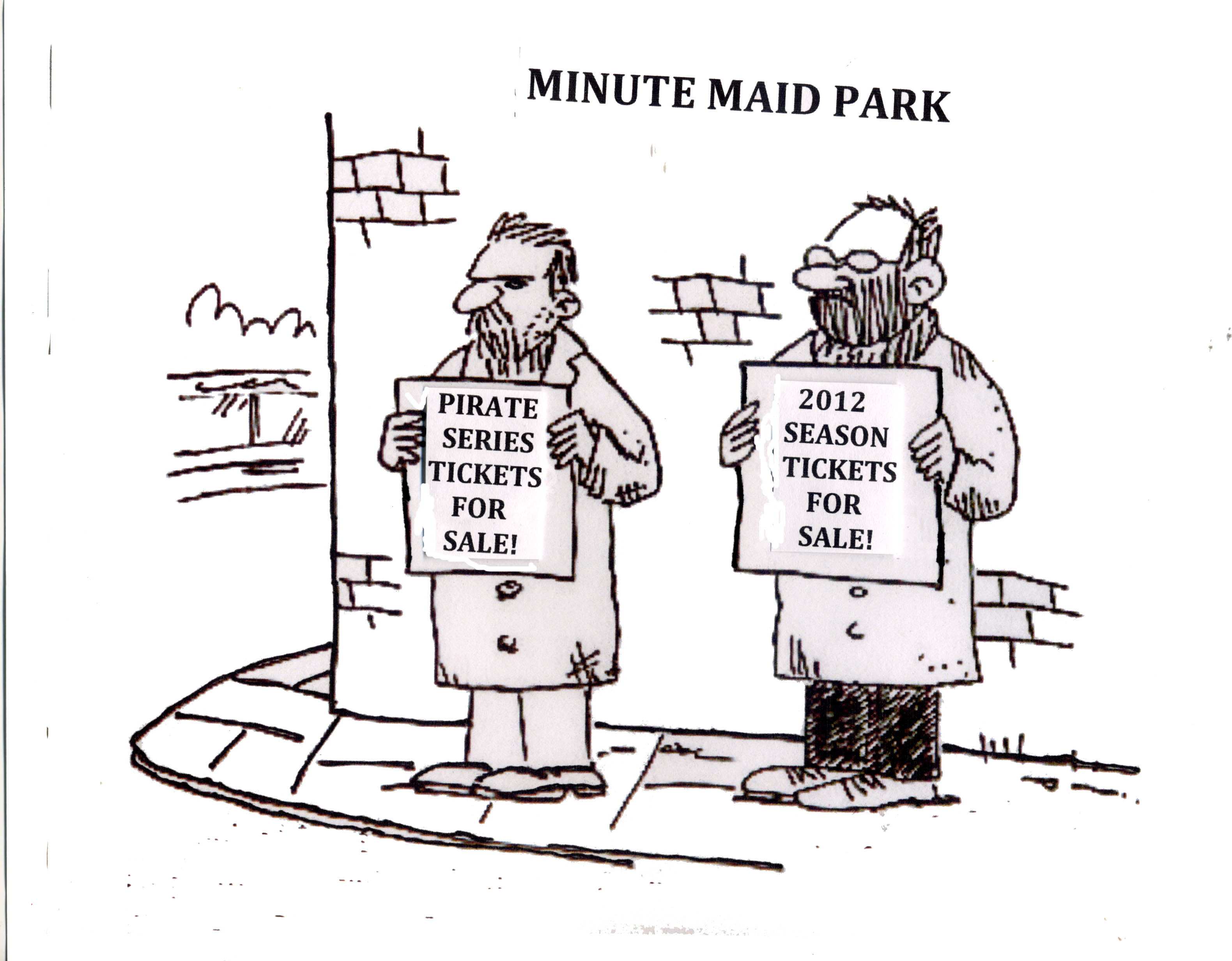
Astros Tickets For Sale

July 28, 2012

Pirates Ticket Seller Pitch: “Buy my four tickets for Saturday and Sunday and be there to see the 2012 Astros possibly set the club’s all time record for most consecutive regular season losses!”

2012 Season Ticket Seller Pitch: “Buy the balance of my four season tickets and be guaranteed of the chance to see if the losing streak will end this year!”


How To Lose Your Job as Bakery Manager

July 27, 2012

First the bakery manager has a meeting with the bakery owner and company business manager. He learns that the big brass intends to save money now while they rebuild and retool the bakery for the market of tomorrow.

The bakery manager listens intently like the good soldier he is and swears to do his best for the business during the short-term period of austerity.

Change is underway. The brass fires the gourmet baker; then they can the baker’s apprentice, the happy, smiling clerks who always treat everyone as their very own special customers,  the cooks who keep the kitchen’s fares moving fresh and on time, the wait staff who treat those who lunch at the bakery with all the ease and class of a European epicurean joint, the people who procure the best ingredients for the bakery’s special products, and, finally, they get rid of the staff who keep the place clean and also those who keep the areas around the bakery safe from threat of vandals and muggers.

All of the qualified, experienced, but now fired personnel are replaced by fewer, inexperienced, multi-purpose employees.

Product integrity immediately goes south. People ordering hot fresh doughnuts are served day-old dippers and given photos of the fresh ones they will be receiving again “for the first time” in 3 to 5 years.

Customers stop coming to the bakery. They are hooked on those instant fixes they get for caffeine at Starbucks, They want instant gratification from their bakery too. They don’t want fresh doughnuts in five years. They want them in five minutes. Tops. And they had better be hot.

The brass realizes what they are dealing with, but they know they cannot give their customers what they crave without spending a whole lot of money they either want to keep or do not have.

Finally, under pressure from the loss of business in the short-term, the bakery brass fires the bakery manager, thanking him for his years of service, but announcing to the public that the company has decided that it’s time to go in another direction for the sake of the short and long-term interests of the bakery.

Autographed pictures of the new manager are passed out to all customers who return to the bakery on Saturday and Sunday mornings for the rest of the year.

The old bakery manager now goes away quietly and graciously, looking for fresh employment at a new bakery in a marketplace far away.

Rest in Peace, Big Ed Stevens

July 26, 2012

Ed Stevens played 1st base for 6 seasons with first the Brooklyn Dodgers and then the Pittsburgh Pirates (1945 to 1950).

“Big Ed” Stevens of the old Brooklyn Dodgers has passed away. Born January 22, 1925 in Galveston, Texas the 87-year-old former first baseman died on Sunday, July 22, 1925 at his home in Houston with his wife at his side. He is survived by his wife of 69 years, Margie Saxon Stevens, his daughter, Vicki Lynn Porter, his son-in-law, Jim Porter, six grandchildren, twelve great-grandchildren, and one great-great grandchild. Sadly, as allows, for any parent, two other daughters, Janice Kay and Barbara Sue preceded Ed in death.

Big Ed Stevens at a Houston SABR meeting in 2009.

Growing up in Galveston with both the passion and talent for baseball, the prototypical lefty hitting and throwing first baseman signed with the Brooklyn Dodgers in 1941. By 1945, his .309 batting average with 19 home runs for the Montreal Royals earned Stevens a late season promotion to Brooklyn where he earned his first start with the Dodgers on August 9, 1945.

Big Ed played every one of his over 2100 games at first base. At six feet, one inch and 190 pounds, he was the prototypical first baseman. On the performance level, he batted .252 with 19 homers in five seasons as a big leaguer and .275 with 275 homers in sixteen seasons as a minor league slugger from 1941 to 1961. His best minor league season came in 1954 at AAA Toronto, where Stevens batted .292 with 27 HR. Unfortunately for Ed, in those days of only sixteen major league clubs, what today might be considered enough reason for a shot at the bigs earned nothing for the then 30-year old Ed Stevens. Once the 1950 season ended for Stevens, so did his major league time, but those were different times. Ed continued to play a lot more AAA ball, which was a cut above back then what it has become today.

I’ve saved the biggest factor in the career of Big Ed Stevens until last. It could have been presented first under a title that read something  like “It Had to Happen to Somebody.”

You see, Ed Stevens didn’t just leave first base for the Dodgers when they pulled him out of the lineup and replaced him with a rookie prospect in 1947. Ed Stevens was the man who Jackie Robinson replaced when the latter took the field to break the color line that had thwarted blacks from playing mainstream professional baseball since the late 19th century.

Margie & Ed Stevens, 2009

Ed Stevens most certainly was not the obstacle to change. He was just the man walking up the road of his personal baseball career when the big ball of great social change came rolling down the highway of major league baseball and buried him in its tracks. Stevens had not preformed well enough to have held the first base job in Brooklyn for much longer, anyway, even if Jackie Robinson had not come along when he did. If Robinson had not taken the first base job with Brooklyn in 1947, Gil Hodges would have taken it in 1948, or 1949, for sure.

That being said, Big Ed Stevens still had a career to look back upon and feel good about. The man got to play the game so many of us love for twenty years professionally – and he played it darn well. Then add to that a long life of love with his soulmate and the adoration of his family and the unconditional caring of family that was also included. – Who could want for more?

Services for Ed Stevens are scheduled for 11:00 AM today, Thursday, July 26, 2012, at Forest Park Westheimer.

Rest in Peace, Big Ed Stevens!