Happy Saturday Morning, Everybody!! ~ And what a great time again to ask the question that will never be answered for certain by even the deepest, blue history thinkers in the game. Even those who do affirm it say their words of support in the most whimsical ways ~ and with everything from a slight to widely spreading smile on their faces when they do.
Did Babe Ruth call his shot at Wrigley Field against the Cubs in the 1932 World Series? ~ Or was he simply pointing at Cubs pitcher Charlie Root, from the plate to the mound, as the two engaged in what we now call “trash talk” with each other prior to the next pitch that ended up flying high and deep off the Babe’s bat as a home run to deep right center ~ and giving birth to a visual communication that engrained the perception in the crowd ~ that they had just witnessed in totality ~ Babe Ruth predicting a home run to center field and them making delivery.
And remember too ~ all this hubbub arose from the mass visual memory of this event. The film you are about to see here ~ or probably already have seen ~ was taken by rare fan in the crowd with an early silent movie camera ~ but it only came to public attention some year in the past twenty or thirty. ~This thing was born and raised on the repetition of often reported memories of those eye witnesses who were there in 1932 to record mental perceptions of Babe Ruth predicting his home runs.
It is the film that brings us the follow-up shots of Babe waving his hand at pitcher Root again as he rounds first and heads for second in his home run trot. Even those motivations can be taken as either the Babe “rubbing it in” or as evidence that it was simply more gloat from the general trash talk that Ruth had decided to engage in with Root.
Ruth doesn’t start making big claims that he called his shot until he finds out back in the dugout after the bases trot that apparently everyone else thinks he did. Then he’s all over the affirmation as the primary source authenticator of that claim.
Enjoy the brief clip and the visual part of this story. It also includes some comment by Lefty Gomez, one of the great Yankee pitchers who was there that day. Plus, a handful of other prominent baseball writers chime in too.
In the end, you will be left with the question that only you can answer: Did Babe Ruth really call his shot in Chicago, or not?
Here’s the link:
Addendum: Reader Cliff Blau‘s suggestion in the comment section below is worth the additional look because of the light it sheds on the angle and direction of Babe Ruth’s arm-pointing. Check it out too at the following link once you’ve seen our suggested site film.
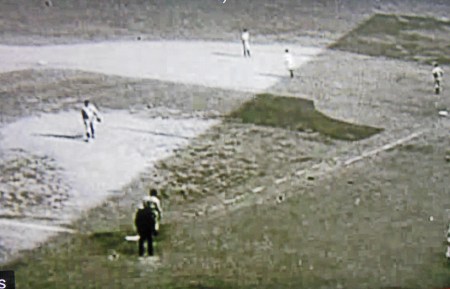
Detroit @ Pittsburgh During the 1909 World Series ~ Check out the shape of the infield grass.
Thank you, Bill Hickman, for drawing our awareness to this fine silent film collection of baseball cation from the Deadball Era. We miss the sensory completeness that sound and the smells of hot dogs, beer, cigar smoke, less hygenic circumstances of rest rooms from those times, to say nothing of rotten food disposals and the industrial age smoke that filled all breathable air could have added to our sense of presence in what was going on, but we shall happily settle for what we got.
Groundskeeping was poor back in the day. As the featured still shot here shows of the Pittsburgh infield during the Pirates’ tangle with the Detroit Tigers that fall, groundskeeping was not a major priority back in the day. The Pittsburgh infield is half eaten or worn away – and badly harmed also by the automobiles that chugged their ways across the diamond during the pre-game activity. And that’s clodhopper dirt out there – not the carefully groomed and even soil that’s imported for use on the intentional-dirt parts of the infield and base lines.
Other Notices: All the players uniformly knew how to wear their uniforms correctly, with the socks showing from the knee down. ~ Photos. Photographers crowded home plate during crucial at bats. The lenses of that age could not handle the distance and produce photo clarity.
NoWorld Series in 1904. The 1904 New York Giants celebrated themselves at home as “world champions” after refusing to play the AL Champion Boston Red Sox in what should have been the second World Series. The Red Sox had won the first World Series over Pittsburgh in 1903, but the Giants apparently were afraid to play them in 1904. The refusal forced baseball to declare that playing the World Series would not be furthermore left to individuals clubs. Winners of the NL and AL would play each other for the right to make “world champion” claims. And that’s the way it stood until the 1994 management-labor meltdown that cancelled only the second World Series in history.
Black Sox Footage of Joe Jackson and his White Sox Company from the 1919 World Series is very good. 3rd Sacker Buck Weaver has to be the ugliest snaggle-toothed innocent-looking guy that’s ever been banned from the game of baseball. – What a tragedy that whole murky-business in Chicago in 1919 was – and still is. Little Dickie Kerr also shows up. – He’s the little pitcher who came out of the Black Sox mess as the young “good guy” who played it straight and won games for the team that had eight men kicked out for life as a result of the gambling bribes they allegedly took to make sure the White Sox lost the World Series.
Baseball practices included much more pre-game defensive practice, including fungo-struck fly balls to the outfielders. They also seemed to like lining up the bats in a long row before their team dugouts.
Dead Ball Era Athleticism, based upon what these films provide, may lead some of us to wonder how many of these guys could compete against any 21st century MLB club. Several of the pitchers display funky wind ups that wouldn’t carry them too far in today’s game either. – See what you think when you watch the film on this very resourceful link:
Hope you enjoy this excellent opportunity for exploration of the so-called Deadball Era.
********************
A Back To The Future Addendum
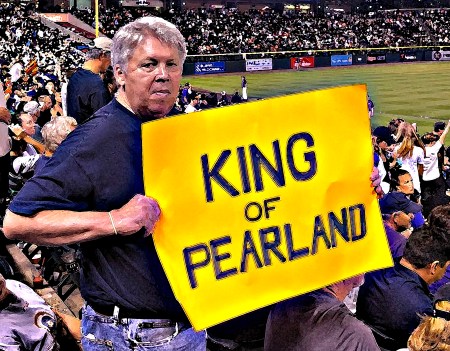
Congratulations to Tom Hunter Denver Resident but Staunch Astros Fan
Great friend and Pecan Park Eagle supporter Tom Hunter got to Coors Field on Tuesday night, 7/24/18, just in time to proclaim his own presence as he also brought his Houston Astros a bucket of extra inning good luck! ~ Where were you Wednesday night, Tom?
Down goes Frazia! ~ Down goes Frazia! ~ Down goes Frazia
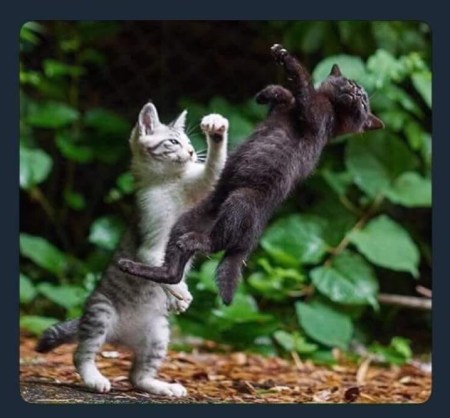
It was one of the biggest boxing battles of all time. Could it also have been the first apparent application of the Marquis of Queensbury rules in a cat fight? We’re talking about the largest gate of nearly 60,000 people that paid to see the big fight at the Catstrodome in Las Vegas back on August 7, 1954 ~ the heavyweight championship cat fight between Cautious Catius Claye and Smokey Joe Frazia!
Today’s featured photo shows how the fight ends, but here’s the audio from the national radio broadcast on how the brief less than one round match played its way out forever into our imagery of why this particular cat fight contributed so much to our appreciation of what really charged athletic competition is all about. All the fearless cool cats were in house that night to see it – and you can take it to the bank – there wasn’t a mouse among them.
The broadcaster that night – the voice on our audio – was a guy known for his descriptive, cynical, and baritone-ringing “New Yawk” accent and precise choice of words – and ones that were used repetitively when a fighter was either in trouble – or a knockout path that had just been landed by a decisive punch.
Now gone to wherever the most judgmental of us go whenever our lives on planet earth are spun and done, our audio guide for this little moment is someone the elder among us all remember as HumbleHoward Catssell. ~ “Take it away, Howard!”
Glad to do so, Billy, and isn’t it wonderful today – in 2018 – that something like a 64-year old audio tape can be programmed to actually allow a dead person like me to thank a totally live person – or maybe I should say technically live person like yourself – for the opportunity to handle this segue with all the finesse and gracious deference of the stellar personality I once had in unfair numbers above all others in my field? ~ OK, here’s the fight description – all of it transcribable in italics – for the sake of time clarity:
Good evening from the Catstrodome in Las Vegas, cat boxing fans! – This is Humble Howard Catssell bringing you the scheduled 15 round heavy weight cat fight championship match between champion Cautious Catius Claye and challenger Smokey Joe Frazia!
No soul in his right mind thinks this fight is going to go anywhere close to the distance. Both fighters are undefeated – Claye at 25 and 0 – Frazia at 21 and 0 – and all wins by both of these ferocious felines have been by the hard knock out route.
Someone must fall tonight! – And one man’s fall will be the other man’s adornment of even higher placement on the historic wall of fighter respect. – The bell for round one has now sounded and we’re about to find out as observers to history in the making. – We may be only fly specks on the wall of history, brave listeners – but even flies draw attention – if they land in the right place – at the right time. – Just ask me. – I’ve made a career of it.
Claye goes into his peek-a-boo dance in the middle of the ring. – Frazia from Philly stalks in – like a longshoreman closing in on an open roll call for work on the docks.
Claye dances in a circle around Frazia – sending out left jabs like love pats. – Frazia moves in the middle of the circle – like the fulcrum of a watch that anchors and rotates its time-telling appendages. – Joe keeps a close watch out for any second-hand movements from Claye.
There’s a right to the belly of Claye by Frazia! – But Claye seems to both inhale and take a two-step leap backward simultaneously – softening the blow from Frazia – as Joe takes a clumsy fall forward as the end reaction to Claye’s quick escape from contact harm.
Now they’re on the ropes. – Joe is two-fisted pounding away at the taller Claye’s middle – but Claye is using the ropes famously to ease the contact harm from body fist pounding – – and he’s also extending his arms across his chest – with his elbows perpendicular to the floor to deflect many of the hard Smokey Joe blows.
Now they are at mid ring – when out of the blue – liked greased lightening – here comes a hard and high arching left to the chin of Frazia by Claye – and Frazia’s down! – Frazia’s down! – Frazia’s down!
Frazia’s not moving! – The ref is counting him out! – They’re dragging Frazia to his corner! – And the cat that stings like a bee is now dancing around the ring like a butterfly!
The winner – and still heavyweight champion of the Cat Fight Boxing Association world – its Cautious Catius Claye!
Back to you, Billy! ~ That’s all I’ve got from 1954, and besides, it’s time for me to get back to my very long nap!
Thank you, Howard! ~ And thanks too, cats in the picture, for reminding us of a time in which boxing was alive and thriving. Now they are simply a barely holding on relic of what they used to be as a once major sport – plus the everyday reminder that their sport is one of the few that still values concussion as a successful outcome.
Professional sports also need to remember that boxing exists today as a reminder to all the current most popular sports groups that none of them either should ever make the mistake of taking athlete participation or fan support for granted.
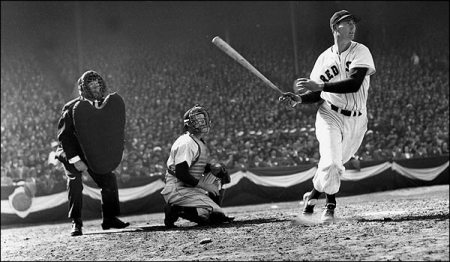
TED WILLIAMS **************** Good shot of Williams at the end of a HR swing at some point in the 1947 season.
On Wednesday, September 28, 1960, famous American novelist John Updike did a fairly ordinary thing, especially so for a New England guy and big fan of the Boston Red Sox. He decided to go see the club play their final home game of the season that afternoon at Fenway Park and, if what I’m given to believe was true, with no big designs upon doing a book, column, or article on the experience.
It turned out to be Ted Williams’ last game ever for the Boston Red Sox, one in which his bottom of the 8th solo home run to right field on a cold, damp and windy autumn afternoon would also stand forever as his last action as a major league hitter.
OK. So Updike went there to see the game, but he was a great writer to the bone. And writers never go anywhere or do anything without bringing that presence of mind and emotion with them. All it needs from there is a little jarring from external events and the muses that provide all the internal packaging of the written word, most authentically in ways that seem familiar, suddenly pour forth through the writer to the world in ways that are never to be forgotten.
“Gods Do Not Answer Letters” is such an expression. John Updike wrote it with muse support to explain why slugger Ted Williams, who was notorious for his disdain of fan support acknowledgement, had refused to come out of the dugout to tip his cap in gratitude to the fans who were tumultuously applauding the dramatic act of their anti-hero hitting a last home run in his last Fenway Park plate appearance – and possibly for all time – if he were to also now sit out the last three games that Boston was still on the hook to play from September 30 through October 2.
“Gods Do Not Answer Letters” is the explanation that Updike offered for Williams’ decision to ignore the fans in the article that he wrote for The New Yorker. But remember. Updike had not intended to write “Hub Fans Bid Kid Adieu”. There simply was no way that this dramatic game was going to fail in its successful efforts to interface with the writer presence of Hohn Updike and not become an article of some considerable erudition.
We’ll never know for sure. Maybe part to some to all of Ted Williams’ decision not to play the last three games in New York was part of – or all of – Teddy Ballgame’s ultimate tip of the cap to all the fans who pled in vain for his consoling and healing recognition after the last HR game of September 28.
By not playing in the last Yankee series, Ted Williams had taken all the fans who saw him hit that career homer on Sept. 28th in Boston with him to the walls of history – as the last fans to ever witness a Ted Williams home run. And suddenly I remember another, this time, well-known godly expression:
The Lord Moves in Mysterious Ways.
The Williams Last HR Box Score
Baseball Almanac Box Score
Boston Red Sox 5 – Baltimore Orioles 4.
Game played on Wed., September 28, 1960 at Fenway Park
E–Klaus (2), Coughtry (5). DP–Baltimore 1. 2B–Baltimore Stephens (15,off Muffett); Robinson (26,off Muffett), Boston Wertz (22,off Fisher). HR–Baltimore Triandos (12,2nd inning off Muffett 1 on, 0 out), Boston Williams (29,8th inning off Fisher 0 on, 1 out). SF–Gentile (5,off Muffett); Clinton (6,off Fisher). Team LOB–6. HBP–Pagliaroni (1,by Barber). Team–7. WP–Barber (10), Muffett (4). HBP–Barber (3,Pagliaroni). U-HP–Eddie Hurley, 1B–John Rice, 2B–Johnny Stevens, 3B–Cal Drummond. T–2:18. A–10,454.
Who took over for Ted Williams in left field for the Red Sox in those last three 1960 season games against the Yankees in The Bronx? Check out the first entry in the comment section that follows this column for the answer in case you do not already know and want to play with your mind for that name before it’s simply handed it to you.
A You Tube Look at the Last Ted Williams HR
Now watch this brief, intelligently stated coverage of Ted Williams HR # 521:
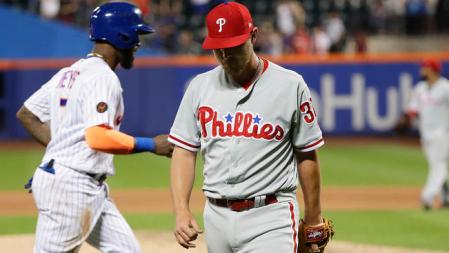
CUBS WIN IN WALK OFF! Pease Note: It’s the loser Phils doing the “walk off”.
Baseball often is referenced by philosophical writers as a metaphor for life, and why not? A full life itself, for better or worse, is very much like the long season of baseball, and it even comes with its own daily grind and periods of variable product outcome and happiness, just as baseball does. So, it’s no big wonder that baseball itself should both lend and feed upon metaphors from other actions in life to sharpen our perspectives on what’s actually happening on the field.
One of my favorite baseball metaphors goes back to the early 20th, or possibly even the 19th century. We never really know for sure when any metaphor is used for certain the first time. They are like unregistered, swift of mind and foot, unregistered guests at some of the biggest hotels in the largest cities in North America. By the time anyone even asks, “where did that guy come from,” they’ve already pulled up and hit the road again, knowing that their names will not be forgotten by anyone whose now heard them. The character I’m thinking of here is “worm burner”.
“Worm Burner”, by the way, was never any biggest voice in the room guy. He was just the name some writer, fan, or player used one day to describes a ball that had been hit back through the infield on its way to the hinterlands at a scorching hot speed without apparently ever elevating one iota of measurable height of distance from the grass.
Then one day, one of those things happened, and some anonymous poet called it what it really was in a mentally visual sense. – This visually literate soul called it a “worm burner” – virtually perfect descriptive metaphor for the action and species of life that had just been most directly affected by such a smashing, low traveling ground ball.
Somebody said it and remembered to say it again. Or somebody else heard or read it and liked it so much that they repeated it and used it elsewhere. And over time, it got so popular that it never lost its home among the vernacular of baseball. And even if it now sits most often on a shelf in the library for archaic expression, it still pops out among all of us who speak, read, and write in baseball English.
It doesn’t take much imagination to see how important an expression like worm-burner was to radio broadcasters during an era in which most fans could listen, and probably rarely so, to big league ball as it reached them by radio.
This brings us to two more contemporary metaphors that probably only became such because of the broad-based high quality opportunity that almost all of us now have to watch MLB in HD quality television. Those are two I’ve included in the following simple table – with one cell that shows where they’ve originated – and a second cell which depicts how they have come to be expressed as contemporary baseball metaphors.
I’m not here to argue their exact dates of origin – for all the good reasons previously expressed – but I will say that they each have a good chance of being original to the 21st century. I don’t remember either being in use twenty years ago and they are so dominant today.
Two Contemporary Baseball Metaphors
#
From Early Times
To 21st Century
1
Game Winning Play
“Walk Off”
2
Pitcher Throws Strike Out
“Punch Out”
Because modern TV so dominates everything it does with multiple angle and capacity high quality pictures at different speeds, we now are able to watch baseball mechanically at home in ways that will always be superior to the one-place / one-distance perspective will each will have at the ballpark. Irony: Whereas, radio cried out for metaphors that provided pictures, television 2018 now cries out for pictures that validate what viewers are seeing on the screen.
“Walk Off” is an appeal to the sight of a losing team walking off the field – something we now see far more often with the growing ubiquity of MLB.Com. The winning team isn’t walking anywhere. They are celebrating all over the place. It’s the losers’ “walk off” that signifies that a game-winning play has ended the game early. The visitor losers are the ones walking off quietly in the background as the home team winners celebrate.
“Punch Out” is a more aggressive expression of what the pitcher’s strike out of a batter has done. And that’s an even longer subject for another time. Television wants to portray pitchers who deserve it to be seen as every ounce and inch the equivalent to offensive home run bombers as players of aggressive intent – and “punch out” carries with it that idea quite clearly.
“Punch Out” may loosely come from boxing’s “knock out”, but let’s face it, if heavyweight champions Muhammed Ali or Rocky Marciano been able to get 12 “punch outs” in a single evening, as Justin Verlander does fairly often, either would have wiped out all his competition for good in three months.
Larry Dierker’s 18th Birthday September 22, 1964 The day Larry Dierker broke into baseball by striking out the greatWillie Mays the first time they faced each other.
At some point in the not-too-murky-distant past, a Houston sports jockey named Craig Shemon did a mid-day live air interview with Larry Dierker over local AM radio station 1590 about the time that one of our great franchise icons broke into the big leagues as a pitcher on his 18th birthday, September 22, 1964.
The interview for radio also was recorded with a video too so we able to watch them have this conversation at Shemon’s broadcast desk.
18-year-old Larry Dierker struck out the great Willie Mays in their first meeting of that game, bronzing forever both the need and justification for remembering this lopsided contest between the classic Giants and the fast-fading Colt .45 identity of the Houston expansion club. ~ A virtual “kid” coming of age had just struck out the legendary “Say Hey” kid from Alabama by way of Coogan’s Bluff.
If only we shall someday find a film of the actual moment it happened ~ Dierker fanning Mays ~ what a treasure that shall be.
********************
In the meanwhile, here are the box score of the game and the brief Dierker interview. We are lucky enough to have these items, and even more fortunate that destiny long ago played a hand in making the gifted athlete and wonderful human being that is Larry Dierker – a big part of us – as a leader in the Houston baseball community. Without Larry Dierker, things never could have been as great on the positive side of Houston’s growth from 1962 into World Series championship status in 2017 – and hungry for more.
********************
The Box Score ~
Baseball Almanac Box Scores
San Francisco Giants 7
Houston Colt .45s 1
Game played on Tuesday, September 22, 1964 at Colt Stadium
Opening Day ~ April 10, 1962 Colt Stadium in Houston Bayou City Big League History Begins
I’m learning that it sometimes pays to simply ask YouTube what they have on any given specific past event. This is a clip I found this morning when I asked about film material on the first Houston Colt .45 game on Opening Day 1962. The film direction is extremely poor by today’s standards, but this was April 10, 1962. Fans lacked access to video equipment and we all had to rely upon the professionals to produce really limited amateurish material for history.
There is no voice explanation of what is going on by player name on the field, but you should be able to figure out that what you are looking at early in this brief clip is Bobby Shantz (#42) performing as the first pitcher in Houston MLB history as he strikes out a left handed Lou Brock (# 24) for the Chicago Cubs. It also features Bob Aspromonte (#14) getting what is most probably the first hit in Houston MLB history; Al Spangler (#21) collecting the first triple in team history; and Roman Mejias (#25) rounding the bases and returning to the dugout on the heels of the first Houston MLB home run.
Yankee Stadium, 1931 ~ Timely site photos are great, but you have to see and hear the people in motion to feel the times. This film clip with sound helps get us there.
Before you immediately click the link, please give us a moment to try and put in perspective what we are about to see. It’s quite rare for the era, but what’s in store is a fresh, raw look a long ago Opening Day of the early Depression period, but one that comes in the form of a 14-minute motion picture with the actual sound of what is going on at Yankee Stadium from prior to the Yankees hosting the Red Sox on April 14, 1931.
It’s mostly pre-game stuff, with great shots of Ruth and Gehrig taking batting practice, the field announcer setting things up for the mammoth crowd with little more than great voice projection, superb articulation, and a hand-held megaphone.
Everybody in the house is in full dress ~ everybody whose adult is wearing a hat (and none of these express “NY” in the loving-letters position) ~ and practically everybody, including the ladies, smokes from wherever they happen to be sitting.
New York playboy Mayor Jimmy Walker is shown throwing out the first pitch from his field box front row seat to, most likely, Bill Dickey, the Yankee catcher, and a uniformed band shows up to escort the raising of the American flag on a tall pole down the left side as they move right into a nice job of playing Our National Anthem without anyone in sight taking a knee.
The Yankee black pinstripe on white with bold numbers on the back of all jerseys looks pretty much as it does today, but the players of 1931 and not yet forgotten that the socks are part of the uniform too. There was no effort back then made to pull the pants down to cover the sox to ankle descent depth. The 1931 Yankees displayed the “NY” letter party on their caps, but did not yet show them at all on the heart-side of their uniform blouses. – Did I mention that the uniforms were far blousier in 1931 than they are now? – That one’s pretty obvious.
We were still wearing those blousy and heavy wool uniforms when I was playing CYO League summer ball in the mid-1950s. By the time we finished a game in the Houston summer heat from all the sweat our clothing had absorbed, it felt like we had gained about twenty pounds playing ball. The big leaguers of 1931 got to feel that way pretty much every day.
As for what we can see about the ’31 Red Sox player uniforms, on the other hand, these displayed a long presumably red stocking on the body face of their caps. Their uniforms were blousy “light wool” too, of course.
Managers Joe McCarthy of the Yankees and Shane Collins of the Red Sox were filmed and recorded extending each other a few good sport wishes prior to the first game start, but the season would soon show that neither club had what it took to stop the pennant roar of the 1931 Philadelphia Athletics. The Yankees fished second to the A’s, 13.5 games back; the Red Sox would get lost in the second division dungeon that year, and end up a whopping 45 games behind the Men of Mr. Mack.
To actually see a pan of the Yankee Stadium outfield from 1931 is to invite amazement. The left field stands seem to jut out early, creating an avenue for short homers down the line. Then, as the field moves further to center, the stands disappear, turning the left-center-to-center outfield area into the “death valley” it came to be for so many home run fly ball outs.
The Wisdom of the Bleacher Fans Story. The 1931 recorded announcer also made a comment that inferred that the people in the outfield bleachers probably know more about baseball than the people seated in the prime seats. – I didn’t realize that this impression as such had been around as long as it obviously has. It is, however, not surprising at all. I think it’s tied to a larger social lesson about the fruits of class warfare: “The poor man gets the lesson ~ and the rich man gets the land.”
Finally, here are three more facts to help personalize your trip to the April 14, 1931 game:
(1) The Box Score of the Game below comes to us courtesy of Baseball Almanac.Com. That’s right. The Yankees won 6-3 behind the pitching of future Hall of Fame right hander Red Ruffing. And yes, Babe Ruth did homer in the game.
(2) Make sure you have your sound turned on before you click the link. It makes for an almost surreal landing to arrive, seeing and hearing the world as it was that long ago day in the Bronx.
(3) On this same date, living just a few blocks away from Yankee Stadium, our own favorite native of the Bronx and most venerable member of our Larry Dierker SABR Chapter, Mr. Larry Miggins was then only a 5-year old Irish street kid. ~ Well, our wonderful Larry Miggins is gearing up to turn age 93 next month on August 20th. ~ Expect to hear more from us on that moment for celebration as the time draws even nearer.
Thanks to Patrick Callahan, another of my Eagle brothers from the St. Thomas HS Class of 1956, for calling my attention to the best 14-minute time travel experience that you too are about to see and enjoy. – It’s a beautiful world when we have people like Pat Callahan doing all he can to spread all the good and true joys that are out there.
The Box Score
Baseball Almanac Box ScoresNew York Yankees 6 – Boston Red Sox 3.
Game played on Tuesday, April 14, 1931 at Yankee Stadium
E–Warstler (1). DP–Boston 1. Warstler-Sweeney. 2B–Boston Scarritt (1). 3B–Boston Warstler (1). HR–Boston Winsett (1,8th inning off Ruffing 1 on), New York Ruth (1,7th inning off Durham 0 on). Team LOB–4. Team–6. CS–Sweeney (1). U–Bill McGowan, Roy Van Graflan, Tommy Connolly.
Game played on Tuesday, April 14, 1931 at Yankee Stadium
April 14, 1931 Game Link: Boston Red Sox @ New York Yankees
Please comment. We’d love to know how this experience registered with you. Can you imagine how this crowd might have reacted to a few contemporary fans walking into the stadium in 1931 wearing Yankees caps and jerseys from that era? Who knows? A uniform with # “3” on the back might have produced an earlier birthdate for the phrase “new revenue stream.”
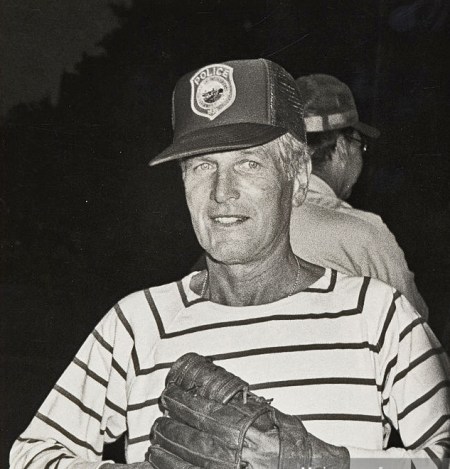
What Alex Bregman may look like someday when he’s too old to play any more baseball.
Well, he may not really be Paul Newman, but Alex Bregman is still playing a Cool Hand Luke brand of baseball these days. He works hard at his craft and he fights back fiercely at everything that fate and pitching dementia throws at him, apparently against all odds.
That first observation also begs for another Newman-driven movie title here to theorize why things first stuck in adversity so often bounce back Bregman’s way. ~ Maybe, yes, just maybe, ~ “Somebody Up There Likes Him.”
What happened Monday and Tuesday in Washington was typical of the snapback pattern this guy has in his determination to make something good happen. Monday night, as the only American League contestant in the Home Run contest, Alex had to beat out this mad grinning, much bigger Bluto of a guy from the Cubs in the first round. He pretty much came on like Popeye in the process. With time running out, Alex needed one more homer to force a tie that he probably could have then broken for a first round win in the bonus time he had earned en route.
Alas, the last long drive to deep left center fell about two feet short and Bregman was done. For Monday night, at least. As for how this low AL interest in the Monday Home Run Derby started, we may have gotten our answer Tuesday. Some of them apparently were saving their homers for the Tuesday game itself.
Maybe it just takes a guy like Alex Bregman to see and then take best advantage of every golden opportunity that comes his way. It also helps to be lucky – and also to have a manager like A.J. Hinch, a guy who knew that putting Bregman in the lineup as a sub at shortstop could make a difference at a critical moment late in the game. And wouldn’t you know it? The home boy NLs tied up the game at 5-5 through nine – forcing about the dreaded extra innings and a kid named Alex Bregman leading off the top of the tenth – and standing squarely in the way of the game reaching a player over-use crisis.
Bregman took the count to 2-2 – long enough for Joe Buck to start yakking about the problems of all-star games and player over-usage when – all of a sudden – it didn’t matter.
Remember, the pitcher had two strikes on Alex. ~ Bregman had him right where he wanted him. Alex drove the next ball over the left field fence and into the bullpen. The face and fire of joy took over the Bregman body and soul as he answered every slap of congratulations from his teammates with resounding force and deliriously happy fury.
Somewhere now standing from the best seat in the house, Commissioner Manfred had to be upright for as far as he can rise, applauding, and grinning his head off as he silently screamed his newfound mantra: “Thank God for Alex Bregman! ~ Now I’m off the hook for my own embarrassing Bud-Selig-All-Star-Game tie moment in the bottom of the 17th inning! ~ And, Oh YES! Thank You too, George Springer! Why, I only had to rise once to see the Astros serve the turkey and dressing ~ and then they also quickly poured gravy on it too! What a beautiful, butt-saving, flying-frito deal this is turning out to be! ~ Don’t go far away, Mr. Alex Bregman! You don’t know it yet, but you just won the MVP award, if this lead holds!”
You just read what happened next in the Commissioner’s mind. There was barely time for Bregman to celebrate alone because Astros teammate George Springer then walked to the plate and took the very first pitch thrown since the last dinger went yard and crunched it even deeper to right for an opposite field homer.
The Bregman-Springer two-pitch back-to-backs would stand as a baseball version of the old one-two punch-out to both cheeks of the NL pitching face. The AL then used a series of hits to add the only run scored without homer aid as the game retired to the bottom of the tenth with an 8-5 AL lead looming large. The NL found a way to add their 5th HR for the 10th record homer of the game, but AL 8 – NL 6 would hold up as the final score.
Wow! And wouldn’t you know it! Mr. Bregman was named the game’s MVP. He even got to select a Chevy Camaro as part of the gift package. The rest of the gift was the fact that he got to be seen by millions as he gave the car in person to his mother, who happened to be at the game with his father.
Raise your hands if you have a kid who ever gave you a Camaro?
Yep. Tuesday came with all the character we Houston fans have come to enjoy. It toyed with all the elements we need around here for pleasant dreams from all the “walk-off” redemption wins we’ve enjoyed, courtesy of Alex Bergman. In fact, the first such game of note involving Alex Bregman that most us will remember forever is worth its weight in ways that go way beyond gold or the even lesser value of any new Chevy Camara or Chevy truck.
It was called Game 5 of the 2017 World Series.
Offense Leaders at the All Star Break
The following table shows where the Astros are relative to AL offensive categorical leadership at the 2018 All Star break. Jose Altuve remains the only Astros leader, but even Jose is off the mark in the important batting average category.
As for whose hanging close to the leaders in 2018, it is now Alex Bregman’s name that is appearing most often as the closest Astro in the chase. Bregman is also now hitting .288 and he seems to be on a steady climb from his earlier plateau around .260. If he keeps it up, he’s well on his way to the magical .300 mark gate.





 Houston, Baseball, & Other Musings.
 The Pecan Park Eagle