SABR SATURDAY ZOOMZ IN HOUSTON!

January 27, 2013
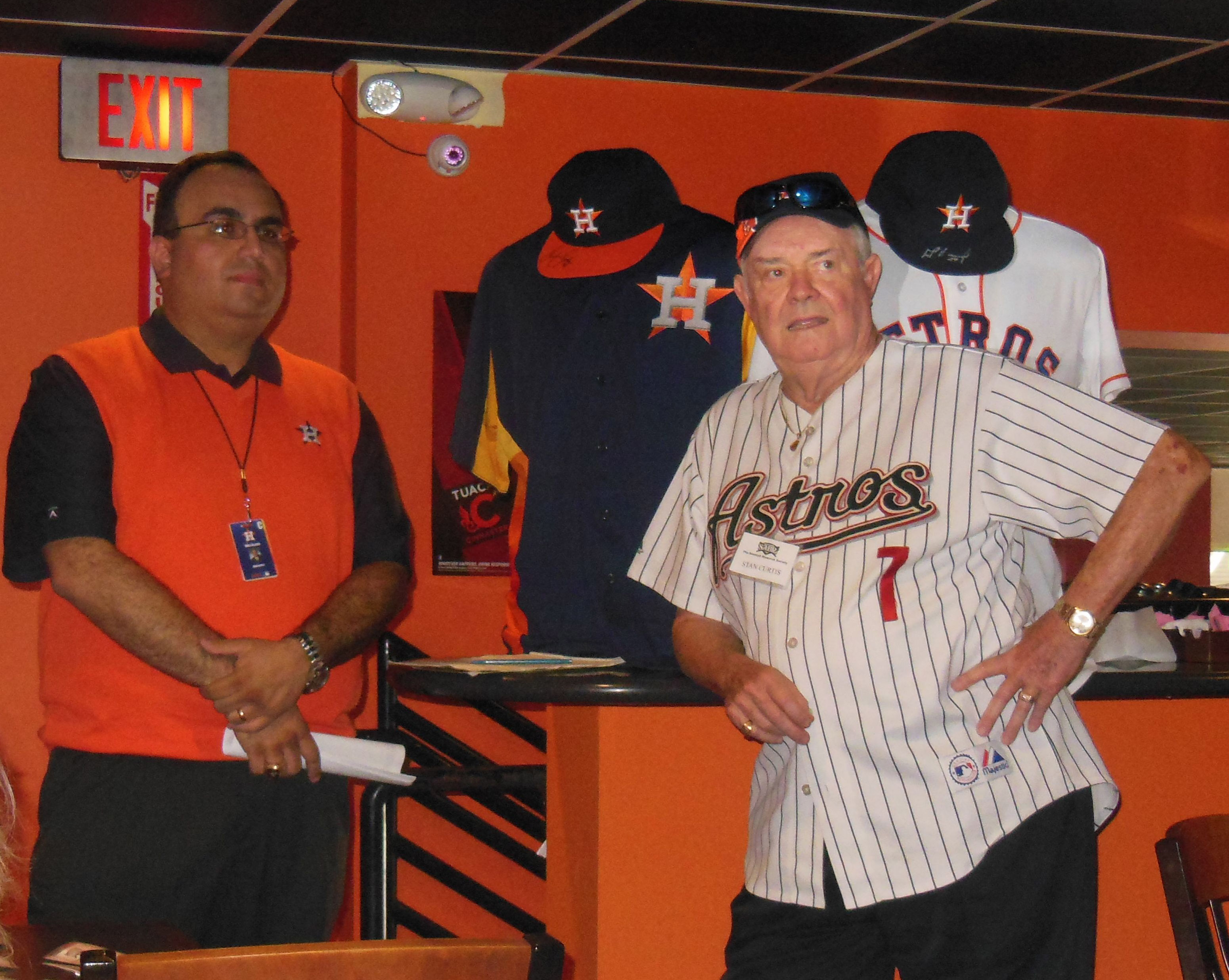
Mike Acosta (L) of the Houston Astros and Stan "The Man" Curtis of SABR get ready for the latter's presentation on the new team uniforms for 2013.

Mike Acosta (L) of the Houston Astros and Stan “The Man” Curtis of SABR get ready for the former’s presentation on the new team uniforms for 2013.

The Larry Dierker Chapter of Houston of SABR (The Society for American Baseball Research) in Houston played a doubleheader on January 26, 2013, adding the neat dimension of playing out their first priority shorter game of conducting a National SABR Saturday meeting inside the longer all day confines of participating across the street at Minute Maid Park in educating the public all day on the merits of SABR and the value of their personal membership.

All SABR eyes were still focused on the "new" old look of Houston Astros gear for 2013, although we've pretty much seen it all since shortly after the end of the 2012 season.

All SABR eyes were still focused on the “new” old look of Houston Astros gear for 2013, although we’ve pretty much seen it all since shortly after the end of the 2012 season.

The SABR meeting was held at the Home Plate Grill on Texas Avenue from 12 NOON to 2:00 PM. The SABR educational/recruitment program was conducted at the ballpark of the Houston Astros, also on Texas Avenue, from 10:00 AM until about 5:00 PM as part of the ball club’s annual Winter FanFest. A good time was had by all in both places as we rotated people in out of the greeting program as well as we could and into the meeting across the avenue.

Matt Rejmaniak makes a strong point in his talk to the group. Matt also brought a seat from old Tiger Stadium in Detroit that he owns to show everyone.

Matt Rejmaniak informed us that the videotape we made of Monte Irvin speaking in 2010 is now on file at the Hall of Fame Library in Cooperstown. That’s a real feather in our Houston cap as a contribution to oral history. Matt also brought a seat from old Tiger Stadium in Detroit that he owns to show everyone who attended SABR Saturday 2013 in Houston.

As one might expect from us in Houston this winter, the major buzz around here is about the Astros’ big move in 2013 to the American League West, the bad blood fomenting in some local National League traditionalists over our city’s surrender to the wide world of DH baseball, the impressive “pluck” in the words and attitude of new Astros manager Bo Porter, and the “plucked-clean” salary figures that now remain on Houston’s youngest, least experienced, and most poorly paid team in the big leagues.

It’s going to be interesting all year. The over/under pools on 100-plus losses this season for the third year in a row should be hot and heavy on the high side, but I don’t know. Something about Bo Porter tells me the Astros  are going to be a better club, even if they do lose most of their games this year, playing in the land of the heavy bats. We’ll soon enough see.
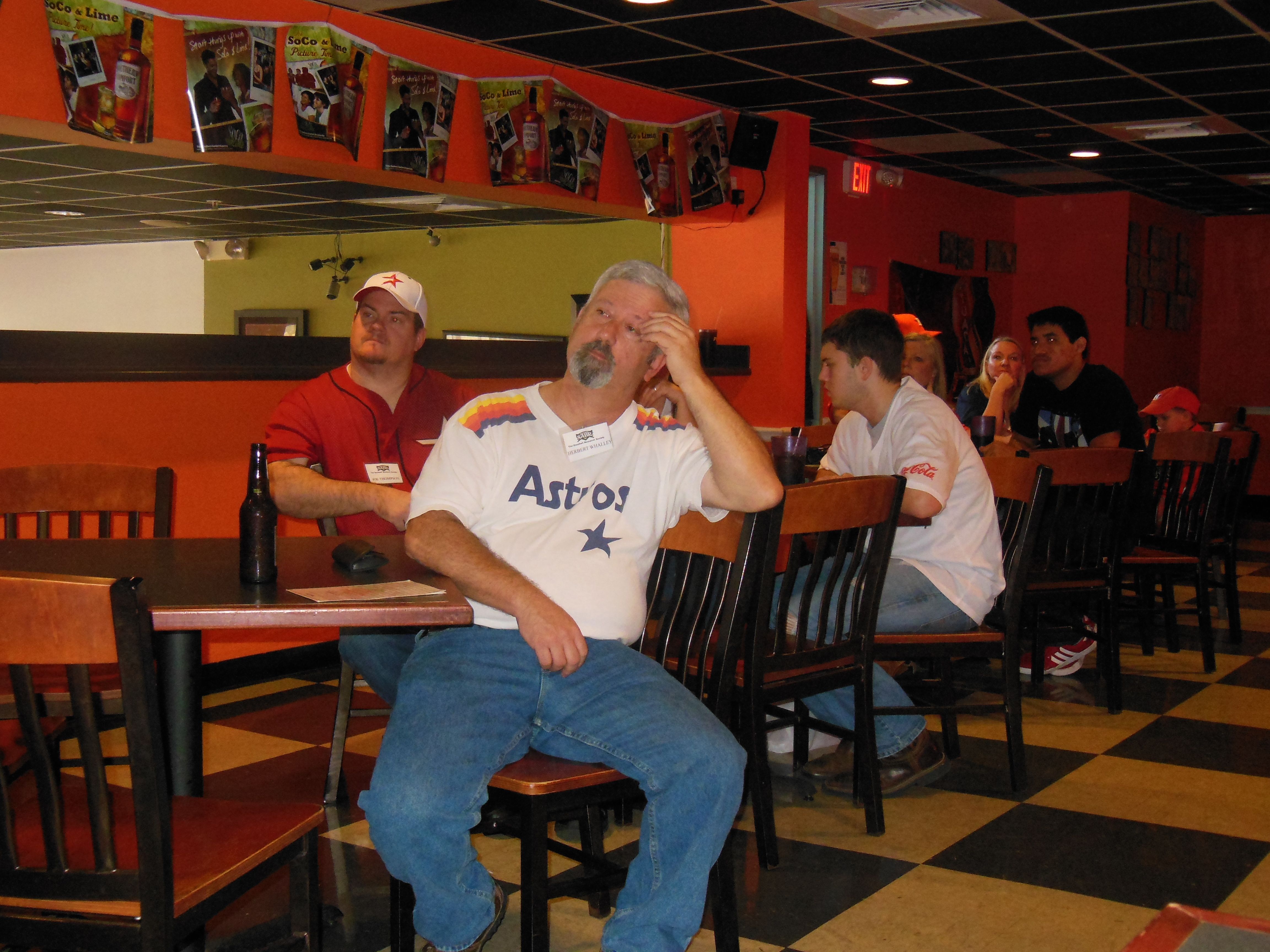
01/26/13: We probably had a rotating group of 20 people in the SABR meeting room at all times.

01/26/13: We probably had a rotating group of 20 people in the SABR meeting room at all times.

The 2013 Houston grey road uniform (L) and the Friday night home orange jersey.

The 2013 Houston grey road uniform (L) and the Friday night home orange jersey.

Houston Astros Authentication Specialist Mike Acosta was our featured speaker on SABR Saturday. Mike came with four of the new uniform models and a lot of information on how he and the club worked to get the club back to its early roots in orange and dark blue. With some adjustments, the uniforms, the lettering, and the decorative torso piping go way back to the early 1960’s – and perhaps, even further, if you care to compare the new “Houston” lettered grey jersey in the second (above) uniform color photo shown here with the black and white “Houston” grey road uniform of shortstop Billy Costa in the old 1952 Houston Buffs minor league photo that follows. I happened to have had this photo with me yesterday in a scrapbook of several we are considering for our major book project, but one of our members found it and spotted the similarity to its 2013 counterpart only after Mike Acosta had departed.
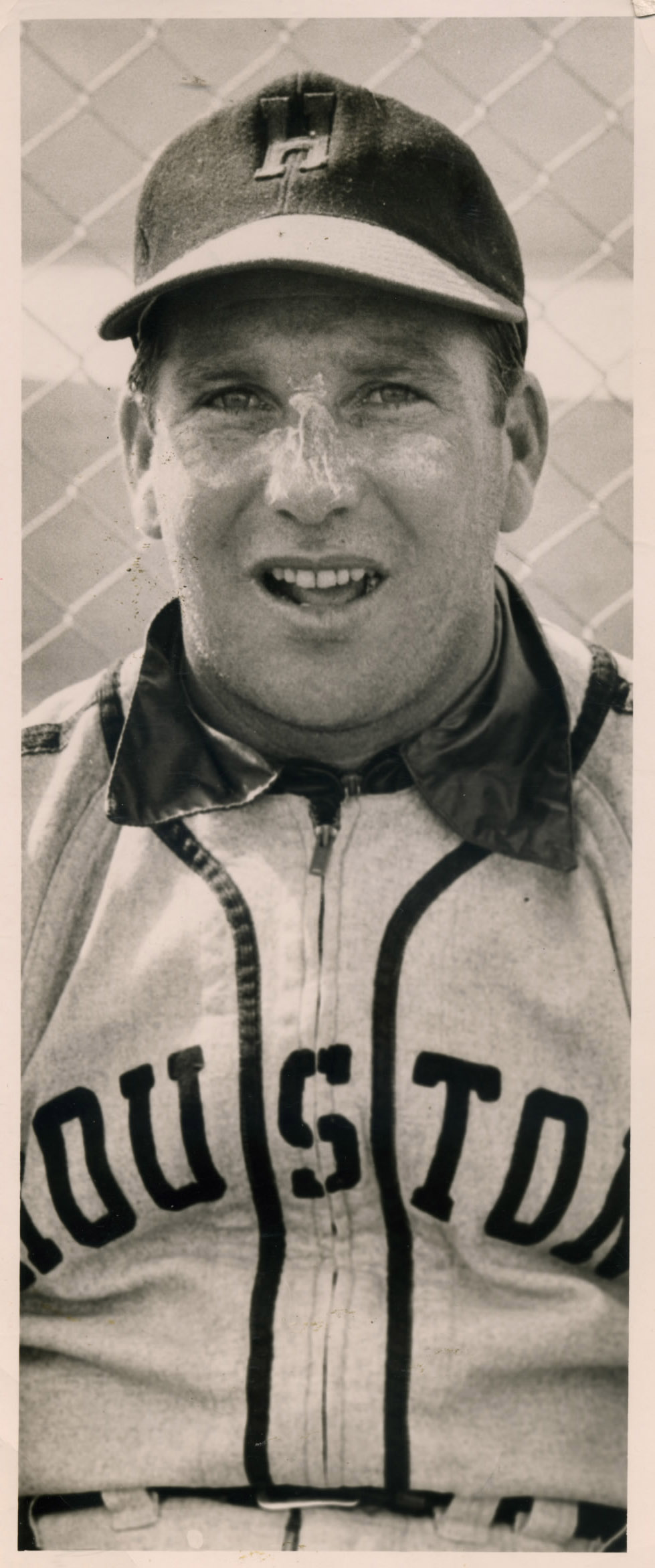
Billy Costa, SS1952 Houston Buffs

Billy Costa, SS
1952 Houston Buffs

It proves one of three things: (1) that chance similarity is wildly inexplicable; (2) that history has a subliminally powerful effect upon the future; or (3) that everything new is really simply a link in the chain of redundant replication of all that came earlier – or words to that effect.

We of SABR want to thank members Matt Rejmaniak and Stan Curtis for putting together yesterday’s meeting plan and we ask all SABR members to stay tuned to some further e-mail word from our Chairman, Bob Dorrill. We’ve been bumped from our normal second Monday date at the Inn of the Ballpark because of the NBA’s All Star grab on just about all downtown hotel space for the month of February and we may have to wait until March to meet again.

Stay tuned.

Meanwhile, the other FanFest news was: (1) the altered way the ballpark now looks with the old Ben Milam Hotel in front now down; (2) the bargain on game-worn uniforms for sale at FanFest. (Wilton Lopez, #50, and others, were going for $20-$50, depending on whether it was the BP or game version; (3) the orange changes that are beginning to work into the color scheme at MMP; and (4) unfortunately, the continuing presence of those butt-ugly special sponsorship signs that continue to decorate/obliterate the architectural lines and beauty of our ballpark.

Current View of Union Station, with the old Ben Milam Hotel now down and out.
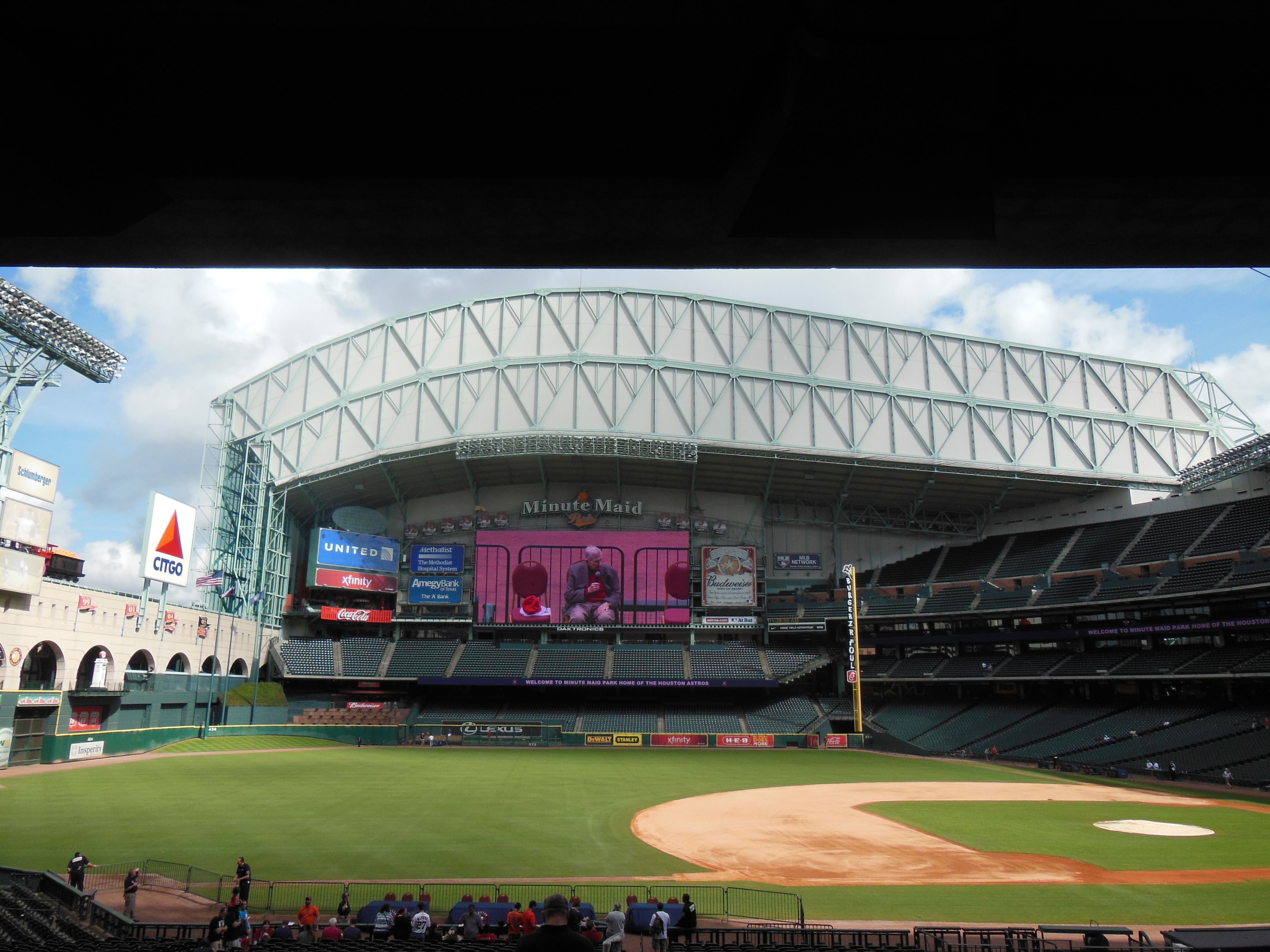
Current View of Union Station, with the old Ben Milam Hotel now down and out.

Minute Maid Park, 01/26/13: The view to center and right still bears that beckoning green call to baseball.

Minute Maid Park, 01/26/13: The view to center and right still bears that beckoning green call to baseball.

Minute Maid Park, 01/26/13: ... You know what? That guy that wrote graffiti on the Picasso at the Menil is still in jail. pending bail.

Minute Maid Park, 01/26/13: … Hope you like it, baseball fans.

On another level, the ugly sponsorship signs in left field that remain from last year’s nightmare, simply serve as ongoing proof of another old law in applied physics:

“If you want to raise ugliness to a new altitude of visual disservice to the community, all you need is one large and powerful crane.”
So Long, Sweet Sam Sacco!

January 26, 2013
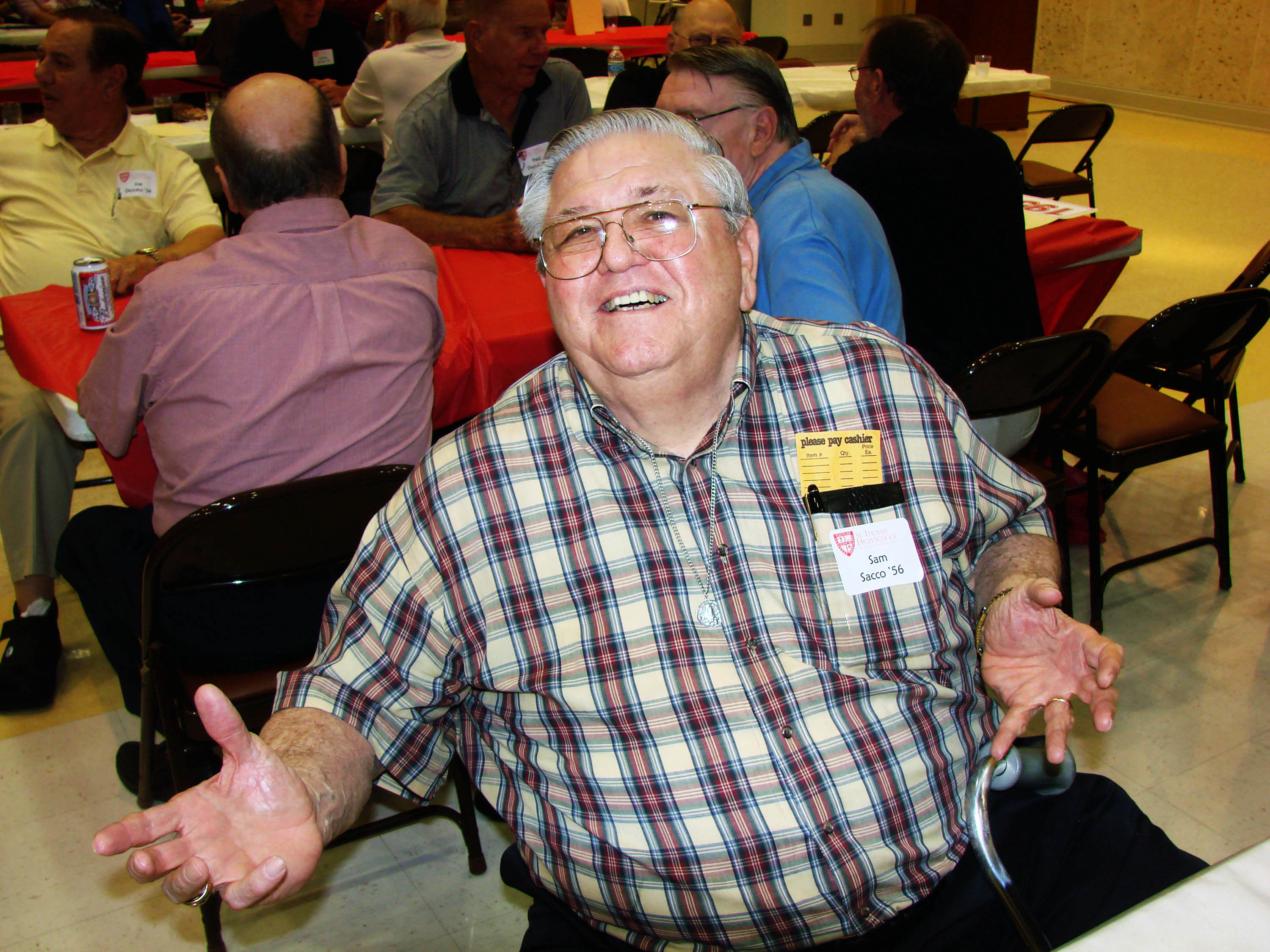
Smilin' Sam Sacco, Class of 1956, at a 2010 St. Thomas High School "Good Old Boys" Luncheon at the campus in Houston.

Smilin’ Sam Sacco, Class of 1956, at a 2010 St. Thomas High School “Good Old Boys” Luncheon at the campus in Houston.

“He was one of the nicest people you could ever hope to meet.”

As broad as that bucket gets splashed at the end, in the instance of 75-year old Sam Sacco, it is indisputably true. Sam passed away about 9:00 AM Friday morning, January 25, 2013, in a hospital at the Texas Medical Center, following a long and difficult spell of bad health. I don’t have all the particulars at this time, but I am informed by his good friend Garland Debner Pohl that he went out as he would have wanted, surrounded by family and the comfort of his Catholic faith. – How sweet is that? Who among us of sound mind could ask for anything more than to make that final solitary trip from life in the company of loved ones at the way station of one’s core beliefs in what this whole journey called life is all about.

As his early life friend and fellow student  from the Class of 1956 at St. Thomas High School, Sam and I shared some good times together, even if our later years contact was mostly reduced to sporadic luncheon gatherings and reunions at our shared alma mater. Our sense of closeness always renewed upon contact, even if we could not name each other’s children in order to each other – or even name them at all. Life works out that way sometimes, but no matter what, we still shared a bond that never went away. We were St. Thomas Eagles. Not once upon a time, but forever.

Eagles Always! Pecan Park and Elsewhere!

Sam and I shared involvement in two major projects at St. Thomas and both took place in our senior year. In the fall of 1955, we both played central characters in the senior school play, “Brother Orchid.” In the spring of 1956, we each played primary roles in the mock version of a national political convention. Sam got to nominate Senator Estes Kefauver as a candidate for President; I got to deliver the keynote address.

The meaning of that jump into the school limelight for both of us was shared and clear: If St. Thomas had ever wanted to offer a course on “ham-ology,” Sam Sacco and I could have taught it.

Excerpt from the St. Thomas Eagle, November 1955.

Excerpt from the St. Thomas Eagle, November 1955.

In “Brother Orchid”, I was chosen for the lead role of “Little John Sarto”, an on-the-lam Italian mob boss who later finds God through his fake hideout identity in a monastery as “Brother Orchid”. – I didn’t ask for the part. I was handed the role by our director, Father (get this name) Walter Scott! – Edward G. Robinson played the role of John Sarto in the movie version.

Man! I figured that getting that role was half the battle won for even trying out. If Father Scott could hand an Italian gangster role to an Irish kid in the middle of our Houston high school version of Sicily, he either knew something special, or else, he was the worst casting director of all time. – As Sam Sacco and I soon enough proved, it was probably a whole lot of the latter.

Father Scott cast Sam Sacco as Fat Duchy, a smiling and happy bartender at the mob’s favorite watering hole who would always treat you right as he was selling you out under the table for a few quick bucks. We both had a lot of lines and some key scenes with each other. And, well, it didn’t take long for us to find out what happens in live theater when one person totally forgets his lines.

On opening night, we had this big early scene in Fat Duchy’s Bar, when I delivered verbatim the line from the script that Sam Sacco needs to answer correctly for the audience to make sense of what happens next. Silence. I could tell from Sam’s turning snow-white face that he has totally forgotten his lines. We both can hear Father Scott practically trying to shout his whispers from the prompter spot in the wings, but neither Sam nor I can hear him – and I can’t say them for Sam, anyway.

What to do? – What to do? – What to do?

All of a sudden, Sam starts saying “stuff” that makes no sense as a response to my lines and I am now forced to see that if I just stick with my next scripted response that it will make no connecting sense to the prattle that has just fallen from the mouth of my fellow would-be thespian friend.

Once more: What to do? – What to do? – What to do?

I have to start winging it too; and Sam and I manage to wiggle our way off-stage talking about something that may have never risen above our imagined discussion of property values on the Jersey shore. I was briefly tempted to throw in an Edward G. Robinson classic line like, “Oh, so you’re a wise guy, eh?” But I held off.

Once off stage, I literally tried to choke Sam.

“Sam,” I said, “if you want to be an actor, it has to start with you remembering your **** lines!”

“A good actor doesn’t have to remember all his lines,” Sam answered, “he just has to feel the part and act out what he’s feeling.”

By the end of the first night, it was my time to flub-the-dub, as we used to proclaim. (Spoiler Alert!) I get shot in the last scene by a special needs gangster named “Dum Dum”, played by Michael Storey. The trouble was, the blanks-loaded gun doesn’t go off. As the recipient of this alleged bullet, I view the hand action of the gun being fired at me, but I also hear the silence, so I just stand there, for about ten seconds.

Then I fall.

And after I fall, the gun goes off. The audience roars in laughter. The curtain closes. And Sam Sacco laughs his head off in a real-time version of ROFLMAO that far precedes anything we have going on today as an Internet exclamation point.

Sam, I told you that I was going to remind you of that great night we both made our acting debuts until the day that one of us died. I had to write this column to keep my promise.

I promise you this too, even if we haven’t seen much of each other in recent years. I shall miss you more than words can say, my dear old friend!

God Bless you too, Sam! Thank goodness you don’t have to know your lines to pass through The Pearly Gates. You just have to be the soul that is Sam Sacco.

_________________

Funeral Arrangements

Arrangements are pending, but the funeral is to be held at St. Anne’s on Tuesday morning Jan. 29th. Carter- Bradshaw Funeral Home is handling arrangements. Burial will be at Forest Park Lawndale in the Sacco family plot. Check online at chron.com or watch for the paper edition of The Houston Chronicle for the exact times of services.

Tagging Up at Third

January 23, 2013
Uh Oh! It's not even February and I'm starting to wish it were closer to Opening Day.

Uh Oh! It’s not even February and I’m starting to wish it were closer to Opening Day.

Skeeters Seeking Interns. Some stories knock us home from third faster than a long fly ball to center with less than two outs. The Sugarland Skeeters are looking for ways to expand their involvement in the community and also offer those who may be interested a chance to learn from a baseball club working experience. The Club has established an internship program that will allow qualified and accepted applicants to pretty much work full-time this spring and summer at Constellation Field in exchange for either college credit or career-building experience.

They are calling it the Skeeters Swat Team program and, right now, they are accepting applicants for both their spring and summer internship programs. If you want to learn more, check out their information page at this link:

http://openingdaypartners.teamworkonline.com/teamwork/r.cfm?i=49515

What’s Up with the Television Media Today? Yeah, I know, it’s always been this way to a certain degree, but now it’s grown into a practice of ridiculous proportions. I’m talking about the way all the local stations go on lock down, as they did yesterday, to cover the shooting at Lone Star College. In the process, they knocked out about three hours of programming and advertising that both the regular viewers and sponsors were expecting for the sake of burning helicopter fuel as they continued to advise the audience that “we don’t really know what is going on here!”

How about leaving things normal on the screen until you do know something. Then you can interrupt or wipe out what we were hoping to watch with your idle prattle. And while you’re at it, how about allowing us to enjoy the next frontal rain storm without trying to put everyone on “better-build-a-raft-in-the-backyard” alert. A lot of us survived growing up in Houston without Frank Billingsley showing us the digitalized rain bans every five minutes on their way to Houston. – OK, hurricanes and tornadoes and quick freezes are fair notice for serious interruption, but let us just go through the rest of the weather changes as though it were the normal thing to do.

BANG! BANG! We went to see the new movie “Gangster Squad” Monday night. If you like those post WWII crime movies set in LA, or the art of quick and violent retribution for earlier grossly criminal acts, you should love this one. Sean Penn is at his despicable slimey-souled worst as the psychotically sadistic gangster Mickey Cohen on his way to making LA the capitol of his west coast crime empire. Josh Brolin is the throw-out-the-rules-book cop who both looks and acts like Dick-Tracy-on-meth in his relentless effort to bring down the evil Cohen. In spite of its limited “Good vs. Evil” plotline, the movie is Grade AAA escapism, a real “beauty and the beast” sensory experience.

The “beauty” just flows from the costuming and setting of LA in 1949. With today’s high-tech support to movie setting and the use of soft color cinematography, the viewer really gets to feel that they have been transported back in time to a visually much more beautiful world. The “beast” nature flows from the creative way the director uses both sight and sound to show all the patterns of blood splattering and body parts flying from various doses of differing sources of violent trauma.

If you can’t handle movie violence without wanting to go visit it upon others, don’t go see “Gangster Squad.” On the other hand, if you are someone capable of using movie violence as an escapism prescription for subliminally converting movie villains into symbolic representations of the negative issues you would like to overcome in your own life, step right up and buy a ticket. – Just don’t sit in the front row. You might get blood in your popcorn.

Have a nice day, everybody!

Rest in Peace, Stanley and Earl

January 20, 2013


Stan Musial

Stan Musial

Dear Stanley and Earl,

Yesterday, January 19, 2013, you each caught the same flight to Hall of Fame Heaven.

We shall miss both of you, but we shall also thank the both of you forever!

Rest in Peace to the two newest stars in the night skies of our fondest baseball dreams!

Affectionately,

The Baseball Fans of the World

Earl Weaver

Earl Weaver

Advantages of an Imaginary Girl Friend

January 19, 2013

imaginary love

The Ten and More Links in the Imaginary Girl Friend Chain

1) An imaginary girl friend can only lead to an imaginary engagement.

2) An imaginary engagement can only lead to an imaginary marriage.

3) An imaginary marriage can only lead to imaginary fighting.

4) Imaginary fighting can only lead to imaginary make-up time.

5) Imaginary make-up time can only lead to imaginary children.

6) Imaginary children can only lead to imaginary debt and family stress.

7) Imaginary debt and family stress can only lead to an imaginary state of lost marital intimacy.

8) Imaginary lost marital intimacy can only lead to an imaginary affair with an imaginary third-party.

9) An imaginary affair may lead to an imaginary discovery and an imaginary divorce.

10) An imaginary divorce under these imaginary circumstances may only lead to one or more of the following imaginary outcomes:

imaginary bankruptcy … imaginary alcoholism or drug addiction …imaginary delusions that getting married again in the same way will this time lead to an imaginary state of “happily ever after” … and, of course,  years and years of either imaginary psychotherapy, imaginary AA, and/or imaginary religious conversion experience.

What are the advantages of an imaginary girl friend? Isn’t it obvious? – All of the unfolding ugly, but potentially real consequences are only imaginary.

Save your “paper dolls” and get involved with a real one, Manti Teo. Maybe you too will turn out to be one of us lucky ones.

The United States of Autisia

January 18, 2013
Welcome to the United States of Autisia! In our land, Lady Liberty puts down that right arm and uses it to help hold the giant ipad she now snuggles on the left side. Then, with the ipad and both hands holding it in front of her, she stares down at it all day as visitors to these shores pass by her.

Welcome to the United States of Autisia! In our land, Lady Liberty puts down that right arm and uses it to help hold the giant ipad she now snuggles safely on the left side in the featured photo. Then, with both hands holding the ipad in front of her for easy touch manipulations, she stares down at it all day as visitors to these shores pass merrily by her into the harbor.

What’s going on today with our shorter and shorter attention spans is essentially complicated by the process of what we are becoming as a culture as a result of our diminished, or re-wired, attention spans.

And what are we becoming? (I have to say this fast before I either lose your attention – or you lose mine.) …

1) a nation of people who only seem to care about contact with those items that come to each of them separately in digitally transmitted form on a 24/7 basis;

2) as a people with damaged awareness of our social or physical surroundings, we are rude and/or indifferent to others (“speaking” to an absent person digitally with our thumbs while we ignore the person who is on site with us); we are less considerate of how our behavior disturbs strangers (texting in movies); and we are unable to risk evaluate that driving a car and simultaneous texting are deadly dangerous partners;

3) we credit ourselves for our growing capacity for multi-tasking, but we dismiss the evidence that we are also learning to take less personal responsibility for own behavior in each little new area that we take on;

4) like the true autistic, we are seeing signs of serious impairment in our culture’s ability to promote healthy interaction and effective communication with others while we also give ourselves more and more to the kinds of compulsive and repetitive patterns of behavior that are the lifelines of digital pursuits like texting and tweeting;

5) this point is a question: What do we now call a body of several hundred autistics that we have gathered together for the sake of resolving our greatest national problems? Answer: Same as always, we call them Congress.

Welcome to the United States of Autisia!


Bo Knows the Power of the Moment

January 16, 2013


Bo Knows the Power of the Moment.

Bo Knows the Power of the Moment.

Winning. – Bo Porter referred to it in so many words as the business of taking care of what’s on your plate each day on the road to becoming the best ballplayer you can be. It’s not dreaming of championships in the future. It’s doing each day what needs to be done for the sake of making a championship possible when the so-called future eventually slides your way as the day to be seized.

In so many well expressed words off the quick mind and clear-speaking tongue of the bright and fiery new Houston Astros manager Bo Porter, that is the cauldron where the power of action in the present eventually boils over into the only future dream that ever comes true. – Bo called it “the process.”

Speaking before a standing room only crowd at the January 14, 2013 monthly meeting of SABR’s Larry Dierker Chapter at the downtown Houston Inn at the Ballpark on Monday evening, new Astros skipper Bo Porter gave all with minds to see, and that seemed to include just about everyone there, that this city has a new kind of leader in town. You could literally feel the energy in the room rising as the ideas from Bo Porter brimmed to the surface and overflowed the cup in crystal clear delivery.

Quality Starts. Bo calls them the most outrageous statistic in baseball. The “QS” goal and the fear of blame teaches minor league staff to mollycoddle big investment pitchers in the minors. Then, when those who learn to pitch in the minors under little pressure, they arrive in the big leagues either prepared to wilt under big pressure, or else, they ruin their arms under great major league exposure to high expectations. – In this baseball culture, look for Bo to rely a lot on relief pitchers who can handle the 7th, 8th, and 9th innings while he continues looking for starters who are retrainable going deeper into the game.

According to Bo, The “QS” stat has become the favorite child of negotiating agents, further noting that agents will quote in bold type a pitcher’s 26 quality starts at contract time and totally downplay the fact that the same pitcher went 12 and 12 the previous year.

Going from 1st to 3rd. Asked by someone of what we might expect from his Astros, Bo answered without hesitation: “Watch they way we run the bases, especially, the way we go from 1st to 3rd.” He then proceeded to point out that runners who reach 3rd with none or one out have a much greater chance of scoring than those who stop at 2nd on a fair ball single to right – and the risk of getting thrown out on these plays is only about 4%. Dick & Jane Reader Translation? – “Run, Astros, Run!”

Fundamentals of Running for Outfielders and Base runners. Bo Porter was a standout football player for the University of Iowa Hawkeyes who might have chosen to try the NFL before he signed to sign with the Chicago Cubs to give his all to major league baseball. He’s a baseball man who still thinks like an aggressive football mind. With the Washington Nationals, for example, Porter noticed that a number of the outfielders had this flopping bird habit of flailing their arms from side to side in the long run pursuit of deep fly balls. The effect of same undermined their abilities to steady themselves for the catch, even if they did manage to reach the ball in descent on the fly.

Bo also remembered the steady downfield running he did at Iowa with the football tucked under one arm while the other pumped in tight tuck on the side like a locomotive power carriage wheel. So, as a result, Coach Bo had some of these guys in spring training out there chasing flies with a football under their throwing arms strictly as a method of searching for a steadier gait. – And, guess what? Many were helped by the exercise, Bo says.

Bo’s base runners on the Nationals ran hard out of the batter’s box, even on apparently dead-for-sure easy out plays. Bo wants to make the opposition’s defense forced to think on every play about all the options available to his own club’s runners, if they go to sleep. – “Relentless pressure” is the name of the game.

Implicit Greater Pitching Change Responsibility as a Result of the DH. Mike Vance, Bob Dorrill, and I were privileged to have dined with Bo Porter prior to his SABR talk. It was there that he revealed his implicit take on how the American League’s DH rule places more responsibility on the manager for deciding how long to go with a tiring or struggling pitcher. In paraphrase, it boils down to this: A manager will always want to get a guy out of there before things go south or get worse, of course, but he isn’t able to use a pinch-hitting chance to cover that concern because that’s a game situation that doesn’t arise in the AL. At times, the AL manager may want to help a pitcher learn to stretch his longevity, and again, with the DH rule in place, he cannot avoid the opportunity of extending a guy’s mound time because of an expected need to pinch hit for him. In the AL, the pitcher stays until the manager pulls him. There is no built-in customary “take out time.”

Too much else to share in one column. – The man Bo Porter is the real deal. I cannot remember ever being more excited than I am at this moment about the coming of a new Astros manager – one whose every word speaks volumes for his wisdom that life only works well when we are able to travel it from moment to moment with all the passion, creativity, ability, and life that’s been given to each of us for living full force.

Bo Porter gets it because Bo Porter obviously lives it.

Now we could only wish that the “The Bo Porter Story” really were a baseball movie script. Then we could watch Astros scoring from second base next season with a football tucked under one arm to both enhance speed and amplify their crunch upon the catcher on close plays.

Thanks for coming to Houston, Bo! We need you!

A Baseball Analysis of the Texans’ NFL Loss

January 14, 2013
Yesterday, the Houston Texans surrendered their 2014 Super Bowl dreams via the 41-28 final score whipping they took in the Divisional Round of the AFC/NFL Playoffs in Foxborough, Massachusetts at the hands of the eternally pesky and vastly superior New England Patriots. Since I'm a baseball guy, football only gets my full attention gets my center field attention this time of year, but here's what I think happened, in baseball terms.

Yesterday, the Houston Texans surrendered their 2014 Super Bowl dreams via the 41-28 final score whipping they took in the Divisional Round of the AFC/NFL Playoffs in Foxboro, Massachusetts at the hands of the eternally pesky and vastly superior New England Patriots. Since I’m a baseball guy, football only grabs my “center field attention” this time of year, but having read and listened to all the football pundits. I have learned by their examples that ignorance should not deter anyone from speaking out on why football teams win and lose. What follows briefly is what I think happened to the Texans, anyway, … in baseball terms.

Why the Texans Lost (in baseball terms) …

1) The E.R.A. Factor. To be a successful quarterback in the NFL, a guy has to have what we call in baseball an E.R.A. Only in football, E.R.A. doesn’t stand for “earned run average.” It stands for “earnest running ability.” QB Matt Schaub of the Texans has an E.R.A. of 1.00. On a scale of 1 to 10, with “10” being best, young Colin Kaepernick of the San Francisco 49ers has a football QB E.R.A. of something close to 9.00.

2) The Branch Rickey Factor. Baseball wise man Branch Rickey used to say that the best time to change out a good player was not the season after he’s had his best year, but the year before he reaches his peak. It’s too late for the Texans to apply that baseball philosophy to QB Matt Schaub. The Texans need to either give Taxi Squad QB Case Keenum a shot next year, or else, trade or draft for a younger QB prospect with a high football E.R.A. It’s too late to think that the aging, immobile Mr. Schaub is going to get better over time. Surrounding Schaub with better talent next year, as some local TV pundits suggested Sunday night, is the equivalent of saying “since Matt can’t win with good players around him, we need to surround him with great players.”

How about acquiring or using a great QB prospect and then work to surrounding him with other great players?

3) The Superstition Mountain Snake-Killing Formula. Developed by the esteemed Dr. Richard Farrell at the Apache Junction, Arizona baseball spring training camp of the Houston Colt .45s over half a century ago, this formula has proved effective in baseball for the literal and figurative elimination of snakes in the grass, clubhouse, or boardroom in 99.99 per cent of every case studied since 1962. It should work equally well in football as it has in baseball.

The Texans first need to find the body of the snake that stands in their way of getting to the Super Bowl. The trick is to make sure that they have identified the real snake in the first place. Once identified, it is important to then locate the head of the snake and to figuratively cut it off before the team, the fans, and the City of Houston are bitten again by the “wait until next year (again)” smiling-while-sighing syndrome.

Take your time in the off-season, Texans, but proceed in the search for your snake in rigorous due diligence. My football-ignorant, but intuitive guess is that the head of this snake is most probably located higher up and even physically away from the literal body and neck of Mr. Matt Schaub.

The snake may not even be a specific person. Sometimes the snake is an attitude that clouds objective player evaluation – or a way of doing business that fails to bring out the best in everyone. Rule everything out, but then find the rascal and kill it. The City of Houston needs to recover from the more general disappointment it has experienced way too many times over the years with it’s snake-bitten sports teams – and that old rascal found all our backsides again on Sunday.

Those are my three strikes. – I’m out.

Murderers’ Row Revisited

January 12, 2013
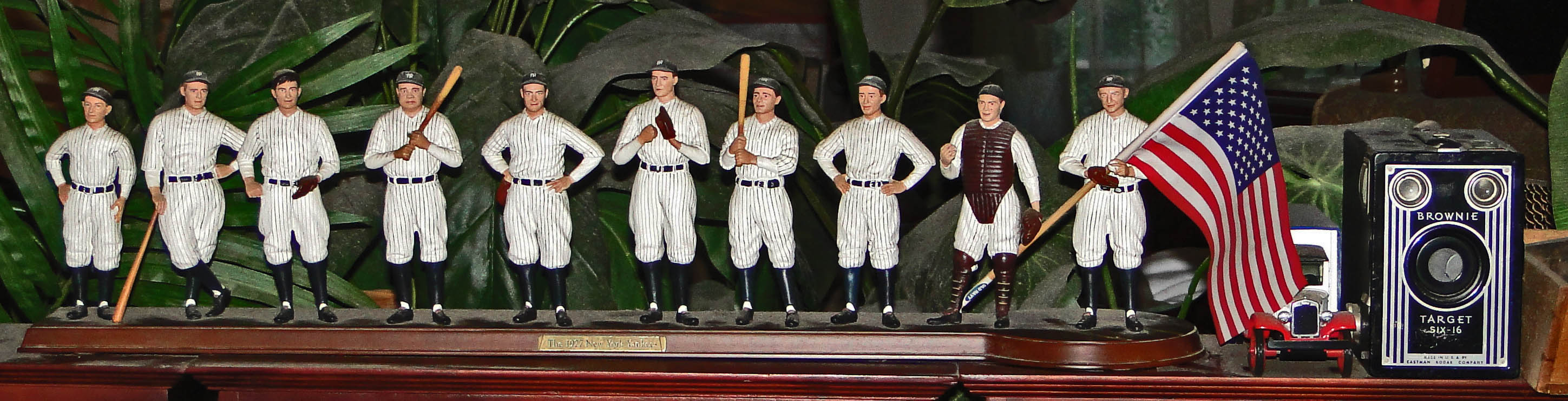
The 1927 New York Yankees

The 1927 New York Yankees

We remember them indelibly, even though none of us were alive or old enough in 1927 to have seen them play and retained, as ancient survivors along a ridiculously long life span, any visage of the power that befell our eyes back in the halcyon days of jazz and baseball. They were collectively revered as the killers of the baseball, the slaughter kings of the game. They were, and still are, Murderers’ Row.

Playing in their 25th year of life, and from their fifth season of residency in the original Yankee Stadium, the ’27 Yankees rolled to their fifth American League pennant with a record of 110 wins, 44 defeats, and a winning percentage of .714 that was good enough for a 19 game final finish over the 2nd place Philadelphia Athletics.

Their 110 Yankee wins in 1927 broke the 105 American League wins record established by the Boston Red Sox in 1912. The ’27 Yankee AL wins mark stood until the 1954 Cleveland Indians broke it with a 111 final wins tab.

The ’27 Yankees went on to crush the Pittsburgh Pirates in the World Series in a four-game sweep. Since then, the Pirates community has been forced to live with the writers’ tale that their Pittsburgh quest for a 1927 World Series title was lost from the time they watched Ruth and Gehrig take batting practice prior to Game One.

The 1927 Yankees and Babe Ruth forever have been a touchstone of sanity for me about all the good things that swept my heart and soul into the game of baseball as a kid. Whenever I’ve had a week of disenchantment with the peripheral egos that control the game today, I heal with some refocus on the players and teams that built my sandlot dream in the first place. For me, those visions always began with the 1947 Houston Buffs and the 1927 New York Yankees. Today I’m taking the Yankee cure.

Left to right among the Murderers’ Row figures you see above you in the sculpture model photo, here is the manager and starting lineup for the 1927 New York Yankees, including their ages that season. All data here is derived from that great fountain of baseball numbers, Baseball Reference.Com:

Miller Huggins, Manager, Age 49.  Miller Huggins posted a .265 BA over the course of his 12-season (1904-1916) career as an MLB 2nd baseman. He began his managerial stint with a 5-year run as mentor of the St. Louis Cardinals (1913-1917) before moving to the helm of the New York Yankees and a 12-season (1918-1929) tenure in which his clubs won 6 pennants and 3 World Series titles. – Miller Huggins died early from pyaemia, a blood abscessing disease, complicated by the flu, on September 25, 1929. It was a devastating loss to his club and the entire baseball world.

Hall of Fame: Miller Huggins was inducted into the HOF by the Veterans Committee in 1964.

1927 Salary for Miller Huggins = Not reported at Baseball Reference.Com

1) Earle Combs, CF (BL/TR), Age 28. As a lead off man, Combs led the AL in 1927 with 725 plate appearances and 648 official times at bat. He also lead the AL with 231 total hits and his triples were the most for any player in the league. He also batted .356 and racked up a .414 OBP. With a 12-season (1924-1935) all Yankee career BA of .325.

Hall of Fame: Earle Combs was inducted into the HOF by the Veterans’ Committee in 1970.

1927 Salary of Earle Combs = $ 10,500 (Michael Haupert research of HOF contracts)

2) Mark Koenig, SS (BB/TR), Age 22. A reliable defensive guy with good abilities at moving runners along at the plate, Koenig batted .285 in 1927, just a tad above his 12 season (1925-1936) career BA of .279. Koenig had 150 hits and an OBP of .320.

Hall of Fame: Mark Koenig is not a member of the HOF.

1927 Salary of Mark Koenig = $ 7,000 (Michael Haupert research of HOF contracts)

3) Babe Ruth, RF (BL/TL), Age 32. 1927 was the signature season for the arguably greatest player in the history of baseball. That was the year that the Babe broke his own 1921 record of 59 HR in a single season by blasting the number 60 into the iconic walls of the games greatest remembered digits. Babe Ruth didn’t simply break home run records. He hit more home runs than some whole teams did in a single season. The number 60 hung as the benchmark for greatness in power hitting through my entire childhood, and it only fell with that ascendantly rising 61* that Roger Maris would later blast in the first longer season of 1961. – In 1927, Ruth also led the AL with 158 runs scored, 137 walks, 89 strikeouts, a .486 OBP, a .772 slugging average, 1.258 OPS, and an OPS + of 225. – Also, thanks to his teammate, Lou Gehrig, Ruth had 192 hits and 164 RBI in 1927, but had to bow to the other Yankee super star for team leadership in those categories. – Speaking of iconic numbers, Babe’s 714 career homers stood as the most for a single career until Hank Aaron passed them in 1974. – With a lifetime BA of .342 also, the 22-year career of Babe Ruth (1914-1935) wrapped with his election to the HOF in 1936 among the first class inductees of the new hall of honor that would not formally open until 1939. Amazingly, 11 of the 226 voting writers in 1936 did not vote for Babe Ruth. This fact only reinforces the recognition that ignorance and arrogance are not an invention of the current generation. – Long live Babe Ruth and the blood lust bats of Murderers’ Row!

Hall of Fame: Babe Ruth was elected to the new Hall of Fame’s first induction class in 1936 when 215 of the 226 voting BBWAA members selected him.

1927 Salary of Babe Ruth = $ 52,000 (Michael Haupert research of HOF contracts)

4) Lou Gehrig, 1B (BL/TL), Age 24. The iron horse led the AL in 1927 by playing in 155 games, hitting 52 doubles, 175 RBI, and adding a .467 OBP. His .374 BA placed him high among the leaders and his 47 HR trailed only the other man who was even close, Babe Ruth. Gehrig closed his 17 year career (1923-39) a deathly ill man, but not before he had established the longest streak of consecutive games played at 2,130 and a total career record of 493 HR and a .340 BA. – When news of Lou’s illness got around, a special vote was convened and Lou Gehrig was inducted into the HOF.

Hall of Fame: Lou Gehrig was elected to the Hall of Fame in 1939.

1927 Salary of Lou Gehrig = $ 8,000 (Michael Haupert research of HOF contracts)

5) Bob Meusel, LF (BR/TR), AGE 30. The 6’3″ Bob Meusel is the guy who hit behind Ruth and Gehrig and still managed to pick up 103 RBI on the year. He batted .337 and registered a .393 OBP and a .510 SA. Over the course of his 11 season career (1930-1930), Meusel hit .309 with 1,067 career RBI. Bob’s best season for HR power was 1925 when banging out 33 was exceptional work for all but one man. The mere mortal Meusel still managed to hang ’em up with credit for 156 HR by retirement day.

Hall of Fame: Bob Meusel is not a member of the HOF.

1927 Salary of Bob Meusel = $ 13,000 (Michael Haupert research of HOF contracts)

6) Tony Lazzeri, 2B (BR/TR), Age 23. “Poosh ‘Em Up, Tony” batted .308 with 18 HR in his second season as a young Yankee in 1927 and he hit .292 over the course of his 14 year (1926-1938) career. He also had a banner year in a non championship season for the 1929 Yankees when he batted .354 and again hit 18 HR on the year. Tony had four seasons in which he hit 18 homers, but he never got any higher. His 178 career HR were still a warning to foes that relief did not exist in the bottom half of the ’27 Yankees lineup.

Hall of Fame: Tony Lazzeri was inducted into the HOF by the Veterans’ Committee in 1991.

1927 Salary of Tony Lazzeri = $ 8,000 (Michael Haupert research of HOF contracts)

7) Joe Dugan, 3B (BR/TR), Age 30. “Jumpin’ Joe” Dugan was the 7th man in the order and even he hit .269 with an OPS of .683. For his 14 year career (1917-1931), Dugan hit .280 with a career OPS of .689 and he was an excellent fielder and probably the biggest character in residence among the 1927 titans of baseball. His best season at the plate came earlier when he hit .322 for the 1920 Philadelphia Athletics.

Hall of Fame: Joe Dugan is not a member of the HOF.

1927 Salary of Joe Dugan = $ 12,000 (Michael Haupert research of HOF contracts)

8) Pat Collins, C (BR/TR). Age 30. Pat Collins hit .275 with an OPS of .825 in 1927. His better days with the stick occurred earlier in his career when he caught for the great St. Louis Browns contenders of the early ’20s. Collins hit .307 for the great 1922 Browns that came within one game of beating the Yankees out of a pennant and he followed that with a .315 BA mark for the 1924 Browns. – Collins and Brownie pitcher Urban Shocker were so good for the Browns, in fact, that you might get what happened to them for aggravating the Yankees. The Yankees acquired them from the cash-starved Browns to herald a pattern of dealmaking that we haven’t seen the end of to this day. – As for Pat Collins, he did quite well for himself as a member of the Bronx crew. He retired with a .254 career BA from a 10-season career (1919-24, 1926-29).

Hall of Fame: Pat Collins is not a member of the HOF.

1927 Salary of Pat Collins = $ 7,000 (Michael Haupert research of HOF contracts)

9) Herb Pennock , P (BB/TL), Age 33. Herb Pennock was 19-8 with a 3.00 ERA as only one of several fine pitchers for the 1927 Yankees. For his 22-season career (1912-17, 1919-34), Pennock won 241 games and lost 162, good enough for a lifetime ERA of 3.60.

Hall of Fame: Herb Pennock was inducted into the Hall of Fame by the BBWAA in 1948 with approval on 94 of the 121 votes cast that year.

1927 Salary of Herb Pennock = $ 17,500 (Michael Haupert research of HOF contracts)

That’s it for now, except to add the obvious: You have to be good to play or stay with the Yankees, but if you do play there, and you also do well, as in World Series well, it won’t hurt you later when you are up for the Hall of Fame.

1927 also was the season that helped the reticently inclined Lou Gehrig learn that he had to do a better job in 1928 of negotiating his new contract.

Bud Thomas: One MLB Shot and Gone

January 11, 2013
test

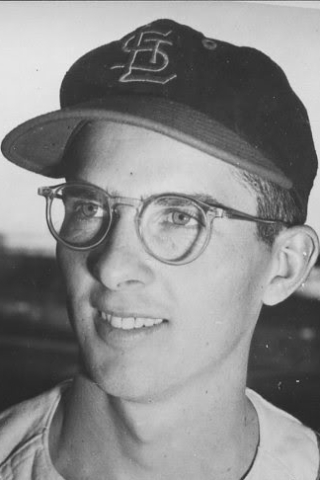
Bud Thomas, SS
BR/TR, 6′ 0″, 180 ilbs
1951 St. Louis Browns

Right behind the curious list of MLB players who retired with one hit in their only big league times at bat is another fun group. Those are the guys who stuck long enough for a cup of coffee, did well, and then disappeared forever with no further shots at the show. Many of these fellows were late season call-ups in September who did well in a handful of games and then, for one reason or another, never made another big league roster appearance during the regular season.

Sometimes the reason for the missing second chance is clear. A guy gets injured in the off-season and is never able to play again. Another fellow only got his first chance as an older ballplayer and simply decides to retire before another try comes open. And, of course, back in the reserve clause era, some players just got stacked in talent-deep farm systems and were never given another opportunity.

22-year-old Bud Thomas of the 1951 St. Louis Browns was one of those One-Month-Wonders. He didn’t exactly set the woods on fire in his short big league run, but a .350 batting average in 14 games over 27 days time is still nothing to dismiss lightly. Between September 2nd and 29th of 1951, Thomas collected 7 hits, including one home run as his only extra base hit in 20 times at bat. He scored 3 runs and registered the one RBI that came with his solo shot homer off Alex Kellner of the Philadelphia Athletics on September 16, 1951. Bud never drew a big league walk and he struck out three times.

Bud Thomas went into the spring of 1952 hoping for another shot in the majors, but instead found himself back in the minors with no further explanation from the big club. As was his style, he gave it his all with acceptance, but the hole just got deeper.

In 1952, Bud Thomas continued his fine defensive work, but he began to slip on offense, batting close to the .200 Mendoza Line at three Brownie farm team stops. There was no September call-up in 1952. He batted .193 in 77 games for Double A San Antonio in 1953 and then retired to begin his long career as a teacher, counselor, principal, and school superintendent.

I was privileged to meet Bud Thomas and his charming wife at a 2003 dinner in St. Louis honoring all former members of the St. Louis Browns. In conversation that day, I found him to be a great guy and a really fine at-peace-with-himself, down-to-earth decent human being. “Walking Integrity” is a good way to describe the man.

Bud now looks back on the fact he never got another big league chance in the healthiest of philosophical ways. In the Fall 2012 edition of Pop Flies, the official magazine of the St. Louis Browns Historical Society, Bud cleared the air on his feelings about that second shot that never came. They evolved as good feelings about what he did have to keep forever from that one shining September in 1951.

82-year-old Bud Thomas, a native of Sedalia Missouri, answered plainly and straight out: “I was around long enough to make one complete circuit around the league during the golden years. It was a dream come true.”

Bud Thomas got a bigger bite of the baseball dream than most of us who love the game will ever know. As did the rest of us who gathered together in St. Louis that fine day in 2003, Bud Thomas treated Stan Musial as the grand icon of the game that he truly is when “The Man” showed up like  a drop-in guest neighbor to visit with his ancient St. Louis Brown contemporaries and the rest of us long ago Brownie and Cardinal fans. Bud didn’t once stop to remind Musial in a teasing way that his own career BA of .350 was .019 points higher than Stan’s .331 career MLB mark. It was a beautiful afternoon and evening, one in which everybody just chilled out and enjoyed a day and night of talking baseball, the game we all love.

God bless you for being a big part of that memory, John Tillman “Bud” Thomas. Hope our paths cross again someday.

Bud Thomas Photo from the 2003 St. Louis Browns Reunion …

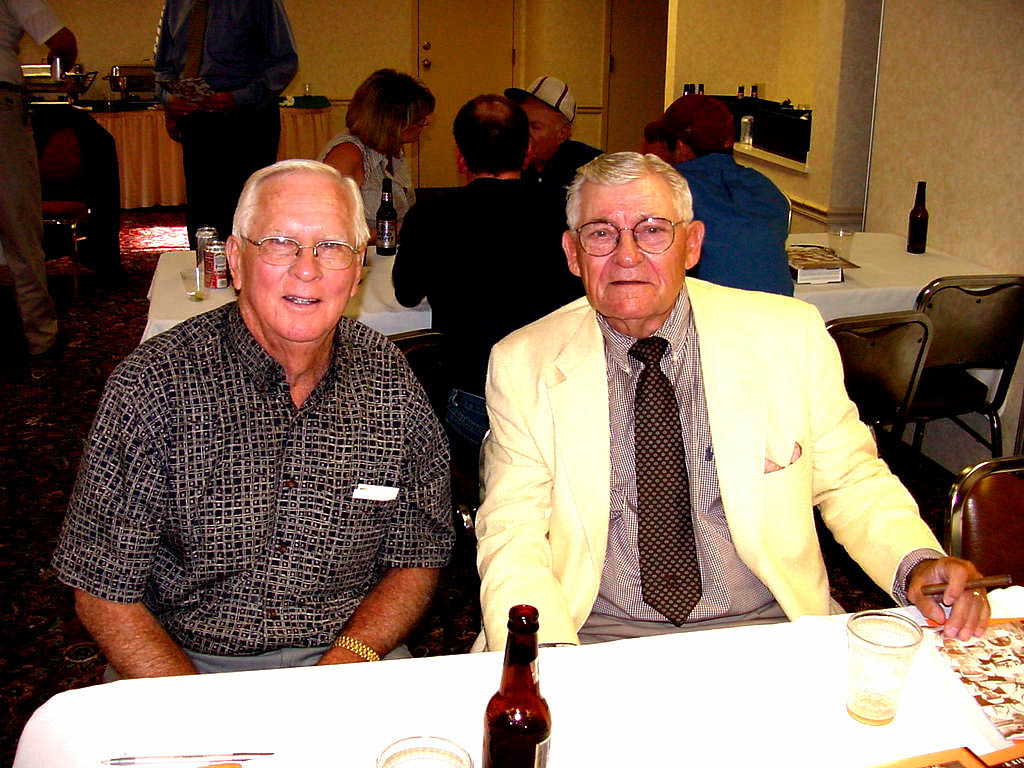
Bud Thomas (L) & a Former Browns Bat Boy (Name Unknown) Renew Old Acquaintance in 2003.

Bud Thomas (L) & a Former Browns Bat Boy (Name Unknown) Renew Old Acquaintance in 2003.