It Happens Every Spring

March 4, 2013
Ray Milland stars as King Kelly in 1949's "It Happens Every Spring." Only Tony Perkins in "Fear Strikes Out" looked worse as a ballplayer than Milland.

Ray Milland stars as King Kelly in 1949’s “It Happens Every Spring.” Only Tony Perkins in “Fear Strikes Out” looked worse as a ballplayer than Milland.

One of my all-time favorite baseball movies is a little black and white comedy from 1949 called “It Happens Every Spring.” Ray Milland stars as a chemistry professor, Vernon K. Simpson, whose baseball fan addiction to the club from St. Louis (the Cardinals, but never named as such) that he can hardly teach when their games are broadcast over the radio at the same time he is scheduled to lecture.

One day, when Professor Simpson is working on the application of some important groundbreaking usage formulae in his laboratory, a baseball from the college team’s practice field crashes though the lab window and destroys everything he has been working for months to prove. Grave disappointment quickly turns to wide-eyed wonder when the professor finds that he has now accidentally perfected a substance that makes any material it touches repellent to wood.

When Simpson rolls the errantly soaked baseball down the lab sink surface in frustration, he is astonished to see that the ball either rolls around or jumps over anything made of wood. When he then tacks the ball to a string and suspends it from an overhanging surface, he tries swinging at it with a long wooden handle. The ball jumps over the stick every time.

The professor tries pitching to a couple of his students who are also members of the college baseball team. The kids kill every dry ball that Simpson throws to them. They also badly miss every doctored baseball that has received even a small touch of the mysterious new substance.

It doesn’t take long for Simpson to perceive the possibility of a career change, but he understands that he has to act right away, while there is still time to help the pitching-desperate St. Louis club. He also recognizes that he cannot share his intentions with anyone, not even his fiancée, Deborah Greenleaf (Jean Peters), the daughter of Dean Alfred Greenleaf (Ray Collins), and that he must take a quick leave of absence and pursue the change with a new identity.

Simpson gets a quickie sabbatical and grabs the next train to nearby St. Louis. He may be leaving Mizzou in Columbia,  but that point also is not made clear.

Once in St. Louis, Simpson barges into the office of St. Louis manager Jimmy Dolan (Ted de Corsia), offering to help the team win the pennant. He is immediately perceived as a nut case, clinching the diagnosis when Dolan asks him in sarcasm, “How many games can you win for us?” Simpson answers with a question of his own: “How many games do you need for me to win?”

Club owner Edgar Stone (Ed Begley) walks into the meeting in time to catch most of the same crazy drift, but is pushed over the edge when Simpson tells him, “Mr. Stone, if you allow me to walk out of here without giving me a chance, I’m taking the pennant with me. I’m sure the people in Chicago will be glad to give me a look.”

That did it.

“Dolan,” shouts the St. Louis owner to his manager, “take this upstart down to the field right now and let him pitch to the top of the batting order. We are going to teach him a lesson he’s never going to forget.”

Simpson, of course, mows them all down with a ball that jumps over and around all of their mighty level swings. He gets signed as “Mike Kelly” and rapidly becomes known as “King Kelly” for his total ability to look awful, but still beat any and all comers.

Manager Dolan still thinks of “Kelly” as a whacko, assigning catcher Monk Lanigan (Paul Douglas) as a roommate who will also keep an eye on the nut job phenom.

Trouble is, Kelly keeps his magic liquid concealed in hair tonic bottles. Prior to games, he squirts a small amount into a small sponge which fits easily into the pitcher’s glove, oozing out through an enormous obvious hole in the glove’s pocket that no opposing team or umpire ever asks to see.

Kelly tells roomie Lanigan that the bottles contain hair tonic when the latter discovers these bottles have no labels and is unsure about what they are. Trouble really is, Kelly cannot make more of the unformulated substance. He has enough to get through the season, but after that, he’s done. And that’s OK too – until late in the season when Lanigan runs out of his own hair tonic and quietly borrows some from Kelly – and also lends a whole bottle to manager Dolan.

Both of the borrowers go through some funny solo scenes trying to comb their hair with wooden combs and watching the repellent features of the magic substance work some wild hair wonder in each case. But, hey! Wouldn’t you just know it? All this happens on the morning of the season’s last game. Kelly set to pitch. If Kelly wins, St. Louis takes the pennant. If Kelly loses, St. Louis goes home empty-handed.

Kelly barely has enough juice left to reach the ninth inning. St. Louis has the lead by a run, but their foes have the bases loaded with two outs – and Kelly is dry-handed.

The batter lines a shot up the middle. Kelly knocks it down with his bare right pitching hand. In great pain, he scrambles to pick up the ball and then makes the throw to first. Game over. St. Louis wins the pennant.

But Kelly breaks his hand and can never pitch again. By this time, his fiancée and her Dean father all know about the adventure, but they are proud of “Vernon” for striking out on this curious road to success. They take him back to their college town where the whole community awaits his return with a brass band welcome.

Vernon gets the girl. They are married. He goes back to being just a fan on his way to academic success. And they live happily ever after.

No scandal, criminal, or civil charges arise from the professor’s journey. There is no media cry for an investigation into how many other players are doing exactly what Vernon Simpson did. And there are no notices from Cooperstown or the BBWAA that the player known as Mike “King” Kelly would be placed on the list of individuals who are ineligible for the Hall of Fame.

“IT HAPPENS EVERY SPRING” is the cheapest good time buy out there.
http://www.imdb.com/find?q=it+happens+every+spring&s=all

What a Difference Three Years Make

March 3, 2013
Carlos Lee: Gone With The Wind from 2010.

Carlos Lee: Gone With The Wind from 2010.

When it comes to their Opening Day 2013 starting lineup for the Houston Astros, the handful of possible repeat starters this year from 2012 are few. They include only Joel Castro, C; Jose Altuve, 2B; Marwin Gonzalez, SS;  and  J.D. Martinez, LF, as the only four holdover possibilities, with Castro and Altuve being the only strong (barring injury) starting repeat probabilities for 2013.

Go back two years to 2011 and Brett Wallace would need to start at first base to salvage the only possible returning starter from that season as a possible repeat in 2013.

Now go back to the Astros’ starting lineup for Opening Day 2010 and the possibility of repeat performers in 2013 slips all the way to the ghostly and gusty gone-with-the-wind level at .000. The 2010 starting Astros are now all either lost or gone forever from Houston – in all probability. Here is a brief “where they are now” look at the …

… 2010 Opening Day starting lineup for the 2010 Houston Astros:

1) Michael Bourn, CF: Dealt away to the Atlanta Braves in 2011, Bourn s now in spring training with his new club, the Cleveland Indians.

2) Kazuo Matsui, 2B: Matsui’s poor early performance in 2010 earned him a May release which quickly translated into his retirement from baseball, at least, on the American side of the really big pond.

3) Hunter Pence, RF: Traded to the Philadelphia Phillies in 2011, Pence was again moved to the San Francisco Giants in 2012, giving him the opportunity to win a World Series ring with the 2012 World Champions, for whom he still plays.

4) Carlos Lee, LF: Dealt away to the Miami Marlins late in 2012, the veteran Lee remains in 2013 ST camp with the Marlins, hoping to catch on at a price that is more appealing to the Miami rebuilding plans.

5) Geoff Blum, 1B: Free agent Blum saw limited action with the 2011-12 Arizona Diamondbacks and then retired. He is now back in Houston in 2013 to work as the back up analyst for 2013 Astros game telecasts.

6) Pedro Feliz, 3B: After a poor 2010 start with the Astros, veteran Feliz was dealt to the St. Louis Cardinals where he finished out what probably was his last season in the big leagues. Feliz continues in 2013 as an independent league ballplayer.

7) J.D. Towles, C: Towles performed poorly in 2010-11 and spent 2012 in the minors. He is set to again play minor league ball in 2013, but away from the Astros farm system.

8) Tommy Manzella, SS: Manzella had bat problems in 2010 and spent 2011-12 back in the minors.He will also play minor league ball outside the Astros system in 2013.

9) Roy Oswalt, P: The former Astros great is overwhelmed with arm injury and run support problems with the Astros in 2010. He is traded to the Philadelphia Phillies before season’s end, but his problems continue in Philly after a 7-1 2010 new club start makes it first appear that he is OK. Following a mediocre, arm-plagued season with the Phillies, Oswalt is released, only to sign with the Texas Rangers for limited action and mediocre results in 2012. Oswalt is in ST with Texas again in 2012, just hoping to salvage his fast-fading options as a big league pitcher.

The 2013 Astros may be fighting an uphill talent battle, but, at least, they will be doing it with young players who have some considerable upsides as career MLB prospects. The same certainly cannot be said for the starting nine from that 2010 Opening Day. Other than Bourn and Pence, and their windows were peaking in 2010 at a time they needed others around them to help them win, there was no future for the club that was taking the field to start that season.

Hindsight is wonderful. Foresight is hopeful. Reality is – play the games and let’s see what happens, always trying to change things as we learn more about the things we need to change. Our real hope is vested in our ability to learn from our mistakes and make the adjustments we need to make for putting constructive change in motion.

Have a nice Sunday, everybody! If what you’re doing today feels good, but doesn’t threaten the health of anyone or your own status with the law, don’t change a thing. Keep it up.

What’s in a Name?

March 2, 2013

aa question marks

What’s in a name? We all know and react to what it is. It’s the power of imagery, that’s what.

Sometimes it’s simply the actions of certain individuals that brands their names forever with a certain character regard in the ears of all others that is strong enough to drown out anything else about them that may have also been true. Judas Iscariot and Benedict Arnold are the clearest examples that occur to me. Their names are each the personification of “traitor.” Along the same line, Houdini is the name we liberally assign to all kinds of legal and social “escape artists,” and even to squiggly, squirming running backs who avoid getting tackled in seemingly inescapable situations on the playing field of American football.

Hollywood has been re-imaging actors and actresses forever with names that seem to better characterize the flow of their leading men and lady roles. Archibald Leach became Cary Grant; Frederick Austerlitz became Fred Astaire; and Virginia McMath became Ginger Rogers. And those changes worked out pretty well. Can you imagine Archibald Leach “getting the girl” at the end of his movies? How about recalling the great dance numbers of Austerlitz and McMath?”

Sometimes there really is a sort of bent logic in the changing of identities for performers. Names are a thing that either to or against the prejudices of their audiences. According to singer Tony Bennett, whose still going strong in his late 80’s, Bob Hope changed his name for him prior to a television appearance with the iconic American comedian (who himself was originally a Brit named Leslie Townes) back in the late 40’s or early 50’s because he felt that the mass audience might have more trouble with his birth name of Anthony Dominick Benedetto. The story doesn’t reveal if Hope thought the “trouble” might have been with memory or ethnic prejudice, but we know there was a time in which the anglicized name was preferred in Hollywood to names of Italian, Jewish, German, or other Eastern European cultures. Just check out this one site of Hollywood name changers and judge for yourself:

http://www.fiftiesweb.com/dead/real-names-1.htm

Thanks to the wonderful baseball biographer of Connie Mack that is Norman Macht, I only recently learned that one unidentified, but well-known general news writer of the early 20th century sometimes also covered sports, but under a tongue-in-cheek pen name. What a name he chose too. He wrote sports as “Jim Nasium.”

Baseball names breathe deeply from the nicknames we assign to players from the deepest points of the baseball community culture.  George Herman Ruth had to be re-born as “Babe Ruth.” He was everything that was new and exciting about the new power game. Tyrus Cobb, on the other hand, only needed to shorten his first name to “Ty“, sharpen his spikes to a razor clear “V”, and to start running those bases like the wild man that his grin and glare  always said he was.

My favorite baseball identity names, in no particular order, are these: Tomato Face Cullop, Satchel Paige, Yogi Berra, No-Neck Williams, Pee Wee Reese, Goose Gossage, Double Duty Radcliffe, Home Run Baker, Dizzy Dean, Rube Waddell, Ducky Medwick, Catfish Hunter, and Cool Papa Bell.

Let’s close on a really good one: Happy Weekend, everybody!


Cliffhanger Serials of the 1940s

March 1, 2013

They came to life twice in the early 20th century with “The Perils of Pauline” (1914, 1933). They zoomed from there into the stratosphere during the Great Depression with “Flash Gordon” (1936).  Then they took off with all the power of  comic books with “Batman” (1943, 1949) and “Superman” (1948) in the 1940s.

The immediate post-war years (1945-1949) were the halcyon days of the 12-15 week movie serials that drew the kids to movie theatres across America every Saturday to see how the storyline’s heroes escaped their latest almost certainly fatal brush with death in the previous chapter. They continued into the 1950’s, of course, but were soon enough put to bed for all time by the role of television coming into the picture and offering virtually the same fare at home for free.

George Reeves as Superman on TV, for example, had a staying power that KIrk Alyn as the movie Superman from 1949 could not have and hold. Alyn was done in 12 chapters. Reeves could keep it up as long as the kids wanted him – and, unlike Alyn, as we said earlier, he was free.

Everyone has their own serial favorites from the old days. Here are my three favorites from the 1940’s:

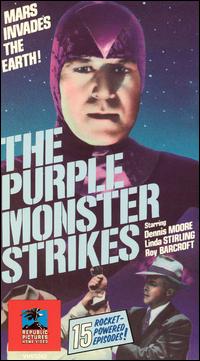
Circa 1945

Circa 1945

(1) “The Purple Monster Strikes” (1945, 15 chapters): Arch movie serial “bad guy” Roy Barcroft played the title role as solo visitor to Earth from Mars as the advance guard explorer of a planned invasion. For some reason, Mars had perfected a one-man rocket plane that could fly to Earth, but they lacked the technology to start it up again for a flight home to Mars. It’s a little hard to start a flying machine that explodes within ten seconds of its only occupant’s quick landing departure from the flight capsule. As the “purple monster,” Barcroft had come to earth to get that return flight know-how, fly back to Mars, and then lead the planned invasion back to Earth.

Described by the serial’s narrator as a “strange, weird visitor” from another planet, Barcroft wears a late 1940’s version of a purple spandex-like suit and something that looks like a purple shower cap as his everyday attire. We see his attire in shades of grey, of course, due the black and white film they used for these adventures.

The Purple Monster also has the ability to stand near a dead human body and explode a little smoky capsule that allows him to enter the deceased in ephemeral form and disguise himself as Dr. Cyrus Leighton, a prominent American scientist. The Martian also carries with him a little black box called the “distance eliminator” that allows him to both speak and understand any language. In the last chapter, the monster almost gets away. He crawls inside the “going home” rocket with all of the plans inscribed on paper in detail. He pushes the rocket’s lever from its “stop” to to the “take off” position. Before he can exit the Earth’s atmosphere, however, he is blasted to smithereens by an atomic rocket missile that has been set up by the US Army to defeat his getaway and save the world.

All’s well that ends well. And Roy Barcroft goes on to play the sheriff in the movies version of “Oklahoma”  in 1956. Those of us who grew up watching Barcroft in serials and Grade B westerns are as proud of him as we were of former Houston Buffs who later made it to the big leagues. A kids, we knew him as the Purple Monster, a bad guy, but one of our actors nonetheless.

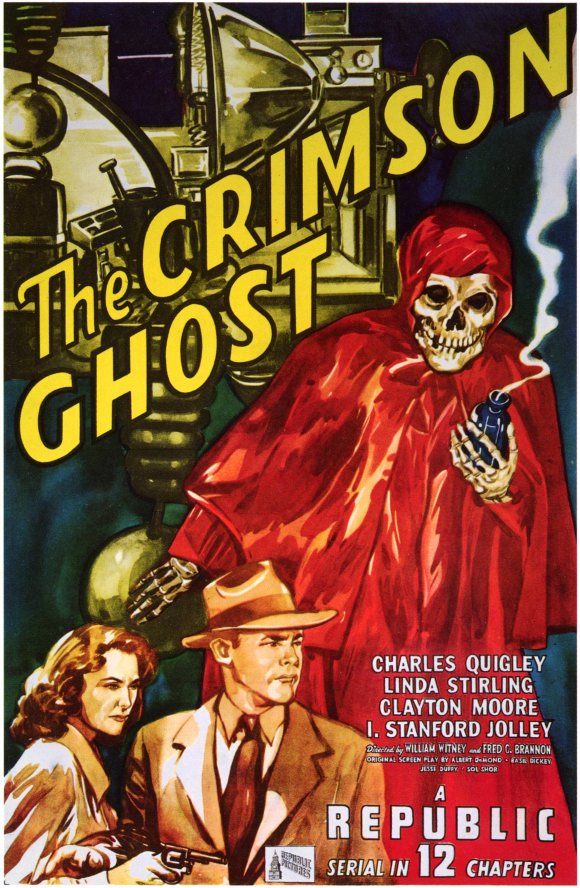
Circa 1946

Circa 1946

(2) “The Crimson Ghost” (1946, 12 Chapters): A college science professor leads a double life as “The Crimson Ghost” and he spends all his time trying to steal a colleague’s plans for building a Cyclotrode device that will have the power to short-circuit all-electric power on the planet. Whoever controls it will possess the power to take over the entire world. Megalomania was a common affliction among the movie serial villains. Must have been a writer’s disease, one that contemporary writers of the TV series “Revolution” may have copied from The Crimson Ghost.

What makes this movie so ironically attractive, however, is the presence of Clayton Moore as the Crimson Ghost’s top henchman, Louis Ashe. Moore is much better remembered today as the actor who played The Lone Ranger on the TV series of the same name.

One continuity problem with a Crimson Ghost scene that violated the laws of physics, even as I understood them at age 8: Hero Duncan Richards is about to drive off a cliff at 80 mph, but he is unconscious in the driver’s seat as the chapter concludes with the car going off into the abyss. The next week, the same scene plays out differently. This time, at the last minute, the hero wakes up in time to jump out of the car. From there, he runs on the highway to a slowing halt without either falling down or losing his hat as he also stops in time to watch the car going off the cliff without him.

What??? – Even at 8, I’m saying, “no way!” Even we kids can’t do that! He doesn’t even need a bandaid!

Like the Purple Monster before him, the Crimson Ghost is finally detected and stopped. This time the villain survives to go the penitentiary.

Circa 1949

Circa 1949

(3) “King of The Rocket Men” (1949, 12 Chapters): This one starred the only guy beyond the great Tris Speaker I ever heard of whose full first name was “Tristram.” Tristram Coffin played the Rocket Man who took on the challenges of the evil Dr. Vulcan for (what? you guessed it!) world domination. The Rocket Man wins to preserve the heroic record of good guys and the American Way against bad guys and evil at a perfect whatever figure for wins it is for America against zippo for the alien baddies.

Our science challenge with the Rocket Man had to do with the flame that burst out of his backpack rocket that enabled his flight. We could not figure out he was able to sit down anywhere after even a short flight. In fact, we would even ask ourselves: “Could the Rocket Man even fly from our neighborhood to the Avalon Theater and still be able to sit down once he bought his movie ticket?” We decided that he must have worn asbestos underwear that they just didn’t talk about back in the day.

Those were the days, my friend.

The Wizards of Odds

February 28, 2013
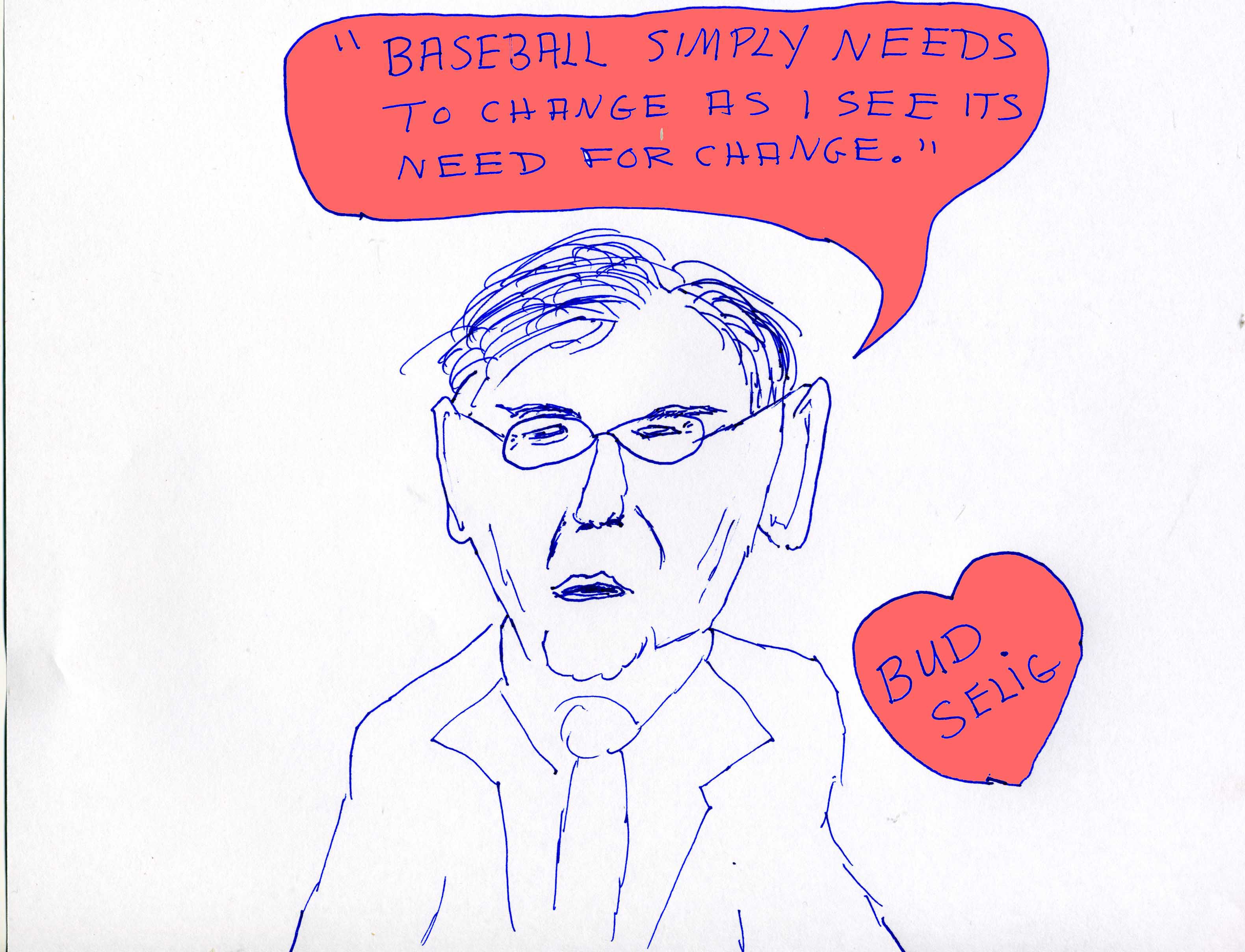
"I'm not really such a bad man. I'm just a terrible Commissioner." - Bud Selig.

“I’m not really such a bad man. I’m just a terrible Commissioner.” – Bud Selig.


I could research this for hours

Conferring batting powers

Consulting with my brain


And my head I’d be scratchin’

While my thoughts were busy hatchin’

On the SABR baseball train.


I’d unravel any riddle

For any individ’le

From Mexico or Spain


With these thoughts I’d be thinkin’

I could be another Lincoln

If I only had a brain


Oh, I would tell you why

K’s are three and walks are four

I could think of things I never thunk before

And then I’d sit and think some more


I will not be just a Selig

My head with lowered ceiling

My heart all full of pain


I will dance and be merry

Life will be a ding-a-derry

On the SABR baseball train


(Shift gears here on the melody after these three lines of shouted dialogue.)


So – where are we going, this summer and next?

To Oz? – To Oz?

No! We’re off to Philadelphia! Then to Houston!


WE’RE OFF TO SEE THE WIZARDS,

THE WONDERFUL WIZARDS OF ODDS!


OF BATTED BALLS AND GREAT PITCH CALLS

THE GREATEST THAT BASEBALL COULD DO BECAUSE,


OUR SABR OWNS – THE WIZARDS,

THE WONDERFUL WIZARDS OF ODDS!

As the NL Time Goes By

February 27, 2013
Hope is Where the Heart is.

Hope is Where the Heart is.

Humphrey Houstonfan and Hope Furtomorrow had been together for a long time, since 1962 to be exact. Their lifelong dream had always been for two things: watching their Houston Astros club win a few World Series titles and then simply living happily ever after as members of the National League family of organized major league baseball clubs.

All that changed in 2011 when the Houston Astros were sold to Mr. Jim Crane, who was also forced by the fascist regime that runs baseball from the Commissioner’s Office to accept reassignment of the club to the American League West as a condition of the deal’s approval.

Humphrey sagged. Hope sank. And the always loyal Houston couple spent the next year in painful deliberation of their next fan course of action: Would they simply go along with the move to the AL, pretending that any league that used a DH was playing real baseball? Would they painfully divorce themselves from the Astros and shift their allegiance to a longtime Houston NL favorite like the Cardinals? Or would they simply re-focus their fan attentions upon amateur baseball, and preferably upon some league that still either avoided the DH – or else – didn’t charge much for watching?

Rice and UH came to mind. Giving up baseball altogether never did.

Humphrey and Hope finally decided to shift their support in 2013 to the Houston Babies of the growing Texas Alliance for Vintage Base Ball. It was good clean 19th century base ball fun. Played from the soul. Played for free. And played out in bucolic grandeur from a deep love of the game on the Elysian-like fields of naturally green places like the George Ranch, south of Sugar Land.

The couple also agreed that they would drive to the big Houston airport and say goodbye to the Astros in the wee small pre-dawn hours of their first road trip of the 2013 season. Because it was so special as a goodbye, Humphrey had been able to get clearance from authorities for he and Hope to be right there at the departing gate with the Astros when the moment of goodbye finally came.

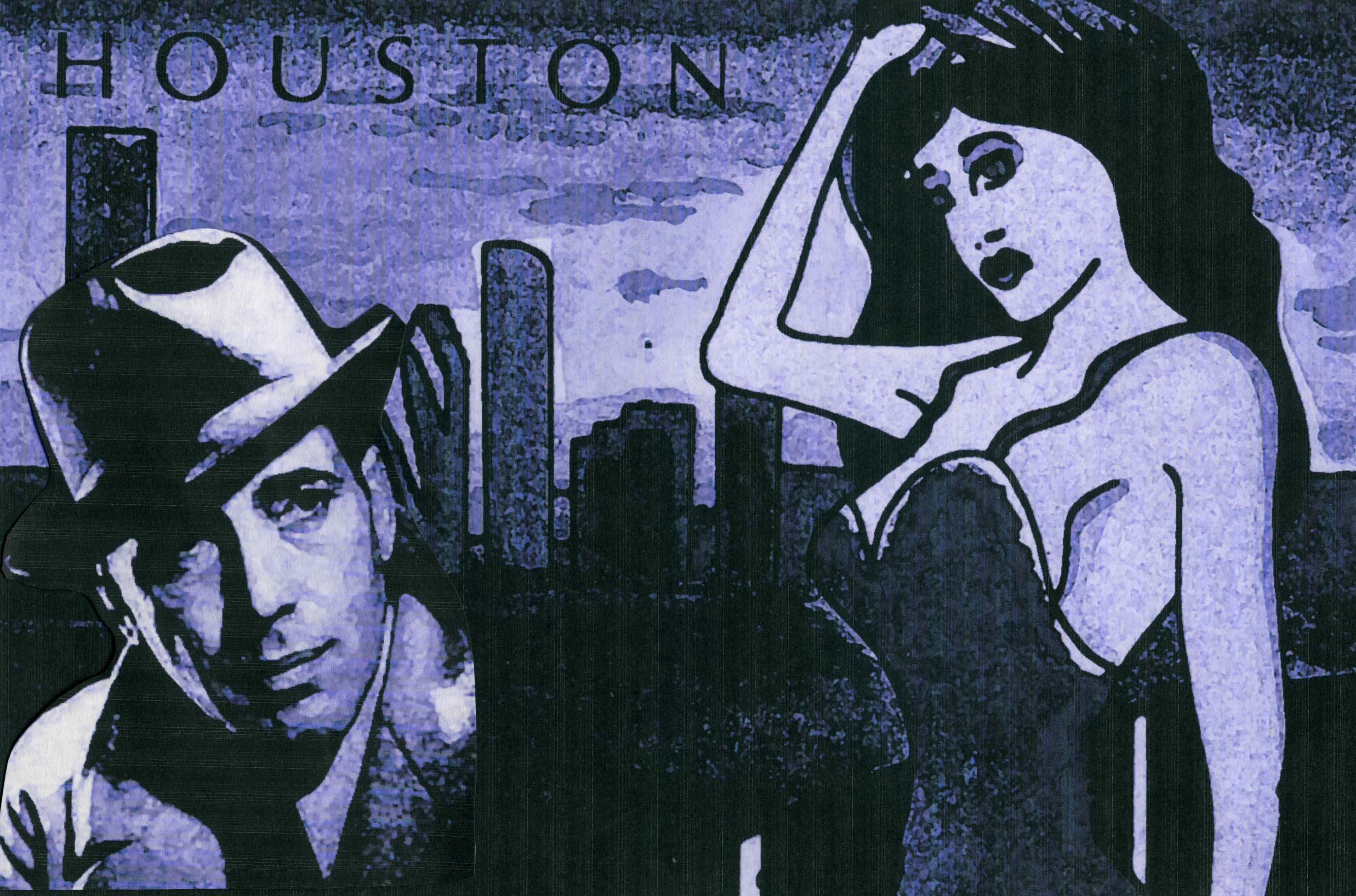
And here’s what actually happened that historic morning. It was like a script for some movie I once saw, but can now hardly remember by title. Perhaps the name will come to me, as time goes by:

As the list of all passengers set for the Astros flight is checked off with each person in line, Humphrey suddenly flashes a single extra computer-printed ticket and speaks to the attendant at the check-in lane:

Humphrey: “Add the name of Miss Hope Furtomorrow to your list.”

Hope: “Why my name, Humphrey?”

Humphrey: “Because you’re getting on that plane. These kids are green. They can’t win without Hope. They need you.”

Hope: “I don’t understand. What about you?”

Humphrey: “Forget me. I’m not Hope. You are. I may still be Love, but I’m too old and tired for this job. It belongs to you.”

Humphrey’s intention suddenly dawns on Hope. The pain in her face is tearful.

Hope: “No, Humphrey, No! What has happened to you? Last night, you said …”

Humphrey: “…Last night we said a great many things. You said I was to do the thinking for both of us. Well, I’ve done a lot of it since then and it all adds up to one thing. – You’re getting on that plane with the Astros where you belong.

Hope: (now protesting) “Humphrey, I..”

Astros Manager Bo Porter notices the couple’s struggle. He walks up close enough to be a concerned third-party listener.

Humphrey: “Hope, do you have any idea what we’d be up against here in Houston if the Astros have to go to the American League with no bats, no arms, and also no hope?  Guess who gets the blame for that last one. It will be you and me. And nine chances out of ten Bud Selig would ban us from every park in organized baseball if you don’t go with the team. – Isn’t that true, Bo?”

Bo Porter: “I’m afraid Commissioner Selig would insist.”

Hope: “You’re saying this only to make me go.”

Humphrey: “I’m saying it because it’s true. Inside of us we both know you belong with the Astros. You’re part of their work, the thing that keeps them going. If that plane leaves the ground and you’re not with them, you’ll regret it. …”

Hope: “…No!”

Humphrey: “…Maybe not today, maybe not tomorrow, but soon, and for the rest of your life.”

Hope: “But what about us?”

Humphrey: “We’ll always have the Spirit of 2005. We didn’t have, we’d lost it until you started going with me to vintage games. We got it back in the pasture land fields at George Ranch.”

Hope: “And I said I would never leave you.”

Humphrey: “And you never will. But I’ve got a job to do too. Where I’m going, you can’t follow. What I’ve got to do, you can’t be any part of. Hope, I’m no good at being noble, but it doesn’t take much to see that the problems of two little people don’t amount to a hill of beans in this crazy world. Maybe someday you’ll understand that my job as general manager of the Houston Babies isn’t all that easy. Finding players that can both catch a baseball with their bare hands and also understand the one-bounce out rule from 1860 aren’t that easy to come by.”

Hope’s expression wells with tears as Humphrey tenderly embraces her chin with the fingertips of both hands and looks her straight in the eyes.

Humphrey: “Wherever you are, I will always have hope. – Here’s looking at you, kid!”

My Favorite Houston MLB Uniform

February 26, 2013
The 1965 Shooting Star is my all time favorite Astros uniform design.

The 1965 Shooting Star is my all time favorite Astros uniform design.

As I first wrote last fall, I’m in the camp of those who like the return of the Astros to their more traditional uniform fonts, the closed star, the big “H”, and the colors orange and navy blue. That’s how we started and that’s  how we’ll always be in my own mind-time for this sort of thing. In fact, the color match is now an even greater natural. If you are going to play in a ballpark called Minute Maid Park, one  that features a train load of pumpkin-sized oranges on the tracks high above left field, how can you not fly the color orange in the uniform scheme of things – especially in light of the fact that half the fans are hanging “The Juicer” on the place as their first choice for the venue’s identity.

I fell in love with the shooting star design that came along with the 1965 christening of the new domed stadium forevermore as the Astrodome and the change of the club’s name from Colt .45’s to Astros. Although I liked the old Colt .45 jersey style, I just really took to the sight of that star blazing across the jersey of the new club from outer space. It simply spoke aloud for the high hopes and aspirations of most Houston baseball fans.

If you had appeared as a psychic prior to that first-ever game against the Yankees on April 9, 1965 and told all of us Astros fans that our future over the next 48 years would include only one World Series appearance and no wins, we probably would have laughed you out-of-town with a free Greyhound bus ticket. I shudder to even think what might have happened had you also told us as a 1965 psychic version of Johnny Carson’s “Beyondo” that our brand new Astros would be moved to the American League before we ever even got our second still unforeseen in 2013 shot at a second World Series.

Now, had you wanted to have built credibility as a psychic in 1965, you could have done so with this simple forecast: “Over the next half century, Houston will continue to build and widen its current system of freeways and cross-town avenues, but any journey to and from the Galleria area shall remain a four-hour round trip from anyplace located within thirty miles of the famous shopping center.”

Shooting stars are great. Unfortunately, they only look good on uniforms and they have nothing to do with the long-term delivery of dreams.

Once Upon a Time ‘Neath a Summer Night Sky…

February 25, 2013
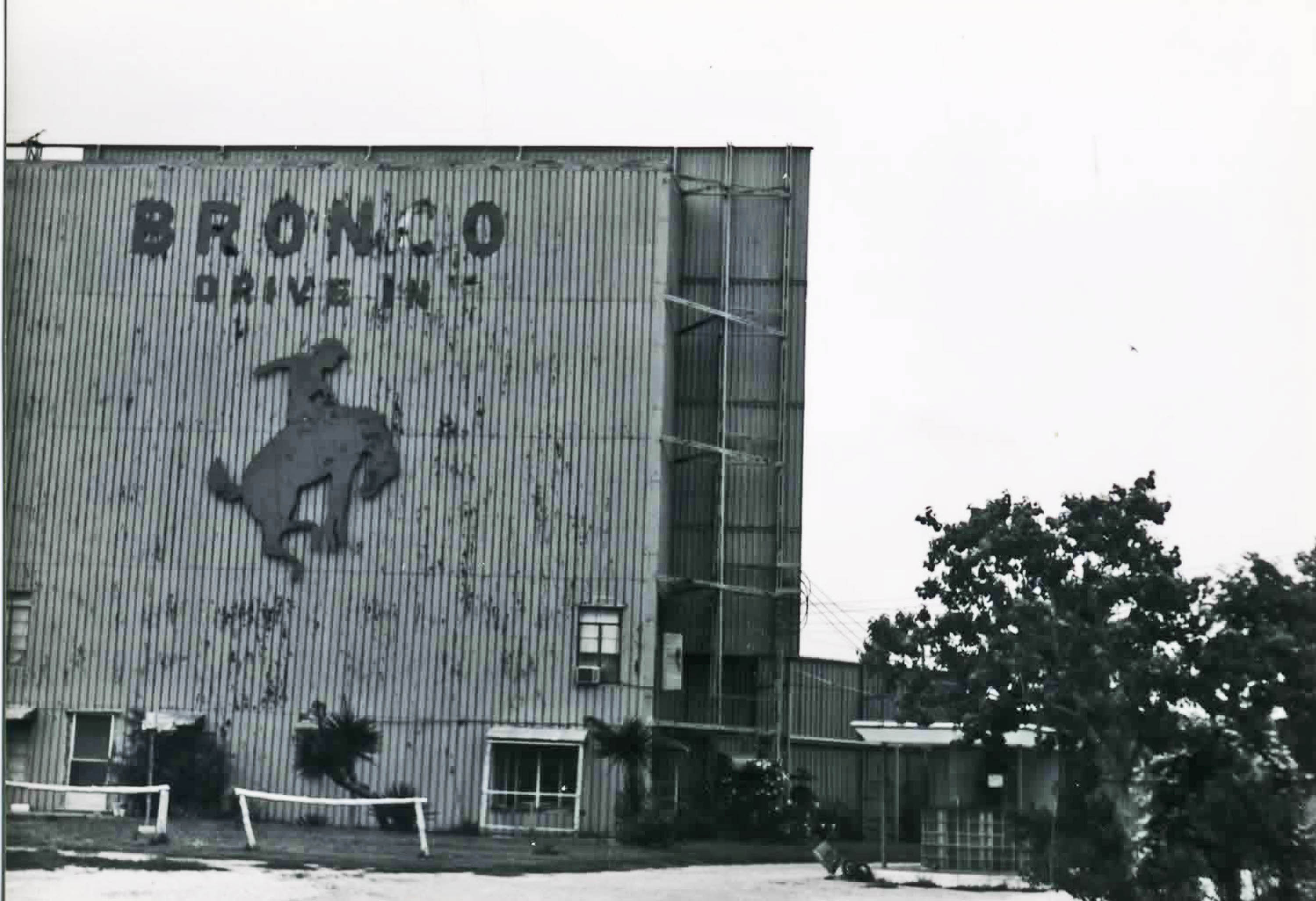
THe Bronco Drive In Theater in Beeville, Texas fell into ruin in the 1970s.

THe Bronco Drive In Theater in Beeville, Texas fell into ruin in the 1970s.

…We had a thing called drive in movie theaters. They were places for families with young children and also havens for young couples who liked to cuddle. They were all over America and, by 1951, they were starting to be the answer to TV’s damage to the indoor movie house market.

With the coming of TV to places like Houston in 1949, people started staying at home more, watching moving characters on the small screen for nothing and maybe saving enough money on movie tickets to move up rom a 10″ black and white screen to one of those new 14″ – or even 17″ – really big TV screen sets.

The problem was quickly apparent. Watching TV did not fulfill the need that most able-bodied younger people have for getting out of the house. And you couldn’t take small kids to a good indoor movie theater anyway – and date nights for teens didn’t work at all if you had to build them around staying home and watching TV with your parents and your girl friend.

Then some marketing genius came up with an alternative that served as the answer for a while – that answer was the invention of the usually suburban or way out in the country drive in movie theater. The trick was to find some cheap land that was not too effected by the lights of the city or heavy highway traffic lights. Then you built a screen that was big enough to handle hundreds of cars with room enough left over near the screen for a playground and a concession stand in the same building that housed the projector. Each car space would then be set up with its own speaker on a wire that the driver could bring inside and adjust for volume. (The sound quality was Grade F Crapola, but we didn’t know any better back then. If you are too young to remember, be glad. You should have heard how bad the sound was for television in the beginning.)

These were also the pre-AC days in most Houston homes, so, the drive in movie theater was also a chance to enjoy the gulf breezes by rolling all your car windows down. The downside in Houston’s summer nights was dealing with the mosquitoes. Our major remedy for these pests was a product we bought at the concession stand, a little green coil of some smokey combustibility that you burned inside the car like a mind-altering incense. They called it “Pic” and it killed and repelled the bugs away very effectively. I’m not sure what it did to our lungs because back in the day, we just assumed that no American manufacturer would make an insect repellent that was also harmful to humans. Heck! We even had a cockroach killer at home called “J.O.” It was a pasty green substance inside a little toilet roll-like container that you placed on the floor at night; it was a material that also glowed in the dark that almost killed any roach that came near it – and totally wiped out all that dared to have a bite. – As they say today sometimes – “What’s up with that?”

At any rate, the drive ins were a neat retreat from the small quarters of home life with no privacy and a great place to cuddle for teen couples. In fact, the desire for closeness among teens drove the film industry into the creation of a genre we now often think of as “drive in movie.” These were the fright films that literally drove girls into the protective arms of their always protective boy friends. Several of these classics have been discussed here recently in The Pecan Park Eagle. The ones that stand out in my memory are “Invasion of the Body Snatchers” (1956), “Creature from the Black Lagoon” (1954), and “The Thing From Another World” (1951). I was too young for date night on the “The Thing’s” first go-round, but it kept coming back for years because of its great matchmaking power over young people.

My main Houston drive in movie theaters included the Winkler, only a mile from my Pecan Park home; the King Center on South Park (now MLK), the Hi Nabor on Mykawa Road, the Trail on O.S.T., and the South Main on South Main. There were many, many others in our town. Perhaps, you have a favorite that I haven’t listed.

Closing Note: I even had my own “Wake Up, Little Susie” moment once at the Trail. It was a Friday summer night and both my girl friend and I had worked hard all day, but we still decided to go to the Trail for one movie in an all night monster film festival. We both went to sleep in the front seat, but some pedestrian finally wakened me when he slammed his hand on my front fender on the way to the concession stand. I looked at my watch. It was 3:42 AM.

Holy Crap! My 16 year old version of “Susie” was supposed to be home by midnight. What was 16 year old me to do?

“WAKE UP, LITTLE SUSIE ! – WAKE UP!”

“Susie’s” mom ripped me pretty good by the time I got her daughter home. Fortunately for me, Susie’s mom did not know how to reach my own parents that night and I was to get home and sneak into the house without anyone there ever knowing.

As for how Susie did after that night, I really couldn’t tell you. Her mom imposed a probation upon contact between us after that night and the clock is still running on that one. I think she said it would be OK for me to call again on the day before the crack of doom.

ROOTS 6: Fly Ball Problem, Take 2

February 24, 2013
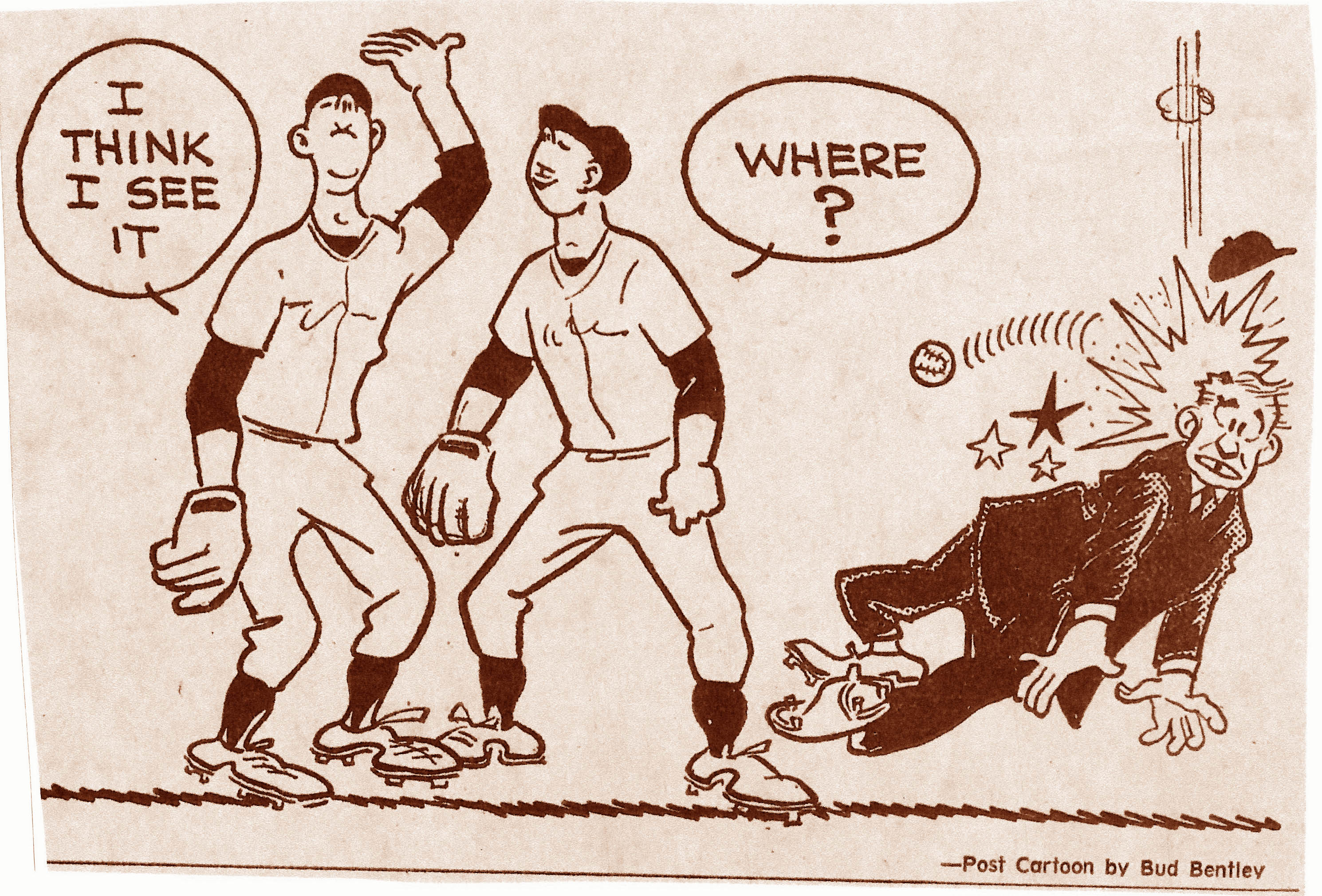
Bud Bentley contributed this cartoon to Mickey Herskowitz's article in the Houston Post on April 10, 1965, entitled: "Dome Puzzle Deepens: As Advice Pours In."

Bud Bentley contributed this cartoon to Mickey Herskowitz’s article in the Houston Post on April 10, 1965, entitled: “Dome Puzzle Deepens: As Advice Pours In.”

We recently wrote our first Astros “ROOTS” column on “The Day it Rained Baseballs” because of day game visual problems for outfielders particularly with fly balls at the new Astrodome. Today we go at the subject again, this time from a Houston Post perspective on the first weekend of play, April 9-11, 1965.

Forty-eight years later, every Houston baseball fan who was around when the Astrodome opened is both aware of the original problem of seeing fly balls during day games and its eventual solution a little thing called paint the ceiling, kill the grass, put in “Astroturf” as our human contribution to nature’s mutating design, but on April 11, 1965, the answers, results, consequences, and the boon that this issue eventually would become for Monsanto wasn’t quite so clear.

Here’s how Houston Post Sports Editor Mickey Herskowitz described the status of things in the Houston Post on Saturday, April 10, 1965: “The keenest intellects within and without baseball were still dumfounded Friday by the plight of the Houston Astros. – No solution had appeared yet to that one great mystery in the sky, namely how to apprehend a fly ball in the daytime in the Domed Stadium. – During the afternoon hours the sun and the Dome’s grand design reduce an outfielder to the status of a helpless pedestrian.”

According to Herskowitz, the “DuPONT COMPANY, developers of the Lucite (Astrodome) ceiling, rushed a research team here (to Houston) by plane to study the problem. ‘Just be patient,’ said one engineer. ‘We’ll think of something.'”

Charles Finley, owner of the Kansas City Athletics, informed the Astros that he was sending them six dozen orange baseballs for game use with him compliment. Hmmm! WOnder what happened to them, if he did mail them, for they were never used in a real game, but would make great historical artifacts from those times, if they were not eaten in time by the Astrodome rats of the current mausoleum era of the great structure’s declining health life span.

An Atlanta artist called to offer a rather oblique opinion that “the problem was one of tones and colors.” Say what?

Another random suggestion included the use of blue floodlights that could be shined upon the Astrodome roof, which we are compelled to view as little more than a “blue sky answer” to a far more complex riddle.

How about changing out the problematic clear light panels into ones which are tinted as polarized orange in color.

The eventual solution was nowhere near home that first weekend, but there was plenty of embarrassment to go around for everyone who had a hand in the final design and construction of the world’s first indoor stadium.

“How could they not see this coming?” That was the question on everyone’s minds. It lives on today as just another reminder that we are never quite as smart as we think we are.

The whole thing could have been avoided by just giving up the idea that daylight baseball was an option for the Astrodome. The National League was even willing to allow the Astros to shift its 21 regular season day games to night contests in 1965. The downside? According to Herskowitz, the club would have been forced to give up its $300,000 share of the TV revenue to be collected from the Game of the Week telecasts by moving to a “nights only” existence.

A 2013 Retrospective …

Problem Solved. Cheap as possible. Paint the clear roof opaque. Block out the sun. Now see the ball. Now also see the grass die. Now see us paint the grass green. Next year, see us replace the painted dead grass with grass that cannot die because it has never lived. It’s fake grass from Monsanto that seemed destined previously o serve mainly as a back yard door mat collector of dog poop and mud from the boots and shoes of homeboy grilling dads. Let’s now call it “Astroturf” as a way of glorifying and identifying its new greater status function to the whimsical distraction needs of western civilization. Problem solved better. Make the roofs of new domed stadiums mobile to sliding open. That way, we get to have opaque roofs that will co-exist with real grass because they can be opened to sunlight when there are no games in motion.

Thank you, Mickey Herskowitz, for being there to cover the onset one of the great technological challenges in American sports – the hazardous art of catching an invisible baseball in flight at the original Astrodome.

ROOTS 5: OTHER ASTRODOME FIRSTS

February 23, 2013
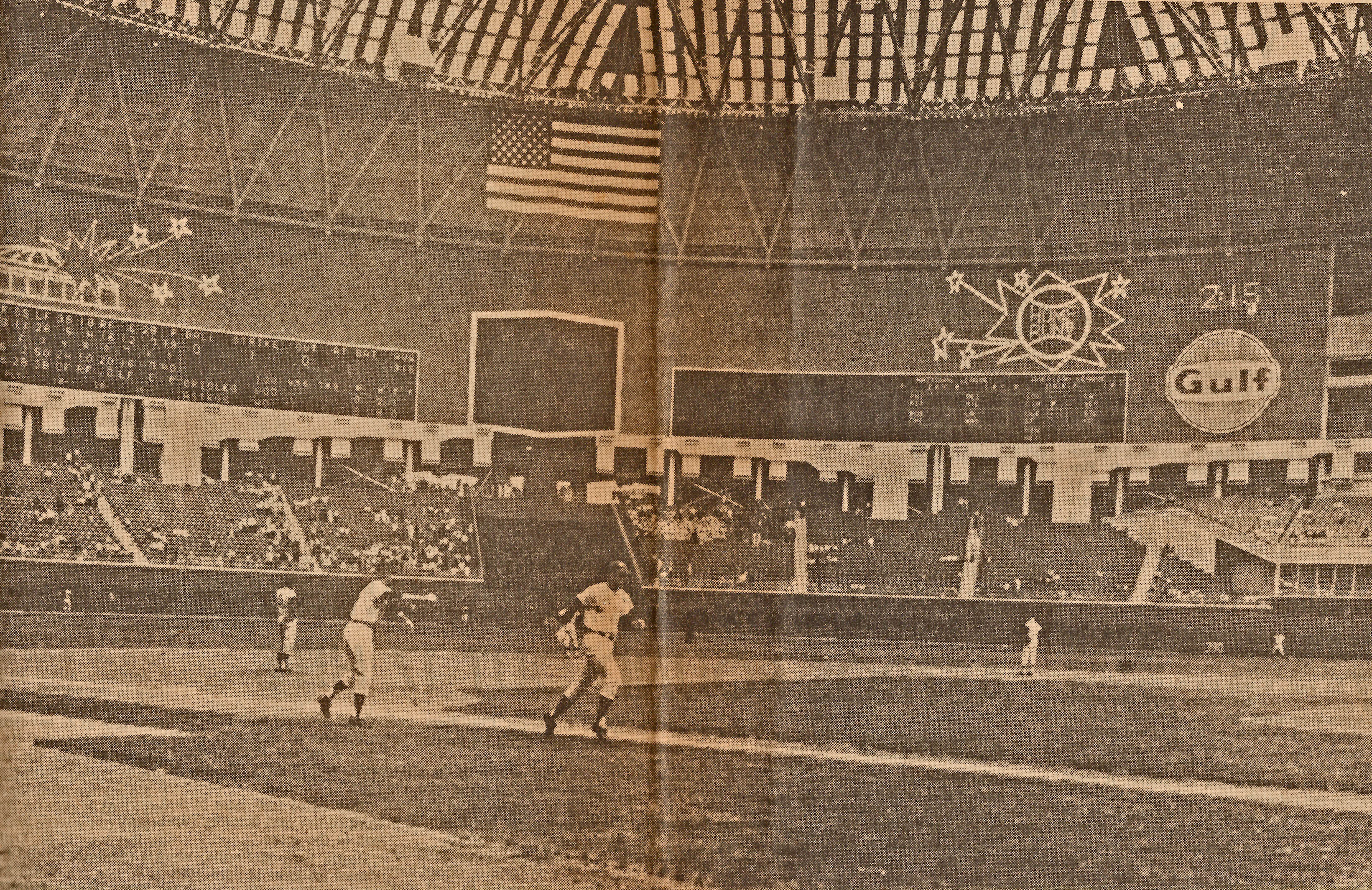
4/10/1965: Jim Beauchamp was the first Astros batter to light up the famous scoreboard in a day game with the Baltimore Orioles when his third inning home run contributed mightily to the club's 11-8 first win of any kind in the Astrodome.

4/10/1965: Jim Beauchamp was the first Astros batter to light up the famous scoreboard in a day game with the Baltimore Orioles when his third inning home run contributed mightily to the club’s 11-8 second win of any kind in the Astrodome.

Although his first Astros home run into the left field pavilion seats in the second game ever played in the Dome didn’t count in the long run because of its exhibition game status, it was still a landmark first time that the famous new all Texas cowboys and bulls scoreboard got lit up by a home club long ball in the great new land of inner playing space.

The world didn’t have to wait long for an official first indoor home run. As with Mantle before him, however, it simply wasn’t going to spring from the bat of an Astros slugger. The first official game home run in the Astrodome came early in the first contest of the season, in a battle  played out on 4/12/1965 between the visiting Philadelphia Phillies and the home team Houston Astros. As in the first exhibition game, it was again a member of the opposition that cracked the first long ball indoors when Phillies first baseman Dick Allen banged out a two run homer in the third inning off Bob Bruce that stood up as the 2-0 final score of the very first Astrodome Opening Day contest.

Astrodome Landmarks from 4/12/1965:

First Astros Loss – 4/12/1965, 0-2.

First Win – Philadelphia Phillies

First Losing Pitcher – Bob Bruce (Astros)

First Astros Reliever – Hal Woodeshick

First Winning Pitcher – Chris Short (Phillies)

First Official Domer Homer – Dick Allen (Phillies)

First Run – Ruben Amaro (Phillies)

First Error – Dick Allen (Phillies)

First Astros Double – Joe Morgan

First Astros Multiple Hit Game – Joe Morgan (2 for 3)

After the 4/12/1965 Dome opener, the Astros went on an eight-game road trip that kept them out-of-town until 4//23/1965 when they returned to the Astrodome to play a three-game series with the Pittsburgh Pirates.

The Astros took the first series game, 4-3, establishing these additional Astrodome firsts:

First Astros Win – 4/23/1965, 4-3.

First Losing Team Foe – Pittsburgh Pirates

First Astros Winning Pitcher and Win in Relief – Dave Giusti

First Opponent Losing Pitcher – Al McBean (Pirates)

First Astros Batter Hit by Pitcher – Ron Brand by Al McBean

First Astros Intentional Walk – to Al Spangler by Al McBean

The next day, 4/24/1965, the Astros finally added the big offensive first:

First Astros Home Run – Bob Aspromonte

First Astros Home Run with at least One Runner on Base – Jimmy Wynn

That’s it for now. If you have any firsts facing you this weekend, may they all be pleasant ones.

* Thanks to Baseball Almanac and Baseball Reference for their usual roles in making basic historical data research a thousand times easier than it was in the old pre-Internet days. If we really wanted to cover all of the baseball firsts associated with the opening of the Astrodome, we could be at the research side of things 12 hours a day for the next six months and still be scraping the surface of new material that had not occurred to us previously.