Teddy’s Amazing Last Day ’41 Run at Clear .400

September 8, 2014
No batter has hit .400 or better since Ted Williams did it in 1941 - and that was 73 years ago.

No batter has hit .400 or better since Ted Williams did it in 1941 – and that was 73 years ago.

There has never been any doubt in my mind as a fan from childhood. Ted Williams’ last day assault upon a clearly above and beyond .400 average in 1941 was the cockiest, most confident, amazing display of personal belief in his own huge talent that any ballplayer ever has, before or since, displayed on a single day in baseball history.

Starting with the fact that he didn’t have to do it. Going into the last day of scheduled games on September 28, 1941, Williams was already at the mathematical equivalent of .400 with 179 hits in 448 official times at bat. Those numbers yield a five-digit figure of .39955 – and those round clearly into the traditional three-digit batting average of .400 by all the rules that govern approximated consequences in digitally averaged terms.

Teddy could have stayed in the dugout on the last day of the 1941 season and had his technical .400 batting average for the season that way. The problem for Teddy Ballgame – and many others of us, as well – would have been Williams living forever with the fact that – if you take the numbers out to five spaces – the “4” at the start of that string fades messily away into a “.3” – followed by “9955” – and who wants that as the prize?

Ted also understood on some clear to visceral level, even at the youthful age of 23 years, that he would have to listen to the question in his mind and certainly too in the cacophony of requests from mindless baseball writers from there to eternity about why he didn’t take his chances for nailing down a final average on the last day by playing and getting enough hits that elevated his season record clearly beyond the .400 level.

A lot of us would have felt the same way, but how many of us would have had the faith in our abilities to succeed in that pursuit by risking all on the last day?

Remember too – the Boston Red Sox were scheduled to play a doubleheader with the Athletics at Philadelphia on the last day, September 28, 1941 and the club was in second place in the AL, but way out the pennant race on the way to a 17-game finish behind the champion New York Yankees. The two games left were simply a run-on-the-table of scheduled business and Sox manager Joe Cronin was leaving the decision all up to Williams on what to do.

Sit them both out. Pay one. Play two. – “Mr. Williams, it’s all up to you” seemed to be the manager’s stance. Cronin too seemed to recognize that the decision was larger than his normal managerial authority. Had the Sox been tied with the Yankees going into this last day DH, of course, it would have been a totally different matter and Williams would have played for the good of the team with no melodrama at play about his own personal goals.

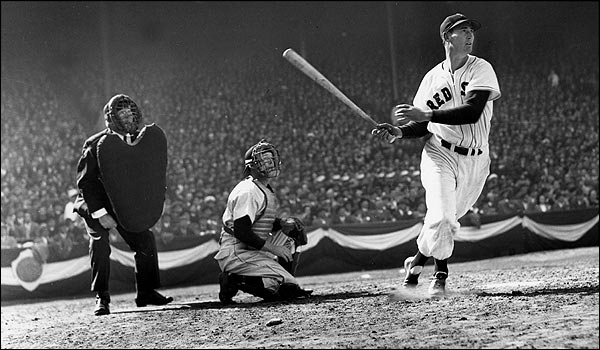
As most of you know, Ted Williams played both games and almost literally tore the cover off the ball. In Game One, Williams went 4 for 5 with 2 runs scored and 2 RBI, plus a 5th inning HR off the right-handed A’s starters, Dick Fowler, It was Ted’s 37th and league leading homer of the 1941 American League season.

Williams pushed over the .400 line good and hard in Game One alone. His 4 for 5 moved his season totals up to 183 hits in 453 official times at bat for a .404 (.40397) season batting average. No need for Ted to play the second game. He had his over-the-“.4”-top mathematical batting average then – with no need to play the second and final game. Besides, the Red Sox beat the Athletics in Game One by 12-11, What was the point of Williams taking any further risk?

None, but Williams played Game Two, anyway. His motor was running and he apparently knew that he was in that zone that he found more often than most hitters ever do, even for brief moments. In fact, it’s probably fair to say that the hitting groove in which Ted Williams mostly lived was more of a station that most hitters only find by aberration, if at all. His all out assault on .400 was about the expression of his lifelong wish, even if it never became inarguable – “to be remembered as the greatest hitter that ever lived.

In Game Two, A’s right-handed starter Fred Caligiuri shut down the Red Sox, 7-1, but Ted Williams still touched him up for a 2 for 3 result that included his 33rd double of the season. Those game stats pushed Ted’s final season batting average up to the .406 (.40570) that are as synonymous to Ted Williams as  the “56”  is to Joe DiMaggio and “60” is to Babe Ruth for different, but related reasons.

Baseball history certainly isn’t about always remembering the major achievements of  the big stars, but neither is forgetting them a good idea. Back in less media prolific times, those of us who grew up in the far away from the big leagues hinterland sandlots of the game got our first taste of these early baseball heroes from books and a sadly now missing national baseball paper known as The Sporting News. Now it’s becoming a real possibility that we may soon have a book or, at least, a written profile on every legionnaire who’s ever played the game. And that’s good, but so was the amazing story of that last two games of the 1941 season in Philly.

DOUBLEHEADER BOX SCORE: BOSTON RED SOX @ PHILADELPHIA ATHLETICS, SEPTEMBER 28, 1941.

Baseball Almanac Box ScoresBoston Red Sox 12, Philadelphia Athletics 11
Boston Red Sox ab   r   h rbi
DiMaggio cf 5 1 3 0
Finney rf 4 1 0 0
Flair 1b 5 2 1 2
Williams lf 5 2 4 2
Tabor 3b 4 2 2 1
Doerr 2b 5 3 2 3
Newsome S. ss 3 0 1 1
  Foxx ph 0 1 0 0
  Carey ss 0 0 0 0
Pytlak c 4 0 1 1
Newsome D. p 2 0 1 0
  Wagner p 3 0 1 2
Totals 40 12 16 12
Philadelphia Athletics ab   r   h rbi
Collins rf 5 2 2 1
Valo lf 5 3 2 1
Richmond 3b 5 2 3 2
Johnson 1b 4 1 2 2
Chapman cf 5 0 2 1
Davis 2b 4 1 1 1
Suder ss 5 1 2 0
Hayes c 3 0 0 0
Fowler p 2 0 0 0
  Miles ph 1 1 1 1
  Vaughan p 1 0 0 0
  Shirley p 0 0 0 0
  McCoy ph 1 0 0 0
Totals 41 11 15 9
Boston 0 0 0 0 3 1 6 0 2 12 16 3
Philadelphia 0 0 2 0 9 0 0 0 0 11 15 3
  Boston Red Sox IP H R ER BB SO
Newsome 4.2 13 11 11 3 5
  Wagner  W(12-8) 4.1 2 0 0 2 0
Totals
9.0
15
11
11
5
5
  Philadelphia Athletics IP H R ER BB SO
Fowler 5.0 8 3 3 0 0
  Vaughan 1.2 5 7 6 3 0
  Shirley  L(0-1) 2.1 3 2 0 2 0
Totals
9.0
16
12
9
5
0

E–DiMaggio (14), Finney (14), Tabor (30), Davis 2 (7), Suder (21).  DP–Philadelphia 4. Suder-B. Johnson, Richmond-Davis-B. Johnson, Richmond-Davis-B. Johnson, Davis-Suder-B. Johnson.  2B–Boston Tabor (29), Philadelphia B. Johnson (30).  3B–Boston Flair (1); Doerr (4), Philadelphia Valo (1); Richmond (1).  HR–Boston Williams (37,5th inning off Fowler 0 on); Tabor (16,5th inning off Fowler 0 on).  SH–S. Newsome (13); Davis (3).  Team LOB–7.  Team–9.  U–Bill McGowan, John Quinn, Bill Grieve.

Baseball Almanac Box Score | Printer Friendly Box Scores

Baseball Almanac Box Scores

Boston Red Sox 1, Philadelphia Athletics 7

Boston Red Sox ab   r   h rbi
DiMaggio cf 4 0 1 0
Finney rf 2 0 0 0
  Fox rf 2 0 1 0
Flair 1b 4 0 0 0
Williams lf 3 0 2 0
Tabor 3b 3 0 0 0
Carey 2b 3 0 1 0
Newsome ss 3 0 0 0
Peacock c 2 0 0 0
  Pytlak c 1 1 1 1
Grove p 0 0 0 0
  Johnson p 2 0 0 0
Totals 29 1 6 1
Philadelphia Athletics ab   r   h rbi
Valo lf 3 1 1 0
Mackiewicz cf 4 1 1 0
Miles rf 4 1 2 1
Davis 1b 3 1 0 0
McCoy 2b 3 1 2 0
Brancato 3b 4 0 2 2
Suder ss 3 1 1 0
Wagner c 4 1 2 2
Caligiuri p 4 0 0 0
Totals 32 7 11 5
Boston 0 0 0 0 0 0 0 1 1 6 1
Philadelphia 3 1 0 1 1 0 1 0 7 11 0
  Boston Red Sox IP H R ER BB SO
Grove  L(7-7) 1.0 4 3 3 0 0
  Johnson 7.0 7 4 4 4 1
Totals
8.0
11
7
7
4
1
  Philadelphia Athletics IP H R ER BB SO
Caligiuri  W(2-2) 8.0 6 1 1 1 1
Totals
8.0
6
1
1
1
1

E–DiMaggio (15).  DP–Boston 2. Tabor-Carey-Flair, Philadelphia 1. McCoy-Suder-Davis.  2B–Boston Williams (33).  3B–Philadelphia Mackiewicz (1); Suder (9).  HR–Boston Pytlak (2,8th inning off Caligiuri 0 on), Philadelphia Wagner (1,2nd inning off Johnson 0 on).  Team LOB–5.  Team–5.  CS–Brancato (5).  U–John Quinn, Bill Grieve, Bill McGowan.

Baseball Almanac Box Score | Printer Friendly Box Scores

1992: Houston Dinner Picks Bagwell as MVP

September 7, 2014
Located at the corner of Kirby Drive and 610 South, the Sheraton-Astrodome Hotel was originally built by Judge Roy Hofheinz as the Astroworld Hotel.

Located at the corner of Kirby Drive and 610 South, the Sheraton-Astrodome Hotel was originally built by Judge Roy Hofheinz as the Astroworld Hotel.

The 1992 Houston Baseball Dinner picked up again on February 11, 1992 at the Sheraton-Astrodome Hotel, the former Astroworld Hotel that had been built just down Kirby Drive from the Eight Wonder in the early glory days of and by Judge Roy Hofheinz. The annual baseball dinner was again sponsored by the Astro Orbiters Booster Club, the Houston Chapter of the BBWAA, and the Houston Sports Association. John Kelley served as Dinner Chairman of the Awards function and Astros broadcaster Milo Hamilton, a 1992 winner of Cooperstown Ford Frick Award for broadcasters was on hand to liven things up as Master of Ceremonies,

Milo Hamilton again served as the HBD Master of Ceremonies in 1992.

Milo Hamilton again served as the HBD Master of Ceremonies in 1992.

In pictures and words, here is a visual parade of how the evening honored several presumably deserving awards recipients over the course of the night:

1991 rookie Jeff Bagwell was chosen as the Astros' 1992 Dinner MVP based upon his 1991 first season record of a .294 BA and 15 HR.

1991 rookie Jeff Bagwell was chosen as the Astros’ 1992 Dinner MVP based upon his 1991 first season record of a .294 BA and 15 HR.

Chuck Knoblauch of Bellaire, Texas was chosen as the outstanding MLB Player from the Houston area. Chuck hit .281 as a rookie for the Minnesota Twins in 1991.

Chuck Knoblauch of Bellaire, Texas was chosen as the outstanding MLB Player from the Houston area. Chuck hit .281 as a rookie for the Minnesota Twins in 1991.

Long-time baseball writer Clark Nealon was recognized by the HBD in 1992 for his long and meritorious service to the game in Houston.

Long-time baseball writer Clark Nealon was recognized by the HBD in 1992 for his long and meritorious service to the game in Houston.

Cleveland Indians pitcher Greg Swindell was celebrated as the AL Consort Pitcher of the Year for 1991.

Cleveland Indians pitcher Greg Swindell was celebrated as the AL Consort Pitcher of the Year for 1991.

Houston's Mr. Versatile and Clutch, Casey Candaele, was given the "Mr. Hustle" award for 1992.

Houston’s Mr. Versatile and Clutch, Casey Candaele, was given the “Mr. Hustle” award for 1992.

Future manager of the club's 2005 and only World Series team, Phil Garner was recognized at the 1992 dinner with the Astros Orbiter Award.

Future manager of the club’s 2005 and only World Series team, Phil Garner was recognized at the 1992 dinner with the Astros Orbiter Award.

and, last, but not least …

Jose Cruz, Jr. of Bellaire, an oufielder like his father, was introduced as amember of the pre-season HAC Pre-Season High School All Stars.

Jose Cruz, Jr. of Bellaire, an outfielder like his father, was introduced as a member of the pre-season HAC Pre-Season High School All Stars.

The 1992 dinner program notes that two of our friends and stalwart SABR members, Bill Gilbert and Larry Miggins, were both table sponsors at the 1992 Houston Baseball Dinner.

Special thanks again to Bill Gilbert for supplying us with information we needed to create this next succession in the history of the Houston Baseball Dinners through 1992. We shal next cover the 1993 dinner when that information also becomes available.

Have a peaceful Sunday, everybody.


Babe Ruth’s MLB HR Titles By Year

September 6, 2014
The Sultan of Swat

The Sultan of Swat

MLB HOME RUN CHAMPIONS BY YEAR DURING CAREER OF BABE RUTH (1914-1935)

1914: Gavvy Cravath, Phillies – 19

1915: Gavvy Cravath, Phillies – 24

1916: Wally Pipp, Yankess; Cy Williams, Phillies; and Dave Robertson, Giants – 12 each

1917: Gavvy Cravath, Phillies and Dave Robertson, Giants – 12 each

1918: Babe Ruth, Red Sox and Tilly Walker, Athletics, 11 each

1919: Babe Ruth, Red Sox – 29

1920: Babe Ruth, Yankees – 54

1921: Babe Ruth, Yankees – 59

1922: Rogers Hornsby, Cardinals – 42

1923: Babe Ruth, Yankees and Cy Williams, Phillies – 41 each

1924: Babe Ruth, Yankees – 46

1925: Rogers Hornsby, Cardinals – 39

1926: Babe Ruth, Yankees – 47

1927: Babe Ruth, Yankees – 60

1928: Babe Ruth, Yankees – 54

1929: Babe Ruth, Yankees – 46

1930: Hack Wilson, Cubs – 56

1931: Babe Ruth, Yankees and Lou Gehrig, Yankees – 46 each

1932: Jimmie Foxx, Athletics – 58

1933: Jimmie Foxx, Athletics – 48

1934: Lou Gehrig, Yankees – 49

1935: Hank Greenberg, Tigers and Jimmie Foxx, Athletics – 36

The Home Run King reign of Babe Ruth began simply enough. He started out as a partial season call-up pitcher in 1914 by the Boston Red Sox during an era in which few players collected double digit totals as home run hitters – least of all pitchers – and. among pitchers, least of all were those who got called up for four game appearances as pitchers. Babe Ruth’s power as a hitter during his six years with the Red Sox (1914-1919) pushed him more and more into the everyday lineup as an outfielder because of his hitting. By 1918, Ruth had taken his first shared season HR title for the most HR in the season and by 1919, he hit those MLB-leading 29 total that fired the imaginations of all about his even greater power possibilities. It was enough to provoke his infamous sale to the New York Yankees and germinate the seeds of a championship drought in Boston that would come to be known as “The Cure of the Bambino.”

Ruth would go on to win or tie for the major league HR season leadership title in nine of the fifteen years (1920-34) he played for the years. 1935 was his too little, too late swan song partial season with the Boston Braves. Of course, he won no titles in that short time on the roster, but he did have that unforgettable late active duty game against the Pirates in which he blasted three mighty home runs at Forbes Field as one last majestic reminder of his contribution to baseball’s survival of the 1919 Black Sox Scandal.

Like so many others among us fans, Babe Ruth has always been my favorite baseball player of all time. The only thing that kept him from his enshrinement in the Hall of Fame as one of the greatest pitchers of all time was the great – no, not just great – but his peerless hitting for power and average. His explosiveness forced him into action as an everyday player who spent the better time of his 22-season MLB career bashing the best offerings of some of his former rival mound rivals – and all the younger ones who came up after them once the Babe roared into the 1920s as baseball’s first really true and dangerous slugger.

1922 was a quirky year in Ruth’s career in the sense that it was one of those rare times that the babe lost both the MLB and AL home run titles to others. As noted in the chart, Rogers Hornsby of the Cardinals had his breakout year by leading the big leagues with 42 homers, and Ken Williams of the Browns beat him out for AL HR title by a tally of 39 to 35.

By winning the 1922 AL HR title, Ken Williams help set up a recent Twitter comparison between the 1922 St. Louis Browns and a within-the-grasp possible matching accomplishment by the 2014 Houston Astros.

In 1922, left fielder Ken Williams of the Browns won the American League home run title with 39 and Hall of Fame first baseman George Sisler led the league in hitting (.420), most hits (246) and most stolen bases (51). The 2014 Astros can become only the next AL team to complete that same leadership parlay if left Fielder Chris Carter wins the league HR title and second baseman Jose Altuve holds on to his leads for the highest league batting average, most total hits, and most stolen bases.

Here’s the reference link we received from Darrell Pittman of Astros Daily on the  possibility of this accomplishment:

http://t.co/EWchInr8uP

We shall see. And soon.

Meanwhile, back to the central thought behind this whole column. – Before him, here never existed a player on the MLB scene like Babe Ruth. Once he left, no other player has since come along who could wear his shoes and accomplish what he did – sometimes – or maybe all the time – in spite of himself.  The Babe was one of a kind – and baseball should be forever grateful that he came along, especially, when he did.

Thanks again also to both Baseball Reference and Baseball Almanac for being our constant fact-checking support system on articles of this nature.

Have a nice weekend, everybody!


Bob “The Other” Allen Comments on Bo Porter

September 5, 2014

whoops

Welcome, Bob Allen!

The problem is – you are not the same Bob Allen that either the readers or  I, the publisher, truly expected. You are Bob Allen, “The Other” – your own self-description in the e-mail I just received – along with with your apology  for the misunderstanding. Here’s what you, “the other” Bob Allen, today’s columnist, had to say:


          “Bill,
          “My bad. I am not the Bob Allen from Channel 11. I am the Bob Allen from SportsMediaInk. This has happened many times in the past, so don’t feel guilty. The Dynamo crossed our credentials several years ago, and the Astrodome people also mixed us up. Bob and I have known each others for many, many years and this has always been a situation that we have both laughed at. I didn’t send the picture because I didn’t have one on the computer. I will get one to you ASAP. So sorry for the confusion. You aren’t the first, and you won’t be the last.
          “The other”
          Wow! I was going to convey these remarks privately to “The Other” Bob Allen, but have decided that they need to be said publicly to the more famous Bob Allen and all our Pecan Park Eagle Readers for falling into the error of assuming a truth that never existed, but one that you, Mr. Bob “The Other” Allen, could have prevented, given the  long history of your mistaken identification you have acknowledged tonight, An earlier plain and simple “by the way, I’m not the Bob Allen from Channel 11 you probably think I am. Do we still have something to talk about, Bill?” would have worked just fine. That would seem to have been a good way to have avoided this incident and all future misunderstandings with other trusting souls. Let me be the last to suffer the cutting edge of a real life sit com plot.
          That being said, some bells don’t ring, even though I forgive you, if not yet myself, but the answer here is as clear as the punchline advice you offer to Jeff Luhnow in your article: You have to warn people upfront who have never seen you. “Do it once, shame on me. Do it twice, shame on you.” If this thing has been going on for years and you are still celebrating how funny it is, it kind of puts the damper on your credibility for giving advice along those same lines without taking it yourself. Don’t you think?
          Your article was well written, but does not reflect the views of The Eagle. It’s still capable of standing on its own stated point of view. Around here, we never ask writers to only write pieces that speak for us, or match our own points of view, but when it comes to the “mistaken identity” vulnerability, it seems to me that you owe it to both the well-known Bob Allen, yourself, your business hosts, and the readers to make it very clear with each piece from the start as to who you are – and who you are not.  Either that – or adopt a pen name.
          I’m not angry, Bob the Other. I’m just embarrassed and frustrated that we could not have avoided this misunderstanding from the git-go. I would have still run your article had I learned your true identity.
 
          My apologies to Bob Allen of Channel 11 and to all our readers for this very avoidable publication error.

          If you’ve lost faith in us, we don’t blame you, but go easy, if possible. We try. We just make mistakes sometimes..

          Sincerely, Bill McCurdy, Publisher and Editor, The Pecan Park Eagle

__________________________________________________

ASTROS PART WAYS WITH BO PORTER

By

Bob Allen—SportsMediaInk

Some said it came as a surprise. But those who frequent the media cafeteria and press box knew better. There were rumors. There was talk. There was speculation. And it all pointed to a change in leadership for the Houston Astros, at one level or another.

As recently as Sunday, before the last game of the Texas Rangers series, one media person was overheard to say that, “Porter is going to be gone. It isn’t a question of whether, just when.”

18 hours later, at about 10:30 AM, Labor Day Monday, the announcement was made.

Bo Porter, the man owner Jim Crane said would lead the Astros to the playoffs and beyond, was fired. Fired with little ceremony. Just fired. He had been Astros’ manager since the start of the 2013 season after working for the Washington Nationals as third-base coach.

Not only that, but the man who had shared coaching duties alongside Porter for the first 300 games of the New Era, bench coach Dave Trembley, was also relieved of his duties with the team.

The new victim, or manager, depending on how you look at it, will be Tom Lawless, a 35- year veteran of the game as a Major League player, Minor League manager and coach. Lawless served the manager at Triple-A Oklahoma City earlier this season while Tony DeFrancesco was on medical leave. Until yesterday morning, Lawless was serving as a roving infield instructor.

Trembley will be replaced by Adam Everett, who spent parts of 11 seasons in the Majors as a shortstop, including seven with the Astros (2001-07). Everett rejoined the organization last season as a Minor League infield instructor.

“Bo’s passion and energy are unparalleled, and his desire to win unquestioned,” Astros general manager Jeff Luhnow said in his announcement of the firing. “This decision was not made because of our current level of competitiveness in the Major Leagues. I recognize that our win-loss record is largely a product of an organizational strategy for which I am responsible. Rather, I made this decision because I believe we need a new direction in our clubhouse….We wish Bo and his family well, and feel he will be successful in future endeavors.”

That’s how these things are usually put. “Thanks, but, no thanks.”

Actually, few around Minute Maid Park, perhaps including Porter himself, really felt that he could or would last the long haul. And when rumors hit the papers last week that there were differences between Luhnow’s ideas and Porter’s strategies, the writing was on the wall. The only question was, were the rumors due to someone telling someone else something? Or did they stem from one of those Washington, D.C. style “leaks?” Whether or not the idea was planted or just slipped out, it amounted to a death knell for Porter.

In fairness to Luhnow, there were many who disapproved of Porter’s managerial style, particularly his undying reliance on the infield shift and the “lefty-lefty, righty-righty” use of his bullpen, a style that extended games to ridiculous lengths time-wise, and wore out pitchers before mid-season. But management knew what to expect when they hired him, so they needn’t go there.

The front office also has traded away many of the “prospects” they once bragged so loudly about. And for what? More prospects. When do they quit being prospects and start being Major League players?

Porter never had a real Big League team with Big League talent. And he wasn’t going to get one any time soon. Neither will the new manager.

The fact is that the problems with this team lie not in the manager, but with management. Right now, the Astros are the laughing stock in baseball. They have traded away significant talent, they seem to have no real direction, have spent no money, coaxed young players into signing long-term, low-paying agreements in return for a trip to The Show.

Also, their claim that the young players who have joined the team are an example of the progress the franchise has made is a totally false statement. In truth, the Jon Singletons and George Springers, are not products of Luhnow’s efforts, they are his inheritance from the previous ownership. Remember, Luhnow failed to get the team’s number one draft pick (and others) under contract.

And now they want to raise ticket prices?

Even the hiring of Porter was like a suit that never fit, not from his introduction to the team, to Opening Day last season, to Sunday after the Astros downed the Rangers 3-2 for their 59th win of the current campaign, eight more than in all of 2013. And they still have a month left.

So, this obviously wasn’t about wins and losses. It was about respect. The fact that there were differences between Porter and Luhnow simply meant that the GM didn’t like the way the skipper was running the team, either in the dugout or the clubhouse, where Porter was more of a high school Rah-Rah guy than Luhnow could be comfortable with. He deemed it unprofessional.

Thus, Luhnow, being of the higher rank, exercised his authority. Thus, Porter was canned.

The big fish eats the little fish.

Crane issued a statement the claimed, “This was not an easy decision to make. We wish Bo nothing but the best in the future. Jeff has my full support moving forward. Our goal to bring a championship to Houston remains.”

Since the Astros’ search for a new manager is to begin immediately, one is prompted to ask, “Who would be foolish enough to take this job?” Even great, Hall of Fame managers like Joe Torre, Billy Martin, Walt Alston and Casey Stengel got fired. And they all had great teams to manage. What poor guy would want to come to Houston knowing full well that his time would be in the hands of Jeff Luhnow and Jim Crane?

It seems a legitimate question since, later in the day, Luhnow indicated that the new manager would likely come from the original list of candidates in place when Porter was chosen. That means that all of those second, third, fourth, etc. choices must still be available. If no one else has hired them over the last two years, what does it say about them?

It probably says that they, too, will be small fish to be gobbled up at the whim of management.

Just remember, Mr. Luhnow, there is one who also outranks you. You picked the wrong guy once. If you do it again, you will probably be the next in the unemployment line.

Fool Jim Crane once, shame on you. Fool him twice, you’re fired.

Worst Three Losses in Houston Sports History

September 4, 2014
April 4, 1983: Lorenzo Charles dunks the winning basket for NC State in their 52-50 victory over Houston in the NCAA final game at Albuquerque.- Coach Valvano launches into insanity run as the face of shock in celebration.

April 4, 1983: Lorenzo Charles dunks the winning basket for NC State in their 52-50 victory over Houston in the NCAA final game at Albuquerque.- Coach Valvano launches into his insanity run as the face of shock finally yields to celebration.

Sometimes the pain of a loss stems from the sport you care about. Sometimes it shoots up from the pain of your emotional connection to the team that just lost. Sometimes the pain electrifies the nervous system like sciatica from the way a game was lost. Other times, the pain drops you to the floor from the nanosecond flashback memory of what was moments ago at stake and up from grabs, but now is lost forever. Most of the time, most probably, its a painful poisonous cocktail that includes a generous dash of all these ingredients – and then some. If you’ve ever struck out with two away and the bases loaded and victory or defeat hanging in the balance in the bottom of the ninth, with your dad and favorite uncle watching, you will know what I mean when I write of this excruciating pain.

Along this dismal line, I always come up with the same three picks whenever I start to review my choices for the three most painful losses in Houston sports history. Realizing, too, that we all have our own least favorite memories in this regard, the “Big Three” for me are spread out, one each, for baseball, basketball, and football. Here they are in chronological order:

1) Sunday, October 12, 1980, The Astrodome, Houston, Texas, Baseball: The Philadelphia Phillies defeat the Houston Astros, 8-7, in ten innings of the Game Five finale of the 1980 NLCS to take the National League pennant and go on from there to defeat the Kansas City Royals to win their first World Championship and first appearance in the big annual Series since 1915. – The Astros had a 5-2 lead going into the top of the 8th inning with Nolan Ryan pitching, but let it all slip away when the Phillies pecked in 5 runs in the 8th and then won in the 10th. – It still hurts to write about it. If you need more turning point down slide details, please feel free to look them up for yourselves.

2) Monday, April 4, 1983, University Arena, Albuquerque, New Mexico, Basketball: North Carolina State scores on the last shot of the game to defeat the heavily favored Houston Cougars and the Phi Slamma Jama fraternity of Akeem Olajuwon and Clyde Drexler for the NCAA Division-1 collegiate basketball championship of 1983. For more information, check out this distant past column from the archives of the Pecan Park Eagle:

https://thepecanparkeagle.wordpress.com/2012/03/14/1983-memories-of-the-unforgettable-uh-ncs-game/

3) Sunday, January 3, 1993, Rich Stadium, Buffalo, New York, Football: This was the NFL Playoff game that saw the Houston Oilers and QB Warren Moon grab a 35-3 lead in the 4th quarter, only to do a sudden steep cliff free-fall at that point that allowed the home team Buffalo Bills to out-score them by the same one-sided 35-3 margin the rest of the way for 38-38 tie at the end of regulation play. The seal to the frustration of the Oilers may have been that the greatest comeback in NFL history had been engineered by back-up QB Frank Reich, who was playing in the absence of injured starter Jim Kelly. With Madam Mo firmly entrenched on the bench of the Bills, the Oilers then lost in OT on a sudden death field goal, 41-38. – Almost 21 years later, I still refuse to totally wrap my mind around the fact that this game actually happened.

At any rate, those are my Big 3 picks in this category of Houston’s worst sports disasters. – How do my picks fit with your choices?


Bill Gilbert: Astros Win; Manager Loses.

September 3, 2014
Bill Gilbert's August 2014 Report on the Houston Astros Baseball Season.

Bill Gilbert’s August 2014 Report on the Houston Astros Baseball Season.

Astros Fire Manager after Posting Winning Month in August

By Bill Gilbert

(Bill Gilbert is a regular monthly reporter for The Pecan Park Eagle during the Houston Astros baseball season and an occasional commentator here in columns about all things baseball. As the former Chair of the Larry Dierker Chapter of SABR and a still current member of the same organization’s Rogers Hornbby Chapter in the Austin area, The Eagle is happy to publish his always well-considered independent reports and commentary..-Editor)

In the final game in August, the Houston Astros rallied for 2 runs in the bottom of the eighth inning to defeat the Texas Rangers, 3-2 to post a record of 15-14 for the month, matching their previous best month in May. The next day, Manager Bo Porter was fired by General Manager, Jeff Luhnow, and replaced by minor league instructor, Tom Lawless.

The Astros have a record of 59-79 with one month remaining and have already exceeded their win totals in each of the last three years. They are on pace to finish with a record of 69-93, an 18 game improvement over 2013.

The Astros played the entire month without outfielders George Springer and Alex Pressley who were on the disabled list. Meanwhile, outfielder J.D. Martinez, released by Luhnow without getting anything in return, is hitting .307 with 18 home runs for Detroit. Picking up the slack were Jose Altuve with a batting average of .325 and 7 stolen bases in August and Chris Carter with 12 home runs. The team scored an average of 4.21 runs per game in August while allowing 4.00. For the season, they have scored 3.96 runs per game while allowing 4.63.

Altuve enters the final month of the season leading the American League in batting average, hits and stolen bases. Carter has 33 home runs and is challenging for the league lead held by Nelson Cruz with 36.

The pitching also improved in August. Three of the five starting pitchers had excellent months. Collin McHugh was 3-0 with an ERA of 1.91, Scott Feldman was 4-2, 3.32 and Dallas Keuchel was 0-2, 3.21 but the Astros were victorious in 3 of his starts. Chad Qualls picked up 5 saves in 6 opportunities. Highly touted prospect, Mike Foltynewicz, made his major league debut in August with 9 relief appearances and flashed some 100 mph fastballs reminiscent of Billy Wagner.

The Astros continued their success against the Texas Rangers taking 5 of 7 games in August to retake the Silver Boot for the first time since 2006 with a record of 16-10. Another highlight was a tough 10-game road trip to play the Red Sox, Yankees and Indians. The Astros won 5 games on the trip including 2 out of 3 at Yankee Stadium.

The minor leagues finished the regular season on Labor Day with only 2 of the 7 Astro domestic farm teams entering the playoffs. The two top farm clubs, AAA Oklahoma City and AA Corpus Christi failed to make the playoffs

9/2/14

1941: DiMag Stopped, But Elmer Riddle Wins

September 2, 2014
The Yankee Clipper signs for fans. From May 25 through July 16 in 1941, Joe DiMaggio hit safely in 56 straight games at a .406 pace to establish a record, as most of you know, that still stands today.

The Yankee Clipper signs for fans. From May 15 through July 16 in 1941, Joe DiMaggio hit safely in 56 straight games at a .406 pace to establish a record, as most of you know, that still stands today.

DiMag Stopped, But Elmer Riddle Wins

________________________________

Smith, Bagby Snap  String at 56

INDIANS STOP JOE DIMAGGIO STREAK

_____________________________

By Charles P. McMahon

Cleveland O., July 18 (1941) (UP) – Three men stopped the great Joe DiMaggio last night in the presence of 67,468 persons conscious of being on-lookers while history was made.

The gangling youth with the long nose and snapping eyes was in the course of compiling of of baseball’s most remarkable records. He had hit safely in 56 consecutive games, surpassing a record so good it had stood for 44 years.

Wee Willie Keeler, its compiler, had hit safely in 43 (years later corrected to 44) games. But Ty Cobb, George Sisler, Tris Speaker, Babe Ruth, Lou Gehrig – all in that succession of immortals that came after – hadn’t been able to touch his record until DiMaggio came along.

Out for 57th

Now, under the harsh white lights bathing the playing field at Cleveland stadium, he was out to hit in his 57th game and most of the thousands in the stands where there to watch  him do it, believing that no could stop him, certainly not the  aging pitcher who had never amounted to much anyway, the Cleveland Indians had put on the mound against his New York Yankees.

But pitcher Al Smith had confidence in himself. This David pitted against Goliath had been a National League cast-off only two years ago and his entire career had been one of half successes mingled with failures. Tonight he had been given the chance of  stopping the hitter that no other pitcher in the American League, including his teammate, Bobby Feller, had been able to stop.

“Robbed” by Keltner

First inning, DiMaggio up. A fast ball, high and outside. DiMaggio let it go for a ball. Then a curve, breaking low over the outside corner. The superb supple body of DiMaggio swung, bat met ball with solid  impact,and the ball hurtled into the infield at such a velocity that it was a blurred streak to the onlookers. The crowd’s roar was cut short, for Third Baseman Ken Keltner stabbed it backhanded and flung it to first. He was the first of the three men who were to stop DiMaggio.

Fourth inning, DiMaggio up. A fast ball, low and outside. Ball one. A fast ball over the outside corner. DiMaggio let it go by and the umpire cried, “Strike!” A few boos from the stands. A curve, breaking inside. Ball two. A fast ball, outside. Ball three. A curve, breaking over the outside corner. DiMaggio took a terrific swing, missed, and the crowd roared. Strike two. A fastball. He swung, fouled. Old Al Smith was trying hard. His next, a curve, broke inside, and DiMaggio walked.

Hits to Keltner again

Seventh inning, DiMaggio up. The first pitch was a waist high curve and DiMaggio whacked it to Keltner who threw him out.

The other Yanks fell on Smith in the next inning and he was taken out, but  he was the second of the three (Indians) who stopped DiMaggio.

Eighth inning, DiMaggio up. Out there on the mound was Jim Bagby, Jr., son of the great pitcher who pitched Cleveland to a pennant in 1920, a tall youth who had never been any great shakes. He had put three men on base and here he was pitching to the great DiMaggio with the bases loaded.

Fastball, outside. Ball one. Fastball, inside. DiMaggio fouled it. A curve, breaking wide. Ball two. A fastball and DiMaggio swung. It was a pathetically weak grounder which Shortstop Boudreau grabbed and snapped to the second baseman, starting a double play.

Takes it good naturedly

He (Bagby) was the third of the three (Indians) who stopped DiMaggio.

The Yankees won the ball game, nevertheless, 4 to 3.

DiMaggio took it in good grace.

“The streak doesn’t mean a thing,” he said. “That seven game lead we took over the Indians means more.But that Keltner certainly robbed me of one hit. That boy can field them.

“I do feel relieved, however, now that it’s all over.”

“I admit that I’ve been under a strain, even after the records were broken. But that’s gone now. And I’ll be out there now, still trying to get my base hits to win games. That’s all that has counted, anyway.”


~ Charles P. McMahon, United Press, Moorhead (MN) Daily News, July 18, 1941, Page 5.


Baseball Almanac Box ScoresNew York Yankees 4, Cleveland Indians 3
New York Yankees ab   r   h rbi
Sturm 1b 4 0 1 0
Rolfe 3b 4 1 2 1
Henrich rf 3 0 1 1
DiMaggio cf 3 0 0 0
Gordon 2b 4 1 2 1
Rosar c 4 0 0 0
Keller lf 3 1 1 0
Rizzuto ss 4 0 0 0
Gomez p 4 1 1 1
  Murphy p 0 0 0 0
Totals 33 4 8 4
Cleveland Indians ab   r   h rbi
Weatherly cf 5 0 1 0
Keltner 3b 3 0 1 0
Boudreau ss 3 0 0 0
Heath rf 4 0 0 0
Walker lf 3 2 2 1
Grimes 1b 3 1 1 0
Mack 2b 3 0 0 0
  Rosenthal ph 1 0 1 2
Hemsley c 3 0 1 0
  Trosky ph 1 0 0 0
Smith p 3 0 0 0
  Bagby p 0 0 0 0
  Campbell ph 1 0 0 0
Totals 33 3 7 3
New York 1 0 0 0 0 0 1 2 0 4 8 0
Cleveland 0 0 0 1 0 0 0 0 2 3 7 0
  New York Yankees IP H R ER BB SO
Gomez  W(8-3) 8.0 6 3 3 3 5
  Murphy  SV(7) 1.0 1 0 0 0 0
Totals
9.0
7
3
3
3
5
  Cleveland Indians IP H R ER BB SO
Smith  L(6-6) 7.1 7 4 4 2 4
  Bagby 1.2 1 0 0 1 1
Totals
9.0
8
4
4
3
5

E–None.  DP–Cleveland 1. Boudreau-Mack-Grimes.  PB–Hemsley (3).  2B–New York Rolfe (13); Henrich (10).  3B–New York Keller (7), Cleveland Rosenthal (1).  HR–New York Gordon (15,7th inning off Smith 0 on), Cleveland Walker (4,4th inning off Gomez 0 on).  Team LOB–5.  SH–Boudreau (8).  Team–7.  U–Bill Summers, Joe Rue, Ernie Stewart.  T–2:03.  A–67,463.

Baseball Almanac Box Score | Printer Friendly Box Scores


Culprit Sightline Feature of New UH Stadium

September 1, 2014
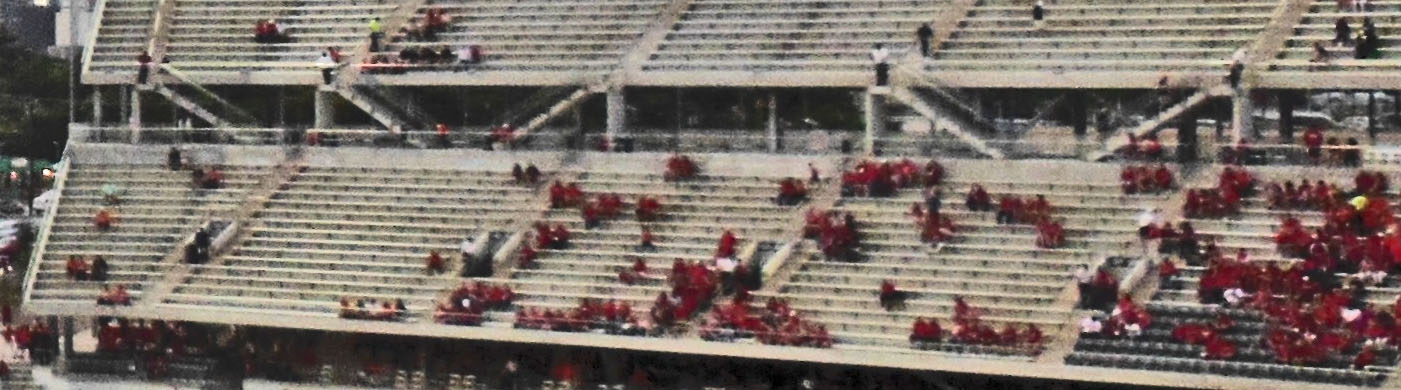
Those landings make some blocked view seats unsaleable twice. They are a serious design failure at TDECU Stadium.

Those landings make some blocked view seats unsaleable twice. They are a serious design failure at TDECU Stadium.

Please don’t blame Jim Crane for ever saying he doesn’t have enough money to improve the Astros. He shot most of his wad counting it out to Drayton McLane, Jr. on the purchase of the franchise back in 2011. If you want to blame anyone for using up that inflated purchase tab, blame McLane for using nearly half his profit on the construction of that new football stadium for Baylor University in Waco. For $260 million dollars, the new “McLane Stadium” brought to Baylor exactly what their alumni had a right to expect for big money – a first class venue with a pronounceable name that combines a charming riverside site with the kind of solid look of a football kingdom-to-come.

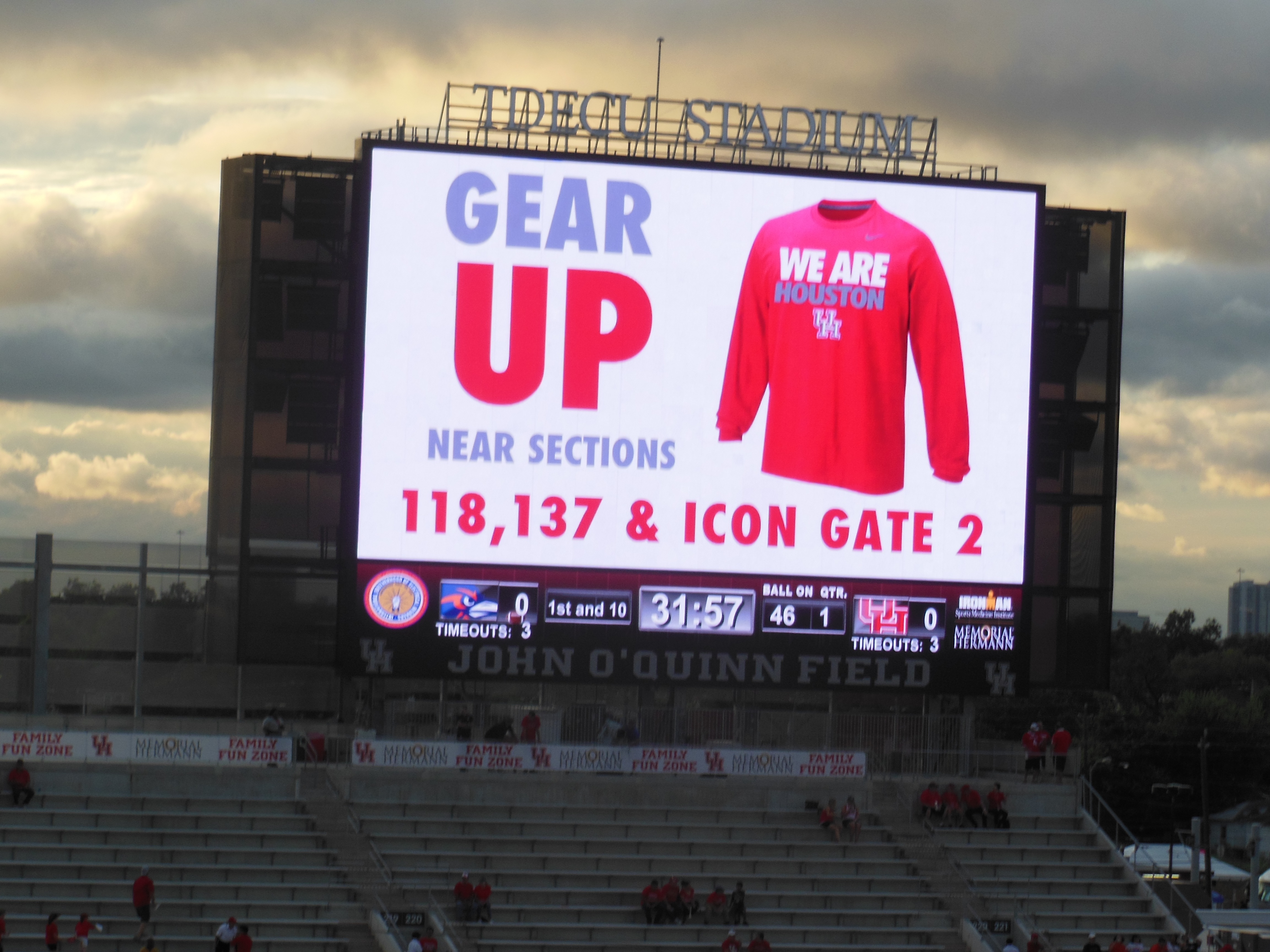
"HURRICANE HURRY" AND LIMITED FUNDS ARE RESPONSIBLE FOR THE ABSENCE OF A "STRONG FINISH" LOOK.

“HURRICANE HURRY” AND LIMITED FUNDS ARE RESPONSIBLE FOR THE ABSENCE OF A “STRONG FINISH” LOOK.

What we got at UH for $120 million dollars was a stadium that looks as though it’s already been hit by a hurricane because of the design-hole features in the exterior walls, the unpronounceable name of “TDECU Stadium,” and more access and handicap patron participation issues that can possibly withstand the shaking of the proverbial “what have you done here” stick. In other words, we got what we paid for, plus some issues that we could have been spared with a little more thought factored into the design process.

Aside from the lack of easy and clear, or adequate, elevator service to the highest seating level, my major complaint as an alumnus and season ticket holder is the presence of those landing bases for stairs that exist in at least four places on both sides of the stadium grandstands. They carry with them a problem that never existed at our former Robertson Stadium in this way –  or in any other local modern venue serving football or baseball in the Houston area.

The landings exist at “TDECU” as the receiving level for fans entering the upward-aisles that lead to their assigned seats. The trouble is, while those fans are on the landings, looking up the aisles for where to go next, or turning for moments or minutes to stare at the playing field, or just make a cell phone text or call, those who purchased the aisle seats behind those “you will only sit here once” seats  because they did not realize what they were getting into, are totally blocked from seeing much of anything but the ebb and flow of upward, downward, and stationary human bodies parading before them in their relentless search for seats, sight, food and drink, or the rest rooms.

I thought I was buying unobstructed seats on the railing for the entire season. What I got was seats that were even worse than the way the Cougars played football last Friday night. I figure the day may yet come when the team gets better and I will regret trying to watch a game from this blighted and blocked perspective. Tomorrow is the day I will pursue exchanging what I bought for something better.

In the meanwhile, and not yet along with other members of the Cougar family who are already calling for his head, I am still hopeful that Tony Levine can prove all his detractors wrong and turn out to be a good coach with some ability to rally the Cougars from this awfully disappointing season start to the UH college football season.

HAPPY LABOR DAY, EVERYBODY! OUR DAY WILL COME. IN TIME.

HAPPY LABOR DAY, EVERYBODY!
OUR DAY WILL COME.
IN TIME.


UH Opener is Long Day’s Journey into Night

August 30, 2014
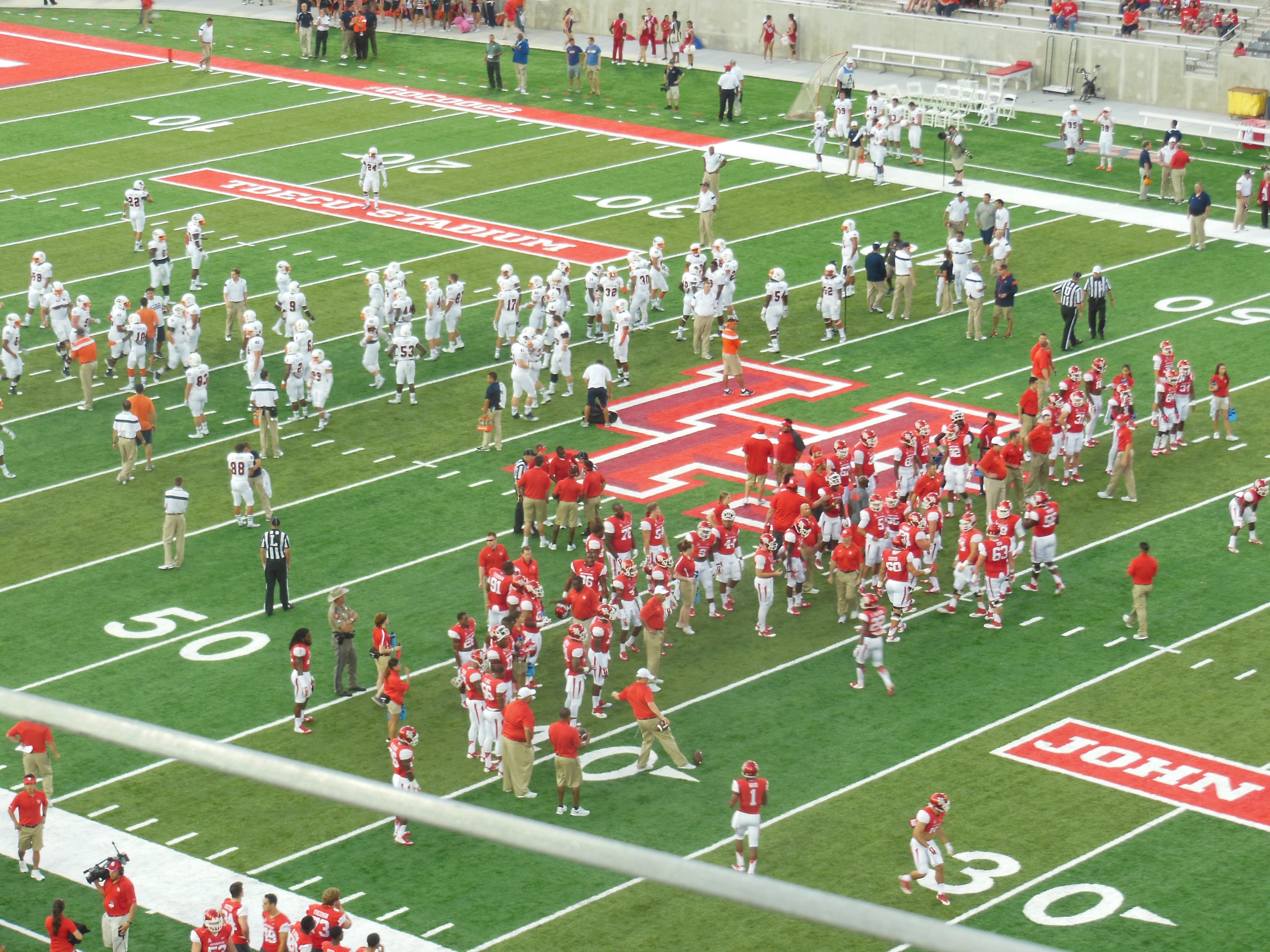
Twilight at TDECU came upon us beautifully, but nightfall and things on the field landed hard upon UH in their new venue opener.

Twilight at TDECU came upon us beautifully, but nightfall and things on the field landed hard upon UH in their new venue opener.

As a proud and usually happy UH alumnus, this editor of The Pecan Park Eagle doesn’t want to go all “Jerome Soloman” on my Cougars this morning, but the clearly visible  facts of our 2014 season opener against UTSA in our new TDECU Stadium merit some criticism.

By the time I arrived home after the game and finally went to sleep after two o’clock this morning, I was conscious of the whole long day’s journey into night was like walking through a daylight-into-darkness pure nightmare.

My good friend and Cougar brother, Sam Quintero, and I arrived on campus about five o’clock Friday afternoon, a full three hours before the scheduled eight o’clock kickoff before a national TV audience. That fact alone should have been our first admonition that a dish of the worst was about to be served in the land of ferocious felines. – The Cougars have a reputation for not doing squat on high profile TV – and laying eggs in these circumstances that smelled bad for years or forever. The 1979 Cotton Bowl loss to Notre Dame and Joe Montana is a prime example. UH led 34-12 with 7:30 left to play in that icy bowl game, but ended up losing 35-34 on the last play of the game. In the 1983 NCAA basketball championship game, the Cougar bunch known as Phi Slamma Jama with (then known as) Akeem Olajuwon and Clyde Drexler fell on the last shot of the legendary loss to North Carolina State.

UTSA, however, was no Notre Dame or North Carolin State. UTSA is just another member of the college “have-not” crowd that fills the UH football schedule, Unlike forty years ago, when UH was getting ready to join the old Southwest Conference, there are no names like George, Ole Miss, LSU, Miami, Florida State, UCLA, Penn State, or Michigan State in our sites. UH is in the Georgia State, Grambling State, Southern, UTSA, and American Conference league crowd of not-so-biggie foes these days. We are hoping that our new $120 million dollar stadium will help us as a step back into the big time, but that’s a long shot. None of the “have” clubs like UT or A&M want to see UH ever rebuild to “Tier One” status in athletics. – Why would they? – The Houston area is one of the most fertile recruiting areas in the country. The big schools want to feast upon the present situation without competition from another “have” school again based in the region. – As a purely competitive matter, who could blame them? – But that’s a much longer story than this one.

Let’s tab this one as a bizarre comedy of errors. Sam and I expected as much on some level. After all, it was the stadium’s grand opening and there were bound to be some kinks. And some of the things we experienced were just that – simple errors to be straightened out later. – Other discoveries appear to be more serious – and these have to do with the architectural construction of the stadium itself. We shall see.

TDECU is s  a major style lean into modernity from "The Rob," but there's more to a stadium than hoW it looks. - How it works ultimately IS what really metters.

TDECU is s a major style lean into modernity from “The Rob,” but there’s more to a stadium than hoW it looks. – How it works ultimately IS what really metters.

Early Going. Sam and I spent our early time on campus walking around the tailgating area, just soaking up the campus culture, watching the Cougar footballers and Coach Tony Levine arrive to dress out for the first time in their new hoe clubhouse, taking in the Cougar Band concert, and even grabbing some free turkey sandwiches that a student group was handing out to visitors prior to the game. We had to buy our own drinks and, as things turned out,   a $4.00 Coke turned out to be the front half of a first game kink to be resolved internally by UH after we notified the stadium security chief. – The Coke I bought to carry into the game had to be surrendered at our entry gate on the other side of the field because, as we only learned upon attempting to enter the stadium, the people who sell the outside drinks are actually competitors of the stadium concession people and their products are banned from entry. I took a few swigs of Coke Zero and gave it up to the stadium attendant. They need to increase their warning signage. Just a kink. Enough said.

Listening to the Cougar Band fired the blood at pre-game festivities.

Listening to the Cougar Band fired the blood at pre-game festivities.

Once Inside the Stadium. Once inside, we ran into two major issues that go way beyond kinks. They speak to problems with the functionality of TDECU Stadium itself and will need to be addressed:

Watching the happy pre-game Cougars streaming into their new digs for the first time was also fun too, while the pre-game joy lasted.

Watching the happy pre-game Cougars streaming into their new digs for the first time was also fun too, while the pre-game joy lasted.

(1) Handicap Unfriendliness. As a cardiovascular disease patient,  I purchased two season tickets for what I thought would be two aisle seats on the front row of Level Four in Section 304. I was also told that an elevator would be available to take me to these seats. That’s not how it worked out. We spent a long time looking for the elevator that would take us where to go and asked countless stadium employees for help along the way. No one we approached had good information (kink) and we then proceeded on a wild goose chase pursuit of the Holy Grail elevator that would take us where we needed to go. Some employees didn’t seem get the handicap aspect of the problem and invariably fell back on “you can always take the stairs.” (kink) “No, I cannot,” I kept telling these folks.

The Chief of Security finally told us to look for two elevators. “Don’t take tbe first one, that elevator will only connect you to level 3, where you are not eligible for admission among the suite holders. Take the second elevator, which only connect levels 2 and 4.” As the instructions turned closer and closer into something resembling an Abbott and Costello “Who’s on First?” routine, the frustrated, ut patient and friendly security chief finally invited us into inner sanctum of the suite level suites and put us on the elevator. Our 30 second ride up was highlighted by the opportunity for shaking hands with a very famous UH alumnus, Joel Osteen and his wife Victoria Osteen  of the internationally famous Lakewood Church in Houston. Both the Osteens were patient and friendly, even after I said to Mr. Quintero, “Hey, Sam, turn around and take a look at whose on this elevator with us.” – Joel was wearing a red Cougar tee shirt, but his famous smiling preacher good looks and manner were with him full glow. And, of course, Mrs. Osteen was also her normally beautiful self.

If Joel Osteen could both recruit and coach football, the Cougars might have entered this season as the ten consecutive times defending national champions!

After about a forty minute search, we finally reached Section 304, with no clear memory of how we got there. The only thing clear was the fact that the construction of TDECU Stadium did not cure the handicap access problems that existed in the now demolished Robertson Stadium. If anything, the lack of clear and easy to us elevators has only made the problem worse.

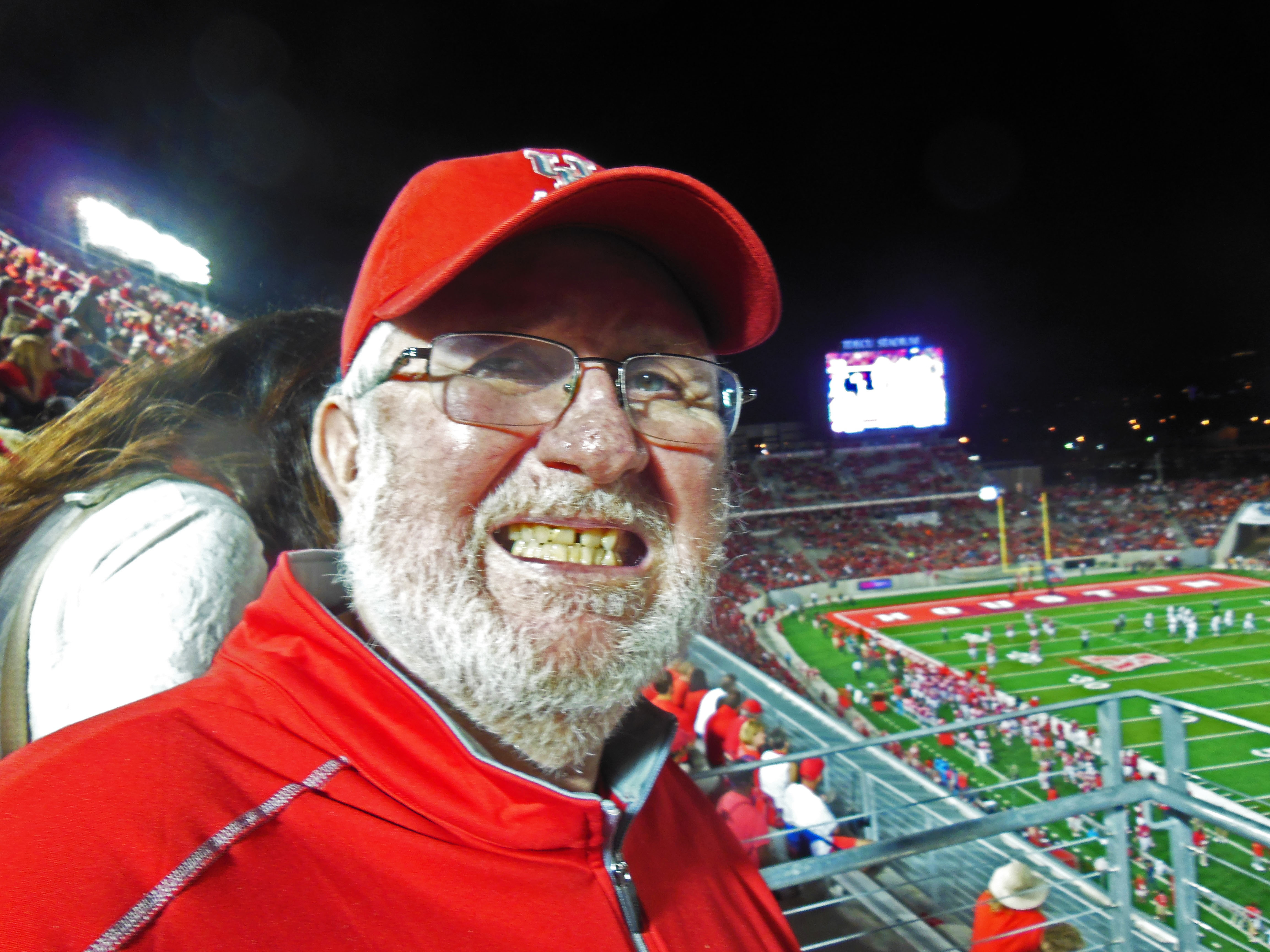
Cougar hopes were high until shortly after the game started.

Cougar hopes were high until shortly after the game started.

(2) My Season Seats Were Not What I Paid to Get. When I purchased my season tickets over the phone this past off-season, I thought, and was led to believe, that I was buying two front row aisle seats with an unobstructed view of the field on the south stands, east goal line. – What we learned I got was far less. It was not front row, but on an elevated section of the stands above the true row that hung below, but did not show on the seating chart. We still had to climb a short steep staircase to find the assigned seats – which were located directly behind the pipe rails on the landing e had just ascended to get there. The structure mess of the pipes totally obliterated any clear site of the field. The architectural planning of this structure also assured that we would watch the game through a constantly moving flow of people up and down the landing in front of us, some of whom stopped to simply stare at the field from the landing while we stared at their backs.

What a mistake on the tickets (kink – I plan to insist upon a change or refund. They weren’t even the two aisle seats I was promised. We had seats 28 and 29. An unused seat # 30 existed to my left as the aisle place.) Here’s the serious part. – No buyer in their right mind would purchase these “behind the landing” seats a second time, once they knew what they were getting – and there are at least eight landings on the upper deck that have the same kind of sight-line blockages.

To the best of my memory, this landing sight-line blockage does not exist at Rice Stadium, NRG Stadium, or Minute Maid Park – nor did it even exist at dear Old Robertson. but it is a definite design flaw at the new TDECU Stadium that works along with access problems for the handicapped in reaching this third level as a serious coupling of design flaws.

This is the view I thought we would have of the field from my newly selected seats/ - It wasn't even close.

This the view that I thought we would have from my new seats. – It wasn’t even close.

Summary. We Houston Cougars are a resilient bunch. Sometimes on the athletic field we fail when the odds seem to be in our favor, but the reverse is true too, and, I think, in even greater everyday proportions. As Cougars, we are dedicated to overcoming and accomplishing the really important goals – in the right ways. – and that’s what becoming a Tier One level university is all about. We also have the ability sometimes to succeed in spite of ourselves.

Hat’s off to life and the limitations of our human failings.

Hat’s off also to Coach Larry Coker and his UTSA Roadrunners! – They gave our UH  Cougars a 27-7 lesson in much deserved humility last night, but count on us coming back too is some way – and, hopefully, sooner than later. And let’s get started on accepting and resolving the design problems that we all thought were going to be addressed with the construction of the new campus-based football venue. The lack of adequate elevator carriage, the problems it creates for the handicapped, and the botched sight-lines created by the landings design are far greater problems of functionality than mere kinks to be  ironed out. They should have been seen and addressed during the stadium architectural design phase of this important university project.

"EAT 'EM UP, COUGARS!"

“EAT ‘EM UP, COUGARS!”

It was August 29 - and "29" has been considered an unlucky number, at least,  since the Wall Street Crash that dropped the world into the famous era we now remember as the Great Depression.

It was August 29 – and “29” has been considered an unlucky number, at least, since the Wall Street Crash that dropped the world into the famous era we now remember as the Great Depression.

Better days are always possible with  the breaking of the next dawn. In the meanwhile, let's try to grab the lessons of the only real time we ever occupy - the always powerful moment of the here and now. - Eat those up too, Cougars! for the are the real "em" of our famous phrase!

Good  Night, Houston!


Induction Day is Informative and Fun

August 29, 2014

Corcoran-Induction Day at Cooperstown_ final flyer tem-pic on lef

Dennis Corcoran Author Induction Day at Cooperstown

Dennis Corcoran
Author
Induction Day at Cooperstown

What Hall of Fame baseball player quit his job as a scout for the team that employed him when they failed to take his strong advice and draft Derek Jeter?

The answer to that Hall of Fame players question and scores of other unusual queries about Hall of Famers is available in a fine little book by SABR member Dennis Corcoran. It’s called “Induction Day at Cooperstown: A History of the Baseball Hall of Fame Ceremony” and it is a 270 fact-packed pages paperback publication by McFarland in 2010. We met Dennis during the recent National Convention of SABR in Houston and bought a copy from him – and much to the satisfaction of our reader’s baseball history palate.

“Induction Day” is a detailed look at the way the selection process has grown in Cooperstown, for better and worse, since its 1936 inception. One may be left with the impression that, except for the earlier Joe Jackson “eight man out”  White Sox ban,, the Pete Rose gambling scandal ban and the more recent still- burgeoning steroids era tainting of numerous recent stars, that the Hall missed few, if any, no-brainer candidates for induction. It also should be obvious too that at times the Hall inducted a few “good, but not great” players because of their popularity, political power, sympathy for an early death, or durability to remain in the majors over time. Rabbit Maranville jumps to mind. Ross Youngs does too. Youngs was inducted with career statistics that were really no greater than contemporary fellow Texas-born outfielder Curt Walker. The difference was the fact Youngs died from illness while involved in his career as a member of the big market New York Giants. Walker played most of his career with Cincinnati and died quietly in retirement many years later.

Corcoran’s fine work allows the readers to evaluate for themselves what has contributed most to the business of getting a candidate of some note inducted or denied admission into the Hall as an honoree. How many players made it on sheer ability alone that might have been rejected had the voters paid much attention to their bad character and violent or shady behavior toward others? How many inductees at other times were merely good players as performers, but forceful social presences in the company of those who held the votes for their induction approvals? How often did the Veterans Committee, under the “Chum’s Club” influence of leaders like Frankie Frisch, simply put the hustle on getting their own friends and others they liked into the Hall?

“Induction Day” doesn’t suggest what you should consider, as the previous two paragraphs here may be guilty of doing, but it beautifully outlines how people got into the Hall of Fame over time and leaves the matter up to us to decide from  our own levels of error-tolerance to answer the big questions we all wish could be settled forever, but most likely will not: Has the Hall of Fame inducted members who do not belong? Has the Hall,  and does the Hall now, keep out candidates who do belong?

Corcoran gives us a steady framework on how the Hall of Fame induction process has shifted in response to changes in the cultural zeitgeist from its earliest times. The process has never been perfect. How could it have been? Any voting process that fails to elect Babe Ruth and Ty Cobb unanimously on the first ballot has already spent its possible run at perfection and shot its wad on the first swing of the bat.

By the way, the answer to that question we posed back there at the start is Hal Newhouser. Hal was working as a scout for the Houston Astros when they bypassed his strong suggestion that they draft Derek Jeter and decided instead upon drafting third baseman Phil Nevin. Newhouser had been planning on retirement at the end of the season, anyway, but the Astros apparently helped Hal make an even earlier exit.

The “Induction Day” book is available from Amazon for $35.00. A better way to go, if you are interested, is to order your copy directly from the author’s stock at the discounted price of $28.00

If you order a book from Dennis Corcoran, just send a $28.00 check or money order for the book and shipping (no cash or credit cards, please) to:

DENNIS CORCORAN

90 WESKORA AVENUE

PLEASANTVILLE, NEW YORK 10570

Please refer all additional questions to the author, Dennis Corcoran, at the following e-mail address:

djcinductionguru@gmail.com