Archive for the ‘Uncategorized’ Category

Scoring Variables Tough Back in The Day

April 19, 2015
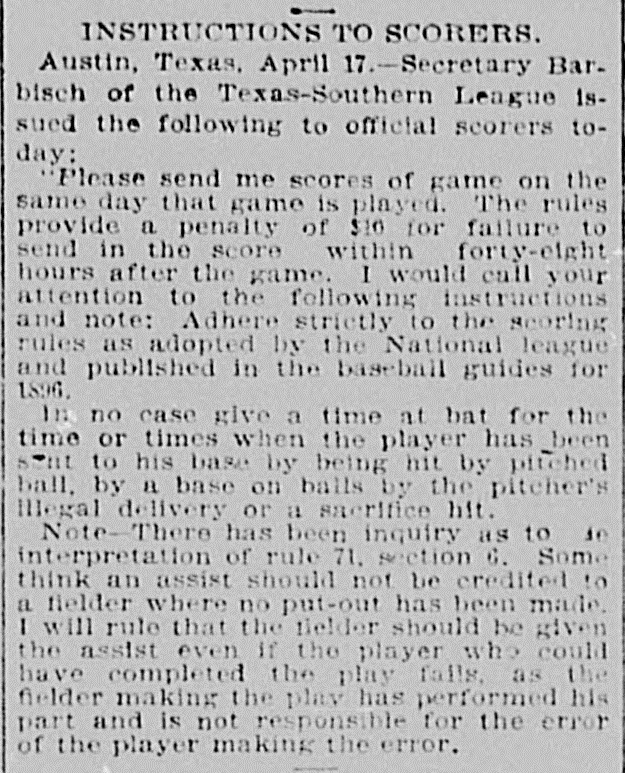
Houston Post April 18, 1896 Contributed By Researcher Darrell Pittman

Houston Post
April 18, 1896
Contributed By Researcher Darrell Pittman

We’re talking “baseball” here, of course.

No big news. Statistical records consistency always has been a bugaboo to player comparisons, especially of players from different eras, due to several variables, including, but not limited to several key considerations: the presence of clearly stated rules on the scoring of certain plays; the clear enforcement of the rules in place; the intelligence, baseball knowledge and training of the people used to serve as official scorers; of course, and actual changes in the rules, back and forth, that shall always taint comparisons by the way these differences alter the statistical records of players who were active during different rule interpretation periods.

The changing face of the sacrifice fly rule over time is a prime example. During Ted Williams’ last day surge to .406 in 1941, the sac fly rule was not in effect and Williams was charged on several occasions for a “time at bat” on fly outs that scored a runner from third base. Had the sac fly rule been in place that season, Williams’ last minute, gutsy call to go for .400 would have been totally unnecessary. His pure-grade .400 batting average would have been secured in advance by the times at bat the sac fly rule that would already have subtracted enough “at bats” from his numbers over the season. The great Ted Williams could have spent his last day of the season planning his celebration for the evening. So, for the sake of the great drama that actually played out on the last day of the ’41 season, I guess we are all better off that things worked out as they did. Anything less would have been a major loss to the legend of Ted Williams.

Today’s feature article from the April 18, 1896 Houston Post simply underscores how much tougher it must have been to achieve consistency in scoring interpretations. For one thing, universal authority for rules-making had not yet developed to the level it has now reached in 21st century organized baseball – and for another – the communication technology and cost of using the telegraph and the early telephone long distance lines was not always up to the immediacy of game reporting expected by league officials. It is easy to presume from our general knowledge of human behavior that game reports and box scores that arrived in the league offices 48 to 72 hours late may have escaped the same scrutiny of those arriving in time for newspaper publication.

The featured flashback piece also poses an interesting view in at least two other respects: (1) The league office seems to be using the opportunity to instruct official scorers how to credit fielders with assists on plays in which another player’s error prevents a “putout”. Makes you wonder: How were the local people scoring assists prior to this interpretation by the Texas-Southern League Secretary? And how many batters were being charged with a “time at bat” after being hit by a pitch or because they had been awarded a walk because of an “illegal pitch” (whatever that means), or having sacrificed to move a runner up a base? (2) How often too were rules simply made by administrative edict. The league secretary in the report is credited with saying “I will rule that” a fielder should be given credit for an assist, regardless, if no out results because of another fielder’s error.

Somewhere along the way, and we make no claims as rules historians, that support for assist credit to fielders on plays that did not result in an out died for want of support. In other areas, we also know that baseball leaders would continue to waver back and forth for years on the “AB” charge exemption on fly balls that scored runners from third base. Hopefully, that issue is now settled for good, but who knows.

In some ways, baseball will always be a work in progress. We keep finding ways to tweak the rules just enough to keep the game on the field in shape as the one we want to see, but, every now and then, some group comes along to deliver a rules change that is the equivalent of a major disease in humans.

Let’s talk about the “DH” some other time!
Radio Nights

April 18, 2015
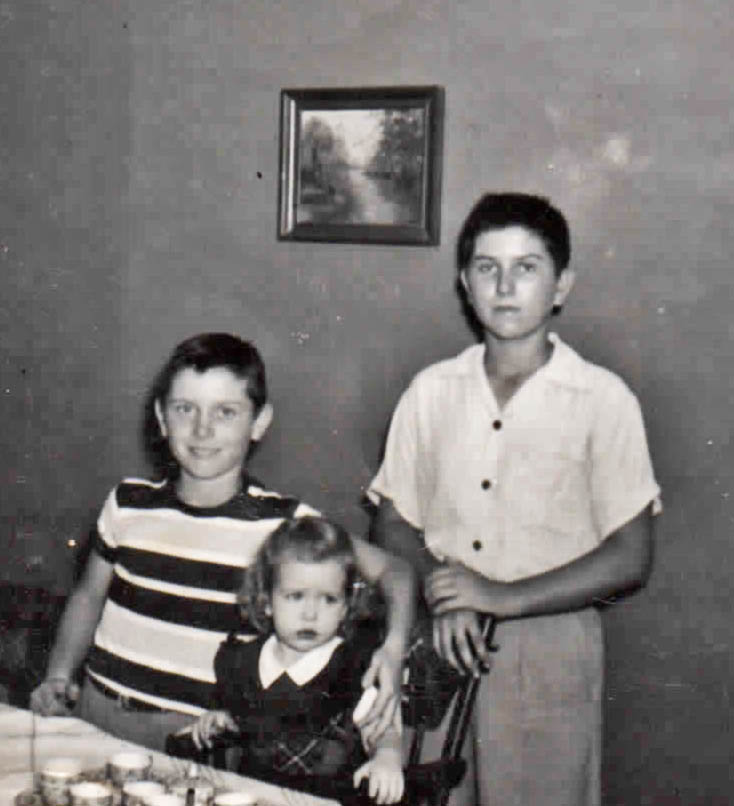
John, Margie, & Bill McCurdy Pecan Park, 1951 Two Years Past the End of the Radio Nights Era

John, Margie, & Bill McCurdy
Pecan Park, 1951
Two Years Past the End of the Radio Nights Era

Sometimes memories are like loose sheets of paper in an otherwise categorically organized mental hard drive file. They just float there through the mind in bright detail of ordinary events that never lose their richness over time. And maybe the reason they never get filed is simply the fact that they already exist as files themselves – files that already serve as the umbrella for any number of other specific memories that their general flavor already embraces.

We have one example for you here from personal experience, plus a few examples of items that follow behind it like ducklings trailing the mother duck. We call this one “Radio Nights”:

Radio Nights

The Timeline. The year probably was 1945, but it could have been any night in Pecan Park from 1945 through 1949. I choose to remember this one event as “Radio Nights” and I have to place the time as being from 1945, our first year in the little house at 6646 Japonica Street in the Houston east end, to 1949, the last year we had no television in my childhood family home. Television reached Houston on January 1, 1949, but we didn’t get a set until the following year. After television came into our lives, our family evenings, like the evenings of most other Americans, were changed forever.  Whether it was really one memory, or so many similar nights synthesizing themselves into one memory, we shall never know. It simply was whatever it was, but it was probably closer to 1945, when I was still young enough at age 7 to be crawling around on the floor as we listened to our favorite radio programs.

Our Parents. Dad is stretched out in his easy chair. His feet are extended into comfortable house shoes and braced upon what most fathers used prior to recliners, placement on the trusty foot stool. Dad was a voracious reader, so h always had a standing reading lamp behind him, plus a magazine/book rack on the left  side of his chair plus a smoking table on the other side of him. Sometimes Dad smoked a pipe, but most of the time he spent the evenings chain-smoking Camels and depositing them in the large ash tray that he filled every evening. He was the quintessential archetype of the 1940’s father. He was gentle, but firm, and, if you were his kid, you tried not to bother him too much when he was busy reading. And he read a lot – about war, sports, history, and politics. – Mom was the stereotypical small town Texas girl – sort of like Lucille Ball, but with a South Texas twang. There wasn’t a song from the 1930s that I didn’t learn because of Mom’s constant singing of them at home. She would even use a song to answer our requests for bottled cokes, or whatever, from the store. “Please, Mom!” would be answered by Mom singing, “Please, lend a little ear to my pleas…” She could be so frustrating at times.

Mom and Dad both had short trips into fantasized careers as a singer and a composer. In fact, that’s how they met. Dad heard Mom singing “Paper Moon” in her ever so brief experience as a radio singer for a little station in our original home town of Beeville, Texas back in 1936. He drove over to the station to meet her. Two weeks later, they eloped to Mexico after a secret marriage they arranged through Dad’s songwriting partner, a young catholic priest named Father Dan Lanning. Mom and Dad were married for 58 years. They died five weeks apart in 1994.

And, oh yes, Dad’s songwriting career included only one published song that he and Dan Lanning wrote together. It was another song with lunar leanings called “The Moon Is Here”. The young writers even took it to New York City in the early 1930s, hoping to get Rudy Vallee to sing it on his radio show. They got through to Vallee’s “people”, but had to drive home with no commitment. A friend later told Dad that he heard Vallee sing the song over the air during their drive home, but there was never any corroboration from others – and more solidly – never any royalty check from Rudy Vallee for its use. “I’d like to think it happened,” Dad always said, when asked about Rudy Vallee’s use of the song, but Dad was always a practical man. He knew that it never got off the ground or over the air. At any rate, he and Mom still seemed happy with the simpler life they found together. With sons born in 1937 and 1941, and a daughter coming along later in 1949, my sweet parents had their hands full, raising their family on an ordinary workingman’s weekly wages as the parts department manager  for the Bill Lee Motors Studebaker dealership on Lawndale near 75th in Houston.

The Moon Is Here 1930 By Dan Lanning and Bill McCurdy

The Moon Is Here
1930
By
Dan A. Lanning and Bill McCurdy

We McCurdy kids were lucky. We all knew always that our parents were each there for us.

The Memory. Dad is smoking and reading away in his special chair. Mom is up and down between the living room and kitchen, usually singing along with anyone attempting a solo over the radio. My little brother John and I are all over the living and dining room hardwood floors, racing our little steel metal cars in what have been the first unofficial Grand Prix 50 house course race in Houston. We are also multitasking, listening to the stream of half hour radio shows as we play. We probably were not too quiet about our passionate pursuit of victory, but, when Dad was reading, he possessed this incredible ability to tune out noise, especially as it generated from the racket of his two rambunctious sons. My brother and I were OK with that condition too because we both knew the rest of the truth. – When we had Dad’s attention, we had all of it. Thanks to Dad, a former school boy and amateur player, we both learned to love and play the game of baseball – and also thanks to Dad – we connected with the Houston Buffs and even got to watch the Buffs take on the New York Yankees in 1951, when they had Joe DiMaggio in center field and Mickey Mantle in right. But that’s jumping way ahead.

On this evening, the transfixing object in our lives is a tall, wooden console model “Philco” AM radio. It’s amber dial contains a needle that is lighted for us all to see. And the glow of its illumination is a magical pass to some of the funniest, scariest, or most mysterious shows ever presented for fantasy visualization by the human mind:

Boston Blackie, “friend of those who have no friends; enemy of those who make him an enemy”

Duffy’s Tavern, “where the elite meet to eat; Archie, the manager speaking, Duffy ain’t here”

The Aldridge Family – “Henry! – Henry Aldridge!” ……. “Coming, Mother!”

Inner Sanctum, (a squeaking door opens slowly) “Good evening, friend! This is your host, Raymond, speaking, and also warning you! – Do not listen to tonight’s story of horror alone! – Make sure you have a “ghoul friend” with you for this story – ‘Hayride with an Axe-Wielding Driver!’ – HaHaHaHaHaHa! – Just remember – when the ride is all over – I’ll be back to tell you what I always do – ‘Goodnight, Friend! – And Pleasant Dreams, Hmmm?’ ….HaHaHaHaHaHa!”

So much more. Jack Benny, Fred Allen, Bob Hope, Red Skelton, Fibber McGee and Molly, The Great Gildersleeve, Eddie Cantor, Abbott and Costello, Burns and Allen, Life with Luigi, Charlie McCarthy and Edgar Bergen, Gangbusters, The Lone Ranger, Mr. District Attorney, G-Men, Lux Theater – and the beat goes on.

And they all lived behind the amber light on the radio dial in all of our homes – just waiting to dance through our minds – creating pictures that still play in our memories today – of another era in our culture – and for some of us – a very happy time in our early lives.

The world stretched out for us like an infinite lawn of garden fresh hope – and all things good in life seemed both right and possible – and much of what seemed attainable came to us younger ones through the stretches of imagery that filled our souls from the forces behind those millions of amber radio lights that once fed the theaters of the American mind with something other than bad news, political agenda quacks, and countless donkey-kong sports hosts who now fill the radio airwaves with nothing but sports crapola gossip and ignorant, often malicious “news” about famous athletes.

Have a nice weekend, everybody!

April 7, 1979: Forsch Pitches 6th Astros No-No

April 17, 2015
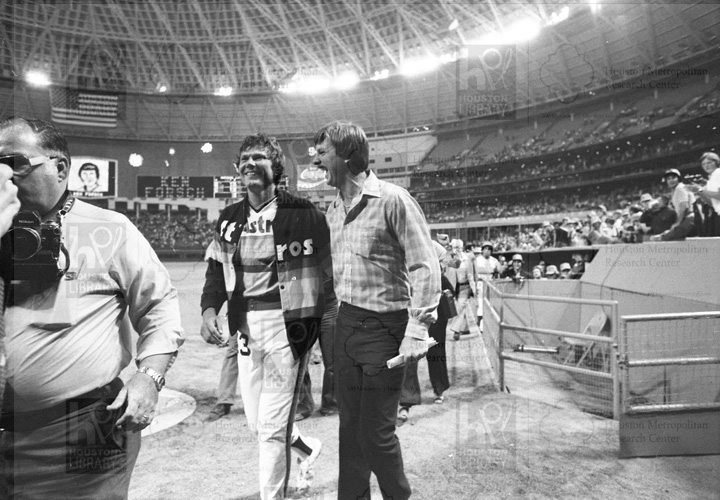
April 7, 1979: Ken Forsch No-Hits Braves, 6-0, in 2nd Game of Season! Larry Dierker arrives to offer congratulations with an inscription he wrote on his score card. ~ Houston Post Photo Courtesy of Houston Public Library

April 7, 1979: Ken Forsch No-Hits Braves, 6-0, in 2nd Game of Season!
Larry Dierker arrives to offer congratulations with an inscription he wrote on his score card.
~ Both Houston Post Photos Used Here Courtesy of The Houston Public Library

Back on April 7, 1979, Ken Forsch pitched a no-hitter in the Astrodome, shutting out the Atlanta Braves, 6-0, in the second game of the season, while striking out 3 and walking only 2. After the game, relatively new media man Larry Dierker caught up with Forsch for post-game congratulations and an interview. Cub reporter (not Cubs” reporter) Dierker seemed almost as pulled into the rosy afterglow of his former teammate’s accomplishment as Forsch himself. And why not? After all, it had been less than three years since Dierker, the former franchise pitching ace, had pitched the last Houston Astros no-hitter in the Astrodome in another early season period of local hopefulness. On 7/09/76, Larry had shut down the Montreal Expos, coincidentally or fatefully, (take your pick) by the same 6-0 epitaph that the club had put on the Canadians this early season evening in 1979.
The empathic course of the two men’s emotions on that post game night in 1979 is obvious from the two featured photos of the two file copies from the Houston Post made available to The Pecan Park Eagle for this article by archivist Joel Draut of the Houston Public Library downtown site.

Based upon the euphoric smiles of each man in both pictures, each also seems to be somewhat joyfully numbed by the magic of the moment. In fact, and in associative deference to Mr. Dierker’s up-to-date hairdo of that era, we are inspired to call this moment as we see it – and in satirical deference to a similarly entitled Jim Carrey and Jeff Daniels movie from the later year of 1994 – we are respectfully inclined to re-baptize these photos for what they show, at least,  as we see them both through these ancient, but always searching-for-meaningfulness eyes.

How does “Numb and Number” sound? – Numbed by the shared jubilation of joy! – Even better, how does Larry Dierker’s explanation of his emotions in that moment fit the circumstances of what both he and Ken Forsch were going through at this golden moment in time and Astros history?

When I shared these photos with Larry Dierker prior to writing this column, he responded with the following brief comment about 1979, his rookie year as a broadcaster – and one that found him keeping score for the first time in his life during the second game of the season – and then having it turn out to be the first Astros no-hitter in the Astrodome since he last threw one himself, three seasons earlier:

“(1979 was) my first year to broadcast (road TV games only),” Dierker wrote.  “Second home game and I thought I would keep a scorecard for practice.  First time I even kept one.  After my no-no, Don Nottebart sent me a telegram that read, “feels good doesn’t it?”  I took my scorecard down to Kenny after the game with the same inscription.  It feels good just thinking about it.”

Thanks for contributing to this wonderful memory, Dierk! You and Ken Forsch each contributed many great memories to so many thousands of us Astros fans in those days. Please know too that both of you – and other people like Jimmy Wynn, Jose Cruz, J.R. Richard, and others too numerous to mention are the same guys who fused the “H” letter of Hope into the same H” letter that begins the name of our dear home town – a very long time ago.

And the “H” still stands for the blend of both!

Larry Dierker's written message on the scorecard (still (in his left hand in the joyful moment of this photo) he soon gave to Ken Forsch that night was short and sweet: "It feels good, doesn't it?"

Larry Dierker’s written message on the scorecard (still (in his left hand in the joyful moment of this photo) he soon gave to Ken Forsch that night was short and sweet: “It feels good, doesn’t it?”

For those who don’t know, there have been ten no-hitters involving Houston MLB pitchers. Amazingly, our record in these is only 9 wins against one loss. You see, we lost one of them, but that’s another story for another time. That tenth and most recent no hit Astros win against the New York Yankees at Yankee Stadium is also another story, but also one with a short version explanation: The Astros used six pitchers in that game – and every one of them held the Yankees hitless over nine shared innings to take an 8-0 win that was credited to Brad Lidge, who worked the 6th and 7th. Here’s the list:

Houston Colt .45s/Astros No Hitters:

No. Date Name IP FOE Stadium K W HB RESULT
1 5/17/63 Don Nottebart 9.0 Phillies Colt 8 3 0 W, 4-1
2 4/23/64 Ken Johnson 9.0 Reds Colt 9 2 0 L, 0-1
3 6/18/67 Don Wilson 9.0 Braves Astrodome 15 3 0 W, 2-0
4 5/01/69 Don Wilson 9.0 Reds Crosley Field 13 6 1 W, 4-0
5 7/09/76 Larry Dierker 9.0 Expos Astrodome 8 4 0 W, 6-0
6 4/07/79 Ken Forsch 9.0 Braves Astrodome 3 2 0 W, 6-0
7 9/26/81 Nolan Ryan 9.0 Dodgers Astrodome 11 3 0 W, 5-0
8 9/25/86 Mike Scott 9.0 Giants Astrodome 13 2 1 W, 2-0
9 9/08/93 Darryl Kile 9.0 Mets Astrodome 9 1 0 W, 7-1
10 6/11/03 Roy Oswalt 1.0 Yankees Yankee Stad. 2 0 0
Pete Munro 2.2 2 3 1
Kirk Saarloos 1.1 1 0 0
Brad Lidge 2.0 2 0 0 W, 8-0
Octavio Dotel 1.0 4 0 0
Billy Wagner 1.0 2 0 0

____________________

Twins: Mickey Rourke and Donald Sterling

April 16, 2015

The Pecan Park Eagle takes no credit for first recognition on this one. It’s been Twittered to pieces and we never even thought of it – or learned about how “out” the comparison already is until my son brought it to my attention this morning. Still, it’s too unbelievably creepy good to pass up for publication here too, even if the word is out already to most readership circles.

If Quentin Tarantino ever wants to make one of his “really-dire-consequences-for-the-leading-man” movies, based upon the life of Donald Sterling, 60ish Mickey Rourke is the only man to pursue for the role the 80ish Sterling. – And I would also think there should be written roles and casting room for Samuel L. Jackson, Spike Lee, and Charles Barkley in the film too.

Just look at these four side-by-sides of Rourke and Sterling. If you can’t tell one from the other, you just made the case for this casting choice being a “done deal”.

Have a great afternoon, everybody! If you live in Houston, we hope too that you are able to miss the hail showers that are waving over the west side at 1:00 PM, heading northeast, as we write.

In each pairing below, which one is Mickey? – And which one is Donald?

rourke-sterlingrourke-sterling3rourke-sterling2

rourke-sterling4


How To Play First Base, By George Sisler

April 16, 2015
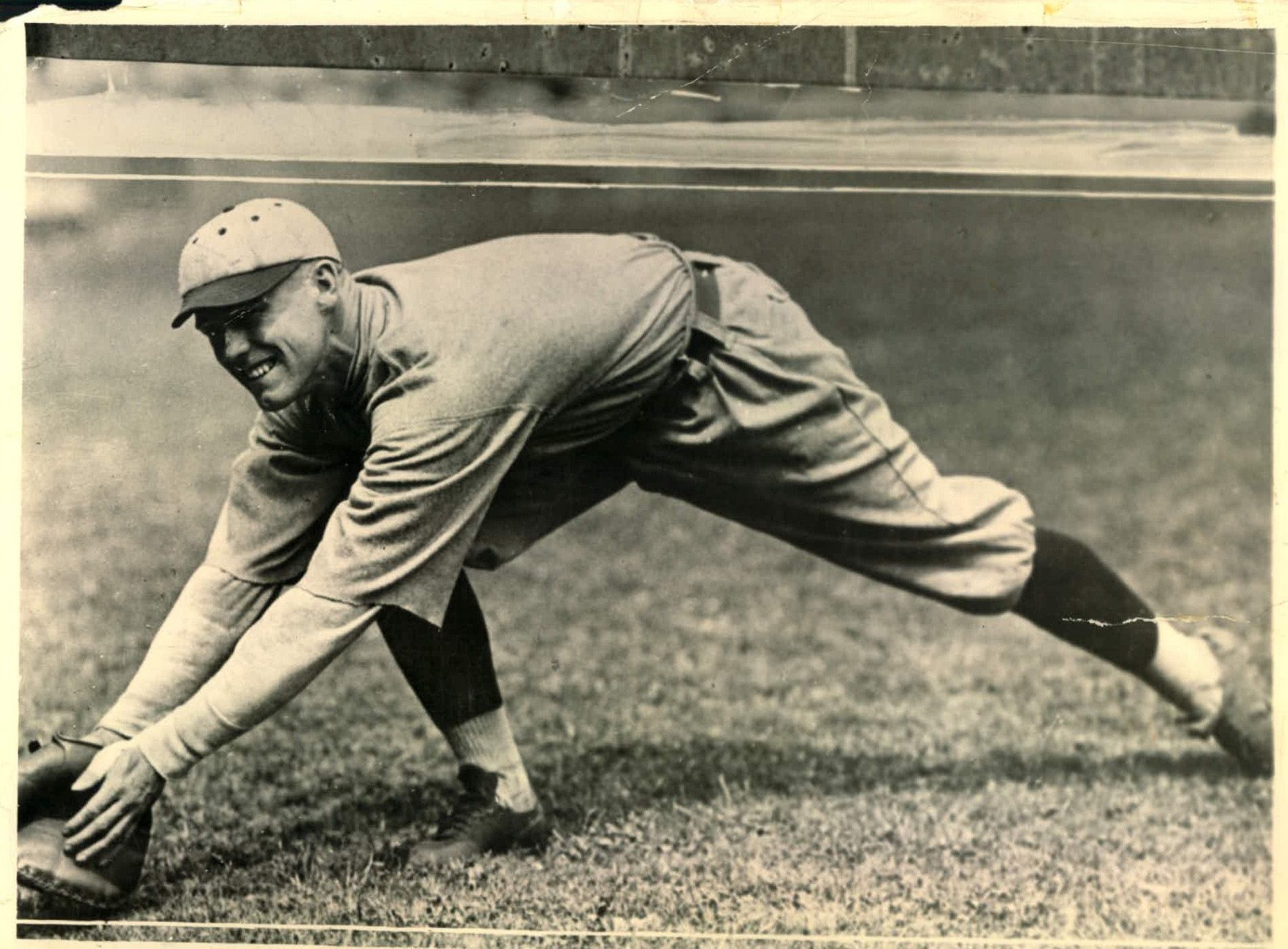
George Sisler,1B, St. Louis Browns August 1922 Hall of Fame, 1939 Photo, Courtesy of The Sporting News

George Sisler,1B, St. Louis Browns
August 1922
Inducted into the Hall of Fame, 1939
Photo, Courtesy of The Sporting News

Under a headline of blazing glory in the May 11, 1924 sports pages of the Port Arthur (TX) News, “FIRST BASEMAN MUST LEARN TO “GO OUT AND MEET THE BALL’ WRITES GEO. SISLER”, the following advice sprang forth like so many lightening bolts of wisdom from one of the gods of baseball heaven:

(How To Play First Base)

By George Sisler

Greatest First Baseman of All Time

No player can hope for success as a first baseman unless he is a sure catch. This feature of play is far more essential at first than any other place in the infield.

It is absolutely necessary for a first baseman to become as efficient in catching a ball with the gloved hand as with both. This makes it possible for him to stretch and take a throw while on the bag that would be impossible if he tried to make the play with both hands.

A study of the batters is another important feature that must be given much consideration. A knowledge of the field to which a batsman is most liable to hit, enables the first baseman to so shift that he  will be in the best possible position to make a play.

Since perhaps 30 per cent of the outs in a ball game are made at first base, it is an easy matter to see that the ability of the man playing that position has much to do with a club’s success.

Speed Enters Into Style of Play

It is impossible to tell just how and where a first baseman should play to be most efficient. The speed of the player enters largely into this feature of first basing. The player fast on his feet can play a much deeper first base than the athlete who is slow of foot.

In determining the best possible position to ordinarily assume, the first baseman must consider not only himself but the batter as well. Naturally a first baseman can play deeper on a slow-footed batter than a speed merchant.

When to hold a runner on first is usually determined by the conditions of the game. However, it is safe to say that with second base unoccupied and a runner on first, it is always advisable to hold him close to the bag.

Every first baseman should learn the art of stretching to meet the ball, rather than catching it standing erect. A fraction of a second is the difference between out and safe at first in a majority of plays.

Footwork or the shifting of the feet for throws is most important. Dexterity in this particular feature of first base play can only be acquired through great effort and constant practice. Some first basemen far excel others in this feature of play. Not every athlete is light on his feet, just as all of us are not good dancers.

————-

I have simply given the fundamentals of first base play. The finer points of the game come with experience. There are too many tricks to the playing of first base that can be gained only as a result of having them come up in actual play and then having them sink in.

In a great many cases the best possible position to assume as well as play to make is governed by the conditions of the game, the score, then number of outs, the inning and the ability f the batter.

These features cannot be briefly discussed. If a player gets the fundamentals, he later grasps the finer points by having them come up in competition.

————-

Pecan Park Eagle Footnote: In 15 seasons as a major leaguer (1915-1923, 1925-1930), George Sisler (BL/TL) played 1,971 major league games, the preponderance of them in 12 seasons as a first baseman for the St. Louis Browns (1915-1923, 1925-1927). Sisler missed the entire 1924 season when a severe case of sinusitis caused double vision and made playing ball impossible for the arguably greatest hitting and fielding first baseman of all time. Sisler finished with a career batting average of .340 and 2,812 career hits. Sisler twice led MLB with 257 hits in 1920 and and 246 hits in in 1922. In both seasons, he hit over .400 – with a .404 mark in 1920 and a .420 average in 1922. Until it was broken in 2004 by Ichiro Suzuki of the Seattle Mariners with 262 hits, George Sisler’s 257 hits in 1920 had stood over time as the MLB record for most hits in any big league single season. – George Sisler was inducted into the Hall of Fame in its opening season of 1939. In 1999, the editors of The Sporting News named George Sisler as the 33rd highest pick on their list of “Baseball’s 100 Greatest Players.” Thanks again to researcher Darrell Pittman for supplying the news file article that inspired this tribute to one of the greatest players in baseball history.

Why Are Baseball Games Nine Innings Long?

April 15, 2015
Why Are Baseball Games Nine Innings Long? By Hannah Keyser

Why Are Baseball Games Nine Innings Long?
By
Hannah Keyser

Hannah Keyser is no mere culinary arts expert, although we’ve read that she is an avid foodie, but sadly, also one of those people who doesn’t like hot dogs. How that could happen to a girl from Brooklyn, we have no idea. All is forgiven, however, for the fact that she also happens to be a deep baseball history fan and a very clear and excellent writer, one who is currently plying her knowledge and skills as such at a catchy-named site called Mental-Floss.com.

Keyser studied Ancient History at the University of Pennsylvania and is reportedly literate in hieroglyphic composition. Hannah lives in Brooklyn with two cats —Gatsby and Kilgore Trout— and one boyfriend.  I am perfectly happy and in love with Norma, my wife of thirty years, but I do have to wonder. – Where was your type of female fifty years ago, Hannah, when I still had not given up hope of finding a girl who knew baseball talk beyond the old “don’t even think of trying to get to first base with me” that all the ladies seem to know really well back in the day – at least, in my experience.

In the following link to her Mental-Floss.Com column, Hannah Keyser provides us with a plausible, considered, and documentable  explanation of why baseball games are scheduled, even today, as nine active fielder matches and nine inning affairs. We almost got stuck with a seven man/seven inning formula preferred by one strong faction of the famous Knickerbocker Club, but a rebellion against that format, led by Louis F. Wadsworth, got that proposition extended to “nine fielders and nine innings”.

Read Hannah Keyser’s version for a much better detailed description of what happened to dress baseball to the “nines”:

http://mentalfloss.com/article/62877/why-are-baseball-games-nine-innings-long

Regards, Bill McCurdy, The Pecan Park Eagle

Thanks again to researcher Darrell Pittman for his suggestion of this topic.

Baseball: Feeding Hope Against All Odds

April 14, 2015
Hope Spring Eternal! So Does George Springer!

Hope Springs Eternal!
So Does George Springer!

What is it about this baseball game of ours that helps us all to never give up hope? If we were all Yankee or Cardinal fans, we probably wouldn’t need to ask that question so much, but who knows, maybe even those far more frequent fan winners are as human as the rest of us – and also battling uphill constantly against the odds of being the one team each year to win the World Series.

Personally, we think it starts with the fact that hope feeds far more on conditions and qualities that are not about being the only team to win World Series annually. If it were, there would be no rational explanation for the ongoing existence of Cub fans, whose family chain hasn’t seen the NL Chicagoans win it all since 1908 – back in their great-great grandfather’s day.  No, hope has to be based upon something as wildly against the odds as buying a power ball winning lottery ticket worth millions.

It’s about our desire to believe in the possible – and our need to disregard the issue of probability that always says that we are all, at best, only 30 to 1 shot favorites to win the World Series in a perfectly balanced universe of evenly distributed talent that, of course, never occurs because it never exists. Especially in this age of free agency and player’s union control of a player’s rights to move easily to the biggest paydays possible, a few very wealthy clubs will always begin each year a probability of winning it all that is much better than 30 to 1 – and vice-verse for the ascending odds against the always larger group of low payroll budget rebuilding clubs of winning big.

Much of the hope springs eternally from the long season of 162 regular schedule games and the little “seconds and inches” plays that continue to breathe hope or despair into our lives on an almost daily basis. Te difference most often seems to be the fact that we are able to put everyday despairing events on “short memory” and then nurture a whole month into the future on the happening of a one play that snared “victory from the jaws of defeat” in an everyday game. And, of course, the earlier these things happen in the season, the earlier it is for us to bank on the possibility of hope.

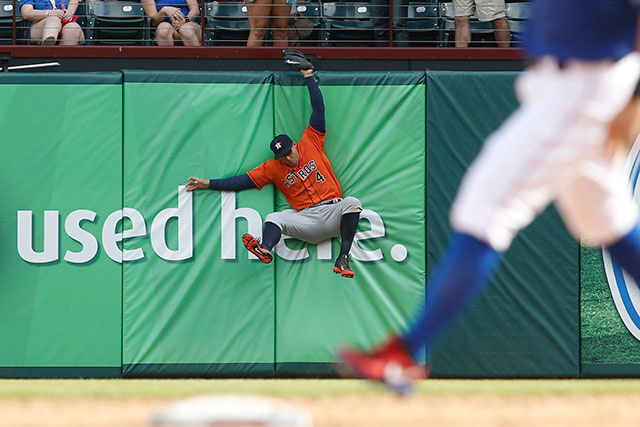
A beautiful example happened In Sunday’s game between the Astros and Rangers at Arlington – one that framed “seconds and inches” together as the difference-maker as the talented George Springer of Houston raced back on a long fly ball to right field that was headed over the fence off the bat of Rangers outfielder Leonys Martin and would have given Texas an 8-4 walk-off grand slam memory, except for one thing. – After a long race to the wall, Springer timed his jump and caught the ball on the other side of the fence, pulling it back for a third out that saved the game for Hank Conger’s two-run homer in the 14th and an Astros win.

Even at home, you could feel the electricity of the moment as an Astros fan. There was pitcher Tony Sipp, smiling and pumping a fist in celebration of hope’s survival as right fielder Springer trotted in to the club’s third baseline dugout as though it was just another day at the office. Pitcher Sipp put a stop to nonchalance by greeting a now smiling Springer with a chest bump as he reached the dugout steps.

Did the play increase the probability that the Astros will win the World Series this year? Not to any appreciable degree, no, it did not. Did it kindle the possibility of hope in the hearts of Astros fans? You bet it did!

The long season of baseball is upon us. And, even if some of us are Cubs fans, we will find something hopeful to get us through the summer with our favorite team.

As a kid in Houston during the late 1940s and early 1950s, the Mutual Game of the Day and The Sporting News allowed many of us from my generation to keep up with all 16 of the teams that then made up the entire map of the major leagues. I was once able to order the pennants of all 16 teams through a special offer I found in TSN – and that worked out great. With thumb tacks, I placed the 8 pennants of the AL near the ceiling of two contiguous walls. The other two walls held the 8 NL team flags. And each morning, if there were a change in the standings, I would change the position of the pennants accordingly.

The movement of my pennants did not improve the probability that clubs like the Browns or Senators in the AL – or that  the Pirates or Cubs in the NL would move up as “probable” World Series contenders, but it was a testimonial of hope to the “possibility” of upward movement.

It wasn’t too long before I came to the realization that hope for a club like the Pittsburgh Pirates did not hinge upon a wild chance of reaching the World Series. After all, at that time, Pittsburgh had not been to a World series in 22 years, the time of their first unpleasant meeting with the 1927 version of the New York Yankees. Things would work out better for the Pirates In their next World Series appearance in 1960, when their foe would again be the Yankees, but with a much better result.

In 1949, the Pirates had a guy named Ralph Kiner playing for them. On his way to his 4th of seven consecutive seasons with the Pirates as the NL’s leader in season home runs, Kiner would bag 54 in 1949. For Pirate fans, the possibility of hope for something better came up every time Ralph Kiner stepped up to the plate.

Nothing says “hope” sweeter than the sound and sight of your own guy’s big bat contact with a baseball that sends it soaring into the summer sky on its way to a pea-size disappearing act upon the farthest visual horizon.

Baseballs soar. And so does hope. All good things are possible. We simply have to believe and fight back from adversity over time – but always one day a time – with the possibilities that are available to us. And that course, friends, is hope in action.

________________

Houston-Galveston: Echoes of an Ancient Rivalry

April 13, 2015
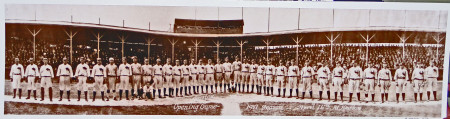
The Houston Buffs and Galveston Sand Crabs were still local rivals for years beyond the 1896 campaign. This panorama shows the two clubs on Opening Day at West End Park in 1921.

The Houston Buffs and Galveston Sand Crabs were still local rivals for years beyond the 1896 campaign. This panorama shows the two clubs on Opening Day at West End Park in 1921.

Back in the latter part of the 19th and early 20th centuries, the rivalry between professional base ball teams from Houston and Galveston grew a little heated. All it needed was a newspaper quote from one manager, followed by a rival response from the other club mentor – and countered yet again by a further published response from the original speaker to sizzle things up prior to game time.

Here’s a small example (Thanks again to the file research of our friend and contributor, Darrell Pittman):

Back in 1896, the Houston Buffaloes and Galveston Sand Crabs both were getting ready to begin the new base ball season with high hopes for success in the Class C Texas-Southern League/later renamed Texas Association competition of 1896. Going into the new year, W.G. “Bill” Garson was on deck as the manager at Houston and W.L. “Bill” Work held the corresponding position at Galveston.

It all started this time with an interview of Houston Manager Garson in the April 9, 1986 edition of the Galveston Daily News following his return to Houston from a league pre-season meeting in Fort Worth. Almost everything that Garson was quoted as saying sounded like fairly innocuous good-spin pre-season talk, by today’s standards, but apparently that isn’t the way it was heard by Galveston Manager Work once he read Garson’s remarks.

“I saw the Chicago Colts drop a game in Dallas Monday by the rankest kind of playing and some awful umpiring,” Garson said, talking about one of the side ventures he enjoyed on his trip to North Texas. “I am confident from what I saw and from the opinions expressed by the Chicago players, that we have a stronger team than either Dallas, Fort Worth, or Galveston, and (I also believe) that the other teams in the league are, perhaps, weaker than either of those teams mentioned, unless it be Galveston.”

Houston Manager Garson’s comments did not settle well with Galveston Manager Work. The very next day, April 10, 1896, the Galveston Daily News published Work’s handwritten and angry public letter response to his Houston rival manager:

“Noticing Mr. Garson’s daily ‘Stab’ at advertising his (Houston) baseball aggregation in yesterday’s (Galveston Daily) News and his attempt at diagnosing the strength of my (Galveston) team in a comparison with Fort Worth, Houston, and Dallas, I deem it my business to make some reply. It has been often and truthfully said that the producer of poultry should postpone the census of the juvenile fowls until the period of incubation has fully arrived. Mr. Garson, however, has not paid much attention to this axiom and takes the license to predict, of course, that Houston team is superior to the Galveston team. When did he become a baseball oracle, and how has he so suddenly acquired the knowledge to speak on any subject to the national game? I won’t take up space and waste breath in a reply to Mr. Garson. The sporting people are the people to whom I look to for support, and who must be the sole judges of my team’s strength. I am not afraid of the future, and certainly shall not lose sleep over the reputed phenomenal strength of Mr. Garson’s team. If to-day’s game is a criterion I think the Houstons, when they meet the Galvestons, will be left at the quarter pole.”

Houston Manager Garson responded to Galveston Manager Work the very next day, April 11, 1896, in a public letter by card, but this time, his second round rebuttal was delivered to and published by the Houston Daily Post:

“To the Editor of the (Houston Daily) Post) – In reply to Manager Work’s letter to the Galveston News in which he scores me in a very ungentlemanly manner, for something I don’t believe I ever said or uttered.

“I am not anxious for such cheap notoriety that Manager Work is trying to bring up through the newspapers and have only this to say: I think Work an ass and in regard to playing ball, the coming season will determine who has the strongest team, and I’m very sure Mr. Work will be welcome to criticize me as much as he pleases if he beats me out, but I think he will find his match when he come to Houston.”

Like most most tempests in most teapots, there were no apparent personal winners between Garson of Houston and Work of Galveston. Both were replaced as managers before the year ended. In fact, two men followed Work in succession. The team gold, however, went to Houston for finishing in first place – 12 games ahead of the second place Galveston club that they then defeated 5 games to 2 in a playoff for the league championship of 1896.

This little old play does little to shed any new light on the workings of the human ego, but it does pretty well reenforce what we all should already know. Everything pursued by the human ego carries baggage that is much older than anything ever written by Wee Willie Shakespeare.

Eloquence on the Astrodome Stakes

April 12, 2015

When a reader essentially spot-on nails the inherent issue that rides with the outcome of an important question, he or she both deserves and shall continue to get more than abundant space in the comment section of The Pecan Park Eagle. Such is the case today with the extended comment submitted this weekend by thoughtful SABR colleague Mark Wernick on the importance of the Astrodome to the City of Houston.

Mark, we’ve been through this earlier on another issue – and we know that your ego-less modesty will beg for more “punctuation consideration” time on future “articles”, but that still isn’t necessary in your case. Once imprinted, the eloquence of your commentary speaks beautifully for itself on the depth of your understanding of what’s at stake with the final outcome on the Astrodome question. In behalf of all Pecan Park Eagle readers, the City of Houston, Harris County and the Astrodome itself, we thank you for your commitment to quality expression.

Excerpted from a Mark Wernick comment to The Pecan Park Eagle column, “The Astrodome: From Here To Eternity” on 4/12/2015.

https://thepecanparkeagle.wordpress.com/2015/04/11/the-astrodome-from-here-to-eternity/

The Astrodome Stakes

By Mark Wernick

Mark Wernick SABR Member

Mark Wernick
SABR Member

I greatly appreciate these revitalization efforts for the Astrodome. This structure stands as one of the world’s most extraordinary architectural, engineering, and construction accomplishments through the end of the 20th century, and represents literally the only claim Houston has to any such world-class icon of human achievement. The citizens of Houston apparently were betrayed by an excessively fluid demographic that made educational continuity difficult to sustain. However, those who understand the situation, understand that our city has been, and still is, at great peril of losing one of its most significant defining features to entropic economic forces that have little serious significance unto themselves. It is true, for example, that the large airplane hangar next to the Astrodome where a football team plays currently is a more viable source of commercial revenues than its nearly-forgotten next-door neighbor; but in the long-term, a historically preserved and revitalized Astrodome will dwarf that one-dimensional venue not only in historical, cultural, educational, entertainment, and recognition value, but because of these elements, the Astrodome also will surpass the football stadium in commercial value. This will grow more glaringly true as the wider culture increasingly withdraws its support for a sport that damages the brains and shortens the lives of its participants.

The right kind of revitalization will of course determine the ultimate success of the Astrodome’s future.

I envision a multi-faceted complex including a sports museum or a museum with a sports component, an automobile museum hopefully as good as the terrific museum in San Marcos housing the Dick Burdick collection, perhaps a petroleum energy museum, a basketball court for college and maybe even pro games, shops and restaurants, a hotel, beautifully landscaped green park areas, monorail transport to various locations within the domain, and no doubt many other great features can be included through a solicitation of public input. Remember, once the paint is removed from the Lucite tiles, grass and greenery grows very nicely inside the Astrodome.

Anything less than full revitalization of our 8th Wonder of the World will represent for Houston the greatest act of self-sabotage in the history of our city.

“30”

Same “Old” Story, No Fight for Love and Glory

April 12, 2015
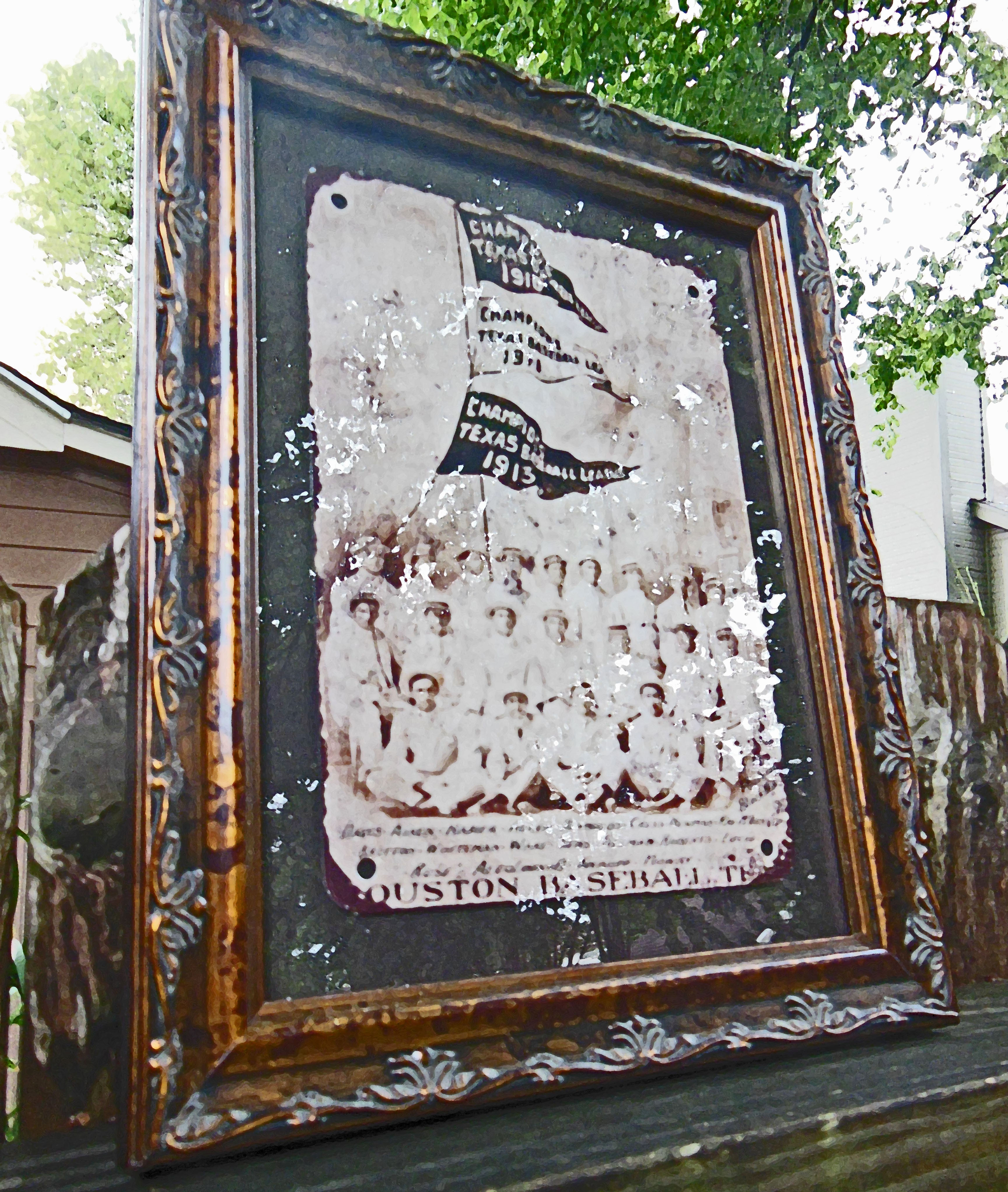
Early 20th Century Houston Buff Champions

Early 20th Century
Houston Buff Champions

It’s not even a case of “do or die”. – The world will always startle “old folks” – as time goes by.

A couple of weeks ago, I received the featured tin-plate team picture from Houston Buffs history friend Darrell Pittman as a gift. Well, Hobby Lobby was having one of their perennial 50% off frame sales so I stopped by there to have the metal piece mounted on a mat that would fit and look good in a 12×16 inch frame. I picked it up today.

Sorry it doesn’t photograph well once it is behind that natural glass due to all of the glare, but you should be able to see it well enough to easily get the drift of this short weekend errand story. It was the only place I went today because of a back problem, but maybe my disability was showing more than I thought.

The young man who retrieved my order and wrapped it for my trip home seemed mildly interested in the picture. Then he suddenly asked the question in all apparent innocence that set me back smiling on my heels:

“Which one is you?”

Did you hear that? The kid wanted to know which one of those fellows from 1910-1913 was me. – He didn’t ask, “Are you in this picture?” – He asked, “Which one is you?”

Let’s see, had I been, say 25, in 1910, that would make me about a pretty good-looking-for-his-130-years-on-earth age in 2015!

“None of them are me,” I told the young man. “I had gotten into a little trouble in a bar fight the night before and had to spend the night in jail.”

“That happened to me once,” the young man said.

“Glad you made it out OK,” I told him.

I didn’t have the heart to mess up a good story with an admission of the truth at this point – so I just thanked him and let it slide from there. Besides, I needed to go home and rest. Guess my penalty will always be one of wonderment: Was this kid really that naive? Or was he simply the greatest dead-pan con man that I’ve ever run into in the normal flow of everyday life.

Don't I look OK for a 130-year old man?

Don’t I look OK for a 130-year old man?