The Sultan of Swat Did he or didn’t he, call his shot?
Did Babe Ruth really call his shot at Wrigley Field in the 1932 World Series?
The answer may rest with what you most prefer, a good story or the certifiable truth? Or you may simply be too bowled over by the volume of romantic writing that has come down upon us over the eighty plus years that have passed since Ruth supposedly called his shot on Cubs pitcher Charlie Root by pointing his finger toward the center field wall and then, following that arguably real display of arrogance, crushing the very next pitch from Root over that same central fence for a home run.
How much light this little film shines upon the truth about what really happened is hard to gleam from either the pictures or the comments of these ancient thinkers and eyewitnesses to history. Ruth’s teammate, pitcher Lefty Gomez, apparently acknowledges that the argument may never be settled, but that he prefers to believe that Ruth truly did call his shot. Billy Herman, the Cubs’ future Hall of Fame 2nd baseman, states that Ruth used his arm-extended pointed finger at the Cubs’ dugout to note that he only had two strikes on him after the umpire’s last call.”
My favorite reason for disbelieving Ruth’s called shot isn’t covered in the film. Pitcher Charlie Root convinced me years ago in far fewer words than we shall use here to paraphrase his answer to the question: “Did Babe Ruth call his shot in Chicago?”
“You gotta be kidding me,” Root uttered, but in far less genteel words that I am paraphrasing here. “If Ruth had jabbed his fist and finger in the air as his signal that he planned to hit the next pitch for a home run to center field, do you really think I would have given him the pitch he got in the film to hit for that homer? – I saw him pointing to the dugout. The Cubs bench was really going after him, but he wasn’t pointing at me. If I had thought that Ruth was calling me out – in any bragging way, the next pitch he would have gotten from me would have left him sprawling in the dirt around home plate – and unable to hit anything!”
Charlie’s reasoning simply made a whole lot of sense. It doesn’t feed our hunger for romance, but it sure fits well with how the game used to be played by pitchers, even if the batter was the great Babe Ruth.
____________________
MARCH 1, 2016 ~ ADDENDUM MATERIAL BY SABR FRIEND AND COLLEAGUE, MARK WERNICK
Mark tried to leave all of this material in two posts as a comment upon this article, but due to a glitch in the WordPress website, he was thrown into one of those damnable Internet digital loops in which the more you try, the harder you stand still.
Our lucky break. Mark Wernick’s comments deserve to be up here as an addendum to the Ruth Called Shot story. ~ They could easily stand alone as a column unto themselves, but they substance they contribute here is a wonderful expansion of the topic started here. ~ Thanks, Mark, for this real contribution of merit:
Roger Snell, who wrote a book about the 1929 Cubs and Charlie Root, said the following: “I actually viewed the entire original film in Kirk Kandle’s Louisville home. Babe was waving his hand toward the Cub dugout and also made a motion like pointing a handgun at Charlie before the pitch when Hartnett said he had one more pitch. “Highly controversial” means two strongly opposing views of honest and earnest factions. My book was about the 1929 season. Charlie Root should be remembered for more than this one pitch in 1932. I read every single same-day newspaper account I could find of reporters actually at the game. All details are in the conclusion of my book. It is sad that Root’s name is never mentioned as the winningest Cub pitcher in franchise history.”
I wrote back to him and said the following:
I have a copy of the Kandle home movie, and I have seen the Harold Warp home movie of the called shot as well. The first home movie of the event was discovered by the Kandle family among the effects of their grandfather after his death in the 1970s. It’s likely his relatives didn’t immediately realize that he had recorded on film the most hotly debated event in baseball history, even after multiple viewings, because the film didn’t come to public attention until the 1980s. Prior to the widespread awareness of these films, the controversy and debate was over the question of pointing, with naysayers insisting that Ruth never pointed or gestured, and others insisting he did. After seeing the irrefutable evidence of Ruth pointing, the naysayers shifted their argument, insisting that Ruth was pointing at the Cubs dugout or towards the stands in left field. But this argument was easily refuted by simple geometry. The still photo of the point shows a lengthy shadow cast along the lower portion of the frame, and the angle of the shadow cuts across the foul line. If Ruth was pointing towards the dugout, his arm would be at least parallel to the shadow, if not intersecting it; instead, the position of his arm near the socket is about 30 degrees above the shadow and angles upward and away from the shadow, reaching about 40 degrees at his fingertip.
So once the evidence clearly showed that Ruth was pointing in the direction of Root and center field, the naysayers insisted that Ruth was pointing at Root. (Which is a helluva gesture unto itself, don’t you think?) However, Root’s back is to Ruth and Ruth easily must be aware that Root doesn’t see him at that moment, standing as he is in the center of Ruth’s field of vision. It seems rather unlikely that Ruth would be pointing at a man who wasn’t looking at him. What’s left is for naysayers to complain that it’s a disservice to Root to make such a fuss about Ruth pointing defiantly at center field and then hitting a home run, forcing people to remember Root for the wrong thing. Roger, I wish with great respect to differ from that belief. I can’t speak for Charlie Root, but speaking for myself, I would be greatly honored to be associated with the memory of this event if I was the pitcher. Root was a fine pitcher and perhaps he was the greatest pitcher in Cubs history. (Jake Arrieta may yet have something to say about that.) But I’d say it’s a very reasonable bet that had Ruth never pointed in that ballgame, Root would at best be remembered by members of his family and maybe some close friends and a few Chicago baseball aficionados, but most folks wouldn’t remember him any better than they remember Tony Freitas, who won 373 games in his professional career. Now Root is an immortal and respected part of baseball lore.”
So, to reiterate, if you look closely at the still photo of Ruth pointing, three important things are immediately evident: 1) Charlie Root’s back is to Ruth. Root is facing the outfield while Ruth is pointing, so Root could not have seen Ruth point. 2) Gabby Hartnett is facing umpire Roy Van Graflan. So Hartnett’s back also is to Root. And so, they could not have seen where Ruth was pointing. (How ironic it is that neither the Cubs pitcher nor their catcher was looking at Ruth at precisely one of baseball’s most historically significant moments.) 3) The geometry of the photo, as detailed above, confirms the direction of the pointing towards center field.
All my nay saying friends can take comfort in knowing that we’ll probably never unearth audio evidence of precisely what Ruth said at that moment. So for now, Gabby Hartnett’s insistence that Ruth’s words were: “It only takes one to hit it”, while pointing towards center field with two strikes on him, can be construed as evidence that Ruth didn’t really call his shot. Consider, however, that while it’s mighty unlikely Ruth said he’s going to put the next pitch over the center field fence next to the flag pole, as he asserts in his retrospective comments, what he did do, as visually evident and as asserted by Gabby Hartnett, is plenty audacious enough.
Who else in the universe points to center field with two strikes in a world series game in front of a furious, screaming full house road audience and says loud enough for the opposing catcher to hear him, “It only takes one to hit it”? Is that not audacious enough for all eternity? And we have him pointing – towards center field – on film! I’d love to have that on color video replay, but I feel blessed that we have the celluloid of Mr. Kandle and Mr. Warp. And it only took 50 years to discover those films.
There is an alleged surviving radio broadcast, although I’ve heard pro and con re: whether it’s a reproduction or the real thing. I’ll see if I can find a link.
~Above Addendum material (in Italicized lettering) by Mark Wernick.
Frank Lovejoy: “Well, Ronnie, I gotta be honest with you. – You will never pitch even a scripted no-hitter – nor will you ever win an Oscar for your acting, but … let me ask you something … have you ever thought about going into politics?”
Eight baseball movies have been nominated for various and sometimes multiple Academy Awards:
(1) Pride of the Yankees (1942) – Gary Cooper starred as Lou Gehrig. Cooper and the movie were both nominated for Best Actor and Best Picture, but neither won. Other nominations also included Best Actress (Theresa Wright), Best Screenplay, Best Writing, Best Cinematography (Black-and-White), Best Art Direction, Best Sound Recording, Best Special Effects, and Best Music. None of those listed won, but Daniel Mandell did take home the Oscar for Best Film Editing to crack the shell on an otherwise goose-egg finish for the film team on an evening of recognition. To the surprise of no one, neither Babe Ruth nor Bill Dickey were nominated for the each did portraying themselves. Ruth’s “oversight” was a little disappointing in the sense that he was much better as himself in “Pride” than either William Bendix or John Goodman would be in their later and much later film portrayals of The great Bambino.
(2) The Stratton Story(1949) – Jimmy Stewart starred as Monty Stratton, the Texas farm boy who showed promise as a pitcher for the Chicago White Sox before he lost a leg in a hunting accident. Unfortunately, Jimmy didn’t have the athleticism it takes to be convincing. Frank Morgan’s portrayal of the down-and-out bird dog scout who falls off a freight train just in time to discover and sign Stratton after watching him pitch in a Texas town ball game, unfortunately, was a virtual replay of his character in “The Wizard of Oz” as “Professor Marvel”, the shadow character to his later star appearance in the same classic OZ film as “The Wizard”. – In the “Stratton” film, when the lead character shoots himself while hunting alone and has to straggle back to his house with no help, we almost expected Professor Marvel to appear as a distant witness to utter his immortal lines from “The Wizard of Oz”: “Poor little kid! I hope he gets home all right!” – At the 1950 Academy Awards, another shutout was avoided when Douglas Morrow took home the Oscar for Best Screenplay for his story.
(3)Bang the Drum Slowly(1973) – This color film is notable as one of Robert De Niro’s earliest performances. After Bang the Drum Slowly, De Niro starred in Mean Streets, The Godfather: Part II and Taxi Driver, consecutively. Vincent Gardenia earned an Oscar nomination for Best Supporting Actor, but did not win. De Niro was brilliant in the role of a limited ability, not-too-bright aspiring catcher, but his absent star power in those days probably kept him from getting the nomination and possibly the Oscar. (This brings up why baseball is so much fairer than acting or practically anything else in life away from sports. If you are Carlos Correa, and not an unknown Robert Di Nero, you don’t have to wait for the powers-that-be to nominate you for great rewards. In baseball, and most team sports, you get those rewards from your measurable performance on the field. If you can do it right away, you get it right away.)
(4)The Natural (1984) – It was the movie that made hitting the cover off the ball a literal event – and a home run slam that breaks a lighting arc and sets off a shower of exploding light the symbol of ultimate triumph in baseball. Roy Hobbs could do it all, even get himself shot by a crazed female fan, ala Eddie Waitkus, while being a far greater loss to the game than Waitkus ever would be as a contributor. Robert Redford was perfect for the part of this super hero, of course, and maybe, along with Kevin Costner in other baseball roles, one of the two most “naturally” gifted athletes whoever asked an audience to suspend their editorial brains and accept them each as real baseball players on the screen. Glenn Close earned a Best Supporting Actress Oscar nomination for her portrayal of Iris Gaines, the childhood sweetheart of Roy Hobbs on his road to baseball redemption. The Natural was also nominated for Best Original Score, Best Cinematography and Best Art Direction-Set Decoration. – The movie hit the “snider” – and took home no Oscars.
(5)Bull Durham (1988) – This was the movie that made a lot of us wish for some early might-have-been-time memories also as players on the roster of the Durham Bulls with Crash Davis and Nuke LaLoosh. Surely, Annie Savoy either had some extra friends or extra time. Crash Davis’ passionate plea to Annie Savoy was, at least, memorable. Crash told Annie that “the small of a woman’s back, the hanging curve ball, high fiber, good scotch, that the novels of Susan Sontag are self-indulgent, overrated crap.” Ron Shelton wrote that line along with all the other dialogue and story and that earned him a nomination for Best Original Screenplay. He didn’t win, but he left us wishing forever that we might get to see again another pitcher beaning a sidelines mascot at some point in our baseball fan lifetimes.
(6)Field of Dreams(1989) – “If you build it, they will come.” ~ Whispers in an Iowa cornfield. ~ Shoeless Joe Jackson and friends coming out of a corn field to play baseball on field that had been built for them on good faith and a young man’s love for the game. ~ The presence and authoritative voice of James Earl Jones, lending his holy book sanctifying expressions to everything that transpired there. ~ Moonlight Graham, showing up to get that time at bat he missed decades earlier, only to cross the line and be transformed again into his elder identity as Doc Graham for the sake of saving an injured child. ~ A father and son reunion to beat all others on a field of dreams. ~ The stream of cars that finally come ~ bearing souls who seek for themselves ~ a chance to bathe their hearts and minds in the visual waters ~ of the place that fast became known to fans from all over ~ as the Lourdes of Baseball. ~ And, in 2016, they still come, in the hope of finding themselves again.
At the 1990 Academy Awards, Field of Dreams was nominated for three awards, including Best Picture, Best Adapted Screenplay, and Best Original Score. The profound baseball theme must have been lost on the non-baseball fan award voters. Remarkably, Field of Dreams won nothing.
(7)Hank Aaron: Chasing the Dream(1995) – We never personally saw this documentary by Michael Tollin. It supposedly was about the life and career of Hank Aaron and it featured such luminaries as Ken Griffey Jr., Dusty Baker, Yogi Berra, President Jimmy Carter, David Justice and Frank Thomas. It was nominated for Best Documentary Feature, but did not win.
(8) Moneyball (2011) – Aaron Sorkin wrote the adapted screenplay of Michael Lewis’ best-selling book about Billy Beane and the use of sabermetrics by modern baseball clubs. The film earned a total of six nominations at the 2012 Oscars. Brad Pitt and Jonah Hill were nominated for Best Actor (Pitt) and Best Supporting Actor (Hill). Moneyball also earned nominations for Best Picture, Best Achievement in Film Editing, Best Achievement in Sound Mixing and Best Adapted Screenplay (Sorkin). The sabermetric path to victory at the Oscars apparently is still a work-in-progress. – Moneyball won nothing.
____________________
Five Famous Actors That Never Made The Oscar Nomination Cut: *
(1) William Bendix as Babe Ruth in “The Babe Ruth Story” (1948) ~ although it remains my sentimental favorite baseball movie from childhood.
(2) Ray Milland as Mike Kelly in “It Happens Every Spring” (1949) ~ Pitcher Kelly had that wood-repellent juice he rubbed into balls that helped him lead the Cardinals to a National League pennant.
(3) Ronald Reagan as Grover Cleveland Alexander in “The Winning Team” (1952) ~ Like the rest of the actors on this list, Reagan wasn’t athletically credible.
(4) Dan Dailey as Dizzy Dean in “The Pride of St. Louis” (1952) ~ Also got what he deserved from the Academy.
(5) Anthony Perkins as Jimmy Piersall in “Fear Strikes Out” (1957) ~ Worst impersonation of a ballplayer. Ever.
The first four listed movies were enjoyable, but none of the five had a shot at an Oscar as credible bodies of writing, acting, or historically accurate works.
Fair Maid Bakery Sign Buffalo Stadium Beyond the Center Field Wall
Like many kids of the Post-World War II Era, I grew up thinking that photography, if not life itself, was all black and white until after the defeat of Adolph Hitler in 1945. Even shortly after that time, the sandlot home of the Pecan Park Eagles was still pretty much a black and white world, as black and white as the Saturday movie fare at the Avalon Theatre on 75th Street in East Houston, until the baseball season of 1947, when my dad took my brother John and me to see our first Houston Buffs game at old Buff Stadium, near the University of Houston.
I’ve told the bare bones of this story before. I’m trying here to explain why it was important to me.
Let’s just start with the facts.
It was a night game. I no longer remember the foe, but I’m totally sure we won. I never left Buff Stadium feeling great when we lost, even the first time. – When the Buffs lost, I went home feeling inconsolable. And that early summer night in 1947, I went home feeling that I had just been delivered to a brand new world of hope and joy and color too. Which, of course, I had.
When we walked up the ramp into the left field stands for the first time, and I first laid eyes upon the sights of all that manicured green grass, and my ears heard the sounds of the organ playing peppy pre-game music, and my nose picked up the smell of hot dogs mixing with the aroma of the freshly baked bread from the Fair Maid Bakery across the street and a block to the north, it was all akin to something like the deja vu resonance of Dorothy Gale landing her house on the witch in Oz – and opening the door of a black and white (or sepia tone) world into the context of a new one that screamed with the color and soul-taste of genuine vitality.
“Johnny,” I felt like saying to my little brother, as we reached field level, “I don’t think we’re in Pecan Park, anymore.”
Pecan Park was not abandoned from the experience. It was enhanced into the Technicolor world too. After the Buff Stadium experience, I discovered that baseballs weren’t really white with black stitching. They were beige to smeared-green to yellow-brown with frayed, fading red stitching. Calloused bare feet were not gradient grey with splotches of black. Our feet were beige to brown to black with tinges of yellow in the calloused areas – and dark dried red in the bloodied cut-injury sections.
The billowing clouds remained white, but now they floated across a periwinkle blue sky over Eagle Field. They were the upper stratosphere of our Pecan Park Eagle hopes – and a good place for us Eagles to try our wings at flying – and using our eyes to survey the horizons – for the larger world that best fit our singular passions for a future life.
All my hoopla here comes down to this simple conclusion: Through the black and white view of our childhood training, we may find the future we’ve been taught to think “should be.” If we want to find ourselves, however, we have to have the color vision that is only available once we figuratively “get the heck out of Dodge City, Kansas.”
Buff Stadium did it for me at an early age. I didn’t understand it at the time, but Buff Stadium actually turned on the idea of beautiful possibilities for me at an early age, lighting a fire for baseball that will never go out.
Thanks for putting up with my Saturday night rambling. I only hope that what I’m trying to explain comes through in this brief discourse. It’s a subject that touches us all, but, at my age, I can live with the conclusions I’ve reached. – I’m totally OK being who I am – even, if I run out of time on some of the things I still hope to research or write. I am still just me, regardless. My writing, and everything else I take action upon in the name of historical or artful fulfillment, is simply what I do – out of my particular passion for living.
We all have our own thing to bring to the table. It’s up to each of us to tap into whatever those healthy passions may be – and then to use, abuse, or lose them to the great thief of all untried dreams – the clock on the wall that measures out secretly our time on earth to do anything.
May God Bless All of You in your own pursuits, even if the word “God” messes with some of your minds.
The 1925 World Series Pittsburgh @ Washington On a windy and chilly afternoon.
It’s only a short film, but it’s far more recent producers have pulled it together with a little jazz piano background to make up for the silence. It’s still a valuable glimpse of the times and some of the more recognizable figures of those days. As we all know and regret too well, we don’t have an overrunning supply of moving action films from those earlier times.
A uniformed Walter Johnson greets the visiting Babe Ruth, who is only a viewer of the action in 1925. A couple of unfamiliar players do a rowboat imitation on the sidelines prior to a game at Griffith Stadium. A tall distinguished fellow with a mustache (not President Coolidge) throws out the first ball. Some poor Pirate hitter gets whacked by an inside fastball from Walter Johnson. Players run the bases like the fastest sugar ants any kitchen has ever seen. Commissioner Landis is there, wearing a top coat on a sunny day that also could have protected him from the blizzard of the century, had there been one. A couple of close-ups give most of us a long, long look at two once wildly famous faces that a lot of us young guys no longer recognize at all. The Griffith Stadium crowd, or crowds, depending on how many contests this film takes in, appear to be booked to capacity. A flag shadow on the field shows the wind to be blowing mighty hard – undoubtedly the reason for all the heavy clothing. Things look cold and clear. And one scene, looking in from the left field stands, shows the infield dirt full of divots and footprint holes – and the infield grass to be rough to clumpy to dying. You don’t get the impression that anything like our contemporary ground crews are coming out to smooth the dirt or hand pick the bad grass. After all, its 1925. The field has been good enough all year. Maybe they fixed it up once they got the World Series out of the way. Oh yes, one more thing, even though you can’t hear him here, and you may be getting tired of me calling his number this week, but I must mention the fact that Graham McNamee did the radio broadcast of all seven games of the 1925 World Series.
Here’s the movie link:
The actual 1925 World Series must have been a pretty exciting one. Walter Johnson of the Senators won a couple of early ones, enough to give Washington a 3-2 lead in games going back to Pittsburgh for the last game or two, if needed. The Pirates proceeded to edge the Senators, 3-2, in Game Six and then they finished their World Series victory with a 9-7 win over Walter Johnson in Game Seven.
Graham McNamee The ballpark couldn’t hold his range of talent.
Thanks, Stan-From-Tacoma, for providing all of us at The Pecan Park Eagle to hear use the link you’ve provided to hear the sonorous baritone voice and superbly regional-free diction of Graham McNamee directly from these ancient radio broadcast recordings.
We have followed your suggestion by first clicking onto archive.org
Then we printed out “Coca Cola Top Notchers” in the “search” line provided there.
If you fill in the “search” line with the name “Graham McNamee”, you also get a large selection of the man working “on the air.”
What we got from Stan’s suggestion were two links that both work to the same March 19, 1930 evening program, “The Coca Cola Top Notchers,” featuring Graham McNamee as Master of Ceremonies for a half-hour program of easy listening to soft music of that era performed by the Coca Cola String Orchestra and some singing – all fitted around the idea that this was a good format for bracketing an interview by iconic sports writer Grantland Rice with future Hall of Famer Ty Cobb – and all planted smack dab in the middle of the musical program.
Get it? Rice and Cobb were the top-notcher cake portion of the show. Everything else was pretty much “relax … think Coke … drink Coke … listen to the music … and float away in your living room easy chair.” McNamee served as ringmaster and Coke-huckster for the show’s commercial interests. McNamee’s beautifully-honed sonorous baritone voice and superbly regional-free diction simply flowed into mellow meandering with the solidly pre-Cambrian advertising era message. “Things really do go better with Coca Cola,” the flow of things suggested, especially when you allow yourself to drink Coke – and to give yourself over to the beautiful music and a “Shirley Temple evening” voyage into relaxation – one that will not leave you struggling with a hangover the next morning.
As to how the show got the two-years-retired Ty Cobb to appear on this live NBC radio show from New York City in dismal March, it probably wasn’t too tough. By this time, Cobb was knee-deep in Coca Cola stock and ready to help everything go better for himself with Coca Cola too.
Graham McNamee’s job on the show made it easier to see why his pioneering role in baseball got lost in the muddle of the things he did on the air in actuality. Can you imagine Red Barber being awarded the Frick for introducing, or maybe even singing, “Ah, Sweet Mystery of Life, At Last, I Found You” over the radio? Only the great Graham McNamee possessed both the talent and the almonds to pull that one off.
Such is the fate of those who are the first in the room to both possess and put to plentiful use the talents that this little boomer invention and commercial industry called “broadcast radio” cried out for someone to do. For most, if not all of his career, McNamee literally had no peer as a multi-talented radio performer. He did baseball, boxing, football, and other sports. He served as MC on several radio variety and musical shows, including the Rudy Vallee Show. He sang opera numbers over the radio; he even substituted for Rudy Vallee, at least once, as the singer of a show, or shows, the star had to miss because of some other commitment. McNamee did all these things – not because “nobody did them better” – but because nobody else did them – period!
And buried in this pile of singularly broad media talent and accomplishment was the fact that Graham McNamee truly was the template builder for real-time baseball radio broadcast play-by-play artistry. And that individually historical contribution has now been rescued from the land of the lost that blurred his pioneer role and denied him the honor that the Ford C. Frick Award reaffirms by the Hall of Fame’s selection of Graham McNamee as the recipient for 2016. – He should have been the first person selected. That will always be my opinion, but it also shall always be my grateful opinion that justice that shows up late is always far superior to justice that gets lost forever.
A Contemporary Book Review Published in the Helena Independent
September 12, 1926
Radios, which have brought the world into closer contact, reunited families and long lost friends, are now a common piece of furniture in American homes. On January 1, 1926, there were 5,200,000 receiving sets in the United States alone.
Graham McNamee, announcer for WEAF, the largest New York City broadcasting station and author of “You’re On The Air,” is heralded the country over as the outstanding radio announcer. McNamee has acquired the ability to individualize and particularize every emotion, whether he is announcing a world series baseball game or a prize fight. The radio may be a marvelous invention and still be as dull as ditch water unless it allows the play of personality. A machine amounts to less than nothing unless a man can ride it. McNamee has been able to take a new medium of expression and through it transmit himself – to give out vividely (sic) a sense of movement and of feeling. Of such is the kingdom of art.
In his book, “You’re On The Air,” published by Harper and brothers, and written in collaboration with Robert Gordon Anderson, McNamee takes you back stage and explains the integral mechanism of the radio. During the past four years, he has broadcast world series games, prize fights, foot-ball games, president’s addresses, and innumerable ground operas.
McNamee was raised in St. Paul and in 1920, with the help of his mother, he studies vocal under such teachers as Madame Esperanza Carrigue. After a successful career as a vocalist, he became interested in radio and in 1922 became announcer for WEAF.
The radio game is young, for up to 1922, it was practically unheard of, but in the last four years, fortunes have been made and lost, huge factories have sprung up all over the land, tens of thousands of radio stores have been opened and the air is full of myriad voices spreading news and messages, music and song, to a listening world.
“A broadcaster should have an acquaintance with literature and of sports, a pleasing voice, a good disposition and control of his temper, as well of the microphone through which he is announcing,” says Mr. McNamee. “One in training for such a position should never, even in off hours, indulge in strong language. If he does not swear off swearing, he is apt to get mixed up sometimes through habit, and use expressions that are all too descriptive, particularly in broadcasting a stirring baseball game or a rattling good prize-fight.”
The perfect teamwork of operators, plantsmen, program makers, the mastery of that vast tangle and network of wires, the accuracy and synchronization, the timing of the programs to a split second, are as much of a poem as any ever written in print – and it gives a new respect for the achievement of man.
~ Helena Independent, September 12, 1926, Page 14. *
Graham McNamee
Once in while, intentionally or inadvertently, news writers draft some thoughts for history. This review was one of those times. Our only regret at The Pecan Eagle tonight is that we are unable to give individual writing credit where it is due. This piece was journalism at its finest. The review captures Graham McNamee as a man ahead of his times, a man who reached far, and taught many, the art of the craft that is live event broadcasting. The fact that McNamee’s world grew larger than baseball alone should never have been a diminishing factor of his role as the trail-blazing father of the play-by-play broadcast. As the author of this piece plainly stated: “A machine amounts to less than nothing unless a man can ride it.” – Graham McNamee both rode the bull and wrote the book on baseball play-by-play over the radio. A couple of kids we remember as Red Barber and Mel Allen, among all others of their great generation, grew up with an open mind and full ear to what McNamee was teaching all of them.
Congratulations again, Graham McNamee, on your 2016 Ford Frick Award. ~ Your day of vindication is at hand by this recognition from the Baseball Hall of Fame.
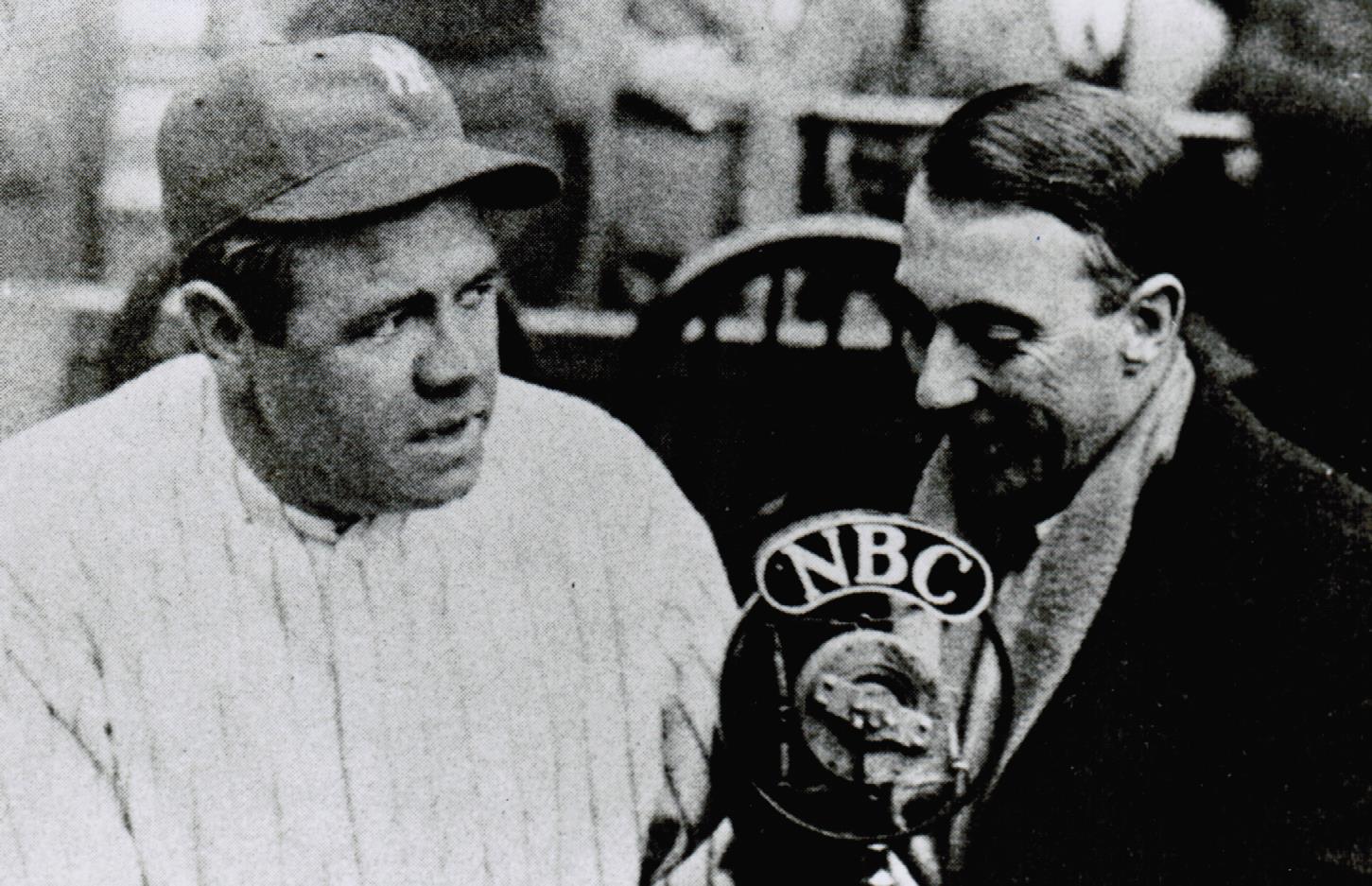
Graham McNamee 2016 Ford Frick Award Winner The Father of Baseball Radio Play-By-Play Interviewing Babe Ruth during the 1923 World Series
It almost was enough to restore my ancient innocent belief that justice over time is inevitable.
What is disturbing to me is that it took this long for me to get the news that became public on December 9, 2015, a full two and a half months ago. I finally got it today, February 23, 2016, when I picked up my Spring 2016 copy of “Memories and Dreams” and read the wonderful story by Bill Francis on Page 29.
And my attention tardiness soon didn’t matter. The man who invented play-by-play finally got in – finally got the Hall of Fame honor he always has deserved. After this long parade of broadcasters – who all benefited from the traction he left on the road of telecommunications via radio – McNamee brought baseball to the fore as one of the great “theaters of the mind” that ever longed for the company of human ears.
Here’s an interesting sidebar: I just ordered a few copies of McNamee’s 1926 book, “You’re on the Air,” for a little project I had in mind – without knowing a thing about the play-by-play pioneer’s selection for the 2016 Frick Award. And Francis, the article writer, turns around and uses the very quote that caught my eye:
“You must make each of your listeners, though miles apart from the spot, feel that he or she, too, is there with you in that press stand, watching the movements of the game, the color and flags; the pop bottles thrown in the air….Gloria Swanson arriving in her new ermine coat; McGraw in the dugout, apparently motionless, but giving signals all the time.” ~ Graham McNamee, “You’re on the Air”.
I’ve never known if my favorite McNamee story was actual or symbolic, but I like it, anyway, because all the other things I’ve read elsewhere suggest that, indeed, Graham McNamee was the man brought real-time, present tense description of game action to life for the radio audience. The story goes that McNamee started working as a side man to the great early 20th century, Grantland Rice, as the latter tried his hand at translating his reflective writing eloquence into something fun and useful to voice business of describing a live baseball game.
Apparently, it wasn’t much fun or Rice’s cup of tea. Let’s say the play was a ground out to shortstop.
Rice’s style was to call it as he might have written it – after the game and in past tense. The radio might hear the bat contact and some audience cheers or boos as the play unfolded. Rice waited in silence for the play to be completed and then reported something like: “Brown hit a ground ball to Jones at shortstop, who then threw to ball to Johnson at first for the out.” – It was not engaging, at all.
As the story goes, real or symbolic, one day, Rice got fed up doing this thing in the middle of a game. “Here,” Rice supposedly said to McNamee, “you take over, I’ve had enough of this business.”
Supposedly again, Graham McNamee then took over like a silent co-pilot with a better flight plan and McNamee began his groundbreaking real-time coverage:
“Ruth stands in there. …. He swings hard … and it’s a long and high fly ball to right field … right fielder Tobin turns and waves … bye-bye … and the Yankees take a 1-0 lead over the Browns in the bottom of the fourth … as the Babe smiles and waves to the home crowd … What a guy!”
For years, I’ve been one of those people who felt that McNamee’s omission from the Frick Award stood as one of the great “overlooks” in the business of baseball awards. Then I talked it over once with 1992 Frick winner Milo Hamilton and got one of the two worst reasons for the absence of Graham McNamee from serious Frick Award consideration.
According some, (1) Graham McNamee wasn’t a pure baseball man. He did other sports and non-sporting events. – And how spurious is that kind of thinking? Look at the long row of excellence we get from broadcasters today who understand the differential process of doing sports on radio versus television. A play-by-play person has to be grounded with an understanding of each sport he or she does, but the TV/radio differences are the real litmus test on versatility for most – not the sport in itself. Of course you have to know the game.
Milo Hamilton gave me a reason that made no sense. Milo felt that Graham McNamee didn’t broadcast baseball long enough to deserve serious consideration. Really, well, if that’s the litmus test, I guess we had better take down the historical plaques at Kitty Hawk, North Carolina. Like Graham McNamee in baseball radio broadcasting, the Wright Brothers didn’t fly long enough to be recognized and honored for their contributions to the science of manned flight.
Congratulations, Graham McNamee! ~ This summer, you will finally get the recognition in Cooperstown that you always have deserved!
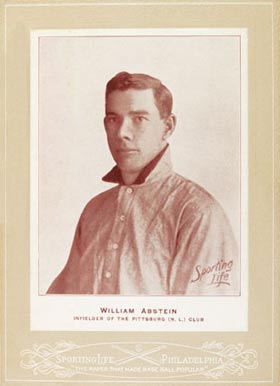
Bill Abstein, 1B 1909 Pittsburgh Pirates ~ in a game against the Cubs in Chicago.
Bill Abstein broke into professional baseball as a 21-year old 2nd baseman for the Houston Wanderers of the Class C South Texas League. The Houston club acquired their nickname that last season of Fair Grounds Base Ball Park by losing their venue to changing times and the need to play out their season on the road with an identity that fit their circumstances.
Young Bill Abstein apparently did OK with the inconvenience of living on the road. He hit .310 in 135 games, collecting 168 hits that included 30 doubles, 8 triples, and 12 home runs.
Following a couple of good years with Class A Shreveport (1905-06), Abstein made it up for a few big league break-in games with the Pittsburgh Pirates in 1906. After two more “seasoning” years (1907-08) at Providence, “Big Bill”, as Abstein was called at only 6’0″ and 185 pounds, was back in the big leagues for a full season with Pittsburgh. This time, he was there as the Pirates’ regular 1st baseman for 135 games and 2 additional game appearances, hitting a respectable .260, with 20 doubles, 10 triples, and a single homer.
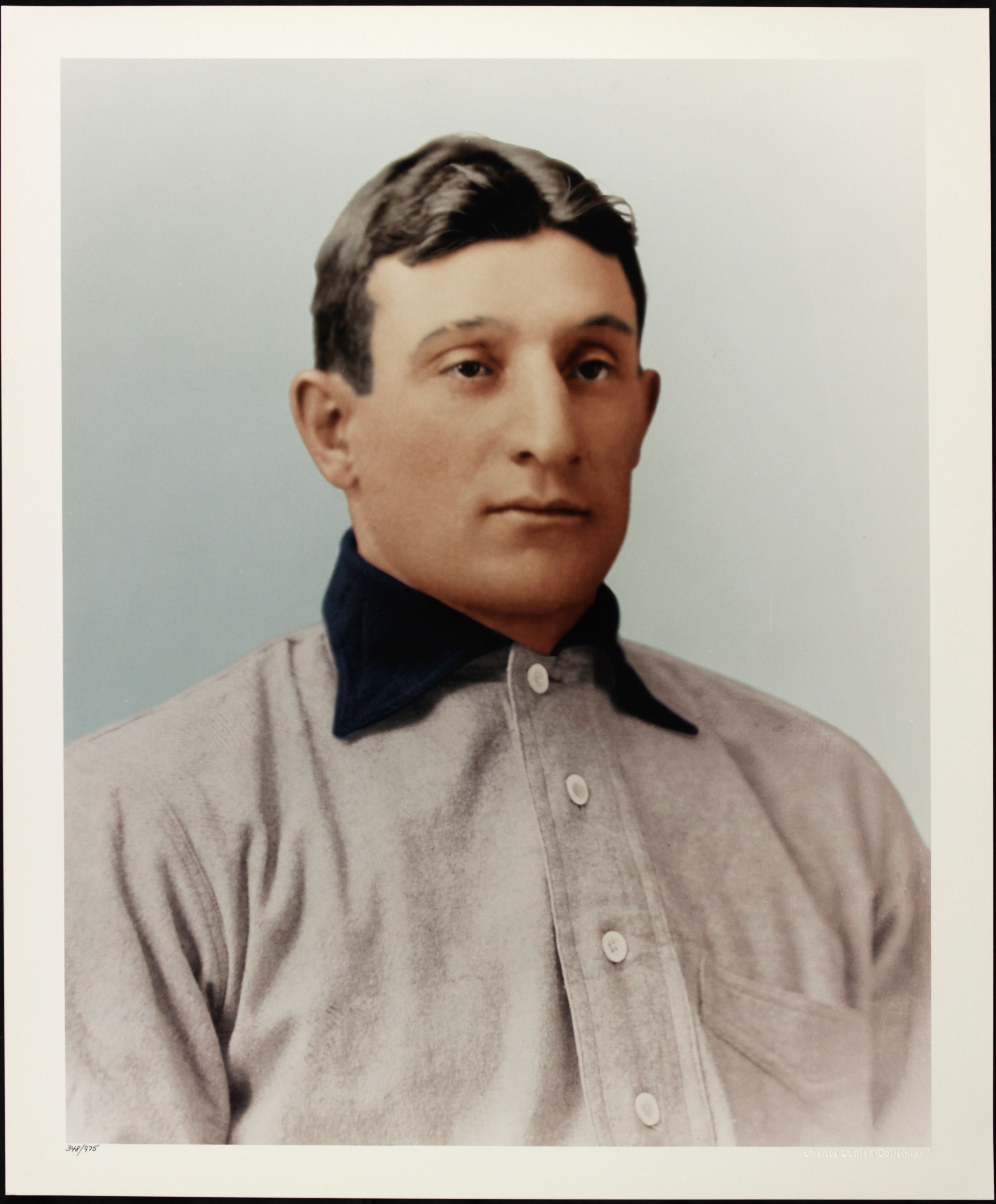
By playing for Pittsburgh in 1909, Bill Abstein had written himself into baseball history as the first 1st baseman for the first Pirates World Series Champions and one of the team pieces that fit around the powerful field leadership of the great future Hall of Fame shortstop, Honus Wagner. The Pirates defeated Ty Cobb and the Detroit Tigers in 1909, with Wagner literally rubbing the ball into the face of the Georgia Peach on the latter’s glaring spikes-high attempt at stealing 2nd base by the art of intimidation. Wagner stopped him. And Cobb didn’t try that again with The Flying Dutchman.
We are not certain what happened to Bill Abstein after the 1909 triumph, but he was assigned to the Jersey City Skeeters minor league club for the 1910 season. After hitting .261 at “Jersey”, Abstein was dealt over to the St. Louis Browns where a .149 batting average with his new American League club would prove to be his last shot at the major leagues. Abstein would play 7 more seasons in the minor leagues and finish his career after the 1915 season with an unspectacular career record as a hitter.
But he did get to the show. He did play with one of the greats. He was a member of the first Pittsburgh Pirates World Championship team. And he did get his start in Houston.
Here’s the link to his career record at Baseball Reference.com:
One of my all time favorite baseball sidebars concerns another true rookie member of the 1909 Pirates, a fellow named John Barney Miller, who played 2nd base, but was never known by either his legal first or middle names.
It happened this way, goes the story: A Pittsburgh writer was watching the rookie fielder make one incredible play after another at 2nd base during infield practice on the first day of full spring training for the Pirates. Not recognizing the young man by name, he quickly hurried over to Honus Wagner to ask as the players came off the field.
“Who’s the kid at 2nd base, Hans?” the writer asked. “He looks great!”
“That kid over there?” Honus asked, as he smiled and pointed at Miller, feigning surprise.
“Yeah,” the impatient writer confirmed, “that kid!”
“Oh,” Wagner said, “dot’s Miller” (as in “that’s Miller”, but not understood by the writer as such.) Wagner spoke English with a rich Dutch/German accent
John Miller became Dots Miller forevermore from that day forward, following the writer’s story on the brilliant play of the young rookie. If Miller ever attempted a correction, we have not found a written mention of it. Apparently, rookies in those days didn’t care what you called them as long as a manager wrote down a name of who they thought they were – into the starting lineup.
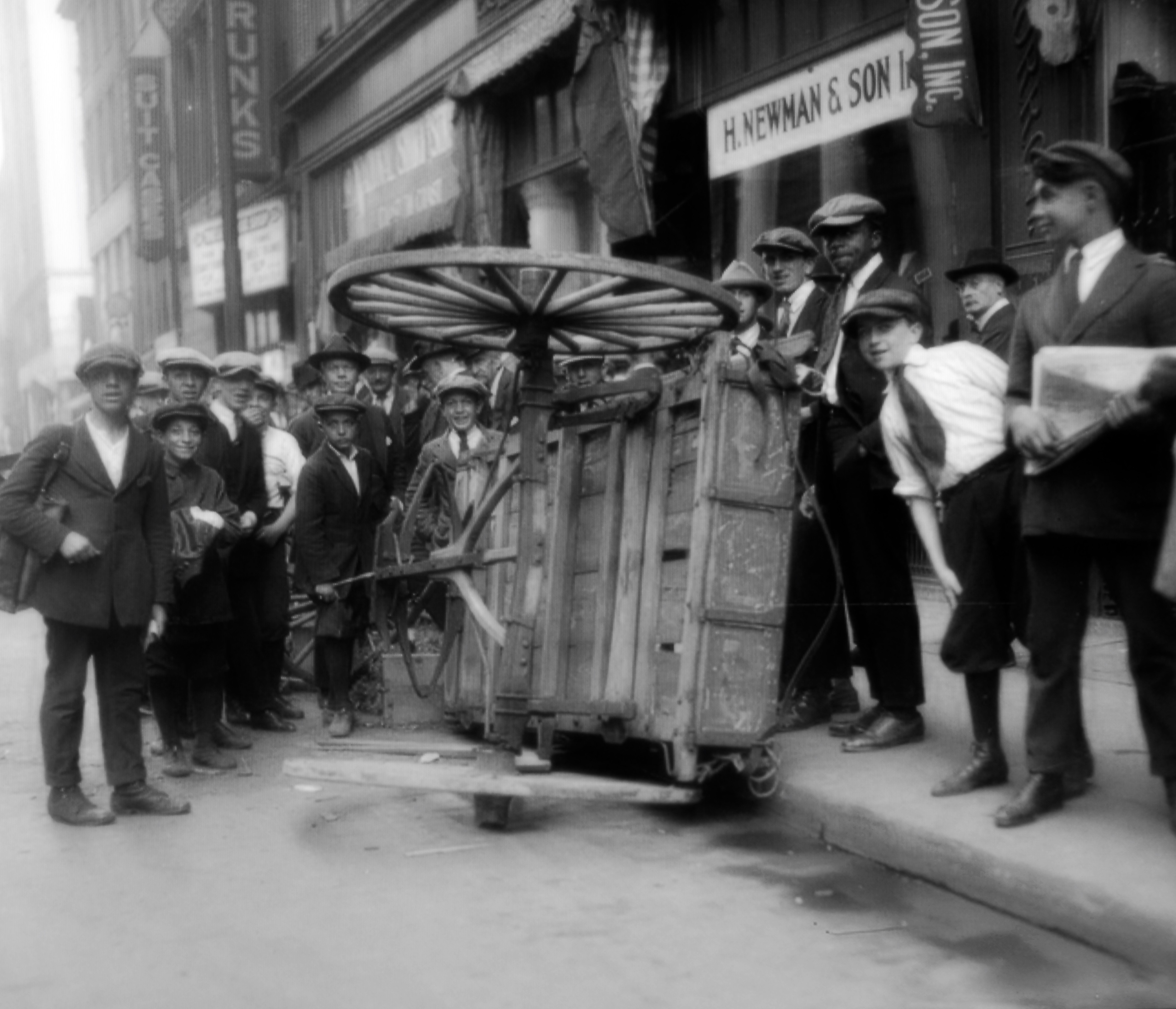
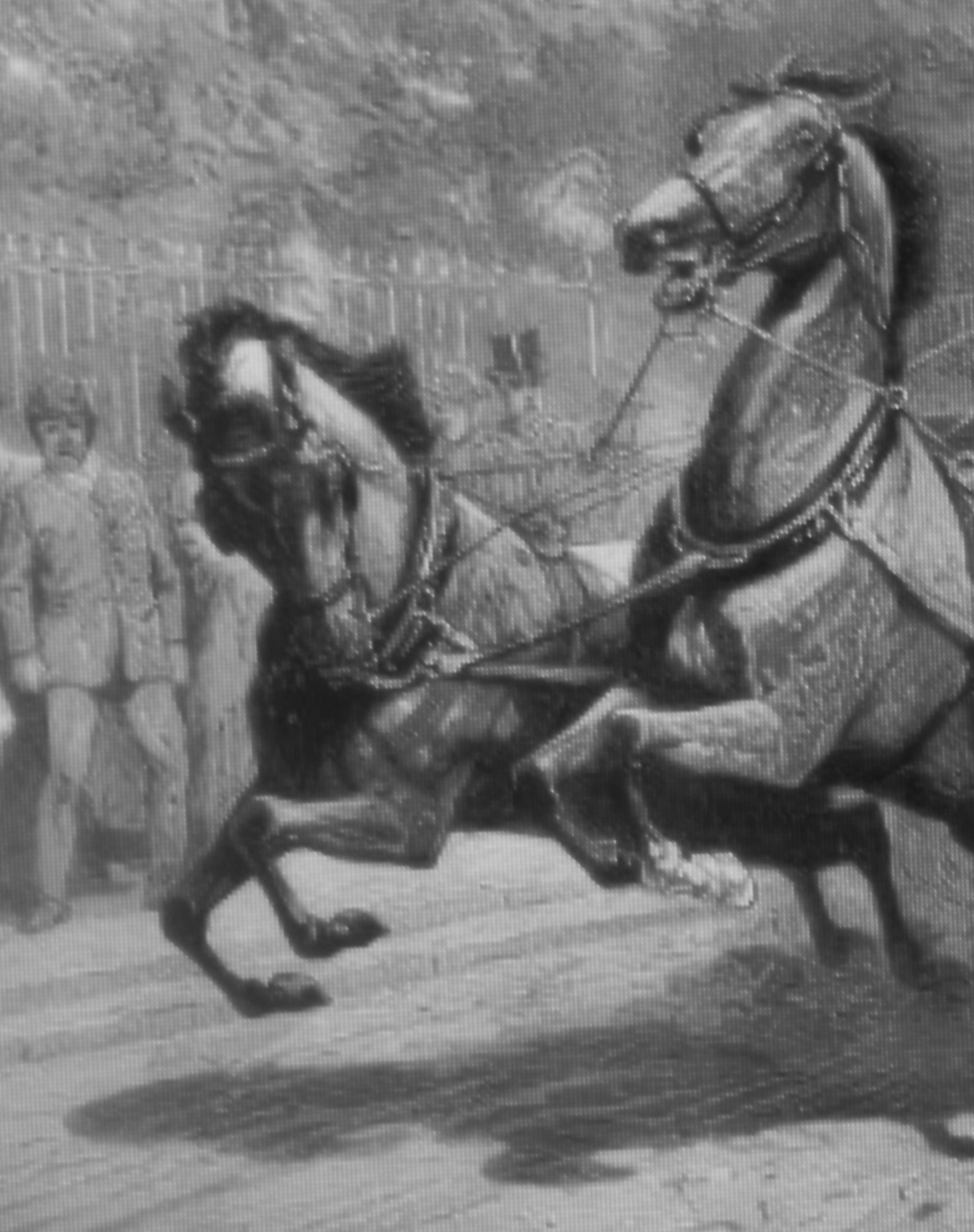
A wagon carrying 2 women and a boy was left by the curb as the frightened horses pulling it broke loose, raced through a china shop, and then came out through the door on a mad dash to the canal, where they both drowned.
“A fair, but frail daughter of Eve, in a Michigam [sic] city yesterday, was sentenced to thirty days in prison and to pay a fine of $50 for drunkeness [sic]. When she heard the sentence she hurled a heavy inkstand at the Judge’s head. He dodged, and the missile flew through the window and fell to the pavement, the ink splashing over a lady’s elegant silk dress and totally ruined it. The lady, in trying to shake the ink from her dress, frightened a team of spirited horses, that ran away with a carriage containing two ladies and a child, upsetting a fruit stand and throwing the ladies on a butcher’s cart while the child was fastened [?] in a bunch of telegraph wires about ten feet above the sidewalk. The team could not be stopped, and continued on their flight, finally plunging through the plate-glass windows of a china shop. They ran through the entire length of the store, spreading destruction on every hand; ran out of the door, leaped into the canal and were drowned. Now they talk of calling [?] on the Judge for damages because he dodged the inkstand.”
~ Idaho Semi-Weekly World, December 11, 1885, Page 1.
… on their fated way to the canal.
____________________
Another “diamond in the rough” story-find by the one-and-only Darrell Pittman. Thanks again, Darrell, for being The Pecan Park Eagle’s nose for serious ancient news confirmations, as well as our recorder of quirky events at any point in news-reported distant history. Not to make light of today’s story and its sad chain of improbable events. This one was scary serious to the two ladies and child in the wagon – and deadly serious to the horses that died in the canal.
According to this Tweet from Mark Berman of Channel 26 in Houston, the Houston Astros have hired the first female strength and conditioning trainer in MLB history:
Her name is Rachel Balkovec. Here’s how Brian McTaggart describes her in his linked column at mlb.com:
“Balkovec, 28, was a catcher at the University of New Mexico and received her master’s degree in sports administration from LSU, where she served as a graduate assistant strength and conditioning coach. A recommendation got her the position with the Cardinals, and she later was the volunteer strength and conditioning coach with Arizona State. She spent the previous two years with the Cardinals as their Minor League strength and conditioning coordinator.
“With the Astros, she’ll work as the strength and conditioning coach for their Gulf Coast League affiliate and will travel to the team’s academy in the Dominican Republic six or seven times a year to supervise the three strength coaches that are down there. And she’ll be blazing a trail along the way.”
~ Brian McTaggart / MLB.com |@brianmctaggart | 4:15 PM ET, Monday, 2/29/2016.
Balkovec achieved her gender break-in status with the St. Louis Cardinals in 2012 and now joins the Astros to help their players and minor league prospects learn about their own needs for nutrition and strength exercising programs that work best for athletes with baseball ambitions. We are simply happy to report that another unspoken barrier to female participation in the preparation of players for action has now been removed and that Houston is acting in support of the move already started by the Cardinals.
Rachel Balkovec in the weight room as a Cardinals Employee.
Let’s be clear about what we are applauding. We are not applauding the creation of jobs in baseball for the sake of making room for women. We are applauding the hiring of women for jobs that need to be done by whomever has the qualifications to do them, regardless of gender.
Forty years ago, except for a few pioneers like the wonderful Anita Martini of Galveston, there were no female sports reporters or broadcasters until people like Anita showed that up to be a mere sexist block to jobs that any qualified woman could also do. In 1974, it was Anita Martini, with help from Los Angeles Dodgers manager Tommy Lasorda and then Dodgers outfielder Jimmy Wynn who broke the barrier on females from entering the clubhouse for post game interviews with players. It happened on a late season Dodgers trip to the Astrodome when Lasorda allowed Martini into the Dodgers’ visitor clubhouse at the Dome with the male reporters after the game. In so doing, the open door for women reporters to do their jobs after games on the same level as men was on its way to becoming the norm that no longer bats eyes or raises eyebrows in 2016.
Here’s one article I found about Rachel Balkovec’s work with the Cardinals:
Rachel Balkovec Getting Ready to Go to Bat for the Astros!
Welcome to Houston, Rachel Belkovec. ~ We Astros fans also welcome whatever you may be able to teach our players and prospects what they need to do for the sake of becoming even more fit for the big leagues and also reaching and winning the World Series.
Thanks again to Darrell Pittman for calling this hiring to our attention. It is a newsworthy step in the right direction as a move earned by this talented young woman’s ability and not a hiring by political entitlement.

 Bill McCurdy





 Houston, Baseball, & Other Musings.
