Archive for the ‘Uncategorized’ Category

LLWS: Who Says There’s No Crying in Baseball?

August 28, 2010

Back in 1950, we never sang for our fathers - and we never danced our way into a game - but who knows? Maybe we should have. It's just not the way we were.

The Little League World Series in Williamsport. Pennsylvania and the College World Series in Omaha, Nebraska are both on my “bucket list,” but, like the rest of you Houston area fans who didn’t make it this year, we probably missed one the best opportunities we shall ever have this time. With Pearland perched on the steps of winning the American division crown today and then facing the International Champion either Taiwan or Japan, tomorrow for all the marbles, we may have missed our best shot at being there as local support to some of our regional kids at the LLWS this very time around.

I really like the way the spirit of Little League comes across over the ESPN screen – and also the way commentators Bobby Valentine, Orel Hershiser, and Nomar Garciappara handle the coverage and their contact with the kids. Each is a walking role model for the players to follow on ow to walk around with a major league mentality about baseball and life.

Most of the coaches, especially Mike Orlando of Pearland and the two gentlemen from Japan and Hawaii have both impressed me in their handling of the kids. As for enthusiasm and obvious respect for authority, no other team beats the Japanese kids. They live and die with their in-game play outcomes – and they listen, listen, listen to their coaches. It’s not hard to see how they took over the automobile and technology industries for years.

One uncomfortable coach and player moment came about in the Thursday Pool B American Division playoff elimination game on Thursday. As Letterman likes to say, i wouldn’t give that coaching problem to “a monkey on a rock,” but it was there, all of a sudden, and the people involved were going to have play through it and eventually get over it.

Take Orlando's HR in the top of the 6th gave Pearland a 6-5 lead over Auburn, Washington.

Because of restrictions on the use of pitchers, the coach from Washington (whose name I cannot readily find – and it’s just as well – because my comments here are driven more to the situation than the man) so, as I was saying, the Washington coach had his own son pitching with the game tied at 5-5 and one man out.

It was a bad spot for both the coach and his son. What happened next is almost easier to tell in pictures than words. (By the way, the son’s name escapes me too.)

The Washington pitcher collapsed on the mound in tears. He had allowed the lead run to score in the last inning of play.

Coach said three things to his pitcher/son once he reached the mound: (1) "Will you stop?" (referring to the crying); (2) "Gimme the ball;" and (3) "Go to right field."

Look! Baseball is about winning and losing. And it’s a game that comes ready to teach us about the joy and heartbreak of each. We still need to remember that kids are not grown ups. Their abilities to feel OK about themselves are still tied to pleasing the important adults in their lives.

The Washington kid had just finished pitching his club out of contention in the Little League World Series and, if he’s anything like some of us, he had just given up a home run that he will see in his mind forever. I certainly hope that he heard something from his father/coach before the day was too far done – and way beyond the scorching tone of disappointment he got from his dad in the moments that followed.

I have to think that fathers and sons would be better off never being put in these kinds of game situations. We play baseball to win and we have to learn that it is a team game to win or lose, no matter who gives up the winning home run or makes the error that costs the game because, sooner or later, unless you’re Joe DiMaggio or Willie Mays, it’s going to be you.

I only coached my son in kid baseball a single season as head coach. That was enough for me. The rest of the time, I either helped out or watched quietly from the stands.

Maybe Little League needs to look at what they can do to here. Maybe coaches need to not pitch their own kids in games like this one.

What do you think?
Brad Ausmus Finally Retires

August 27, 2010

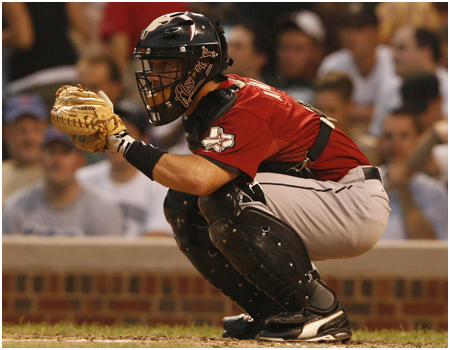
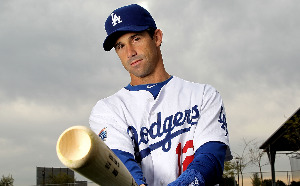
At Age 41, Former Astro Catcher Brad Ausmus is Done.

Word out of Los Angeles from reliable sources is not surprising. After 18 seasons in the big leagues, former Houston Astros catcher and pitching coach on the field, a catcher named Brad Ausmus, will not be returning in 2011 for another limited duty spin on the bench for the Dodgers or any other MLB club.

At 41 – the man is done. And he will leave as one of the smartest men to ever put on the tools of ignorance and squat for a living in baseball. The former Dartmouth University alumnus somehow escaped all of the Ivy League nicknames that writers could have crowned upon him for his brainy background, but that did not stop him from showing us all over time just how the powerful the combination of intelligence plus ability plus MLB experience plus the ability to communicate wisdom to others as coaching information together all carries the weight of a value that goes way beyond that of a player’s individual statistics.

Ausmus was one of the greatest handlers of pitchers to ever play the game – and he did it with a flair for oozing every ounce of confidence in pitchers about their own abilities. You can’t get a pitcher to relax and use his own best abilities for long unless he really believes in himself and that truism is something that Brad Ausmus just seemed to naturally understand. If anything, he inspired confidence as much as he taught or picked up on issues of technique and mechanical performance. The catcher who do both of those things is a cut above all others – and Brad Ausmus was such a catcher.

Maybe the “Dartmouth Dandy” or the “Daring Datmouthian” would have either worked as monikers for Ausmus. Or maybe not. He didn’t need them anyway to get the job done – and his abilities extended to working with both the young and the veteran members of the Astros staff while he was here.

Brad Ausmus trained young pitchers for success – and he made it beyond easy for exceptional veterans like Roger Clemens and Andy Pettitte to join the staff at Houston in confidence that they were working with a battery mate that totally knew what he was doing behind the plate.

Statistically speaking, the offensive career of Brad Ausmus is not much to write home about. In eighteen seasons (1993-2010), Brad Ausmus batted .251 with 80 career homers and a career slugging average of .344. Over his past two seasons (2009-10) as a limited duty backup catcher for the Los Angeles Dodgers, Brad had only appeared in 51 games through August 26th of this current 2010 season. His main value to LA has been in his role as a coach on the ground of active duty, but the absence of success under the Joe Torre managerial tenure and wholesale personnel questions seem to negate the continuation of Ausmus in his current role. Until the Dodgers figure out what they want to do now, even Brad Ausmus can’t help them.

Old Number 11 Lives on in Astros Club Lore.

Brad Ausmus did a little traveling in his big league days. He started out with the San Diego Padres (1993-96) before being dealt to the Detroit Tigers for the latter part of the 1996 season. The Tigers then traded Ausmus to the Houston Astros for his first tour of duty here (1997-98) and those first two NL Playoff Runs under new manager Larry Dierker.

Then, because the Astros still didn’t understand the jewel they held in their hands, Ausmus was dealt back to the Tigers for the 1999-2001 seasons. After a huge fall from playoff grace, the Astros reacquired Brad Ausmus in time for an eight-season run (2001-08) that would see the Astros return to the playoffs under Dierker in 2001, and then, under new manager Phil Garner, get close to the pennant in 2004, and then take the NL flag and go all the way to the World Series for the first and only time in 2005.

Brad Ausmus made the American League All Star Team with the 1999 Detroit Tigers, Upon his return to the Astros, Ausmus also captured Gold Glove Awards at catcher in 2001, 2002, and 2006.

Brad Ausmus’s greatest Astros moment came in the deciding game of the NLDS battle with the Atlanta Braves at Minute Maid Park in 2005. With the Astros needing only one more win to move into the championship round against the St. Louis Cardinals, the Braves jumped all over the Astros and led 6-1 going into the bottom of the eighth. Then thunder began to strike from Astro bats.

Lance Berkman crunched a grand slam in the bottom of the eighth to bring the Astros back to mere 5-6, one-run deficit. Then, in the bottom of the ninth, with two outs and Brad Ausmus batting, things looked pretty much “over and done with” for the trailing Astros.

That’s when Brad Ausmus lifted a high fly to deep left center. The ball bounced arguably over the HR line on the high wall for a game-tying swat. The two teams would then spend almost another nine innings trying to break the 6-6 tie before Houston rookie Chris Burke finally  lifted a home run into the left field Crawford Boxes to sudden death the 7-6 Houston win and send the Astros on to a pennant series win over the St. Louis Cardinals.

Were it not for the 9th inning game-saver shot by Brad Ausmus, the whole parade of iconic drams that unfolded from there, including Roger Clemens’s great  extra inning relief appearance, never would have happened.

And now Brad Ausmus finally takes leave of his valued role as the flight instructor who still sits down in the co-pilot seat for every flight with his trainees. In my view, Brad Ausmus is quitting just in time to begin a beautiful new career as a full-time coach and manager – if that’s what he wants to do.

Good Luck, Brad Ausmus! Maybe we will see you in Houston again someday for a charm-filled third tour of duty with the Astros as a full-time teacher, coach, or even manager.

Who knows? I just have a hunch, or maybe it’s a baseball wish,  that our paths will cross again in Houston in some kind of way down the line.

Papai Was a Rollin’ Stone

August 26, 2010

Al Papai Won 20+ For Both the '47 & '51 Champion Buffs!

Al Papai was a rolling stone. Wherever he worked his knuckleball magic was his home.

In ten of his fourteen-season minor league career (1940-58) years, the wobble-ball expert worked in different cities beneath the major league level, building a career mark of 178 wins, 128 losses, and an ERA of 3.29.

On four occasions, Papai won 20 plus games in minors. His first two big years found him going 21-10 for the 1947 Texas League and Dixie Series Champion Houston Buffs, returning to post a 23-9 mark with the 1951 Texas League Champion Buffs. Papai also pitched for the Buffs in 1952 and 1953, but failed to come close to 20 wins. His other two 20 plus win seasons came about for Al with the 1955 Oklahoma City Indians (23-7) and once more in 1956 with the Memphis Chicks (20-10).

In four seasons at the major league level (1948-50, 1955) with the Cardinals, Browns, Red Sox, and White Sox, Al Papai also chipped in another 9 wins and 14 losses with a 5.37 ERA. Papai’s control and the character of his wobbler pitches were a little too hittable at the major league level, but he was hell on wheels in his four seasons as a minor league big-time winner. Papai definitely had the stuff against the much tougher high minor league competition of that era to have become a big time winner in the big leagues of that time. It just didn’t happen.

At 6’3″ and 185 pounds, Al Papai was a popular Buff during his Houston days – and a guy with a droll sense of humor that everyone seemed to appreciate. Example: Al Papai escorted a beautiful young lady in a bathing suit named Kathryn Grandstaff to home plate at Buff Stadium in 1951 to be honored as “Miss Houston Buff.” The club had asked teammate Larry Miggins to do these honors originally, but the very modest and bashful Mr. Miggins was too embarrassed to escort what he considered a “nearly naked” young woman into a public appearance under these circumstances. The absence of much clothing did not bother Papai in the least.

Later, when Kathryn Grandstaff changed her name to Kathryn Grant and went on to Hollywood as the new wife of singer Bing Crosby, Papai called up the memory of that time he escorted the beautiful young actress at Buff Stadium. “Hope she remembers who made her what she’s become today,” Papai offered.

Al Papai passed away at his home in Springfield, Illinois on September 7, 1995 at the age of 78. That was the around the same time we were preparing in Houston for “The Last Round Up of the Houston Buffs” and I was helping former Buffs President Allen Russell with putting together his mailing list to all the former Buffs we could locate.

Sadly, we learned from Al Papai’s widow that his invitation had arrived on the day of his funeral. Allen Russell was so touched by the irony of this near miss that he brought Al’s widow to Houston to represent him among all the former teammates who were left behind to grieve his loss.

In addition to Papai, we’ve lost most of the former Buffs who were alive and able to attend that 1995 great reception at the Westin Galleria in late September 1995. including Allen Russell himself. Among the players who made it there that day, only Solly Hemus, Larry Miggins, and Russell Rac, plus program emcee, Milo Hamilton. After the Sunday lunch and reception, the last of the old Buffs went together to watch the Astros take on the Cardinals at the Astrodome. The spirit of Al Papai was very much present with all of us that afternoon.

As a kid, I really woke up to baseball in 1947. Al Papai, the original old knuckleballer, is the first pitcher I ever saw. He had a lot of influence upon my later interest in the careers of Joe and Phil Niekro.

Chalk that one up to the “small wonders” category of explanations. And have a memorable Thursday, as long as the memories are worth keeping.

The Astrodome: No Way to Treat a Lady!

August 25, 2010

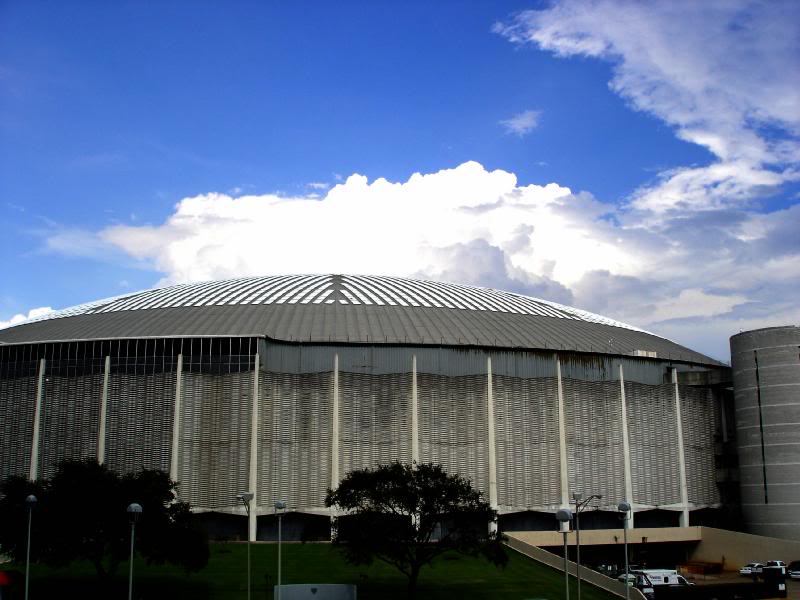
We need to make a clear decision on the Astrodome. The old girl deserves a better fate than the one she's now getting by default. As a big part of our local past, we need to decide her future with a little more dignity than she's so far received.

In the 46 years of her life, the Astrodome spent the first 35 of those years (1965-1999) as home to the Astros, Oilers, Rodeo, and numerous and myriad other notable sporting events and concerts, crusades, and even one national political convention. Everybody from Pastorini to Presley played the house that Judge Hofheinz established once upon a time as The Eighth Wonder of the World.

Things were great at the Dome. Then everything changed just prior to this last turn of the century. The Oilers left Houston without the NFL once the city rejected their bid for major help in building a new stadium. Then the Astros threatened to leave if we didn’t do the same for baseball and, this time, we were persuaded to “step up to the plate” and keep major league baseball from leaving too.

Once the Astros moved downtown to the new baseball retro design park at Union Station in 2000, the Astrodome found itself reassigned to purgatory, if not hell. Local interests led by Bob McNair and the Rodeo got us another NFL team in 2002 by building us a second retractible roof new venue designed mainly for football and things were looking good again, except for one thing.

Everybody, except for the rats and the tax collector, forgot about the Astrodome. For the past eleven years (2000-2010), it’s been allowed to sit and rot away before our “we-don’t-even-want-to-look” eyes as one flamboyant pie-in-the-sky plan after another has failed to fly with iron butterfly wings.

So the Dome sits and rots some more. And we pick up the two to three million dollar annual tab from the county as the tax on our no-decision point of view.

Personally, I agree with the position expressed by Houston Chronicle writer Richard Justice in an article he wrote within the past week on this same subject. We ought to do something to preserve the Astrodome by putting it to some constructive, big plan use. If we’re not going to do anything, then I say, “tear her all the way down and let the pictures and memories we shall always have for her be her last testimony as the first great domed stadium in the world.”

What we are doing now with the Astrodome is no way to treat a lady.

Satch Davidson Dies in Houston

August 24, 2010

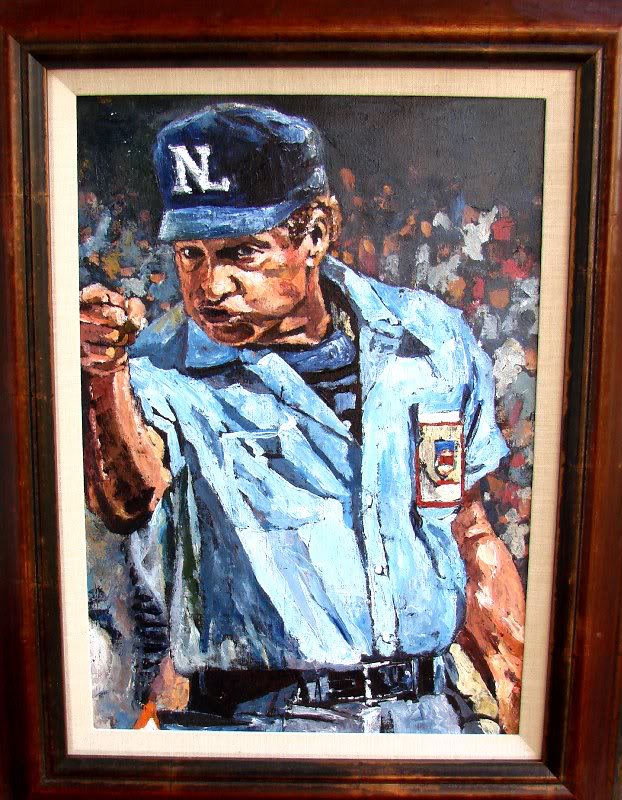
Former NL Umpire Satch Davidson in a 2005 oil piece by Opie Otterstad.

Sad news fills my heart today. Former National League umpire and ongoing good friend to baseball, Satch Davidson, passed away in his Houston home this past Saturday, August 21, 2010. He was 75.

Word came here from Satch’s widow, Lynn, shortly after I had completed and published the column I wrote yesterday on The Father of All Umpires, Bill Klem. Details of his death and memorial service plans were still pending at this writing deadline. Keep checking with the Houston Chronicle online for further information.

I was blessed to get to know Satch a little better on a personal basis during my four years as active Board President of the Texas Baseball Hall of Fame from 2004 to 2008. As a longtime Houston resident from his service years through retirement, Satch Davidson was most deservedly, and most enthusiastically, inducted into the Texas Baseball Hall of Fame on November 11, 2005. Texas people, and especially Houston people, are most appreciative of all that Satch did and continued to do as a representative of baseball to the community at large.

“Satch” acquired that only first name he accepted as his own during his boyhood years in his native home town of New London, Ohio. As a young fan of the old Bowery Boys movies, Davidson’s favorite character from the gang was “Satch,” the comedic sidekick to gang leader Leo Gorcey, whose own character shifted in name over the years from Mugs McGinnis to Slip Mahoney.

Mugs was my guy. If only I had grown up in Satch’s neighborhood, we could have both gone on from there to our various careers as Mugs McCurdy and Satch Davidson, but it wasn’t to be.

As an adult, Satch Davidson actually met and became fast friends with actor Huntz Hall, the fellow who played Horace Debussy “Satch” Jones in that almost endless stream of Bowery Boys/East Side Kids films that poured out of hollywood as Saturday afternoon kid’s fair stuff from the late 1930s into the 1950s.  As part of Satch’s TBHOF induction “goody bag,” we also gave him a DVD set of Bowery Boy movies that hit home harder than the plaque or artwork of himself that he also received, but that was Satch. He never lost track of what was really important.

Speaking of such, Satch’s attraction to sports soared early. After playing as a three-sport man at WIlmington College and Ohio State University, Satch played a little professional football and baseball before settling into his major life work as a National League umpire from 1969 through 1984. During those years, Satch spent the baseball off-season a referee in the midwest for NCAA Division I basketball games.

Davidson embraced his umpiring job with great fairness and a unmistable flair for the dramatic call. The expression captured in the accompanying 2005 painting here by artist Opie Otterstad says it all.

Satch bristled when people tried to draw him into discussions about items like the “phantom gimme out call” on second base during double plays. “There is no such thing as a ‘gimme’ on any out call,” Satch would state firmly. “A runner is either safe or out – and he is really neither until the umpire gives the signal.”

Sounds a lot like Bill Klem and “it ain’t nothing until I call it,” Don’t you think.

Stach was no fan of game time instant replays on the big screen of big league ballparks and was a leader in fighting for their elimination on crucial play situations. Satch had some help into that position when a Cincinnati fan once hit him in the head with a flying soda can after instant replay on a  Davidson call was made to look doubtful on the big screen.

Satch Davidson saw some memorable action as a big league umpire. He was behind the plate for five no-hitters – and he was also there when Hank Aaron hit his 715th home run to surpass Babe Ruth in April 1974. Davidson also was behind the plate for the famous home run by Carlton Fisk of the Boston Red Sox in Game Six of the 1975 World Series against the Cincinnati Reds.

In addition to his Texas Baseball Hall of Fame induction, Satch received the Al Somers Man of the Year Award, an honor  granted for outstanding service to Major League Baseball and also the Sports Professionals Foundation Lifetime Achievement Award.

Satch also has served as an instructor for the Southern Umpires Camp in Atlanta, Georgia and the Harry Wendlestedt School for Umpires in Daytona Beach, Florida.

During the 1994 baseball season, Satch even saw duty as the pitching coach for the San Antonio Tejanos of the Texas-Louisiana baseball league.

When you come down to it, Satch Davidson was a baseball renaissance man. He loved the game. And he loved teaching people about the game and how to care about it. He also approached life with the kind of fairness and certainty of outlook that made him successful as both an umpire and tight friend of the game. He was the total package of the only kind of teacher worth having: He came. He saw. He learned. He taught what he learned to others. And then he went back to earn some more.

Baseball has again surrendered one of its true-blue family members. And we’re all going to miss him.

Say hello to the other “Satch” and old Mugs for me, Mr. Davidson. Our loss is their gain.

Late News (8/31/10): A memorial to celebrate Satch’s life will be held on Saturday, September 18, 2010 at 10:00 AM at Geo H. Lewis & Sons 1010 Bering Drive, Houston, Texas 77057. Please visit the website www.geohlewis.com for further details.

“It Ain’t Nothing Until I Call It!”

August 23, 2010

Bill Klem invented the "safe" and "out" hand signs.

Even if we hate umpires, the game of baseball could not survive for long without them exerting a real place of fair authority over what happens on the field. They are the judge and jury of everything that happens on the field, from Little League to Major League. Take away that power and the game soon dies.

Before a fellow named Bill Klem came along at the turn of the twentieth century, there was something of a danger to the integrity of the game because baseball had failed to back its officials to the nth degree. A few players got away with two-fisted attacks upon umpires and some umpires even got fired for trying to fine owner’s pet players for assaulting behavior toward them on the field. Top that with the presence of bully managers like John McGraw of the New York Giants and baseball had the potential of making itself over into something that resembled what professional wrestling was to become by the the mid-twentieth century – little more than a sideshow entertainment in which the umpires were little more than a prop in service to the melodrama.

Baseball survived as a legitimate sport and much of the credit has to go to Bill Klem for all he did to build unshakeable support for the umpire’s authority in the game. The issue that got settled is probably best summarized in this heated exchange between the bombastic John McGraw and arbiter Bill Klem. In a rage over one of Klem’s umpiring calls, McGraw lashed out that “I can have your job removed from you over this call!” Klem quickly responded, “If it’s true that you can have my job because you don’t like my call, then I don’t want this job, anyway!”

In an interesting tale of two adversaries, Klem and McGraw actually became close friends over time, often having lunch together when the opportunity presented itself, even though their on-field vitriol continued on the through McGraw’s last 1933 season as manager of the Giants.

McGraw didn’t get Klem’s job and “The Old Arbitrator” held his ground.   From 1905 to 1941, he held forth as a major league umpire, becoming the on-field official who developed the universal hand signals for strike/ball, safe/out. and fair/foul. Klem recognized that no umpire had a voice to carry this ongoing heart-of-the -game news to fans throughout any large ballpark so he developed and used, and guided others to use the very signals we still rely upon today to know the result of every action on the field.

Klem also developed the crouching, over-the-shoulder  of the catcher view on balls and strikes and the

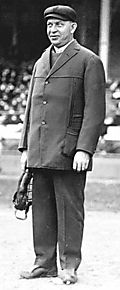
Bill Klem, Hall of Fame Umpire

regular use of chest protectors by plate umpires, plus the straddle view on long balls hit closely down the line. Klem is famous today for getting across his umpiring role as the supreme authority in games with this simple answer to a real game-in-progress question, “Is that ball fair or foul?”

“It ain’t nothing until I call it,” Bill Klem snapped.

Over the course of his 26-season career, Bill Klem worked in 18 World Series. No other umpire has worked more than 10. He also was one of the umpires who worked the first 1933 All Star Game, returning as an umpire in the 1938 All Star Game, as well.

Klem hated the nickname “Catfish” that a minor league manager once hung on him in the heat of the moment. The manager yelled something like, “Hey, Klem! You big catfish! You don’t speak. You don’t smile. You just stand back there like a big old catfish, breathing through your gills!”

The manager got tossed, but the “catfish” name stuck. Legend has it that Klem would toss a player for even whispering the word within earshot of his presence. Klem once even ejected a player when he caught him in the dugout quietly drawing a picture of a catfish.

Bill Klem passed away in 1951 at the age of 77. Two years later, Klem and fellow umpire Tommy Connolly became the first two umpires to be admitted to the Baseball Hall of Fame.

As an aside, my ninth grade home room teacher at St. Thomas in 1952-53 was “Mr. Klem,” a nephew of the famous umpire. When spring came and I played freshman baseball for one of the three feeder teams into our all-star freshman club (I also played for them), I played for the squad managed by Mr. Klem of New York. – He called us the “Giants.”

Funny how history rattles around in sidebar ways sometimes, isn’t it?

Houston: Where Hope Floats

August 22, 2010

Allen Parkway, 1960.

Allen Parkway, 2010.

You Houstonians already know these facts. Allen Parkway is a short, but important traffic artery leading into downtown Houston from the west at Shepherd Drive and ending 2.3 miles later at the I-45 section that skirts the immediate west bank of the tall buildings at Sam Houston Park near City Hall.

Through the 1950s, this busy, winding travel path to the south bank of Buffalo Bayou was known as Buffalo Drive. The name was changed to clear up confusion with another road in Houston near West University Place that is still called Buffalo Speedway. The name selected for the true bayou partner street fell quickly to “Allen Parkway” in honor of John Kirby Allen and Augustus Chapman Allen, the founders of Houston.

The towers of the 1960 vista are basically now covered by the monsters of the second. Houston has grown so much in the past fifty years – and it hasn’t been all physical. Thanks to the prevailing culture of can-do energy and adaptability, the city has survived wars, a number of economic crises, and important changes in the old culture that kept Houston spiritually small back in the days of racial segregation.

Houston was founded as an inland port and railroad transportation center. It grew as a rice, cotton, and cattle town. Then it leapt into prominence as the oil capital of the world. Now it builds on its still important energy center status as a growing international community manning an ever-diversifying economy in the world marketplace.

At the same time Houston changes, the forces that support our community’s memory and preservation of the area’s history are growing stronger by the day. It is important we adapt and change to both our needs for spiritual growth and the demands of the changing marketplace, but it is also important that we don’t give up connection to where we’ve come from. Our city’s history also contains some discriminatory values and practices in its past that we never want to forget or repeat. We will not forget those either.

For the city to embrace hope, there has to be hope and opportunity here for all law-abiding citizens.

As you’ve probably figured out by now, if you’ve been reading my columns for long, I’m a 100% Houston guy. This city has owned my heart forever and always will. We may not always be right, but we never stop working to get it right for the greater good of Houston, whatever that turns out to be..

Now, if we could just figure a way to dome the city for air conditioning in August each year, I might start believing that we could actually turn this town into the garden spot of the world. Have a nice Sunday, folks. I’m on my way to the take out service at Pappasito’s now. Nobody else around here wants to leave the house.

Early Houston TV Programs & Personalities

August 21, 2010

Bunny Orsak: Channel 13’s “Kitirik” mascot from 1954 to 1971.

Thinking for long on the subject of Houston’s early TV years brings to mind a ton of pleasant memories and so many unforgettable personalities. I’m going more for volume than explication this morning. with a look back at what’s still with me off the top of my pointed head by way of a Saturday morning notion of how each fits together by group association.

Here’s what I’ve come up with. Please feel free to add your favorites and all the others I’ve forgotten in the comment section of this column:

Local Station Caricature Figures: Kitirik of Channel 13, Milk Drop Mo, Cadet Don, Jock Mahoney.

Early Station Singers and Musicians: Howard Hartman, Marietta Marek, Don Estes, Johnny Royal, Paul Schmidt and the Tune Schmidts, Curly Fox, and Miss Texas Ruby.

Dick Gottlieb

1950s Station Announcers, News People, and Personalities: Dick Gottlieb, Lee Gordon, Bob Dundas, Bob Marek, Guy Savage, Paul Boesch, Pat Flaherty, John Wiessinger, Gus Mancuso, Lloyd Gregory, Bruce Layer, Jack Hamm (artist), Joy Mladenka, Page Thompson, and Jane Christopher.

1960s People: Carl Mann, Sid Lasher, Gene Elston, Loel Passe, Dave Ward, Dan Rather, Anita Martini, Larry Rasco, Doug Johnson, Bill Ennis, Bill Worrell, and Dan Rather.

Early Kiddie Shows: Crusader Rabbit, Mr. I. Magination, Mr. Wizard, Smilin’ Ed McConnell, Buster Brown,  Kukla, Fran, and Ollie, Howdy Doody, Mr. Rogers, Captain Midnight, Sky King, Batman, and Superman.

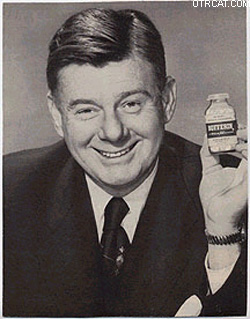
Arthur Godfrey, Hawking Aspirin.

Early Variety and Game Shows: The Texaco Star Theatre with Milton Berle, Arthur Godfrey Time, The Gary Moore Show, Stop the Music, Toast of the Town/Ed Sullivan, The $64,000 Question, Beat The Clock, Name That Tune, Who Do You Trust?, Twenty Grand, I’ve Got A Secret, What’s My Line?,  The Tonight Show with Steve Allen, George Gobel, The Jackie Gleason Show, and Password.

Early Sitcoms: My Little Margie, The Life of Riley, I Married Joan, Leave it to Beaver, Ozzie and Harriet, Amos ‘n Andy, The Addams Family, and Mr. Peepers,

Early Westerns: Gunsmoke, Cheyenne, Paladin, Wyatt Earp, The Lone Ranger, Wagon Train, Sugarfoot, Grizzly Adams, The Rifleman, The Cisco Kid, Roy Rogers, and Gene Autry.

Early Drama/Adventure/Cop Shows: Dangerous Assignment with Brian Donlevy, Boston Blackie, I Led Three Lives, One Man’s Family, Playhouse Ninety, Studio One, Dragnet, Route 66, Outer Limits, and The Twilight Zone.

Sports: Major League and Houston Buffs Baseball, plus one game of College Football every Saturday and a Red Grange telecast of the Chicago Bears or Cardinals from the NFL every Sunday – and it was all there for us on that tiny little fuzzy black and white TV screen with the visible horizontal separator lines running all across the picture, but so what? What did we know back then about the greater possibilities that lay ahead for us down the technological advancement line in years to come? Based on the “nothing” we had prior to TV, we thought we had died and gone to Heaven!

Family Famous Last TV-Related Words from Our Mom Back in 1952: “Hey, kids, why don’t we all sit down and watch ’em blow up that atomic bomb out in Nevada before you leave for school today?”

Early TV Was Like Radio with Pictures

August 20, 2010

TV Reached Houston on January 1, 1949.

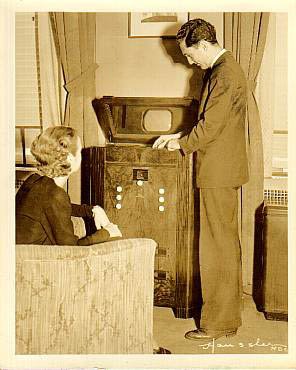
It came. We saw. It conquered us all. It was the middle of the 20th century and our communication media preferences were changing fast, from radio to television, and from big movie theaters out there in the world to those little theaters that moved just for us in our own homes. What a wild world it was turning out to be.

In spite of the fuzzy, squint-sized black & white pictures that came with our first 10 inch screen TV sets, the medium rapidly addicted us all to the idea that we could actually possess in our own homes, and for our own personal use, with no one sitting in front of us to block our view, a little machine that produced moving pictures for our individual home entertainment.

At first, television broadcasters and their home audiences shared this state of mind in common: Neither really knew what they were doing. Some may argue that this truth still holds today, but if it does, it is no longer a condition we may attribute to naiveté.  If it’s still true today, it’s now due to the kind of missing creativity that spawns reality television programming over great storytelling.

Back in 1949, when TV first came to Houston, everyone labored with two wrong handles on the new medium. Broadcasters and viewers alike treated the medium as either (1) radio with pictures; or (2) the movies with a small screen.

Nobody really knew what kind of baby had landed on their doorstep – and we especially misunderstood and underestimated the potential and demand for interaction that television would produce as the medium matured. In the beginning, people just saw it as a medium for putting out pictures that other people could watch for the sake of movement alone. Old movies became popular fare at local stations and slapstick comedy, boxing, and wrestling were all big too – because they all moved rapidly into action..

The early news broadcasts were literally radio with pictures. You got to watch a man sitting behind a desk literally reading the news from the typed paper in his hand. The only movement was the reporter’s lips as he read – and the papers being placed down on the desk as each page of reading was finished.

At commercial break time, the news man might pull out a Camel cigarette from his coat pocket and light one up to show you how mild and satisfying it was before he placed it down in the ash tray to keep on smoking as he finished reading the news.

At KPRC-TV in Houston back in 1950, the news, weather, and sports  were  handled by Pat Flaherty (Thanks for the correction on Pat’s last name, Bill Bremer!), John Wiessenger, and Bruce Layer. There were no anchor women back in the day and all the broadcast faces were white. Fortunately, in spite of our many ongoing imperfections, we have grown up as a people since the middle of the last century, but we should never forget from whence we came – so we don’t ever go back. Not everything in the good old days was all that good or fair, but it was interesting.

Weatherman Wiessinger of Channel 2 always began his weather-casts with this statement: “Good evening, ladies and gentlemen! Let’s see what the weather’s been doing.” He would then turn over his right shoulder, and using a stick of chalk as his pointer, he would indicate on a blackboard that contained an outline of the USA where the big weather-makers were occurring. Sometimes he drew clouds so that we might have an idea of what the next norther was going to look like. Lightning bolts made for a nice storm symbol too, but the rain drops he drafted were often hard to figure. The board would then be flipped to show the State of Texas – where Wiessinger would write the high/low temps from around the area. Sometimes the temps from the previous day would have to be erased first. That discovery always seemed to irritate John.

Once again, it was radio with pictures in that news era. Even if broadcasters had a bigger image of their job, they lacked the technology to do much more than what amounted to radio with pictures.

Bruce Layer on sports was a favorite of mine. I didn’t know about it back in 1950, but Bruce Layer had broadcast the first Houston Buff game back on April 11, 1928, the season opener for the Houston Buffs in their very first official game at the then new Buff Stadium. Bruce was knowledgeable in a droning sort of way, but he liked the Buffs – and that made him alright with me.

One live program I really enjoyed each spring on Channel 2 was a weekly pre-season show called “The Hot Stove League.” Moderated by Lloyd Gregory with the help of Bruce Layer and writer Clark Nealon, The HSL was dedicated to examining the upcoming season of the Houston Buffs from about eight weeks over the time that led into the regular season. The show would feature guests like Buffs President Allen Russell and the Buffs manager and featured players as they became available.

Lloyd Gregory had been the arguably leading sports writer in Houston from the late 1920s forward, He is the guy who gave Joe Medwick his “Ducky” nickname during the latter’s 1934 season in Houston. After a female fan wrote Gregory, suggesting that Medwick should be called “Ducky” because he walks like a duck, Gregory just picked it up and put it on poor Joe and it stuck. For life.

This small slice of memory is pretty much how local programming worked here until the coaxial cable reached Houston and connected us to live broadcasting from New York on July 1, 1952. The flow of live TV into Houston via cable began to change everything, but I don’t think TV really separated itself from radio until the late 1970s, when satellite pictures and videotape enhanced the availability of fitting action pictures a thousand times over to the field of news reporting.

Just my thoughts. – Have a nice weekend, everybody!

Judas Asparagus and the Like.

August 19, 2010

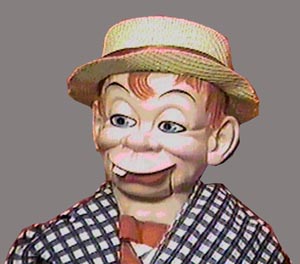
Whenever I heard the name "Harold Square" from that song, he looked like Mortimer Snerd in my child's mind.

One of the things about being kids was that we heard things literally as they sounded to our ears. For my big personal example, I only have to go back to that old George M. Cohan song, “Give My Regards To Broadway” for an example. Whenever I heard the lyric, “Give my regards to Broadway. Remember me to Herald Square,” I heard the latter part as the name of a person, some guy named “Harold Square” and, to make it worse, “Harold” conjured up the image in my mind of the biggest square I could think of back in the day, a puppet that radio’s Edgar Bergen called “Mortimer Snerd.”

I never thought much about that confusion until I grew older and learned that some other people had done the same thing with many other words and phrases they heard. Former broadcaster Hugh Downs admitted on 20/20 once that he used to hear that old song about “carry moonbeams home in a jar” and think that some guy named Cary Moonbeams was staying home inside a jar.

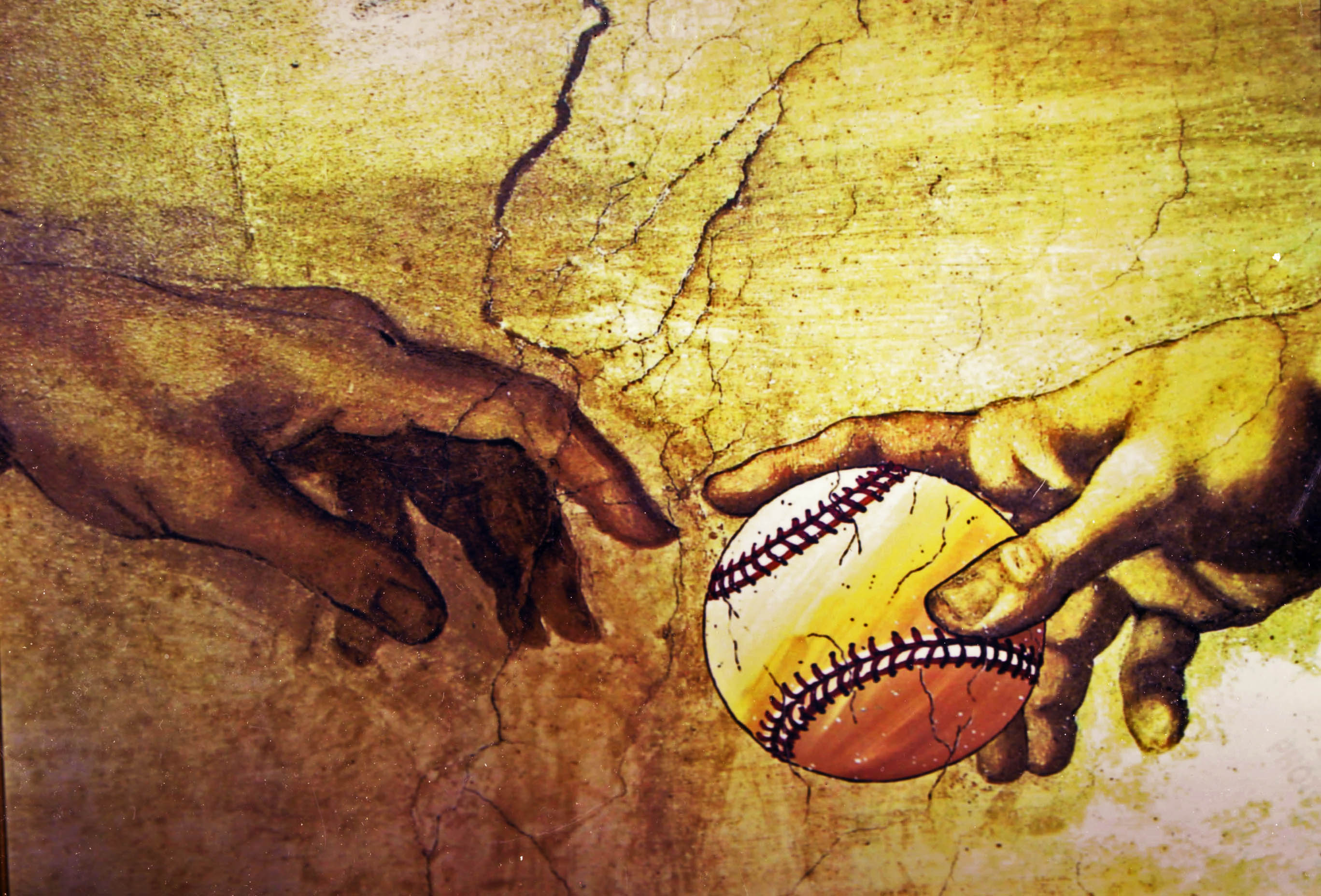
Wow! It’s a good thing we sometimes get smarter as we age. Sometimes. Remember hearing someone reading Genesis from the Bible for the first time and thinking it was about baseball because the story starts out, “In the big inning?”

"In the big inning ..."

How many people still misunderstand the start of Genesis? Apparently the artist who did this wonderful baseball version of the beginning, at least, thought it once or twice in his or her early life. Wish I could give him or her full credit for a job well done here, but I most apologetically do not know who did the piece. I will make an effort to find out and let you know what I learn, sometime down the road.)

One of my former classmates from St. Thomas High School, the one and only Vito Schlabra, sent me an item an overnight that stirred the inspiration for today’s column on literal childhood thinking. “Judas Asparagus” also comes to us with no author making claim for its contents. As one result, there is no one around to explain if these materials are actually the products of childhood misunderstanding – or simply the adult reconstructions of what easily could’ve been misunderstood by a child as he or she listened to these bible stories long ago.

No disrespect to the Bible is intended here. Anyone who thinks so is already living in a hell that I want no part of. I can’t imagine spending eternity with a group of people who have no sense of humor. One evening with same is bad enough.

At any rate, Judas Asparagus (by our anonymous/unknown author) is both funny and engaging. I hope you agree and, also, regardless of your personal beliefs, that it helps tilt your Thursday even closer to the weekend. Enjoy!

Judas Asparagus

Judas Asparagus

A child was asked to write a book report on the entire Bible.  This is amazing and brought tears of laughter to my eyes. I wonder how often we take for granted that children understand what we are teaching???

Through the eyes of a child:

The Children’s Bible in a Nutshell

In the beginning, which occurred near the start, there was nothing but God, darkness, and some gas.  The Bible says, ‘The Lord thy God is one, but I think He must be a lot older than that.

Anyway, God said, ‘Give me a light!’ and someone did.

Then God made the world.

He split the Adam and made Eve.  Adam and Eve were naked, but they weren’t embarrassed because mirrors hadn’t been invented yet.

Adam and Eve disobeyed God by eating one bad apple, so they were driven from the Garden of Eden…..Not sure what they were driven in though, because they didn’t have cars.

Adam and Eve had a son, Cain, who hated his brother as long as he was Abel.

Pretty soon all of the early people died off, except for Methuselah, who lived to be like a million or something.

One of the next important people was Noah, who was a good guy, but one of his kids was kind of a Ham.  Noah built a large boat and put his family and some animals on it. He asked some other people to join him, but they said they would have to take a rain check.

After Noah came Abraham, Isaac, and Jacob.  Jacob was more famous than his brother, Esau, because Esau sold Jacob his birthmark in exchange for some pot roast.  Jacob had a son named Joseph who wore a really loud sports coat.

Another important Bible guy is Moses, whose real name was Charlton Heston. Moses led the Israel Lights out of Egypt and away from the evil Pharaoh after God sent ten plagues on Pharaoh’s people.  These plagues included frogs, mice, lice, bowels, and no cable.

God fed the Israel Lights every day with manicotti.  Then he gave them His Top Ten Commandments. These include: don’t lie, cheat, smoke, dance, or covet your neighbor’s stuff.

Oh, yeah, I just thought of one more: Humor thy father and thy mother..

Joshua fought the battle of Geritol and the fence fell over on the town.

After Joshua came David.  He got to be king by killing a giant with a slingshot. He had a son named Solomon who had about 300 wives and 500 porcupines. My teacher says he was wise, but that doesn’t sound very wise to me.

After Solomon there were a bunch of major league prophets. One of these was Jonah, who was swallowed by a big whale and then barfed up on the shore.

There were also some minor league prophets, but I guess we don’t have to worry about them.

After the Old Testament came the New Testament. Jesus is the star of The New.  He was born in Bethlehem  in a barn.  (I wish I had been born in a barn too, because my mom is always saying to me, ‘Close the door! Were you born in a barn?’ It would be nice to say, ‘As a matter of fact, I was.’)

During His life, Jesus had many arguments with sinners like the Pharisees and the Democrats.

Jesus also had twelve opossums.

The worst one was Judas Asparagus. Judas was so evil that they named a terrible vegetable after him.

Jesus was a great man. He healed many leopards and even preached to some Germans on the Mount.

But the Democrats and Republicans put Jesus on trial before Pontius the Pilot. Pilot didn’t stick up for Jesus.  He just washed his hands instead.

Anyway, Jesus died for our sins, then came back to life again.  He went up to Heaven, but will be back at the end of the Aluminum. His return is foretold in the book of Revolution.