Archive for the ‘Uncategorized’ Category

Worst. Astros Club. Ever.

June 17, 2011

June 16, 2011: The day the Astros fell 11 games back of the once lowly Pirates.

I can’t think of a better time to do this little knee jerk spot check on the future of our current Astros roster. After all, it’s the middle of June, hotter than hell, with no rain to cool us and preserve our lawns  in what feels like a thousand days, and no run support and relief help for any Astros starting pitchers who dare to take the mound and pitch an effective six to seven innings in this redundantly disappointing baseball season.

Yesterday it was rookie Jordan Lyles turn to take his lumps and this time the lumps were on the starter and his ineptly supportive Astros offense. Lyles first attempted to pitch an entire game in the first inning, getting two outs before allowing a couple of batters reached and sat on the ponds for a bigger Pirate duck to bop them home with a drive out of the park. Lyles then settled down and blanked the Buccos until the bottom of the sixth when he gave up two more runs, both unearned this time, but again after two men were out.

The Astros left 9 men on base, starting with 3 in the first and concluding with the tying run on second in the bottom of the ninth. The Astros might have scored the tying run on a badly muffed grounder to third, but the slowest man wearing an Astros uniform, short of some coaches, Carlos Lee, could not beat the long distance chase-and-throw recovery of the fielder’s throw to first for the last dagger out.

The 5-4 Pirates win sealed a sweep of the Astros and concluded a 2-8 record for Houston in the current home stand. It was definitely time for the team to hit the road and head for a time zone where only the most ardent Astros fans will now view the last televised out – and many will not even see the first. – What’s the point of even watching once you get to mail-it-in time?

Worst. Astros club. Ever.

So, back to that question: What’s the point of watching now? Assuming the club does not really go into a mail-it-in gear, the point of watching now is to see the future, as clearly as possible, from what we have here on the current roster, what we see coming along at Oklahoma City and Corpus Christi – and deeper down the minor league chain, and what we need to acquire via sensible future-oriented trades and growth supportive free agency signings.

People like Tal Smith, Ed Wade, and Brad Mills know far more than people like you and me about the detailed potential of the current 40-man roster, but we have opinions too as fans – and these opinions shape our abilities as fans to find enough hope to spring for tickets during an otherwise lost and crashing season.

What I go by on the assessment of players with potential value to a future winning team are age, performance, and signability. – Signability, in my book, covers all players who use agents other than Scott Boras. If I’m the GM, I don’t deal with any players who use Scott Boras. I try to trade them before their current contracts expire, especially if they are near 30 in age, anyway. – Get my drift? – Nobody gets rich by also volunteering for hold ups on the way to the bank!  Here’s the current Astros 40-man Roster by age attained in 2011, position, and current 2011 performance stats. I have used bold type only for those player whom I think have potential on-the-scene value to a future Astros winning team. I also do not assign “future value” status to the few good journeymen players that now help keep th 2011 Astros wheels from completely coming off. My list includes only young-enough veterans and prospects – with no “suspects” and no journeymen “expects.”

The 2011 Houston Astros: Those with Future Value and All Others

Pitchers:

Fernando Abad (L-L)  (26) (1-4, 6.91)

Enerio del Rosario (R-R) (26) (0-1, 4.65)

(1) Sergio Escalona (L-L) (27) (2-0, 3.24)

(2) J.A. Happ (L-L) (29) (3-8, 4.95)

(3) Wilton Lopez (R-R) (28) (1-2, 2.25)

(4) Jordan Lyles (R-R) (21) (0-2, 4.30)

(5) Mark Melancon (R-R) (26) (4-1, 1.62)

Brett Myers (R-R) (31) (2-6, 5.03)

(6) Bud Norris (R-R) (26) (4-5, 3.48)

(7) Aneury Rodriguez (R-R) (24) (2-4) (0-4, 5.80)

(8) Fernando Rodriguez (R-R) (27) (1-0, 3.65)

Wandy Rodriguez (S-L) (32) (4-3, 3.13)

Position Players:

Carlos Corporan, C (S-R) (27) (.143)

J.R. Towles, C (R-R) (27) (BA .198)

Clint Barmes, SS (R-R) (32) (BA .212)

Matt Downs, INF (R-R) (27) (BA .280)

Chris Johnson, 3B (R-R) (27) (BA .233)

Jeff Kepppinger, 2B (R-R) (31) (BA .301)

Angel Sanchez, SS (R-R) (28) (BA .252)

(9) Brett Wallace, 1B (L-R) (25) (BA .316)

Jason Bourgeois, OF (R-R) (29) (BA .377)

Michael Bourn, OF (L-R) (29) (BA .279)

Carlos Lee OF (R-R) (35) (BA .266)

Jason Michaels, OF (R-R) (35) (BA .193)

(10) Hunter Pence, OF (R-R) (28) (BA .326)

That’s it. I could only give bold endorsement to 10 men on the current 40-man roster s having some potential value to a winning club in four tof five years – and I had to be generous with my speed-mind development picture on some of the pitchers from this staff I’ve watched. We also need to include (11) Jason Castro, C (L-R) (24) (2010 BA .205) as our 12th man endorsement as a potential value to winning in the reasonable future, but I’m not sure I would consider even any of these men as untouchable if the right trade for rebuilding came along. Michael Bourn is not my bold lst because of his age in five years and his agent right now. The Astros need to deal Bourn while they can still get something for him. With a guy like Bourgeois available to fill in as  center fielder in the meanwhile, and the prospect of George Springer coming along in the future, the club doesn’t need to mortgage Mr. Crane’s ranch for the sake of dealing with agent Scott Boras.

That’s how I see it this morning, anyway, and, short of watching Koby Clemens come up to take a whack at major league pitching at catcher or third, I can’t see too much else to get excited about the rest of this season’s weary way beyond watching the hopefully continuing developments and improvements in Jordan Lyes, Bud Norris, and Brett Wallace – and waiting for Mr. Pence to bang out another multiple game imitation of Joe DiMaggio.

Have a nice weekend, everybody, and don’t fall asleep watching the Astros and Dodgers from LA tonight!

MLB Seeks What? League Balance?

June 16, 2011

My suggestion? Send Milwaukee back to the AL.

Baseball Commissioner Bud Selig and some members of the MLB ownership family apparently would like to see the American and National Leagues equalize their membership numbers, for the sake of easier scheduling and symmetry, we suppose.  As you probably know, the NL now has 16 member city teams and the AL only has 14 clubs. The result of that spread over three divisions per league i that the NL operates three units of 6, 5, and 5 teams while the AL squeezes by with three divisions of 5, 5, and 4 teams.

Without tearing everything up that now defines historic league boundaries and starting over, or adding two teams and then doing some minor shifting of franchise for the sake of creating two 16-club leagues that could schedule games without creating the need for some inter-league play on any everyday basis, the short answer, for now, would be to move one NL club to the AL.

But which club?

Houston? One fairly locally opposed suggestion has been to move the Houston Astros from the 6-team NL Central to the 4-team AL West. That move would place Houston in the same division with Texas and theoretically help generate a more competitive rivalry between the two intrastate clubs. Why not? Well, for one thing, Houston is traditionally an NL town. I don’t have any surveys to back me up here, but I don’t think you will find many Astros fans who want to see their club swooped up by the DH rule that governs the brand of baseball they play in the AL. Our other big local complaint is that such a move would involve moving Houston to all those late starting (9:00 PM) series in three cities on the west coast.

Arizona? Some say that Arizona is the most probable pick of the commissioner. Arizona would move to the AL West, but then, here comes the Houston penalty again. The Astros would move from the 6-team NL Central to the now depleted NL West 4-club division to restore its total to five members following the loss of Arizona to the other league. From a Houston perspective, this choice is almost as bad as the first suggested option. The club gets to stay in the NL, but still moves to the red-eye schedule of playing all those divisional rod games on the west coast.

My pick? How about Milwaukee! If Commissioner Selig really wants to make this move, why doesn’t he look no further than the club he used to own (or still does, in trust?), the Milwaukee Brewers. The Brewers were born in the AL and only came to the NL in the late 1990s s part of an earlier balancing move. WIth their natural history and affinity for the DH, the Brewers and their fans would most likely be the least affected by a change of leagues. It might even feel like a homecoming.

The first result of the Milwaukee move would be to reduce the NL Central to a 5-club division, After that extraction, it’s a two-move jump to what I think is our best solution: (1) Move the Kansas City Royals from the 5-club AL Central to the 4-club AL West Division; and (2) place Milwaukee in the now depleted 4-club AL Central to bring it back to five clubs – and creating two leagues, each now functioning with three 5-club divisions.

I realize that Kansas City fans might have most of the same problems with a transfer to a west coast division, but Houston is a bigger market and, as such, a bigger potential loss to both turnstile and television advertising revenues.

Here’s how the major leagues would then look with the return of Milwaukee to the American League under this plan:

American League

East: Baltimore, Boston, New York Yankees, Tampa Bay, Toronto

Central: Chicago White Sox, Cleveland, Detroit, Milwaukee, Minnesota

West: Kansas City, Los Angeles Angels, Oakland, Seattle, Texas

National League

East: Atlanta, Florida, New York Mets, Philadelphia, Washington

Central: Chicago Cubs, Cincinnati, Houston, Pittsburgh, St. Louis

West: Arizona, Colorado, Los Angeles Dodgers, San Diego, San Francisco

With two 15-club leagues, the door would be open for two clubs, one from each circuit, to play an inter-league series at every scheduling opportunity throughout the regular season. In fact, the change to two unevenly numbered leagues virtually removes the option to cancel inter-league play without serious consequences to the creation of a regular season schedule. Without inter-league play, one club from each league would always have an unwanted three days off while the other 14 clubs were playing each other.

So, one has to ask: What would be the real purpose of balancing the two leagues at 15 clubs each? Would it be to wrap up inter-league play as a necessity?  I really don’t know. I’m just asking.

What do you think is behind this movement?

Platters Head Jimmy Menutis Party, Sept. 3rd!

June 15, 2011

The Platters Await All Menutis Fans in Lafayette, LA, Sept. 3rd!

What a great Labor Day Weekend this 2011 celebration is shaping up to be!

The big Jimmy Menutis Birthday and 1950s-1960s Music Celebration has moved to Lafayette, Louisiana, the I-10 midway point between Houston and New Orleans, in a family effort to make Jimmy’s big celebration with his fans from both cities as equal a destination as possible.

Look, friends, and fanciers of the great music and artfully cool whip-dance fashion of that era, this is a once in a lifetime opportunity!

Where else are you ever going to have the chance to hear a headlining group like The Platters for free? Jimmy and Ruth Menutis are picking up the tab on bringing this iconic singing group to town with every memory string you may still have left in contact with numbers like, Only You, The Great Pretender, My Prayer, Smoke Gets in Your Eyes, Twilight Time, and Harbor Lights. The thoughts of these great songs alone are enough to make all of us fall in love all over again.

And this is no Time-Life music infomercial. This offer is free – free to all of you who are free to plan a beautiful holiday weekend deep in the heart of Cajun Country – where there is so much to do in addition to this golden chance for an evening time portal into those wonderful earlier times of the Jimmy Menutis Club in Houston and the birth of rock and roll.

You will have to provide your own transportation over to Lafayette, of course, and also pay for your hotel/motel room when you get there, but there is no charge for The Platters’ performance – and none for the old style whip dancing  opportunity you are going to have at The Petroleum Club of Lafayette, the site of the big party. The Menutis family is still working on arrangements. If any news surfaces about special hotel rates for Menutis party goers, I will quickly publish them here.

One thing you will need to do is register with Ruth Menutis, JImmy’s wife and the arrangements planner, as soon as possible. Ruth needs a firm showing of hands on who is coming and how many people are included in each traveling party.  The Petroleum Club can hold about 250 people and still have room for dancing, but Ruth needs to keep a gauge on names and numbers. This is going to be one popular venue come Sept. 3rd and folks need to make reservations to be guaranteed entrance.

The contact email address for Ruth Menutis is

rmenutis@brandedworksinc.com

Houston, 1959.

People who make early reservations will receive a special souvenir party invitation that includes a picture of the once gilded home of rock and roll in Houston, the Jimmy Menutis Club. Those who attend the party will get to express their own birthday good wishes to Jimmy in person; they will have the opportunity to fully  participate, if they so choose in a planned whip-dancing contest; and, very mysteriously, they will also be on the spot for a possible surprise performing guest. I’m not free to say who this special guest might be, but come on, Jimmy Menutis never did anything small. Plug in your own imaginations.

That’s it for now, but get your reservations in to Ruth Menutis soon. As plans develop further, and Ruth advises me of them, I will publish everything I learn right here in The Pecan Park Eagle.

One more “by the way.” Lafayette rests just north of New Iberia, where they have been making “Tabasco” for generations. If you’ve never visited the swampy wildness where all this hot stuff is raised from seed and then processed into that delicious fiery sauce, make sure you leave yourself time for a great day trip to the Tabasco Plantation during your stay in Lafayette. And bring your camera. The feathered and scaly wildlife are both abundant in this region of the world.

Rock n Roll: Narrative of the 1950s

June 14, 2011

Carl Gardner, Dead at 83.

The death of Coasters lead singer Carl Gardner this week at the age of 83 brought to light again an awareness of how much those early rock and roll singers of the late 1950s mirrored  the angst of my adolescent generation. They didn’t simply speak our language, they sang it, and they put it all into a rocking beat that spoke to our most puerile yearnings.

http://today.msnbc.msn.com/id/43383977/ns/today-entertainment/t/yakety-yak-singer-carl-gardner-dies/43383977

Take out the papers and the trash, or you don’t get no spending cash. If you don’t scrub that kitchen floor, you ain’t gonna rock and roll no more. – Yakety yak. – Don’t talk back.

So much of it was about getting enough money go out and all the “stuff” we had to go through (work) to get money. To those of who grew up with parents who lacked both the aspirations and the means to make things easy for us, work or crime were the only two ways to access cash. Fortunately for me, I had parents who frowned severely upon crime as an acceptable option to financial independence.

Chuck Berry was another of my other lyrical mentors in the song Too Much Monkey Business:

Workin’ in the fillin’ station, too many tasks. Wipe the windows. –  Check the tires. – Check the oil. – A dollar gas. – Too much monkey business. – Too much monkey business. – I don’t want your botheration. – Get away. – Leave me.

Of course, Eddie Cochrane also sounded the “do I really have to work” hue and cry with Summertime Blues in the summer of 1958:

I’m a gonna raise a fuss, I’m a gonna raise a holler – about workin’ all summer just to try and make a dollar. – Sometimes I wonder – what I’m gonna do, but there ain’t no cure for the summertime blues.

Somehow, and no doubt aided by the values and circumstances of our East End Houston families, most of us got the work ethic message without any tinge of entitlement to a life in which we took it easy while others worked to support us. Today you have to wonder how widespread that value remains. among today’s generation.

I’m not talking about the “work smart” folks who see labor only as something to do until you invent the net Facebook billionaire industry upon the sands of the Internet beach. I’m talking about the coming of people who view work as a choice, not a ball and chain master of life. How many people coming up today in this climate still see work as a desirable way to focus one’s productive efforts? Or is it now mostly all tied to “get rich quick and then quit work” ambitions – or simply finding a way to entitle one’s self to support from the public coffers?

Perhaps, we’ve come a long way from the Yakety Yak complainant days. Perhaps not.  When it comes down to our ideas about career work, however, it seems to me that we have taken something of a veer away from the lifetime commitment notion  that my 1950s generation embraced.

Do you like the road we seem to be taking with jobs and work today? Or am I simply imaging a difference that really isn’t there? What I see today is way too much political and cultural emphasis upon entitlement and less willingness to working for anything that isn’t tied to some kind of “get rich quick” scheme.

Please check in with a comment here.

What Happened? King James Version.

June 13, 2011

What happens when a talented narcissistic athlete faces a bitter  disappointment of his dream, but also lacks the intelligence to understand that his words of unpleasant digestion are dissing not only the fans who cheered for his downfall, but also those who loyally supported him? Look no further than Mr. LeBron of Miami for the King James version of how he compensates for the pain of supreme defeat’s great agony.

Here’s what LeBron James said:

“Sometimes you got it; sometimes you don’t. It hurts, of course. I’m not going to hang my head low. 

“At the end of the day, all the people who rooting for me to fail … tomorrow they have to wake up to the same life that (they had) before they  woke up today. They’ve got the same personal problems they had today. And I’m going to continue to live  the way I want to live and continue to do the things I want to do.”

Wait a minute, LeBron? Doesn’t your comment about all the little people who cheered for your failure also apply to all the loyal little people who supported you? Are you going to cover them? Share some of your choices with the faithful Heat masses?

I didn’t think so. And whether you now realize it, or not, you’ve just gonged a bell that will never be unrung. By your own words, you are simply declaring yourself as another elitist who thinks that his money and personal power are more important than the trust of others who pay his way at the NBA turnstiles and shopping mall shoe stores.

Oh, yeah, we know. Fans have short memories. And some of your lesser light fans won’t get, even now, the insult of your words toward them too, but it’s there, and it isn’t going away.

Lots of luck “taking your talent” to the next level, King James. Some of us will forgive you in time for being stupid, but only if you learn to show some genuine appreciation and humble awareness of how fortunate you are to have those talents you often speak of at transitional points in your life.

Brownie, JD, & Greg: A Winning Team

June 12, 2011

May Their Sunset As a Team Happen Only on the Longest Day of Some Far Distant Year.

If it’s the last thing on his to-do list as owner of the Houston Astros, at least, he gave it a  good scratch at Minute Maid park before the Saturday, June 11th game between our treasured home club and the visiting Atlanta Braves. Drayton McLane, Jr. and the Houston Astros took the time to recognize and honor the fine play-by-play television game broadcasting work of Bill Brown. Now working his 25th season as the TV play-by-play broadcaster for the Astros, “Brownie” worked a number of seasons with Astros icon Larry Dierker as his game analyst-sidekick, When “Dierk” took over the managerial reins in 1997, former Astros lefty pitcher Jim DeShaies stepped into the Dierker role with no fall off in either native or natural baseball intelligence. “JD” also brought with him an infectious sense of humor that continues to keep each game telecast entertaining and lively, even in the doldrums of a cellar-dwelling season like 2011. As Brown himself has noted in a recent interview, DeShaies inherently knows that television baseball is about entertainment and holding an audience’s attention.

The professionalism of both men, their natural chemistry together, and their mutual grasp of Marshall McLuhan’s old saw about TV that “the medium is the message” bodes well as the shortest explanation of their longevity. Both men know baseball, but they both understand that it has to play out well on camera to maintain its audience. Give people something they have to stay tuned to find out about and they are more likely to keep watching on the other side of the commercial avalanche. These guys get it. And they handle it over the air without any sacrifice to the integrity of the game.

Here’s a good way to make a comparative point: Back when Harry Caray was still alive enough to broadcast Cubs games, fans stayed tuned to see how many innings it was going to take for Harry to get sloshed and start mispronouncing even common names and words. In 2011, Astros fans stay tuned to see what Brownie, JD, and field broadcaster Greg Lucas are going to say when the Houston bullpen coughs up yet another winnable game in the last couple of innings. And what they each say is always fair, always measured, but honest, and often laced with irony or humor. I just love watching these three guys work together.

And JD also needs a night of his own someday. So does Greg.

JD’s use of pop cultural information and satire is seemingly inexhaustible. My favorite example came several years back, when everyone was still getting used to the option of having the option of a retractable roof. Once in while, the decision to leave the roof open left t game vulnerable to sudden rain bursts that called fora roof closure, asap.

This happened one day when Greg Lucas of Fox Sports Houston (and another of Houston’s best kept national broadcasting talent secrets) was working the sidelines near the Astros dugout. Greg Lucas is also highly knowledgeable baseball man and, like working partner Bill Brown, Greg Lucas is also an inducted member of the Texas Baseball Hall of Fame. Greg does most of the pre and post game interviews and special features work for the Fox broadcasting team – a duty that sometimes exposes him to hazards and other distractions of sudden bad weather changes.

On this particular day of memory, a rain came up faster than brains and machinery could engage and start the closing of the roof at the fairly new downtown Houston ballpark. So, Greg needed shelter from the rain to protect his hand mike while he continued his slightly time-perishable story. He grabbed some of the field tarp and sort of pulled it out and got under it, as I recall, and he kept trying to finish his story, even though now the visual of him seeking shelter was all that viewers could focus upon.

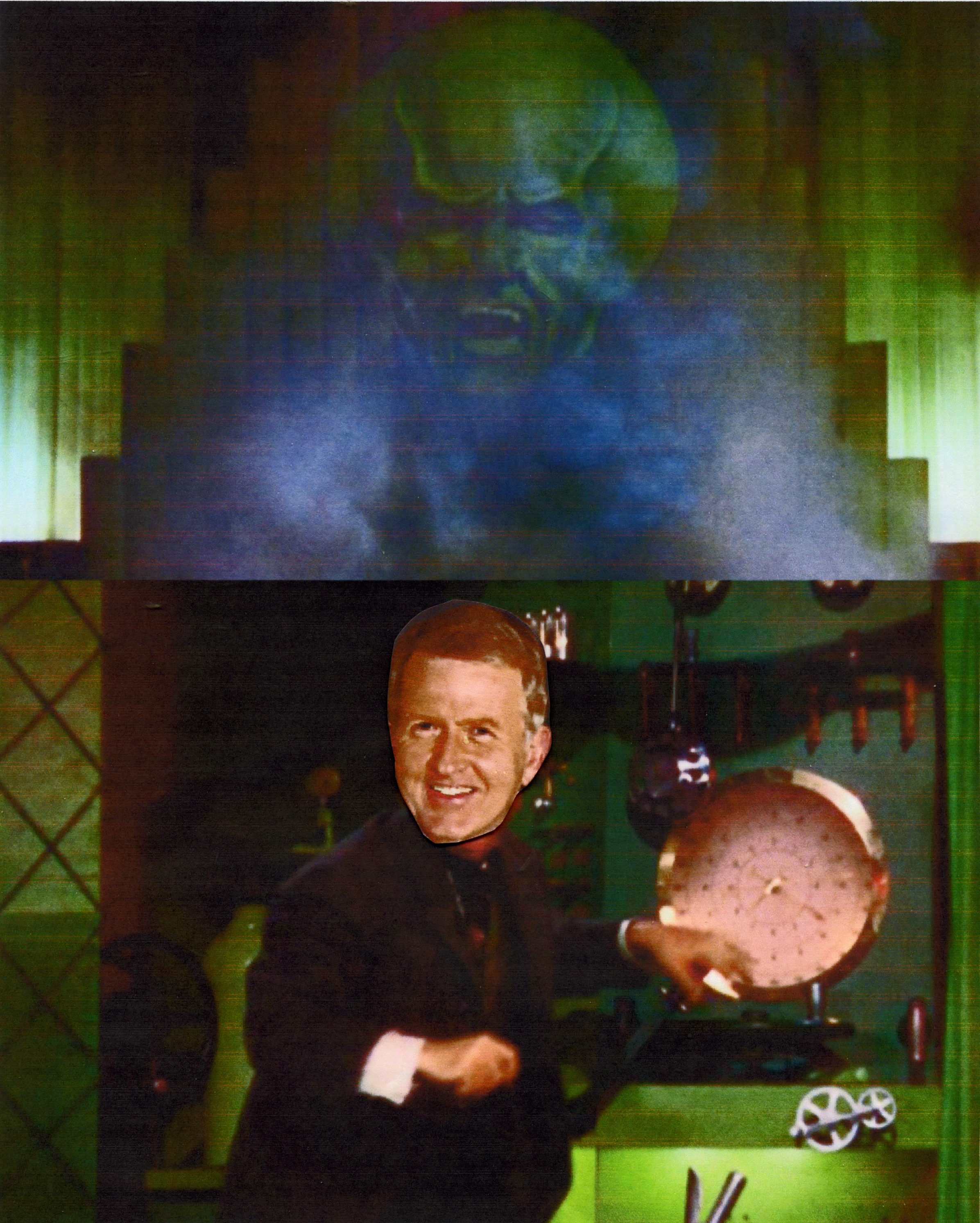
Jimmy DeShaies somehow sensed that same distraction as it unfolded. And so, with the impromptu use of a line that was straight out of “The Wizard of Oz,” JD pulled the audience back to Brownie and himself in the booth while saving Greg from an awkward moment of trnsition:

“Pay no attention to the man behind the curtain, folks. We’ve got a game to get back to up here.”

"Pay no attention to that man behind the curtain!"

With broadcasters like Brownie, JD, and Greg Lucas, Houston is well covered. In fact, with these guys aging like fine wine, I’m betting that the best is yet to come.

Somewhere in Time: KLEE-TV

June 11, 2011

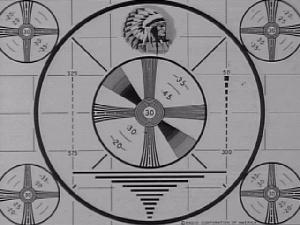
Channel 2 once had a station ID card that read "KLEE-TV".

Television first came to Houston on January 1, 1949, when KLEE-TV began broadcasting on Channel 2. A year and a half later, the still solitary station in town was purchased by the William P. Hobby family and its call letters changed to KPRC-TV. The plot of another urban legend soon enough took form.

In late 1953, more than three years beyond the time that Channel 2 had made the change of call letters, the Houston station received a letter from someone in England who claimed to have received a picture of their station call letters on a home TV. They reportedly took a picture of the call letters “KLEE-TV” on the placard with a box camera and included this photo with the letter. The alleged date of this event was noted as September 23, 1953.

Wow! Where do we start? The Britisher claim flew in the face of several scientific and factual realities in play for 1953. Remember. There was no existing operative home video equipment available back in 1953, no complete cable for connecting all of the USA for live broadcasting, and certainly no satellite capacity for worldwide transmission of images to England. Back then, you either lived with a few miles of a television station’s transmission tower and picked up their signal by aerial through a roof-mounted antenna (or by a rabbit-eared antenna on the TV set for visitors ling close-by) or you didn’t get a TV picture at all.

TV pictures rapidly left the earth for outer space once they departed as signals from their various transmission towers, but here was this character from England, claiming to have received the Channel 2 signal from North America. And more mind-boggling. Claiming to have received a signal that had to be three and then some years old, at least – from the most recent time that the station had broadcasted as KLEE-TV.

I remember the weird science speculation that unleashed itself from the public disclosure of this reported phenomenon. “Let’s see, Wilmer, these TV signals must have bounced off some object in space and reflected back to earth. If it took this thing three and one half years to happen, that comes down to a 42-month expanse of time. That means the signal had to hit something that was 21 light years away from Earth before it came back and hit the TV set of that dumbfounded viewer in rural England! Hmm! Makes you wonder if some little green men in another galaxy are just sitting there right now and watching ‘I Love Lucy!'”

The thing came with no quick explanation, or debunking, as most certainly would occur today in this era of Internet. It simply ripened for many of us as an urban legend, one that personally always wondered about until recently, when I read this bunko exposure article on snopes.com

http://www.snopes.com/radiotv/tv/klee.asp

Apparently, it was all part of a larger bogus plan to sell ordinary TV reception sets as special units with the power to pick up TV signals from all points on the globe. As it often does, the truth saddened me. I had learned to comfortably feel good about the possibility of beings in another galaxy watching “I Love Lucy.” And why not? If they ever do come visit us, wouldn’t it be nice to know that they came here with some appreciation for our sense of humor?

Prodigy Pollet, Impossible to Forget

June 10, 2011

Howie Pollet

The kinship ideas of seasoning and player development hardly ever applied to young lefty Howie Pollet of New Orleans. The kid signee of the St. Louis Cardinals began his pitching career at the age of 18, going 14-5 for New Iberia of the Evangeline League before moving up to Houston of the Texas League to add a 1-1 mark to his rookie season totals. At age 19, Pollet went 20-7, with a 2.88 ERA for the 1940 Houston Buffs. He returned to the Buffs at age 20 to go an amazing 20-3 with a 1.16 ERA for the 1941 Houston club. Pollet did turn age 21 on June 26, 1941. By the time he had finished the season at that tender age of new adult status, hie had registered a minor league record of 55 wins against only 16 defeats and a minor league career ERA of 2.28.

Cardinals General Manager Branch Rickey watched Pollet win his 20th game of the 1941 Buffs season and then called him up to help the Cardinals in their close near-miss pennant race with the Brooklyn Dodgers.  The loss of Howie Pollet unquestionably cost the 103-win first place Buffs the 1941 pennant as they went on from there to lose to fourth place Dallas, 3 games to 1, in the first round of the post-season playoffs, but that’s the way things still work in professional baseball. In a pinch, the needs of the major league club always come first.

Pollet finished the 1941 season with a 5-2, 1.93 ERA. He reported to spring training with the 1942 Cardinals with a sore arm. That would be the start of an arm injury history that would haunt and deaden the final results of his total career. More serious shoulder issues were yet to come a few years down the road.

Howie went into the army after posting a 7-5 record and an 8-4 mark for the 1942 and 1943 Cardinals. Pollet didn’t have the greatest fastball in the world, but he had great location ability on his pitches and an uncanny, hard-to-discern capacity for changing the speed at three leels on the pitches he did deliver.

After the war, Howie Pollet pitched the 1946 Cardinals to a World Series championship, posting a season record of 21-10 with an amazing 2.10 ERA. Pollet enjoyed one more 20-win season in 1949, going 20-9 with a 2.77 ERA for yet another near-miss Cardinals club, but painful shoulder trouble would continue to haunt his 14-season MLB career with the Cardinals, Pirates, Cubs, and White Sox through his last season of 1956.

Howie Pollet finished his MLB career with a record of 131 wins against 116 defeats and an ERA of 3.81.

After baseball, Pollet retired to his adopted home town of Houston to enter the insurance business in partnership with his former Buffs and Cardinals manager, Eddie Dyer. Pollet also kept an active connection with major league baseball, serving as pitching coach for the Houston Astros in 1965  Sadly, Howie Pollet passed away only nine years later in 1974 at the age of 53.

How many potential Hall of Fame pitchers have lost their way to greatness due to arm injury? Probably more than we shall ever know, but we have to place the name of Howie Pollet high on that list. Were Pollet’s arm and shoulder problems the result of genetics, a freak injury, or the product of too much pitching work too early? I doubt we’ll ever know.

On the other hand, there seems to be no doubt where Howie’s talent was taking him, had he not been injured. It’s also too bad that his family had to lose him so early, but that’s the way life works. We don’t always get what we want, but there are a number of lessons wrapped up in that reality too, starting with my favorite:

Every morning we wake up on the sunny side of the grass is reason enough to celebrate our gratitude by making the most of our day.

Houston Buffs of the Hall of Fame

June 9, 2011

The nine Houston Buffs of the Hall of Fame are simply those nine players who passed through our town and put in some big and small playing time with the old Texas League/American Association Houston Buffs on their ways onto, and away from,  greatness as major leaguers and career minor leaguers with incredible major league managerial experience.  Here they are in basic  chronological appearance of their various seasons with the Houston Buffs:

The list has been modified from the original seven Buffs I had identified as the whole body of those who later made it to the Hall of Fame. Thanks to diligent researcher Cliff Blau, we today add the names of Earl Weaver (1951-52) and Willard Brown (1955) to the list. Both were favorites of mine, making it harder to imagine how I missed either in my own search. I even played in the 1952 Earl Weaver League that waaa sponsored by the City of Houston Parks & Recreation Department and named for one the several youth program circuits identified by the names of various Buff players.

The lesson is always the same in baseball research. More than one brain and two pair of eyes are always preferable to the goal of due diligence in our search for accuracy. – Thanks again, Cliff!

Tris Speaker

 (1) Tris Speaker, OF,  (1907) batted .314 to lead the Texas League in hitting during his one 1907 season as a Houston Buff outfielder, Speaker, of course, went on to become one of the 1937 earliest inductees into the not-even-opened-until-1939 Baseball Hall of Fame. His career major league batting average weighed in at .345 and, at the time of his retirement, he was regarded by most to hae been the greatest fielding center fielder in the history of the game.

Jim Bottomley

 (2) Jim Bottomley, 1B,  (1921) had few “Sunny Jim” days with the 1921 Buffs. He hit only ..27 during his season with Houston before going on to a career .317 mark as a major leaguer and great first baseman.  Bottomley was inducted into the Hall of Fame in in 1974.

Chick Hafey

(3) Chick Hafey, OF, (1924) hit .360 for the 1924 Buffs, but still  failed to lead the league in hitting because a fellow named Art Weis of Wichita Falls hit .377 that year. Hafey went on to hit .317 as a major leaguer. He was inducted into the Hall of Fame in 1971.

Dizzy Dean

 (4) Dizzy Dean, P, (1930-1931) was 8-2 with a 2.86 ERA for the 1930 Buffs and then came back for a big leadership wins record of 26-10 and a 1.53 incredible ERA for the high-flying 1931 Buffs club. Dean’s 1.53 ERA tied Whitlow Wyatt of Beaumont for the league lead and his 303 strikeouts for the year blew away everyone else. Dean, of course, went on to a 30-win season with the 1934 Gashouse Gang World Champion St. Louis Cardinals and an injury-shortened career record of 150-83 and 3.02 career ERA. Ole Diz was inducted into the Hall of fame in 1853.

Joe Medwick

 (5) Joe “Ducky” Medwick, OF, (1932-1933, 1948) batted .305 for the 1931 Buffs; he led the league that years 19 home runs and 126 RBI. In 1932, Medwick’s Buff Batting average jumped to .354, but he lost the batting title to Ervin Fox of Beaumont and his .357 mark. After banging out a career major league BA of .324, Medwick came back down the Baseball ladder to hit .276 in limited action for the 1948 Buffs. Joe Medwick was voted into te Hall of Fame in 1968.

Earl Weaver

 (6) Earl Weaver, 2B, (1951-1952) hit .233 in 13 games for the 1951 Buffs and .219 in 57 games for the 1952 Buffs. Weaver never made it to the big leagues as a player, finishing a 14-season (1948-1960, 1965) minor league career with a BA of .267. Earl Weaver, of course, went on to a 17-season Hall of Fame major league managerial career record with the Baltimore Orioles from 1968 to 1986, winning 1,480 and losing 1,060. Under Weaver, the O’s won four pennants and a World Series, boosting Earl to Hall of Fame induction as a manger in 1996.

Willard Brown

 (7) Willard Brown (1955) hit .301 and crunched 19 home runs for the 1955 Buffs in 149 games as the club’s right fielder. Already in the record books as the first black player in the history of the old St. Louis Browns, and as the first black player to homer in the American League during the 1947 season, Brown was rewarded for his earlier, deeper record of achievement in the Negro Leagues with induction into the hall of Fame in 2006. In 1955, however late it ma have been, he was one of the most valuable members of the Houston Buffs and a man who definitely deserves remembrance on this list of “Houston Buffs of the Hall of Fame.”

Billy Williams

  (8) Billy Williams, LF, (1960) batted .323 with 26 home runs for the Houston Buffs in their next to last season of existence.  He went on to hit .290 with 426 home runs as a career major leaguer and he was inducted into the Hall of Fame in 1987. Billy  had a teammate on that 1960 Buff club that some of us over time felt was also worthy for Hall of Fame consideration, but it never  happened. His name was Ron Santo.

Enos Slaughter

 (9) Enos Slaughter, Manager-PH, (1960) was inducted into the Baseball Hall of Fame in 1985 after hitting .300 over the course of his very successful and legendary major league career with the Cardinals and Yankees. He became Houston Buffs hall of Famer when he later managed the 1960 Buffs club and gave into his passion for playing the game by using himself as a pinch hitter and spot player, hitting .289 in 45 official trips to the plate.

Without requesting a cross-reference check from the Hall of Fame Library, these are the only Houston Buffalo Hall of Fame players that I have ever been able to identify from a tedious review of available records. If you happen to find anyone I’ve missed, please let me know. I don;t do this kind of research for pride or ego. I do it because I care about baseball history and getting it right. I will take all the help I can get – just as those of us who are now working on the SABR Project we call “Houston Baseball: The Early Years, 1861-1961” will take all the help any of you may care to offer us that serves the aims of “getting it right.”

Just get in touch with me here at any times by leaving a comment on a column, along with whatever contact information you care to provide.

Thanks.

Baseball: A Kindergarten Summary

June 8, 2011

The baseball scoreboard is "pointless." This game is about "runs."

Some friends from Algeria are going with us to their first baseball game in the near future. As a result, I have tried to put together a basic set of points on what the game is all about. That job has turned out to be not as easy as it may have first looked. At my age, I’m still trying to figure out all the little odds and ends that sometimes appear.

Learning baseball is like learning a language. The younger you are at first exposure, the easier it is to absorb. Learning baseball as an adult, with no previous exposure to the game, is a little too much like any average English-speaking American deciding to learn Chinese Mandarin at the age of forty.

Here’s what I’ve gotten down on paper, so far. Let me know what you think is missing – or needs to be said differently:

A Kindergarten Course on the Game of Baseball

The object of the game of baseball is to score more runs than the other team over a course of nine equal attempts called innings. A run opportunity is registered each time a player either bats a ball safely enough to reach first base, one of the four running stations, or arrives there by one of the prescribed non-hitting ways – or as a result of some errant play by the team on defense. Once a “runner” reaches first, second, and third base safely, and then returns to “home” plate without being tagged or forced out along the way, a run is scored. There are a few other basics, of course, – basics such as balls and strikes, outs per inning, fair versus foul balls, called and swinging strikes, sacrifice bunts and suicide squeeze plays, balks and catcher’s interferences, tagged versus forced outs, and can-of-corn fly ball outs and shoestring catches – but we will try to pick up on those as they come up and explain certain things that happen in the context of the actual game we shall be watching. In the meanwhile, keep your eyes on the train and watch what it does every time an Astros player hits a home run. Also, check out the loud music that sometimes keeps you from thinking, let alone talking – and watch for the girls on the field that use a big slingshot to fire tee shirts into the crowd. Otherwise, you may get hit in the eye. That tradition goes way back to 1876 and the first season of the National League. Finally, as a first-time baseball game spectator, please don’t come to the game expecting to see any pepper games. There won’t be any.

In summary, baseball is a lot like many other things in life in one important regard. – The team that ends up with the most runs when play is finished wins the game. – Can you think of anything else in your life that works like that?