Archive for the ‘Uncategorized’ Category

Price Gouge Mars Special Trip for Young Idealist

July 7, 2011

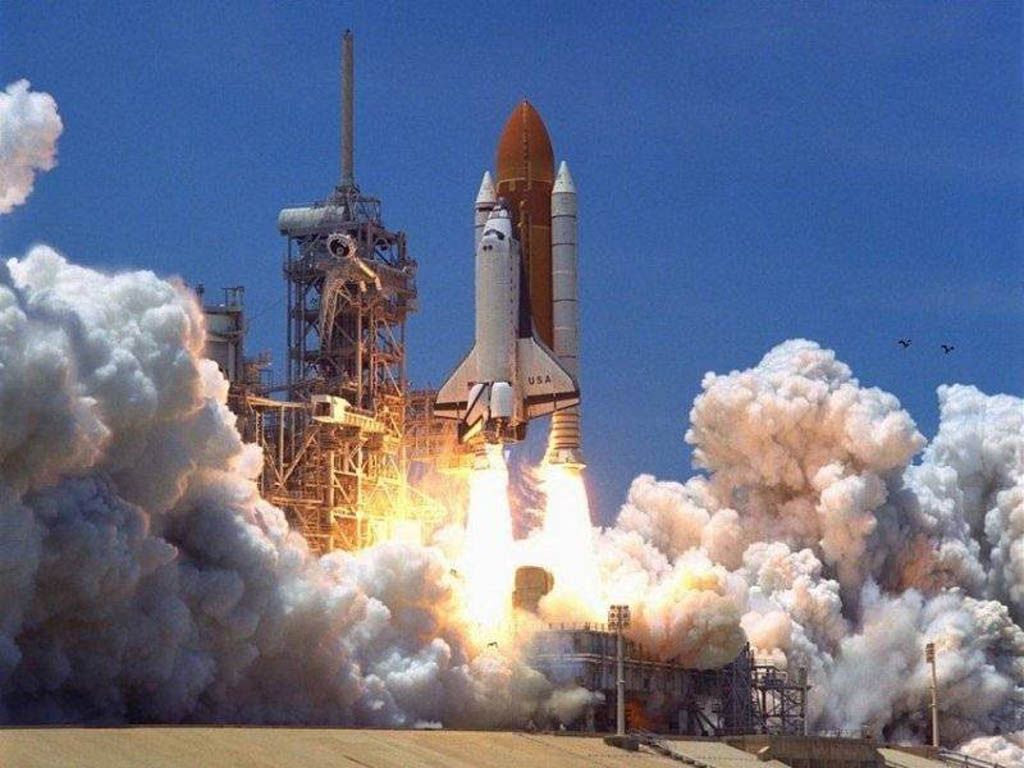
What Price Old Glory? Ask the Motels of Greater Cape Canaveral!

The 2005 World Series replay starts tonight and starts reporting tomorrow, one game a day in real-time until it’s done, but I had to report on this little extra discovery while it was still current and the juices were still flowing.

My young adult son Neal has been a NASA devotee forever. He has been planning to squeeze in an auto trip over there to watch this last launch live for several months in between semesters at UH, where he is now enrolled as a part-time working college student. The timing and financing of the trip were all on him – and he had to make his plans too in the knowledge that delays in the launch could result in him making the trip and still missing the launch.

One piece of advice Neal didn’t take from me was to check on motel prices in advance and make reservations somewhere nearby, if possible. He didn’t want to do that. I think he got it into his head that, if he made reservations in advance, and then couldn’t go, for whatever reason, that he would lose money he could not afford to lose. The worst we both figured might happen is that he would get down there and find that there was no room in the inn and be forced to drive a hundred miles away to find a room.

Well, that’s happened, all right. Neal left Houston Tuesday. Today, Thursday, he is currently driving south from Cape Canaveral, looking for a room, but not for the reasons we suspected might be at play. They have plenty of rooms available in the great launch area for those who can afford the price gouge that’s at play. Neal tried checking in to a Super * in Titusville, Florida that normally charges $69 a night. This week, however, because of the “last launch” the local Super 8 is asking for $279 a night.

Price gouging is the death rattle for local motel chains as they face the end of NASA’s space launch programs. It won’t stop NASA from shutting down as it is envisioned by the Obama Administration, but it will be the motel operators’ last chance to stick it to the American public before these capitalists move on to some other basis for attracting travelers to their area.

What gets me is not the supply/demand factor in price setting. Like all of you, I’ve lived with that axis of our system all my life, What gets me in this instance is that these businesses are taking advantage of the NASA patriotic public under these circumstances of special demand. Like my son, many of the people coming to their area to see the last launch are not rich. They are there to show their support for an active NASA Mission program. Price gouge for Super Bowls and diva concerts all you want, friends, but don’t take out either your greed or vindictiveness  on patriots, which is pretty much how I see the people jamming the area to watch the last launch. It should have been enough to have filled all their rooms at some price near their norm.

Of course, it took legislation to keep some businesses from doing this same thing to victims of hurricanes and other disasters a few years ago. The appetite of greed seems to have no limits.

Thanks for giving me the space here to get that off my chest, friends. “Taking advantage of others because you can” is a behavior that has always riled my blood. I don’t like it in this instance – and other examples are endless. For example, I especially don’t like it when I learn of doctors who perform the same procedures or prescribe the same medications for most of their patients. These actions have to make you wonder: Is the doctor doing this for his patient? Or is he doing it because that’s how he covers his expenses and makes a living?

I prefer to think the best of other people in general, but it doesn’t always happen – and $279 a night for a Super 8 room in Titusville, Florida sure doesn’t help me trust the people behind this sorry scam.

UPDATE, 8:55 PM, Thursday, July 7, 2011: Neal found a room at the Campbell Motel in Cocoa, Florida, about 20 miles south of Titusville. Their normal $55 a night rooms were going for only $95 a night this special week. It was an encouraging note. When Neal told the independent small place innkeeper of his experience elsewhere with pricing for similar accommodations near $290 a night, the Indian woman who checked him into the Campbell Motel said: “I don’t stay in business by robbing the people.”

Now there’s an innkeeper I really like.
2005 World Series Replay to Help Fill Rain Delay

July 7, 2011

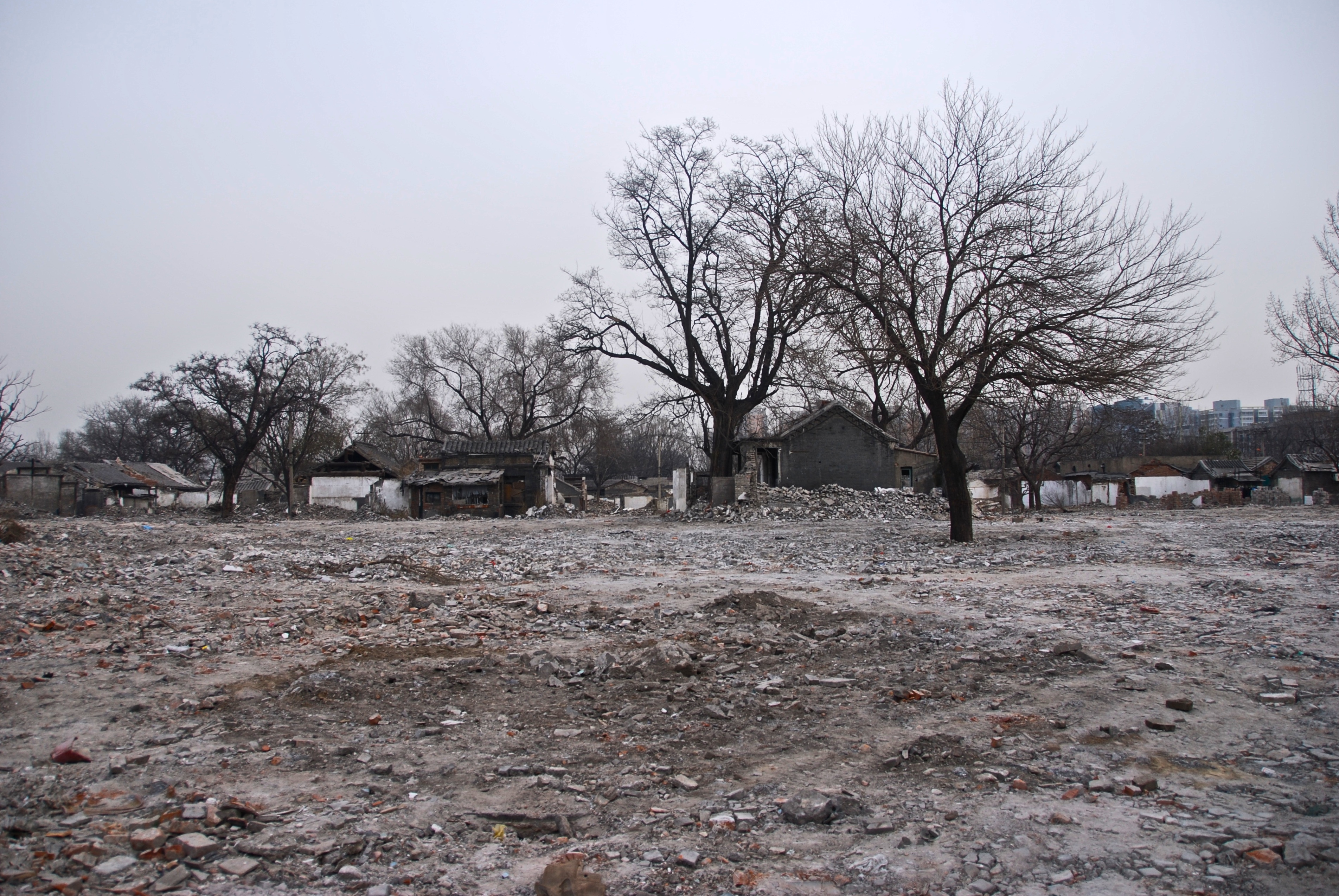
If the drought continues, is this the future landscape of Houston?

Into each life – some rain must fall,

Unless you’re in Houston – and get none at all.

Break the drought spell soon – is our plaintive wet call,

Our thoughts in dry Houston – have just hit the wall.

Cry me a river – Take me on a sea cruise,

I never felt more like – singing’ the blues,

I’ll take Stormy Monday – it’s the day that I choose,

To bring down the rain – on my blue suede shoes.

In the meanwhile, while we are waiting for the rain, how about a little simulation series on APBA BASEBALL to slightly help break the  monotony of meaningless Astros baseball games. Starting tomorrow, The Pecan Park Eagle will replay the 2005 World Series between the Houston Astros and the Chicago White Sox.

The Series will be played in real-time, one game at a time, starting Thursday, July 7th. That game will be reported here, with box score, on Friday, July 8th. It’s a best four game of seven series, so, barring a rain out in Chicago, the whole thing will consume the next four to seven columns in this little corner of the wired world, starting July 8th.

My apologies with a plea for patience from our non-baseball fan readers. Chalk it up to “BASEBALL NERD WEEK” at The Pecan Park Eagle and come back here soon. We also have some non-baseball subjects lined up for the near future.

What Will They Think of Next?

July 5, 2011

...Houston Daily Post, May 7, 1899.

What will they think of next?

Good friend and fellow early Houston baseball researcher Darrell Pittman sent me a copy of this ancient cartoon over the weekend. One of the wonderful bi-products of our current SABR project work is the discovery of all kinds of interesting other facts and points of view from the past. This cartoon demonstrates beautifully how current points of view can so totally distort our perspectives on the future.

As the new medium of radio was coming into being during the last decade of the nineteenth century, and for almost two decades into the twentieth century, people basically saw this new technology as a form of either the telephone or the telegraph – and a new way to send mail and messages by wireless transmission – and nothing more. The prospects of radio’s use as a medium for broadcasting live current events and vital topical news to listeners at home had yet to really take form. Once the ideas of reaching the public with a combination of news and advertising together took place, however, and the captains of industry began to see the money to be made, radio broadcasting was off to the races in ways the designers of our 1899 cartoon hardly could have imagined.

While watching one of the the Red Sox-Astros games in HD on one of our flat screens over the weekend, I’m thinking, “It can’t get any better than this?” And no, I don’t mean the quality of the Astros’ play – I mean the television picture itself. – Come on! Really! – How much better does a picture need to be? With today’s HD, you already can see every skin mole or speck of dandruff. – Who wants more?

OK, add 3-D, but only if you can find a way to make it practical to watch without those stupid glasses.

Maybe one day we will all have hologram rooms in our homes, special areas where we may watch movies and sporting events in true 360 degree 3-D perspective action without going anywhere. Watch “Casablanca” from the perspectives of either Rick Blaine, saloon keeper, or Major Strasser of the Third Reich. Or maybe we even have a way to get into the hologram action by taking the table next to Rick and Elsa in “Casablanca” – and then eavesdropping on the first conversation the couple has had since Paris.

The hologram theatre possibilities are endlessly fascinating.

Sit next to Manager Brad Mills of the Houston Astros during the World Series – or maybe visit every planet in the universe in the company of astronaut Neil Armstrong. Both opportunities should be available some day – on the Hologram HD3DTV System’s Science Fiction Network.

Who really knows what our most brilliant technological minds will think of next? Whatever it may be, let’s hope we also  grow in our mass need for creative contact and engagement with other people – and with life in general. There has to be more to communication than texting or tweeting others what we just had for lunch.

Independence Day: The Heart of the Matter

July 4, 2011

“We hold these truths to be self-evident, that all men are created equal, that they are endowed by their Creator with certain unalienable Rights, that among these are Life, Liberty and the pursuit of Happiness.–That to secure these rights, Governments are instituted among Men, deriving their just powers from the consent of the governed, –That whenever any Form of Government becomes destructive of these ends, it is the Right of the People to alter or to abolish it, and to institute new Government, laying its foundation on such principles and organizing its powers in such form, as to them shall seem most likely to effect their Safety and Happiness. Prudence, indeed, will dictate that Governments long established should not be changed for light and transient causes; and accordingly all experience hath shewn, that mankind are more disposed to suffer, while evils are sufferable, than to right themselves by abolishing the forms to which they are accustomed. But when a long train of abuses and usurpations, pursuing invariably the same Object evinces a design to reduce them under absolute Despotism, it is their right, it is their duty, to throw off such Government, and to provide new Guards for their future security.”

excerpt from the Declaration of Independence, Signed by Our Founding Fathers, July 4, 1776.

The Declaration of Independence means as much as we, the people, give it deliberate thought, firm conclusion, and committed action.

Read it for yourself and think about it on your own for a while during this special day in our nation’s history. What does it mean to you today in light of all we have endured and overcome in the past 235 years of America’s life? Are these familiar sections of the document still living words and ideas that mean something to us in our everyday lives? Or are they more like the token, memorized expressions of mindless salute we all give on cue to all those grand aspirations that we never really treat in the trenches of our personal lives as having much to do with our ordinary struggles?

Ask yourselves: What can we all do in 2011 to better live the words that were at the heart of why we celebrate this day in the first place?

Happy Independence Day, Everybody!

In The Company of The Astros Angel

July 3, 2011

All the Angels Aren't in Anaheim.

Last week I was privileged to have attended the dedication of the new Jimmy Wynn Training Center for young people on Victory drive on the near north side. What an appropriate street of right dreams that turns out to be for a place dedicated primarily to the service of inner-city youth in the name of the great Houston Astros slugging icon. Slugging icon? The greatness hardly stops there. The man is a walking embodiment of how we should all live – each in our own ways. Jimmy Wynn is a winner of the first order. The more you get to know him, the more you learn how that true that turns out to be.

Jimmy Wynn is a very modest man. He doesn’t do things to draw attention to himself, nor does he expect somebody to name a building after him for any reason. He just quietly does what he does out of genuine caring – and as he so acts – his resultantly energized legend as one of baseball’s all time greatest ambassadors – and certainly too, his reputation as one the most powerful icons of caring that ever reached out to Houston in the name of the Astros –  just each, both, and one and the same – continue to grow.

In a world where many players and former players only do the minimum, if anything at all, in the name of community service, Jimmy Wynn does little things constantly that just astound. Jimmy performs acts of goodwill out of caring all the time that no one else would ever know about, if they didn’t have someone like me around, observing him in jaw-dropping awe. I just happen to be around lately as Jimmy and I go through this round of almost weekly book signings on his new book, “Toy Cannon: The Autobiography of Baseball’s Jimmy Wynn.” I see how Jimmy  interacts with fans, making each one who approaches him feel special and valued. There’s no phoney-baloney too it either, Jimmy Wynn really cares about the people whose interest in him made it possible for him to have a long and wonderful career in baseball.

How many current or former players can we list who never seem to “get” how important the fans are to their success? Potentiate that appreciation for players like Jimmy Wynn with the fact also that he played in the era that preceded baseball becoming a road to mind-blowing riches. No, Jimmy doesn’t appreciate the fans because they made him financially rich, which they did not. He appreciates them for giving him a reason to have played the game that he loved in really net ballparks around the country – and in pursuit of that always elusive World Series championship..

The fans. Baseball itself. The way Jimmy Wynn played  his way into becoming The Toy Cannon. – They were all part of the man’s Love of the Game.

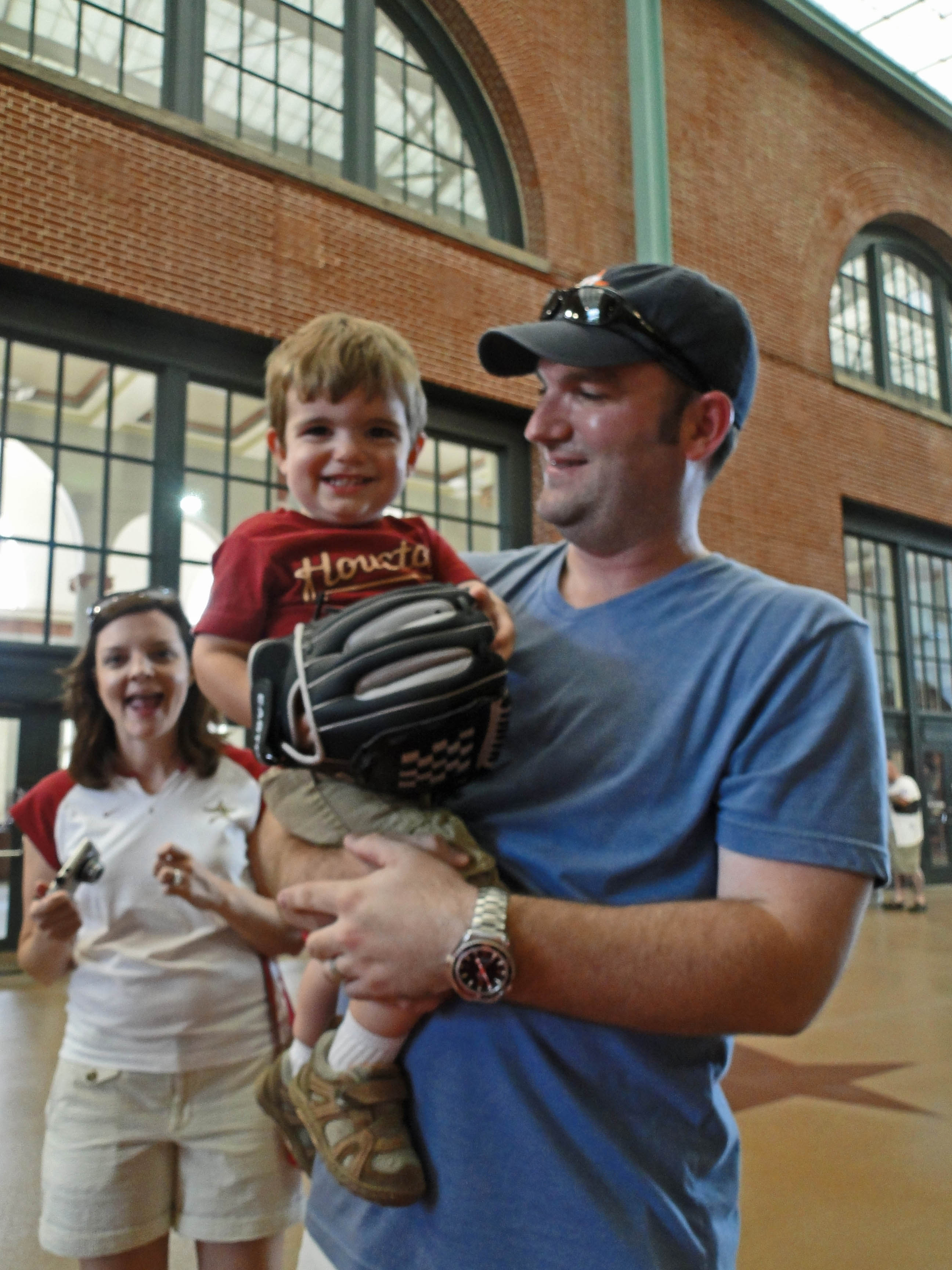
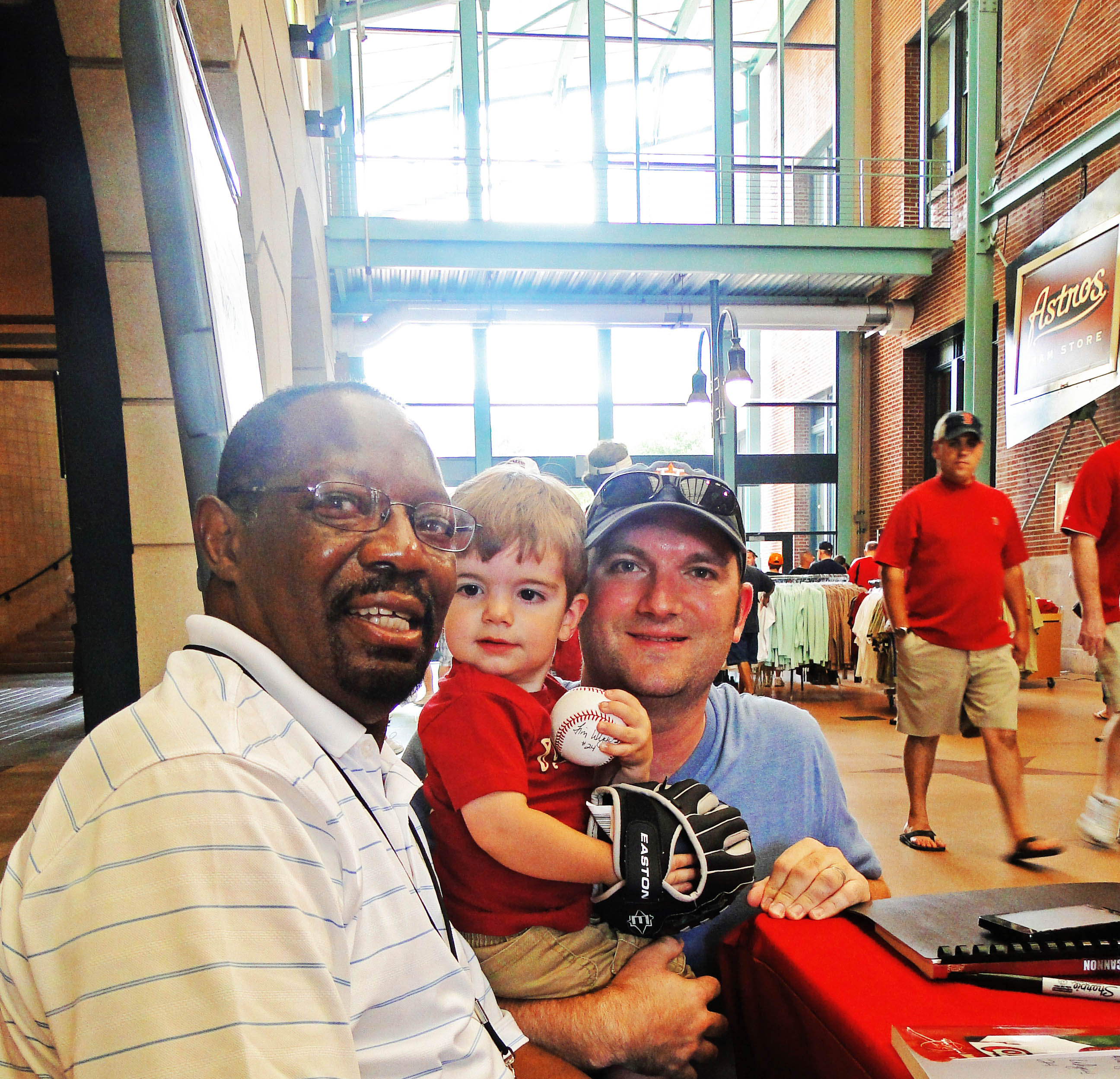
On Saturday, this anonymous family approached Jimmy Wynn, to say hello. They told Jimmy that it was their little son's first baseball game.

Yesterday, at a Saturday book signing that Jimmy Wynn and I did at Minute Maid Park, one of those quiet little honest moments just happened, as they so often do in the everyday life of Jimmy Wynn. There were no public relations people around to stage it, or make a deal of it for the wrong reasons. It just happened – and it just happened because of the man that Jimmy Wynn is.

A young couple walked up to say hello to Jimmy Wynn. They had seats in the nose bleed section, but they wanted their young son to meet jimmy Wynn before they settled in for the Red Sox-Astros game up in the hinterlands. This was a special day. It was their cute little boy’s first major league baseball game.

Jimmy Wynn wanted the little boy to have a real souvenir of his first game at Minute Maid Park.

“His very first game?” Jimmy asked, as his eyes lit up. “Then we need to do something to help him remember someday how special this day really was.” The next thing we all knew, including the parents of the little boy, Jimmy had summoned one of the ballpark people over to our table. He gave this person his car keys, along with a special request.

“There’s a baseball in the back seat of my car across the street,” Jimmy told the attendant. “Would you mind going over there and getting it for me?”

Once  the attendant most obligingly did what had been asked, Jimmy took this official MLB baseball and signed it. – “Jimmy Wynn” now sweeps across the sweet spot of this baseball in ink that will still be there when the little boy is old enough to understand – if he doesn’t play with it too much in the yard.

It was a golden moment when the little boy’s eyes and smile both lit up as Jimmy handed him that special baseball. I do hope he has it for a lifetime. Nobody needs to grow old with the story of the signed baseball or special baseball card that they should have saved.

Wow! My mind still boggles over Jimmy’s generosity!

Jimmy Wynn’s actions provide us with a common sense answer to that famous question from philosophy and physics: When a tree falls in the forest, and there’s no one around to hear it, does it make a sound?

In the case of people like Jimmy Wynn, the answer is “Yes! Yes! And Yes!”

In the butterfly effect of things, where actions of all kinds register and vibrate to the whole world in some way, for better or worse, it makes for a big, big big sound on the side of positive energy regeneration. For Jimmy Wynn to have taken the trouble to have signed and given that ball to the little kid is just “above and beyond” the call. – It was pure love – and completely detached from any self-serving motive. This man simply gives –  because he enjoys giving.

For those of us who believe in God as the Divine Creator of All, allow me the liberty to express it a little differently: To me, Jimmy Wynn is the living, breathing example of the paradigm that “God is Love.”

And God bless you too, Jimmy Wynn. Just keep on doing what you do, We are all fortunate to have you here as an important contributing member of our greater Houston community.

Godspeed. And a safe and happy Independence Day wish to one and all.

Pickpockets Hit Minute Maid Park

July 2, 2011

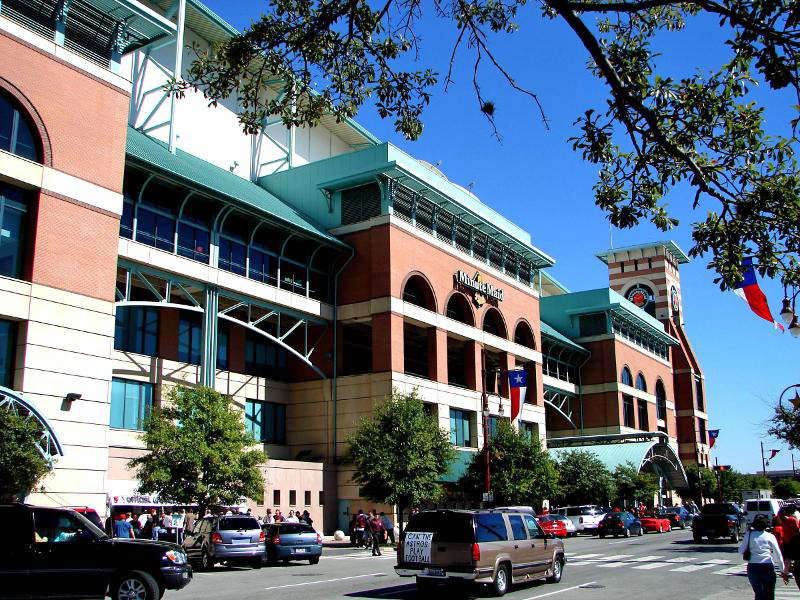
Minute Maid Park, Houston.

We’ve all heard the warnings forever about crowds and pickpockets. “Watch your wallet! Beware of the old ‘Excuse me’ bump after colliding with a stranger on a crowded concourse! Don’t leave your wallet in your back pocket, where it is easiest to reach!” And on and on. We’ve heard them so much that we have begun to think that pickpockets are the stuff of Oliver Twist, or Gypsy camps, or Mexican border town markets, or the back streets of Paris, or any other foreign or unfamiliar port of call. We have fallen into the trap of feeling safe in those places that are familiar to us. Bottom Line: An overdose of familiarity sets us for the double play of greatest risk. (1) It can’t happen to me; and (2) It can’t happen here.

Well, as a friend of mine learned only three night ago this past Wednesday, it can happen to us – and it can happen here – and right here at home, smack dab in the midst of the friendly confines of our very own Minute Maid Park. My friend doesn’t want the notoriety of having his name put out there in association with the crime that has fallen upon him, but he does want people warned: It can happen to you – and right here in your home away from home at the ballpark.

Pickpockets hit my buddy at Minute Maid Park Wednesday night. They got his wallet from his back pocket before he even knew what had hit him and, with the steal, they got a large amount of cash, all his credit cards, and an irreplaceable sentimental item that he had carried on his person for years. My friend reported the crime at the ballpark, but not before the thieves had already started using one credit card, To make things worse, he could not remember all the dangerous credit and other identity items that he might have been carrying in the wallet. It’s going to take some time to reconstruct what was there so that everything that needs to be braked i stopped and reissued.

And all of this torment has come down upon my friend because of this unfounded wish we have to live in a trustworthy world. It doesn’t take long for a couple of low life crumb-bums to bring down a rain of painful reality upon that slice of misguided wishfulness.

The police at Minute Maid told my friend that pickpockets are a cyclical problem at the ball park. In other words, these problems only happen on the days that pickpockets have tickets for a game and then actually show up to reap havoc. Unfortunately, pickpockets do not make their season ticket plans available for public scrutiny so we can know when its best to stay home. These people are sociopaths. Crooks. People with no profile identity, but people with absolutely no concern for bringing harm to others.

So, what can we do to protect ourselves? (1) The best we can do is not allow ourselves to be lulled into a false sense of security that we are safe in familiar public environments like the trusty old ballpark. Pickpockets and thieves are ready to strike wherever they see the opportunity. (2) Do an inventory of how much cash and what credit and identity cards you are carrying in your wallet or purse. (2) Do not carry anything of irreplaceable sentimental value on your person. (4) As you’ve heard a thousand times, be aware of your surroundings. (5) Don’t flash cash or credit cards in crowded public view. (6) Keep your wallet in a side pocket, not the back one – and keep your hands on your wallet whenever you are walking through crowds of people. (7) Never abandon common sense.

It’s a tough old world out there. Always has been. Always will be. We have to be tougher. And as smart and conscious as we can be.

Early Houston Baseball Project Getting Some Pub

July 1, 2011

Market Square in Houston, June 30, 2011: SABR's Tony Cavender, Josh Thompson, Joe Thompson, Lance Carter, & Tom Trimble. (Apologies to Junior for not having his first name handy at publication time this early morning. Send it to me, Joe, and I'll correct it.)

Our Larry Dierker Chapter of SABR (The Society for American Baseball Research) recently took on the multi-year, multi-task job of researching and writing a book on a segment of Houston’s rich history that has been long overdue.  The working title of the project is “Houston Baseball, The Early Years: 1861-1961.”

The century of note covers a long and colorful period, from the formation of the first Houston Base Ball Club in 1861 through the last minor league season of the Houston Buffs in 1961. After 1961, Houston’s baseball stage moved to the major leagues, first with the Houston Colt .45s (1962-64) and then to their new and still present identity as the Houston Astros (1965-2011 and counting).

Although we have only been on the job officially since our first May 21st meeting, some of the early discoveries of our fifteen member volunteer research team have been both mind-boggling and sometimes surprising. Back in the late 19th century, for example, four to five members of the Houston professional club were dismissed on a road trip to Dallas for attempting to throw a game for gamblers. And, in that same last decade, a group of Houstonians, still enamored with the still recently new availability of electric lights, rigged up a portable lighting system that allowed the Houston club to play the first night game in Houston history. It apparently wasn’t a mechanical plan for efficient everyday use, but it happened – and it adjusts existing thought by about forty years earlier as to when  the first night game in Houston was actually played.

The members of our sixteen-member SABR research team are: Steve Bertone, Lance Carter, Tony Cavender, Bob Dorrill, Marsha Franty, Harold Jones, Bill McCurdy, Tom Murrah, Darrell Pittman, Susan Pittman, Jo Russell, Story Sloane, Joe Thompson, Tom Trimble, Mike Vance, & Herb Whalley.

Wow! Sixteen fired-up people! Just about the roster size of a minor league club back in the early history of professional baseball.

We are tracing the history of baseball in Houston from its earliest amateur roots through its growth as a highly organized professional sport at the highest level of minor league play. Along the way, our goal includes filling in the blanks on the continuation of amateur play, semi-pro ball, women’s baseball, and black baseball. We have our work cut out for us, but we wouldn’t have it any other way. We didn’t take on this project because we thought it would be easy. We took it on for the sake of setting the record straight on Houston’s ancient history with baseball. And yes, we took it on because it needed to be done to help correct a misleading national impression of Houston’s sports history.

As project director and editor-in-chief of this activity, my own interest in the idea peaked during the 2005 World Series when I heard a national commentator say over the air that Houston’s fans seem to understand the game pretty well “for a city that only recently discovered baseball.”

“Whoa!” I thought. “These folks don’t know us very well at all. They think because of our current population’s love-dip with football that baseball is new to everyone around here. How wrong they are. Houstonians were playing base ball before a single shot was ever fired upon Fort Sumter – and long before anyone in Houston had ever seen or held a ball that was pointed on two ends.

The Houston Chronicle gathered some of our crew for a photo shot at Market Square yesterday morning. That’s La Carafe, the oldest commercial building still standing in Houston in the background across the street. It’s that two-story, slender red brick building you will see in the picture above the shoulder of Tony Cavender. The building dates back to the 1840s or 1850s – and it once served as the stagecoach station in Houston. For us, it represents a building that was standing on the night in early 1861 when the first Houston Base Ball Club was founded in this city.

If you have an interest in helping us piece together the true, not speculative, history of baseball in Houston – or if you are in possession of any artifacts or scrapbooks that might shed ligt on the history, especially, of black baseball in Houston, or the women’s game, please, please, please get in touch.

I can be reached by you leaving me a comment on this column, or by you e-mailing me at

 houston_buff@hotmail.com

Watch for an article soon in the Houston Chronicle. And please get in touch, if you have anything to offer.

Regards,

Bill McCurdy, Project Director, Editor-in-Chief, Early Houston Baseball Research Project

Does Houston Need a New Landmark?

June 30, 2011

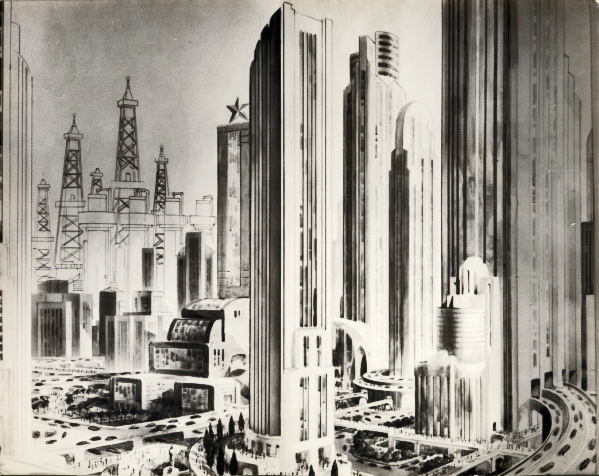
How The Houston Post in the 1920s Saw Houston's Skyline in 1980.

That column I did yesterday on the changing image of Houston brought about some evocative contributions and challenges. Darrell Pittman of our Early Houston Baseball Research team sent me the above JPG of how writers in the Houston Post projected that the Houston skyline would look in 1980. It made sense. Back then, New York City already had established the standard indicator of urban progress as the presence of very tall vertical structures in the city’s main business district.

Other smaller US cities followed suit. Or tried. They built skyward, even if the cost or availability of land was not the premium construction issue that it almost always has been on the tiny island of Manhattan. People went up. Not establishing community uniqueness. But doing a good job of building that generic look of downtown buildings that we see from all major city’s downtown skyline pictures.

Bob Hulsey called it right when he then wrote me  “To the uninformed,” Hulsey wrote,  “the Houston skyline could be the generic one of any metropolis.” Hulsey went on to describe the absence of any unique natural or constructed landmark that sets aside the Houston skyline from all others.

Bob’s right. St. Louis has the Cardinals baseball and the Arch. Seattle has computers, coffee, airplanes, and the space needle. Los Angeles has palm trees, star searchlights, an old style crank handle movie camera, and the Hollywood signage on the hill. New Orleans has jazz and the ancient look of the French Quarter architecture, Jackson Square, and St. Louis Basilica.

You got it. What does Houston have that makes out skyline unique? We once stood strong on oil derricks, NASA, and the Astrodome (back in its eighth wonder days), but as Bob Hulsey also points out, we’ve lost the latter two and may soon have the first mentioned oil derricks legislated away from us too.

If Houston needs a physical symbol of its identity uniqueness, we are a little short on natural jaw-dropping wonders in these flattened-out mud and sand plains of the near gulf coast terrain. We would have to build something. Like St. Louis, who couldn’t figure out a way to co-opt the image of the Mississippi River from New Orleans and Memphis for its own use, Houston needs to build something that will remain standing in good times or bad to tell people who we are.

An idea suddenly hit me along the lines of that old joke about the batter waiting on a fastball. Remember that one? “I was standing at the plate, thinking about my chance to whack at a fastball. – Then it hit me.”

“WHOA,” I thought. We’ve got most of our answer in tow already. All we need to do is move it here to downtown Houston and do a first class job of its presentation.

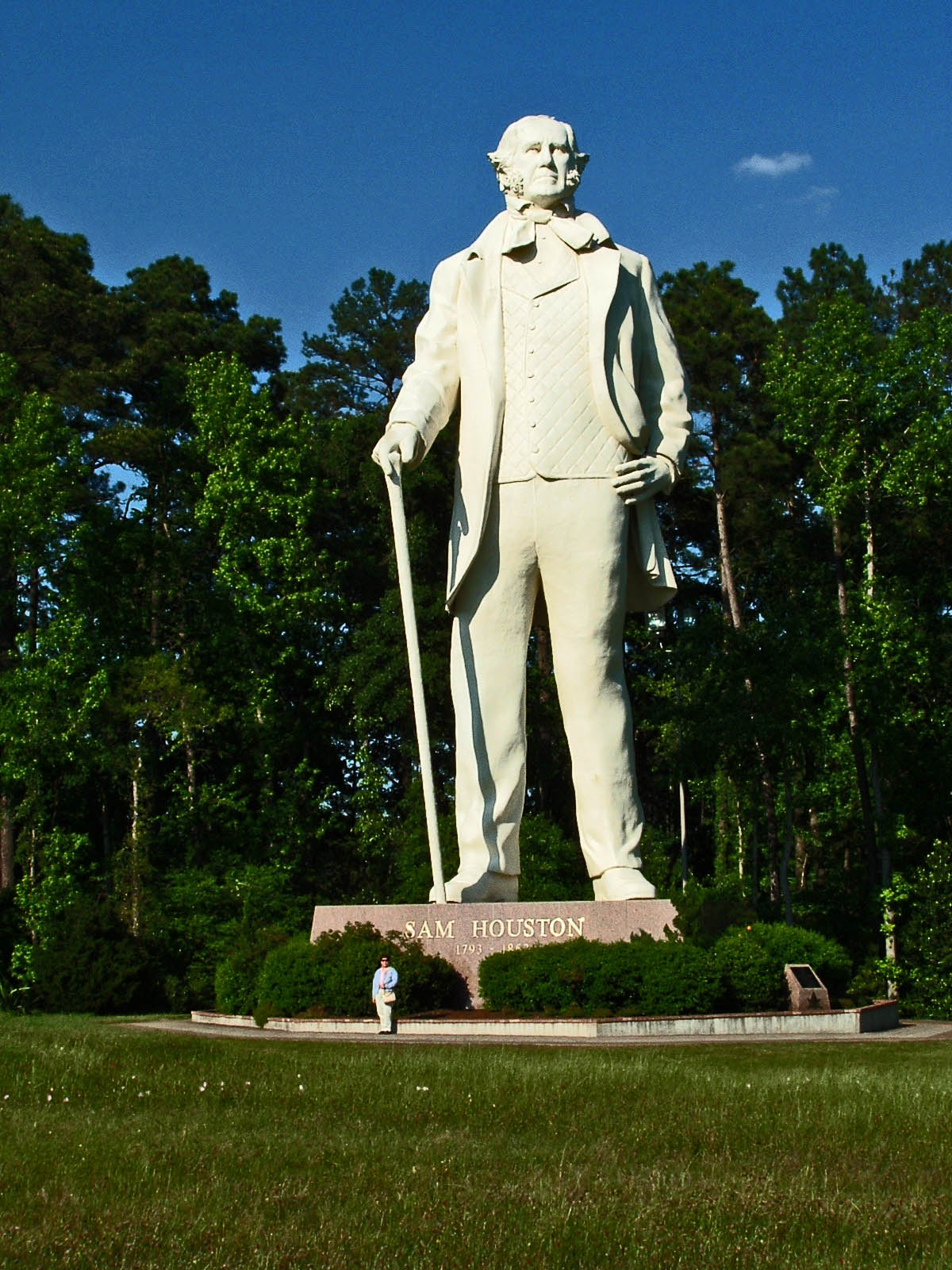
Let's bring Sam home so he can greet the whole world for us.

What do you say we head on up I-45 North and arrange to pull dear old General Sam Houston out of the weeds of that rest stop south of Huntsville and bring him to Houston as our iconic architectural greeter to the world. But we don’t just put him anywhere. Here comes the “class” and crass part of this proposal.

We acquire the property for a six-columned base on both sides of Main Street at the extreme north side of downtown, on the south side of Buffalo Bayou, across the bridge from the UH Downtown campus. Build a pedestal that is 500 feet above street level to make sure that a full body view of Sam is never obscured by any building from the several freeways view of his complete torso. Then pass ordinances against the construction of any high rise buildings on the near north side of the bayou that would obstruct the view.

Each columnar base could be built out large enough at street level to accommodate six informational and retail centers that each specialize on the goods, opportunities, and foods of Houston’s diverse ethnic and business community.

Artist David Adickes built the 67-foot high steel, concrete, and fiberglass structure that is now located south of Huntsville. If the relocation of that specific statue raises too much political sand, let’s raise the ante on our dreams and expectations. Let’s commission Adickes to build an even taller version, altered somewhat for uniqueness from the Huntsville version – and this time –  let’s do the whole thing in white marble, if that’s feasible. If not, then just do it in the best, most lasting way.

Houston deserves its own larger version of the famous “David.” Our “Sam” would put Italy’s “David” in the shade – at least, in size and vantage point, if not in artistic genius. After all, “David” is the work of Michelangelo. “Sam” is the work of David Adickes.

Standing at the spot I’m proposing, Sam would be there to personally greet all newcomers to Houston who came here through the big airport. And he could be here forever. If we want to go first class.

I ran the first skeletal plans for this icon construction by Bob Hulsey last night. “As long as I’m not paying for it,” Hulsey says, “they can put whatever they want. Even a 50-foot tall Craig Biggio.”

Good point, Bob. Here’s what I propose: The city sells the sponsorship, naming, and management rights of the street level base store or stores to some individual or group managed inter-corporate operation. The company(ies) who step forward to help Houston do this project right will put themselves on the market integrity level in a way that no amount of public relations splurge could ever hope to attain. They would weld themselves to the history of Houston itself as the makers of a major American icon.

And those are my thoughts for this Thursday. Let me hear what you think of the idea.

The Changing Image of Houston

June 29, 2011

“Having a wonderful time in Houston! Wish you were here!”

In spite of all the changes in technology we’ve gone though in recent years, communication is no longer a simple matter of lying through the teeth on a post card and dropping it in the mail box. Have you tried to find a mail box lately? They are few and far between. Most likely, you would have to take the thing to your nearest post office for mailing.

But that’s not my point today. My point is about the image of Houston – and what it’s become. Time was when we used post cards to express images of our city as we hoped the world would see it as a point of attraction.

Many of these Houston images projected our downtown skyline as a symbol of Houston’s dynamic business community. I suppose, and as a sign to the world that we were not the terrain of John Wayne’s Texas, the one shown especially in “The Searchers” – of a place enveloped in dirt-dry deserts and rocky mountains, rolling tumbleweed, jumping jackrabbits, and Native Americans hiding behind every rock and tree with bows and arrows.

Maybe if the drought keeps up we will be able to actually show them the deserts and tumbleweed that some newcomers still expect.

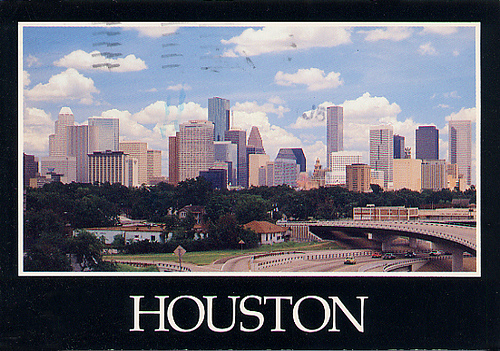
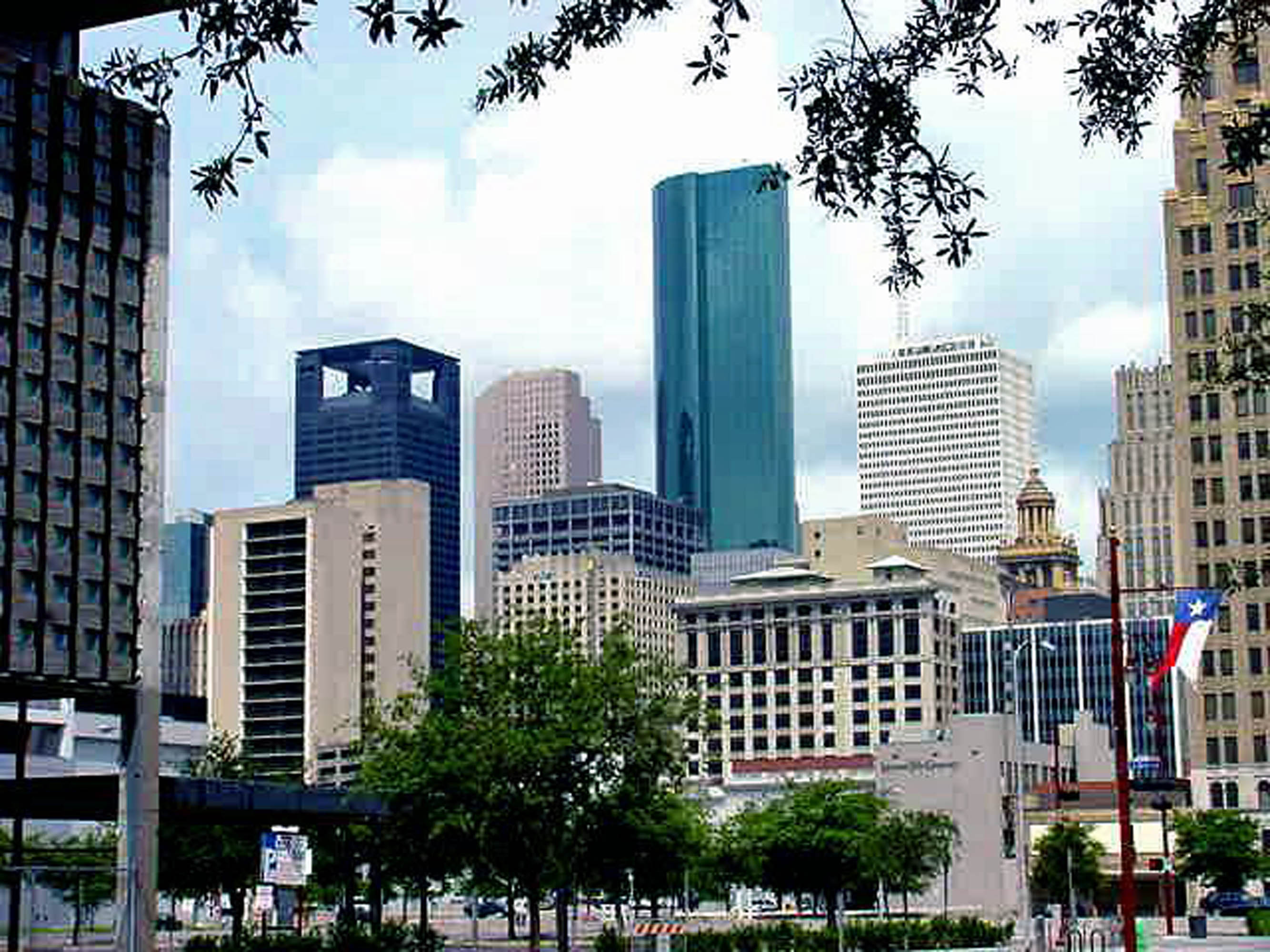
As a post card collector, today’s column is just about the mutating image of Houston. At least one of the following cards go off the expectation chart to raise this aside question: “What were they thinking?” I’ll save that one until last as we first examine the others.

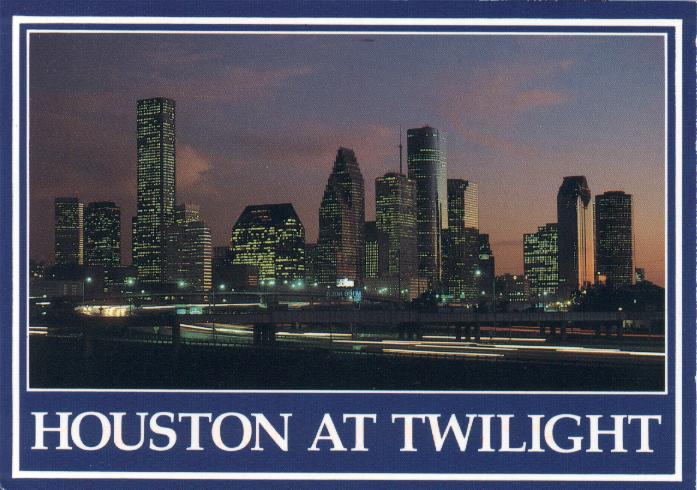
"Houston at Twilight" bears the same message as our first card, except now, it's getting darker.

Sometimes Houston really lights up after dark. It just doesn't happen all that often.

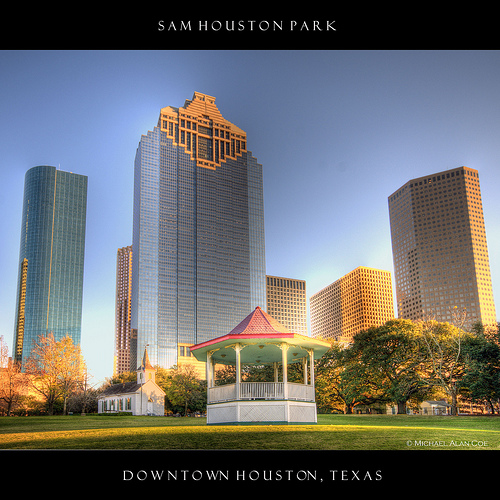
This card says to me: "Houston is a modern muscle town with roots in the ginger bread days of the 19th century."

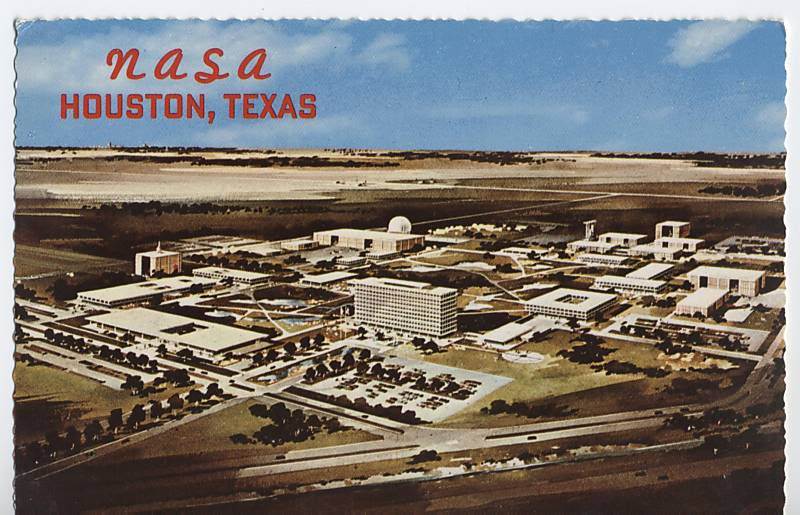
Houston once flew the image of NASA as its own. Those days are now done.

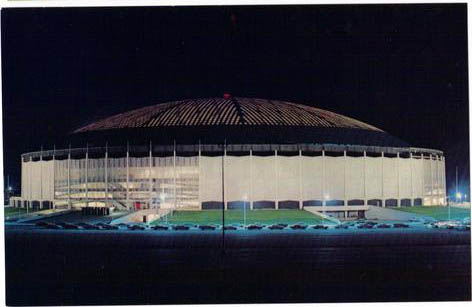
The Astrodome also once served as the major symbol of Houston as "Space City, USA." Now that image is also gone with the wind.

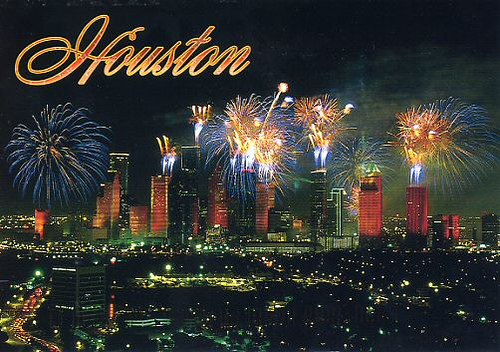
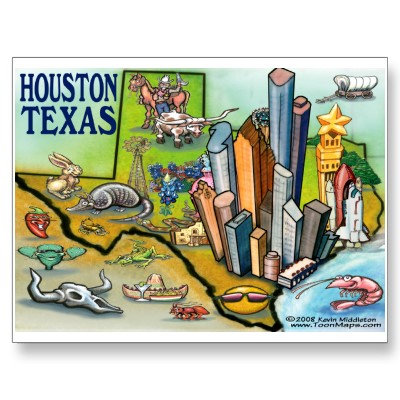
It's not hard to find the Houston-Heart of Texas image in this card, is it?

This card says: "We Houstonians are a people who don't mind telling you how we feel about our home town."

This was simply a photograph I took a few years back from the corner of Crawford and Texas. It never was a post card, but it could have been.

And, finally …

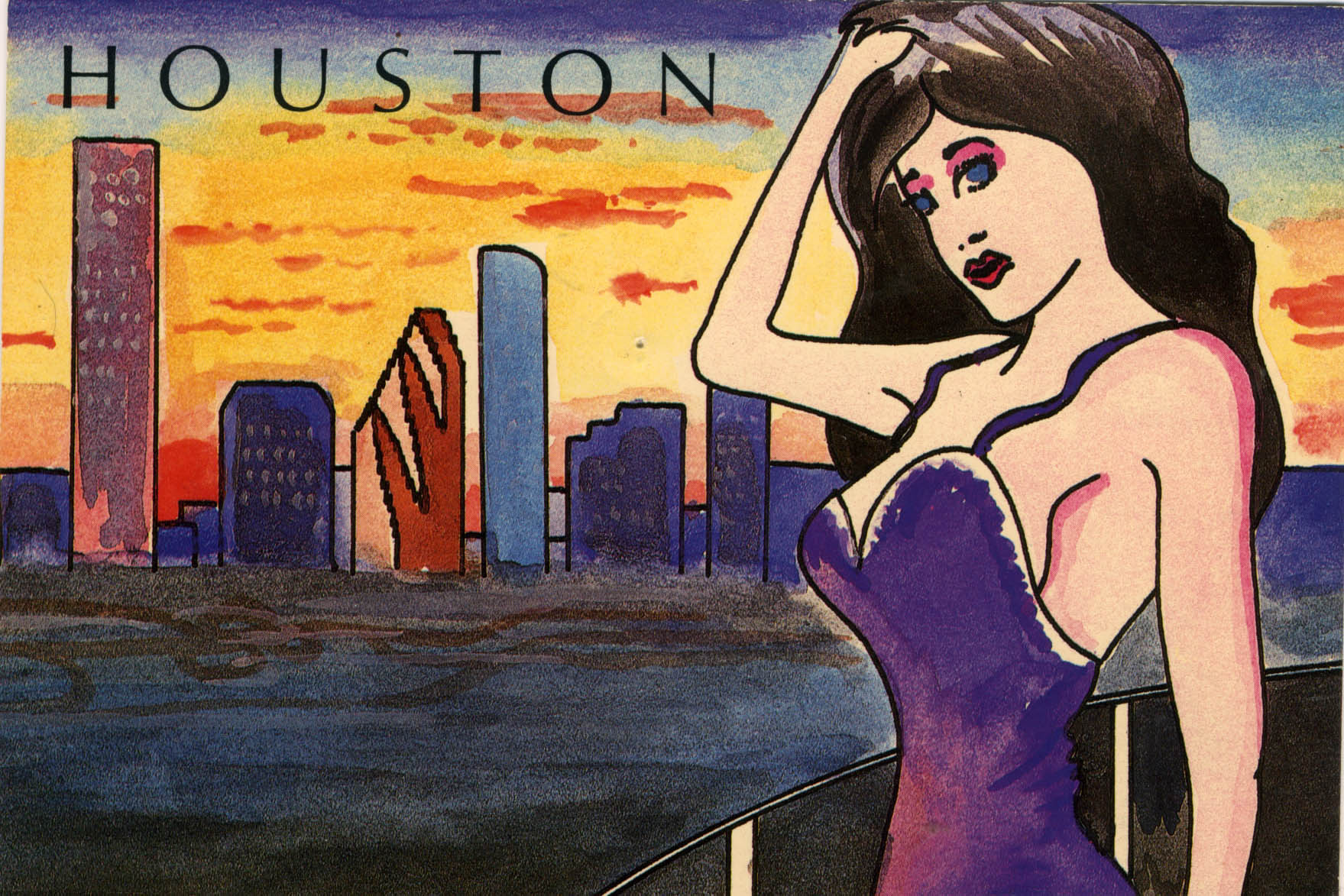
What were the designers of this card really thinking?

Holy cow! What is the message of this card, anyway? I found it years ago in a flea market card pile and just had to acquire it as a curiosity.

What do you think is the message here? A friend of mine offered that it looks like a sad young woman at the railing of ship, sailing on a City of Houston that is now under water from some recent flood, perhaps, Allyson.

That’s not what I saw. Because of the light in the background, it appears that dawn is coming on the east side of downtown. That impression of the time of day is slightly conflicted by the lighted area of certain buildings on the west side of downtown, but not enough to override the general impression that dawn has just come to the city.

In the main theme, I saw it as a young woman standing on a high-rise apartment balcony of a residential building located somewhere in the near Memorial Drive West area. What my friend saw as an ocean of water, I saw as the trees that forest easily from that area into downtown. – And here’s where my projections run amuck because the lady is obviously not dressed to go downtown to an office job at that early time of day.

Given the imagery that arises for me from those visual assumptions, my question forms as: Why would a sad, hung over young woman with regrets about the night before, and a short time left to dress for work, be the kind of picture we would want to portray to the world as “Houston?”

Help me out there, folks. Maybe I’ve simply listened to too many stories in my long professional life that move along the line that these images suggest to be really objective about what I see in the card.

The larger questions prevails: What were the graphic designers really thinking when they published this card as “Houston?”

BAM: The Beeville Art Museum

June 28, 2011

Dr. Joe Barnhart of Houston bought the property for use as a museum in 1981.

I’ve been a Houstonian since Dad and Mom moved me here on my fifth birthday, December 31, 1942. Coming from the little town of Beeville, about 180 miles southwest of the city down Highway 59, and about 50 miles beyond Victoria. I remember getting here, even at that early age. The lights blew me away. Even the very outskirts of Houston at South Main and OST appeared on fire with excitement. Of course, what I was mainly seeing were all the neon lights of Prince’s Drive In. After we checked into the Alamo Courts, Dad drove us over to Prince’s for our first Houston meal. They were showing Laurel and Hardy movies on an outdoor screen that faced the cars. Man! Was that ever impressive to this kid from the sticks!

I wanted to stay here the rest of my life – and so I have. Except for a brief period during my young adult years, when I did post-graduate work at Tulane and UT, and then did some clinical faculty work at Tulane Med School, Houston has been my home and the only place on earth that could ever feel like my home town.

That being said, I still hold a special place in my heart for Beeville, where my family came from, and where my sister still lives. The little oil and gas, cattle-agricultural town is holding its own at 14,000 citizens. Coastal Bend College, where my sister teaches history, and a TDC maximum security penitentiary help support the local economy.

Culturally, I’m happy to say, the Beeville Art Museum (BAM) stands in my old birthplace today as a striking blow for certain aspirational points of view that are not commonly associated with historically cowboy towns. Chicken fried steak, homemade tamales, and yoga classes on Tuesday evenings are not a usual combo, and probably still are not, but you may now have both in Beeville, Texas, even if choosing the first two leaves you out of the loop for best benefits from the last-mentioned item in this trio of local choices.

On the grounds of the Beeville Art Museum.

My grandfather started the town’s first newspaper, The Beeville Bee, in 1886. As a classically  educated young man of his times, he always spoke in behalf of the town’s needs to grow in its appreciation for history, literature, music, and the arts. He would be very happy today to know that a later like-minded, but richer, former Beevillian had purchased the old Hodges homestead in 1981 and then converted the building property and ample grounds into the magnificent service to the community that it has become. It was Joe Barnhart’s legacy gift to his original hometown and, today, this inspired  program continues to grow in support of its mission as a teaching museum through the support of the Joe Barnhart Foundation.

Here’s a link to the BAM’s own website. They’ve done a nice job of explaining on the website – their mission, what they have to show you, and what they offer to teach you.

http://bamtexas.org/

 The Beeville Art Museum is free to those care to visit. They also offer training courses in the arts, including group instruction in yoga, I’m not sure what the pricing structure is on these special educational features, but I doubt it’s much.Dr. Barnhart’s mission here was making cultural exposure accessible and affordable to everyone who finds the willingness to drink it in.

Most of you know of my interests in history. As such, you already understand why the work of a place like the Beeville Art Museum is important to me, as I hope it is to you.

So much of small town Texas life is about daily survival for all those with little education and really good job opportunity. As long as that’s the daily grind, it’s hard for people to get excited about the lessons of history and how these impinge upon community improvement when we aren’t even conscious enough to learn about what’s really holding us back.

 The Beeville Art Museum is one of those “points of light” that former President George H.W. Bush used to talk about. It exists to awaken all people to the larger possibilities of life and culture – and to the spiritual process that derives from our active involvement in the search for what we each want to do with our lives.

If you are ever traveling through Beeville on Highway 59, just take a right on Adams Street when you reach it inside the city. Keep driving north on Adams until you can’t miss the same view of the BAM that’s featured in our first photo at the corner of Adams and Fannin.

Tracy Saucier is the Museum Director. In my view, Saucier and staff are running a frontier play of culture that is every ounce as important to the discovery and preservation of perspective on past and future as Fort Davis once was to the preservation of life itself.

We need to give credit where credit is due.