Archive for the ‘Uncategorized’ Category

Rice Stadium Dreams

August 26, 2011

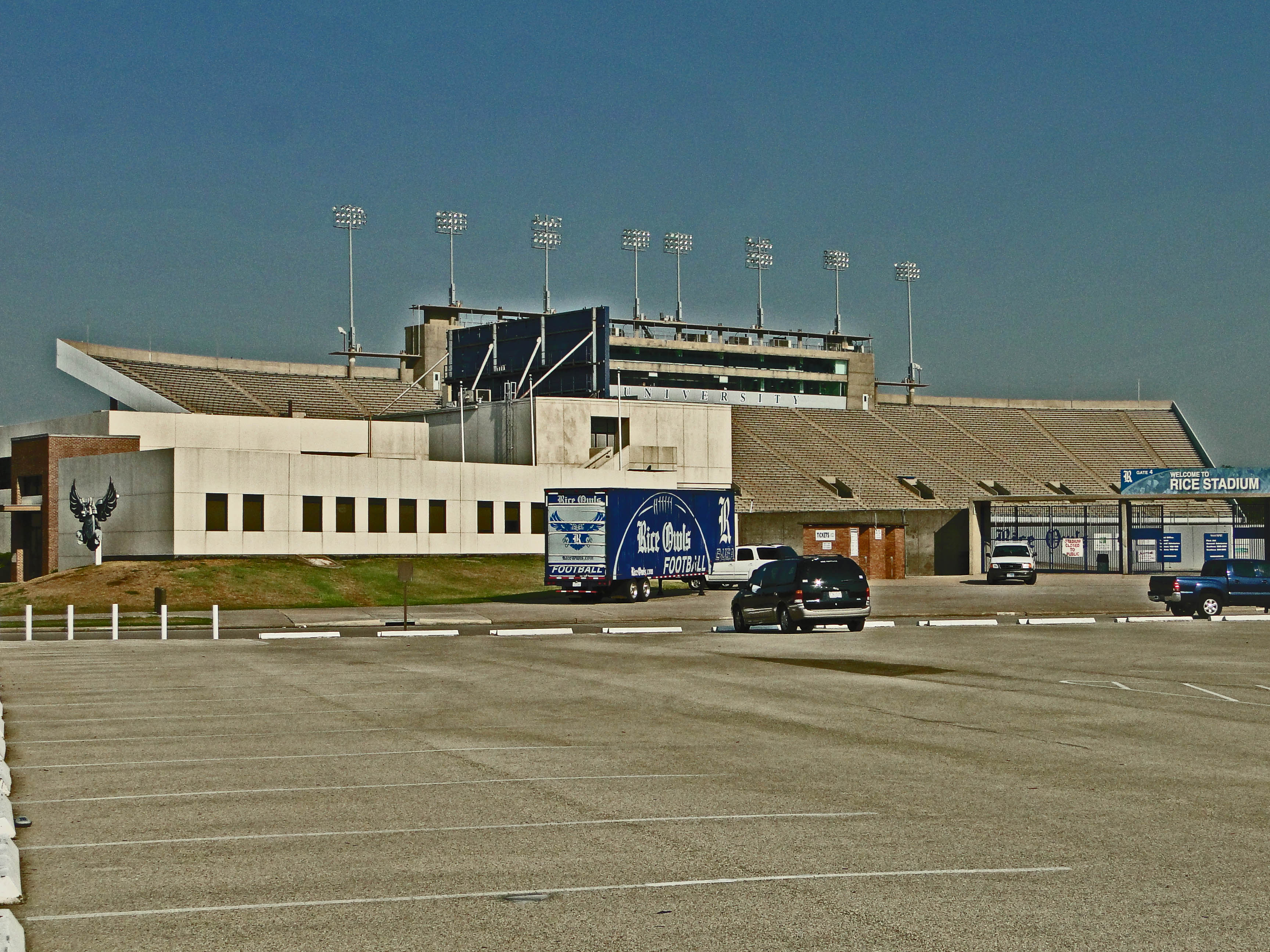
Rice Stadium, Houston, 1950-2011, And the Dream Lives On.

What were they thinking?

When the community that was then known as Rice Institute went to work on the plans and funding for what would then become the largest football venue in the State of Texas, short of the Cotton Bowl in Dallas back in 1949, people who were alive and old enough back then had to wonder where this tiny private university, located in a city of an as yet uncounted half million souls, was going to get the fans it needed who could fill the place for five games each fall.

Rice Stadium echoed behind the stadium drive, as did the City of Houston. The Rice Owls had just won the 1949 Southwest Conference Football Championship under venerable Coach Jess Neely and the names of Quarterback Tobin Rote, end/kicker Froggy Williams and lineman Weldon Humble all reverberated to jar open the pocketbooks of hope that a tiny private out-of-pace Ivy League-type school could actually grow to compete with the University of Texas and other larger, sports-richer schools in the State of Texas and the nation over time.

The NFL still mired away in its pre-significance days as this country’s off-season professional sport alternative to baseball and college football still reigned as the king of the oblong ball game. Notre Dame was the New York Yankees of college football and UT was merely one.of several state school versions of the Boston Red Sox, with Oklahoma University making a strong bid for that entire bean town franchise prescription.
Even then, on the heels of 1949, and all the vivid memories of Froggy Williams plunking his magic field goal kicks more dramatically than Smilin’ Ed McConnell himself, the outlook wasn’t brilliant for the Rice I boys at play – the great ones played here sight unseen – and never could they stay. – Rice failed to own a talent trough – that ran both long and deep – where they could store All American stock – avoiding seasons bleak.

So, for the Rice community of 1949, I guess it came down to that many years later old saying from the movie, Field of Dreams, in 1985: “If we build it, they will come.”

The City of Houston subsidized the project, originally intending it as a venue to serve both Rice Institute and the University of Houston, but to be built on the Rice campus as Houston Stadium.  Things change. It became a Rice project and Rice Stadium, opening in 1950, with UH joining Rice as a tenant in 1951.

On October 13, 1951, I made my first trip to Rice Stadium. My dad took me to see Rice play Navy. Our seats were way up there on the north side of the second story east side grandstands and we seemed swallowed up in an ocean of people. Compared to trips to Buff Stadium, it was certainly the biggest crowd I’d ever seen. At least, that’s how I remember it. To cap off the night, Rice won, 21-14.

It was a simpler time, at least, on the level of much recorded public thought and action. People in amateur sports didn’t talk about market shares and revenue streams – nor did they plan too deeply, if at all, about supplemental income possibilities for a venue that could seat 70,000 people. There was no rock and roll in 1949, no big extravaganza sub-culture, no traveling musical shows, other than the ones that Bob Hope took to war zones on a much more limited basis, but there wasn’t any big interest in 1949 behind the idea of staging a Bing Crosby or Perry Como concert.

Rice apparently just wanted a 70,000 seat stadium in case a game of that ticket-selling potential came along, maybe with UT, A&M, Arkansas, or independent Notre Dame. They had to have realized, even then, however, that they weren’t going to get 70K for usual conference foes like SMU, TCU, or Baylor.

They did it, they built beautiful Rice Stadium, but by the mid-1960s, the football program and game attendance had hit the decline that came to a lot of small private schools when network television and big money became the driving force behind college football. For Rice, and every other school that actually required their players to live up to their titles as “student athletes,” the obstacle to big time winning on the national title level were out of reach.

Rice got by without sacrificing their academic integrity. UH played their home games at Rice Stadium from 1951-1964, as did the new professional club, the Houston Oilers from 1965-1967. Both of those tenants moved down the street to the new Astrodome once it opened in 1965, but Rice moved on, playing their games in the emptiest, best sightline-seated stadium in the country. With the first underground level of Rice Stadium invisible to the ground level eye from the outside, you really have to enter the place to get a true feel for its enormity. Then, because it was built for football, you notice that the lower seating goes right down to field level, with very little sideline space between the edge of the stands and the field of play. The lower recession of the field itself alone also assures that even those people on the lower front row are going to have a true perspective on the play action unfolding before them. The designers of Rice Stadium,  never lost track of who needs to be comfortable with their place. – It’s the fan. Credit goes to the modernist architectural designers, Hermon Lloyd & W.B. Morgan and Milton McGinty.

The Bluebonnet Bowl played at Rice Stadium from 1959-1967 and again in 1985-1986.

On September 12, 1962, President John F. Kennedy delivered his famous speech behind the launching of the new space program that would come to be known as NASA at Rice Stadium. In 1974, the National Football League played Super Bowl VIII at Rice Stadium, with the Miami Dolphins beating the Minnesota Vikings, 24-7.

Owls Fight!

Today Rice Stadium remains the playing field home of the Fighting Rice Owls, where winning is important, but only if it stands on top of a true “student athlete” program. The Owls play on a field that has been remodeled for the comfort of fans and the safer traction of players on the field. Seating capacity has been reduced to 50,000 by the university’s decision to seal off the end zone seats on both the north and south sides from ticket sales, but there is little threat to Rice running out of room anytime soon. The usual gates for most games of Rice’s C-USA schedule range from 13,000 to 20,000.

The important things are these: Rice University’s football program and beautiful Rice Stadium are both still with us as symbol’s of integrity. The next time they win anything big in football, it will be as they have done it in baseball and a recent national championship. – It will be because they did it with superior effort – and in the right way.

Go Owls! – You guys have been doing Houston proud for as long as I can remember.


Cataract Surgery Now a Done Deal

August 25, 2011

"Thank you, Dr. Colby Stewart! - Thank you very much!"

Six hours ago I was coming out of day surgery for cataract removal surgery on my right eye. As the above photo shows, I had the left eye done on July 28, 2011, exactly four weeks ago with no problem. With Dr. Stewart’s knowledge, skill, and keen eye, and the Will of God blowing my way, everything went painlessly, quickly, and successfully. The whole time in surgery took no more than ten minutes.

On my left eye procedure in July, I don’t remember a thing because of the anesthesia. This time, for some inexplicable reason, I remained conscious through the whole thing, but still experienced no pain or apprehension. I trust Dr. Colby Stewart.

Making a decision to trust a surgeon with a surgery that pertains to something so vital as “sightedness or blindness” is pretty big. All I could do is research my choices and then follow the path of faith I found in testimonials and walking results. I didn’t have to search long and far. Nearly three years ago, my good friend and personal optometrist, Dr. Sam Quintero, OD,  discovered evidence of my wife Norma’s brain tumor during the process of what we thought was going to be a mere routine eye exam.

At some other doctor’s office, this test and discovery might have been missed, but it wasn’t at Sam’s. The man always goes the extra mile to be thorough and to insist upon the kind of testing that fits in with the age and symptoms presented by his patients. Maybe that’s why Dr. Quintero also holds a full-time position among the senior faculty at the University of Houston School of Optometry.  He is the consummate professional.

At any rate, when I learned that Dr. Quintero had referred his own mother to Dr. Colby Stewart for cataract surgery, that was good enough for me.

Today I’ve been basically sleeping since my son Neal brought me home from the day surgery place at Twelve Oaks Professional Building on the Southwest Freeway, but I’m feeling quite OK. I just need to rest and stay out of the sun’s relentless glare, take my eye drops four times a day, – and then go see Dr. Stewart in the morning for a followup visit.

That’s it.

When Dr. Stewart came dressed in his UT gear and flashed the "hook 'em" sign for our post-surgical photo, he left me no choice but to hit the picture too with my "Cougar Claw."

I had no intentions of writing anything today, but when I awoke this afternoon, I thought, “Why not? Surgery was hours ago and I’m feeling great about it! Time to share the joy and then go back to taking it easy. First I need to directly express my appreciation to Dr. Colby Stewart one more time:

“Thank you! ………….. Thank you very much!”

Is Lying OK in Sports?

August 24, 2011

Everything about Buff Stadium felt totally honest to us Post WWII kids.

Yesterday morning I had a chance in the car to hear Mark Vandermeer and John Lopez on SportsRadio 610  discussing a little program time-filler subject: “The Biggest Lie in Sports.” Today I cannot even recall their two favorite candidates, but that’s the way it goes with popcorn thoughts passed along by radio waves into the mind-numbing heat of another Houston August day.

No lie.

The subject still intrigues, raising question about the nature of lying itself. When politicians tell us what they think we need to hear, simply to get our votes, we seem to accept that behavior as normal to the process of electing public officials. Then, unless we are left detectably unaffected by the same public officials on the basis of their actual later performances in office, or better yet, unless we perceive some direct benefit to us from the politician’s actions, we turn on these “liars” as traitors that need to be tarred, feathered, and run out-of-town.

Where was the lie in that? Was it in the specific words of the politician? Was it in a system in which power, money, and votes go to candidates who do the best job of kissing the public derriere with their promises? Or is it simply embedded in a culture which thrives on these paraphrased  words of advice that Joseph P. Kennedy once passed on to his Massachusetts sons:  “It’s not who you are that matters. It’s who people think you are that counts.”

To my way of thinking, it is that kind of Kennedy political philosophy that eventually makes liars out of 99% of us in a culture that has thrived from the start on the notion of “putting your best foot forward.” At what point does that homemade little bromide transform from “here’s something good about me that I’d like you to know” into “here’s something good that I want you to think is true about me.”

Examples of the difference: The promises of fidelity are easy during the wedding ceremony. The delivery of fidelity has to take place in the daily trenches of marriage, day in, day out; year in, year out.

So it is in sports.

Every new club owner in professional baseball, football, or basketball says something at the start like: “Our team will work hard to deliver a superior product and a great experience for the fans. I believe in running a first class franchise, and everything we do will be built around building a championship team.”

When an owner says something like that to us fans, (1) is it true? (2) Is it a lie? (3) Or is it just one of those completely predictable “best foot forward” statements that will have to play itself out over time in proof of its worth? Only the most gullible and most paranoid among us could go with either of the first two picks suggested here. The rest of us will have to play out the string of demonstrated behavior over time to find the truest answer.

As for the shortest biggest lie in sports, we need look no further than the NCAA. My vote goes to the phrase “student athlete.”


Young Talent Equals Winning Baseball

August 23, 2011

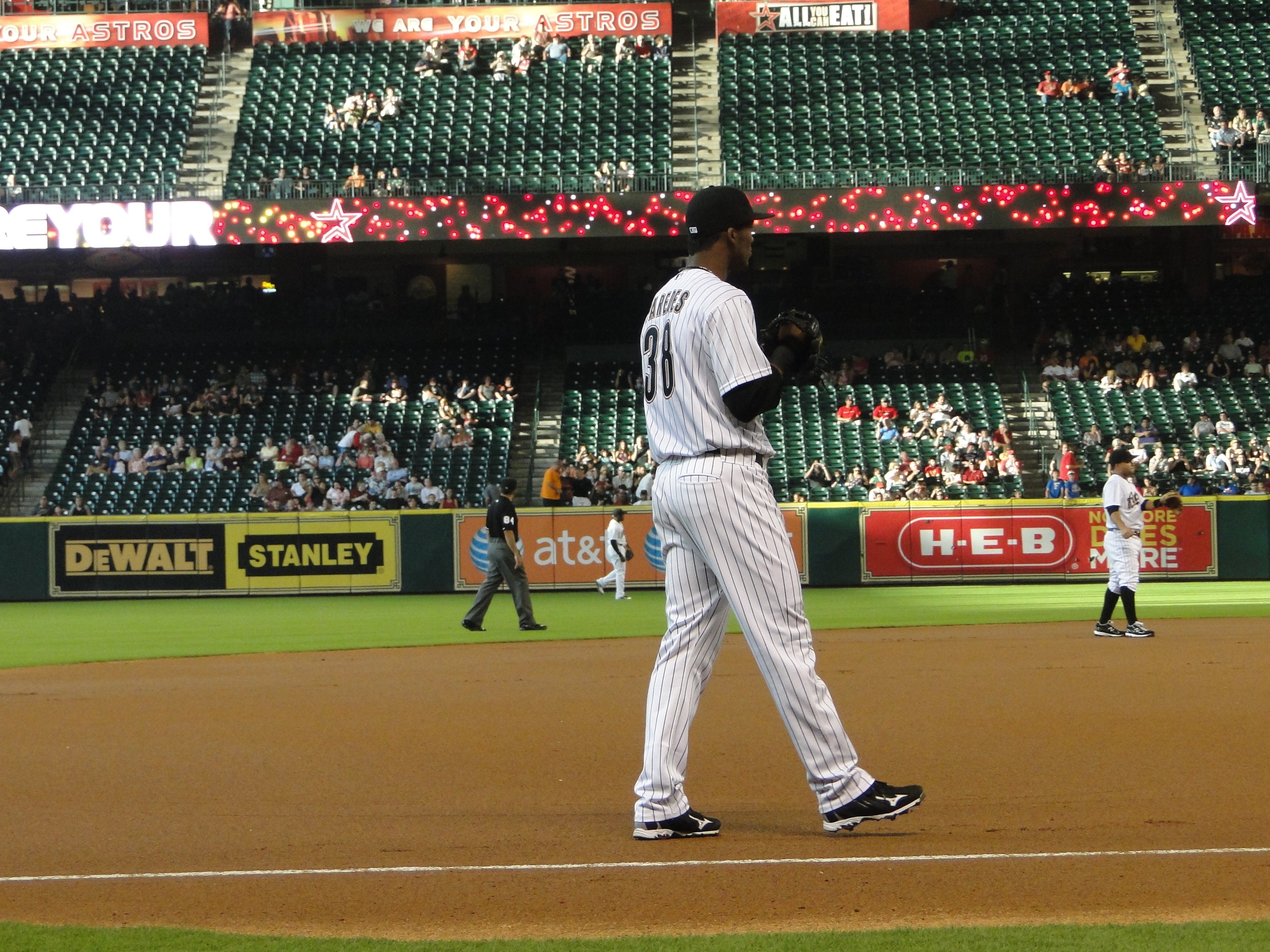
Jimmy Paredes, a Bonified Young Prospect at 3B for the Astros.

As General Manager, Ed Wade of the Houston Astros holds one of the thirty toughest jobs in big league baseball. All he has to do is guide his team with the money and talent evaluative and developmental resources at his disposal to an undefined point in the fairly near future when all factors come together to make his club a contender again for the World Series. It’s sort of like firing a skeet gun at a target that already has been launched at you from beyond the trees on the horizon on an inexactly known course – and then hitting it in the sky when it passes your way.

Lots of luck, Ed. You are going to need it.

Perhaps I exaggerate the degree of difficulty in becoming ultimately competitive again, by just a tad, but I’m not so sure. Unless you are the GM for the Yankees or Red Sox, and can afford to buy known talent that works now, your developmental energies have to go into an accurate assessment of the prospective young talent out there and then having the people, facilities, materials, and plan for bringing that talent to ripeness together in a time window that translates into a team competitive performance at the critical team moment.

Having control of enough playing contracts to keep this competitive edge viable for more than one season is also important to the idea of success – as well as the development of an ongoing pipeline plan for keeping the infusion of new replacement talent plugged into the team on an ongoing basis. It “ain’t” easy but it is essential to the realization of affordable winning baseball on an ongoing basis. It’s really what Branch Rickey had in mind when he created the farm system concept back in the early 1920s.

Free agency has distracted many clubs away from player development as those with money try to buy their way to quicker winning ways through big salaries and multiple year contracts, but, as we know in Houston, these deals more often than not become better remembered as the obstacles to winning once the need for rebuilding becomes nakedly apparent.  (For greatest local reference, see the contracts for Carlos Lee, Brett Myers, and Wandy Rodriguez,)

This “building a winner” business will never be an exact science, but put me in the camp of those who agree with what Ed Wade is trying to do with rebuilding the talent stream in the farm system. Even that move is no guarantee of annual competitiveness, but I think it’s pretty important, more  often than not. A club has to see talent, sign talent, and successfully develop talent to be an ongoing competitive presence.

Hopefully, Mr. Wade will have the ongoing support of new owner Jim Crane long enough to determine if he’s capable of getting the job done at all.  It has to be done over time, no matter who does it. Anybody who thinks it isn’t all that important to develop young talent is blowing smoke as far as I’m concerned.

Pitcher’s Paradise Lost: Harvey Haddix

August 22, 2011

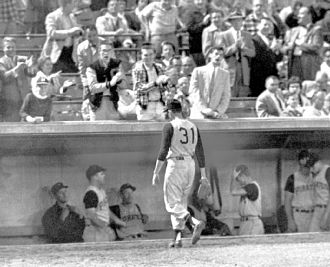
May 26, 1959: Pittsburgh's Harvey Haddix leaves the field after losing his perfect game, then his no-hitter and the game itself in the 13th inning at Milwaukee.

On May 26, 1959, little lefty Harvey Haddix of the Pittsburgh Pirates pitched a game that no pitcher before or after him as ever matched or bettered over the course of twelve (12) complete innings. Hurling for the visitors at County Stadium in Milwaukee against the home team Braves, Haddix had faced 36 men and retired all 36 of them without a single batter reaching first base over the course of his entire 12 innings of working the corners to near perfection with fast balls and sliders.

Haddix’s problem was that his Pirate teammates had been unable to score all night against Braves starter Lew Burdette. In 13 innings of work against Burdette, the Pirates had managed 12 singles, but no runs. As the game moved cautiously to the bottom of the 13th, both starters in this incredible 0-0 tie remained in the game, with Haddix up history points for every successive batter he retired.

Then it happened. And when it did, the end came in closely connected stages, with the first ending  coming about through actions which were totally outside the control of Pirates pitcher Haddix.

Felix Mantilla led off the bottom of the 13th with a routine grounder to Pirates third sacker Don Hoak for what should have been a routine 5-3 put out at first, but an errant throw to first allowed Mantilla to reach safely, ending Haddix’s streak of all-retired batters at 26 and, of course, also killing his prospects for a perfect game victory in additional innings.

The no-hitter possibility still lived when Eddie Mathews of the Braves sacrificed Mantilla to second base as the potential winning run. The Pirates then responded by walking Hank Aaron to set up hope for an inning-ending double play with slugger Joe Adcock coming to bat.

Then came the ka-boom.

Right-handed slugger Adcock unloaded on a pitch, driving it to deep let center. Pirates center fielder Bill Virdon tracked the ball, but there was nothing he could do. That ball was headed for the stands as an end to both the Haddix no-hitter and all Pirates hope for victory.

The game should have ended as a 3-0 13th inning walk off home run victory for the Milwaukee Braves, but a little base-running brain freeze by the great Hank Aaron ultimately reduced the final score to Milwaukee 1 – Pittsburgh 0. Thinking the game was over once Mantilla crossed the plate, Aaron left the field after touching second base on the Adcock thumper. Failing to notice, Adcock passed Aaron on the base paths, causing Aaron to be out and ultimately, reducing his home run in status to a double.

Mantilla’s run still counted. And that’s all the home boys needed for a phenomenal 1-0 Braves victory over Hard Luck Harvey and the valiant Pirates of Pittsburgh on a late spring Milwaukee night in 1959.

And what a heartbreaker for the lights out Mr. Haddix. In a few minutes times, he had lost the longest perfect game ever pitched through no fault of his own; he had surrendered his hold on a serious extra inning no-hitter; and he had lost the game itself.

The game triggered years of debate over how much official credit baseball should extend to Harvey Haddix for his feat. Should he have been given credit for pitching a 12-inning no-hitter and perfect game? Hardly. He lost the game in the 13th. And two batters reached first base before he gave up his only hit of the day, but that one hit was a walk-off winning blast for the other team.

How about perfect game credit for 9 innings? No way again.

In 1991, Major League Baseball took steps to clarify their official requirements for recognizing a perfect game: (1) The game had to be won in nine or more innings, without a single batter reaching first base in any way. (2) Games shortened to conclusion by fewer than nine innings because of weather, catastrophe, or any other bizarre circumstances would be counted as perfect games – or even as no-hitters.

That sounds fair to me. Besides, official recognition is not that big a deal here. Who is ever going to be able to really forget the man who pitched 12 innings of perfect ball on his way to perhaps the most disappointing individual performance outcome in baseball history?

Not me. And not guys like Don Hoak either. And certainly not all those ancient Pittsburgh and Milwaukee fans. It just may have been at the top of baseball’s most unusual games of all time list. Off hand, I cannot think of another game in history that measures up to this one as a repository for unique baseball accomplishment and disappointment.

Altuve Joins Inside-The-Park HR Club

August 21, 2011

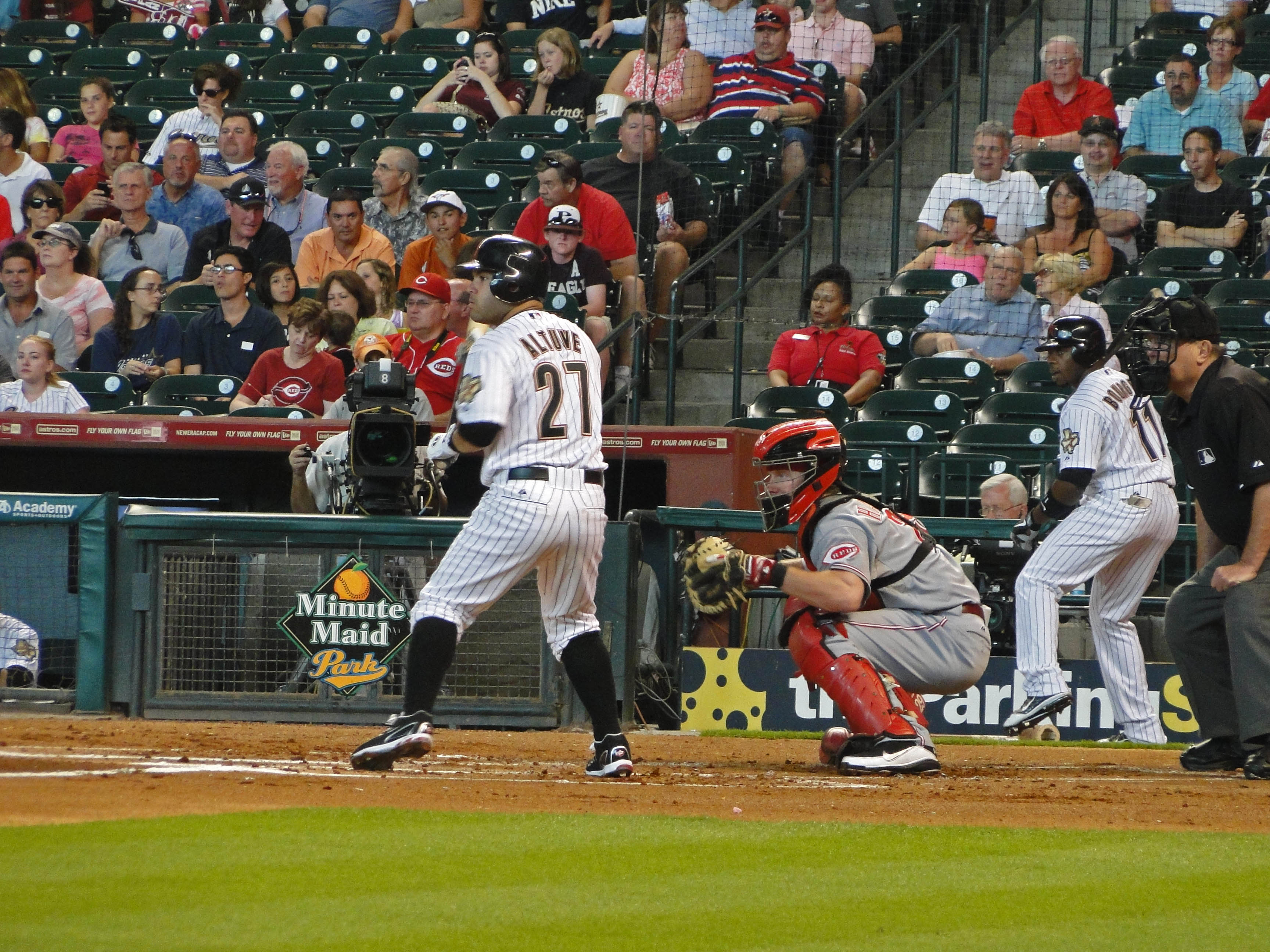
Jose Altuve, shown above in his recent home debut for the Houston Astros in a game against the Reds, has now joined the MLB Inside-The-Park HR Club in a game against the Giants.

We’ve got a little more road to cover before we anoint the career of 21-year old rookie second baseman Jose Altuve of the Houston Astros, but in the meanwhile,  the kid certainly isn’t doing much to discourage the early adulation. He went 3 for 5 in Saturday’s game at Minute Maid Park against the defending World Champion San Francisco Giants, raising his batting average  to .327 in 110 official times at bat during this late portion of the 2011 season.

Yesterday ALtuve also collected his first big league home run too, but it wasn’t just any old homer. It was inside-the-park job that caromed off the far left center field wall and got lost from the tracking vision of Giants center fielder long enough for Jose to burn a base running path all the way home for his first big league round-tripper, The kid has speed, moxie, and a high native baseball IQ. Nothing was going to stop him once he caught a glimpse of the fielder searching for the ball as he rounded second base. Not Third Base Coach Dave Clark, Not common sense. Not caution. Not the thought that starting any game with a man of third was a pretty good way to go. Nothing got in the way of Altuve’s literal most true enactment of a hell-bound-for-leather home run trip around the bases on the wings of opportunity. And he made it. With no play on him at the plate from a late and more than errant return throw of the ball to the infield.

In the early dead ball days of baseball, when many parks were canyons of space covered by shallow-playing outfielders, the balls that did skip through the defenses on a good roll were always a danger of becoming inside the park homers. The triple count, of course, was also quite high. The number of players who hit two inside-the-parkers in the early part of the 20th century is also quite high.

Ty Cobb led the American League with 9 home runs in the 1909 season and everyone of them was an inside-the-park job. That total by Cobb also represents the most inside-the-park home runs by an American Leaguer in any single season. That all of them for Cobb in 1909 were inside-the-park jobs speaks volumes for the normalcy of such a play back in the day. Tyrus was banging inside-the-prkers at a 100% rate in 1909.

Sam Crawford led the National League in 1901 with 16 home runs, and with 12 of these being inside-the-park acts and the NL record for same in a single season, giving old Sam a 66.7% sub-total of inside-the-park-home-runs to grand total homers for that one season.

Ty Cobb (1905-1928) hit 46 career inside-the-park homers to lead the American League for all time. His 46 sub-total from his 117 grand total career homers gave him a 39.3% average of insiders to total HR strokes.

Tommy Leach (1898-1915) hit 48 of his 63 career total homers as inside-the-parkers to become the National League’s all time leader. His figures represent that 76.2% of his shots never left the ballpark.

Jesse Burkett (1890-1905) is the major league leader in career inside-the-park homers. His career totals for each league place him back of Cobb and Leach respectively, but his grand total of 55 inside-the-parkers among 75 total homers still leads all MLB challengers. Burkett’s inside-to-total HR percentage is 73.3% – also the high stat among the three leaders portrayed here.

Isn’t baseball wonderful? Every time a kid like Jose Altuve does something like start a game off with an inside-the-park home run, it triggers the minds of many back to the days of old, when such a play was not quite the oddity it’s become in the early 21st century.

Keep it up, Jose Altuve! – We Astros fans need all the stoking of hope coals that players like you can give us by your performances.in the embers of this mostly forgettable 2011 season.

Saturday Morning Meanderings

August 20, 2011

Vanity. Vanity. All is Vanity. - As Time Goes By.

Why is it that baseball managers need to dress in uniform like their players to seem at home in their jobs, but football and basketball coaches would look stupid in our eyes if they came to work dressed out like their players?

Why is it that football and basketball coaches are controlled by a limited number of time-outs they may call during a game, but baseball managers may call as many time-outs as they damn well choose?

Why was now retired manager Bobby Cox ejected a record-setting 161 times during his career while retired Hall of Famer Stan Musial was never tossed from a game in his long big league life?  Let me put it another way: Why was Bobby Cox seen by most people as a sore-headed old baseball curmudgeon while Stan Musil was viewed as one of the most likable people in baseball history?

If the baseball season was only sixteen (16) games long and the football season stretched to one hundred and sixty-two (162) games, who would go to see either sport? My guess is there would still be big crowds for football, with people betting the over/under numbers on season roster and game fatality totals. Interest in once a week baseball would shift attention to one (or two) big starters. A once-a-week Sandy Koufax job might just be your club’s biggest ticket to the World Series.

Why is it that football and basketball both have stronger penalties against unfair play than baseball? Oh sure, baseball has the take your base by the HBP rule, and the base advancement for runners penalty by the balk rule, but football awards huge acres of field position for miscreant behavior and basketball awards offended players the opportunity to directly score uncontested points by so-called free throws in most instances as a result of defined egregious acts. Is baseball out of whack here? Or is it just my imagination? Of course, baseball is right there in the open for all to see. Unlike football or basketball, baseball offers less chance for players to hide dirty tricks – and you can get kicked out of a game and possibly suspended for serious acts of misconduct in baseball. Of course, that kind of ejection/suspension is also possible in the other two major sports, so maybe the gap is not as big here as first meets the eye.

Unlike football or basketball, baseball is off the clock. Theoretically, a baseball game could go on forever, and, like our lives, we live them that way, even though we all know that the end comes for all of us in time – at a moment we least expect. Baseball is life itself in that regard, a thing to be lived all out while it’s here. To live our lives as well as possible, we need to be grateful for each day that comes our way, giving ourselves to acts of love for those people and passions we most deeply cherish.

I choose my family. My friends. My country. My city. My undergraduate university. My high school. Arts and Literature. And baseball.

The Houston MLB Managerial Chain: 1962-2011

August 19, 2011

Larry Dierker: His 4 Playoff Clubs Tops All Other Houston Managers.

In their fifty National League seasons as the Houston Colt .45s (1962-1964) and Houston Astros (1995-2011), eighteen different men have served as field manager of the local franchise. This roll call includes two men who served only in the briefest of transitional roles as interim managers when things fell apart before season’s end.  Salty Parker managed one winning game between Harry Walker and Leo Durocher in 1972, and the current third base coach Dave Clark of the 2011 Astros crash-landed the 2009 club for the departing Cecil Cooper in 2009 with a 4-9 mark at season’s end.

All others had some time. Thanks to Baseball Almanac and a trusty calculator, here are the records of all managers who have served Houston MLB Baseball over the past half century. The list presents the group in chronological order, showing their place in the order of appearance, the years they each worked any part of a season, plus the totals number of separate seasons they each worked, their cumulative W-L records and Win Percentage.

As you probably already know, Bill Virdon was the first Astros manager to lead the club to the playoffs in 1980; Larry Dierker led the club to the most playoff appearances (1997, 1998, 1999, and 2001); and Phil Garner is the only man, so far, who has led the Astros to a World Series appearance. (You know the year for that one, right?)

Here’s the broad data bank on Houston big league managers. Two more notes: So far, too, no fired or retired Astros manager has ever returned for a second shot at the same job. Also, Brad Mills’ current dynamic record as the Houston manager is only good through the games of 2011 season that have been played through August 17th. The team won the final two game of the home Cubs series to reach the 40-84 mark for this year,

Houston Big League Managers: A Chronology

(1) Harry Craft (1962-64, 3 seasons) (191-280, .406) **

(2) Luman Harris (1964-65, 2 seasons) (70-105, .400)

(3) Grady Hatton (1966-68, 3 seasons) (164-221, .426)

(4) Harry Walker (1968-72, 5 seasons) (355-353, .501)

(5) Salty Parker (1972, 1 season) (1-0, 1.000)

(6) Leo Durocher (1972-73, 2 seasons) (98-95, .507)

(7) Preston Gomez (1974-75, 2 seasons) (128-161, .443)

(8) Bill Virdon (1975-81, 8 seasons) (544-522, .510)

(9) Bob Lillis (1982-85, 4 seasons) (276-261, .514)

(10) Hal Lanier (1986-88, 3 seasons) (254-232, .523)

(11) Art Howe (1989-93, 5 seasons) (392-418, .484)

(12) Terry Collins (1994-96, 3 seasons) (224-197, .532)

(13) Larry Dierker (1997-2001, 5 seasons) (448-362, .553)

(14) Jimy Williams (2002-04, 3 seasons) (215-197, .522)

(15) Phil Garner (2004-07), 4 seasons) (277-252, .524)

(16) Cecil Cooper (2007-09, 3 seasons) (171-170, .501)

(17) Dave Clark (2009, 1 season) (4-9, .308)

(18) Brad Mills (2010-11 ongoing, 2 seasons) (116-170, .406) *

*Dynamic record of active manager Brad Mills through games of 08-17-2011 and the 40-84 club record for 2011 through that date.

** For  a much more complete picture of the managerial picture on both the Houston Astros and the Texas Rangers, check out the material on Astros Daily. Thanks to the work that Darrell Pittman and Bob Hulsey have done at Astros Daily, using Baseball Reference as their primary season data base source,

I discovered that Baseball Almanac,Com was guilty of a major data base error in their reporting of wins and losses for the Colt .45s in 1963. “BA” reports the team with only a 55-95 record in 1963, whereas, “BR” and all other sources I find show their 1963 record as 66-96. Thanks to Darrell and Company, I have now made amends to the damage that 1963 data error caused to my first reporting on the record for Harry Craft.

A subsequent data check confirms no additional errors beyond the one effecting Harry Craft. My figures here, including the ones for Harry Craft, square off exactly with those offered in the Astros Daily bottom lines on wins and losses for each of the eighteen men who have served the first half century as Houston MLB managers.

I hate errors, even though they are apparently inevitable.

In the meanwhile, check out this link to the fine report on this same subject at Astros Daily.

http://astrosdaily.com/history/managers/

Baseball Players with Uniform #s Retired by Multiple Teams

August 18, 2011

Hall of Famer Phil Niekro (L) had his #35 retired by the Atlanta Braves. Many also feel that his late brother Joe Niekro (R) also deserves to have his #36 retired by the Houston Astros. (That’s me, Bill McCurdy, in the middle above. The photo was taken in 2005, on the day of Joe Niekro’s induction into the Texas Baseball Hall of Fame.)

In addition to Joe Niekro, there are number of deserving former players out there whose numbers could easily be retired with ease and complete justification. The practical question is, how long can this relatively new condition continue to thrive until most teams use up all the available one and two digit figures available? The thought of three-digit uniform numbers hardly sounds like a great station to reach. On the other side, if some of the older clubs who have been doing the retired number honor longer suddenly stop, the danger over the years to come exists that better players may come along than some of those who have already had their numbers retired. In that case, how do we justify withholding the same honor from the newer greats in franchise history?

Maybe each club should simply establish its own franchise hall of honor and leave uniform number retirement out of the honors formula.

Jackie Robinson is the only player to have his #42 retired by all thirty LLB clubs in honor of his 1947 civil rights role in breaking the ancient racist color line, but are you  aware that eight other former big leaguers have had their playing numbers retired by more than one team? I was jogged into a state of greater consciousness of this fact as I mulled over the list of those who have been so honored and found it interesting.

Nolan Ryan again is the leader of the pack, Three of his four clubs shone the light of attention on both Ryan and themselves by retiring his team number. The Los Angeles Angels at Anaheim (California Angels in Nolan’s day) retired his number 30; the Houston Astros and the Texas Rangers also retired the #34 that he wore with their clubs.

Longtime home run king Hank Aaron had his #44 retired by both the Atlanta Braves and the Milwaukee Brewers.

Manager Sparky Anderson had # 10 retired by the Cincinnati Reds and then saw #11 equally honored by the Detroit Tigers.

Catcher Carlton Fisk saw his #27 retired by the Boston Red Sox and then played long enough, and apparently well enough, to have hi new inverted #72 retired by the Chicago White Sox.

Mr. October, Reggie Jackson, had his #9 number with the Oakland A’s retired, but also his #44 with the New York Yankees tkane out of use by others on that club as well.

Pitcher Greg Maddux is another same #/two team number retiree. (I missed Greg on my first weep, but Barb Presko Hughes pigtailed my catch and brought us up to speed on the omission. Thanks, Barb!) Greg Maddux’s #31 was retired by both the Atlanta Braves and the Chicago Cubs.

Intrepid slugger Frank Robinson held onto his #20 long enough to see it retired by both the Cincinnati Reds and the Baltimore Orioles.

Finally, Ole Perfesser Casey Stengel wore drab old #37 long enough as manager of both the juggernaut New York Yankees and the jigsaw-puzzle New York Mets to have it retired by each Gotham City team.

I may have missed someone in today’s morning rush, but I don’t think so. Feel free to check me out at Baseball Almanac.Com.

And have a nice Thursday. Once again, too bad it’s not coming our way with any rain.

Worst. Superhero Costume. Ever.

August 17, 2011

"Holy Lost Peripheral Vision, Batman! What do we do now?"

Worst superhero costume ever? It’s a no-brainer in my book. It came along in the 1949 second Batman serial that starred Robert Lowery as the famous caped crusader and Johnny Duncan as his faithful sidekick Robin. Never heard of either actor? Watch a few minutes of Chapter One in this fifteen unit Saturday kid show special feature and you’ll quickly understand why neither actor’s name is familiar today.

All I know is that Batman, both this one from 1949 and the 1943 earlier Batman serial of equivalently anonymous leading character actors, stirred the crime-fighting soul of this kid from the Houston East End. Now these same serials are the stuff of “rolling-on-the-floor, laughing-my-ankles-off” fun and amusement.

Some amazing things happen in these old serials. (1) Good and Evil are clearly distinguishable in black and white terms. There is no lost time in debate over who is responsible for the national debt or its relative ceiling. You just had to arrest or kill the bad guys and everything would be OK again. (2) In high-speed chase scenes going around treacherous mountain curves,  good guys and bad guys alike were capable of jumping out of cars that were headed over cliffs and never losing either their hats or their footing as they hit the highway from the car door running and then walked their way to a safe stop. (3) Batman and Robin could both take on fist fights with the bad guys in spite of costume masks that virtually destroyed all peripheral (and sometimes forward) vision.

The Batman’s mask was especially bad. The caped crusader was constantly holding his head back to see through the eye slits that had been pulled by ear-grabbing bad guys over his eyes.  He also took a lot of shots from the right and left because of the total shadow on peripheral vision cast by his Batman hood.

Even we kids saw the flaws in the Batman costume, but it was still better than the mimic costumes we rigged up at home. A bath towel had to pass for a cape. These worked better if you cut one long end in a sawtooth pattern to make it look more “batty” apparent, but the downside of that slight  alteration was that  it made our mamas very unhappy and lethal-like in their punishments of us for destroying a “perfectly good bath towel.”

The homeboy hood consisted of charcoal blackening around the eyes, a small rag tied around the head, and clothes pins attached to either side as “bat ears.”

What do you think?

On second thought, maybe Mr. Batman ’49 looked pretty cool after all. Rent or buy the serial and judge for yourself.