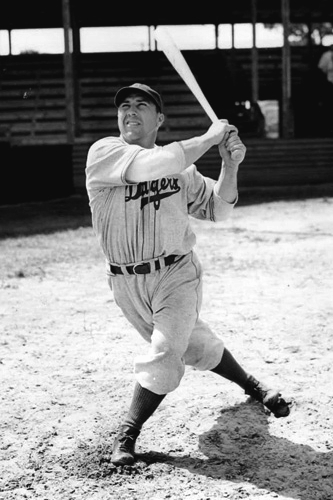
Our reminder from friend Randy yesterday is the whole impetus behind this data column. Randy had written a reminder comment in response to yesterday’s piece about the first MLB games of 15 great HOF players to remind us that former UT star Ernie Koy, Sr. had once homered in his first 1938 MLB batting appearance for the Brooklyn Dodgers. Well, that’s a rare feat, all right. Only 114 major leaguers have done it and here’s the list of names in chronological order. The chart shows their names, their teams, the dates of their first time at bat explosions, and the number of homers they each compiled in their MLB careers (Thank you, Wikipedia, for doing all the work):
Archive for the ‘Uncategorized’ Category
Batters who hit HR in 1st MLB times at bat
December 17, 20131st Games for 15 Baseball Favorites
December 16, 2013This morning I got to thinking about the big league batters that mattered the most to me when I was both a kid and growing into a young man – and still trying to play baseball at some low-level of amateur competition. I stopped when my list reached the name of someone who was nearly my age contemporary. In my case, that guy happened to be Frank Robinson, who was breaking into the big leagues at age 20 in 1956, the same year that I was 18 and graduating from high school.
When I suddenly stopped, I had a list of 15 names that almost any group of long time fans could have derived in the same five minutes time, given a difference here and there. Without conscious intention, I had come up with a list of names that shared one aspect in common. – They are all members of the Baseball of Fame. As a little exercise in leisurely research, I decided to go to Baseball Almanac and do an uncomplicated documentation of how each of these fifteen greater hitters did in their very first MLB games. Baseball Almanac is good for that sort of quick snapshot work, although, in devising my table for recording the data, I miscalculated. Baseball Almanac box scores don’t give us individual game stats on batter walks and strikeouts. As a result, those columns remain blank in my table, but it is still interesting to review how they each performed in their first chances as big league batters.
For your entertainment and/or edification, here’s how my “fine fifteen” made out individually and collectively in this chronological break=in date table of major hitting stats.
I think you will be able to easily follow who they are from the brevity names I’ve assigned to each for the sake of making this table work. If not, I spell out their names after the table presentation for the sake of bringing other first game facts to light. It helps to always remember that baseball, like life, is a long-season, Any of us can have good or bad time, but it’s how we grow from adversity over time that really determines the quality of our lives.
Here’s the first game day performance picture for each of 15 men who eventually each played good enough to be inducted into the Hall of Fame at Cooperstown:
| PLAYER | AGE | 1st Game | AB | R | H | RBI | 2B | 3B | HR | BB | SO | BA |
| Joe D | 21 | 5/3/36 | 6 | 3 | 3 | 1 | 0 | 1 | 0 | – | – | .500 |
| Ted W | 20 | 4/20/39 | 4 | 0 | 1 | 0 | 1 | 0 | 0 | – | – | .250 |
| Stan M | 20 | 9/17/41 | 4 | 0 | 2 | 2 | 1 | 0 | 0 | – | – | .500 |
| Ralph K | 23 | 4/16/46 | 4 | 0 | 1 | 0 | 0 | 0 | 0 | – | – | .250 |
| Jackie | 28 | 4/15/47 | 3 | 1 | 0 | 0 | 0 | 0 | 0 | – | – | .000 |
| Duke | 20 | 4/17/47 | 2 | 1 | 1 | 0 | 0 | 0 | 0 | – | – | .500 |
| Larry D | 23 | 7/05/47 | 1 | 0 | 0 | 0 | 0 | 0 | 0 | – | – | .000 |
| Monte I | 30 | 7/08/49 | 0 | 0 | 0 | 0 | 0 | 0 | 0 | – | – | .000 |
| Mickey | 19 | 4/17/51 | 4 | 1 | 1 | 1 | 0 | 0 | 0 | – | – | .250 |
| Willie | 20 | 5/25/51 | 5 | 0 | 0 | 0 | 0 | 0 | 0 | – | – | ,000 |
| Eddie M | 20 | 4/15/52 | 3 | 0 | 0 | 0 | 0 | 0 | 0 | – | – | .000 |
| Ernie B | 22 | 9/17/53 | 3 | 1 | 0 | 0 | 0 | 0 | 0 | – | – | .000 |
| Hank A | 20 | 4/13/54 | 5 | 0 | 0 | 0 | 0 | 0 | 0 | – | – | .000 |
| Roberto | 20 | 4/17/55 | 4 | 1 | 1 | 0 | 0 | 0 | 0 | – | – | .250 |
| Frank R | 20 | 4/17/56 | 3 | 0 | 2 | 0 | 1 | 0 | 0 | – | – | .667 |
| TOTALS | – | – | 51 | 8 | 12 | 4 | 3 | 1 | 0 | – | – | .235 |
(1) Joe DiMaggio played left field and was a slugfest participant as the Yankees drubbed the Browns at Yankee Stadium with 17 hits for a 14-5 win.
(2) Ted Williams was in the lineup in right field for the Red Sox when they opened the season with a 2-0 loss to New York in Yankee Stadium. Boston had 7 hits and Teddy’s double off Red Ruffing was one of them.
(3) Stan Musial played right field in the second game of a Sportsman’s Park double-header in which the Cardinals edged the Boston Braves, 3-2. Stan’s first hit came off Jim Tobin and it was a double that produced the two-runs needed to produce the one-run difference the Cards needed for the win.
(4) Ralph Kiner broke in as a center fielder for the Pirates on Opening Day in 1946 against the home team Cardinals. The Pirates won, 6-4, but it is unclear as to whom Young Ralph got his first league hit among the several pitchers he faced.
(5) Jackie Robinson went hitless in what has to be the most publicized first big league game for any player in baseball history. The home Dodgers beat the Braves, 6-4, with Robinson scoring one of the Brooklyn runs. Jackie played most of the game at 1st base, but was relieved late by Howie Schultz.
(6) Duke Snider was the 3rd Brooklyn left fielder of the day, but he arrived in time to get a single for his first MLB hit and also to score a run that added to the 12-6 final score that favored the Dodgers. Again, no ready information this morning reveals which of several Braves pitchers yielded his first hit.
(7) Larry Doby was a 7th inning pinch hitter for Indians’ reliever Bryan Stephens in a game at Chicago, That was it for Larry D. as he was retired and the White Sox went on to defeat Cleveland, 6-5.
(8) Monte Irvin was called upon to pinch hit for Giants starter Clint Hartung of the Giants in the top of the eighth in a game at Ebbets Field his club would lose to the Dodgers, 4-3. Monte probably reached base on a walk, but he could have received a no time at bat charge in one of the three other ways it works to that end, but the box score does not provide us with the whole game story to make that clear.
(9) Mickey Mantle played right field in his first big league game as the great Joe D. still owned center in his last MLB season. No clarity again on the first hit pitcher, but Mantle’s home team Yankees defeated the Red Sox on Opening Day.
(10) Willie Mays was off to his now famous inauspicious start, but he made for it in time. Playing center field on the road in Philadelphia, Willie’s Giants did beat the Giants, 8-5, in MLB debut game.
(11) Eddie Mathews played 3rd base (where else?) in his Season Opener debut for the Boston Braves, but couldn’t scratch a hit off Preacher Roe of the visiting Brooklyn Dodgers, who beat Warren Spahn, 3-2, to start the season.
(12) Ernie Banks broke in at shortstop for the Cubs with a hitless performance that would not be the style of his always upbeat career.
(13) Hank Aaron’s 2 for 4 Opening Day got him off to a good start, but his club lost, 9-8, to the home town Reds.
(14) Roberto Clemente got his first MLB hit off winning pitcher Johnny Podres of the Brooklyn Dodgers in the first game of a double-header, 10-3.
(15) Frank Robinson started in left field on Opening Day with a 2 for 3 day that included a double, but no runs or rbi’s.
In general, it is interesting to note that these 15 players were not the .235 average of their collective first game performance. These stars also were mostly power hitters, who would each recover from their first-game goose eggs on home runs to bash hundreds of home runs each over the course of their careers. Can you even imagine what these guys would be worth on today’s MLB market?
The thought chills all reason.
1960: Houston Gets Big League Baseball
December 15, 2013
Monday, October 17, 1960, Houston and New York City are both awarded NL baseball expansion franchises. Houston Sports Association Members celebrate (L>R): (1) R.E. “Bob” Smith; (2) Judge Roy Hofheinz; (3) Co. Commissioner V.V. “Red” Ramsey; (4) City Council Johnny Goyen; (5) Co. Judge Bill Elliott; (6) George Kirksey; and (7) Craig Cullinan.
On Tuesday, October 18, 1960, the following Associated Press story flooded the nation’s newspapers. Here’s how the San Antonio Express reported the news with their own headline and physical presentation:
*****************************
National Loop Admits Houston, N.Y.
Chicago (AP) – The National League unanimously awarded franchises to Houston and New York City Monday, expanding baseball’s oldest major league to 10 teams for the 1962 season.
It was the first structural change for the National League since 1900.
The resolution on Houston and New York was by Walter O’Malley who, ironically, had moved the Dodgers out of Brooklyn to Los Angeles in 1957, two months after Horace Stoneham had contracted to take his Giants from New York to San Francisco.
“The resolution was enthusiastically accepted,” said O’Malley. “There was no concerted objection although earlier there had been some feeling that along with Houston, the Dallas-Fort Worth territory might be more feasible than New York.”
League President Warren Giles, who said the club owners’ action will be finalized at the major league’s annual convention in St. Louis in December, termed the addition of New York and Houston as a “giant progressive step toward bringing major league baseball to all four corners of the country.”
“This makes us a very solid league geographically,” he said enthusiastically.
“To all intents and purposes,” Giles added, “we are now a 10-team league, with operations beginning in 1962. There are certain specifications the new clubs will have to meet, but I have no doubt they will meet the qualifications. I don’t anticipate any obstacles.”
Giles pointed out that two points must be cleared to pave the way for New York’s and Houston’ entry. First, a rule must be changed to make New York, currently American League territory, available to the National League. This the NL expects to do as soon as possible.
Second, the Houston Sports Association, recipients of the Houston franchise, must acquire the (minor league) territorial rights from the Houston Buffs of the American Association.
The syndicate representing Houston numbers 13 and includes Craig Cullinan, Jr., George Kirksey, Judge Roy Hofheinz, K.S. (Bud) Adams, and R.E. (Bob) Smith. Cullinan, Kirksey, and Judge Hofheinz were present at the meeting and presented plans of their newly proposed $15 million dollar (Colt) stadium which they said could be ready by the start of the 1962 season.
The New York syndicate, which includes Mrs. Charles Payson, M. Donald Grant, Dwight (Pete) Davis, Jr., William Simpson, and H.H. Walker, Jr., (who) was not represented.
“The Cullinan group must first indemnify the American Association and the Houston club in the AA,” he said. “I understand they’ve already begun negotiations and they’ve assured us that (settlement) will be no problem.”
“Regarding New York,” Giles said, “Commissioner Ford Frick has assured us if we propose a rule to open the New York territory to a National League franchise, and if the American League should opposes it, he will cast the deciding vote in our favor.”
Giles said, however, he was not certain the American League would oppose the return of New York to the National, of which that city had been a member without interruption from 1883 to 1957.
Asked whether the American League, which is to meet Oct. 26, expects to move into Los Angeles, Giles said he did not know.
“We did not discuss the American League,” he said, “but I understand that the Commissioner feels the same way about Los Angeles as he does about New York.”
O’Malley, owner of the Dodgers, said he would not oppose the AL’s reported move into Los Angeles.
“I don’t think it would be so smart of them to move into Los Angeles right now,” he said, “although I would not oppose it.”
“I believe eventually they (the AL) will go to the (West) Coast, but there are other fine cities that would make fine (locations for) major league franchises (besides Los Angeles).”
… excerpt from the San Antonio Express, Tuesday, October 18, 1960, Page 21.
**********************
Contemporary news reports often give us our only clues about the birth of reality and legend in history. Today’s column data suggests, at least, one example for each category:
Reality: The 1962 NL expansion back into New York City simply fanned the AL fires for placing their own franchises in those two gilded west coast markets that were already in play for the NL in LA and SF. The AL was already well on their way into LA, but the NL move into NYC simply greased the skids by eliminating any technical resistance the NL might have otherwise tried to use. They already had played that card with the support of the Commissioner. The AL was coming to the west coast, all right, and they would not go first to any of the “other fine cities” that Mr. O’Malley had in mind for them, as in “any other place on the west coast, but LA.”
Legend: Judge Hofheinz apparently didn’t build Colt Stadium as an angry response to his difficult and expensive territorial rights settlement with the Houston Buffs. The HSA already had that $15 million dollar stadium plan in place at the time of their franchise award. The Judge wanted Houston fans to lick their chomps in close up observation of the domed stadium that would be going up near them on the prairie south of the Texas Medical Center in Houston.
Thank You Note: Thank you, AstrosTalk, for identifying our third man in the photograph as Harris County Commissioner V.V. “Red” Ramsey.
Beyond the Statistical Case for Keenum
December 14, 2013While some Texans football fans still wait to see if rookie QB Case Keenum can actually win a game for a demoralized team in the last three games against the probably best NFL team, the Denver Broncos, and two other pretty good ones, the Indianapolis Colts and the Tennessee Titans, I remain one of those who still believes that the young man from UH will get there as a winning starter in the league. The guy just eats lessons and adapts his game better than most I’ve ever seen, for whatever that’s worth. And it may not be much. I still consider myself first as a baseball fan who watches football in the off-season because there’s nothing else to do, but, given the time, I have this habit of getting into the details of what the diversion game is about and the details of predicting success and failure.
What I’m going by here are Case Keenum’s past and the circumstances of his current trial. Let’s look at the latter aspect first.
The absence of a superior running game, effective pass blocking, the presence of # 8, with his helmet on his head, simply pouting on the sidelines and waiting for his chance to go back in at QB have been big. Throw in the the disastrous losing streak he inherited, poor play in the defensive secondary, undisciplined dumb play and all the penalties that spring from it, an unreliable kicking game – and the QB is almost set up to take the rap for the mistakes of so many others. Throw in the dour inflexible conservatism of our likeable, but media-beleaguered head coach and … well … taking over at QB for the 2013 Texans has been about as easy as planning a book club meeting at a house that’s already on fire. Had Keenum been able to either start the season or take over earlier, for better or worse, as the starter – with no threat of replacement after a bad series, thing could have gone so much better. This is a kid who did some pretty great statement playing with a weighed down chance. – Remember the five great TD catches by Andre Johnson? They came served up by a guy who could have quit last year when he set all those records at UH and didn’t even get drafted. He also could have quit after one year on practice squad and little focus on his own preparation for ever starting.
Case Keenum didn’t quit. He has no “quit” in him. And someday, in spite of the putdowns of his abilities by some of our full-of-themselves electronic and print media egos, some NFL team is going to reap the benefits of his full bloom. We may be looking at the second coming of Drew Brees in Case Keenum.
Now, as for all those collegiate records, do you know what he did? His passing records are mostly held by a statistical landslide. And these are not the distances that come only from a “systems” accomplishment. As an individual player, Case Keenum had three influential head coaches in college: Art Briles, the coach who recruited him went on to do the great things he is continuing to do at Baylor – and that includes taking UH recruit Robert Griffin III with him to Baylor when he left for the Waco job. It was a move that set RGIII on the road to his 2011 Heisman Trophy award. Then came Kevin Sumlin to UH and he and Keenum took the Cougars to its biggest winning season in history in 2011. Then Sumlin left for Texas A&M where, in 2012, he became the 2nd former UH coach in two consecutive years to be responsible for Heisman Trophy winners when Johnny Manzeil won it for himself and the Aggies. Tony Levine became Keenum’s third college coach for one victorious bowl game victory over Penn State at the end of the 2011 season.
Then Case Keenum went to the pre-draft performance trials in the spring of 2012, where he pulled a hamstring, but kept on trying anyway. His timing was apparently slowed enough to cost him a place in the 2012 draft by clubs who were either unaware of his injury or were otherwise simply dismissive that it made any difference in the evaluation of his true potential. Gary Kubiak was not among the totally dismissive group. He signed Keenum for the Texans after the draft and he is the reason that Keenum even has this late season chance to launch his career in Houston.
Now, let’s look at that college ball data. Here are Case Keenum’s monstrous collegiate passing records:
1) Most pass completions, career
– Case Keenum, 1,546
2) Most passing yards, career
– Case Keenum, 19,217
3) Most games, 300 or more passing yards, season –
14, Paul Smith, Tulsa, 1907
14, Case Keenum, Houston, 2011
Warning, Kids! Don’t Try This At Home!
December 13, 2013Somewhere, in the hustle and bustle of technological change and all the abundant news reading that rolls over all of us in indigestibly monstrous portions from all digital and ink print corners by the nanosecond, I missed the Chron.Com story from 2.5 years ago about the part that dear old Pecan Park played in the earliest deployment of the new Super WiFi technology in Houston. Here’s the link to an article from April 2011 that describes the inititation of the project that got started with the strong and able support of Rice University in April 2011.
I have no idea where the fruits of this early experience have fallen into growth and use elsewhere by now. I just know that we have a wireless system at home that shuts down if you set a bag of groceries down in a way that blocks the WiFi system’s signal blaster – or zapper – or whatever you choose to call it. Like many of you, I have grown into the bane of modernity – as the person who is now totally dependent upon a technology that he still barely understands.
When I was a kid in Pecan Park, back in the late 1940s and early 1950s, we invented a few things on the street, but nothing that would invite any of us to have been renamed as the next Edison or Einstein. Most of our stuff had to do with dangerous, but less than deadly instruments of street warfare. For my best example, we “invented” something we called “The Willow Wand.” – The Willow Wand was made from the last three to four feet of fairly stable, but flexible Willow Tree branch that grew in the McGee’s back yard on Japonica Street, across the street and immediately north of our house – and immediately east of our sandlot base at Eagle Field.
Willow Wands formed out of our perceived need to defend Eagle Field from invasion by interloping gangs of kids from other streets. They worked like this: Warning! Kids, Please Don’t Try This at Home! We Were Stupid Back in the Day! (1) find your willow stick and pick it clean of little leaves and small off-shoots. (2) Form some black soil gumbo mud and roll it in small pieces into balls that were about one inch thick. (3) Find a small rock and insert it into the mud ball. (4) Then insert the mud ball onto the smallest, most flexible end of the stick. (5) Teach yourselves and the younger kids how to whiplash that little mud ball straight and hard-flying off the end of the wand with just the right flick of the wrist once your stick is pointing toward the kid you are trying to hit in protection of your territory. (6) With practice, you hardly ever miss.
We learned better. The hard way. And I’ve told this story before.
Willow Wands were fine until we learned that one of our younger and childless married neighborhood husbands, a machinist named “Harry”, could actually make us a couple of pipe cannons that used Baby Giant firecracker sticks to propel gravel out the end of a long pipe. We got Harry to build these items for us from some scrap materials and we told him it would be a good way to learn about shooting guns. We didn’t tell Harry that we planned to start those lessons just as soon as the Kernel Street kids again tried taking over Eagle Field – which, as luck would have it, took place on the Sunday afternoon following the Saturday we got the cannons and the firecracker power they each required.
The Kernel Street Kids crossed the alley which separated them from Japonica Street and Eagle Field. Lucky for us, we got earlier word that they were coming and already had set up the loaded pipe cannons on the sandlot. Then, when the Kernels came charging at us, we set off both our blasters. One missed, but the other sprayed a shirtless kid in the chest, causing a discharge of blood and a general halt to everything.
It was like time stopped and we all got hung up on “what have we done?” But sooner than we could react, my dad came running out of the house, shouting “STOP!” in all the ways he knew how to express that idea. I don’t know where the other parents were, but dad was the only one who showed up. He gave us all a healthy reprimand for what we had done as he ministered first aid to the one kid who, fortunately, was only scratched from the gravel that hit him.
Dad told us strongly that we didn’t own the field to the exclusion of others. “If you kids have any differences with each other, then settle it right here and now with a game of baseball,” he added. Which we did.
We won, but so what. It didn’t seem to matter after that scary day. The Kernel Street kids joined in with the Japonica-Myrtle bunch after that Sunday – and from that date, we would blossom eventually into the sandlot club that became The Pecan Park Eagles.
Oh yeah, I still got a whipping from dad that night, but that’s more than OK. I had it coming.
I’ll never know what was said to the neighbor who built our cannons for us back then. Maybe nothing. It was a different time and place.
Our Top Ten Sports Carols for Christmas 2013
December 12, 2013Our Top Ten Sports Carols for Christmas 2013
10) Hark the LA Angels sing; save us from all Pujols swings!
9) I saw daddy kissing Santa Claus – underneath the driveway hoop last night!
8) Deck the Texans in a year of folly: Simply dump Matt Schaub – and we’ll be jolly!
7) All I want for Christmas is – two billion bucks!
6) Frosty the Closer – was a very special man – with an unseen hitch – he could change each pitch – and retire ‘ em with a fan!
5) I dream watched – of a White Christmas! – Turned out to be the Eagles game!
4) Silent Night! Unholy Night! Astros Bats! Swung Left – or Right!
3) A Rod roasting – on an open fire! – Bold truth – nipping at his nose!
2) Jingle Bells! – Jingle Bells! – Jingle All the Way! – That’s the sound – that you’re riches bound – when Scott Boras wins the day!
1) I’ll be home – for Christmas – or my name’s – not Qualls! Please leave bats – and agile cats – and pitchers – more like me. – I’ll be home – for Christmas – at dear Minute Maid! – I’ll be HOME – for Christmas! – And I’m hoping – You’ll be too!
Merry Christmas, Everybody!
Book Your Cooperstown Trip Early in 2014
December 11, 2013
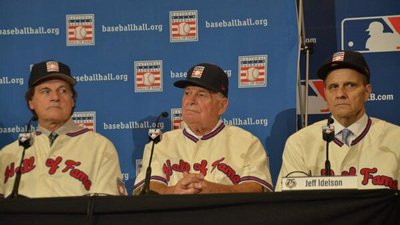
Tony LaRussa, Bobby Cox, and Joe Torre
~ The guys wore their game faces to the HOF induction announcement. ~
With the Veterans Committee’s approval of great modern managers Tony LaRussa, Bob Cox and Joe Torre for Hall of Fame enshrinement in 2014, Cooperstown, New York is going to get a little crowded next August on Induction Weekend, and just imagine how it will even spike-hype attendance all the more with the probable inclusion of recently retired 300-game winners Greg Maddux and Tommy Glavine, plus the real possibility this time of Houston’s Craig Biggio!
By adding LaRussa, Cox, and Torre, the Hall of Fame has inserted the numbers 3, 4, and 5 men on the “most games won by a manager” list that may start forever with Connie Mack and John McGraw in the numbers one and two spots on wins.
How man other guys beside Connie Mack are ever going to manage for 53 years in a single lifetime? Mack doesn’t even have a .500 percentage on winning, but his 3,731 managerial wins is still a far spot ahead of everyone else.
Here’s the essential win/loss and pennants/World Series achievement list for each of what, by August 2014, will be The Top Wins List Among Five Hall of Fame Managers:
| MANAGER | SEASONS | WON | LOST | WIN % | PENNANTS | WS WINS |
| Connie Mack | 53 | 3,371 | 3,948 | .486 | 9 | 5 |
| John McGraw | 33 | 2,763 | 1,948 | .586 | 10 | 3 |
| Tony LaRussa | 33 | 2,728 | 2,365 | .536 | 6 | 3 |
| Bobby Cox | 29 | 2,504 | 2,001 | .556 | 5 | 1 |
| Joe Torre | 29 | 2,326 | 1,997 | .538 | 6 | 4 |
| TOTALS | 177 | 13,692 | 12,259 | .528 | 36 | 16 |
Tony LaRussa went out like the champion he is after the 2011 season that saw his St. Louis Cardinals rally from two “one strike away from defeat” situations in Game 7 conditions to defeat the Texas Rangers. Although he was only 35 games behind the career win total for John McGraw after 2011, La Russa didn’t keep playing the next season. The record second place on this list was his to take. He could have won it easily, even had he been managing the 2012 Astros, but he passed. That wasn’t what Tony LaRussa was about. LaRussa didn’t stay in the game that long – just to nurse personal achievement numbers. He managed the game with all the passion and deftness of a grand chessmaster because he loved the intrigue and the challenge. He also knew that it was better to quit on the mountaintop – and to leave with fans still wanting for more.
Cox and Torre were both in control of things as managers, wily in their own ways, and insanely successful at Atlanta and New York on a regular season basis. Torre, of course, was the most World Series successful of the three new HOF member managers, and Cox won his division so often that fans almost seemed to overlook the fact that his one World Series win in 29 years was a little scarce as a figure on the career accomplishments side.
No matter how else we slice it, the 2014 Induction ceremony is going to be a hot ticket. If you are going, you had better start planning prior to the January writers vote on eligible players.
Last of the MLB-Active 2005 Houston Astros
December 10, 2013Table of the 36 Men who played for the 2005 Houston Astros and their Active MLB Playing Statuses today in December 2013:
| 2005 ASTROS | LAST MLB SEASON | OFFICIALLY RETIRED? |
| Brad Ausmus, C | 2010, LA Dodgers | Yes |
| Lance Berkman, 1B-OF | 2013, Texas Rangers | ? at age 37 |
| Craig Biggio,2B | 2007, Astros | Yes |
| Adam Everett, SS | 2011, Cleveland Indians | Yes |
| Morgan Ensberg, 3B | 2008, New York Yankees | Yes |
| Chris Burke, LF | 2009, San Diego Padres | Minors thru 2010 |
| Willie Taveras, CF | 2010, Washington Nats | Minors thru 2013 |
| Jason Lane, RF | 2007, San Diego Padres | Minors thru 2013 |
| Mike Lamb, 1B | 2010, Florida Marlins | Minors thru 2011 |
| Orlando Palmeiro, OF | 2007, Astros | Yes |
| Jose Vizcaino, INF | 2006, St. Louis Cardinals | Yes |
| Jeff Bagwell, 1B | 2005, Astros | Yes |
| Eric Bruntlett, UTIL | 2009, PHA Phillies | Minors thru 2010 |
| Raul Chavez, C | 2009, Toronto Blue Jays | Minors thru 2011 |
| Luke Scott, OF | 2013, Tampa Bay Rays | Still active at age 35 |
| Humberto Quintero, C | 2013, Seattle Mariners | Still active at age 33 |
| Todd Self, UTIL | 2005, Astros | Minors thru 2009 |
| Charles Gipson, OF | 2005 Astros | Yes |
| Charlton Jimerson, OF | 2008, Seattle Mariners | Minors thru 2010 |
| Roy Oswalt, P | 2013, Colorado Rockies | ? at age 35 |
| Andy Pettitte, P | 2013, New York Yankees | Yes |
| Roger Clemens, P | 2007, New York Yankees | Yes |
| Brandon Backe, P | 2009, Astros | Yes |
| Wandy Rodriguez, P | 2013, Pittsburgh Pirates | Still active at age 34 |
| Ezequiel Astacio, P | 2006, Astros | Minors thru 2011 |
| Brandon Duckworth, P | 2008, Astros | Minors thru 2012 |
| Chad Qualls, P | 2013, Miami Marlins | Astro again at age 34 |
| Chad Harville, P | 2006, Tampa Bay Rays | Minors thru 2007 |
| Mike Burns, P | 2009, MIL Brewers | Minors thru 2013 |
| Scott Strickland, P | 2010, Florida Marlins | Yes |
| Travis Driskell | 2007, Astros | Yes |
| Mike Gallo, P | 2006, Astros | Minors thru 2008 |
| Dan Wheeler, P | 2012, Cleveland Indians | Minors thru 2013 |
| John Franco, P | 2005, Astros | Yes |
| Russ Springer, P | 2010, Cincinnati Reds | Yes |
| Brad Lidge, P | 2012, Washington Nats | Yes |
The trade this week that brought reliever Chad Qualls back to the Houston Astros has activated the question of how many former members of the 2005 National League champions are still active in the major leagues today, eight years later. The preceding chart is just something the Pecan Park Eagle work out this morning with the deft assistance of Baseball Reference.Com. The 36 men shown here are the body total of every player who made it onto the roster of the Astros in 2005 and participated in any way or degree as active participants.
The chart show each player name by position in column one; each last MLB season for each individual player; and, in column three, whatever clarity there is on those who have either formally retired or shown by their absence from the big leagues over the last two seasons that they are effective done, except for their needs to either hang in there as minor leaguers, or to simply keep playing for want of any other clear work alternatives.
By our count, 25 of the 36 players (69.4%) are listed as either “Yes” for formally retired or shown now being at least a season past their last active minor league season. By this accounting, we are willing to float the assumption that any of these players who played minor league baseball this year could still be hoping to get pulled back to the MLB level. We realize that we have no way to actually separate that group from those who know better, but are still willing to collect some kind of baseball check for as long as it is possible.
Only 4 of 36 (11.1%) go into the 2014 season with active MLB records in 2013 and apparent intentions to play MLB in 2014. Those four would include Luke Scott, Humberto Quintero, Wandy Rodriguez, and Chad Qualls. We did not include either Lance Berkman or Roy Oswalt as returning big leaguers because of their ages, health issues, and a general doubtfulness that either wants to keep playing, As to whether each will make a statement of formal retirement, that remains to be seen.
Have fun with the data, folks, and, if you know something that we couldn’t find out at “BR.COM” about the “retirement/keep playing” status of any 2005 Astro, please leave your information here as a comment on this column.
Thanks, and have a pleasant day. – The Pecan Park Eagle.
My 3 Favorite Team-Sport Rules Questions
December 9, 20131) In baseball, why is the ball that gets crushed, but caught at the right center field wall, 385 feet away, treated statistically the same way as a bunt when a runner scores from 3rd base as its result and then called a “sacrifice fly ball out”?
Really? Really? Where was the batter’s sacrifice? Do you mean to argue that the batter preferred that outcome to the one he more apparently almost got, had the fly ball kept going another foot and over those nearby fences?
2) In football, why is a team not penalized for “intentional grounding” whenever the quarterback takes the ball from center and slams it to the turf in front of him to stop the clock?
Really? Really? It looks like a completely intentional act to me. – Maybe some teams have ants in the grass that function as wide receivers! From the rules on grounding that now stand, it’s obviously OK to ground the ball to stop the loss of time. You simply can’t ground the ball to stop the loss of space (or yardage, if you please).
3) In baseball, why should a pitcher who enters a 0-0 game in the top of the 9th, and then gives up 2 runs, get the “win” after his home club scores 3 runs in the bottom of the 9th?
Really? Really? Well, how about the pitcher who worked the first 8 innings and gave up no runs? Doesn’t he really deserve more credit than the pitcher who gave up 2 runs in one inning and still got the win? Under today’s rules, that starter simply gets improved ERA stats, but no part in the “W” decision.
Bill Gilbert: Triple Milestones – 2013
December 8, 2013Triple Milestones – 2013
By Bill Gilbert
Offensive production in the major leagues was down in 2013. The number of runs and home runs per game both decreased in 2013 after a slight increase in 2012. Batting average, on-base percentage and slugging average dropped in 2013 to the lowest levels in over 20 years.
Year Runs/Game HR/Game BAVG OBA SLG OPS Triple Milestone Hitters
—- ——— ——- —- —- —- — ————————
1990 8.51 1.58 .258 .324 .386 .710 2
1991 8.62 1.61 .255 .323 .384 .707 3
1992 8.23 1.44 .256 .322 .377 .699 2
1993 9.20 1.78 .266 .332 .404 .736 5
1994 9.85 2.07 .270 .339 .424 .763 3
1995 9.69 2.02 .267 .338 .417 .755 8
1996 10.07 2.19 .270 .340 .427 .767 21
1997 9.53 2.05 .267 .337 .419 .756 7
1998 9.58 2.08 .266 .335 .420 .755 14
1999 10.17 2.28 .271 .345 .434 .779 19
2000 10.28 2.34 .271 .345 .437 .782 26
2001 9.55 2.25 .264 .332 .427 .759 21
2002 9.24 2.09 .261 .331 .417 .748 12
2003 9.46 2.14 .264 .332 .422 .754 8
2004 9.63 2.25 .266 .335 .428 .763 12
2005 9.18 2.06 .265 .330 .419 .749 10
2006 9.72 2.22 .269 .336 .432 .768 13
2007 9.59 2.04 .268 .336 .423 .759 8
2008 9.30 2.01 .264 .333 .417 .750 7
2009 9.23 2.02 .262 .333 .418 .751 6
2010 8.77 1.90 .257 .325 .403 .728 6
2011 8.57 1.87 .255 .321 .399 .720 7
2012 8.64 2.03 .255 .319 .405 .724 4
2013 7.77 1.79 .253 .318 .396 .714 3
Runs were down in 2013 to the lowest level in over 20 years. Home runs were at the lowest level since 1993. Only two players hit 40 or more home runs in 2013 compared to six in 2012. The 30 home run level was reached by only 14 players in 2013 compared to 27 in 2012.
A useful indicator for tracking offense is the number of players who hit for both power and average by achieving a .300 batting average, 30 home runs and 100 runs batted in. A record 26 players reached all three milestones in 2000, but that figure has dropped significantly in recent years. Only three players reached all three milestones in 2013, the lowest since 1992, Of the 14 players with 30+ home runs, only four batted over .300 and three had 100+ RBIs.
The three players who made the .300-30-100 club were Miguel Cabrera, for the seventh time, David Ortiz, for the fourth time and Paul Goldschmidt, the only National League player, for the first time. Goldschmidt became the 172nd player to register at least one .300-30-100 season starting with Babe Ruth in 1920.
Following is a listing of players who achieved triple milestones in 2013.
Player Times BAVG-HR-RBI Comments
Miguel Cabrera 7 .348-44-137 Comparable to Triple Crown year in 2012.
David Ortiz 4 .309-30-103 First time since 2007.
Paul Goldschmidt 1 .302-36-125 Also recorded 15 stolen bases.
Three players achieved triple milestones in 2012 but fell short in 2013:
2012 2013
Player Times BAVG-HR-RBI BAVG-HR-RBI
Ryan Braun 3 .319-41-112 .298- 9- 38 Derailed by PED suspension.
Adrian Beltre 2 .321-36-102 .315-30- 92 Came up short on RBIs.
Prince Fielder 1 .313-30-108 .279-25-106 Had an off-year.
Since baseball is now in a low scoring era, it has become more difficult for players to achieve triple milestones. Several players came close this year
Player BAVG-HR-RBI Comments
Mike Trout .323-27- 97 Walks too much to put up big power numbers.
Robinson Cano .314-27-107 Comes close every year.
Adrian Beltre .315-30- 92 Has done it before.
Chris Davis .286-53-138 BAVG fell in September.
Adam Jones .285-33-108 Best year of career.
The following list contains the names of players, active in 2013, who have had multiple .300-30-100 seasons in the past but have not done it in the last three years. Many have been limited by injuries. Some are still very productive players like Matt Holliday, but not at the same level as in his peak years. Since this list was started in 2004, Ortiz is the only player that has come back with another triple milestone season.
Last
.300-30-100 .300-30-100
Player Seasons Season 2013 Comments
Alex Rodriguez 8 2008 .244- 7-19 Played in only 44 games.
Todd Helton 5 2003 .249-15-61 Final year.
Jason Giambi 4 2002 .183- 9-31 Still hits the long ball.
Lance Berkman 3 2006 .242- 6-34 Hurting all year.
Mark Teixeira 3 2008 .151- 3-12 Played in only 15 games.
Aramis Ramirez 2 2004 .283-12-49 Still productive.
Travis Hafner 2 2006 .202-12-37 Good start didn’t continue.
Vernon Wells 2 2006 .233-11-50 Has become his norm.
Matt Holliday 2 2007 .300-22-94 Still very productive.
David Wright 2 2008 .307-18-58 Held back by injuries.
Twenty nine of the thirty major league teams have now had at least one triple milestone hitter since the year 2000. Kansas City has not had a triple milestone hitter since Danny Tartabull in 1991.
Five minor league players also recorded triple milestone seasons. Only three are under the age of 30.
Player Team (Level) Organization Age BAVG-HR-RBI
Japhet Amador Mexico City (AAA) Houston 26 .368-36-121
Oklahoma City (AAA) .302- 0- 2
.361-36-123
Ruben Mateo Carmen Mex. (AAA) None 35 .322-39-119
Brian Burgamy Three Ind. Teams None 32 .314-17- 66
Campeche Mex (AAA) .335-15- 35
.322-32-101
Maikel Franco Clearwater (A+) Philadelphia 20 .299-16- 52
Reading (AA) .339-15- 51
.320-31-103
George Springer Corpus Christi(AA) Houston 23 .297-19- 55
Oklahoma City (AAA) .311-18- 53
.303-37-108
No college players achieved triple milestones in 2013
Pitchers also strive for triple milestones – 20 wins, 200 strikeouts and an ERA under 3.00. Only one pitcher made all three in 2013 – Max Scherzer 21-240-2.90. In the current low scoring environment, it might be expected that more pitchers would make all three. Five pitchers (listed below) had over 200 strikeouts and an ERA under 3.00 but fell short of 20 wins. There are factors that tend to make it more difficult for starting pitchers to pick up wins in the current environment. Low scoring games are frequently decided in the late innings when the starting pitcher is long gone. Starting pitchers tend to be taken out earlier in today’s game, which reduces their chances of being involved in the decision.
Pitcher Wins-Strikeouts-ERA
Yu Darvish 13-277-2.83
Clayton Kershaw 16-232-1.83
Cliff Lee 14-222-2.67
Adam Wainwright 19-219-2.94
Anibal Sanchez 14-202-2.57
A complete list of hitters with triple milestone seasons since 1920 can be found at Baseball-Almanac, with the following link.
http://www.baseball-almanac.com/legendary/triple_milestones.shtml
TRIP2013.DOC
12/5/13
Pecan Park Eagle Footnote: Bill Gilbert was a long-time Houston area resident during his years of employment at Exxon and a stabilizing leader of the Larry Dierker Chapter of SABR (The Society for American Baseball Research) during its early years in southeast Texas. Now retired in the Austin area, Bill remains active with the Rogers Hornsby Chapter of SABR, where he continues his “passionate dispassionate” ongoing evaluation of Houston Astros baseball. Thank you, Bill Gilbert, for making your assessments available to an even larger base of fans through the readership of The Pecan Park Eagle. God Willing in favor of us all, we shall look forward again to both your monthly Astros evaluation contributions in 2014 – and to whatever else you care to write for us, anytime, along this joyful baseball way.
Bill Gilbert may be reached at billcgilbert@sbcglobal.net