Archive for the ‘History’ Category

Larry Miggins: A Man for All Seasons

May 18, 2018

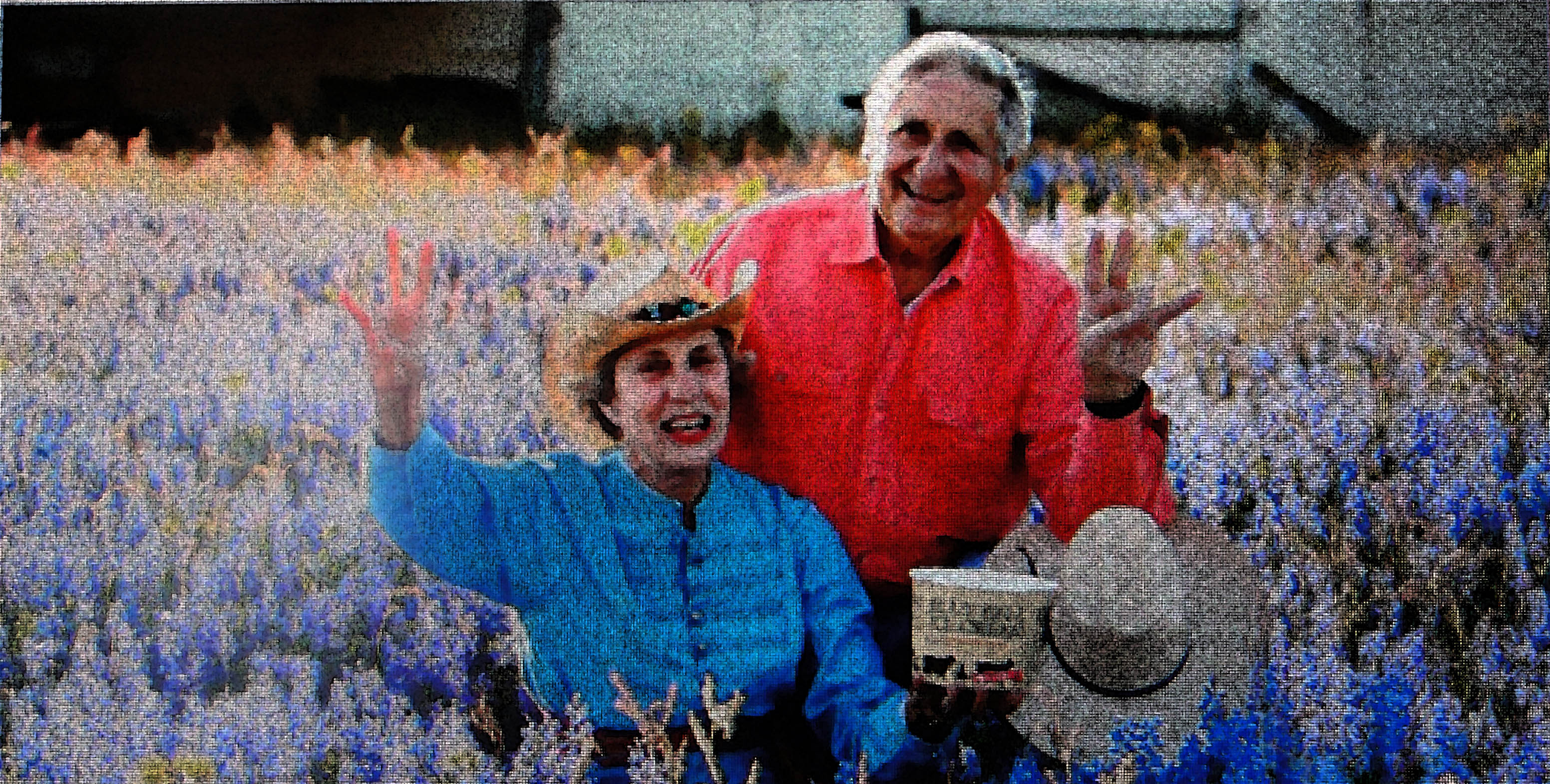
Larry and Kathleen Miggins
St. Patrick’s Day 2017


During the early 1940s, our very own Houston SABR baseball treasure was a student at Fordham Prep in New York City, where excelled in baseball, basketball, and football — eventually earning a football scholarship as a tight end, offense and defense in those days, of course, to play for the University of Pittsburgh.

Larry also played baseball at Pitt, but passed on basketball because of the conflict it presented to his scholarship time on the gridiron. And this was in the days in which a young man of 6’4″ in height was considered tall enough to be a dominant force.

Basketball Force? Miggins could shoot too — once totaling 38 points in a single game. And in baseball, Miggins played third base in those days, taking infield grounders and playing catch with one of the Pitt voluntary coaches — a fellow named Honus Wagner.

Well, this winter, the For Prep football people decided it was a high time they recognized Mr. Miggins for all he did in behalf of their good name on the gridiron back in 1943. They selected 92-year old Larry Miggins for induction into the Fordham Prep Football Hall of Fame.

In his usual humble way, Larry Miggins shared this news with us in Houston at the SABR April 2018 meeting. Fordham wanted Larry and his wife Kathleen to come to NYC for the induction at the annual banquet of their Gridiron Club on May 5, 2018.

As things turned out, Larry wasn’t up to the travel requirement this time, but he did appear on video to deliver this very charming and honest acceptance speech to the offer of this honor.

Do yourselves a favor. Pick out a ten minutes time span you may listen in peace. Then turn on the sound to your video replay equipment in advance and click the link below to watch and listen to Larry Miggins accepting this deserved honor in digital person.

Once you click the link and reach the site’s home page, simply click the middle bar — the one noted as “Larry Miggins ’43 Gridiron Hall of Fame Induction Speech” — to see and hear Larry talk it through from the heart — as he does everything else.

Then, when that’s done, do yourselves another favor and read the eloquently thorough article that David E. Skelton wrote on Larry Miggins in behalf of the SABR biography project in 2015.

https://sabr.org/bioproj/person/f925ea43

Larry Miggins turns 93 on August 20, 2018.

God Bless You, Larry! — And May God Bless us for the time He has given us with you!

You are very, very loved — and my own love for you started back in my Pecan Park Eagle days. From that ancient personal time, I am still able to run mental images of you walking to the plate at Buff Stadium, bashing line drives over the left field wall. I just never dreamed back then that you would still be in my life seventy years later.

What a wonderful world this has turned out to be.

Thanks, old friend and hero. From the bottom to the top of our shared Irish being-ness, I thank you too — for being you.


********************

Bill McCurdy

Principal Writer, Editor, Publisher

The Pecan Park Eagle

The Tommy John World We Live In

May 17, 2018

Tommy-John-2


“When they operated, I told them to add in a Koufax fastball.

They did, but unfortunately it was Mrs. Koufax’s.”

– Tommy John, N.Y. Yankees, recalling his 1974 arm surgery

********************

Can you imagine what it must have been like for Tommy John? Or still may be? He went into baseball as a pretty fair pitching prospect, but a common career-ending injury to his arm transported him to a medical doctor who performed a radical surgery on John that not only saved his place as an MLB pitcher for a while longer, It also forever set up his name — “Tommy John” — to become more the identity of this particular surgery than it ever was as the name of the first pitcher who saved his career because of it.

When we hear today that arm injury to a current big league pitcher is going to cause him to miss the rest of this season and possibly most or all of next year because of “Tommy John”, we all know what that means. There is no time wasted blaming the former pitcher named “Tommy John” for the ballplayer’s bad news.

“Tommy John” is surgery first — a ballplayer barely. But it works in our minds and that’s apparently what counts.

At any rate, the “Tommy John” human expression of humor, about coming back to the game with the fastball speed of “Mrs. Koufax”, did pull me back to all the other human beings who have lost their identities to other matters in life, and we’re not talking anything possible in a single column. It would require more of a book, or a book series, to cover all the streets, airports, and cities in America alone that take their identities directly from adopted or applied human names.

JFK and LaGuardia airports in NYC are great examples. But how about the City of Houston?

Texas History teaches us that Texan Army General Sam Houston won the Battle of San Jacinto in eighteen minutes over General Santa Anna and the Mexican Army on April 21, 1836 at a site just east of present day Pasadena. Today that win is celebrated as Texas Independence Day.

The Irony of San Jacinto probably is the fact that the previously described battle was both the first and last time that anyone got anything done anywhere near “Houston” in eighteen minutes. Today, in 2018, I can’t even drive from home to my office in eighteen minutes, — and I live only five miles away.

Houston street names are often the result of names put forth by elected officials who just happened to think of a name from their own histories that was different enough to stand out among the other nearby street names. Gessner Road on the west side, for example, was a name supplied decades ago when that north-south passage was little more than a two-lane passage through a still fairly agricultural part of the county and not the “new downtown” Houston it is becoming.

Harris County Commissioner Squatty Lyons suggested “Gessner” when he recalled having a classmate by that name at then Reagan High School years earlier. There was no other distinguishing reason beyond the fact that Lyons remembered the name and that it fit the name distinction needs during a year in which that sort of thing was declared as important.

We do have a baseball byway in Houston. The Nolan Ryan Expressway, a north-south artery on the southeast side of town, has proved an apt name for the several miles long section of State Highway 288 that runs near to Minute Maid Park, the home of the Houston Astros, but it certainly hasn’t “Tommy Johned” the old Alvin Strikeout King’s primary ownership of that identity.

Personally, I would like to see the Katy Freeway, from downtown Columbus, Texas, given back its local bullet train parallel track, – all the way to downtown Houston with three strategic stops along the way in Sealy, Katy, and Gessner for passengers prepared to travel at bullet-train speed over short distances. Call it the Larry Dierker49Fastball Line and make it so workable that consumers will reference themselves as being Dierkered to the office for a special meeting with the boss.”

Then just watch the suburbs between here and Columbus continue to grow at an even faster rate.

Along those same lines —

Maybe, if they can get sign-off approval from former Astros great Jimmy Wynn, they could christen that bullet train’s Houston to Dallas ride as The Toy Cannon. Sounds pretty strong and fast to me. What do you think? Of course, if we could get the Dallas people to sign off on the other side, this would be a great place for a railed extension of The Nolan Ryan Expressway as the north to south version of the trip. After all, Nolie and Son did sort of come back to Houston when all was said and done. Did they not?

Lou Gehrig’s Disease comes to mind far easier for what it is in reality. We doubt that many people know it’s scientific name, — or likely would there be many of us shouting out the answer to this question: “What is a more common name for a disease catalogued as “Amyotrophic lateral sclerosis”?

That’s it for now from our side, but we would love your help in further Tommy Johning the world with the individual name identities that are more associated with the action or event itself than the formal name that goes with whatever it may have been called in scientific or legal language.

Have a hope-floating night, Astro friends, as we slide toward the weekend home series with the Indians. If we could simply “Justin Verlander” all our Astro starters into pitching the kind of game that the original “JV” threw against the Angels on the wings of a 2-0 complete game shutout on Wednesday night —  and get the same results — where do you suppose we might be this coming November 1st?

********************

Bill McCurdy

Principal Writer, Editor, Publisher

The Pecan Park Eagle


Drew Blake’s Entry: Greatest HR Ever!

May 16, 2018

And Drew Blake didn’t even have to call the shot he hit to his own dad in his last collegiate game.


Infielder Drew Blake Hits HR to His Dad in Lasr College Game


https://www.mlb.com/cut4/in-the-final-home-game-of-his-career-this-college-senior-hit-a-hr-right-into-his-dads-arms/c-276897800

Note: Just another example of why baseball mythology sticks so hard, so fast. — It’s because even the real stories of baseball, like this one, are so often incredible to the nth degree.


********************

Bill McCurdy

Principal Writer, Editor, Publisher

The Pecan Park Eagle


Rest In Peace, Patrick Lopez

April 16, 2018

Rest in Peace, Patrick Lopez!
Your Devotion to Family, Your Love of Life, and Your Artistic Always Growing Gifts to the World Are Your Ongoing Legacy!

Patrick George Lopez
1937-2018

Patrick George Lopez died on Wednesday, April 11, 2018 after a brief stay in hospice. He was born in Houston on January 7, 1937 to Manuel and Carmen Lopez.

He married Barbara Jean Holman in 1961. Survivors include his wife of 57 years, his children (Claudia, Patrick, and Sarah), his grandchildren (Patrick Joey and Justin), and his brother (John David).

As an architectural delineator, he worked with some of the most important national and local architects and architectural firms of the post WWII era, including Skidmore Owings and Merrill, Johnson Burgee, and Helmut Jahn.

He loved his family, his lifelong home of Houston, his pets (Oso!), baseball, the Astros, art, buildings, music (he was a lifelong piano player), fishing, plants (he grew orchids, bromeliads, succulents), and a good meal.

A public memorial will be held in the future at an as-yet undetermined date.

Published in Houston Chronicle on Apr. 15, 2018

Title: “Buffalo Walking” or “Travis Street Park” By Patrick Lopez (at Fair Grounds Base Ball Park), One of Several Works that Patrick did for the 2014 “Early Houston” Baseball History Book researched and written by members of the Larry Dierker Chapter of SABR and published in 2014.

Patrick Lopez finished a year ahead of me at St. Thomas High School in 1955. Although we never really knew each other at St. Thomas, Patrick always impressed me then as a very nice and thoughtful person. He could often be seen staring across the front lawn during classroom breaks, looking far to the south, beyond Buffalo Bayou. We never actually met until the Houston Early Baseball book project arose, nearly 55 years later, but it was only then that the question clarified about this true 21st century Renaissance man came to roost. — He could have been thinking about anything much earlier in life — as long as it was artistic, giving of itself in part to some greater whole idea, then it probably was getting the attention of the naturally artistic Patrick Lopez.

When our team member Mike Vance, with some independent discovery work help from Darrell Pittman, finally found that the Travis Street Ballpark was our best bet as Houston’s first true organized baseball park, we had no pictures of the same, but we did possess some very detailed newspaper writing on the construction of the place.

Patrick Lopez was able to let his creative mind go to bed with all these black worn sentences on fading white paper and put together for our eyes — and the whole world — to see — how it was meant to be seen. The watercolor work featured here is only one of the many he did that gave us all a vision into how the typical game day looked to Houstonians back in the 19th century. If you can hear the sound of horse hooves making a steady beat up and down Travis — and if you can hear the thud of a bat and ball joyously, or sorrowfully, interrupting every now and then, you may actually be able to allow your own mind to travel back to the corner of Travis and McGowan at many spring afternoons of those late 19th century years and actually experience the presence of old time Houston for yourself. And, if you get there, try to remember — the now late Patrick Lopez probably helped you make the trip.

Patrick Lopez
1937-2018

Thank you, Patrick Lopez! All of us are the richer for having known you even a smidgen’s amount of eternity’s time.

And God Bless you too, Barbara! Patrick was lucky to have found and never lost you. That doesn’t always happen.

Sincerely,

The Pecan Park Eagle


********************

Bill McCurdy

Principal Writer, Editor, Publisher

The Pecan Park Eagle

Maxwell Kates: “42” – A Film Review

April 16, 2018

“42” – THE FILM REVIEW

A CELEBRATION OF JACKIE ROBINSON DAY

By Maxwell Kates

Maxwell Kates

Five years ago, in April 2013, Legendary Pictures released a film called “42”. Written and directed by Brian Helgeland, the film documented Jackie Robinson’s first season in the major leagues while emphasizing the trials and tribulations involved with breaking the colour barrier.
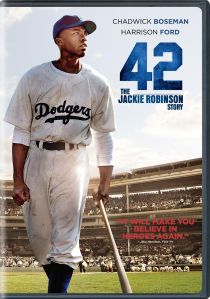
“42”

The story behind “42” is well known among baseball fans and American historians alike.  After declaring victory over Nazi Germany in May 1945 and Imperialist Japan three months later, American soldiers returned from the Second World War to a country that could not defeat its own Jim Crow laws.  A ‘gentleman’s agreement’ had existed in professional baseball which segregated white and black players into different leagues.

Branch Rickey (Harrison Ford), the President of the Brooklyn Dodgers, is a shrewd businessman, a lawyer, and a devout Methodist.  We learn in the context of the movie that he is haunted by not having done enough to fight segregation as a baseball coach some four decades earlier.  Partly out of religious conviction and partly out of opportunism, he vows to promote a black player to the Dodgers late in the 1945 season.  Rickey admires Jack Roosevelt Robinson (Chadwick Boseman), a shortstop on the segregated Kansas City Monarchs, for his talent and his hardnosed style of play, but warns him that the inability to control his volatile temper is tantamount to failure for Rickey’s ‘Great Experiment.’  In other words, Rickey did not need a player not tough enough to fight back, but one tough enough not to fight back.

Harrison Ford as Branch Rickey

The plot line begins by covering Robinson in spring training both with the Montreal Royals, the Dodgers’ top minor league affiliate, and the Dodgers. After he is promoted to Brooklyn in 1947, the film narrates how Robinson led the Dodgers to the National League pennant in spite of vitriolic players and fans, racially motivated hate mail, and the ubiquity of the press.

The movie was criticized for its lack of character development, a claim I perceived to have been justified.  The Rickey character was developed well, as was Leo Durocher (Chris Meloni), the tenacious yet morally bankrupt manager of the Dodgers who aimed to win at all costs.  However, the movie could have benefit from a more vivid portrayal of Wendell Smith (Andre Holland). Smith worked as a journalist for the Pittsburgh Courier, covering Robinson throughout the 1947 season while attempting to break barriers of his own.  A more thorough description of Robinson’s wife Rachel (Nicole Beharie) would have also improved the plotline, as her support was crucial to the success of Robinson’s campaign.

Jackie and Rachel in “42”

“42” shows balance between the players who supported Robinson from those who did not.  Pee Wee Reese (Lucas Black), Gene Hermanski (Blake Sanders), and Ralph Branca (Hamish Linklater) were three Dodger teammates depicted to have supported Robinson but their characters were scarcely developed beyond that.  The movie did address the difficult matter of Dixie Walker’s (Ryan Merriman) harsh disapproval of Robinson, arguing it to be economic rather than racial.  However, it does not expand on the complexities of the anti-Robinson camp. This group which includes Brooklyn pitcher Kirby Higbe (Brad Beyer) who circulated a petition aimed to prevent Robinson from taking the field, Philadelphia manager Ben Chapman (Alan Tudyk) and general manager Herb Pennock (Mark Harelik), and St. Louis outfielder Enos Slaughter (David Thoms).

The film aptly portrayed fans in opposing National League cities such as Philadelphia, St. Louis, or Cincinnati to be vociferous in their hatred of Robinson but did not show balance – there were many white fans in those and other cities who supported Robinson.

The Pee Wee-Jackie Moment —
As depicted in “42”

Another opportunity was missed in the side plot involving Dodgers infielder Bobby Bragan (Derek Phillips).  As the scion of a prominent family in Birmingham, Alabama, Bragan was raised with segregation and was thereby a vocal opponent of integration.  Accordingly, he refused to initially play with Robinson but later recanted.  A fact which would better drive the point but ignored in the movie is that when Jackie Robinson passed away in 1972, Bragan was among his pall bearers.

A poignant scene in the movie took place on the field at Ebbets Field as the Dodgers hosted the Philadelphia Phillies.  Manager Ben Chapman was among Robinson’s most tyrannical opponents and was not afraid to voice his opinion.  Only with the intervention of Dodgers’ infielder Eddie Stanky (Jesse Luken) a Philadelphia native and former teammate of Chapman’s did the Philadelphia manager back down.  In actuality, Stanky had been one of the players to sign Higbe’s petition but felt compelled to defend Robinson as one of his teammates.

Hank Greenberg and Jackie Robinson

Another opportunity missed was during a brawl following a beaning by Pittsburgh pitcher Fritz Ostermueller (Linc Hand).  At no point did the movie refer to prominent National League opponents who supported Jackie Robinson and the brawl scene would have presented this player in Ostermueller’s teammate Hank Greenberg.  The veteran 1st baseman discussed the racism he encountered in his own career with Robinson as the Dodgers rookie led off the base in a game with Pittsburgh.  Cardinals outfielder Stan Musial was another Hall of Famer who supported Robinson.

The movie included several historical errors and inaccuracies.  For example, the Mississippi bred broadcaster Red Barber (John McGinley) did not speak with the brogue of a New York Irishman.  Nor did Robinson wear number 9 with the Montreal Royals – he actually wore number 20.  It is unfortunate that the movie did not expand on Robinson’s time in Montreal, where he led the Royals to the International League pennant in 1946. According to Montreal sportswriter Sam Maltin, “it was probably the only day in history that a black man ran from a mob with love instead of lynching on his mind.” Lastly, in light of Robinson’s pact with Rickey to be tough enough not to fight back, the altercation with Dixie Walker in front of the Ben Franklin Hotel could never have taken place.
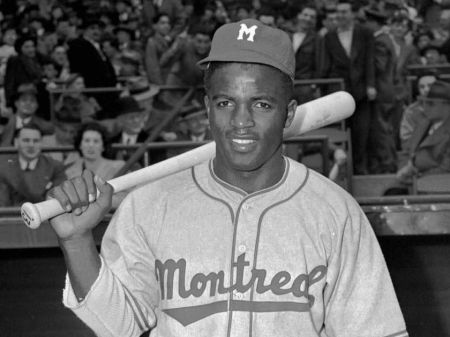
The real Jackie Robinson at Montreal in 1946.

Why did they make “42”?  For one thing, the events took place in 1947.  Infants born the day Robinson took the field are now 71 years old.  Of the journalists in the Ebbets Field pressbox that afternoon, only Jim Becker of the Associated Press is still alive and he is 92 years old.  The story of Jackie Robinson is an important one and it is important that the legacy of Jackie Robinson and what he stood for continues.  The film received criticism for its liberal use of ‘the N-word.’ To understand history is to understand context. It is only by exposure to unpleasant aspects of the English language, like ‘the N-word,’ that we become aware of their meaning and why they should not be used.

Whom did they make “42” for?  The answer to that question can be expressed by discussing the character whom I understood to have been the most important in the movie. That was the young African American child in Florida who saw Jackie Robinson in a spring training game with his mother.  Viewers learn at the end of the film that the young fellow grew up to be Ed Charles, clubhouse leader of the World Champion 1969 New York Mets. Charles, who died earlier this year, credited Robinson as an inspiration for him growing up in segregated Florida. It was important to bridge the gap with this young fan to show why Jackie Robinson was inspiration to him and many others.
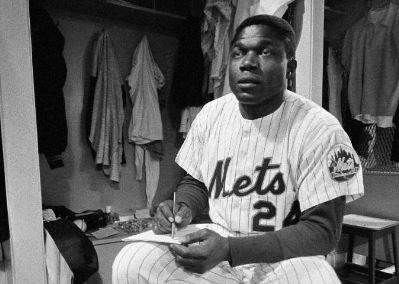
Ed Charles

Of equal significance, there was one scene where Rickey tells Robinson about the white fan on a Brooklyn street who tried to be like Jackie Robinson when he played.  Robinson broke into the major leagues in 1947, seven years before Brown v. Board of Education and seventeen years before the Civil Rights Act was signed into law.   Therefore, it is important to understand the context of the odds Jackie Robinson faced and the insurmountable mental toughness he required to overcome them.  The movie was made for young people of all races and nationalities to understand the harshness of prejudice and that any individual is capable of achieving personal triumph in spite of it.

“42” is definitely worth the price of admission and is an enjoyable movie to watch with an important message to convey.  At one point in the movie, Pee Wee Reese, a Kentucky native, tells Jackie Robinson that “maybe tomorrow we’ll all wear 42 so that nobody can tell us apart.” Tomorrow being April 15, Pee Wee’s oracle will see the light of day.

Toronto, Canada

April 14, 2013

EPILOGUE
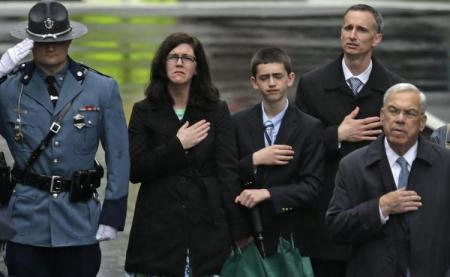
Young Boston Bombing Victim Martin Richard and Family.

One day after I wrote this film review of “42”, the city of Boston was rocked by an unthinkable tragedy. At the finish line of the Boston Marathon, two brothers detonated two homemade explosives, killing three and injuring hundreds. One of the victims, eight year old Martin Richard, lost his life as he awaited his father Bill to complete the marathon. After his death, a photo of young Martin holding a placard bearing the message “No more hurting people. Peace” circulated around the four corners of the globe. In doing so, Martin was carrying out Jackie Robinson’s legacy. His life remains important as it continues to have an impact on others.

Fenway Park, Boston
Jackie Robinson Day
2013

********************

Post Note. The Pecan Park Eagle also did a review of “42” after attending one of the opening day matinee features in the company of one of the very few remaining survivors who played in that earlier landmark color line-breaking game in 1946, when Jackie Robinson broke the organized baseball race barrier as a member of the Montreal Royals. It was our lucky day at the Eagle to watch the flim with our own Larry Miggins, who played third base for Jersey City that historical day. The date of our first publication on this topic was April 13, 2013. And here’s the link to its contents:

“42”: A Beautiful Profile in Courage

Hope you enjoy this doubleheader.

********************

Cell Phones as History Changers

April 2, 2018

“Listen, my children, and you shall hear,
Of a phone call made by Paul Revere.”

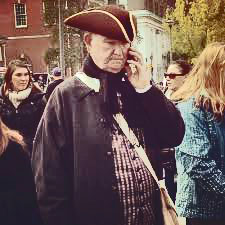
Have you ever thought about how much cell phones might have changed history, had they been around earlier? Or how about all those times in fictional books and movies in which the plot evolved around mysterious phone calls or the mad search for a usable phone booth during a point of crisis?

With a cell phone handy back in the 18th century, there would have been no need for a  “midnight ride.” Paul Revere could have called it in: “Hello, is this Major Tom Brady? – Paul Revere here. It’s by sea. The Brits are pouring into Boston Harbor right now. I can see ’em getting off at the dock, even as we speak. OK? – Now, if you don’t mind, I’ve got a great dart game to finish over here at Sullivan’s Pub before I scat home to finish polishing some silver. – What’s that? – No problem! Glad to help.”

Perhaps, the following could serve as a few other examples:

1) Non-Fiction / Pearl Harbor, Dec. 1, 1941, A call comes in from Cell Phone Float Tower 29, about 180 miles NW of Oahu, at 7:39 AM:

“HELLO, PEARL! Listen up. This is Cappy Hunt, and I’m out here NW of Honolulu, doing a little fishing off the banks of Tower 29. – Listen real good. – You’re going to need to get some people out here to see what I’m looking at right now as the dawn comes up on us. – It looks like Hirohito has sent the whole dad-gum Japanese Navy out to greet us and it don’t look friendly in any way. As far as my eyes can see, they got destroyers, cruisers, battle ships, and flat tops – and one way and another – they is all loaded to the gills with big guns or them Mitsubishi Zero planes – as they is all decked out to fly, fire, and bomb. Send enough men to do the roadkill work and get everybody braced at Hickam Field and Pearl ready to defend everything we’ve got – with every thing lethal that we’ve got. I’ll hang loose as your lookout for as long as I can out here, but, granddad gummit, I forgot to charge this phone last night.”

2) Fiction / Barbara Stanwyck plays a disabled New York socialite who accidentally over-hears plans for a woman’s murder in the 1948 big movie, “Sorry, Wrong Number”. By the time she learns that she is the intended victim, it’s the last scene in the script and the killer is standing over her bedside, as her husband also calls to check on her, gets the killer, only to hear him say, “Sorry, wrong number” as he finishes the job and the movie through her screams. Had there been digital cell phones in 1948, Stanwyck would have had a suspicious phone number or a GPS on the scary caller – or something early enough – to have saved herself from starring in one of the creepiest bad ending movies of all time.

3) Weather News / Remember the old days, when some really bad storms, like the deadly tornado that struck Waco, Texas in 1953? As per usual, there were plenty of horrifying, but few, if any actual newsreel photos of the twister itself in real time. And we would always say or think: “It’s too bad someone didn’t have a camera handy when this monster hit!” – Now. in 2018,  there are no shortages of cameras – anywhere there are people. It’s all about the digital phone and how we now use them.

4) Cell Phones & The Bullpen / Do we really still need those clunky dugout wall phone land lines to be in touch with the bullpens during big league games? It’s imaginable the bullpen coach could even reply to a manager’s call with a phone video if he really wanted to see for himself if a certain reliever appeared ready.

5) The Cell Phone Immediacy App / (Maybe we already have this app and I just haven’t gotten the word on it.) How about a cell phone app that shuts the instrument down once it detects that the phone is moving through space that exceeds the power and speed of human assistance alone. – And maybe the same app could have the same capacity for broadcasting to the first 100 car-length of phones behind you why everyone is stuck on the freeway and not moving at other times. And it may also throw in some alternate route suggestions to boot.

Footnote: The problem with effective need-serving phone apps is that they immediately convert from need service into entitlements – and we start treating them immediately as desirable conditions of life that we have a right to expect every day from womb-to-tomb that we spend alive on Planet Earth.


********************

Bill McCurdy

Principal Writer, Editor, Publisher

The Pecan Park Eagle

A Houston Buffs Souvenir Mitt Mystery.

April 29, 2010

The Souvenir Buffs Mitt is About 5″ Tall. When was it sold at Buff Stadium?

Yesterday an acquaintance got in touch with me about a souvenir Houston Buffs catcher’s mitt he had just acquired from another collector. This person is a solid Houston Buffs and City of Houston history fan, but he wishes to remain anonymous in this matter that he now shares with everybody else. The question we both have is: When, if ever, was this little (pictured above) item sold at Buff Stadium?  My own guesses are only speculative.

I never saw anything along the line of souvenir gloves for sale at Buff Stadium during the Post World II Era. I recall a few miniature bats and pennants for sale, but I never acquired anything like that as a kid. We weren’t thinking about souvenirs when we went to Buff Stadium back in my day and it’s just as well. Remember what I’ve written here many times over. We played in the sandlot with baseballs held together by electrical tape. There was no money for thinking about souvenirs.

Besides, the style of the glove looks older to me, like something from the early 30s. That sort of works against the idea that souvenirs could have been very appealing to the average Buffs Baseball fans of Houston during the Great Depression Era, but who knows? Maybe they were. We simply lack the proof that this item ever sold at Buff Stadium during any period, in spite of what it says broad as all daylight on the souvenir glove itself. I personally believe that it was once a Buff Stadium souvenir. I just can’t prove it.

Fred Ankenman served as President of the Houston Buffs from 1925 through 1942, the beginning of the World War II Texas League shutdown. Allen Russell took over as President of the Buffs in 1946 and served through 1952. I’m fairly convinced that the souvenir glove in question sold at Buff Stadium somewhere during one of these two periods. It’s too antiquated to have sold beyond the Russell Era – and it’s simply a little impractical to think it sold earlier at West End Park. Buff Stadium didn’t open until 1928.

The back side of the souvenir glove appears to have once been stuck to something.

My friend and I both observed that the marketing decision to actually write the word “souvenir” on the mitt seems a little primitive and unsophisticated by today’s marketing standards, but a lot of items could be judged that way in comparison to the promotion of uniform replica and game-authentic sale of ballpark material in 2010. We have to remember that game replica jerseys and caps have only been around as sales items to fans since the early 1980s. (We sold an authentic game jersey to fans at the University of Houston in 1979, but that’s a much longer story about what probably was the first sale of game-style apparel items to the general  public in America.)

The buffalo figure is remindful of the logo used during the late 20s and early 30s.

If you ever saw this featured Buffs item for sale at Buff Stadium, or if you have any of your own theories on when it might have appeared there, please post them below as comments on this article. Like so many other artifacts of baseball history, the Houston Buffs souvenir mitt comes to light raising more questions than it answers.

Hopefully, it will someday find its way into proper public exhibition and not just get stuck in someone else’s attic or closet for another sixty or seventy years.

UH Honors Alumnus Richard Coselli and Others.

April 27, 2010

UH Grads Mary Jo & Richard Coselli, At Home in Chappell Hill.

For five years, 2004 to 2009, it was my great pleasure to work along side attorney Richard Coselli as volunteers in service to the Texas Baseball Hall of Fame. As Board President from 2004 to 2008, and as President Emeritus through the crack of doom since 2008, but now retired from active service, it remains my fondest hope that the TBHOF will still someday find its home in the form of a physical presence that Houstonians and fellow Texans will be proud to embrace as worthy of its fully stated mission statement for preserving Texas baseball history.

Mr. Richard Coselli was the major person who helped us organize this effort as a legal entity from 2004 through 2009, even providing us with the use of his own office board room for our periodic meetings. We could not have done it all without him. Richard Coselli just happened to have been the exact person we needed during our transitional years in Houston. He was a native Houstonian and a man who loved baseball. Put that all in the basket with his intellect, experience, wisdom, and senses of balance and humor, and we could not have found a better counsel of service to a cause that remains to this day – one that shall always be larger than the whims, aims, needs, or desires of any single person at the helm of leadership. Although Richard Coselli, yours truly, and most others of us from our original formative group are now gone from direct connection to the TBHOF, I think I speak for us all when I say that we still hope for the best and that the organization will survive these hard economic times and find a way to flourish and grow in the future along lines that are governed by integrity of purpose and stable financial support.

Richard Coselli is no newcomer in service to this community. I could not begin to list all the things that both he and his wife, Mary Jo Coselli, have done for Houston, but the two University of Houston graduates continue to do a great many things.

I first became acquainted with Richard Coselli’s contributions while we both were students at UH more than a half century ago. Richard was slightly older than me back then – and still is, for that matter. Funny how that works. – Anyway, we never met back in the 1950s, but I was very aware of his work in organizing the original Frontier Fiesta at UH, the largest campus college show on earth, one that grew big enough to gain a write-up in Life Magazine – a publication from back in the day that spread the good word  in those primitive pre-Internet times that something big was happening in Houston. Ironically, even though I worked on the Frontier Fiesta myself, Richard Coselli and I never met until we both fell into involvement with the Texas Baseball Hall of Fame move to Houston in 2004. I had been a volunteer member of the TBHOF’s selection committee since 2001, but I didn’t wade into the deep water of its work until 2004, when Greg Lucas of Fox Sports and I agreed to head up a move of the organization’s headquarters from Dallas to Houston. Richard Coselli soon came on deck as our legal advisor.

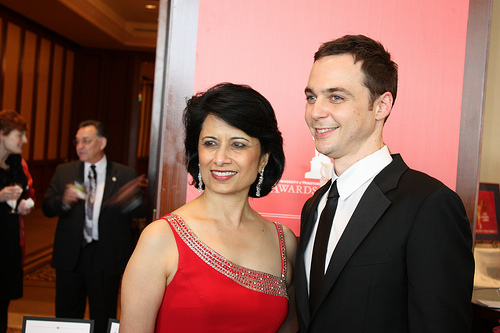
Last Friday night, April 23, 2010, the University of Houston honored Richard Coselli (BS ’55, JD ’58) as one of eleven distinguished alumni who have made enormous contributions to the benefit of UH over the years. The occasion was marked by a formal dinner party, hosted by the UH Alumni Association and addressed by UH Chancellor and President Renu Khator.

President Renu Khator & Jim Parsons (BS '96) of TV's Big Bang Theory.

Richard Coselli was denied the opportunity of being the funniest man on the dais Friday by the presence of fellow honoree Jim Parsons. A 1996 UH graduate, Parsons is having a pretty good run these days on television as the star of the hit comedy show called “The Big Bang Theory,” but that is OK too. Our UH people come in all ages, shapes, and sizes across a diverse line of differential talent.

Richard Coselli simply brings a quartet of elements to the table of any enterprise that money cannot buy. Their names are intelligence, loyalty, honesty, and integrity.

Congratulations, Richard! It’s good to know that our university has now officially recognized what a lot of your friends have known for years. You are the kind of person that has made the University of Houston and the City of Houston the great places they each are.

“In Time” is our UH motto. In time, UH has now finally recognized one of its own for all he has done in service to the greater good of the university community. Congratulations again, my friend. You deserve every ounce and inch of credit that flows from this much larger measure.

Cold Case: Who Killed Eddie Gaedel?

April 25, 2010

August 19, 1951: St. Louis Browns Manager Zack Taylor Ties Eddie Gaedel's Right Baseball Shoe..

The story of Eddie Gaedel’s one-time at bat as the only midget pinch hitter in big league history back on August 19, 1951 is one of baseball’s biggest travelers. We talked about it here yesterday.

A much less popular subject is the death of Eddie Gaedel nearly ten years later on June 18, 1961 in Chicago. Eddie’s mom found him dead in bed in his apartment on that date. He had a bruise and cuts near his left eye and bruises and cuts on his knees. The coroner’s report concluded that Eddie had died of a heart attack, probably caused by the trauma of physical assault upon his body in physical combat with an unknown other or others. The only fact ascertained by the police in their brief look at the case was that Eddie Gaedel may have gone to a nearby bowling alley the previous evening where he may have had too much to drink and may have either gotten into an argument at the alley or encountered an assailant on his walk home. From what I can tell, there was no real evaluation performed on Eddie’s blood contents in the sketchy post-mortem that followed. Almost everything about his death had been concluded by the Chicago police from Eddie Gaedel’s reputation as a heavy drinker and combative personality.

Since money was missing, the CPD concluded that Eddie Gaedel had been attacked and robbed, but that he was able to make it home before collapsing and dying. The “evidence” of missing money is not spelled out as a missing wallet, nor do the CPD reports jump out and say how they knew how much cash Eddie had on him in the first place.

Because of his “reputation,” the Chicago Police Department declined to investigate the death of Eddie Gaedel any further.

What? …. What?

Since when is “reputation” grounds for letting someone go off to eternity without justice while some other guilty person gets off Scott-Free of murder? Eddie Gaedel died 49 years ago this summer. It’s wholly conceivable that his murderer is still out there in the bleachers during a White Sox or Cubs games in 2010. He or she wouldn’t be particularly conscious by this late time in life, but how alert do you need to be to keep going to baseball games as a Chicago fan on either side of town in 2010?

The point here is simple: Someone got away with murder in the Case of Eddie Gaedel and that’s too bad.

The Ballad of Eddie Gaedel.

April 24, 2010

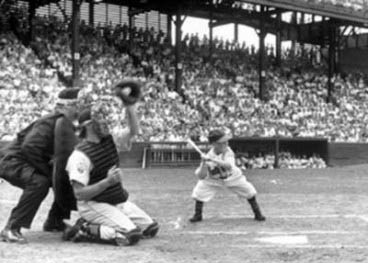
Eddie Gaedel, At Bat for the Browns Against Bob Cain of the Tigers, Sportsman's Park, St. Louis, August 19, 1951. The Catcher is Bob Swift; the Umpire is Ed Hurly.

It was a one-time practical joke and publicity stunt from the ever-mischievous-making mind of Browns owner Bill Veeck, but it looms in baseball history as big or bigger than Babe Ruth calling his home run shot in the 1932 World Series because of its shock value to the usual baseball norm and the picture that resides here with this article.

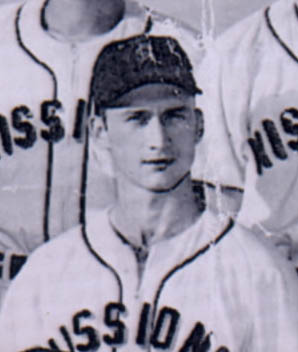
Frank Saucier, 1950.

Midgets simply don’t play major league baseball, except for this one incident of contractually legal entry into a game as a first inning pinch hitter by Eddie Gaedel, batting for the Browns’ rookie leadoff man and center fielder, Frank Saucier. Many say the episode ruined Frank Saucier for major league ball. He had led the Texas League in 1950 with a .343 batting average for the playoff champion 1950 San Antonio Missions, but he was gone from baseball after the Gaedel stunt due to the ego blow he suffered deeply on that fateful day in Sportsman’s Park, August 19, 1951. No matter how Bill Veeck and the Browns explained it later to Saucier, he apparently took it personally. After a 1 for 14 times at bat experience in 18 games for the 1951 Browns, Frank Saucier left baseball for good at season’s end. That .071 final batting average for season in limited action may have helped him close the door.

At any rate, little 3’7″ Eddie Gaedel finished his one time at bat history in the big leagues with a walk to first on four pitches from Detroit Tiger pitcher Bob Cain and then trotted down to first and into the history books. Gaedel supposedly batted under threat from owner Bill Veeck: “I’ll be on the roof with a rifle. If you take one swing, I’ll shoot you dead.”

Once he reached first, Browns manager sent outfielder Jim Delsing out to pinch run. “My surprise came after I reached the bag to take over for Gaedel,” the late Delsing once told me.  “Before Gaedel left the field, he patted me on the butt and wished me luck.”

Well, the Browns went on to eventually lose this game by a score of 6-2, but they imbedded the idea of this possibility coming up again into the minds of a baseball nation. the fantasy was short-lived. Baseball quickly acted to ban midgets and dwarfs from playing big league ball. We can’t be sure how that kind of ruling would fly in the 21st century. There are a lot of people out there now looking after the rights of vertically challenged people. All we need now is for one very short Mickey Mantle type to come screaming onto the scene, demanding the restoration of opportunity. I’d be all for him or her.

In the meanwhile, I’ll close here with a little tribute parody I wrote a few years back to honor the memory of Veeck’s man back in 1951. “The Ballad of Eddie Gaedel” is sung to the tune of “Rudolph the Red-Nosed Reindeer” and it is intended as a tribute to one of the few men in history who ever retired from baseball with a perfect one base percentage of 1.000.

The Ballad of Eddie Gaedel
(All verse stanzas are in regular shade type and are sung to the main tune of “Rudolph, The Red-Nosed Reindeer.” The two chorus stanzas, shown in bold type, are sung to the chorus tune from “Rudolph” that goes with “Then one foggy Christmas Eve, Santa came to say, etc.”)

by Bill McCurdy, 1999.

Bill Veeck, the Brownie owner,
Wore some very shiny clothes!
And if you saw his sport shirt,
You would even say, “It glows!”

All of the other owners,
Used to laugh and call him names!
They wouldn’t let poor Bill Veeck,
Join in any owner games!

(chorus)
Then one humid summer day,
Bill Veeck had to – fidget!
Got an idea that stirred his soul,
He decided to sign a – midget!

His name was Eddie Gae-del,
He was only three feet tall!
He never played much baseball,
He was always just too small!

(chorus)
Then one day in Sportsman’s Park,
Eddie went to bat!
Took four balls and walked to first,
Then retired – just-like-that!

Oh, how the purists hated,
Adding little Eddie’s name,
To the big book of records,
“Gaedel” bore a blush of shame!

Now when you look up records,
Look up Eddie’s O.B.P.!
It reads a cool One Thousand,
Safe for all eternity.

"Have a Nice Weekend, Everybody!" - Eddie Gaedel.