Archive for the ‘Baseball’ Category

1974-1986: No Dinners; 1987: They’re Back

August 15, 2014
The Houston Baseball Dinners disappeared for 13 seasons, from 1974 to 1986. It had to do with the shaky ownership grounds of the Astros franchise and tough changes in the Houston economy.

The Houston Baseball Dinners disappeared for 13 seasons, from 1974 to 1986. It had to do with the shaky ownership grounds of the Astros franchise and tough changes in the Houston economy. Allen and Jo Russell started them up again in 1987.

After 13 straight years (1961-73) of honoring some of baseball’s best seasonal performers, many of whom who were on their ways to the Hall of Fame as all-time greats, and at a cost to fans that never exceeded $12.50 a dinner plate, the Houston Baseball Dinners went dark for an equal period of 13 years (1974-86) due to hard times in the transitional history of the Astros franchise ownership and some bumpy economic times in the then almost 100% heavily oil-dependent Houston economy.

The annual Houston winter baseball dinners were resurrected in early 1987, thanks to the efforts of former Houston Houston Buffs president Allen Russell and his devoted wife and hard-working life companion, Jo Russell.

From the way things sounded in the earliest news notices we could find among our digital sources, there was nothing to learn about the politics involved in both the shutting down of the original series or the starting up of the new run in this annual Houston banquet event. One thing we have to build upon, conjecturally, is our personal knowledge of Allen Russell from the short time I got to know him personally in 1995, only six months shy of his death in January 1996 from chronic renal failure.

I had known of Allen Russell since those childhood days I watched him set gasoline on fire as the cure for a wet infield that otherwise threatened Buff Stadium with a postponement and loss of gate. I never met him personally until the very last page in his lifespan.

Allen Russell, the man, was a passionate baseball guy with a driving energy for making things work to the best of their ability. I met Allen as a volunteer assistant to his search for all former Buffs about an upcoming “Last Roundup” reunion dinner in September 1995. Before I knew it, Allen had picked up on my enjoyment of writing and was using me to put some of his ideas for improving baseball into essay form. Even through his toughest days, he hung in there with his goals. In effect, and to the very end, Allen lived life as a man who knew he had something to give to baseball – and he behaved as a man who was simply to busy to die. And Jo Russell was right there at his side, doing all she could to help him get things done while paying some attention to taking care of himself as well.

There is no doubt in my mind that, whenever Allen Russell decided to resurrect the Houston Baseball Dinner in January 1987, it was going to happen.

The following article summarizes the gist of things 2ithout shedding light on Russell’s expanded support system, although I think local sportswriter Ivy McLemore was there to help.

______________________________________
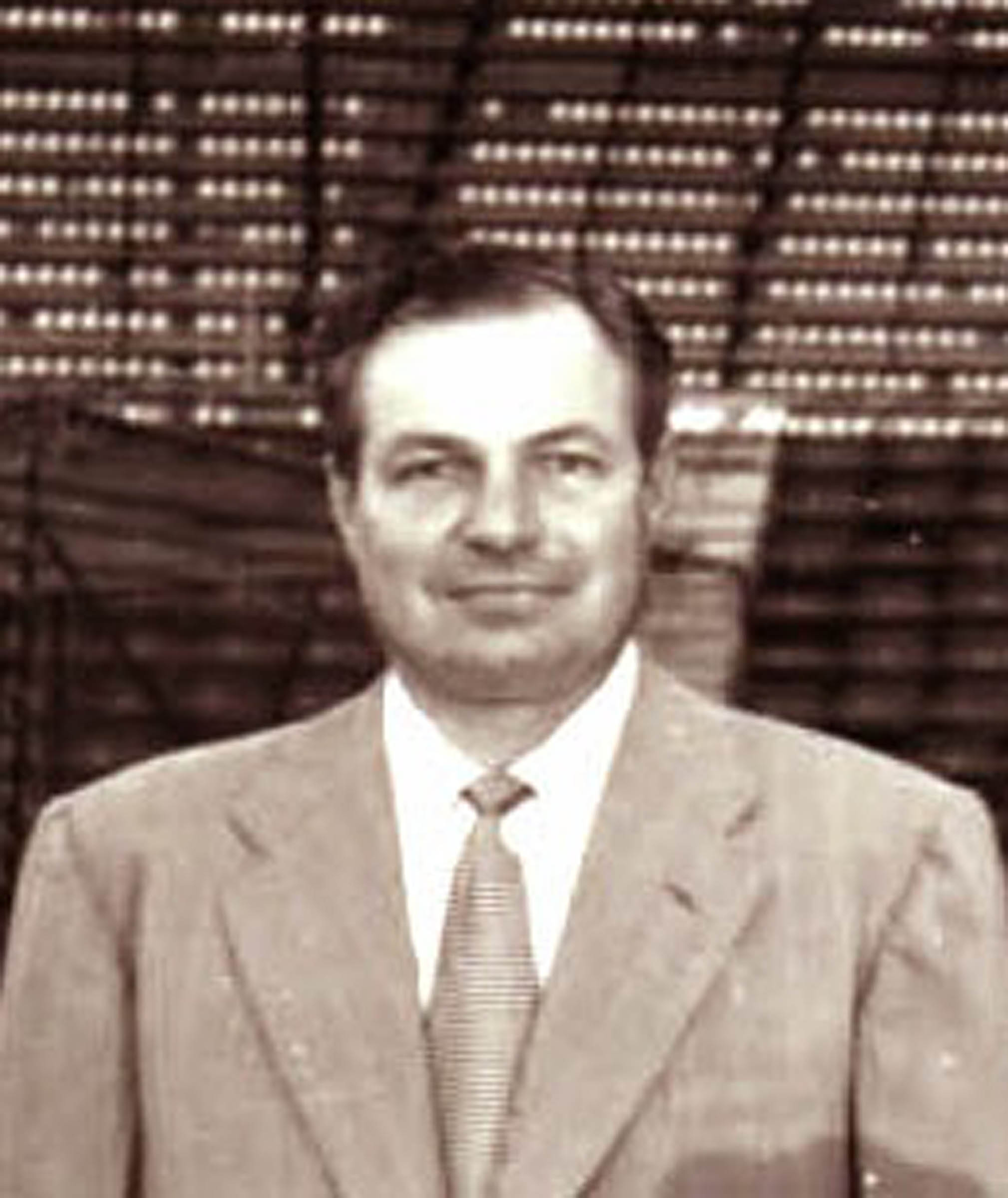
ALLEN RUSSELL AND HIS WIFE JO RUSSELL LED THE HOUSTON BASEBALL DINNER BACK TO LIFE IN 1987.

ALLEN RUSSELL AND HIS WIFE JO RUSSELL LED THE HOUSTON BASEBALL DINNER BACK TO LIFE IN 1987.

Baseball Dinner Planned

HAL LANIER MANAGER HOUSTON ASTROS 1986-1988
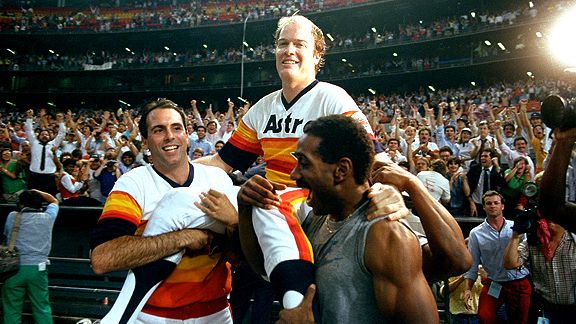
HAL LANIER
MANAGER
HOUSTON ASTROS
1986-1988

MIKE SCOTT NL CY YOUNG AWARD 1986

MIKE SCOTT
NL CY YOUNG AWARD
1986

ROGER CLEMENS AL CY YOUNG AWARD 1986

ROGER CLEMENS
AL CY YOUNG AWARD
1986

(Houston Astros) Manager Hal Lanier and Cy Young Award winners Mike Scott and Roger Clemens will be the guests of honor at the 1987 Houston Baseball Dinner Feb. 12 (1987) at th Westin Galleria Hotel.
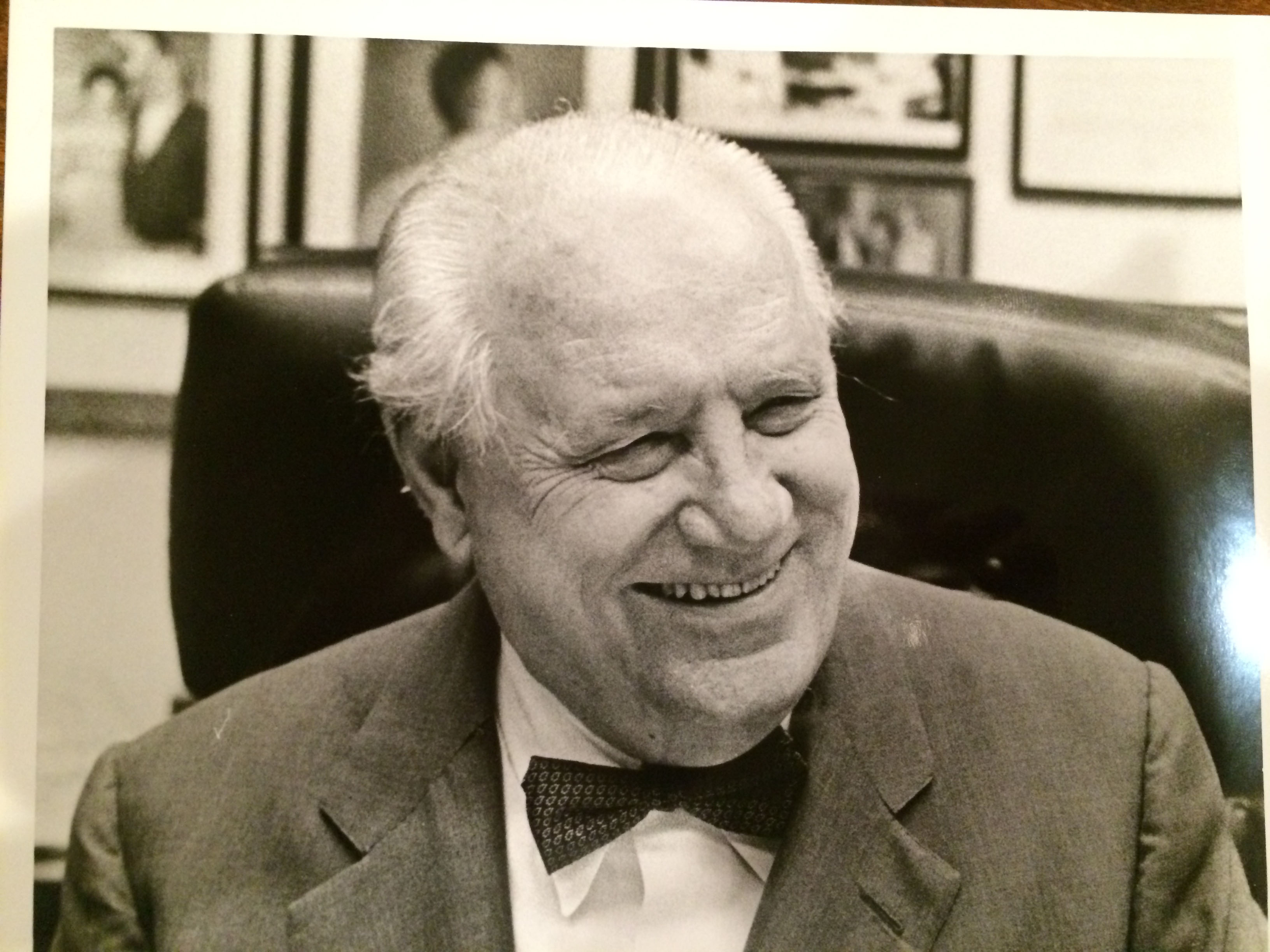
FRED HARTMAN FORMER PUBLISHER BAYTOWN SUN "FOR LONG AND MERITORIOUS SERVICE TO THE GAME"

FRED HARTMAN
FORMER PUBLISHER
BAYTOWN SUN
“FOR LONG AND MERITORIOUS SERVICE
TO THE GAME”

The BBWAA will also present an award to Fred Hartman, former publisher of the Baytown Sun, for long and meritorious service to the game.

Activities will begin at 6:30 p.m. with a reception. A dinner will follow, with the program set to start at 7:45 p.m. Tickets for the event cost $25. Checks should be made payable to (the) Houston Athletic Committee and mailed to Allen Russell, Chairman, Houston Baseball Dinner, 924 Fleetwood Place Drive, Houston, Texas 77079.

~ Baytown Sun, January 17, 1987, Page 14.

—————————————————–
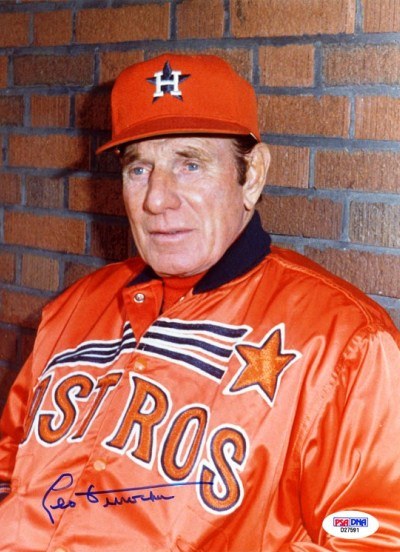
1973: Leo Steals Spotlight at 13th Dinner

August 14, 2014
LEO DUROCHER ~ Leo the Lip Talks Big at the 13th Houston Baseball Dinner About his Aspirations in 1st Full Season as Astros Manager,

LEO DUROCHER
~ Leo the Lip Talks Big at the 13th Houston Baseball Dinner About his Aspirations in 1st Full Season as Astros Manager,

Leo Would Like Fourth Title to be at Houston

Houston (AP)  Wichita Falls Times, Jan. 27, 1973, Pages 31, 33.. Lippy Leo Durocher, who has taken three teams to the World Series in his controversial career, says he’d like to win it all once more with feeling.

“I’d like to say at this late stage in my baseball career – just one more time” the new Houston Astros manager told the 13th annual Houston Baseball Writers Association dinner Friday night. “Let’s win one more time here in Houston”

Durocher, who took over as manager of the Astros from Harry Walker last August 26th (1972), said that seven positions (the outfield and infield) were set and (that), if he can mold a four-man pitching staff, the team is set.

“Pitching is where we’ve had our trouble,” Durocher told the audience. Durocher said he would take his four-man rotation from Larry Dierker, Don Wilson, Dave Roberts, Ken Forsch, Jerry Reuss, James Rodney Richard, and Tom Griffin.

“If we can’t get four good starters out of that bunch then Durocher isn’t doing his job,” he said.

Durocher said that 1972 left fielder Bob Watson would be given a shot at catcher in spring training with John Edwards, last year’s starting catcher, as the back-up.

Durocher said he has a few changes in mind for spring training, including conditioning. “I’m not worried about us being in shape,” he said. “I have my own way and we’ll be in shape.”

Very honestly, there are no rebels or clubhouse lawyers on our team,” the Lip said. “We’re going to have some kind of ball club.”

BILLY WILLIAMS 1973 WINNER TRIS SPEAKER AWARD

BILLY WILLIAMS
1973 WINNER
TRIS SPEAKER AWARD

Billy Williams of the Chicago Cubs won the Tris Speaker Award. His 1972 stats of a .333 batting average with 37 HR and a .606 slugging average more than justified his pick.

CESAR CEDENO 1973 WINNER JIM UMBRICHT AWARD

CESAR CEDENO
1973 WINNER
JIM UMBRICHT AWARD

Cesar Cedeno was selected as the Houston Astros’ Player of the Year, receiving the coveted  Jim Umbricht Award as the symbol of that honor. Cedeno batted .320 with 22 HR and a .537 slugging average in 1972.

NATE COLBERT 1973 WINNER JOHNNY KEANE AWARD

NATE COLBERT
1973 WINNER
EDDIE DYER AWARD

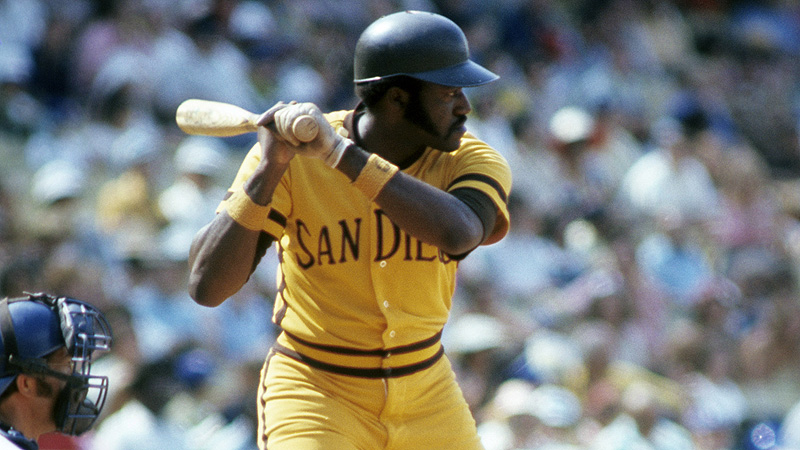
Nate Colbert of the San Diego was tagged as the Slugger of the Year which, in Houston, is recognized as the Eddie Dyer Award. Colbert had 38 HR and 111 RBI in 1972 in support of his deservedness.

WILBUR WOOD 1973 WINNER DICKIE KERR AWARD

WILBUR WOOD
1973 WINNER
DICKIE KERR AWARD

Wilbur Wood, of the Chicago White Sox was named as Pitcher of the Year and received the Dickie Kerr Award as his testimony. Wood’s 1972 AL record included 24 wins, 17 losses, and an ERA of 2.51.

CARLTON FISK 1973 WINNER JOHNNY KEANE AWARD

CARLTON FISK
1973 WINNER
JOHNNY KEANE AWARD

Carlton Fisk of the Boston Red Sox took the Johnny Keane Award – Fisk was the American League Rookie of the Year in 1972 and a member of the AL All Star team. He batted .298 with 22 HR, posted a slugging average of .538 and was a defensive standout in the field to justify all of his honors.

TOM GORMAN 1973 WINNER BILL KLEM AWARD

TOM GORMAN
1973 WINNER
BILL KLEM AWARD

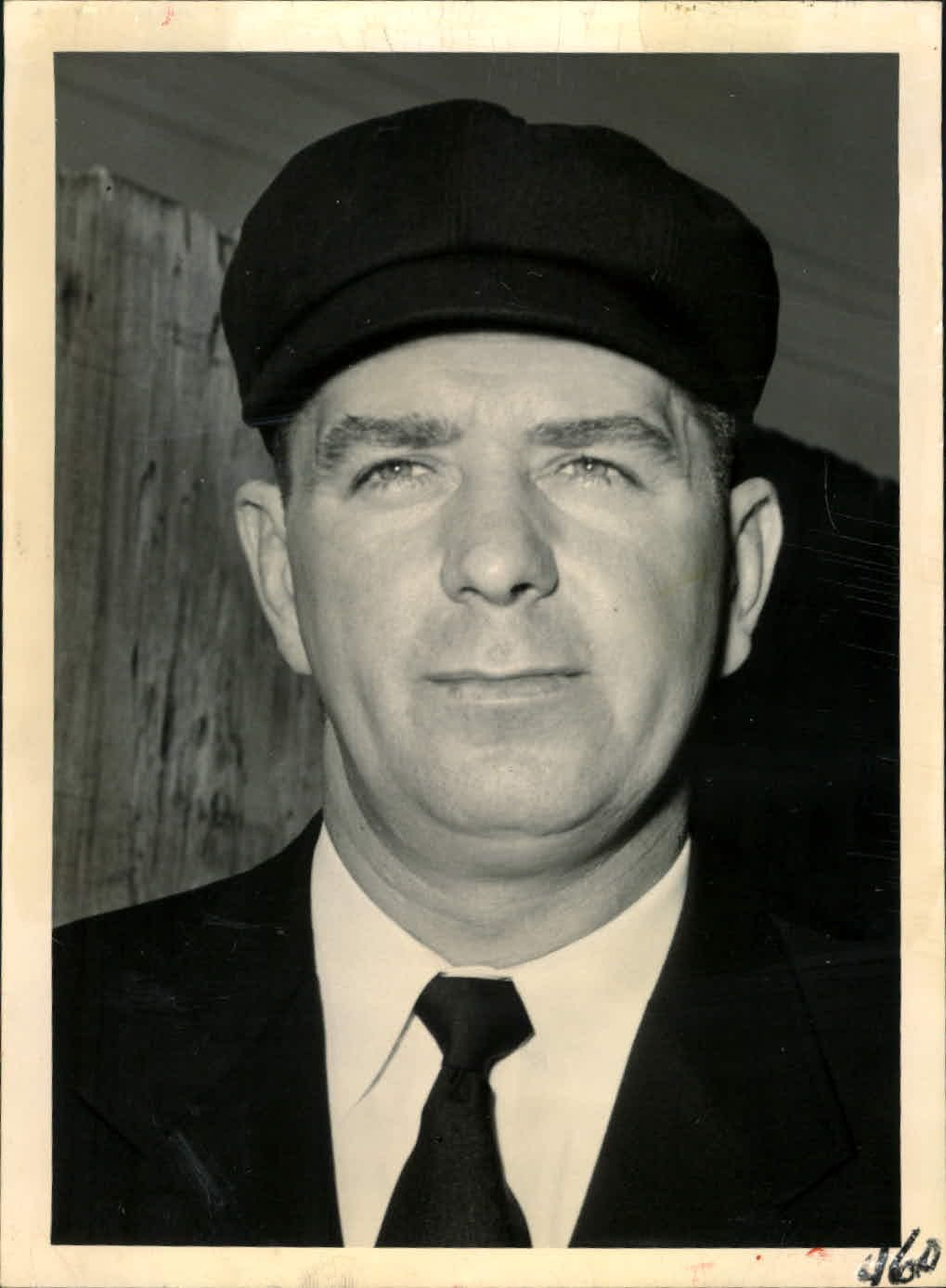
Tom Gorman received the nod from the Houston Baseball Writers as the Umpire of the Year. Taking home the Bill Klem Award Gorman had been an NL umpire since 1951 at the time of his 1973 award and would go on to finish his highly respected career after the 1976 season. Prior to umpiring, Gorman pitched five innings in four big league games for the New York Giants in 1939. Tom’s son Brian Gorman also became a big league umpire, following in his famous father’s footsteps.

ROLLIE FINGERS 1973 WINNER SPECIAL WORLD SERIES AWARD

ROLLIE FINGERS
1973 WINNER
SPECIAL WORLD SERIES AWARD

Rollie Fingers of the Oakland Athletics won the Special World Series Award. He appeared in 6 of the 7 World Series games, preserving an A’s victory over the Cincinnati Reds in Game 7 that handed the club their first World Series win since 1930 – and also the first such win since the Athletics’ move to Oakland. Rollie finished the World series a 1-1 record and 1.75 ERA, shutting down the Reds with goose eggs in their final two innings at bat.

DAVE HILTON 1973 WINNER JOE SMITH AWARD

DAVE HILTON
1973 WINNER
JIMMY DELMAR AWARD

Dave Hilton, San Diego – Texas-born minor leaguer of the year – Jimmy Delmar Award

The 13th annual Houston Baseball Writers’ Dinner was again held in the Grand Ballroom of the Astroworld Hotel.


Sources:

~ Wichita Falls Times, January 27, 1972, Pages 31, 33,

~ San Antonio Express, January 7, 1973, Page 62.

~ Denton Record Chronicle, January 14, 1973, Page 20.

~ Big Spring Herald, January 1, 1973, Page 8.

~ Baseball Reference.Com

~ Baseball Almanac.Com

~ Wikipedia

Hoffman, Rivera: Faraway Leaders in Saves

November 30, 2010

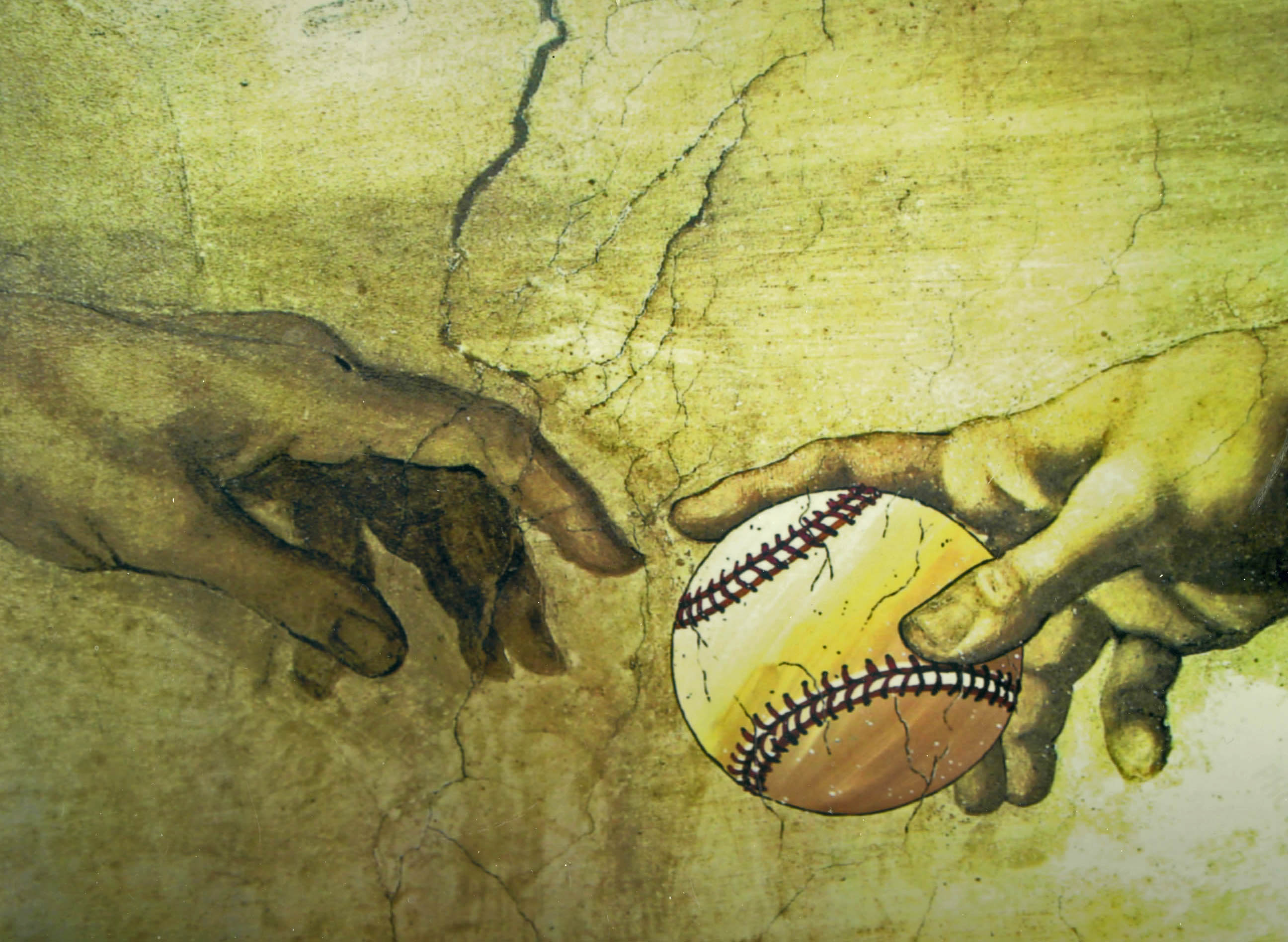
Saves are an expression of Baseball's belief in Divine Intervention.

“Saves” have been around as a recognized statistic in organized baseball since 1969. The following description from Wikipedia explains them for what they are as well as any other I have read or could write:

In baseball statistics, the term save is used to indicate the successful maintenance of a lead by a relief pitcher, usually the closer, until the end of the game. A save is a statistic credited to a relief pitcher, as set forth in Rule 10.19 of the Official Rules of Major League Baseball. That rule states the official scorer shall credit a pitcher with a save when such pitcher meets all four of the following conditions[2]:

  1. He is the finishing pitcher in a game won by his team;
  2. He is not the winning pitcher;
  3. He is credited with at least ⅓ of an inning pitched; and
  4. He satisfies one of the following conditions:
    1. He enters the game with a lead of no more than three runs and pitches for at least one inning
    2. He enters the game, regardless of the count, with the potential tying run either on baseat bat or on deck
    3. He pitches for at least three innings

If the pitcher surrenders the lead at any point, he cannot get a save, but he may be credited as the winning pitcher if his team comes back to win. No more than one save may be credited in each game.

If a relief pitcher satisfies all of the criteria for a save, except he does not finish the game, he will often be credited with a hold (which is not an officially recognized statistic by Major League Baseball).

Save rules have changed over the years; the above rules are the current as defined in Section 10.19 of Major League Baseball‘s Official Rules. The statistic was formally introduced in 1969,[1] although research has identified saves earned prior to that point.

You may also find the other information about “saves” from this page equally helpful. Just click the following link to go there:

http://en.wikipedia.org/wiki/Save_(sport)

Trevor Hoffman and Mariano Rivera, both still active, are the pulling away leaders in career saves and the just retired former Astros saves leader, Billy Wagner, places high in fifth place on the list. All three of these men are prime candidates for the Baseball Hall of Fame once they have retired and become eligible for consideration beyond the five-year retirement waiting period.

Members from the Top Twenty-One Career Saves list already inducted into the Hall of Fame include # 6 Dennis Eckersley, #10 Rollie Fingers, # 18 Goose Gossage, and # 21 Bruce Sutter.

Why certain others, notably # 3 Lee Smith or # 4 John Franco, never made it into “The Hall” with comparable or superior save totals to the others is beyond my ability to explain or defend. I will say this much: Sometimes baseball achievement is denied recognition if a player takes “too long” to do whatever it is he’s doing. At other times, however, baseball rewards players who achieve certain cumulative records over time.

On the objective side, here’s how the current leadership list stacks up through the 2010 season:

Career Leaders in Major League Baseball Pitching Saves

Player↓ Saves↓ Years(s)↓
(1)Trevor Hoffman* 601 1993–present
(2) Mariano Rivera* 559 1995–present
(3) Lee Smith 478 1980–1997
(4) John FrancoL 424 1984–2005
(5) Billy Wagner*L 422 1995–2010
(6) Dennis Eckersley 390 1975–1998
(7) Jeff Reardon 367 1979–1994
(8) Troy Percival 358 1995–2005, 2007–09
(9) Randy MyersL 347 1985–1998
(10) Rollie Fingers 341 1968–1985
(11) John Wetteland 330 1989–2000
(12) Roberto Hernández 326 1991–2007
(13) José Mesa 321 1987, 1990–2007
(14) Todd Jones 319 1993–2008
(15) Rick Aguilera 318 1985–2000
(16) Robb Nen 314 1993–2002
(17) Tom Henke 311 1982–1995
(18) Goose Gossage 310 1972–1994
(19) Jeff Montgomery 304 1987–1999
(20) Doug Jones 303 1982, 1986–2000
(21) Bruce Sutter 300 1976-1986, 1988


Who’s On First? Not Berkman!

November 29, 2010

Who's on First for the Astros? Not Lance Berkman!

Put on your “readiness to suspend belief in reality” caps and red forward.

The following interview took place last week at Minute Maid Park in Houston. It was conducted by that outspoken sportswriter of the Houston Chronicle, Edward Equity, with Ed Wade, the General Manager of the Houston Astros. The subject was “Who’s going to play first base for the Houston Astros next year? … Who? … The fellow on first base. … That’s the answer? … No, Silly, … that’s the question.”

Edward Equity: “So, Ed, if you don’t mind. Lets’ get old business out of the way first. In a word or two, can you confirm that Lance Berkman will not be returning to the club to play first base for the Astros in 2011?”

Ed Wade: “Who?”

Edward Equity: “Thanks, Ed, that’s what we all thought. So, what gives at first?”

Ed Wade: “What-Gives will start the season at Corpus Christi.”

Edward Equity: “So, who’s on first?”

Ed Wade: “Whoever seems to play it best.”

Edward Equity: “Can we take that to mean the job is wide-open?”

Ed Wade: “No, you can take that to mean that rookie Wally Whoever played first base better than anyone else in the Arizona Fall League.”

Edward Equity: So, if you give the job to Whomever …”

Ed Wade:: “We won’t give it to whomever, but we may give it to Whoever.”

Edward Equity: “Whatever.”

Ed Wade: “Whatever’s on third.”

Edward Equity: “OK, Whoever’s on first.”

Ed Wade: “Not quite. I just said he might be.”

Edward Equity: “So, Brett Wallace is not out?”

Ed Wade: “Of course he’s not Out. Out’s our new shortstop.”

Edward Equity: “No, I meant ‘not out at first’.”

Ed Wade: “He was out at first far too many times in 2010 to suit us. That’s why he’s on the bubble now for 2011.”

Edward Equity: “Listen, Ed, what I’m getting from all this is that the job at first still seems pretty much open and,  if a whomever comes along who can outplay Mr. Whoever, that the job will be the former’s to lose.”

Ed Wade: “Who?”

Edward Equity: “Whomever!”

Ed Wade: “Who died and made you the General Manager?”

Edward Equity: “Nobody, but in my own mind, I usually have all the right answers. I just seem to come by them naturally. And that’s what makes me think that good old Carlos Lee might even be the Astros’ best answer at first base in 2011.”

Ed Wade: “Must be fun being an outspoken genius!’

Edward Equity: “It sure is, Ed. It sure as heck is.”

A Houston Buffs Souvenir Mitt Mystery.

April 29, 2010

The Souvenir Buffs Mitt is About 5″ Tall. When was it sold at Buff Stadium?

Yesterday an acquaintance got in touch with me about a souvenir Houston Buffs catcher’s mitt he had just acquired from another collector. This person is a solid Houston Buffs and City of Houston history fan, but he wishes to remain anonymous in this matter that he now shares with everybody else. The question we both have is: When, if ever, was this little (pictured above) item sold at Buff Stadium?  My own guesses are only speculative.

I never saw anything along the line of souvenir gloves for sale at Buff Stadium during the Post World II Era. I recall a few miniature bats and pennants for sale, but I never acquired anything like that as a kid. We weren’t thinking about souvenirs when we went to Buff Stadium back in my day and it’s just as well. Remember what I’ve written here many times over. We played in the sandlot with baseballs held together by electrical tape. There was no money for thinking about souvenirs.

Besides, the style of the glove looks older to me, like something from the early 30s. That sort of works against the idea that souvenirs could have been very appealing to the average Buffs Baseball fans of Houston during the Great Depression Era, but who knows? Maybe they were. We simply lack the proof that this item ever sold at Buff Stadium during any period, in spite of what it says broad as all daylight on the souvenir glove itself. I personally believe that it was once a Buff Stadium souvenir. I just can’t prove it.

Fred Ankenman served as President of the Houston Buffs from 1925 through 1942, the beginning of the World War II Texas League shutdown. Allen Russell took over as President of the Buffs in 1946 and served through 1952. I’m fairly convinced that the souvenir glove in question sold at Buff Stadium somewhere during one of these two periods. It’s too antiquated to have sold beyond the Russell Era – and it’s simply a little impractical to think it sold earlier at West End Park. Buff Stadium didn’t open until 1928.

The back side of the souvenir glove appears to have once been stuck to something.

My friend and I both observed that the marketing decision to actually write the word “souvenir” on the mitt seems a little primitive and unsophisticated by today’s marketing standards, but a lot of items could be judged that way in comparison to the promotion of uniform replica and game-authentic sale of ballpark material in 2010. We have to remember that game replica jerseys and caps have only been around as sales items to fans since the early 1980s. (We sold an authentic game jersey to fans at the University of Houston in 1979, but that’s a much longer story about what probably was the first sale of game-style apparel items to the general  public in America.)

The buffalo figure is remindful of the logo used during the late 20s and early 30s.

If you ever saw this featured Buffs item for sale at Buff Stadium, or if you have any of your own theories on when it might have appeared there, please post them below as comments on this article. Like so many other artifacts of baseball history, the Houston Buffs souvenir mitt comes to light raising more questions than it answers.

Hopefully, it will someday find its way into proper public exhibition and not just get stuck in someone else’s attic or closet for another sixty or seventy years.

Cold Case: Who Killed Eddie Gaedel?

April 25, 2010

August 19, 1951: St. Louis Browns Manager Zack Taylor Ties Eddie Gaedel's Right Baseball Shoe..

The story of Eddie Gaedel’s one-time at bat as the only midget pinch hitter in big league history back on August 19, 1951 is one of baseball’s biggest travelers. We talked about it here yesterday.

A much less popular subject is the death of Eddie Gaedel nearly ten years later on June 18, 1961 in Chicago. Eddie’s mom found him dead in bed in his apartment on that date. He had a bruise and cuts near his left eye and bruises and cuts on his knees. The coroner’s report concluded that Eddie had died of a heart attack, probably caused by the trauma of physical assault upon his body in physical combat with an unknown other or others. The only fact ascertained by the police in their brief look at the case was that Eddie Gaedel may have gone to a nearby bowling alley the previous evening where he may have had too much to drink and may have either gotten into an argument at the alley or encountered an assailant on his walk home. From what I can tell, there was no real evaluation performed on Eddie’s blood contents in the sketchy post-mortem that followed. Almost everything about his death had been concluded by the Chicago police from Eddie Gaedel’s reputation as a heavy drinker and combative personality.

Since money was missing, the CPD concluded that Eddie Gaedel had been attacked and robbed, but that he was able to make it home before collapsing and dying. The “evidence” of missing money is not spelled out as a missing wallet, nor do the CPD reports jump out and say how they knew how much cash Eddie had on him in the first place.

Because of his “reputation,” the Chicago Police Department declined to investigate the death of Eddie Gaedel any further.

What? …. What?

Since when is “reputation” grounds for letting someone go off to eternity without justice while some other guilty person gets off Scott-Free of murder? Eddie Gaedel died 49 years ago this summer. It’s wholly conceivable that his murderer is still out there in the bleachers during a White Sox or Cubs games in 2010. He or she wouldn’t be particularly conscious by this late time in life, but how alert do you need to be to keep going to baseball games as a Chicago fan on either side of town in 2010?

The point here is simple: Someone got away with murder in the Case of Eddie Gaedel and that’s too bad.

The Ballad of Eddie Gaedel.

April 24, 2010

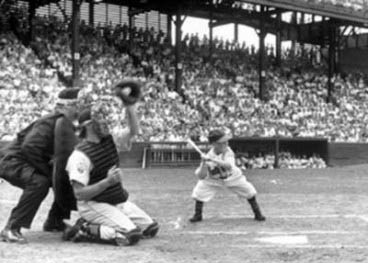
Eddie Gaedel, At Bat for the Browns Against Bob Cain of the Tigers, Sportsman's Park, St. Louis, August 19, 1951. The Catcher is Bob Swift; the Umpire is Ed Hurly.

It was a one-time practical joke and publicity stunt from the ever-mischievous-making mind of Browns owner Bill Veeck, but it looms in baseball history as big or bigger than Babe Ruth calling his home run shot in the 1932 World Series because of its shock value to the usual baseball norm and the picture that resides here with this article.

Frank Saucier, 1950.

Midgets simply don’t play major league baseball, except for this one incident of contractually legal entry into a game as a first inning pinch hitter by Eddie Gaedel, batting for the Browns’ rookie leadoff man and center fielder, Frank Saucier. Many say the episode ruined Frank Saucier for major league ball. He had led the Texas League in 1950 with a .343 batting average for the playoff champion 1950 San Antonio Missions, but he was gone from baseball after the Gaedel stunt due to the ego blow he suffered deeply on that fateful day in Sportsman’s Park, August 19, 1951. No matter how Bill Veeck and the Browns explained it later to Saucier, he apparently took it personally. After a 1 for 14 times at bat experience in 18 games for the 1951 Browns, Frank Saucier left baseball for good at season’s end. That .071 final batting average for season in limited action may have helped him close the door.

At any rate, little 3’7″ Eddie Gaedel finished his one time at bat history in the big leagues with a walk to first on four pitches from Detroit Tiger pitcher Bob Cain and then trotted down to first and into the history books. Gaedel supposedly batted under threat from owner Bill Veeck: “I’ll be on the roof with a rifle. If you take one swing, I’ll shoot you dead.”

Once he reached first, Browns manager sent outfielder Jim Delsing out to pinch run. “My surprise came after I reached the bag to take over for Gaedel,” the late Delsing once told me.  “Before Gaedel left the field, he patted me on the butt and wished me luck.”

Well, the Browns went on to eventually lose this game by a score of 6-2, but they imbedded the idea of this possibility coming up again into the minds of a baseball nation. the fantasy was short-lived. Baseball quickly acted to ban midgets and dwarfs from playing big league ball. We can’t be sure how that kind of ruling would fly in the 21st century. There are a lot of people out there now looking after the rights of vertically challenged people. All we need now is for one very short Mickey Mantle type to come screaming onto the scene, demanding the restoration of opportunity. I’d be all for him or her.

In the meanwhile, I’ll close here with a little tribute parody I wrote a few years back to honor the memory of Veeck’s man back in 1951. “The Ballad of Eddie Gaedel” is sung to the tune of “Rudolph the Red-Nosed Reindeer” and it is intended as a tribute to one of the few men in history who ever retired from baseball with a perfect one base percentage of 1.000.

The Ballad of Eddie Gaedel
(All verse stanzas are in regular shade type and are sung to the main tune of “Rudolph, The Red-Nosed Reindeer.” The two chorus stanzas, shown in bold type, are sung to the chorus tune from “Rudolph” that goes with “Then one foggy Christmas Eve, Santa came to say, etc.”)

by Bill McCurdy, 1999.

Bill Veeck, the Brownie owner,
Wore some very shiny clothes!
And if you saw his sport shirt,
You would even say, “It glows!”

All of the other owners,
Used to laugh and call him names!
They wouldn’t let poor Bill Veeck,
Join in any owner games!

(chorus)
Then one humid summer day,
Bill Veeck had to – fidget!
Got an idea that stirred his soul,
He decided to sign a – midget!

His name was Eddie Gae-del,
He was only three feet tall!
He never played much baseball,
He was always just too small!

(chorus)
Then one day in Sportsman’s Park,
Eddie went to bat!
Took four balls and walked to first,
Then retired – just-like-that!

Oh, how the purists hated,
Adding little Eddie’s name,
To the big book of records,
“Gaedel” bore a blush of shame!

Now when you look up records,
Look up Eddie’s O.B.P.!
It reads a cool One Thousand,
Safe for all eternity.

"Have a Nice Weekend, Everybody!" - Eddie Gaedel.

Johnny Keane: A Manager for (Almost) All Seasons.

October 22, 2009


Born November 3, 1911 in St. Louis, Johnny Keane accepted his first minor league managerial job just prior to the start of World War I. – No, wait! – It wasn’t really that early. It just Johnny Keane 02 seems that way. His 17-year minor league playing career (1930-41, 1946-48) as a pretty good hitting middle infielder, however, quickly revealed an even greater talent for leadership. At age 26, Keane was awarded his first managerial assignment from the parent Cardinals as Manager of the Class D Albany, Georgia Travelers. Johnny promptly rewarded the Rickey organization’s judgment of him by reeling off two consecutive first place league pennant winners in Albany in both 1938 and 1939.

Over the course of his 17 seasons as a manager in the St. Louis Cardinals minor league system (1938-41, 1946-58), Keane won 4 league championships and lost 8 other playoff appearances.  He had a losing record in only 5 seasons. His winning touch in the minors (1,357 wins, 1,166 losses) finally won him a place on the coaching staff of the Major league Cardinals in 1959, where he remained until he replaced Solly Hemus as manager on July 6, 1961. It is a note of irony that Solly Hemus had first played for Johnny Keane when the latter led the 1947 Houston Buffs to the Texas League title and Dixies Series championship.

In Johnny Keane’s fourth year at the Cardinal helm, he came under fire as the Cardinals seemed to be fading in the stretch of the 1964 National League pennant race. It soon became the worst kept secret in town that the club planned to bury Keane’s St. Louis managerial career at year’s end.

A funny thing happened on the way to the funeral.

With some considerable help from Phillies manager Gene Mauch and his misuse of pitchers, the NL’s 1st place Philadelphia club pulled the arguably biggest el foldo job in history over the last two weeks as the Cardinals got hot neough to catch them at the wire for the National League pennant. Now the talk of firing Keane went dark as he then led the club to an exciting seven-game World Series victory in 1964 over the fabled frequent Big Show flying New York Yankees.

Now, before Cardinals owner August Busch could disengage his foot from the brake pedal on a policy reversal and offer Keane a new contract extention with the Cardinals, the New York Yankees and Johnny Keane had a notice of their own, one that called for a quick media conference.  The Yankees announced that they were firing Yogi Berra and hiring Johnny Keane as their new manager for 1965.

I suppose Keane found some revenge for the Cardinals’ lack of faith in him through this move, but further validation of his abilities as a mentor would be unavailable in New York. The talent bank at New York was pretty much bankrupt by 1965 as the once great Mickey Mantle played out in emptiness the four bad last seasons of his career. They were the years that never should have been. All Mantle did from 1965 to 1968 was roughly drop his career batting average below .300 lifetime while adding a few meaningless home runs to his already assured Hall of Fame career, but Keane would not be around long enough to see even half of that period of demise.

After leading the Yankees to a 77-85 record and 6th place finish in 1965, Keane and the Yankees got off to a horrendous 4-16 start in 1966, prompting yet another exercise in the Yankees’ quick trigger finger response policy. On May 7, 1966, the Yankess fired Johnny Keane, replacing him with former Yankee manager Ralph Houk.

Johnny Keane’s managerial record had come to an end at sge 54. He went back to his home in Houston  and private business, but that didn’t last long. On January 6, 1967, Johnny Keane suddenly passed away from a heart condition at age 55. Whoa again! Less than three years after winning the National League Manager of the Year Award, Johnny Keane was gone.

Johnny Keane was loved by the old time baseball community members in Houston who remembered him as either a fellow player or manager. I use the past tense here because most of those who remember Johnny Keane are also now gone. He was a long-time winner with a quick and fast memory for what appeared to him as acts of short term, underhanded disloyalty.

As a manager, Johnny Keane did the five things that I think any winning manager must do: (1) he was a good judge of talent; (2) he managed his pitchers well; (3) he treated his players with respect; (4) he publicly covered for his players; and (5) he took responsiiblity for the outcome of his own decisions. He apparently did not, however, adjust to the change in cultures he experienced when he moved from the Cardinals to the Yankees. As a disciplinarian, his style worked with Cardinal youngesters and veterans there who knew him well. When he moved to New York, however, the proud Yankees did not like the little man who apparently came there to tell the proud Yankees what to do. The Yankees read his authoritative style as disrepect for their proud heritage and ability. Going from the laid-back style of Yankee legend Yogi Berra to the more militant mode of outsider Keane didn’t help matters either. Besides, many of the Yankees felt that Yogi had gotten a raw deal in the post-1964 World Series firing and weren’t about to be open to taking on the man who had defeated them as the Cardinal mentor. As a result, Johnny Keane either never had or quickly lost control of the Yankees in 1965. There was no way that the situation could hold up for a second full year after the club’s horrible 1966 start.

Johnny Keane’s signature was one of the few autographs I ever collected directly as a kid. It was about 1950 and Keane was actually playing in one of those post-season “All Star Games” that President Allen Russell liked to stage at Buff Stadium. Keane and some of his random teammates were having a beer in the clubhouse at game’s end when they opened the door for us kids to greet the players coming out. All I had was a scoring pencil so I grabed a loose paper cup and tore it open flat for Johhny to sign, which he did. – Wish today I had saved it. I used to think back in 1947 that Johnny Keane was the smartest man in the world and, who knows, maybe he was.

Johnny Keane had an ancient Buffs connection. He played a few games for the 1934 Buffs, then returned for three full seasons as a player from 1935-37, batting .265, .272, and and .267. He even had a few times at bat during his three (1946-48) managerial years with the Buffs. Somewhere along the way, Johnny Keane fell in love with Houston and made it his adopted home town – and I’m glad he did. I just wish he could’ve hung around longer, but it was not to be.

Jerry Witte’s Last Ballgame.

September 30, 2009

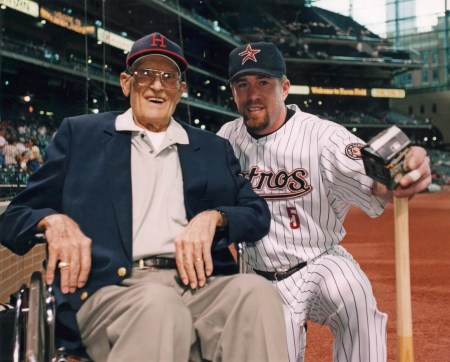
JW 2001 11A few years ago now, my best friend and all time greatest baseball hero got to throw out the first pitch at an Astros game in the place we now call Minute Maid Park. The date was Friday, August 3, 2001. My late friend and hero was a fellow named Jerry Witte.

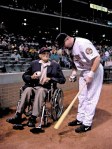
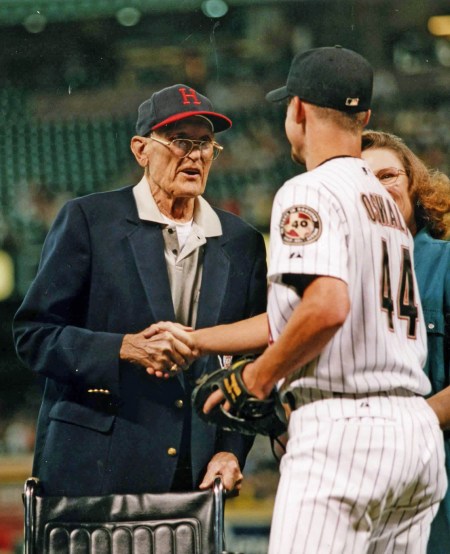
The actual game that night wasn’t exactly one for the ages, but Houston won over the Montreal Expos, 6-2, behind the pitching of Shane Reynolds, a 2 for 4 night by Jeff Bagwell, and a rare homer by Brad Ausmus. The victory bumped the Astros record to 60-49, something that always feels great late in the year of another season bound for nowhere, but the real story that night was Jerry Witte and his meetings prior to the game with Astros players Jeff Bagwell and Roy Oswalt.

As one of the people allowed on the field that evening to accompany Jerry and do a little photography, I also walked into the privilege of witneessing the first class treatment that both players and the entire Astros administrative staff all extended to the aging slugger of a Houstons Buffs team that played ball in this town a half century earlier. In fact, the big scoreboard even introduced Jerry as “the slugging firstbaseman of the 1951 Texas League Champion Houston Buffs.” How cool was that!

Most of all, the background on what led to this special evening is important to the story too. Jerry had lost his dear wife of 54 years, Mary, to cancer only two months earlier on June 10, 2001. He had been going downhill in spirit ever since, in spite of all that his devoted seven daughters and all of us other friends could do to help him rally.

With the help of Astros Vice President Rob Matwick, we were able to line up the special night for Jerry to throw out the ceremonial frst pitch. Jerry still lived in his East End Houston home, the same one in which he and Mary had raised their family, but he had never seen a game at the new Enron Field.

Jerry’s first reaction was hesitation. “I’m 86 years old,” he exclaimed. “An old bird like me’s got no place on the field anymore!”

JW 2001 07JW 2001 09JW 2001 08

JW 2001 01

Jerry soon turned around to support the idea once he grasped that the Astros simply wanted to honor him with Jeff Bagwell as two slugging first basemen from Houston who played the position fifty years apart. Jerry insisted that he wanted to give Bagwell one of his 40 ounce bats for that special occasion – and he also wanted to get in some practice throwing the ball before he took the mound. For the next three weeks prior to “the fist pitch night,” I would go to Jerry’s house and work out as his catcher. At the end of this period, I asked him to sign the ball we had used. He signed it, “To Bill, My Catcher.” I will treasure that ball forever.

On the night of “the first pitch,” Jeff Bagwell came over down on the field and presented Jerry with a signed baseball for his use in the ceremony. Jeff was magnificent, referring to Jerry as “Mr. Witte” all the time. In turn, Jerry surprised Jeff Bagwell wth his gift of the big Witte model Louisville Slugger.  Jeff beamed in awe at the weight of the thing. and he said something about how he might have trouble getting it off his shoulder in time to catch up with a fastball, but that he did have a place of honor for it at home.

For about five minutes, the two sluggers of yesterday and today talked baseball together in quiet repose prior to the game: Jerry in his wheelchair; Jeff squatting to eye level with Jerry. In that brief moment of time, it felt as though the whole of Houston’s professional baseball history, from Babies to Buffs to Colt .45s to Astros, had been joined together forever on sacred ground.

JW 2001 04

When Jerry finally made the first pitch, he did it with unintentional dramatic flair. Using a wheel chair in place of  a walker, he actually rode to the mound behind a son-in-law, Ken Katzen. He was also accompanied there by his oldest daughter, Mary Ann Crumbaugh, a registered nurse. Jerry could walk just fine, but, of course, few in the crowd knew that fact when they saw him being wheeled onto the field. It was a moment simply born in destiny as a stage for magical impression.

Once he reached the mound, Jerry began to stir, pulling himself up from the chair, and all the while motioning away leaning offers for help from anyone. The crowd roared. Jerry then walked slowly to the back of the chair to position himself for the throw – and the crowd roared even louder. Now everyone was on their feet. Jerry then matter of factly removed the ball from his coat side pocket and heaved it into his catcher, a role now played by a young rookie Astros pitcher named Roy Oswalt. The crowd gave it up for Jerry Witte with a “Standing O.”

JW 2001 05

The brief dialogue between Jerry Witte and his “game catcher,” Roy Oswalt, said it all about the old Buff’s next encounter with the Astros’ personal respect for him on that night of long ago:

Jerry Witte: “Young man, where did you learn how to throw a baseball so well?”

Roy Oswalt: “My daddy taught me, sir.”

Jerry Witte: “Well, you tell him for me that I think he did a great job of raising you, both as a good pitcher and a fine young man.”

Roy Oswalt: “Thank you, sir. I’ll tell him, sir.”

JW 2001 12

Jerry stayed for the whole game. We’d had plenty of discussion earlier about leaving anytime he felt tired and wanted to go home, but that didn’t happen. Once Jerry settled into the ballgame, he wanted to stay til the end. Along the way, he even caught a foul ball and gave it to a little girl who was sitting nearby. The little girl then asked Jerry to sign the ball for her – and that pleased him immensely.

It turned out to be Jerry Witte’s last ballgame. He passed away on April 28, 2002 at the age of nearly 87, surrounded by all his daughters, sons-in-laws, grandchildren, and good friends. All of us who were there at the ballpark on August 3, 2001 will never forget the joy of that moment in the days of a man who lived his life so fully, so well, and so always lovingly.

JW 2001 06

Godspeed, Jerry! Just know that all of us from your old gang who remain in the game down here are still trying to play it out as best you taught us. Anytime that any of us are facing a tough choice about anything really important, we also know that you’re still sitting there next to us on the bench,  in full spirit, reminding us to just gut it through – whatever it is – and do the next right thing – whatever that may be – while we trust the rest to God.

Thank you for just being you – and for  staying here with us physically for as long as you were able. We love you, and Mary too, and we always will. – Jerry, I never met anyone who embodied the spirits of love and baseball together anymore than you. And I guess that’s possible because those two spirits are actually pretty darn close to being one and the same in some of us horsehided soul people.

Allen Russell: The Believable Barnum and Bailey of Buffs Baseball!

September 12, 2009

Marr WIcker Hawn That’s Houston Buffs President Allen Russell in the business suit and hat at the far left of today’s featured first photo. He’s showing some kind of report in early 1950 to St. Louis Cardinal coaches Runt Marr (next to Russell) and Freddy Hawn (far right). That’s Kemp Wicker, the first of two managers who commanded the Good Ship Buffalo at the start of the ’50 season wearing the “Houston” jersey. Little Benny Borgmann would soon replace Wicker and manage the Buffs for most of their ride into the Texas League cellar that most inglorious year, but that kind of field performance disaster never stopped Allen Russell. It simply provided a different kind of marketing challenge.
Bill Veeck wasn’t the only organized baseball promoter who would try almost anything that worked to draw fans to the ballpark. He was just the most creatively famous owner/president to do it – and he also did it at the major league level. Allen Russell could hold his own with just about anybody in baseball when it came down to bodacious ingenuity – and the 1950 season provided him with one of his brightest and coolest moments of gate-rattling chutzpah – and Allen wasn’t even Jewish!

Late in the 1950 season, when it became apparent that the Buffs had been shortchanged on the minor league talent distribution by the parent Cardinals that year, Russell decided he needed to do something unique in the interest of pumping the gate a little bit on the way to a crippled attendance finish. What he chose to do wasn’t totally unique. The rival Fort  Worth Cats had tried it briefly in 1949, but Russell forged onward, anyway, after talking his club into going along with the gimmick. The Buffs said “OK”, but they gave their consent to the plan with some considerable reservation.

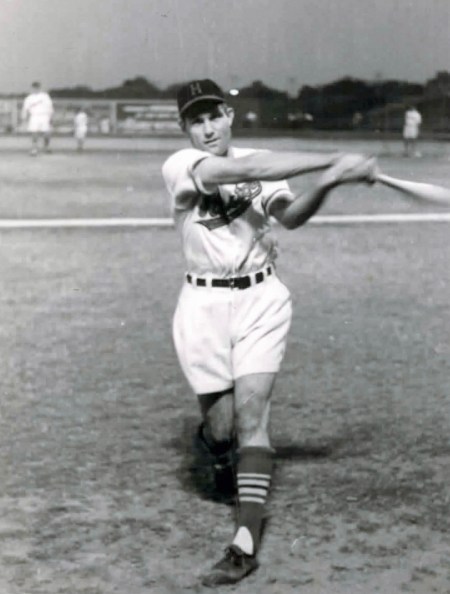
Jerry Witte in ShortsAs modeled in the photo by the Buffs’ sluggung first baseman Jerry Witte, the Buffs agreed to wear shorts, as I also covered in a recent article. The ostensible reason given for this change was that the Buffs wanted to do all they could to make sure their players were made as comfortable as possible in the searing, humid Houston summer heat.
A lot of fans weren’t concerned with the comfort problems of a team that was already well on its comfortable way to a dead last finish, but that was not Russell’s concern. If he couldn’t give them winning baseball without the Cardinal home club’s help, he could at least provide the fans with something with the gawk-value of grown men playing baseball in short pants, that a fan had to buy a ticket to see.

“Players who aren’t comfortable losing should either find a way to win or be given a ticket down to Class A Omaha!” was a fairly typical conservative fan attitude, but that didn’t stop the short pants experiment.

The blousy short pants created a short term curiosity spike in attendance, but that thrill soon wore thin. Fans don’t like watching losers and short pants don’t make it more OK in the long run. Besides, the players hated the extra easy mosquito bites and sliding strawberry wounds they were getting from the goofy looking sawed-off uniform pants. Seeing all these things for himself, Allen Russell soon restored the Buffs to regular long pants before season’s end – and the Buffs marched on to a last place finish like real men.

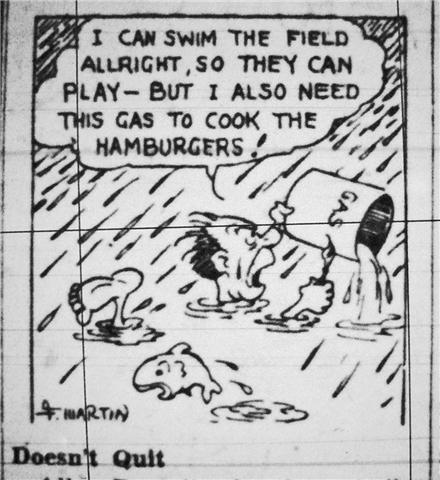
During his eight seasons as Buffs President (1946-53), Allen Russell was largely responsible for a major growth in attendance at Buff Stadium for Houston Buff Texas Leaue games. Throw in the extra facts that this was arguably the halcyon era of baseball game attendance popularity. From 1946 through about 1953, the year that TV and a diversification of other leisure time interests pretty much changed everything  – baseball held the stage for a bull market run at new attendance records. All a city needed was a promoter like Allen Russell to make it happen – and easy access to the ballpark. Houston built their first freeway right past Buff Stadium in 1948 and the old ballpark was still very accessible to the bus lines and middle class neighborhoods that surrounded the place. Russell took advantage of every break that swung his way – and he also  pretty much declared war on rain-outs and the loss of income they produced. Russell would get out there on the field himself and pour gasoline into all standing waters on the infield and then set it on fire. He would literally burn the water off the field before he ever called a game because of rain. If he could’ve stopped the rain from ever falling on game days with a little voodoo ceremony, he probably woul d have done that too.

Allen Russell & Rain In 1946, the year that Russell took over as Buffs President, the Buffs drew 161,000 fans and the major league St. Louis Browns drew 526,000. The very next year, 1947, the Buffs outdrew the Browns by 326,000 to 282,000. By 1948, the Buffs again won the gate battle, 401,000 to 336,000. The Browns edged a bad Buffs team in 1949 by 271,000 to 254,000, but an 8th places Buffs club in 1950 still edged a 7th place Browns club by 256.000 to 247,000. The Buffs won again in 1951 by 333,000 ro 294,000 By 1952, St. Louis was reaping the benefits of Bill Veeck’s second year at the Browns helm. The Browns outdrew the Buffs by 519,000 to 195,000 in 1952 – and they edged them again in 1953, the last year of the Browns, by a 297,000 to 204,000 count.
In spite of the lapses in his twofinal  Buff seasons, Russell had made his point before leaving Houston to take over running the nearby Beaumont Exporters. The St. Louis Cardinals even considered moving to Houston prior to the 1953 season because of some serious ownership problems, but that possibility was quashed by the purchase of the club by August Busch and the Budweiser Beer Company.

After 1953, it would be the Browns who moved from St. Louis, but that relocation would not be to Houston. It would be to Baltimore. Still, Allen Russell supplied the original rachet for others who would now pursue major league baseball for Houston with great passion and political savvy. They would succeed seven years later when Houston was awarded an expansion club franchise in 1960 to start playing in 1962.

Now we just need to make sure we remember the man who made it all possible. His name was Allen Russell and, as far as I’m concerned, he’s also the real father of major league baseball in Houston.


********************

Bill McCurdy

Principal Writer, Editor, Publisher

The Pecan Park Eagle