The Tootsie Roll Game: May 4, 1975
By Maxwell Kates
PROLOGUE
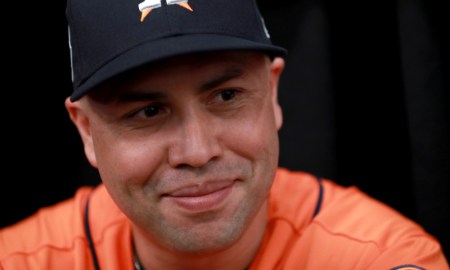
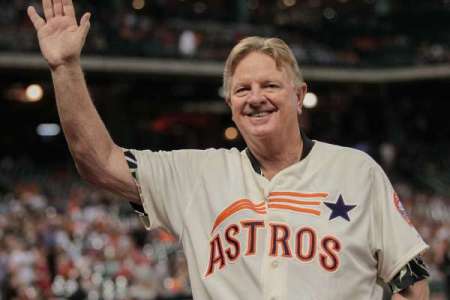
First, a trivia question, courtesy of former Los Angeles Dodger Wes Parker. Who was the only #8 hitter (as of 2011) to win a Most Valuable Player Award? Maybe this photo can offer a clue.
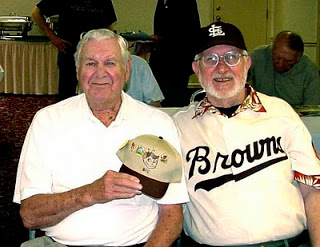
Who Dat Above? ~ Above, I Say!
Just Two Peeps ~ On a Baseball Day!
The genesis of this article arose from a conversation I had with Bill McCurdy earlier in the year. He asked me to prepare an essay about episodes in Astros history where the players crossed paths twice. For example, the first pitch in Colt .45’s history was thrown on April 10, 1962 by starting pitcher Bobby Shantz to Chicago Cubs’ leadoff hitter Lou Brock. Two years later, on June 15, 1964, the two were traded for one another. Moving ahead to Game 4 of the 1980 National League Championship Series, there was a collision at home plate in which Philadelphia’s Pete Rose bowled over catcher Bruce Bochy of the Astros. Five years later, on September 11, 1985, when Rose broke (*) Ty Cobb’s record with his 4,192nd hit in Cincinnati, catching for the visiting San Diego Padres was none other than Bruce Bochy. In the name of factual accuracy, it should be pointed out that two of Cobb’s hits have since been erased from the record book, meaning that Rose actually broke the record on September 8, 1985 in Chicago with his 4,190th hit. But that’s not important right now.
Research the Astros’ history book, I attempted in vain to find other instances in franchise history where the protagonists would cross paths at a later date. J. D. Davis tightening up on his swing as Archie Bell and the Drells performed at Discovery Green? I don’t think so. Then a lightbulb went off. Fantastic, Holmes! I remembered the name…Bob Watson.
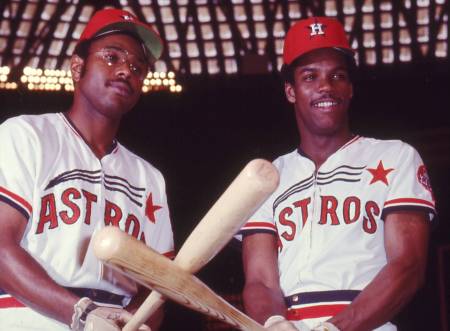
Bob Watson and Cesar Cedeno, 1973.
Until John Olerud matched his record in 2001, Watson was the only player in major league history to have hit for the cycle in either league. He turned the trick for the Astros on June 24, 1977 in a 6-5 victory over the San Francisco Giants. Traded to the Boston Red Sox in 1979, he repeated his accomplishment, hitting for the cycle against the Orioles as part of a 10-2 victory in Baltimore. Could there possibly have been someone other than Watson who was present for both games? Reading further, I discovered another footnote to history involving Watson in 1975 when he played for Houston. Both games were against the Giants.
During the 1974-1975 offseason, Connecticut newscaster Mark Sackler uncovered that 997,513 runs had scored in major league history. Using his new calculator and his MacMillan baseball Encyclopedia, Sackler projected that the millionth run would score sometime in 1975. Tootsie Roll Industries saw enough value in the promotion to sponsor a sweepstakes. Fans were invited to predict who would score the millionth run in baseball, along with when and where. The winner would take home $10,000. Ultimately, Seiko was roped in to co-sponsor the promotion as baseball luminaries Stan Musial, Ernie Banks, and Ralph Branca were called upon for public relations purposes. There was a countdown clock in every ballpark and a mission control centre in Rockefeller Center, New York as telephone spotters were on hand to call in every home run.
Now I realize that Bill McCurdy has already written about this topic in a 2011 issue of the Pecan Park Eagle in his article “An Evening with Bob Watson.” While the focus of the previous article was about the SABR meeting itself, this one will focus on the game in which the run was scored.
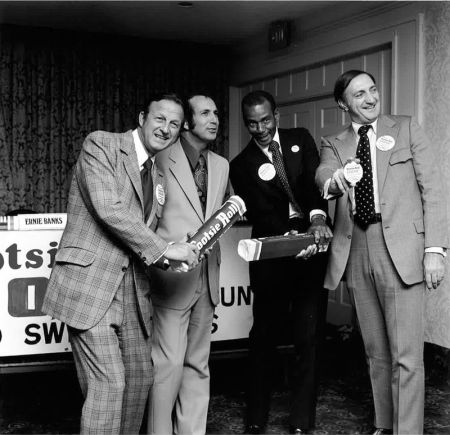
Stan Musial, Johnny Bench(?), Ernie Banks, and Ralph Branca. Person in Above Photo,
Article Addendum on the Identity Question of 2nd Figure from Left,
In Above Photo, Submitted by Article Writer Maxwell Kates, 12/10/18:
“I submitted the Tootsie Roll photo to a website called “Vintage Baseball Photos” to determine who that is between Stan Musial and Ernie Banks. The general consensus is that it’s not Bench. Some of the guesses (all of them wrong, presumably) include Mel Brooks, Pete Townsend, Garry Shandling, Herb Alpert, Nick Buoniconti, Bob Sakamano from Seinfeld, Garo Ypremian, and Chevy Chase. This is what I call fun when it comes to baseball research.” ~ Maxwell Kates, writer.
“It also may be a text book example of what happens to people among the “almost famous” group from an earlier time-limited era. People later may scramble to remember from a single photo who the heck they actually were in the long ago and faraway once-upon-a-time land from whence they came.” ~ Bill McCurdy, Editor, The Pecan Park Eagle.
******************************
Robert Jose Watson was born in 1946 in Los Angeles. Watson signed his first minor league contract with the Astros in January 1965, earning a promotion to Houston a year later. He became a regular in 1971 after switching from catcher to left field and later played 1st base. A right-handed power hitter whose aggregate was impeded by the cavernous dimensions of the Astrodome, Watson batted .303 with 122 home runs and 690 RBI in eight full seasons with the Astros. He was selected to his first of two All-Star Games in 1973
Manager Preston Gomez pencilled Watson in as the starting 1st baseman in the first game of a doubleheader on May 4, 1975. Only 9,451 spectators braved the Candlestick Park weather conditions, which remained inhospitable weather after rain curtailed the contest one day prior. Dave Roberts took the starting assignment for the Astros, facing eventual Rookie of the Year John ‘Count’ Montefusco.

A Typical Candlestick Fan Face on a Normal Windy Day?
Half a continent away in Chicago, future Astros’ manager Phil Garner rapped a double off the White Sox’ Jim Kaat in the top of the 5th inning. At 2:26 pm Central Time, Claudell Washington scored home from 1st base for run number 999,999. The next run would be the milestone but who would score it? Would it be Rod Carew? He too was thrown out in a collision at home plate by Al Cowens of the Kansas City Royals. Adding insult to injury – quite literally – the future Hall of Fame injured his leg on the play. Six minutes had passed and nobody had scored the run. Would it be Chris Chambliss? He took off from 3rd base in Milwaukee when Yankee teammate Ron Blomberg rapped a base hit to 1st baseman George Scott. The Boomer decided to go for the lead runner, throwing Chambliss out at the plate.
“We were hoping it would be us,” remembers Marty Appel, then director of public relations for the Yankees. “We weren’t winning pennants then and it would have been a nice moment.” Back in San Francisco, Watson led off the 2nd inning by drawing a walk against Montefusco. He stole second before the Count issued a second base on balls to Jose Cruz. Little did Watson know that he may have been standing 180 feet from immortality as Milt May strode to the plate.
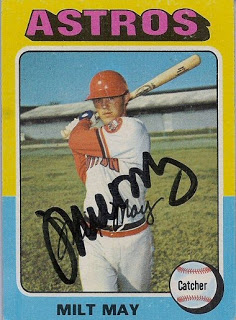
Oakland Had Mr. October. ~ Houston Had Mr. May.
According to Sackler’s research, Wes Fisler of the Philadelphia Athletics scored the first run in major league history on April 22, 1876. Now, as May lifted Montefusco’s pitch into the fog and filthy air before landing in the empty Candlestick Park bleachers, Watson was poised to score baseball’s millionth run. Not so fast, Roll N Roaster. With nobody out in the 5th inning, Atlanta’s Phil Niekro surrendered a home run to Dave Concepcion in Cincinnati. Could the lumbering Watson score from 2nd base in the time it would have taken the limber Concepcion to circle the bases? Living up to his nickname, Watson rounded 3rd and headed for home like a bull in a china shop.
“I got to third,” Watson told Anthony McCarron of the New York Daily News, “and our bullpen was right behind third and the guys were saying ‘Run, run, run!'” On the Cincinnati Astroturf before a packed house, Concepcion was running the bases at full steam, but to no avail. He was rounding 3rd as mission control ruled that Watson’s foot had touched home plate. Depending on the source, Concepcion was anywhere from twelve seconds (Dan Epstein) to a second and a half (Bill McCurdy) short.
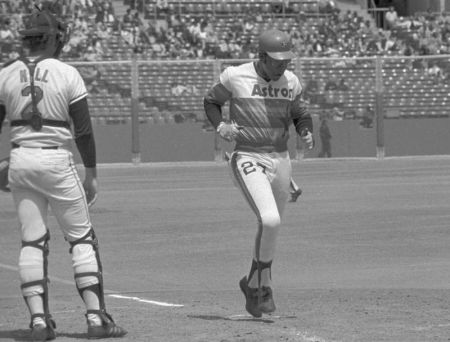
Bob Watson Scores the Millionth Run in Baseball History.
For scoring the millionth run in baseball, Watson was awarded one million Tootsie Rolls. As it were Watson’s children were allergic to chocolate so he donated his prize to charity. Since nobody guessed the correct answer in the sweepstakes, he was also given the $10,000 grand prize. There was a catch. The money was denominated in pennies, so he donated those to charity as well. As least Watson got a nice watch out of the promotion. In the aftermath of scoring the millionth run, Watson joked that his fan mail doubled – from four letters per week to eight.
It should be stated that Sackler did not count the National Association, the Federal League, or any of the other ‘third’ major leagues. Therefore, Watson did not actually score the millionth run and it may never be determined who did.
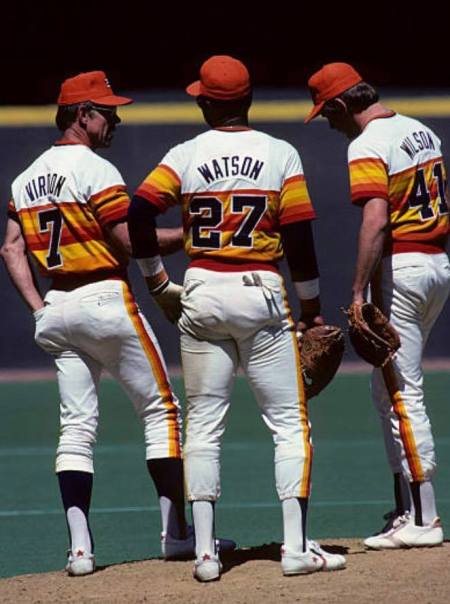
Bob Watson, Bill Virdon and Gary Wilson, 1979.
Watson remained an Astro until his 1979 trade to Boston and filed for free agency at the end of the season. He played another five years with the Yankees and the Braves, retiring as a player in 1984. Watson was appointed general manager of the Astros in 1994, only the second African-American after Atlanta’s Bill Lucas. Also in 1994, Watson was diagnosed with prostate cancer before undergoing successful treatment. In 1996, he left the Astros to become general manager of the New York Yankees, overseeing their first World Series championship since 1978. Watson retired from his position as a Major League Baseball executive in 2010.
For the record, five Giants, Marc Hill, Gary Lavelle, Randy Moffitt (’82 Astros), Derrel Thomas (’71 Astros), and Gary Thomasson, who played in the game Watson scored baseball’s millionth run also took the field the day Watson hit for the cycle. Hill was actually catching the Giants both for the millionth run and the home run of Watson’s cycle. And no player on either team for Watson’s cycle with the Astros appeared in the game when he hit for the cycle with the Red Sox.
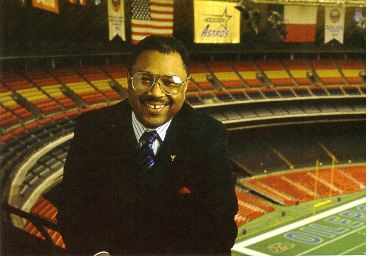
Bob Watson as the Astros General Manager, 1994.
*********************************
Bill McCurdy
Principal Writer, Editor, Publisher
The Pecan Park Eagle





 Houston, Baseball, & Other Musings.
 The Pecan Park Eagle