
‘HEY! IF I WALK THIS RUN HOME, DON’T CHARGE ME WITH NO ERROR! – GIVE THE ERROR TO THE MANAGER WHO PUT ME IN THE GAME IN THE FIRST PLACE!” ~ WILL FERRELL
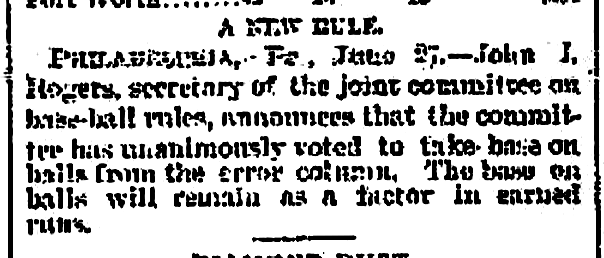
Galveston Daily News
June 28, 1888
Submitted by Research Associate Darrell Pittman
______________________________
(STORY CLIP RECAP): A NEW RULE
Philadelphia, Pa., June 27. – John J. Rogers, secretary pf the tthe joint committee on base-ball rules, announces that the committee has unanimously voted to take base on balls from the error column. The base on balls will remain as a factor in earned runs.
~ Galveston Daily News, June 28, 1888
______________________________
It’s an old winnable argument that we cannot fairly or accurately compare players from one generation to another based upon statistical performances due to changes in the rules that have governed the playing of the game differently from one era to another – and with no no worse examples than any comparison from recent years to the performances of players from the 19th century – when many of the rules were really quite different.
Today’s note on an 1888 rules change on the scoring of walks thatnoted in the Galveston Daily News on June 28th of that year is an excellent case-making example.
Can you imagine a pitcher today with control problems being charged errors for every walk? If the rules governing runs that score after an inning should have ended applied back in early 1888, a wild pitcher could have built a terrible fielding average, but also complied an E.R.A. approaching 0.00 with a landslide of his own B.O.B./errors opening the door for every run that scored would be correctly noted after three walks as “unearned”. Or something like that!
Wonder how they scored “intentional walks” back in 1887, if, indeed, they even engaged in that kind of intellectual mentoring of the game back in the day. If they did, (tongue in check here), would an intellectual walk have been charged to the pitcher as an error, but then reassigned to the manager s an error, if the strategy didn’t work out?
Lucky for those of us living in 2015, the rules governing baseball work pretty darn well today, don’t you think? Now, if we could only reach a universal agreement on the DH rule – and resolve how much scratching and wedgy-rearrangement time batters and pitchers need between pitches, everything might move even closer to Norman Rockwell perfect.
GO ASTROS! BEAT THE YANKEES!

Tags: baseball rule changes make stat comparions over time impossible
 The Pecan Park Eagle
June 26, 2015 at 4:53 pm |
I think a pitcher’s fielding error should count as an earned run. If the pitcher sails his throw over the first baseman’s head I see no reason why the runner who reaches base on that error should not count as an earned run if he eventually scores.